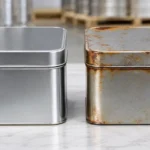
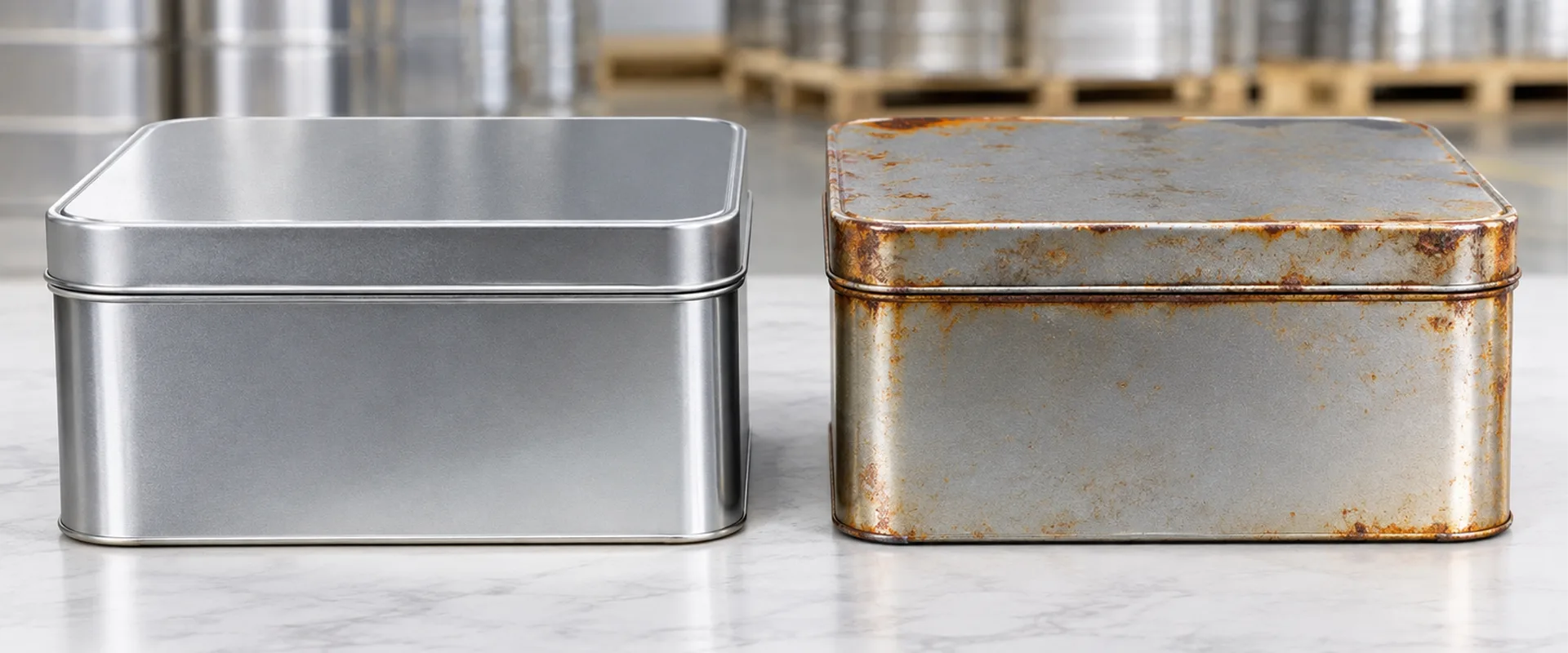
Rust is one of the most common complaints in overseas orders, and tin packaging rust prevention starts before the cartons are loaded. A buyer opens a carton after a long sea shipment and finds orange spots along the lid edge, a hinge that has stained, or a faint haze under the varnish. The tin may have passed inspection at the factory, so the buyer is left asking where the problem started.
In most cases the answer is not a single cause. Corrosion in tin packaging depends on the tinplate, the coating system, the forming and cutting process, the packing method, and the humidity the cartons are exposed to between the factory and the shelf.
This guide to tin packaging rust prevention explains how corrosion starts on tinplate containers, which areas are most at risk, how coatings and process controls reduce the risk, and what a buyer should specify before production.
Table of Contents
Why Do Tin Boxes Rust and What Causes Corrosion on Tin Packaging
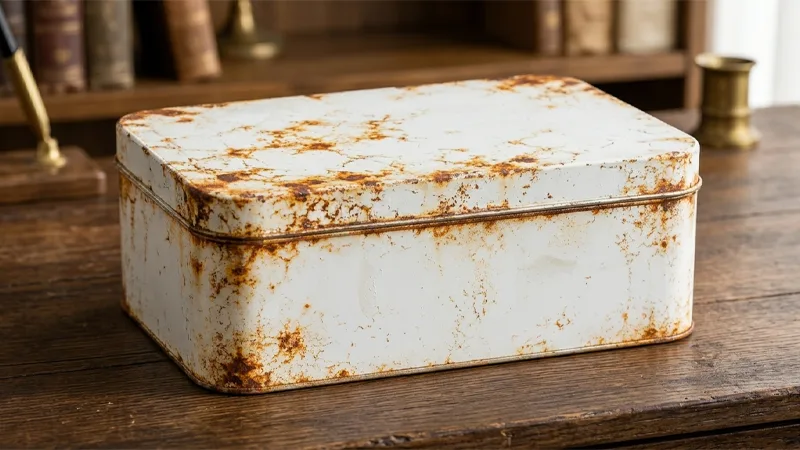
Tinplate is a thin steel sheet with a metallic tin layer on both sides. The tin layer is much thinner than the steel, and the steel is the part that rusts. Rust forms when exposed steel is in contact with oxygen and moisture, so the question is always how moisture reaches the steel.
Tin itself does not rust, which leads to a common misunderstanding. A tin box is not rust-proof because it carries a tin layer. The tin layer, the passivation treatment on top of it, and the lacquer or ink system above that work together as a barrier. When the barrier is broken or incomplete, the steel beneath can corrode.
In ordinary atmospheric conditions the tin layer protects mainly as a barrier. It does not reliably protect exposed steel at a scratch in the way a sacrificial coating would. A scratch that goes through the tin and the coating can therefore start a rust spot, and the spot can spread under the surrounding film.
The main factors are:
- Moisture: High relative humidity, condensation, and wet cartons.
- Coating gaps: Bare edges, thin coating areas, and scratches.
- Contamination: Salt residue, fingerprints, oil, and dust that hold moisture on the surface.
- Mechanical damage: Dents, rubbing during transport, and abrasion at hinges.
- Corrosive contents: Products that contain water, acids, or salts.
Where Rust Starts on Tin Box Lids, Edges, Hinges, and Seams
Corrosion rarely starts in the middle of a printed panel. It usually starts at places where the coating is thin, interrupted, or stressed by forming.
| Location | Why it is at risk | Typical appearance |
|---|---|---|
| Cut edges | Steel is exposed when sheets are cut after coating or printing | Thin orange line along the edge |
| Lid curl and body curl | Metal is stretched and bent, and the coating can thin or crack | Spots on the rim |
| Seams and joints | Overlaps and folds trap moisture | Staining along the seam |
| Hinge and hinge pin | Moving parts, abrasion, and sometimes uncoated metal parts | Brown staining near the hinge |
| Drawn corners | High deformation can crack the coating | Small pits at corners |
| Scratches from stacking | Tins rub against each other in cartons | Linear rust marks |
| Inside the base | Product contact or residual moisture | Spots or a metallic odor |
The forming steps that stress the coating are described in Tin Packaging Forming Processes, and the way seams affect sealing and leakage is covered in Tin Packaging Seams and Joints. Both affect corrosion because they determine where the coating can be damaged.
Tinplate Coating Systems That Prevent Rust on Tin Boxes
Corrosion protection is built in layers. Each layer has a different job.
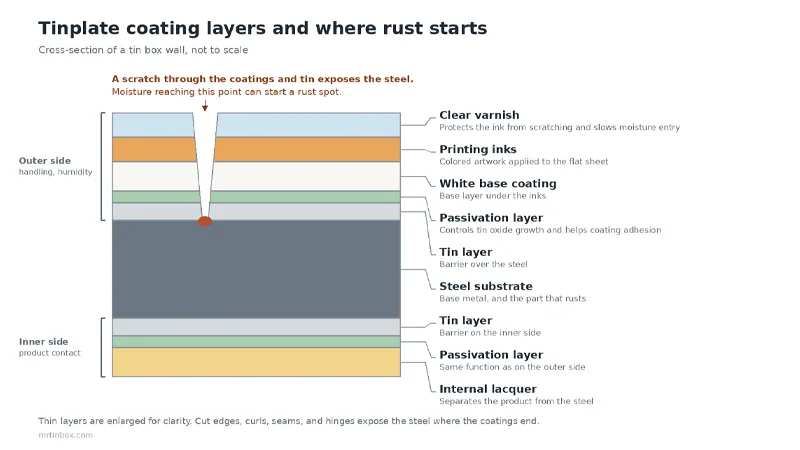
Tin Layer and Passivation on Tinplate
The tinplate mill applies the tin layer and a thin passivation treatment on its surface. The tin coating weight is specified by grade, and heavier coatings give a thicker barrier. Passivation controls the growth of tin oxide on the surface, which would otherwise weaken lacquer adhesion, as explained in a tinplate datasheet from Tata Steel. Chromium-based passivation has long been the standard, and European mills have developed a chromium-free alternative, described in ArcelorMittal’s packaging steel update. The passivation used depends on the mill and the destination market, so a buyer with specific requirements should ask for it in the specification.
White Base Coating and Printing Inks on Tin Boxes
Most printed tins receive a white base coating, then the colored inks, then a clear varnish. These layers add barrier protection, but they are applied to flat sheets. They do not automatically cover the cut edges or the areas that are later formed. Color control on this stage is discussed in Tin Box Printing Color Consistency.
Outer Varnish for Scratch and Moisture Resistance
A clear varnish over the print protects the ink from scratching and slows moisture entry. Gloss, matte, and textured varnishes can behave differently under abrasion, so the finish should be tested on the real tin shape, not only on a flat panel.
Internal Lacquer and Food Contact Tin Box Coatings
When a tin holds food, cosmetics, or other products that touch the inner wall, an internal lacquer separates the product from the steel. The coating must suit the product and the regulations of the destination market. In the European Union, food contact materials fall under Regulation (EC) No 1935/2004, which requires them to be safe and not to change the food in an unacceptable way. Food contact coatings and migration are covered in Food Grade Tin Packaging. Some products, such as container candles and solid balms, are often packed in unlined tins, which is acceptable when the product is not corrosive and the choice is agreed in advance.
Manufacturing Controls for Tin Packaging Rust Prevention
A coating system can still fail if the process leaves weak points. The following controls support tin packaging rust prevention at the factory.
- Incoming material inspection: Check the tinplate grade, coating weight, surface condition, and storage condition of the coils or sheets. Sheets stored in damp conditions can already carry oxidation before printing.
- Cleanliness before coating: Oil and dust on the sheet weaken adhesion.
- Complete curing: Under-cured inks and varnishes can stay soft, scratch easily, and allow moisture entry.
- Edge protection: Where cut edges will be visible or exposed to moisture, the process may include edge lacquer, or the design may fold or hide the edge. This should be agreed during structural design.
- Tool condition: Worn or burred tooling can scrape the coating during forming. The effect is explained in Tin Packaging Tool Wear.
- Handling: Operators and packers should avoid bare-hand contact on finished surfaces where possible, since fingerprints can leave salts that hold moisture.
- Drying before packing: Tins that were washed, wet-tested, or stored in humid areas should be fully dry before they are packed.
General process steps from material preparation to final inspection are summarized in Tin Packaging Production Process Control, and common forming defects that damage coatings are listed in Tin Packaging Defects. Buyers who want to check these controls at the supplier can use the criteria in What B2B Buyers Expect from Metal Packaging Audits.
How to Prevent Tin Boxes from Rusting During Shipping and Storage
Many rust complaints begin after the tins leave the factory. A sealed shipping container can reach high humidity inside, and temperature changes during a voyage can cause condensation on the carton ceiling and on the cargo. Moisture that forms in this way is often called container rain. The UK P&I Club’s cargo guidance explains that cargo adjusts to changing temperatures more slowly than the container walls and air, which creates the temperature differences behind condensation. It advises separating cargo from container walls and floors with dunnage, and warns against plastic sheets laid over cargo, because condensation can form between the sheet and the goods. The same logic applies to sealed plastic around damp tins.
Factors to control for tin packaging rust prevention during transport include:
- Carton and pallet moisture: Paperboard absorbs and releases water. Cartons stored in a damp warehouse before packing can add moisture to the load.
- Inner packaging: Individual wraps, bags, or partitions reduce rubbing and can slow moisture contact. Plastic bags that trap moisture around a damp tin can make the problem worse, so tins must be dry when sealed.
- Desiccant: Desiccant packs or strips in cartons or in the container can lower humidity during transit. The amount depends on the route, the season, and the carton volume.
- Stacking and cushioning: Rubbing between tins damages the varnish and creates scratch points. Packing design is covered in Custom Tin Box Packaging for Shipping and Damage Prevention.
- Storage at the destination: Buyers should store tin cartons off the floor, away from exterior walls and water sources, in a space with stable temperature and moderate humidity. A common guideline is to keep relative humidity below about 60 percent, though the right level depends on the coating and the product.
- Time in storage: Long storage of empty tins increases exposure. If an order will be stored for months, mention it in the specification so that the packing method can be adjusted.
Why Tin Boxes Rust Inside When the Product Causes Corrosion
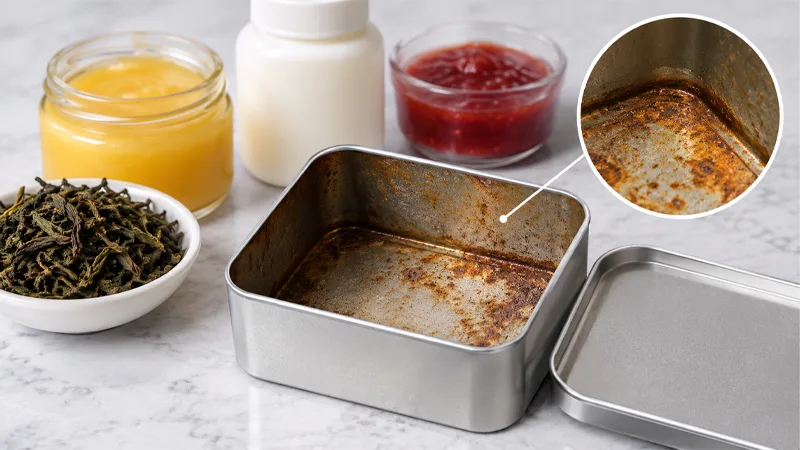
Corrosion can also start from the inside. Products that contain water, acids, salts, or reactive ingredients can attack the inner wall if the coating is thin, cracked, or incompatible.
Examples include moist food products, water-based cosmetics, products with essential oils or acidic ingredients, and products that release moisture after filling. A coating that works well for dry tea may not be suitable for a wet or acidic formulation.
Before choosing the internal finish, the manufacturer should know the product type, water content or acidity, filling temperature, and expected shelf life. Barrier design for dry goods such as tea, coffee, and spices is described in Tin Packaging Barrier Performance, and sealing validation for airtight tins is covered in Hermetic Metal Packaging for Tea and Coffee. If the product is a balm or salve, see Salve Tins for the usual packaging choices.
It is also advisable to run a compatibility test with the real product, stored in the real tin for a defined period, before approving mass production.
Salt Spray and Humidity Tests for Tin Box Corrosion Resistance
Corrosion testing shows how a coating system behaves under controlled conditions. The neutral salt spray method in ISO 9227is used to find pores and other coating defects. The standard does not intend it to rank materials or predict long-term corrosion life, and testing equipment maker Q-Lab notes that it does not necessarily correlate well with real outdoor conditions. For tins that spend weeks in damp transit, a condensation test such as ISO 6270-2 is often closer to real exposure, although that standard leaves the test duration and the assessment of results to the parties.
| Test | What it checks | Notes |
|---|---|---|
| Neutral salt spray (ISO 9227, ASTM B117) | Resistance to salt-laden moisture | Checks coating continuity and batch consistency; not a prediction of service life |
| Humidity or condensation chamber (for example ISO 6270-2) | Resistance to high humidity and condensation | Closer to shipping and warehouse exposure |
| Coating adhesion test (cross-cut or tape) | Whether the coating stays attached after forming | Check on formed areas, not only flat sheet |
| Scratch or abrasion test | Resistance of the varnish to rubbing | Relevant for stacked tins |
| Product compatibility test | Reaction between product and inner wall | Run with the real product |
| Visual inspection of edges, curls, and hinges | Early signs of rust at risk points | Include in batch inspection |
The test method, the duration, and the acceptance criteria should be agreed in writing before production. A statement such as “no rust” is difficult to verify unless it states where the tin is inspected, under what lighting, and after what exposure. General inspection and validation steps are listed in Tin Packaging Testing and Validation.
Tin Box Specification Checklist for Rust Prevention
The following information helps the manufacturer select materials and packing methods for tin packaging rust prevention.
| Requirement | Information to provide |
|---|---|
| Destination and climate | Country, port, and whether the climate is humid or coastal |
| Shipping route and duration | Sea or air freight, expected transit time, and season |
| Storage time | How long the empty tins will be stored before filling |
| Product | Type, form, water content, acidity, and filling temperature |
| Internal coating | Bare, lacquered, or food contact coating, and the applicable regulation |
| Exterior finish | Varnish type, emboss or deboss areas, and special effects |
| Metal parts | Hinge pin, buttons, and inserts, with material and coating if known |
| Edge treatment | Whether cut edges or curls need extra protection |
| Packing method | Inner wraps, partitions, desiccant, and pallet wrapping |
| Test and acceptance | Test method, duration, inspection points, and defect limits |
| Quantity | Order quantity and expected repeat volume |
Sending this list with the request helps the manufacturer decide whether the standard coating system is enough or a modified one is needed. Technical items for quotations are listed in Custom Tin Packaging RFQ: Technical Requirements for Quotation, cost factors are discussed in Custom Tin Box MOQ and Pricing Factors, and the wider production brief is described in Defining Tin Packaging Requirements for Production.
Common Tin Box Rust Problems and How to Fix Them
Rust on Tin Box Edges After Sea Shipping
This usually comes from exposed steel at cut edges combined with moisture during transit. The fix may include edge protection at the factory, desiccant in the carton, and drier packing conditions.
Rust on Tin Box Hinges
Hinges involve friction, small parts, and sometimes uncoated pins. The material and coating of the hinge parts should be confirmed, and the hinge should be checked after repeated opening cycles. See Hinged Tin Boxes Design and Durability Testing.
Rust Spots and Bubbles Under the Varnish
Small blisters or threads under the film can show that moisture reached the steel through a flaw and spread beneath the coating. The cause may be contamination before coating, incomplete curing, or damage during forming.
Scratch Rust from Stacking in Cartons
Tins that rub inside a carton can lose varnish and then rust at the scratch. Partitioning or inner wraps reduce this.
Rust Inside a Tin Box
This can come from an unsuitable internal coating, a product with high moisture, or a damaged lacquer layer. A compatibility test with the product is a direct check.
Cosmetic Rust vs Functional Rust on Tin Packaging
Light surface marks on an outer edge are a cosmetic defect. Pitting that goes through the wall, or rust that contaminates the product, is a functional defect. The acceptance criteria should say which level is allowed.
Final Thoughts on Tin Packaging Rust Prevention
Rust on a tin box is rarely random, and tin packaging rust prevention starts from that fact from the fact that rust on a tin box is rarely random. It follows exposed edges, damaged coatings, moisture in transit, and poor storage. A tin that meets its coating specification can still show corrosion if it is packed damp or stored in a humid room.
Buyers can reduce the risk by describing the shipping route, storage time, and product at the start of the project, by agreeing on coating and edge treatment, and by setting test methods and acceptance limits in writing. Manufacturers can reduce it by controlling coating quality, protecting exposed edges, keeping tooling in good condition, and packing the finished tins dry. A pre-production sample tested against the agreed criteria, as described in From Tin Packaging Prototype to Mass Production, helps confirm that mass production matches what was approved.
FAQ
Do tin boxes rust, and is tinplate rust proof?
The tin layer does not rust, but the steel under it can. If the tin and coating layers are broken or incomplete, moisture can reach the steel and cause rust.
Why do new tin boxes arrive with rust spots after shipping?
The most common causes are moisture during sea transport, exposed cut edges, scratches from rubbing in cartons, and tins packed before they were fully dry.
Are aluminum tins better than tinplate for rust resistance?
Aluminum does not rust like steel, but it has other trade-offs in cost, strength, and forming. A comparison is given in Aluminum Tins vs Tinplate Tins.
Does an inner lacquer stop a tin box from rusting inside?
Not always. The lacquer must suit the product and cover the formed areas without cracks. Wet, acidic, or salty products may need a specific coating and a compatibility test.
Is a salt spray test enough to prove a tin box will not rust?
No. Salt spray mainly checks coating continuity and batch consistency, not real-world service life. Humidity tests, real packing trials, and inspection of edges and hinges are also needed.