

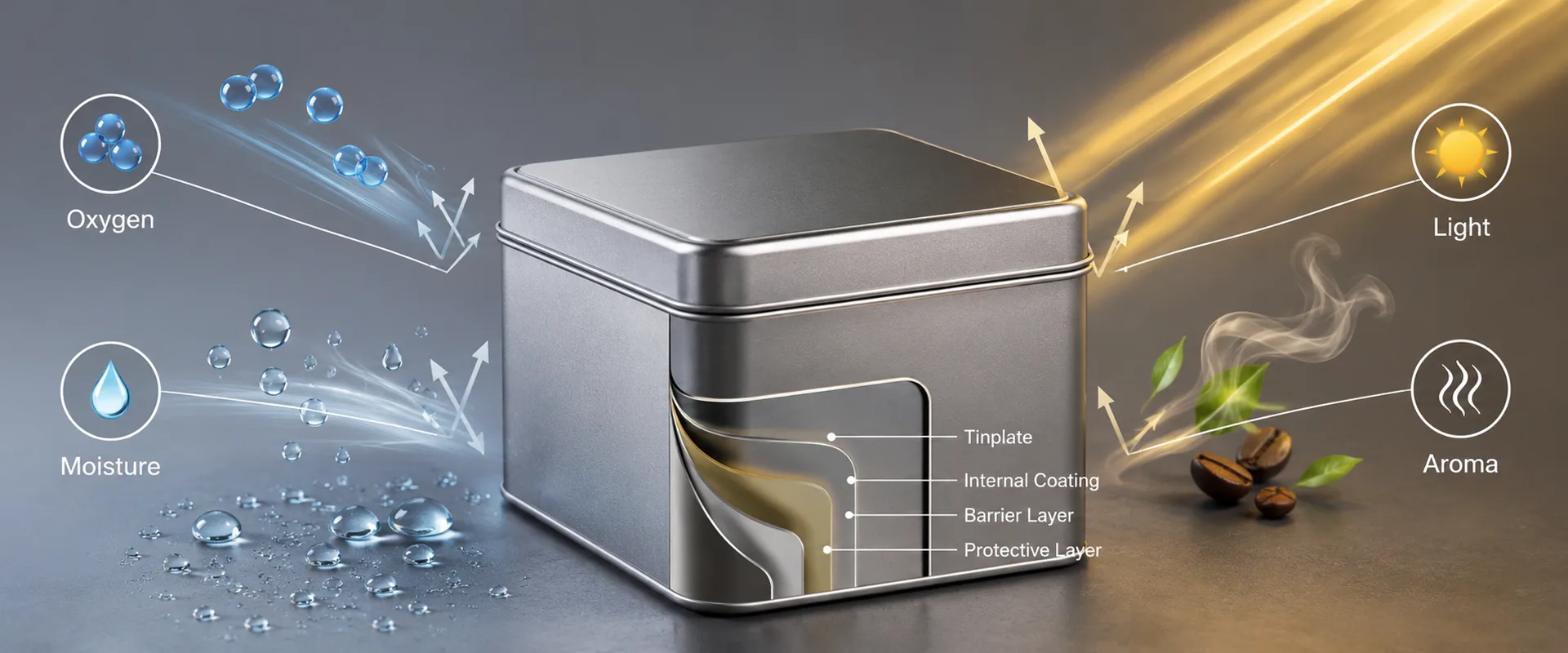

Tin packaging barrier performance depends on the complete packaging structure rather than the metal body alone. For tea, coffee, spices, cookies, confectionery, and other dry food products, the finished package consists of the tinplate substrate, internal coating, lid-to-body interface, gasket or liner, secondary seal where applicable, and the conditions under which the package is stored and opened.
For tea and coffee packaging, the main barrier requirements generally involve moisture, oxygen, light, and aroma. These requirements are related but should be evaluated separately because each one is affected by different parts of the package. The metal body provides an opaque structure and has very low permeability to gases and water vapor. The closure, however, introduces an interface that can influence the actual barrier performance of the assembled package.
This distinction is important when evaluating tin packaging barrier properties. The permeability of the metal substrate does not by itself define the barrier performance of a finished tin box. Lid geometry, gasket compression, liner construction, seams, secondary seals, and the condition of the formed container can all influence the final result.
For tea packaging, moisture and aroma retention are often important considerations. For coffee packaging, oxygen exposure and carbon dioxide release after roasting also need to be considered. The appropriate packaging structure therefore depends on the food product, contact conditions, storage duration, and closure design.
Table of Contents
Tin Packaging Barrier Properties
Metal as a Barrier Material
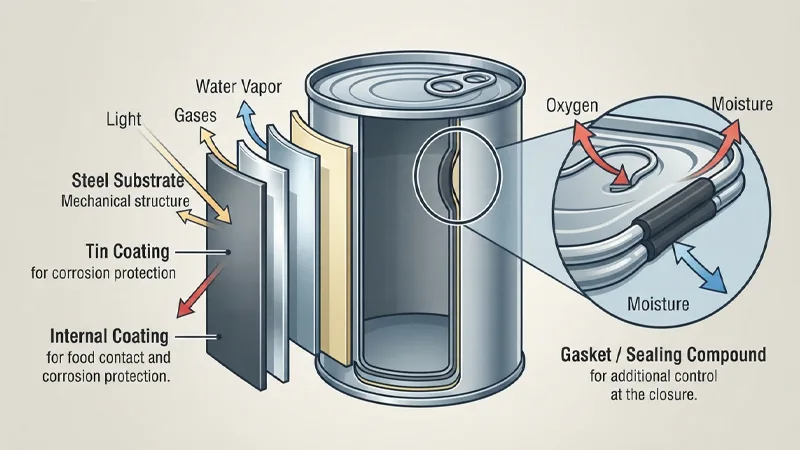
Tinplate consists of a steel substrate with a tin coating. The steel provides the mechanical structure of the container, while the tin layer contributes to corrosion protection. An internal coating can then provide a controlled food-contact surface between the product and the metal substrate.
The barrier function of the finished tin package can therefore be divided according to the role of each component. The metal body provides the primary barrier against light and has very low permeability to gases and water vapor. The internal coating primarily addresses food contact and corrosion protection. The lid-to-body interface controls the opening of the container and can influence air and moisture exchange. A gasket, liner, or secondary seal can provide additional control at the closure.
This means that tin packaging barrier performance should be considered as a system.
Material Barrier and Finished-Package Barrier
A flat tinplate sheet and a completed tin container do not represent the same testing condition.
The flat sheet does not contain a lid-to-body interface, gasket, closure clearance, or formed geometry. After stamping, drawing, curling, and assembly, the finished container contains several interfaces where gas or moisture exchange can occur.
For this reason, a metal body can have a low permeability while the finished container still has measurable leakage or moisture ingress.
The relevant engineering question is therefore not simply whether tinplate is an effective barrier material. It is whether the complete tin packaging structure maintains the required barrier performance under the intended storage and handling conditions.
Tin Packaging Oxygen Barrier
Tin packaging oxygen barrier performance is relevant when oxygen exposure can affect the packaged product.
Oxygen can participate in oxidation reactions and can contribute to changes in flavor, aroma, color, and storage stability. The effect depends on the product composition and storage conditions.
Oxygen Exposure in Tea Packaging
For tea, oxygen exposure can affect the product during extended storage. The degree of sensitivity depends on the tea type, processing condition, moisture content, packaging configuration, and storage environment.
A metal body provides a low-permeability barrier, but the closure remains an important part of the system. If the lid-to-body interface does not maintain the intended contact condition, external air can enter even though the metal wall itself has very low gas permeability.
Repeated opening introduces another mechanism. Each opening replaces part of the internal headspace with surrounding air. Consequently, the oxygen condition inside a tea tin is affected not only by the initial package seal but also by how the container is used after opening.
Oxygen Exposure in Coffee Packaging
Coffee packaging involves an additional gas-management issue. Roasted coffee continues to release carbon dioxide after roasting, and the rate of release changes with time, roast condition, grinding, and storage temperature.
The package therefore has two separate requirements. The first is to limit external oxygen ingress. The second is to provide a means of managing internally generated carbon dioxide where necessary.
These functions should not be confused.
A package can restrict external air exchange while still requiring pressure management because of CO₂ generated by the coffee. When a one-way degassing valve is used, its function is to allow internal CO₂ to escape while limiting the entry of external air.
The valve is therefore part of the gas-management system, while the metal body and closure provide the main package barrier.
Oxygen Barrier and Closure Design
The oxygen barrier of a finished tin container depends partly on the relationship between the lid and body.
For a friction-fit closure, the lid diameter, body diameter, curl geometry, clearance, and contact length determine how the two components interact. For a gasketed closure, the sealing condition additionally depends on gasket material, geometry, and compression.
A dimensional change that appears small in the metal components can change the contact condition of the closure. This is why dimensional control and barrier performance should be considered together during package development.
Tin Packaging Moisture Barrier
Tin packaging moisture barrier performance is important for products that can absorb water vapor from the surrounding environment.
Tea, coffee, cookies, confectionery, powders, and spices can respond to moisture exposure in different ways. Moisture uptake can affect texture, aroma, chemical stability, and storage life.
Moisture Barrier of the Metal Body
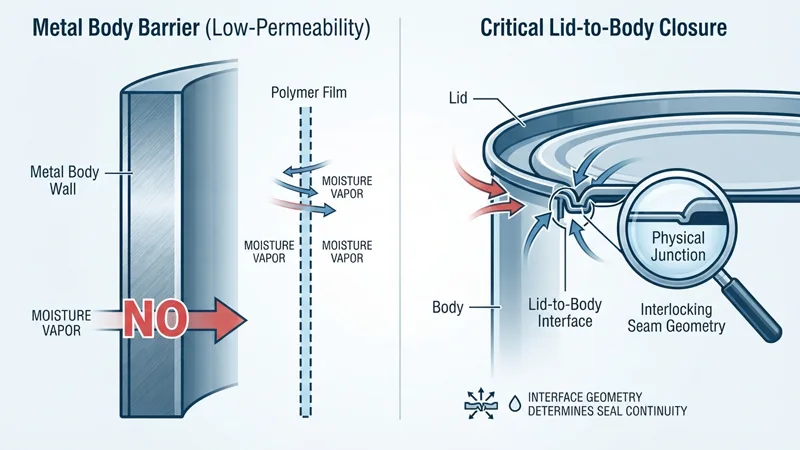
The metal body itself provides a low-permeability structure against water vapor. In a correctly formed container, moisture does not normally pass through the metal wall in the same way that it can pass through polymer film.
The closure therefore becomes an important consideration.
At the lid-to-body interface, the package contains a physical junction rather than a continuous metal wall. The geometry of this junction determines how the lid contacts the body and whether a continuous sealing condition is established.
Moisture Ingress Through the Closure
A slip-lid or friction-fit tin depends on the dimensional relationship between the lid and body.
If the clearance is too large, the contact condition can become insufficient. If the lid or body is deformed, the contact may become uneven around the circumference. If a gasket is used, insufficient compression can also create a pathway for air and moisture exchange.
The practical moisture barrier is therefore determined by the complete closure structure rather than the metal body alone.
Moisture Protection for Tea
For tea packaging, moisture control is particularly relevant because dry tea can absorb moisture during storage.
Loose-leaf tea has direct exposure to the internal package atmosphere. Matcha and other powdered tea products have different physical characteristics because of their fine particle size and exposed surface area.
When additional moisture protection is required, the tin can be combined with an inner pouch, foil seal, or other secondary barrier. The selection depends on the product and the intended storage conditions rather than on the metal container alone.
Light Barrier in Metal Tin Packaging
Light protection is one of the physical characteristics of metal packaging.
Light Protection for Tea
Tea products can be affected by light exposure depending on their composition and storage conditions. A metal container prevents direct transmission of light through the container wall.
This function is different from oxygen and moisture protection.
The metal body can block light even when the closure does not provide the same level of control over air exchange. Consequently, light barrier and gas barrier should be evaluated as separate package functions.
Light Protection for Coffee
Coffee packaging can also require protection from light together with control of oxygen, moisture, and temperature.
For a metal coffee tin, the metal body provides the opaque barrier. The closure and any secondary seal then determine how the package controls exchange with the surrounding atmosphere.
This creates a simple engineering distinction:
Metal body → light barrier
Closure and seals → gas and moisture exchange control
The actual performance depends on the complete package structure.
Aroma Barrier in Tea and Coffee Tin Packaging
Aroma retention is relevant to both tea and coffee because both products contain volatile compounds.
The movement of these compounds is influenced by the package atmosphere, closure condition, storage duration, and opening frequency.
Aroma Loss
Aroma loss can occur when volatile compounds leave the package and are replaced by external air.
For an unopened container, the closure interface is an important factor. After opening, the headspace is repeatedly exposed to the surrounding environment.
The package therefore has two different conditions: initial sealed storage and repeated-use storage.
A container designed for repeated opening should consider the mechanical durability of the closure because the sealing condition can change after multiple opening and closing cycles.
External Odor Transfer
External odors should also be considered when evaluating aroma protection.
The surrounding storage environment can contain volatile substances originating from other products, transport materials, secondary packaging, printing systems, or processing areas.
The metal body provides a physical barrier, but odor transfer can still involve the closure and other packaging components.
For this reason, tin packaging aroma barrier performance should be considered together with the closure structure and the materials used inside and around the container.
Closure Design and Tin Packaging Barrier Performance
The closure is one of the main variables affecting the barrier performance of a finished tin.
Lid-to-Body Interface
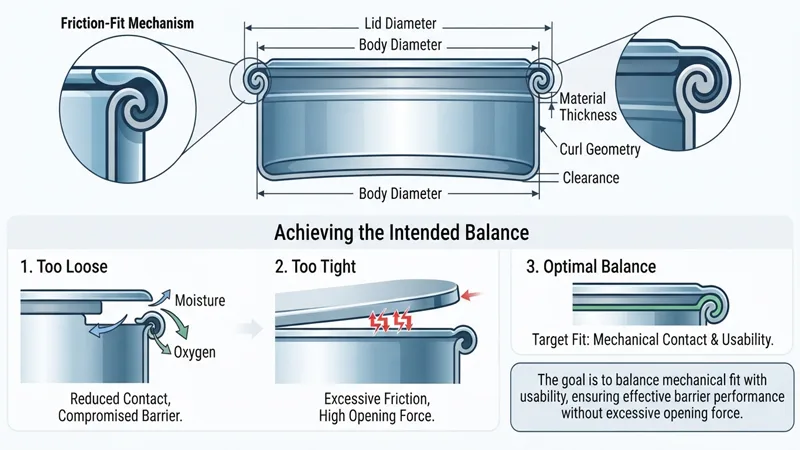
In a friction-fit tin, the lid and body are manufactured to specific dimensions so that the two components establish the intended mechanical contact.
The relationship between lid diameter, body diameter, material thickness, curl geometry, and clearance determines the resulting fit.
A closure that is too loose can reduce contact around the interface. A closure that is too tight can increase opening force and create excessive friction between the metal surfaces.
The target is therefore not simply the smallest possible clearance. The dimensions must produce the intended balance between mechanical fit and usability.
Gasketed Closure
A gasket changes the sealing mechanism because the gasket becomes a deformable component between the lid and body.
When the container is closed, the gasket is compressed against the mating surfaces. The resulting seal depends on the gasket material, geometry, compression level, contact surface, and dimensional consistency.
Insufficient compression may leave a leakage pathway. Excessive compression can increase closing and opening forces and may affect the gasket over repeated cycles.
The gasket should therefore be designed together with the lid and body rather than treated as an independent component.
Secondary Seals
A secondary seal can provide another barrier beneath the main lid.
Foil seals, membrane seals, inner liners, and pouches are examples of structures that can be used for this purpose.
The secondary barrier can reduce oxygen and moisture exchange before the container is first opened. After opening, however, its function changes depending on whether the seal remains intact.
Internal Coating and Tin Packaging Barrier Performance
The internal coating of tin packaging has a different function from the metal body barrier.
The coating separates the food from the metal substrate and contributes to corrosion control and product compatibility.
Coating Continuity
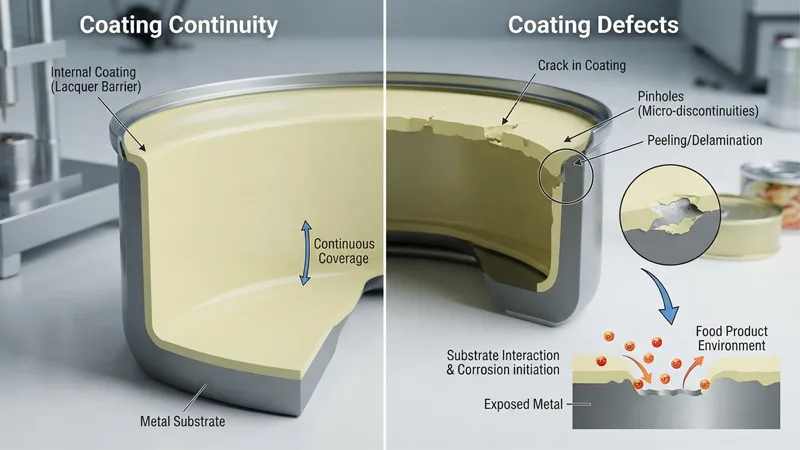
The internal coating should provide continuous coverage over the intended food-contact surface.
A coating defect can expose the underlying metal and create a local interaction between the food environment and substrate.
Potential defects are not limited to the original coated sheet. Forming operations can create cracks, pinholes, peeling, or other discontinuities that were not present before forming.
Coating After Forming
Tin containers can undergo stamping, drawing, curling, embossing, and other forming operations.
During these operations, the metal substrate changes shape and experiences local deformation. The internal coating must accommodate the deformation without losing its intended coverage.
This creates a direct relationship between forming and food-contact performance:
Forming deformation → coating integrity → metal exposure → corrosion and compatibility
The internal coating should therefore be evaluated on the formed container when the forming process produces significant deformation.
Tea Packaging Barrier Requirements
The barrier requirements for tea depend on the type of tea and the intended storage conditions.
Loose-Leaf Tea
For tin packaging for loose leaf tea, moisture, aroma, oxygen exposure, and light are relevant factors.
The metal body provides protection from light and has low permeability to gases and water vapor. The closure determines how effectively the assembled package limits air and moisture exchange.
If the tea requires additional barrier control, an inner pouch or foil seal can be used as a secondary layer.
Matcha
Matcha is a fine powder, and its storage behavior differs from that of loose-leaf tea.
Moisture exposure can cause changes in the powder, while oxygen and light can also influence product condition during storage.
A matcha tin may therefore combine a metal container with an inner seal or pouch. The purpose of the additional layer is to provide another barrier between the product and the surrounding environment.
Tea Bags
Tea bags can use a different internal packaging structure because the tea is already contained within individual bags.
In this case, the outer metal tin can provide structural protection and light protection, while the inner packaging controls moisture and aroma exchange.
The required barrier therefore depends on the combination of the tea bag material, secondary packaging, and outer tin.
Coffee Packaging Barrier Requirements
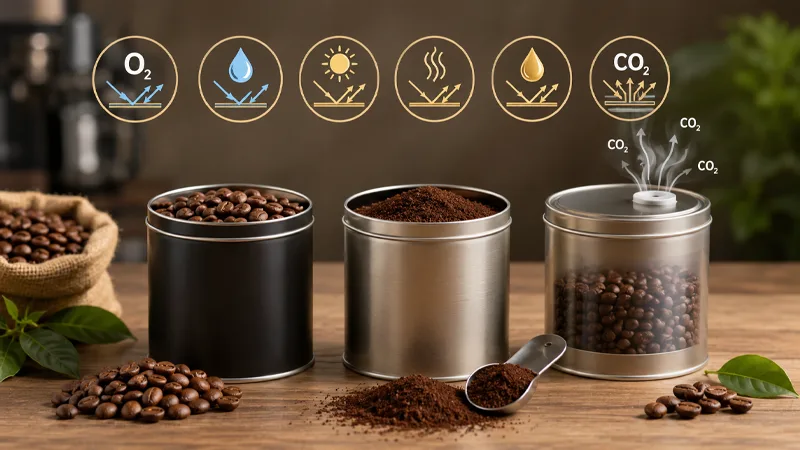
Tin packaging for coffee requires consideration of oxygen, moisture, light, aroma, coffee oils, and carbon dioxide.
Whole Coffee Beans
Whole coffee beans can remain in the package for an extended period.
The package therefore needs to control exposure to the surrounding atmosphere while accommodating the gas released by the roasted coffee.
The coffee oil content can also influence material compatibility, making the internal coating an important part of the package design.
Ground Coffee
Ground coffee has a larger exposed surface area than whole beans.
The larger surface area changes the interaction between the coffee and the internal package atmosphere. Oxygen exposure can therefore become more significant depending on the storage period and package configuration.
The package should be evaluated based on the actual coffee condition rather than applying the same assumptions used for whole beans.
Freshly Roasted Coffee
Freshly roasted coffee releases carbon dioxide after roasting.
If the container is completely closed without pressure management, internal pressure can increase.
A one-way degassing valve can allow carbon dioxide to leave while restricting external air from entering.
The valve does not replace the oxygen barrier of the package. It addresses a separate pressure-management requirement.
Secondary Barriers in Tin Packaging
A metal container can be combined with another packaging layer when the product requires additional control of oxygen, moisture, or aroma.
Foil Seals
A foil seal can be positioned beneath the main lid to provide an additional barrier before the package is opened.
It can also serve as an indication of package opening.
The effectiveness of the foil seal depends on the seal material, sealing process, surface condition, and continuity of the seal.
Inner Pouches
An inner pouch provides another material layer between the food and the metal container.
Depending on the pouch construction, it can provide additional control of oxygen and moisture transmission.
In this configuration, the pouch and tin perform different functions. The tin provides the rigid outer structure and light barrier, while the pouch provides the additional internal barrier.
Liners and Gaskets
Liners and gaskets are associated mainly with the closure interface.
Their performance depends on material compatibility, geometry, compression, temperature, and contact duration.
A gasket should therefore be evaluated as part of the closure system rather than simply as a sealing accessory.
Barrier Performance After Metal Forming
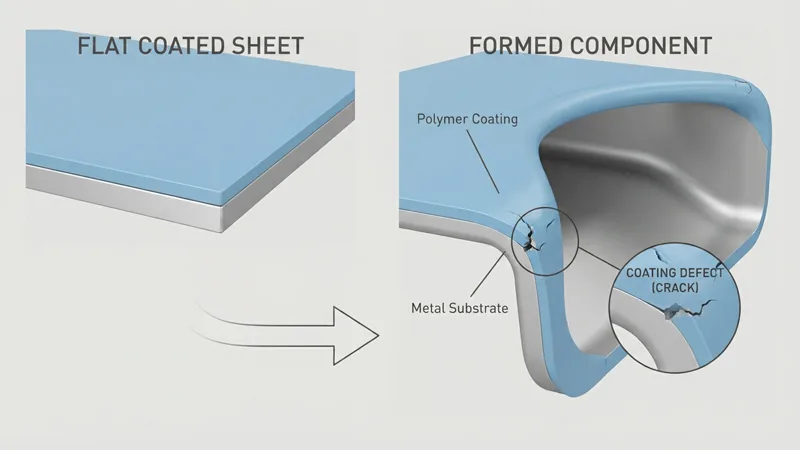
Tin packaging barrier performance after forming can differ from the performance of the original flat material.
During drawing and stamping, the metal undergoes deformation. Curling and embossing also change the final geometry of the container.
Forming and Internal Coating
The internal coating must remain continuous after forming.
If the coating cannot accommodate the deformation, cracks or other defects can occur. These defects may expose the underlying metal and change the food-contact condition.
Forming and Closure Geometry
Forming also determines the final dimensions of the body and lid.
A small dimensional change can influence the relationship between the two components. This can affect closure force, gasket compression, contact area, and leakage behavior.
For this reason, barrier validation should be performed on containers manufactured using the intended forming and assembly process.
DFM Parameters for Tin Packaging Barrier Performance
Design for Manufacturing connects the barrier requirements with the physical geometry and manufacturing process of the container.
Tinplate thickness affects structural stability and forming behavior. Lid-to-body clearance affects the closure interface. Curl geometry determines how the lid and body interact. Gasket dimensions and compression affect sealing. Internal coating coverage protects the metal substrate from direct food contact.
Forming radius and drawing depth are also relevant because they determine the degree of local deformation. If the deformation exceeds the capability of the coating system, coating defects can occur.
The inner seal diameter, where applicable, should also be controlled because the secondary barrier needs to maintain continuous contact with the intended sealing surface.
The engineering drawing should therefore identify the dimensions that directly affect closure fit, coating integrity, and sealing performance.
Testing Tin Packaging Barrier Performance
Testing should be based on the actual package structure and intended conditions of use.
Oxygen Barrier Testing
Oxygen-related testing can evaluate the assembled package rather than only the metal substrate.
For a metal container, the closure and other interfaces are particularly important because the metal wall itself has very low gas permeability.
Where the package uses a secondary seal or valve, these components should also be considered in the test configuration.
Moisture Barrier Testing
Moisture-related evaluation should consider the complete package and its intended storage environment.
Temperature, relative humidity, contact duration, closure design, secondary seals, and package dimensions can all influence the result.
Testing conditions should represent the intended application as closely as practical.
Leak Testing
Leak testing determines whether air or another test medium can pass through the finished package under defined conditions.
For metal tins, the relevant areas may include the lid interface, seams, gasket area, and secondary seal.
The test method and acceptance criteria should be defined according to the package structure and intended application.
Closure Testing
Closure testing evaluates the mechanical relationship between the lid and body.
Opening force and closing force provide information about the fit, but these measurements alone do not establish the complete barrier performance.
The closure should also be evaluated for dimensional consistency, gasket compression where applicable, and leakage after repeated opening and closing.
Storage Testing for Tea and Coffee Tin Packaging
Laboratory testing provides measurements under controlled conditions, while storage testing examines how the package and product behave over time.
Temperature
Temperature can influence product stability, coating behavior, gasket properties, gas pressure, migration, and sealing conditions.
For coffee, temperature can also influence the rate of carbon dioxide release.
The storage temperature used for validation should therefore reflect the expected distribution and storage environment.
Humidity
Relative humidity is particularly relevant to tea, coffee, cookies, powders, and other moisture-sensitive products.
The external humidity condition affects the driving force for moisture transfer when a package has a leakage pathway or when the package is opened.
Contact Duration
Longer storage periods provide more time for moisture exchange, oxygen exposure, material interaction, and changes in the product.
The storage period used for validation should therefore correspond to the intended shelf-life conditions where practical.
Failure Modes in Tin Packaging Barrier Performance
Moisture Ingress
Moisture ingress can result from excessive lid-to-body clearance, insufficient gasket compression, closure deformation, liner damage, or an incomplete secondary seal.
The metal wall itself may remain intact while the closure interface becomes the effective pathway for moisture exchange.
Oxygen Ingress
Oxygen ingress can occur through closure leakage, discontinuity in a secondary seal, gasket damage, or dimensional changes in the lid and body.
For coffee, oxygen ingress should be considered separately from the CO₂ release mechanism because one concerns external gas entering the package while the other concerns internally generated gas leaving the package.
Aroma Loss
Aroma loss can be associated with headspace exchange, repeated opening, closure leakage, and interaction between the product and packaging materials.
The effect depends on the product’s volatile compounds and the storage period.
Coating Failure
Coating failure can occur when the coating cannot withstand the deformation produced during forming or when adhesion and curing are insufficient.
A damaged coating can expose the metal substrate and change the food-contact condition.
Barrier Reduction After Transport
Mechanical handling can deform the lid, body, curl, or gasket.
A package that meets its initial closure requirements can therefore require additional evaluation after transport simulation or mechanical testing.
The relevant sequence is:
Mechanical stress → dimensional change → closure change → leakage → barrier reduction
Validation Protocol for Tin Packaging Barrier Performance
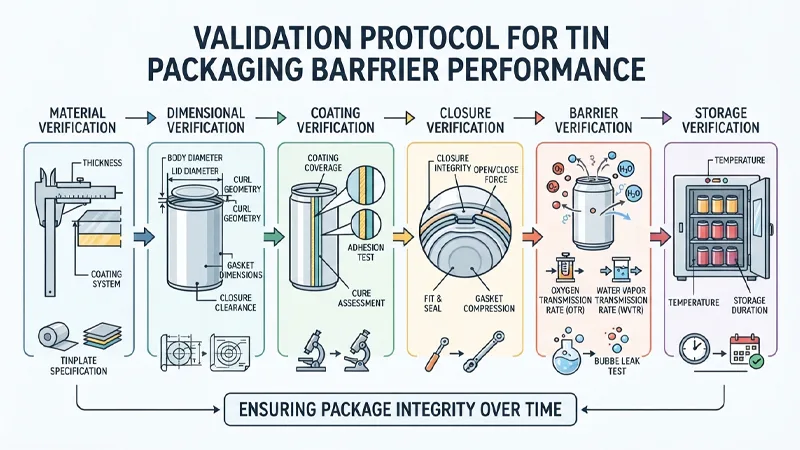
A tin packaging barrier validation should connect the material specification, forming process, dimensional requirements, closure structure, and storage conditions.
The first stage is material verification. The tinplate thickness, internal coating system, and other food-contact materials should correspond to the approved specifications.
The second stage is dimensional verification. Critical dimensions such as body diameter, lid diameter, curl geometry, closure clearance, and gasket dimensions should be checked against the engineering drawing.
The third stage is coating verification. The formed container should be inspected for coating coverage, adhesion, curing condition, and defects caused by forming.
The fourth stage is closure verification. The finished container should be evaluated for opening force, closing force, fit, gasket compression where applicable, and sealing condition.
The fifth stage is barrier verification. Oxygen, moisture, and leakage performance can be evaluated according to the actual package design and intended application.
The final stage is storage verification. The assembled package can be evaluated under defined temperature, humidity, and storage-duration conditions to determine whether the required package performance is maintained over time.
Relationship Between Barrier, Sealing, and Food Contact
Barrier performance, sealing performance, and food-contact performance are separate engineering functions, but they interact within the finished package.
The metal body provides the main opaque structure and a low-permeability barrier. The internal coating controls the food-contact surface and protects the substrate from direct interaction with the product. The closure controls the opening interface. A gasket or liner can establish the sealing condition. A secondary seal can provide an additional barrier. In coffee packaging, a degassing valve can manage internally generated CO₂.
A failure in one area does not necessarily mean that the other areas have failed.
For example, a tin body can provide complete light protection while the closure allows moisture ingress. An internal coating can maintain food-contact compatibility while the closure has insufficient sealing performance. A coffee package can restrict oxygen ingress while still requiring a valve to release CO₂.
This separation of functions is important when establishing test methods and acceptance criteria.
Conclusion
Tin packaging barrier performance is determined by the interaction between the metal body, internal coating, closure, sealing components, and storage environment.
The metal body provides the main opaque structure and has low permeability to gases and water vapor. The internal coating provides the food-contact surface and contributes to corrosion protection. The closure, gasket, liner, and secondary seal influence the exchange of oxygen and moisture at the package interfaces.
For tea packaging, moisture, aroma, light, and oxygen exposure should be evaluated according to the product and storage condition.
For coffee packaging, these factors must also be considered together with coffee oils and CO₂ released after roasting.
The engineering sequence can be represented as:
Food Characteristics → Barrier Requirements → Material and Coating Selection → Forming Process → Closure Design → Secondary Barrier Where Required → Leak and Barrier Testing → Storage Validation
The key distinction is between the barrier property of the packaging material and the barrier performance of the finished package. A metal substrate can provide a low-permeability structure, but the final performance depends on the interaction between the body, coating, closure, gasket, seal, and other components.
For tea and coffee tins, barrier design should therefore be evaluated as part of the complete packaging structure rather than as a property of tinplate alone.
FAQ
Does tin packaging provide an oxygen barrier?
The metal body provides a low-permeability barrier to gases. However, oxygen ingress into a finished package can also occur through the closure, seams, gaskets, liners, or other interfaces.
Does tin packaging prevent moisture ingress?
The metal body provides a low-permeability barrier to water vapor. The practical moisture barrier of the finished container also depends on the lid-to-body interface, gasket, liner, and secondary seal where used.
Is tin packaging suitable for loose-leaf tea?
Tin packaging can be used for loose-leaf tea when the internal coating, closure, and overall barrier structure are suitable for the intended product and storage conditions.
Does metal packaging protect tea from light?
The metal body is opaque and prevents direct light transmission through the container wall.
Is tin packaging suitable for coffee beans?
Tin packaging can be used for coffee beans. The package design should consider oxygen, moisture, light, coffee oils, aroma, storage conditions, and carbon dioxide release after roasting.


