
Tin packaging prototype to mass production involves more than reproducing an approved sample. The transition requires the manufacturer to verify tooling, material, forming conditions, printing, assembly, and inspection under normal production conditions.
A prototype confirms the basic product structure and shows how the tin behaves during forming and assembly. Mass production introduces longer production runs, material batches, tooling wear, machine setup, production speed, and repeat-order requirements. A tin that works correctly as a prototype still needs to maintain the approved dimensions, lid fit, surface condition, and functional performance throughout mass production.
The transition between these stages is where production issues often become visible. Tooling that performs correctly during a small sample run may require adjustment before continuous production. A closure that fits one sample needs to remain consistent across a production batch. Printed panels may also require register control when production moves from development quantities to normal production speed.
For custom tin packaging, the transition should therefore be treated as a controlled production-development process rather than simply increasing the order quantity.
Table of Contents
Prototype Production Establishes the Starting Point

The prototype stage gives the manufacturer the first physical version of the tin packaging.
At this stage, the engineering team checks whether the proposed structure can be formed and assembled as intended. The prototype may be produced using development tooling, modified tooling, or a limited production setup depending on the project.
The sample provides physical information that cannot always be confirmed from a drawing. The body and lid can be assembled, the closure can be operated, formed areas can be checked, and the printed surface can be reviewed after forming.
For a deep-drawn tin, the prototype also shows how the material behaves through the drawing operation. Springback, corner forming, wall deformation, and dimensional recovery may become visible only after the first parts are produced.
The prototype therefore becomes the reference for the next stage of engineering review.
Sample Approval Does Not Mean the Process Is Ready for Full Production
An approved sample confirms that the customer accepts the product against the agreed requirements. It does not automatically prove that the production process is ready for a large batch.
A sample may be produced at a controlled setup with frequent adjustments. Mass production runs the same tooling repeatedly and introduces normal variation from material batches, machine settings, tool wear, production speed, and operator handling.
This difference matters for tin packaging because several operations interact.
A lid must maintain its fit after repeated forming. A curled edge must remain within the required geometry. Embossed features must remain in position. Printing must stay within the required register. Coating must remain intact after forming and assembly.
The production process needs to reproduce the approved sample rather than simply produce another acceptable sample.
Review Tooling Before the Production Run
Tooling should be reviewed before the first full production order.
The engineering team checks the condition of forming dies, punches, curling tools, cutting tools, embossing tools, fixtures, and other production tooling. The review also considers whether any tool modification made during prototype development has been properly recorded.
Tool Adjustment After Prototyping
Prototype production often reveals small forming issues.
The body may require a change to a corner radius. A lid curl may need adjustment. An embossing feature may need a change in forming depth. A hinge component may require a revised forming position.
These changes should be completed and documented before mass production.
The final tooling condition should correspond to the approved sample. Otherwise, the production line may use a tool configuration that differs from the sample used for customer approval.
Establish the Production Process
Mass production requires a defined process route.
The manufacturer determines the sequence for blanking, stamping, drawing, bending, curling, embossing, coating, printing, assembly, and other operations according to the product structure.
The sequence matters because one operation can change the condition required by the next operation.
For example, a body that passes through drawing before curling must maintain the required geometry for the curling operation. An embossed panel must be formed without interfering with the later printing or assembly process. A lid must retain the required shape after several forming stages before it reaches the closure assembly stage.
The process route used for the approved sample should therefore be reviewed against the process planned for mass production.
Confirm Material and Production Batch Conditions

Prototype material and mass-production material should follow the same approved material specification.
The actual production batch may differ from the material used during prototype development within the allowed material range. These differences can influence forming behavior, especially for drawn or embossed components.
Material thickness, temper, surface condition, and coating condition should be controlled according to the approved specification.
For deep drawing, the production team also needs to watch forming behavior as material batches change. Changes in material condition can affect drawing force, springback, corner formation, and final dimensions.
The purpose is not to make every sheet identical. The process needs to remain within the conditions under which the approved product was developed.
Run a Pilot Production Before Full Volume
A pilot production run provides a bridge between prototype production and normal mass production.
Instead of immediately releasing the complete order quantity, the manufacturer produces a controlled production batch using the intended material, tooling, machines, process route, printing setup, and assembly method.
This run shows whether the process remains stable when production continues for a longer period.
Tool wear can become visible. Printing registration can shift as the line runs. Curling tools may require adjustment. Assembly fit can change when components from different production batches are combined.
A pilot run gives the production team an opportunity to correct these issues before the full quantity is released.
Check Repeatability During Production
Mass production requires repeatability rather than a single successful result.
For tin packaging, repeatability often concerns the relationship between components.
A lid may fit correctly at the beginning of a run but become tighter or looser as tooling conditions change. A body diameter may remain within the drawing tolerance while still affecting the closure fit when combined with another component.
This is why functional checks should be performed during production rather than only on the first pieces.
The same principle applies to printing. A printed panel can match the approved artwork while the register between artwork and formed features changes during production. Production checks need to consider both the graphic position and the physical geometry.
Control Changes Between Prototype and Mass Production
The transition from prototype to production should not introduce undocumented changes.
Changes can occur because the prototype used development tooling, while mass production uses production tooling. The production machine may also differ from the machine used for development. Printing may move to a higher-volume setup. Assembly may use dedicated fixtures rather than manual positioning.
These changes do not necessarily require the product design to change. They require engineering review to confirm that the production method still produces the approved product.
Any change affecting the product geometry, material, tooling, artwork, coating, or assembly method should be recorded through the project’s revision-control process.
Define the Production Release
Before mass production starts, the manufacturer should have a clear production release package.
The approved mechanical drawing defines the product geometry. The approved artwork controls the printed design. The material specification defines the production material. The approved sample establishes the physical reference. Tooling records define the production setup.
These documents should point to the same revision.
A common production problem occurs when different departments work from different versions. The tooling department may have one drawing, the printing department another artwork file, and purchasing a different material specification.
Production release should therefore establish one controlled version for each document.
Monitor the First Mass-Production Batch
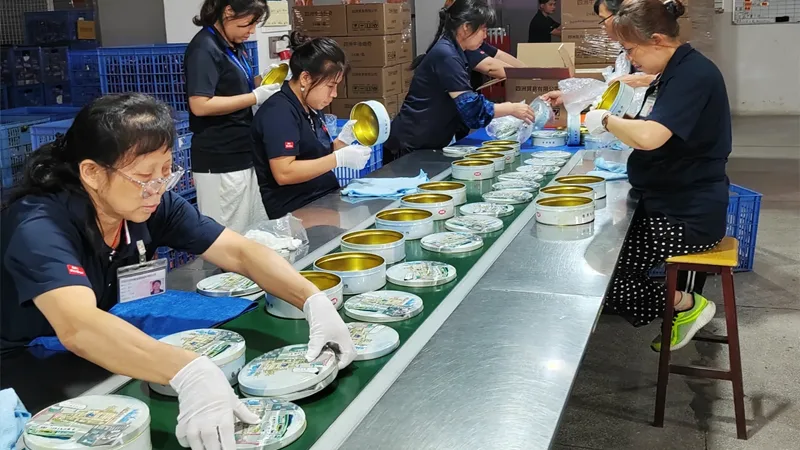
The first full production batch should receive closer process attention than later repeat orders.
The production team monitors the conditions that were identified during prototype and pilot production. Tooling wear, forming stability, lid fit, printing register, coating condition, assembly fit, and other controlled characteristics are checked against the approved reference.
The objective is not to inspect every feature continuously. The focus should remain on the characteristics that can change during production and affect product function or appearance.
If an adjustment is required, the adjustment should be recorded so that the same condition can be reproduced in later batches.
Establish Repeat-Order Control
A custom tin packaging project does not end with the first production order.
Repeat orders should use the same approved product definition unless the customer issues a controlled change.
The manufacturer should retain the relevant tooling records, production parameters, approved artwork, material specification, sample reference, and inspection requirements. This gives later production runs a reference point rather than requiring the product to be developed again.
Tool condition also becomes more relevant over time. Curling edges, cutting surfaces, forming profiles, and embossing features can gradually wear. The production team needs to identify when tool maintenance or replacement is required before the finished tin moves outside the approved condition.
Production Records
Production records help identify changes between batches.
The useful information is not limited to final inspection results. Tool maintenance, material batch, machine setup, production date, process adjustments, and production quantity can help explain why a later batch behaves differently from the original production run.
This becomes particularly useful when a customer places repeat orders months after the first shipment.
Prototype, Pilot Run, and Mass Production
These three stages serve different purposes.
The prototype establishes the physical product and allows the engineering team to verify the basic structure and forming concept.
The pilot run tests whether the approved design can be produced using the intended production equipment, tooling, material, printing setup, and assembly process.
Mass production demonstrates whether the process can repeatedly produce the approved product at the required volume.
The stages should remain connected. The production sample should not become a different reference from the prototype, and the mass-production process should not introduce undocumented changes after sample approval.
Common Problems During Scale-Up
A common issue occurs when a prototype is produced using frequent manual adjustments, while the mass-production line needs a fixed process condition. A sample may therefore look correct even though the process has not yet reached a stable production state.
Tool wear is another issue. A tool that produces acceptable samples may require maintenance after thousands of forming cycles. Curling and cutting tools are particularly sensitive to wear because their working edges directly affect the finished geometry.
Component matching can also create problems. A body and lid may each pass individual dimensional checks but produce an inconsistent fit when assembled together. Functional fit needs to be evaluated at the assembly stage.
Printing introduces another production variable. Artwork that was approved on the prototype may require register control during longer production runs, especially when printed panels later pass through forming and assembly.
These issues are easier to manage when prototype approval, pilot production, tooling release, and mass production remain separate but connected stages.
When Is a Tin Packaging Project Ready for Mass Production?
A project is ready for mass production when the product design has been approved, the production tooling is released, the intended process route has been verified, and the production team has a controlled reference for material, artwork, assembly, and inspection.
The pilot run should confirm that the production equipment and tooling can reproduce the approved sample without relying on continuous manual correction.
The production documents should also be synchronized. The drawing revision, artwork revision, material specification, tooling condition, and approved sample should describe the same product.
At that point, mass production becomes a repeatable manufacturing process rather than an extension of prototype development.
Conclusion
Moving custom tin packaging from prototype to mass production requires control over more than the finished sample. The approved design, production tooling, material condition, forming process, printing setup, assembly method, and inspection criteria all need to remain consistent as production volume increases.
Prototype production verifies the product structure and forming concept. A pilot run checks whether the approved design can be reproduced under normal production conditions. Mass production then requires stable tooling and process control across the full production batch.
Once the production process is established, the same technical documents and tooling records provide the reference for repeat orders. Changes to dimensions, material, artwork, tooling, or assembly should follow revision control rather than being introduced directly on the production line.
The objective is straightforward: the tin produced in mass production should remain consistent with the approved sample, not just similar to it.
FAQ
What is the difference between a tin packaging prototype and mass production?
A prototype confirms the physical product design and forming concept. Mass production must reproduce the approved product repeatedly at the required production volume using controlled tooling, material, machines, printing, and assembly processes.
Is a pilot production run necessary for custom tin packaging?
A pilot run is useful when the project involves new tooling, complex forming, multiple components, new printing conditions, or a large production volume. It allows the manufacturer to evaluate process stability before releasing the full order.
Can the production tooling be different from the prototype tooling?
Yes. Prototype tooling and production tooling may use different configurations depending on production volume and manufacturing requirements. The production tooling should still be validated against the approved product before mass production.
What should happen if the manufacturer needs to change the tooling after sample approval?
The change should be reviewed against the approved drawing and sample. If the change affects product geometry or function, another sample may be required before mass production continues.
How can repeat orders maintain the same tin packaging quality?
Repeat orders should reference the approved drawing, artwork, material specification, tooling records, production process, and sample. Tool maintenance and production records should also be retained so later batches can be compared with the original production condition.