Custom tin box MOQ and pricing are closely related to the manufacturing process, material specifications, tooling requirements, printing setup, and order quantity. For buyers developing custom metal packaging, the minimum order quantity for tin boxes is not simply a number set by the supplier. It reflects the production resources required to manufacture a specific design.
A custom tin box may use an existing mold or require new tooling. It may have a standard rectangular structure, a deep-drawn shape, a hinged lid, a slip lid, or a separate inner component. Each construction method involves different production operations and cost considerations.
Understanding these factors helps buyers evaluate custom tin box pricing, compare supplier quotations, and prepare packaging specifications before requesting a price.
Table of Contents
What Is the MOQ for Custom Tin Boxes?

MOQ stands for minimum order quantity. In tin packaging manufacturing, it refers to the minimum number of units required for a production order under a specific set of specifications.
The MOQ for custom tin boxes varies according to the box structure, dimensions, printing requirements, material availability, and production arrangement.
A factory may accept a lower order quantity for a standard tin box using an existing mold and available material. A new design with special dimensions, new tooling, or multiple printed components may require a larger order quantity to distribute production preparation costs across more units.
For this reason, custom tin box MOQ should be evaluated together with the product specifications rather than treated as a fixed quantity for every type of tin packaging.
Existing Mold and New Mold Requirements
Existing molds are already available for certain box dimensions and structures. When a buyer selects one of these designs, the factory may not need to manufacture a new forming tool.
However, using an existing mold does not mean that every other production requirement is unchanged.
The box may still require:
- New printed tinplate sheets
- A different surface coating
- New artwork and printing setup
- Different internal components
- Special assembly or packaging operations
A new mold requires additional tooling preparation. The tool must be designed and manufactured according to the intended dimensions, material thickness, forming sequence, and structural requirements.
The tooling cost is generally considered separately from the unit price of the tin box.
Production Quantity and MOQ
The production quantity affects how manufacturing preparation costs are distributed.
For example, a production order may require printing setup, press adjustment, forming tool installation, and inspection before regular production begins.
These activities require time and resources even when the order contains a relatively small number of boxes.
When the same preparation is used to manufacture a larger quantity, the setup cost per unit may decrease.
This is one reason the unit price of custom tin boxes often changes at different order quantities.
The actual MOQ depends on the production conditions of the specific factory and should be confirmed during quotation.
How MOQ Affects Custom Tin Box Pricing
Custom tin box pricing includes costs that are related to the order as a whole and costs that increase with the number of units produced.
Order-related costs may include artwork preparation, printing setup, tooling preparation, production changeover, and inspection arrangements.
Unit-related costs may include tinplate, printing materials, forming operations, assembly, and packaging.
When the order quantity is low, fixed preparation costs account for a larger proportion of the total order value.
When the order quantity increases, these costs are distributed across more units.
Fixed Costs and Variable Costs
The distinction between fixed and variable costs helps explain why the same tin box design can have different unit prices at different order quantities.
Fixed or order-related costs do not necessarily increase in direct proportion to the number of boxes.
Variable costs generally increase with production quantity.
A simplified pricing model can be expressed as:
Total Order Cost = Fixed Order Costs + Variable Production Costs
The estimated unit cost can then be calculated as:
Unit Cost = Total Order Cost ÷ Order Quantity
This is a simplified cost model. Actual factory quotations may also include packaging, inspection, handling, and other costs depending on the agreed delivery terms.
Example of Order Quantity and Unit Cost
Consider a hypothetical tin box project with the following production costs:
| Cost item | Example amount |
|---|---|
| Order-related preparation costs | $1,200 |
| Variable production cost per box | $1.00 |
The following table illustrates how the fixed preparation cost is distributed across different quantities.
| Order quantity | Preparation cost per box | Simplified unit cost |
|---|---|---|
| 1,000 | $1.20 | $2.20 |
| 3,000 | $0.40 | $1.40 |
| 5,000 | $0.24 | $1.24 |
| 10,000 | $0.12 | $1.12 |
These figures are for illustrating the calculation only. They are not actual custom tin box prices or standard factory MOQ levels.
The example shows why a small order may have a higher unit cost even when the box dimensions, material, and printing specifications remain unchanged.
What Determines the Cost of a Custom Tin Box?
The cost of a custom tin box depends on several manufacturing specifications. The dimensions and material are only part of the calculation.
A quotation should be based on the complete box structure and the production requirements.
Tinplate Material and Thickness
Tinplate is commonly used for custom metal tin boxes because it can be printed, cut, and formed into different packaging structures.
Material cost depends on factors such as:
- Tinplate thickness
- Material grade and temper
- Sheet dimensions
- Material utilization
- Required surface condition
- Purchasing quantity
A thicker tinplate sheet generally uses more material by weight, but material thickness should not be evaluated independently of the forming and structural requirements.
For example, a large rectangular box may require different panel stiffness considerations from a small round tin. The required thickness also depends on the box dimensions, corner construction, lid structure, and intended use.
Reducing material thickness without evaluating the box structure may affect panel rigidity, forming stability, or lid fit.
Box Dimensions and Shape
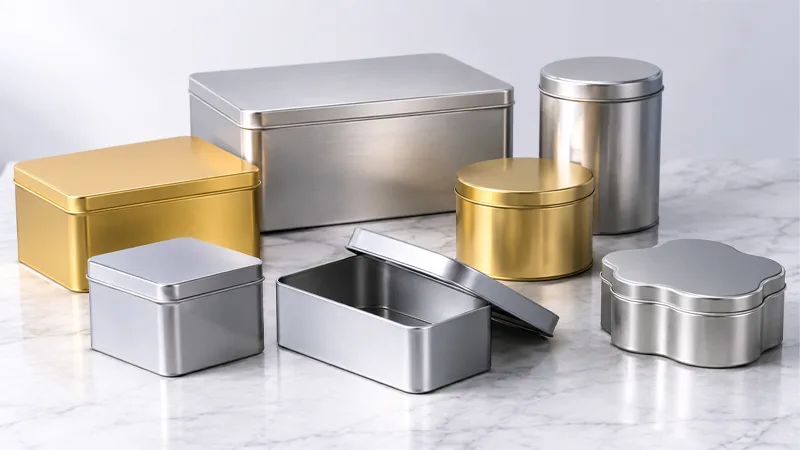
Custom tin box dimensions affect material consumption and forming operations.
A larger box generally requires a larger blank, although the relationship between finished dimensions and material consumption is not always proportional.
The production method also matters.
A rectangular tin box may use separate panels or a body-forming process depending on its construction.
A deep-drawn round tin requires a different forming arrangement from a shallow rectangular box.
Complex shapes may require additional forming operations, special tooling, or more demanding dimensional control.
When evaluating custom tin box cost, buyers should provide the external dimensions and, where relevant, the internal dimensions and required product clearance.
Lid Structure and Closure
The lid design affects both tooling and assembly.
Common structures include:
- Slip lid
- Hinged lid
- Separate plug lid
- Double-lid construction
- Lid with an internal sealing component
A simple slip lid may require fewer components than a hinged tin box.
A hinged structure requires a hinge connection and may involve additional assembly operations.
A closure with an internal plug or gasket may require extra components and more detailed dimensional control.
The cost difference depends on the actual design rather than the lid category alone.
Printing and Surface Finishing
Printed tinplate packaging may use CMYK process printing, Pantone spot colors, white ink, or combinations of these methods.
The printing requirements affect material preparation and production setup.
Artwork with multiple colors, special white ink coverage, or additional coating requirements may involve different printing arrangements.
The exterior protective coating is also part of the surface specification.
A buyer should identify whether the design requires:
- CMYK printing
- Pantone color matching
- Spot white or full white
- Matte or gloss finish
- Protective overprint varnish
- Special surface effects
The final printing cost depends on the artwork, printing process, material arrangement, and order quantity.
Internal Components and Inserts
Custom tin box inserts can include paperboard partitions, foam components, molded trays, or other product supports.
These components affect the total packaging cost and the available internal space.
For example, a tin box designed to hold several products may require separate compartments to prevent movement during handling.
The insert must fit the internal dimensions of the tin box.
If the box has a formed lid or an internal plug structure, the available product space may be smaller than the external dimensions suggest.
Buyers should provide the product dimensions and the required arrangement when requesting a quotation.
Custom Tin Box Cost for Existing Molds vs. New Molds
Tooling is an important consideration when developing custom tin packaging.
An existing mold may reduce the initial tooling requirement, but it does not automatically mean that the complete box can be manufactured without further preparation.
Using an Existing Mold
When the required box structure and dimensions match an available mold, the factory may be able to use existing tooling.
This can reduce the need for new mold manufacturing.
However, the buyer should confirm:
- Whether the mold dimensions match the required box
- Whether the lid and body use compatible tooling
- Whether the required tinplate thickness is supported
- Whether the mold is available for production
- Whether the design requires any additional forming tools
A similar-looking box may not use the same mold if its dimensions, corner radius, lid fit, or body construction are different.
Developing a New Mold
A new custom tin box design may require new tooling.
The tooling cost depends on the shape, dimensions, forming method, number of operations, and tool construction.
A simple modification to an existing design may involve less tooling work than a completely new structure.
A complex box with multiple formed components may require several tools or forming stages.
Tooling is generally a separate cost from the production quantity. The quotation should identify whether the tooling charge is included in the unit price or listed separately.
Buyers should also clarify whether the tooling is intended for one project or may be used for future orders under the agreed conditions.
How to Reduce Custom Tin Box Costs Without Changing the Required Function
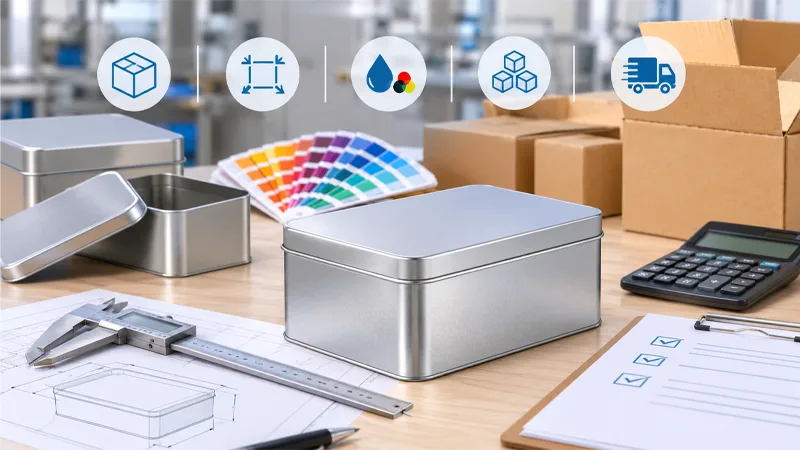
Cost adjustments should be based on the actual packaging requirements rather than reducing specifications without checking their effect.
Select a Suitable Existing Structure
If an existing box structure meets the required dimensions and product protection needs, using it may reduce tooling preparation.
The available dimensions should be checked against the product and the required internal space.
Review the Box Dimensions
Unnecessary space inside a tin box can increase material consumption and shipping volume.
However, reducing dimensions too much may create problems with product fit, insert design, or packing operations.
The box should be sized according to the product dimensions, required clearance, and internal components.
Simplify the Printing Specification
Artwork can be reviewed to determine whether the required visual design can be produced using a suitable printing arrangement.
The number of colors, white ink coverage, and surface finish should be defined before production.
Any changes to the printing specification should be evaluated against the required appearance and color consistency.
Consolidate Order Quantities
When several orders use the same structure and printing specification, combining quantities may reduce repeated production preparation.
This depends on the production schedule, inventory requirements, and whether the products can be manufactured under the same specifications.
Different artwork versions or different box structures may still require separate preparation.
Review Packaging and Shipping Requirements
The inner packaging and shipping carton configuration can affect the total order cost.
The number of boxes per carton, carton dimensions, and required protection should be reviewed together.
Reducing packaging volume may help control shipping costs, but the packaging must still protect the tin boxes during handling and transportation.
What Information Is Needed for a Custom Tin Box Quote?
A complete quotation request should include the information needed to identify the box structure and manufacturing requirements.
Missing specifications can lead to assumptions during quotation, which may result in differences between the initial estimate and the final production cost.
Box Specifications
Provide the following information where available:
- Box length, width, and height
- External or internal dimensions
- Box shape
- Lid structure
- Required tinplate thickness
- Product dimensions and weight
The dimension reference should be clearly identified.
For example, a buyer may provide the external dimensions of the box but require a specific internal space for the product.
These two measurements are not interchangeable.
Printing and Surface Requirements
The quotation request should include the artwork or a reference design.
If the artwork is not complete, provide the intended printing arrangement and surface requirements.
Specify whether the box requires CMYK printing, Pantone colors, white ink, a matte finish, or a protective coating.
Quantity and Order Schedule
The buyer should provide the estimated order quantity.
If the project involves several order quantities, request pricing at each quantity for comparison.
The expected order schedule is also relevant when production preparation, material purchasing, or inventory arrangements may affect the quotation.
Tooling and Sample Requirements
Identify whether the project uses an existing mold or requires a new design.
If a sample is needed before mass production, specify the type of sample and the approval requirements.
A sample made with production tooling may involve different preparation costs from a visual or structural prototype.
The quotation should distinguish sample charges, tooling charges, and production costs where applicable.
Conclusion
Custom tin box MOQ and pricing are determined by the relationship between product specifications, manufacturing preparation, and production quantity.
A quotation should account for the complete packaging structure, including tinplate material, dimensions, tooling, printing, lid construction, inserts, and shipping packaging.
When these specifications are defined before quotation, buyers can compare custom tin box prices on a consistent basis and evaluate the cost implications of different order quantities.
The MOQ should be confirmed for the specific design and production arrangement rather than assumed to be the same for every tin box project.
FAQ
What is the minimum order quantity for custom tin boxes?
The minimum order quantity for custom tin boxes depends on the box structure, dimensions, printing requirements, material arrangement, and factory production conditions.
There is no single MOQ that applies to every custom tin box design.
Why does custom tin box pricing change with order quantity?
Order-related preparation costs are distributed across the production quantity. A larger order may reduce the preparation cost per unit, although material, printing, forming, and packaging costs still increase with quantity.
Does using an existing mold reduce the cost of custom tin boxes?
Using an existing mold may reduce or eliminate the need for new tooling. The final cost still depends on material, dimensions, printing, surface finishing, assembly, and order quantity.
Can I order custom tin boxes with a low MOQ?
A low MOQ may be possible for certain structures and production arrangements. The factory must evaluate the required dimensions, printing, material availability, and production setup before confirming the order quantity.
What information should I provide to get an accurate custom tin box price?
Provide the box dimensions, structure, material requirements, printing artwork, estimated order quantity, product dimensions, and packaging requirements. If tooling or samples are needed, include those requirements in the quotation request.