

Custom tin box packaging for shipping requires more than placing finished metal boxes into a corrugated carton. Tinplate containers can develop dents, scratches, coating damage, and shape distortion when the packing arrangement does not control movement, stacking loads, and contact between metal surfaces.
A tin box may pass its final inspection and still arrive at the buyer’s warehouse with visible damage. The cause may be insufficient clearance inside the shipping carton, excessive movement between units, weak carton panels, poor pallet loading, or compression during transport.
For packaging buyers, the objective is to define a shipping configuration that protects the finished tin while using carton space efficiently. Carton dimensions, dividers, packing orientation, stacking height, and transport conditions should be evaluated as one system.
Table of Contents
Custom Tin Box Packaging for Shipping

- Select the shipping carton according to the finished tin dimensions, weight, surface finish, and expected transport conditions.
- Use dividers or protective materials when direct metal-to-metal contact can cause scratches or dents.
- Check carton compression and pallet stacking when cartons will be stored or transported in multiple layers.
- Prevent excessive movement inside the carton without applying pressure that deforms the tin body or lid.
- Evaluate the complete packed configuration rather than relying only on the strength of an individual tin box.
- Use representative shipping tests when the route, packaging structure, or product value justifies them.
Why Tin Box Shipping Damage Occurs
Tinplate packaging is rigid, but rigidity does not make it immune to damage. Thin metal panels can dent under localized loads, and printed or coated surfaces can be scratched when packages rub against each other.
The type of damage depends on where the force is applied and how the tin is supported.
| Observed damage | Possible cause | What to inspect |
|---|---|---|
| Dents on the lid or broad panels | Localized impact, excessive stacking load, insufficient support | Carton compression, contact points, stacking arrangement |
| Scratches on printed surfaces | Metal-to-metal rubbing or movement against packing materials | Dividers, surface protection, clearance |
| Bent corners or curled edges | Impact during handling or pressure at carton edges | Corner protection, carton fit, packing orientation |
| Deformed bodies | Excessive compression or concentrated loads | Carton stacking, internal support, pallet loading |
| Loose or displaced products | Excessive clearance or inadequate separation | Carton dimensions, divider layout, unit restraint |
| Crushed shipping cartons | Inadequate carton strength, moisture exposure, or stacking beyond the design condition | Board specification, storage environment, pallet configuration |
These are possible causes rather than definitive diagnoses. The same visible defect can result from different stages of handling, so inspection should determine whether the damage originated during packing, warehouse storage, pallet handling, or transportation.
How to Select a Shipping Carton for Custom Tin Boxes
The shipping carton must accommodate the finished tin, any protective components, and the clearance needed for packing and handling. Selecting a carton based only on the nominal tin dimensions can leave insufficient space for dividers or create excessive empty space that allows movement.
Measure the Finished Tin, Not Just the Design Drawing
Use the actual finished dimensions when defining the carton layout. The measured envelope should account for the lid, hinges, handles, raised embossing, or other features that extend beyond the main body.
For a rectangular tin, record the maximum external length, width, and height. For a round tin, use the maximum external diameter and height. If the product has projecting hardware or an irregular shape, measure the overall envelope rather than relying on the main body dimensions alone.
The packing arrangement should also account for the thickness of dividers and protective sheets.
For example, if a row contains four tins separated by three dividers, the required row length is:
Required row length = sum of four tin widths + sum of three divider thicknesses + specified end clearance
This calculation describes only the internal layout. The carton manufacturer’s board construction and converting tolerances must also be considered when establishing the final carton dimensions.
Avoid Excessive Clearance
A carton that is too large can allow tins to move during handling. Movement increases the likelihood of rubbing, impact, and contact between corners or lids.
However, a carton should not be made so tight that workers must force the tins into position. Excessive packing pressure can distort thin panels, damage curled edges, or interfere with lid fit.
The appropriate clearance depends on the carton structure, protective material, loading method, and dimensional variation of the finished tins. It should be verified using a physical packing trial.
Dividers and Protective Materials for Metal Tin Packaging
Dividers separate individual tins and reduce direct contact between adjacent metal surfaces. Their design should match the package geometry, the finish requirements, and the number of units packed into each carton.
Corrugated Dividers

Corrugated dividers can separate tins into individual cells or rows. They are often useful when multiple units are packed together and the printed surfaces must be protected from rubbing.
The divider should remain in position during packing and transport. If it bends, collapses, or shifts, the separation between tins may disappear.
Cell dimensions should allow the packing operator to insert and remove each tin without scraping its printed surface. Very tight cells may increase packing time and create abrasion at the corners.
Paper Separators and Surface Protection
Flat paper separators may be sufficient for tins with relatively low abrasion risk and stable carton arrangements. More sensitive finishes may require a protective sheet or an individual wrapping layer.
The material should be checked for its interaction with the finished surface. A protective material that retains moisture, transfers color, or creates friction under vibration can introduce a different problem while preventing direct metal contact.
For glossy, matte, or specialty-coated surfaces, evaluate the protection material against the actual finished tin. A visual check after packing and unpacking can help identify rubbing marks that are not obvious when the carton is first assembled.
When Foam Protection Is Necessary
Foam can provide cushioning for selected products, but it should not be added automatically to every tin packaging order. Its usefulness depends on the product’s weight, geometry, fragility, surface finish, and shipping conditions.
If foam is used, confirm that its compression does not put excessive pressure on lids, embossed panels, or other vulnerable areas. The foam should restrain movement without forcing the metal package into a distorted shape.
How to Prevent Scratches on Printed Tin Boxes During Shipping
Scratches often occur when the package moves repeatedly against another surface. A tin may leave the production line without visible damage, yet develop fine abrasion marks after repeated vibration in a shipping carton.
The risk is influenced by the coating or varnish, the geometry of the tin, the packing material, and the amount of relative movement.
Control Contact Between Metal Surfaces
When tins are packed directly against one another, the contact points may shift during handling. Edges and corners can concentrate contact pressure, particularly when the carton is dropped or tilted.
Dividers and separators reduce direct contact, but they must cover the areas where rubbing is most likely. A divider that separates the bodies while leaving the lids in contact may not provide adequate protection.
The packing layout should therefore be evaluated in three dimensions, including the top, bottom, corners, and side surfaces of each tin.
Check for Abrasion After Unpacking
A useful shipping evaluation includes inspection after the package has been unpacked. Check the same areas that are most exposed during transport, including lid edges, raised embossing, corners, and broad printed panels.
Record the defect location and the packing arrangement. If scratches repeatedly appear on one side of each tin, the pattern may indicate a contact point or movement path within the carton.
The corrective action should address the observed mechanism. Adding more wrapping material without identifying the contact point may increase packing cost without eliminating the damage.
Carton Compression and Pallet Stacking for Tin Packaging
Carton compression is an important consideration when shipping cartons are stacked in warehouses, containers, or distribution centers. The load from upper cartons is transferred through the carton walls and internal contents.
If the carton structure cannot withstand the applied load, the walls may buckle or deform. The resulting pressure can reach the tins inside, particularly when the internal packing does not distribute the load effectively.
Estimate the Stacking Load
A simplified static estimate can help identify the load that lower cartons may experience.
Static load on a lower carton = number of cartons above it × gross weight of one carton
For example, if four cartons are stacked above a lower carton and each carton weighs 12 kg, the nominal static load from the cartons above is:
4 × 12 kg = 48 kg
This estimate excludes the weight of the carton supporting the stack itself and does not account for dynamic forces, uneven loading, humidity, duration, or differences in load distribution. It is not a carton strength specification.
Actual carton performance depends on the board construction, box dimensions, closure design, environmental conditions, and how the load is applied. A suitable compression test or packaging evaluation should be used when stacking performance is critical.
Consider Storage and Transport Conditions
Corrugated board can lose strength under high humidity or prolonged exposure to moisture. Cartons may also be subjected to vibration, handling impacts, or uneven pallet loads.
For export shipments, the packaging should be evaluated against the expected distribution route. A carton intended for short local transport may require a different validation approach from one that will experience long-distance shipping, multiple transfers, and extended warehouse storage.
Pallet loading should keep cartons stable and avoid unsupported overhang. If the load shifts during transport, cartons at the edge of the pallet may experience additional impact or compression.
How to Arrange Tin Boxes Inside a Shipping Carton
The packing layout affects both protection and packing efficiency. The correct arrangement depends on the tin shape, lid construction, carton dimensions, and protective components.
Rectangular Tins
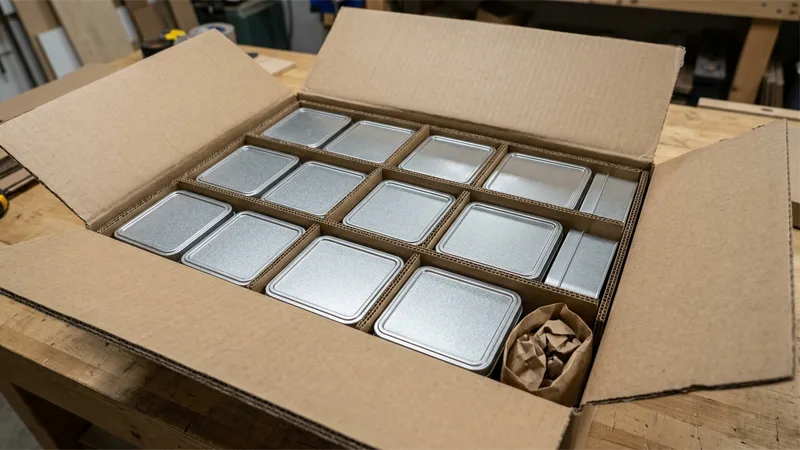
Rectangular tins can often be arranged in rows with dividers between adjacent units. The arrangement should prevent excessive movement while maintaining enough clearance for loading and unloading.
If tins are stacked vertically, check whether the lower tins can support the load without permanent deformation. The lid and broad top panel should not automatically be treated as load-bearing surfaces.
Where the design includes a raised lid, handle, or embossed panel, the packing arrangement should prevent that feature from carrying unintended compression loads.
Round Tins
Round tins may leave larger gaps around the edges of a rectangular carton than rectangular units of a similar volume. Those gaps can permit movement unless the carton layout includes suitable separators or a stable arrangement.
The packing design should also consider whether the tins can roll, tilt, or move vertically. Dividers must be designed around the actual diameter and height, including any curled edges or projecting lid features.
Nested or Stacked Tins
Some tins can be nested or stacked, but this should only be done when the structure permits it. Direct nesting may create abrasion between surfaces or cause one component to become difficult to separate from another.
Before adopting a nested arrangement, check the clearance between components, contact points, coating protection, and the force required to separate the units. A packing method that saves carton volume but damages the finish may not be suitable for the product.
Shipping Tests for Custom Tin Box Packaging
A shipping test should represent the complete packed configuration, not just the empty tin or shipping carton. The result depends on the product, packing materials, carton design, loading pattern, and distribution conditions.
Drop Testing
Drop testing evaluates the response of a packaged product to specified impact events. The test procedure should define the package mass, drop height, impact orientation, and inspection criteria.
After testing, inspect both the carton and the tins. External carton damage alone does not establish that the product has failed, and an intact carton does not guarantee that the tins are undamaged.
For decorative packaging, acceptance criteria may include visible dents, scratches, coating damage, and lid deformation. The criteria should be established before the test.
Vibration Testing
Vibration testing evaluates how a packaged product responds to repeated movement during transport. It can help identify abrasion, shifting, divider displacement, and loosening of the packing arrangement.
After the test, inspect the likely contact areas and compare the damage pattern with the original packing layout. Fine scratches on adjacent surfaces may indicate repeated rubbing rather than a single impact.
Compression Testing
Compression testing evaluates the ability of a shipping package to withstand an applied compressive load under specified conditions. It is relevant when cartons will be stacked during storage or transport.
The test configuration should reflect the actual carton and closure construction. If the carton is tested empty or with a different internal arrangement, the result may not represent the packed product’s performance.
The appropriate test method and acceptance criteria depend on the distribution environment and the consequences of package damage. Not every shipment requires every test, but the selected method should address the principal risks.
A Practical Shipping Validation Plan
A shipping validation plan can be organized around the actual packing configuration and the most likely damage mechanisms.
| Stage | Verification | Record |
|---|---|---|
| Carton design | Internal dimensions, board construction, closure method | Approved carton specification |
| Packing trial | Loading sequence, clearance, divider fit, operator handling | Packing trial record |
| Stacking assessment | Load arrangement and carton compression requirements | Stacking evaluation |
| Transport simulation | Selected drop, vibration, or compression tests | Test results and observed damage |
| Post-test inspection | Dents, scratches, coating damage, lid condition | Defect record |
| Corrective action | Changes to carton, dividers, restraint, or loading pattern | Revised packing specification |
The plan should identify the product configuration, carton specification, number of tins per carton, protective materials, and pallet arrangement. If any of these change materially, the team should assess whether the existing validation remains representative.
Common Mistakes in Tin Box Shipping Packaging
Choosing a Carton Based Only on Price
A low-cost carton may be appropriate for some shipments, but price alone does not establish its suitability. The carton must meet the dimensional, stacking, handling, and surface-protection requirements of the packed product.
Using More Protective Material Without Testing the Layout
Adding more wrapping or cushioning may increase cost and packing time. It may also create pressure points if the material compresses unevenly.
The first step should be to identify how the tins move and where contact occurs. The protective material should then be selected to address that specific mechanism.
Ignoring the Pallet Configuration
Cartons that perform adequately in isolation may behave differently when stacked on a pallet. Overhang, uneven loading, unstable stacking, and moisture exposure can affect the load carried by individual cartons.
The carton specification and pallet arrangement should be evaluated together when the shipment will be palletized.
Inspecting Only the Outside of the Carton
An intact carton can contain scratched or dented tins. Conversely, some external carton marks may not affect the product. The acceptance decision should be based on the condition of the actual tins and the agreed packaging requirements.
Conclusion
Custom tin box packaging for shipping should be designed around the finished product, the carton structure, the internal packing arrangement, and the expected distribution conditions.
Carton clearance, dividers, surface protection, stacking loads, and pallet stability all influence the condition of the tins at delivery. The most reliable approach is to evaluate the complete packed configuration, inspect the product after testing, and document any changes to the approved shipping specification.
A shipping package is suitable when it protects the finished tin under the defined handling and transport conditions without creating unnecessary material use or packing complexity.
Frequently Asked Questions
How do you prevent scratches on tin boxes during shipping?
Prevent direct contact between vulnerable surfaces, control movement inside the carton, and use dividers or protective materials appropriate to the finish. Inspect the tins after a representative packing or transport test to confirm that the protection works.
What carton is best for shipping custom tin boxes?
The suitable carton depends on tin dimensions, gross weight, stacking conditions, transport distance, and required surface protection. Board construction and carton strength should be selected for the actual distribution conditions rather than by carton size alone.
Do metal tin boxes need individual wrapping?
Not every tin requires individual wrapping. Dividers, paper separators, or other protective materials may be sufficient when they prevent damaging contact. The decision should be based on the surface finish, packing arrangement, and observed shipping risk.
How can tin box shipping damage be tested?
Depending on the risk, evaluation may include drop testing, vibration testing, compression testing, and post-test inspection. The test should use the actual packed configuration and defined acceptance criteria.
Why do tin boxes arrive dented even when the cartons look intact?
The carton may have allowed movement or transferred a localized load to a vulnerable panel. Damage can also occur during handling or pallet stacking without producing obvious external carton failure. Inspecting the tins and recording the damage location helps identify the likely cause.