

A Metal Packaging Audits is an independent evaluation of a supplier’s manufacturing facility against global quality and safety standards. B2B buyers can use such audits to verify ISO 9001 compliance, FSSC 22000 food safety measures, traceability protocols, and reductions in defect rates. These audits ensure supply chain reliability, enforce sustainability goals, and mitigate procurement risks.
Procurement managers face constant pressure to secure reliable, compliant, and cost-efficient supply chains. When sourcing tin can packaging for the food and beverage industry, the stakes extend beyond unit price. Defective packaging compromises product integrity, triggers costly recalls, and damages brand reputation. Third-party audits serve as the primary defense against these risks—providing an objective, standardized assessment of a metal packaging supplier’s operational capabilities.
Relying on self-reported supplier data is no longer sufficient for global distribution. Regulatory bodies and major retail chains demand empirical proof of food safety and quality control. Third-party auditing firms bridge this gap by deploying certified inspectors to manufacturing facilities. These inspectors assess every production phase—from raw tinplate sourcing to the final sealing inspection. The resulting audit report provides purchasing personnel with the exact data needed to evaluate new suppliers, negotiate contract renewals, or initiate cost-reduction programs.
Understanding the mechanics of a third-party audit allows procurement teams to make exact, data-backed sourcing decisions. By knowing which certifications hold weight and what specific manufacturing controls auditors verify, buyers can align their procurement strategies with strict environmental goals, navigate supply chain disruptions, and build long-term partnerships with certified metal packaging manufacturers.
Table of Contents
Why Do Metal Packaging Audits?
Third-party audits transform abstract supplier promises into verified operational data. They provide a documented baseline of a manufacturer’s quality management system, ensuring the facility meets predefined international criteria. For purchasing personnel dealing with large volume orders, this verified data acts as a critical risk management tool.
How do audits impact procurement costs and supply chain reliability?
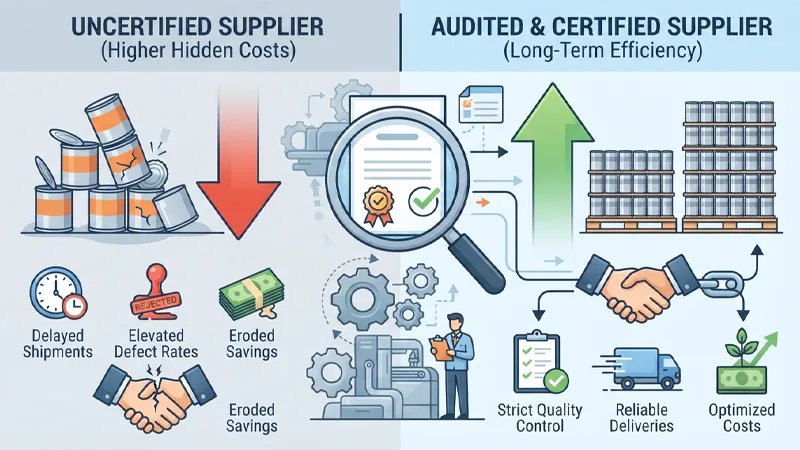
Audits directly influence the total cost of ownership. While an uncertified supplier might offer lower upfront pricing, the hidden costs of elevated defect rates, delayed shipments, and inconsistent sealing quality quickly erode those savings. Third-party audits verify that a metal packaging supplier maintains strict quality control measures—resulting in reliable and consistent output for global brands.
Auditors examine machine maintenance logs, raw material inventory buffers, and production scheduling systems. Suppliers that pass these evaluations demonstrate the capacity to handle fluctuating production demands and execute rapid delivery schedules. When a buyer selects an audited and certified supplier, they reduce procurement lead times and eliminate the costly supply chain disruptions caused by manufacturing bottlenecks. Choose certified suppliers when long-term cost efficiency matters more than immediate unit price discounts.
What role does sustainability play in audit criteria?
Environmental compliance is now a core component of supplier evaluation. Third-party auditors measure a facility’s carbon footprint, waste management protocols, and energy consumption. They verify ISO 14001 certifications—ensuring the supplier adheres to international environmental management standards.
For buyers mandated to meet corporate sustainability goals, audit reports confirm whether a metal packaging supplier actively recycles scrap tinplate, utilizes energy-efficient curing ovens, and sources BPA-free, compliant coatings. This documentation allows procurement teams to prove their supply chain aligns with strict environmental targets.
Which Global Food Safety Standards Apply to Metal Packaging?
Metal packaging intended for food and beverage applications must adhere to specific Global Food Safety Initiative (GFSI) recognized standards. Auditors use these frameworks to measure a facility’s hazard analysis and prerequisite programs.
What are the requirements of FSSC 22000 and ISO/TS 22002-4?
FSSC 22000 is a robust food safety management system certification that incorporates ISO standards and sector-specific technical specifications. For metal packaging, auditors apply ISO/TS 22002-4:2013—a standard that defines the prerequisite programs required for food packaging manufacturing.
During an audit, inspectors verify compliance across several precise criteria:
- Facility layout and workspace—preventing cross-contamination between raw tinplate and finished cans.
- Utilities and air quality—ensuring compressed air used in the manufacturing process is free of oil and moisture.
- Waste disposal systems—mandating the secure segregation of hazardous coating chemicals from production zones.
- Equipment suitability—confirming all cutting, pressing, and sealing machinery undergoes scheduled hygienic maintenance.
Choose FSSC 22000 certified suppliers if your end-product requires strict adherence to European and international food safety regulations.
How does the BRCGS Global Standard for Packaging Materials work?
The BRCGS (Brand Reputation Compliance Global Standards) Packaging Materials standard provides a framework for product safety, legality, and quality. Auditors evaluating a metal packaging facility against BRCGS requirements focus heavily on senior management commitment and continuous improvement.
The BRCGS audit is organized into specific modules:
- Senior Management Commitment—verifying that leadership allocates adequate resources to quality control.
- Hazard and Risk Management System—requiring a documented plan to mitigate chemical migration and physical contamination.
- Site Standards—assessing pest control, security, and facility hygiene.
- Process Control—evaluating the calibration of measuring equipment used for seam inspections and coating thickness.
When should buyers require SQF certification?
The Safe Quality Food (SQF) program is another GFSI-recognized benchmark. SQF places heavy emphasis on the comprehensive documentation of both food safety and quality plans. Choose SQF-certified metal packaging suppliers if your primary market is North America, where major retailers often explicitly mandate this specific certification. SQF audits require manufacturers to designate an internal SQF practitioner, ensuring continuous on-site compliance long after the third-party auditor leaves the facility.
What Exactly Happens During a Supplier Quality Control Audit?
A standard third-party audit spans two to five days, depending on facility size and production volume. The process moves systematically from documentation review to floor inspection, ending with management interviews.
How do auditors evaluate raw material sourcing and traceability?

Traceability is a non-negotiable requirement in food-grade metal packaging. Auditors execute a “traceability exercise”—selecting a random pallet of finished tin cans and requiring the supplier to trace the product back to the exact coil of tinplate used.
- Supplier approval protocols—reviewing the facility’s own audits of their steel and coating providers.
- Material certificates—verifying compliance with heavy metal limits and BPA-free declarations.
- Batch coding precision—ensuring every finished unit features a clear, permanent tracking code.
100% traceability—preventing massive systemic failures during a product recall.
What manufacturing processes face the strictest inspection?
Auditors target the manufacturing stages that dictate the structural integrity and safety of the metal packaging. They observe operators on the floor to confirm they follow documented standard operating procedures (SOPs).
- Coating application—measuring the exact curing time and temperature to ensure internal lacquers do not migrate into food products.
- Seaming and flanging—verifying the mechanical dimensions of the double seam to guarantee airtight performance.
- Leak testing—confirming automated light testers or pressure decay systems identify and reject compromised cans.
How is the defect rate reduction verified on the production line?
Third-party auditors do not just look at functioning machinery; they examine how the facility handles failure. They review the non-conforming product log. They track how often out-of-spec products are produced, how they are quarantined, and what corrective actions the metal packaging supplier implements to prevent recurrence. A facility with a verified defect rate reduction protocol offers a higher degree of cost efficiency and order reliability.
How Should Procurement Managers Evaluate Metal Packaging Audit Reports?
Receiving the final audit report is only the first step. Procurement managers must analyze the findings to make informed contracting decisions.
What red flags indicate potential supply chain disruptions?
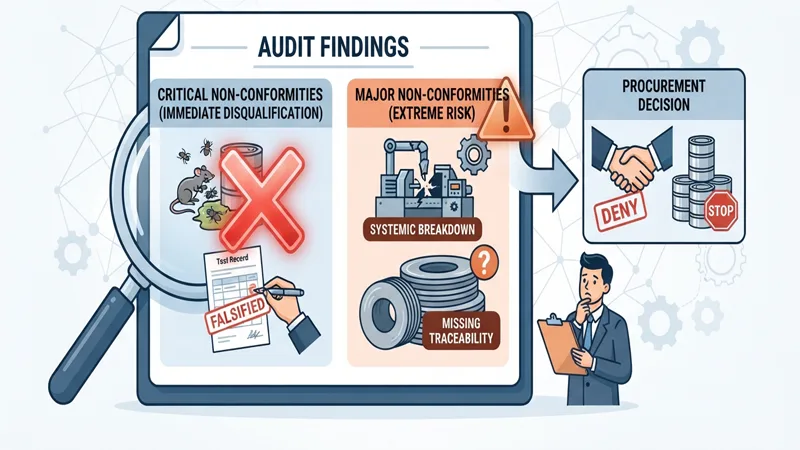
Audit reports categorize findings by severity: critical, major, and minor non-conformities. A single critical non-conformity—such as evidence of pest infestation or falsified testing records—results in immediate audit failure and should disqualify the supplier.
Major non-conformities indicate systemic breakdowns in quality management. Frequent machine breakdowns without preventative maintenance logs or missing traceability data for raw materials signal extreme risk. Suppliers exhibiting these red flags are highly susceptible to production delays, directly causing supply chain disruptions for the B2B buyer.
How do non-conformities affect long-term supplier partnerships?
Minor non-conformities are common and usually involve isolated documentation errors or minor facility wear and tear. The true test of a supplier’s reliability is their Corrective and Preventive Action (CAPA) plan.
Evaluate the supplier based on their response time and the thoroughness of their root cause analysis. A metal packaging supplier that swiftly implements permanent corrective actions demonstrates the operational maturity required for long-term partnerships. Flexible agreements and volume discounts carry value only when the underlying supplier proves capable of continuous improvement.
Navigating Next Steps in Supplier Compliance
Managing a global supply chain requires precision, verified data, and zero tolerance for assumptions. Third-party audits strip away marketing claims and reveal the exact operational reality of a metal packaging supplier. By understanding the distinct parameters of ISO 9001, FSSC 22000, and BRCGS standards, procurement managers can accurately benchmark new suppliers, enforce stringent quality control requirements, and drive meaningful cost reduction initiatives.
Demand full audit transparency during your next contract renewal. Require corrective action plans for any recorded non-conformities, and align your purchasing volume with suppliers who treat quality assurance as an absolute metric.
Frequently Asked Questions (FAQ)
What is the typical cost of a third-party metal packaging audit?
A standard third-party audit for a metal packaging facility costs between $3,000 and $6,000 USD, excluding auditor travel expenses. The facility size, the number of employees, and the specific certification standard (such as BRCGS or FSSC 22000) dictate the final price. The supplier typically bears this cost to maintain their certification status.
How long does the certification and auditing timeline take?
The complete auditing timeline ranges from three to six months. Initial preparation and gap analysis take 30 to 90 days. The actual on-site audit takes two to five days. Following the audit, the facility has 28 days to implement corrective actions for any non-conformities before the final certification is issued.
What are the primary risks if a supplier fails an audit?
If a metal packaging supplier fails a third-party audit, the primary risks include immediate suspension of their certification, halted production lines, and blocked shipments. For the B2B buyer, this results in severe supply chain disruptions, delayed product launches, and the sudden need to secure higher-priced emergency inventory from alternative vendors.
Who is responsible for requesting the supplier audit?
The procurement manager or corporate quality assurance director is responsible for requesting current third-party audit reports during the initial supplier evaluation phase. However, maintaining the certification schedule and booking the auditing body is the explicit responsibility of the metal packaging supplier.