

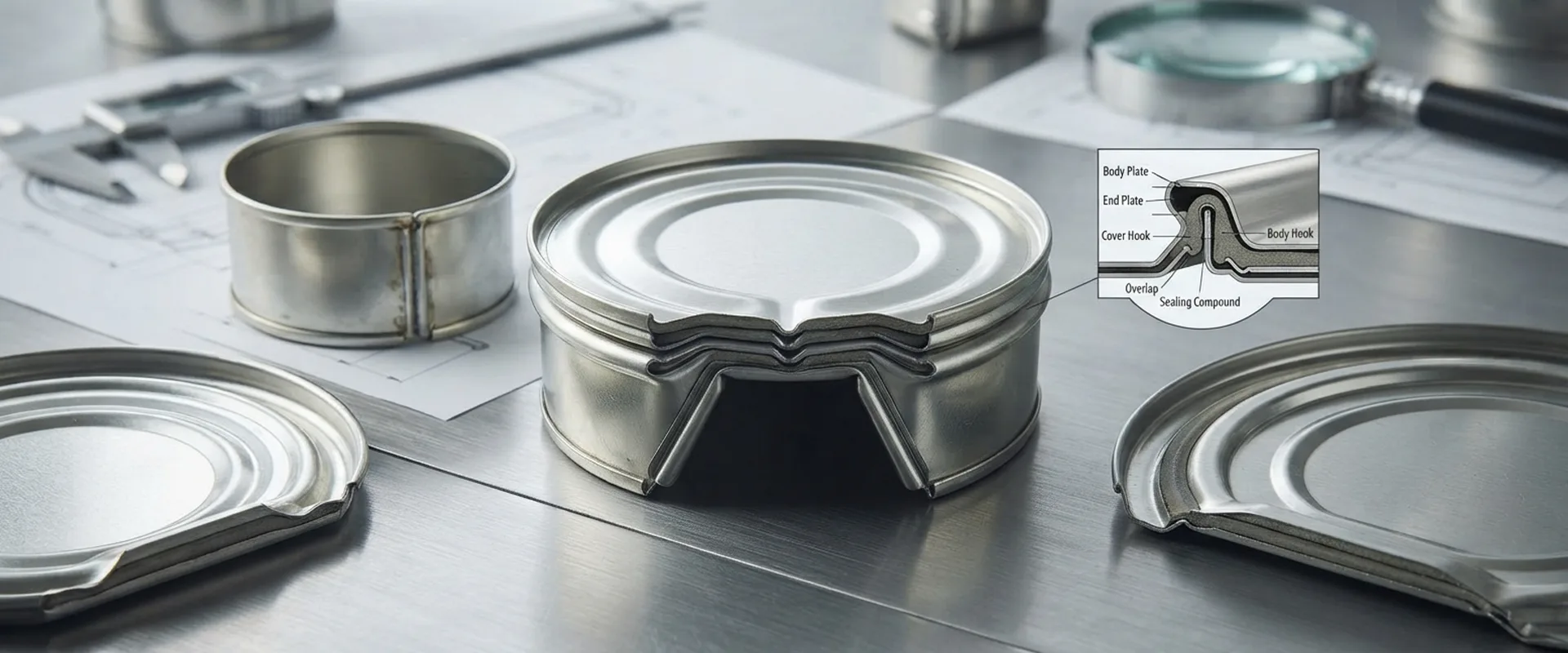

Tin packaging seams and joints connect different parts of a metal container and can affect structural strength, dimensional stability, and leakage performance.
A tin container may contain several types of connections, including folded seams, soldered joints, welded joints, adhesive connections, and mechanically engaged closures. The appropriate structure depends on the container geometry, material, manufacturing process, and intended use.
For food, tea, coffee, cosmetics, and other products, the joint structure can also influence the condition of the internal surface and the performance of the closure.
Understanding tin packaging seams and joints is therefore part of evaluating the complete metal packaging structure.
Table of Contents
What Are Tin Packaging Seams and Joints?
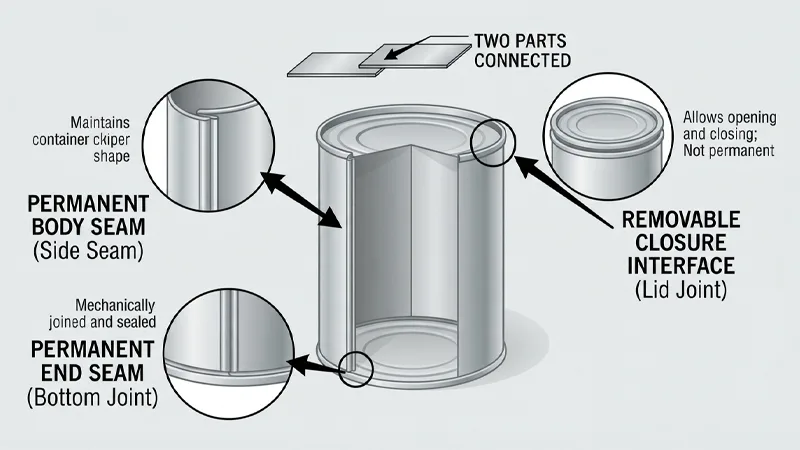
A seam or joint is the area where two or more parts of a metal package are connected.
In a simple tin container, the body may be formed from a sheet that is joined along one vertical edge. The bottom may then be connected to the body through another seam or mechanical structure.
The lid can use a separate closure interface rather than a permanent joint.
The design of each connection depends on its function. A permanent body seam needs to maintain the shape of the container, while a lid connection needs to allow opening and closing.
The distinction between a permanent joint and a removable closure is important because their dimensional and sealing requirements are different.
Types of Tin Packaging Joints
Different manufacturing processes create different types of joints.
Common structures include folded seams, welded joints, soldered connections, adhesive-bonded areas, and mechanically fitted components.
The selection depends on the material, container structure, production equipment, required joint geometry, and intended application.
A joint should not be evaluated only by its appearance. Its dimensions, mechanical condition, internal surface, and leakage behavior may all need to be considered.
Folded Seams in Tin Packaging
Folded seams connect sheet-metal sections by folding one or more layers together.
The sheet is first positioned and then formed through a sequence of bending and folding operations. The final geometry determines how the layers overlap and remain connected.
The dimensions of the folded section affect the position and shape of the container body.
If the seam width or folding position changes, the body dimensions can also change.
For rectangular tin boxes, this can affect the relationship between the side walls and corners. For cylindrical containers, it can affect the circular geometry of the body.
Seam Overlap
The amount of material overlap is part of the seam design.
Insufficient overlap can reduce the mechanical connection between the parts. Excessive overlap can increase local thickness and affect subsequent forming or assembly operations.
The required overlap depends on the specific joint design and manufacturing process.
It should therefore be defined by the production drawing or process specification rather than by a general value applied to all tin containers.
Welded Joints in Metal Packaging
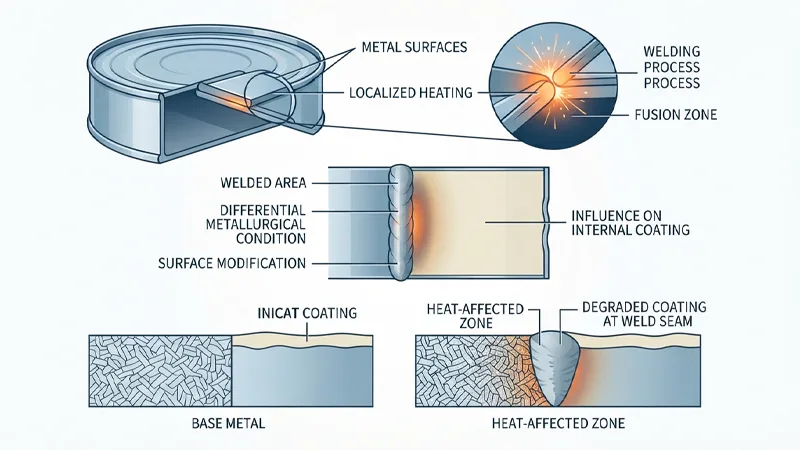
Welding joins metal surfaces through localized heating and fusion or another welding mechanism.
The welding method depends on the material, thickness, geometry, and production equipment.
The welded area can have a different metallurgical and surface condition from the surrounding sheet.
Heat generated during welding can also influence nearby coatings or surface treatments.
For this reason, when welding is used on a food-contact package, the relationship between the welding process and the internal coating system needs to be evaluated.
Welding and Internal Coatings
If the metal sheet has an internal coating before welding, the welding operation can affect the coating near the joint.
The coating may need to be removed from the welding zone before joining, or the process may require another defined treatment.
The resulting joint should then be evaluated for surface condition and compatibility with the intended package application.
The specific process depends on the welding method and package structure.
Soldered Joints in Tin Packaging
Soldering uses a filler material to connect metal surfaces without melting the main substrate in the same way as welding.
When soldering is used, the solder material becomes part of the joint structure.
For food packaging, the suitability of the solder system must be evaluated according to the intended food-contact conditions if the solder or its associated materials can influence the food-contact surface.
The joint design should also prevent unintended exposure of the joining material to the packaged product where this is not permitted by the applicable specification.
Adhesive Joints in Metal Packaging
Adhesives can be used to connect metal components or attach other materials to the package.
An adhesive joint is influenced by the adhesive formulation, substrate preparation, curing conditions, joint geometry, temperature, and storage environment.
Adhesive selection should consider the intended application and whether the adhesive can come into direct or indirect contact with the packaged product.
For food packaging, the relevant food-contact requirements should be evaluated for the specific adhesive and conditions of use.
Tin Packaging Seams and Dimensional Control
Seams are not only connection points. They can also influence the dimensions of the finished container.
During forming, the seam creates an area with multiple layers or a different local structure.
This can affect wall thickness, local geometry, and the position of adjacent surfaces.
For a lid and body that must fit together, dimensional variation around the seam can affect the closure.
For this reason, tin packaging seam dimensions should be included in the dimensional inspection when the seam influences a functional characteristic.
Seams and Tin Box Squareness
Rectangular tin boxes require control of the relationship between their four sides and corners.
A seam that is not positioned correctly can contribute to variation in the overall geometry.
For example, changes in seam position can affect the relationship between the side walls. This may result in differences in length, width, corner position, or squareness.
When a lid is designed to fit over the body, these variations can affect the closure interface.
The inspection should therefore consider both the seam position and the overall container geometry.
Seams and Circularity in Round Tin Containers
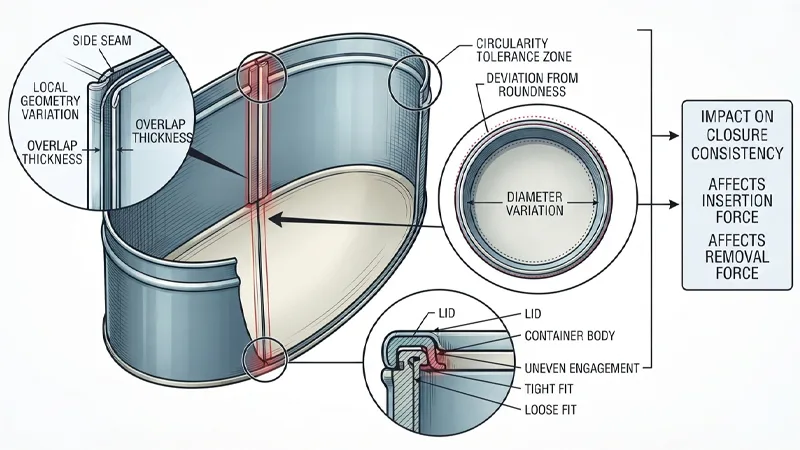
Round metal containers require control of circularity.
During forming and joining, the body can develop local dimensional variation.
A seam or joint can become one of the areas where the local geometry differs from the rest of the body.
If the body is not sufficiently circular, the lid may experience different levels of engagement around its circumference.
This can affect insertion force, removal force, and the consistency of the closure.
Therefore, tin packaging seam inspection can be related to circularity inspection when the joint is part of a round container body.
Seams and Internal Coating Integrity
The internal surface around a seam requires attention when the package is used for food contact.
The joining operation can change the surface condition of the metal and coating.
Potential issues include coating discontinuity, exposed substrate, heat-affected areas, mechanical damage, or changes in the coating near the joint.
The actual condition depends on the joining process and the sequence used during manufacturing.
Inspection should therefore be based on the actual finished package rather than only on the original flat sheet.
Seams and Food Contact
The seam can become part of the food-contact surface depending on the package design.
If the packaged product can reach the joint, the materials used in that area need to be considered as part of the food-contact system.
This may include the metal substrate, tin coating, internal coating, solder, sealant, adhesive, or other joining material.
The applicable food-contact requirements depend on the market and intended conditions of use.
A material should not be described as suitable for all food products without considering the specific food-contact conditions.
Seams and Leak Prevention
A seam can become a leakage path if the joint does not maintain the required connection under the specified conditions.
Leakage can result from incomplete joining, dimensional variation, cracks, local deformation, coating damage, or defects in the sealing system.
The appropriate inspection method depends on the type of joint and the package requirement.
For containers requiring resistance to air or liquid leakage, the complete finished package should be tested using a defined leak-test method.
Leak Paths Around Seams
Leakage does not always occur through a visible opening.
A small discontinuity in a joint can create a path for air or liquid movement.
The size and location of the leakage path can influence whether it is detected by a particular test method.
Therefore, a test method should be selected according to the required leakage limit.
A test that can identify visible water leakage under one condition may not detect the same leakage path under another condition.
Seam Design and Closure Performance
The body seam can influence the closure when it is located near the lid interface.
For example, a change in the local body profile can change the clearance between the lid and body.
This is particularly relevant for friction-fit and interference-fit closures.
The lid may fit correctly over most of the circumference while experiencing increased resistance at the seam location.
In this situation, checking the lid alone may not identify the cause.
The body opening, seam position, local diameter, and circularity should be evaluated together.
This creates a connection between:
Seam Geometry → Body Dimensions → Lid Fit → Closure Performance
Seams, Forming, and Dimensional Variation
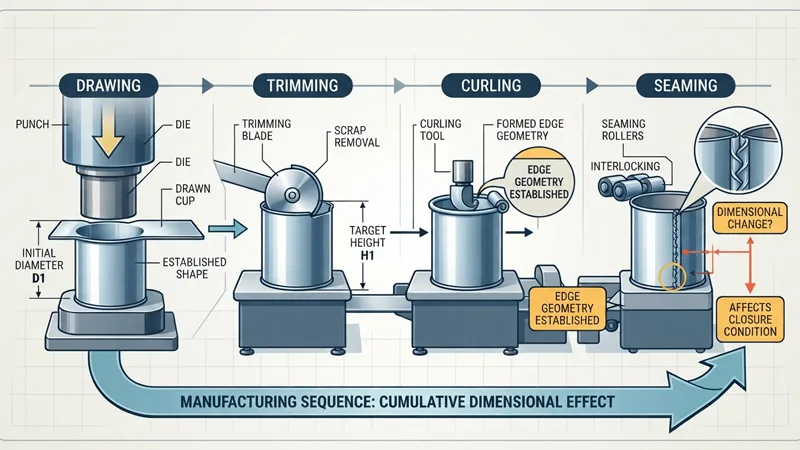
Seaming is normally performed after one or more forming operations, although the exact production sequence depends on the container design.
Each operation can affect the geometry established by the previous operation.
For example, drawing can establish the body shape, trimming can establish the body height, and curling or seaming can establish the edge geometry.
If the seam operation changes the body dimensions, the final closure condition can also change.
This is why the tin box manufacturing process should be considered as a sequence rather than as separate operations with independent dimensional requirements.
Common Tin Packaging Seam Defects
Seam defects can take several forms depending on the joining process.
Incomplete Joint
An incomplete joint occurs when the intended connection between the components is not fully established.
The cause can be related to material positioning, tooling, process parameters, or contamination of the joining area.
Excessive Local Deformation
A seam can produce local deformation when the material is subjected to excessive forming force or incorrect tooling conditions.
This can change the body profile and may affect closure fit.
Cracks or Splits
Cracks can occur when the material is subjected to deformation beyond its forming capability.
They may occur around folded sections, corners, or other areas where strain is concentrated.
Coating Damage
Joining and forming can damage an internal coating near the seam.
The affected area should be evaluated according to the requirements of the internal coating system.
Dimensional Variation
Changes in seam position, overlap, or forming condition can contribute to dimensional variation.
If the affected dimension controls the closure, the variation should be included in the closure inspection.
Inspection of Tin Packaging Seams
Inspection methods depend on the joint structure.
Visual inspection can identify visible defects, but it does not establish all mechanical or leakage properties.
Dimensional inspection can verify seam width, position, overlap, curl geometry, or other defined dimensions.
Mechanical testing can be used where joint strength is a specified requirement.
Leak testing can be used where leakage resistance is required.
Coating inspection can be used to evaluate the internal surface near the joint.
The inspection plan should therefore connect each test to the property it is intended to measure.
Tin Packaging Seam Testing
A seam test should have a defined method and acceptance criterion.
For dimensional testing, the drawing should identify the required dimension and tolerance.
For mechanical testing, the test direction, loading method, and acceptance range should be defined.
For leak testing, the pressure or vacuum condition, test duration, sample configuration, and allowable leakage should be specified.
For coating inspection, the applicable coating property and test method should be identified.
Without these parameters, test results can be difficult to compare between different production conditions.
Seam Inspection During Production
Seam inspection can be performed during setup and production.
Initial samples can be checked after the equipment is adjusted. Production samples can then be inspected at defined intervals.
Inspection frequency depends on the process and the importance of the seam to the final package.
Changes such as tooling replacement, machine adjustment, material changes, or joining-process changes can require additional inspection.
The purpose is to determine whether the production process continues to produce the specified joint geometry and condition.
Seams in Airtight Metal Packaging
For an airtight metal container, the seam is one part of the complete leakage-control system.
The body seam may need to resist air or liquid movement, while the lid interface may use a separate closure or sealing mechanism.
These two areas should not be treated as the same type of seal.
A container can have a mechanically sound body seam while still leaking through the lid interface.
Conversely, a closure can fit correctly while a body seam has a leakage path.
Therefore, airtight metal packaging should be evaluated as a complete package with all potential leakage paths considered.
Seam Design for Tea and Coffee Packaging
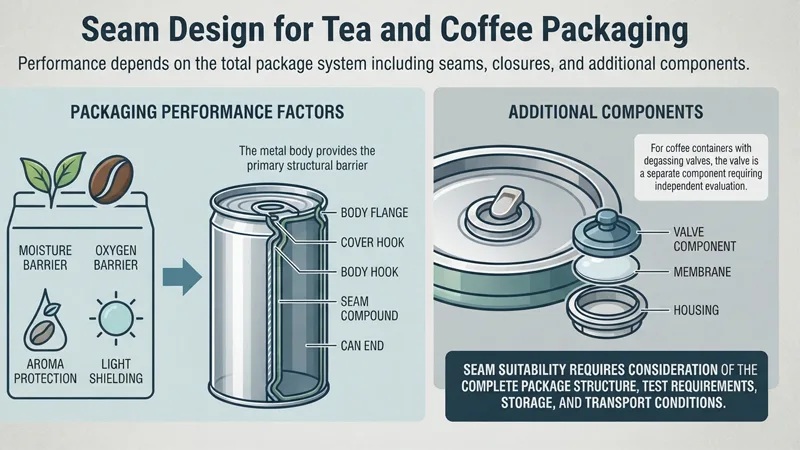
Tea and coffee packaging can have requirements related to moisture, oxygen, aroma, and light.
The metal body provides the primary structural barrier, but the complete package performance also depends on the closure and any additional sealing components.
A body seam should maintain the required structural and leakage condition under the specified storage and transport conditions.
For coffee containers using a degassing valve, the valve becomes another component of the package system and should be evaluated separately from the body seam.
The presence of a seam does not by itself determine whether the package is suitable for tea or coffee. The complete package structure and test requirements need to be considered.
Seams and Transport Conditions
Metal containers can experience changes in temperature, pressure, vibration, and mechanical loading during transport.
These conditions can affect the package through changes in material dimensions, closure force, or mechanical loading of joints.
For a package with defined airtightness or leak-resistance requirements, testing can include conditions that represent the intended distribution environment.
The exact conditions should be based on the actual transport and storage requirements rather than a general assumption about international shipping.
Conclusion
Tin packaging seams and joints are part of the structural and functional design of a metal container.
Folded seams, welded joints, soldered connections, and adhesive joints each have different manufacturing conditions and inspection requirements.
The joint can influence body dimensions, coating condition, closure fit, and leakage performance. For this reason, seam design should be evaluated together with forming, dimensional tolerances, internal coatings, and closure requirements.
The relationship can be summarized as:
Joining Process → Seam Geometry → Body Dimensions → Closure Fit → Leak Performance
For food and other regulated applications, the materials used in the joint should also be evaluated according to the intended contact conditions and applicable requirements.
The final validation should be performed on the finished package using defined dimensional, mechanical, coating, closure, and leak-testing methods where those properties are required.
FAQ
Can a tin packaging seam cause leakage?
Yes. A defective or incomplete joint can create a leakage path. The appropriate leak test depends on the package structure and specified leakage requirement.
How are tin packaging seams inspected?
Inspection can include visual inspection, dimensional measurement, mechanical testing, coating inspection, and leak testing. The method depends on the joint and its function.
Can a folded seam be used for food packaging?
A folded seam can be used in food packaging when the complete package construction and joining method meet the applicable requirements for the intended application.
Are all tin packaging seams airtight?
No. A seam should only be considered leak-resistant or airtight when the complete package has been designed and tested against a defined requirement.
Does seam position affect tin box dimensions?
Yes. Seam position and geometry can influence the overall dimensions and local profile of the container, particularly for rectangular or round bodies.


