

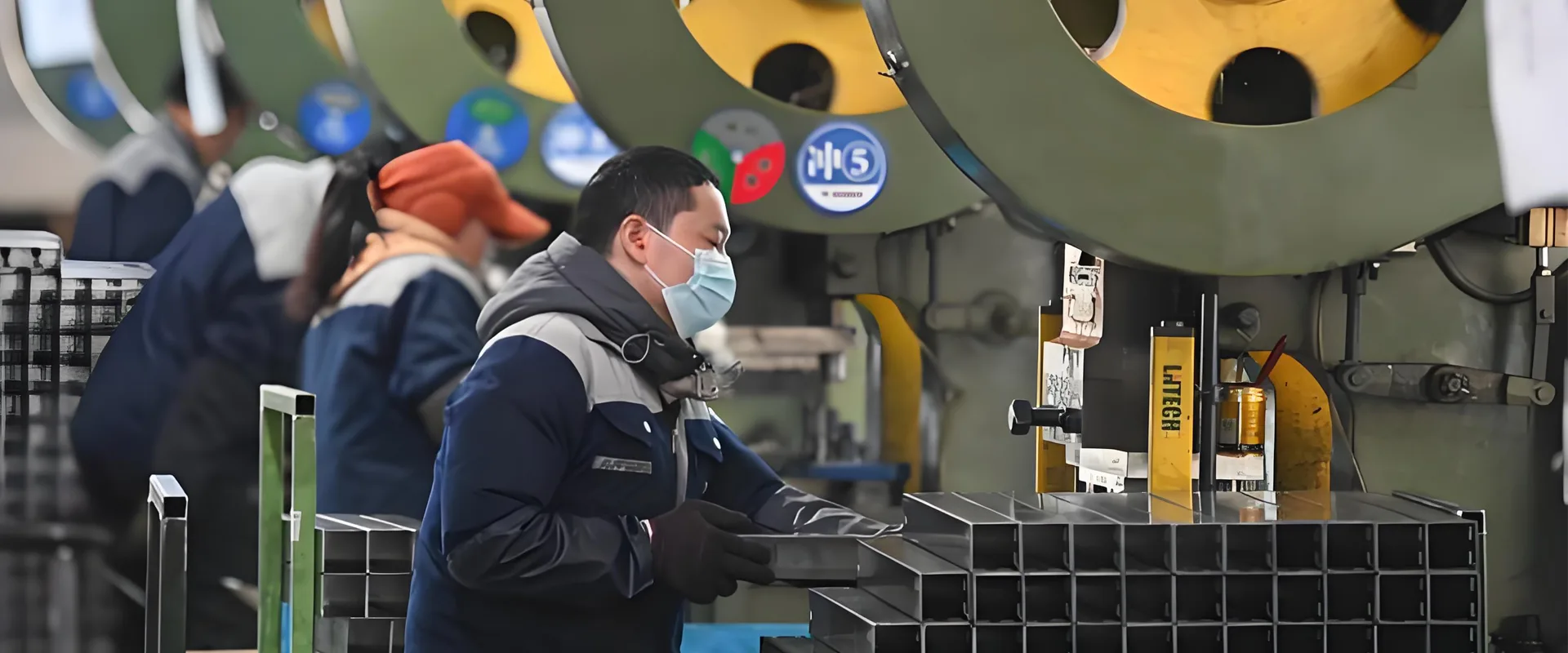

Tin packaging forming processes determine the shape, dimensions, and mechanical condition of a metal container. During manufacturing, flat tinplate is converted into a body, lid, base, or other packaging component through operations such as stamping, drawing, bending, and curling.
The forming process also affects dimensional variation, lid fit, coating integrity, and the condition of the metal surface. For containers that require a defined closure fit, these effects need to be considered during tooling design and production.
This article explains the tin packaging forming process, including tinplate forming, stamping, deep drawing, curling, dimensional control, forming defects, and inspection.
Table of Contents
What Is the Tin Packaging Forming Process?
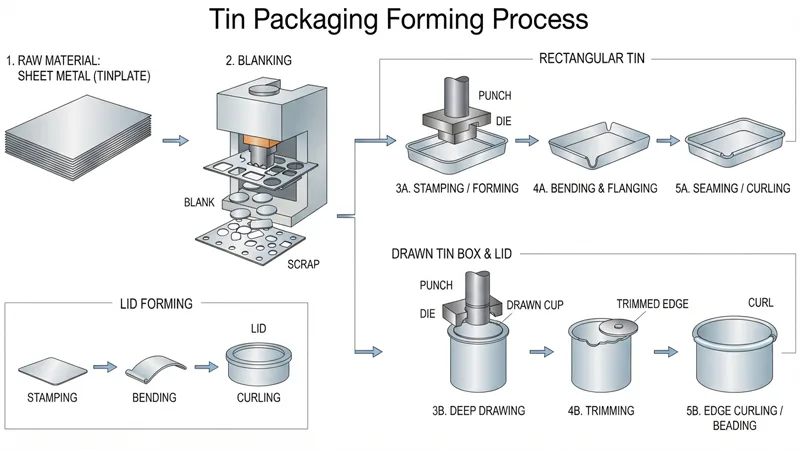
The tin packaging forming process starts with tinplate or another specified metal substrate in sheet form. The sheet is cut into blanks and transferred into forming dies or other tooling. Mechanical force then changes the shape of the blank without removing material from the main body of the component.
Depending on the container structure, forming may include several operations. A shallow rectangular tin may require blanking, stamping, bending, and curling. A drawn tin box may require a drawing operation followed by trimming and edge forming. A lid may require stamping, bending, and curling to create the interface with the container body.
The forming sequence depends on the final geometry, material thickness, drawing depth, corner radius, edge structure, and closure design.
The tin box manufacturing process therefore cannot be separated from the dimensional requirements of the finished container. The tooling controls the geometry produced during forming, while material behavior and process conditions influence the variation around that geometry.
Tinplate Material and Forming Behavior
Tinplate consists of a steel substrate with a tin coating. The steel provides the structural portion of the sheet, while the tin coating forms the surface layer.
During forming, the steel substrate undergoes bending, stretching, compression, or a combination of these deformation modes. The tin coating must remain attached to the substrate while following the change in shape.
The forming behavior depends on factors such as material thickness, steel grade, temper, grain direction, coating system, and forming geometry.
Material thickness is also related to forming force and dimensional behavior. A change in thickness can affect the relationship between the blank, die, punch, and finished component. Therefore, changing the material specification without reviewing the forming process can change the dimensions or forming condition of the container.
For this reason, tinplate forming should be considered together with the material specification and tooling design rather than as an isolated production operation.
Tin Packaging Stamping Process
Stamping is one of the main operations used in metal packaging manufacturing. In a stamping operation, a sheet blank is positioned between tooling components and formed by mechanical force.
The stamping operation can produce flat or shallow three-dimensional structures. It is commonly used for lids, bases, shallow bodies, decorative profiles, recessed areas, and other formed features.
The geometry of the die determines the position and shape of the formed area. The punch applies force to the blank while the surrounding tooling controls material movement.
For a shallow container, the tin packaging stamping process may produce most of the final shape in one operation. For a deeper container or a structure with multiple formed features, several operations may be required.
Stamping parameters can affect dimensional consistency. Changes in press force, tool clearance, material positioning, or tool wear can produce variation between production batches or between different areas of the same component.
Stamping and Material Deformation
During stamping, different areas of the blank may experience different levels of deformation. Flat areas may undergo limited deformation, while corners and transition areas may experience greater strain.
Sharp transitions can concentrate deformation in a small area. This can increase the possibility of local distortion or cracking, depending on the material and geometry.
A forming radius provides a transition between surfaces and allows the material to change direction during forming. The radius therefore becomes a part of the forming design rather than only a geometric detail.
Tin Box Deep Drawing Process
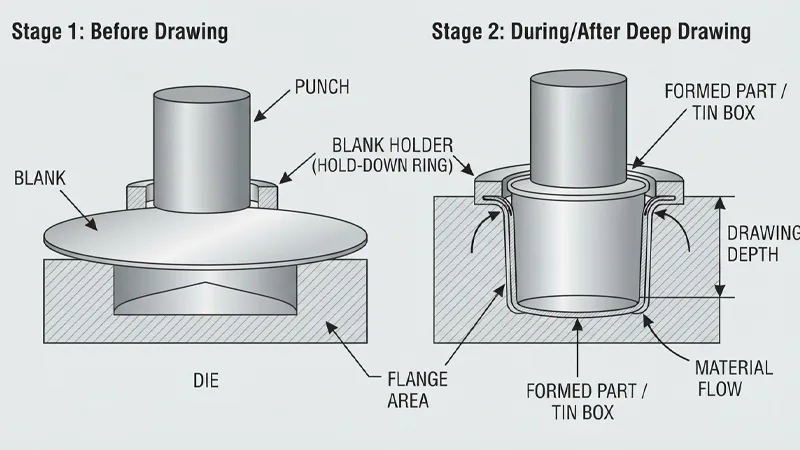
Deep drawing is a forming method in which a flat blank is pushed into a die cavity to produce a container with greater depth.
In the tin box deep drawing process, the blank moves into the die while material flows from the surrounding flange area toward the formed wall. The amount of material movement depends on the blank diameter or dimensions, drawing depth, die geometry, punch geometry, material properties, and process conditions.
The ratio between the initial blank size and the final drawn geometry affects the forming requirements. When the required depth increases, the material undergoes greater deformation and may require more than one drawing operation.
Drawing Depth and Tin Packaging Dimensions
Drawing depth affects both the forming condition and the final dimensions of the container.
A shallow drawn component may be produced in one operation, while a deeper structure may require multiple stages. Each additional stage introduces another opportunity for dimensional variation.
The corner radius is also important. A small radius changes the direction of material flow over a shorter distance, while a larger radius provides a longer transition.
The relationship between drawing depth, wall height, corner radius, material thickness, and blank dimensions should therefore be evaluated during tooling development.
Tinplate Deformation During Forming
Tinplate deformation is not limited to the final height or width of the container. The material can also experience changes in the shape of corners, walls, bottom surfaces, and edge areas.
If deformation is not distributed correctly, the finished component can develop local dimensional variation. This can affect subsequent operations such as trimming, curling, or lid assembly.
For this reason, the tinplate forming process should be evaluated as a sequence rather than only by checking the final container dimensions.
Tin Packaging Curling Process
Curling forms the edge of a metal component into a curved or rolled profile. It is commonly used on the upper edge of tin containers and lids.
The tin box curling process creates the edge geometry required for handling, joining, or closure engagement. Depending on the structure, the curled edge may interact directly with another metal component or with a sealing material.
The curling operation changes the local geometry of the edge. Because the closure interface is located in this area, dimensional control of the curl is directly related to lid fit.
If the curled diameter, height, radius, or position changes, the relationship between the lid and body can also change.
Curling and Lid Fit
A friction-fit or interference-fit lid depends on the relationship between the body and lid dimensions.
For example, if the body opening becomes smaller while the lid remains unchanged, insertion force can increase. If the opening becomes larger, the lid may have less contact with the body.
The same principle applies to curled edges. A change in the curl profile can change the effective engagement between the two components.
This means that tin packaging curling process parameters should be considered together with closure dimensions rather than treated as an independent edge operation.
How Forming Affects Tin Packaging Lid Fit
Lid fit is determined by several dimensions rather than one nominal measurement. These can include body opening dimensions, lid dimensions, curl geometry, wall thickness, corner dimensions, and the relative position of these features.
Forming can influence each of these dimensions.
For a rectangular tin, corner deformation can be particularly important. The straight sections may remain close to the intended dimensions while the corner areas show greater variation.
For a round tin, the circularity of the body and lid becomes an important factor. A change in circularity can produce changes in local clearance and opening force.
The tin packaging dimensional variation therefore needs to be evaluated at the closure interface.
A drawing that specifies only the overall length, width, and height may not fully define the closure. Critical closure dimensions should have their own inspection requirements and reference datums.
Forming and Internal Coating Integrity
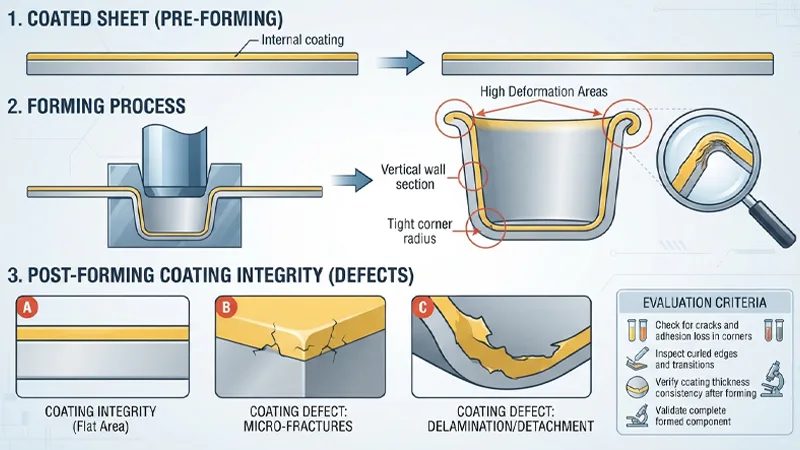
Tin packaging may use an internal coating between the metal substrate and the packaged product. The coating can be applied before or after forming, depending on the production system and product structure.
When coated sheet is formed, the coating follows the deformation of the substrate. Bending and drawing can therefore affect the coating condition.
Areas with high deformation include corners, drawing transitions, curled edges, and other formed features.
If the forming strain exceeds the capability of the coating system, coating defects may occur. The type and extent of the defect depend on the coating formulation, substrate, coating thickness, curing condition, forming geometry, and process.
For food packaging, the internal coating system should therefore be evaluated as part of the complete manufacturing process.
A coating that passes a test on a flat sheet does not automatically demonstrate the same condition after forming. Validation should consider the formed component when the forming operation creates significant deformation.
Forming Tolerances in Tin Packaging Manufacturing
The tin packaging forming tolerance should be related to the function of each dimension.
Not every dimension requires the same tolerance. A non-functional external dimension may allow more variation than a closure dimension.
For example, overall container height may have one tolerance range, while the lid engagement diameter may require a different control range.
A practical drawing should identify critical dimensions and define the measurement method. The measurement location also matters because a formed wall can vary along its height.
For rectangular containers, measurements may include:
- Overall length and width
- Body opening
- Corner radius
- Wall height
- Curl dimensions
- Lid dimensions
For round containers, measurements may include:
- Outside diameter
- Inside diameter
- Circularity
- Wall height
- Curl diameter
- Lid engagement dimensions
The exact tolerance values should be established according to the container structure, forming method, material, tooling, and closure requirements. A single tolerance value should not be applied to every tin packaging component.
Common Tin Box Forming Defects
Several types of defects can occur during the tin box forming process. Their causes can be related to material properties, tooling, process parameters, lubrication, blank positioning, or forming geometry.
Wrinkling
Wrinkling occurs when compressive forces cause the sheet to buckle during forming.
Wrinkles can occur in flange areas or other regions where material is compressed. The severity depends on the material, geometry, tool design, and process conditions.
Cracking
Cracking occurs when local deformation exceeds the material’s forming capability.
It can appear around corners, drawing transitions, or other areas where strain is concentrated.
A reduction in drawing depth per operation, a change in forming radius, or a change in material specification may be considered when investigating cracking.
Local Deformation
Local deformation refers to an area that does not maintain the intended geometry after forming.
It may appear as a dent, distortion, uneven wall, or localized change in the formed profile.
Local deformation can affect assembly when it occurs near the lid interface.
Dimensional Variation
Dimensional variation occurs when formed components differ from the intended dimensions or when dimensions vary within the same component.
Tool wear, material variation, press conditions, blank positioning, and forming sequence can all contribute to dimensional variation.
The correct response depends on where the variation occurs and whether the affected dimension has a functional requirement.
Tin Packaging Forming and Surface Finishing
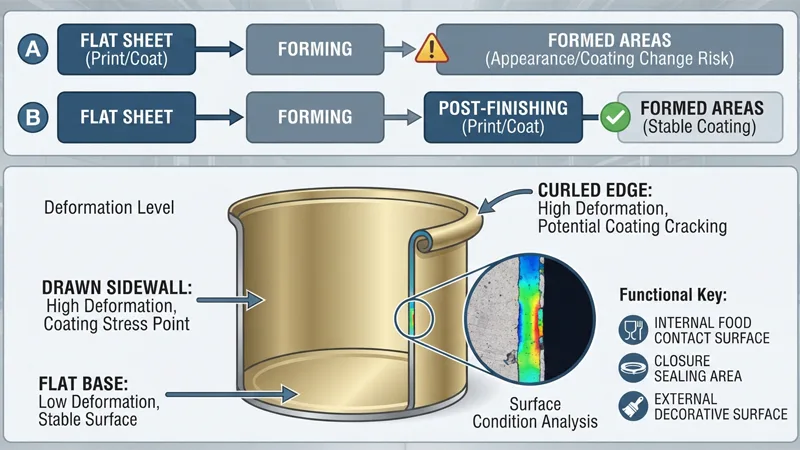
Surface finishing should be considered in relation to forming.
Printing, varnishing, coating, and forming can be arranged in different production sequences. When printed or coated sheet is formed, the formed areas may experience changes in appearance or coating condition.
The production sequence should therefore account for the deformation level of each surface.
A surface that remains flat during forming has a different deformation condition from a surface that becomes a drawn wall or curled edge.
For this reason, the production drawing should identify surfaces that have functional requirements, such as internal food-contact surfaces, closure areas, and external printed areas.
DFM for Tin Packaging Forming
Design for manufacturing, or DFM, should be considered before tooling is produced.
The container geometry should be reviewed against the selected forming process. Drawing depth, corner radius, wall structure, curl geometry, material thickness, and feature spacing can all affect manufacturability.
For a deep-drawn tin box, the designer should review whether the required depth can be achieved in the planned number of operations.
For a stamped tin, the designer should review whether the formed features can be produced without excessive local deformation.
For a lid, the designer should review the relationship between the lid profile and the body curl before finalizing tooling.
DFM also includes inspection access. A dimension that cannot be measured consistently during production is difficult to control, even when its nominal value is defined on the drawing.
Inspection After Tin Packaging Forming
Inspection after forming verifies whether the component meets the defined dimensions and surface requirements.
Dimensional inspection may include direct measurement with calipers, micrometers, gauges, height gauges, optical equipment, or other measurement systems depending on the geometry and required accuracy.
For closure components, inspection should focus on the dimensions that control assembly.
The body and lid should also be evaluated as a matched system. Measuring each component separately does not always show how they will behave during assembly.
For example, a body can be within its individual dimensional range while a lid is also within its own range, but the combination may produce a closure condition outside the required assembly range.
This is why tin packaging dimensional variation should be evaluated using both component-level measurements and assembly checks.
Validation of Tin Packaging Forming Process
Process validation should establish whether the forming process can repeatedly produce components within the specified requirements.
The validation approach depends on the container structure and application. Dimensional inspection can be combined with closure assembly checks, coating inspection, visual inspection, and other tests relevant to the final package.
For containers with sealing requirements, the forming process should also be evaluated together with the closure and sealing system.
A forming process that produces correct external dimensions does not by itself demonstrate leak resistance. Leak performance depends on the complete closure system, including the mating geometry and any sealing component.
Similarly, dimensional inspection does not by itself demonstrate coating compatibility. Coating condition should be evaluated using the applicable coating and food-contact requirements.
Conclusion
The tin packaging forming process determines more than the external shape of a metal container. Stamping, drawing, bending, trimming, and curling affect the dimensions and geometry of the body, lid, edges, and closure interface.
For tin packaging manufacturing, forming should therefore be considered together with material selection, tooling design, dimensional tolerances, coating requirements, and inspection.
The main relationship can be expressed as:
Material → Tooling → Forming Process → Dimensions → Closure Fit → Final Package Performance
Controlling this sequence helps establish a connection between the design drawing and the finished metal container. For containers with specific closure or sealing requirements, the forming process should be validated using the dimensions and functional requirements that control the final package.
FAQ
How are tin boxes formed?
Tin boxes are formed from sheet metal using operations such as blanking, stamping, drawing, bending, trimming, and curling. The specific sequence depends on the shape and dimensions of the container.
What is the tin box deep drawing process?
The tin box deep drawing process uses a punch and die to form a flat metal blank into a container with depth. The material flows from the blank into the die cavity while the walls and bottom are formed.
What is the tin packaging stamping process?
The tin packaging stamping process uses a press and tooling to form sheet metal into a specified shape. It is used for lids, bases, shallow containers, recessed areas, and other formed features.
Why is curling used in tin packaging?
Curling forms the edge of a tin container or lid into a defined profile. The resulting edge can be used for closure engagement, joining, or other structural functions.
Does forming affect tin box lid fit?
Yes. Forming can change the dimensions and geometry of the body and lid. Changes in the opening, curl, corner profile, circularity, or other closure dimensions can affect insertion force and engagement.
What causes tin box forming defects?
Forming defects can result from material properties, tooling geometry, forming depth, tool clearance, blank positioning, press conditions, lubrication, or process sequence. The cause should be determined from the location and type of defect rather than from the appearance alone.
Does forming affect internal coating performance?
It can. Forming causes the substrate and coating to deform together. Areas with higher deformation may require evaluation of coating adhesion, continuity, and compatibility after forming.


