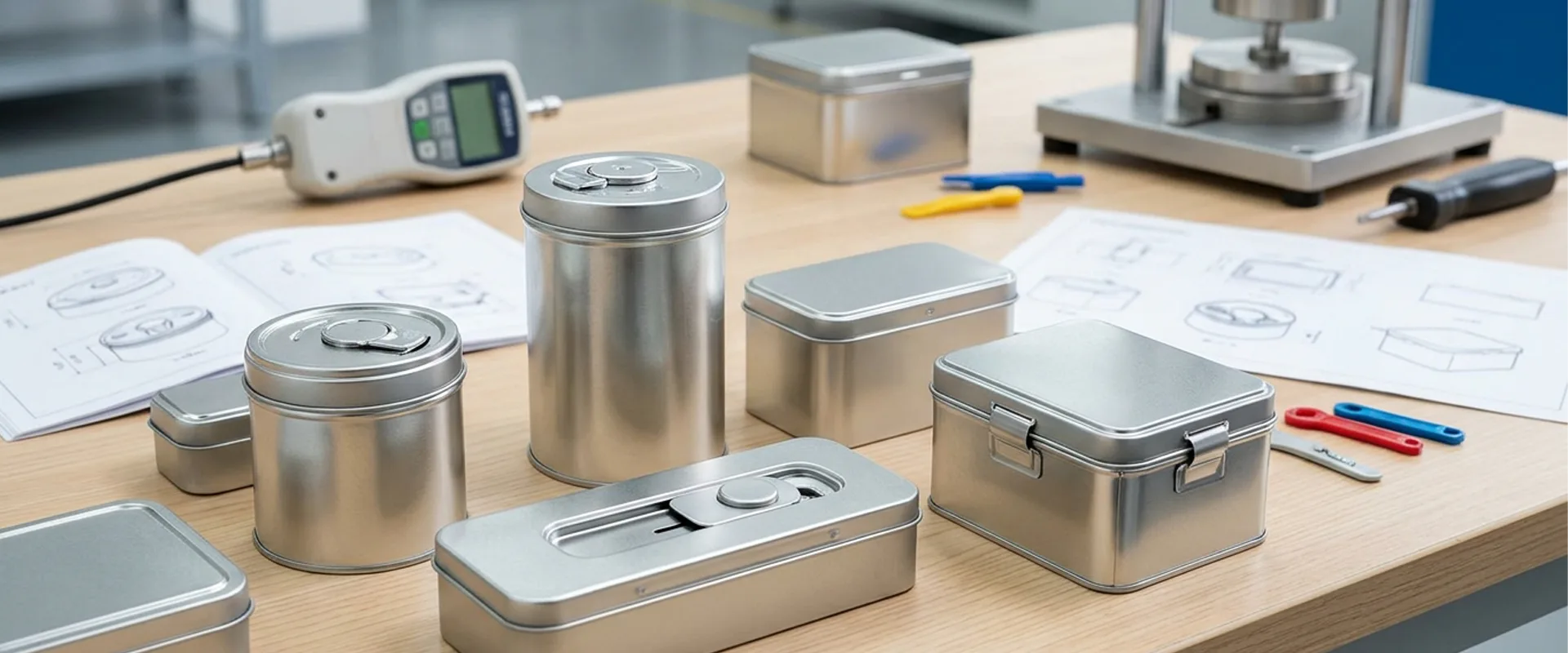
A child resistant tin box is a metal container with a closure that young children find difficult to open, while adults can still open and reclose it without special tools. The closure is usually a push-button mechanism, a sliding lid, or a lid that needs two actions at the same time.
Many buyers treat child resistance as a feature that can be added to any hinged tin. In practice, the closure, the tin body, the lid fit, and any insert work as one system. A change in one part can change how the package performs in testing.
This article explains the main closure types for child resistant metal tins, the standards that apply in the United States, Europe, and Canada, and the specification details a manufacturer needs before developing a custom child resistant tin container.
Table of Contents
What Is a Child Resistant Tin Box
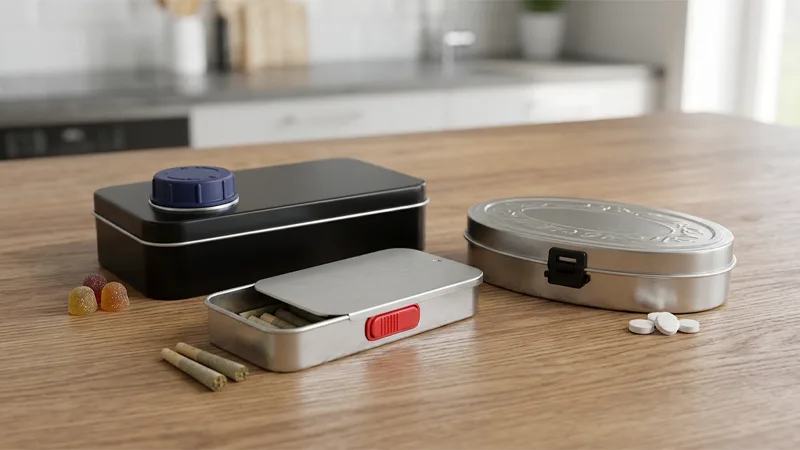
A child resistant tin box is a reclosable metal package designed so that a young child cannot open it within a defined test period. The package must also remain usable for adults, including older adults.
Tinplate is commonly used for these containers because it holds its shape, accepts printing, and can be formed into hinged or sliding structures. The tinplate body is often combined with plastic parts such as a push button, a locking tab, or an inner tray.
The term “child resistant” does not mean “child proof.” Packages are tested against a defined child panel and a defined adult panel, and the result is a pass rate, not a guarantee for every child.
Typical Products
Child resistant tin packaging is used for products that need restricted access, including:
- Pre-rolled products and edibles in regulated markets
- Nicotine and tobacco-related products
- Over-the-counter supplements and vitamins
- Mints and confectionery containing active ingredients
- Certain household and chemical products
Which products legally require child resistant packaging depends on the country, the product category, and the substance. The requirement should be confirmed for the destination market before packaging development starts.
Child Resistant Tin Closure Types
The closure determines how the package is opened and how it relocks. Each type has different structural requirements.
Double Push-Button Hinged Tin
This structure uses a hinged lid with two buttons, usually on opposite sides of the body. Both buttons must be pressed at the same time to release the lid. A young child often lacks the hand strength or coordination to press both buttons together while lifting the lid.
The hinge, the button travel, and the catch on the lid edge all affect the opening force. A hinged child resistant tin box usually needs tighter tolerances than a standard hinged tin because the catch must engage reliably after every closing cycle.
Sliding Lid Child Resistant Tin
A sliding structure requires the user to push a locking element and slide the lid in one direction. The rails or grooves on the body must keep the lid aligned, and the lock must reset when the lid closes.
Sliding tins are used for flat products such as cards, small pre-rolls, and mints. The rail geometry and the metal thickness affect how smoothly the lid moves after repeated use.
Push-and-Turn Round Tin

Some round child resistant metal tins use a lid that must be pressed down and rotated at the same time. The lid and body include matching lugs or a plastic liner that engages when the lid is turned.
This type depends on the circular fit between the lid and the body. Roundness, curl dimensions, and lid depth have a direct effect on the opening torque.
Tin Shell with Plastic Insert
In some designs the child resistant mechanism is built into a plastic insert, and the tinplate shell provides the outer structure and printed surface. The insert holds the locking parts, and the tin keeps the insert in position.
This structure can reduce the number of metal forming steps, but the fit between the insert and the tin must be controlled because the locking parts depend on it.
| Closure type | Common shape | Opening action | Main structural considerations |
|---|---|---|---|
| Double push-button hinged | Rectangular | Press two buttons and lift lid | Hinge alignment, button travel, catch engagement |
| Sliding lid | Rectangular, flat | Push lock and slide lid | Rail geometry, lock reset, metal thickness |
| Push-and-turn | Round | Press down and rotate | Roundness, curl dimensions, liner fit |
| Tin shell with insert | Rectangular or round | Depends on insert design | Insert tolerance, retention in the tin |
Testing Standards for Child Resistant Packaging
Child resistant packaging is evaluated with a test protocol that uses a panel of children and a panel of adults. The specific standard depends on the market where the product is sold.
United States: 16 CFR 1700.20
In the United States, the Consumer Product Safety Commission regulates special packaging under the Poison Prevention Packaging Act. The test procedure is described in 16 CFR 1700.20. The regulations set effectiveness specifications of not less than 85 percent without a demonstration and not less than 80 percent after a demonstration of how to open the package.
The list of products that must use special packaging is given in 16 CFR 1700.14. Some state programs for regulated products also refer to this test procedure.
International: ISO 8317
ISO 8317 specifies performance requirements and test methods for reclosable packages designated as resistant to opening by children. It applies to reclosable packages for any product that is exposed or removed from the package in normal use. The standard is intended for type approval, not for routine quality assurance.
European Union: CLP Regulation
Under the CLP Regulation, child resistant containers must be tested by a laboratory accredited to ISO 17025. ISO 8317 applies to reclosable containers, and EN 862 applies to single-use containers. Metal tins are reclosable, so ISO 8317 is the usual reference.
Canada: CCCR
The Consumer Chemicals and Containers Regulations accept testing against CSA Z76.1, ISO 8317, or 16 CFR 1700.20, or an equivalent or higher standard, for products that require child resistant containers.
| Market | Regulation or standard | Package type |
|---|---|---|
| United States | 16 CFR 1700.20 | Reclosable special packaging |
| International | ISO 8317 | Reclosable packages |
| European Union | CLP, ISO 8317, EN 862 | Reclosable and single-use |
| Canada | CCCR, CSA Z76.1, ISO 8317 | Reclosable |
The applicable requirements change over time and differ by product. The buyer or brand owner should confirm them with a regulatory adviser or the testing laboratory.
What the Certification Covers
A test report applies to a specific package design, not to a type of tin in general. The report is tied to the combination of body, lid, closure parts, insert, and the product or a suitable substitute used in the test.
For this reason, the following changes may require the package to be evaluated again:
- A change in tinplate thickness or temper
- A change in lid or body dimensions
- A change in the push button, lock, or hinge material
- A change in the insert design
- Replacement of tooling with a new die set
- A change in the coating or print finish on contact surfaces
Whether retesting is needed in each case should be confirmed with the laboratory that issued the report. Certification of a sample does not automatically cover later production if the tooling or components have changed.
Design Factors in Child Resistant Metal Tins
Closure Force and Opening Force
The force needed to open the tin has two limits. It must be high enough that children cannot open it, and low enough that adults, including older adults with reduced hand strength, can open it. This balance is one reason these tins need tighter control than standard tins. The factors that affect opening and closing force are discussed in Tin Packaging Closure Force.
Lid Fit and Dimensional Tolerance
The gap between the lid and the body, the curl height, and the hinge position affect how the locking parts engage. If the lid is too loose, the lock may not hold. If it is too tight, the package may be difficult for adults to open. More detail on this relationship is in Tin Packaging Lid Fit and Dimensional Tolerances.
Hinge Durability
A child resistant tin is opened and closed many times during its use. The hinge and the catch should keep the same behavior across the expected number of cycles. The test approach for repeated opening is described in Hinged Tin Boxes Design and Durability Testing.
Surface Finish and Print
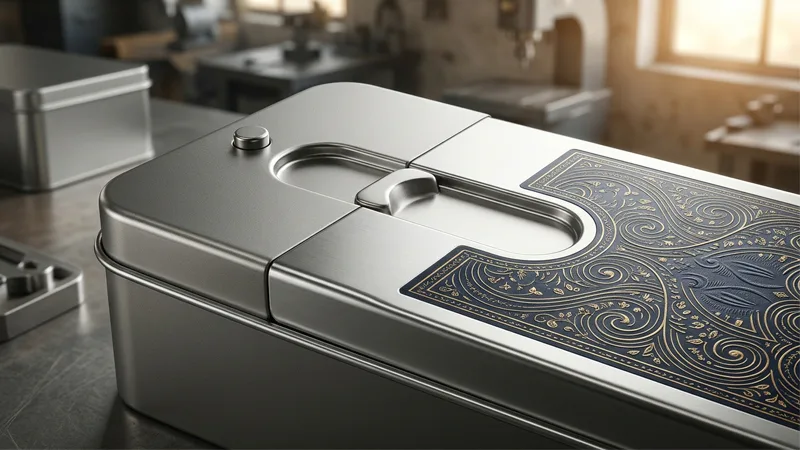
Printing, varnish, and embossing near buttons or sliding surfaces can change friction and appearance. Artwork should be reviewed against the structural drawing so that print areas do not overlap the parts that move or lock.
Inserts and Inner Packaging
If the tin contains a tray, divider, or inner pouch, the insert should not interfere with the lock. Material choices for inserts are covered in Custom Tin Box Inserts Material Selection and Fit Guide.
Production Controls for Child Resistant Tin Containers
After a design is approved, production needs to keep the dimensions and closure behavior close to the tested sample.
- Tooling control: Die wear changes dimensions over time, which can change how the lock engages. The effect is described in Tin Packaging Tool Wear.
- Incoming parts: Plastic buttons, locks, and inserts should be inspected for dimensions and material before assembly.
- In-process checks: Closure force, lid fit, and lock engagement can be checked at set intervals during production.
- Final inspection: Samples from each batch are opened and closed to confirm that the lock resets and that the lid does not release without the intended action.
- Records: Batch records that link the lot to the approved sample and the test report make later review easier.
General inspection and validation methods are listed in Tin Packaging Testing and Validation.
Specification Requirements for Custom Child Resistant Tin Packaging
A manufacturer needs the following information to evaluate a custom child resistant tin box.
| Requirement | Information to provide |
|---|---|
| Destination market | Country or state, and the applicable regulation |
| Product type | Product, form (solid, liquid, powder, pre-roll), and net quantity |
| Required standard | 16 CFR 1700.20, ISO 8317, CLP, or other |
| Tin shape and size | Internal and external dimensions |
| Closure type | Push-button hinged, sliding, push-and-turn, or other |
| Material | Tinplate thickness and finish, if specified |
| Inner packaging | Insert, tray, pouch, or liner requirements |
| Food contact | Whether an internal coating is needed |
| Artwork | Print files, color references, and varnish or emboss requirements |
| Testing | Who arranges the laboratory test, and on which samples |
| Quantity | Order quantity and expected repeat volume |
Sending this information with the request helps the manufacturer decide whether an existing structure can be used or a new tool is required. A list of technical items for quotations is given in Custom Tin Packaging RFQ: Technical Requirements for Quotation, and order quantity and cost factors are explained in Custom Tin Box MOQ and Pricing Factors.
Common Problems
The Lid Opens Without the Intended Action
This can happen when the catch does not fully engage, the hinge is out of alignment, or the lid dimensions are outside tolerance. The lock and lid fit should be checked together.
Adults Have Difficulty Opening the Tin
The opening force may be too high, the buttons may be too small, or the lid may fit too tightly. An adult usability check should be included during development, not only at final testing.
The Lock Does Not Reset After Closing
Weak springs, worn parts, or contamination from the product can keep the lock from resetting. The package should be checked after repeated cycles.
Test Results Do Not Match Production Samples
If the production tooling or parts differ from the tested sample, the results may not apply. The approved sample, the tooling, and the component list should be recorded and compared with each new production lot.
Rust or Coating Damage Near Moving Parts
Friction at hinges and sliding surfaces can wear the coating over time. The finish on these areas should be reviewed in the structural stage.
Conclusion
A child resistant tin box depends on the closure type, the dimensional fit between lid and body, the parts used in the lock, and the standard required in the destination market. The test report applies to a specific package design, so changes to tooling, material, or components should be reviewed before production.
Buyers can reduce development time by confirming the market requirement first, selecting a closure type that matches the product, and providing a complete specification. Structural drawings, a sample for adult opening checks, and agreement on laboratory testing should be settled before production tooling is made.
FAQ
What is a child resistant tin box?
It is a reclosable metal container with a closure that young children find difficult to open. Adults can open and close it using a defined action, such as pressing two buttons or sliding a lock.
Which standards apply to child resistant tin containers?
In the United States, the test procedure is 16 CFR 1700.20. ISO 8317 is used internationally for reclosable packages and is referenced in the European Union and Canada. The correct standard depends on the product and the destination market.
Can any hinged tin be made child resistant?
Not by adding a lock alone. The hinge, lid fit, and lock work together, and the complete package is tested. A standard hinged tin may need structural changes before it can pass.
Does a child resistant tin need to be retested when the design changes?
Changes to the body, lid, closure parts, insert, or tooling may affect the result. The laboratory that issued the report can advise whether retesting is needed.
What tin material is used for child resistant packaging?
Tinplate is commonly used for the body and lid. The closure parts are often plastic or metal, depending on the structure. Food contact requirements, if any, are handled with internal coatings and inner packaging.
What information is needed for a quotation?
The destination market, product type, closure type, tin dimensions, material, inserts, artwork, testing requirements, and order quantity.