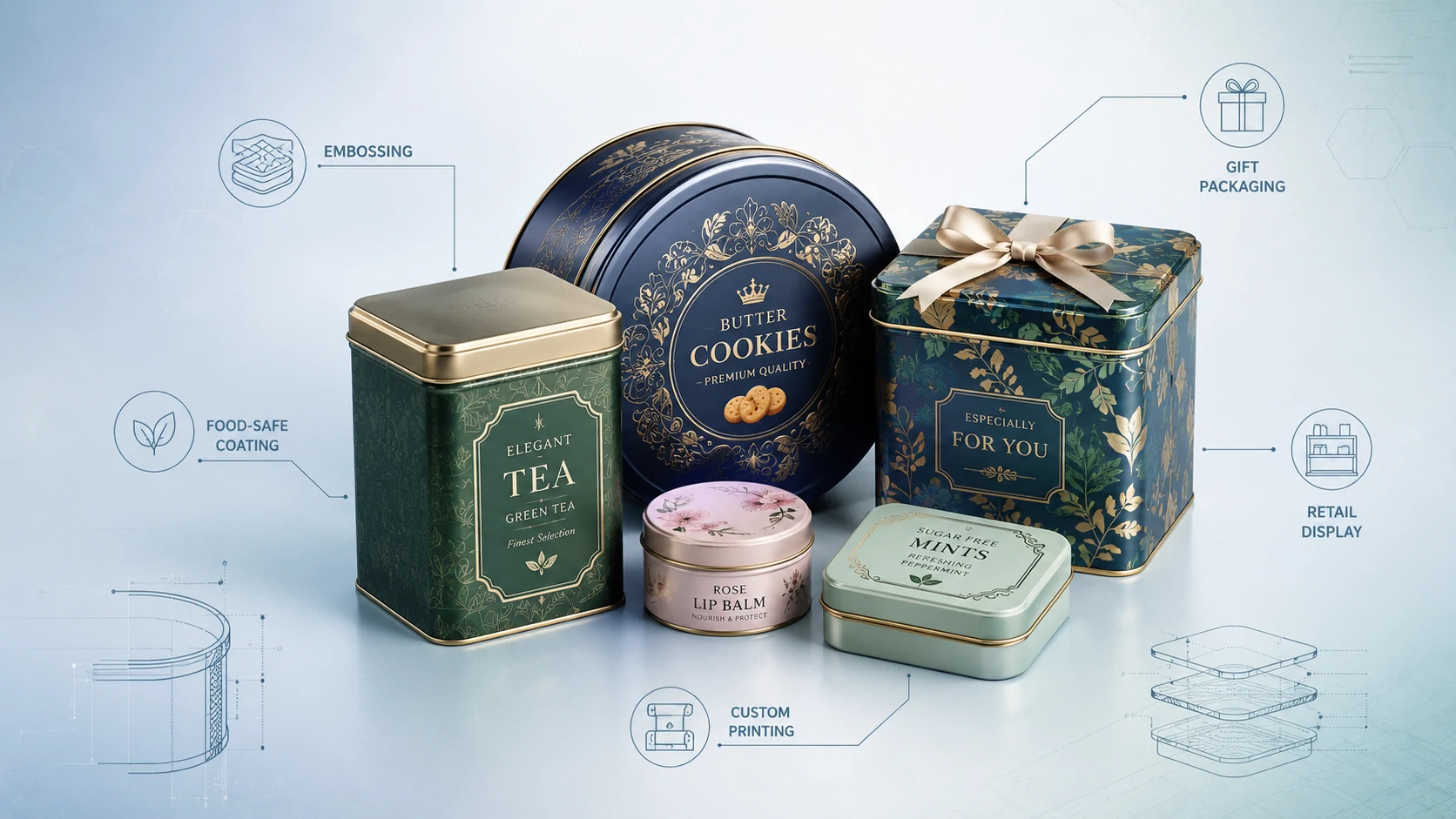
Decorative tins are no longer simple metal boxes used only for cookies, mints, or holiday candy. For modern retail and promotional products, they have become a practical packaging format that combines shelf appeal, product protection, gift value, brand storytelling, and long-term reuse. A well-designed decorative tin can make a tea collection look premium, turn a candle into a giftable product, make a cosmetic balm feel more collectible, organize a promotional kit, or help a limited-edition launch stand out in a crowded retail aisle.
For brands, the real value of decorative tins is not only that they look attractive. The stronger business reason is that decorative tin packaging can work as both a container and a brand asset. It protects the product during storage and distribution, gives designers a large printable surface, creates tactile interaction through embossing or special varnish, and often remains in the customer’s home after the original product has been used. This reuse behavior is especially valuable for gift, seasonal, beauty, food, tea, coffee, confectionery, and corporate promotional programs.
At Mr. Tin Box, custom metal tin packaging is developed for Food & Beverage Packaging, Beauty & Personal Care Packaging, gift and promotional products, and specialty packaging projects. The same design logic applies whether the brand is ordering small decorative tins for lip balm, square tins for tea, round tins for mints, hinged tins for gift sets, or large decorative cookie tins for seasonal retail campaigns.
This guide is written for brand owners, product managers, packaging buyers, private-label teams, distributors, and promotional product companies that want to turn decorative tins into a practical commercial advantage. It explains design ideas, material decisions, finish options, compliance considerations, cost drivers, quality checkpoints, and briefing details in plain English. It also includes data tables and source links that can help support internal decision-making before requesting samples or a quotation.
Table of Contents
Quick Buyer Summary
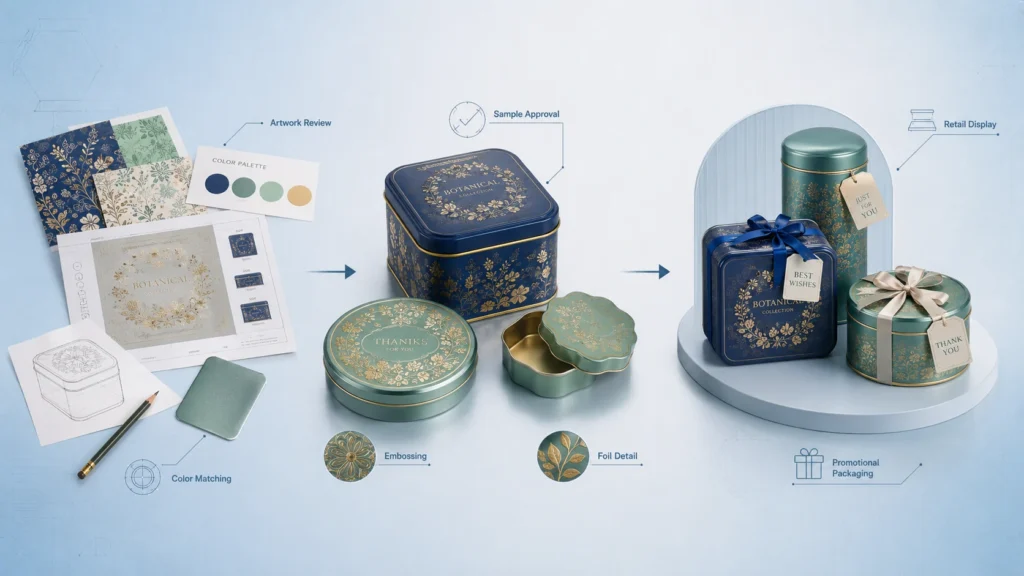
If you need a fast starting point, decorative tins usually make the most sense when your product needs at least two of the following advantages: stronger shelf impact, premium gift value, structural protection, long-term reuse, special printing, retail differentiation, or a more durable promotional experience. The table below shows how decorative tins fit common retail and promotional categories.
| Product category | Common products | Why decorative tins work | Useful structure ideas | Key buyer concern |
|---|---|---|---|---|
| Food and beverage | Tea, coffee, cookies, chocolate, candies, mints, spices | Better shelf presence, light protection, gift value, collectible reuse | Slip lid, plug lid, hinged lid, inner tray, sealed inner bag | Food-contact suitability, liner choice, moisture control |
| Beauty and personal care | Lip balm, solid perfume, soaps, skincare kits, shaving products | Premium feel, compact format, strong tactile experience, reusable storage | Screw lid, sliding tin, hinged tin, small round tin, insert tray | Coating compatibility, sharp-edge control, surface finish durability |
| Gift and holiday | Christmas tins, anniversary gifts, wedding favors, corporate gifts | Seasonal storytelling, keepsake value, strong emotional presentation | Shaped tins, window tins, embossed lids, multi-piece gift sets | Artwork timing, retail labeling, gift presentation |
| Promotional products | Branded kits, event giveaways, sample sets, loyalty gifts | Durable brand exposure, reusable object, high perceived value | Hinged tins, window tins, foam insert, card insert, QR code printing | MOQ, unit cost, delivery schedule, insert accuracy |
| Specialty and industrial | Tool kits, electronics accessories, collector items, samples | Organization, protection, professional appearance, repeat use | Deep tin, hinged tin, snap lid, molded insert, partition tray | Dimensional tolerance, dent resistance, export packing |
The biggest mistake is treating a decorative tin as decoration only. The best tin should be designed from the inside out: product size, product sensitivity, contact surface, lid fit, insert, shipping conditions, retail display method, artwork, finish, and target price should be discussed together.
What Are Decorative Tins?
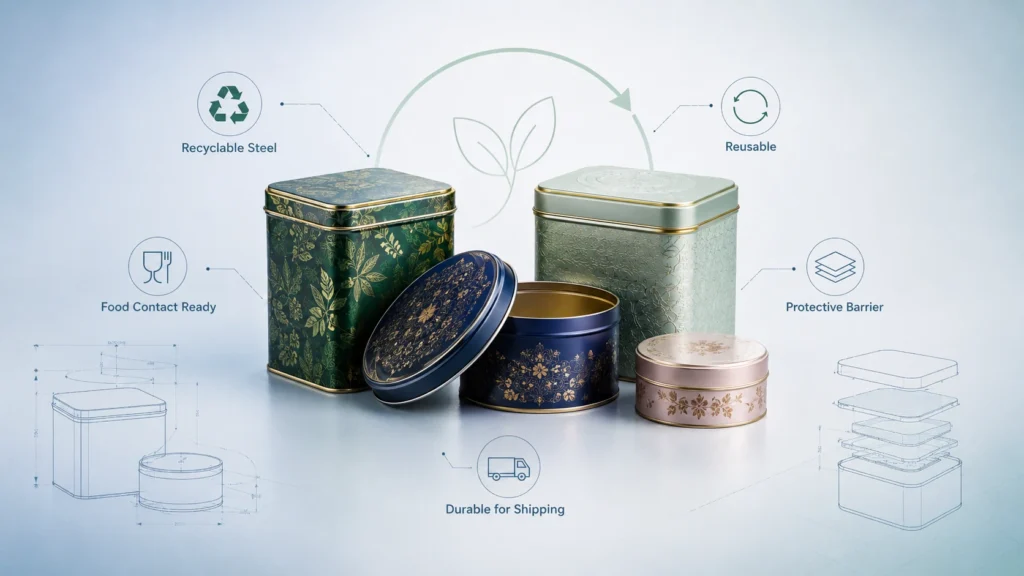
Decorative tins are metal containers designed with visual, tactile, and brand-building features. They are usually made from tinplate, which means a thin steel sheet coated with tin, then printed, coated, formed, and assembled into a finished container. In some projects, aluminum may be used instead of tinplate, but in most retail packaging conversations the phrase “decorative tins” refers to tinplate boxes, tin cans, or custom metal tins with printed and finished surfaces.
A decorative tin may be round, square, rectangular, oval, heart-shaped, book-shaped, house-shaped, or fully custom-molded. It may use a simple slip lid, a screw lid, a hinged lid, a plug lid, a sliding structure, or an inner sealing solution. It may also include paperboard inserts, metal dividers, PET trays, molded pulp, foam inserts, printed sleeves, hang tags, or window panels. The design can range from a clean matte single-color tin to a highly detailed holiday tin with full-surface illustration, embossing, metallic ink, spot UV, and a matching gift sleeve.
Mr. Tin Box’s Custom Tin Packaging Guide explains that custom tin packaging should be considered as a full packaging program involving material selection, structure engineering, surface finishing, sample approval, quality control, and logistics. This is especially true for decorative tins because decoration choices can affect both appearance and production stability. A raised embossed logo may look excellent, but the tooling, artwork registration, varnish, and forming process must be coordinated carefully. A window panel may improve product visibility, but it can also change recycling communication, cleaning requirements, and packaging cost.
Decorative tins are often chosen because they can create a stronger physical impression than paperboard or lightweight plastic. A rigid tin feels substantial in the hand. The sound of the lid, the smoothness of the edge curl, the gloss level of the varnish, and the precision of the print all influence perceived value. For premium products, this physical impression can be as important as the graphic design itself.
Why Decorative Tins Matter for Retail and Promotional Products
Retail shelves and online product pages are crowded. Many products compete on similar ingredients, flavors, fragrances, or functions, so packaging becomes one of the first signals customers use to judge value. Decorative tins help because they add three layers of differentiation at once: visual differentiation through artwork, physical differentiation through structure, and emotional differentiation through reuse or collectability.
In retail, a decorative tin can make a product easier to notice from a distance. The package can use a distinctive shape, high-contrast colors, metallic highlights, or embossed brand marks to create shelf recognition. For holiday programs and limited editions, decorative tins can also work as part of the theme. A cookie brand can build a winter landscape around the package; a tea brand can create a botanical collection; a cosmetics brand can use a minimalist tin to communicate clean premium positioning; a promotional company can design a tin around an event date, city skyline, or campaign message.
In promotional products, decorative tins extend brand exposure. A paper flyer is discarded quickly, but a well-made metal tin can be used later for stationery, small tools, coins, jewelry, tea bags, cosmetics, or desk accessories. This repeated visibility gives the brand a longer life than many disposable giveaways. For corporate gifts, the tin can make even a simple product set feel planned and premium.
Research and market data support the idea that packaging design and material choice matter. A 2025 open-access review on packaging design notes that visual packaging elements play an important role in purchase decisions and cites survey evidence that many consumers believe packaging design influences buying behavior. For waste and sustainability context, the U.S. Environmental Protection Agency reports that containers and packaging accounted for 82.2 million tons of U.S. municipal solid waste generation in 2018, or 28.1% of total generation. This means packaging is not a minor decision; it is a major commercial and environmental touchpoint. You can review the EPA data directly at the EPA containers and packaging page.
For brands selling into Europe, packaging decisions are also influenced by regulation. The European Commission states that the EU Packaging and Packaging Waste Regulation aims to make all packaging on the EU market recyclable in an economically viable way by 2030. The official European Commission overview is available here: Packaging waste rules in the EU. This does not mean every decorative tin automatically qualifies as compliant in every market, but it does mean brands should design with recyclability, material simplicity, labeling clarity, and unnecessary packaging reduction in mind from the beginning.
Market and Sustainability Data Brands Should Know
Decorative tins sit inside the broader metal packaging category. The exact numbers vary by source, region, and methodology, but several industry data points are useful for brand owners and buyers. They show why metal packaging remains commercially relevant, why sustainability claims should be specific, and why design decisions should be documented.
| Data point | What it means for decorative tin buyers | Source |
|---|---|---|
| U.S. containers and packaging generated 82.2 million tons of municipal solid waste in 2018, equal to 28.1% of total MSW generation. | Packaging choices are highly visible to regulators, retailers, and consumers. Durable and reusable decorative tins can support a more responsible packaging story when correctly designed and communicated. | U.S. EPA |
| The EPA estimated steel packaging recycling in 2018 at 1.6 million tons, or 73.8% of generation. | Steel-based tinplate packaging has a strong recycling foundation in many markets, but claims should still be adapted to local collection systems. | U.S. EPA |
| Steel for Packaging Europe reported that 80.5% of steel packaging placed on the European market was “really recycled” in 2022. | For European-facing brands, steel packaging can support credible circularity communication when supported by accurate regional wording. | Steel for Packaging Europe |
| Metal Packaging Europe describes metal as a permanent material and reports high recycling rates for steel and aluminum packaging in Europe. | Decorative tins can be positioned around reuse and recyclability, but the design should avoid unnecessary mixed-material features that reduce recycling clarity. | Metal Packaging Europe |
| The EU Packaging and Packaging Waste Regulation aims to make packaging recyclable by 2030 and reduce unnecessary packaging. | Brands exporting to the EU should discuss labeling, recyclability, empty space, material composition, and reusable packaging strategy early. | European Commission |
| The U.S. FDA explains that the regulatory status of a food contact material depends on the regulatory status of each substance that may migrate to food under intended use. | Food decorative tins require attention to coatings, inks, varnishes, liners, inner bags, and actual food-contact conditions. | U.S. FDA |
The commercial lesson is simple: decorative tins are not just a design trend. They belong to a packaging category with strong retail relevance, measurable recycling performance in many regions, and clear compliance responsibilities for food and personal care products. A beautiful tin is only successful when the brand can also explain how it protects the product, how it should be used, how it should be disposed of or reused, and why its design choices make sense.
Decorative Tins as a Sales Tool
A decorative tin can support sales in several ways. First, it helps the product stand out. A rigid metal surface can hold saturated colors, sharp illustrations, metallic effects, and high-gloss or matte finishes. Second, it increases perceived value. Customers often associate metal packaging with durability, gifting, and premium positioning. Third, it supports pricing. When a product is sold as a limited edition, gift set, sampler, or collector item, the decorative tin can justify a higher price point than a simple pouch or folding carton. Fourth, it improves post-purchase experience. Customers can reuse the tin, display it, or keep it as a storage container.
This is why decorative tins are especially effective for products with emotional or sensory value. Tea, coffee, chocolate, cookies, candles, lip balm, solid perfume, soap, fragrance samples, skincare kits, wedding favors, and seasonal gifts all benefit from packaging that feels personal. A tin can carry a story: origin, flavor, fragrance, holiday, city, heritage, sustainability, craft, or exclusivity.
For promotional campaigns, the tin can also make the campaign easier to remember. A branded event tin with an insert can hold a product sample, instruction card, coupon, QR code, USB drive, pin badge, small tool, or collectible item. Because the tin is rigid, the gift feels more organized and intentional than loose items in a bag. Because it can be reused, the logo may remain visible long after the campaign ends.
However, the sales value depends on execution. A decorative tin that scratches easily, opens too loosely, dents during shipping, or uses unclear artwork can damage the brand instead of improving it. The design should therefore be evaluated through both marketing and manufacturing logic.
Design Principles for Retail Decorative Tins
Retail decorative tins must work in a real sales environment. They may sit on a shelf, hang from a display, stack in a gift tower, ship in an e-commerce parcel, or appear in product photography. Before discussing artwork, the brand should define how customers will first encounter the product.
A tin designed for supermarket shelves should communicate quickly. The main product type, flavor, brand, and key benefit should be easy to understand from a short distance. A gourmet cookie tin may use a large product image or illustration. A tea tin may use color coding by flavor. A candy tin may use bright seasonal graphics. A premium skincare tin may use negative space, soft-touch varnish, and minimal typography.
A tin designed for gift retail can be more decorative and story-driven. The package can use patterns, illustrations, texture, embossing, special shapes, or collectible series design. In this case, the tin is part of the gift. The customer is not buying only the product inside; they are buying the presentation.
A tin designed for online sales must photograph well. Matte finishes can reduce glare, while glossy finishes can look vivid but may reflect studio lights. Embossing and debossing can be powerful in close-up shots, but they need angled lighting to show depth. If the tin is sold through marketplaces, the front panel should be clear enough for thumbnail images.
A tin designed for repeat product lines should be systemized. Instead of creating a completely new layout for every SKU, use a consistent brand grid: fixed logo area, fixed product name area, flavor color zone, and optional illustration zone. This makes future SKU expansion easier and keeps the brand family coherent.
| Retail goal | Recommended design direction | Why it works |
|---|---|---|
| Fast shelf recognition | High-contrast front panel, clear product name, strong color blocking | Helps shoppers identify product type quickly |
| Premium gifting | Matte finish, metallic ink, embossing, elegant pattern, insert tray | Creates tactile and emotional value |
| Seasonal launch | Limited-edition illustration, holiday colors, collectible numbering | Encourages urgency and repeat purchase |
| Product family | Consistent layout with color-coded variants | Supports SKU management and brand recognition |
| E-commerce display | Simple front face, strong thumbnail readability, scratch-resistant finish | Improves online presentation and shipping performance |
| Retail stacking | Flat lid, stable bottom, consistent dimensions, carton protection | Helps stores display and replenish products efficiently |
The best decorative tin design balances attraction and clarity. A tin may be beautiful, but if customers cannot understand the product, size, flavor, or use case, the design is not finished.
Design Ideas for Promotional Decorative Tins
Promotional decorative tins have a different job from standard retail packaging. They need to communicate a campaign, reward a customer, support a sales team, or make a brand experience memorable. Because the goal is often brand recall rather than immediate shelf conversion, promotional tins can use more creative structures and inserts.
One effective idea is a campaign kit tin. This type of tin can hold a sample product, printed introduction card, discount code, QR code, and small accessory. The tin becomes a portable presentation box for trade shows, sales visits, influencer seeding, or distributor meetings. For B2B products, a decorative tin can make a sample kit feel more professional and organized.
Another idea is a loyalty gift tin. Retailers, coffee brands, tea brands, cosmetics brands, and lifestyle brands can use a custom tin as a gift-with-purchase item. The tin may contain mini products, refills, sachets, coupons, or collectible accessories. The structure should be easy to open, reusable, and visually aligned with the brand’s main product line.
A third idea is a seasonal promotional tin. Christmas, New Year, Valentine’s Day, Halloween, Easter, wedding seasons, and anniversary campaigns all benefit from decorative metal packaging. Because tins feel more giftable than many disposable containers, they work well for limited editions. Mr. Tin Box’s article on Wholesale Cookie Tins is a useful internal reference for bakery and confectionery brands that need decorative tins at wholesale scale.
A fourth idea is a collector tin series. Instead of one design, the brand creates multiple tins around cities, artists, flavors, animals, botanical illustrations, vintage posters, or seasonal themes. This encourages customers to collect multiple SKUs. It also gives the marketing team more content for email campaigns, social media, and retail displays.
A fifth idea is an educational tin. For specialty products, the tin can include a printed insert with usage instructions, origin story, recycling guidance, QR code, or product care tips. This is useful for tea brewing, coffee tasting, skincare routines, candle safety, tool kits, and premium sample sets.
| Promotional tin concept | Best for | Suggested contents | Design notes |
|---|---|---|---|
| Campaign kit tin | Trade shows, sales visits, product launches | Sample, brochure, QR card, coupon, accessory | Use a precise insert to prevent movement |
| Loyalty gift tin | Gift-with-purchase, membership rewards | Mini products, sachets, refill packs, thank-you card | Keep branding visible after reuse |
| Holiday tin | Seasonal retail, corporate gifting | Cookies, candies, tea, candles, beauty minis | Plan artwork and production early |
| Collector series | Premium retail, tourism, lifestyle products | Product variants, limited editions, souvenirs | Use consistent structure with changing artwork |
| Educational tin | Tea, coffee, skincare, tools, hobby kits | Product, instruction card, care guide | Combine inner printing or card insert with QR code |
Promotional tins work best when the brand defines the after-use scenario. What should the customer do with the tin after opening? Keep it on the desk? Store tea? Hold small accessories? Display it as a collectible? The clearer the reuse idea, the stronger the promotional value.
Product Category Design Ideas
Decorative tins can serve many industries, but each product category has different priorities. A food tin may need inner bags and food-contact documentation. A beauty tin may need coating compatibility and a premium touch. A promotional tin may need insert precision and fast delivery. A specialty tin may need dimensional accuracy and dent protection.
Decorative tins for food and beverage
Food and beverage brands often use decorative tins for tea, coffee, cookies, biscuits, chocolates, candies, mints, spices, and specialty snacks. The main benefits are protection, shelf presence, and gift value. Tinplate blocks light, provides rigidity, supports high-quality printing, and can make dry food products feel more premium.
For tea and coffee, decorative tins can support aroma perception and reuse. A plug lid or inner lid can improve closure feel, but brands should still validate shelf-life requirements. Many tea and coffee products use an inner foil bag for freshness while the tin provides structure, branding, and reuse value.
For cookies and biscuits, decorative tins help protect against crushing and create strong gift appeal. However, many decorative tins are not fully airtight. If crispness matters, use an inner bag, tray, or liner and conduct shelf-life testing. The Mr. Tin Box article on Tin Containers with Lids explains how different lid structures affect protection, presentation, and product fit.
For chocolates and candies, inserts are often important. Paper cups, trays, or molded inserts can separate pieces, improve opening presentation, and reduce movement. The coating and liner should be selected according to direct or indirect food contact conditions.
Decorative tins for beauty and personal care
Beauty and personal care brands use decorative tins for lip balm, solid perfume, shaving soap, cosmetic balm, skincare kits, essential oil sets, hair wax, sample collections, and wellness products. The tin should feel smooth, safe, and premium. Edge treatment matters because customers may handle the product frequently.
Small round tins are common for lip balm and solid perfume because they are compact and familiar. Mr. Tin Box’s article on Metal Lip Balm Tin Packaging discusses round, square, sliding, and custom shapes for small cosmetic formats. For beauty products, decoration should also consider photography. Soft-touch, satin, and matte finishes can create a high-end look, while metallic ink and embossing can make the logo feel more premium.
Compatibility is important. Some balms, oils, fragrances, and waxes may interact with coatings or liners if the formulation touches the tin directly. Brands should define whether the formula is direct-contact, held in a separate cup, wrapped, or sealed in a secondary container.
Decorative tins for gifts and holidays
Gift and holiday tins are among the most natural uses of decorative metal packaging. Christmas tins, anniversary tins, wedding favor tins, Valentine’s tins, Halloween tins, and New Year tins can be designed as keepsakes. The decoration can be emotional, seasonal, nostalgic, playful, or luxurious.
Because seasonal schedules are fixed, planning is critical. Artwork approval, sample confirmation, tooling, printing, forming, inspection, export packing, shipping, and retailer delivery all need time. A late design change can affect the entire launch calendar. Brands should prepare artwork earlier than they would for simple labels or paper sleeves.
Decorative tins for specialty and industrial products
Decorative tins are also useful outside food and beauty. Small tools, sewing kits, electronics accessories, collector cards, pins, hardware samples, promotional components, and premium stationery can all be packed in metal tins. These projects often need inserts, partitions, or foam to prevent movement. The design should focus on organization and durability as much as appearance.
For specialty products, the tin may serve as long-term storage. A clean industrial design, clear labeling, and strong hinge or lid fit may matter more than colorful decoration. If the product is sold through distributors, barcode placement, carton labeling, and export packing should be discussed early.
Choosing the Right Tin Shape and Structure
Shape is one of the first decisions buyers notice, but it should not be made only by appearance. Shape affects tooling cost, production stability, packing efficiency, retail display, insert design, and shipping protection.
Round decorative tins are efficient for mints, balms, candies, candles, and small gift items. They feel friendly and reduce corner sharpness. Square and rectangular tins use space efficiently and are easy to stack, making them useful for tea, cookies, chocolate sets, and promotional kits. Oval tins can feel softer and more elegant, especially for beauty and gift products. Custom-shaped tins create strong differentiation but usually require more tooling time and careful production planning.
Lid style is equally important. A slip lid is simple and common. A plug lid can improve closure feel and perceived freshness. A hinged lid keeps the lid attached and improves reuse. A screw lid works well for small cosmetic tins. A sliding lid is compact and distinctive for mints, small candies, or promotional items. A window lid can show the product, but it introduces mixed-material considerations and may affect recyclability communication.
Mr. Tin Box’s guide to Metal Tins with Lids is a useful internal reference for buyers comparing lid types, structure, and product fit.
| Structure | Best-fit products | Advantages | Watch-outs |
|---|---|---|---|
| Slip lid tin | Tea, cookies, candy, gift items | Simple, cost-effective, familiar | May not be airtight; validate lid fit |
| Plug lid tin | Tea, coffee, dry food, premium gifts | Stronger closure feel, premium opening | Needs accurate forming and tolerance control |
| Hinged tin | Promotional kits, mints, tools, collector items | Lid stays attached, reusable, practical | Hinge durability and alignment must be checked |
| Screw lid tin | Lip balm, solid perfume, small cosmetics | Secure closure, compact, familiar | Thread fit and edge smoothness are critical |
| Sliding tin | Mints, small candy, cards, compact gifts | Distinctive, pocket-friendly | Sliding friction must be consistent |
| Window tin | Gift sets, candies, promotional items | Shows product, improves visibility | Window material and recycling message need review |
| Custom-shaped tin | Holiday gifts, collectibles, limited editions | Strong differentiation and story value | Tooling cost, sampling time, and packing efficiency |
A practical approach is to start with an existing mold when speed and budget are important. Use a custom mold when the tin shape is central to the brand story, the order quantity justifies tooling, or the brand wants a proprietary package structure.
Tinplate, Coatings, and Food-contact Planning
Most decorative tins are made from tinplate. As explained in Mr. Tin Box’s Tinplate Packaging Guide, tinplate packaging is not solid tin. It is typically steel as the structural base, tin as the protective metallic coating, and organic coatings, inks, and varnishes as functional and decorative layers. This matters because the final package performance depends on the complete system, not only the metal sheet.
For food packaging, the key question is whether the product directly touches the tin. If cookies, chocolates, candies, tea, or mints touch the inner surface, the buyer should confirm the inner coating, food type, conditions of use, and target-market requirements. If the food is packed in a sealed inner bag, paper cup, tray, or liner, the direct-contact situation may be different, but the full packaging system still needs review.
The U.S. FDA explains that the regulatory status of a food contact material depends on the regulatory status of each individual substance that may migrate to food. This includes coatings, adhesives, additives, and other components used under intended conditions. The FDA page on determining the regulatory status of components of a food contact material is a useful reference for brands selling into the U.S. market.
For EU-facing projects, brands should also consider the general principles for food contact materials, local requirements, and retailer documentation. Even when a decorative tin is used for dry food, buyers should not rely on the phrase “food grade” alone. They should ask specific questions: What is the inner lacquer? What food type and use condition is it intended for? Is there an inner liner? Will the product be hot-filled, stored long term, or exposed to oils, acids, alcohol, or fragrance? What documentation can be provided?
For beauty and personal care, the concern is often compatibility rather than food-contact compliance. Oils, waxes, fragrance ingredients, or active cosmetic ingredients may require a suitable liner, cup, or coating. If the formula is oily, aromatic, or acidic, direct-contact testing is wise.
Printing and Finishing Options for Decorative Tins
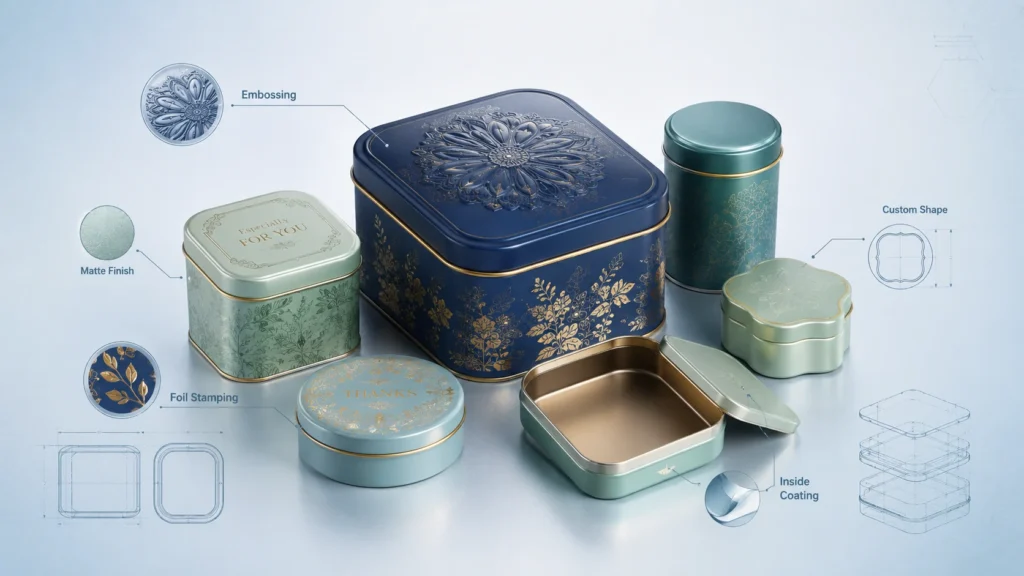
Decoration is where tins become powerful. The metal surface can support offset printing, spot colors, full-surface artwork, matte varnish, gloss varnish, satin finish, metallic ink, pearlescent effects, texture varnish, soft-touch coating, spot UV, embossing, debossing, and shaped relief effects. Mr. Tin Box’s article on Metal Tin Box Finishing Options explains how finish affects both appearance and buyer perception.
Offset printing is common for full-color artwork. It is suitable for brand illustrations, product images, patterns, and seasonal graphics. Spot colors help maintain brand consistency, especially for corporate colors. Metallic effects can use the natural metal background or metallic ink to create shine. Matte varnish gives a calm premium look. Gloss varnish makes colors more vivid and can improve shelf visibility. Satin is a balanced option between matte and gloss.
Embossing raises selected areas, such as a logo, product name, border, pattern, or character. Debossing presses areas inward. Both effects add tactile value, but they require tooling and careful alignment. Spot UV can create contrast by making one area glossy against a matte background. Texture varnish can create anti-slip, leather-like, sand, wrinkle, or special tactile effects.
The key is not to use every effect at once. Too many finishes can make the tin expensive, visually confusing, or harder to produce consistently. A better approach is to choose one main visual strategy and one tactile accent.
| Brand positioning | Recommended finish combination | Why it works |
|---|---|---|
| Premium minimalist | Matte or satin background + embossed logo | Clean, tactile, high-end |
| Luxury gift | Metallic ink + gloss accents + structured insert | Strong visual richness and presentation |
| Natural organic | Soft matte finish + botanical illustration + muted colors | Calm, trustworthy, suitable for tea and wellness |
| Fun seasonal | Full-color artwork + gloss varnish + shaped tin | High visibility and collectible appeal |
| Corporate promotional | Brand spot color + logo embossing + QR code | Clear identity and practical campaign use |
| Vintage style | Aged color palette + debossed border + satin varnish | Nostalgic and collectible |
| Beauty and skincare | Soft-touch or satin + fine line art + subtle metallic detail | Premium tactile feel and clean photography |
When preparing artwork, brands should ask the manufacturer for dielines, bleed requirements, color mode guidance, embossing limitations, barcode placement rules, and proofing expectations. A decorative tin is a three-dimensional object; artwork that looks perfect on a flat screen may shift visually after forming, curling, and assembly.
Retail Design Ideas by Visual Style
Decorative tins can support many visual directions. The best style depends on the product category, price point, customer profile, and sales channel.
A minimalist design uses fewer colors, generous space, and strong typography. It works well for premium tea, skincare, solid perfume, wellness products, and boutique gifts. The risk is that the package may look too plain if the material and finish are not excellent. Minimalist tins need precise printing, clean edges, and good surface quality.
A vintage design uses heritage colors, engraved-style line art, serif typography, and nostalgic patterns. It works well for biscuits, coffee, chocolate, tea, tobacco-free collectibles, and gift products. The tin material naturally supports the vintage feeling because metal packaging has a long historical association with premium food storage and collectible tins.
A botanical design uses leaves, flowers, herbs, spices, or ingredient illustrations. It works especially well for tea, coffee, wellness, soap, candles, and beauty products. Botanical graphics can communicate natural ingredients without relying on exaggerated claims.
A playful design uses bright colors, characters, icons, and strong contrast. It works for candy, mints, children’s gifts, seasonal tins, tourism souvenirs, and promotional campaigns. The design should still leave enough space for required label information.
A luxury design uses dark colors, metallic accents, embossing, and controlled typography. It works for premium chocolate, fragrance, skincare sets, corporate gifts, and limited-edition collections. The challenge is cost control: luxury effects should be used strategically, not excessively.
A transparent-window design lets customers see the product. It can work for candies, cookies, gift sets, or colorful accessories. However, the window should be designed carefully. Mixed materials may complicate recycling communication, and the window can show product movement or breakage if the inner support is weak.
How to Design Decorative Tins for Reuse
Reuse is one of the biggest advantages of decorative tins. Customers may keep the tin for tea bags, stationery, coins, sewing tools, cosmetics, jewelry, memory items, or small accessories. But reuse does not happen automatically. The tin must be convenient, attractive, durable, and not too narrowly branded for one-time use.
To increase reuse, keep the structure practical. A hinged tin should open and close smoothly. A slip lid should not be too loose or too tight. The interior should be clean and safe to touch. The size should match common storage behaviors. A very unusual shape may be memorable but difficult to reuse.
The graphics should also consider long-term visibility. A strong logo is useful, but if the entire tin feels like an advertisement, some customers may not keep it. A more elegant approach is to integrate the brand into a beautiful pattern, illustration, or collectible design. This makes the tin feel like an object worth keeping.
Inner printing can also encourage reuse. For example, the inside of a tea tin can include brewing tips. A candle tin can include safety reminders. A promotional tin can include a QR code to a campaign page. A chocolate tin can include a brand story. The inside panel is often overlooked, but it can improve the opening experience.
From a sustainability communication perspective, reuse claims should be honest. A brand can say “designed for reuse” or “reusable decorative tin” when the structure genuinely supports repeat use. Avoid broad claims such as “zero waste” or “completely eco-friendly” unless the brand has strong evidence and local context.
Cost Drivers in Custom Decorative Tins
Decorative tin cost depends on more than size. Buyers often ask for a unit price first, but the quote is shaped by structure, mold, material thickness, printing complexity, finishing process, inserts, quality requirements, order quantity, packing method, and shipping destination.
Existing molds usually reduce tooling cost and lead time. Custom molds create stronger differentiation but require tooling investment and sample adjustment. More colors, special varnishes, embossing, debossing, windows, handles, locks, or inserts can increase cost. Thicker material may improve rigidity but can also affect forming and price. Export cartons, individual polybags, paper wraps, dividers, and e-commerce protection can also change the total landed cost.
| Cost factor | Low-complexity option | Higher-complexity option | Business impact |
|---|---|---|---|
| Mold | Existing round, square, or rectangular tin | Fully custom shape or special lid | Affects tooling cost and development time |
| Printing | One or two spot colors | Full CMYK artwork with tight registration | Affects proofing and print control |
| Finish | Standard gloss or matte varnish | Soft-touch, texture, spot UV, metallic effects | Affects unit cost and sample approval |
| Structure | Simple slip lid | Hinge, window, lock, handle, inner lid | Affects assembly and inspection |
| Insert | No insert or simple paper card | Foam, molded tray, divider, printed insert | Affects presentation and product protection |
| Packing | Bulk pack | Individual bag, sleeve, display carton, e-commerce pack | Affects labor, carton size, and shipping |
| Documentation | Basic project specification | Food-contact, retailer, or market-specific documents | Affects preparation and supplier coordination |
A practical buyer should ask for two or three specification levels. For example: standard finish with existing mold, premium finish with existing mold, and custom-shaped premium tin. This allows the team to compare cost, timing, and marketing value before choosing.
MOQ and Lead Time Planning
MOQ and lead time should be treated as strategic planning topics, not last-minute details. Decorative tins require coordination between artwork, proofing, printing, forming, inspection, assembly, packing, and shipping. Seasonal projects require even more discipline because retail deadlines cannot easily move.
Existing mold projects are usually faster than custom mold projects. Simple printing is faster than complex effects. Standard finishes are faster than special varnishes or embossing. Projects requiring food-contact documentation, retailer testing, or special inserts need extra time.
Mr. Tin Box’s article on Custom Tin Box MOQ and Lead Time Planning can support buyers who need to plan order timing, sampling, approval, and production schedules. For decorative tins, the safest approach is to build a timeline backward from the retail launch date or event date.
A typical planning sequence looks like this:
- Define product size, product weight, target market, sales channel, and target launch date.
- Select existing mold or custom mold direction.
- Confirm product-contact method, insert requirements, and packing method.
- Prepare artwork based on the correct dieline.
- Approve digital proof and physical sample.
- Confirm order quantity, carton packing, and documentation.
- Begin mass production.
- Inspect printing, forming, lid fit, finish, and packing.
- Arrange shipment with enough buffer for customs, warehousing, and retailer delivery.
The earlier the buyer provides complete information, the easier it is for the manufacturer to recommend the right structure and prevent expensive changes.
Quality Control Checkpoints
Decorative tins are visual products, but quality control must cover more than color. A tin can look beautiful in a photo and still fail if the lid is loose, the hinge is misaligned, the edge is sharp, or the surface is scratched during packing. A professional quality plan should include material, printing, forming, assembly, and packing checks.
| Quality checkpoint | What to check | Why it matters |
|---|---|---|
| Material and thickness | Material grade, thickness range, surface condition | Affects rigidity, forming, and durability |
| Printing accuracy | Color consistency, registration, barcode readability, logo position | Protects brand appearance and retail scanning |
| Finish quality | Gloss level, matte consistency, scratches, fingerprints, varnish adhesion | Affects perceived value and handling durability |
| Forming quality | Edge curl, dents, wrinkles, shape consistency | Affects safety and appearance |
| Lid fit | Opening force, looseness, tightness, wobble, alignment | Affects customer experience and product protection |
| Hinge or slide action | Smooth movement, durability, alignment | Critical for reusable tins |
| Interior cleanliness | Dust, oil, metal particles, coating defects | Important for food, beauty, and gift products |
| Insert fit | Product movement, tray stability, foam accuracy | Protects contents and improves presentation |
| Carton packing | Scratch protection, dent protection, carton strength, labeling | Prevents damage during export and e-commerce handling |
For retail launches, approved samples should be treated as reference standards. The buyer and manufacturer should agree on acceptable color tolerance, finish appearance, lid fit, minor scratch criteria, packing method, and inspection level before production.
Decorative Tins and E-commerce Shipping
Many brands now sell through both retail stores and online channels. Decorative tins can improve product protection, but they are not immune to dents and scratches. E-commerce shipping exposes packages to parcel drops, vibration, compression, and rough handling. A beautiful retail tin may need additional protection when sold direct to consumer.
For e-commerce, consider a paper sleeve, tissue wrap, protective bag, molded paper insert, corrugated mailer, or stronger export carton. If the tin has a glossy finish, scratch protection becomes more important. If the tin has a large flat lid, compression resistance should be checked. If the product inside is fragile, the insert should prevent movement.
The design should also account for unboxing. A decorative tin inside a plain mailer can still feel premium if the interior presentation is clean. A printed card, simple wrap, or inner sleeve can improve the opening experience without excessive packaging. However, be careful with overpacking. The EU PPWR direction toward minimizing unnecessary packaging is a reminder that premium does not mean wasteful.
Sustainability messaging for decorative tins
Decorative tins can support strong sustainability messaging, but the wording must be careful. Metal packaging has real circularity advantages in many regions. The EPA reports a strong steel packaging recycling rate in the United States, and Steel for Packaging Europe reports high verified recycling performance in Europe. Metal Packaging Europe also promotes the idea that metal is a permanent material that can be recycled repeatedly without loss of fundamental properties.
Still, responsible claims should be specific. A brand should not simply say “eco-friendly” without evidence. Better wording includes:
- reusable decorative tin
- designed for long-term reuse
- recyclable metal packaging where local systems accept steel packaging
- made from widely recycled metal packaging material
- removable insert for easier sorting
- durable tin designed to reduce the need for secondary gift packaging
Design choices can make sustainability communication stronger. Avoid permanently bonded mixed-material elements where possible. If using a window, make the material and disposal instruction clear. If using an insert, consider whether it can be removed easily. Avoid oversized tins that create unnecessary empty space. Choose an appropriate size for the product. Design for reuse, not only one-time display.
For EU-facing products, review the European Commission’s PPWR overview and current implementation guidance. The regulation is changing how brands think about recyclability, labeling, reuse, and unnecessary packaging. Global exporters should watch these rules because European packaging expectations often influence retailer requirements beyond Europe.
How to Prepare a Clear Decorative Tin Packaging Brief
A clear brief saves time, reduces misunderstandings, and improves quotation accuracy. Many project delays happen because the supplier receives only a photo and a desired size, but not enough information about product weight, contact surface, target market, artwork, packing, and schedule.
A strong brief should include:
- product type and product dimensions
- product weight and quantity per tin
- whether the product touches the tin directly
- target market or countries of sale
- sales channel: retail, e-commerce, distributor, event, or gift program
- desired tin size or reference mold
- preferred shape and lid style
- required insert, tray, liner, or pouch
- artwork direction and brand guideline
- finish preference: matte, gloss, satin, metallic, embossing, spot UV, texture
- barcode, warning label, nutrition label, ingredient panel, or legal text needs
- expected order quantity and reorder plan
- target launch date or delivery date
- packing requirements and shipping destination
- testing or documentation expectations
If the project is still early, the buyer can provide product samples and ask the manufacturer to recommend structure options. Mr. Tin Box’s Small Tin Containers guide is useful for buyers comparing compact tin formats across food, beauty, gift, and specialty applications.
How Mr. Tin Box Can Support Decorative Tin Projects
Mr. Tin Box is positioned for global brands that need custom metal tin packaging with both design value and manufacturing reliability. For decorative tins, this means helping buyers connect creative ideas with practical production decisions: shape, mold, material, coating, printing, finish, insert, lid style, food-contact requirements, quality inspection, and export packing.
A strong decorative tin project usually begins with product reality. What must the tin protect? What should the customer feel when opening it? How will the tin be displayed? Does the product need an inner bag or liner? Will the tin be reused? Does the artwork need embossing or a special finish? What is the target price? What is the launch date? These questions help the packaging team recommend a solution that is attractive, manufacturable, and commercially sensible.
For food and beverage projects, Mr. Tin Box can help brands think through cookie tins, tea tins, coffee tins, candy tins, chocolate tins, mint tins, and specialty food containers. For beauty and personal care, the team can support lip balm tins, solid perfume tins, soap tins, skincare set tins, and wellness packaging. For gift and promotional projects, the team can develop holiday tins, anniversary tins, corporate gift tins, event giveaway tins, and collector series tins. For specialty applications, the team can support tool kits, electronics accessories, sample tins, and custom storage boxes.
If you are still comparing general material choices, the Mr. Tin Box article on Metal Tin Packaging provides a broad overview of benefits, applications, and custom options. If you already know you need tinplate, the Tinplate Packaging Guide explains materials, coatings, printing, and food safety considerations in more detail.
Decorative Tin Design Examples by Business Goal
The following examples show how decorative tins can be designed around commercial objectives rather than decoration alone.
| Business goal | Product example | Decorative tin idea | Why it supports sales |
|---|---|---|---|
| Increase premium perception | Loose leaf tea | Tall rectangular tin with botanical artwork, matte varnish, and color-coded variants | Makes the product look organized, giftable, and collectible |
| Improve seasonal sales | Butter cookies | Large round Christmas tin with embossed winter illustration and inner tray | Turns a simple food item into a holiday gift |
| Support product sampling | Skincare minis | Hinged tin with molded insert and QR routine card | Makes samples feel like a curated kit |
| Create corporate gift value | Branded candy or tea set | Rectangular tin with logo embossing and custom sleeve | Extends brand exposure after the event |
| Encourage collection | Mints or candies | Small tins in city-themed series | Motivates repeat purchase across designs |
| Improve portability | Lip balm or solid perfume | Small screw lid tin with soft-touch finish | Feels premium and easy to carry |
| Organize specialty parts | Tool accessories | Hinged tin with divider insert and printed instruction card | Adds protection and professional presentation |
These examples can be adapted to many product lines. The important point is to connect each design decision to a business reason.
Common Mistakes to Avoid
The first mistake is choosing a shape before defining the product requirement. A custom shape may look attractive, but if it wastes space, increases shipping cost, or makes the product unstable, it may not be the best choice.
The second mistake is overusing finishes. Matte, gloss, metallic ink, embossing, spot UV, texture varnish, and window panels can all be useful, but too many effects can create visual noise and cost pressure. Choose finishes that support the brand strategy.
The third mistake is ignoring the inside of the tin. Opening presentation is important. A poorly fitted insert, loose product, dusty interior, or unfinished inner surface can reduce perceived quality immediately.
The fourth mistake is assuming all decorative tins are airtight. Many tins protect against light and physical damage but are not designed as hermetic containers. If shelf life depends on oxygen or moisture control, use an appropriate inner bag, liner, seal, or closure system and validate performance.
The fifth mistake is making unsupported sustainability claims. Use accurate, specific wording and consider local recycling systems. A reusable tin is a strong story, but it should be designed for genuine reuse.
The sixth mistake is leaving artwork too late. Decorative tins require dielines, print proofing, possible embossing files, and sample approval. Seasonal products should be planned early.
FAQ
Are decorative tins suitable for food packaging?
Yes, decorative tins can be suitable for food packaging when the material, inner coating, product-contact method, and target-market requirements are correctly specified. For many dry foods such as tea, coffee, cookies, candies, and chocolates, brands use a tin with an inner bag, liner, paper cup, or tray. If food touches the tin directly, the buyer should confirm coating suitability, intended food type, conditions of use, and documentation.
Are decorative tins airtight?
Not always. Many decorative tins provide strong structure, light protection, and premium presentation, but they are not automatically airtight. If freshness, aroma, crispness, or moisture control is critical, discuss inner bags, liners, plug lids, seals, or shelf-life testing with the supplier.
What is the best shape for decorative tins?
The best shape depends on the product and business goal. Round tins are common for mints, balms, candles, and small gifts. Square and rectangular tins are efficient for tea, cookies, chocolates, and promotional kits. Hinged tins work well for reuse and sample sets. Custom shapes are useful for limited editions and collectible campaigns when the order quantity and timeline support tooling.
Can decorative tins be used for cosmetics?
Yes. Decorative tins are widely used for lip balm, solid perfume, soap, shaving products, skincare kits, wellness products, and beauty gift sets. For direct-contact formulas, confirm coating or liner compatibility. For premium beauty products, matte, satin, soft-touch, metallic accents, embossing, and clean typography are common design choices.
What decoration options are available?
Common decoration options include CMYK printing, spot colors, matte varnish, gloss varnish, satin finish, metallic ink, pearlescent effects, soft-touch coating, texture varnish, spot UV, embossing, debossing, window panels, printed sleeves, and custom inserts. The right combination depends on budget, brand positioning, and production requirements.
Final Thoughts: Make Decorative Tins Work Harder for Your Brand
Decorative tins can do far more than make a product look attractive. When designed correctly, they protect the product, improve retail visibility, support premium pricing, create gift value, encourage reuse, and extend brand exposure after purchase. This makes them especially powerful for food, beverage, beauty, gift, holiday, promotional, and specialty product categories.
The best decorative tin projects start with practical questions. What does the product need to protect against? How will customers first see the package? How should the tin feel in the hand? Will the product touch the metal directly? What information must appear on the package? How will the tin ship? Will customers reuse it? What claim can the brand make responsibly?
Once those questions are answered, decoration becomes more than surface design. It becomes a tool for product positioning, customer experience, and commercial growth. If your brand is developing decorative tins for retail, gifting, promotional campaigns, or specialty packaging, contact Mr. Tin Box to discuss mold options, structure ideas, printing and finishing, inserts, food-contact considerations, samples, and production planning.