

When buyers search for aluminum tins, they are usually comparing more than one metal packaging option. Some want a lightweight screw-top tin for lip balm or solid perfume. Some want a brushed aluminum look for premium tea, mints, supplements, or promotional gifts. Others use the phrase “aluminum tins” simply because they want a metal container and do not yet know whether aluminum or tinplate is the better material.
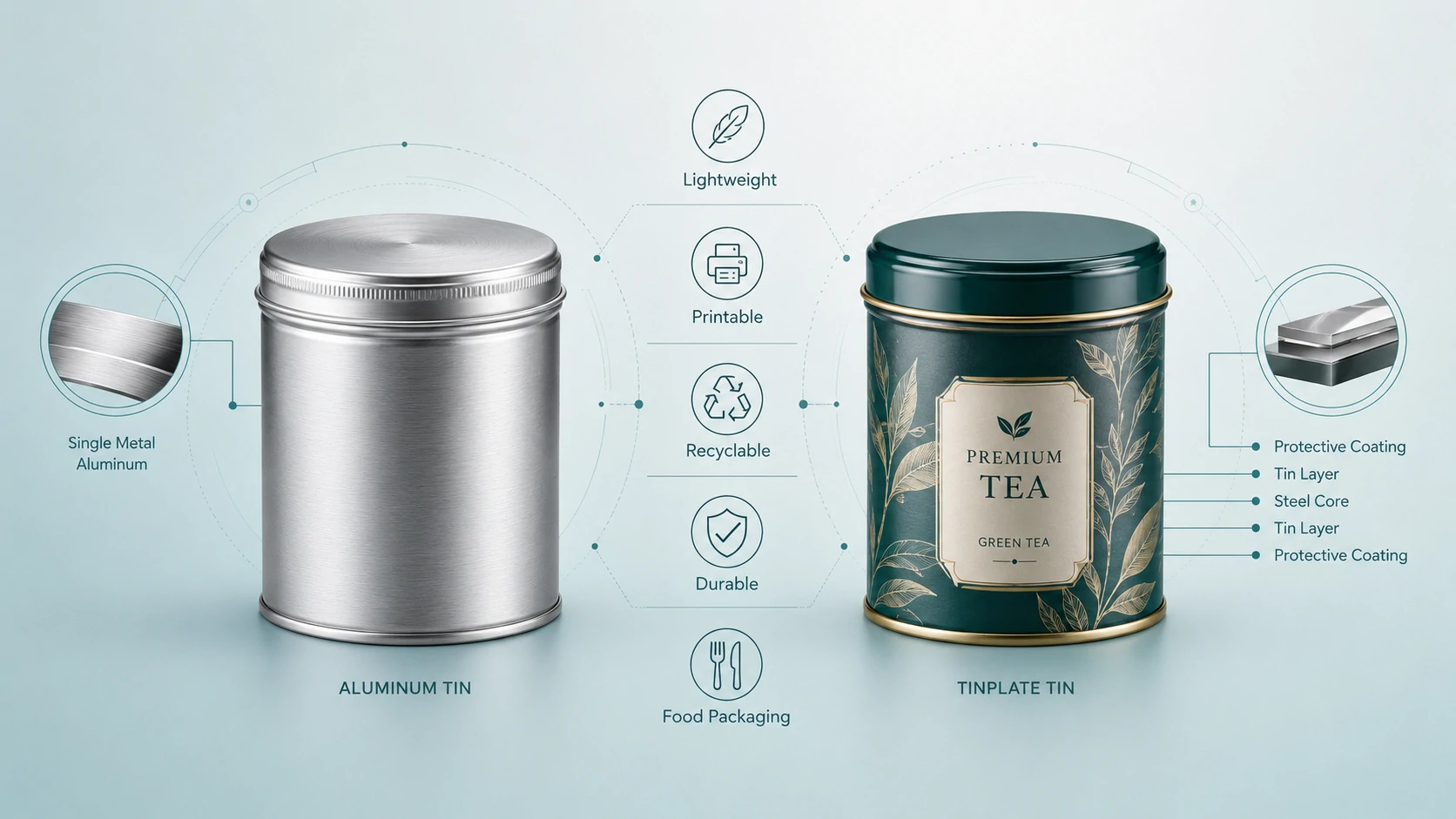
That distinction matters. Aluminum tins and tinplate tins can both look premium, both can support reusable packaging concepts, and both can be suitable for food, beauty, gift, promotional, and specialty products when the correct coating and structure are selected. But they are not interchangeable. Aluminum is naturally lightweight, non-magnetic, and corrosion resistant because it forms a protective oxide layer. Tinplate is a thin steel sheet coated with tin, giving the package higher structural rigidity, strong forming stability, excellent printability, and easy magnetic sorting in many recycling systems.
For a brand owner, the wrong material choice can create avoidable problems: lids that deform, coatings that are not compatible with the product, higher-than-expected tooling cost, unstable artwork results, weak shelf impact, or a sustainability claim that is too broad for the target market. For a purchasing team, the right material choice can reduce sampling rounds, clarify RFQ documents, shorten launch timelines, and prevent disputes after mass production.
This guide compares aluminum tins and tinplate tins in practical business language. It is written for product managers, packaging buyers, importers, sourcing teams, and brand owners who need to choose a metal package for real commercial use. It also connects material decisions to Mr. Tin Box’s custom metal packaging categories, including Food & Beverage Packaging, Beauty & Personal Care Packaging, gift tins, promotional tins, holiday tins, and specialty packaging.
Quick answer for busy buyers
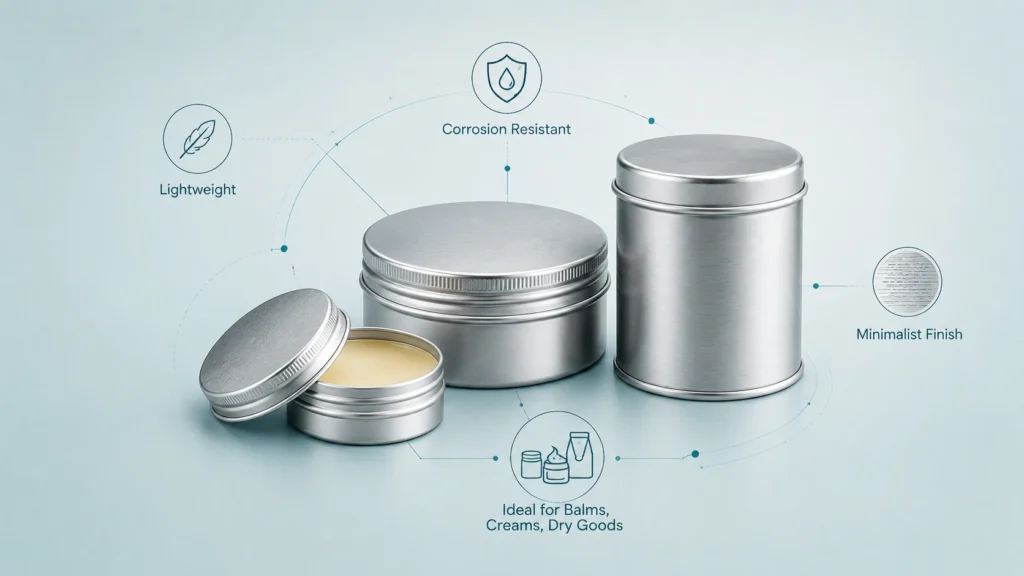
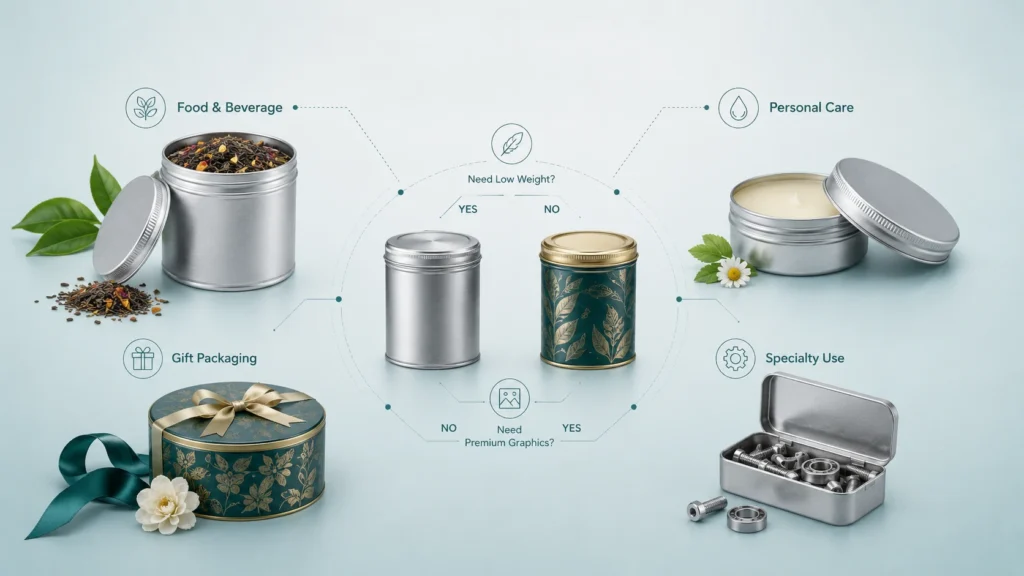
If you need a lightweight, sleek, small-to-medium container with a modern metallic appearance, aluminum tins are often worth considering. They are especially attractive for lip balm, solid perfume, travel candles, cosmetic balms, mints, supplements, sample kits, premium promotional gifts, and products where low weight and corrosion resistance are important.
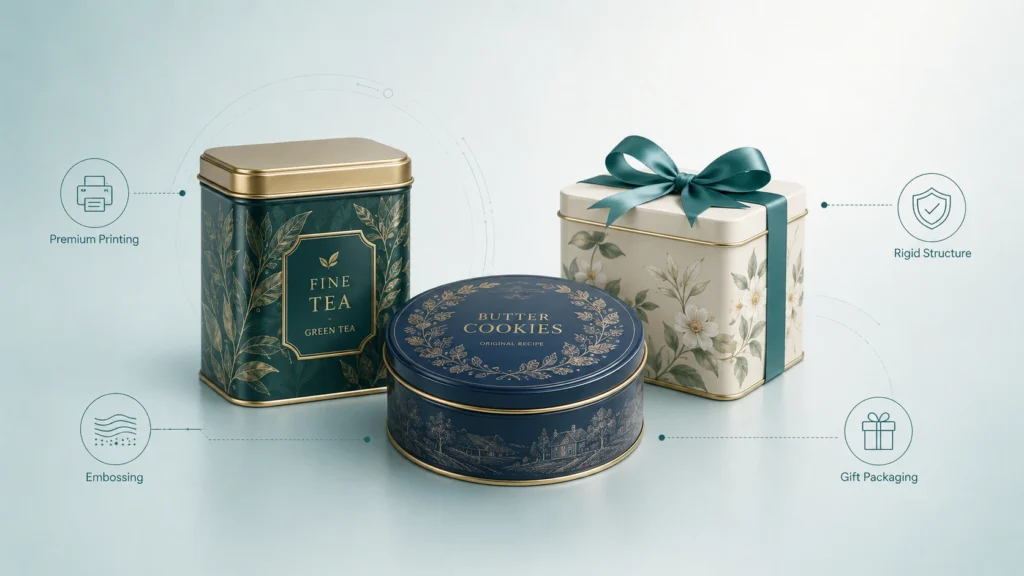
If you need a stronger printed box, a rectangular or square structure, a hinged tin, a large cookie tin, a tea tin, a gift set, a collectible holiday tin, or a highly decorated promotional tin, tinplate tins are usually the more practical choice. Tinplate offers a strong steel core, stable forming, broad shape flexibility, good lithographic printing performance, and mature manufacturing routes for custom decorative tins.
The safest buying rule is simple: choose aluminum when lightweight metallic elegance is central to the product experience; choose tinplate when structure, decoration, lid stability, and mass-production versatility are more important.
| Buying question | Aluminum tins often fit better when… | Tinplate tins often fit better when… |
|---|---|---|
| Is weight a key priority? | Yes, especially for travel-size products and e-commerce shipping. | Less critical, or the brand wants a heavier premium feel. |
| Is the product oily, waxy, or cosmetic? | Often yes, with compatible internal coating or liner. | Also possible, but coating compatibility must be checked carefully. |
| Is the package large, square, rectangular, or hinged? | Possible but less common for complex decorative boxes. | Usually stronger and more economical for custom shapes and hinged structures. |
| Is full-surface lithographic artwork important? | Possible, but decoration route may vary by structure. | Usually excellent for printed decorative tins. |
| Is dent resistance important? | Depends on thickness and geometry; thin aluminum can dent more easily. | Tinplate generally provides higher rigidity at common decorative tin gauges. |
| Is magnetic recycling sorting helpful in the target market? | No, aluminum is non-magnetic and requires eddy-current sorting. | Yes, steel packaging benefits from magnetic sorting. |
| Is a brushed, silver, minimalist look desired? | Often a strong fit. | Possible with metallic inks or clear varnish, but the look is different. |
| Is the project highly cost-sensitive? | Aluminum may increase material cost depending on gauge and structure. | Tinplate is often more cost-effective for many custom decorative tins. |
What “aluminum tins” actually means in packaging
The phrase aluminum tins is common in search behavior, but technically it combines two different ideas. “Tin” is often used by consumers to mean a small metal container, while aluminum is a separate metal. In commercial packaging, an aluminum tin is normally a container made from aluminum sheet, aluminum alloy, or an aluminum-based component system. In some markets, buyers may also call it an aluminium tin, aluminum box, aluminum jar, aluminum screw tin, aluminum balm tin, aluminum candle tin, or aluminum metal container.
Aluminum is valued because it is light, corrosion resistant, ductile, and visually clean. The Royal Society of Chemistry describes aluminum as a lightweight packaging material that can be flexible, durable, impermeable to water, and resistant to chemical attack in foil applications. The Aluminum Association also emphasizes aluminum’s lightweight versatility, corrosion resistance, and recyclability. Those properties explain why aluminum appears in beverage cans, foil, tubes, aerosol formats, beauty packaging, pharmaceutical packaging, and many premium reusable containers.
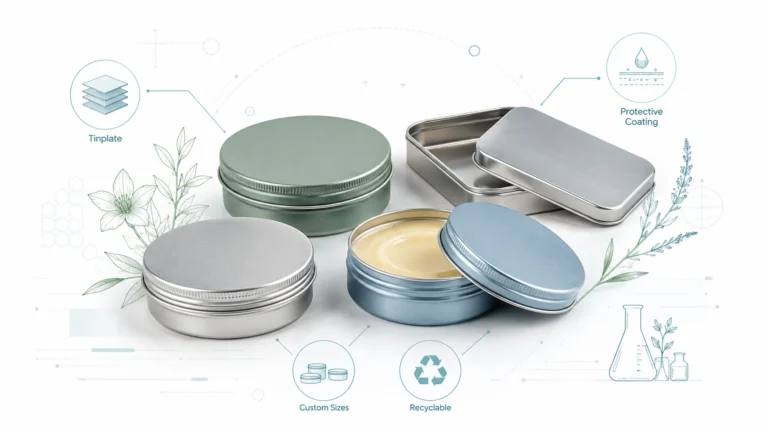
For custom tins, aluminum is commonly seen in round screw-top jars, shallow balm tins, slip-lid cosmetic tins, candle tins, mint tins, solid perfume containers, sample tins, and specialty promotional containers. It can be left with a natural metallic finish, brushed, anodized, lacquered, printed, labeled, or combined with paper sleeves and inserts. Its light weight makes it appealing for e-commerce, travel kits, beauty products, and giftable small items.
However, aluminum is not automatically the best choice for every project. Thin aluminum walls can dent if the geometry is weak or the material gauge is too light. Aluminum is also non-magnetic, so it is sorted differently from steel in recycling facilities. For direct food or cosmetic contact, the internal surface still needs to be evaluated for product compatibility, coating safety, migration requirements, filling method, storage temperature, and shelf life. The base metal alone does not make a package compliant.
What tinplate tins are and why they dominate decorative metal packaging
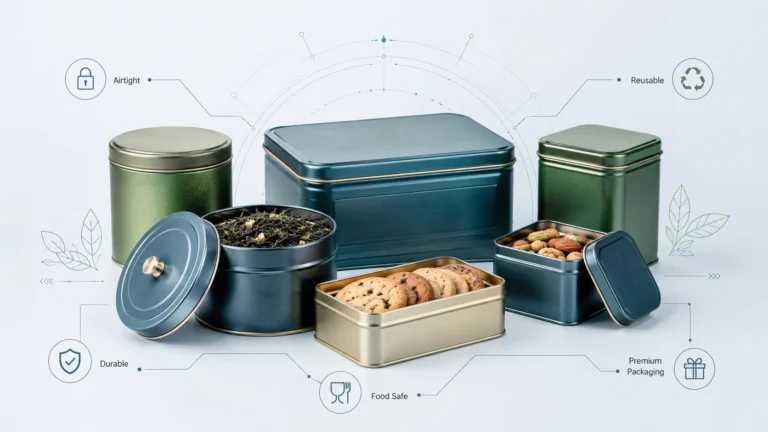
Most decorative “tin boxes” used for cookies, tea, coffee, mints, chocolates, holiday gifts, cosmetics, games, promotional products, and specialty kits are made from tinplate. Tinplate is not solid tin. It is thin steel sheet coated with a thin layer of tin. The steel core gives the package strength and formability. The tin coating improves corrosion resistance and supports downstream coating and printing processes.
The World Steel Association’s tinplate LCA eco-profile describes tin plated steel as a thin cold-rolled steel coil electroplated with tin, used primarily in food cans and industrial packaging, with typical thickness between 0.13 mm and 0.49 mm and typical width between 600 mm and 1100 mm. That thickness range is one reason tinplate works so well for custom decorative packaging: it can be thin enough for cost-efficient forming, but strong enough to hold a stable shape.
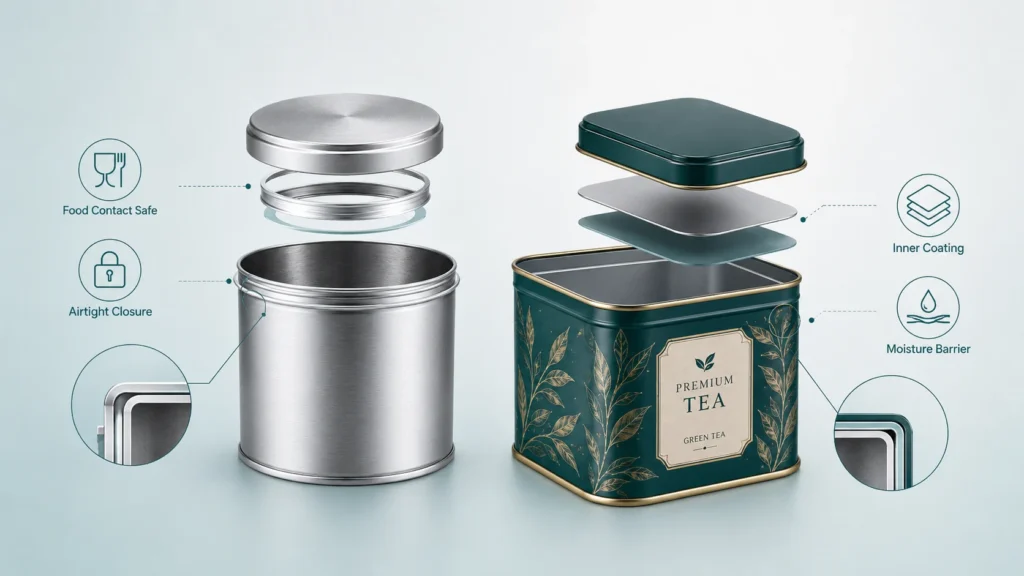
Tinplate packaging is a system, not just a sheet of metal. A finished tin may include base tinplate, passivation, internal lacquer, external primer, CMYK or Pantone printing, varnish, embossing, debossing, rolled edges, beads, hinges, lids, windows, inserts, trays, gaskets, and secondary packaging. Mr. Tin Box explains this system in more detail in its Tinplate Packaging Guide and Metal Tins with Lids Structure Guide.
Tinplate is especially strong for custom tins because it supports a wide range of shapes: round, square, rectangular, oval, heart-shaped, windowed, hinged, slide-lid, slip-lid, nested, tall, shallow, multi-piece, and promotional novelty structures. It also works very well with offset lithographic printing on flat metal sheets before forming. That makes it attractive for brands that need full-surface artwork, seasonal graphics, collectible designs, high shelf impact, or a premium tactile finish.
Material comparison: the practical differences that affect packaging performance
The best material choice depends on the product, not only the appearance. Aluminum and tinplate differ in density, stiffness, forming behavior, corrosion behavior, decoration route, tooling approach, recycling stream, and typical commercial use. The table below summarizes the most important differences for buyers.
| Factor | Aluminum tins | Tinplate tins |
|---|---|---|
| Base material | Aluminum or aluminum alloy sheet/component. | Cold-rolled steel sheet coated with tin. |
| Weight | Lightweight; useful for travel products, beauty items, and e-commerce. | Heavier than aluminum; can feel more solid and premium. |
| Rigidity | Good in the right gauge and shape, but thin aluminum can dent. | Strong rigidity from steel core; good for boxes, lids, and complex structures. |
| Corrosion behavior | Naturally forms a protective oxide layer; still needs compatibility checks. | Tin coating plus lacquer helps resist corrosion; exposed steel edges need good design. |
| Magnetism | Non-magnetic. | Magnetic because of the steel core. |
| Sorting route | Typically separated by eddy-current systems where available. | Can be separated by magnets in many recycling systems. |
| Common decoration | Brushed finish, anodizing, labels, screen printing, pad printing, digital/offset depending on structure. | Lithographic printing, varnish, embossing, debossing, metallic effects, matte/gloss finishes. |
| Common structures | Round screw tins, balm tins, candle tins, shallow jars, small specialty containers. | Cookie tins, tea tins, coffee tins, candy tins, gift tins, hinged tins, rectangular and square tins. |
| Cost tendency | Often higher material cost for many decorative tin projects. | Often cost-effective for printed decorative tins at scale. |
| Best commercial positioning | Lightweight, minimalist, modern, portable, cosmetic, wellness, travel. | Protective, highly printable, giftable, collectible, structural, seasonal, retail-ready. |
A useful way to think about the decision is this: aluminum gives the buyer a lightweight metal experience; tinplate gives the buyer a highly printable metal box platform. Both can be premium. Both can be recyclable. Both can be wrong if the project brief is incomplete.
Product protection: barrier, light control, moisture, odor, and impact
Metal packaging is popular because it solves several product protection problems at once. Both aluminum and tinplate are opaque, so they block light. This matters for tea, coffee, spices, confectionery, oils, waxes, balms, fragrances, pigments, supplements, and ingredients that can degrade under UV or visible light exposure. Compared with transparent plastic, metal can remove light exposure as a shelf-life variable.
Both materials can also help with moisture and oxygen control when the overall package structure is designed correctly. A metal body is a strong barrier, but the real-world performance depends on the lid, seam, gasket, liner, inner bag, coating, closure tolerance, and filling process. A simple slip-lid tin is not the same as a hermetically sealed can. A cookie tin may still require an inner pouch to maintain crispness. A tea tin may need a tight lid and an inner seal to preserve aroma. A cosmetic tin may need a compatible lacquer or liner to prevent reaction with oils, waxes, fragrance ingredients, or alcohol-based formulas.
Tinplate often has an advantage in impact resistance and structural stability for larger decorative boxes. The steel core helps the package maintain its geometry during stacking, shipping, retail handling, and repeated opening. That is why tinplate is widely used for cookie tins, tea tins, candy tins, gift tins, and promotional boxes. Mr. Tin Box’s article on Metal Tin Packaging Benefits, Applications, and Custom Options explains how metal packaging can combine protection with shelf appeal.
Aluminum can still protect products well, especially in small round formats. It is attractive for lip balm, solid perfume, salves, wax-based cosmetics, mints, dry supplements, and travel candles. But buyers should not assume that “metal” automatically means dent-proof. Aluminum gauge, lid geometry, sidewall height, rolled edge design, and outer packing are all important.
Food contact safety: the material is only one part of compliance
For food and beauty packaging, material choice must be tied to intended use. A tin for individually wrapped candy is not the same compliance scenario as a tin used for direct contact with acidic candy. A dry tea tin with an inner bag is different from a tin where loose tea touches the internal coating directly. A lip balm tin is different from a tin used for alcohol-based fragrance balm or essential-oil-rich formulations.
In the United States, the FDA explains that components of food packaging material used in compliance with regulations in 21 CFR Parts 174-179 need no further FDA review. Buyers can refer to the FDA page on determining the regulatory status of food contact material components. In the European Union, Regulation (EC) No 1935/2004 sets the general safety and inertness principles for food contact materials, while Regulation (EC) No 2023/2006 covers good manufacturing practice for materials and articles intended to come into contact with food.
For EU food-contact projects, BPA-related coating claims also require caution. The European Commission’s Access2Markets notice states that Commission Regulation (EU) 2024/3190 prohibits BPA, its salts, and other hazardous bisphenols in food contact materials from 20 January 2025, with transition arrangements depending on the application. This does not mean every existing metal package is automatically unsafe. It means buyers should request appropriate documentation and verify coating systems for the target market.
The practical takeaway is that buyers should ask for compliance by material system, not by slogan. “Food-grade aluminum” or “food-grade tinplate” is not enough. A serious RFQ should specify product type, direct or indirect contact, food characteristics, fill temperature, storage conditions, target market, expected shelf life, testing standard, coating type, and whether a declaration of compliance or migration test report is required.
| Compliance question | Why it matters | What buyers should request |
|---|---|---|
| Will the product touch the metal directly? | Direct contact creates higher coating and migration requirements. | Internal coating specification and contact-condition assessment. |
| Is the product acidic, salty, oily, alcoholic, fragrant, or alkaline? | These products may react with unsuitable coatings. | Compatibility testing with real product formula. |
| Is the target market the U.S., EU, UK, Canada, Australia, Japan, or another region? | Food-contact rules and documentation expectations vary. | Market-specific compliance documents. |
| Is the package for dry food, wet food, cosmetics, or gifts? | Each use case has different risk points. | Intended-use declaration and testing route. |
| Will the package be heated, filled hot, washed, or exposed to high humidity? | Heat and humidity can accelerate coating failure. | Process and storage condition review. |
| Are BPA-free, PFAS-free, or other chemical claims required? | Claims must be supported, not assumed. | Supplier declaration and lab testing where needed. |
For a deeper business-level overview of how coatings, inks, varnishes, and food safety work together, read Mr. Tin Box’s Custom Tin Packaging Guide.
Sustainability and recycling: strong claims need market-specific wording
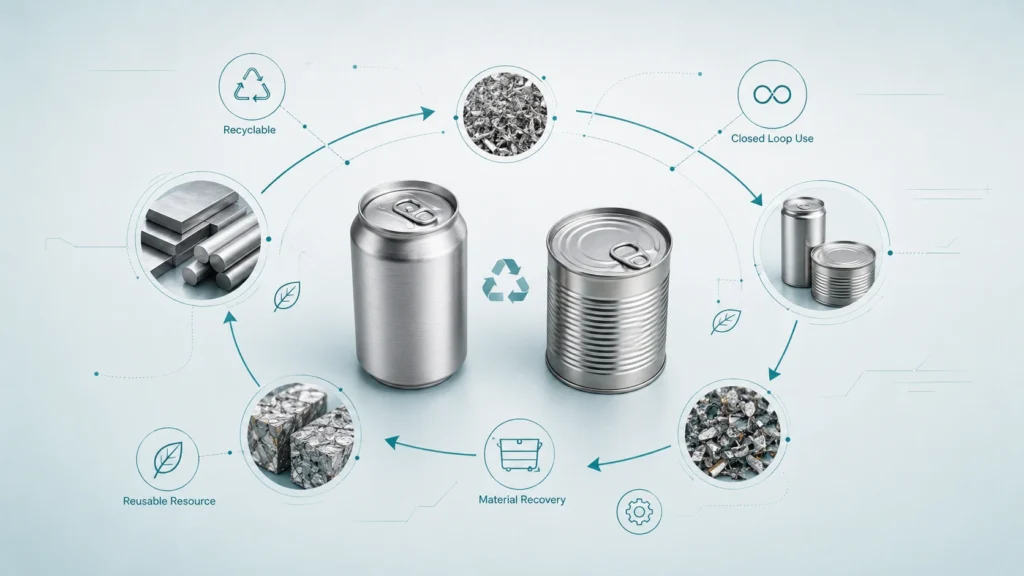
Both aluminum and tinplate can support a strong sustainability story, but buyers should avoid exaggerated claims. Recycling rates differ by country, municipality, collection system, product size, consumer behavior, contamination level, and sorting technology. A recyclable material is not always recycled in practice.
Aluminum has a powerful recycling advantage because recycled aluminum saves a very large amount of energy compared with primary aluminum. The Aluminum Association states that recycled aluminum saves 95% of the energy needed to make new aluminum, and that recycled aluminum makes up more than 80% of U.S. aluminum production. The International Aluminium Institute reports a similar energy-saving figure, comparing global primary aluminum production with recycled aluminum production.
Tinplate also has strong circularity advantages. Steel packaging is magnetic, which gives it a practical sorting benefit in many recovery systems. Steel for Packaging Europe notes that steel’s magnetic properties provide a natural advantage in sorting, because discarded steel packaging can be removed from the waste stream by magnetic sorting. Worldsteel’s tinplate eco-profile also models end-of-life recycling in its LCA methodology, reflecting steel’s established recycling route.
At the same time, U.S. EPA data reminds buyers to be specific. EPA’s containers and packaging data reported a 53.9% recycling rate for generated containers and packaging in 2018. EPA’s aluminum material-specific data also notes that its aluminum recycling figures represent aluminum cans only and that data on other aluminum product categories are not available. In other words, beverage can statistics should not be automatically applied to all aluminum tins.
For brand copy, a safer wording is usually: “reusable and recyclable where local metal recycling facilities accept this packaging.” For e-commerce product pages, a better sustainability statement might combine reuse, refill, and recyclability: “Designed as a durable reusable metal tin and recyclable in metal recycling streams where accepted locally.”
| Sustainability factor | Aluminum tins | Tinplate tins | Buyer note |
|---|---|---|---|
| Reusability | Strong for screw-top tins, balm tins, sample tins, and travel containers. | Strong for tea tins, cookie tins, gift tins, and collectible boxes. | Reuse depends on design quality and consumer value. |
| Recycling energy story | Very strong when aluminum is actually collected and recycled. | Strong due to established steel recycling routes. | Avoid applying beverage-can statistics to every format. |
| Sorting | Eddy-current sorting where available. | Magnetic sorting is a practical advantage. | Local infrastructure matters. |
| Weight and transport | Lower weight can reduce shipping load. | Heavier but often more protective for large formats. | Evaluate total pack system, not only metal weight. |
| Premium reuse value | Excellent for cosmetics and minimalist products. | Excellent for gift, tea, cookies, holiday, and collectible series. | A tin kept by consumers can extend brand exposure. |
Cost and MOQ: why the cheapest unit price is not always the best business choice
Material cost is only one part of total packaging cost. A buyer comparing aluminum tins and tinplate tins should evaluate tooling, printing, coating, sampling, minimum order quantity, defect risk, assembly, inserts, labels, outer cartons, shipping weight, and the value the package creates at retail.
Aluminum may cost more in many custom decorative tin projects, especially when a special gauge, surface treatment, anodized finish, screw thread, or custom structure is required. However, aluminum can be commercially reasonable for small premium products where the package supports a higher selling price. A $1 packaging upgrade may be acceptable for a $28 balm, fragrance, candle, or wellness product if it improves perceived value and repeat use.
Tinplate is often more economical for larger printed tins and high-volume decorative projects. Sheet printing before forming can be efficient, and the material is widely used in established decorative tin factories. Existing molds can also reduce development cost for common sizes. For example, a brand developing a cookie tin, holiday gift tin, tea tin, or rectangular promotional box can often start from an existing mold and customize artwork, coating, and finishing. This is one reason tinplate remains dominant in wholesale cookie tins, tea tins, candy tins, and seasonal gift packaging.
But “cheapest” can be misleading. If a thin tin deforms during shipping, the real cost includes product returns, retailer complaints, repacking, delayed launch, and brand damage. If an untested coating reacts with the formula, the real cost includes scrapped inventory. If artwork is too complex for a curved aluminum surface, the real cost includes extra proofing rounds. A good supplier helps buyers reduce total project risk, not just unit price.
| Cost item | Aluminum tins | Tinplate tins | Practical buying advice |
|---|---|---|---|
| Base material | Often higher for comparable custom decorative formats. | Often more cost-efficient for many printed tins. | Compare final structure, not raw material alone. |
| Tooling | Can vary widely for threaded or special shapes. | Existing molds are common for many shapes. | Ask for existing mold options first. |
| Printing | May require labels, screen print, pad print, or specialized methods. | Lithographic printing on flat sheets is mature. | Match artwork complexity to the process. |
| Coating | Important for cosmetics, food, and corrosion control. | Also essential for direct-contact food/cosmetic use. | Request coating compatibility testing. |
| Shipping | Lightweight advantage. | Higher weight but stronger large structures. | Estimate landed cost, not factory price only. |
| Brand value | Strong minimalist premium appeal. | Strong gift, collectible, and shelf-impact appeal. | Choose the material that supports the selling story. |
Decoration and brand experience: modern minimalism vs printed storytelling
Packaging is not only a container. It is a silent salesperson. The best material is often the one that communicates the brand story at first touch.
Aluminum tins naturally fit brands that want a modern, clean, lightweight, and minimalist look. A brushed silver tin with a simple black logo can work beautifully for solid perfume, beard balm, travel candle, supplement samples, aromatherapy products, and wellness kits. Aluminum can also support anodized color, laser marking, adhesive labels, paper sleeves, and understated embossing depending on the structure and supplier capability. The result can feel technical, clean, and contemporary.
Tinplate tins are stronger when the brand needs full visual storytelling. A tea brand can print botanical illustrations across the lid and side walls. A cookie brand can use seasonal artwork and collectible series. A chocolate brand can create a gift-ready tin with embossing and metallic varnish. A toy or promotional brand can use a hinged tin with bright graphics, internal printing, and an insert. For these projects, tinplate behaves like a printable metal canvas.
The correct finish also depends on shelf environment. In a luxury boutique, a minimal aluminum tin may stand out because it looks restrained and premium. In a supermarket or holiday display, a colorful tinplate tin may win because it communicates flavor, giftability, and emotional appeal from a distance. In B2B promotional gifting, tinplate can offer more room for brand artwork, while aluminum can communicate a modern industrial style.
| Brand goal | Better material tendency | Why |
|---|---|---|
| Minimalist beauty product | Aluminum | Lightweight, modern, clean metallic feel. |
| Premium tea or coffee tin | Tinplate | Strong print area, stable structure, aroma-preserving design options. |
| Holiday cookie tin | Tinplate | Large printed surface and strong gift association. |
| Travel balm or salve | Aluminum | Portable, light, corrosion resistant with the right liner/coating. |
| Corporate promotional kit | Tinplate or aluminum | Tinplate for artwork; aluminum for minimalist executive style. |
| Collectible limited edition | Tinplate | Better for shaped tins, embossing, and full-surface illustration. |
| Natural skincare sample | Aluminum | Small, lightweight, refill-friendly positioning. |
| Industrial small parts kit | Tinplate | Rigidity and magnetic steel character can be useful. |
Application-by-application recommendations
Food and beverage packaging
For dry food packaging, both aluminum and tinplate can be used, but tinplate is often more common for decorative food tins. Tea, coffee, cookies, chocolates, candy, mints, biscuits, spices, and gift assortments benefit from tinplate’s printable surface, structural stability, and established food tin manufacturing routes. Tinplate is especially strong when the package needs a square or rectangular body, a hinged lid, a window, a large gift format, or seasonal lithographic artwork.
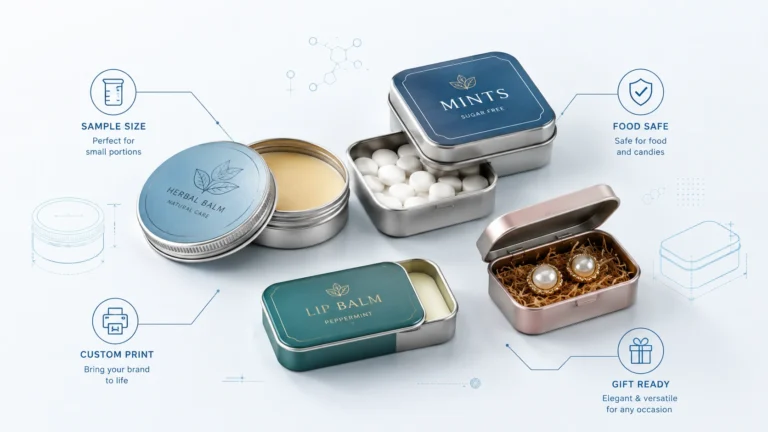
Aluminum tins can work well for mints, candies, supplements, and compact premium foods, especially when lightweight portability is important. However, direct food contact still requires the correct coating and compliance documentation. For aroma-sensitive products, lid tightness and inner seals matter more than material name alone.
A safe food packaging brief should state whether the food is dry, oily, acidic, salty, powdered, wrapped, loose, or in direct contact with the tin. It should also specify target market, shelf life, fill weight, storage conditions, and whether an inner bag or liner will be used. Mr. Tin Box’s Food & Beverage Packaging page is a useful starting point for brands developing food-grade metal tins.
Beauty and personal care packaging
Aluminum tins are very popular for beauty and personal care products because they feel clean, light, and modern. They are especially suitable for lip balm, solid perfume, hair wax, beard balm, salve, lotion bars, massage bars, travel soap, body butter, and sample products. Aluminum’s corrosion resistance and low weight are attractive, but oils, waxes, fragrance ingredients, essential oils, and alcohols can still create compatibility concerns. Testing with the real formula is essential.
Tinplate also works well for beauty packaging, especially for gift sets, cosmetic kits, soaps, bath products, grooming sets, and collectible tins. A tinplate box can hold multiple items with paperboard, PET, EVA, pulp, or metal inserts. For balm products, buyers can compare aluminum screw tins with tinplate slip-lid tins and select based on hand feel, closure preference, decoration route, and formula compatibility.
Mr. Tin Box’s guide on Metal Lip Balm Tin Packaging explains sizes, coatings, and branding options that are directly relevant to this category.
Gift, promotional, and holiday packaging
Tinplate is usually the stronger choice for gift, promotional, and holiday packaging because it supports complex shapes, large graphics, embossing, debossing, festive finishes, and collectible structures. Christmas tins, anniversary tins, wedding gift tins, chocolate tins, cookie tins, and promotional kits rely heavily on visual impact. Tinplate gives designers a broad canvas.
Aluminum tins can still be excellent for premium minimalist gifts, especially in wellness, cosmetics, executive promotions, travel kits, or refillable lifestyle products. The key is to avoid forcing aluminum into a role where tinplate would create better shelf storytelling.
If your project needs a decorative keepsake box that customers will keep after the product is gone, tinplate often provides more structural and graphic flexibility. If your project needs a small modern metal container that feels clean and portable, aluminum may be the better fit.
Specialty and industrial packaging
For specialty and industrial products, material choice depends heavily on contents. Screws, samples, small tools, electronic accessories, sewing kits, medical-adjacent kits, hobby supplies, and technical promotional items can use either material. Tinplate often provides better rigidity for rectangular kits and hinged boxes. Aluminum can be useful when low weight, corrosion resistance, or a clean technical appearance is preferred.
For any chemical, adhesive, lubricant, solvent, fragrance, essential oil, or reactive product, do not choose the material based only on appearance. Ask for compatibility testing and clarify whether a liner, inner pouch, gasket, or secondary seal is needed.
When aluminum tins are the better choice
Aluminum tins are the better choice when the package needs to feel light, modern, portable, and clean. They are especially attractive when the product is small and premium, the consumer may carry it every day, and the brand wants a minimalist metal identity.
Choose aluminum tins when:
- The product is a lip balm, salve, solid perfume, lotion bar, travel candle, mint, sample, supplement, or wellness product.
- Low weight is important for e-commerce, travel, sampling, or portable use.
- A silver, brushed, anodized, or minimalist appearance supports the brand identity.
- A screw-top or shallow round format is acceptable.
- The buyer wants a reusable container that feels modern and personal.
- The product formula has been tested with the selected internal surface or coating.
- The target customer values lightweight refillable or reusable packaging.
However, aluminum is not always the best fit for large printed boxes, complex gift tins, high-impact holiday artwork, or structures that need strong resistance to denting. In those cases, tinplate may provide a better balance of cost, strength, decoration, and production stability.
When tinplate tins are the better choice
Tinplate tins are the better choice when the package must combine strength, decoration, shape flexibility, and high-volume manufacturability. If the buyer needs a printed rectangular tin, a hinged tin, a cookie tin, a tea tin, a collectible gift tin, or a complex promotional box, tinplate is usually the safer starting point.
Choose tinplate tins when:
- The package needs square, rectangular, oval, heart-shaped, hinged, windowed, or multi-piece construction.
- Full-surface printing, seasonal artwork, or collectible graphics are important.
- The product needs stronger rigidity during shipping and retail handling.
- The brand wants a giftable or keepsake packaging format.
- Existing molds can reduce development cost and speed up sampling.
- Magnetic sorting is a relevant sustainability advantage in the target market.
- The product category already has strong consumer expectations for tinplate packaging, such as cookies, tea, chocolate, candy, or holiday gifts.
Tinplate is not automatically right for every product. For formulas with aggressive oils, acids, salt, alcohol, or unusual chemical properties, coating selection and compatibility testing remain essential. For very small minimalist products, tinplate may feel heavier or less modern than aluminum.
How to decide: a buyer’s material selection framework
A professional packaging decision should begin with the product, not the material. Before asking for a price, prepare a short project brief. The brief should answer what the product is, how it touches the container, where it will be sold, how it will be filled, what artwork is required, what shelf life is expected, and what budget level is realistic.
Use the following framework before confirming aluminum or tinplate:
| Decision factor | Key question | Material implication |
|---|---|---|
| Product chemistry | Is the product dry, oily, acidic, salty, fragrant, alcoholic, or reactive? | Determines coating, liner, and compatibility testing. |
| Contact type | Direct contact or inner bag/insert? | Direct contact requires stronger compliance review. |
| Structure | Round, square, rectangular, hinged, screw-top, slide-lid, or windowed? | Tinplate is stronger for many complex shapes; aluminum is strong for round small tins. |
| Decoration | Minimal logo or full-surface artwork? | Aluminum supports minimalist metal; tinplate supports printed storytelling. |
| Volume | Small batch, pilot launch, or mass production? | Existing molds and standard sizes can reduce cost. |
| Retail channel | Boutique, supermarket, e-commerce, gifting, B2B promotion? | Determines shelf impact, dent risk, and outer packing. |
| Sustainability claim | Recyclable, reusable, refillable, recycled content? | Claims must match local infrastructure and documentation. |
| Budget | Is the packaging meant to protect cost or increase perceived value? | Premium projects can justify higher material and finish costs. |
For many projects, the best first step is not to ask, “Which material is cheaper?” but “Which material helps the product sell, protects it during distribution, and avoids compliance problems?”
Sample RFQ checklist for aluminum tins and tinplate tins
A clear RFQ saves time for both buyer and supplier. It also makes quotations easier to compare. If one supplier quotes a thin aluminum tin with a sticker and another quotes a printed tinplate box with internal lacquer, the prices are not comparable. Use this checklist before requesting a quote.
| RFQ item | Details to provide |
|---|---|
| Product type | Food, tea, coffee, cookie, candy, balm, candle, cosmetic, gift, industrial part, etc. |
| Product contact | Direct contact, inner bag, wrapped product, insert, liner, or no contact. |
| Product characteristics | Dry, oily, waxy, acidic, salty, fragrant, alcoholic, powdered, granular, or sharp. |
| Target market | U.S., EU, UK, Canada, Australia, Japan, Middle East, global, or specific country. |
| Size and fill | Outside dimensions, internal capacity, fill weight, product dimensions, tolerance needs. |
| Preferred structure | Screw top, slip lid, hinged, slide lid, window lid, three-piece, two-piece, insert required. |
| Material preference | Aluminum, tinplate, open to recommendation, or compare both. |
| Coating requirement | Food-contact lacquer, BPA-free requirement, cosmetic compatibility, matte/gloss varnish. |
| Decoration | Full printing, logo only, embossing, debossing, label, paper sleeve, metallic effect, QR code. |
| Quantity | Sample quantity, first order quantity, annual forecast, repeat order plan. |
| Testing documents | FDA, EU, LFGB, migration test, declaration of compliance, heavy metals, coating certificate. |
| Packing and logistics | Export carton, inner polybag, anti-scratch packing, palletization, shipping method. |
| Launch timeline | Artwork date, sample deadline, mass production deadline, shipping deadline. |
A serious supplier should ask follow-up questions instead of quoting blindly. When a supplier requests product details, it is not creating friction; it is reducing risk.
Common mistakes buyers should avoid
The first mistake is assuming aluminum is automatically more sustainable than tinplate. Aluminum has an excellent recycling energy story, but only when collected and recycled. Tinplate has a strong recycling route and magnetic sorting advantages. The correct claim depends on the target market and packaging format.
The second mistake is assuming tinplate is automatically food-safe because it is called a “tin.” Food-contact safety depends on the full system: metal, coating, ink, varnish, adhesive, liner, insert, manufacturing process, and intended use conditions. This is why Mr. Tin Box repeatedly treats custom tin packaging as a complete packaging system rather than a simple container.
The third mistake is choosing material before choosing structure. A buyer may request aluminum for a large rectangular hinged cookie tin because aluminum sounds premium, but tinplate may offer better structure, decoration, cost, and production stability. Another buyer may request tinplate for a small minimalist balm tin, but aluminum may better match the desired feel.
The fourth mistake is overcomplicating decoration. Small aluminum tins often look better with restrained branding. Large tinplate tins often benefit from richer storytelling. The artwork should match the material and the customer’s buying behavior.
The fifth mistake is ignoring packaging logistics. A beautiful tin that scratches during transport is not a successful package. Aluminum may need anti-scratch protection. Tinplate may need corner protection or careful carton design. Gift tins may need individual bags, dividers, or tissue protection. Shipping tests are worth doing before mass production.
How Mr. Tin Box helps buyers choose the right material
Mr. Tin Box focuses on custom metal tin packaging for global brands in food and beverage, beauty and personal care, gifts, promotions, holidays, and specialty applications. The company’s role is not only to produce a box, but to help buyers connect product requirements with the correct structure, material, coating, decoration, and production route.
For a brand comparing aluminum tins and tinplate tins, the most useful supplier discussion usually includes three steps.
First, define the product risk. Is the product dry, oily, fragrant, acidic, salty, or sensitive to moisture? Will it touch the metal directly? Does it require food-contact or cosmetic compatibility testing? What target market regulations matter?
Second, define the commercial goal. Is the package intended to reduce cost, increase perceived value, support gifting, improve shelf impact, make the product portable, encourage reuse, or create a collectible series?
Third, define the manufacturing route. Can an existing mold be used? Does the artwork require full printing or only a logo? Is the best finish matte, gloss, brushed, metallic, embossed, debossed, labeled, or sleeved? What packing method will prevent scratches and dents?
Buyers can explore related Mr. Tin Box resources, including the Small Tin Containers Guide, Tin Containers with Lids Guide, and Metal Tin Packaging Guide, to better understand how shape, lid style, coating, and decoration affect the final product.
Final recommendation: choose the material that supports the product strategy
Aluminum tins and tinplate tins are both valuable packaging options, but they serve different commercial strategies.
Choose aluminum tins when your brand needs a lightweight, modern, portable, corrosion-resistant metal container for a small or medium product. Aluminum works especially well for beauty, wellness, balm, salve, solid perfume, mints, travel candles, samples, and minimalist premium products. It can make a small product feel clean, personal, and reusable.
Choose tinplate tins when your brand needs structure, printability, shape flexibility, gift appeal, and mass-production stability. Tinplate is usually the stronger choice for tea tins, coffee tins, cookie tins, candy tins, chocolate tins, holiday tins, hinged boxes, promotional kits, and collectible packaging. It gives brands a printable metal canvas with strong shelf presence.
The best decision is not based on a generic material ranking. It is based on the product, the consumer, the retail channel, the compliance requirement, the artwork, and the target price. If the package must be light and minimal, aluminum may win. If the package must be strong, decorated, and giftable, tinplate may win. If the product has direct food or cosmetic contact, coating and testing may matter more than the base metal.
For buyers developing a new metal packaging project, the smartest next step is to prepare a clear brief and compare both options with real drawings, samples, coating requirements, decoration plans, and landed cost estimates. Mr. Tin Box can help convert that brief into a practical packaging proposal so your brand chooses the material that protects the product, supports compliance, looks right on the shelf, and helps customers remember the brand long after purchase.
Frequently asked questions about aluminum tins and tinplate tins
Are aluminum tins food safe?
Aluminum tins can be suitable for food packaging when the selected material, coating, liner, and manufacturing process match the intended food contact conditions and target market regulations. Buyers should not rely on the phrase “food grade” alone. They should clarify whether the food touches the tin directly, whether the product is dry or reactive, and what documentation is required.
Are tinplate tins made of real tin?
No. Most commercial tinplate tins are made from thin steel sheet coated with a thin layer of tin. The steel gives strength, while the tin coating and additional lacquers help with corrosion resistance and surface performance.
Which is cheaper, aluminum tins or tinplate tins?
Tinplate is often more cost-effective for printed decorative tins, large tins, rectangular boxes, hinged tins, and high-volume gift packaging. Aluminum may cost more in many custom formats, but it can be justified for small premium products where lightweight feel, minimalist design, and portability increase perceived value.
Which material is better for lip balm tins?
Aluminum is very common for lip balm tins because it is lightweight, clean-looking, and suitable for small round screw-top formats. Tinplate can also be used, especially for slip-lid balm tins or gift sets. The final choice should depend on formula compatibility, lid preference, decoration, target market, and brand positioning.
Which material is better for cookie tins?
Tinplate is usually better for cookie tins because it supports larger printed surfaces, stronger structure, giftable shapes, seasonal artwork, and existing mold options. Cookies often still require inner trays, liners, or bags for product protection.
Can aluminum tins be printed?
Yes, aluminum tins can be decorated with labels, screen printing, pad printing, digital printing, laser marking, anodized effects, or other methods depending on structure and supplier capability. For complex full-surface illustration, tinplate often provides a more mature decorative route.
Can tinplate tins rust?
Tinplate has corrosion resistance from the tin coating and lacquer system, but exposed edges, damaged coatings, high humidity, or reactive contents can create corrosion risk. Proper material selection, edge design, internal lacquer, and storage conditions are important.
Which material is more recyclable?
Both materials can be recyclable, but actual recycling depends on local infrastructure and package format. Aluminum has a strong energy-saving story when recycled, while tinplate benefits from magnetic sorting in many recycling systems. Brands should avoid broad claims and use market-specific wording.
Can I use the same artwork on aluminum and tinplate?
Not always. Artwork that works well on a flat tinplate sheet may need adjustment for aluminum tins, especially if the aluminum structure is curved, brushed, anodized, or decorated after forming. Ask for a technical artwork template before finalizing design.
Should I choose aluminum or tinplate for my custom packaging project?
Choose aluminum if the project needs a lightweight, modern, portable, minimalist metal package. Choose tinplate if the project needs stronger structure, full-surface printing, gift appeal, complex shapes, or mass-production decorative flexibility. For direct food or cosmetic contact, test the coating and material system before confirming either option.