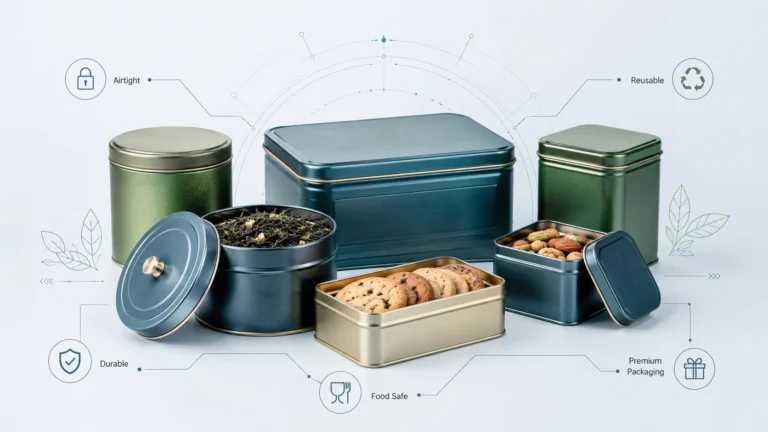


A personalized tin box is not only a metal container with a logo printed on the lid. For modern brands, it can be a retail display tool, a product protection system, a gift carrier, a collectible object, and a long-term brand reminder that stays in the customer’s home after the original product is finished. This is why personalized tin box packaging has become popular across food, beauty, promotional gifts, seasonal collections, lifestyle products, and specialty industrial packaging.
When a brand asks for a personalized tin box, it usually wants more than a standard container. It may need a custom size for cookies, tea, coffee, chocolate, lip balm, candles, skincare sets, game cards, stationery, tools, or promotional merchandise. It may also need a special color, embossed logo, shaped window, hinged lid, magnetic closure, inner tray, food-grade coating, QR code, limited-edition artwork, or a collectible design series. These details turn ordinary packaging into a brand asset.
For B2B buyers, the commercial value is clear. A personalized tin box can help a product look more premium, improve shelf impact, protect the contents during logistics, support seasonal campaigns, and encourage reuse. Unlike many disposable packages, a well-designed tin often remains visible on desks, kitchen shelves, bathroom counters, gift tables, and retail displays. Every time a customer reuses the box, the brand gets another moment of exposure.
At Mr. Tin Box, custom metal tin packaging is developed for Food & Beverage Packaging, Beauty & Personal Care Packaging, Gift, Promotional & Holiday Packaging, and Specialty & Industrial Packaging. That makes personalized tin boxes especially suitable for brands that need a balance of appearance, structure, safety, production efficiency, and export-ready packaging. If you are planning a project from the beginning, the Custom Tin Packaging Guide is a useful internal reference because it explains how material selection, structure design, finishing, sampling, quality control, and logistics all connect in one custom packaging program.
This guide explains how brands create memorable personalized tin boxes, what decisions matter most before production, and how to prepare a clear request for quotation. The goal is simple: help brand owners, product managers, distributors, private-label buyers, and promotional product teams make better packaging decisions before they spend money on tooling, samples, printing, and mass production.
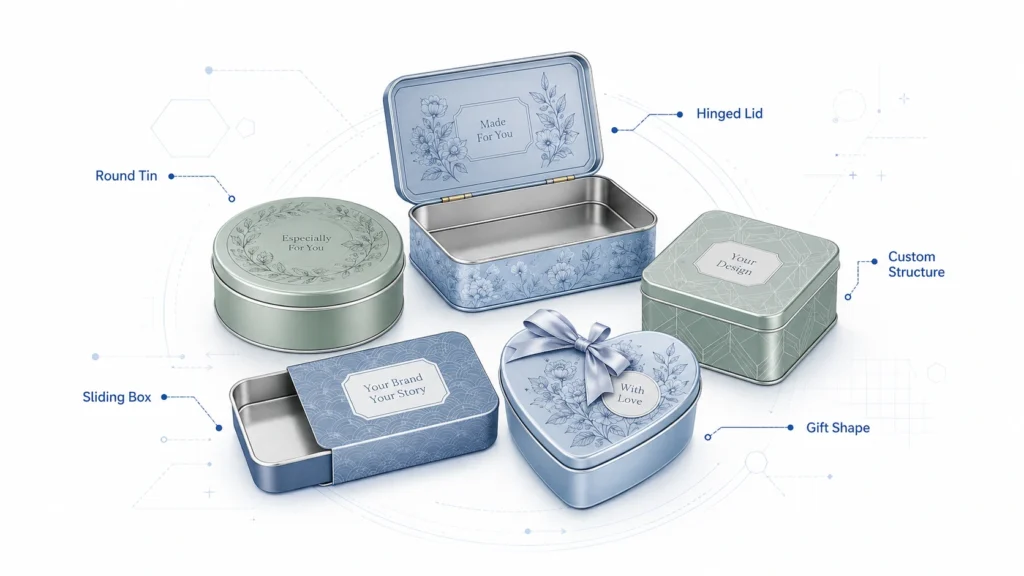
Why personalization matters in packaging strategy
Personalization is powerful because it makes the package feel intentional. Consumers do not always study packaging in detail, but they do respond quickly to shape, color, material, texture, and message. A metal tin with the right design can communicate quality before the product is opened. A tin with the customer’s name, a special city design, a holiday theme, a corporate gift message, or a limited-edition number can feel more valuable than a plain box holding the same product.
Marketing research supports the broader business case for personalization. McKinsey reported that 71% of consumers expect companies to deliver personalized interactions, and 76% get frustrated when this does not happen. Although that research covers the wider customer experience, the principle applies directly to packaging: buyers increasingly expect brands to feel relevant, thoughtful, and specific rather than generic.
Packaging is one of the most physical forms of personalization. Digital ads disappear in seconds. Emails are easy to ignore. A personalized tin box can remain in the customer’s hand, home, or workplace. It is tangible, photographable, giftable, and reusable. For brands selling through retail stores, e-commerce, subscription boxes, trade shows, corporate gifting channels, or seasonal promotions, this physical presence can strengthen brand recall.
Deloitte has also highlighted the commercial value of personalization, noting that many consumers prefer brands that offer personalized experiences and report higher spending with those brands. For packaging teams, this does not mean every tin must be individually printed one by one. It means the brand should design packaging around the market, occasion, audience, and product use. A personalized tin box can be customized at the brand level, campaign level, customer segment level, or individual level.
In practical terms, personalization can help brands achieve four commercial objectives. First, it improves recognition by making the package visually specific to the brand. Second, it increases perceived value because metal, embossing, varnish, and structured inserts can make the product feel more premium. Third, it supports campaign storytelling, especially for holiday tins, anniversary tins, city editions, sports events, weddings, trade shows, and corporate gifts. Fourth, it encourages reuse, which keeps the package visible after the product is consumed.
Key industry data buyers should know
Good packaging decisions should not rely only on taste. A personalized tin box project should be supported by material facts, consumer behavior, recycling data, and compliance expectations. The table below summarizes several useful data points that can help buyers justify a custom tin packaging investment internally.
| Topic | Data or regulatory point | Why it matters for personalized tin box projects | Source |
|---|---|---|---|
| Consumer personalization | 71% of consumers expect personalized interactions; 76% get frustrated when they do not receive them. | Personalized packaging can support a more relevant brand experience, especially for gifts, seasonal products, and loyalty campaigns. | McKinsey |
| Retail personalization | Deloitte reported that many consumers prefer brands that offer personalized experiences and spend more with those brands. | A personalized tin can turn packaging from a cost item into a value-building part of the customer journey. | Deloitte |
| EU steel packaging recycling | Steel for Packaging Europe reported that 82% of steel packaging placed on the European market was really recycled in 2023. | Tinplate is a steel-based packaging material, so brands can discuss circularity and recyclability more confidently in EU-facing markets. | Steel for Packaging Europe |
| Permanent material concept | Metal can be recycled again and again without losing its inherent properties. | This supports sustainability messaging for reusable personalized tins, especially when the design avoids unnecessary mixed-material complexity. | Metal Packaging Europe |
| U.S. containers and packaging recycling | The U.S. EPA reported a 53.9% recycling rate for generated containers and packaging in 2018. | Recycling systems vary by market, so export brands should avoid vague claims and use accurate, region-specific language. | U.S. EPA |
| Food contact safety | FDA defines food contact substances as substances that contact food and are not intended to have a technical effect in food. | Food tins require suitable coatings, inks, and supplier documentation for the intended food type and use conditions. | FDA |
| EU food contact materials | EU rules require food contact materials to comply with Regulation (EC) No 1935/2004 when placed on the European market. | Buyers selling in the EU should discuss food-contact compliance before artwork and production are finalized. | European Commission |
| Material supply | Food-safe tinplate is used in packaging applications such as cans and other formed packaging structures. | Brands should treat tinplate grade, coating, thickness, and forming method as technical decisions, not only design choices. | Tata Steel |
These figures should be used carefully. They do not mean every tin is automatically sustainable, compliant, or premium. They show why material selection, coating choice, production control, and market-specific labeling matter. A good personalized tin box project connects marketing claims with real packaging engineering.
What a personalized tin box really includes
The phrase personalized tin box can mean different things to different buyers. Some buyers only mean printed branding. Others mean a fully custom shape with new tooling, embossing, inner partitions, and market-specific artwork. To avoid confusion, it helps to separate personalization into layers.
The first layer is visual personalization. This includes brand colors, logos, patterns, product illustrations, flavor coding, limited-edition artwork, customer names, QR codes, social media handles, and retail messages. This is the most visible form of personalization and usually receives the most attention from the marketing team.
The second layer is structural personalization. A tin can be round, rectangular, square, oval, heart-shaped, book-shaped, windowed, hinged, sliding, stackable, or nested. It can include a slip lid, plug lid, hinged lid, screw lid, or multi-piece assembly. The Metal Tins with Lids Structure Guide explains why the lid is not a small accessory. It affects opening feel, closure performance, shelf display, logistics stability, and customer perception.
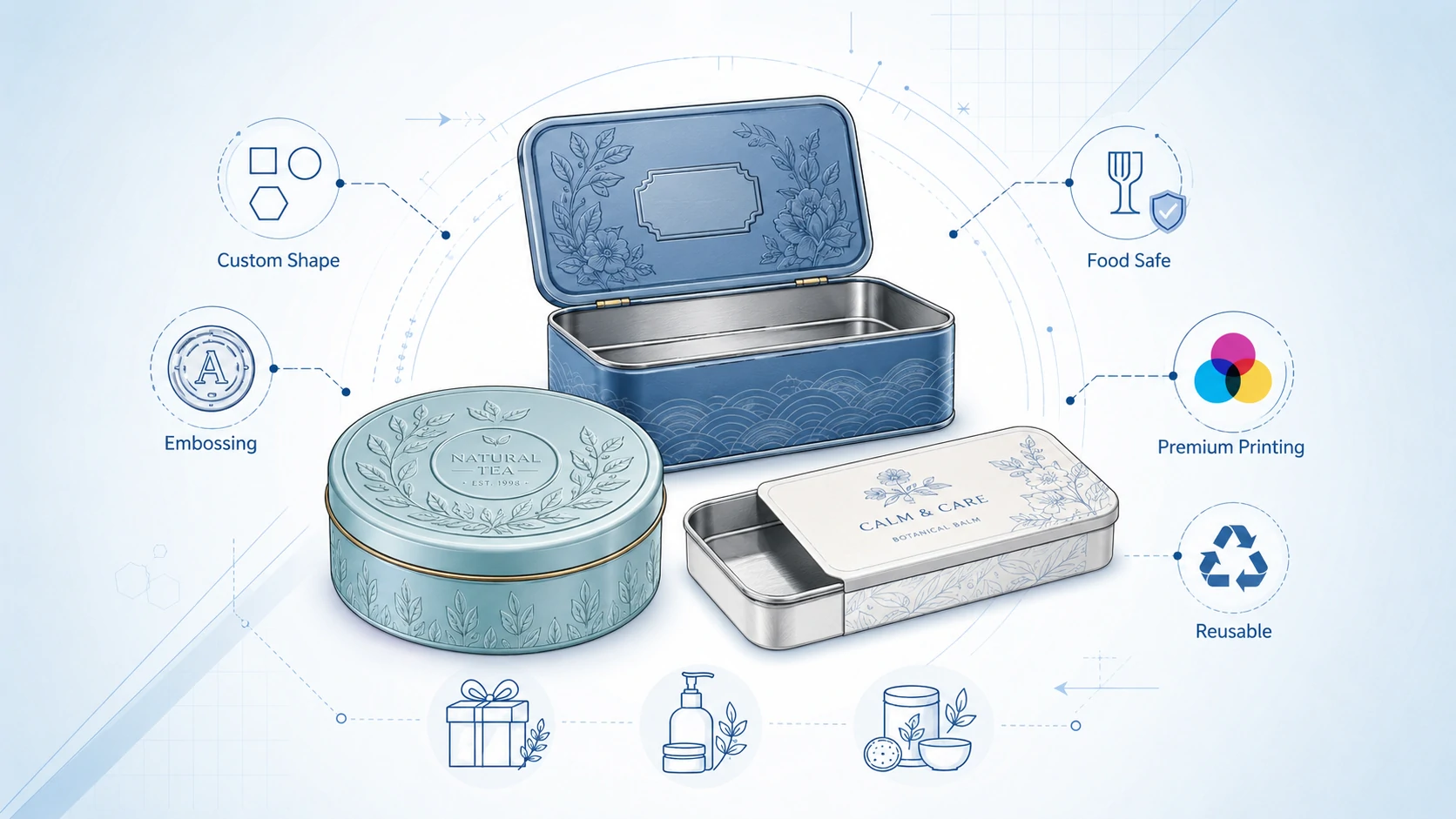
The third layer is tactile personalization. Customers touch the tin before they read the details. Matte varnish, glossy varnish, satin finish, soft-touch coating, embossing, debossing, textured effects, and spot UV can all change how the package feels. The Metal Tin Box Finishing Options article is a good reference for understanding how finishes influence premium perception, scratch resistance, fingerprint visibility, and production planning.
The fourth layer is functional personalization. This includes food-grade internal coatings, protective inserts, EVA foam, paperboard trays, plastic trays, flocked inserts, window films, handles, locks, labels, anti-counterfeit features, and tamper-evident solutions. Functional personalization is especially important for food, cosmetics, candles, wellness products, and specialty industrial items.
The fifth layer is campaign personalization. A brand may need different artwork for Christmas, Valentine’s Day, Ramadan, Lunar New Year, Easter, weddings, anniversaries, city editions, influencer collaborations, subscription boxes, event giveaways, or loyalty gifts. In this case, the structure may stay the same while the printing changes. This approach can reduce tooling cost while allowing the brand to release multiple personalized versions over time.
The most successful projects usually combine several layers. For example, a personalized tea tin may use an existing round structure, food-grade coating, matte botanical artwork, embossed logo, color-coded flavor bands, and a QR code linking to brewing instructions. A corporate gift tin may use a rectangular hinged structure, soft-touch finish, debossed company logo, custom card insert, and reusable desk-storage design. The final package feels personal because every detail supports the intended use.
Why tinplate is suitable for personalized packaging
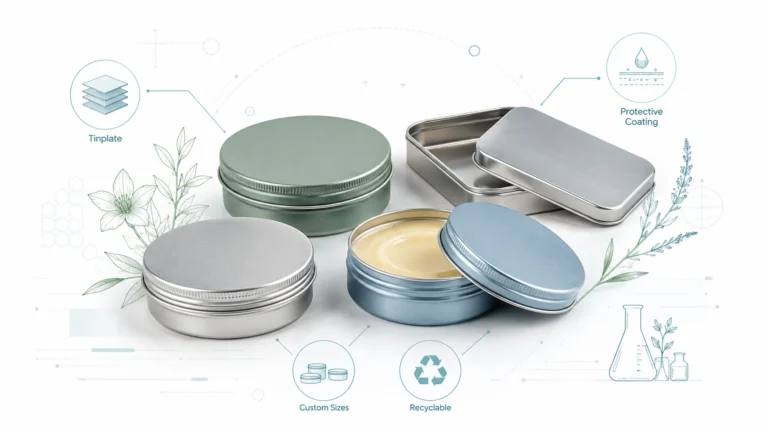
Most personalized tin boxes are made from tinplate, a thin steel sheet coated with tin. The steel base gives strength and formability, while the tin layer helps improve corrosion resistance and surface performance. Additional coatings, lacquers, inks, and varnishes are added depending on the product, artwork, and use conditions. For buyers who need a deeper technical introduction, Mr. Tin Box has a dedicated Tinplate Packaging Guide covering material, coating, printing, and food safety considerations.
Tinplate is attractive for personalized packaging because it can be stamped into many shapes while still holding crisp printed graphics. It supports offset printing, spot colors, CMYK artwork, metallic effects, embossing, debossing, and protective varnish. It also feels more durable than thin paperboard and many flexible packages. This makes it suitable for products that need a premium gift impression or repeated handling.
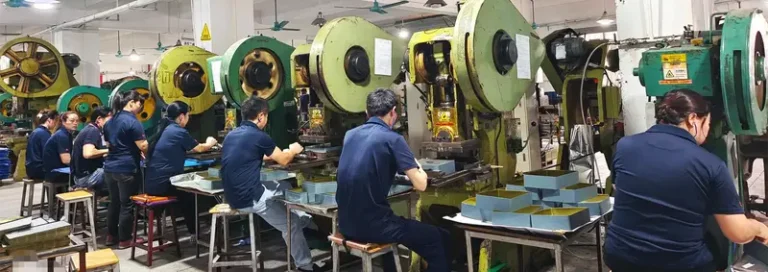
From a supply-chain perspective, tinplate also supports efficient mass production. A factory can print large metal sheets, apply coatings, cure the surface, and then form the sheets into lids, bodies, and other components. This process can be economical at scale, especially when the design uses standard structures and well-planned artwork. If the project requires a new shape, new molds may be needed, which affects tooling cost and lead time.
Tinplate is also useful when packaging must protect against light, physical impact, and external handling. It is not automatically airtight unless the structure and sealing method are designed for that purpose, but it does provide a rigid shell that can protect products better than many soft packages. For snacks, cookies, tea, coffee, candies, chocolates, cosmetics, lip balm, candles, and gift sets, this rigidity can help reduce crushing and improve perceived value.
However, tinplate should not be treated as a one-size-fits-all solution. The correct thickness, temper, coating, and finish depend on the tin size, forming depth, embossing design, lid type, product sensitivity, filling method, and shipping route. A small lip balm slider tin does not need the same structure as a large cookie tin. A candle tin has different requirements from a chocolate gift tin. A food-contact tin requires different internal coating discussions from a decorative stationery tin.
This is why a personalized tin box should be engineered as a complete packaging system. The artwork is important, but it must match the metal forming process, coating performance, food or cosmetic contact expectations, and packing method. A beautiful design that cracks during forming, scratches during shipping, or fails a compliance review is not a successful design.
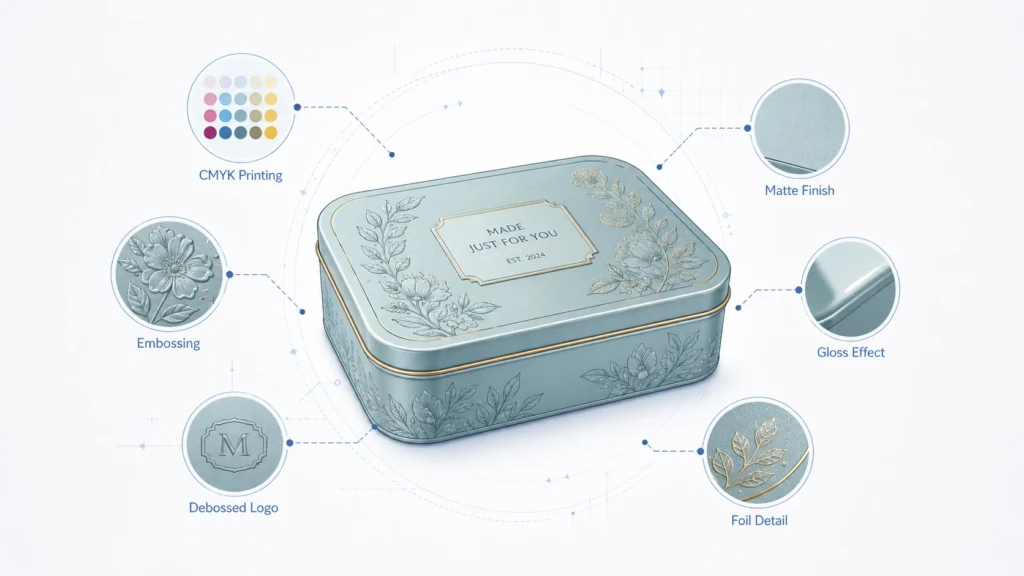
Personalization methods brands can use
There are many ways to personalize a tin box. The best option depends on brand positioning, order quantity, budget, timeline, and the level of uniqueness required. The table below compares common methods.
| Personalization method | Best for | Typical advantage | Important buyer note |
|---|---|---|---|
| Full-surface offset printing | Retail food tins, cosmetic tins, gift tins, seasonal tins | Strong shelf impact and consistent mass-production graphics | Artwork must be prepared to the correct dieline, with attention to bleed, seams, curves, and embossing areas. |
| Brand logo printing | Corporate gifts, promotional tins, simple product lines | Cost-effective branding on existing structures | Works well when the structure is standard and the campaign needs a faster launch. |
| Embossing or debossing | Premium products, luxury gifts, collectible tins | Adds tactile value and makes the brand feel more dimensional | Deep or complex embossing may require special tooling and careful artwork adjustment. |
| Matte, glossy, satin, or soft-touch finish | Beauty, wellness, tea, chocolate, lifestyle gifts | Changes perceived value and touch experience | Finish affects scratch resistance, fingerprints, and visual brightness. |
| Spot UV or contrast varnish | Premium retail packaging and limited editions | Highlights logos, patterns, or product names | Requires accurate registration and may increase cost or lead time. |
| Shaped tin structure | Holiday gifts, novelty products, brand icons | Makes the package instantly recognizable | New shapes may require new molds and a higher MOQ. |
| Window design | Food, cosmetics, stationery, gift sets | Shows the product while keeping a rigid metal frame | Window material and assembly should match safety, recyclability, and logistics goals. |
| QR code or NFC label | Loyalty programs, product authentication, storytelling | Connects physical packaging to digital content | Codes must remain scannable after printing and varnishing. |
| Personalized labels or sleeves | Short campaigns, trial runs, small batches | Flexible and lower tooling risk | Labels can be useful for lower quantities but may not feel as premium as direct printing. |
| Insert personalization | Gift sets, cosmetics, tools, samples, promotional kits | Improves product organization and unboxing | Insert material, fit, and tolerance should be confirmed during sampling. |
For many brands, the best starting point is not the most complex option. A standard tin structure with excellent artwork, good coating, and a refined finish can often outperform an overly ambitious custom shape. The goal is not to add every possible feature. The goal is to choose the features that support sales, protection, and brand memory.
How personalized tins support different industries
Personalized tin box packaging works across many industries because the same material system can be adapted to different product sizes and brand messages. A food company may focus on aroma protection, food-grade coating, and gift presentation. A beauty brand may focus on premium finish, clean color, and Instagram-friendly unboxing. A corporate gifting team may focus on logo visibility, reuse, and fast delivery. A specialty product buyer may focus on durability and internal organization.
| Industry | Common products | Why personalized tin boxes work | Suggested internal reference |
|---|---|---|---|
| Food & Beverage Packaging | Tea, coffee, cookies, chocolates, candies, mints, spices, biscuits, snacks | Rigid metal packaging improves gift value, shelf presence, and product protection. Food-contact coatings can be selected according to use. | Food & Beverage Packaging |
| Beauty & Personal Care Packaging | Lip balm, perfume sets, skincare samples, essential oils, wellness products, shaving kits | Metal tins communicate premium value and can be reused for travel or storage. Finishes and embossing are especially important. | Beauty & Personal Care Packaging |
| Gift, Promotional & Holiday Packaging | Christmas tins, anniversary tins, corporate gift boxes, event giveaways, wedding favors | Personalized artwork and collectible structures help create emotional value and campaign memorability. | 10 Creative Custom Metal Tin Packaging Design Ideas |
| Specialty & Industrial Packaging | Tools, small parts, stationery, game cards, electronics accessories, sample kits | Rigid tins protect small items and create organized presentation. Inserts can improve product fit. | Metal Tin Packaging Benefits and Applications |
| Small-format consumer goods | Lip balm, mints, earplugs, mini candles, sample products, promotional items | Small tins are portable, reusable, and easy to personalize for niche product lines. | Small Tin Containers and Metal Lip Balm Tin Packaging |
The commercial logic changes by industry. A cookie tin may need to look generous and festive. A coffee tin may need to preserve aroma and communicate origin. A lip balm tin may need pocket-friendly dimensions and smooth opening. A corporate tin may need space for the company message and a clean insert. A specialty tool tin may need stronger corners, inner compartments, and scuff-resistant printing.
This is why professional suppliers ask questions before quoting. Size, product weight, filling method, closure style, target country, food or cosmetic contact, packing method, sales channel, and launch schedule all influence the recommended structure. A personalized tin box is not only a graphic design task; it is a business and engineering task.
Designing a personalized tin box that customers remember
A memorable tin usually has one clear idea. It may be a color system, a shape, a texture, a seasonal story, a local landmark, a mascot, a gift message, or a collectible series. The mistake many brands make is trying to place too much information on the surface. A tin is not a brochure. It should communicate quickly.
Start with the main customer moment. Is the buyer seeing the tin on a retail shelf? Is the recipient opening it as a gift? Is the customer receiving it in an e-commerce box? Is the tin being handed out at a trade show? Is it part of a subscription program? The context determines the design priority.
For shelf retail, the front face and lid should be immediately recognizable. Product name, flavor, brand color, and key visual elements should be clear from a short distance. For gift packaging, emotional value matters more. Metallic effects, embossing, soft-touch finish, ribbon compatibility, and reusable structure may be more important than dense product information. For corporate promotional tins, the design should make the logo visible but not cheap. A clean layout with strong material quality often works better than oversized logos.
Color is one of the most efficient personalization tools. A brand can use one tin structure but create different versions by flavor, region, season, or collection. For example, a tea brand can use green for jasmine, black for breakfast tea, red for holiday spice, and blue for earl grey. The structure remains consistent, while the artwork makes each SKU easy to recognize.
Embossing and debossing can make the design more memorable, but they should be used with restraint. A raised logo on the lid can feel premium. A deep embossed illustration can be beautiful but may complicate forming, printing registration, and stacking. The supplier should review the embossing area, metal thickness, curvature, and artwork before sample approval.
Typography also matters. Small text may look fine on a computer screen but become difficult to read on a curved tin wall or embossed area. Always check dielines and physical samples. Text should not be placed too close to seams, rolled edges, deep curves, or areas with high deformation. For international brands, multilingual text requires careful layout planning so that the tin does not become visually crowded.
Finally, design for photography. Personalized tins often appear on product pages, Amazon listings, social media posts, trade show displays, and distributor catalogs. Matte finishes reduce reflections but may look less bright. Glossy finishes can look vibrant but may reflect lights. Metallic inks can look premium but require controlled photography. A good finish choice supports both physical retail and digital selling.
Structure decisions: lid, shape, size, and opening feel
The structure of a personalized tin box affects how customers experience the product. A tin can look beautiful but still fail if it is hard to open, too loose, too sharp, too heavy, too shallow, or too weak for shipping. Structure should be decided before final artwork because the dieline, printing layout, and decoration method depend on it.
The lid style is especially important. A slip lid is simple and common for many gift and food tins. A plug lid can create a tighter feel for certain products. A hinged lid improves convenience and reduces the risk of losing the lid. A sliding lid can work well for mints, lip balm, small stationery, or pocket products. A screw lid may be suitable for some round tins but requires different forming and threading considerations.
Shape also influences cost and production risk. Round, square, and rectangular tins are usually easier to produce using existing tooling. Heart-shaped, book-shaped, house-shaped, car-shaped, or character-shaped tins can be more memorable, but they may require new molds, longer development time, and higher MOQ. For a new brand or test launch, using an existing structure with personalized printing can be a safer first step.
Size should be based on the product, not only visual preference. The internal dimensions must match the contents, insert, protective space, and filling method. A cookie tin must consider cookie diameter, stack height, breakage risk, and paper cup or tray layout. A tea tin must consider net weight, bag format, scoop, and headspace. A cosmetic gift tin must consider bottle height, cap clearance, insert tolerance, and unboxing order.
Opening feel is a hidden part of brand experience. A premium tin should open smoothly and close securely. A lid that is too tight can frustrate customers. A lid that is too loose can feel cheap and may open during shipping. For repeat-use tins, the lid fit must survive repeated opening and closing. This is why sample testing is essential before mass production.
Stacking and transport should also be considered early. A tall tin may look impressive but create higher carton volume and shipping cost. A curved lid may be beautiful but harder to stack. A window may show the product but can reduce rigidity if not designed properly. A reusable handle may improve gift value but add assembly steps. Every structure decision affects cost, lead time, logistics, and quality control.
For buyers comparing container types, Tin Containers with Lids offers a useful overview of packaging options for food, gifts, and personal care products. The most important takeaway is simple: the lid, body, coating, printing, and internal fit must work together.
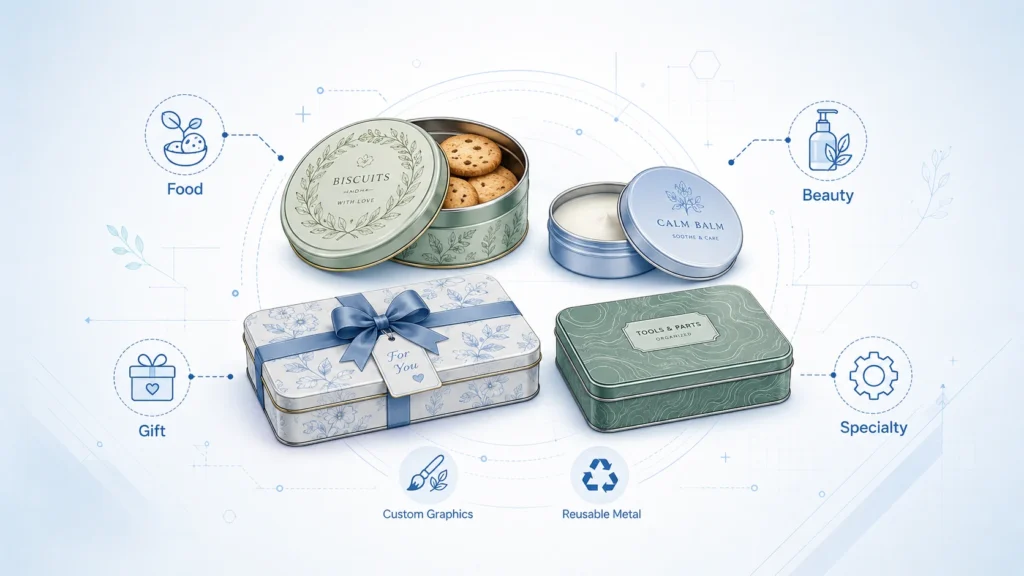
Printing, coating, and finishing for brand impact
Personalized tin boxes usually rely on a layered decoration system. The process often starts with tinplate sheet preparation, then base coating, printing, varnish or lacquer, drying or curing, cutting, stamping, forming, assembly, inspection, and packing. The exact workflow depends on the structure and finish.
Offset printing is common for mass-produced custom tins because it can produce high-quality graphics on metal sheets. The artwork must be separated correctly and adjusted for the metal surface. Colors may appear different on metal than on paper or digital screens. If brand color is critical, the buyer should provide Pantone references and request color confirmation during proofing.
Internal coatings are important for food and sensitive products. The inside of a food tin should be selected based on the product type, moisture, oil content, acidity, aroma sensitivity, and expected shelf life. A dry cookie tin has different requirements from a spice tin, tea tin, or oily confectionery package. The coating should be suitable for the intended contact conditions and market requirements.
External varnish protects the printed surface and controls the look and feel. Glossy varnish can make colors look bright and festive. Matte varnish can feel modern and premium. Satin finish offers a balanced appearance. Soft-touch finish can feel luxurious but may require more care in handling and testing. Textured finishes can improve grip or create a special tactile effect.
Embossing and debossing add a three-dimensional effect. For logos, seals, icons, or product names, they can create strong brand recognition. However, artwork must be adjusted to avoid distortion. If a design uses fine text, thin lines, or detailed illustrations, embossing may not be suitable in every area. The factory should review technical feasibility before tooling.
Spot UV, metallic ink, pearlescent effects, and other premium finishes can be useful for limited editions. They should be selected for a clear reason, not simply because they look expensive. Too many effects can make the tin difficult to produce and visually confusing. A clean premium design often uses one or two strong effects rather than many decorative elements.
Quality control should include color consistency, surface scratches, coating adhesion, rub resistance, forming cracks, lid fit, edge safety, printed registration, and packing protection. For export projects, buyers should also discuss carton strength, palletization, labeling, humidity control, and transit conditions.
Food safety and compliance considerations
If a personalized tin box is used for food, food-contact planning must begin early. It should not be added at the end after the design is approved. Food packaging is not only about appearance. The materials that may contact food, including internal coating, inks, adhesives, inserts, and liners, must be suitable for the intended product and market.
The FDA explains that a food contact substance is a substance that comes into contact with food and is not intended to have a technical effect in the food. This can include packaging components, coatings, colorants, adhesives, and other substances used in food contact applications. For brands selling in the United States, this means the packaging discussion should include intended food type, contact conditions, and documentation expectations.
For the European market, the European Commission states that food contact materials must comply with Regulation (EC) No 1935/2004 when placed on the European market. The general principle is that materials should not transfer constituents to food in ways that could endanger human health, change food composition unacceptably, or affect taste and smell. This is especially relevant for tea, coffee, chocolate, candies, biscuits, spices, and other products where aroma and flavor quality matter.
Food-contact compliance depends on the exact construction. A tin used only as a secondary outer gift box may have different requirements from a tin that directly touches unwrapped food. A tin holding individually wrapped candies may be different from a tin holding loose cookies. A tin with a paper liner may be different from a direct-contact tin. Buyers should describe how the product will be packed inside the tin, not only the product category.
For dry foods, common concerns include moisture, odor, grease, abrasion, and coating suitability. For oily or strongly aromatic foods, coating selection and migration considerations become more important. For premium foods, the packaging should also avoid unwanted odor transfer. Samples should be tested under realistic storage and transport conditions.
Labels and claims should also be controlled. If the brand wants to claim recyclable, reusable, food safe, BPA-free, PFAS-free, or compliant with a specific regulation, the claim should be supported by relevant documentation and market-specific rules. Avoid broad claims that cannot be proven. A professional supplier can help prepare technical information, but the brand owner remains responsible for final market compliance and labeling.
Sustainability, reuse, and responsible design
Sustainability is one of the reasons many brands consider metal packaging. Metal is widely recognized as a permanent material because it can be recycled repeatedly without losing its inherent properties. Metal Packaging Europe explains that permanent materials are not consumed in the same way as many other materials; they can return as raw material for new uses. Steel for Packaging Europe reported that 82% of steel packaging placed on the European market was really recycled in 2023.
For personalized tin boxes, the sustainability opportunity is not only recycling. Reuse is often more visible to the customer. A beautiful tin can become a storage box for tea bags, sewing tools, stationery, jewelry, USB drives, receipts, craft supplies, cosmetics, or small hardware. This reuse extends the life of the package and keeps the brand visible. In marketing terms, the tin becomes a long-term brand touchpoint.
However, sustainability claims must be accurate. A tin with unnecessary mixed materials, glued-on plastic decorations, difficult-to-remove inserts, or excessive secondary packaging may weaken the environmental message. A recyclable base material does not automatically make the full package easy to recycle in every market. Recycling systems differ by country, city, and waste stream.
Responsible design starts with simplicity. Use mono-material construction where possible. Avoid unnecessary accessories. Make inserts removable. Choose durable finishes that keep the tin reusable. Print recycling and reuse instructions clearly if the target market supports them. Avoid oversized packaging that wastes shipping volume. Align the tin size with the product and carton plan.
Brands should also consider the product-to-packaging ratio. A tin that is too large may look impressive but create a negative impression if the customer feels the package is mostly empty. Good design should feel generous without becoming wasteful. For food gifts, this may require a tray, divider, or paper cup layout that makes the product look abundant while protecting it.
The best sustainability argument for personalized tin packaging is not simply that metal can be recycled. It is that a well-designed tin can protect the product, reduce damage, support reuse, communicate quality, and eventually enter a recycling stream. This is a more balanced and credible message than a generic green claim.
MOQ, lead time, and cost drivers
MOQ and lead time are common pain points in custom packaging. Many buyers ask for a low MOQ, complex design, premium finish, short lead time, and low price at the same time. In real production, these goals often conflict. A professional quotation must consider printing setup, sheet utilization, tooling, mold availability, coating, forming, assembly, inspection, packing, and supplier scheduling.
The Mr. Tin Box article MOQ and Lead Time Planning for Your Custom Tin Box explains why MOQ is not just an arbitrary number. It reflects the economics of printing, stamping, coating, labor, tooling, and upstream materials. A standard tin with existing tooling and simple printing may allow a more flexible MOQ than a brand-new shape with special finish and custom insert.
Lead time should be divided into development lead time and mass production lead time. Development includes structure selection, dieline creation, artwork adjustment, sample making, coating confirmation, mold development if needed, and approval. Mass production includes material preparation, printing, forming, assembly, inspection, packing, and shipping. Buyers often underestimate development time, especially when several departments must approve artwork, compliance, and samples.
The table below summarizes typical cost and timeline drivers.
| Driver | Lower complexity option | Higher complexity option | Commercial impact |
|---|---|---|---|
| Structure | Existing round, square, or rectangular tin | New custom shape or multi-part structure | New tooling increases cost and development time. |
| Artwork | Simple logo or limited colors | Full-surface artwork, multiple SKUs, tight color matching | More proofing and color control may be required. |
| Finish | Standard gloss or matte varnish | Soft-touch, spot UV, metallic, texture, special effects | Premium finishes can improve value but increase cost and risk. |
| Embossing | Small logo embossing | Large multi-level detailed embossing | Requires tooling and careful forming review. |
| Insert | No insert or simple paper liner | EVA foam, plastic tray, paperboard structure, flocking | Adds supplier coordination and assembly time. |
| Compliance | Non-food decorative use | Direct food contact or regulated cosmetic packaging | Requires coating selection and documentation review. |
| Quantity | Larger continuous run | Small batch with multiple designs | Small runs may have higher unit cost. |
| Approval process | Fast single decision maker | Multiple brand, legal, distributor, and retailer approvals | Slow approvals can delay production even when the factory is ready. |
For budget planning, buyers should decide which features are essential and which are optional. If the tin must launch for Christmas, lead time may be more important than a complex new structure. If the tin is for a premium anniversary gift, embossing and finish may matter more than the lowest unit price. If the tin is for a new product test, using an existing mold may be smarter than investing in custom tooling.
A clear brief saves time. Provide target size, product dimensions, filling quantity, product weight, artwork direction, target market, required certificates or compliance documents, order quantity, packing method, launch date, and reference images. The more complete the brief, the more accurate the quotation.
How to plan a personalized tin box project
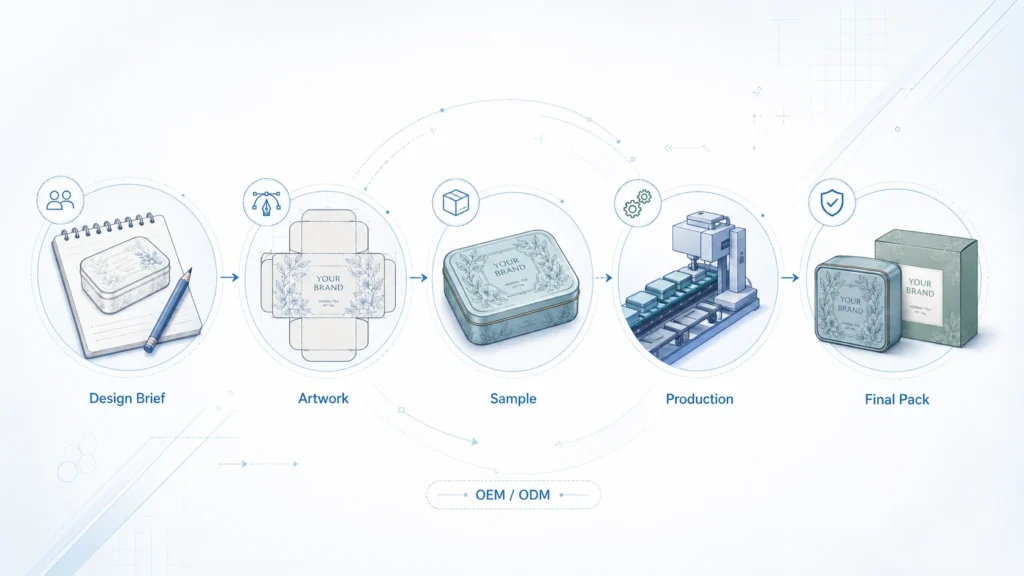
A successful personalized tin box project usually follows a structured process. Skipping steps may save a few days at the beginning but can create expensive problems later.
First, define the product and market. What product will go inside the tin? Will it touch the tin directly? Where will it be sold? Is it for retail shelves, e-commerce, gifting, subscription boxes, distributors, or corporate events? What is the target price range? What market regulations matter?
Second, choose the structure. Decide whether an existing tin can meet the goal or whether a new mold is necessary. Existing molds usually reduce tooling cost and speed up development. New molds can create stronger differentiation but require more investment. At this stage, internal references such as Metal Tin Packaging Benefits and Applications can help buyers compare use cases.
Third, prepare the design direction. This should include logo files, color references, artwork style, finish preference, embossing ideas, text content, barcode, QR code, regulatory labels, and any retailer requirements. If the package will be used in multiple countries, prepare language versions early.
Fourth, confirm technical feasibility. The supplier should review dimensions, forming areas, print layout, embossing location, lid fit, internal coating, insert design, packing method, and cost drivers. This step prevents unrealistic artwork from moving too far into production.
Fifth, create samples. Depending on project complexity, samples may include white samples, digital mockups, printed samples, pre-production samples, or tooling samples. A white sample checks size and structure. A printed sample checks artwork, color, finish, and overall impression. A pre-production sample confirms mass-production feasibility.
Sixth, test the sample. Do not only look at the sample on a desk. Open and close it repeatedly. Place the real product inside. Check product fit, lid tightness, edge safety, odor, scratch resistance, stacking, barcode scanning, QR code scanning, and carton packing. For food or cosmetic projects, review relevant documentation.
Seventh, approve mass production. After sample approval, keep artwork files, color references, sample photos, inspection criteria, and packing requirements clearly documented. This reduces disputes and helps the factory maintain consistency.
Eighth, inspect and ship. For export orders, confirm carton marks, pallet requirements, humidity protection, container loading plan, and destination requirements. A personalized tin box is often part of a launch schedule, so logistics planning should not be treated as an afterthought.
What to include in a request for quotation
A good RFQ makes the supplier’s job easier and helps the buyer receive a more accurate quote. Instead of asking only, “How much is a personalized tin box?” provide a structured brief.
| RFQ item | What to provide | Why it matters |
|---|---|---|
| Product type | Tea, coffee, cookies, chocolate, lip balm, candle, gift set, tools, etc. | Determines coating, structure, insert, and safety considerations. |
| Product dimensions and weight | Exact size, net weight, quantity per tin, product arrangement | Helps calculate internal size and shipping weight. |
| Contact condition | Direct food contact, wrapped food, secondary packaging, cosmetic contact, non-contact use | Affects internal coating and documentation. |
| Target market | United States, European Union, United Kingdom, Canada, Japan, Australia, Middle East, etc. | Compliance and labeling expectations vary by market. |
| Tin shape and size | Existing reference or desired custom shape | Determines tooling and MOQ. |
| Lid style | Slip lid, hinged lid, plug lid, sliding lid, screw lid | Affects opening feel and structure cost. |
| Artwork | Logo, dieline if available, color references, design concept | Determines printing and proofing needs. |
| Finish | Matte, gloss, satin, soft-touch, spot UV, embossing, debossing | Affects premium feel, cost, and lead time. |
| Insert | Paperboard, plastic tray, EVA foam, no insert, custom compartment | Affects product fit and assembly. |
| Quantity | Trial order, first mass order, annual forecast | Helps supplier recommend the best production approach. |
| Timeline | Sample deadline, mass production deadline, launch date | Helps plan realistic lead time. |
| Packing requirements | Inner bag, master carton, pallet, retail display, FBA, distributor carton | Affects export packing and logistics cost. |
This information does not need to be perfect before the first discussion. But the more accurate it is, the faster the project can move from concept to quotation. When you are ready to discuss a project, the Mr. Tin Box contact page is the best place to request samples, technical suggestions, and a quotation.
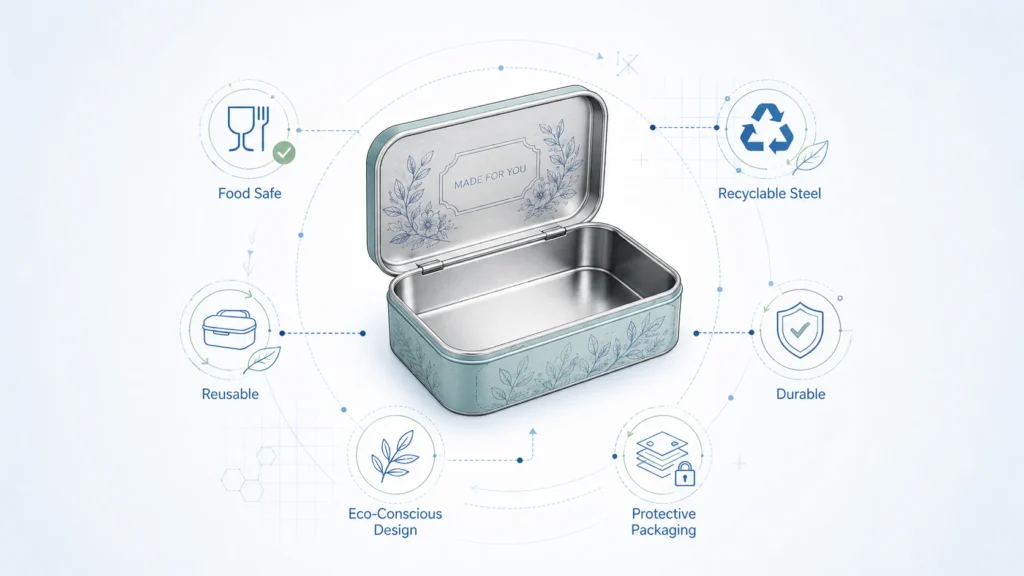
Common mistakes to avoid
The first mistake is starting with artwork before confirming the structure. If the size, lid, and forming method change later, the dieline may also change. This can waste design time and delay the project.
The second mistake is ignoring the inside of the tin. Buyers often focus on the outside graphics but forget internal coating, product fit, insert, and odor control. For food, beauty, and wellness products, the internal packaging experience matters as much as the external design.
The third mistake is over-personalizing the design. Too many colors, messages, textures, labels, and effects can make the tin look busy. Strong personalization usually means a clear concept, not maximum decoration.
The fourth mistake is treating MOQ as a negotiation number only. MOQ comes from printing efficiency, tooling, materials, labor, and production setup. A better approach is to ask which design changes can reduce MOQ or unit cost without hurting the brand goal.
The fifth mistake is underestimating lead time. Custom tins require artwork approval, sampling, printing, forming, assembly, inspection, packing, and shipping. If the project is tied to a holiday or product launch, build in buffer time.
The sixth mistake is making sustainability claims without market support. A tin may be recyclable, but the full package may include other components. Claims should be accurate and aligned with local recycling systems and regulations.
The seventh mistake is approving samples without real product testing. A sample can look beautiful while still failing in product fit, lid tightness, scuff resistance, or carton packing. Always test with real product units and realistic handling.
Personalized tin box ideas by use case
For gourmet food brands, personalized tins can be built around origin, flavor, and occasion. A tea brand might create a botanical collection with different colors for each blend. A cookie brand might create a holiday tin with embossed snow patterns. A coffee brand might use matte black and metallic copper to communicate roast quality. A chocolate brand might create a limited-edition tin for Valentine’s Day or an anniversary campaign.
For beauty and personal care brands, personalized tins can support travel, sampling, gifting, and premium presentation. Lip balm tins can use sliding or small round structures with soft-touch finish. Skincare sets can use hinged tins with custom inserts. Perfume sample sets can use metal boxes that feel collectible. Wellness brands can use clean color systems and simple typography to communicate trust.
For corporate gifting, the tin should feel useful after the campaign. A reusable desk tin with mints, tea bags, stationery, cables, or small tools can remain on a desk for months. The brand message should be visible but tasteful. Corporate buyers often want quick delivery, so existing structures with personalized printing are often the best option.
For holiday promotions, the package should feel seasonal without becoming disposable. Christmas tins, anniversary tins, wedding tins, and festival tins can use color, pattern, embossing, and shape to create emotional value. If the same structure can be reused for multiple holidays with different artwork, the brand can reduce development cost over time.
For specialty and industrial products, personalization should emphasize organization and protection. A tool accessory tin can use foam inserts and strong printing. A sample kit tin can present parts in a clean, professional layout. An electronics accessory tin can use a minimalist design and protective insert. In these categories, the package can improve perceived reliability.
How Mr. Tin Box supports personalized tin box projects
Mr. Tin Box focuses on custom metal tin packaging for global brands that need both creative design and production-ready execution. The company supports applications across food, beauty, gifts, promotional products, and specialty packaging. This matters because personalized tin packaging requires more than printing. It requires understanding of tinplate material, forming, coating, finishing, tooling, sampling, inspection, and export packing.
For buyers who are still comparing materials, the Metal Tin Packaging guide explains benefits, applications, and custom options. For buyers comparing small containers, the Small Tin Containers article provides ideas for compact packaging formats. For lip care and beauty products, Metal Lip Balm Tin Packaging gives category-specific guidance on sizes, coatings, and branding options.
The value of a good supplier is not only the ability to say yes. It is the ability to explain trade-offs. A supplier should tell you when an embossing design is too complex, when a finish may scratch easily, when a new mold may not be necessary, when an insert changes MOQ, or when a food-contact requirement needs early confirmation. Clear advice helps buyers avoid expensive changes later.
Mr. Tin Box can help brands review design ideas, select suitable structures, prepare dielines, discuss surface finishes, develop samples, and plan mass production. For B2B buyers, this support is especially useful when the project involves multiple stakeholders, such as marketing, procurement, compliance, distributors, and retailers.
FAQ about personalized tin box packaging
What is a personalized tin box?
A personalized tin box is a metal tin package customized for a brand, product, event, customer group, or campaign. Personalization can include logo printing, custom artwork, special colors, embossing, finish, shape, lid style, insert, QR code, or limited-edition design.
Is a personalized tin box the same as a custom tin box?
They are closely related, but not always identical. A custom tin box often refers to a package made to a buyer’s specifications. A personalized tin box emphasizes brand-specific or customer-specific design. In practice, many B2B projects use both ideas: a custom structure with personalized branding.
Can I use an existing tin mold and still personalize the package?
Yes. This is often the most efficient approach. You can choose an existing round, square, rectangular, oval, or sliding tin and personalize it with printing, finish, embossing, labels, or inserts. This can reduce tooling cost and development time.
When do I need a new mold?
A new mold may be needed when you require a unique shape, special dimensions, unusual lid structure, deep forming, custom window, or highly distinctive brand form. New molds can improve differentiation but usually increase cost, MOQ, and lead time.
Are personalized tin boxes suitable for food packaging?
Yes, but the structure and internal coating must be selected for the intended food and market. Direct food contact, wrapped food, dry food, oily food, and aromatic products may require different coating and documentation discussions. Start food-contact planning before final artwork approval.
What finishes are popular for premium personalized tins?
Matte, satin, gloss, soft-touch, spot UV, metallic effects, embossing, debossing, and textured finishes are common. The best choice depends on brand positioning, scratch resistance needs, product category, and budget.
What is the typical MOQ for a personalized tin box?
MOQ depends on structure, printing, tooling, finish, insert, and supplier production planning. Existing molds and simpler finishes usually support more flexible MOQs. New shapes, special effects, and custom inserts usually require higher quantities.
How long does a personalized tin box project take?
Lead time depends on design complexity, sample approval speed, mold requirements, printing schedule, production quantity, and shipping method. Buyers should separate development lead time from mass production lead time and build buffer time for launch schedules.
Can a personalized tin box be recyclable?
Tinplate is a steel-based packaging material, and metal can be recycled repeatedly. However, recyclability also depends on the full package design and local recycling systems. Avoid unnecessary mixed materials and make inserts removable where possible.
How can I reduce cost without making the tin look cheap?
Use an existing mold, keep the structure simple, focus on strong artwork, choose one premium finish instead of many effects, avoid unnecessary accessories, and plan multiple SKUs around the same tin size. Good design discipline often saves more money than simply reducing material quality.
What files should I prepare before requesting a quote?
Prepare logo files, artwork direction, product dimensions, product weight, target quantity, target market, required finish, lid preference, insert needs, compliance expectations, packing requirements, and launch timeline. Reference images are also helpful.
Can personalized tins be used for seasonal campaigns?
Yes. Personalized tins are excellent for Christmas, Valentine’s Day, Easter, Ramadan, Lunar New Year, weddings, anniversaries, corporate events, and limited-edition releases. Brands can reuse the same structure with different artwork to control cost.
Final thoughts: make the tin personal, practical, and production-ready
Personalized tin box packaging works best when creativity and production reality move together. A memorable tin is not just a decorated container. It is a structured brand experience that combines material, shape, color, finish, closure, safety, product fit, reuse, and logistics.
For brand owners, the opportunity is significant. A personalized tin box can increase perceived value, support giftability, improve retail presence, protect the product, and keep the brand visible long after purchase. For procurement teams, the challenge is to manage MOQ, lead time, compliance, and cost without weakening the design. For marketing teams, the goal is to create a package that customers want to keep.
The most reliable path is to start with a clear brief, choose the right tin structure, confirm food or cosmetic contact requirements early, keep the design focused, test physical samples, and work with a supplier that understands both branding and manufacturing. When these pieces align, personalized tin box packaging becomes more than a package. It becomes a memory, a gift, a display piece, and a lasting brand touchpoint.
If your brand is preparing a food, beauty, gift, promotional, or specialty packaging project, Mr. Tin Box can help turn your idea into a production-ready personalized tin box. Visit the Mr. Tin Box contact page to discuss structure options, artwork ideas, samples, MOQ, lead time, and quotation details.