
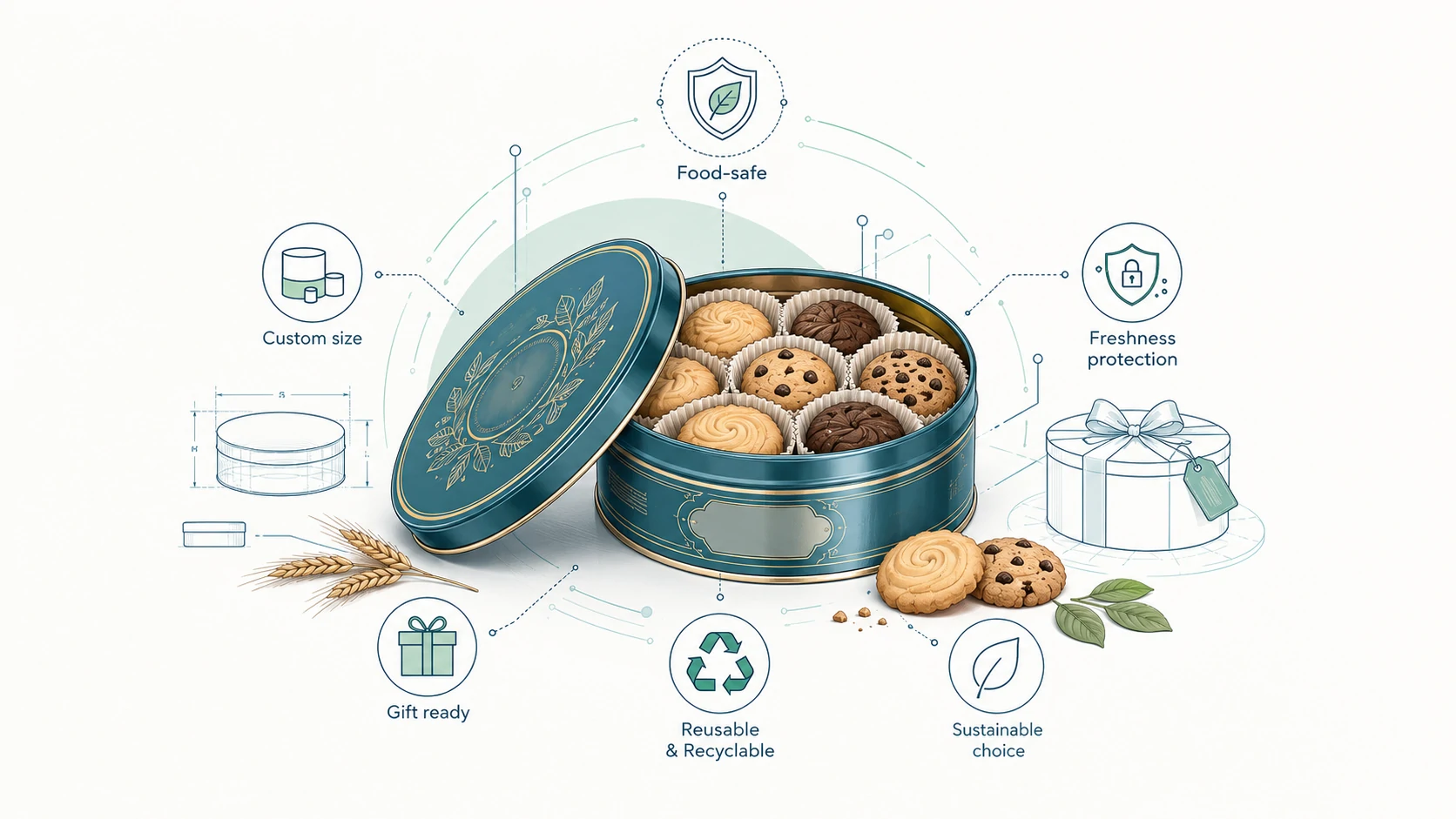
For bakery brands, cookie packaging is more than a box around a sweet product. It is the first proof of quality, the first visible signal of freshness, and often the reason a customer decides whether the product feels giftable. This is especially true for cookies because they are frequently purchased for family sharing, holiday gifting, corporate events, hotel amenities, private-label assortments, travel retail, subscription boxes, and premium retail displays. In these situations, ordinary paperboard cartons or flexible plastic bags may hold the cookies, but they do not always create the same sense of value that a well-designed metal tin can provide.
That is why wholesale cookie tins remain a practical and commercially powerful packaging option for bakery brands. A cookie tin can protect delicate cookies from crushing, reduce exposure to light, support better moisture-control strategies when combined with a suitable inner liner, and create a reusable container that customers may keep long after the cookies are eaten. For brands trying to increase perceived value, build seasonal collections, launch a premium SKU, or improve e-commerce packaging, custom metal cookie tins can turn a standard cookie product into a gift-ready experience.
At Mr. Tin Box, custom metal tin packaging is developed for global brands across Food & Beverage Packaging, beauty and personal care, gift programs, promotional packaging, and specialty applications. For bakery buyers, this means the project should not be treated as “buying a tin box.” A successful cookie tin project connects product protection, food-contact planning, brand design, lid structure, logistics, retail display, and wholesale cost control into one specification.
This guide is written for bakery owners, food brand managers, packaging buyers, private-label sourcing teams, gift companies, distributors, and procurement teams that need to choose wholesale cookie tins with confidence. It explains the commercial reasons for using metal tins, the data that supports the packaging decision, the most important technical choices, and the practical details that should be included in a professional request for quotation.
Table of Contents
Why Wholesale Cookie Tins Matter for Bakery Brands
Cookies are emotionally simple products, but commercially they can be surprisingly complex. A bakery may sell butter cookies, shortbread, wafer rolls, chocolate chip cookies, iced cookies, sandwich cookies, biscotti, macarons, holiday assortments, or individually wrapped cookie selections. Each product has a different texture, oil content, fragility, aroma profile, and shelf-life expectation. The packaging must support those differences while still communicating the brand story clearly.
Wholesale cookie tins solve a specific business problem: they help bakery products look more valuable without requiring the food itself to become radically more expensive. The same cookie recipe placed in a plain pouch may feel like an everyday snack. Placed in a rigid printed tin with an embossed lid, divider tray, holiday artwork, and a gift sleeve, it can become a premium gift item. This is why cookie tins are common in holiday retail, department stores, airport shops, wedding favors, corporate gifting, tourist souvenirs, luxury hotel welcome gifts, and seasonal food promotions.
The value comes from three layers. First, the tin gives physical protection. It resists compression better than thin paper or film and helps reduce corner damage during shipping and retail handling. Second, it creates a premium tactile experience. Metal has weight, sound, and surface feel, which can make the product feel more substantial before the customer opens it. Third, it offers reuse value. Customers often keep cookie tins for tea bags, sewing supplies, snacks, stationery, ornaments, receipts, or small household items. That reuse extends brand visibility beyond the first purchase.
For brands comparing packaging formats, it is useful to think in terms of commercial goals. If the goal is the lowest possible unit cost for a discount cookie line, a metal tin may not be the right primary pack. If the goal is to create a premium collection, build a giftable SKU, improve shelf presence, reduce deformation complaints, support limited-edition artwork, or raise the average order value, wholesale cookie tins deserve serious consideration.
Key Industry Data That Supports the Packaging Decision
A packaging decision should not rely only on opinion. The following data points help explain why custom metal packaging, cookie products, and better packaging design remain commercially relevant for bakery brands.
| Data point | What it means for bakery brands | Practical packaging takeaway |
|---|---|---|
| Grand View Research estimated the global metal packaging market at USD 148.13 billion in 2024, with a projected value of USD 184.21 billion by 2030 and a 3.7% CAGR from 2025 to 2030 (source). | Metal packaging is not a niche decorative option; it is a large, mature packaging category with long-term demand. | Bakery brands can use metal tins as a credible premium packaging format rather than an unusual novelty pack. |
| Global Market Insights reported the global cookie and wafer market at USD 23.3 billion in 2024, growing to USD 44.2 billion by 2034 at a 6.6% CAGR (source). | Cookie and wafer products remain a large, competitive category where differentiation matters. | Premium packaging can help bakery brands stand out in a crowded snack and gift market. |
| Ipsos reported that 72% of Americans said packaging design often influences purchase decisions, while 67% said packaging material often influences purchase decisions (source). | Customers judge packaging before tasting the product. | A well-designed tin can improve perceived value at the point of sale. |
| Steel for Packaging Europe reported that 82% of steel packaging placed on the EU market was “really recycled” in 2023 (source). | Tinplate packaging can support circularity messaging in markets with strong metal recycling systems. | Sustainability claims should be specific, market-aware, and supported by evidence. |
| The U.S. EPA estimates that steel packaging recycling in 2018 was 1.6 million tons, or 73.8% of generation (source). | U.S. recycling data also supports the strong recyclability story of steel containers. | Brands can discuss recyclability more credibly when they reference local recycling conditions. |
| The FDA explains that food contact substances used in packaging must be authorized for the intended use before marketing in the U.S. (source). | Food packaging is a compliance topic, not only a design topic. | Bakery brands should confirm coatings, liners, inks, and direct-food-contact surfaces early. |
| USDA FSIS explains that a “Best if Used By/Before” date indicates best flavor or quality, not a purchase or safety date (source). | Many bakery products use quality-based date labeling. | Packaging should help maintain texture, aroma, and appearance through the intended quality window. |
These numbers do not mean every cookie brand needs a tin. They do show that the commercial logic is strong when the product is positioned as premium, seasonal, giftable, export-ready, or reusable. The key is to choose the correct tin structure and avoid over-designing a package that becomes too expensive for the target retail price.
What “Wholesale Cookie Tins” Actually Means
The phrase wholesale cookie tins can mean several different things. Some buyers use it to describe ready-made empty tins purchased in bulk. Others mean custom printed tins produced at factory scale for a bakery brand. Some want standard molds with custom artwork. Others need completely custom sizes, special shapes, windows, inserts, and premium finishes.
For a serious bakery packaging project, it is helpful to separate four sourcing models.
| Sourcing model | Best for | Main advantage | Main limitation |
|---|---|---|---|
| Stock empty tins | Small bakeries, short runs, local events, urgent orders | Fast availability and low development risk | Limited size, color, and branding control |
| Standard mold + custom printing | Growing bakery brands, seasonal launches, private label | Good balance of cost, speed, and brand identity | Size and shape must fit existing tooling |
| Standard mold + custom inserts | Cookie assortments, gift sets, fragile products | Better presentation and product separation | Insert design adds sampling and assembly work |
| Fully custom tin structure | Premium brands, iconic gift packaging, long-term SKUs | Strong differentiation and ownable design | Higher tooling cost and longer development time |
For most bakery brands, the best starting point is not a fully custom mold. A standard mold with custom printing, embossing, inner liner planning, and a well-designed insert often delivers excellent commercial value. The customer sees a premium package, while the brand avoids unnecessary tooling risk. Fully custom structures make more sense when the tin itself is part of a long-term brand asset, such as a collectible holiday series or signature gift collection.
Mr. Tin Box already explains broader structure logic in its guide to metal tins with lids. For cookie projects, that lid decision is especially important because cookies are sensitive to crushing, moisture, aroma loss, and customer opening experience.
The Five Jobs a Cookie Tin Must Perform
A cookie tin should be evaluated as a functional packaging system. It is not enough for the sample to look attractive in a product photo. It must work across filling, storage, transport, retail display, customer opening, and after-use.
1. Protect product appearance. Cookies are often purchased visually. Broken edges, sugar dust, icing cracks, and crushed decorations can make a premium product feel defective. A rigid metal body can reduce external compression, while inserts, paper cups, flow wraps, or trays can reduce movement inside the tin.
2. Support texture and aroma. Many cookies are valued for crispness, buttery aroma, spice notes, chocolate aroma, or snap. Metal helps block light and provides a strong outer barrier, but most cookie tins still require an inner packaging strategy. Depending on the product, that may be a sealed bag, wax paper, food-grade paper cup, plastic tray, or compartment system. The tin protects and presents; the inner pack often controls moisture and direct food contact.
3. Communicate gift value. A cookie tin is frequently bought as a gift. The lid artwork, finish, shape, and opening feel must communicate “I can give this to someone” immediately. This is where embossing, metallic effects, matte varnish, soft-touch finishes, seasonal illustrations, and clean typography can create value before the product is tasted.
4. Work in wholesale logistics. Wholesale packaging must survive bulk cartons, pallet handling, long-distance shipping, warehouse stacking, retailer handling, and sometimes e-commerce parcel delivery. Tin thickness, lid fit, carton count, divider protection, and drop-test planning all affect the final customer experience.
5. Encourage reuse. Reuse is not only a sustainability story; it is a brand exposure story. If the customer keeps the empty tin on a shelf, in a kitchen, or on a desk, the package continues to remind them of the bakery. This is one reason collectible tin series can be powerful for holiday launches.
Matching Cookie Type to Tin Structure
Different cookies need different packaging logic. A heavy butter cookie assortment does not behave like a delicate iced cookie. A dry biscotti selection has different risks from chocolate-coated cookies. Before choosing the tin size, bakery brands should define the product risks clearly.
| Cookie type | Packaging risk | Recommended tin approach | Buyer note |
|---|---|---|---|
| Butter cookies and shortbread | Breakage, oil aroma loss, crumbs | Round or rectangular tin with paper cups or tray | Use inner liner or sealed bag if longer shelf life is required. |
| Assorted gift cookies | Product movement, mixed flavors, premium presentation | Large rectangular or square tin with divider tray | Dividers improve unboxing and reduce flavor mixing. |
| Iced or decorated cookies | Surface damage, decoration cracks | Shallow tin with protective insert and minimal stacking | Validate clearance between cookie surface and lid. |
| Biscotti and stick cookies | Length fit, edge breakage | Long rectangular tin or tall vertical tin | Use paper wrap or tray to prevent rubbing. |
| Chocolate-coated cookies | Heat sensitivity, bloom, grease transfer | Tin with food-safe inner pack and stable insert | Tin cannot solve temperature abuse; logistics still matter. |
| Holiday cookie assortment | Seasonal shelf impact, gifting expectations | Custom printed tin with embossing or collectible artwork | Plan artwork and sampling early because seasonal deadlines are fixed. |
| Individually wrapped cookies | Carton replacement, gift display, multipack order | Deeper tin with bulk arrangement or paper insert | Inner wrappers handle food contact and freshness; tin handles branding. |
The most important lesson is simple: the tin and the cookie must be designed together. If the cookie size changes after the tin is approved, the insert may not fit. If the insert is changed after artwork approval, the visual opening experience may suffer. If the bakery fills cookies manually but the tin was designed for automated packing, labor cost may become higher than expected.
Tinplate Material: Why It Is Common for Cookie Tins
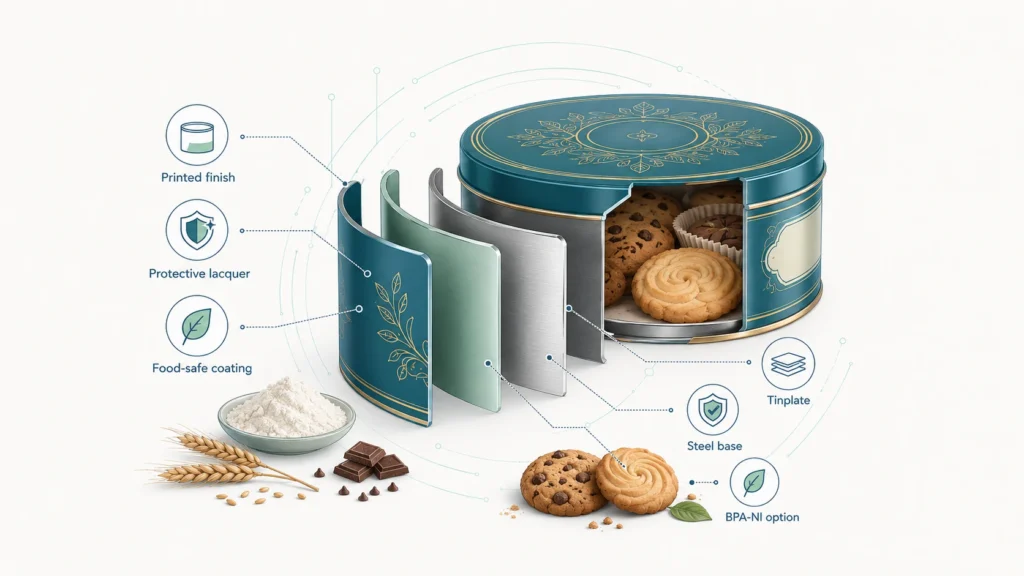
Most wholesale cookie tins are made from tinplate, which is a thin steel sheet coated with a thin layer of tin. The steel provides strength, rigidity, and forming performance. The tin layer helps with corrosion resistance and supports the surface system used for printing and coating. In modern decorative tins, tinplate is combined with internal lacquer, external coating, offset printing, varnish, and sometimes embossing or debossing.
For bakery brands, tinplate has several practical advantages. It forms well into round, rectangular, square, heart-shaped, or specialty tins. It offers a stable surface for high-quality printing. It feels more premium than many lightweight plastic tubs. It resists crushing better than paperboard alone. It also supports reusable packaging concepts.
Mr. Tin Box’s guide to tinplate packaging explains the material, coating, printing, and food-safety logic in more detail. For cookie tins, the most important point is that “tinplate” alone does not define food suitability. The food-contact surface, coating system, ink position, liner, and intended use must all be considered.
Common planning ranges for decorative cookie tins may include tinplate thickness around 0.23 mm to 0.30 mm, depending on the size, shape, forming depth, lid structure, and stacking needs. This is a planning reference, not a universal rule. Large tins, deep tins, or tins used for heavy cookie assortments may require stronger structures. Small promotional tins may use lighter material if the product and logistics allow it. The packaging supplier should confirm the correct material after reviewing the product weight, dimensions, carton packing method, and distribution channel.
Choosing the Right Size and Capacity
Cookie tin size should be based on product dimensions, cookie count, net weight, insert layout, headspace, and carton efficiency. Many buyers start with a target net weight, such as 100 g, 200 g, 454 g, 500 g, 1 lb, or 1 kg. That is useful, but it is not enough. Two cookie products with the same net weight can require very different tin volumes because cookie thickness, diameter, stacking method, and empty space vary.
A practical process is to measure the actual cookie first. Define diameter or length, thickness, weight per piece, fragility, and whether the cookie can be stacked. Then decide the target count per tin. Only after that should the team choose the tin footprint and depth.
| Planning format | Typical product direction | Commercial advantage | Design caution |
|---|---|---|---|
| Small round tin | Mini cookies, butter cookies, samples, wedding favors | Compact, giftable, efficient for small runs | Limited label space for ingredients and allergens |
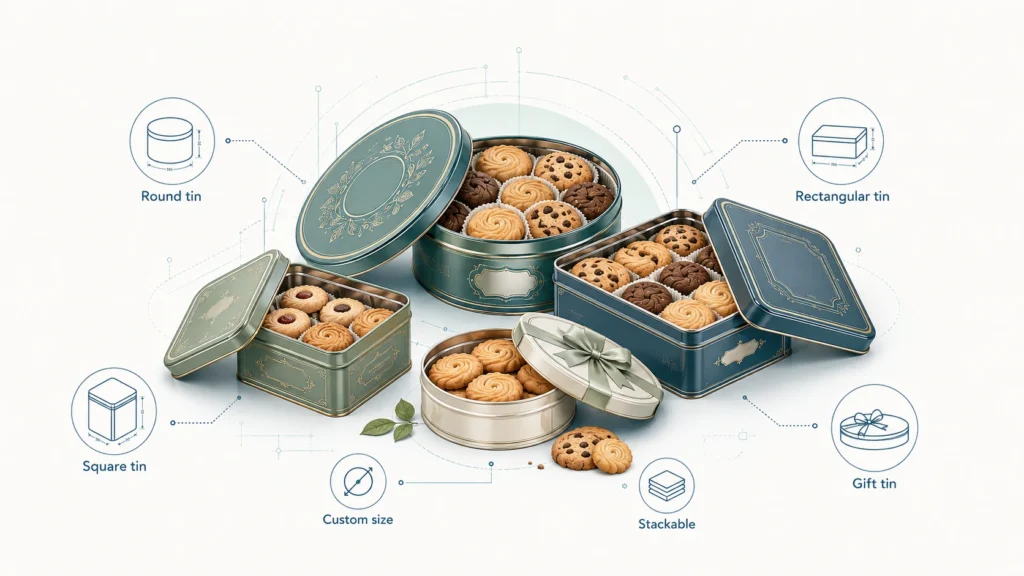
| Medium round tin | Danish-style butter cookies, shortbread, family gift packs | Familiar cookie tin format with strong gift appeal | Round tins may waste space for square cookies |
| Rectangular tin | Biscotti, sandwich cookies, assorted rows, premium biscuits | Efficient shelf display and carton packing | Corners and lid fit must be controlled carefully |
| Square tin | Holiday assortment, luxury cookie set, brand gift | Balanced top artwork area and premium appearance | Insert design is important to reduce movement |
| Deep tin | Large assortment, individually wrapped cookies, bulk gift | Higher perceived value and larger net weight | Heavy tins need stronger carton planning |
| Shallow presentation tin | Decorated cookies, iced cookies, delicate pieces | Shows product beautifully when opened | Lower capacity and more insert complexity |
For WordPress product pages, it is tempting to state a simple capacity such as “this tin holds 500 g of cookies.” In real sourcing, that statement should be validated with actual cookies. A 500 g butter cookie assortment may fit differently from 500 g of biscotti or individually wrapped sandwich cookies. The safer commercial language is: “capacity depends on cookie size, count, arrangement, insert design, and inner packaging method.”
Lid Styles and Closure Expectations
A cookie tin lid affects freshness perception, opening feel, retail display, and reuse. Many cookie tins use slip lids or hinged lids. Some use plug lids, inner lids, or additional sealed bags inside the tin. Buyers should avoid assuming that a metal lid automatically means airtight performance. Many decorative tins are not hermetically sealed containers. They are premium protective outer packs, often paired with an inner food-grade barrier pack.
| Lid style | Best use | Customer experience | Freshness note |
|---|---|---|---|
| Slip lid | Butter cookies, shortbread, holiday tins, general gift tins | Familiar, simple, reusable | Use inner liner if moisture control is critical. |
| Hinged lid | Premium gift sets, corporate gifts, reusable tins | Strong unboxing feel; lid stays attached | Hinge alignment and opening angle should be tested. |
| Plug lid | Products needing a tighter fit and better closure feel | More secure feel than a loose slip lid | Still validate moisture performance with real product. |
| Window lid | Visual retail display and decorated cookies | Lets customers see the product | Window material must be food-safe if exposed to food. |
| Inner sealed bag plus outer tin | Longer shelf-life cookies, export, e-commerce | Strong balance of freshness and premium branding | The bag handles barrier; the tin handles protection and branding. |
For many bakery brands, the best packaging system is a decorated tin plus a sealed inner bag or tray. This gives the brand a premium outer presentation while giving the product a more controlled barrier environment. It also simplifies food-contact compliance because the cookie may primarily touch the inner bag or tray rather than the metal surface. However, the inner pack must still fit neatly, open cleanly, and look premium when the customer removes the lid.
Food-contact Safety and Compliance Planning
Food-contact planning should begin before artwork approval. In the United States, the FDA Food Ingredients & Packaging pages explain that FDA regulates substances that come into contact with food, including packaging materials. For food packaging and food contact substances, the FDA explains that a food contact substance that is a food additive must be authorized for the intended use before marketing.
In the European Union, Regulation (EC) No 1935/2004 sets the general framework for materials and articles intended to come into contact with food. In practical terms, EU-facing packaging projects normally need careful attention to food-contact suitability, traceability, good manufacturing practice, and supporting documentation.
For cookie tins, compliance planning usually depends on how the cookie contacts the package. There are three common scenarios.
| Contact scenario | What touches the cookie | Main compliance focus | Common buyer action |
|---|---|---|---|
| Direct contact with coated metal | Cookie touches internal lacquer | Internal coating suitability, migration, corrosion resistance | Request food-contact documentation for the coating system. |
| Contact through paper cup or paper liner | Cookie touches paper first | Paper/liner food suitability, grease resistance, aroma transfer | Confirm liner specification and testing requirements. |
| Sealed inner bag inside tin | Cookie touches bag, not metal | Bag barrier, sealing quality, food-contact film suitability | Treat the tin as premium secondary packaging but still check cleanliness and odor. |
Cookie products often contain butter, oils, chocolate, nuts, spices, flavorings, or acidic fruit components. These ingredients can interact differently with packaging materials. A plain dry biscuit may be less demanding than a high-fat chocolate-coated cookie. A cinnamon or ginger cookie may carry strong aroma that needs odor-control planning. A cookie with fruit filling may require a different inner liner strategy than a dry shortbread.
Allergen labeling also matters. The FDA identifies major food allergens and provides guidance for packaged foods, including sesame as a major allergen after the FASTER Act. Bakery products commonly contain wheat, milk, eggs, tree nuts, peanuts, soy, and sesame. The tin artwork must reserve enough space for ingredient statements, allergen declarations, net weight, manufacturer information, lot code, date code, barcode, and any market-specific labeling. A beautiful tin that lacks label space can become expensive to correct.
Shelf Life, Freshness, and the Role of the Tin
A cookie tin can help protect product quality, but it should not be oversold as a magical freshness solution. Shelf life depends on recipe, water activity, fat oxidation, packaging barrier, sealing, storage temperature, distribution time, and handling. Metal is excellent at blocking light and providing a rigid protective body, but many decorative tins are not airtight unless specifically engineered and validated.
For dry cookies, the most common quality problems are softness from moisture gain, rancid notes from fat oxidation, loss of aroma, broken pieces, chocolate bloom, color changes, and flavor transfer between varieties. The packaging system should be designed around these risks.
A useful approach is to separate the roles of each layer.
| Packaging layer | Main job | Example |
|---|---|---|
| Cookie formula | Controls inherent stability | Low moisture, stable fat, suitable ingredient system |
| Inner wrap or bag | Controls moisture and oxygen exposure | Heat-sealed film, flow wrap, pouch, or liner |
| Insert or tray | Controls movement and presentation | Paperboard divider, molded tray, paper cup |
| Metal tin | Controls crushing, light exposure, shelf presence, reuse | Printed tinplate body and lid |
| Master carton | Controls wholesale handling and pallet distribution | Corrugated carton with dividers or protective packing |
Date labeling should also be handled carefully. USDA FSIS explains that “Best if Used By/Before” is about best flavor or quality rather than a purchase or safety date. For cookie brands, that means packaging should help the product maintain its intended eating quality through the declared best-quality window. The stronger the brand promise, the more important it is to validate packaging performance with real shelf-life testing rather than relying only on supplier claims.
Printing, Finishes, and Brand Differentiation
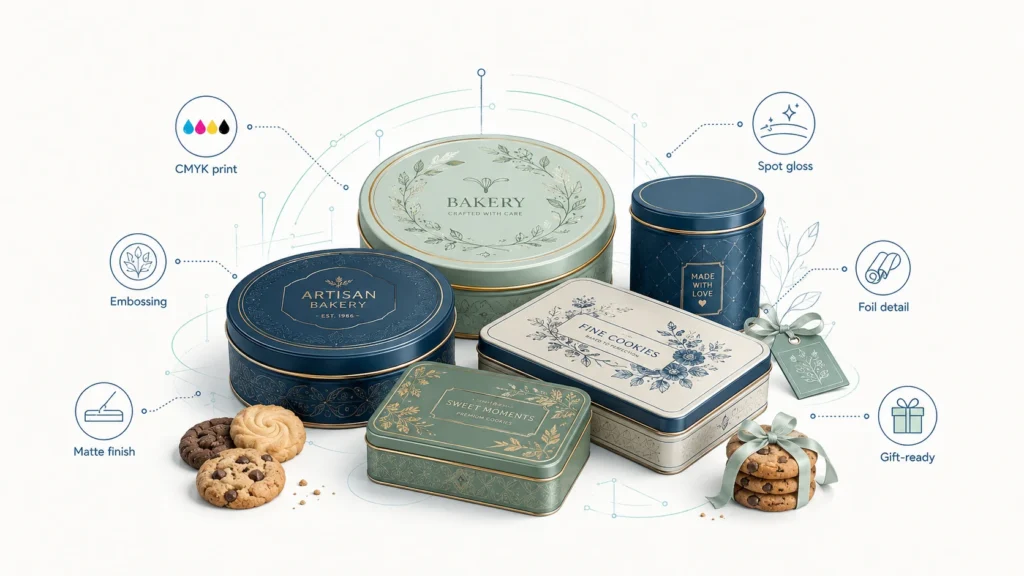
A major reason bakery brands choose custom cookie tins is that metal offers a strong surface for brand decoration. Offset printing can reproduce detailed artwork, seasonal patterns, product illustrations, vintage bakery graphics, premium typography, and color-coded flavors. Additional finishes can make the tin feel more expensive without changing the cookie recipe.
Common decoration options include full-color printing, Pantone color matching, matte varnish, gloss varnish, spot gloss, metallic effects, embossing, debossing, textured varnish, and printed sleeves. The right choice depends on the brand position.
A heritage bakery might use a cream background, illustrated storefront, gold accents, and embossed logo. A modern organic cookie brand might use a matte white tin with simple typography and muted flavor colors. A children’s cookie brand might use bright illustration and collectible character artwork. A luxury holiday gift line might use deep colors, metallic ink, raised details, and a soft-touch finish.
Mr. Tin Box’s article on custom metal tin packaging design ideas is useful for brands exploring embossing, unique shapes, windowed packaging, collectible series, and premium finishes. For cookie tins, the best design is not necessarily the most complicated. The best design is the one that makes the product easier to understand, easier to gift, and easier to remember.
Standard Molds Versus Custom Molds
One of the biggest cost decisions is whether to use a standard mold or create a custom tin structure. Standard molds are usually better for first launches because they reduce development time, tooling cost, and uncertainty. A bakery brand can still create strong differentiation through artwork, finish, embossing, inserts, sleeves, and gift packaging.
A custom mold becomes attractive when the packaging shape itself is part of the brand. Examples include a house-shaped Christmas cookie tin, a heart-shaped Valentine’s Day cookie tin, a book-shaped heritage bakery tin, a tin shaped like a famous landmark for tourist retail, or a signature container used every year for a flagship gift line.
| Decision factor | Standard mold | Custom mold |
|---|---|---|
| Development speed | Faster | Slower |
| Tooling cost | Lower | Higher |
| Shape ownership | Limited | Stronger |
| Sampling risk | Lower | Higher |
| Best use | First launch, private label, seasonal test | Long-term premium SKU, collectible series |
| Design flexibility | Artwork and finish-driven | Structure and artwork-driven |
A practical rule for bakery brands is to prove demand first, then invest deeper. If the brand is testing a new cookie assortment, standard molds are usually safer. If the product becomes a successful annual holiday gift, a custom mold may be justified in the second or third season.
Inserts, Dividers, and Inner Packaging
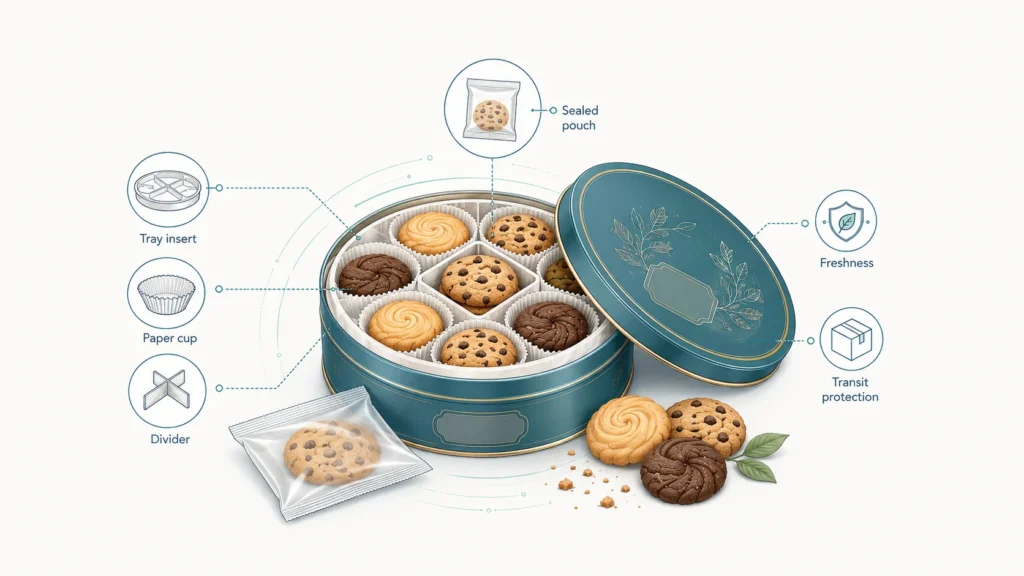
Many cookie tin failures happen inside the tin, not outside it. The outer tin may look beautiful, but if the cookies slide around, crumble, mix flavors, or look messy when opened, the customer experience suffers. Inserts and dividers solve this problem.
Paper cups are suitable for butter cookies, shortbread, and assorted biscuits. Paperboard dividers work well for flavor separation and visual organization. Molded trays can protect delicate pieces but may increase tooling and material complexity. Flow-wrapped cookies can be arranged inside a tin for better freshness and distribution control. Tissue paper, grease-resistant paper, or printed liners can improve the first-open presentation.
For wholesale projects, inserts should be designed with assembly efficiency in mind. A beautiful insert that takes too long to fold, place, and fill can increase labor cost. If the bakery uses manual packing, the insert should be simple and forgiving. If the brand uses automated or semi-automated packing, dimensions and tolerances must be tighter.
| Insert type | Best for | Advantage | Caution |
|---|---|---|---|
| Paper cup | Individual cookies or small stacks | Low cost and familiar bakery look | May not stop movement in shipping without dividers. |
| Paperboard divider | Assorted flavors and gift sets | Clean presentation and flavor separation | Needs accurate layout based on cookie size. |
| Molded tray | Premium delicate cookies | Strong protection and neat opening | Tooling and material choice require planning. |
| Sealed inner bag | Longer shelf life and export | Better freshness control | Bag must fit the tin and still look premium. |
| Tissue or grease-resistant liner | Visual presentation | Soft, handmade bakery feel | Not a substitute for barrier packaging. |
Wholesale Cost Drivers
The cost of wholesale cookie tins depends on more than size. Buyers sometimes compare quotes using only the outer dimensions, but that can be misleading. Two tins with similar dimensions may have very different costs because of material thickness, lid type, shape complexity, printing colors, varnish, embossing, insert system, production quantity, carton packing, and inspection requirements.
The main cost drivers include the following:
| Cost driver | Why it affects price | How to control it |
|---|---|---|
| Tin size and depth | More material and forming work | Choose size based on real cookie layout, not guesswork. |
| Material thickness | Stronger tins cost more material | Match thickness to weight and logistics risk. |
| Lid structure | Hinges, plug lids, windows, and special fits add complexity | Use the simplest lid that supports the brand and product. |
| Printing and varnish | More colors and finishes can increase setup and control needs | Prioritize high-impact areas such as the lid. |
| Embossing/debossing | Requires tooling and alignment | Use it for logo or key visual elements, not everywhere. |
| Inserts and liners | Add material and assembly work | Design inserts early and simplify manual packing. |
| Quantity | Larger runs spread setup cost | Combine SKUs with shared structure when possible. |
| Carton packing | Protection affects shipping cost and damage rate | Optimize carton count and protective dividers. |
Wholesale buyers should ask suppliers to separate tin cost, tooling cost, sample cost, insert cost, and shipping carton details. This makes it easier to compare quotes fairly. A lower unit price may not be better if the carton packing is weak or the lid tolerance creates higher rejection risk.
MOQ and Lead-time Planning
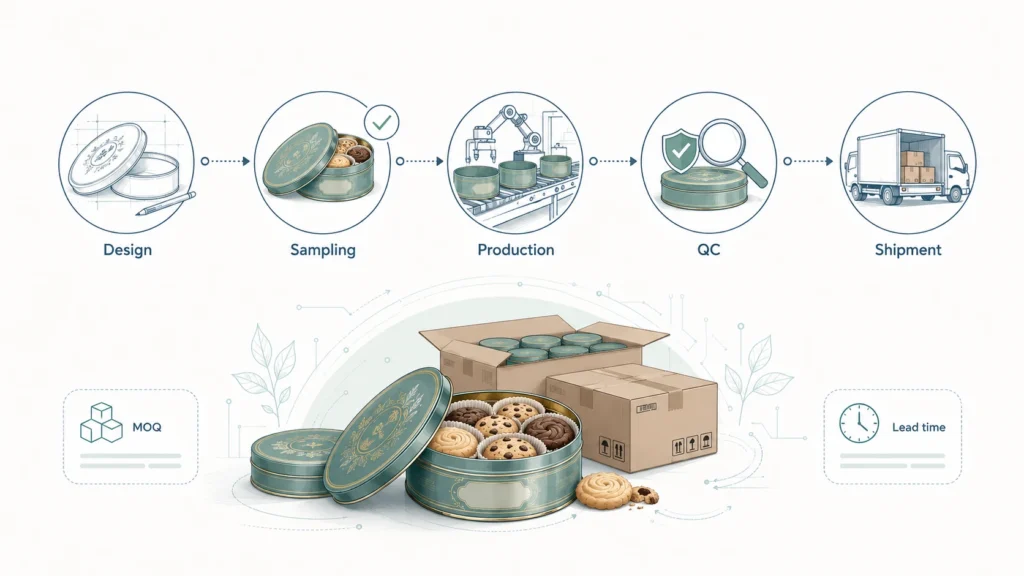
Minimum order quantity and lead time vary by structure, printing, mold availability, production schedule, and customization level. A standard mold with custom printing usually has a shorter development path than a fully custom mold. Embossing, special finishes, inserts, or window structures can add sampling and approval steps.
For seasonal cookie tins, timeline discipline is critical. Holiday packaging cannot arrive late. A Christmas cookie tin should not enter mass production when retailers are already building displays. Artwork approval, pre-production samples, food-contact documentation, barcode verification, carton testing, shipping, customs clearance, and warehouse intake all need time.
A practical development sequence looks like this:
- Define cookie type, count, net weight, and sales channel.
- Select standard mold options or develop a custom structure brief.
- Confirm food-contact scenario and inner packaging method.
- Build an insert layout using actual cookie dimensions.
- Prepare artwork with dielines, barcode area, date-code area, and legal text.
- Produce samples or pre-production proofs.
- Test product fit, lid feel, carton packing, and shelf-life assumptions.
- Approve final artwork, coating, inserts, and carton specification.
- Start mass production.
- Inspect, pack, ship, and receive before the retail deadline.
For repeat seasonal programs, brands should keep the same tin structure and update artwork each year. This reduces development risk and helps build collectibility. Customers may even look forward to the new annual design.
Retail, E-commerce, and Corporate Gift Requirements
The sales channel affects the tin specification. A cookie tin sold in a boutique bakery does not face the same stress as a tin shipped through e-commerce. A corporate gift tin may need a larger branding area, message card, or custom sleeve. A supermarket tin may need strong shelf blocking and barcode performance.
| Sales channel | Packaging priority | Recommended focus |
|---|---|---|
| Bakery retail store | Visual appeal and giftability | Premium lid artwork, easy opening, reusable feel |
| Supermarket or club retail | Shelf blocking and carton efficiency | Strong color coding, barcode placement, stackability |
| E-commerce | Damage prevention and unboxing | Inner protection, snug carton fit, drop-test planning |
| Corporate gifting | Brand customization and perceived value | Sleeve, card insert, embossed logo, premium finish |
| Travel retail | Compact premium packaging | Durable tin, clear origin story, strong shelf visibility |
| Subscription box | Fit consistency and weight control | Standard mold, predictable dimensions, protective insert |
E-commerce deserves special attention. A tin that performs well on a retail shelf may still dent during parcel shipping if the outer carton is weak. If the tin is part of an online gift set, the master carton and mailer are as important as the tin itself. Brands should test the full shipping configuration, not only the empty tin.
Sustainability and Responsible Claims
Metal tins can support a strong sustainability story, but claims must be accurate. Steel packaging has strong recycling performance in many markets, and reuse is a meaningful consumer benefit. However, brands should avoid vague claims such as “eco-friendly” unless they can explain exactly what they mean.
The FTC Green Guides are designed to help marketers avoid misleading environmental claims. The FTC also explains that environmental claims should be qualified when needed and substantiated. For bakery brands selling in the U.S., this means a claim such as “recyclable metal tin” may need market-specific nuance if local recycling access varies. A stronger claim may be: “Reusable tinplate cookie tin; check local recycling guidance.”
In the EU, Eurostat publishes packaging waste statistics, and Steel for Packaging Europe publishes steel packaging recycling performance. These sources can support more specific claims, especially for B2B buyers that need sustainability talking points for retailers.
For cookie tins, the strongest sustainability message often combines three points: the tin is durable, it is reusable, and steel packaging is widely recyclable in many established recycling systems. Reuse is especially important because the customer may keep the tin for months or years. That extended use can reduce the perception of waste and strengthen the emotional value of the package.
Artwork and Labeling Space
Cookie tin artwork must balance beauty and information. A beautiful lid helps sell the product, but the package must also carry the information required by the market. This may include product name, net weight, ingredients, allergen statement, nutrition facts panel, best-by date, lot code, storage instructions, manufacturer or distributor information, country of origin, barcode, recycling guidance, and import labels.
A common mistake is using every surface for decoration and leaving no clean area for mandatory text. This creates problems later when the brand must add a sticker, cover artwork, or redesign the tin. A better approach is to plan artwork zones early.
| Surface | Best use | Buyer note |
|---|---|---|
| Lid top | Main brand visual, product name, seasonal artwork | Highest emotional impact; keep hierarchy clear. |
| Front side wall | Flavor, net weight, product line | Useful for shelf display when tins are stacked. |
| Back or bottom | Ingredients, allergens, barcode, company information | Reserve a clean, readable area from the beginning. |
| Inner lid | Brand story, serving suggestion, gift message | Adds a premium experience when opened. |
| Sleeve or paper label | Market-specific text or campaign message | Useful when one tin structure serves multiple markets. |
Barcodes should also be planned early. GS1 explains that barcodes play a key role in supply chains. For wholesale bakery products, a barcode that is too small, distorted by curved metal, placed too close to an edge, or printed with poor contrast can create retail problems. If the tin will be sold through supermarkets or distributors, barcode verification should be part of pre-production approval.
Quality Inspection Points for Cookie Tins
A custom cookie tin should be inspected for both appearance and function. Cosmetic defects may hurt brand perception, while structural defects can affect usability and product protection.
Important inspection points include color consistency, registration accuracy, scratches, dents, edge smoothness, lid fit, hinge movement, surface gloss, embossing alignment, internal cleanliness, odor, coating coverage, carton packing, and insert fit. For food packaging, internal cleanliness and odor are especially important. A tin that smells strongly of ink, solvent, oil, or storage conditions can damage the customer experience even if the printed design is beautiful.
A practical inspection checklist should include:
| Inspection area | What to check | Why it matters |
|---|---|---|
| Appearance | Color, scratches, dents, print defects | Protects shelf appeal and brand trust |
| Lid function | Opening force, fit, alignment, hinge movement | Defines perceived quality and reuse value |
| Safety | Smooth edges, burrs, sharp corners | Prevents customer complaints and handling risk |
| Interior | Cleanliness, odor, coating condition | Critical for food packaging perception |
| Insert fit | Movement, clearance, assembly ease | Protects cookies and controls opening experience |
| Carton packing | Compression protection, divider use, quantity per carton | Reduces transit damage |
Brands should approve a golden sample and keep it as a reference. The factory, buyer, and quality team should all understand which defects are acceptable, which require sorting, and which require rejection.
How to Write a Professional RFQ for Wholesale Cookie Tins
A clear RFQ saves time and reduces sampling mistakes. Instead of asking “How much for cookie tins?”, bakery buyers should send a structured brief. The more specific the brief, the more accurate the quotation.
A strong RFQ should include:
| RFQ item | Information to provide |
|---|---|
| Product type | Butter cookies, shortbread, biscotti, decorated cookies, assorted cookies, individually wrapped cookies |
| Cookie dimensions | Diameter/length, width, thickness, weight per piece |
| Target fill | Net weight, cookie count, arrangement method |
| Tin preference | Round, square, rectangular, hinged, slip lid, plug lid, window lid |
| Food-contact plan | Direct contact, paper liner, tray, sealed inner bag |
| Artwork requirements | CMYK, Pantone, matte, gloss, metallic, embossing, debossing |
| Insert requirements | Divider, tray, paper cup, sleeve, tissue, inner bag |
| Market | U.S., EU, UK, Canada, Middle East, Asia, global distribution |
| Quantity | Trial order, annual volume, seasonal forecast |
| Sales channel | Retail, supermarket, e-commerce, corporate gift, travel retail |
| Timeline | Sample deadline, production deadline, delivery deadline |
| Compliance needs | Food-contact documentation, allergen label area, barcode, recycling text |
This kind of brief allows the packaging supplier to recommend the most realistic structure. It also reduces the risk of receiving a quote for a tin that looks correct but fails in actual packing.
Common Mistakes Buyers Should Avoid
The first mistake is choosing the tin before measuring the cookie. Packaging should be built around the real product, not a guess. If the cookie diameter changes after the tin is selected, the insert may fail or the net weight may no longer fit.
The second mistake is confusing a decorative tin with an airtight container. Many cookie tins are premium outer packs, not hermetic food cans. If crispness and shelf life are critical, the brand should validate an inner barrier pack, not assume the metal lid alone is enough.
The third mistake is overusing special finishes. Embossing, metallic ink, and complex varnishes can be powerful, but too many effects can increase cost and reduce design clarity. Premium packaging often works best when one or two high-impact details are executed well.
The fourth mistake is ignoring label space. Cookie products often require ingredients, allergens, net weight, nutrition, date coding, barcode, and distributor information. If the tin design does not reserve space, the brand may need unattractive stickers later.
The fifth mistake is treating shipping as an afterthought. Tins can dent if packed poorly. Cookie tins should be tested in their final carton configuration, especially for e-commerce and export.
The sixth mistake is waiting too long for seasonal projects. Holiday tins require earlier planning than ordinary packaging because artwork, samples, production, ocean shipping, customs, and retailer delivery windows all have fixed deadlines.
How Bakery Brands Can Use Cookie Tins Strategically
Cookie tins can support several business strategies. For a premium bakery, a tin can become the flagship gift SKU that raises average transaction value. For a private-label manufacturer, tins can help retailers create seasonal exclusives. For a hotel group, custom cookie tins can become a welcome gift that guests remember. For a corporate gift company, branded tins can carry both cookies and a business message. For an e-commerce bakery, tins can reduce damage while improving unboxing.
One strong strategy is the annual collectible tin. The brand keeps the same size and structure each year but changes the artwork. Customers may collect the tins, and retailers can promote the new edition. This works well for Christmas, Lunar New Year, Valentine’s Day, national holidays, city souvenirs, museum shops, and bakery anniversaries.
Another strategy is the flavor-coded tin series. Each flavor or product line uses the same tin shape but a different color system. This improves shelf consistency while allowing variety. It also helps with production because the structure stays the same across SKUs.
A third strategy is the corporate customization program. The bakery uses a standard cookie tin structure but offers custom sleeves, stickers, lid prints, or message cards for corporate clients. This allows personalization without fully custom tooling for every client.
Why Choose Mr. Tin Box for Custom Cookie Tins
For bakery brands, a good packaging partner should understand both the commercial and technical sides of the project. The tin must look attractive, but it must also fit the cookie, support the sales channel, meet food-contact expectations, and remain manufacturable at wholesale scale.
Mr. Tin Box focuses on custom metal tin packaging for food, beverage, beauty, gift, promotional, holiday, and specialty categories. The company’s broader content on small tin containers, tin containers with lids, and metal tins with lids is useful for buyers comparing size, lid style, structure, decoration, and practical use cases.
For cookie tins, Mr. Tin Box can help brands think through the key questions: Should the cookie touch the tin directly or use an inner liner? Should the product use a standard mold or a custom shape? Does the brand need a divider tray? Is the lid fit suitable for gifting and reuse? Can the artwork support retail visibility and required label text? Is the carton strong enough for export or e-commerce?
This consultative approach matters because the best cookie tin is not simply the most decorative one. The best tin is the one that protects the product, strengthens the brand, supports the channel, and makes commercial sense at the target quantity.
FAQ
Are wholesale cookie tins food-safe?
They can be food-safe when the material, internal coating, liner, and intended contact conditions are suitable for the product and target market. Buyers should confirm whether cookies will touch the coated metal directly or be packed in paper cups, trays, or sealed inner bags. Food-contact documentation should be reviewed before production.
Do cookie tins keep cookies fresh?
Cookie tins help protect cookies from crushing and light exposure and can improve presentation. However, many decorative tins are not airtight. If crispness and shelf life are critical, use a suitable sealed inner bag or liner and validate performance with shelf-life testing.
What is the best shape for cookie tins?
Round tins are classic for butter cookies and holiday assortments. Rectangular tins are efficient for biscotti, rows of cookies, and shelf display. Square tins work well for premium gift assortments. The best shape depends on cookie size, count, insert layout, brand style, and carton efficiency.
Can I print my bakery logo and artwork on cookie tins?
Yes. Custom cookie tins can support full-color printing, Pantone colors, matte or glossy varnish, metallic effects, embossing, debossing, sleeves, and other decorative options. Artwork should be prepared using the supplier’s dieline and should reserve space for required label information.
What information should I send for a quotation?
Send cookie dimensions, target net weight, cookie count, preferred tin shape, lid style, inner packaging method, artwork requirements, quantity, target market, sales channel, timeline, and any food-contact or labeling requirements. A complete RFQ helps the supplier recommend the correct structure and quote more accurately.
Conclusion
Wholesale cookie tins are a strong packaging choice when a bakery brand wants more than basic containment. They can improve perceived value, protect delicate products, support seasonal and corporate gifting, create collectible brand assets, and help the product stand out in competitive retail and e-commerce channels.
The best results come from treating the tin as a complete packaging system. Start with the cookie, not the container. Measure the product, define the target count, decide the food-contact method, choose the lid style, plan the insert, reserve label space, validate carton protection, and align the decoration with the brand position. Use data and compliance guidance to support the decision, but keep the buyer experience simple: the package should look premium, open smoothly, protect the cookies, and feel worth keeping.
For bakery brands planning a new gift line, holiday program, private-label assortment, or premium retail SKU, custom wholesale cookie tins can become a practical growth tool. When structure, food-contact planning, artwork, and logistics work together, the tin is no longer just packaging. It becomes part of the product value.