

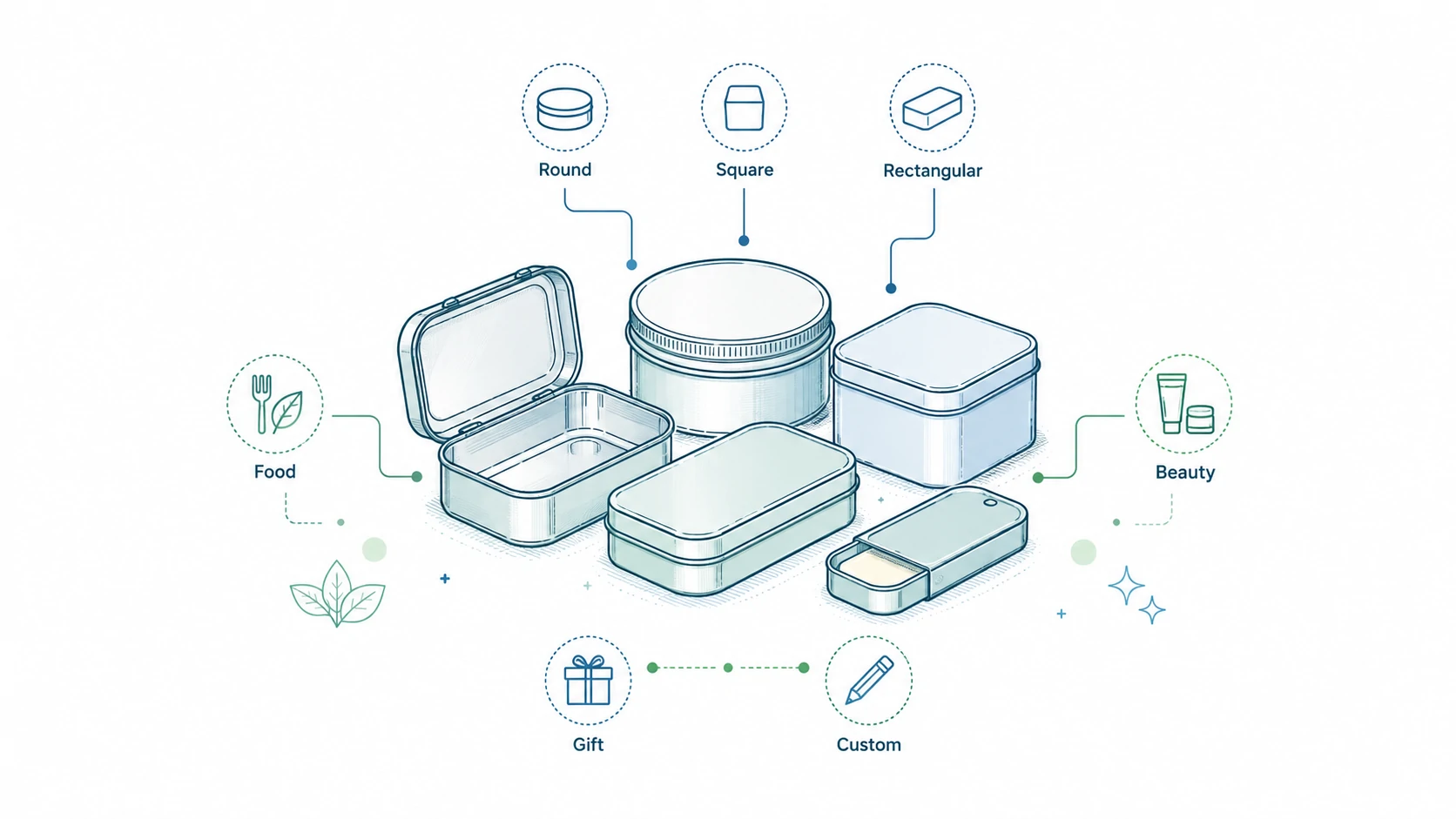

Small tin containers are one of the most practical packaging formats for brands that need a compact, protective, reusable, and highly customizable container. They are small enough for samples, pocket products, travel kits, confectionery, tea portions, lip balms, candles, promotional gifts, and small accessories, but strong enough to carry a premium brand impression. For companies developing consumer products, they solve a common problem: how to make a small item feel valuable before the customer even opens it.
This guide is written for brand owners, product managers, packaging buyers, and sourcing teams who are comparing small tin containers for a real commercial project. Instead of treating a tin as a simple box, it explains how size, shape, material, lid design, coating, printing, and inserts affect the final packaging result. It also gives practical tables that can help your team build a clearer request for quotation and avoid costly revisions during sampling.
At Mr. Tin Box, small-format metal packaging is not only a container category. It is a customizable product system for Food & Beverage Packaging, Beauty & Personal Care Packaging, gift programs, promotional collections, and specialty industrial applications. When the container is designed correctly, it protects the product, supports retail display, communicates quality, and often stays in the customer’s home long after the original product is used.
Table of Contents
Why small tin containers are valuable for modern brands
Small products are easy to overlook in retail. A tea sampler, mint tablet, solid perfume, mini candle, balm, spice blend, USB accessory, or collectible token may have a strong product story, but if the pack looks disposable, the customer may assume the product is ordinary. Small tin containers help solve that gap because metal immediately communicates durability, care, and permanence.
The value is not only visual. Metal packaging provides a rigid body that resists crushing, protects edges, blocks light, and gives a more stable unboxing experience. For dry foods, cosmetics, and promotional products, that physical protection reduces the risk of deformation during transport and helps the product arrive in a condition that matches the brand promise. This is especially important for cross-border e-commerce, subscription kits, seasonal gift boxes, and retail displays where the pack may be handled many times before purchase.
Another advantage is reusability. Customers often keep small tins for sewing kits, coins, desk items, spices, jewelry, travel medicine, or small tools. This gives the brand repeated visibility without additional advertising cost. A cardboard box may be thrown away immediately, while a well-made tin can stay on a shelf or desk for months. For lifestyle brands, that after-use value is part of the product experience.
Small tin containers also support rich customization. They can be printed, embossed, debossed, varnished, textured, windowed, fitted with inserts, or produced in custom shapes. A brand can choose a simple rectangular mint tin, a round candle tin, a square tea tin, a hinged gift tin, a sliding lid container, or a compact metal case with dividers. For surface decisions such as matte varnish, glossy varnish, soft-touch finish, spot UV, metallic effects, or embossing, the Mr. Tin Box article on Metal Tin Box Finishing Options gives a useful overview of how finishes influence both perceived value and durability.
What counts as a small tin container?
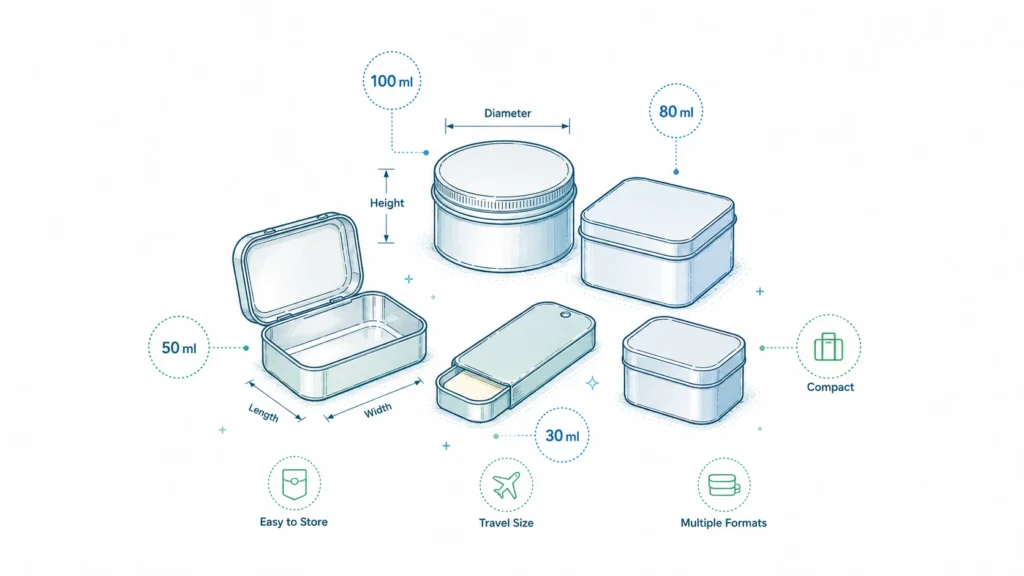
In packaging projects, “small” is not a fixed international standard. It usually means a tin that can be held easily in one hand, stored in a pocket, placed in a retail counter display, or packed into a larger gift set. For practical buying purposes, most small tin containers fall somewhere between 5 ml and 500 ml in usable internal volume, although some rectangular tins are described by dimensions rather than volume.
The better way to define the size is to start with the product and the sales channel. A small mint tin needs to fit in a pocket and open repeatedly. A cosmetic balm tin needs a smooth rim, a safe inner coating, and enough opening area for finger access. A tea sampler tin needs aroma protection and space for a label or printed origin story. A hardware tin needs strength, edge safety, and sometimes a foam or paperboard insert to stop parts from rattling. A promotional tin needs enough surface area to carry a logo clearly even when viewed in a crowded event environment.
The following table gives a practical size map for early planning. Exact dimensions depend on tooling, shape, drawing depth, corner radius, lid style, insert thickness, and product tolerance. It should be used as a buyer briefing tool, not as an engineering drawing.
| Size class | Approximate internal volume or footprint | Common shapes | Typical product examples | Packaging goal |
|---|---|---|---|---|
| Micro tins | 5-30 ml or very small footprint | Round, square, sliding rectangular | Lip balm, solid perfume, pills, mints, sample creams, small beads | Pocket use, sampling, travel convenience |
| Mini tins | 30-100 ml | Round, square, oval, shallow rectangular | Tea samples, spices, wax melts, small candles, candies, promotional tokens | Trial size, impulse purchase, subscription kits |
| Small retail tins | 100-250 ml | Round, square, rectangular, hinged | Chocolates, cookies, loose tea, coffee portions, cosmetic bars, mini gift sets | Shelf impact, gift value, reusable storage |
| Compact gift tins | 250-500 ml | Rectangular, square, heart, oval, custom shape | Confectionery, skincare sets, stationery kits, holiday gifts | Premium presentation, limited editions, collectible value |
| Small specialty tins | Dimension-led rather than volume-led | Hinged, deep drawn, divided, custom molded | Tools, electronic accessories, first-aid kits, samples, industrial parts | Protection, organization, safe handling |
A common mistake is to choose the outside dimensions first and only later check whether the product actually fits. The correct sequence is the opposite: product size, fill weight, protection needs, opening behavior, label or print area, carton pack-out, and then final tin dimensions. For powders, tea, coffee, spices, candies, and cosmetic products, small differences in fill density can create major differences in volume. A 50 g product may require very different container sizes depending on whether it is dense tablets, loose tea leaves, or low-density cookies.
Tinplate, coatings, and why material choice matters
Most small tin containers are made from tinplate, which is steel sheet coated with a thin layer of tin. Tinplate combines the strength and formability of steel with the corrosion resistance and decorative surface benefits of tin. According to a World Steel Association tinplate eco-profile, tin plated steel is used primarily in food cans and industrial packaging, with typical thicknesses stated in the range of 0.13-0.49 mm for the referenced product scope (Worldsteel tinplate LCA eco-profile). In real custom tin packaging, the selected thickness depends on container size, drawing depth, lid style, stacking strength, and cost target.
A technical review published through the U.S. National Library of Medicine notes that metal packaging materials provide excellent barrier properties and are widely used in food packaging applications because they can protect against factors such as gases, moisture, light, and microorganisms (Review on metal packaging). For small tin containers, this barrier value is especially useful when the product is sensitive to light, aroma loss, moisture uptake, or physical damage.
However, the metal sheet is only one part of the packaging system. Internal coatings, external varnishes, inks, and closures also matter. For food, tea, coffee, confectionery, nutraceutical powders, mints, and certain personal care products, the inner coating must match the product chemistry and intended contact conditions. A dry tea tin and an acidic sauce container do not have the same risk profile. Even within food categories, oil, salt, acidity, aroma compounds, and storage time can affect the coating requirement.
For brands selling into the European Union, food-contact coating decisions have become more important because Commission Regulation (EU) 2024/3190 addresses the use of BPA and other bisphenols in certain food-contact materials and articles (EUR-Lex Regulation (EU) 2024/3190). In the United States, shelf-stable low-acid and acidified food rules may become relevant when the product is processed and sold in hermetically sealed containers; official U.S. eCFR references include 21 CFR Part 113 for thermally processed low-acid foods packaged in hermetically sealed containers and 21 CFR Part 114 for acidified foods. Many small tin container projects are for dry products rather than retorted canned foods, but the lesson is the same: packaging decisions should be made together with product safety, regulatory, and market-entry requirements.
How to choose the right size
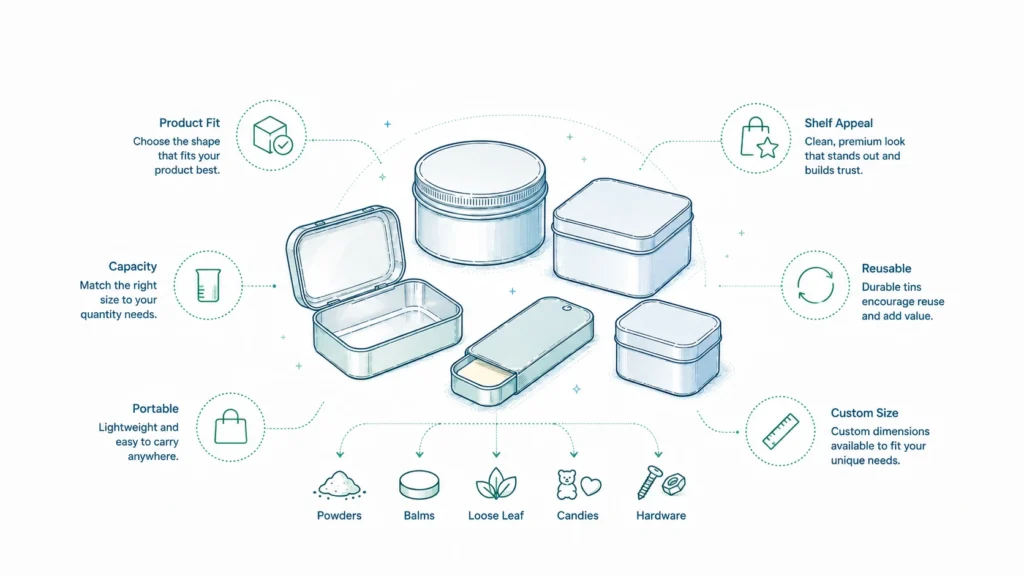
Choosing the right size for small tin containers is a commercial decision as much as an engineering decision. A tin that is too small can damage the product, make filling inefficient, and create customer frustration. A tin that is too large can increase material cost, waste carton space, and make the product feel underfilled. The best size usually balances four requirements: product fit, perceived value, shipping efficiency, and repeat-use potential.
Start by measuring the product in its real selling form. For loose products, test the actual fill weight and settling behavior. For pieces, measure the largest dimension and count the number of pieces needed per unit. For cosmetic solids, check shrinkage, pour line, and cooling behavior. For hardware kits, measure not only the parts but also the insert, instruction leaflet, desiccant, and any protective bag. Many packaging problems happen because buyers only measure the product and forget the supporting components.
Next, define the opening experience. A pocket mint tin should be easy to open with one hand but secure enough not to pop open in a bag. A small tea tin may need a friction lid or inner seal to protect aroma. A candle tin needs a lid that can be removed without damaging the wax surface and a coating that tolerates the product environment. A jewelry or gift tin may require a hinged lid because the opening motion feels more premium and prevents the lid from being lost.
Then consider the visible branding area. Small tins have limited surface area, so every millimeter matters. A micro tin may only support a logo, a product name, and a color system. A compact gift tin can carry a full illustration, ingredients panel, QR code, barcode, regulatory marks, and recycling instructions. If your product must include mandatory label information, do not choose a tin size that forces illegible text.
Finally, test carton pack-out. Small differences in tin dimensions can change how many units fit into a master carton, how stable the carton is on a pallet, and how much freight volume you pay for. A beautiful tin that wastes 20% of carton space may be expensive in export logistics. For global buyers, smart size planning can improve both shelf appeal and landed cost.
| Product type | Common buyer priority | Practical size guidance | Recommended lid style | Notes for sampling |
|---|---|---|---|---|
| Mints and tablets | Pocket convenience and repeat opening | Very shallow rectangular or sliding tin | Sliding lid or hinged lid | Test one-hand opening, pocket abrasion, and logo readability |
| Tea, coffee, spices | Aroma and moisture protection | Mini to small retail tins based on fill density | Slip lid, plug lid, or friction lid | Confirm fill volume with real product, not water volume only |
| Candies and chocolates | Gift appeal and crush protection | Small retail tin or compact gift tin | Slip lid or hinged lid | Check insert need, food-contact coating, and migration documentation |
| Lip balm and solid perfume | Finger access and safe contact | Micro or mini round tin | Screw lid or slip lid | Test rim smoothness, coating compatibility, and filling process |
| Mini candles | Heat, wax compatibility, and premium feel | Round or square tin with stable base | Slip lid | Validate coating, wick centering, and lid clearance above wax |
| Beauty tools or sample kits | Organization and unboxing | Rectangular, square, or hinged tin | Hinged lid with insert | Check divider tolerance, mirror or card insert options |
| Small hardware parts | Strength and part control | Rectangular or deep tin | Hinged or slip lid | Test rattling, corrosion risk, labeling, and edge safety |
| Promotional gifts | Logo visibility and perceived value | Shape depends on campaign | Hinged, sliding, or custom lid | Confirm PMS colors, event timeline, and carton labeling |
Popular uses for small tin containers
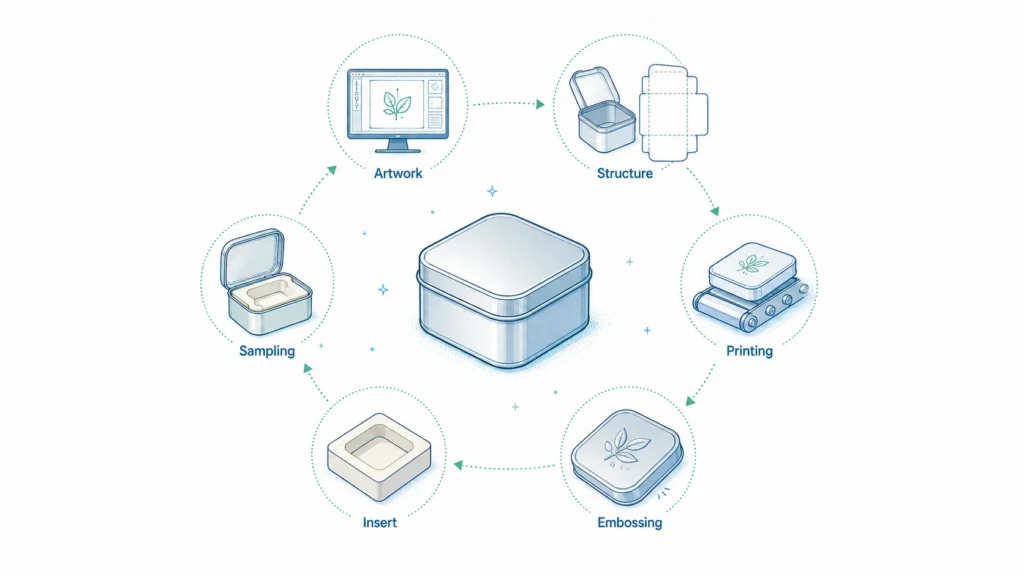
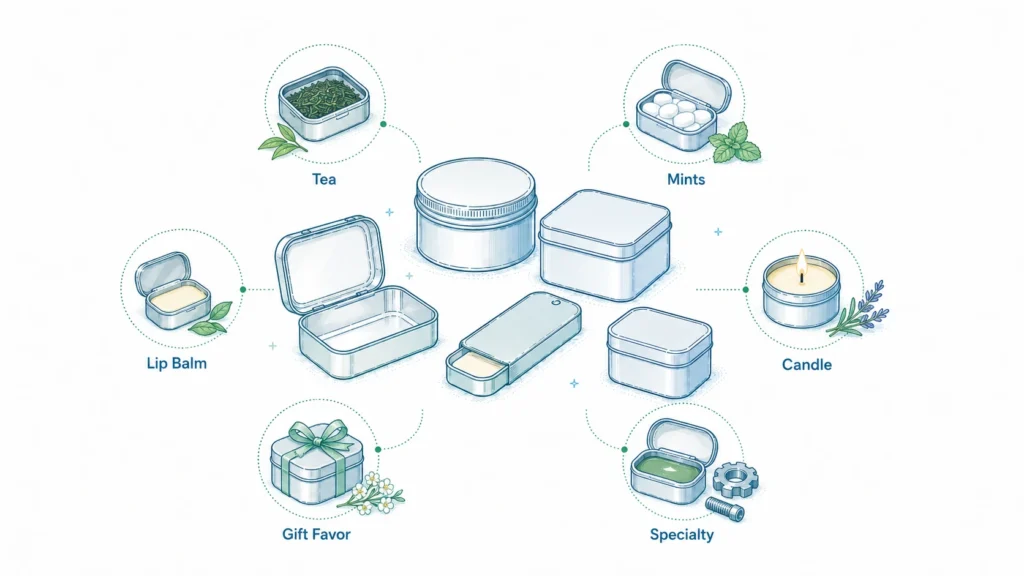
Small tin containers are used across many industries because they can be adapted to both product protection and brand storytelling. The same basic material can become a food-safe candy tin, a cosmetic balm tin, a holiday gift tin, a tool accessory case, or a collectible promotional item. The difference comes from size, structure, coating, decoration, and accessories.
Food and beverage packaging
Food and beverage brands use small tins for tea, coffee, chocolate, biscuits, candies, mints, spices, cocoa, matcha, supplements, and specialty snacks. The strongest use cases are products that benefit from light blocking, crush protection, aroma retention, or premium presentation. Small tins are also effective for sampling programs because they make a trial-size product feel giftable instead of cheap.
For dry foods, the key design questions are simple: Does the product need direct food contact? Does it need an inner coating? Does it need an extra bag or inner seal? How much moisture protection is required? Will the customer scoop, pour, or pick pieces by hand? A spice tin, a tea sampler, and a cookie tin all belong to the food packaging category, but their user behavior is different.
The Mr. Tin Box food and beverage packaging page highlights tin boxes and metal containers for snacks, tea, coffee, chocolates, candies, and specialty food products. For small tin containers in this category, the best commercial results usually come from matching the pack to a clear occasion: tasting set, travel size, premium refill, holiday gift, subscription sample, or counter display impulse purchase.
Beauty and personal care packaging
Beauty and personal care products are a natural fit for small tin containers because many formulas are compact, giftable, and tactile. Common examples include lip balm, solid perfume, lotion bars, shaving soap, hair wax, beard balm, bath salts, sample creams, essential oil accessories, and beauty tool kits. Metal gives these products a more durable and premium impression than lightweight plastic jars or simple paper sleeves.
For beauty packaging, the most important technical question is compatibility. A cosmetic product may contain oils, fragrance, waxes, pigments, salts, or actives that interact with coatings differently. The pack also needs to feel safe and comfortable in the hand. Sharp edges, rough seams, hard-to-open lids, and weak varnish can damage the customer experience even when the design looks good in a rendering.
The Mr. Tin Box beauty and personal care packaging page describes metal packaging for cosmetics, skincare, fragrances, and personal care items. For small formats, brands can use premium finishes such as soft-touch coating, pearl effects, embossing, or satin varnish to make a compact pack feel more luxurious without increasing the product volume.
Gift, promotional, and holiday packaging
Small tins are excellent for gift and promotional programs because they are easy to customize and easy to keep. A holiday tin can carry seasonal artwork. A corporate gift tin can hold candy, tea, USB drives, lapel pins, cards, or small accessories. A brand collaboration can use a limited-edition tin shape or illustration to create collectibility.
The commercial value of a small promotional tin is that it does not feel like a throwaway item. If a customer keeps the tin on a desk, in a kitchen drawer, or in a travel bag, the brand logo continues to be visible. That makes small tin containers useful for trade shows, retail launch kits, influencer mailers, museum shops, sports events, wedding favors, and anniversary campaigns.
Designing for this category requires timeline discipline. Seasonal packaging often has fixed launch dates, so tooling, artwork approval, proofing, sampling, production, and shipping must be planned backward from the retail date. If embossing, special shapes, or custom inserts are needed, they should be confirmed early. The Mr. Tin Box article on 10 Creative Custom Metal Tin Packaging Design Ideas is a helpful reference for unique shapes, windowed structures, premium finishes, and collectible concepts.
Specialty and industrial packaging
Small tin containers are also useful outside typical consumer categories. They can package small tools, electronic accessories, fasteners, spare parts, fishing accessories, sewing kits, repair kits, medical-adjacent accessories, collectible cards, samples, or product demonstration kits. In these cases, the container may need to prioritize strength, organization, and repeated opening rather than food-grade appeal.
For specialty and industrial uses, inserts are often more important than printing. Foam, paperboard, molded pulp, or plastic trays can hold parts in position and prevent rattling. A hinged tin may be preferred because it keeps the lid attached during field use. A deeper tin may be necessary for tools, while a shallow sliding tin may work better for flat accessories.
The buyer should also consider corrosion, oil residue, sharp components, and label durability. If a tin will be stored in a workshop, warehouse, vehicle, or tool bag, the finish should be selected for abrasion resistance rather than only shelf appearance. For industrial projects, simple one-color printing, clear item identification, and durable varnish can be more valuable than complex artwork.
Custom shapes and lid styles
The shape of a small tin container affects more than appearance. It affects tooling cost, forming feasibility, label area, shelf efficiency, carton packing, opening behavior, and customer memory. Round tins feel familiar and are efficient for balms, candles, and powders. Rectangular tins are excellent for mints, tablets, cards, and promotional kits because they create a larger flat print area. Square tins feel modern and display well in grids. Oval tins feel soft and premium. Heart, hexagon, house, book, car, or character shapes can work for seasonal and collectible campaigns.
The lid style should be chosen according to how the product will be used. A slip lid is simple, cost-effective, and widely used. A hinged lid prevents the lid from being lost and gives a more durable feel. A sliding lid is ideal for mints and pocket products. A screw lid can support repeated opening for balms or cosmetics. A window lid can show color, texture, or product pieces, but it introduces another material and must be considered carefully for recyclability and sealing.
| Lid or structure | Best for | Strengths | Trade-offs |
|---|---|---|---|
| Slip lid | Tea, candy, cookies, gifts, candles | Simple, familiar, cost-effective, good decoration area | Lid can be misplaced; seal depends on fit and structure |
| Hinged lid | Mints, gift tins, tool kits, cosmetics sets | Lid stays attached, premium opening feel, strong repeat use | Higher tooling complexity than a simple slip lid |
| Sliding lid | Pocket mints, tablets, small accessories | Compact, easy to open, distinctive user experience | Limited depth and product types; sliding tolerance must be controlled |
| Screw lid | Balms, creams, solid perfume, specialty products | Secure closure, repeated use, good for round formats | Thread quality and coating compatibility must be tested |
| Window lid | Confectionery, gifts, beauty items | Shows product, builds trust, improves shelf appeal | Adds material complexity; may reduce barrier performance |
| Plug lid or inner lid | Tea, coffee, powders, aroma-sensitive products | Better aroma and moisture control than a loose lid | Extra component cost; needs good user ergonomics |
For custom packaging, the best lid is not always the most complex lid. The best lid is the one that matches the product use case. A luxury balm may need a secure screw lid, while a seasonal cookie tin may only need a beautifully printed slip lid. A retail mint product may succeed because the sliding lid feels satisfying. A small tool kit may need a hinge because users open it while working.
Printing, finishing, and decoration options
Small tin containers have limited space, so decoration must be planned carefully. A large box can carry many visual elements, but a small tin needs a cleaner hierarchy. The most successful designs usually use a strong background color, clear product name, visible logo, and one or two memorable graphic elements. If every surface is filled with text, the tin may look crowded and less premium.
Lithographic printing on tinplate can create sharp color and durable artwork when the design is prepared correctly. Buyers should provide vector artwork, Pantone references where needed, dielines, barcode requirements, regulatory information, and clear instructions for finish placement. If the artwork includes fine text, QR codes, small patterns, or metallic effects, it should be checked at actual size before approval.
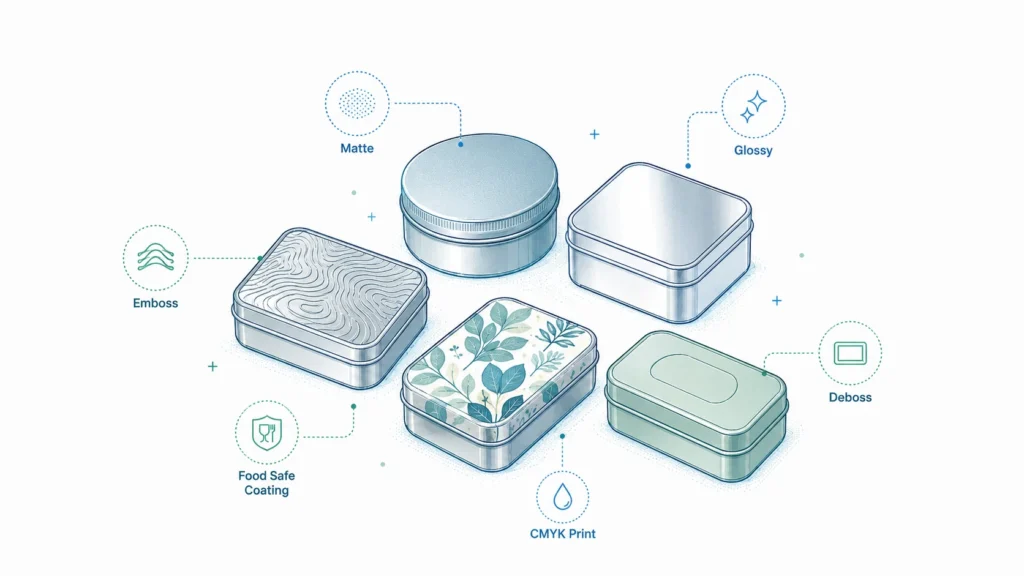
Finishes can change the perceived value dramatically. Glossy varnish makes colors look bright and lively. Matte varnish feels modern and reduces glare. Satin is balanced and practical. Soft-touch coating can make a small cosmetic tin feel premium. Spot UV can highlight a logo or product illustration. Embossing and debossing add tactile memory, especially for logos, patterns, seals, and collector editions.
For more detail, the Mr. Tin Box guide to Metal Tin Box Finishing Options explains common finish systems and how buyers should specify them. In small tin projects, finish decisions should be tested with real samples because a coating that looks good on a large flat panel may behave differently around small radii, lid edges, and stamped corners.
| Decoration option | Visual or tactile effect | Good use cases | Buyer caution |
|---|---|---|---|
| CMYK printing | Full-color graphics and illustrations | Food tins, gift tins, seasonal collections | Confirm color proofing and print tolerance on metal |
| Pantone spot color | Strong brand color control | Corporate gifts, beauty brands, premium SKUs | Metallic substrate may affect perceived color |
| Matte varnish | Modern, low-glare surface | Luxury tea, skincare, wellness, minimalist brands | Fingerprints and scuffs should be tested |
| Glossy varnish | Bright, colorful, retail-friendly look | Candy, holiday tins, children’s products | High glare may reduce readability under store lights |
| Soft-touch coating | Smooth premium hand feel | Cosmetics, perfume, lifestyle gifts | More sensitive to scratches; confirm packing method |
| Spot UV | Contrast and logo emphasis | Premium logos, limited editions | Requires accurate registration |
| Embossing / debossing | Raised or recessed tactile details | Logos, seals, heritage brands, collectibles | Tooling adds cost and affects lead time |
| Metallic ink / pearlescent effect | Premium shine and depth | Beauty, chocolate, gift packaging | Artwork must avoid visual clutter |
Data points that support the business case
Packaging buyers often need data to justify a move from paper, plastic, or generic containers to small tin containers. The strongest business case usually combines product protection, premium perception, circularity, and reuse.
From a waste and recycling perspective, packaging is a major material stream. The U.S. Environmental Protection Agency reports that containers and packaging represented a large portion of municipal solid waste generation in its product-specific data set, with paper and paperboard containers and packaging alone totaling 41.9 million tons in 2018 (EPA containers and packaging data). The EPA national overview also reports total U.S. municipal solid waste generation of 292.4 million tons in 2018, with about 69 million tons recycled and 25 million tons composted (EPA national overview). These numbers show why packaging choices are increasingly reviewed by retailers, regulators, and consumers.
In Europe, Eurostat states that in 2023 the EU generated packaging waste across several material categories and achieved an overall packaging recycling rate of 67.5%, close to the 2030 target of 70% (Eurostat packaging waste statistics). Eurostat also reported that packaging waste by material included paper and cardboard, plastic, glass, wood, metal, and other materials, with metal representing a smaller share by weight than paper, plastic, glass, or wood in the reported breakdown (Eurostat packaging material breakdown). For brands, this supports a practical message: metal packaging is not just a premium design choice; it belongs to an established recycling stream in many markets.
Steel packaging recycling performance is also a strong point in European sustainability communication. Steel for Packaging Europe announced that steel packaging achieved an 82% recycling rate in the EU, described as the highest rate on record for the sector (Steel for Packaging Europe recycling announcement). Recycling rates vary by country and collection system, so brands should avoid overgeneralized claims. Still, the magnetic properties of steel packaging can support efficient sorting in many material recovery systems, which is one reason tinplate has a credible circular-economy story.
| Business concern | How small tin containers help | Evidence or practical support | What the buyer should verify |
|---|---|---|---|
| Product damage | Rigid metal body resists crushing and abrasion | Metal packaging is widely recognized for strong barrier and protection properties | Drop tests, carton packing, edge strength, insert fit |
| Shelf appeal | Metal feel, weight, and finish communicate premium value | Retail packaging often influences first impression and perceived product quality | Artwork proof, finish sample, barcode readability |
| Reuse value | Customers often keep tins for storage | Reuse extends brand visibility beyond the first purchase | Design after-use into the shape, label, and lid style |
| Sustainability story | Tinplate belongs to established steel recycling streams | EPA, Eurostat, and industry data show packaging recycling is a major policy focus | Local recycling claims, labeling rules, material separation |
| Compliance | Food and cosmetic applications can be matched with suitable coatings | EU and U.S. food-contact requirements make coating selection important | Target market rules, migration testing, coating documentation |
| Logistics | Compact rigid tins can support stable packing | Correct dimensions can improve master carton efficiency | Carton count, pallet layout, shipping test, dent inspection |
The business case should be honest. Small tin containers are not automatically the cheapest packaging option. Their value comes from the combination of protection, premium positioning, repeated use, and brand visibility. If the product is extremely low-margin and sold only on price, a tin may not be the right choice. If the product is giftable, sensory, collectible, refillable, premium, seasonal, or sample-driven, a tin can increase perceived value in ways that a disposable pouch or carton cannot.
Custom packaging ideas for small tin containers
A small tin can be more than a branded box. It can be a product concept, a refill platform, a collectible series, a gift object, or a sampling tool. The following ideas can be adapted for food, beauty, gift, and specialty markets.
Tea origin sampler tins
A tea brand can create a set of three to six mini tins, each containing a different origin, harvest, or flavor profile. Each tin can use a different color band while keeping the same master brand layout. A paperboard sleeve or rigid gift box can hold the tins together. This format encourages trial, improves gifting value, and creates a natural path toward full-size refills.
Coffee tasting flight tins
Small tins can hold single-origin coffee portions, cold brew sachets, espresso samples, or specialty roast testers. Metal protects aroma better than a simple paper envelope, especially when paired with an inner bag or seal. The outside of the tin can show roast level, tasting notes, grind recommendation, and QR code for brewing instructions.
Premium mint and candy pocket tins
Pocket tins remain one of the most recognizable uses for small tin containers. A sliding or hinged rectangular tin is easy to carry and creates repeated brand interaction. For a premium mint, candy, or functional tablet brand, the opening sound, lid resistance, and pocket durability are part of the product experience.
Lip balm and solid perfume tins
Round micro tins are ideal for balms, salves, solid perfumes, and travel skincare. The brand can use a small label, direct printing, or embossed top. The key is to test coating compatibility, lid fit, rim smoothness, and filling temperature. A beautiful tin is not enough if the user struggles to open it with product on their hands.
Mini candle tins
Small candle tins work well for travel candles, hotel amenities, wedding favors, seasonal scents, and subscription boxes. The tin must be compatible with the wax, fragrance, wick, and filling process. The lid should leave enough clearance above the wax and should not damage the surface during transport. A matte or textured finish can make the candle feel more premium.
Spice and seasoning tins
Spice brands can use small tins for gourmet blends, barbecue rubs, salt collections, or cooking gift sets. A plug lid, shaker insert, or secondary inner seal may be needed depending on the product. The shape should fit kitchen storage behavior. A rectangular tin may line up neatly in a drawer, while a round tin may feel more traditional.
Chocolate and confectionery gift tins
For chocolates, candies, and biscuits, small tins add protection and gift value. Inserts can separate flavors or prevent movement. Seasonal artwork can turn the package into a collectible item. A window can show the product, but a fully opaque metal lid may be better for light-sensitive ingredients and a more premium surprise reveal.
Promotional desk tins
A business gift tin can hold mints, clips, pins, USB accessories, stickers, or thank-you cards. The tin should be designed for reuse after the event. For example, a shallow hinged tin can become a desk organizer for small items. This is more useful than a standard plastic promotional item and can carry the logo for a longer time.
Small repair or tool tins
For tools, spare parts, sewing kits, bicycle repair kits, electronics screws, or fishing accessories, a small tin can organize components while protecting them from loss. Foam or paperboard inserts can prevent movement. Clear item labeling is important. A simple, durable finish may outperform a decorative finish in this category.
Refill-ready lifestyle tins
A brand can sell the first product in a decorated tin and then offer refill packs in lower-material formats. This works for tea, coffee, spices, tablets, candies, bath salts, and some solid personal care products. The tin becomes a reusable brand asset, while refill packs help reduce repeated primary packaging material. Claims should be worded carefully and supported by real refill behavior, not just marketing intention.
Cost drivers and sourcing considerations
The cost of small tin containers depends on more than size. Tooling, material thickness, shape complexity, lid style, printing method, finish, embossing, insert type, packing method, compliance documentation, and order quantity all influence the final quotation. A simple existing-tool round tin with one-color printing will price very differently from a custom-shaped hinged tin with embossing, soft-touch varnish, food-grade internal coating, and a molded insert.
Existing tooling is usually faster and more economical. If your product can fit into an existing tin size, you may reduce development time and tooling investment. Custom tooling is valuable when shape is central to brand differentiation or when the product requires a very specific fit. For example, a custom insert inside an existing tin may be a better investment than a completely new tin shape.
MOQ also matters. Small tins are often used for sampling and launch programs, but highly customized metal packaging is generally more efficient at mass-production quantities. If the first order is small, buyers should ask whether the supplier can recommend existing sizes, standard lid styles, or simplified decoration to reduce risk. For a large retail launch, buyers should plan more time for tooling, color proofing, coating confirmation, and pre-production samples.
Lead time should be separated into development lead time and mass production lead time. Development includes size selection, dieline creation, artwork, sample making, coating decisions, and testing. Mass production includes material preparation, printing, forming, assembly, inspection, packing, and shipping. A rush project can succeed only if the design is realistic and approvals are fast.
| Cost or timeline driver | Lower-complexity choice | Higher-complexity choice | Commercial recommendation |
|---|---|---|---|
| Tin size | Existing mold | Fully custom mold | Start with existing tooling unless shape is a core selling point |
| Lid structure | Slip lid | Hinge, screw, sliding, window, special mechanism | Match lid complexity to user behavior, not only appearance |
| Printing | Simple CMYK or one-color design | Multi-color artwork with tight registration | Keep small designs clean and readable |
| Finish | Standard gloss or matte varnish | Soft-touch, texture, spot UV, metallic, embossing | Use premium finishes where the customer can feel the value |
| Insert | No insert or paperboard divider | Foam, molded pulp, custom tray, multi-part insert | Use inserts when damage prevention or unboxing value is clear |
| Compliance | Non-food accessory packaging | Food-contact or cosmetic compatibility requirements | Confirm market requirements before final quotation |
| Packing | Bulk or standard carton | Individual bags, sleeves, retail display boxes | Consider dent prevention and retail presentation together |
A professional request for quotation should include the target product, fill weight, product dimensions, desired tin shape, expected quantity, target market, food-contact or cosmetic-contact requirement, artwork status, preferred finish, insert requirement, delivery deadline, and any required tests. The clearer the brief, the faster the supplier can provide a realistic price.
Quality checks before mass production
Small tin containers look simple, but they have many quality details. A buyer should evaluate samples with real product, not only with empty tins. The lid may feel perfect when the tin is empty but become too tight after filling. A printed design may look excellent on a flat proof but lose clarity around curved corners. An insert may hold the product during desk review but fail in a vibration test.
Basic checks include dimensions, lid fit, opening force, edge safety, surface scratches, color accuracy, print registration, coating adhesion, odor, cleanliness, and carton protection. For food-contact packaging, documentation and testing should be reviewed according to the target market and product type. For beauty products, coating compatibility and formula interaction should be evaluated. For industrial products, corrosion risk and part movement should be tested.
Drop and vibration testing are especially useful for e-commerce. Small tins can dent if they are packed too loosely, rubbed against each other, or shipped without protective separation. The solution may be a better master carton, individual polybag, paper wrap, divider, or modified carton count. A packaging supplier should help buyers think beyond the tin itself and consider the complete distribution system.
| QC item | What to check | Why it matters |
|---|---|---|
| Dimension tolerance | Length, width, height, lid depth, insert fit | Ensures filling, packing, and display consistency |
| Lid performance | Opening force, closing sound, repeated-use fit | Directly affects customer experience |
| Edge safety | Curling, seam smoothness, sharp points | Protects users and product handlers |
| Print quality | Color, registration, barcode, small text | Prevents brand inconsistency and retail scanning issues |
| Coating adhesion | Scratch, tape test, rubbing, product compatibility | Reduces scuffs, corrosion, and appearance defects |
| Odor and cleanliness | Interior smell, dust, oil, residue | Critical for food, tea, coffee, and beauty products |
| Packing protection | Carton layout, separators, drop resistance | Prevents dents and shipping complaints |
How small tin containers support premium positioning
Premium packaging is not only about luxury. It is about making the customer believe the product was designed carefully. Small tin containers do this because they create a physical moment: the cool touch of metal, the sound of the lid, the resistance of the opening, the shine or softness of the finish, and the sense that the object can be reused.
For a food brand, this can make a sampler feel giftable. For a beauty brand, it can make a balm feel more crafted and durable. For a promotional brand, it can make a small giveaway feel useful. For an industrial brand, it can make a parts kit feel organized and professional. In each case, the container raises the perceived value of a small product.
The Mr. Tin Box article Why Metal Packaging Boosts Shelf Life and Brand Value explains how metal packaging can support protection and premium perception at the same time. This dual role is especially important for small products because there is less physical product volume to communicate value. The package must do more of the brand-building work.
Small tins also create stronger product lines. A brand can use the same structure across multiple flavors, scents, colors, or SKUs, then change artwork and labels for each variant. This keeps production efficient while making the product range look coherent. A set of six small tins can often look more valuable than one large container, even if the total fill weight is similar, because it creates variety and collectibility.
Practical design rules for better small tin packaging
Good small tin design is disciplined. It should be attractive, but it must also be readable, manufacturable, packable, and compliant. The following rules help avoid common mistakes.
First, design at actual size. A layout that looks spacious on a computer monitor may become crowded on a 60 mm lid. Print the dieline at 100% scale and check logo size, ingredient text, barcode, QR code, and legal marks. If users cannot read the product name at arm’s length, the design needs simplification.
Second, prioritize the lid. For many small tins, the lid is the main branding surface. It should communicate the product identity quickly. The side wall can carry supporting information, batch code, flavor color, or decorative patterns. The bottom can carry less emotional but necessary information, depending on market rules and retail requirements.
Third, avoid forcing too many claims onto a small package. Claims such as recyclable, reusable, BPA-free, food-grade, refillable, plastic-free, or sustainable must be accurate and relevant to the target market. If the claim requires explanation, consider using a QR code to link to a detailed sustainability or product page rather than crowding the tin.
Fourth, think about hands. A small tin is touched more than a large box. It may be opened repeatedly, carried in pockets, placed in bags, used with wet hands, or stored in kitchens and bathrooms. Corners, lid resistance, coating texture, and scuff resistance should be tested in real use.
Fifth, make the pack-out efficient. A tin can be beautiful and still fail commercially if it ships poorly. Confirm how many units fit per inner carton and master carton. Check whether tins need individual protection. Test whether a display tray or paper sleeve is needed for retail. Packaging design should support the whole supply chain, not only the product photo.
How to brief Mr. Tin Box for a custom small tin container
A complete brief helps the factory recommend the right structure quickly. If you are preparing a project for Mr. Tin Box, include the following information wherever possible:
| Brief item | Details to provide | Example |
|---|---|---|
| Product category | Food, tea, coffee, candy, cosmetic, candle, gift, tool, accessory | “Dry tea sampler for premium gift set” |
| Product form | Solid, powder, loose leaf, liquid-adjacent, oily, aromatic, sharp parts | “Loose leaf tea, high aroma, 35 g fill weight” |
| Target quantity | Sampling order, launch order, annual volume | “Initial 10,000 units, repeat orders expected” |
| Target market | U.S., EU, UK, Japan, Australia, Middle East, global | “EU and U.S. retail” |
| Size target | Existing product dimensions, fill volume, desired outside size | “Round tin around 80 mm diameter, 45 mm high” |
| Lid preference | Slip, hinged, screw, sliding, plug, window | “Slip lid with optional inner plug lid” |
| Contact requirement | Direct food contact, indirect contact, inner bag, no contact | “Tea will be packed in inner pouch, tin is secondary pack” |
| Decoration | CMYK, Pantone, matte, gloss, embossing, spot UV, metallic | “Matte green body, embossed logo on lid” |
| Insert requirement | None, divider, foam, paperboard, tray | “Paperboard divider for three sachets” |
| Launch date | Required sample date and delivery deadline | “Samples needed before packaging approval meeting” |
With this information, the supplier can advise whether an existing mold is available, what material thickness is suitable, whether food-grade coating is needed, which printing method is practical, and what cost drivers should be expected. This reduces back-and-forth communication and makes the first sample more likely to match the commercial goal.
Why choose Mr. Tin Box for small tin containers
Choosing a small tin container supplier is not only about unit price. The supplier must understand metal forming, printing, coating, lid fit, packaging protection, and export communication. A low-cost tin that dents easily, opens poorly, smells wrong, or fails color expectations can damage a launch.
Mr. Tin Box focuses on custom metal tin packaging for global brands across food, beauty, gift, promotional, holiday, specialty, and industrial applications. The website positions the company around high-quality tin boxes designed for food, beauty, gift, and industrial uses, supported by custom manufacturing, precision forming, and premium finishing capabilities. For buyers developing small tin containers, that matters because compact packages have less room for error. A small defect is highly visible when the entire product fits in the customer’s palm.
A strong supplier should help you answer practical questions: Which existing size is closest to my product? Is a custom mold worth the investment? Which lid style will customers prefer? How should the artwork be simplified? Does my product need an inner coating or separate inner bag? Which finish will survive shipping? How should the tins be packed to prevent dents? These answers are often more valuable than a fast quote alone.
For brands planning a new launch, a seasonal campaign, a premium upgrade, or a refillable packaging concept, small tin containers offer a flexible and commercially powerful format. They can protect the product, improve shelf presence, support reuse, and make a small item feel like a designed object. When size, structure, coating, decoration, and logistics are aligned, a small tin is not just packaging. It becomes part of the product’s value proposition.
Frequently asked questions about small tin containers
What are small tin containers usually made of?
Most small tin containers are made from tinplate, which is steel sheet coated with a thin layer of tin. Depending on the application, the container may also include internal coatings, external varnish, printing inks, plastic or paper inserts, window components, or secondary seals. The exact material system should be chosen according to product type and target market.
Are small tin containers food safe?
They can be food safe when the correct food-contact material, internal coating, manufacturing process, and documentation are used for the intended product and market. A dry tea tin, a candy tin, and a thermally processed food container have different requirements. Buyers should explain whether the food touches the tin directly or is packed in an inner pouch.
What size should I choose for a small tin container?
Start with the product’s real fill weight, density, dimensions, and user behavior. Then add space for inserts, inner bags, scoops, seals, labels, and lid clearance. If you are unsure, ask the supplier for existing molds close to your target size and test them with real product before confirming custom tooling.
Can small tin containers be customized with my logo?
Yes. Small tin containers can be customized with printed artwork, Pantone colors, matte or glossy varnish, soft-touch coating, metallic effects, embossing, debossing, spot UV, paper sleeves, stickers, QR codes, and custom inserts. For small surfaces, artwork should be simplified and checked at actual size.
Which lid style is best for small tins?
The best lid depends on the product. Sliding lids are good for mints and tablets. Screw lids work well for balms and solid cosmetics. Slip lids are practical for tea, candy, candles, and gifts. Hinged lids are useful for repeated opening, tool kits, and promotional tins. Window lids help show products but may reduce barrier performance.
Are small tin containers recyclable?
Tinplate is part of the steel recycling stream in many markets, and steel packaging benefits from magnetic sorting. Recycling rules and actual recycling rates vary by region, so brands should use market-specific claims. A safe claim is usually to explain that the tin is reusable and recyclable where local facilities accept metal packaging.
What products are not ideal for small tin containers?
Products with high acidity, high salt content, aggressive oils, liquid leakage risk, or unusual chemical compatibility may need special coatings, liners, inner packaging, or a different container system. Very low-margin products may also find tins too costly unless the pack creates clear added value.
Can I use small tins for refillable packaging?
Yes. Many brands use a decorated tin as the durable container and sell refill packs separately. This can work for tea, spices, mints, tablets, bath salts, solid personal care products, and other dry or solid items. The refill system should be easy for customers to understand and should be supported by accurate sustainability language.
How do I reduce dents during shipping?
Use proper carton design, avoid loose bulk packing, consider paper or film separation, test inner cartons, and conduct drop or vibration testing when possible. Deep colors and glossy finishes can make small dents more visible, so the packing method should be confirmed before mass production.
How soon should I start a custom tin project?
Start as early as possible if the design needs a custom mold, special coating, embossing, window structure, or retail launch deadline. Existing molds and standard finishes can shorten development, while highly customized designs require more time for dielines, samples, color approval, tooling, testing, and production.
Final takeaway
Small tin containers are compact, durable, reusable, and highly customizable. Their biggest strength is that they turn small products into complete brand experiences. A well-designed tin can protect tea aroma, make a candy sample giftable, give a balm a premium hand feel, organize a tool kit, or make a promotional item worth keeping. For commercial buyers, the key is to choose the size and structure based on real product requirements, not only appearance.
If your brand needs small tin containers for food, beauty, gifts, promotional campaigns, or specialty products, begin with a clear brief: product type, fill weight, target market, lid preference, artwork goal, coating requirement, quantity, and launch timeline. Then work with a supplier that can connect design, engineering, printing, and quality control. With the right planning, small tin containers can do far more than hold a product. They can help the product sell, travel safely, and remain memorable long after purchase.


