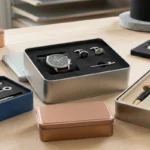
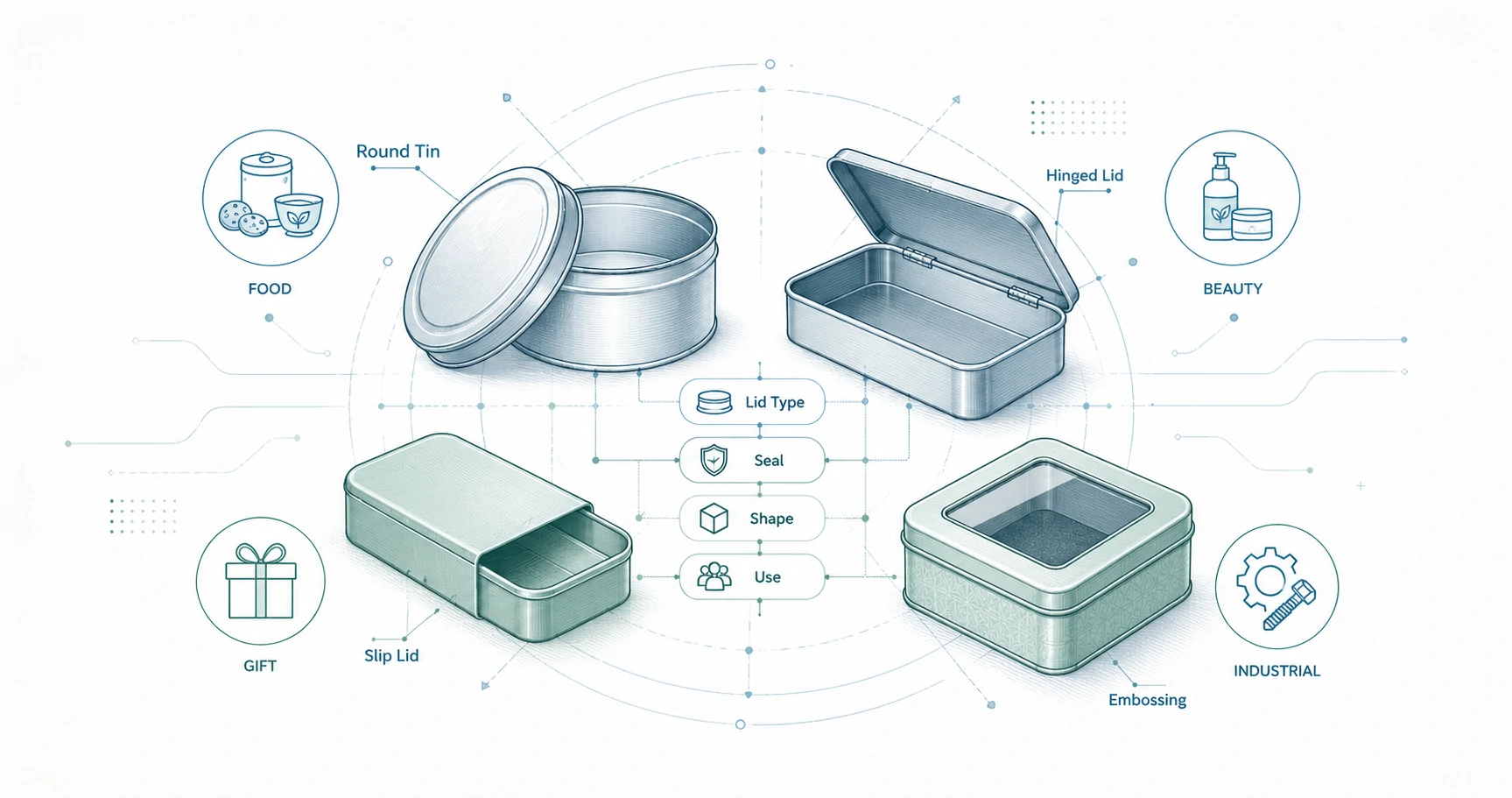
Metal tins with lids look simple from the outside. A buyer sees a metal container, a printed surface, and a lid that opens and closes. In real packaging development, however, the lid structure is one of the most important decisions in the entire project. It affects freshness protection, opening feel, shelf presentation, stacking strength, insert design, consumer reuse, production cost, tooling risk, and even the type of product claims a brand can safely make.
For global brands, private-label buyers, sourcing managers, and product developers, the question is not simply, “Can we put our product in a tin?” A better question is: “Which tin structure will protect the product, support the sales channel, meet compliance expectations, and make the customer want to keep the package?” That is the practical purpose of this guide.
At Mr. Tin Box, we focus on custom metal tin packaging for food, beauty, gift, promotional, holiday, and specialty industrial applications. This article explains how to choose the right structure for metal tins with lids, using plain language and practical buyer logic. You will learn how common lid styles work, which products they fit best, what data and compliance factors matter, and how to prepare a clear specification before requesting samples or a quotation.
The guide is written for commercial decision-making. It does not try to make every tin sound perfect for every product. Some products need a basic slip lid. Some need a hinged lid. Some need a plug lid, inner lid, gasket, window, compartment insert, or protective foam. Some need a standard mold to control launch cost. Others need a custom structure to create premium shelf impact. The best choice depends on the product’s sensitivity, the customer experience you want to create, and the practical conditions of production and logistics.
Table of Contents
Why the lid structure matters more than many buyers expect
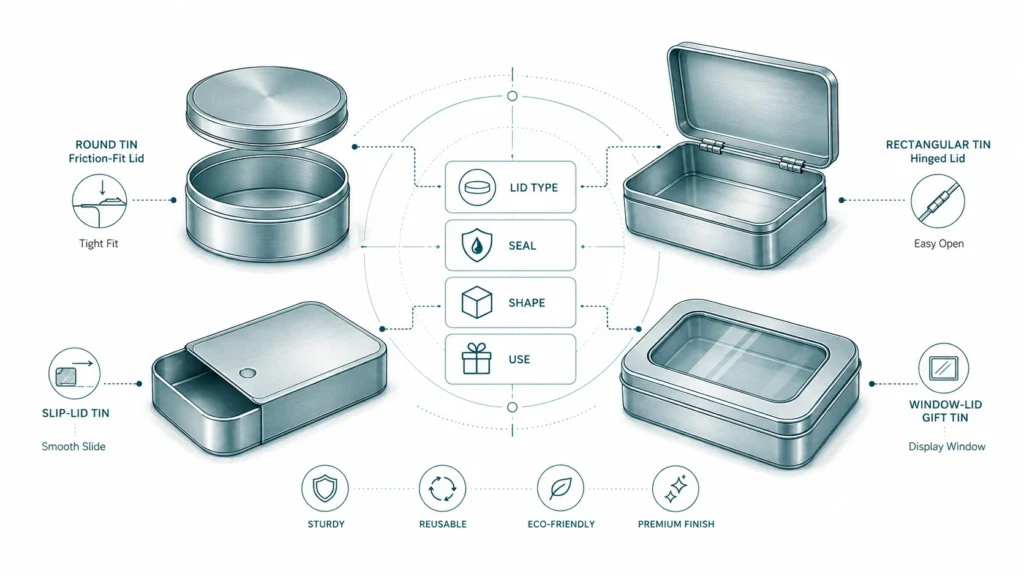
The lid is the most touched part of a tin. It is also the part most likely to create a strong first impression. When the lid fits well, customers feel quality immediately. When it is too loose, too tight, noisy, sharp, misaligned, or difficult to open, the product feels cheaper even if the printed artwork looks excellent.
A lid also controls practical performance. It can help reduce dust, light exposure, moisture exchange, aroma loss, product movement, and retail handling damage. It can improve stackability, prevent accidental opening, or make the tin easier to reuse. For food and beverage products, the lid structure may work together with an inner bag, liner, coating, or secondary seal. For cosmetics, it may support a luxury unboxing experience. For industrial products, it may keep small parts organized and protected. For gift tins, it may create a reusable keepsake.
Packaging data supports the commercial importance of this decision. Smithers reports that the metal packaging industry is expected to be worth over USD 177 billion by 2029, with 2024-2029 growth around 3%, which shows that metal packaging remains a mature and commercially serious category, not only a nostalgic format. Ipsos has also reported that 72% of Americans say packaging design often influences purchase decisions, while 67% say packaging materials often influence purchase decisions. These numbers do not mean that every brand should choose metal. They do show that structure, material, and packaging experience can influence buying behavior before the customer even tries the product.
Sustainability and regulatory pressure also make structure decisions more important. The U.S. EPA containers and packaging data shows that containers and packaging are a major material stream in municipal solid waste. In Europe, Eurostat packaging waste statistics reported a 67.5% overall EU packaging recycling rate in 2023, close to the 2030 target of 70%. For steel packaging specifically, Steel for Packaging Europe announced that steel packaging placed on the EU market reached an 82% recycling rate in 2023 under the EU harmonised methodology. For brands choosing metal tins with lids, these data points can support a more credible packaging story when the structure is reusable, recyclable, and not over-complicated with unnecessary mixed materials.
What “metal tins with lids” means in packaging engineering
In everyday language, people use “tin,” “tin box,” “metal tin,” and “metal container” in similar ways. In packaging engineering, most decorative tins are made from tinplate, which is a thin steel sheet coated with tin. The steel core gives strength and formability. The tin coating helps protect the surface and supports printing, coating, and forming. Depending on the product, the tin may also include food-grade internal lacquer, external varnish, printed inks, embossed elements, a plastic window, paperboard sleeves, EVA foam, PET trays, cardboard inserts, gaskets, locks, handles, hinges, or additional inner seals.
A metal tin with lid is not one single component. It is a packaging system. A typical structure may include the body, base, side wall, rolled edge, bead or rib, lid panel, lid skirt, hinge, plug area, friction fit zone, liner, coating, and insert. Each part has a job. If the body wall is too thin, it may deform. If the lid skirt is too shallow, the lid may fall off during handling. If the curl is poorly designed, the opening edge may feel rough. If the coating is not compatible with the contents, food or cosmetic use may be risky. If the insert does not match the lid height, the product may rattle or press against the top.
This is why a professional custom tin project should begin with the product, not with the artwork. The artwork matters, but the product decides the structure. Tea, coffee, cookies, chocolate, lip balm, soap, candles, electronics, tools, jewelry, mints, candy, and promotional gifts all create different requirements. Before choosing a lid style, the buyer should define the product’s sensitivity to air, light, moisture, oil, fragrance loss, breakage, heat, vibration, and repeated opening.
Mr. Tin Box’s own Custom Tin Packaging Guide explains custom tin packaging as a full program involving material selection, structure engineering, surface finishing, production planning, quality control, and logistics. This same logic applies directly to metal tins with lids. The lid is not a small accessory; it is part of the packaging performance.
A quick structure selection table for buyers
The table below gives a practical starting point. It does not replace sampling, but it helps buyers quickly match common lid structures with common product needs.
A useful rule is to start with the minimum structure that protects the product and supports the brand promise. A premium structure is valuable when it solves a real problem: better shelf impact, stronger closure, safer handling, longer reuse, or higher perceived value. A complex lid that adds cost without improving the product experience is usually not the best choice.
Common lid structures and when to use them
Slip lids and lift-off lids
A slip lid is one of the most common structures for metal tins with lids. The lid fits over the body by friction. The customer removes it by lifting it upward. This structure is popular because it is simple, familiar, and cost-effective. It can be used for round tins, rectangular tins, square tins, and many shallow gift tins.
Slip lids are useful for cookies, candies, mints, tea bags, stationery, small accessories, promotional gifts, and seasonal products. They can also work well for beauty items such as soap sets, bath tablets, and small cosmetic kits when the product is already protected by primary packaging. The lid can be printed, embossed, debossed, textured, or finished with matte or glossy varnish.
The biggest misunderstanding is that a slip lid automatically creates an airtight package. In most decorative tin packaging, this is not true unless the structure includes a specific seal, liner, gasket, or inner packaging system. A slip lid can provide good coverage against dust and light, and it can reduce exposure, but it should not be described as hermetic unless the project has been engineered and tested for that purpose.
For dry snacks, confectionery, and tea, many brands use a slip lid together with an inner pouch, food-grade liner, or sealed bag. This combination allows the outer tin to deliver shelf impact and reuse while the inner packaging manages freshness. For a buyer, this can be a practical balance between cost, appearance, and product protection.
Plug lids
A plug lid uses a tighter fitting part that presses into or against the opening area of the body. It can create a stronger and more satisfying closure feel than a basic slip lid. Buyers often choose plug lids for tea, coffee, spices, powdered products, premium candies, and aroma-sensitive dry goods.
A plug lid can make the package feel more secure. When customers open and close it, they often perceive the product as better protected. This matters for premium tea and coffee brands because aroma is part of the product value. It also matters for powders and spices where consumers expect the container to close firmly after use.
The trade-off is precision. If the plug area is too tight, customers may struggle to open the tin. If it is too loose, the premium effect disappears. Tooling, metal thickness, coating build-up, and production tolerances all influence the result. Buyers should approve real physical samples, not only 3D drawings, and test the opening force with the actual target user in mind.
Hinged lids
A hinged lid is attached to the tin body, usually through a metal hinge structure. This is popular for gift tins, chocolate assortments, sewing kits, stationery tins, cosmetic kits, candle sets, and specialty industrial packaging. The major benefit is convenience: the lid does not get lost, and the package feels more reusable.
A hinged tin often creates a better unboxing moment. The lid opens like a small case. This can make the product feel more organized and giftable, especially when used with an internal tray, foam insert, paperboard divider, or molded holder. For corporate gifts and promotional campaigns, a hinged tin can also increase the chance that customers keep the container after the product is used.
The trade-off is manufacturing complexity. The hinge area must be aligned. If the hinge is weak, stiff, or noisy, the packaging feels cheap. If the lid does not close flat, the product may look defective on the shelf. Hinged tins also require careful packaging during shipping because deformation near the hinge can affect opening and closing performance.
Window lids
A window lid includes a transparent area, often made from plastic material, so customers can see the product inside. This structure works well for cookies, candies, confectionery assortments, gift sets, cosmetics, and products where visual confirmation increases trust.
Window tins are attractive in retail because shoppers can see color, texture, shape, and product quantity. This can reduce uncertainty and support impulse buying. For food products, a window can show the real product instead of relying only on printed photos. For cosmetics, it can show product shade, package arrangement, or premium accessories.
The limitation is material complexity. A window usually adds a non-metal component, which may affect recyclability communication, cost, and production steps. The window also needs secure attachment and clean finishing. If the window scratches easily, fogs, loosens, or collects dust, it damages the premium impression. For brands focused heavily on simple recyclability claims, a full metal lid may be better than a window lid.
Inner lid plus outer lid
Some metal tins with lids use two closure layers: an inner lid or inner plug plus an outer decorative lid. This structure is common for premium tea, coffee, spices, and selected food gifts. The inner lid supports a stronger sense of freshness protection, while the outer lid carries the branding and design.
This approach is useful when the brand wants both functional protection and a premium opening sequence. The customer removes the outer lid, sees a second seal or inner closure, and feels that the product has been carefully protected. For high-value tea or coffee, this experience can support pricing and repeat purchase.
The trade-off is added cost and assembly. More parts mean more material, more handling, more quality checks, and a larger chance of tolerance issues. Buyers should only choose this structure when the product value and brand positioning justify it.
Locking, clasp, and handle structures
Locking or clasp-style tins are used for industrial kits, tool sets, first-aid-style kits, craft supplies, collector items, and premium promotional packages. Handles may be used when the tin functions like a small case. These structures are less common for simple food tins but can be very effective when the package needs to travel, be carried, or protect many components.
The key advantage is security. A clasp can prevent accidental opening during transport. A handle can improve portability. A reinforced body can improve crush resistance. The trade-off is higher component cost and more detailed quality control. For industrial packaging, this cost can be justified because product damage, missing parts, and customer complaints may be more expensive than the improved structure.
Match the structure to product sensitivity
The best metal tin structure starts with product sensitivity. Different products fail in different ways. A cookie may break or lose crispness. Tea may lose aroma. Chocolate may be affected by heat and odor. Cosmetics may react with unsuitable coatings or suffer from leakage if the primary container is not secure. Electronics may need impact protection and anti-scratch organization. Tools may need rust control and compartment separation.
| Product sensitivity | Packaging risk | Recommended tin structure response | Notes for buyers |
|---|---|---|---|
| Moisture sensitivity | Cookies become soft, powders clump, tea loses quality | Tight-fit lid, inner pouch, liner, or inner lid | Decorative tins are often paired with sealed inner packaging |
| Oxygen sensitivity | Aroma and flavor may degrade | Plug lid, inner seal, pouch, or secondary barrier | Avoid making airtight claims without testing |
| Light sensitivity | Color, fragrance, oils, or active ingredients may degrade | Full metal body and lid, opaque decoration | Metal naturally blocks light |
| Breakage sensitivity | Biscuits, chocolates, glass jars, or pressed powders may crack | Rigid tin plus tray, divider, or foam insert | Validate with drop and vibration tests |
| Odor sensitivity | Tea, coffee, chocolate, and cosmetics absorb unwanted odors | Food-grade coating, low-odor inks, clean packing | Odor checks should be part of QC |
| Oil or formula contact | Coating may stain, soften, or corrode | Compatible internal lacquer and primary packaging | Test with actual product or simulant |
| Retail handling | Lid loosens, dents, scratches, or opens | Deeper lid skirt, stronger bead, protective carton | Check shelf handling and carton packing |
| Reuse expectation | Customer opens and closes frequently | Hinged lid, reinforced curl, durable finish | Opening-cycle tests are useful |
| E-commerce shipping | Compression, vibration, and impact damage | Stronger body, insert, secondary carton | Test the complete shipment pack |
For food and beverage applications, the packaging should be considered a complete system. The European Commission food contact materials legislation explains that Regulation (EC) No 1935/2004 sets general principles of safety and inertness for food contact materials. The full EUR-Lex text of Regulation (EC) No 1935/2004 states that food contact materials should not transfer substances to food in quantities that endanger human health, cause unacceptable changes in food composition, or deteriorate organoleptic properties. In the United States, the FDA guidance on food contact materials notes that components used in compliance with applicable 21 CFR 174-179 regulations need no further FDA review.
For buyers, the practical message is simple: do not approve a food tin only by appearance. Ask about the substrate, internal coating, inks, varnish, liner, insert, intended food contact condition, and test documentation. For direct food contact, the inside surface matters as much as the printed outside surface.
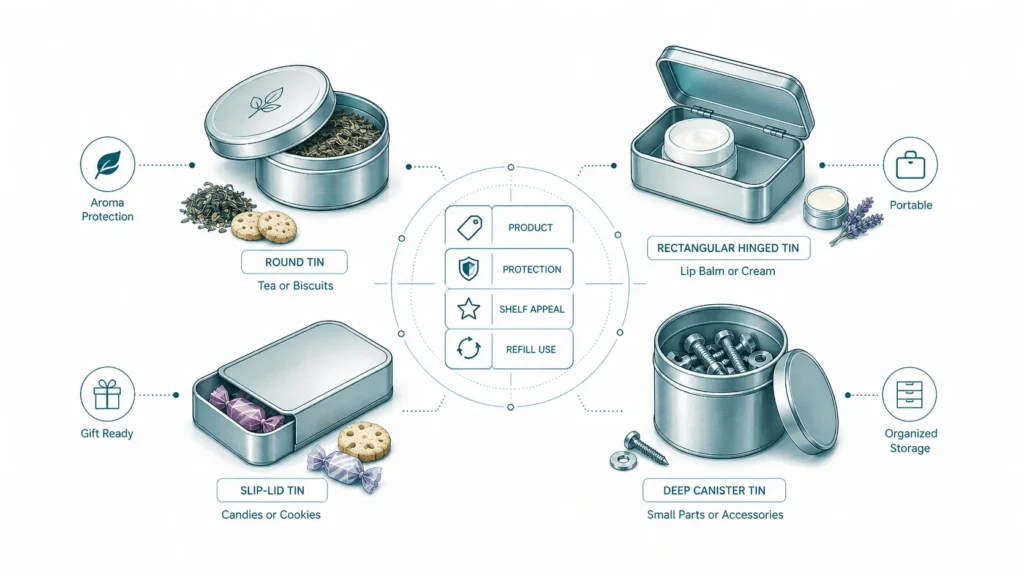
Food and beverage packaging: protect freshness and support shelf appeal
Food and beverage brands often choose metal tins with lids because metal offers excellent rigidity, strong light protection, premium shelf presence, and reuse value. Mr. Tin Box’s Food & Beverage Packaging page highlights applications such as snacks, tea, coffee, chocolates, candies, and specialty foods, where structural durability and shelf stability matter.
For tea, a round or rectangular tin with a plug lid, inner lid, or tight slip lid can communicate aroma protection and premium quality. Many tea brands also use an inner pouch because tea is sensitive to moisture, oxygen, light, and odor. The tin provides the durable outer package and brand identity, while the inner packaging protects freshness before first opening.
For coffee, aroma management is even more important. Ground coffee and beans release and absorb volatile compounds. A simple decorative tin may be suitable for gift presentation or secondary packaging, but coffee freshness normally requires a carefully selected inner bag, valve pouch, liner, or sealing strategy. A plug lid can improve the consumer’s daily experience after opening, but it should not be treated as a replacement for a validated primary freshness barrier unless the structure is tested.
For cookies, biscuits, and chocolates, the key issues are breakage, moisture, fat compatibility, odor, and shelf appeal. A rectangular or round tin can protect against crushing better than a soft pouch, but brittle products may still need paper cups, trays, dividers, or molded inserts. If the product is oily or contains fat, the internal coating and paper liners should be checked for compatibility. The article Custom Tin Box for Luxury Chocolate and Biscuit Lines is a useful internal reference for this category.
For candies and mints, small metal tins with slip lids are popular because they are portable and reusable. The opening feel matters because the customer may open the package many times. Too much opening force is annoying; too little can cause accidental opening in a pocket or bag. For mint tins, a shallow slip lid, hinged lid, or sliding lid can all work depending on brand style and target price.
Food waste is also part of the broader packaging conversation. The UNEP Food Waste Index Report 2024 estimates 1.05 billion tonnes of food waste across retail, food service, and households in 2022. Packaging alone cannot solve food waste, but better protection, clearer portioning, stronger distribution durability, and improved resealability can help reduce preventable product damage and quality loss in selected categories.
Beauty and personal care packaging: protect the product and elevate the ritual
Beauty and personal care brands use metal tins with lids for a different reason. Freshness may matter, but the emotional experience often matters just as much. A cosmetic gift set, fragrance accessory, skincare sample kit, balm tin, candle tin, bath product, or wellness set must look clean, premium, and safe. Mr. Tin Box’s Beauty & Personal Care Packaging page emphasizes aesthetic value, protection, and reliability for skincare, cosmetics, fragrance, and wellness applications.
For solid balms, wax-based products, and small personal care items, round tins with slip lids or screw-style closures can create a compact and familiar format. However, formula compatibility is critical. Oils, fragrance, waxes, pigments, and active ingredients may interact with coatings or liners. In many cases, the tin is used as secondary packaging around a primary container. When the formula contacts the metal or coating directly, the buyer should request compatibility testing.
For cosmetic gift sets, hinged tins and lift-off lid tins can create a strong unboxing effect. A foam insert, paperboard tray, or molded tray can hold multiple products in place. The lid structure should match the expected retail position. If the product is displayed vertically, the lid and insert must prevent movement. If it is sold online, the tin and insert must survive parcel vibration and compression.
For candles, the lid can be part of the user experience. A well-fitting lid helps keep dust away from the wax and protects the fragrance when the candle is not in use. The finish should resist fingerprints and minor scratches because candle tins are handled frequently. Matte or satin finishes may feel premium, while glossy finishes may make colors look brighter. Mr. Tin Box’s Metal Tin Box Finishing Options guide explains how matte, glossy, satin, textured, metallic, soft-touch, and spot UV finishes can change perceived value and durability.
Beauty packaging buyers should also think about odor. A new tin should not add an unwanted smell to a fragrance, balm, soap, or skincare product. Low-odor inks, suitable varnish, clean packing, and adequate curing are important. An attractive tin with a chemical odor can damage customer trust quickly.
Gift, promotional, and holiday packaging: make the tin worth keeping
Gift packaging is where metal tins with lids often create the strongest commercial value. A holiday cookie tin, chocolate tin, tea gift tin, corporate gift tin, or limited-edition collectible tin is not only a container. It is part of the gift. A customer may buy it because it feels more special than a disposable box.
The Gift, Promotional & Holiday Packaging category focuses on presentation, durable protection, and memorable unboxing experiences. This category benefits from decorative lids, embossed patterns, metallic finishes, shaped tins, window structures, and internal trays. A simple product can feel more valuable when the tin feels collectible.
For seasonal gifts, the lid can carry most of the emotional design. A raised snowflake, embossed logo, heart-shaped lid, festive window, or illustrated top panel creates shelf impact. However, brands should avoid over-customizing the structure if the campaign volume is small or the launch schedule is tight. Existing molds can often achieve strong results with custom printing and finishing, while fully custom shapes require more tooling time and a larger budget.
For corporate gifts and promotions, hinged tins and lift-off tins are both common. A hinged tin often feels more like a reusable case, while a lift-off lid may provide a larger clean canvas for printed artwork. Inserts are important because promotional items often include multiple components such as candies, USB drives, cards, small bottles, badges, or accessories. If the insert looks cheap, the gift feels cheap. If the insert fits cleanly, the whole package feels intentional.
For premium campaigns, the keepsake effect matters. The customer may throw away a paper sleeve, but they may keep a tin for years. That means the brand remains visible in the customer’s home or office long after the campaign. For ideas on seasonal applications, see Mr. Tin Box’s guide to custom metal tin packaging for holiday gifts and seasonal campaigns.
Specialty and industrial packaging: prioritize protection and organization
Specialty and industrial products need a more practical structure. The packaging may need to protect tools, electronics, hardware, replacement parts, repair kits, sewing kits, craft supplies, collectible cards, or technical samples. In these cases, the tin must do more than look attractive. It must organize the contents, resist deformation, prevent accidental opening, and survive storage or transport.
Mr. Tin Box’s Specialty & Industrial Packaging page describes high-strength metal packaging for tools, hardware, electronics, and sensitive components. For these products, a hinged lid, clasp lid, reinforced body, handle, internal divider, EVA foam, or custom tray may be more important than a decorative finish.
For small tools and hardware kits, the lid should not open accidentally. A hinged lid with a clasp or friction lock can work well. The body may need ribs or beads to improve rigidity. The insert may need separate compartments to prevent metal parts from scratching each other. If the kit contains sharp items, the insert and lid clearance should be checked carefully.
For electronics accessories, the tin should prevent cosmetic scratches and movement. Foam or molded trays can separate parts. If the product is sensitive to static discharge, additional packaging layers may be needed; a decorative tin alone is not an ESD protection system. Buyers should define whether the tin is retail packaging, storage packaging, or transport packaging.
For collectible items, the lid structure affects perceived value. A hinged presentation tin can feel like a case, while a shallow lift-off lid can feel like a premium display box. The internal fit is critical because collectors notice details. A dented corner, loose insert, or scratched inner surface can lead to complaints.
Material, thickness, and coating decisions
Most custom decorative tins use tinplate, but the exact specification should be chosen based on structure, size, forming depth, product weight, and finishing requirements. A small mint tin does not need the same metal thickness as a large cookie tin or industrial kit. Thicker material may improve strength, but it can increase cost and affect forming. Thinner material may reduce cost, but it may dent more easily or feel less premium.
The internal coating is equally important. Food-contact tins may require food-grade lacquer. Beauty products may need coating compatibility with oils, fragrance, or wax. Industrial products may need corrosion resistance. External varnish protects printing from scratches, fingerprints, and abrasion.
| Specification item | Typical buyer question | Why it matters |
|---|---|---|
| Base material | Is this tinplate, tin-free steel, or another metal? | Determines formability, appearance, cost, and recycling path |
| Metal thickness | What thickness is recommended for this size and use? | Affects rigidity, dent resistance, forming stability, and price |
| Internal coating | Is the inside suitable for direct or indirect product contact? | Critical for food, cosmetics, and corrosion-sensitive products |
| External coating | Matte, gloss, satin, texture, or special effect? | Controls appearance, scratch resistance, and tactile feel |
| Printing system | Offset printing, spot color, CMYK, metallic ink? | Affects color accuracy and mass production repeatability |
| Edge treatment | Are edges curled, rolled, or protected? | Affects safety, hand feel, and premium perception |
| Lid tolerance | How tight should the lid be? | Affects opening force, perceived quality, and transport security |
| Insert material | Foam, paperboard, PET, molded pulp, or none? | Affects product protection, unboxing, and recyclability claims |
| Compliance documentation | What test reports or declarations are needed? | Important for export, retail, food contact, and buyer approval |
For a deeper explanation of metal substrate, coating, printing, and food safety, see Mr. Tin Box’s Tinplate Packaging Guide. Buyers planning direct food contact should be especially careful with coating selection and documentation.
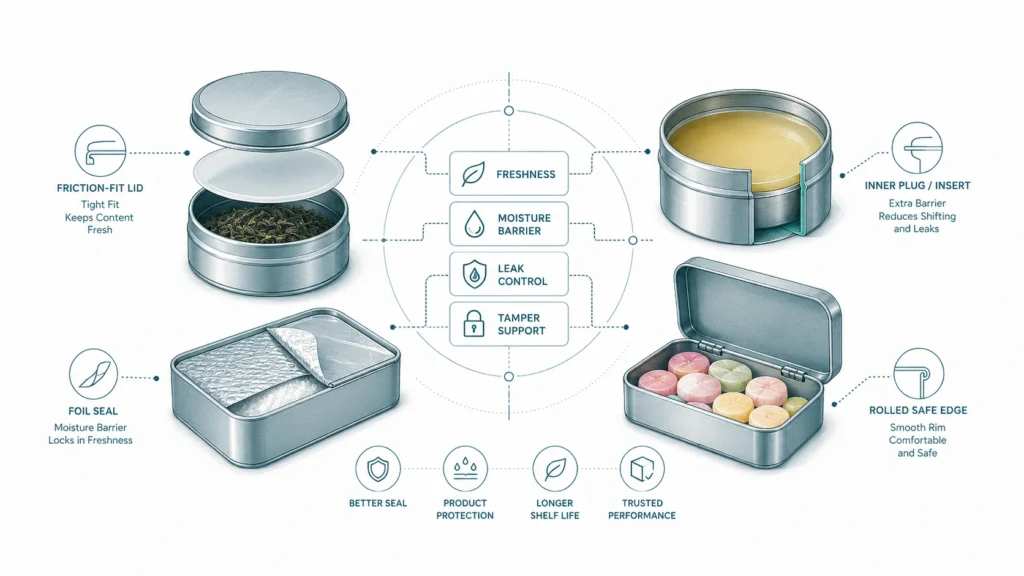
Shape and size: do not let design waste shipping volume
Shape is a major commercial decision. Round tins feel traditional, friendly, and premium for tea, cookies, candles, and cosmetics. Rectangular tins are efficient for shelf display, gift sets, chocolate assortments, stationery, and industrial kits. Square tins can feel modern and stable. Irregular shapes can create strong brand memory, but they may increase tooling cost, packing complexity, and shipping inefficiency.
A common mistake is choosing a beautiful shape without checking carton efficiency. A tin that looks impressive individually may waste space in master cartons, containers, or warehouse shelves. That wasted space becomes cost in every shipment. For export orders, carton dimensions, palletization, and container loading should be considered during structure design, not after production.
The lid also affects stacking. A flat lid may stack cleanly. A domed, embossed, or highly shaped lid may reduce stacking stability unless the base is designed to nest or support it. A window lid may need extra protection to prevent scratches. A hinged lid may require the tin to be packed in a specific orientation.
Before approving a custom structure, buyers should request not only a 3D rendering but also practical packing information: individual polybag or paper wrap, inner carton quantity, master carton quantity, gross weight, carton dimensions, stacking guidance, and pallet plan if needed. Packaging is not complete until it can be packed, shipped, displayed, and opened reliably.
Opening experience: the hidden driver of perceived quality
Many buyers spend weeks perfecting artwork but only a few minutes testing the lid. That is risky because customers interact with the lid directly. Opening force, sound, fit, alignment, edge smoothness, and closing feedback all influence perceived quality.
A premium tea tin should not feel loose. A child or elderly customer should not need excessive force to open a candy tin. A cosmetic gift tin should not scrape or squeak. A hinged lid should not wobble. A window lid should not flex in a cheap way. A cookie tin should not pop open during transport.
Opening experience should be tested with the actual target user. For example, a gym supplement tin may be acceptable with a firmer closure, while a small candy tin carried in a handbag must balance security with easy access. A corporate gift tin may be opened only a few times, while a tea tin may be opened daily for weeks. The more frequently the tin is opened, the more important lid durability becomes.
Buyers should also test repeated opening and closing. The first sample may feel good, but after 50 or 100 cycles the lid may loosen, scratch, or deform. Reuse-oriented tins should be tested as reusable objects, not only as one-time retail packages.
Decoration and finish: structure and surface must work together
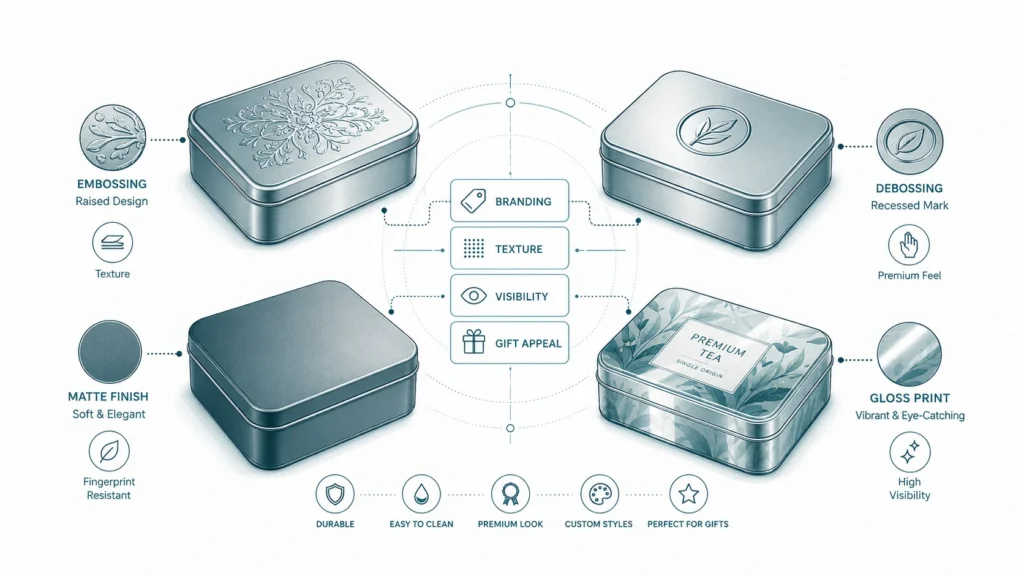
The lid is usually the visual focus of the tin. It carries the logo, main artwork, product name, embossed detail, or window. A good finish can make the same structure feel more premium. A poor finish can make a strong structure look cheap.
Matte finishes often feel modern and premium. Glossy finishes make colors bright and giftable. Satin finishes balance premium appearance with practical handling. Soft-touch finishes feel luxurious but may require careful scratch and fingerprint testing. Spot UV can highlight a logo or pattern. Embossing and debossing create tactile memory. Metallic effects can make holiday and luxury tins stand out.
However, finish is not only decoration. It can affect friction, opening feel, scratch resistance, and production yield. Heavy embossing near a lid fit area can affect closure. Thick varnish can slightly change tolerance. A high-gloss finish may show scratches more easily under retail lighting. A soft-touch finish may need more careful packing.
The safest approach is to treat finish as a system: substrate, primer, printing, varnish, curing, forming, and packing. Do not approve a finish only from a flat printed sheet. The final tin sample should be formed, closed, opened, rubbed, stacked, and photographed under realistic conditions. Mr. Tin Box’s finishing options guide is a useful reference before choosing matte, glossy, satin, texture, soft-touch, spot UV, or embossing.
Existing mold or custom mold: how to control cost and risk
For many buyers, the biggest early question is whether to use an existing mold or develop a custom mold. Existing molds are faster and usually cheaper. They are ideal for market testing, seasonal launches, lower initial quantities, and projects where printing and finish can create enough differentiation. Custom molds are better when the product requires a special shape, special lid action, unusual dimensions, brand-owned structure, or high-volume long-term program.
| Development route | Best for | Advantages | Risks or trade-offs |
|---|---|---|---|
| Existing mold with custom printing | Fast launches, pilot orders, seasonal gifts, standard food tins | Lower tooling cost, faster sampling, proven structure | Size may not perfectly fit product; less structural exclusivity |
| Modified existing structure | Moderate differentiation, better fit, improved lid or insert | Balanced cost and customization | Still limited by base mold geometry |
| Fully custom mold | Premium brand-owned shapes, high-volume programs, special product needs | Unique structure, exact fit, stronger differentiation | Higher tooling cost, longer development, more validation required |
| Custom insert inside existing tin | Gift sets, cosmetics, tools, chocolates | Strong protection and presentation without full tin tooling | Insert material, fit, and recyclability need planning |
Mr. Tin Box’s article on how to develop a custom tin box from concept to mass production is useful for buyers who need to understand the full workflow. In practice, a good supplier should help you compare existing mold options before recommending a fully custom mold. Custom tooling can be powerful, but it should serve a clear commercial purpose.
Quality testing: what buyers should verify before mass production
A metal tin with lid should be tested as a finished package. A beautiful sample is not enough. The buyer should define the minimum tests based on product category, sales channel, and risk level.
| Test item | What to check | Why it matters |
|---|---|---|
| Lid fit test | Opening force, closing force, looseness, alignment | Prevents poor customer experience and accidental opening |
| Repeated opening test | Lid performance after multiple cycles | Important for reusable tins |
| Drop test | Complete packed product after realistic drops | Checks dents, opening, product breakage, and insert performance |
| Compression test | Carton and product stacking pressure | Important for warehousing and export shipping |
| Vibration test | Product movement during transport | Helps prevent scratches, breakage, and lid loosening |
| Coating adhesion test | Ink and varnish resistance to rubbing or tape | Protects appearance during handling |
| Odor test | Smell inside tin after production and packing | Critical for tea, coffee, chocolate, and cosmetics |
| Corrosion check | Rust risk under expected storage conditions | Important for humid markets and long storage |
| Food contact review | Coating, liner, and documentation | Required for food-grade use |
| Carton packing trial | Master carton strength and loading efficiency | Controls logistics cost and damage risk |
For e-commerce, the test should include the secondary shipping pack. A tin may be strong on its own but still dent if packed poorly in a shipping carton. For retail, shelf display and handling tests matter. For food, compatibility and odor testing matter. For cosmetics, formula and fragrance compatibility matter. For industrial kits, insert retention and component movement matter.
Sustainability: make specific claims, not vague claims
Metal tins with lids can support a strong sustainability story because steel is widely recycled in many markets and metal tins are often reused by consumers. However, buyers should avoid vague claims such as “100% eco-friendly” unless they can prove exactly what they mean. Better claims are specific: reusable, recyclable where facilities exist, made from steel/tinplate, designed for long-term storage, or designed to reduce single-use secondary packaging.
The structure affects sustainability. A simple all-metal tin is easier to explain than a tin with a plastic window, mixed-material insert, glued decorations, magnets, or multiple non-removable components. That does not mean windows or inserts are wrong. It means buyers should choose them only when they create enough product visibility, protection, or unboxing value to justify the added complexity.
In Europe, recycling performance and packaging design are becoming increasingly important for brands. Steel packaging’s 82% EU recycling rate in 2023 is a strong data point, but the brand still needs to design responsibly and communicate honestly. In the United States, EPA data shows that material-specific recycling performance varies widely, and packaging systems are not identical across regions. A global brand should avoid assuming that one recycling claim works everywhere.
A practical sustainability hierarchy for metal tins is:
- Use the right size so the package does not waste material or shipping volume.
- Choose a structure the customer is likely to reuse.
- Keep materials as simple as possible.
- Use inserts only when they protect the product or improve the user experience.
- Avoid unnecessary plastic windows unless visibility is commercially important.
- Provide clear disposal or reuse guidance where appropriate.
- Keep compliance documents and supplier material information organized.
For more on this topic, see Mr. Tin Box’s article on sustainable custom metal packaging and circular packaging goals.
Cost drivers: what changes the quotation
When buyers request quotations for metal tins with lids, they often focus on size and quantity. Those are important, but many other factors influence cost. A quote depends on material thickness, mold status, lid complexity, printing colors, finish, embossing, insert material, packing method, food-grade requirements, testing, order quantity, and delivery schedule.
| Cost driver | Lower-cost direction | Higher-cost direction |
|---|---|---|
| Mold | Existing mold | Fully custom mold or complex shape |
| Lid style | Simple slip lid | Hinged, plug, clasp, gasket, or multi-part lid |
| Size | Standard efficient dimensions | Oversized, unusual, or low carton efficiency |
| Material thickness | Standard recommended thickness | Reinforced or premium heavy feel |
| Printing | Standard CMYK or simple spot colors | Metallic inks, many spot colors, strict color matching |
| Finish | Standard gloss or matte varnish | Soft-touch, texture, spot UV, multiple special finishes |
| Embossing | No embossing or simple logo | Deep, large, or precise multi-level embossing |
| Insert | No insert or simple paperboard divider | Custom foam, molded tray, multi-component insert |
| Food-grade need | Indirect contact or secondary packaging | Direct food contact coating and documentation |
| Packing | Bulk or standard polybag/carton | Individual boxes, sleeves, premium protective packing |
| Testing | Basic appearance and fit QC | Additional migration, transit, odor, cycle, or corrosion testing |
| Timeline | Normal production schedule | Urgent sampling or rush mass production |
A good supplier should not only give a price. It should explain why the price changes. If a buyer wants a lower cost, the supplier can suggest using an existing mold, simplifying the finish, reducing special embossing, improving carton efficiency, or using a simpler insert. If the buyer wants a more premium result, the supplier can suggest a stronger lid, better finish, custom insert, or improved coating.
How to prepare a clear brief for metal tins with lids
The quality of the buyer’s brief directly affects the quality of the quote and sample. A vague inquiry such as “we need metal tins with lids for cookies” forces the supplier to guess. A clear brief helps the supplier recommend the right structure quickly.
| Brief item | What to provide |
|---|---|
| Product type | Tea, coffee, chocolate, cookies, cosmetics, candle, tool kit, gift set, etc. |
| Product dimensions | Actual product size, weight, quantity per tin, and arrangement |
| Contact condition | Direct food contact, indirect contact, primary packaging, or secondary packaging |
| Sensitivity | Moisture, oxygen, light, odor, oil, breakage, heat, corrosion, vibration |
| Sales channel | Retail shelf, e-commerce, gift box, wholesale, export, subscription box |
| Preferred lid | Slip lid, plug lid, hinged lid, window lid, clasp lid, inner lid, or open to suggestion |
| Size target | Exact dimensions or product-based size requirements |
| Shape | Round, square, rectangular, heart, custom, or existing mold preferred |
| Decoration | CMYK, spot color, matte, glossy, satin, embossing, debossing, spot UV, metallic effect |
| Insert | Foam, paperboard, PET tray, molded pulp, none, or supplier recommendation |
| Compliance market | USA, EU, UK, Canada, Australia, Japan, or other target markets |
| Quantity | Trial order, first production run, annual volume forecast |
| Timeline | Sampling deadline, launch date, shipping deadline |
| Packing | Individual wrap, sleeve, carton, display box, master carton, pallet requirements |
| Reference samples | Photos, existing tins, competitor packages, color references, brand guide |
Buyers who prepare this information can often reduce sampling rounds and avoid misunderstandings. The supplier can recommend whether an existing mold is enough, whether a custom mold is needed, and which lid structure best fits the product.
Decision matrix: choosing the right lid structure
The decision matrix below gives a simple scoring method without forcing the buyer to treat every structure as equal. Score each factor from 1 to 5, where 1 means low importance and 5 means high importance. The best lid structure is usually the one that supports the highest-scoring factors with the least unnecessary complexity.
| High-priority factor | Structures usually worth testing first | Practical reason |
|---|---|---|
| Fast development and lower tooling risk | Existing slip lid, lift-off lid, standard hinged tin | These structures are familiar, easier to sample, and often available through existing molds. |
| Premium closure feel | Plug lid, inner plus outer lid, well-fitted hinged lid | These options create a stronger opening and closing experience, which can support premium pricing. |
| Reuse value | Hinged lid, clasp lid, reinforced slip lid | The tin should stay functional after repeated opening, closing, and household storage. |
| Product visibility | Window lid or clear display area with internal tray | Visibility helps retail shoppers trust color, texture, assortment, and quantity before purchase. |
| Aroma or freshness perception | Plug lid, inner lid, inner pouch plus outer tin | These structures support a stronger freshness message, especially for tea, coffee, spices, and dry food gifts. |
| Secure transport | Clasp lid, deeper lid skirt, plug lid, strong secondary carton | Secure closure and external packing reduce accidental opening and dents during shipment. |
| Decorative lid impact | Flat slip lid, shaped lid, embossed lid, window lid | A clear top panel gives the artwork, logo, embossing, or seasonal design more visual power. |
| Industrial durability | Hinged lid, clasp lid, reinforced body, foam insert | Tools, parts, and technical kits need organization and impact resistance more than decorative complexity. |
| Gift presentation | Hinged lid, lift-off lid with tray, inner plus outer lid | These structures create a better unboxing sequence and make the package feel more collectible. |
For example, a premium loose-leaf tea brand may score aroma perception, reuse value, and premium closure feel as very important. A plug lid or inner plus outer lid may be the best direction. A holiday cookie brand may score gift presentation, decorative lid impact, and product protection as most important. A slip lid or window lid with trays may work well. A tool kit may score secure transport and industrial durability highest, which points toward a hinged or clasp lid.
Common mistakes to avoid
The first mistake is assuming all tins are airtight. Most decorative tins are not hermetically sealed unless specifically engineered and tested. Use accurate language. A tin can protect, cover, organize, and improve perceived freshness, but airtight claims require validation.
The second mistake is choosing a lid only by photo. A lid must be touched, opened, closed, shaken, stacked, and packed. The customer will judge the product by feel, not only by the rendering.
The third mistake is ignoring the insert. Many premium tins fail because the product moves inside. A good insert can make a standard tin feel custom. A poor insert can make an expensive tin feel unfinished.
The fourth mistake is over-customizing too early. A new brand may not need a fully custom mold for the first launch. Existing molds with strong printing and finish can be a smart first step. Custom molds are better for validated products, strong annual volume, or clear brand-owned structure needs.
The fifth mistake is treating compliance as a late-stage document request. Food-contact, cosmetic, and sensitive product requirements should be discussed before sampling. Material, coating, ink, liner, insert, and intended use conditions all matter.
The sixth mistake is ignoring logistics. A tin that looks beautiful but dents easily in shipment will create customer complaints. The master carton, inner protection, pallet plan, and e-commerce shipping pack are part of the packaging system.
The seventh mistake is using vague sustainability claims. Strong packaging communication is specific, measurable, and region-aware. Reusable and recyclable claims should be tied to the actual structure and target market.
Why brands work with Mr. Tin Box
Choosing metal tins with lids is not only a design choice. It is a packaging engineering decision. The right supplier should help you compare lid options, existing molds, custom molds, inserts, coatings, finishes, packing methods, and quality tests before mass production.
Mr. Tin Box supports custom metal tin packaging projects across food and beverage packaging, beauty and personal care packaging, gift, promotional, and holiday packaging, and specialty and industrial packaging. The company’s website also describes in-house mold development, premium printing and finishing, strict QC, food-grade material options, fast sampling, and production capacity for mass-market orders.
For buyers, the biggest advantage is practical guidance. You may come with a product idea, artwork, or competitor reference. The job of a professional tin packaging partner is to turn that idea into a structure that can be sampled, tested, produced, packed, shipped, and used by real customers.
If you are still comparing tin packaging with other materials, the Tin Packaging Guide and Metal Tin Packaging Benefits articles can help you understand broader applications. If you are evaluating suppliers, the Custom Metal Tin Packaging Manufacturer Guide explains what global buyers should check before choosing a manufacturing partner.
Practical examples by product category
Loose-leaf tea
A loose-leaf tea brand wants aroma protection, premium shelf presence, and reuse. A round or rectangular tin with a plug lid is often a good starting point. For higher-end products, an inner lid or inner pouch may be added. Matte or satin finishes can make the design feel refined. Embossing can highlight the logo without making the design too busy.
Premium cookies
A cookie brand needs crush protection, gift appeal, and moisture control. A rectangular or round slip-lid tin can work well, especially with paper cups, trays, or dividers. If the cookies are fragile, the internal layout matters more than the lid decoration. For retail visibility, a window lid may help, but buyers should balance visibility with material simplicity and scratch resistance.
Chocolate assortment
A chocolate assortment needs premium presentation, product separation, and coating compatibility. A hinged lid or lift-off lid with a tray can create a luxury unboxing experience. The internal coating, paper cups, and tray materials should be selected carefully because chocolate can absorb odors and may be sensitive to heat and handling.
Cosmetic gift set
A cosmetic gift set needs a premium look, insert protection, and strong brand presentation. A hinged tin with EVA foam or paperboard tray can make the package feel like a reusable case. Soft-touch, satin, spot UV, or embossing may support premium positioning. If the cosmetics are liquid, the primary containers must prevent leakage; the tin should not be expected to control liquid containment by itself.
Candle tin
A candle tin needs coating compatibility, heat awareness, fragrance protection, and a clean lid fit. A slip lid can protect the wax from dust and help preserve the fragrance when not in use. The finish should be tested for fingerprints and scratches because candle tins are handled repeatedly. A simple structure with excellent finish quality is often better than an overly complex design.
Tool or hardware kit
A tool kit needs impact resistance, component organization, and secure closure. A hinged or clasp lid is often more appropriate than a simple slip lid. Internal dividers or foam inserts prevent rattling and scratches. The tin should be tested under realistic transport vibration and drop conditions.
Corporate gift tin
A corporate gift tin needs brand visibility, keepsake value, and flexible product arrangement. A hinged lid or lift-off lid can both work. The best choice depends on whether the brand wants a reusable case feeling or a large uninterrupted printed lid. The insert should be designed around the exact gift items. This category benefits from embossing, metallic effects, and seasonal artwork.
Final buyer checklist
Before approving a metal tin with lid, use this checklist:
- Does the lid style match the product’s sensitivity and user experience?
- Is the tin structure suitable for the sales channel: retail, e-commerce, gifting, wholesale, or export?
- Has the opening and closing feel been tested with real samples?
- Does the lid stay secure during realistic handling and transport?
- Is the internal coating suitable for the product and target market?
- If food contact is involved, are the required documents and tests planned?
- Does the insert prevent movement, breakage, scratches, and poor presentation?
- Does the finish match the brand position and handling environment?
- Are sustainability claims specific and defensible?
- Does the shape use carton and shipping space efficiently?
- Has the supplier explained tooling, MOQ, lead time, and cost drivers clearly?
- Has the full package been tested, not only the empty tin?
Conclusion: choose the lid by function first, then make it beautiful
Metal tins with lids can be powerful packaging assets. They can protect products, raise perceived value, improve shelf impact, support reuse, and create a memorable customer experience. But the result depends on choosing the right structure. A slip lid, plug lid, hinged lid, window lid, inner lid, gasket, clasp, or custom decorative lid will each create a different balance of cost, protection, user experience, and brand value.
The best projects begin with a clear understanding of the product. What can damage it? How will it be sold? How often will customers open it? Does it need direct food contact compliance? Does it need an insert? Will it ship through e-commerce? Should the customer keep the tin after use? Once those questions are clear, lid selection becomes much easier.
For commercial buyers, the right approach is practical: define the product requirements, choose a suitable structure, validate with real samples, test the complete pack, and communicate claims honestly. When structure, finish, insert, compliance, and logistics work together, a metal tin becomes more than packaging. It becomes a durable brand asset.
If you are planning a custom metal tin packaging project, contact Mr. Tin Box to discuss your product, target market, lid structure, artwork, sampling plan, and production requirements. A clear brief today can save multiple sampling rounds tomorrow and help your product reach the shelf with stronger protection, better presentation, and higher buyer confidence.
FAQ
Are metal tins with lids airtight?
Most decorative metal tins with lids are not automatically airtight. A tight lid can reduce exposure and improve perceived protection, but airtight or hermetic claims require a specifically engineered and tested sealing system. For tea, coffee, cookies, and powders, many brands use an inner pouch, liner, or inner lid together with the metal tin.
Which lid is best for tea packaging?
For loose-leaf tea, a plug lid, tight slip lid, or inner plus outer lid is often preferred because customers expect aroma protection and repeated reuse. The final choice depends on product value, target price, and whether an inner bag or inner seal is used.
Which lid is best for cookies and biscuits?
A slip lid or lift-off lid is common for cookie and biscuit tins. If the product is fragile, the tray or divider is usually more important than the lid style. For premium retail display, a window lid may help customers see the product, but it adds material complexity.
Which lid is best for cosmetic gift sets?
Hinged tins and lift-off lid tins both work well for cosmetic gift sets. A hinged lid feels reusable and case-like, while a lift-off lid provides a large branding area. Inserts are critical because cosmetics should remain organized and protected during transport.
Can metal tins be used for direct food contact?
Yes, but the full food-contact system must be suitable for the intended use. Buyers should review internal coating, ink, varnish, liner, insert, and documentation. FDA and EU food contact requirements should be considered for the target market.
Are metal tins recyclable?
Steel-based tins are recyclable where proper collection and recycling systems exist. Steel packaging has strong recycling performance in Europe, and steel can be magnetically sorted. However, recyclability claims should be specific to the structure and market, especially if the tin includes plastic windows, glued decorations, or mixed-material inserts.
Should I use an existing mold or a custom mold?
Use an existing mold when you need faster development, lower tooling cost, and a proven structure. Use a custom mold when your product needs a unique size, special shape, special lid action, or long-term brand-owned structure. A supplier should help compare both options before tooling begins.
What information should I provide when requesting a quote?
Provide product type, dimensions, weight, quantity per tin, target market, sales channel, preferred lid style, decoration requirements, insert needs, compliance requirements, order quantity, and timeline. Photos or competitor samples are also helpful.
How can I make a tin feel more premium without a fully custom mold?
You can use an existing mold and upgrade the finish, printing, embossing, insert, lid fit, and packing method. A standard structure with excellent finish quality and a well-designed insert can feel more premium than a custom shape with poor execution.
How does Mr. Tin Box help buyers choose the right structure?
Mr. Tin Box helps buyers review the product application, lid options, mold choices, material and coating needs, printing and finishing, insert design, sampling, testing, and mass production requirements. The goal is to create a tin structure that is practical, attractive, and suitable for the product’s real market conditions.