

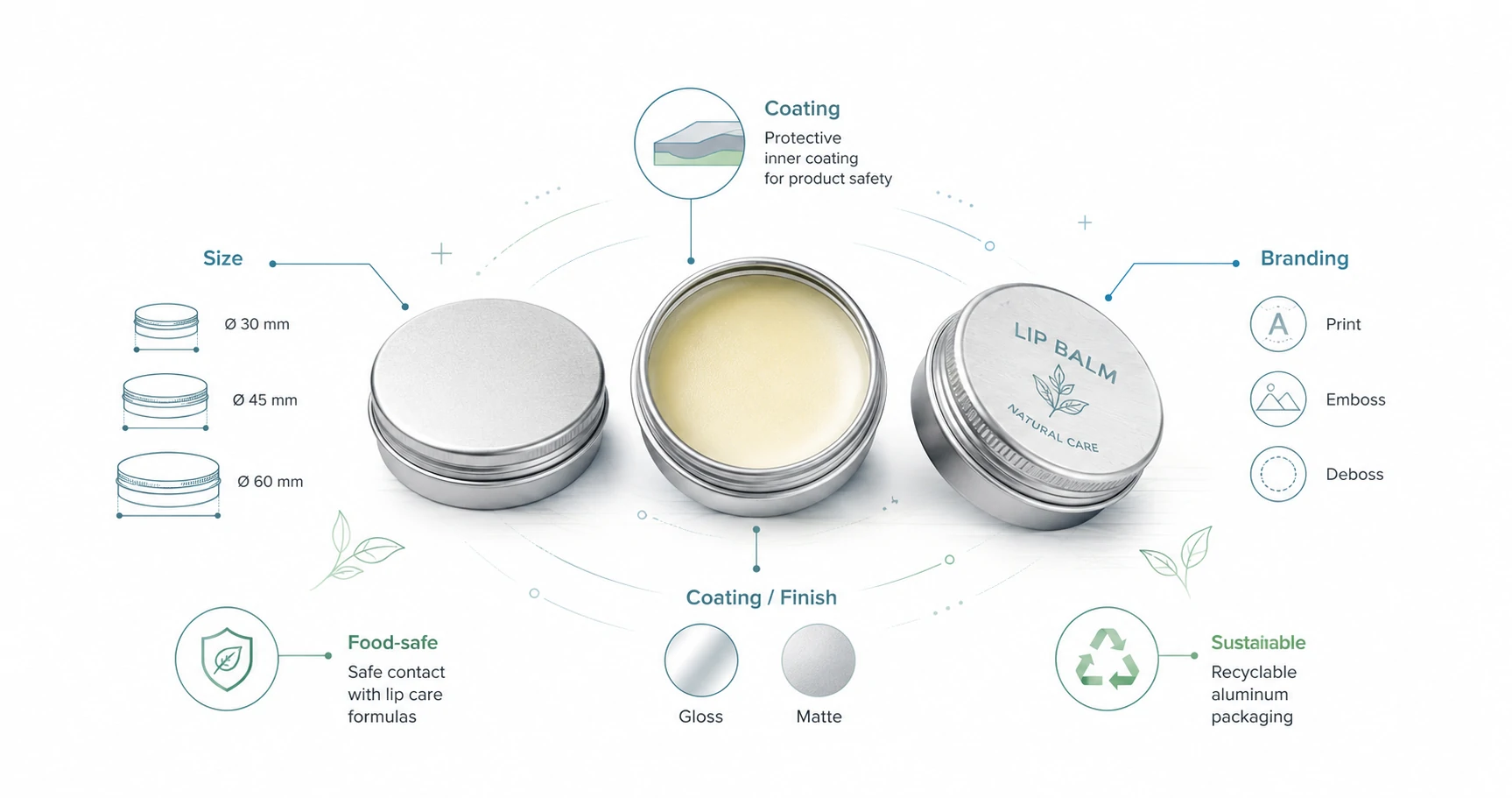

A metal lip balm tin is a small package, but it carries a large commercial responsibility. It must protect a wax-and-oil formula, feel smooth against the fingers, open and close reliably, provide enough space for branding and regulatory information, and still look premium after being carried in a handbag, pocket, travel pouch, retail counter display, or gift box. For beauty brands, wellness brands, promotional buyers, private label manufacturers, and cosmetic sourcing teams, the right metal lip balm tin is not just a container. It is a physical brand asset that can improve shelf presence, support repeat use, and make a compact product feel more valuable.
This guide is written for buyers who are planning a real custom packaging project. It explains how to choose a tin size, how internal coatings affect formula compatibility, how lid styles influence user experience, how branding options change cost and lead time, and how to prepare a professional request for quotation. It also includes tables that can be used directly in product planning, procurement briefs, packaging specifications, and internal discussions with design teams.
At Mr. Tin Box, we focus on custom metal tin packaging for global brands across food, beauty, gifting, promotional, and specialty product categories. For lip balm projects, the most relevant starting point is our Beauty & Personal Care Packaging capability, where metal packaging is used for cosmetics, skincare, fragrances, balms, soaps, solid products, and gift sets. If you are still comparing small formats, our guide to Small Tin Containers is also useful because it explains compact packaging sizes, product applications, and lid structures across multiple categories.
Table of Contents
Why Metal Lip Balm Tins Are Popular in Beauty Packaging
Lip balm is a tactile product. Customers do not only look at it; they touch the package, open it, apply the product with a finger or applicator, close it, and often carry it for weeks. This repeated use makes packaging quality more visible than it is for many single-use packs. A weak plastic pot may crack, a paper sleeve may lose its premium effect quickly, and a poorly fitted lid may loosen during transport. A well-made metal lip balm tin solves these problems with rigidity, compactness, durability, and a strong sensory impression.
Metal also gives brands a different positioning language. A round metal balm tin can feel natural, apothecary-inspired, vintage, minimalist, or luxury depending on the finish and artwork. A matte white tin with black typography communicates clean beauty. A brushed silver tin suggests gender-neutral grooming. A gold lacquer tin can support gift and premium ranges. A colorful illustrated tin can work for seasonal balm collections, children-friendly lines, influencer collaborations, and travel-size promotions.
From a marketing perspective, packaging has measurable influence. Ipsos reported that 72% of Americans said product packaging design often influences their purchase decisions, while 67% said the material used in packaging also often influences purchase decisions (Ipsos packaging survey). For small products like lip balm, where the unit price may be modest but brand switching is easy, these first impressions matter. The package must quickly communicate quality, safety, portability, and brand personality.
Metal lip balm tins also support reuse. Customers may keep the empty tin for pills, jewelry, travel cream, small accessories, or refills. This after-use value can keep the brand visible long after the first purchase. For brands that sell gift sets, sampler kits, subscription boxes, hotel amenities, spa products, or private-label wellness lines, reusability can turn a small balm into a memorable branded object.
What a Metal Lip Balm Tin Must Do?
Before comparing sizes and finishes, it helps to define the functional job of the package. A lip balm tin normally needs to do seven things well.
First, it must protect the formula from contamination and physical damage. Most lip balms contain waxes, oils, butters, fragrances, flavors, colorants, or active ingredients. The tin should not introduce off-odors, visible corrosion, coating failure, or rough edges. The lid must keep the product covered during storage and transport.
Second, it must fit the filling method. Some brands pour hot balm directly into the tin. Others fill a separate insert or liner. Hot-fill temperature, cooling shrinkage, surface appearance, and fill line control all matter. A tin that looks perfect when empty may not perform well if the product shrinks away from the wall, seeps into seams, or leaves residue under the lid.
Third, it must be comfortable to use. Lip balm tins are often opened by hand and used with fingers. The rim must be smooth. The opening should be wide enough for finger access. The depth should not make the balm hard to reach as the product is used. A very deep tin may look generous, but it can become inconvenient when the remaining balm sits at the bottom.
Fourth, it must provide branding space. Even a micro tin should carry a recognizable logo, product name, variant color, and possibly a small claim or icon. Larger tins may also need ingredients, net weight, batch code, barcode, recycling information, country of origin, company name, address, website, QR code, or multilingual text.
Fifth, it must survive the sales channel. A retail counter display creates different stress than e-commerce shipping. A balm carried in a pocket is exposed to abrasion, keys, coins, and temperature changes. A spa gift set may require the tin to sit perfectly inside an insert. The required durability should be decided before artwork and finish approval.
Sixth, it must support compliance planning. In the United States, many lip balms are cosmetics, but some products become over-the-counter drug products if they make sunscreen, skin protectant, or therapeutic claims. The FDA explains that products intended to affect the structure or function of the body, or treat or prevent disease, may be drugs as well as cosmetics (FDA summary of cosmetic labeling requirements). For lip protectant drug products, the eCFR includes specific labeling language under 21 CFR 347.50 (eCFR 21 CFR 347.50). Packaging teams should reserve enough label space early instead of trying to force required text onto a tin that is too small.
Seventh, it must be manufacturable at the required quantity and cost. Special shapes, deep draws, screw threads, embossing, multi-color printing, inner lacquers, inserts, window lids, and premium coatings can all affect tooling, sampling, production time, and inspection requirements. A good design is not just beautiful; it is repeatable.
Common Metal Lip Balm Tin Sizes
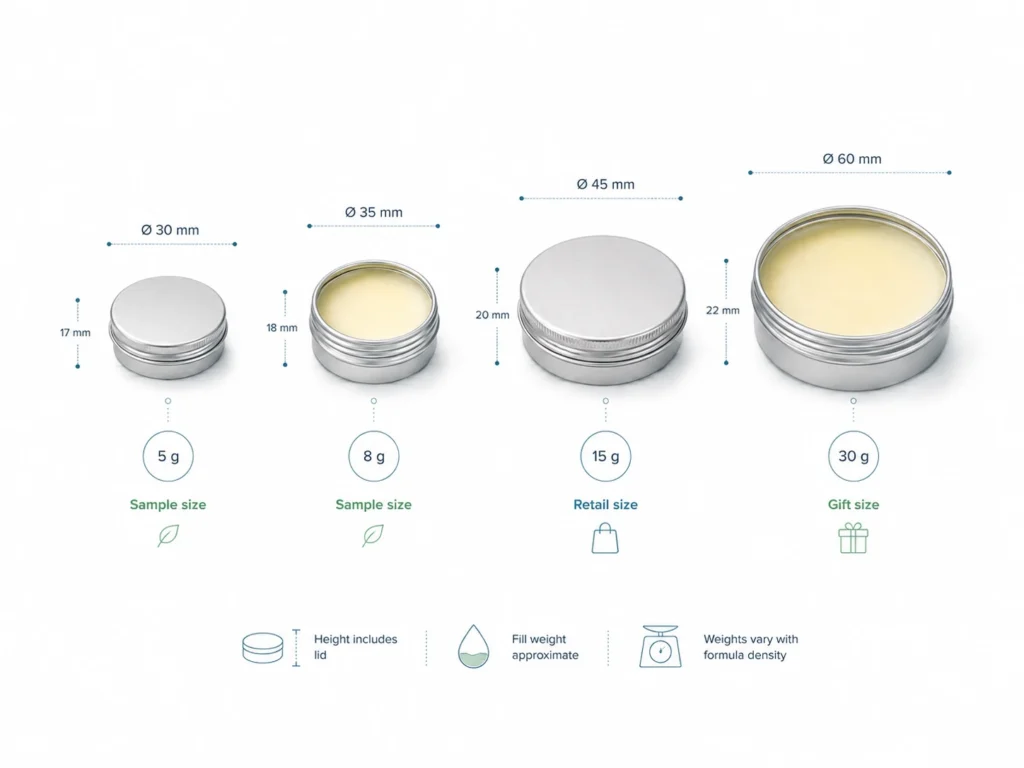
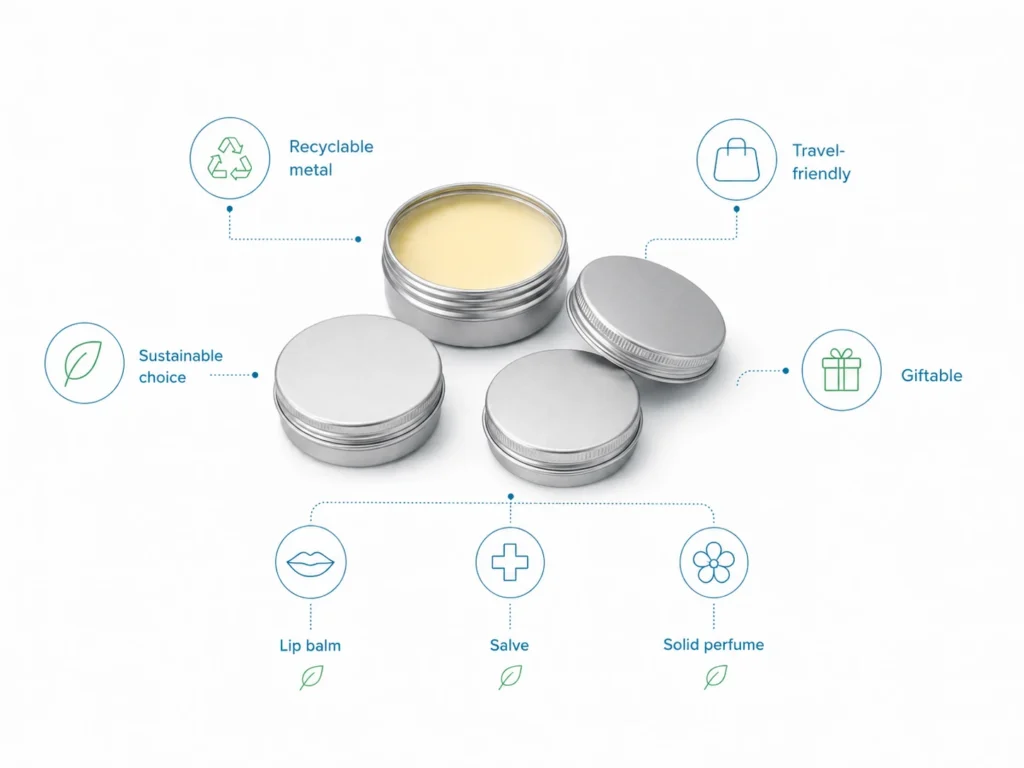
There is no single global standard size for a metal lip balm tin. Brands usually choose by capacity, diameter, depth, opening comfort, visible branding area, and carton packing efficiency. The most common commercial range is approximately 5 ml to 30 ml for standard balm products, although larger 50 ml tins may be used for multi-purpose balms, salves, body balms, pet balm, tattoo balm, solid perfume, beard balm, or gift products.
The table below gives practical planning ranges. These are not engineering drawings. Final dimensions depend on tooling, wall thickness, curl design, lid structure, coating system, and the formula’s fill density. For a confirmed project, always test with the real balm formula, the actual fill weight, and the intended filling temperature.
| Planning size | Approximate capacity | Typical use case | Commercial advantage | Buyer note |
|---|---|---|---|---|
| Mini sample tin | 3-5 ml | Trial-size balm, gift-with-purchase, spa sample, influencer kit | Low product fill cost and easy sampling | Very limited label space; often needs outer card or box |
| Pocket balm tin | 8-10 ml | Daily lip balm, travel balm, natural balm | Compact, portable, strong impulse-purchase potential | Opening must be wide enough for finger access |
| Standard lip balm tin | 10-15 ml | Main retail SKU, private label balm, wellness line | Good balance of perceived value, cost, and branding area | Common choice for round screw or slip lid formats |
| Premium balm tin | 15-20 ml | Luxury balm, tinted balm, solid perfume, gift set component | More generous feel and stronger lid presence | Higher product fill cost; check carton pack-out |
| Multi-purpose balm tin | 25-30 ml | Lip and skin balm, salve, tattoo balm, hand balm, beard balm | Allows broader use and higher retail price | Requires more labeling space and stronger structure |
| Large salve tin | 50 ml or above | Body balm, ointment-style product, professional use, refill pack | Strong value perception and repeat use | Not always ideal for pocket carry; validate lid seal and coating |
For most direct-to-consumer lip balm brands, 10 ml to 15 ml is a practical starting range. It feels substantial enough for retail, but it remains portable. For premium natural skincare brands, 15 ml to 20 ml may be more attractive because the top surface gives more space for a clean logo, variant color, and premium finish. For promotional projects, 5 ml to 10 ml can work well if the tin is paired with a printed sleeve, back label, gift card, or outer carton.
The shape also affects perceived size. A shallow, wider tin can look more premium on the lid because it offers a larger print area. A narrow, deeper tin may hold the same volume but feel less convenient when the balm gets low. For finger-applied products, diameter is often more important than capacity. A buyer should always ask: Can a typical adult finger comfortably access the product without scraping the rim? Can the consumer use the remaining balm near the bottom without frustration? Will the lid still close cleanly if balm residue is present around the edge?
Round, Square, Sliding, and Custom Shapes
Round tins are the most common choice for lip balm because they match the user behavior of circular finger application, support screw or slip lids, and feel familiar in cosmetic packaging. Round formats also reduce sharp corner concerns and can be efficient for stamping and forming. If your brand wants a safe, proven, commercially scalable structure, a round metal lip balm tin is usually the best first option.
Square tins can look modern and distinctive. They provide a different shelf profile and may align better with minimalist beauty branding. However, corners require careful tooling and edge control. Square tins can also create a different hand feel, which may be positive for a design-led brand but less familiar for mainstream balm consumers.
Oval tins are useful when a brand wants a softer, more ergonomic feel. They can work for lip balm, solid perfume, grooming balm, and small salves. Oval shapes may offer better pocket comfort than square tins while still looking different from standard round packaging.
Sliding tins are less common for poured lip balm because they are shallower and more exposed during opening, but they can work for solid balm bars, lip care tablets, sample wafers, or promotional products. A sliding tin has a distinctive user experience and can be memorable, but it needs careful tolerance control. If the slide is too loose, it feels cheap and may open in a bag. If it is too tight, the customer struggles.
Custom shapes, such as heart-shaped tins, flower tins, shell tins, or character tins, can be effective for seasonal campaigns and limited editions. They are especially suitable for Valentine’s Day lip care, holiday gift sets, children-friendly balm lines, and collaboration products. The trade-off is tooling cost and longer development time. If your launch date is fixed, custom shapes must be planned early.
Mr. Tin Box discusses the structure implications of lid styles in Metal Tins with Lids: How to Choose the Right Structure for Your Product. That article is useful for buyers who need to compare slip lids, hinged lids, sliding lids, screw lids, window lids, and plug lids before committing to a lip balm packaging structure.
Lid Styles for Lip Balm Tins
The lid is one of the most important user-experience decisions. Lip balm customers open and close the package repeatedly, often with one hand, and often when their hands are not perfectly clean or dry. The lid must feel secure but not annoying. It must protect the product but not create excessive friction. It must match the brand’s price point and retail promise.
| Lid style | Best application | Strengths | Trade-offs | Recommended tests |
|---|---|---|---|---|
| Slip lid | Natural balm, promotional balm, small gift tin | Simple, clean, cost-effective, easy to decorate | Lid can loosen if tolerance is poor; not ideal for very oily leakage risk | Drop test, bag abrasion test, open-close cycle test |
| Screw lid | Premium balm, salve, solid perfume, travel product | Secure feel, strong repeat-use experience, better consumer confidence | More tooling/control needed; thread quality must be stable | Thread smoothness, torque feel, coating wear, hot-fill compatibility |
| Friction lid | Shallow balm, apothecary-style product | Classic metal-tin feel and clean appearance | Fit must be precise; difficult if residue builds around rim | Opening force, lid retention, residue handling |
| Hinged lid | Balm sets, grooming kits, promotional kits | Lid cannot be lost; premium opening motion | Less common for single poured balm; hinge adds complexity | Hinge cycle test, lid alignment, packing pressure |
| Sliding lid | Solid balm bar, sample product, tablets, novelty lip care | Distinctive, pocket-friendly, memorable | Less protective for soft poured balm unless designed carefully | Sliding force, accidental opening, product clearance |
| Outer sleeve plus tin | Small labels, regulated products, multilingual markets | Adds label area and merchandising space | More components and assembly cost | Sleeve fit, barcode readability, shelf scuffing |
For a core lip balm SKU, screw lids and slip lids are usually the most practical. Screw lids work well for premium balm and formulas that customers will carry daily. Slip lids work well when cost control, simple decoration, and fast repeat production are priorities. Hinged or sliding tins are better for special projects rather than default balm packaging.
The lid should also be discussed together with filling. If the product is poured hot into the tin, temperature can affect internal coating, lid fit, and the risk of residue at the rim. A high-quality sample should be evaluated after filling and cooling, not only as an empty packaging component. This is particularly important when the formula includes oils, botanical extracts, flavors, essential oils, pigments, or fragrance compounds.
Tinplate, Aluminum, and Material Choice
Most custom lip balm tins are made from tinplate: thin steel sheet coated with tin. Tinplate is strong, formable, printable, and familiar in metal packaging. It can support stamping, curling, embossing, varnishing, and a wide range of decorative effects. Tinplate is also magnetic, which can be useful in recycling sorting systems.
Aluminum may be selected for certain cosmetic containers because it is lightweight, corrosion-resistant, and often associated with clean, modern beauty packaging. However, aluminum and tinplate have different forming behavior, surface feel, dent resistance, cost, and decoration possibilities. The best material depends on size, structure, formula, target market, and desired brand impression.
The Tinplate Packaging Guide on Mr. Tin Box explains tinplate materials, coatings, printing, and food safety considerations in more detail. For lip balm buyers, the key point is simple: the base metal is only one layer of the packaging system. The internal lacquer, external coating, printing ink, varnish, lid tolerance, and packing method all influence final quality.
| Material option | Commercial fit | Main advantages | Main watch-outs |
|---|---|---|---|
| Tinplate | Most custom balm tins, gift tins, promotional tins | Strong structure, good printability, premium metal feel, wide customization range | Needs correct internal coating for oily or aromatic formulas |
| Aluminum | Modern beauty, lightweight premium lines, travel products | Lightweight, corrosion-resistant, clean aesthetic | Dents differently; decoration and tooling should be confirmed early |
| Tinplate with gold or clear internal lacquer | Natural balm, salve, solid perfume, wax products | Improved visual appeal and separation between formula and metal | Lacquer must be tested with formula and fill temperature |
| Tinplate with BPA-NI or market-specific coating | Brands targeting stricter retail or regional requirements | Supports buyer sustainability and compliance preferences | Documentation, availability, and cost should be confirmed before quotation |
| Metal tin plus inner cup or liner | Formulas that need extra separation or refill concept | Better product contact control and possible refill strategy | Adds component cost and may affect recyclability if material mix is complex |
For balm formulas, compatibility is especially important because oils and fragrances can be aggressive toward some coating systems. A formula that appears stable in a short sample test may still need longer stability testing under heat, cold, and transport conditions. Buyers should provide formula characteristics to the packaging supplier early, including whether the product contains essential oils, citrus oils, menthol, camphor, pigments, SPF actives, flavor oils, high fragrance load, or botanical extracts.
Internal Coatings and Formula Compatibility
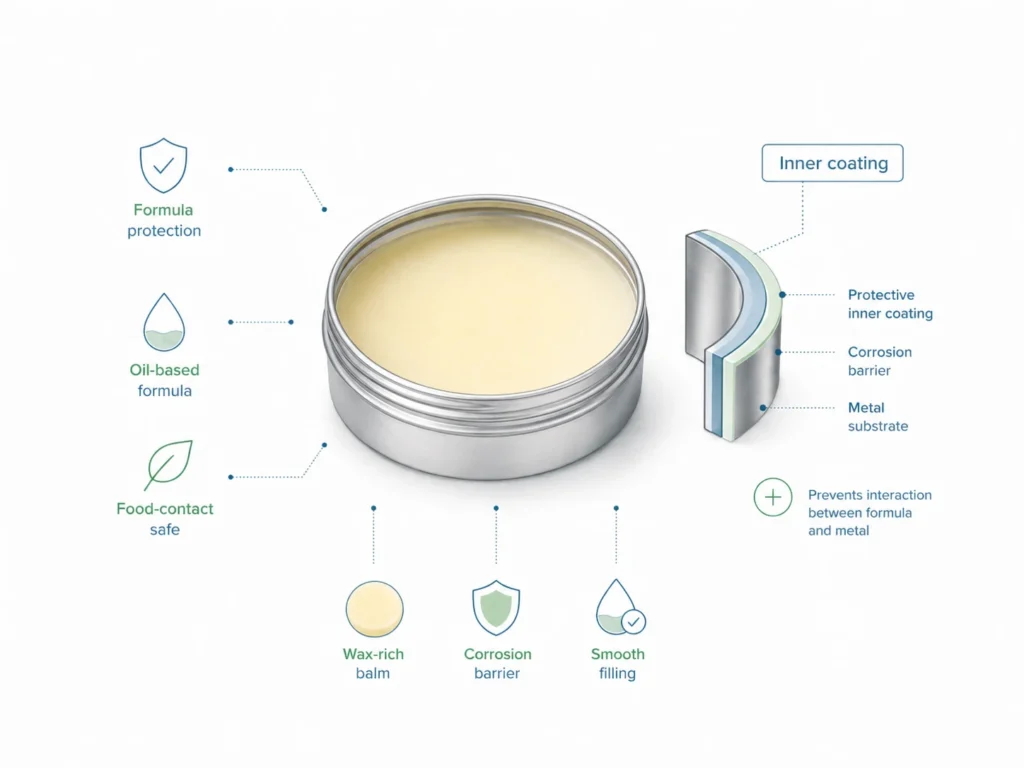
The internal coating is one of the most important technical decisions in metal lip balm tin packaging. It helps separate the product from the metal surface, improves corrosion resistance, and reduces the risk of interaction between the formula and the container. A lip balm tin may look simple, but the formula can contain lipophilic ingredients, fragrance compounds, pigments, or active ingredients that need careful compatibility review.
For direct-fill lip balm, the coating must be compatible with both the hot-fill process and the finished formula. The brand should not assume that every “cosmetic tin” is automatically suitable for every balm. A mint-flavored balm, a citrus essential oil balm, a tinted balm, a zinc oxide SPF balm, and a plain beeswax balm may have different coating needs.
| Formula characteristic | Packaging concern | Coating or design response | Practical buyer action |
|---|---|---|---|
| High oil content | Possible coating softening, staining, or migration concerns | Use an appropriate internal lacquer and test with the real formula | Share oil profile and run accelerated stability testing |
| Essential oils or fragrance | Odor transfer, lacquer compatibility, flavor/aroma change | Select coating based on formula sensitivity | Test sealed samples at elevated temperature |
| Tinted or pigmented balm | Staining on rim or lid, visible residue | Smooth internal coating and easy-clean rim geometry | Check filled samples after repeated use |
| SPF or skin protectant balm | More label requirements and possible drug status in some markets | Reserve more packaging/label space; consider outer carton | Review claims with regulatory counsel |
| Hot-poured balm | Coating and lid affected by fill temperature | Validate coating under real filling conditions | Fill real samples, cool, inspect, then run stability test |
| Natural or “clean beauty” positioning | Buyer may request BPA-NI, recyclable, or low-plastic packaging | Confirm coating claims and documentation | Avoid unsupported sustainability or safety claims |
| Refill or multi-use concept | Repeated handling and cleaning | Durable coating and robust lid | Test user behavior, not only factory appearance |
For regulatory language, avoid promising that a coating is “non-toxic,” “chemical-free,” or “approved” unless you have specific documentation that supports the exact claim in the target market. More accurate wording is often “selected to meet the project’s product-contact and market requirements” or “available with market-appropriate internal lacquer options upon request.” This approach protects the brand from overclaiming while still communicating professional packaging control.
Exterior Finishes for Premium Brand Perception
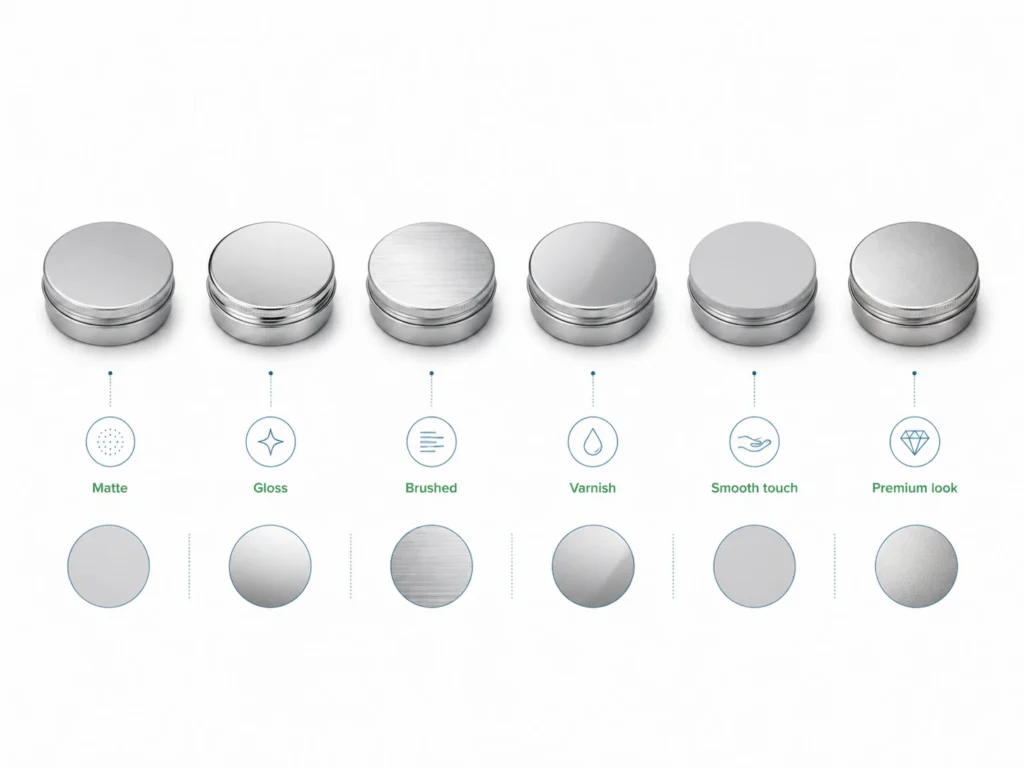
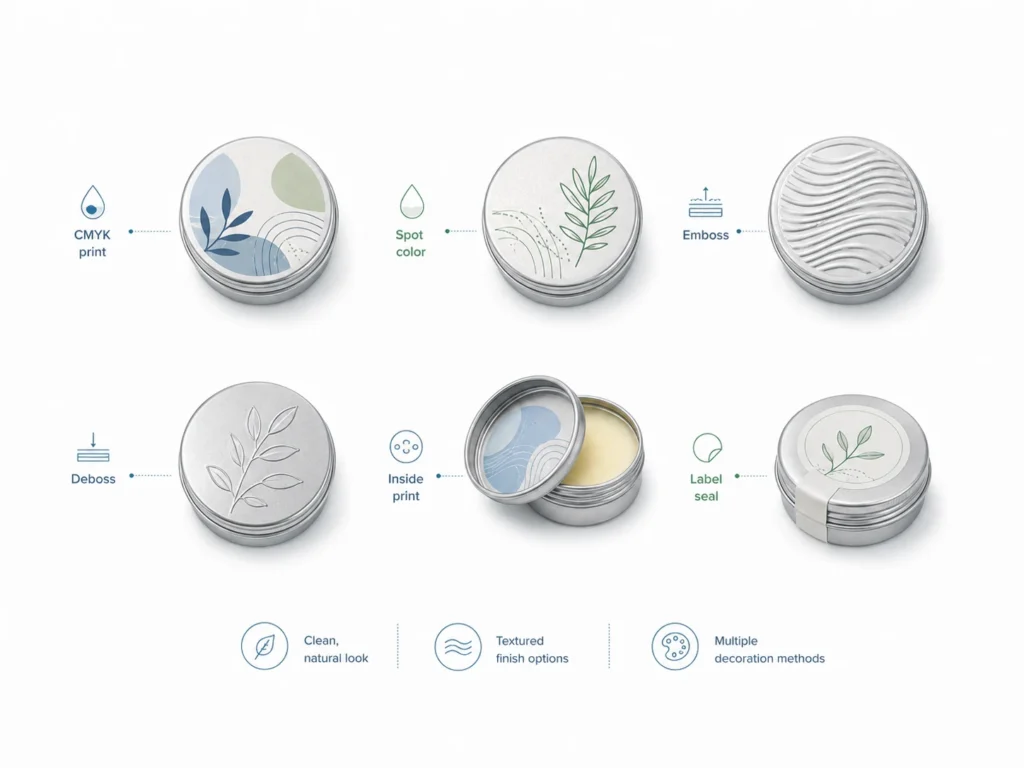
The exterior finish determines how the metal lip balm tin looks and feels in the customer’s hand. For a small product, finish can change the entire price perception. A plain glossy tin may suit a colorful mass-market line. A satin tin can feel balanced and premium. A matte tin can support clean beauty and modern wellness branding. A soft-touch coating can make a small balm feel luxurious. Spot UV can highlight a logo without making the whole surface shiny. Embossing can add tactile memory.
Mr. Tin Box provides a broader explanation in Metal Tin Box Finishing Options, including matte, glossy, satin, textured, metallic, soft-touch, spot UV, embossing, debossing, and protective coatings. For lip balm tins, the best finish is usually the one that looks good after real handling, not just the one that looks good in a rendering.
| Finish option | Brand impression | Best use | Risk to manage |
|---|---|---|---|
| Glossy varnish | Bright, colorful, retail-friendly | Fruity balm, seasonal designs, youth-oriented lines | Glare in photography and visible scratches |
| Matte varnish | Clean, modern, premium | Natural balm, minimalist skincare, wellness brands | Fingerprints or scuffing depending on formula and handling |
| Satin varnish | Balanced, practical, refined | Most commercial balm lines | Less dramatic than matte or gloss, but safer for many projects |
| Soft-touch coating | Luxury, smooth, high-end | Premium lip care, spa products, gift sets | Higher handling requirements and possible scuff sensitivity |
| Metallic ink or gold effect | Giftable, celebratory, premium | Holiday balm, limited editions, luxury line extensions | Color matching and approval should be physical, not screen-based |
| Spot UV | Premium contrast and logo highlight | Minimalist or luxury branding | Registration accuracy must be controlled |
| Embossing/debossing | Tactile, memorable, collectible | Logo lids, monograms, limited editions | Tooling cost and minimum quantity impact |
| Textured finish | Practical, anti-slip, distinctive | Outdoor balm, men’s grooming, active lifestyle products | Texture must not interfere with artwork readability |
For e-commerce, finish selection should consider photography. Gloss can create strong highlights under studio lighting. Matte can reduce glare but may make colors appear softer. Metallic effects can look excellent in hand but difficult to represent accurately online. The safest process is to approve physical finish samples under the same lighting conditions used for product photos and retail display.
Printing and Branding Options
A metal lip balm tin can be branded in many ways. The right method depends on quantity, artwork complexity, budget, launch date, and the desired level of premium impact. Small tins require disciplined design because the printable area is limited. A complex illustration that works on a large gift tin may become unreadable on a 10 ml balm lid.
The most common decoration approach is offset printing on metal sheet before forming. This provides clean graphics and is suitable for larger production runs. For smaller runs, labels, stickers, sleeves, or digital printing solutions may be considered depending on supplier capability and cost. Embossing and debossing require tooling but create a premium tactile effect. Foil stamping or metallic effects can make the product feel gift-ready. Spot UV adds contrast and highlights logos or patterns.
| Branding method | Best for | Cost impact | Lead-time impact | Design guidance |
|---|---|---|---|---|
| One-color printing | Minimalist balm, apothecary design, private label | Low to medium | Low | Works well with strong typography and simple icons |
| Full-color printing | Illustrated balm, seasonal collections, flavored variants | Medium | Medium | Avoid tiny text and check color proof physically |
| Lid label | Small batch, fast launch, many variants | Low to medium | Low | Useful when MOQ is low or variants change often |
| Paper sleeve or belly band | More label space, storytelling, barcode, multilingual copy | Medium | Medium | Good for regulated claims and retail displays |
| Embossed logo | Premium, tactile brand memory | Medium to high | Medium to high | Keep artwork simple and avoid very thin lines |
| Debossed pattern | Subtle luxury, minimalist branding | Medium to high | Medium to high | Works well with matte or satin finishes |
| Spot UV logo | High-end contrast | Medium | Medium | Best on matte or satin base colors |
| QR code | Ingredient detail, certification, how-to-use content | Low | Low | Test scannability at final printed size |
| Outer carton | Premium gift, compliance space, retail shelf block | Medium to high | Medium | Adds merchandising space and protects the tin |
For lip balm, variant management is a major branding issue. A brand may have mint, vanilla, rose, citrus, unscented, tinted, SPF, and limited-edition versions. If every variant needs a separate fully printed metal tin, inventory risk can increase. A smart strategy is to use a shared branded tin with variable labels, stickers, sleeves, or color-coded elements. Once demand is proven, the best-selling variants can move to fully printed custom tins.
Labeling Space and Compliance Planning
Packaging design should not be separated from labeling compliance. Lip balm is a small product, so the package can run out of space quickly. This is especially true for products sold in the United States, European Union, United Kingdom, Canada, Australia, or multiple markets with multilingual requirements.
In the United States, cosmetic labeling is governed by the FD&C Act, Fair Packaging and Labeling Act, and FDA regulations. The FDA provides a Cosmetics Labeling Guide and a summary of cosmetic labeling requirements. If the balm makes claims such as sunscreen protection, treating chapped lips, or preventing specific skin conditions, it may fall into OTC drug or drug-cosmetic territory. For products formulated and labeled as lip protectants, 21 CFR 347 includes definitions and labeling provisions; the eCFR definition notes that a lip protectant drug product is traditionally called “lip balm” (21 CFR 347.3).
In the European Union, cosmetic products are regulated under Regulation (EC) No 1223/2009. The European Commission explains that cosmetic products placed on the EU market require a responsible person, safety requirements, and centralized notification through the Cosmetic Products Notification Portal (European Commission cosmetics legislation). Packaging teams should consider these requirements because the responsible person details, nominal content, batch number, product function, precautions, and ingredients may all need to appear on the packaging or associated label system.
This article is not legal advice, but the commercial lesson is clear: packaging size is partly a compliance decision. If a buyer chooses a very small tin for a product that needs long warning text, the design will likely need an outer carton, folded leaflet, peel-back label, sleeve, or web-linked information system. That should be planned before tooling and artwork approval.
Sustainability and Recyclability Considerations
Sustainability claims are increasingly important in beauty packaging, but they must be handled carefully. Metal has strong advantages: it is durable, reusable, and widely recyclable in many markets. A compact metal lip balm tin can also reduce the “disposable” feeling of small personal care products. However, recyclability depends on local collection systems, component design, coatings, labels, liners, and whether the package uses mixed materials.
McKinsey’s 2025 U.S. packaging survey reported that recyclable packaging was considered extremely or very important by 77% of respondents, and packaging made with recycled content by 62% (McKinsey 2025 packaging survey). This does not mean every customer will pay more for metal, but it does show that recyclability is a language consumers understand. For a lip balm brand, a reusable metal tin can support that story better than a small plastic pot, especially when paired with honest disposal guidance.
In Europe, the Packaging and Packaging Waste Regulation raises the importance of recyclable design. The European Commission explains that all packaging must be recyclable by 2030 and that clearer labeling should help consumers understand where packaging belongs in recycling systems (European Commission PPWR page). This makes design-for-recycling relevant even for small cosmetic packs.
Steel packaging also has strong recycling performance in Europe. Steel for Packaging Europe announced in 2025 that steel packaging reached a record 82% EU recycling rate for 2023 under the harmonized calculation method (Steel for Packaging Europe announcement). This is a useful data point for brands considering tinplate-based packaging, but the claim should be phrased carefully: it reflects regional steel packaging recycling performance, not a guarantee that every individual lip balm tin will be recycled in every market.
| Sustainability decision | Good practice | Avoid |
|---|---|---|
| Use mono-material where possible | Keep the main pack metal and minimize unnecessary mixed materials | Adding decorative components that make recycling confusing |
| Communicate reuse honestly | Encourage customers to reuse the tin for small items or refills if appropriate | Claiming reuse will happen automatically |
| Provide clear disposal information | Use market-specific recycling guidance where possible | Generic “eco-friendly” claims without support |
| Choose durable finishes | Reduce cosmetic rejects and improve long-term reuse value | Fragile finishes that scuff before retail sale |
| Consider outer packaging carefully | Use sleeves/cartons only when needed for protection or labeling | Overpacking a small product just for appearance |
| Validate claims | Match claims to evidence and target market rules | “100% sustainable,” “zero waste,” or unsupported carbon claims |
For beauty brands, the strongest sustainability message is usually a practical one: durable metal packaging, reusable after purchase, designed with recyclable material streams in mind, and supported by clear disposal information. This is more credible than exaggerated claims.
Cost Drivers and MOQ Planning
The cost of a custom metal lip balm tin depends on more than size. Tooling, lid type, metal thickness, coating system, printing complexity, finish, embossing, packaging method, inspection requirements, and order quantity all influence the final unit price. Buyers often focus on the tin itself, but the full landed cost includes sampling, artwork proofing, inner cartons, master cartons, shipping volume, customs, storage, and potential inventory risk.
For early planning, separate one-time costs from unit costs. Tooling, embossing molds, special structure development, and some printing setup costs may be one-time or semi-fixed costs. Tinplate, coating, printing, labor, packing, inspection, and shipping are unit-related costs. A special structure may be economical at high quantity but expensive for a small launch. A standard round tin with custom artwork may be better for a first market test.
| Cost driver | Low-risk option | Premium option | Buyer recommendation |
|---|---|---|---|
| Shape | Existing round tin | Custom shape or special depth | Use existing tooling for first launch if timeline is tight |
| Lid | Slip lid | Screw, hinge, or special closure | Match lid to user behavior, not only appearance |
| Printing | One or two colors | Full-color artwork plus spot effects | Approve physical proofs, not only digital renderings |
| Finish | Satin or standard gloss | Soft-touch, texture, spot UV, metallic effects | Use one hero finish instead of too many effects |
| Branding relief | Flat print | Embossed or debossed logo | Best for established SKUs or premium collections |
| Label system | Printed label | Outer carton, sleeve, insert, QR system | Add outer packaging when compliance space is required |
| Coating | Standard compatible lacquer | Market-specific or formula-specific coating | Test with real formula before mass production |
| Inspection | Standard QC | Enhanced cosmetic inspection, torque testing, stability support | Use stricter QC for premium retail and export orders |
Mr. Tin Box’s beauty packaging workflow includes consultation, 3D drawing and structure design, mold development or sample making, printing and surface finishing, stamping and assembly, and final quality inspection. The Beauty & Personal Care Packaging page notes rapid sampling within 7-10 days for sample verification, which is useful for buyers building a development timeline. Complex projects with custom molds, special coatings, or premium finishes may need more time.
For MOQ planning, a practical approach is to define three quantities: sample quantity, pilot quantity, and scale quantity. Sample quantity is for structure and finish approval. Pilot quantity is for market testing, influencer kits, retail buyer presentations, or formula stability validation. Scale quantity is for full commercial rollout. If a brand is not yet sure which scent or flavor will sell best, it may be wiser to use a common tin body with variable labels before investing in fully printed metal for every variant.
Quality Testing Before Mass Production
A lip balm tin should be tested as a finished pack, not only as an empty container. The most common mistakes appear after filling, cooling, shipping, and consumer handling. A beautiful empty tin does not guarantee a stable filled product.
| Test area | What to check | Why it matters |
|---|---|---|
| Dimension check | Diameter, height, lid fit, wall consistency | Confirms compatibility with filling line, inserts, and cartons |
| Rim smoothness | Finger contact area and edge safety | Prevents poor user experience and complaints |
| Open-close test | Lid force, thread smoothness, retention | Validates daily use and bag carry reliability |
| Coating compatibility | Formula contact, odor, staining, corrosion, softening | Protects product quality and brand reputation |
| Hot-fill test | Coating stability, lid fit after cooling, surface appearance | Ensures manufacturing process will not damage the pack |
| Drop and vibration | Lid retention, denting, scuffing, carton protection | Simulates transport and e-commerce handling |
| Abrasion test | Exterior print and varnish durability | Prevents shelf damage and pocket-wear complaints |
| Code readability | Batch code, barcode, QR code | Supports traceability and retail operations |
| Stability aging | Heat, cold, cycling, humidity | Identifies delayed formula-package interaction |
For a professional project, the buyer should keep approved samples from each stage: blank structure sample, coated sample, printed proof, filled sample, and final pre-production sample. These become reference standards for quality inspection. Without physical standards, “acceptable quality” becomes subjective and disputes are more likely.
Branding Strategies by Business Model
Different buyers need different packaging strategies. A startup natural balm brand does not have the same needs as a global beauty retailer, hotel amenity supplier, promotional gift buyer, or private label manufacturer. The best metal lip balm tin should match the business model.
| Business model | Recommended packaging strategy | Why it works |
|---|---|---|
| Clean beauty startup | Standard round tin, matte or satin finish, simple label, shared body across variants | Controls cost while building a premium look |
| Premium skincare brand | Screw lid tin, soft-touch or satin finish, embossed logo, outer carton | Elevates gift value and supports higher retail price |
| Promotional gift buyer | Small slip lid tin, strong logo, fast label or simple print | Keeps budget and timeline controlled |
| Hotel or spa amenity | Mini tin, soft neutral colors, easy-open lid, compact carton pack-out | Feels premium without taking much space |
| Outdoor or active lifestyle balm | Durable satin or textured finish, secure lid, strong code area | Handles pocket carry and rugged use |
| Tinted balm line | Color-coded labels or lids, good ingredient space, smooth rim | Helps shade identification and user comfort |
| SPF lip balm | Larger label system or outer carton, regulatory review, secure lid | Supports warning/direction space and customer trust |
| Private label manufacturer | Flexible artwork system, shared structure, variant-ready labels | Reduces inventory complexity across clients |
| Seasonal gift collection | Custom artwork, metallic finish, sleeve or gift insert | Makes the balm collectible and giftable |
For many brands, the best first step is not the most expensive tin. It is the clearest packaging system. A shared metal structure, consistent logo position, variant color logic, and scalable label strategy can make the brand look more mature immediately. Premium upgrades can be added after sales data confirms which SKUs deserve custom embossed or fully printed tins.
How to Prepare an RFQ for a Metal Lip Balm Tin
A good RFQ saves time and reduces sampling errors. Instead of asking for “a custom lip balm tin,” provide enough detail for the factory to recommend a practical structure, coating, and decoration plan. A clear brief also helps your team compare quotes fairly, because each supplier is quoting the same specification.
| RFQ item | What to provide | Example |
|---|---|---|
| Product type | Formula and use case | Natural lip balm, hot-filled wax/oil formula |
| Target capacity | Fill weight or volume | 15 ml / 12 g target fill |
| Preferred shape | Round, square, oval, custom | Round screw lid tin |
| Dimensions | Target diameter and height if known | Approx. 38 mm diameter, shallow depth preferred |
| Formula notes | Oils, fragrance, essential oils, SPF, pigment, acidity | Contains coconut oil, beeswax, peppermint oil |
| Filling process | Hot fill, cold fill, manual, automated | Hot fill at approx. 70°C, then cooling tray |
| Market | Countries or regions | United States and EU retail |
| Label needs | Ingredients, barcode, warnings, QR, multilingual copy | Tin lid logo + bottom label + outer carton |
| Decoration | Printing, label, embossing, finish | Matte white tin, black logo, spot UV logo optional |
| Quantity | Sample, pilot, mass production | 100 samples, 5,000 pilot, 30,000 annual |
| Packing | Inner carton, display tray, master carton | 24 units inner tray, export master carton |
| Timeline | Launch date and approval deadline | Retail launch in September; samples needed in May |
| Documentation | Compliance or material documents | Coating info, material declaration, inspection report |
If your project involves SPF, drug claims, medical-adjacent claims, child-oriented products, or highly regulated markets, include that information from the beginning. A packaging supplier can help with structure and documentation, but the brand owner must confirm final claims, labeling, and market compliance with qualified regulatory professionals.
Design Tips for Small Tin Artwork
Small tin artwork must be simple enough to read at real size. Many packaging designs look impressive on a large computer screen and fail when printed on a 35 mm lid. The safest design approach is to prioritize hierarchy: logo first, product identity second, variant third, supporting details last.
Use contrast carefully. A pale logo on a metallic background may look elegant in a rendering but become hard to read under store lighting. Thin lines may disappear after printing or embossing. Tiny serif fonts may become muddy. QR codes may fail if they are too small or printed on a curved or highly reflective area. Barcodes should be tested at final scale.
A good lip balm tin design usually includes a strong top-lid identity and a more practical bottom or side label. The lid creates desire. The bottom label carries detailed information. The outer carton or sleeve can carry extended claims, ingredients, warnings, and retail information. This division keeps the tin beautiful without sacrificing compliance.
For a premium look, consider one main visual effect rather than many. For example, matte black with debossed logo can feel more luxurious than full-color artwork plus metallic ink plus spot UV plus embossing. For natural brands, off-white, kraft sleeve, muted green, warm beige, or soft pastel tones can support clean positioning. For colorful flavor collections, use a consistent layout with different lid colors so customers can recognize variants quickly.
Direct Metal Printing, Labels, Sleeves, and Cartons
Buyers often ask whether they should print directly on the tin or use a label. The answer depends on quantity, variant count, budget, and timeline. Direct printing looks integrated and premium, but it is less flexible when variants change. Labels are flexible and useful for small runs, but they must be durable and well-applied. Sleeves and cartons add storytelling space but increase component count.
Direct metal printing is usually best when the brand has stable artwork and sufficient order volume. It gives the tin a finished, retail-ready look and can support advanced effects. Labels are ideal for early-stage brands, limited test runs, and multi-variant product lines. A well-designed label can still look premium if the base tin finish is good. Sleeves are excellent when the tin needs more label space, gift presentation, or multilingual copy. Outer cartons are useful for premium retail, SPF products, and products requiring more compliance information.
| Decoration system | Best timing | Main benefit | Main risk |
|---|---|---|---|
| Direct metal printing | Stable SKU, larger production run | Integrated premium appearance | Less flexible if artwork changes |
| Lid label | Small batch or many variants | Flexible and cost-efficient | Label edge wear or lower premium feel if poorly executed |
| Bottom label | Regulatory and traceability text | Keeps lid clean and beautiful | Limited space and curved-surface constraints |
| Full wrap label | More artwork space | Good for colorful or detailed graphics | Alignment and seam appearance must be controlled |
| Paper sleeve | Storytelling and retail display | Adds label space without changing tin | Extra packing step and material |
| Outer carton | Premium and compliance-heavy products | Protects tin and supports full information | More cost, more storage volume |
A practical launch strategy is to start with a high-quality standard tin and flexible labels, then move top-selling products into direct-printed tins after demand is proven. This reduces inventory risk and still allows a premium packaging experience.
Production Workflow from Idea to Mass Production
A metal lip balm tin project usually moves through several stages. The process starts with the product brief, not the artwork. The supplier needs to understand formula type, size target, filling method, market, lid preference, and desired price position. Then the structure can be selected from existing tooling or developed as a custom mold.
After structure selection, a blank sample verifies size, feel, and fit. If the product will be hot-filled, the blank sample should be tested with the real formula before final decoration. Next, the internal coating and exterior finish are selected. Artwork is prepared based on a dieline or printing template. A printed proof or pre-production sample is then used for approval. Only after structure, coating, filling, artwork, and packing are confirmed should mass production begin.
The production workflow also includes inspection. For lip balm tins, inspection should cover appearance, dimensions, coating quality, lid fit, smooth edges, printing alignment, varnish consistency, carton packing, and any agreed functional requirements. If the tin is part of a gift set, it should also be tested with the insert, sleeve, carton, and final product arrangement.
A well-managed project avoids late changes. Changing the lid style after artwork approval may require new templates. Changing the size after filling tests may affect carton pack-out. Changing the coating after stability testing may require retesting. The best way to reduce risk is to align product development, packaging engineering, artwork, regulatory review, and procurement before tooling and print approval.
Commercial Recommendations for Buyers
For most brands, the best metal lip balm tin is not the most complex package. It is the package that matches the product formula, target customer, sales channel, and launch timeline.
Choose a 10-15 ml round tin if you need a safe commercial starting point. It is portable, familiar, and suitable for daily balm. Choose a screw lid if the product is premium, travel-focused, or carried frequently. Choose a slip lid if the project needs simpler production and cost control. Choose a 15-20 ml tin if your brand wants a more generous premium impression. Choose a sleeve or outer carton if you need more label space, regulatory text, retail merchandising, or gift presentation.
For finishes, satin is the safest premium default. Matte is excellent for clean beauty but should be tested for fingerprints and scuffs. Soft-touch is powerful for luxury positioning but should be validated through handling tests. Gloss is strong for colorful, playful, or seasonal balm. Embossing works best when the logo is simple and the order quantity justifies tooling.
For compliance, plan label space early. If your product is a simple cosmetic balm, the label burden may be manageable on the tin plus bottom label. If it includes SPF, lip protectant claims, drug facts, multilingual requirements, or retail barcode needs, an outer carton or sleeve may be necessary. Do not shrink required text to the point of unreadability.
For sustainability, use precise language. Metal packaging can be reusable and recyclable in many systems, but avoid unsupported claims. A credible message might be: “Durable reusable metal tin. Please recycle according to local guidance.” If your target market requires specific disposal labels, follow those requirements.
FAQ
What is the best size for a metal lip balm tin?
For most commercial lip balm products, 10 ml to 15 ml is a practical size range. It provides enough product for daily use, enough lid area for branding, and good portability. Smaller 3-5 ml tins are better for samples or gift-with-purchase programs. Larger 20-30 ml tins work better for multi-purpose balms, salves, body balm, or premium gift products.
Is a screw lid better than a slip lid?
A screw lid usually feels more secure and premium, especially for travel balm, salve, solid perfume, and higher-value lip care. A slip lid can be simpler, cleaner, and more cost-effective. The best choice depends on formula, price point, customer behavior, and the desired user experience.
Can lip balm be filled directly into a metal tin?
Yes, many balm products are hot-filled directly into metal tins, but the tin, internal coating, fill temperature, formula, and cooling process must be tested together. Always validate coating compatibility and product appearance after filling and aging.
What coating should be used inside a lip balm tin?
The right internal coating depends on the formula. Oils, fragrance, essential oils, pigments, SPF actives, and hot-fill conditions can affect compatibility. Buyers should share formula characteristics with the supplier and run stability testing with filled samples before mass production.
Can a metal lip balm tin be recycled?
Tinplate and aluminum are recyclable materials in many markets, but actual recycling depends on local collection, sorting systems, package design, labels, liners, and contamination. For best results, keep the design as simple as possible and provide market-appropriate recycling guidance.
Should I use direct printing or labels?
Direct printing is ideal for stable, larger-volume SKUs because it looks integrated and premium. Labels are better for small runs, many variants, quick launches, or early-stage market testing. Sleeves and cartons are useful when more storytelling or regulatory space is needed.
Build a better lip balm line with the right metal tin
A metal lip balm tin can make a small product feel durable, premium, reusable, and giftable. But the best result comes from treating packaging as a system: size, shape, lid, coating, formula compatibility, decoration, label space, sustainability, and production planning must work together.
For a simple and reliable launch, start with a standard round tin, choose a practical 10-15 ml size, validate the internal coating with your formula, keep the artwork readable, and use a finish that matches your brand. For a premium launch, consider a screw lid, satin or soft-touch coating, embossed logo, spot UV, and an outer carton for storytelling and compliance information. For a flexible multi-variant line, use a shared tin structure with variable labels or sleeves until sales data proves which SKUs deserve fully customized printed tins.
If you are developing a lip balm, salve, solid perfume, grooming balm, spa amenity, promotional beauty gift, or private-label wellness product, Mr. Tin Box can help turn your packaging brief into a practical metal packaging solution. Explore our Beauty & Personal Care Packaging solutions, review our guide to Small Tin Containers, and contact Mr. Tin Box to discuss size, coating, branding, sampling, and quotation for your next metal lip balm tin packaging project.


