Custom tin packaging is no longer just a nostalgic container for cookies, tea, and holiday gifts. For modern brand owners, product developers, sourcing managers, and private-label buyers, it can be a practical packaging system that protects products, supports premium positioning, strengthens shelf impact, and gives customers a package they may keep long after the first purchase.
This guide is written for decision-makers who need to understand custom tin packaging before requesting a quotation or approving a new packaging project. It explains what tin packaging is, how it is made, which product categories benefit most, what compliance questions buyers should ask, how decoration and finishes affect cost, and how to prepare a clear brief for a manufacturer such as Mr. Tin Box.
The core point is simple: good custom tin packaging is not only a printed metal box. It is a designed packaging program that combines material selection, structure engineering, surface printing, coating compatibility, production planning, quality control, and logistics. When these elements are aligned early, a tin package can help a brand reduce product damage, improve perceived value, support seasonal campaigns, and create a more memorable consumer experience.
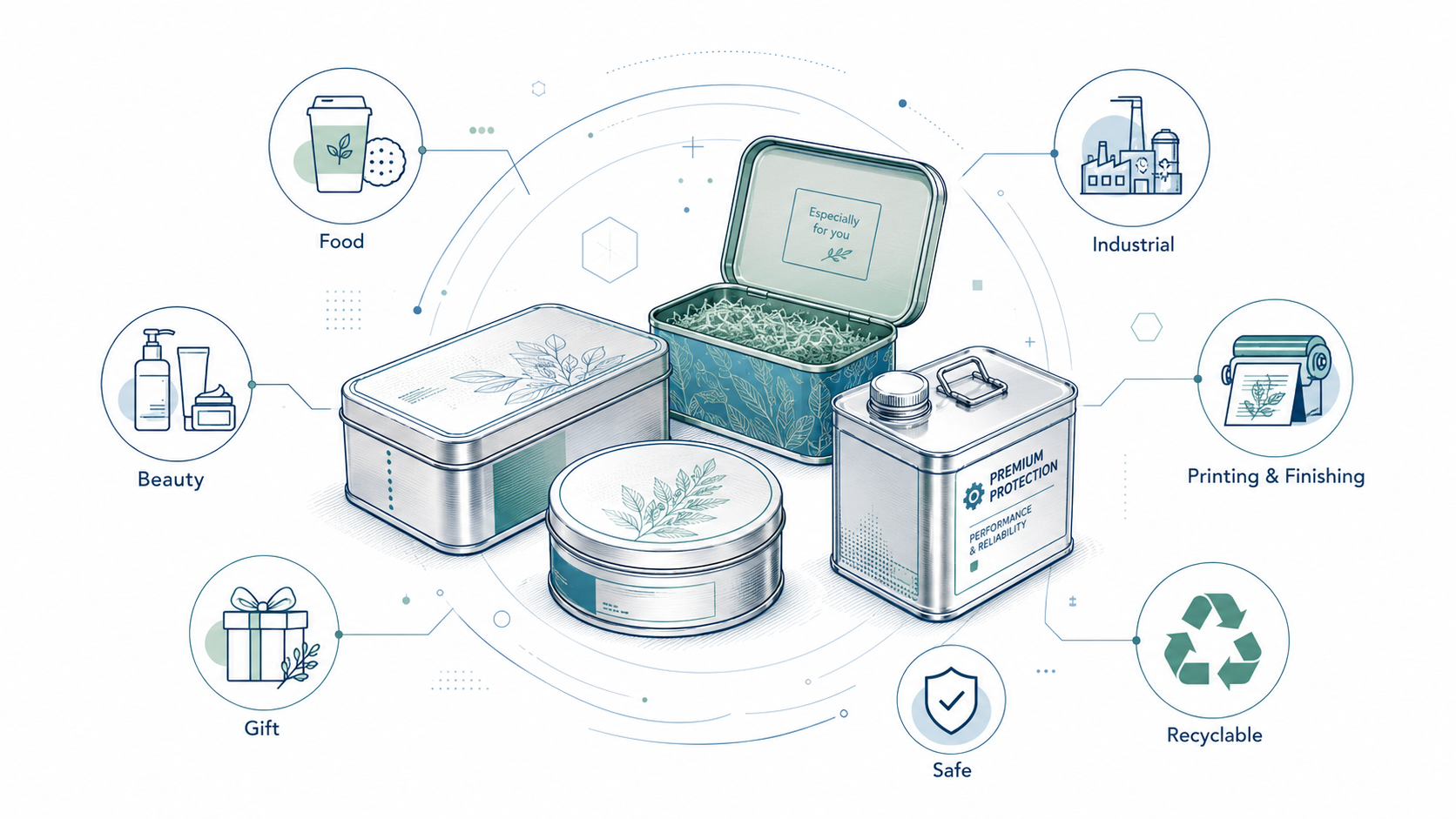
For buyers comparing packaging options, custom tin packaging is especially relevant when the product needs at least one of the following: strong physical protection, a premium tactile feel, a reusable container, food-grade or sensitive-product suitability, long-distance export reliability, or a collectible gift presentation. That is why tins remain common in food and beverage packaging, beauty and personal care packaging, gift and holiday packaging, and specialty and industrial packaging.
Table of Contents
Key industry data buyers should understand first
Before choosing a tin shape, finish, or supplier, buyers should look at the wider commercial and regulatory context. Packaging decisions now sit at the intersection of brand experience, product protection, sustainability pressure, and compliance. The following data points help explain why metal packaging continues to attract attention from consumer brands and global buyers.
| Data point | What it means for custom tin packaging buyers | Source |
|---|---|---|
| The metal packaging industry is expected to be worth over USD 177 billion by 2029, with 2024-2029 growth around 3%. | Metal packaging is a mature global category, not a niche novelty. It remains commercially important across food, beverage, personal care, and industrial markets. | Smithers |
| Steel packaging in Europe reached an 82% “really recycled” rate in 2023. | Steel-based tins can support credible circular-economy messaging, especially where collection and recycling systems are well established. | Steel for Packaging Europe |
| EU policy requires all packaging to be recyclable by 2030. | Export-oriented brands should consider recyclability, material simplicity, and labeling requirements during the design stage, not after tooling is made. | European Commission |
| Eurostat reports that the EU’s overall packaging recycling rate reached 67.5% in 2023, close to the 2030 target of 70%. The 2030 target for ferrous metals is 80%. | Buyers selling into Europe should treat recycling performance as a measurable packaging-design issue rather than a general marketing slogan. | Eurostat |
| FDA guidance says food packaging components used in compliance with 21 CFR 174-179 need no further FDA review. | Food-grade tin packaging must be evaluated as a full system: metal, coating, ink, varnish, adhesive, liner, insert, and intended food contact conditions. | U.S. FDA |
| EU Regulation (EC) No 1935/2004 sets general principles for food contact materials, including safety, inertness, traceability, and documentation. | EU-facing food packaging buyers should request relevant declarations, test plans, and component-level details for the exact product use. | European Commission Food Safety |
| UNEP’s Food Waste Index Report 2024 estimates 1.05 billion tonnes of food waste at retail, food service, and household levels in 2022. | Packaging that protects texture, aroma, breakage-sensitive products, and shelf quality can be part of a broader waste-reduction strategy. | UNEP |
| Ipsos found that 72% of Americans said packaging design often influences purchase decisions, while 67% said packaging materials often influence purchase decisions. | Packaging is not only a container; it is a sales signal. Tin material, finish, and opening feel can influence perceived quality. | Ipsos |
| McKinsey’s 2025 global consumer research found that every geography studied has a segment willing to pay more for sustainable packaging. | Sustainability can support premium positioning, but brands must make specific and defensible claims rather than vague “eco” statements. | McKinsey |
These numbers do not mean that every product should use a tin. They do show that custom tin packaging sits in a commercially serious category with strong links to product protection, premium perception, recyclability, and brand differentiation. For a buyer, the important question is not “Is tin packaging good?” but “What job must this package do for my product, my customer, and my market?”
What custom tin packaging means in practical terms
In everyday purchasing language, custom tin packaging usually refers to a metal container made from tinplate. Tinplate is typically a thin steel sheet coated with tin. The steel core gives strength and formability, while the tin layer helps protect the surface and supports many packaging applications. Depending on the product and market, the packaging may also include internal lacquer, protective varnish, plastic or paper inserts, EVA foam, PET trays, gaskets, windows, hinges, locks, handles, sleeves, labels, or secondary cartons.
This is why a professional custom tin project should not begin with decoration alone. A beautiful printed tin can fail commercially if the lid is too loose, the insert does not hold the product, the coating is not compatible with the contents, the size wastes shipping volume, or the MOQ is not aligned with the launch plan. Good custom tin packaging starts by defining the function of the pack.
For a tea brand, the function may be aroma protection, shelf elegance, and reuse. For a chocolate brand, the function may be gift value, crush protection, and seasonal shelf impact. For a cosmetics brand, the function may be premium feel, corrosion resistance, formula compatibility, and a compact reusable format. For a specialty tool or electronics accessory brand, the function may be organization, durability, and professional presentation.
Mr. Tin Box’s own industry pages reflect this multi-category logic. Its Food & Beverage Packaging page focuses on freshness protection, structural durability, and shelf stability for products such as snacks, tea, coffee, chocolates, candies, and specialty foods. Its Beauty & Personal Care Packaging page emphasizes protection, aesthetic value, and reliability for cosmetics, skincare, fragrance, and wellness applications. Its Gift, Promotional & Holiday Packaging category highlights the emotional and campaign value of decorative tins, while Specialty & Industrial Packaging points to functional durability for tools, electronics, collectible items, and small industrial products.
In other words, “custom tin packaging” is best understood as a flexible metal packaging platform. The base material may be similar, but the final solution changes dramatically depending on size, shape, lid style, coating, decoration, insert, compliance requirements, and production volume.
Why brand owners choose custom tin packaging
Brand owners usually choose custom tin packaging because it solves several business problems at once. It can protect the product, upgrade perceived value, create a giftable format, support reuse, and provide a durable surface for premium decoration. These benefits matter in different ways depending on product category and sales channel.
The first benefit is physical protection. A rigid tin body can resist crushing, bending, and abrasion better than many flexible pouches or lightweight paperboard boxes. This matters for cookies, biscuits, chocolates, mints, candles, beauty kits, small tools, and promotional sets that must survive retail handling or parcel shipping. When paired with a well-designed insert, the tin can reduce product movement and help the unboxing experience feel organized and intentional.
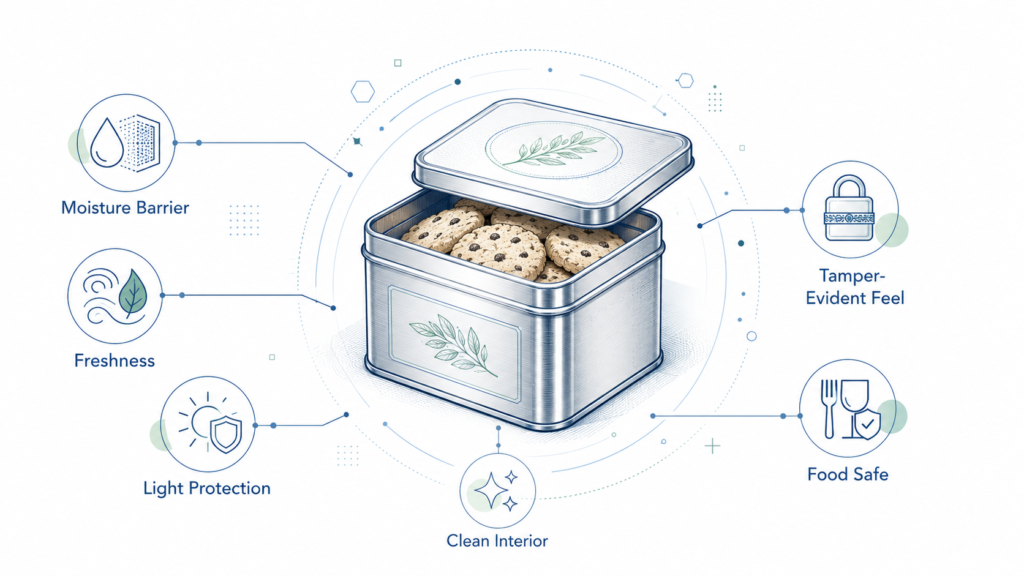
The second benefit is barrier performance. Metal naturally blocks light, and light protection matters for products whose color, aroma, oils, flavors, pigments, fragrances, or active ingredients may degrade during storage. Tin packaging can also support moisture and aroma control when the lid, liner, gasket, or inner pouch is selected correctly. A tea tin, for example, may use a tight-fit lid and an inner bag. A coffee tin may need stronger aroma management. A cookie tin may require a food-grade inner surface plus a sealed inner pouch to preserve crispness.
The third benefit is premium perception. Metal feels more permanent than ordinary disposable packaging. Consumers can feel its weight, cool touch, lid movement, embossed details, and surface finish. These tactile signals can make a product feel more giftable, more durable, and more valuable before the customer even reads the label. This is why custom tins are widely used for holiday gifts, collector editions, corporate gifts, confectionery, tea sets, candle sets, and premium cosmetics.
The fourth benefit is reusability. A well-designed tin may remain in the consumer’s home as a storage box for tea bags, stationery, sewing tools, candies, small accessories, receipts, photos, or keepsakes. This gives the brand a longer presence than a disposable carton. In premium categories, this “keepsake effect” is not a minor detail; it can become part of the product’s emotional value.
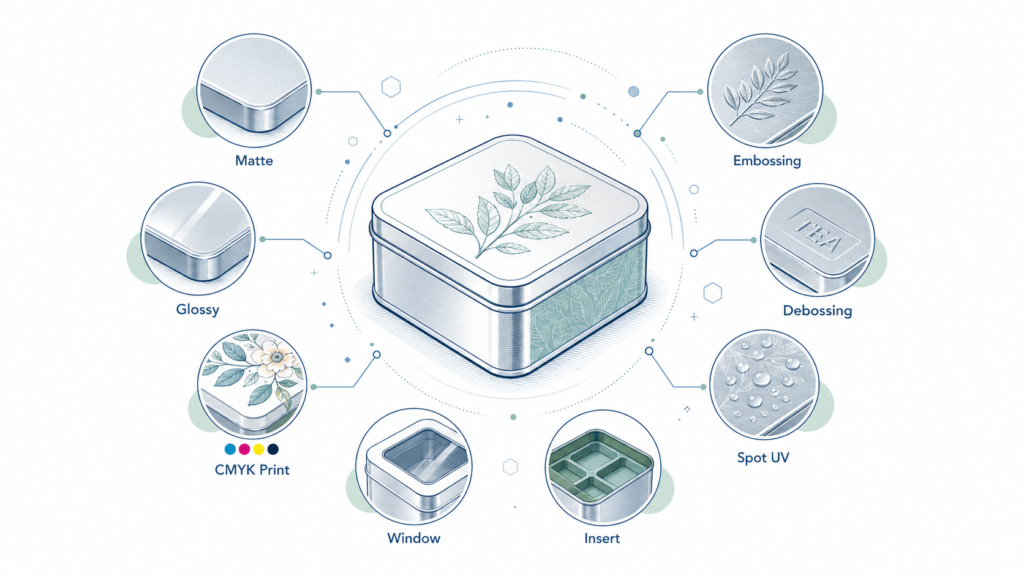
The fifth benefit is flexible decoration. Custom tin packaging can support full-surface printing, matte varnish, gloss varnish, satin finish, metallic ink, embossing, debossing, spot UV, texture effects, foil-like highlights, shaped lids, window structures, and custom inserts. Mr. Tin Box’s guide to metal tin box finishing options explains how finishes such as matte, glossy, satin, textured, metallic, soft-touch, and spot UV affect both appearance and buyer perception.
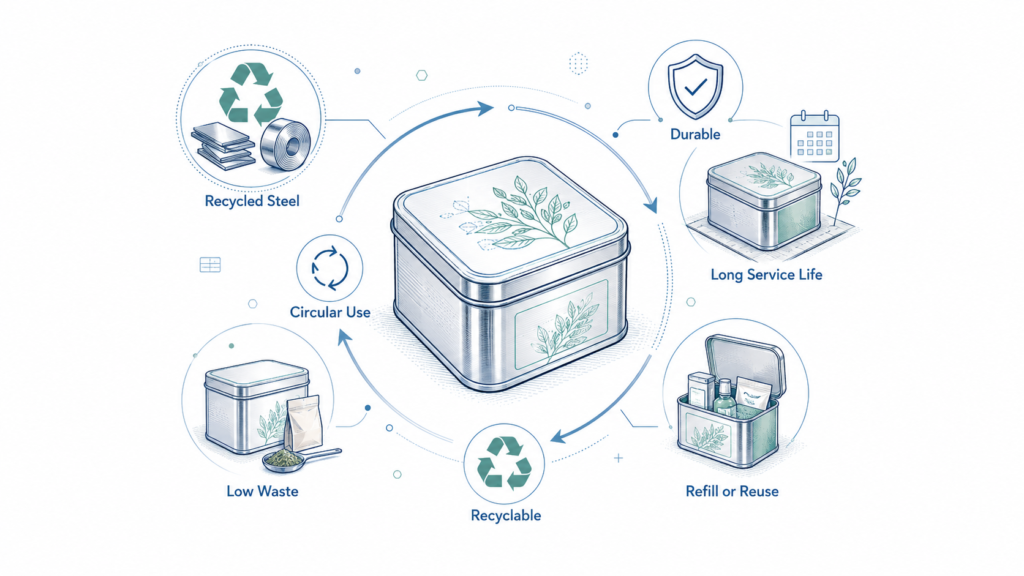
The sixth benefit is sustainability communication. Steel can be magnetically sorted and recycled through established systems in many markets. Steel for Packaging Europe describes steel as a permanent material that can be recycled repeatedly without loss of quality, and its 2023 EU recycling data shows a high real recycling rate. Buyers should still adapt claims to the country of sale, but metal packaging gives brands a stronger basis for specific claims such as “reusable metal tin,” “steel packaging is widely recyclable where collection systems exist,” or “designed for long-term reuse.”
Best product categories for custom tin packaging
Custom tin packaging is versatile, but it is not automatically the best choice for every product. It performs best when the product benefits from rigidity, shelf presence, reusability, moisture or light protection, gift value, or premium tactile experience. The table below summarizes common applications and the main business logic behind them.
| Product category | Why tin packaging works | Key design considerations | Common business goal |
|---|---|---|---|
| Tea, coffee, matcha, cocoa, spices | Protects aroma, blocks light, supports premium shelf presence | Tight lid, inner coating, possible inner bag, stackable structure | Improve freshness perception and premium positioning |
| Cookies, biscuits, chocolate, candy | Protects against crushing and creates strong gift value | Food-grade coating, tray or divider, seasonal artwork, scratch-resistant finish | Increase gift appeal and reduce damage complaints |
| Mints, lozenges, small snacks | Durable pocket-size format encourages repeated handling | Smooth lid, rounded edges, compact shape, safe coating | Build daily brand exposure and convenience |
| Cosmetics, balms, waxes, solid perfume | Compact, premium, reusable, and suitable for gift sets | Formula compatibility, corrosion-resistant coating, smooth opening | Upgrade brand image and support refill or gift programs |
| Candles and fragrance products | Creates home-decor appeal and protects delicate surfaces | Heat behavior, coating compatibility, lid fit, fragrance review | Improve unboxing and display value |
| Promotional gifts and seasonal campaigns | High memorability, collectability, and visual impact | Embossing, metallic finish, custom shape, QR area, sleeve | Increase campaign impact and perceived gift value |
| Specialty tools, electronics accessories, collectibles | Rigid protection and organized presentation | Foam liner, compartments, hinge, latch, labeling area | Reduce damage and create professional product display |
| Premium sample kits | Helps small items feel organized and valuable | Multi-cavity insert, lid printing, compact dimensions | Increase trial conversion and influencer unboxing value |
For buyers, the most important lesson is that the best tin design depends on the product’s real needs. A cookie tin and a cosmetics tin may both use tinplate, but they should not be specified in the same way. A cookie tin may focus on food contact, tray fit, seasonal printing, and outer carton protection. A cosmetics tin may focus on coating compatibility, opening feel, color consistency, and scratch resistance. A tool tin may focus on hinge strength, foam density, and drop protection.
Material structure: what buyers should know about tinplate
Tinplate is popular because it combines strength, formability, printability, and recyclability. The steel core gives the package rigidity and shape stability. The tin coating protects the surface and helps create a suitable base for printing, coating, and forming. In many packaging applications, additional lacquer or varnish is applied to protect the inside or outside surface.
A custom tin package may look simple, but the material system has several layers. The exact stack varies by supplier, application, and coating requirement, but a simplified structure is useful for buyers.
| Layer or component | Main purpose | Buyer implication |
|---|---|---|
| Steel substrate | Provides strength, shape, and resistance to deformation | Thickness affects rigidity, weight, cost, and forming behavior |
| Tin coating | Helps protect the steel surface and improves packaging suitability | Specification should match product type and production process |
| Internal lacquer or coating | Reduces direct interaction between product and metal | Critical for food, cosmetics, waxes, oils, powders, and moisture-sensitive goods |
| External primer and ink | Creates artwork, brand color, and visual impact | Artwork must be adapted to metal printing tolerances and forming areas |
| External varnish or finish | Protects print and defines touch or gloss level | Finish affects scratch resistance, fingerprints, luxury feel, and cost |
| Insert, liner, or pouch | Holds product, improves freshness, or separates contents | Must be designed with product dimensions, filling method, and compliance in mind |
Tinplate thickness should be selected according to the box size, shape, lid type, and product weight. A small mint tin does not need the same material thickness as a large cookie tin or a hinged gift box. Over-specifying thickness can increase material cost and shipping weight. Under-specifying thickness can lead to dents, poor lid feel, deformation, or inconsistent assembly.
Buyers do not need to become metallurgists, but they should provide enough information for the supplier to recommend the right material. Important details include product weight, package dimensions, stacking requirements, shipping route, retail channel, filling method, and whether the tin will have a hinge, deep-drawn shape, window, handle, lock, or internal tray.
Food-grade custom tin packaging: compliance is a system, not a slogan
Food-grade packaging is one of the most important areas where buyers must ask precise questions. A tin is not “food grade” simply because it is made from metal. Food safety depends on every component that may directly or indirectly contact food, including coating, lacquer, ink, varnish, insert, liner, adhesive, and production handling.
In the United States, the FDA explains that components of food packaging used in compliance with applicable regulations in 21 CFR 174-179 generally need no further FDA review. These sections cover indirect food additives, including adhesives, coatings, polymers, and production aids. The FDA also provides specific guidance on determining the regulatory status of food contact material components. For a buyer, this means the supplier should understand which components are relevant to the intended food-contact use.
In the European Union, Regulation (EC) No 1935/2004 provides the general framework for food contact materials. The European Commission explains that food contact materials must not release substances into food at levels harmful to human health or change the food composition, taste, or odor in an unacceptable way. Commission Regulation (EC) No 2023/2006 also sets good manufacturing practice requirements for food contact materials.
For custom tin packaging buyers, the practical question is not only “Can you provide food-grade material?” A better question is: “Which surfaces will contact my product, which coatings and inserts will be used, what documentation can you provide, and which market requirements are we designing for?”
| Food-grade check item | Why it matters | Buyer question to ask |
|---|---|---|
| Direct-contact surface | Food may touch the base, wall, lid, seam, tray, liner, or pouch | Which components are intended for direct food contact? |
| Internal coating | Helps prevent corrosion, staining, flavor change, or metal-product interaction | Which lacquer is recommended for my food type? |
| Product chemistry | Salt, acid, fat, moisture, alcohol, and essential oils can affect compatibility | Has this coating been used for similar products? |
| Ink and varnish | Exterior decoration must avoid odor and migration concerns | Are printing inks and varnishes suitable for my market? |
| Freshness system | A tin may need an inner bag, seal, gasket, or liner | Do I need a secondary freshness barrier inside the tin? |
| Documentation | Different markets require different evidence | Can you support test reports, declarations, or component details? |
| Production hygiene | Packaging must stay clean after forming and inspection | How are tins packed, protected, and stored after production? |
For many dry foods, a practical solution is to use a food-grade tin with an inner pouch or bag. The tin delivers shelf impact, crush resistance, and gift value, while the inner structure provides additional freshness control. This is common for tea, coffee, cookies, candies, chocolate assortments, spices, and premium snacks. For direct-contact applications, the coating selection and validation become more important.
Buyers should also separate decorative tins from true hermetically sealed canned-food systems. A biscuit tin can be suitable for food contact and still require an inner bag for freshness. A tea tin can protect aroma and light exposure without being a retort can. If the product requires commercial sterility, thermal processing, or low-acid canned-food compliance, the packaging system must be engineered and validated for that specific purpose.
For more detailed buyer preparation, Mr. Tin Box’s article on food-grade custom metal packaging before production is a useful internal reference to link from this guide.
Shape, lid, and structure options
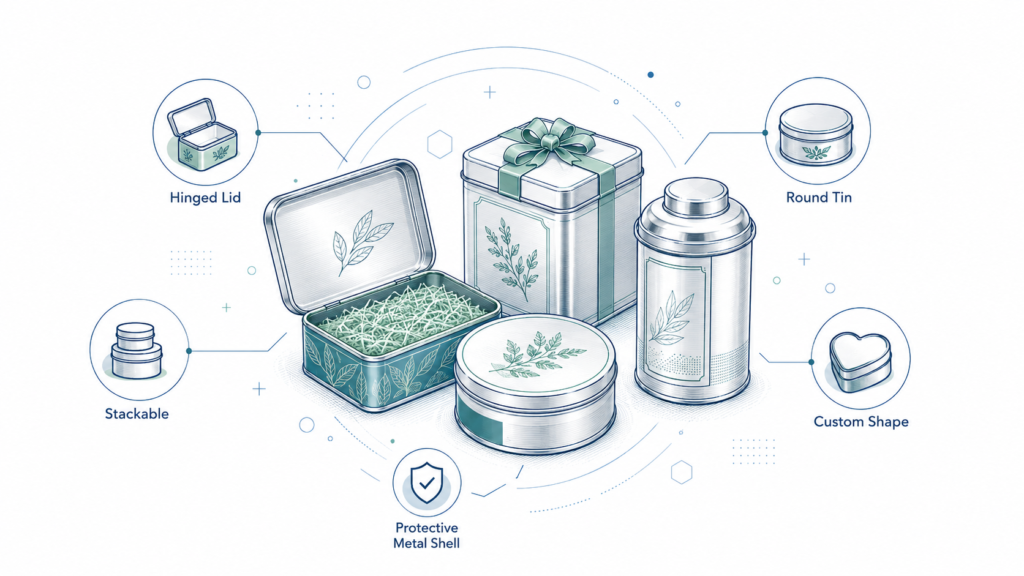
One reason custom tin packaging is valuable is that it offers a wide range of structural choices. Buyers can develop square tins, rectangular tins, round tins, oval tins, heart-shaped tins, hinged tins, slip-lid tins, window tins, shoulder tins, deep-drawn tins, handle tins, and multi-component gift boxes. The structure should be selected based on both product needs and manufacturing efficiency.
A square or rectangular tin is often efficient for shipping, shelf display, and internal trays. It works well for biscuits, chocolate bars, tea bags, cosmetics sets, stationery, and tool kits. A round tin is attractive for cookies, candles, balms, waxes, loose tea, and premium confectionery. An oval or special-shape tin creates stronger shelf differentiation but may increase tooling cost, material waste, and packing complexity.
The lid style is especially important because the opening experience affects perceived quality. A loose lid may feel cheap and may not protect the product well. A lid that is too tight can frustrate consumers and create complaints. A hinged lid improves convenience and keeps the lid connected to the body, but hinge strength and alignment must be controlled. A plug lid can improve fit and freshness perception. A window lid can show the product but may introduce a plastic component that affects recyclability and compliance claims.
| Structure option | Best for | Advantages | Watch-outs |
|---|---|---|---|
| Slip-lid tin | Tea, cookies, candy, gift sets | Simple, classic, cost-effective | Lid fit must be consistent |
| Hinged tin | Mints, cosmetics, tools, small kits | Convenient, reusable, premium feel | Hinge alignment and strength matter |
| Window tin | Confectionery, gifts, display products | Shows product before purchase | Window material may complicate recycling claims |
| Deep-drawn tin | Balms, candles, compact formats | Smooth body, modern appearance | Tooling and forming limits affect shape |
| Shoulder tin | Premium tea, coffee, cosmetics | More refined opening feel | Higher structure complexity |
| Tin with insert | Chocolate, beauty kits, electronics | Protects and organizes contents | Insert material and tolerance must be planned early |
| Tin with handle or lock | Larger gifts, industrial kits | Strong display and usability | More components, higher QC requirement |
A strong structure brief should include product dimensions, desired capacity, filling method, product weight, stackability, shipping method, retail display requirements, expected opening frequency, and whether consumers are likely to reuse the tin.
Printing and finishing: where brand value becomes visible
The surface of a tin is where buyers often focus first, and for good reason. Tin packaging can be a high-impact branding canvas. However, decoration should be designed together with structure, not after structure is finalized. Embossing, debossing, lid shape, corner radius, seam position, hinge placement, and artwork alignment all interact.
Common decoration options include CMYK printing, spot colors, metallic effects, matte varnish, glossy varnish, satin finish, soft-touch feel, spot UV contrast, texture varnish, embossing, debossing, and limited-edition artwork. For premium products, buyers may combine several effects, such as matte background with glossy logo, metallic ink with embossing, or textured varnish with a clean minimalist color palette.
The right finish depends on the product category. A matte finish can look modern, natural, and premium. It works well for skincare, wellness, tea, and minimalist food brands. A glossy finish can make colors pop and is useful for candy, holiday tins, children’s products, and promotional campaigns. A satin finish can provide a balanced look between luxury and practicality. Textured finishes can improve grip and create a more tactile experience. Spot UV can highlight logos or product illustrations without making the full tin overly shiny.
| Finish option | Visual and tactile effect | Good fit | Buyer note |
|---|---|---|---|
| Matte varnish | Soft, refined, low-glare | Premium tea, cosmetics, wellness, minimalist gifts | May show fingerprints depending on color and coating |
| Gloss varnish | Bright, vivid, high-impact | Candy, holiday gifts, colorful promotions | Can show scratches more visibly on dark colors |
| Satin finish | Balanced, smooth, professional | Coffee, chocolate, lifestyle goods | Good compromise for premium but practical packs |
| Metallic effect | Reflective, festive, premium | Christmas tins, luxury confectionery, beauty sets | Needs careful artwork control to avoid looking busy |
| Soft-touch finish | Velvety hand feel | High-end cosmetics, gift boxes | Higher cost and scratch testing recommended |
| Spot UV | Contrast highlight | Logos, patterns, limited editions | Works best when artwork contrast is planned early |
| Embossing/debossing | Physical depth and tactile memory | Logos, icons, premium lids | Tooling and registration must be controlled |
| Texture varnish | Anti-slip or decorative texture | Industrial kits, premium gifts, collectible tins | Sample approval is important because feel is subjective |
Mr. Tin Box’s metal tin box finishing options guide can serve as a supporting internal link for readers who want a deeper explanation of matte, glossy, satin, textured, metallic, soft-touch, spot UV, embossing, and protective coatings.
Inserts and internal presentation
A tin package is often judged at the moment of opening. That moment depends not only on the outside artwork, but also on how the product sits inside the container. Inserts can protect fragile goods, organize multi-SKU sets, create a luxury unboxing experience, and prevent product movement during shipping.
Common insert materials include paperboard, molded pulp, PET, PS, EVA foam, sponge, flocked plastic, fabric lining, and custom dividers. A chocolate tin may use a food-safe tray. A cosmetics gift set may use a paperboard or EVA insert. A tool kit may use foam cutouts. A candle set may require dividers and padding. A premium tea gift set may use paperboard compartments with printed labels.
The insert should be designed at the same time as the tin. If the insert is added late, the package may become too tight, too loose, too expensive, or too difficult to assemble. Insert design affects labor, packing speed, shipping stability, product presentation, and compliance.
| Insert type | Best use | Advantage | Consideration |
|---|---|---|---|
| Paperboard divider | Tea bags, small gifts, food assortments | Recyclable appearance, printable, lightweight | Moisture and strength limits must be considered |
| PET or PS tray | Chocolate, cookies, cosmetics | Clean cavity shape and good presentation | Food-contact suitability and recycling claims vary by market |
| EVA foam | Electronics, tools, fragile promotional products | Strong protection and premium organization | Not ideal for sustainability claims unless justified |
| Molded pulp | Gifts, beauty sets, natural products | Strong environmental perception and cushioning | Tooling and dimensional tolerance need planning |
| Fabric or flocking | Luxury gifts, jewelry-style packaging | Premium touch and display value | Higher cost and dust control considerations |
| Inner pouch or bag | Tea, coffee, snacks, powders | Freshness and odor protection | Must match food-contact and sealing requirements |
Inserts are especially important for e-commerce. Parcel shipping creates vibration, drops, compression, and unpredictable handling. A rigid tin without a proper insert can still allow the product to rattle, scratch, or break. For premium products, that damage harms both the product and the brand story.
Custom tin manufacturing process
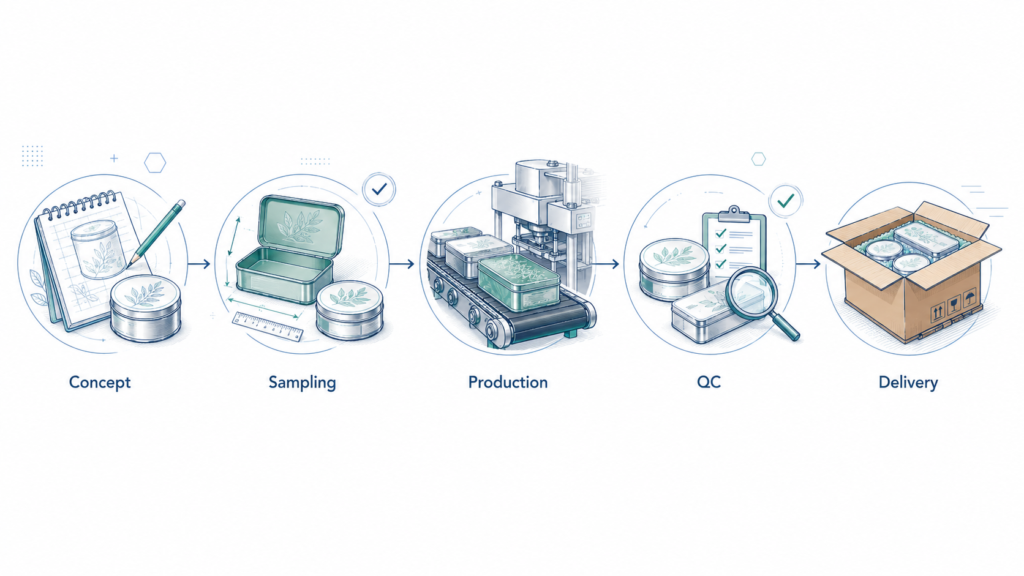
A professional tin packaging project follows a structured workflow. Mr. Tin Box describes a process that includes consultation, 3D drawing and structure design, mold development or sample making, printing and finishing, stamping and assembly, and quality inspection. This is a useful framework because it shows buyers that custom tin packaging is both a design project and a manufacturing project.
The workflow usually begins with requirements. The supplier needs product size, target market, quantity, artwork direction, budget range, food or non-food use, expected launch date, shipping destination, and any required certifications or documentation. Without these details, the quotation may be vague or misleading.
Next comes structure design. Engineers translate the product and brand requirements into dimensions, drawings, lid style, forming process, tooling needs, and insert planning. If a new shape is required, tooling or mold development may be necessary. If an existing mold can be used, the buyer may save cost and reduce lead time.
Sampling follows. A sample allows the buyer to verify size, lid fit, opening feel, color direction, finish, embossing, insert fit, and product presentation. For complex projects, one sample may not be enough. Structural samples, printed samples, pre-production samples, and packaging drop tests may each answer different questions.
Once the sample is approved, mass production begins. Printed tinplate sheets are coated, dried, cut, stamped, formed, assembled, inspected, packed, and prepared for shipment. Quality control should monitor color consistency, scratches, dents, lid fit, seam quality, printing registration, coating defects, insert fit, carton strength, and final packing condition.
| Project stage | Main work | Buyer responsibility | Typical risk if skipped |
|---|---|---|---|
| Requirement review | Define product, market, size, use, volume, budget, timeline | Provide clear product and launch details | Wrong quote, wrong structure, missed compliance issue |
| Structure design | Create dimensions, lid style, insert plan, tooling plan | Approve drawings and functional requirements | Poor fit, high cost, inefficient shipping |
| Sampling | Make prototype or printed sample | Test with real product and review internally | Surprise defects in mass production |
| Artwork and finish approval | Confirm dieline, color, varnish, embossing, barcode, warnings | Provide final artwork and approvals | Color mismatch, printing distortion, missing legal text |
| Mass production | Print, cut, stamp, form, assemble, inspect | Monitor schedule and approval milestones | Delay, inconsistent QC, launch risk |
| Final inspection and packing | Check appearance, function, cartons, labels, export packing | Confirm inspection standard and shipping marks | Damage in transit or warehouse confusion |
For more detail about supplier selection and manufacturing expectations, buyers can read Mr. Tin Box’s Custom Metal Tin Packaging Manufacturer Guide for Global Buyers.
MOQ, lead time, and cost drivers
MOQ and lead time are among the first questions buyers ask, but they are often misunderstood. Custom tin packaging cost is driven by material, tooling, printing setup, production line efficiency, order quantity, decoration complexity, insert design, inspection requirements, and packing method. A small order with a new mold, complex printing, embossing, and custom insert may be expensive per unit. A larger order using an existing mold and standard finish may be much more efficient.
Lead time also depends on project complexity. A simple project using an existing mold may move quickly from artwork to sample to mass production. A new shape requires structural engineering, mold development, trial production, sample approval, and possible adjustment. Food-grade or cosmetics applications may require additional documentation or compatibility review.
Mr. Tin Box’s MOQ and lead time planning article is a useful internal link because it focuses specifically on tooling, sampling, production, shipping, and launch planning.
| Cost driver | How it affects price | How buyers can control it |
|---|---|---|
| New mold or tooling | Adds upfront cost and development time | Use an existing mold when possible or reserve custom tooling for high-value SKUs |
| Tinplate thickness | Thicker material increases cost and weight | Match thickness to size, product weight, and strength requirement |
| Printing complexity | More colors, special effects, and tight registration increase production control needs | Keep artwork manufacturable and approve printed samples |
| Finish selection | Soft-touch, spot UV, texture, or embossing may increase cost | Use premium effects strategically on high-visibility areas |
| Insert design | Custom trays or foam add material and assembly cost | Design inserts only where they protect product or improve perceived value |
| Order quantity | Small quantities have higher unit cost because setup is spread over fewer pieces | Plan annual demand, campaign batches, or shared structures across SKUs |
| Inspection standard | Higher inspection requirements add labor | Define critical defects clearly instead of over-controlling minor hidden areas |
| Export packing | Stronger cartons, pallets, labels, and protection add cost | Match packing method to shipping route and damage risk |
Buyers should avoid evaluating suppliers only by the lowest unit price. A low quote may exclude tooling, sampling, special packing, document support, or realistic QC standards. It may also use thinner material, weaker cartons, or less consistent finishing. For brand owners, a damaged launch or poor unboxing experience can cost more than the small savings from a cheaper tin.
A better approach is to ask for a transparent quotation that separates tooling, sample cost, unit price, insert cost, packing method, lead time, payment terms, and shipping assumptions. This makes the quote easier to compare and reduces surprises.
Sustainability and recyclability: make claims carefully
Sustainability is a major reason many brands consider metal packaging, but buyers should use precise language. Tinplate and steel packaging have strong recyclability advantages, and steel can be magnetically recovered in efficient waste streams. Steel for Packaging Europe reports that 82% of steel packaging placed on the EU market was “really recycled” in 2023, meaning it entered actual recycling operations rather than merely being collected.
The European Commission’s Packaging and Packaging Waste Regulation direction is also important. The EU states that all packaging must be recyclable by 2030, and labeling should become clearer so consumers understand what packaging is made of and how to sort it. Eurostat also reports that the EU reached an overall packaging recycling rate of 67.5% in 2023, close to the 2030 overall target of 70%, while the 2030 target for ferrous metals is 80%.
For custom tin packaging buyers, the design implications are practical. Use material combinations carefully. Avoid unnecessary mixed-material parts if they do not improve product protection or consumer experience. If a window, plastic insert, foam liner, or decorative sleeve is needed, make sure the sustainability claim remains accurate. A tin with a plastic window may still be useful and attractive, but the claim should not pretend the entire pack is a simple mono-material tin.
Good sustainability claims are specific and verifiable. Examples include “reusable metal tin,” “tinplate steel container,” “designed for repeated storage use,” “widely recyclable where metal packaging collection exists,” or “steel packaging supports established recycling streams in many markets.” Weak claims include “100% eco-friendly,” “zero waste,” or “fully sustainable” unless the brand has strong evidence for the exact market and product system.
The reuse story is also important. A tin that consumers keep for storage creates additional value beyond the first purchase. However, reuse should be designed, not assumed. A tin is more likely to be reused when it has a durable finish, attractive design, comfortable size, smooth opening, safe edges, and a shape that works in the home.
For more internal context, Mr. Tin Box’s article on sustainable custom metal packaging and circular packaging goals can support this section.
Quality control points buyers should specify
Custom tin packaging quality is not only about whether the box looks attractive. Quality includes visual appearance, structural fit, safety, coating condition, printing accuracy, assembly consistency, packing strength, and shipment durability. Buyers should define critical quality points before production begins.
Appearance defects include scratches, dents, color deviation, stains, printing misregistration, coating bubbles, dust under varnish, uneven gloss, and poor embossing clarity. Functional defects include loose lids, tight lids, misaligned hinges, sharp edges, weak locks, poor insert fit, unstable stacking, and deformation. Packing defects include weak cartons, insufficient dividers, poor palletization, wrong shipping marks, and moisture exposure.
A buyer’s quality standard should focus on what matters to the consumer and the sales channel. A luxury chocolate tin may require stricter surface standards than an industrial tool tin. A cosmetics tin sold online may require stronger carton protection than a tin sold in a retail display tray. A food-contact tin may require stricter hygiene and coating review than a promotional stationery tin.
| QC area | What to inspect | Why it matters |
|---|---|---|
| Dimensions | Length, width, height, capacity, lid fit, insert fit | Ensures product fits and packing remains consistent |
| Edges and seams | Curling, seam strength, sharp edges, hinge position | Protects user safety and opening experience |
| Surface quality | Scratches, dents, stains, coating marks, fingerprints | Affects shelf appeal and premium perception |
| Printing | Color, registration, barcode, text clarity, logo position | Protects brand consistency and retail usability |
| Finish | Gloss level, matte feel, spot UV alignment, texture consistency | Ensures approved sample matches mass production |
| Coating | Interior coverage, odor, corrosion resistance, compatibility | Critical for food, cosmetics, candles, and moist products |
| Function | Opening force, lid retention, latch or hinge movement | Determines consumer satisfaction and reuse value |
| Packing | Inner bags, dividers, cartons, pallet labels, moisture protection | Reduces transit damage and warehouse problems |
Buyers should request pre-production samples and define acceptable tolerances where possible. For important projects, third-party inspection or buyer-side AQL inspection may be appropriate. The key is to avoid vague standards such as “good quality.” Instead, define visible surfaces, critical defects, major defects, minor defects, functional checks, and packing requirements.
How to prepare a clear RFQ for custom tin packaging
A clear request for quotation saves time and improves supplier accuracy. Many delays happen because the buyer sends only a picture and asks for a price. That is not enough for custom manufacturing. A supplier needs the product, structure, decoration, quantity, market, compliance, and logistics details.
| RFQ item | What to provide | Example |
|---|---|---|
| Product type | What will be packed inside | Loose tea, chocolate biscuits, lip balm set, candle, tool kit |
| Product size and weight | Dimensions and unit weight | 120 mm x 80 mm x 35 mm, 220 g per set |
| Tin size or target capacity | Desired tin dimensions or required volume | Approx. 150 mm x 100 mm x 45 mm, must fit 12 cookies |
| Quantity | Trial order and forecast | 5,000 pieces first order, 30,000 pieces annual forecast |
| Shape and lid style | Square, round, hinged, slip lid, window, etc. | Rectangular hinged tin with paperboard insert |
| Artwork | Dieline, logo, colors, finish direction | CMYK printing, matte varnish, embossed logo |
| Food or non-food use | Direct contact, inner bag, cosmetic formula, etc. | Food-grade tin for cookies with inner pouch |
| Target market | Countries or regions of sale | United States, Germany, Australia |
| Compliance needs | Test report, declaration, coating request | FDA food contact, EU food contact framework, BPA-free request |
| Packing method | Master carton, polybag, pallet, labels | Individual polybag, 100 pieces per carton, export pallet |
| Launch date | Required delivery or shelf date | Goods needed before September 15 for holiday campaign |
| Shipping term | EXW, FOB, CIF, DDP, air or sea | FOB Shenzhen, sea freight to Los Angeles |
If the buyer is not sure about some details, it is better to say so clearly. A professional manufacturer can recommend existing molds, suitable thickness, practical finishes, or insert options. However, the buyer should still provide the real product and market requirements. Guesswork creates rework.
Common mistakes that increase cost or delay production
Custom tin packaging projects often become expensive or delayed for predictable reasons. The first mistake is starting with a complex shape before confirming product fit, MOQ, and tooling budget. Special shapes are powerful for branding, but they need stronger justification than standard rectangular or round tins.
The second mistake is finalizing artwork before confirming structure. Metal printing and forming can distort artwork near curves, corners, seams, and embossed areas. Dielines matter. Safe zones matter. Barcode placement matters. Legal text and ingredient information may need flat, readable areas.
The third mistake is choosing finishes from photos only. Matte, soft-touch, metallic, and texture effects can look different under different lighting. Buyers should approve physical samples whenever the finish affects brand value.
The fourth mistake is ignoring insert tolerance. A product that fits perfectly in a digital drawing may not fit in mass production if product dimensions vary, tin dimensions vary, or insert material changes. Always test real products in physical samples.
The fifth mistake is making sustainability claims too broad. “Eco-friendly” is weaker than a specific claim. If a tin includes plastic windows, EVA foam, labels, and mixed-material components, the claim should be adjusted. Accurate claims protect the brand.
The sixth mistake is underestimating export packing. A perfect tin can arrive damaged if cartons are weak, pallets are poorly protected, or the shipment route is rough. E-commerce and long-distance sea freight need practical packaging validation.
The seventh mistake is comparing quotations without checking what is included. One quote may include printing, tooling, inserts, sampling, export cartons, and quality inspection. Another may include only the basic tin. Buyers should compare like for like.
Custom tin packaging for food and beverage brands
Food and beverage brands use tin packaging for both protection and presentation. The strongest use cases include tea, coffee, cocoa, matcha, biscuits, cookies, wafers, chocolate, candy, mints, spices, powdered drinks, gourmet snacks, and seasonal gift assortments.
For tea and coffee, the main value is aroma protection, moisture control, light blocking, and premium shelf presence. The tin should have a suitable lid fit, clean interior, and a size that matches refill behavior. Some brands use a tin as an outer reusable container and include a sealed inner bag for freshness. This combines the emotional value of the tin with the technical barrier of the pouch.
For cookies, biscuits, and chocolate, the main value is crush protection and gift appeal. The tin body protects delicate products better than many flexible packs. Internal trays or dividers help preserve arrangement. Seasonal artwork makes the same product feel new for Christmas, Valentine’s Day, Easter, Halloween, anniversaries, or regional festivals.
For mints and small snacks, pocket-size tins create daily brand exposure. The package is handled repeatedly, which makes lid feel, edge safety, coating durability, and printing resistance very important. A small tin that opens smoothly can become part of the product habit.
Food brands should link this article to category pages such as Food & Beverage Metal Packaging and deeper educational resources such as Tin Packaging Guide: Why Brands Use Metal Tins for Food, Gifts, and Cosmetics.
Custom tin packaging for beauty and personal care brands
Beauty and personal care packaging must communicate trust quickly. Custom tins can support that goal because metal feels durable, clean, compact, and premium. Common applications include lip balm, solid perfume, beard balm, shaving soap, salve, wax, solid lotion, hair wax, cuticle balm, mini candles, skincare sample kits, fragrance discovery sets, wellness gift sets, and refillable or reusable formats.
The main technical issue is compatibility. Cosmetics and personal care formulas may contain oils, waxes, fragrances, alcohols, acids, botanical extracts, pigments, or active ingredients. These substances may interact with coatings or create staining, odor transfer, corrosion, or finish changes if the wrong material system is used. Buyers should provide formula type, filling temperature, storage conditions, market requirements, and expected shelf life.
The main brand issue is finish. A matte tin may support natural skincare positioning. A glossy tin may suit a playful beauty line. A satin tin may work for minimalist wellness. Embossing can make a logo feel more premium without changing the structure. Soft-touch finishing can create a luxury feel, but it should be tested for scratches, fingerprints, and compatibility with retail handling.
For beauty kits, inserts are often essential. A tin that holds several small items needs compartments so the products do not rattle or scratch. EVA foam, paperboard trays, molded pulp, or plastic trays can all work depending on positioning, sustainability goals, and product fragility.
For internal linking, connect this section to Mr. Tin Box’s Beauty & Personal Care Packaging page and the broader article on Metal Packaging Trends for Premium Consumer Goods.
Custom tin packaging for holiday gifts and promotional campaigns
Holiday and promotional packaging is where custom tins often create the strongest emotional value. A product that feels ordinary in a paper box can feel collectible in a printed metal tin. This is why tins are common for Christmas cookies, chocolate assortments, tea gift sets, corporate gifts, wedding favors, anniversary editions, character merchandise, regional souvenirs, and limited-edition retail campaigns.
The commercial logic is different from basic packaging. A holiday tin does not only protect the product; it helps justify the gift price, creates urgency, and supports campaign storytelling. A brand can release new artwork each season while keeping the same proven structure. This allows marketing teams to refresh the shelf story without rebuilding the entire packaging system.
For corporate gifts, custom tins can add long-term desk visibility. A tin with a subtle embossed logo, satin finish, and organized insert may remain in use after the original gift is consumed. For retail promotions, QR codes can be integrated into the artwork to connect the physical package with digital campaigns, loyalty programs, or product stories.
However, seasonal packaging requires careful schedule planning. Holiday goods often have fixed retail windows. A delay of two weeks can turn a successful campaign into excess inventory. Buyers should confirm artwork deadlines, sample approval timing, production lead time, shipping time, customs clearance, and warehouse receiving schedules.
For related content, link this section to Custom Metal Tin Packaging Ideas for Holiday Gifts and Seasonal Campaigns and the Gift, Promotional & Holiday Packaging category page.
Custom tin packaging for specialty and industrial products
Tin packaging is not limited to food and beauty. Specialty and industrial buyers use tins for small tools, spare parts, electronics accessories, tobacco-related accessories where legally permitted, collectible items, repair kits, stationery, sewing kits, medical-adjacent accessories where compliant, and branded merchandise.
In these categories, the value of the tin is often durability and organization. A foam insert can hold tools securely. A hinged lid can prevent the cover from being lost. A printed instruction area can help users identify parts. A latch can support repeated opening. A rugged finish can protect the box in workshop, warehouse, or field environments.
Industrial tins do not always need luxury finishes, but they do need functional reliability. Edge safety, hinge strength, corrosion resistance, label readability, and insert durability may matter more than decorative effects. Buyers should provide real product samples and explain how the customer will use the box.
For internal linking, connect this section to Specialty & Industrial Packaging and relevant custom packaging manufacturer resources.
How to choose the right custom tin packaging supplier
A strong supplier should be able to discuss structure, tooling, material, coating, printing, finishing, inserts, quality control, and export packing in practical terms. The best supplier is not simply the one with the lowest unit price. It is the one that helps the buyer reduce development risk and launch on time.
Buyers should evaluate suppliers across several dimensions. Manufacturing capability matters: in-house mold development, stamping equipment, printing coordination, coating control, assembly, and QC systems. Engineering support matters: the supplier should help convert product needs into manufacturable structure. Communication matters: the supplier should explain trade-offs clearly and warn buyers when a design may be risky. Documentation matters: food, cosmetics, and international buyers may need test support, declarations, or material details. Logistics experience matters: export packing and shipping coordination can protect the project after production.
| Supplier capability | Why it matters | What to ask |
|---|---|---|
| Existing mold library | Can reduce tooling cost and lead time | Do you have similar shapes or sizes already available? |
| Engineering design | Converts idea into manufacturable structure | Can you provide 3D drawings or dielines before sampling? |
| Printing and finishing control | Determines brand consistency | Can I approve physical color and finish samples? |
| Food or sensitive-product experience | Reduces compliance and compatibility risk | What documentation or coating options can you support? |
| Insert development | Improves protection and unboxing | Can you design inserts based on real product samples? |
| QC process | Protects mass-production consistency | What inspection points are included before shipment? |
| Export packing | Reduces shipping damage | What carton, divider, pallet, and labeling methods do you recommend? |
| Communication speed | Protects launch schedule | Who manages artwork, sample feedback, and production updates? |
Mr. Tin Box positions itself around custom metal tin packaging for global brands, with industry pages covering food, beauty, gifts, and specialty applications, plus a manufacturing workflow from consultation to quality inspection. For buyers, the practical next step is to provide a clear product brief and request guidance on structure, finish, MOQ, lead time, and compliance.
A practical specification template for buyers
The following template can be copied into an email or RFQ form when requesting a custom tin packaging quote. It helps the supplier respond accurately and reduces back-and-forth communication.
Product information Product name: Product category: Product dimensions: Product weight: Number of items per tin: Food, cosmetics, gift, or industrial use: Direct contact with tin: yes / no / not sure Target market countries: Expected shelf life or storage conditions:
Tin structure Preferred shape: Preferred size or capacity: Lid style: slip lid / hinged / plug lid / window / other Need insert: yes / no / not sure Need inner bag or pouch: yes / no / not sure Reuse expectation: storage / gift / refill / not required
Decoration Artwork available: yes / no Printing: CMYK / spot color / metallic / not sure Finish: matte / glossy / satin / texture / soft-touch / spot UV / not sure Embossing or debossing: yes / no Barcode or legal text: yes / no
Commercial details Estimated order quantity: Annual forecast: Target unit price if available: Required sample date: Required delivery date: Shipping destination: Shipping term: EXW / FOB / CIF / DDP / not sure
Compliance and quality Food contact documentation needed: yes / no / not sure BPA-free request: yes / no / not sure EU, FDA, LFGB, or other market requirements: Special inspection requirement: Packing requirement: individual bag / master carton / pallet / retail display / other
Using a structured brief like this helps the supplier recommend the right combination of existing mold, new tooling, material thickness, coating, printing, finish, insert, and packing method.
FAQ about custom tin packaging
What is custom tin packaging?
Custom tin packaging is a metal packaging solution, usually made from tinplate, that is customized in size, shape, structure, printing, finish, lid style, insert, and packing method. It is used for food, beverage, cosmetics, gifts, promotions, specialty products, and industrial items.
Is tin packaging suitable for food?
Yes, tin packaging can be suitable for food when the material, internal coating, production process, and intended use are properly evaluated. Buyers should clarify which surfaces contact the food, whether an inner pouch is needed, and what documentation is required for the target market. Food-grade packaging is a system, not just a material claim.
Is custom tin packaging recyclable?
Steel-based tin packaging is widely recyclable where metal collection and recycling systems exist. In Europe, Steel for Packaging Europe reported an 82% real recycling rate for steel packaging in 2023. Buyers should still make claims carefully and consider whether added components such as plastic windows, foam inserts, labels, or sleeves affect the claim.
What products are best for custom tin packaging?
Strong candidates include tea, coffee, cookies, chocolate, candy, mints, spices, cosmetics, balms, candles, gift sets, corporate gifts, holiday promotions, collectibles, electronics accessories, small tools, and premium sample kits. The best fit is any product that benefits from protection, premium feel, reuse, or gift value.
How long does a custom tin packaging project take?
Lead time depends on mold availability, structural complexity, sample approval, printing, finishing, order quantity, and shipping method. Projects using existing molds are usually faster than projects requiring new tooling. Buyers should discuss sampling, production, and shipping schedules early. The Mr. Tin Box article on MOQ and lead time planning provides a useful planning reference.
What affects custom tin packaging cost most?
Major cost drivers include tin size, material thickness, new tooling, order quantity, printing complexity, finishing effects, embossing, inserts, food-grade requirements, inspection standards, and export packing. A low unit price may not include all required services, so buyers should compare quotation details carefully.
Can I use the same tin shape for multiple SKUs?
Yes. Many brands use one proven tin structure across multiple flavors, scents, colors, or seasonal designs. This can reduce tooling cost, simplify packing, and make production planning easier. The artwork and insert can change while the core structure remains the same.
Should I choose matte or glossy finish?
Matte finish is often better for premium, natural, minimalist, wellness, and skincare brands. Glossy finish is stronger for colorful, festive, candy, children’s, and high-impact promotional packaging. Satin finish is a balanced option. The best choice depends on brand positioning, artwork, retail lighting, scratch risk, and desired hand feel.
Do I need an insert inside the tin?
You need an insert if the product must be held in position, protected from movement, organized for display, separated from other items, or presented as a premium set. Inserts are common for chocolate, cosmetics, electronics, tools, and gift kits. For loose tea or cookies, an inner pouch or tray may be more useful than a decorative insert.
How do I start a custom tin packaging project with Mr. Tin Box?
Start by preparing product details, target quantity, desired size or reference shape, artwork direction, target market, compliance needs, and launch schedule. Then contact Mr. Tin Box for samples, structure guidance, and a quotation. A clear brief helps the team recommend the right material, mold, coating, finish, insert, and packing method.
Final thoughts: treat the tin as part of the product
Custom tin packaging performs best when it is treated as part of the product experience, not as an afterthought. The tin protects the product, communicates value, creates shelf impact, supports gifting, and may remain with the customer long after the original product is used. That makes it a packaging investment with both functional and marketing value.
For brand owners, the smartest approach is to begin with the product’s real needs. What must the package protect? What should the customer feel when opening it? Which market requirements apply? How will it ship? Will the customer reuse it? Which design elements are truly worth paying for? These questions lead to better decisions than choosing a shape or finish based only on appearance.
For product buyers, the best results come from clear specifications, realistic timelines, physical samples, and transparent communication with the manufacturer. When material, coating, structure, finish, insert, quality control, and packing are planned together, custom tin packaging can become more than a container. It can become a brand asset that protects products, supports premium positioning, and helps customers remember the brand.
If you are developing a food tin, cosmetic tin, holiday gift tin, promotional tin, or specialty product tin, Mr. Tin Box can help you turn the idea into a manufacturable packaging solution through structure design, sample development, printing, finishing, stamping, assembly, and inspection. Explore the company’s custom metal packaging solutions or start with the relevant category page for food and beverage, beauty and personal care, gift and holiday, or specialty and industrial applications.