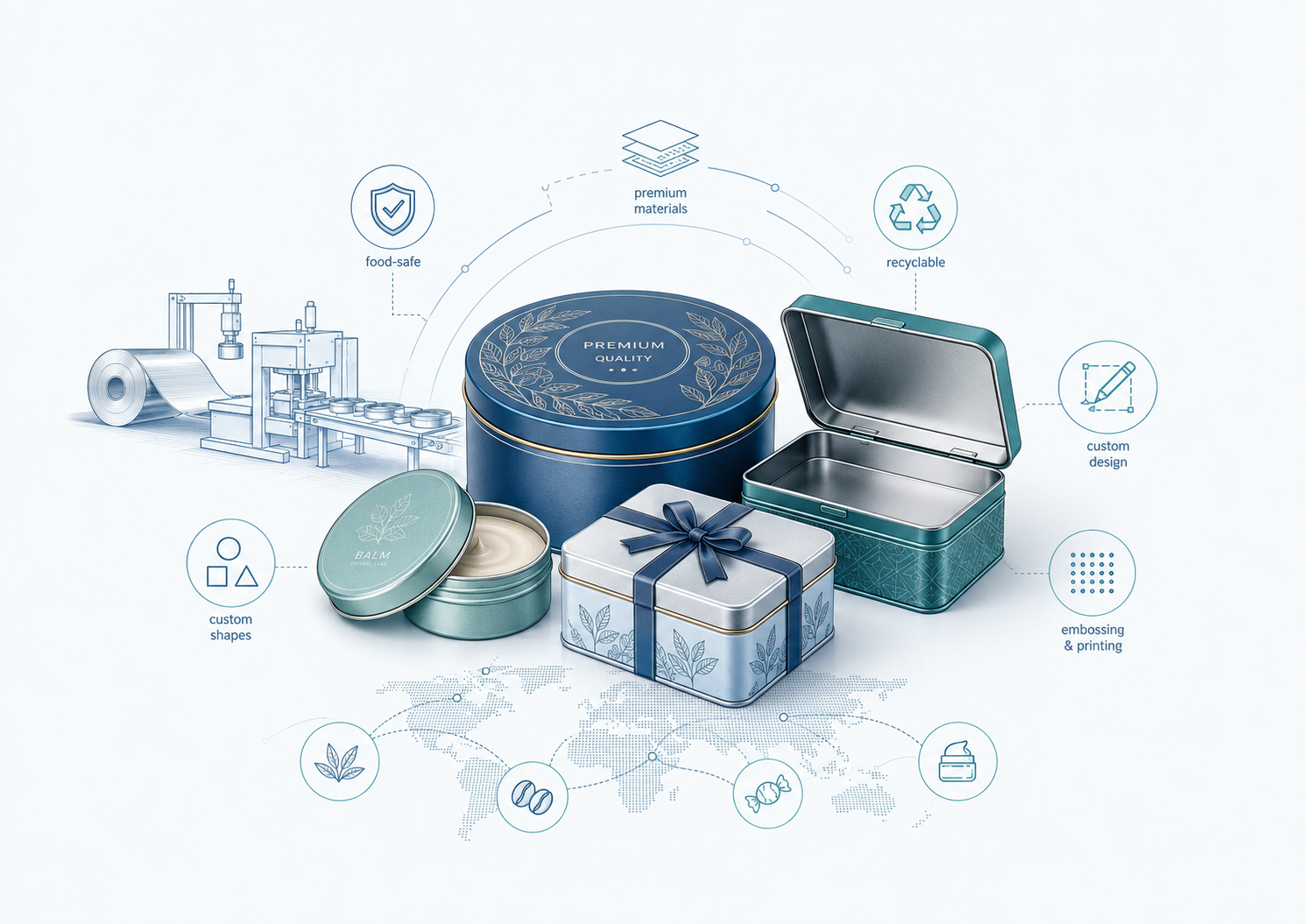
Custom metal packaging has moved far beyond the old idea of a simple tin container. For premium product brands, it can be a strategic packaging system: a protective structure, a brand asset, a shelf-impact tool, a reusable object, and a compliance-sensitive component of the product experience. A well-designed metal tin can help tea keep its aroma, make chocolate feel gift-worthy, give a cosmetics kit a stronger unboxing moment, turn a seasonal promotion into a collectible, or protect specialty components during transport.
This guide is written for brand owners, packaging managers, sourcing teams, product developers, private-label buyers, and marketing teams that need to choose custom metal packaging with commercial confidence. The goal is not to make the subject unnecessarily technical. The goal is to explain, in plain business language, how metal packaging works, what decisions matter, what data supports the choice, and how to discuss the project with a professional supplier.
At Mr. Tin Box, custom metal tin packaging is positioned for global brands across Food & Beverage Packaging, Beauty & Personal Care Packaging, Gift, Promotional & Holiday Packaging, and Specialty & Industrial Packaging. Those categories matter because a tea tin, a skincare gift box, a holiday biscuit tin, and a precision parts container do not need the same structure, coating, closure, insert, decoration, or documentation. Premium packaging should begin with the product and the business objective, not only with the shape.
Table of Contents
What Custom Metal Packaging Means
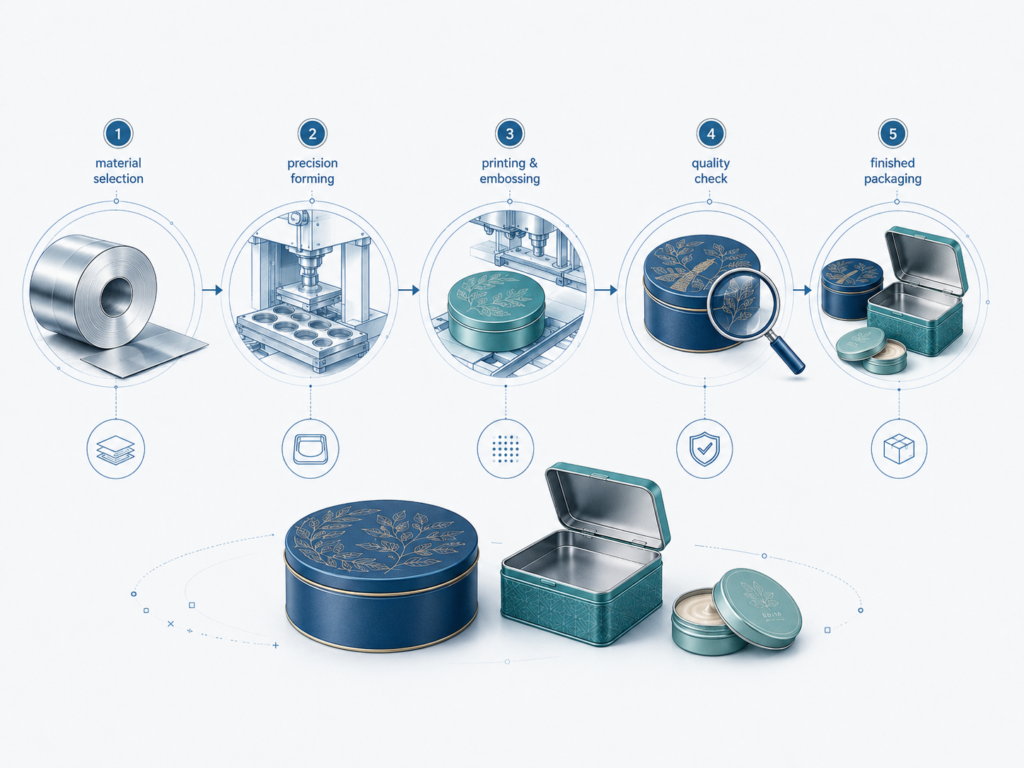
Custom metal packaging usually refers to a metal container engineered and decorated for a specific product, brand, campaign, or distribution need. In the premium consumer goods market, it often includes tinplate boxes, steel tins, aluminum containers, decorative metal cases, hinged tins, slip-lid tins, window tins, compartment tins, collector tins, and gift-ready metal packaging sets.
The word “custom” can mean several levels of customization. A brand may choose a standard round, rectangular, or square tin and customize the artwork. Another project may require a new structure, a unique lid system, a custom insert, a special window, a shaped embossing tool, or a completely new mold. Both can be valid choices. The right level of customization depends on launch timing, MOQ, budget, brand positioning, product sensitivity, and repeat-order potential.
Metal packaging is most commercially useful when it performs three jobs at the same time. First, it protects the product from handling, light, moisture, oxygen exposure, compression, or retail damage. Second, it communicates quality through weight, texture, closure feel, print quality, embossing, and surface finish. Third, it supports a credible sustainability story through durability, reuse potential, and recyclability.
A disposable wrapper disappears after purchase. A premium tin can stay in a kitchen, bathroom, office, travel bag, retail display, or gift collection long after the original product is consumed. That continued presence is a powerful branding advantage.
Why Premium Brands Choose Metal Packaging
Premium brands usually choose custom metal packaging for one of six reasons: shelf differentiation, protection, perceived value, gifting potential, reuse, or sustainability positioning. In many successful projects, several of these reasons overlap.
A metal tin has a tactile quality that paperboard and flexible pouches often cannot reproduce. The customer hears the lid, feels the edge, notices the rigidity, and sees light reflect from the printed and varnished surface. These small sensory signals can make the product feel more expensive before the customer even opens it. This is especially valuable for tea, coffee, chocolate, cookies, candy, cosmetics, fragrance samples, candles, wellness products, limited editions, and holiday gift lines.
Metal also gives brands more structural confidence. A tin can protect fragile cookies from crushing, reduce scuffing on beauty tools, keep a fragrance discovery set organized, or make a promotional gift look more permanent. For industrial and specialty products, the same durability can protect tools, electronic accessories, hardware samples, and small components from rough handling.
The sustainability argument is important, but it should be made carefully. Metal packaging is not “impact-free.” Every material has a footprint. However, steel and aluminum are well-established recyclable materials, and premium tins are often reused by consumers because they remain useful and attractive. The strongest claim is not that every tin is automatically the most sustainable option. The stronger and more credible claim is that custom metal packaging can support circular packaging goals when it is engineered for product protection, reuse, and recyclability.
For a deeper sustainability-focused internal reference, see Mr. Tin Box’s article on Sustainable Custom Metal Packaging, which explains how tin boxes can support circular packaging goals when material, structure, and reuse are planned together.
Market and Sustainability Data That Packaging Buyers Should Know
Data helps buyers make a business case. It also helps a packaging article sound credible instead of promotional. The following figures are useful because they connect metal packaging to market demand, recyclability, food-contact planning, circular economy policy, and product-waste reduction.
| Data point | Figure or rule | Why it matters for custom metal packaging |
|---|---|---|
| Global metal packaging market size | Grand View Research estimated the global metal packaging market at USD 148.13 billion in 2024 and projected USD 184.21 billion by 2030 at a 3.7% CAGR. | Metal packaging is not a niche decoration category. It is a large global packaging sector supported by food, beverage, personal care, industrial, and specialty applications. |
| Food and beverage share of metal packaging | The same Grand View Research report states that food and beverages led end use with 57.36% revenue share in 2024. | For brands selling tea, coffee, snacks, chocolate, cookies, candy, and specialty foods, metal packaging has a strong existing market logic. |
| U.S. steel packaging recycling performance | The U.S. EPA containers and packaging data estimated steel containers and packaging recycling at 1.6 million tons, or 73.8% of generation, in 2018. | Steel packaging has a strong recovery record in a major market, especially compared with many hard-to-recycle flexible formats. |
| U.S. plastic container and packaging recycling performance | The same EPA data estimated that plastic containers and packaging were recycled at 13.6% of generation in 2018. | This contrast helps explain why many brands are evaluating more recyclable or reusable formats for premium products. |
| EU packaging policy direction | The European Commission Packaging and Packaging Waste Regulation states that all packaging must be recyclable by 2030. | Export-oriented brands should design packaging with future recyclability expectations in mind, not only current retail appearance. |
| Food contact safety in the EU | The European Commission food contact materials page explains that food packaging and containers must comply with food-contact safety rules and must not endanger health or affect food quality. | Food-grade tin projects require early planning around coatings, contact type, documentation, and market requirements. |
| Food contact safety in the U.S. | The U.S. FDA explains that food contact substances used as food additives must be authorized for their intended use before marketing. | U.S.-market food packaging should be discussed with compliance documents, intended use, and migration considerations in mind. |
| Global plastic waste pressure | The OECD warned that global plastic waste is on track to almost triple by 2060 under current policies, with less than one fifth recycled. | This does not mean every plastic package is wrong, but it does support the business case for reusable and recyclable packaging redesign. |
| Food waste at consumer level | UNEP’s Food Waste Index Report 2024 reported around 1.05 billion tonnes of food wasted in 2022 at retail, food service, and household levels. | Packaging that helps preserve freshness, aroma, texture, and product integrity can reduce quality-related waste in suitable food categories. |
| Steel and circular economy logic | The World Steel Association emphasizes efficient design, durability, reuse, remanufacture, and recycling for steel products. | Tinplate packaging should be designed as a durable and recoverable material system, not merely a printed shell. |
These data points should not be used to claim that metal is always better than every alternative. That would be too simplistic. Packaging decisions depend on product type, filling method, distribution distance, consumer behavior, recycling infrastructure, total material weight, and regulatory requirements. What the data does show is that custom metal packaging has a strong strategic position when a brand needs premium presentation, protection, reuse value, and recyclability in one package.
Core Materials: Tinplate, Steel, and Aluminum
The most common custom tin box material is tinplate. Tinplate is a thin steel sheet coated with a thin layer of tin. The steel core gives strength and formability, while the tin layer helps with corrosion resistance and surface performance. For custom tins, the material is printed, varnished, cut, stamped, curled, assembled, and inspected. Depending on the product, the interior may also require a food-safe lacquer or protective coating.
Tinplate is especially common for food, tea, coffee, confectionery, gift, promotional, and specialty tin boxes. It is rigid enough to feel premium, formable enough for many shapes, and compatible with high-quality printing and finishing. It can also be magnetically separated in recycling systems, which supports a clearer end-of-life story in many markets.
Aluminum is another important metal packaging material. It is lightweight, corrosion-resistant, and widely used for beverage cans, cosmetic containers, closures, and specialty formats. For some personal care and beauty applications, aluminum can create a sleek modern appearance. However, not every custom tin box should be aluminum. Tinplate may be more cost-effective and structurally suitable for many box-style packaging projects.
The material decision should never be made only by appearance. Buyers should consider the product’s weight, intended reuse, corrosion risk, food-contact status, shipping conditions, retail positioning, decoration requirements, tooling cost, and target market.
Matching Metal Packaging to Product Categories
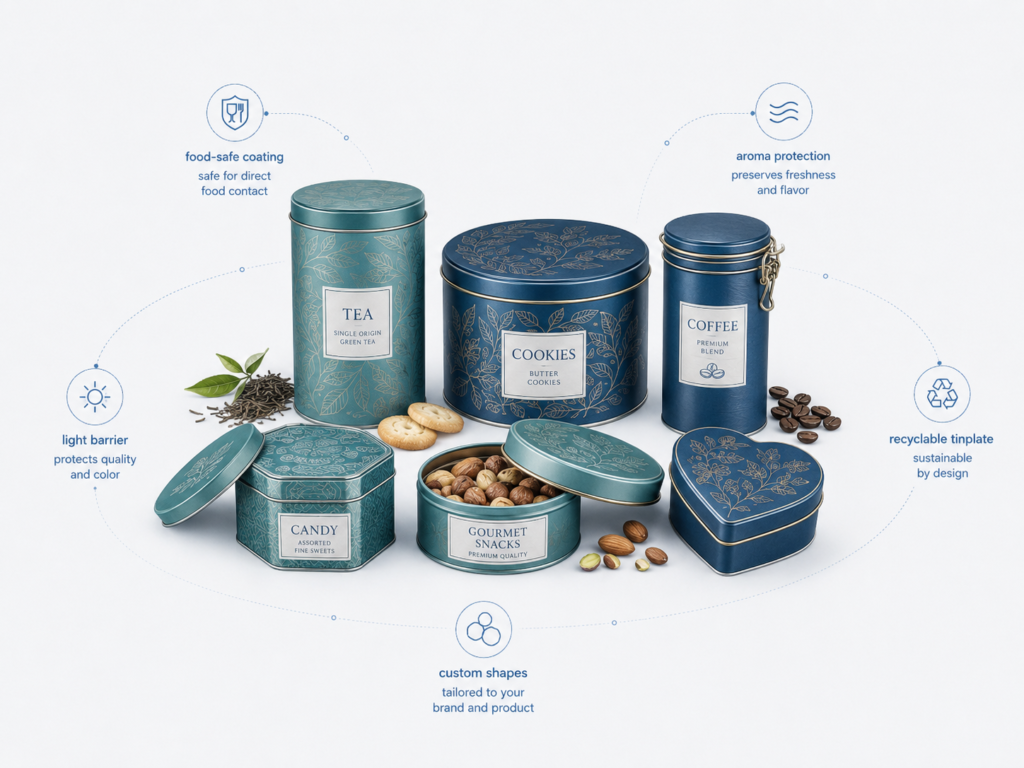
The best custom metal packaging projects start with the product category. Shape and artwork come later. The following category framework is useful for brand owners planning a new premium package.
| Product category | Common metal packaging goals | Key design questions |
|---|---|---|
| Tea, coffee, matcha, cocoa, spices | Aroma protection, moisture resistance, premium shelf presence, refill potential | Does the closure feel tight enough? Is an inner bag needed? Is the tin designed for storage after opening? |
| Chocolate, cookies, biscuits, candy | Gift value, crush protection, seasonal artwork, food-grade surfaces | Is direct food contact expected, or will product use inner wrapping? Will inserts prevent movement and breakage? |
| Skincare, cosmetics, fragrance, wellness | Luxury presentation, surface finish, kit organization, corrosion resistance | Does the formula contact the tin? Are inserts needed? Will the finish resist fingerprints and scuffing? |
| Corporate gifts and holiday campaigns | Memorability, collectible value, strong branding, fast recognition | Can the tin be reused after the campaign? Can artwork change seasonally without changing structure? |
| Specialty and industrial products | Impact resistance, compartment organization, long storage life, anti-scratch protection | Are foam, EVA, paperboard, or molded inserts needed? Is moisture or anti-static protection required? |
| E-commerce premium goods | Damage reduction, unboxing experience, outer carton efficiency | Can the tin survive parcel handling? Does it require a secondary carton or protective sleeve? |
Mr. Tin Box’s Custom Tin Box Guide makes the same practical point: a tin box should be evaluated as a business decision, not just a packaging style. Product sensitivity, material thickness, food-contact safety, closure design, inserts, printing, finishing, MOQ, lead time, logistics, and supplier capability should be clarified before artwork approval.
Food and Beverage Metal Packaging
Food and beverage brands often choose custom metal packaging because the package has to protect product quality and sell the product visually. Tea, coffee, chocolate, cookies, candy, nuts, mints, biscuits, spices, and specialty foods are common categories. Many of these products are sensitive to light, oxygen, moisture, aroma loss, physical breakage, or texture change.
A food tin may be used as primary packaging, secondary packaging, or gift packaging. That distinction is critical. If the product is in direct contact with the tin, the interior material, coating, and documentation become more important. If the product is wrapped in a sealed inner bag, the tin may mainly provide secondary protection, shelf value, and reuse appeal. Both scenarios can be food-related, but they do not require the same risk assessment.
Mr. Tin Box’s Food & Beverage Packaging page positions metal packaging for snacks, tea, coffee, chocolates, candies, and specialty foods, with a focus on tinplate, precision stamping, forming, durability, barrier properties, and food-grade suitability. For category-specific planning, the article Custom Tin Box for Tea, Coffee, Chocolate, Cookies, and Candy Packaging is a useful internal resource because it connects tin box structure to real food categories.
In practical buying terms, food brands should clarify five points early. First, is the tin for direct food contact or secondary packaging? Second, what is the food chemistry: dry, oily, acidic, aromatic, powdery, or hygroscopic? Third, what is the intended shelf life and storage environment? Fourth, which market requirements apply: U.S., EU, UK, Japan, domestic retail, or another target market? Fifth, what documents will retailers, importers, or distributors request before launch?
Food-grade packaging is not a label that applies equally to every product. It is a match between material, coating, product, contact time, temperature, and jurisdiction. This is why food packaging buyers should avoid choosing a tin only because it looks beautiful. The correct sequence is product requirement first, compliance logic second, design and decoration third.
Beauty and Personal Care Metal Packaging
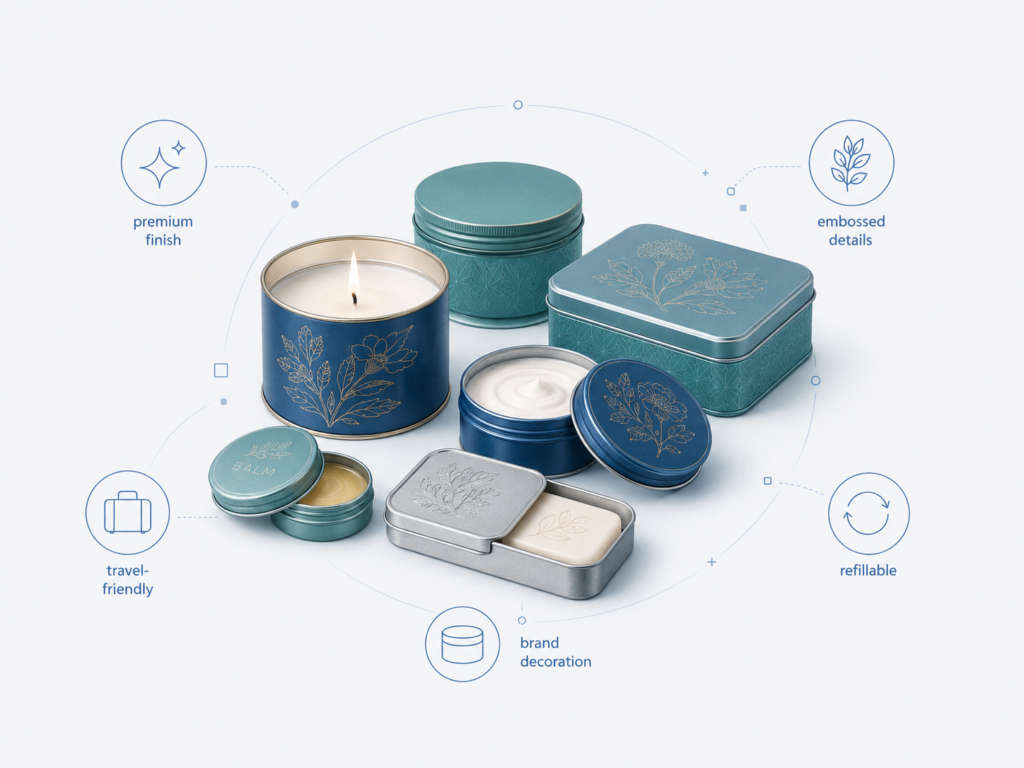
Beauty and personal care brands use metal packaging for a different reason: sensory value. Cosmetics buyers often judge quality from the package before they test the product. A tin with a soft-touch matte finish, pearl texture, metallic ink, embossed logo, or precisely fitted insert can make a skincare set feel more curated and giftable.
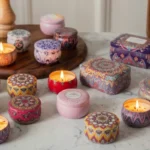
Metal packaging is suitable for soaps, solid perfumes, fragrance discovery kits, cosmetic tools, lip balm sets, facial mask kits, essential oil gift sets, wellness items, candles, sample programs, and limited-edition collections. It can also support refill behavior when the durable tin is retained and refilled with lighter secondary packs.
However, cosmetics packaging also requires careful planning. If the formula directly contacts the metal, coating compatibility becomes important. If the metal box is secondary packaging, the main priorities may be presentation, insert fit, surface durability, and shipping protection. If the product includes glass bottles or fragile cosmetic tools, the inner structure may matter more than the outer artwork.
Mr. Tin Box’s Beauty & Personal Care Packaging page describes custom metal containers for skincare, cosmetics, fragrances, and personal care products, with emphasis on protection, aesthetics, corrosion-resistant materials, and surface treatments. For brands selling premium sets, the main lesson is simple: the outside should attract attention, but the inside must hold products securely and elegantly.
Gift, Promotional, and Holiday Metal Packaging
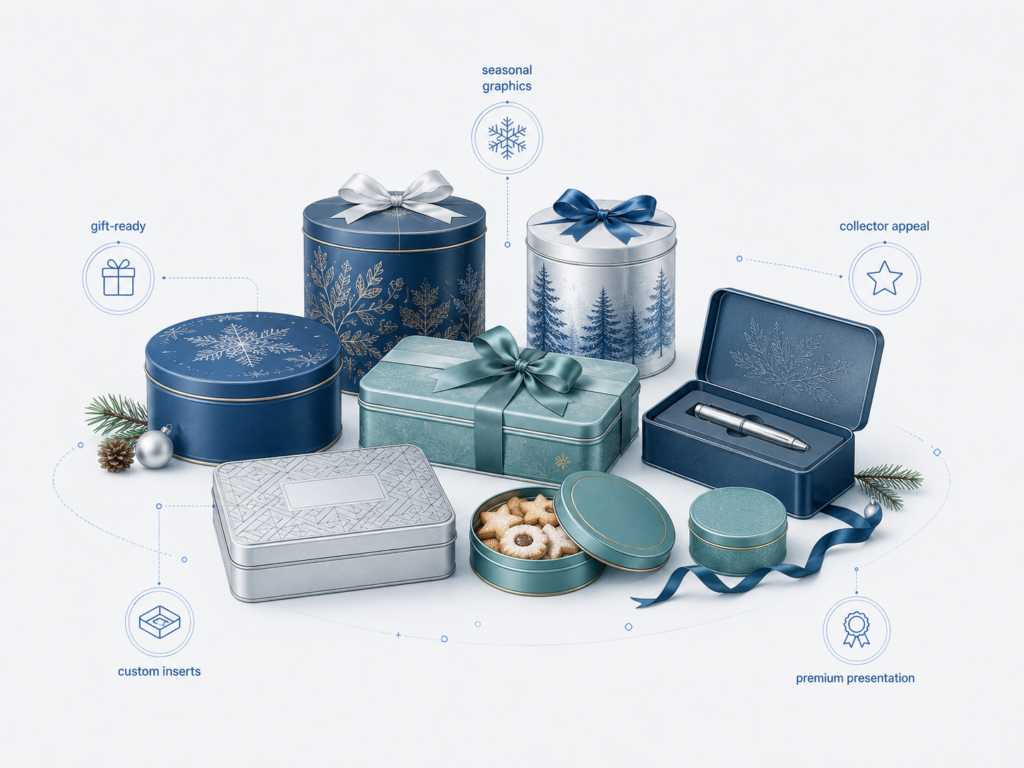
Gift and promotional packaging is where custom metal packaging often delivers its strongest emotional value. Holiday tins, promotional tins, corporate gift boxes, collector tins, festival packaging, and limited-edition product launches are designed to be noticed, kept, photographed, and remembered.
A metal gift tin has a clear advantage over disposable seasonal packaging because it can become part of the gift. Customers may keep it for storage, display, decoration, or collection. This reuse value helps brands extend campaign visibility long after the selling season ends. A Christmas cookie tin, a Valentine’s chocolate tin, a Lunar New Year tea tin, a corporate sample kit, or a limited-edition cosmetic box can remain in the customer’s home or office for months.
Mr. Tin Box’s Gift, Promotional & Holiday Packaging page highlights refined presentation, durable protection, memorable unboxing, personalized shapes, colors, embossing, and inserts. That is exactly the buying logic for gift packaging: the tin must look premium, protect the contents, and feel worth keeping.
For promotional campaigns, brands should also think about cost control. A fully custom shape may be memorable, but it can increase tooling cost and lead time. A standard structure with strong seasonal artwork, embossing, and a good insert may deliver better ROI for a one-time campaign. For annual programs, a shared structure with changing artwork can be more efficient because the mold investment can support multiple seasons.
Specialty and Industrial Metal Packaging
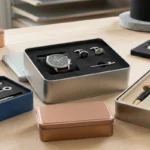
Specialty and industrial products use metal packaging for protection, organization, and durability. These projects may include tool kits, spare parts, electronic accessories, hardware samples, repair kits, collectible parts, technical samples, or B2B demonstration sets. The package may need to survive repeated handling, protect sharp or delicate components, and keep multiple parts organized.
This is where internal structure becomes critical. EVA foam, molded pulp, paperboard dividers, plastic trays, anti-scratch liners, anti-static inserts, or custom holders may be needed. The outer tin gives rigidity, but the insert controls product movement. A strong tin with a weak insert can still fail during transport.
Mr. Tin Box’s Specialty & Industrial Packaging page emphasizes high-strength metal packaging for tools, hardware, electronics, sensitive components, high-impact resistance, protective surface finishes, fitted trays, and stable protection. For industrial buyers, the commercial value is not only shelf appeal. It is fewer damaged items, better organization, more professional samples, and packaging that can continue to be used after delivery.
Product Protection and Shelf Life
Packaging is often discussed as branding, but product protection is the foundation. A premium package that fails to protect the product is not premium at all. It creates returns, customer complaints, retailer problems, replacement costs, and brand damage.
Metal packaging can support product protection in several ways. The rigid body resists crushing better than many flexible formats. The printed and varnished exterior can resist scuffing when specified correctly. The lid and closure system can reduce exposure to dust, handling, light, moisture, or oxygen, depending on structure and use. Inserts can prevent products from moving inside the tin. Secondary cartons can be optimized to prevent denting during long-distance shipping.
For food products, protection may mean maintaining aroma, texture, appearance, and freshness. For beauty products, it may mean keeping a set organized and preventing glass bottles or tools from hitting each other. For gift products, it may mean protecting the product and the unboxing experience at the same time. For industrial products, it may mean impact resistance and organization.
Mr. Tin Box’s article Why Metal Packaging Boosts Shelf Life and Brand Value is useful for explaining this dual role. Metal packaging can help block oxygen, light, moisture, and contamination while also increasing perceived brand value. The strongest projects combine both benefits: the tin protects the product physically and makes the product feel worth a premium price.
Food-Contact and Compliance Planning
Food-contact planning should begin before sampling. It should not be treated as a final checkbox. The reason is simple: compliance requirements can affect material, coating, internal surface, artwork, documentation, test scope, and lead time. If these decisions are made late, the project may require redesign or delayed approval.
For U.S.-market food packaging, the FDA explains that food contact substances that are food additives must be authorized for their intended use before marketing. For the EU, the European Commission explains that food contact materials must not release substances into food in a way that endangers health, changes food composition, or affects taste or smell. These principles are highly relevant when a custom metal package may directly contact food.
Buyers should be precise when they ask suppliers for “food-grade” packaging. Better questions include:
- Is the product in direct contact with the metal, or is there an inner bag, tray, cup, paper liner, or sealed wrapper?
- What is the food type: dry tea, oily nuts, chocolate, acidic candy, powder, biscuit, coffee, spice, or another product?
- What is the expected contact time and storage temperature?
- What coating or lacquer is used on the interior?
- Which market documents are available for the substrate, coating, and finished package?
- Does the final package require migration testing or other specific third-party testing for the target market?
Mr. Tin Box has two useful internal resources for this topic: Food-Grade Custom Metal Packaging: What Buyers Should Know Before Production and Food Grade Custom Tin Box Packaging: Materials, Coatings, and Safety Considerations. These are good internal links because they help buyers understand that food-grade suitability depends on the full packaging system, not only on the word “tin.”
Structure Design: Shape, Closure, and Usability
Structure is where packaging becomes engineering. A beautiful tin shape is not enough. The package must open correctly, close reliably, stack efficiently, protect the product, support the artwork, and fit the carton system.
Common tin structures include round tins, rectangular tins, square tins, hinged tins, slip-lid tins, plug-lid tins, window tins, tray-style tins, compartment tins, drawer tins, and shaped promotional tins. Each option has advantages and tradeoffs.
A hinged tin can feel premium and convenient, but hinge alignment must be consistent. A slip-lid tin can be cost-effective and simple, but the lid fit must be controlled. A window tin can show the product, but the window material and assembly method may affect recyclability and food-contact planning. A shaped tin can create strong shelf impact, but it can increase tooling investment, packing inefficiency, and lead time.
For premium brands, usability matters as much as visual design. If the lid is too tight, customers may struggle to open it. If it is too loose, the package may feel cheap or may open during handling. If the edges feel sharp, the experience is poor. If the base is unstable, the tin may tip on shelf. If the inner volume is wrong, the product may rattle or look underfilled.
The best structure is not always the most unusual one. It is the structure that fits the product, supports the brand, protects the contents, and can be produced consistently at the required quantity.
Printing and Finishing: Turning Metal into Brand Value
Printing and finishing are where metal packaging becomes emotionally powerful. A plain tin can protect the product, but a well-finished tin can make the product feel collectible, premium, and memorable.
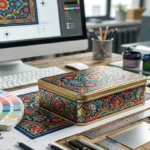
Common decoration options include CMYK printing, Pantone spot colors, metallic inks, matte varnish, glossy varnish, satin finish, soft-touch coating, texture varnish, spot UV, embossing, debossing, foil stamping, pearlescent effects, brushed looks, and registered embossing. These processes can be combined, but more is not always better.
A clean matte surface with a single embossed logo may feel more premium than a crowded design with too many effects. A glossy finish may make colors look brighter, but it may show fingerprints more easily. Soft-touch can create a luxury feel, but buyers should discuss scuff resistance and handling. Embossing can add tactile value, but it requires tooling and precise artwork planning.
For a detailed internal reference, see Metal Tin Box Finishing Options: Matte, Glossy and More. That article is especially useful for buyers who need to compare finishes in practical terms instead of choosing by sample photos alone.
When specifying finishes, buyers should provide a clear artwork file, Pantone references when needed, surface finish requirements, embossing depth expectations, varnish type, special effect locations, tolerance expectations, and sample approval criteria. Vague instructions like “make it premium” are not enough for mass production.
Inserts, Trays, and the Inside Experience
Many premium packaging projects fail because the outer tin looks good but the inside feels unfinished. Inserts are not secondary details. They are part of protection, presentation, and perceived value.
A chocolate tin may need a food-safe tray or paper cups. A cosmetic set may need an EVA insert, molded tray, or paperboard holder. A tea gift set may need compartments for tins, spoons, cards, and sample packs. An industrial sample kit may need foam cutouts or dividers. A promotional package may need a reusable layout that still looks good after the first opening.
The insert must solve real problems: product movement, breakage, noise, alignment, organization, and unboxing sequence. It should also match the sustainability story. If a paperboard insert can do the job, it may be preferable to foam. If foam is needed for protection, it should be used intentionally and sized efficiently.
Good insert design also affects shipping. A loose product inside a tin can dent the tin from the inside, scratch the finish, or create a cheap rattling sound. A proper insert makes the package feel controlled and premium.
Sustainability: Reuse, Recyclability, and Honest Claims
Sustainability is one of the strongest reasons to consider custom metal packaging, but it should be communicated responsibly. Buyers should avoid vague claims like “100% eco-friendly.” Instead, the language should be specific: reusable, recyclable where facilities exist, made from metal, designed for long-term use, compatible with circular packaging goals, or suitable for refill concepts when applicable.
There are three practical sustainability advantages to consider.
First, metal packaging can be reused. A tin that customers keep for storage, display, refills, or collectibles continues to deliver value after the first purchase. Reuse is especially strong in tea, coffee, cookies, chocolate, candy, cosmetics, holiday gifts, corporate gifts, and specialty products.
Second, metal packaging can be recyclable. Steel and aluminum are established recycling materials in many markets. Steel packaging can often be sorted magnetically, while aluminum has strong scrap value. However, recyclability still depends on local systems, package design, contamination, and mixed-material components.
Third, metal packaging can reduce product waste when it protects the product effectively. A package that prevents crushing, moisture damage, aroma loss, or early quality failure can reduce waste even if the package itself is not the lightest option.
The key is design discipline. Avoid unnecessary mixed materials. Make windows, labels, magnets, trays, and inserts easy to separate where possible. Do not overbuild the tin beyond functional need. Choose the right thickness for durability without wasting material. Design a shape customers will actually reuse.
For global brands, the EU direction is especially important. The European Commission’s packaging rules show that recyclability and clearer labeling expectations are becoming more important by 2030. Even brands outside Europe should pay attention because large retailers often adopt global packaging standards based on leading regulatory markets.
Cost, MOQ, and Lead Time Planning
Custom metal packaging cost is shaped by more than size. Buyers should expect the quote to reflect structure, material thickness, tin dimensions, order quantity, printing complexity, finish stack, tooling, mold development, insert design, assembly steps, packing method, inspection requirements, and shipping.
MOQ exists because metal packaging production has setup costs. Printing metal sheets, adjusting equipment, preparing tooling, stamping, forming, finishing, assembling, and inspecting all require production efficiency. A low quantity may be possible for some standard shapes or sample runs, but a highly customized structure usually needs a higher MOQ to make the project economical.
Lead time also has multiple parts. A buyer may think only about production days, but a custom tin project includes requirement review, 3D structure design, artwork confirmation, mold or tooling development, sample making, sample approval, metal sheet printing, curing, stamping, assembly, insert production, final inspection, packing, and logistics.
Mr. Tin Box’s internal guide MOQ and Lead Time Planning for Your Custom Tin Box explains this clearly. MOQ and lead time are not just supplier numbers; they are planning variables that affect cash flow, launch timing, inventory risk, and campaign reliability.
| Project type | Typical planning logic | Cost and timing implications |
|---|---|---|
| Standard structure with custom printing | Best for faster launches, lower risk, and moderate customization | Lower tooling burden; suitable for seasonal or first-time projects |
| Existing mold with premium finish | Best for brands that want stronger shelf impact without new structure | Finish and artwork drive cost more than shape |
| New custom shape | Best for long-term SKU programs or high-value campaigns | Higher tooling cost, longer development time, stronger differentiation |
| Food-contact direct packaging | Best when the tin is part of the functional product system | Requires more careful coating, documentation, and testing planning |
| Gift set with insert | Best for retail gift, cosmetics, holiday, or promotional programs | Insert development affects cost, sampling, and assembly time |
| Industrial kit tin | Best for samples, components, tools, or technical accessories | Requires protection testing, insert control, and functional validation |
The most professional approach is to request several quantity levels. Instead of asking only “What is the cheapest price?”, ask for price breaks at realistic order quantities and compare unit price, total investment, storage cost, launch timing, and reorder strategy.
Quality Control: What to Inspect Before Mass Production
Quality control should be defined before production, not after a problem appears. A custom metal package has several quality dimensions: appearance, dimensions, lid fit, closure feel, surface finish, print color, coating condition, edge safety, hinge alignment, insert fit, packing strength, and carton protection.
For appearance, buyers should approve color standards, finish samples, artwork placement, embossing location, and acceptable tolerance. For dimensions, they should confirm outer size, inner volume, lid height, seam position, and stacking behavior. For closure, they should test opening force, repeated use, and transport stability. For surfaces, they should inspect scratches, dents, varnish defects, dust, print misregistration, and sharp edges.
Food-related projects may need additional documentation or testing, depending on target market and contact scenario. Industrial projects may require drop tests, vibration checks, insert retention tests, or corrosion considerations. Gift projects may require retail display checks and unboxing consistency.
Mr. Tin Box’s homepage describes a workflow that includes consultation, 3D structure design, mold development or sample making, printing and surface finishing, stamping and assembly, and quality inspection. That workflow is important because premium packaging quality is not produced at the final inspection stage alone. It is built through each step.
Supplier Evaluation: What Premium Brands Should Look For
A good custom metal packaging supplier should not simply ask for artwork and quote a price. The supplier should ask about the product, contact scenario, order quantity, deadline, target market, channel, pack-out method, insert needs, and quality expectations.
When evaluating suppliers, buyers should look for these capabilities:
- Experience with the target category, such as food, cosmetics, gifts, or industrial products.
- Ability to provide structure design and 3D drawing support.
- Understanding of tinplate, aluminum, coatings, printing, finishing, and assembly.
- Mold development or access to existing molds that reduce cost and lead time.
- Sampling capability before mass production.
- Clear communication around MOQ, lead time, price breaks, and tooling costs.
- Food-contact documentation support when needed.
- Quality control procedures for appearance, dimensions, closure, and packing.
- Export experience and packaging methods suitable for long-distance shipping.
- Willingness to explain tradeoffs instead of pushing the most expensive option.
Mr. Tin Box is commercially relevant because the website presents category-specific packaging solutions rather than treating all metal packaging as one generic offer. The site also gives buyers several practical entry points: Food & Beverage Packaging, Beauty & Personal Care Packaging, Gift, Promotional & Holiday Packaging, Specialty & Industrial Packaging, and process-focused articles such as How to Order a Custom Tin Box from Concept Design to Mass Production.
RFQ Checklist for Custom Metal Packaging Buyers
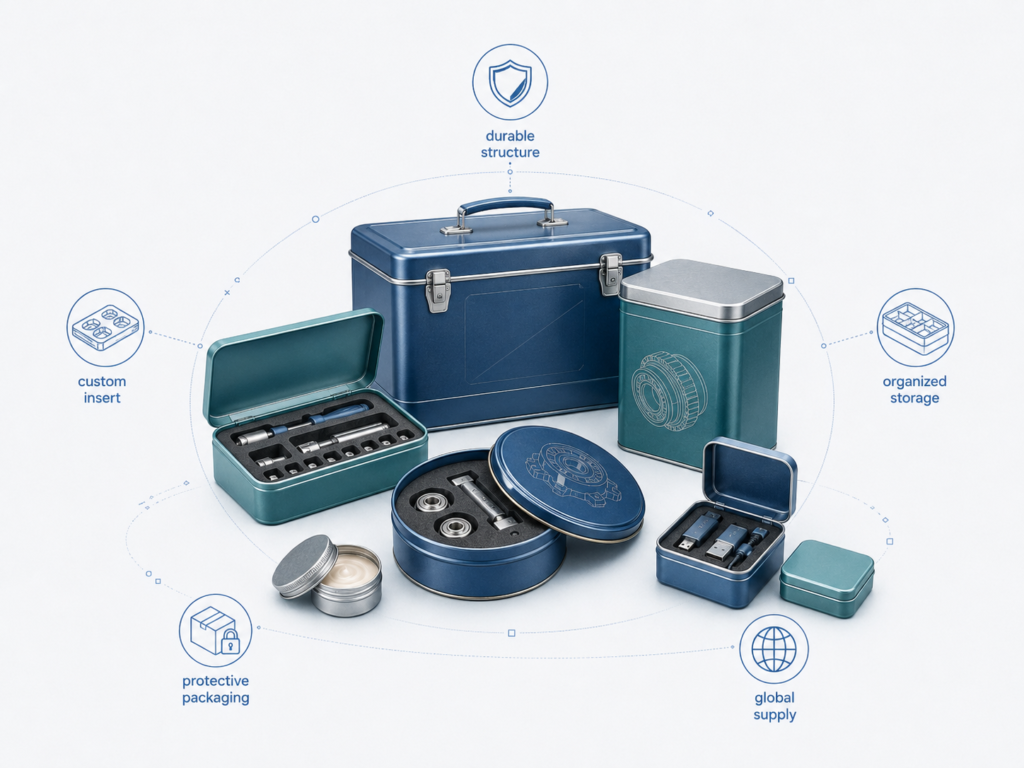
A clear RFQ saves time and improves quote accuracy. Before contacting a supplier, prepare the following information.
| RFQ item | What to prepare | Why it matters |
|---|---|---|
| Product type | Tea, coffee, chocolate, cosmetics, gift set, tool kit, electronics, etc. | The product category drives material, coating, insert, and protection decisions. |
| Packaging role | Primary packaging, secondary packaging, gift packaging, refill container, sample kit | The role affects compliance, structure, and cost. |
| Contact scenario | Direct food contact, indirect contact, no food contact, cosmetic contact, industrial use | This determines whether food-contact or formula compatibility planning is needed. |
| Size and capacity | Product dimensions, target tin size, fill volume, product weight | Accurate sizing prevents rattling, underfilled appearance, and shipping inefficiency. |
| Shape preference | Standard round, square, rectangular, hinged, window, custom shape | Shape drives tooling, MOQ, lead time, and shelf impact. |
| Artwork status | Final artwork, concept artwork, brand guide, Pantone colors | Artwork readiness affects sampling and production schedule. |
| Finish requirements | Matte, gloss, satin, soft-touch, embossing, foil, spot UV | Finish stack affects cost, durability, and production complexity. |
| Insert needs | EVA, foam, paperboard, tray, molded pulp, divider, none | Inserts affect protection, unboxing, and assembly cost. |
| Quantity plan | First order quantity, annual forecast, repeat-order potential | Quantity affects unit price, tooling strategy, and production planning. |
| Deadline | Launch date, retail delivery date, trade show date, seasonal window | Deadline determines whether custom tooling is realistic. |
| Target market | U.S., EU, UK, domestic, Japan, Middle East, etc. | Market affects documentation and compliance expectations. |
| Logistics | Bulk packing, retail carton, e-commerce protection, palletization | Packing decisions affect damage rate and landed cost. |
This checklist is especially important for premium brands because the lowest unit price is rarely the best decision. A tin that arrives late, damages the product, fails retailer review, or looks inconsistent will cost more than a better-planned package.
Common Mistakes to Avoid
The first common mistake is choosing a special shape before defining product requirements. A unique shape may look impressive, but it can increase tooling cost, reduce packing efficiency, create lid-fit problems, or delay launch. Shape should support product and brand objectives.
The second mistake is treating “food-grade” as a single universal label. Food-contact suitability depends on product chemistry, contact time, temperature, coating, market, and documentation. Buyers should ask precise questions instead of assuming that all tins are suitable for all foods.
The third mistake is ignoring the insert. Premium packaging is judged from the inside as well as the outside. A beautiful tin with a loose, noisy, or cheap-looking insert weakens the customer experience.
The fourth mistake is overdecorating the tin. Matte, gloss, embossing, foil, spot UV, metallic ink, and texture can all be useful, but too many effects can increase cost and production risk without improving sales. A restrained premium design often performs better.
The fifth mistake is underestimating lead time. Custom metal packaging includes design, sampling, tooling, printing, forming, finishing, assembly, inspection, and shipping. Seasonal products should be planned early.
The sixth mistake is making sustainability claims that are too broad. “Eco-friendly” is weak and risky. More credible claims focus on specific attributes such as reusable design, recyclable metal, refill potential, durable protection, or reduced product damage.
The seventh mistake is comparing suppliers only by unit price. A lower price may hide thinner material, weaker coating, poor print consistency, unclear documentation, or inadequate packing. Premium brands should compare total risk, not just unit cost.
How to Build a Premium Metal Packaging Strategy
A strong strategy begins with the customer promise. What should the customer feel when they see, hold, open, reuse, and remember the package? A tea brand may want calm, freshness, and ritual. A chocolate brand may want gift value and indulgence. A cosmetics brand may want elegance and sensory refinement. A corporate gift program may want memorability. An industrial brand may want reliability and precision.
Once the customer promise is clear, translate it into engineering requirements. What does the package need to protect? How many units will be produced? Will the tin be used once, reused, refilled, or collected? Will it be shipped through e-commerce, distributors, or retail pallets? Does it need food-contact documentation? Will artwork change seasonally? Is there a reorder plan?
Then choose the structure, material, finish, and insert around those requirements. The best packaging is usually the result of disciplined tradeoffs. It is not always the most expensive structure or the most complex finish. It is the package that gives the brand the highest practical value for the market.
For design inspiration, Mr. Tin Box’s article 10 Creative Custom Metal Tin Packaging Design Ideas offers useful directions such as collectible tins, unique shapes, premium finishes, smart packaging, eco-friendly design, and custom compartments. Inspiration is valuable, but the final design should still be validated through sampling, cost review, and production feasibility.
Practical Examples by Brand Goal
| Brand goal | Recommended metal packaging approach | Why it works |
|---|---|---|
| Launch a premium tea line | Rectangular or round tin with inner bag, matte finish, aroma-focused closure, and refill messaging | Balances shelf value, product protection, and reuse. |
| Upgrade chocolate gifting | Hinged or slip-lid tin with food-safe inner tray, seasonal artwork, and embossing | Creates gift value while protecting fragile contents. |
| Build a cosmetics discovery set | Shallow hinged tin with EVA or paperboard insert, soft-touch finish, and subtle logo embossing | Improves unboxing and keeps small products organized. |
| Create a holiday limited edition | Existing mold with new artwork, metallic highlights, and collectible series design | Controls tooling cost while increasing seasonal appeal. |
| Promote a B2B sample kit | Reinforced rectangular tin with foam insert and printed technical branding | Protects samples and remains useful after the sales meeting. |
| Support a refill model | Durable reusable tin with simple labeling and lightweight refill packs | Makes circular packaging behavior easy for customers. |
These examples show that custom metal packaging is not one fixed format. It is a toolkit. The right design depends on what the brand wants the package to do commercially.
FAQ
No. It is especially effective for premium and gift-oriented products, but it can also work for mid-market brands, promotional campaigns, food products, cosmetics, industrial samples, and refill systems. The key is matching the structure and finish to the price point.
Tinplate can be used in food-related packaging, but suitability depends on the full system: material, coating, product type, direct or indirect contact, contact time, temperature, and target market requirements. Buyers should request the right documentation and clarify the intended use early.
No. Many projects can use existing standard molds and customize the printing, finish, embossing, or insert. A new mold is useful when the brand needs a unique structure, special size, or long-term product line differentiation.
Use existing molds when possible, simplify finish combinations, choose efficient dimensions, reduce unnecessary mixed materials, provide complete artwork early, and compare realistic quantity tiers. Cost control should not mean weakening protection or quality.
Steel and aluminum are widely recyclable materials in many markets, and steel can often be magnetically sorted. However, real recyclability depends on local infrastructure, package design, contamination, and mixed-material components. Brands should make precise claims rather than vague environmental promises.
The biggest advantage is the combination of protection and perceived value. A metal package can protect the product, feel premium, support reuse, and strengthen brand memory at the same time.
Start as early as possible, especially for food-contact packaging, custom shapes, seasonal campaigns, or gift sets with inserts. The best time to discuss structure, coating, artwork, MOQ, testing, and lead time is before the design is finalized.
Final Thoughts: Custom Metal Packaging as a Business Asset
Custom metal packaging is not simply a container. For premium product brands, it can be a business asset that protects product quality, improves shelf impact, increases perceived value, supports reuse, and gives the brand a more credible packaging story.
The best projects begin with practical questions: What product are we protecting? What experience should the customer remember? What market requirements apply? What quantity makes financial sense? What structure can be produced consistently? What finish supports the brand without creating unnecessary risk? What documentation will be needed before launch?
When these questions are answered clearly, custom metal packaging becomes much easier to specify, quote, sample, produce, and scale. A good tin is not only beautiful. It is functional, manufacturable, protective, brand-aligned, and commercially realistic.
For brands preparing a food, beauty, gift, promotional, holiday, specialty, or industrial packaging project, Mr. Tin Box provides a practical starting point through category-specific packaging solutions, custom structure development, printing and finishing options, sampling, quality inspection, and project guidance. To move from idea to production, review the internal guide How to Order a Custom Tin Box from Concept Design to Mass Production and prepare a clear RFQ with product details, target market, quantity plan, artwork, finish requirements, insert needs, and deadline.
A premium product deserves packaging that protects it, sells it, and stays useful after the first purchase. That is where custom metal packaging can create long-term value.