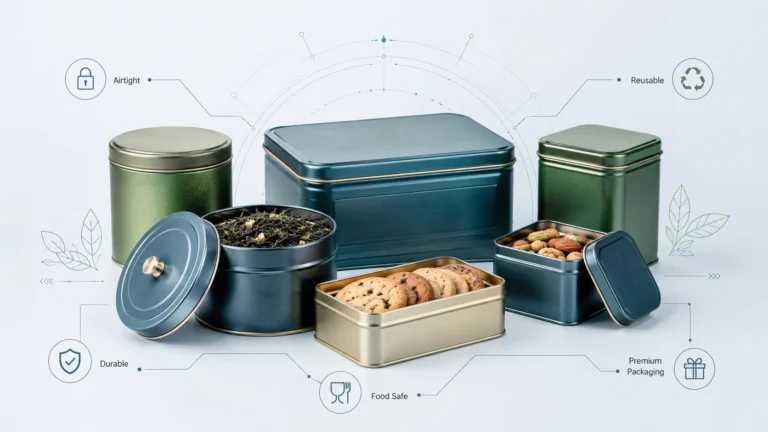

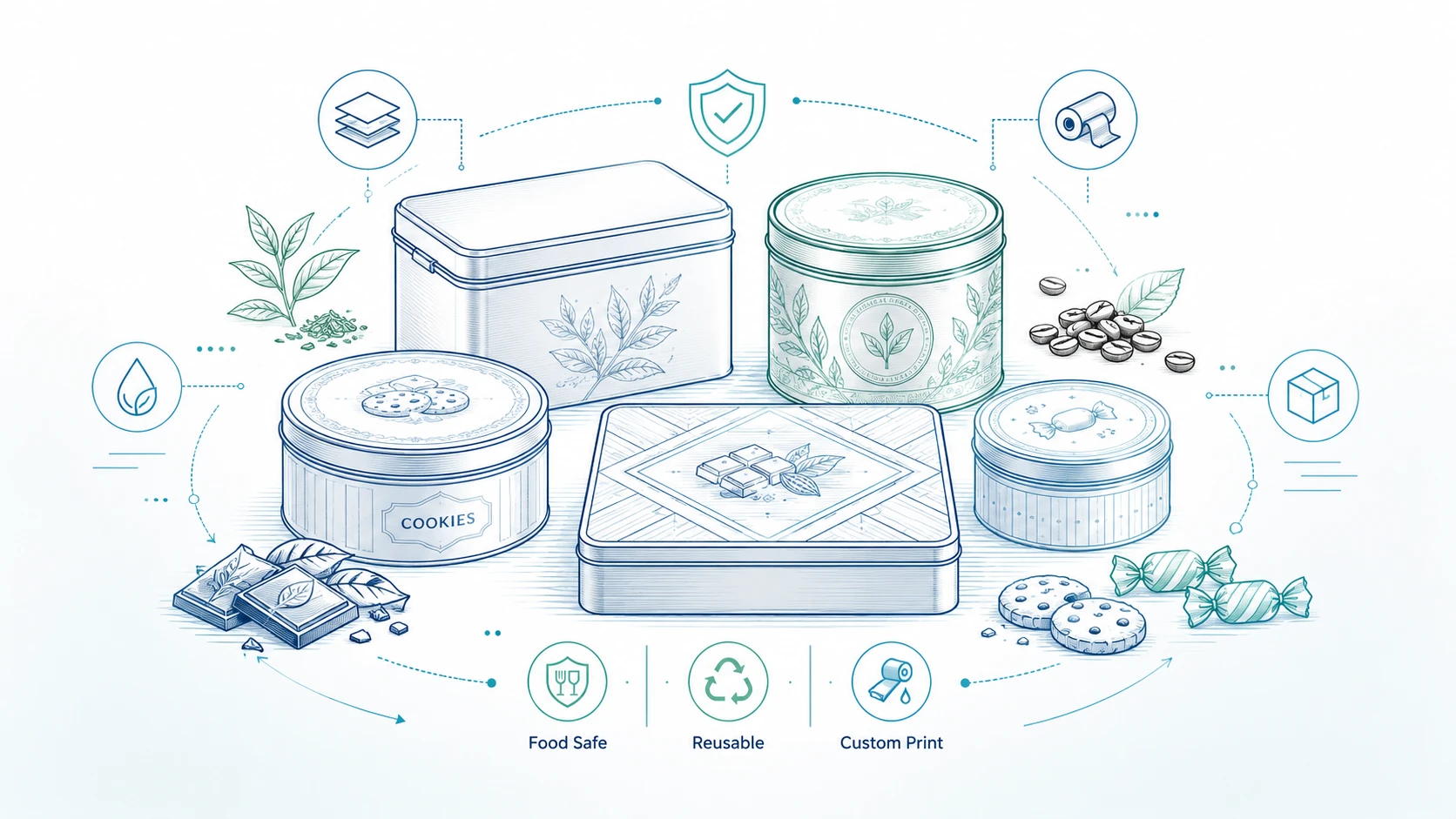

A custom tin box is more than a decorative container for tea, coffee, chocolate, cookies, and candy. For a food brand, it can become a practical packaging system that protects aroma, controls moisture risk, improves shelf presence, supports gifting value, and helps the product feel worth a higher price. For an importer, distributor, private-label buyer, or retail brand, the right tin also affects carton loading, lead time, testing documents, barcode placement, seasonal promotion planning, and repeat-order stability.
This article explains how to select and develop custom tin box packaging for five common food categories: tea, coffee, chocolate, cookies, and candy. The goal is not to make packaging sound complicated. The goal is to make the buying decision clearer. A tin may look simple from the outside, but the commercial result depends on many small decisions: size, shape, lid style, internal lacquer, insert, tray, paper wrap, window, artwork, surface finish, carton method, food-contact scenario, and final inspection. When these details are planned early, a custom tin box can become one of the strongest parts of the product offer.
At Mr. Tin Box, custom metal packaging is positioned for global brands across Food & Beverage Packaging, Beauty & Personal Care Packaging, Gift, Promotional & Holiday Packaging, and Specialty & Industrial Packaging. For food and beverage projects, the company highlights food-grade metal packaging for tea, coffee, snacks, confectionery, and specialty foods, with attention to barrier protection, food-safe coatings, precision stamping, and surface finishing. That is the right starting point for this article: the best food tin is not only attractive; it must be suitable for the product, the supply chain, and the target market.
Table of Contents
Why custom tin box packaging works well for premium food brands
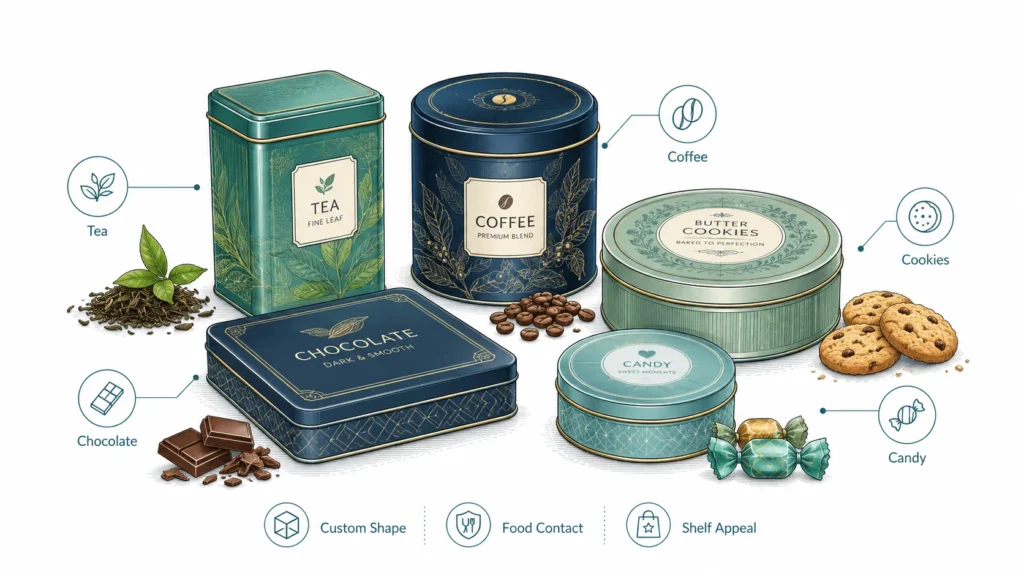
Food packaging has two obvious jobs: it protects the product and helps sell the product. In premium food categories, it also has a third job: it gives the product a second life in the consumer’s home. A paper carton is often thrown away soon after opening. A durable tea tin, coffee tin, cookie tin, or chocolate tin may stay in the kitchen, pantry, desk drawer, or gift shelf for months. That reuse is not just a sustainability story; it is repeated brand exposure.
The commercial value of a custom tin box is especially strong for products where presentation matters before the first bite or first brew. Tea buyers often judge a blend by the container before they smell the leaves. Coffee buyers care about freshness, origin, roast profile, and the feeling of craft. Chocolate buyers expect gifting value, clean arrangement, and protection from scuffing. Cookie buyers respond to seasonal artwork, family-size presentation, and collectible tins. Candy buyers often respond to bright colors, fun shapes, and convenient repeat opening. A custom tin box can support all of these purchase triggers.
Metal packaging also has a strong material story. The global metal packaging market was estimated at USD 148.13 billion in 2024 and is projected by Grand View Research to reach USD 184.21 billion by 2030, with food and beverages representing the leading end-use segment in 2024. That does not mean every food product needs a tin. It means metal packaging remains commercially important in food and beverage because brands continue to value shelf life, product protection, and premium presentation. For buyers who want a reusable and recyclable-looking package, a metal tin can fit both branding and functional requirements.
Public waste and recycling data also explain why packaging format matters. The U.S. Environmental Protection Agency reports that containers and packaging accounted for 82.2 million tons of U.S. municipal solid waste generation in 2018, or 28.1% of total generation. On the same EPA page, steel containers and packaging achieved an estimated 73.8% recycling rate in 2018. In Europe, Eurostat reported that the EU generated 83.4 million tonnes of packaging waste in 2022, equal to 186.5 kg per inhabitant, while metal represented 5% of packaging waste by material. Industry reporting from Packaging Europe, citing Steel for Packaging Europe, stated that 82% of steel packaging placed on the European market was recycled in practice in 2023. These figures are useful for food brands because they show two things at once: packaging waste is scrutinized, and metal packaging has a strong recovery story when designed and collected properly.
| Data point | Reported value | Why it matters for custom tin box buyers | Source |
|---|---|---|---|
| Global metal packaging market size in 2024 | USD 148.13 billion | Shows that metal packaging remains a large, active packaging category | Grand View Research |
| Projected global metal packaging market size by 2030 | USD 184.21 billion | Supports long-term investment in reusable and recyclable metal packaging formats | Grand View Research |
| Food and beverage share of metal packaging end use in 2024 | 57.36% | Confirms food and beverage is a major application area for metal packaging | Grand View Research |
| U.S. containers and packaging MSW generation in 2018 | 82.2 million tons | Packaging decisions are increasingly visible in waste and sustainability discussions | U.S. EPA |
| U.S. steel containers and packaging recycling rate in 2018 | 73.8% | Steel packaging has a comparatively strong recycling pathway in the U.S. data set | U.S. EPA |
| EU packaging waste generated in 2022 | 83.4 million tonnes | European buyers and retailers pay close attention to packaging reduction and recyclability | Eurostat |
| EU plastic packaging waste recycled in 2022 | 41% | Helps explain why many brands compare plastic-heavy formats with metal alternatives | Eurostat |
| Steel packaging recycling in Europe in 2023 | 82% recycled in practice | Useful for sustainability messaging when claims are accurate and locally appropriate | Packaging Europe |
The practical lesson is simple: a custom tin box should not be treated as decoration added at the end of product development. It should be engineered as part of the product offer. If the tin is too large, the brand pays for excess material and freight. If the lid is too loose, the consumer experience feels poor. If the food-contact situation is unclear, the buyer may face compliance delays. If the insert is weak, chocolates or cookies may arrive broken even though the outer tin looks perfect. If artwork is beautiful but not production-friendly, color matching and registration problems can appear during mass production.
A strong tin project starts by matching the food category to the right structure.
Understanding the product before choosing the tin
The same custom tin box cannot serve every food product equally well. Tea, coffee, chocolate, cookies, and candy may all be dry or shelf-stable products, but their packaging risks are different. Tea is sensitive to aroma loss, moisture, light, and odor transfer. Coffee is sensitive to oxygen, moisture, light, and degassing behavior after roasting. Chocolate is sensitive to heat, fat bloom, odor absorption, scuffing, and presentation. Cookies and biscuits are sensitive to crushing, moisture pickup, breakage, and crumbs. Candy can vary widely: hard candy, gummies, mints, caramels, sour candies, and sugar-coated products each create different contact and storage questions.
Before choosing a shape, ask what role the tin will play. Is the tin the primary package touching loose food directly? Is it secondary packaging around a sealed pouch, wrapped chocolate, paper cup, flow-wrap, or plastic tray? Will the consumer repeatedly open and close the tin after purchase? Will the product be sold in supermarkets, gift stores, airport retail, e-commerce, subscription boxes, or corporate gifting? Each answer changes the design.
For example, loose tea in a tin may require an internal food-safe lacquer and a tight lid, but many premium tea brands still use an inner foil pouch to protect aroma. Coffee in a tin may require a sealed inner bag or valve-equipped primary packaging if freshness is central to the brand promise. Chocolate assortments may require cavity trays, paper cups, or dividers to prevent movement. Cookies may need stackable trays, paper wraps, or compartment structures to reduce breakage. Candy may need a safe inner coating, smooth edges, controlled opening force, and sometimes tamper-evident closure depending on the product and market.
The FDA’s food-contact materials guidance explains that food packaging and its components can be food contact substances when they come into contact with food and are not intended to have a technical effect in the food. In the EU, the European Commission’s food contact materials framework requires materials to be safe and sufficiently inert so they do not endanger health or unacceptably change the food’s composition, taste, or smell. These are not abstract legal points. They affect real decisions such as whether an internal lacquer is suitable, whether a plastic window is appropriate, whether a paper liner needs documentation, and whether the tin should be treated as direct-contact or secondary packaging.
| Product type | Main packaging risks | Typical custom tin box structure | Inner protection usually considered | Commercial advantage |
|---|---|---|---|---|
| Tea | Moisture, odor pickup, light exposure, aroma loss | Round, square, rectangular, or slip-lid tea tin | Inner bag, tight lid, food-safe lacquer, optional paper liner | Premium shelf presence and pantry reuse |
| Coffee | Oxygen exposure, moisture, aroma loss, degassing, light | Round coffee tin, square tin, rectangular gift tin | Sealed pouch, valve bag, inner seal, tight lid | Craft positioning and premium gifting |
| Chocolate | Heat, scuffing, odor, fat bloom, fragile decoration | Hinged tin, rectangular tin, round gift tin, multi-layer tin | PET/PP/paper tray, paper cups, food-safe lacquer | High gift value and organized unboxing |
| Cookies and biscuits | Breakage, crumbs, moisture pickup, dented corners | Rectangular biscuit tin, round cookie tin, seasonal tin | Trays, dividers, paper wrap, internal coating | Strong seasonal retail and collectible value |
| Candy and mints | Direct contact, sugar dust, flavor transfer, repeated opening | Small sliding tin, round candy tin, shaped promotional tin | Food-safe lacquer, liner, tamper seal if needed | Portable use and brand memorability |
This product-first workflow is also consistent with Mr. Tin Box’s own buyer guidance. The company’s Custom Tin Box Guide emphasizes that a packaging decision should consider product protection, food-contact safety, closure design, inserts, printing, finishing, tooling, lead time, logistics, and quality inspection, not only appearance. For food categories, that is exactly the right approach.
Tea packaging: preserving aroma while creating a collectible object
Tea is one of the most natural matches for a custom tin box. Consumers already associate tea tins with quality, ritual, and storage. A good tea tin feels calm, clean, and durable. It can sit on a pantry shelf and continue presenting the brand long after the first purchase. For loose leaf tea, tea bags, sachets, herbal blends, matcha-style powders, and seasonal gift blends, a metal tin can support both protection and premium storytelling.
The key technical issue is that tea is sensitive to moisture, light, air, and odor. Tea leaves can absorb surrounding smells, and high humidity can damage aroma and texture. A tin provides opacity, rigidity, and a reusable storage form, but the buyer should not assume that a decorative tin alone automatically creates a long shelf-life barrier. If the tea must stay highly aromatic for months across international distribution, a sealed inner pouch or foil bag may still be the primary freshness barrier, while the tin becomes the premium outer package and long-term storage container.
For tea tins, shape is often driven by shelf behavior and brand mood. A tall round tin has a classic tea-store feeling and works well for loose leaves. A square tin can improve carton efficiency and shelf alignment. A rectangular hinged tin works well for tea bag assortments and gift sets because it opens cleanly and displays multiple flavors. A slim tin may be used for sample sets, travel tea, or corporate gifting. For a high-end tea brand, the tin can also include a paperboard insert, divider, label card, tasting note, QR code, or refill pouch.
Artwork should match the tea experience. Green tea often suits clean, soft, botanical visuals. Black tea can use deeper colors and metallic accents. Herbal tea may use bright ingredient illustrations. Premium single-origin tea can benefit from restrained typography, matte varnish, and small embossing. For seasonal tea collections, the tin can become a giftable collectible series, where the same base mold is reused but artwork changes each year.
| Tea packaging decision | Recommended direction | What to confirm before mass production |
|---|---|---|
| Tin shape | Round for classic loose tea; square for efficient stacking; rectangular hinged for assortments | Fill weight, scoop access, carton count, lid fit |
| Closure | Slip lid, plug lid, or hinged lid depending on positioning | Opening force, repeat use, lid looseness after transport |
| Freshness strategy | Use tin plus sealed inner pouch for long distribution routes | Whether tin is direct-contact or secondary packaging |
| Internal finish | Food-safe lacquer for direct or possible contact | Target market documentation and migration/compatibility needs |
| Branding finish | Matte varnish, embossing, metallic ink, limited-edition artwork | Color proof, embossing depth, scratch resistance |
| Reuse value | Design tin for pantry display and refill use | Label removability, easy cleaning, durable external varnish |
From a business perspective, tea tins are especially useful when a brand wants to sell gift sets, sampler packs, refill programs, or premium retail SKUs. A buyer may start with a standard round or square mold to reduce tooling cost, then move to a special shape after market validation. This staged approach reduces development risk while still allowing the brand to use metal packaging as a premium signal.
Coffee packaging: combining tin presentation with freshness logic
Coffee packaging requires careful thinking because roasted coffee behaves differently from tea. After roasting, coffee releases carbon dioxide and becomes highly sensitive to oxygen, moisture, light, and heat. Many coffee brands use valve bags because valves allow carbon dioxide to escape while limiting oxygen entry. If a brand wants to use a custom tin box for roasted coffee, the tin should be designed around the freshness plan, not used as a substitute for it without testing.
A coffee tin can work very well as premium secondary packaging. For example, the coffee may be packed in a sealed high-barrier bag, then placed inside a printed tin for retail or gifting. This gives the brand strong shelf impact while preserving the freshness function of the inner pack. For ground coffee, single-origin beans, espresso blends, or seasonal gift packs, the tin can also include brewing cards, origin information, QR codes, or sample compartments.
If the tin is intended as the primary coffee container, the buyer must define the filling method, roast age at packing, degassing plan, seal method, and expected shelf life. A loose-fitting decorative lid is usually not enough for long-term aroma protection. Some coffee tin projects may use an inner membrane seal, plug lid, or additional pouch. The correct structure depends on whether the product is whole bean, ground coffee, instant coffee, capsules, or coffee gift sets.
The FDA’s water activity guidance is also relevant to dry foods in general because moisture conditions influence microbial stability and product quality. Coffee is not usually discussed like a high-moisture food, but moisture exposure can still harm flavor and cause quality problems. In packaging terms, this means buyers should ask about water vapor protection, storage humidity, and warehouse conditions, especially for exports to humid climates.
| Coffee product | Best-fit custom tin box approach | Freshness note | Buyer warning |
|---|---|---|---|
| Whole bean coffee | Tin as premium outer package around sealed bag | Inner bag usually does the strongest oxygen and moisture work | Do not assume a decorative lid equals coffee freshness protection |
| Ground coffee | Tight tin or tin plus sealed pouch | Ground coffee has more exposed surface area and can stale faster | Confirm shelf-life target and barrier requirements early |
| Instant coffee | Round or rectangular tin with controlled closure | Product may require moisture protection and easy scooping | Check powder leakage, lid fit, and humidity exposure |
| Coffee gift set | Hinged or rectangular tin with insert | Tin can hold bags, sachets, filters, cups, or tasting cards | Confirm insert tolerance and shipping vibration |
| Coffee sampler | Multi-compartment tin or boxed tin set | Good for premium trials and subscription campaigns | Avoid complex inserts that slow packing too much |
Coffee brands should also consider how the tin photographs online. A matte black coffee tin with embossed origin details can look premium, but it may show fingerprints or scuffs if the finish is not selected carefully. A bright printed tin can stand out in retail but may look less artisanal. A brushed-metal or metallic-ink finish can work well for espresso and premium blends. For coffee, packaging often has to balance craft authenticity with shelf visibility.
Mr. Tin Box’s Custom Metal Tin Box Solutions for Global OEM Projects discusses how OEM projects require structure design, food-contact compliance, artwork, testing, and delivery planning across markets. Coffee is a good example of why this matters: the tin must look good, but it must also fit the filling process and freshness model.
Chocolate packaging: protection, layout, and gift value
Chocolate packaging is highly visual and highly sensitive. A chocolate tin may hold truffles, pralines, molded bars, chocolate coins, seasonal shapes, filled chocolates, or mixed confectionery. The customer expects the tin to open beautifully. The pieces should not be scuffed, crushed, or randomly moved. The arrangement must feel intentional. The tin must protect the product during shipping, but it should not create a false sense of temperature protection. Metal can protect against light and crushing, but it does not prevent heat damage by itself.
The first design question is whether the chocolates are individually wrapped. Wrapped chocolates simplify direct-contact concerns and reduce scuffing, but they may reduce the visual luxury of an open presentation. Unwrapped chocolates often need trays, paper cups, pads, or dividers. The tray material may be PET, PP, paperboard, molded pulp, or another approved material, depending on brand positioning and food-contact requirements. The tin’s internal lacquer should also be suitable for the intended contact scenario.
Chocolate is also sensitive to odor. If a tin has strong ink, varnish, adhesive, insert, foam, or printing odor, that can become a quality problem. For premium chocolate, samples should be evaluated not only for appearance but also for smell, insert fit, abrasion, and transport movement. A beautiful sample that smells like solvent or allows chocolates to rub against the lid will fail the real customer experience.
| Chocolate packaging requirement | Design response | Commercial reason |
|---|---|---|
| Clean unboxing | Hinged tin, lift-off lid, or multi-layer structure with neat tray | Makes the product feel gift-ready and premium |
| Piece protection | Custom cavity tray, paper cups, dividers, or pads | Reduces scuffing, cracking, and movement |
| Food-contact safety | Suitable internal lacquer and documented tray material | Supports retailer audits and market access |
| Odor control | Low-odor materials, cured coatings, sample airing and sensory check | Prevents packaging smell from affecting chocolate perception |
| Seasonal editions | Reusable mold with new artwork or limited-edition finish | Reduces tooling risk while keeping campaigns fresh |
| Premium feel | Embossing, debossing, metallic accents, matte/gloss contrast | Supports higher perceived value and gifting emotion |
For chocolate brands, the tin is often a margin tool. A plain box may hold the same product, but a well-designed tin can support a premium price point, holiday campaign, or corporate gift program. This is why luxury chocolate brands often care about the sound of the lid, the weight in the hand, the tray layout, and the way the artwork continues inside the box. A tin can create a stronger gift impression before the chocolate is tasted.
For a deeper confectionery-specific angle, the Mr. Tin Box article Custom Tin Box for Luxury Chocolate and Biscuit Lines is a useful related internal link because it focuses on premium confectionery packaging, trays, coatings, logistics, and custom tin box development for chocolate and biscuit lines.
Cookies and biscuit packaging: crush resistance and seasonal retail impact
Cookies and biscuits are among the most familiar uses of metal tins. Many consumers have a personal memory of a cookie tin kept at home, reused for sewing supplies, tools, tea bags, or small household items. That cultural familiarity is valuable. A cookie tin does not need to explain itself; customers understand it as a giftable, reusable, family-friendly package.
The main technical risk is breakage. Cookies are fragile, and a rigid tin does not automatically stop breakage inside the box. If cookies move freely during shipping, the tin may arrive intact while the product inside is damaged. For this reason, internal design is crucial. Buyers should consider paper wraps, stack sleeves, dividers, trays, pads, or layered structures. For butter cookies, wafer rolls, crackers, and biscuit assortments, the insert should match the product’s real dimensions, not only the drawing.
Moisture is another issue. Many cookies need crispness. A tin provides a better moisture-resisting storage experience than an open paper carton, but it may still require inner flow-wrap, sealed bags, or a liner depending on shelf-life needs. If the product is shipped globally or stored in humid conditions, the moisture strategy must be tested. FDA water activity guidance explains why moisture availability matters in foods; for dry bakery and confectionery products, packaging should prevent quality loss as well as safety risk.
Cookie tins also create strong seasonal opportunities. Christmas, Lunar New Year, Mid-Autumn Festival, Easter, Valentine’s Day, Halloween, national holidays, and corporate gifting all use packaging as part of the purchase reason. A tin can be designed as a limited edition without changing the entire structure. This is commercially efficient: keep the mold and core size stable, change the artwork, finish, sleeve, label, or insert arrangement.
| Cookie or biscuit tin format | Best use | Key benefit | Risk to manage |
|---|---|---|---|
| Round cookie tin | Butter cookies, family-size assortments, holiday tins | Familiar gift format and strong reuse value | Product movement and carton efficiency |
| Rectangular biscuit tin | Biscuit stacks, crackers, chocolate biscuits | Efficient shelf face and easier stacking | Corner dents and tray fit |
| Hinged tin | Premium cookies, gift assortments, corporate gifts | Better opening experience and display | Hinge alignment and cost |
| Multi-layer tin | Premium assortments and collectible products | Surprise unboxing and higher perceived value | Packing speed and tolerance control |
| Window tin | Colorful cookies or visible decorations | Product visibility builds trust | Window scratch, recycling complexity, food-contact documentation |
For cookies and biscuits, it is also important to test the export carton. A tin that looks strong may still dent if cartons are stacked incorrectly, if void space is too large, or if the outer carton specification is weak. Buyers should ask the supplier to discuss carton quantity, divider method, pallet stacking, drop-test expectations, and corner protection. The final consumer sees the tin, but the supply chain sees cartons, pallets, humidity, vibration, and handling.
Candy and mint packaging: repeat use, portability, and direct-contact control
Candy is a broad category. A custom tin box for mints is different from a tin for hard candy, gummies, caramels, sour candies, lollipops, or novelty sweets. Some candy products are individually wrapped, while others may touch the tin directly. Some are dry and hard; others are sticky, acidic, oily, or sugar-dusted. Because of this variety, candy packaging should begin with product chemistry and contact type.
Small sliding tins are popular for mints and pocket candy because they are portable, reusable, and easy to brand. A small tin can become part of the consumer’s daily carry. It sits in a bag, desk drawer, car, or pocket. This creates repeated brand exposure and makes the product feel more permanent than a disposable plastic pack. However, small tins need careful edge curling, smooth sliding action, and controlled opening force. If the lid is too loose, candy may spill. If it is too tight, customers may dislike the experience.
For hard candy, round or shaped tins can work well for gifting and seasonal promotions. For gummies or sticky candy, buyers should be more careful. Direct contact with a metal surface may not be appropriate without a liner, inner bag, or approved coating, and heat exposure may cause sticking. Sour candy may involve acidity, flavor oils, or powders that require compatibility review. Candy with strong aromas may transfer scent to packaging components.
| Candy type | Recommended tin strategy | Contact and quality notes |
|---|---|---|
| Mints | Small sliding tin or hinged pocket tin | Confirm opening force, edge safety, internal lacquer, and powder control |
| Hard candy | Round tin, shaped tin, or promotional tin | Individually wrapped candy simplifies contact; loose candy needs coating review |
| Gummies | Tin as secondary packaging around inner bag | Sticky products may not suit direct contact; heat and humidity matter |
| Sour candy | Lined tin or inner pouch inside tin | Acidity and powders require material compatibility review |
| Caramels | Individually wrapped pieces in rectangular or square tin | Wrapping reduces sticking and improves handling |
| Novelty candy | Special-shape tin or collectible tin | Tooling, child safety, and small-part risks should be checked |
Candy packaging is often more playful than tea or coffee packaging. Bright printing, special shapes, character artwork, transparent windows, embossing, and collectible series can all work. But playful design should not ignore compliance. Child-friendly graphics, small containers, and edible products may attract extra scrutiny in some markets, especially when the product could be confused with non-food items or if child-resistant features are needed for certain regulated categories. For ordinary candy, the main focus is usually food-contact safety, tamper evidence, labeling, and safe edges.
The Mr. Tin Box article 10 Creative Custom Metal Tin Packaging Design Ideas is a helpful internal resource for buyers exploring unique shapes, windowed tins, premium finishes, smart packaging, collectible series, and custom compartments. Candy brands can use many of those ideas, provided that each structural feature is checked for food-contact suitability and manufacturability.
Food-contact safety: what buyers should specify early
Food-contact safety should be discussed before artwork approval and before tooling investment. The phrase “food grade” is not specific enough. A custom tin box may be acceptable for dry tea in an inner pouch but not automatically suitable for loose acidic candy. A lacquer that works for dry cookies may not be right for oily, acidic, or high-aroma products. A paper insert may be fine for wrapped chocolates but needs review if it touches unwrapped foods. A PET window may improve product visibility but adds another material to the compliance and recycling discussion.
In the United States, the FDA explains that food contact substances include packaging components such as materials applied to or used in food packaging. In the European Union, Regulation (EC) No 1935/2004 sets the general safety and inertness principles for food contact materials, and the European Commission also points to Good Manufacturing Practice requirements under Regulation (EC) No 2023/2006. For buyers, the practical action is to ask for documentation that matches the exact use condition, not only a generic certificate.
A good supplier discussion should include these questions:
| Question | Why it matters | Supplier document or action to request |
|---|---|---|
| Will the food touch the tin directly? | Direct contact requires closer review of internal lacquer and coating suitability | Internal coating specification and relevant test report |
| Is the food dry, oily, acidic, aromatic, powdery, sticky, or moist? | Product chemistry affects corrosion, migration, odor, and staining risk | Product compatibility review and sample test |
| Is there an inner pouch, tray, wrap, or paper cup? | The true food-contact material may be the inner pack, not the tin | Material declaration for each contact layer |
| Which markets will the product enter? | EU, U.S., UK, GCC, Japan, China, and other markets may have different documentation expectations | Market-specific food-contact compliance support |
| What shelf life is expected? | Longer contact time may increase compatibility concerns | Storage condition and shelf-life test plan |
| Will the tin be exposed to heat, humidity, or cold-chain conditions? | Storage and shipping conditions can affect coating and product quality | Transport simulation or accelerated condition review |
| Are inks, varnishes, adhesives, or windows near the food? | Non-metal components can affect odor, migration, and recycling claims | Full bill of materials and material safety review |
Food-contact testing should be practical and product-specific. For many dry food tins, buyers may use an inner bag and treat the tin as secondary packaging. This may reduce direct-contact risk, but it does not remove the need for general packaging safety and odor control. For direct-contact applications, a third-party lab may test migration, heavy metals, coating performance, and other parameters depending on the market. For large retail programs, customers may also require supplier audits, declarations of compliance, or batch traceability.
Materials, coatings, and structure: how a tin box is engineered
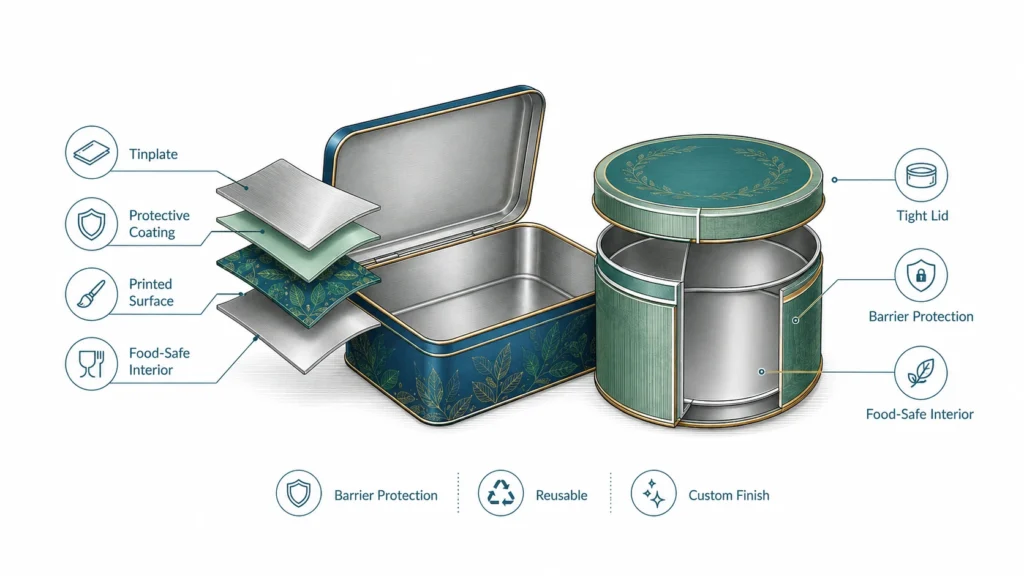
Most custom tin boxes are made from tinplate, which is steel coated with a thin layer of tin. Tinplate offers a useful balance of strength, printability, formability, corrosion resistance, and recyclability. It can be printed, varnished, embossed, debossed, stamped, curled, and assembled into many shapes. For some applications, aluminum or tin-free steel may also be considered, but tinplate is a common material for premium food tins.
Material thickness should match the product and structure. A small mint tin can use a lighter gauge than a large biscuit tin. A large gift tin may need more rigidity because broad panels can dent or flex. A heavily embossed design may require careful tooling and material control. A deep tin may need different forming considerations than a shallow tray. Choosing the thinnest material only to reduce unit cost can be a mistake if the tin dents, feels cheap, or fails during assembly.
Internal lacquer is critical for food applications. Its job is to separate the product from the metal, reduce corrosion risk, and support compatibility. The correct lacquer depends on product type, contact condition, target market, and storage. For dry products, the requirements may be different from acidic or oily products. Buyers should avoid vague requests such as “make it food grade” and instead share the product category, ingredients, direct-contact status, and target countries.
Closure design is also part of engineering. A slip lid is simple and cost-effective. A plug lid may improve closure feel. A hinged lid improves gift value but adds alignment requirements. A sliding lid works well for mints but must be smooth and safe. A window lid improves visibility but introduces a plastic or transparent material. A sealed inner membrane can improve protection but changes filling and opening behavior.
| Engineering element | What it controls | Common buyer mistake | Better approach |
|---|---|---|---|
| Tinplate thickness | Strength, feel, dent resistance, forming behavior | Choosing lowest cost without testing | Match thickness to size, product weight, embossing, and logistics |
| Internal lacquer | Food-contact suitability and corrosion resistance | Treating all “food grade” coatings as the same | Specify product chemistry, contact time, and target market |
| Lid design | Opening force, reuse, dust control, shelf feel | Selecting by appearance only | Test opening/closing after transport simulation |
| Edge curling | Safety, hand feel, strength | Ignoring small sharp-edge defects | Inspect edges during sample approval and mass QC |
| Insert or tray | Product protection and unboxing | Designing insert after tin tooling is fixed | Design tin and insert together |
| External varnish | Scratch resistance and brand feel | Using a beautiful finish that scuffs too easily | Test handling, rubbing, stacking, and carton packing |
| Carton packing | Dents, abrasion, pallet stability | Assuming metal tins do not need protection | Confirm dividers, polybag/paper wrap, carton strength, and pallet plan |
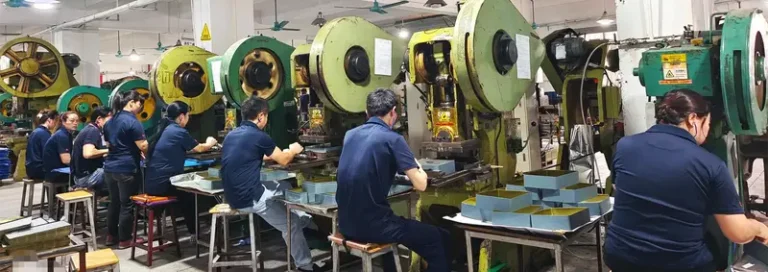
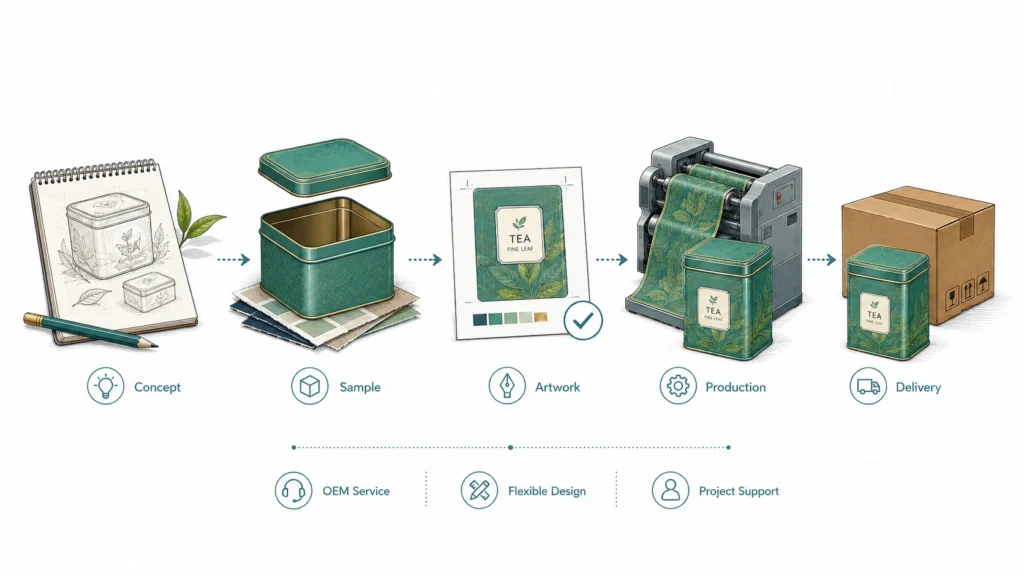
Mr. Tin Box’s Food & Beverage Packaging page describes a workflow that includes consultation, 3D drawing and structure design, mold development or sample making, printing and finishing, stamping and assembly, and quality inspection. Buyers should use that workflow actively. The best time to solve a structure problem is during 3D design, not after mass production has started.
Printing and finishing: turning metal into brand value
The outside of a custom tin box is a compact brand billboard. It must attract attention, explain the product, carry legal information, and feel appropriate for the price point. Metal offers strong visual options because it can support lithographic printing, spot colors, metallic effects, varnishes, embossing, debossing, and textured finishes.
Tea packaging may use soft botanical art, clean typography, and matte varnish. Coffee packaging may use dark tones, origin maps, foil details, or minimalist craft branding. Chocolate packaging may use rich colors, metallic accents, embossed logos, and premium interior presentation. Cookie packaging may use seasonal illustration, family-friendly artwork, or nostalgic graphics. Candy packaging may use bright colors, characters, special shapes, or collectible patterns.
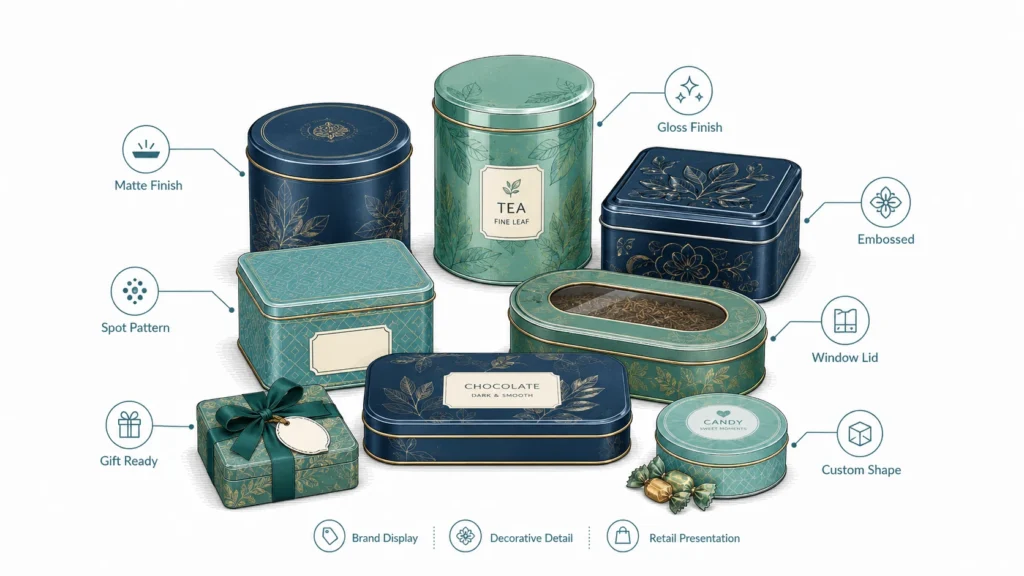
However, finishing should be selected with manufacturing reality in mind. Too many effects can raise cost, increase risk, and extend lead time without improving sales. A clean matte background with one embossed logo may look stronger than a crowded design with multiple special finishes. The best finish is not the most complex finish; it is the one that reinforces the brand promise and survives production, packing, shipping, and retail handling.
| Finish option | Best for | Buyer benefit | Production note |
|---|---|---|---|
| Gloss varnish | Bright candy, festive cookies, colorful gift tins | Strong color and high shelf visibility | Can show scratches and fingerprints more easily |
| Matte varnish | Tea, premium coffee, luxury chocolate | Soft premium feel and modern appearance | Needs scratch testing for dark colors |
| Embossing | Logos, patterns, seals, heritage marks | Adds tactile memory and premium feel | Requires tooling and careful artwork positioning |
| Debossing | Minimalist luxury designs | Elegant depth and subtle texture | Best used with simple shapes and clean graphics |
| Metallic ink or visible metal | Chocolate, coffee, holiday tins | Premium shine without full foil complexity | Color proofing is important |
| Spot gloss or spot UV | Logo highlights, product imagery | Creates contrast on matte backgrounds | Registration tolerance should be confirmed |
| Soft-touch finish | Luxury tea and chocolate gift tins | Distinct hand feel | Must be tested for scuffing and oil marks |
Artwork should be prepared for metal printing, not simply copied from a paper box. Curved surfaces, edges, seams, hinges, beads, and embossing all affect design placement. Legal text and barcode areas should remain readable. If the tin will be photographed for e-commerce, consider glare, color accuracy, and how the front face appears at thumbnail size. A design that looks impressive in a flat PDF may not work on a round tin or a curved lid.
Inserts, trays, and inner structures: the hidden part of premium packaging
Many custom tin box projects fail not because the outside looks bad, but because the inside feels unfinished. For food gifting, the internal arrangement is a major part of perceived value. When a customer opens a chocolate tin and sees pieces neatly arranged in cavities, the product feels more expensive. When cookies are stacked cleanly with paper wraps, the product feels cared for. When tea flavors are separated with printed cards, the set feels curated. When candy spills loosely or chocolates slide around, the package feels cheap even if the outer tin is beautiful.
Inserts can be made from many materials: paperboard, molded pulp, PET, PP, PS, EVA foam, velvet-covered board, tinplate dividers, or hybrid structures. For food, the insert material must match the food-contact scenario. Paperboard may support a natural look, but it must be strong enough. Plastic trays give precise cavities, but they affect sustainability messaging and require documentation. Molded pulp may support eco positioning, but the surface quality and food-contact suitability must be reviewed. Tin dividers can feel premium but may add cost and weight.
| Product | Insert purpose | Suitable insert ideas | Key test |
|---|---|---|---|
| Tea sampler | Separate flavors and create discovery | Paperboard dividers, printed flavor cards, sachet compartments | Fit, labeling clarity, hand-packing speed |
| Coffee gift set | Hold bags, sachets, filters, accessories | Paperboard tray, molded pulp, foam insert for accessories | Vibration and carton drop behavior |
| Chocolate assortment | Prevent scuffing and preserve layout | PET/PP tray, paper cups, paperboard cavities | Piece movement, odor, food-contact document |
| Cookie tin | Reduce breakage and crumbs | Stack sleeves, paper wraps, dividers, pads | Breakage after transport simulation |
| Candy tin | Prevent spill and support repeat use | Internal liner, small tray, paper wrap, sachets | Opening force, leakage, powder control |
Inserts should be developed with the tin, not after it. A 2 mm change in inner dimension can affect a tray. A lid bead can reduce usable height. An embossing feature can interfere with internal stacking. A loose insert can rattle. A tight insert can slow packing or deform the tin. For mass production, the insert must work with the filling method, labor plan, and inspection process.
MOQ, tooling, cost, and lead-time planning
A custom tin box is a manufactured product, not just a printed package. Cost depends on structure, size, material thickness, printing, finishing, insert, order quantity, tooling, packing method, inspection level, and shipping. A simple round tin using an existing mold may move quickly. A special-shaped collectible tin with embossing, window, multi-layer insert, and premium varnish will require more development time and a higher investment.
Buyers often ask for a simple unit price, but the better question is total project cost. A slightly higher tin cost may be acceptable if it supports a higher retail price, reduces product damage, improves gift value, and strengthens repeat purchase. Conversely, a complex shape may be unnecessary if a standard mold with strong artwork can achieve the same sales result.
| Cost driver | Impact on price | How to optimize |
|---|---|---|
| Existing vs. new mold | New tooling increases initial cost and lead time | Start with existing or modified molds for first launch |
| Tin size | Larger tins use more material and increase freight | Fit the product closely without making the tin feel empty |
| Material thickness | Stronger material costs more but improves feel and dent resistance | Match thickness to real product weight and logistics risk |
| Printing colors | More color complexity can increase proofing needs | Use clear artwork and realistic color tolerances |
| Special finishes | Embossing, soft-touch, metallic effects add cost | Use one or two meaningful effects instead of many weak ones |
| Insert design | Trays and dividers add material and labor | Design for protection and efficient packing |
| Order quantity | Larger runs usually reduce unit cost | Forecast repeat demand and seasonal programs early |
| Packing method | Individual wrapping, dividers, and stronger cartons add cost | Balance tin protection against export route risk |
Lead time should include consultation, structure design, sample making, artwork proofing, tooling if needed, material preparation, printing, stamping, assembly, inspection, and export packing. Mr. Tin Box’s website highlights rapid sampling within 7-10 days for prototypes in its production workflow, but full project timing depends on complexity, approval speed, testing needs, and order scale. Buyers should plan packaging development early, especially for holiday products. Seasonal tins lose value if they arrive late.
For buyers with one landing page, one brand campaign, or one seasonal launch, the safest commercial path is often to start with a focused product family. For example, a tea brand may launch three blends in the same square tin with different artwork. A cookie brand may use one rectangular tin for Christmas and then adapt it for New Year. A chocolate brand may use the same tin body with different trays for different assortment sizes. This reduces tooling risk while still building a recognizable packaging system.
Quality control: what to inspect before approving mass production
Quality control for custom tin boxes should cover appearance, dimensions, function, food-contact documentation, and packing. A tin can look good in a product photo but still fail because the lid is loose, the hinge is misaligned, the printed color is inconsistent, the surface scratches easily, or the carton allows dents during transport. Buyers should define inspection expectations early.
Sample approval should not be rushed. At minimum, buyers should check the tin with real products inside. Fill the tin, close it, shake it gently, pack it in the intended carton, and simulate handling. Open and close the lid repeatedly. Check whether cookies break, chocolates move, tea bags fit, coffee bags compress, or candy spills. Evaluate smell after the tin has been closed for a period. Review barcode readability, legal text, color consistency, and artwork positioning.
| Inspection point | What to check | Why it matters |
|---|---|---|
| Dimensions | Length, width, height, inner volume, lid fit | Ensures product and insert fit correctly |
| Lid function | Opening force, looseness, hinge movement, sliding action | Determines consumer experience and spill risk |
| Edges | Curling, sharpness, burrs, seam finish | Affects safety and perceived quality |
| Printing | Color, registration, scratches, varnish, text readability | Protects brand image and retail compliance |
| Embossing/debossing | Depth, alignment, surface distortion | Controls premium finish quality |
| Internal coating | Coverage, scratches, odor, documentation | Supports food-contact suitability and product quality |
| Insert fit | Movement, rattle, cavity tolerance, packing speed | Prevents product damage and slow production |
| Carton packing | Divider, abrasion, corner protection, stacking | Reduces dents and export damage |
| Documentation | Material specs, test reports, declarations, batch records | Supports audits and market access |
Mass production inspection should be aligned with the buyer’s risk level. A large retail order may require AQL inspection, pre-shipment inspection, container loading checks, and sample retention. A smaller promotional order may still need clear acceptance criteria for printing, dent tolerance, lid fit, and packing. A professional supplier should welcome clear standards because they reduce disputes.
Sustainability: reuse, recyclability, and honest claims
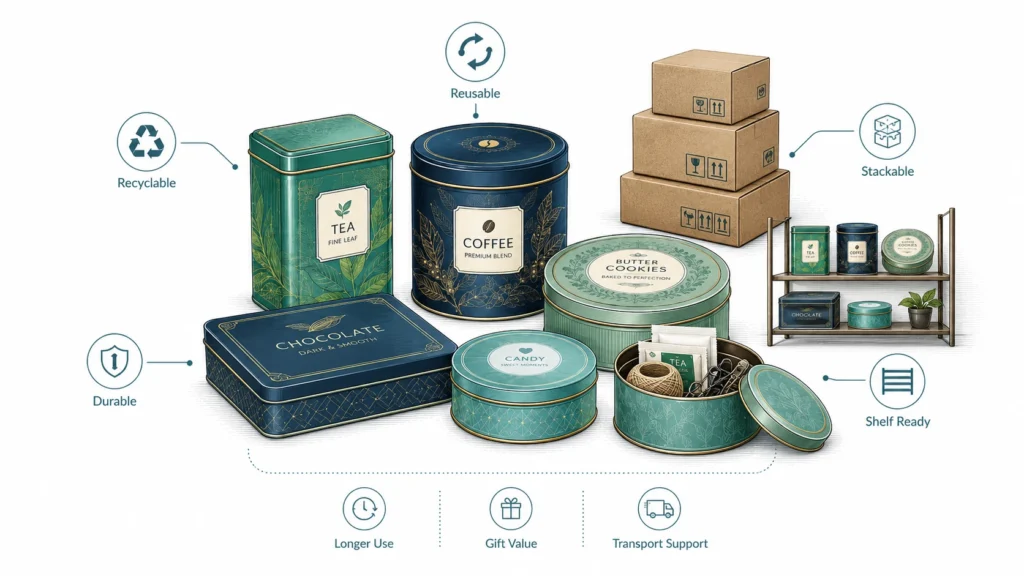
Sustainability is one of the strongest reasons buyers consider metal packaging, but claims must be accurate. A tinplate box can be reusable and recyclable, but the final recyclability of a package depends on design, local collection systems, labels, inserts, windows, adhesives, mixed materials, and consumer behavior. A tin with a large plastic window, glued foam insert, and complex decoration may still be useful and beautiful, but it should not be marketed as if every component has the same recycling pathway.
The best sustainability strategy is practical: reduce unnecessary material, design for reuse, avoid overcomplex mixed-material features where possible, use clear disposal labels, and make the tin genuinely worth keeping. A reusable tin that customers like enough to keep can deliver more value than a flimsy package with a vague eco claim. For tea, cookies, candy, and chocolate, reuse is often natural because the tin can store dry goods, small tools, stationery, sewing items, or keepsakes.
| Sustainability goal | Custom tin box design action | Better claim style |
|---|---|---|
| Reduce single-use feel | Make the tin durable, attractive, and refill-friendly | “Reusable tin designed for long-term storage” |
| Support recycling | Use mostly metal structure and removable non-metal inserts where possible | “Tinplate body is recyclable where metal packaging is accepted” |
| Avoid misleading claims | Do not overstate recyclability of windows, foam, or complex inserts | “Check local recycling guidance for components” |
| Lower waste in development | Reuse standard molds and update artwork seasonally | “Repeatable packaging platform for seasonal editions” |
| Improve consumer value | Add refill pouch, recipe card, tea guide, or collector series | “Designed to be kept, refilled, and reused” |
The most credible sustainability message is specific and modest. Instead of saying “100% eco-friendly,” say what the package actually does: reusable tin, recyclable tinplate body where accepted, refill-compatible structure, reduced plastic outer packaging, or long-life collectible format. This style is more trustworthy for buyers, retailers, and consumers.
How Mr. Tin Box supports food packaging projects
A successful custom tin box project needs manufacturing knowledge, not only catalog options. Mr. Tin Box presents its capabilities around structure design, sampling, printing, stamping, assembly, finishing, and inspection. The Food & Beverage Packaging page specifically refers to metal containers for snacks, tea, coffee, chocolates, candies, and specialty food products, while the homepage highlights food-grade materials, premium printing and finishing, in-house mold development, strict QC, and prototype sampling.
For a buyer, this matters because food tins require coordination across design, compliance, production, and logistics. A tea tin project may need a tight lid and inner pouch. A coffee tin may need secondary packaging around a valve bag. A chocolate tin may need a cavity tray and odor control. A cookie tin may need breakage testing and carton protection. A candy tin may need edge safety and direct-contact coating review. The supplier should be able to ask these questions before quoting, not after problems appear.
Mr. Tin Box also provides useful related content that can support internal linking on the final website article. The Custom Tin Box Guide can be linked when discussing how to choose shape, material, closure, inserts, and supplier capability. The Custom Metal Tin Box Solutions for Global OEM Projects article fits discussions about OEM buyers, tooling, compliance, and project workflow. The Global Sourcing Guide for Custom Metal Packaging can support sourcing and supplier evaluation. The Custom Metal Tin Packaging for Food, Beauty, and Gift Brands article is relevant when explaining cross-category packaging applications. The Custom Metal Tin Packaging for Premium Products article can support premium positioning and gift packaging discussions.
A practical RFQ checklist for tea, coffee, chocolate, cookies, and candy tins
A clear RFQ saves time and improves quotation accuracy. Many packaging delays happen because the buyer sends only a picture and asks for a price. A professional supplier needs enough information to judge size, structure, material, coating, printing, tooling, packing, and lead time.
Use this checklist before requesting a custom tin box quotation:
| RFQ item | Information to provide |
|---|---|
| Product category | Tea, coffee, chocolate, cookies, candy, or mixed food gift set |
| Product form | Loose, wrapped, bagged, powdered, whole bean, ground, pieces, bars, stacks, or assortment |
| Product dimensions and weight | Exact product size, fill weight, count per tin, and target net weight |
| Contact scenario | Direct contact with tin, inner pouch, tray, paper wrap, or individually wrapped pieces |
| Target market | U.S., EU, UK, Canada, Australia, Middle East, Japan, China, or other regions |
| Shelf-life target | Expected storage period and storage conditions |
| Tin role | Primary packaging, secondary gift packaging, refill tin, promotional tin, retail display tin |
| Preferred shape | Round, square, rectangular, hinged, slip-lid, sliding, windowed, or special shape |
| Branding requirements | Artwork status, Pantone colors, logo placement, legal text, barcode, QR code |
| Finish requirements | Matte, gloss, embossing, debossing, metallic ink, soft-touch, spot gloss |
| Insert requirements | Tray, divider, paper cup, foam, paperboard, molded pulp, or no insert |
| Quantity and schedule | Trial order, launch order, repeat forecast, required delivery date |
| Testing needs | Food-contact report, migration test, coating specification, retailer audit, inspection standard |
| Logistics | Export carton requirements, pallet preference, destination port, e-commerce handling risk |
A buyer who provides these details will usually receive a more accurate and practical proposal. The supplier can recommend existing molds, suggest structure adjustments, warn about risks, and identify documents needed for the target market. This reduces the chance of redesign later.
Common mistakes when buying custom tin box food packaging
The first mistake is choosing the shape before defining the product. A beautiful special shape can increase tooling cost, reduce carton efficiency, and create closure issues. Shape should support the product and the sales channel.
The second mistake is treating “food grade” as one universal label. Food-contact suitability depends on the product, contact time, coating, inner pack, temperature, market, and documentation. Buyers should ask for the specific material and coating information that supports the intended use.
The third mistake is ignoring the insert. Chocolate, cookies, and gift assortments need internal organization. A premium outer tin with a cheap or loose insert can ruin the unboxing experience.
The fourth mistake is overdecorating. Too many finishes can make the tin expensive and risky without improving sales. A focused design with one strong tactile or metallic detail often works better.
The fifth mistake is underestimating lead time. Custom metal packaging involves structure design, sampling, tooling, printing, forming, assembly, inspection, and shipping. Holiday and seasonal projects should start early.
The sixth mistake is forgetting logistics. Tins can dent, scratch, or rub if packed poorly. Carton design, dividers, wrapping, and palletization are part of the packaging system.
The seventh mistake is making vague sustainability claims. It is better to explain the reusable tin body, recyclable tinplate where accepted, refill potential, and material choices honestly.
Final recommendation: design the tin as a product asset
A custom tin box for tea, coffee, chocolate, cookies, and candy packaging should be treated as a product asset, not just a container. It protects the product, creates shelf impact, supports gifting, improves perceived value, and continues advertising the brand through reuse. But the value appears only when the tin is properly designed around the food category, contact scenario, freshness requirement, insert, printing, quality control, and supply chain.
For tea, the focus is aroma, moisture control, and pantry reuse. For coffee, the tin should work with a clear freshness strategy, often together with a sealed inner pack. For chocolate, the priorities are presentation, tray layout, odor control, and heat-aware logistics. For cookies, the tin must reduce breakage and support seasonal retail. For candy and mints, portability, repeat opening, edge safety, and contact suitability are essential.
The best project brief is simple but complete: product type, size, fill weight, contact scenario, target market, shelf-life target, preferred structure, artwork, finish, insert, quantity, and schedule. With that information, Mr. Tin Box can help transform an idea into a practical, attractive, and commercially useful custom tin box that supports both SEO-driven discovery and real business conversion.
For brands planning a new food packaging program, the next step is to review the relevant Food & Beverage Packaging capabilities, compare them with the buyer guidance in the Custom Tin Box Guide, and prepare a structured RFQ for the product category. The more clearly the project is defined, the easier it becomes to create a tin that protects the food, strengthens the brand, and performs reliably from factory to shelf.
FAQ
What is a custom tin box for food packaging?
A custom tin box is a metal packaging container designed around a specific food product, brand, and sales channel. For tea, coffee, chocolate, cookies, and candy, it can be customized by shape, size, lid style, printing, finish, internal coating, insert, and carton method. It may be used as primary packaging or as secondary gift packaging around an inner pouch, tray, wrap, or individually packed product.
Is a custom tin box suitable for direct food contact?
It can be suitable when the material, internal lacquer, production process, and testing documents match the intended food-contact use. Buyers should not rely on a vague “food grade” claim. They should confirm whether the food touches the tin directly, what coating is used, what market the product will enter, and whether relevant test reports or declarations are available.
Do tea and coffee tins need an inner bag?
Often yes, especially when long shelf life, aroma protection, and export distribution are important. A tin provides rigidity, opacity, shelf appeal, and reuse value, but a sealed inner pouch may provide stronger oxygen and moisture protection. The correct solution depends on product type, freshness target, and filling process.
What tin shape is best for cookies and biscuits?
Round tins are familiar and giftable, while rectangular tins usually improve shelf facing, stacking, and tray layout. The best shape depends on cookie size, fill weight, breakage risk, carton efficiency, and brand positioning. For seasonal cookie tins, a standard shape with updated annual artwork can be a cost-effective strategy.
How can a chocolate brand prevent product damage inside a tin?
Use a properly fitted tray, divider, paper cup, pad, or cavity insert. The insert should be designed together with the tin and tested with real chocolates. Buyers should check movement, scuffing, odor, tray fit, and transport behavior before mass production.
Why are custom tin boxes popular for candy and mints?
Small tins are portable, reusable, and memorable. Sliding tins and hinged tins are especially useful for mints and pocket candy because customers open them repeatedly. The main details to check are edge safety, opening force, coating suitability, powder leakage, and spill resistance.
Are custom tin boxes sustainable?
A tinplate box can support sustainability goals because it is durable, reusable, and recyclable where metal packaging is accepted. However, sustainability claims should be specific. If the design includes windows, plastic inserts, foam, labels, or adhesives, each component may have a different recycling pathway. Honest claims are more credible than broad claims such as “100% eco-friendly.”
How do I start a custom tin box project with Mr. Tin Box?
Prepare a short brief with product type, dimensions, fill weight, contact scenario, target market, shelf-life target, preferred shape, artwork, finish, insert, quantity, and delivery schedule. Then use the Mr. Tin Box Food & Beverage Packaging page or contact process to request design guidance, samples, and a quotation.