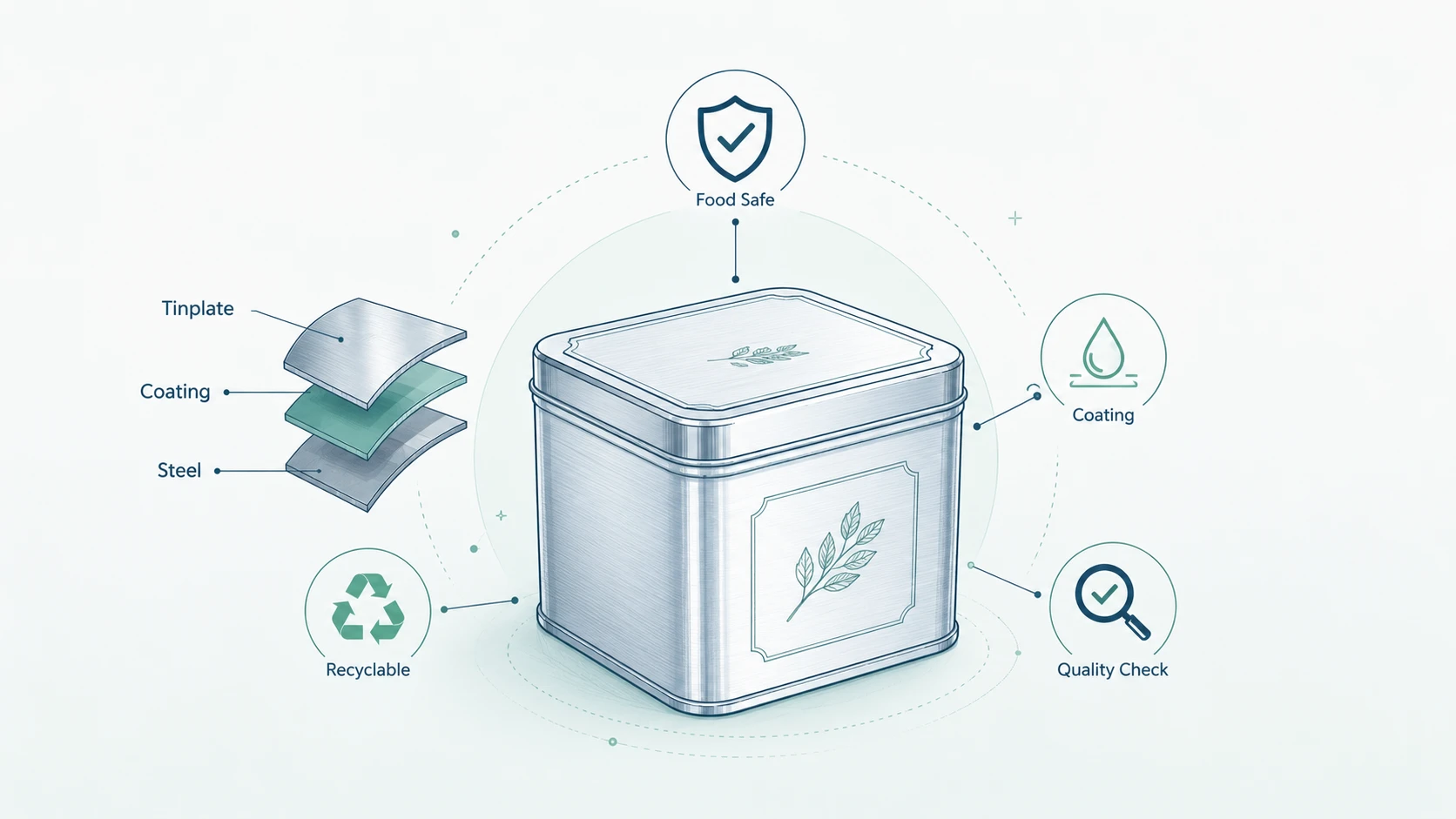
Food-grade packaging is not only a compliance topic. For food, beverage, confectionery, tea, coffee, snack, wellness, and premium gift brands, packaging is part of the product promise. A beautiful custom tin box can make a product look more valuable, protect it during distribution, support a reusable packaging story, and create stronger shelf presence. But when the package may touch food, or may be used around food, the buyer must look beyond shape, printing, and price. The key questions become: What metal is being used? What coating protects the food-contact surface? Is the tin intended for direct food contact or secondary packaging? What test reports and compliance documents are relevant for the target market? How will the product chemistry, shelf life, storage conditions, and filling process affect the final packaging choice?
This guide is written for brand owners, sourcing managers, OEM project teams, packaging designers, product developers, and import buyers who need to purchase custom tins for packaging with practical confidence. It focuses on food-grade custom tin box packaging, especially materials, coatings, safety considerations, documentation, and supplier communication. It also explains how food-grade requirements connect to commercial goals such as shelf impact, lower damage rates, smoother sourcing, better reuse value, and faster project approval.
At Mr. Tin Box, custom metal packaging is developed for global brands across Food & Beverage Packaging, Beauty & Personal Care Packaging, Gift, Promotional & Holiday Packaging, and Specialty & Industrial Packaging. For food-grade projects, the same manufacturing strengths that make a tin attractive, such as precision stamping, structure design, lithographic printing, embossing, varnishing, and quality inspection, must be combined with the correct food-contact logic.
Table of Contents
Why food-grade tins for packaging matter for commercial buyers
A custom tin box is often selected because it feels stronger and more premium than ordinary paperboard or flexible plastic packaging. Metal gives the product a firm structure, a smooth hand feel, a collectible appearance, and strong visual impact. For tea, coffee, cookies, chocolate, candy, biscuits, spices, seasonal gifts, and specialty foods, the tin can become part of the consumer experience. Many customers keep an attractive tin long after the original product is consumed, which extends the brand exposure far beyond the first purchase.
However, food-grade packaging is not defined by appearance. A tin may look clean and premium but still be unsuitable for direct contact with a specific food. Dry tea leaves, oily nuts, acidic fruit candy, chocolate, biscuits, powdered drink mixes, spices, and cookies do not create the same contact conditions. A packaging material that is acceptable for a dry wrapped biscuit may not be appropriate for a moist, acidic, oily, or high-aroma product. Temperature, humidity, contact time, grease content, acidity, filling method, and whether an inner bag is used all influence the correct specification.
Regulators use the term food contact materials to describe materials and articles that contact food or may transfer constituents to food under normal or foreseeable use. The European Commission food contact materials framework explains that packaging materials, containers, machinery, kitchenware, and tableware may all fall under food contact rules. The same page states that all food contact materials placed on the EU market must comply with Regulation (EC) No 1935/2004 and Good Manufacturing Practice rules under Regulation (EC) No 2023/2006. In the United States, the FDA explains that a food contact substance includes substances that contact food and are not intended to have a technical effect in that food, including packaging components such as adhesives, colorants, coatings, and other materials used on packaging surfaces.
For business buyers, this means the phrase “food grade” should never be treated as a single universal answer. A serious supplier conversation should identify the actual food-contact surface, the intended food type, the market where the product will be sold, and the documents needed to support that use. This is why the Food & Beverage Packaging page from Mr. Tin Box emphasizes not only attractive metal packaging, but also high-quality tinplate, food-safe lacquer layers, barrier performance, durability, airtightness, and quality inspection.
The following table summarizes the commercial logic behind food-grade custom tin box packaging.
| Buyer concern | Why it matters | Packaging decision affected |
|---|---|---|
| Direct food contact | Determines whether the inner metal, lacquer, liner, tray, or paper wrap must be tested as food-contact material | Internal coating, liner, inner bag, migration test plan |
| Product chemistry | Oily, acidic, moist, aromatic, or salty foods can create higher compatibility demands than dry wrapped products | Lacquer type, corrosion resistance, shelf-life testing |
| Target market | U.S., EU, UK, China, and other markets may require different documentation and test references | Test reports, declarations, supplier documentation |
| Shelf life | Longer contact time can increase the importance of compatibility and migration review | Coating selection, packaging format, storage condition testing |
| Brand positioning | Premium food packaging must protect the product while also looking valuable | Tin thickness, printing, embossing, varnish, insert design |
| Logistics route | Export handling can dent or scratch weak tins if carton design is poor | Material thickness, rib structure, carton strength, drop-test plan |
| Sustainability claim | Reuse and recyclability claims must be honest and compatible with local recycling systems | Material simplification, removable inserts, labeling language |
What “food grade” really means in custom tin box projects
In everyday sourcing, buyers often ask a simple question: “Is this tin food grade?” The better question is: “Which part of this packaging system is intended to contact the food, under what use conditions, and what evidence supports that intended use?” A complete custom tin box may include tinplate, internal lacquer, external ink, external varnish, inner printing, adhesive, paper wrap, PET window, plastic tray, EVA foam, paperboard insert, desiccant, oxygen absorber, seal, label, and export carton. Not all of these components will contact food, but any component that does should be treated carefully.
There are three common food-grade scenarios in custom tin packaging. The first is direct-contact packaging, where the food touches the lacquered inner surface of the tin. This can apply to loose tea, some candies, cookies, biscuits, chocolate assortments, or specialty foods. In this case, the inner coating and any internal decoration need much more attention. The second is indirect or secondary packaging, where the food is first packed in a pouch, wrapper, tray, cup, or liner and the tin functions as a protective or premium outer container. This is common for tea bags, individually wrapped cookies, chocolate pieces in paper cups, coffee in a foil bag, or gift assortments. The third scenario is display or gift packaging, where the tin is primarily a reusable brand object and does not directly touch the food. Compliance still matters, but the risk assessment is different.
Many sourcing mistakes happen because these scenarios are mixed together. For example, a buyer may approve a printed holiday cookie tin based on appearance, then later decide to place unwrapped cookies directly inside it. That change can affect internal coating requirements, grease resistance, sensory risk, and migration testing. Another buyer may request a clear window lid to show candies, without confirming the food-contact suitability of the window material and adhesive. A third buyer may choose an insert material for beauty-style presentation, then use it for chocolate or biscuits without checking whether the insert is food-contact suitable.
The safest approach is to define the contact scenario before artwork approval. Packaging design, tooling, coating, and testing should move together. This protects the launch schedule because compliance questions discovered late can force new sampling, new reports, different liners, or even a structural redesign.
| Food-contact scenario | Typical example | Main safety focus | Practical recommendation |
|---|---|---|---|
| Direct food-to-tin contact | Loose tea, hard candy, cookies placed directly in the tin | Internal lacquer suitability, migration, corrosion, odor | Confirm lacquer specification and request relevant test reports before mass production |
| Food in primary wrap, tin as secondary pack | Tea bags, wrapped chocolate, coffee pouch in tin | Suitability of actual food-contact wrap; tin protects appearance and structure | Use the tin for brand value and protection while the inner pack provides stronger barrier control |
| Food in tray or paper cups inside tin | Chocolate assortments, biscuits, gift snacks | Tray or paper cup compliance, movement control, grease transfer | Specify food-contact tray material and test the filled sample under storage conditions |
| Window tin | Cookies, candies, gift snacks | Window film and adhesive suitability; scratch and dust control | Confirm whether the window touches food and avoid unnecessary direct contact |
| Promotional gift tin with packaged food | Holiday sets, corporate gifts, sampling boxes | Mixed materials, labeling, insert safety | Define which components contact food and keep compliance documents by component |
Tinplate as the core material for food-grade custom tin boxes
Most premium custom tin boxes are made from tinplate. Tinplate is a thin steel sheet coated with tin. It is valued because it combines the formability of steel with a corrosion-resistant tin surface, good printability, stable mechanical strength, and strong recycling potential. It can be cut, stamped, curled, embossed, seamed, printed, varnished, and assembled into many structures. For buyers, tinplate also feels substantial in the hand, which makes it suitable for premium food packaging and gift packaging.
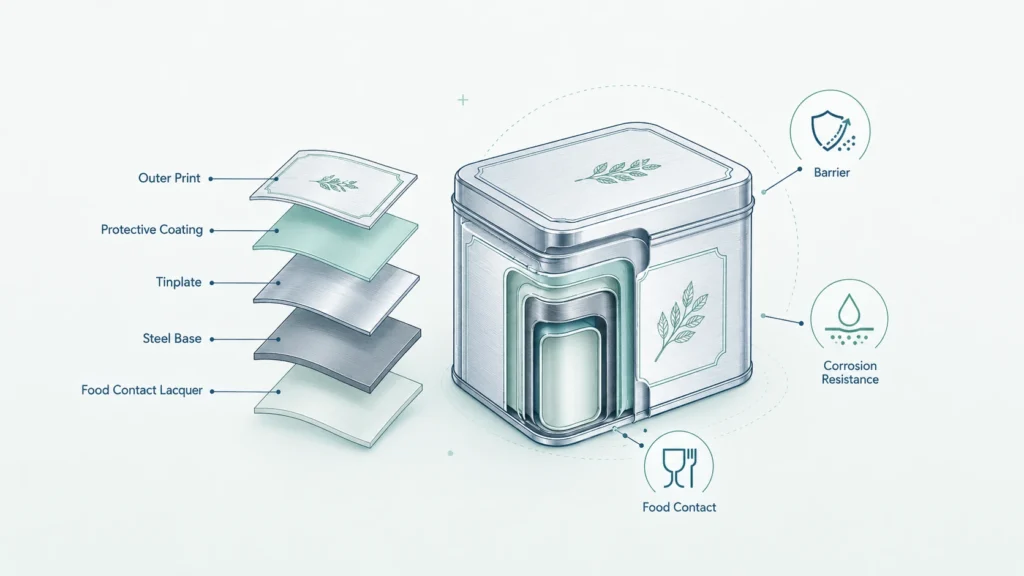
Tinplate should be understood as a packaging steel system rather than a decorative sheet. The base steel provides strength and shape stability. The tin coating contributes corrosion resistance and surface quality. Organic coatings or lacquers can be added to protect the internal food-contact surface or improve external print performance. Tata Steel describes its packaging tinplate range as food-safe tinplate for applications including DWI food and beverage, two-piece DRD cans, three-piece bodies, easy-open ends, classic ends, twist-off caps, crown corks, and specialty packaging. Tata also lists single-reduced tinplate thickness ranges of 0.17-0.49 mm and double-reduced ranges of 0.13-0.26 mm for packaging applications on its tinplate product page. Thyssenkrupp Rasselstein describes packaging steel in thicknesses from 0.100 to 0.499 mm, with tin-coated or electrolytic chromium-coated steel and optional organic coatings such as lacquer or polymer on its packaging steel page.
These industrial ranges do not mean every decorative tin box should use any thickness in that window. A small mint tin, a medium tea tin, a rectangular cookie tin, a hinged gift tin, and a large promotional set all have different forming and strength requirements. For custom tin box purchasing, thickness is a design variable. Too thin may dent easily or feel cheap. Too thick may increase cost, forming difficulty, tool wear, and freight weight without improving the consumer experience. A professional packaging supplier should recommend thickness based on the tin size, shape, embossing depth, lid style, product weight, stack load, and shipping method.
| Tinplate decision | What it affects | Buyer-friendly explanation |
|---|---|---|
| Base steel temper | Forming behavior, stiffness, dent resistance | Softer material forms complex shapes more easily; harder material can improve rigidity but may be less forgiving in forming |
| Material thickness | Feel, dent resistance, cost, weight | Bigger tins, premium gifts, and heavy contents usually need stronger material than small pocket tins |
| Tin coating weight | Corrosion resistance and surface performance | The required level depends on product, coating system, and storage conditions |
| Internal lacquer | Food compatibility and corrosion protection | Essential when there is possible food contact or product interaction risk |
| Surface finish | Print quality, visual effect, scratch behavior | Matte, gloss, satin, metallic, or soft-touch finishes should match brand position and handling conditions |
| Forming design | Edge safety, closure, stackability | Curling, seams, beads, ribs, hinges, and lid fit affect both safety and user experience |
For many food brands, tinplate works best as part of a complete packaging system. A tea tin may use an inner pouch to preserve aroma while the tin provides reusable storage and shelf appeal. A cookie tin may use a food-safe lacquer and a tray or paper cup system to prevent breakage. A chocolate tin may use paper cups and dividers to protect surface quality. A snack tin may require stronger grease resistance. The material is the foundation, but the complete structure determines performance.
Coatings, lacquers, and why the inner surface deserves special attention
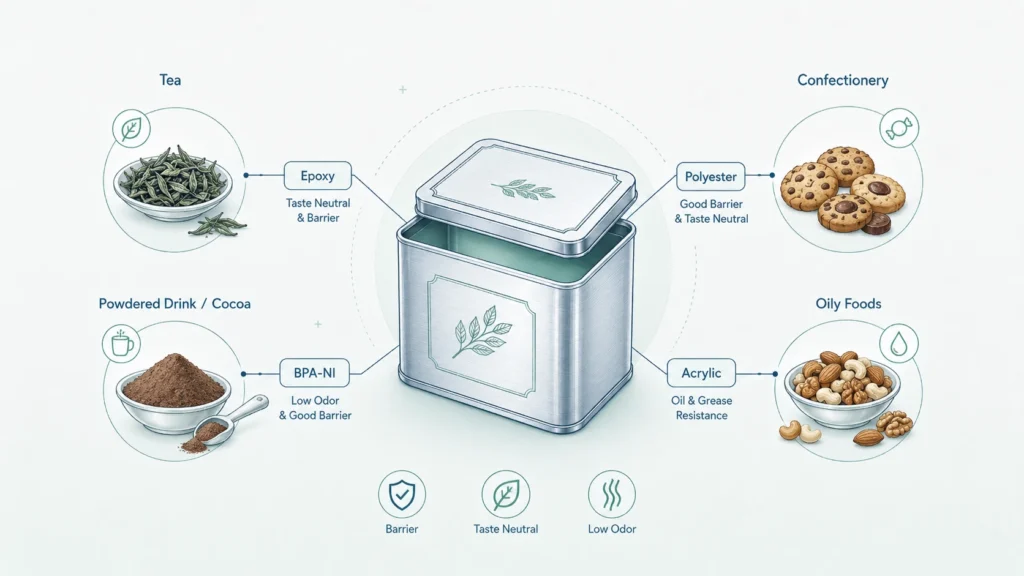
The inside of a food-grade custom tin box is often more important than the outside. The exterior may carry the brand story, but the interior must help protect the food and prevent unsuitable interaction between the product and the metal. Internal coatings, often called lacquers or enamels, can serve as a functional barrier between the food and metal substrate. They can reduce corrosion risk, limit metal-food interaction, protect product taste and odor, and support compliance with the intended use conditions.
In the United States, one important regulatory reference for coatings is 21 CFR 175.300, which covers resinous and polymeric coatings used as food-contact surfaces under prescribed conditions. The regulation describes coatings applied as continuous films or enamels over metal substrates, and includes extraction limits for certain use conditions. Buyers do not need to become coating chemists, but they should understand the practical meaning: the lacquer system must be selected and documented for the intended food-contact scenario, not guessed after production.
Coating selection depends heavily on the food. Dry tea leaves are different from oily nuts. Chocolate is different from acidic candy. Cookies are different from moist pastries. Coffee beans are different from powdered drink mixes. Some foods are mostly dry and low-risk, while others contain fats, acids, salts, flavors, or aromas that may increase compatibility demands. High humidity storage can also accelerate corrosion risk. If the tin is used only as secondary packaging around an inner pouch, the direct-contact demands are often reduced, but the buyer should still consider odor, cleanliness, and packaging integrity.
BPA-free alternatives are increasingly requested by brand owners, retailers, and consumers. However, “BPA-free” should not be treated as a complete food safety statement. It only tells you one part of the chemistry story. The buyer still needs to confirm that the chosen coating is suitable for the food type, market, contact condition, and shelf-life expectation. A BPA-free coating that is not compatible with a specific acidic or oily food may still be the wrong choice. Conversely, a coating that has a relevant food-contact report for one use condition may not automatically cover every use condition.
| Coating or inner surface option | Common use case | Advantage | Key caution |
|---|---|---|---|
| Clear food-safe lacquer | Tea, cookies, candy, dry snacks | Maintains clean metal appearance while protecting the surface | Must match the food type and contact conditions |
| Gold lacquer | Tea tins, confectionery tins, gift tins | Premium internal look and good visual warmth | Visual appeal does not replace compatibility testing |
| White or light-color internal coating | Gift foods, biscuits, chocolate assortments | Clean premium look, good contrast with product and trays | Internal printing or coating needs food-contact review if exposed |
| BPA-free coating system | Retail food brands, export markets, consumer-sensitive categories | Supports retailer and consumer expectations | “BPA-free” is not a substitute for full compliance documentation |
| Inner bag or pouch | Tea, coffee, spices, powders, aroma-sensitive foods | Better oxygen and moisture barrier; reduces direct tin-food contact | Tin still needs clean, suitable interior and proper fit |
| Paper liner or food-contact paper | Cookies, biscuits, candies, dry foods | Simple separation layer and improved presentation | Paper, ink, and grease resistance should be suitable for food contact |
| Plastic or molded tray | Chocolate, confectionery, assortments | Product organization and breakage reduction | Material must be food-contact suitable if it touches food |
A buyer should avoid making coating decisions based only on color. The correct inner coating is a technical specification. It should be discussed with product samples, product chemistry, storage conditions, and target market information. If the food is high-value or has a long shelf life, compatibility testing with filled samples is highly recommended before full mass production.
Food-category risk matrix for custom tin box selection
The best custom tin box specification starts from the product. A tin that is excellent for wrapped biscuits may not be enough for oily snacks. A tea tin may require aroma protection. A chocolate tin must consider scuffing and heat sensitivity. A candy tin may need attention to acidity, moisture, and sugar residue. A coffee tin may need an inner bag or valve strategy depending on the product format.
The matrix below is not a legal standard. It is a practical sourcing tool to help buyers ask better questions before requesting a quotation.
| Product category | Typical contact risk | Recommended packaging logic | Questions to ask supplier |
|---|---|---|---|
| Loose tea leaves | Aroma loss, moisture exposure, possible direct contact | Tinplate body with suitable internal lacquer; consider inner bag for premium freshness | Does the tin touch the tea directly? Is an inner pouch recommended for aroma control? |
| Coffee beans or ground coffee | Aroma, oil, oxygen, degassing, moisture | Decorative tin plus inner bag is often safer than relying on tin alone | Is the coffee packed after degassing? What barrier does the inner pack provide? |
| Cookies and biscuits | Breakage, grease, crumbs, direct or indirect contact | Food-safe lacquer plus paper cups, trays, or liner | Are products wrapped, tray-packed, or loose? Is grease resistance needed? |
| Chocolate and confectionery | Fat bloom, scuffing, heat sensitivity, odor | Tin with trays, paper cups, dividers, and controlled storage | Does the insert touch chocolate? Is the product temperature-sensitive in shipping? |
| Hard candy and mints | Direct contact, sugar residue, acidity in some formulas | Lacquered tin or food-contact inner wrap | Are candies acidic or coated? Will they be loose or wrapped? |
| Nuts and oily snacks | Oil migration, salt, oxidation, odor | Inner pouch or strong food-contact liner; careful lacquer choice | Is direct tin contact necessary, or can a pouch protect freshness better? |
| Spices and herbs | Aroma, staining, moisture, volatile compounds | Inner bag plus reusable tin; avoid relying on decoration alone | Can the coating handle strong aromas? Is moisture control required? |
| Powdered drink mix or supplements | Dust, moisture, direct contact, regulatory sensitivity | Inner pouch, scoop strategy, and carefully documented components | Does the product require supplement-specific labeling or contact documentation? |
| Seasonal gift assortment | Mixed foods, mixed materials, brand presentation | Component-level compliance: tray, wrap, liner, tin, label | Which component touches each food? Are all materials documented? |
For commercial buyers, the strongest strategy is often not to force the tin to do everything. A custom tin box can provide structure, premium appearance, reuse value, light protection, and gift appeal. A separate food-contact pouch, tray, liner, or wrap can provide stronger barrier protection and simpler compliance control. This combination is common in premium food packaging because it balances safety, freshness, and brand experience.
Regulatory references buyers should understand before sourcing
Food-contact regulation can look intimidating, especially for buyers who are not regulatory specialists. The practical goal is not to memorize every law. The goal is to know which authorities and documents matter enough to discuss with the supplier, importer, testing lab, or compliance consultant.
For the EU, Regulation (EC) No 1935/2004 sets the general framework for materials and articles intended to come into contact with food. The European Commission’s legislation page summarizes the principle that materials must not release constituents into food at levels harmful to human health, and must not change food composition, taste, or odor in an unacceptable way. Good Manufacturing Practice under Regulation (EC) No 2023/2006 also matters because compliance is not only about the final material; it is also about controlled production, documentation, and quality systems.
For metals and alloys, the EDQM technical guide is a useful European reference for manufacturers and regulators. It explains that metal ions may affect human health or alter organoleptic characteristics if they end up in food above appropriate levels, and it describes specific release limits for elements where appropriate. This is especially relevant for packaging buyers because metal packaging is not only a visual category; it is a material system that can interact with product chemistry if not properly specified.
For the United States, FDA food-contact rules are organized through the Federal Food, Drug, and Cosmetic Act, food additive regulations, food contact substance notifications, and related guidance. The FDA inventory of food contact substances listed in 21 CFR helps businesses review substances authorized for specific food-contact uses and use conditions. For coatings used on metal food-contact surfaces, 21 CFR 175.300 is frequently relevant.
The table below converts the regulatory landscape into buyer actions.
| Reference | What it is useful for | What buyers should do |
|---|---|---|
| FDA food contact substance resources | U.S. understanding of food-contact substances, packaging components, and indirect food additives | Ask which packaging components contact food and request documents matching the intended use |
| 21 CFR 175.300 | U.S. reference for resinous and polymeric coatings used as food-contact surfaces under defined conditions | Confirm whether the internal lacquer report is relevant to the food type and use condition |
| EU Regulation (EC) No 1935/2004 | General EU safety and inertness framework for food contact materials | Request EU-relevant compliance support if products enter the EU market |
| EU Regulation (EC) No 2023/2006 | Good Manufacturing Practice for food contact materials | Evaluate supplier process control, traceability, and documentation discipline |
| EDQM metals and alloys guide | Technical guide for metallic food-contact materials and release considerations | Use it as a reference when discussing metal release, corrosion, and metallic food-contact risk |
| Third-party migration or extraction tests | Evidence for specific material and use conditions | Make sure reports match the actual material, coating, food simulant, time, temperature, and product contact scenario |
A key warning is necessary: “FDA compliant,” “LFGB compliant,” “EU food grade,” or “BPA-free” should not be accepted as vague marketing labels without context. Ask for the specific report, tested material, standard or regulation, date, laboratory, sample description, test conditions, and result. Also confirm that the sample in the report represents the final mass-production material. A certificate for a similar coating, older material batch, or different color may not be enough for a serious export program.
Data points that make metal packaging commercially persuasive
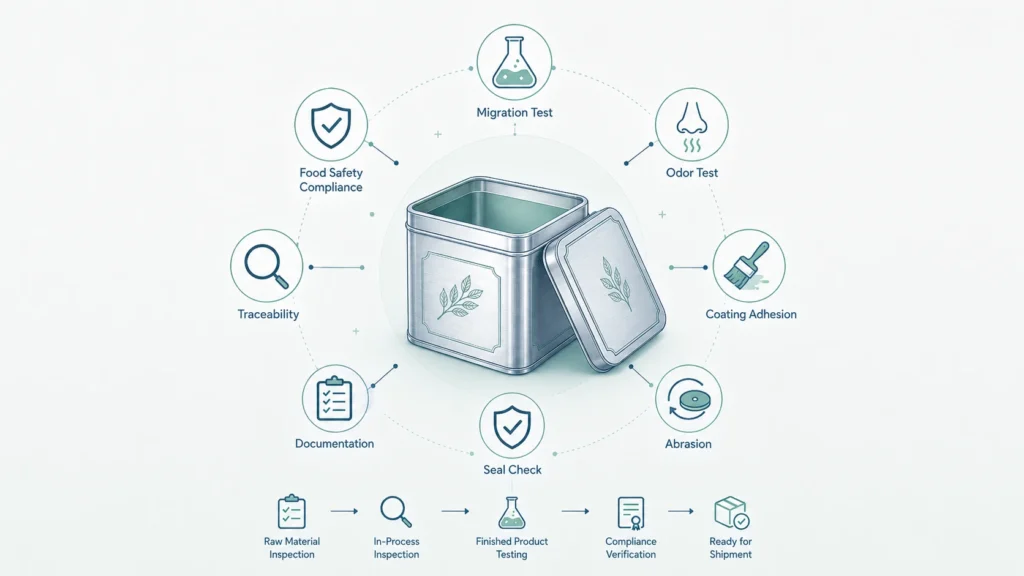
Food-grade custom tin packaging has a strong commercial story because it connects product protection, premium perception, reusability, and recyclability. To keep this story credible, buyers should use factual, source-based claims rather than vague sustainability language.
The U.S. Environmental Protection Agency reports that steel containers and packaging in municipal solid waste totaled 2.2 million tons in 2018, with 1.6 million tons recycled, equal to a 73.8% recycling rate for steel packaging in that data set. The same EPA containers and packaging data also shows how packaging is measured by material type, which is useful for brands comparing steel, aluminum, paper, glass, and plastic claims.
In Europe, industry reporting based on Steel for Packaging Europe data indicates that steel packaging reached an 82% recycling rate in 2023 under the EU harmonized methodology, with the figure described as independently verified. Packaging Europe summarized this in its article on steel packaging recycling in 2023. This type of data can support a brand’s metal packaging story, but claims should still be localized. Recycling rates vary by country, collection system, consumer behavior, and the presence of mixed-material components.
Material data also supports the engineering story. As noted earlier, packaging steel manufacturers such as Tata Steel and Thyssenkrupp publish tinplate and packaging steel thickness ranges, food and beverage application categories, and coating options. These references help buyers understand that tinplate is a controlled industrial packaging material, not simply “thin metal.”
| Data point | Source context | Why it matters for custom tin box buyers |
|---|---|---|
| Steel containers and packaging in U.S. MSW: 2.2 million tons generated and 1.6 million tons recycled in 2018 | EPA product-specific containers and packaging data | Supports fact-based discussion of steel packaging recycling in the U.S. |
| U.S. steel packaging recycling rate: 73.8% in 2018 | EPA data supplied from Steel Recycling Institute estimates | Gives buyers a credible reference instead of vague “eco-friendly” wording |
| EU steel packaging recycling rate: 82% in 2023 | Steel for Packaging Europe data reported by Packaging Europe | Supports European recyclability messaging, with local-claim caution |
| Tinplate single-reduced thickness range: 0.17-0.49 mm; double-reduced range: 0.13-0.26 mm | Tata Steel tinplate product range | Helps buyers understand thickness as a technical specification |
| Packaging steel range: 0.100-0.499 mm with tin-coated, chromium-coated, and optional organic coatings | Thyssenkrupp packaging steel | Shows that coatings and substrates are part of a packaging steel system |
For marketing, the most defensible language is specific and modest. Instead of saying “100% sustainable packaging,” a brand can say the custom tin box is made from recyclable steel-based tinplate, designed for reuse, and specified with removable or simplified inner components where possible. Instead of saying “food-safe for all foods,” a brand can say the packaging is specified for the intended food-contact condition and supported by relevant material documentation. This kind of language is more credible and safer.
Structural design: safety is not only about the coating
Food-grade packaging safety includes the full physical structure. A tin box must be safe to handle, open, close, store, fill, pack, ship, and reuse. Sharp edges, poor curling, loose lids, weak hinges, bad seams, misaligned window panels, or unstable inserts can all create quality problems. Even if the material and coating are suitable, poor structure can damage the product or disappoint customers.
Edge safety is fundamental. Tinplate sheets are cut and formed, so edges must be curled, folded, hemmed, or otherwise controlled to avoid sharpness. Lid fit is also important. A lid that is too loose may open during shipping. A lid that is too tight may deform the tin or frustrate the user. Hinged tins need hinge alignment and strength. Sliding tins need controlled friction. Tall tins need stable sidewalls and stackability. Rectangular tins need corner strength and dimensional consistency.
For food, the inside structure matters as much as the outside. A cookie tin may need ribs or trays to reduce breakage. A chocolate tin may need paper cups and dividers to prevent scuffing. A tea tin may need an inner seal or pouch. A mixed gift tin may need compartments that prevent strong aromas from contaminating other foods. A high-end confectionery tin may need a smooth internal presentation because customers see the inside when they open it.
Mr. Tin Box describes its production workflow as consultation, 3D structure design, mold development or sample making, printing and surface finishing, stamping and assembly, and quality inspection. This workflow, also shown on the Food & Beverage Packaging page, is important because food-grade packaging projects should not jump straight from artwork to mass production. Structure, coating, insert, and quality control all need to be tested with real products.
| Structural feature | Food-grade relevance | Commercial benefit |
|---|---|---|
| Curled or folded edges | Reduces sharp-edge handling risk | Improves perceived quality and user confidence |
| Controlled lid fit | Helps prevent accidental opening or difficult use | Better unboxing and fewer complaints |
| Internal tray or divider | Separates food pieces and reduces movement | Better product presentation and lower breakage |
| Hinge or clasp | Adds premium reusable value | Supports gift positioning and repeat opening |
| Ribs or beads | Improves rigidity and stackability | Reduces dents and supports logistics efficiency |
| Window panel | Displays product without opening | Increases shelf appeal, but requires material review |
| Carton packing plan | Protects tins from dents, scuffs, and deformation | Reduces losses during export distribution |
A custom tin box sample should be evaluated with the real product, not just as an empty tin. Fill it, shake it, open it repeatedly, close it repeatedly, stack it, photograph it, pack it into the intended carton, and expose it to realistic storage conditions. Many problems are only visible after a filled-package trial.
Printing, varnish, and decoration in food-grade projects
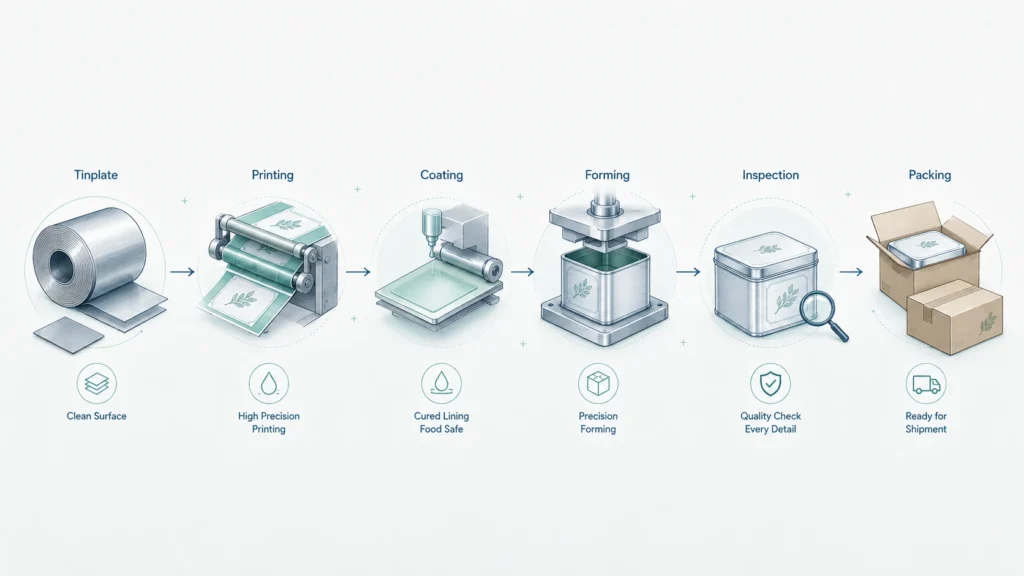
The exterior of a custom tin box is where the brand becomes visible. Metal lithographic printing can create strong color, crisp graphics, metallic effects, seasonal artwork, premium patterns, and collectible packaging. Additional processes such as embossing, debossing, matte varnish, gloss varnish, spot effects, metallic inks, and textured finishes can make the package feel more valuable. These details are especially important for confectionery, tea, coffee, holiday gifts, premium snacks, and limited-edition products.
However, food-grade projects require a clear separation between exterior decoration and food-contact safety. External inks and varnishes are usually designed for outside decoration and should not automatically be treated as food-contact surfaces. If the design includes internal printing, printed inserts, internal labels, or decorative surfaces that may touch food, those materials require separate review. A beautiful internal design can be appropriate, but it must be specified correctly.
Another practical issue is odor. In food packaging, residual odor from ink, varnish, solvent, paper, adhesive, or foam can affect the product experience even when there is no direct safety issue. Tea, coffee, chocolate, spices, and delicate biscuits can be especially sensitive to odor. For this reason, drying, curing, storage time, packaging ventilation, and final inspection matter. A premium food brand should not approve mass production until the finished tin smells clean and neutral under realistic storage conditions.
Color matching also needs discipline. Metal printing is different from printing on paper. The reflective substrate, white base coat, varnish type, curing, and forming process can change the final appearance. Embossing can distort artwork if the design is not adjusted. Matte and gloss finishes can affect color depth. Buyers should approve color proofs and pre-production samples before production, especially for brand-critical colors.
| Decoration choice | Best use | Food-grade caution |
|---|---|---|
| CMYK lithographic printing | Full-color artwork, seasonal designs, retail packaging | Keep external print separate from direct food-contact assumptions |
| Spot color printing | Brand colors, logos, premium product lines | Confirm color tolerance on metal, not only on paper proof |
| Matte varnish | Modern premium look, reduced glare | Can show scratches depending on handling and carton packing |
| Gloss varnish | Bright shelf impact, vivid colors | Fingerprints and glare may be more visible |
| Embossing or debossing | Logo emphasis, tactile brand value | Check forming limits and avoid coating cracks on deep embossing |
| Metallic ink or exposed metal effect | Luxury, festive, collectible appearance | Ensure protective varnish and accurate artwork setup |
| Internal printing | Premium opening experience | Must be reviewed if there is possible food contact |
The commercial goal is not to add every possible effect. Too many processes can increase cost, lead time, and risk without increasing conversion. A clean matte finish with one precise embossed logo may outperform a crowded design with too many special effects. The best food-grade custom tin box should look premium, feel safe, and be manufacturable at scale.
Documentation checklist for RFQ and supplier evaluation
A food-grade tin box project should not rely on verbal promises. Documentation protects both buyer and supplier. It also helps retailers, importers, quality teams, and compliance reviewers approve the project more quickly. The exact documents depend on product, target market, and buyer requirements, but the following checklist is a practical starting point.
| Document or information | Why it matters | Buyer action |
|---|---|---|
| Material specification | Identifies tinplate, coating, thickness, and structure | Request material description and thickness recommendation |
| Internal lacquer specification | Clarifies food-contact barrier and compatibility | Ask whether the lacquer matches the food type and market |
| Relevant food-contact test report | Provides third-party support for intended use | Check sample name, date, method, food simulant, time, temperature, and result |
| BPA-free statement, if required | Supports retailer or brand requirements | Treat as one document, not the entire safety file |
| Heavy metal or metal release report, if relevant | Supports metallic food-contact review | Match report to product and target market requirements |
| Ink and varnish information | Helps separate external decoration from food-contact surfaces | Confirm whether any printed surface contacts food |
| Insert or liner documentation | Ensures trays, paper, plastic, or foam are suitable if food-contacting | Request material-specific documents for each contact component |
| Production sample approval | Confirms final construction, color, smell, fit, and finish | Approve filled samples before mass production |
| Quality inspection criteria | Prevents disputes over scratches, dents, lid fit, and color | Define AQL or inspection standard, defect categories, and sample retention |
| Carton packing specification | Reduces dents and export damage | Confirm polybag, dividers, master carton, pallet, and loading plan |
A buyer should also ask whether the supplier can maintain traceability between the approved sample, material batch, coating, printing, and mass production. This is especially important for repeat orders. If the brand repeats the same holiday tin every year, the supplier should not silently change coating or insert materials without review.
Quality control points before mass production
Quality control for food-grade custom tin box packaging should be practical and visible. Many buyers focus only on lab reports but ignore physical quality. A compliant tin that arrives scratched, dented, smelly, misprinted, or hard to open will still create a commercial failure.
Pre-production sample approval is the first control point. The sample should represent the final structure, coating, artwork, finish, insert, and packing method as closely as possible. Check dimensions, lid fit, hinge movement, edge safety, color, gloss level, embossing position, internal smell, coating appearance, and product fit. If the product will be packed directly into the tin, test the actual product in the tin for a realistic period before launch.
Production control is the second point. The supplier should inspect material condition, coating surface, printing registration, forming quality, edge curling, lid fit, hinge alignment, and cleanliness. Food-grade packaging should be protected from contamination during production and packing. Workers should handle finished tins carefully to avoid fingerprints, scratches, dents, and dust.
Final inspection is the third point. This should include appearance, dimensions, opening and closing function, internal cleanliness, carton packing, label accuracy, and quantity. For export projects, carton strength and packing method are important because tin boxes can dent if they rub against each other. A small change in carton partition, polybag, or stacking direction can reduce damage significantly.
| Inspection stage | What to check | Why it matters |
|---|---|---|
| Incoming material | Tinplate surface, thickness, coating condition | Prevents forming and corrosion issues |
| Printing | Color, registration, varnish, scratches, dust | Protects brand appearance |
| Forming and stamping | Dimensions, edges, seams, lid fit, hinge | Controls safety, function, and consistency |
| Internal surface | Lacquer coverage, smell, cleanliness, defects | Protects food-contact confidence |
| Insert assembly | Fit, movement, food-contact suitability | Prevents breakage and improves presentation |
| Finished product | Appearance, open/close force, stackability | Prevents customer complaints |
| Carton packing | Polybag, separators, master carton, pallet plan | Reduces dents, abrasion, and export damage |
Quality control should be written into the purchase agreement or specification sheet. This helps the supplier quote accurately and helps the buyer avoid vague disputes later.
How Mr. Tin Box supports food-grade custom tin box projects
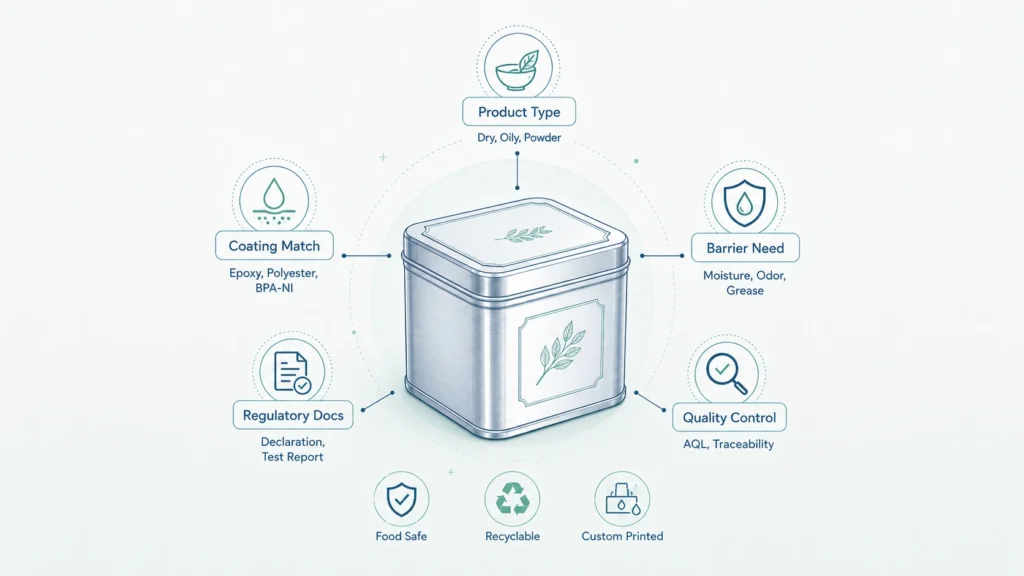
A food-grade custom tin box project requires more than a catalog shape. It needs structured communication between buyer, designer, engineer, production team, quality team, and compliance reviewer. Mr. Tin Box positions its service around custom metal packaging for global brands, with a production workflow that includes consultation, 3D structure design, sample making, printing and finishing, stamping and assembly, and quality inspection. This is especially relevant for food projects because early clarification prevents late redesign.
The custom metal tin packaging for food, beauty, and gift brands article explains how different product categories need different packaging logic. Food and beverage tins prioritize freshness protection, safe contact, internal coating, and product fit. Beauty and personal care tins focus more on formula compatibility, premium finish, and insert protection. Gift and promotional tins need stronger unboxing value and reuse appeal. For food-grade buyers, this category-specific thinking is important because a tin designed for a candle, cosmetic set, or tool kit should not automatically be used for loose food.
The Global Sourcing Guide for Custom Metal Packaging is also relevant for import buyers who need to manage supplier selection, communication, sampling, quality, documentation, and delivery. A custom tin box project can involve tooling, artwork, material selection, coating, sample approval, inspection, and logistics. The more food-contact requirements are involved, the more important it is to start with a clear RFQ.
A practical RFQ for Mr. Tin Box should include the following information:
| RFQ item | Example details to provide |
|---|---|
| Product type | Loose tea, wrapped biscuits, chocolate assortment, coffee pouch, candy, snack gift set |
| Contact scenario | Direct food contact, inner pouch, paper liner, tray, individually wrapped product |
| Target market | U.S., EU, UK, Canada, Australia, Japan, Middle East, or multiple markets |
| Tin size and shape | Existing mold preferred, modified mold, or fully custom shape |
| Product weight and filling method | Hand filling, automated filling, product weight, number of pieces |
| Shelf-life expectation | Storage temperature, humidity, contact time, retail channel |
| Artwork and finish | CMYK, PMS, matte, gloss, embossing, metallic effect, internal decoration |
| Insert or liner | Paperboard, food-contact paper, PET/PP tray, molded pulp, EVA only if not food-contacting |
| Compliance requirements | FDA-related documentation, EU food-contact support, BPA-free, LFGB, retailer test protocol |
| Order plan | Trial order, launch order, annual repeat program, seasonal campaign |
| Logistics | Export carton requirements, palletization, e-commerce shipping, retail display needs |
This brief allows the supplier to recommend a realistic structure and documentation path. It also helps the buyer compare quotations fairly. A cheaper quotation that ignores coating, insert, carton packing, or testing may become more expensive after corrections.
Common mistakes when buying food-grade custom tin boxes
The first mistake is treating “food grade” as a universal label. A food-grade statement must be linked to a material, coating, component, test condition, and intended use. Ask what has been tested and whether it matches your actual product.
The second mistake is deciding the tin shape before defining product requirements. A special shape can create strong shelf impact, but it may also increase tooling cost, reduce carton efficiency, weaken stacking, or complicate food-contact review. Shape should support the product and the brand, not create unnecessary risk.
The third mistake is ignoring the inner packaging. Many food tins perform best with an inner pouch, liner, tray, paper cup, or wrap. This is not a weakness. It is often the smartest way to combine freshness protection, compliance control, and premium presentation.
The fourth mistake is assuming that external printing is safe for internal use. Exterior inks and varnishes are not automatically food-contact materials. If artwork, labels, adhesives, or printed inserts may touch food, they need separate review.
The fifth mistake is approving an empty sample only. A tin can look perfect when empty but fail when filled. Cookies may break. Chocolate may scuff. Tea aroma may fade. Candy may stick. A lid may open during carton drop. Always evaluate filled samples.
The sixth mistake is chasing the lowest unit price without comparing specifications. Thickness, lacquer, printing quality, insert design, inspection level, carton packing, and documentation all influence cost. A low quote may exclude the controls that make the package commercially safe.
The seventh mistake is making sustainability claims too broad. Tinplate is recyclable and reusable, and recycling data for steel packaging can be strong in many markets, but claims should match the actual package and local recycling system. Mixed-material windows, glued inserts, and non-removable foam can weaken the recycling story.
Practical specification framework for buyers
A strong food-grade custom tin box specification should be simple enough for purchasing teams to use, but detailed enough for engineers and quality teams to act on. The framework below can be copied into an RFQ or internal packaging brief.
| Specification area | Required decision | Example wording |
|---|---|---|
| Product and contact | Define whether food touches tin, liner, tray, or pouch | “Loose tea leaves will be packed in a food-contact inner pouch; tin is secondary reusable packaging.” |
| Material | Define tinplate or alternative material and target feel | “Tinplate structure suitable for premium retail tea gift packaging; final thickness to be recommended by supplier based on size.” |
| Internal coating | Define food-contact expectations | “Interior must use suitable food-safe lacquer or remain secondary only; provide relevant documentation for intended use.” |
| Insert or liner | Define material and food-contact status | “Paper tray must be suitable for direct contact with wrapped confectionery; provide document if it touches food.” |
| Decoration | Define exterior and any interior decoration | “Exterior CMYK plus matte varnish and embossed logo; no printed surface should directly contact food unless separately approved.” |
| Testing | Define market and report expectations | “Provide FDA/EU-relevant food-contact documentation for the material system used in approved sample.” |
| Sample approval | Define what the buyer will test | “Buyer will approve filled sample for fit, smell, lid function, color, and product presentation before production.” |
| QC | Define inspection points | “Check edge safety, lid fit, coating coverage, print defects, scratches, dents, odor, and carton packing.” |
| Logistics | Define packing plan | “Each tin protected from abrasion; export cartons suitable for international shipment and pallet loading.” |
This framework reduces misunderstanding. It also makes the supplier’s engineering work easier because the use condition is clear from the beginning.
When to use direct-contact tins and when to use secondary tin packaging
Direct-contact tin packaging can be suitable when the internal coating, product chemistry, and compliance documentation are aligned. It may work well for certain dry foods, candies, biscuits, and tea products, depending on the exact material system. Direct contact can create a clean, simple consumer experience and reduce extra packaging layers.
Secondary tin packaging is often better when the food requires stronger barrier protection, when the product has oil, aroma, acidity, or moisture concerns, or when the brand wants to simplify food-contact risk. For example, a premium coffee brand may use a sealed foil pouch inside a custom tin box. The pouch controls oxygen and moisture, while the tin delivers premium presentation and reuse value. A chocolate brand may use paper cups and a tray inside a decorated hinged tin. A cookie brand may use a wrapped tray to reduce breakage and grease transfer.
| Choose direct contact when… | Choose secondary packaging when… |
|---|---|
| The product is compatible with the approved internal lacquer | The product needs high oxygen or moisture barrier performance |
| The compliance reports match the actual food and use condition | The food is oily, aromatic, acidic, moist, or sensitive |
| The brand wants minimal inner packaging | The product needs trays, cups, pouches, or wraps for quality |
| The shelf life and storage conditions are moderate and tested | The product will be exported, stored long-term, or exposed to variable humidity |
| Filled sample testing confirms no odor, staining, corrosion, or quality change | The buyer wants easier component-level compliance control |
The right decision is not always the most visually simple decision. In many premium food categories, the best solution is a hybrid: food-contact primary packaging plus a reusable custom tin box. This approach protects the product while preserving the commercial value of metal packaging.
Conclusion: food-grade custom tin box packaging should be engineered, not guessed
A food-grade custom tin box can be a powerful packaging solution. It can protect fragile products, improve shelf presence, support premium pricing, encourage reuse, and strengthen brand memory. Tinplate offers a strong base material for many food and beverage packaging applications because it is formable, printable, rigid, opaque, and widely recyclable. Coatings and lacquers can help create a suitable internal surface, while inserts, liners, trays, and inner bags can improve safety, freshness, and product presentation.
But food-grade packaging must be specified carefully. The buyer should define the food type, contact scenario, target market, storage condition, shelf life, and documentation requirements before approving tooling or artwork. Internal coatings should be selected for the intended product, not chosen only for color. External printing should not be assumed safe for direct contact. Sustainability claims should be specific and honest. Filled samples should be tested before mass production.
For brands developing tea tins, coffee tins, cookie tins, confectionery tins, candy tins, snack gift tins, or seasonal food packaging, the most successful projects combine regulatory awareness with practical packaging engineering. Mr. Tin Box can support this process through category-focused consultation, custom structure design, sampling, printing and finishing, stamping and assembly, and quality inspection. To begin a project, buyers can review the Food & Beverage Packaging solutions, explore the broader Custom Tin Box Guide, or contact Mr. Tin Box with product details, target markets, and compliance expectations.
A good custom tin box should not only look beautiful. It should be suitable for the product, credible for the market, efficient for production, safe for the consumer, and valuable for the brand.