

Sustainability in packaging used to be treated as a soft marketing claim. A brand could say a package was “eco-friendly,” add a green icon, and hope customers accepted the message. That approach is no longer enough. Retailers, regulators, importers, distributors, and consumers increasingly expect packaging to prove its environmental value through practical design: less waste, better recyclability, longer product life, lower damage rates, more reuse, and clearer end-of-life pathways.
That is exactly why custom metal packaging deserves a serious place in circular packaging planning. A tin box is not only a premium-looking container. When it is engineered correctly, it can protect the product, survive logistics, remain useful after first purchase, and enter established metal recovery streams at end of life. For brand owners, that combination is commercially powerful because sustainability is no longer separated from shelf performance. A package must help sell the product, protect margin, satisfy compliance expectations, and support a more circular material story at the same time.
At Mr.Tin Box, custom metal tin packaging is positioned for food, beauty, gift, promotional, holiday, specialty, and industrial applications. This matters because sustainability is not one universal design formula. A tea tin, a cosmetic gift box, a chocolate tin, a promotional collector box, and a specialty parts tin all have different barrier, coating, closure, decoration, MOQ, and logistics requirements. The goal is not simply to “use metal.” The goal is to design the right tin structure for the product, the market, the distribution channel, and the customer behavior after purchase.
This article explains why sustainable custom metal packaging, especially tin boxes made from tinplate or other appropriate metal substrates, can support circular packaging goals in a practical business environment. It also shows where metal packaging performs well, what buyers should specify, what the data says about recycling, and how brands can use custom tin boxes to connect sustainability with premium brand value.
What circular packaging goals actually mean for brand owners
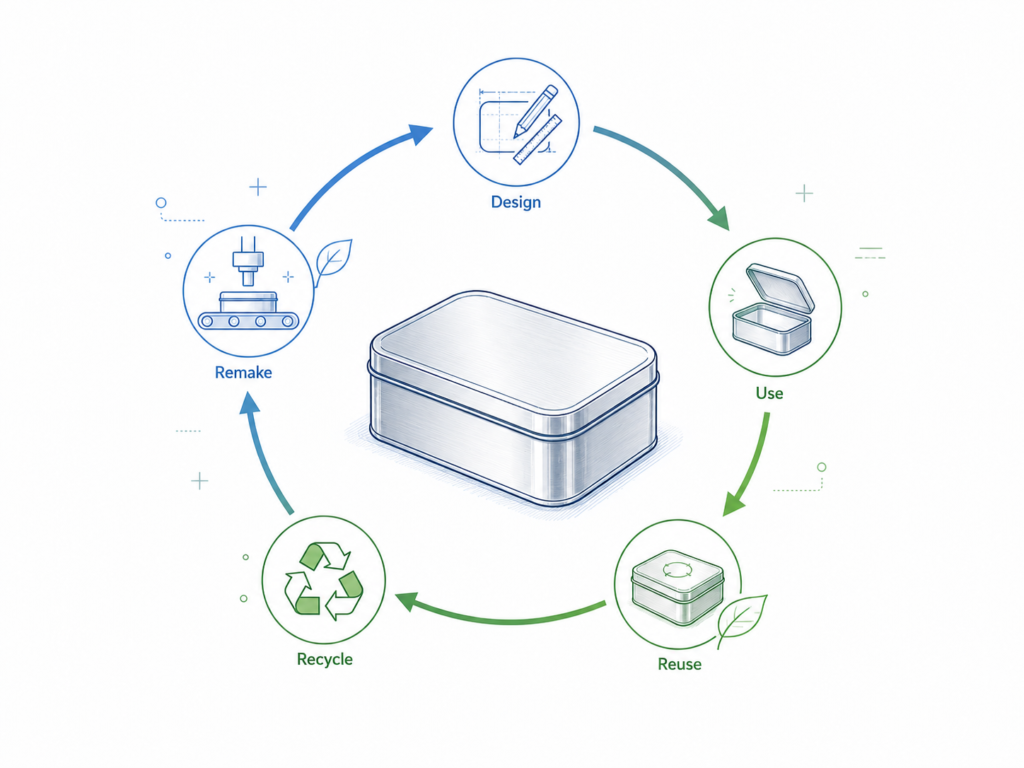
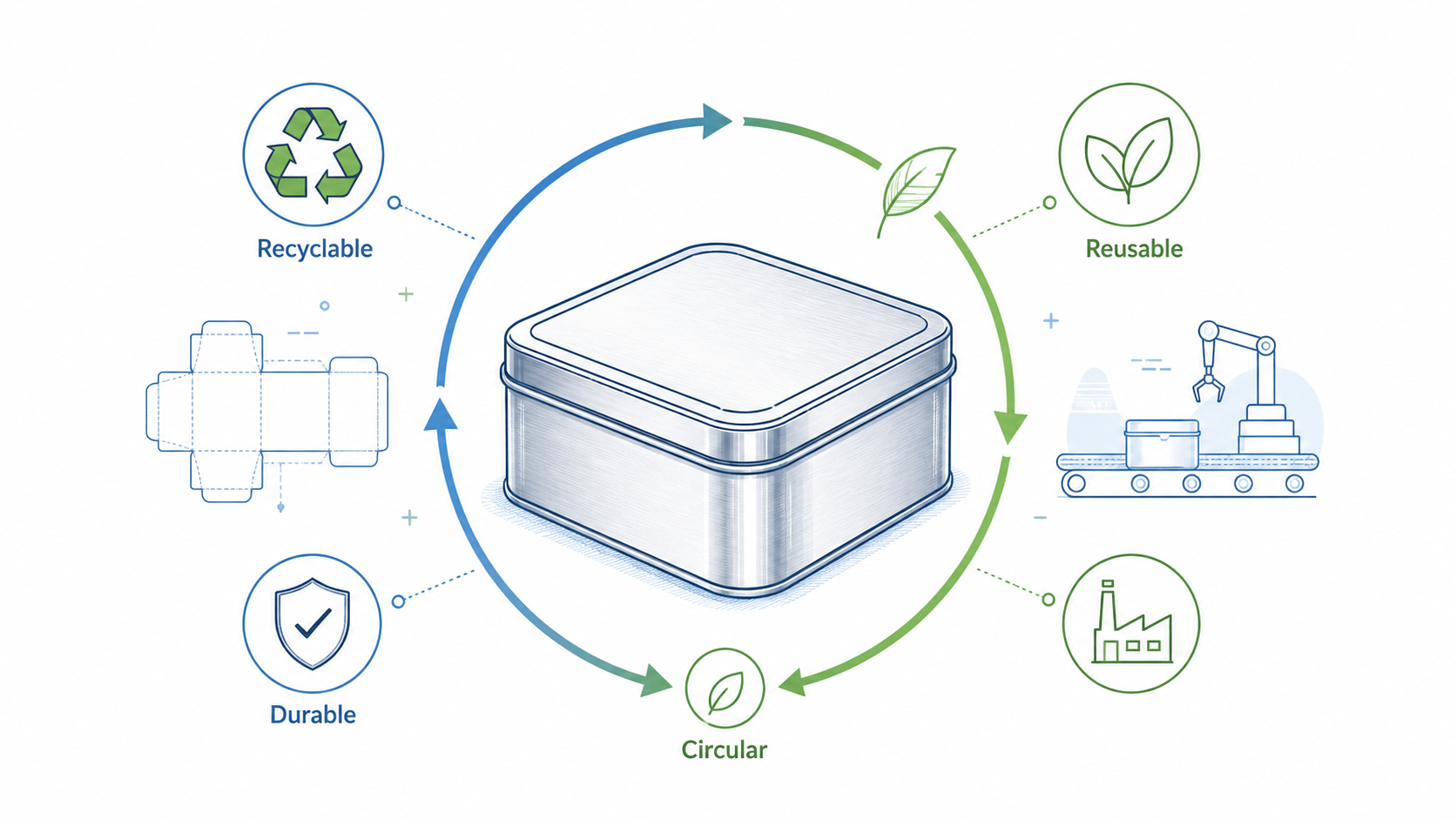
Circular packaging is often summarized as “reduce, reuse, recycle,” but business buyers need a more operational definition. For packaging managers, circularity means designing packaging so that material value is preserved for as long as possible. The package should reduce avoidable waste, protect the product during storage and transportation, stay useful where reuse is realistic, and be recyclable through real infrastructure when it reaches end of life.
A circular package is not automatically the lightest package. It is also not automatically the cheapest package. A very light package that allows product damage, leakage, breakage, oxidation, moisture ingress, or early disposal may create more total waste than a slightly heavier but more protective and recyclable package. In commercial packaging decisions, sustainability has to be evaluated across the full use scenario: product sensitivity, distribution distance, display environment, consumer use, reuse likelihood, recycling access, and compliance risk.
The direction of regulation is also becoming clearer. The European Commission’s page on the Packaging and Packaging Waste Regulation states that all packaging must be recyclable by 2030. For international brands, even if a product is not sold only in Europe, this policy trend influences global retail expectations. Buyers want packaging that will not become a compliance problem within the next product cycle.
Circular packaging goals can be translated into practical questions:
- Can the material be separated, sorted, and recycled at scale?
- Does the package protect the product well enough to reduce spoilage, returns, and damage?
- Can the structure be reused, refilled, collected, or kept by the consumer?
- Are coatings, inks, windows, inserts, labels, magnets, handles, and mixed materials designed so they do not destroy recyclability?
- Can the supplier document the material, coating, food-contact suitability, and production process clearly?
- Does the packaging still support brand value, shelf impact, and customer experience?
A custom tin box can answer many of these questions well when the project is engineered from the beginning instead of treated as a decorative afterthought.
| Circular packaging goal | What it means in real buying decisions | How custom metal packaging can help |
|---|---|---|
| Design for recycling | Packaging should be recoverable through existing recycling systems, not only theoretically recyclable | Steel and tinplate packaging can be sorted magnetically, and metal recycling infrastructure is well established in many markets |
| Reduce product waste | Packaging should prevent damage, quality loss, moisture exposure, aroma loss, and early disposal | Tin boxes provide rigidity and strong barrier protection against light, moisture, oxygen, and contamination when properly designed |
| Support reuse | Packaging should have a second life when reuse is realistic and valuable | Premium tins are often kept for storage, refills, gifting, collectibles, and seasonal reuse |
| Improve material value retention | Material should remain useful after recycling instead of rapidly losing quality | Steel is widely treated as a permanent material because it can be recycled into new steel products repeatedly |
| Support compliance | Packaging should align with tightening regulation and retailer requirements | Metal structures can be specified with food-safe linings, coatings, material documentation, and clear recycling guidance |
| Strengthen brand trust | Sustainability should be visible, credible, and connected to product quality | A durable tin box gives customers a physical reason to believe the package is not designed for immediate disposal |
Why tin boxes are relevant to circular packaging
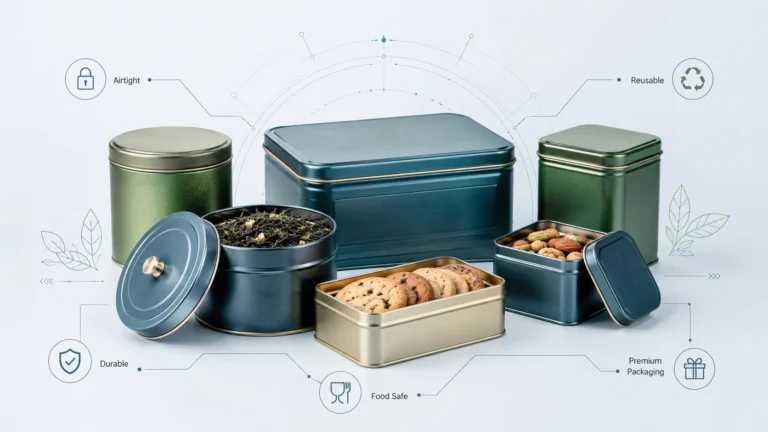
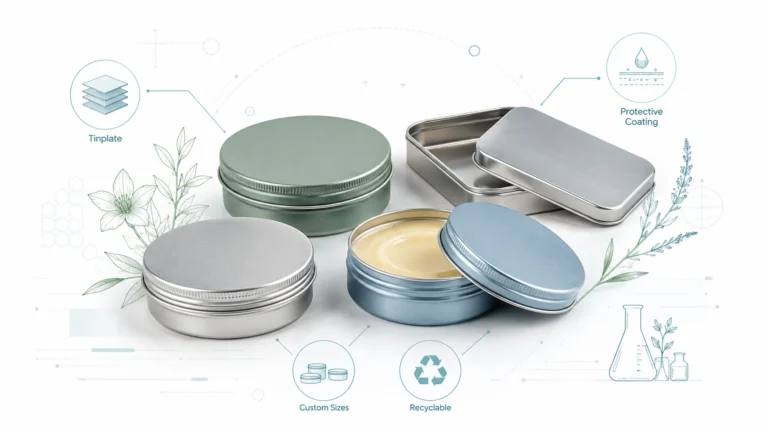
A tin box is usually made from tinplate, which is a thin steel sheet coated with tin for corrosion resistance and processability. The structure may include a body, lid, hinge, rolled edges, curled seams, friction-fit closure, window, inner tray, insert, or other custom components. The external surface can be printed, embossed, debossed, varnished, textured, or finished with matte, glossy, satin, metallic, soft-touch, or spot UV effects. The internal surface may use a lacquer or coating depending on the product and contact requirements.
This combination creates an unusual advantage. Metal tin packaging is both industrial and emotional. It is industrial because the material can be stamped, formed, tested, stacked, shipped, and recycled. It is emotional because the same structure can feel premium, collectible, durable, and gift-worthy. For circular packaging, this is important because reuse does not happen only because a brand asks for it. Reuse happens when customers want to keep the object.
A thin disposable tray may technically be recyclable in some markets, but consumers are unlikely to keep it. A well-designed tea tin, biscuit tin, cosmetics tin, or holiday gift tin can stay in a kitchen, office, drawer, or shelf for months or years. It can hold refills, accessories, stationery, sewing items, coffee capsules, candies, tools, cables, samples, or small collectibles. This is why metal packaging often performs well in premium and gift categories. The package feels like part of the product experience, not merely a wrapper.
Mr.Tin Box’s Food & Beverage Packaging page emphasizes food-grade tin boxes and metal containers for snacks, tea, coffee, chocolates, candies, and specialty foods. It also describes the role of high-quality tinplate, precision stamping, forming, airtightness, durability, and safe contact with food products. For beauty and personal care, the Beauty & Personal Care Packaging page describes custom-engineered metal containers for cosmetics, skincare, fragrances, and personal care items, with corrosion-resistant tinplate or aluminum formed for premium aesthetics and functional protection.
Those category differences are important. A sustainable package for loose tea may need aroma retention and moisture control. A chocolate gift tin may need premium decoration, food-contact lining, and careful insert design. A skincare set may need presentation value, transport protection, and a surface finish that resists scuffs and fingerprints. A specialty industrial tin may need structural durability, organized compartments, and anti-rust design. In each case, circularity must be connected to product function.
The data behind the circular packaging opportunity
Sustainability articles often become vague because they avoid numbers. The packaging industry cannot afford that. Packaging waste, recycling performance, and plastic waste projections are measurable issues. The data does not mean that one material is always the best choice. It does show why durable, reusable, and recyclable formats such as tin boxes should be considered in serious packaging redesign programs.
The following table summarizes several useful reference points that can support decision-making and article credibility. These data points come from recognized public sources such as Steel for Packaging Europe, the U.S. Environmental Protection Agency, Eurostat, the OECD, and UNEP.
| Data point | Figure | Why it matters for sustainable custom metal packaging |
|---|---|---|
| EU steel packaging recycling rate in 2023 | 82% “really recycled” | Steel for Packaging Europe reports that 82% of steel packaging placed on the market was really recycled in 2023, meaning it entered actual recycling operations rather than only being collected |
| U.S. steel containers and packaging recycling rate in 2018 | 73.8% | The U.S. EPA estimated steel packaging recycling at 1.6 million tons, or 73.8% of generation, showing strong recovery performance in a major market |
| U.S. plastic containers and packaging recycling rate in 2018 | 13.6% | The U.S. EPA estimated that almost 2 million tons of plastic containers and packaging were recycled, equal to 13.6% of generated plastic packaging |
| EU packaging waste generated in 2023 | 79.7 million tonnes | Eurostat reported 79.7 million tonnes of packaging waste in the EU in 2023, equal to 177.8 kg per inhabitant |
| EU packaging waste share from plastic in 2023 | 15.8 million tonnes, 19.8% | Eurostat data shows the scale of plastic packaging waste pressure in the EU, reinforcing why brands are redesigning packaging systems |
| Global plastic waste outlook under current policies | Plastic waste could almost triple by 2060, with less than one fifth recycled | The OECD Global Plastics Outlook projects that plastic waste could almost triple by 2060 under current policies |
| Food wasted at retail, food service, and household levels in 2022 | 1.05 billion tonnes | The Stop Food Loss and Waste platform, citing UNEP 2024, reports 1.05 billion tonnes of food waste in 2022; better protective packaging can help reduce quality-related waste in suitable categories |
The most useful lesson from these numbers is not “metal good, plastic bad.” Packaging choices are more complex than that. The lesson is that recyclable design, product protection, and reuse potential must be evaluated together. Metal packaging can be commercially attractive because it often performs well across all three dimensions: it can protect the product, encourage reuse, and enter metal recycling streams.
Steel and tinplate: permanent material logic in plain language
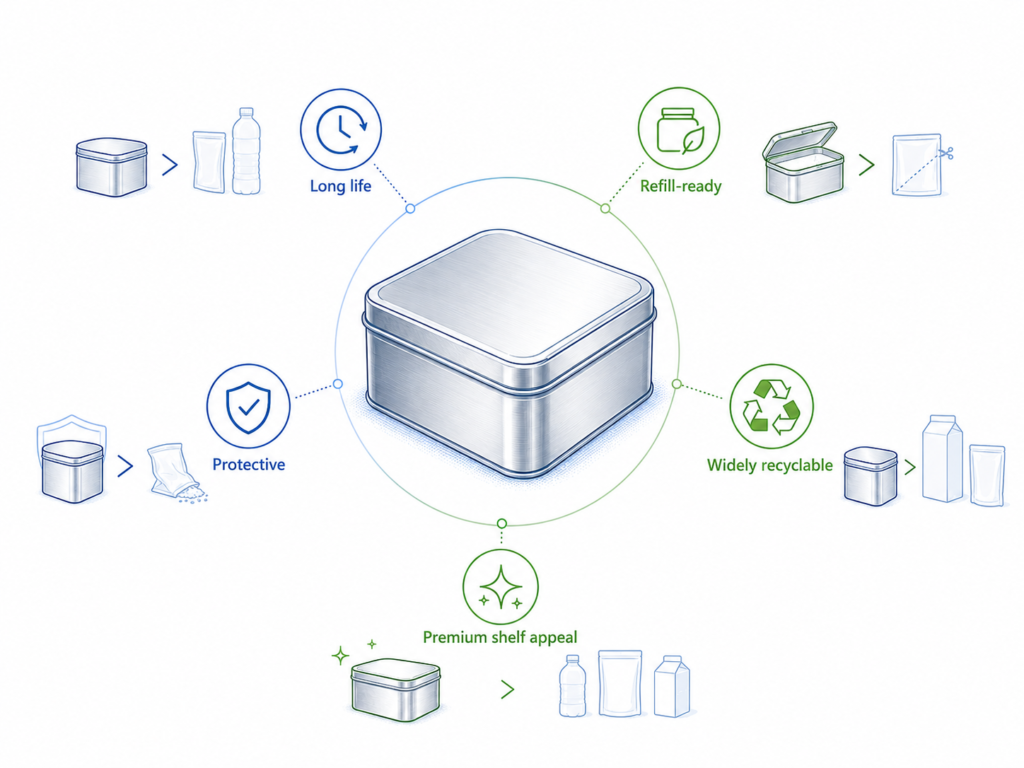
Tinplate is steel with a thin tin coating. Steel is widely discussed as a permanent material because its metallic properties can be retained through recycling. According to the World Steel Association’s circular economy guidance, steel products should be designed efficiently, made durable, reused or remanufactured where possible, and ultimately recycled. That framework matches the logic of circular packaging: keep material in useful circulation and avoid unnecessary loss.
For brand owners, the phrase “permanent material” should be used carefully. It does not mean a specific package has zero environmental impact. Mining, steelmaking, coating, printing, transport, and production all have impacts. It also does not mean every tin box will automatically be recycled in every country. Recycling depends on local collection systems and user behavior. What it does mean is that steel packaging has a strong material pathway after use, especially because ferrous metal is easier to detect and sort than many lightweight composite materials.
Magnetic sorting is one of the practical reasons steel packaging performs well in waste systems. In many material recovery facilities, magnets can separate ferrous metals from mixed waste streams. This does not solve every recycling problem, but it gives steel packaging an infrastructure advantage. A plastic laminate with multiple resin layers, a paper-plastic-metal composite that cannot be separated, or a small contaminated pouch may be much harder to recover economically. A steel tin box is more visible, more sortable, and more valuable as scrap.
This is one of the key commercial arguments for sustainable custom metal packaging. A brand can tell a clearer end-of-life story when the core material is familiar to recyclers. Customers and retailers do not need to understand a complicated polymer code or multilayer structure. They can understand a durable metal tin that can be reused and recycled.
Reuse is where custom tin boxes create brand value
Recycling is important, but reuse usually creates a stronger emotional connection. When a customer keeps a tin box after the original product is consumed, the packaging continues to work as a brand asset. It sits on a shelf, travels in a bag, holds small items, or becomes part of a refill routine. Every reuse moment reinforces the brand without another advertising cost.
This is one reason custom tin boxes are especially strong for tea, coffee, cookies, chocolate, candy, cosmetics, skincare kits, candles, promotional gifts, holiday products, stationery, and limited-edition collections. These categories benefit from packaging that customers want to touch, open, close, display, and keep. A disposable package disappears after purchase. A well-designed tin can remain in the customer’s life.
Reuse is not automatic. Buyers should design for it intentionally. A reusable tin should have a comfortable opening force, smooth edges, stable closure, useful proportions, appropriate internal volume, and an exterior finish that remains attractive after handling. If the tin scratches easily, dents too easily, or has an awkward shape, customers may not keep it. If it feels like a useful object, they often do.
Mr.Tin Box’s article on 10 Creative Custom Metal Tin Packaging Design Ideas discusses multi-purpose tins, collectible series, unique shapes, premium finishes, smart packaging, eco-friendly design, and custom compartments. These ideas matter because reuse is partly a design decision. A tin that looks beautiful but cannot store anything useful may be admired briefly and discarded. A tin that feels premium and remains functional becomes a circular packaging story customers can experience directly.
For refill models, tin packaging can also act as a durable primary container while lightweight refill packs reduce material intensity over repeat purchases. This approach is not right for every product, but it is attractive for tea, coffee, powder, confectionery, solid cosmetics, fragrance samples, wellness items, and certain dry goods. The first purchase delivers the branded tin. Later purchases deliver refills. The customer keeps the durable packaging, while the brand keeps repeat purchase behavior connected to the original premium experience.
| Reuse strategy | Best-fit product categories | Packaging design implications |
|---|---|---|
| Keep-and-store tin | Tea, biscuits, candy, stationery, accessories, small tools | Choose useful dimensions, safe edges, stable stacking, durable varnish, and easy open-close force |
| Refill-ready tin | Coffee, tea, powder, solid cosmetics, wellness products | Design a strong closure, clear product labeling, inner coating compatibility, and refill instructions |
| Collectible tin series | Holiday gifts, limited editions, character licensing, luxury confectionery | Maintain a consistent structure while changing artwork, seasonal themes, embossing, or colorways |
| Promotional long-life tin | Corporate gifts, event kits, brand campaigns | Make the tin useful after the campaign: desk storage, travel kit, sample kit, or keepsake container |
| Secondary organization tin | Industrial samples, electronics accessories, craft goods, repair kits | Use compartments, trays, labels, and structural reinforcement to make the tin practical after first use |
Product protection is a sustainability benefit
Packaging sustainability is often discussed only after the product is used. That is a mistake. A package also affects sustainability before purchase by protecting the product through manufacturing, warehousing, ocean freight, trucking, retail handling, e-commerce delivery, and consumer storage. If weak packaging causes damage, spoilage, leakage, oxidation, aroma loss, moisture absorption, or customer returns, the total environmental and commercial cost can be high.
Metal packaging offers excellent rigidity compared with many paperboard and flexible packaging formats. It resists crushing, supports stacking, and protects edges during handling. For premium products, this is not only about avoiding broken goods. It is about preserving perceived value. A dented cosmetic gift box, scuffed chocolate tin, or crushed tea package can undermine the entire brand promise even if the product inside remains usable.
Barrier performance is also critical. Mr.Tin Box’s article Why Metal Packaging Boosts Shelf Life and Brand Value explains how metal packaging helps block oxygen, light, and moisture while supporting premium brand perception. This is especially relevant for aroma-sensitive and oxidation-sensitive products such as tea, coffee, matcha, cookies, chocolate, nuts, candies, spices, nutraceutical powders, skincare products, and fragrances.
For food categories, better protection can also help address food waste. The Stop Food Loss and Waste platform reports that 1.05 billion tonnes of food were wasted at retail, food service, and household levels in 2022. Packaging alone cannot solve food waste, and brands should not overclaim. However, packaging can reduce quality-related waste when it extends usable shelf life, protects aroma and texture, and prevents damage during distribution.
In plain language, a package that keeps the product fresh longer can be more sustainable than a package that is lighter but allows quality to fail sooner. This is why lifecycle thinking matters. The package has to be evaluated alongside the product it protects.
Circularity depends on good engineering, not only good material
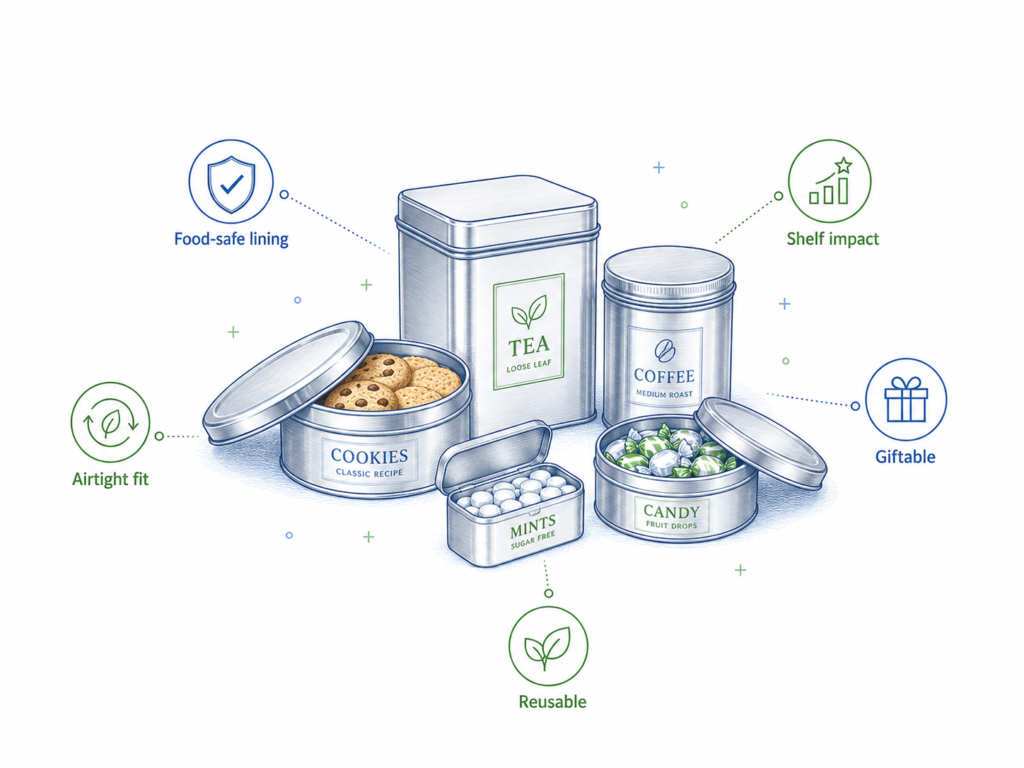
A tin box can support circular packaging goals, but only when it is designed correctly. Material choice is the beginning, not the whole solution. Poor design can reduce recyclability, increase damage rates, create unnecessary weight, make reuse inconvenient, or force excessive secondary packaging. Good engineering turns metal packaging from a nice-looking container into a functional circular asset.
Several decisions are especially important:
Substrate thickness. A tin that is too thin may dent easily and lose premium value. A tin that is too thick may use unnecessary material and increase cost. The right thickness depends on size, shape, stacking, shipping method, product weight, closure design, and reuse expectation.
Closure design. A tin must close securely without becoming difficult to open. Friction-fit lids, hinged lids, slip lids, plug lids, and special closures each create different user experiences. Reuse depends heavily on how the closure feels after repeated opening.
Coatings and lacquers. Internal coatings must match product chemistry and regulatory requirements. A dry biscuit tin is different from a tea tin, a cosmetic balm container, or a specialty industrial box. Coating decisions should be made based on contact, corrosion risk, odor sensitivity, food safety, and migration requirements.
Decoration stack. Printing, varnish, embossing, debossing, spot UV, metallic effects, and soft-touch coatings can build premium value. But overdecorating can add cost, production risk, and lead-time pressure. The best sustainable packaging is often not the most complicated package. It is the package with the strongest balance of visual impact, durability, manufacturability, and recyclability.
Mixed materials. Windows, plastic trays, foam inserts, magnets, ribbons, labels, and adhesives can make packaging harder to recycle if they cannot be separated. Mixed materials may still be appropriate, but they should be used deliberately. If a paper tray or molded pulp insert can achieve the same function as plastic foam, it may improve the total sustainability story. If a PET window is necessary for product visibility, the buyer should consider whether it can be minimized or designed for easy separation.
Logistics validation. Drop tests, stacking tests, rub tests, scuff checks, humidity exposure, and packout trials can prevent failure in the real world. A circular package that arrives damaged does not create circular value.
Mr.Tin Box’s guide to Metal Tin Box Finishing Options explains that a finishing layer is not just decoration; it can include base coating, printing inks, and topcoat systems that control gloss, texture, and protection. That is an important sustainability point. A more durable finish can help the tin stay attractive through retail handling and reuse, which supports longer packaging life.
A practical specification checklist for sustainable custom metal packaging
Sustainable custom metal packaging should be specified with the same discipline as any industrial product. Buyers should not simply ask for “eco-friendly tin boxes.” That phrase is too vague. A professional RFQ should translate circular goals into measurable requirements.
| Specification area | Buyer questions to include in the RFQ | Why it matters |
|---|---|---|
| Product category | What product will contact the tin, and is direct contact expected? | Food, cosmetics, candles, chemicals, and industrial parts have different coating and safety requirements |
| Material | Is the structure tinplate, aluminum, or another metal? What thickness is proposed? | Material affects cost, forming, corrosion resistance, recyclability, weight, and durability |
| Coating system | What internal lacquer or coating is recommended? Is BPA-free or other specific compliance required? | The coating must match product chemistry, market requirements, and consumer expectations |
| Reuse objective | Should the tin be refillable, collectible, storage-friendly, or display-focused? | Reuse only works when the structure is designed for real customer behavior |
| Decoration | Which effects are essential: CMYK printing, spot color, embossing, debossing, matte, gloss, texture, or spot UV? | Decoration drives shelf impact, cost, tooling complexity, and lead time |
| Inserts | Is an insert needed? Can it be paperboard, molded pulp, or removable material? | Inserts protect the product but can affect recyclability and customer experience |
| Recycling guidance | Should the artwork include clear disposal or recycling instructions? | Clear communication improves correct end-of-life behavior |
| Testing | What tests are required: fit, closure, rub, scuff, drop, stacking, humidity, migration, odor, or corrosion? | Testing reduces damage, returns, compliance problems, and quality disputes |
| MOQ and lead time | What are the tooling, sampling, printing, production, and shipping timelines? | Sustainability should be planned without creating last-minute air freight or overstock waste |
The MOQ and Lead Time Planning for Your Custom Tin Box article is useful here because sustainability also depends on planning. If a brand rushes production, changes artwork late, skips testing, or orders the wrong quantity, waste can increase. Overstocked packaging becomes dead inventory. Emergency shipments can raise cost and emissions. Late packaging can delay a launch. Good sustainability starts with realistic project management.
Food and beverage packaging: circularity plus freshness protection
Food and beverage is one of the clearest categories for sustainable custom metal packaging because the package has to do more than look good. It must protect freshness, preserve aroma, reduce moisture exposure, maintain shelf appeal, and support consumer trust. For tea, coffee, chocolate, cookies, candies, nuts, mints, spices, and specialty foods, a tin box can offer both protection and premium value.
The circular advantage is strongest when the tin is designed for reuse. Tea tins and coffee tins are often kept because they naturally fit household storage behavior. Cookie and chocolate tins often become gift containers, sewing boxes, stationery boxes, or seasonal storage. Candy tins may be pocketable and collectible. These second lives matter because they extend the useful period of the packaging beyond one purchase.
For food-contact applications, brands should be careful and precise. Not every metal package is automatically suitable for every food. Product chemistry matters. Moisture level, acidity, fat content, aroma sensitivity, contact time, storage temperature, and regulatory market all affect coating choice. A dry tea tin does not require the same specification as a wet sauce can, and a decorative outer tin around a wrapped product has different requirements from a direct-contact confectionery tin.
That is why Mr.Tin Box’s Food & Beverage Packaging information is relevant for buyers. It describes food-grade metal packaging made with high-quality tinplate, precision stamping, edge curling, assembly, food-safe lacquer options, and exterior customization. For a brand owner, those details should become part of the RFQ discussion, not an afterthought.
A practical food packaging brief should include product type, fill weight, direct or indirect contact, shelf-life target, export market, storage temperature, filling method, aroma sensitivity, closure expectation, inner coating requirements, artwork, carton packout, and expected reuse scenario. The more precise the brief, the easier it is for a factory to recommend the right tin structure.
Beauty and personal care packaging: premium, protective, and refill-friendly
Beauty and personal care brands face a different sustainability challenge. Many products are small, high-value, visually driven, and sold through competitive retail or e-commerce channels. Packaging must communicate quality immediately. At the same time, beauty buyers are under pressure to reduce excessive packaging, avoid cheap-looking disposable materials, and support refill or reuse concepts where possible.
Metal packaging can help because it feels durable and premium. A skincare set in a tin box can look more giftable than the same product in a standard folding carton. A fragrance discovery kit in a metal case can feel more collectible. A solid perfume, balm, soap, candle, shaving product, or wellness item can be packaged in a reusable tin that supports a low-waste brand story.
The Beauty & Personal Care Packaging page describes metal packaging for cosmetics, skincare, fragrances, and personal care items, using food-safe, corrosion-resistant tinplate or aluminum and precision forming for premium aesthetics and protection. This type of packaging can be especially useful for brands that want to combine luxury presentation with a more durable packaging format.
For circular design, beauty brands should consider refill behavior carefully. A beautiful tin can hold a refill pouch, refill pan, replacement cartridge, or refillable inner component. But the refill system must be convenient. If customers cannot find refills, if the refill is messy, or if the container is difficult to clean, reuse rates will be low. The package should be designed around real consumer routines, not only the sustainability section of a brand deck.
Another important issue is scuff resistance. Beauty packaging often appears in photos, social media posts, bathroom shelves, gift boxes, and retail displays. If the finish wears badly, the tin may be discarded earlier. Matte, satin, gloss, soft-touch, spot UV, and textured finishes should be chosen based on both aesthetics and durability. The right surface can make the package feel premium for longer.
Gift, promotional, and holiday packaging: where reuse becomes visible
Gift and promotional packaging is one of the strongest use cases for custom tin boxes because the package is part of the reason people buy the product. A holiday cookie tin, chocolate tin, candle tin, corporate gift tin, event tin, or limited-edition collector tin is not merely a protective container. It is part of the gift experience.
This category gives brands a strong circularity opportunity because customers are more willing to keep gift packaging than ordinary daily packaging. A well-designed holiday tin may be reused every year. A promotional tin may stay on a desk. A collector series may encourage repeat purchases. A beautiful chocolate tin may become home storage. The more the package is reused, the longer the brand remains visible.
Commercially, this is important because sustainable packaging must still help the product sell. Tin boxes can justify higher perceived value, improve shelf differentiation, and create a sense of permanence. They also offer many decoration options: embossing, debossing, metallic inks, spot UV, matte varnish, textured effects, windowed lids, special shapes, and seasonal artwork. These effects can be used responsibly. The goal is not to add every technique. The goal is to create a durable, memorable package that customers want to keep.
The article on Metal Packaging Trends for Premium Consumer Goods is useful for this category because it frames metal packaging as a brand asset that protects the product, signals quality, and supports sustainability and compliance expectations. That is exactly the role gift packaging needs to play.
Specialty and industrial packaging: durability is sustainability too
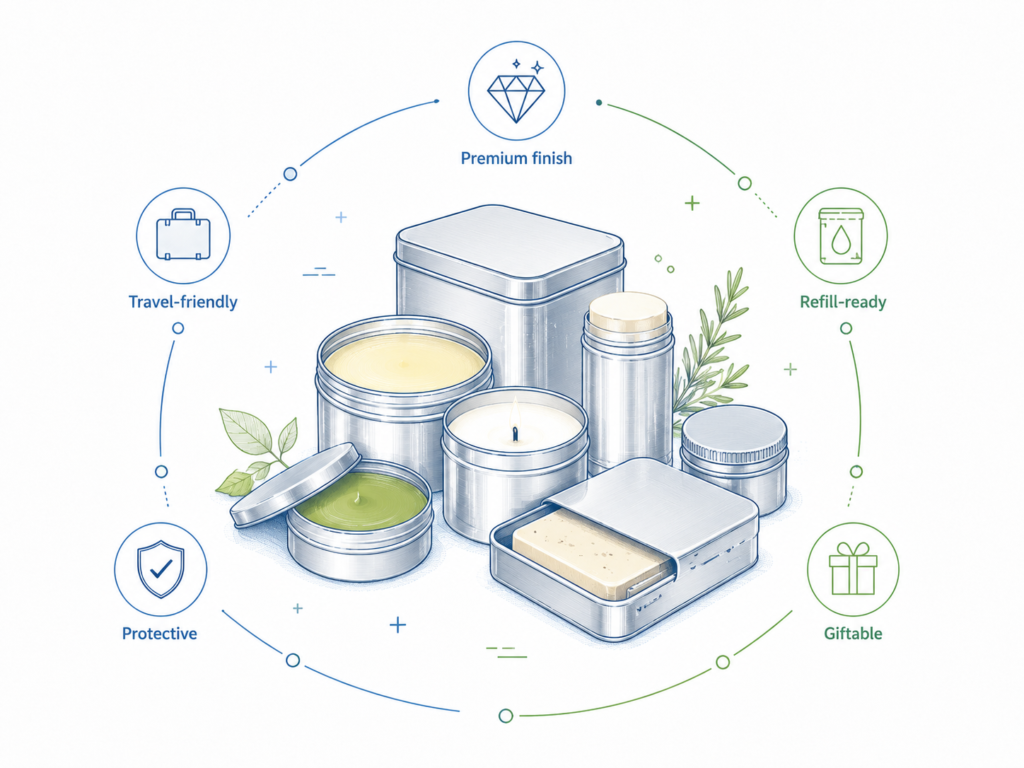
Sustainable custom metal packaging is not only for consumer goods. Specialty and industrial applications can also benefit from metal tins, especially where the product is valuable, fragile, reusable, technical, or sold as a kit. Examples include small tools, electronics accessories, repair kits, hardware samples, medical or laboratory accessories, collectibles, premium tobacco-related accessories where legal, and precision components.
In these categories, durability is a central sustainability benefit. A weak package may collapse, spill contents, mix parts, or create rework. A metal tin with compartments can protect components, organize SKUs, and remain useful after the original product is consumed or installed. For B2B buyers, a reusable industrial tin can also support field service, sample distribution, sales kits, and training kits.
The design logic is different from food or beauty packaging. Industrial tins may need stronger hinges, foam or molded inserts, anti-rust treatment, labeling zones, tamper evidence, barcode areas, or reinforced corners. Circularity may come from long reuse rather than consumer recycling. A tin that serves as a technician’s storage case for months has already delivered more value than a disposable box.
This is why custom engineering matters. Sustainable packaging for industrial goods should be evaluated by damage prevention, organization, transport efficiency, reuse period, and end-of-life recyclability. When the package prevents product loss and stays useful, sustainability and cost control move in the same direction.
Comparing metal packaging with plastic and paperboard in buyer terms
No serious packaging expert should claim one material is always best. Plastic can be lightweight, flexible, transparent, sealable, and cost-efficient. Paperboard can be renewable, printable, lightweight, and familiar to consumers. Glass can feel premium and inert. Metal can be durable, protective, recyclable, and reusable. The best choice depends on the product and the packaging objective.
However, for circular packaging goals, metal has several advantages that are worth evaluating. It is mechanically strong, visually premium, sortable in many systems, reusable in real consumer behavior, and suitable for long-life packaging objects. It can also reduce reliance on multi-layer flexible plastics in certain premium applications.
The comparison below is intentionally practical rather than ideological.
| Material format | Strengths | Common circularity challenges | Where metal tin boxes may outperform |
|---|---|---|---|
| Flexible plastic pouch | Lightweight, low cost, strong sealing, efficient shipping | Often difficult to recycle if multi-layer, low reuse value, limited premium feel | Premium dry goods, refillable systems, giftable products, collectible packaging |
| Rigid plastic box | Transparent, moldable, lightweight | Resin identification, contamination, low recycling rates in some markets, lower perceived permanence | Premium cosmetics, gift sets, reusable storage tins, stronger brand object value |
| Paperboard carton | Printable, lightweight, renewable fiber options | Moisture sensitivity, lower durability, may need coatings or plastic windows | High-protection premium tins, long shelf life categories, reusable gift packaging |
| Glass jar | Premium, inert, transparent, refillable in some systems | Heavy, breakable, transport emissions, damage risk | E-commerce gift sets, lightweight premium tins, non-liquid products, durable kits |
| Metal tin box | Durable, recyclable, reusable, premium, strong barrier against light and physical damage | Higher tooling/setup planning, potential denting, coating specification needed | Products where shelf impact, reuse, protection, and circular material story all matter |
This table does not mean metal should replace everything. It means brands should choose metal when the product benefits from the package becoming a durable object. If the product is low value, ultra-price-sensitive, and consumed immediately, a tin may be excessive. If the product is premium, giftable, sensitive, refillable, collectible, or exposed to long distribution, metal may make strong business sense.
Designing tin boxes for better recyclability
To support circular packaging goals, tin boxes should be designed for easier recycling at end of life. The first principle is to keep the core material as simple as possible. A mostly metal structure is easier to communicate and recover than a complex mixture of metal, rigid plastic, foam, magnets, fabric, and adhesives.
When mixed materials are necessary, buyers should think about separability. A removable paperboard insert is easier for a consumer to separate than a permanently glued foam insert. A small label may be acceptable, but heavy lamination or difficult adhesives can create problems. A window can improve product visibility, but it should be used only when it adds real value. If the brand can communicate product quality through artwork, embossing, or a small display sample, a window may be unnecessary.
The second principle is right-weighting. Lightweighting should not weaken the package to the point of damage. Overbuilding should not waste material. The right tinplate thickness is the one that meets protection, stacking, opening, and reuse needs without unnecessary excess.
The third principle is clear communication. Consumers are more likely to recycle correctly when disposal instructions are simple. Brands can include concise recycling guidance, reuse messaging, or refill instructions on the tin, label, insert card, or product page. The message should be accurate for the target market. Avoid universal claims such as “100% recyclable everywhere” unless you can support them for the actual markets where the product is sold.
The fourth principle is supplier documentation. Ask for material details, coating information, relevant food-contact or safety documents, and production process explanations. This documentation supports compliance teams and helps sales teams answer retailer questions.
Design for circularity without losing shelf impact
A common fear is that sustainable packaging will look plain. Tin boxes prove that circular packaging can still be beautiful. In fact, premium aesthetics may help circularity because customers are more likely to keep attractive packaging.
The design challenge is to create impact without unnecessary complexity. A clean rectangular tin with a matte finish and an embossed logo can feel more premium than a crowded design with too many effects. A simple seasonal illustration on a proven structure can reduce tooling changes while keeping the collection fresh. A limited-edition colorway can create repeat interest without changing the entire package.
For many brands, the most sustainable design choice is not the most minimal design. It is the design customers keep. A beautiful tin that functions as home storage may have a longer useful life than a plain box that is immediately discarded. Emotional durability matters. People keep objects they like.
Here are practical design moves that support both circularity and brand value:
- Use a structure that is easy to reuse: stable shape, comfortable edges, practical volume, and reliable closure.
- Choose a durable finish that resists scuffs, fingerprints, and abrasion in the intended sales channel.
- Avoid unnecessary mixed materials when artwork, embossing, or printing can achieve the same effect.
- Design inserts to be removable, recyclable, or reusable when possible.
- Use artwork space to communicate reuse or refill behavior in simple language.
- Plan a series system so future campaigns can reuse the same tooling and structure.
- Test real packout and shipping conditions before mass production.
These choices do not reduce commercial appeal. They usually improve it.
How custom metal packaging supports retailer and distributor goals
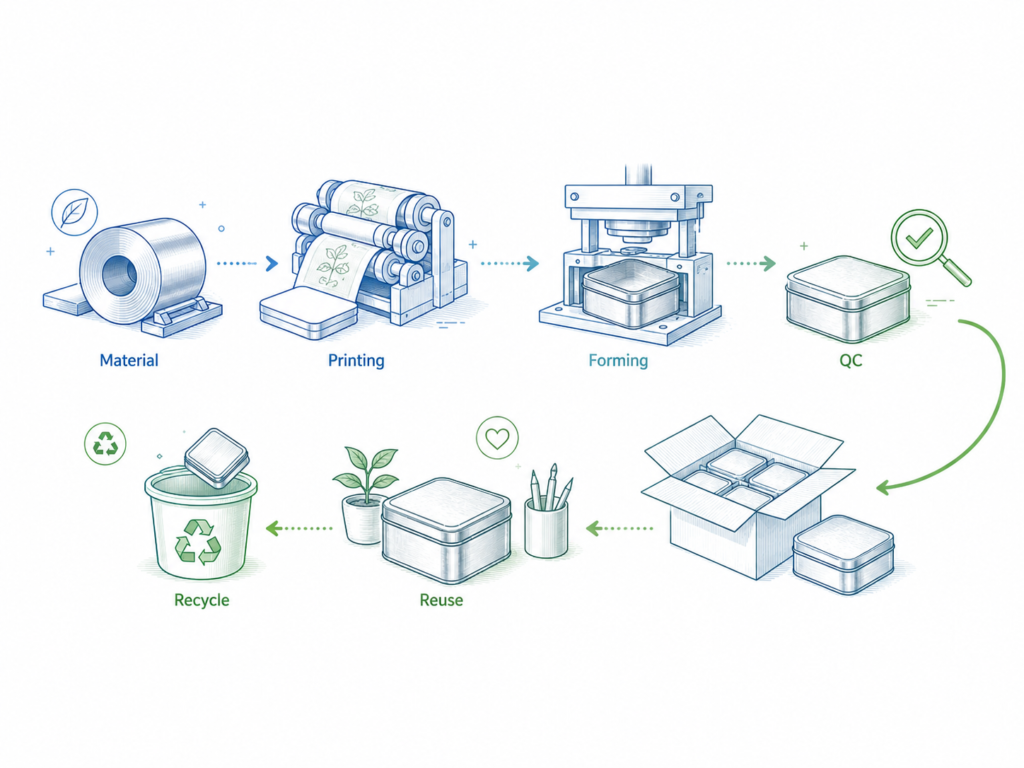
Retailers care about sustainability, but they also care about sell-through, shelf efficiency, damage rates, compliance, and customer complaints. A custom tin box can support these priorities when it is engineered correctly.
For physical retail, metal packaging provides strong shelf presence. It reflects light differently from paper and plastic, supports crisp shapes, and feels premium in the hand. A tin can also protect the product from repeated handling. For seasonal retail, tins help products look gift-ready without additional wrapping. For club stores or travel retail, metal packaging can create a premium bundle that feels more valuable.
For distributors, durability matters. A stronger package can reduce damage during pallet handling, container loading, warehouse transfers, and courier delivery. This is especially important for export brands. A package that survives long-distance logistics protects the product, the margin, and the customer relationship.
For e-commerce, the package may arrive directly in the customer’s hands. That makes unboxing quality more important. A metal tin can make the delivery feel like a premium experience, but only if the tin arrives clean and undented. This requires good carton packout, protective dividers, correct stacking, and realistic drop testing.
For sustainability reporting, metal packaging can help because the material story is easier to explain than many complex formats. A buyer can discuss recyclability, reuse potential, refill systems, material recovery, and product protection in one coherent narrative. This is valuable for sales teams, distributors, retailers, and corporate sustainability teams.
Common mistakes when buyers choose sustainable tin packaging
The first mistake is choosing a shape before defining the product requirements. A special shape may look attractive, but it can create tooling cost, packing inefficiency, closure problems, or delayed production. Shape should support the product and the reuse scenario, not distract from practical performance.
The second mistake is treating “food-grade” as a single universal label. Food contact depends on substrate, coating, product chemistry, contact time, temperature, and target market. Buyers should ask for relevant documentation instead of assuming one tin is suitable for every food.
The third mistake is ignoring the insert. Many premium tins fail because the outer box looks good but the inside feels cheap, loose, noisy, or difficult to use. Inserts are part of product protection and customer experience. They also affect circularity, especially when they are made from mixed materials.
The fourth mistake is overdecorating. Too many effects can increase cost and risk without improving sales. A clean finish with one strong tactile detail can be more effective than a complicated decoration stack. The right finish should match the brand position and production reality.
The fifth mistake is underestimating lead time. Custom metal packaging includes consultation, design confirmation, tooling, sampling, artwork proofing, printing, coating, stamping, forming, assembly, quality inspection, packing, and shipping. Sustainable planning should avoid rushed production and emergency logistics.
The sixth mistake is making sustainability claims that are too broad. Say what is true and useful: reusable tin, recyclable metal, designed for long-term storage, refill-ready structure, reduced secondary packaging, or separable insert. Avoid claims that cannot be supported in every sales market.
A buyer roadmap: from sustainability goal to finished tin box
A successful sustainable custom metal packaging project should follow a clear roadmap. This is not bureaucracy. It is how brands prevent waste, delays, and redesign.
Define the sustainability objective. Decide whether the main goal is recyclability, refillability, reuse, plastic reduction, premiumization, damage reduction, shelf-life support, or a combination. Different goals require different structures.
Map the product risks. Identify what can damage product quality: moisture, oxygen, light, impact, odor transfer, corrosion, abrasion, leakage, or contamination. Packaging should solve real risks.
Choose the right structure. Decide shape, size, lid type, hinge, edge design, internal insert, and closure force based on use, not only appearance.
Specify material and coating. Confirm tinplate thickness, internal lacquer, external coating, food-contact or cosmetic compatibility, and market requirements.
Design for reuse and end of life. Add reuse-friendly proportions, separable inserts, clear disposal guidance, refill instructions, and durable finishes.
Prototype and test. Validate appearance, opening force, closure, stacking, scuff resistance, drop performance, insert fit, odor, and product compatibility.
Plan MOQ and lead time. Align production with launch calendar, sales forecast, inventory strategy, and shipping method.
Document the packaging story. Prepare a simple internal sheet for sales, retailers, distributors, and customer service: material, intended reuse, recyclability guidance, care instructions, and compliance documents.
This roadmap helps buyers turn sustainability from a slogan into a controlled packaging project.
Where Mr.Tin Box fits in sustainable custom metal packaging programs
Mr.Tin Box is commercially relevant because the website presents metal packaging as a category system, not one generic product. Food and beverage, beauty and personal care, gift and promotional, holiday, specialty, and industrial packaging all require different thinking. A supplier that understands these differences can ask better questions early, which reduces mistakes later.
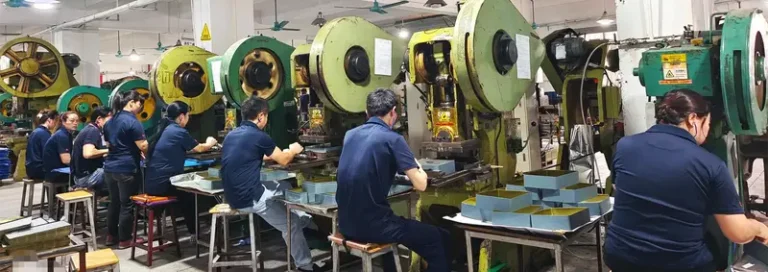
The company’s public content also emphasizes manufacturing logic: consultation, design, tooling, sampling, finishing, stamping, inspection, and delivery. For custom metal packaging, that process visibility matters. Sustainable packaging is not only a material decision. It is a manufacturing decision. The most recyclable material can still fail if the closure is wrong, the coating is mismatched, the insert is poorly designed, or the lead time is unrealistic.
For brands developing sustainable custom metal packaging, Mr.Tin Box can be positioned around four practical advantages:
- Category-specific packaging thinking. Food, beauty, gift, and industrial projects are not treated as identical.
- Custom structure and decoration. Tin boxes can be designed for shape, finish, embossing, printing, insert, and reuse objective.
- Protection plus presentation. Metal packaging can help products arrive intact while improving shelf appeal.
- Circular packaging communication. Reusable and recyclable tin structures give brands a clearer sustainability story.
A strong call to action should invite buyers to bring product details, target market, artwork direction, sustainability goals, and launch timeline. The Mr.Tin Box contact page is the logical next step for brands that want to translate a circular packaging goal into a real tin box specification.
Sustainability claims: what brands can say more safely
Packaging sustainability claims must be specific. Overclaiming can create compliance risk and customer distrust. Instead of saying “green packaging” or “zero-waste packaging,” brands should use claims that match the actual structure and target market.
Safer claim examples include:
- “Reusable metal tin designed for long-term storage.”
- “Recyclable tinplate structure where local metal recycling is available.”
- “Refill-ready tin designed to support repeat use.”
- “Durable metal packaging designed to reduce product damage during handling.”
- “Separable paperboard insert to support easier material sorting.”
- “Plastic window removed to simplify packaging structure.”
- “Metal tin designed for collectible seasonal reuse.”
Claims should be supported by material details and, where needed, supplier documents. If the tin includes plastic windows, foam inserts, magnets, heavy labels, or specialty coatings, those details should be considered before making recyclability claims. Clear and accurate language is better than exaggerated sustainability language.
Commercial benefits: why sustainable tin packaging can improve ROI
Sustainable packaging should not be evaluated only as a cost. In many premium categories, a tin box can create several commercial benefits that offset the higher unit cost compared with simple disposable packaging.
First, it can increase perceived value. Customers often associate metal with quality, durability, giftability, and permanence. This can support premium pricing, seasonal promotions, and stronger shelf differentiation.
Second, it can reduce damage-related costs. Stronger packaging can lower product returns, retail markdowns, replacement shipments, and customer complaints. This is especially relevant for export, e-commerce, and fragile premium goods.
Third, it can extend brand exposure. A reusable tin keeps the brand visible long after the first purchase. This is difficult to achieve with disposable packaging.
Fourth, it can support refill and repeat purchase models. Once a customer owns a branded tin, the brand can sell refill packs, seasonal refills, or limited-edition refills that use less material than the first purchase.
Fifth, it can support retail storytelling. Sales teams can explain recyclability, reuse, protection, and premium design in a simple way. Retail buyers like packaging that is easy to understand and easy to merchandise.
Sixth, it can reduce redesign risk. A proven tin structure can be used across multiple artwork versions, seasonal launches, and product variants. This helps brands control tooling costs while keeping the line fresh.
These benefits are why sustainable custom metal packaging should be treated as a business asset, not only an environmental gesture.
Example packaging concepts for different circular goals
| Circular goal | Example custom tin concept | Why it works commercially |
|---|---|---|
| Reduce single-use gift packaging | Holiday chocolate tin with embossing and removable paperboard tray | Gift-ready presentation, customer keeps the tin, tray can be separated |
| Support refill behavior | Premium tea tin with tight-fitting lid and refill label system | First purchase feels premium; future purchases can use refill packs |
| Reduce damage in e-commerce | Rigid cosmetics gift tin with molded pulp insert and scuff-resistant finish | Protects high-value items and improves unboxing experience |
| Improve shelf-life perception | Coffee or matcha tin with opaque body, moisture-conscious closure, and aroma-focused messaging | Connects packaging function with product quality |
| Build collectible reuse | Seasonal biscuit tin series using the same structure but new artwork each year | Encourages repeat buying and keeps tooling stable |
| Organize technical products | Industrial sample tin with removable compartments and printed part guide | Extends use as a field kit or sample organizer |
Final thoughts: tin boxes make circular packaging tangible
Circular packaging goals become meaningful when customers, retailers, and recycling systems can understand the package. Tin boxes help because they make sustainability tangible. Customers can feel durability. They can reuse the container. They can recognize metal as a recyclable material. Retailers can see premium shelf value. Brands can connect the package to product protection, refill behavior, and long-term value.
Custom metal packaging is not the right answer for every product. It requires planning, tooling, coating decisions, artwork control, quality inspection, and realistic lead-time management. But for premium foods, tea, coffee, chocolate, cookies, candies, cosmetics, skincare sets, gifts, promotional campaigns, specialty kits, and industrial products, a well-designed tin box can support sustainability and sales at the same time.
The most important point is this: circular packaging is not only about what happens after disposal. It is also about what happens before disposal. If the package protects the product, prevents damage, creates reuse, supports refill behavior, improves customer experience, and remains recyclable at end of life, it has done more than carry a product. It has helped the brand build a more resilient packaging system.
For brands looking to move beyond vague “eco-friendly” claims, sustainable custom metal packaging offers a clearer path: design the package as a durable object, specify the material and coating responsibly, reduce unnecessary mixed materials, validate performance, communicate reuse clearly, and choose a supplier that understands both manufacturing and brand value. That is where tin boxes can support circular packaging goals in a way customers can see, touch, and remember.