

Ordering a custom tin box is not the same as buying a standard empty container from a catalog. For a serious brand, importer, distributor, private-label buyer, or promotional product team, the tin box becomes part of the product system. It protects the item inside, influences shelf presence, affects logistics cost, supports food-contact or cosmetic packaging requirements, and shapes how the customer remembers the brand after purchase.
A well-developed custom tin box can make tea feel more collectible, chocolate more giftable, cosmetics more premium, holiday products more seasonal, and industrial components more secure. A poorly planned tin, however, can create late artwork revisions, tooling delays, lid-fit problems, insert failures, carton inefficiency, or compliance questions at exactly the wrong moment. The difference is not luck. It is process.
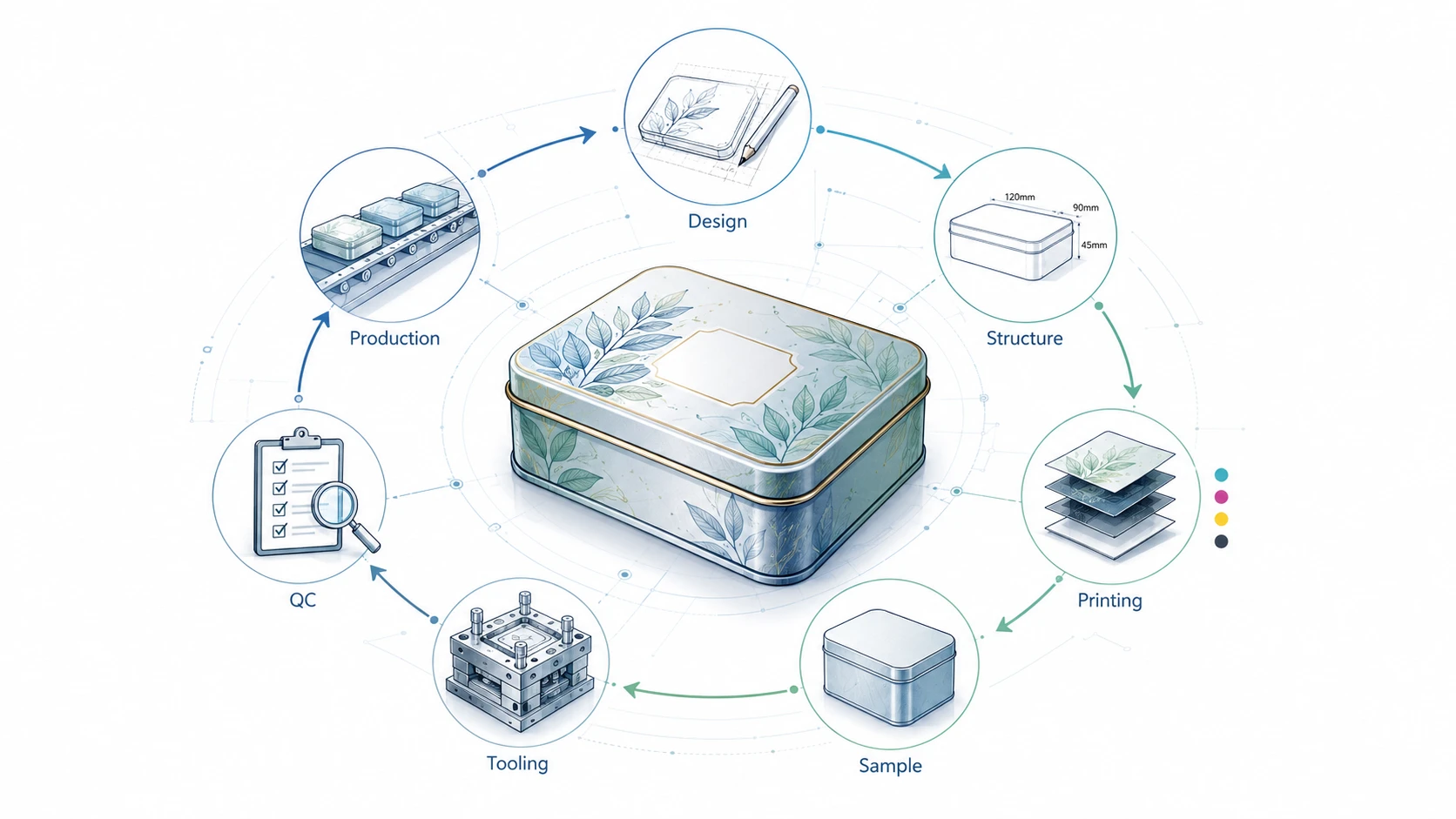
This guide explains how to order a custom tin box from the first idea to mass production. It is written for commercial buyers who need a practical, plain-English roadmap, not a technical textbook. You will see what information to prepare, how structure and material decisions are made, why food-contact status must be clarified early, what to check during sampling, how tooling and printing affect cost, and how quality control should be organized before the first production order.
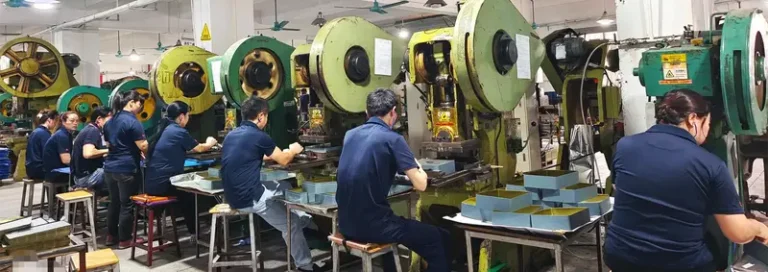
Mr. Tin Box develops custom metal packaging for global buyers across Food & Beverage Packaging, Beauty & Personal Care Packaging, Gift, Promotional & Holiday Packaging, and Specialty & Industrial Packaging. The company’s own workflow emphasizes consultation, 3D structure design, sample making, printing, stamping, assembly, and inspection. That is exactly the kind of workflow a buyer should expect from a professional custom tin box supplier.
Before we go step by step, the most important idea is this: a custom tin box should be specified as a business asset, not only as a beautiful shell. The best project starts with the product, target market, order quantity, retail channel, packaging role, and deadline. Shape, color, embossing, insert, and finishing should support those requirements, not replace them.
Table of Contents
Why a custom tin box is a commercial packaging decision
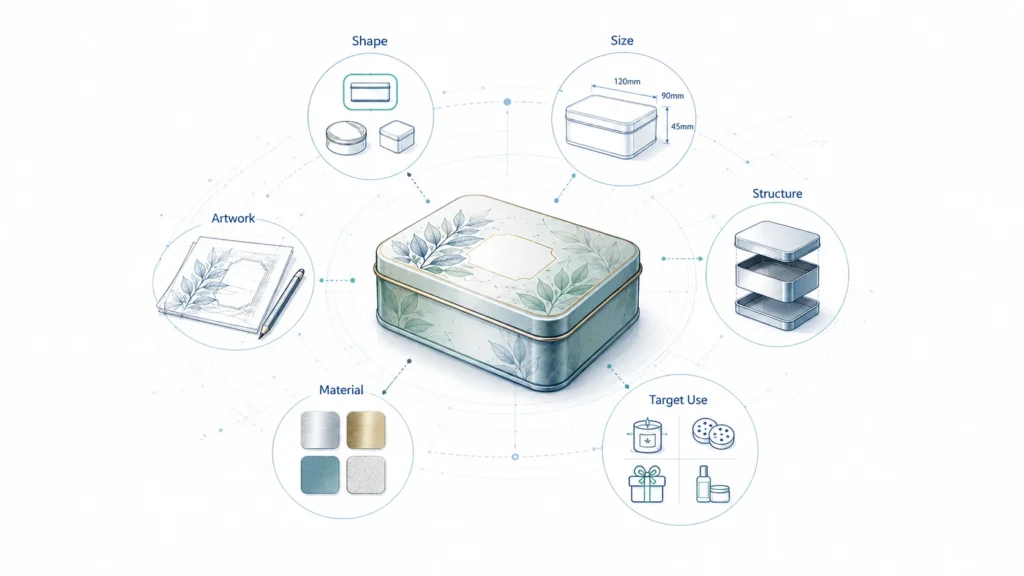
A custom tin box is popular because metal packaging gives buyers a rare combination of strength, decoration, reusability, and recyclability. It can be printed with detailed artwork, embossed for tactile branding, shaped into distinctive structures, and reused by consumers after the original product is finished. That reuse is valuable because the packaging continues to display the brand in kitchens, bathrooms, offices, desks, drawers, workshops, or gift shelves.
The business case is especially strong for products where presentation influences perceived value. A tea tin can become part of the daily brewing ritual. A chocolate tin can turn a simple assortment into a gift. A cosmetic balm tin can communicate durability and portability. A promotional tin can keep a campaign visible longer than a disposable card box. An industrial tin with a fitted insert can protect parts while making the product look organized and professional.
At the same time, buyers should not assume that all tins are automatically suitable for every product. Tinplate is strong and printable, but it still requires the correct coating, thickness, shape, forming process, closure design, and quality control. A custom tin box used for direct food contact is different from a tin used as secondary packaging around a sealed pouch. A cosmetic tin holding a greasy balm is different from a gift tin holding wrapped candies. An electronics tin may need anti-scratch or anti-static insert planning, while a holiday cookie tin may need carton strength and shelf impact.
Industry data also supports why metal packaging remains commercially relevant. Grand View Research estimated the global metal packaging market at USD 148.13 billion in 2024 and projected it to reach USD 184.21 billion by 2030, with food and beverages leading end use by revenue share in 2024 (Grand View Research). These figures do not mean every product should use metal packaging. They do show that metal packaging remains a large, active category because brands continue to value product protection, shelf life, recyclability, and premium presentation.
Sustainability pressure is another reason buyers look closely at metal packaging. The U.S. EPA reports that containers and packaging generated 82.2 million tons of U.S. municipal solid waste in 2018, or 28.1% of total generation, and that steel containers and packaging had an estimated 73.8% recycling rate in that data set (U.S. EPA). In Europe, Steel for Packaging Europe reported that 82% of steel packaging placed on the market was really recycled in 2023, meaning it entered actual recycling operations rather than only being collected (Steel for Packaging Europe).
| Data point | Reported value | Why it matters for custom tin box buyers |
|---|---|---|
| Global metal packaging market size, 2024 | USD 148.13 billion | Shows the scale of metal packaging as a commercial category. |
| Projected global market size, 2030 | USD 184.21 billion | Supports long-term brand investment in metal formats. |
| U.S. containers and packaging MSW, 2018 | 82.2 million tons | Packaging choices are visible in waste policy and retail discussions. |
| U.S. steel packaging recycling rate, 2018 | 73.8% | Steel packaging has a strong recovery pathway in U.S. EPA data. |
| European steel packaging recycling, 2023 | 82% really recycled | Useful for sustainability positioning when claims are accurate. |
There is also a material advantage. Steel is magnetic, so it is easier to separate from waste streams than many non-metal materials. World Steel Association explains that steel can be recycled repeatedly and that every tonne of steel scrap used for steel production avoids the emission of 1.5 tonnes of CO2 and the consumption of 1.4 tonnes of iron ore, 740 kg of coal, and 120 kg of limestone (worldsteel). A custom tin box buyer should still avoid exaggerated claims. The correct message is not “this package creates no waste.” A better message is: “This metal package is durable, reusable, and recyclable where suitable recycling systems exist.”
Define the packaging brief before choosing the shape
Many custom tin box problems begin because the buyer starts with a shape before defining the product requirements. A heart-shaped tin, window tin, suitcase tin, book tin, or irregular luxury structure may look attractive, but it may not be the best first decision. Shape affects tooling cost, material use, carton loading, lid fit, stacking, filling efficiency, and delivery schedule. A special shape should serve the product and the brand, not create unnecessary production risk.
A professional brief should answer several basic questions. What product will go inside the tin? Is it food, cosmetic, promotional merchandise, a candle, a toy, a tool, an electronic accessory, or an industrial component? Is the tin primary packaging, secondary packaging, or a gift outer box? Does the product touch the metal directly, or is there an inner bag, bottle, jar, tray, wrap, blister card, pouch, sleeve, paper cup, or foam insert? What are the product dimensions, weight, shelf life, retail price, and target market?
The brief should also include commercial information. What is the target order quantity? Is the project a one-time seasonal campaign or a repeat SKU? Is the launch date fixed by a holiday, trade show, crowdfunding campaign, retail listing, or distributor deadline? Will the tin be shipped empty to another factory for filling, or will it be packed together with the product at the same site? Will the final cartons be shipped by sea, air, courier, or domestic truck?
For Mr. Tin Box, the first visible step in the published workflow is consultation and requirements review. This is not a formality. At this stage, a good supplier should ask about size, shape, artwork, structure, and application. The buyer should be ready to share samples, drawings, photos, mood boards, target price, desired finish, and any known compliance requirements.
| Brief item | What to prepare | Why it matters |
|---|---|---|
| Product information | Dimensions, weight, material, odor, fragility, shelf life | Determines structure, coating, insert, and carton plan. |
| Packaging role | Direct contact, secondary pack, gift pack, refill container | Determines food-contact or cosmetic-contact risk. |
| Target market | U.S., EU, UK, GCC, Japan, Australia, or global | Affects labeling, testing, documentation, and claims. |
| Order plan | Trial order, seasonal launch, annual program | Influences tooling investment and unit cost. |
| Retail channel | Supermarket, e-commerce, gift shop, distributor, B2B | Affects drop-test, display, barcode, and carton design. |
| Deadline | Launch date, sample approval date, delivery date | Controls whether a custom mold is realistic. |
A buyer who can provide this information early will receive a more accurate quotation and a more realistic timeline. A buyer who only says “I need a beautiful custom tin box” will force the supplier to guess, and guessing is expensive in packaging development.
Choose the correct tin structure for the product
Once the brief is clear, the next step is structure. Structure means the physical form of the tin: its footprint, height, opening method, lid style, seam design, edge treatment, hinge method, window, handle, insert, tray, divider, or internal support. This is where design becomes engineering.
The most common custom tin box structures include slip-lid tins, hinged tins, plug-lid tins, telescopic tins, round tins, square tins, rectangular tins, sliding tins, window tins, book-shaped tins, suitcase tins, and multi-layer gift tins. Each structure has advantages and limits. A slip-lid tin is simple, cost-effective, and suitable for many food and gift applications. A hinged tin feels premium and convenient, but the hinge must be formed consistently. A window tin gives product visibility, but the window material, adhesive method, scratch risk, and recyclability claims need careful review. A shaped tin can create strong shelf recognition, but tooling may cost more and carton efficiency may decrease.
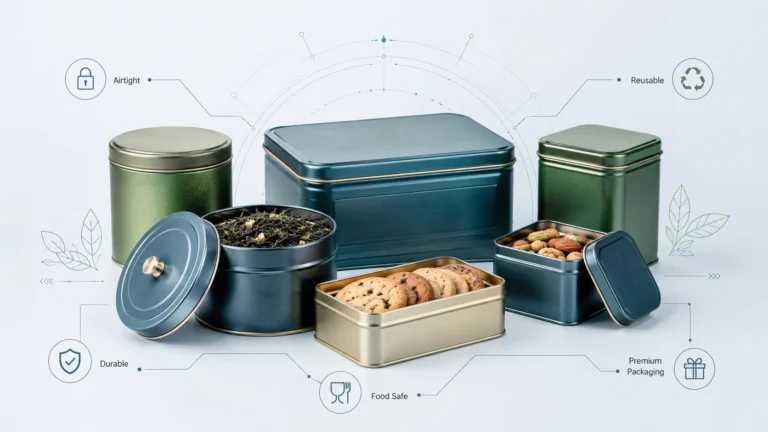
Food and beverage projects often start with protection. For tea, coffee, cookies, chocolate, and candies, the custom tin box must manage light, moisture, aroma, breakage, and presentation. The Custom Tin Box for Tea, Coffee, Chocolate, Cookies, and Candy Packaging guide on Mr. Tin Box discusses why each food category has different risks. Tea may need aroma protection and a tight lid. Coffee may need an inner pouch or freshness strategy. Chocolate may need trays to reduce scuffing. Cookies need crush resistance. Candy and mint tins need safe surfaces and repeat opening.
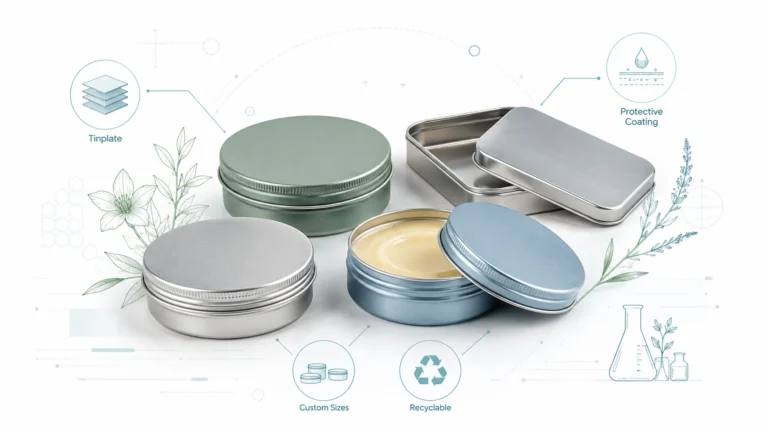
Beauty and personal care projects often start with brand emotion and formula compatibility. A balm tin, skincare set tin, perfume gift tin, essential oil box, or soap tin must feel clean and premium, but it also needs the right liner, insert, and coating plan. Greasy or aromatic products can interact with packaging differently from dry goods. For this category, Mr. Tin Box positions metal packaging as a way to deliver protection, aesthetic value, and long-term reliability through its Beauty & Personal Care Packaging service page.
Gift and promotional projects often prioritize unboxing, collectability, and campaign impact. A holiday tin may not need the same direct-contact performance as a primary food can, but it may need stronger decorative effects, inserts, special shape, limited-edition artwork, and carton planning for peak-season logistics. Mr. Tin Box describes these tins as suitable for corporate gifts, holiday collections, collector series, and promotional campaigns on its Gift, Promotional & Holiday Packaging page.
Industrial projects prioritize protection. A specialty industrial tin for tools, electronics, parts, or components may need reinforced structure, anti-scratch lining, EVA foam, partitions, moisture-resistant layers, or anti-static features. The Specialty & Industrial Packaging page highlights impact resistance, protective surface finishes, fitted trays, partitions, and stable transport protection.
| Product category | Common tin structure | Key design priority |
|---|---|---|
| Tea and coffee | Round, square, rectangular, slip lid, plug lid | Aroma, moisture control, shelf presence, reuse. |
| Chocolate and cookies | Hinged, rectangular, round, seasonal shaped tin | Gift presentation, insert layout, breakage control. |
| Candy and mints | Small sliding tin, round tin, shaped tin | Portability, safe edges, repeat opening. |
| Cosmetics and skincare | Hinged tin, balm tin, gift set tin | Premium finish, formula compatibility, clean interior. |
| Promotional gifts | Special shape, window tin, suitcase tin | Campaign memorability, visual impact, lead time. |
| Tools and components | Reinforced rectangular tin, fitted insert | Impact resistance, organization, surface protection. |
The right structure is not always the most creative structure. Often, the best business decision is to use an existing or near-standard mold, then create differentiation through artwork, embossing, matte/gloss contrast, metallic ink, or a high-quality insert. Fully custom molds are valuable when the shape itself creates brand equity, improves function, or supports repeat sales over a long program.
Select materials, coatings, and food-contact status carefully
Most decorative custom tin boxes are made from tinplate, which is thin low-carbon steel coated with tin. The steel provides strength and formability; the tin layer supports corrosion resistance and appearance. Some projects may use tin-free steel or aluminum depending on structure, cost, and application. In practical packaging discussions, “tin box” often refers to tinplate boxes rather than a box made entirely of tin.
Typical tinplate thickness depends on size, structure, rigidity needs, and forming requirements. Small mint tins may use thinner material, while larger biscuit tins, gift boxes, or industrial tins often require thicker material to reduce denting and improve hand feel. Public technical references describe tinplate as a packaging steel product commonly manufactured in thin gauges, with IspatGuru noting a conventional tinplate thickness range of approximately 0.13 mm to 0.50 mm (IspatGuru). Buyers do not need to memorize the exact gauge. They need to understand that thickness affects cost, strength, forming behavior, and perceived quality.
The coating system is just as important as metal thickness. A decorative tin usually has an external print and protective varnish. The interior may have a clear lacquer, gold lacquer, white coating, or another approved internal coating. For food-contact applications, the coating must be suitable for the product type, contact time, temperature, and target market. Acidic foods, oily products, aromatic items, dry powders, chocolate, candies, tea, and coffee can each create different compatibility questions.
Food-contact regulation should be treated seriously and early. The FDA explains that food packaging and its components can be food contact substances when they contact food and are not intended to have a technical effect in food (FDA). The FDA also maintains an inventory of food contact substances listed in 21 CFR for specific intended uses and use conditions (FDA Inventory).
In the European Union, the European Commission states that all food contact materials placed on the European market must comply with Regulation (EC) No 1935/2004, and all FCMs must be manufactured according to Good Manufacturing Practice under Regulation (EC) No 2023/2006 (European Commission). EFSA explains that chemicals can transfer from food contact materials into food and that EU requirements aim to ensure such transfer does not raise safety concerns, unacceptably change food composition, or adversely affect taste or odor (EFSA).
For buyers, the practical lesson is simple: do not use “food grade” as a vague marketing phrase. Specify the contact scenario. Is the tin in direct contact with dry biscuits? Is there an inner bag? Will wrapped chocolates touch the tin only accidentally? Will powder, candy, oil, or balm contact the coating? What is the intended shelf life? Which country will the product enter? What documents will retailers request?
| Contact scenario | Practical meaning | Buyer action |
|---|---|---|
| Direct food contact | Food touches the tin interior or liner. | Confirm suitable coating, migration/testing needs, and documentation. |
| Indirect or secondary contact | Food is inside a pouch, wrap, tray, or bottle. | Document the primary barrier and confirm the tin’s role. |
| Cosmetic contact | Balm, soap, fragrance, or skincare may touch the tin. | Check formula compatibility, odor, corrosion, and leakage risk. |
| Non-contact gift use | Tin holds wrapped items or merchandise. | Focus on safety, finish durability, insert fit, and customer experience. |
| Industrial use | Tin holds tools, parts, or electronics. | Specify protection, scratch resistance, moisture, and anti-static needs. |
Mr. Tin Box’s article on Food Grade Custom Tin Box Packaging is a useful internal resource for buyers who need to think through materials, coatings, and safety considerations. It is especially relevant for food and beverage buyers who want the custom tin box to support both presentation and compliance confidence.
Translate the brand into industrial design
A custom tin box is a three-dimensional brand object. It is not just a printed sheet folded into shape. Consumers touch it, open it, hear the lid close, feel the edge radius, notice the gloss level, and decide whether to keep it. That is why structural design and graphic design should develop together.
The design stage usually begins with product dimensions and reference samples. A buyer may send a competitor tin, a paper box, a mood board, a Pantone color target, a 3D sketch, or product photos. The supplier then turns these inputs into a structure that can be manufactured. At Mr. Tin Box, the published process includes 3D drawing and structure design after consultation. That step helps both sides align on proportions, opening style, functional details, and decoration zones before sample making.
A good industrial design should answer practical questions. Can the consumer remove the product easily? Does the lid open smoothly? Will the tin stack on shelf? Does the shape create dead space in cartons? Are the corners safe? Is the bottom stable? Can the tin pass reasonable handling without denting? Does the lid stay closed during transport? Is the embossing location away from areas that might deform during forming? Can artwork registration remain stable after stamping?
The best designs also manage visual hierarchy. A custom tin box usually has several surfaces: lid, front wall, back wall, side panels, base, and sometimes internal surfaces. The lid is often the main branding area, but the front wall may be more visible in shelf display. The side wall may be important for stacked retail. The bottom may need barcode, recycling marks, batch code, country of origin, or caution text. If all surfaces are overloaded with graphics, the tin can look noisy and cheap. If all surfaces are too plain, the package may fail to communicate value.
Buyers should also think about whether the tin is meant to be kept. A reusable tin should not rely entirely on temporary stickers that become messy after opening. It should have durable external varnish, attractive proportions, and a structure that remains useful after the product is consumed. A refillable tea tin, a desktop mint tin, a storage tin for sewing items, or a component organizer can keep the brand visible for months or years.
At this stage, it is often useful to read Mr. Tin Box’s Custom Tin Box Guide, which explains how buyers can match metal packaging to product needs rather than choosing by appearance alone. For SEO and commercial intent, that internal link also helps connect this ordering guide to another buyer-focused resource on the website.
Prepare artwork for metal printing and finishing
Printing on tinplate is different from printing on paper. Metal has reflectivity, forming stress, coating layers, and registration limits. A design that looks perfect on screen may behave differently after coating, printing, varnishing, drying, cutting, stamping, bending, curling, and assembly. This is why artwork preparation should be handled with production reality in mind.
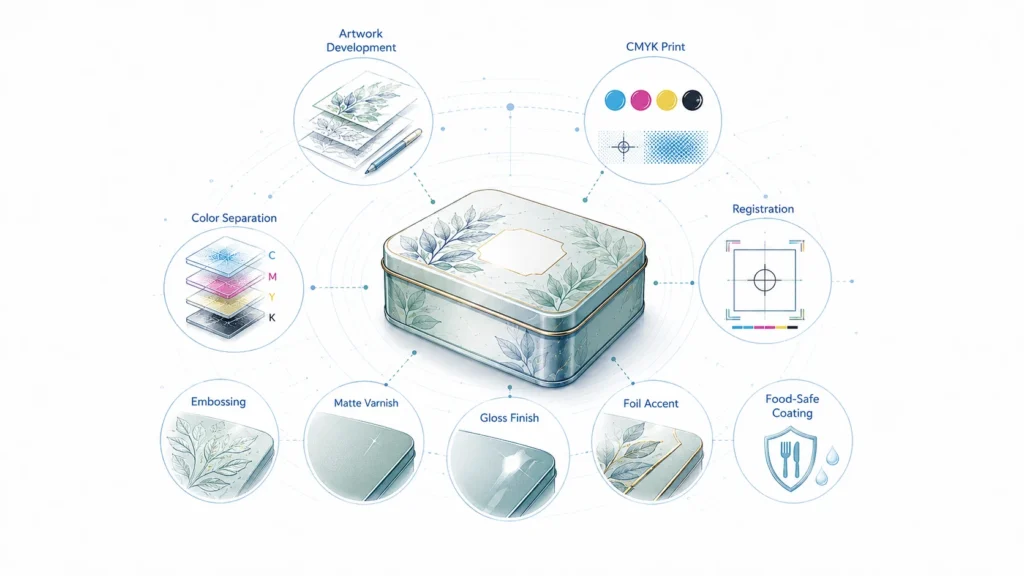
Most custom tin boxes use offset lithographic printing on metal sheets before forming. The printed sheets are then cut and stamped into components. Depending on the design, the exterior may use CMYK, spot colors, metallic inks, white base, clear varnish, matte varnish, gloss varnish, crackle effect, pearlescent finish, embossing, debossing, or other decorative processes. Interior printing is also possible for some projects, but it adds cost and requires careful planning.
Color management is one of the most common sources of buyer frustration. Pantone colors can shift depending on whether the ink is printed over a white base, silver metal, or tinted lacquer. Metallic backgrounds can make colors appear richer or darker. Matte varnish can reduce shine and change perceived color depth. Gloss varnish can increase brightness but show fingerprints or scratches more easily. The buyer should not approve color based only on a digital PDF. A metal color proof or production sample is much more reliable.
Embossing and debossing need special attention. These effects can make a custom tin box feel premium, but they change the metal surface. If embossing is too deep, placed too close to an edge, or combined with fine printed details, it can cause distortion, misalignment, or cracking in the coating. A good supplier will advise on feasible embossing depth and position. A buyer should approve embossing by sample, not only by drawing.
Finishing should match the brand category. Food tins often use bright, clean artwork for shelf visibility, or restrained matte finishes for premium tea, coffee, or chocolate. Beauty tins may use soft-touch matte, metallic accents, minimal typography, and precise embossing. Promotional tins may use stronger colors and visual effects. Industrial tins may use durable coatings, clear labeling, and functional branding rather than delicate luxury finishes.
| Finish option | Commercial effect | Production note |
|---|---|---|
| Gloss varnish | Bright, retail-friendly, colorful | Can show scratches and fingerprints more clearly. |
| Matte varnish | Premium, soft, modern | May reduce color brightness; check scuff resistance. |
| Embossing | Tactile logo or pattern | Must be checked against forming and registration limits. |
| Debossing | Subtle recessed detail | Works well for premium minimal designs. |
| Metallic ink | Luxury and shelf impact | Appearance depends on base layer and lighting. |
| Spot gloss | Contrast between matte and shine | Requires careful registration and proofing. |
| Interior printing | Premium unboxing | Adds cost and may require contact-safety review. |
A buyer should provide artwork in editable vector format when possible, with fonts outlined, images at proper resolution, Pantone references, barcode requirements, mandatory label text, and clear indication of finish effects. The artwork file should match the supplier’s dieline. If a buyer changes product dimensions after artwork has begun, the dieline may change and artwork may need to be rebuilt.
Develop inserts, trays, and internal protection
Many buyers focus on the outside of the custom tin box and underestimate the inside. This is a mistake. The insert often decides whether the product arrives safely and whether the unboxing experience feels premium. A beautiful metal box with a loose, cheap, noisy, or poorly fitted insert can damage the customer’s perception.
Insert options include paperboard dividers, molded pulp, PET trays, PP trays, EVA foam, sponge, velvet flocking, paper sleeves, blister trays, cardboard risers, window cards, and fitted component holders. The correct choice depends on the product category. Chocolates may need cavity trays or paper cups. Cookies may need dividers or stack supports. Cosmetics may need a fitted platform to hold bottles, jars, tubes, or brushes. Promotional sets may need a tray that presents multiple items cleanly. Industrial components may need EVA foam, partitions, or anti-scratch layers.
The insert also affects packing speed. A complex insert may look wonderful in a prototype, but if workers struggle to assemble it during mass production, labor cost and schedule risk increase. A good insert should be protective, attractive, easy to load, and consistent across volume.
For e-commerce, the insert becomes even more important because parcels experience drops, vibration, compression, and unpredictable handling. A metal tin is rigid, but the product inside can still move. If chocolates scuff, jars rattle, tools scratch, or cookies break, the outer tin alone has not solved the packaging problem.
Buyers should test inserts with real products, not empty samples. Real products reveal weight, center of gravity, friction, rattle, product removal difficulty, and visual fit. If the project involves multiple product variants, every variant should be checked. A tin designed for one bottle diameter may not hold another bottle securely. A holiday gift tin may work with one cookie stack height but fail after a supplier changes the cookie size.
Mr. Tin Box’s Custom Metal Tin Packaging Solutions for Promotional and Retail Products is a useful related article because promotional and retail tins often depend on the relationship between outer tin, inner holder, and display effect. For many campaigns, the inside is what turns packaging into a memorable gift.
Sampling: what to approve before tooling and mass production
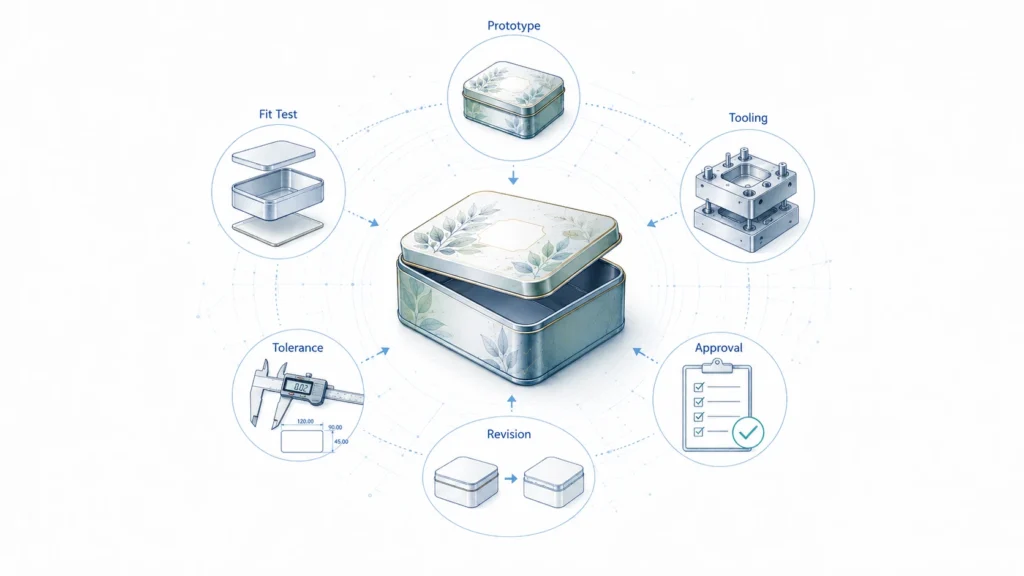
Sampling is the bridge between idea and production. For custom tin box projects, samples may include existing mold samples, blank structure samples, 3D printed mockups, hand-made prototypes, metal color proofs, printed samples, pre-production samples, and pilot-run samples. The exact sample route depends on whether the buyer uses an existing mold or develops a new custom mold.
A sample should not be judged only by whether it looks attractive. Buyers should inspect dimensions, lid fit, opening force, edge smoothness, hinge movement, coating quality, odor, artwork position, color, embossing, insert fit, product loading, carton packing, and handling behavior. If the sample is intended for food or cosmetic use, the buyer should also confirm whether the sample uses the same coating and materials planned for production.
Mr. Tin Box states on its service pages that rapid sampling can verify structure and finishing, and the homepage mentions 7–10 days for prototypes. This is helpful, but buyers should understand what “sample” means in context. A simple existing-mold blank sample can be fast. A fully custom printed sample with special finish, new mold, complex insert, and food-contact documentation takes more coordination.
A practical sample approval checklist should include four types of review: functional, visual, compliance, and supply-chain review. Functional review asks whether the tin works. Visual review asks whether it looks like the brand expects. Compliance review asks whether materials and documents match the target market. Supply-chain review asks whether the tin can be packed, shipped, filled, and displayed efficiently.
| Sample check area | What to inspect | Common problem avoided |
|---|---|---|
| Structure | Size, lid fit, hinge, edge, closure force | Loose lid, sharp edge, poor opening feel. |
| Appearance | Color, gloss, scratches, dents, print registration | Retail rejection or brand inconsistency. |
| Finish | Embossing depth, varnish, metallic effect | Distortion, scuffing, unrealistic design. |
| Insert | Fit, rattle, product removal, protection | Broken product or cheap unboxing. |
| Odor | Tin, coating, ink, insert, adhesive | Food or cosmetic quality complaints. |
| Packing | Carton count, orientation, protection | Freight inefficiency and transport damage. |
| Documents | Coating, material, test reports if needed | Compliance delays or retailer concerns. |
Never approve a sample casually if the project has a fixed retail launch date. Once tooling, printing plates, or mass production begin, changes can become expensive. A buyer should approve samples in writing and keep one approved “golden sample” for comparison during production and final inspection.
Tooling, mold development, and cost planning
Tooling is one of the most important cost and timeline drivers in a custom tin box project. If the buyer uses an existing mold, the project can move faster and avoid major tooling investment. If the buyer needs a unique shape, unique size, special hinge, special lid, or unusual structure, new tooling may be required. Tooling can create strong brand differentiation, but it should be justified by commercial value.
A custom mold is most worthwhile when the packaging will support repeat orders, high-volume retail, a long-term product line, a premium launch, or a protected brand shape. For a one-time small campaign, a standard mold with customized artwork may be more practical. A buyer should ask whether the desired visual result can be achieved by graphics and finishing before investing in a completely new structure.
Tooling cost is also connected to manufacturability. A shape with deep corners, narrow metal flow, complex embossing, tight tolerances, or multiple components may need more development. Minor design adjustments can sometimes reduce cost dramatically. For example, changing a corner radius, slightly adjusting height, using an existing base size, or simplifying a lid style may improve forming stability and reduce tool complexity.
Unit cost is influenced by more than tooling. Metal thickness, tin size, sheet utilization, number of components, printing colors, varnish system, embossing, insert, labor, packaging method, order quantity, inspection requirements, and freight all matter. A cheap-looking quotation may exclude insert, inner bag, export carton, testing, or special finishing. A professional quotation should make assumptions clear.
| Cost driver | Cost impact | Buyer decision |
|---|---|---|
| Existing vs. new mold | New mold adds upfront cost and time. | Use custom tooling only when it adds real value. |
| Tin size and height | Larger tins use more metal and carton space. | Avoid excess internal space unless needed for display. |
| Metal thickness | Thicker metal improves rigidity and feel. | Balance premium feel with budget and forming limits. |
| Printing and finish | Special effects add processes. | Use effects selectively for brand impact. |
| Insert design | Fitted inserts add material and labor. | Test protection and packing efficiency. |
| Order quantity | Higher volume often reduces unit cost. | Plan repeat orders if the SKU is long-term. |
| Packing method | Stronger cartons may cost more but reduce damage. | Match packing to shipping route and channel. |
Mr. Tin Box’s article How to Choose the Right Custom Metal Tin Packaging for Your Business is a good internal link for buyers comparing structure, budget, application, and supplier capability. It reinforces the idea that the best tin is not always the most decorative one; it is the one that fits the commercial job.
Production planning from printing to stamping and assembly
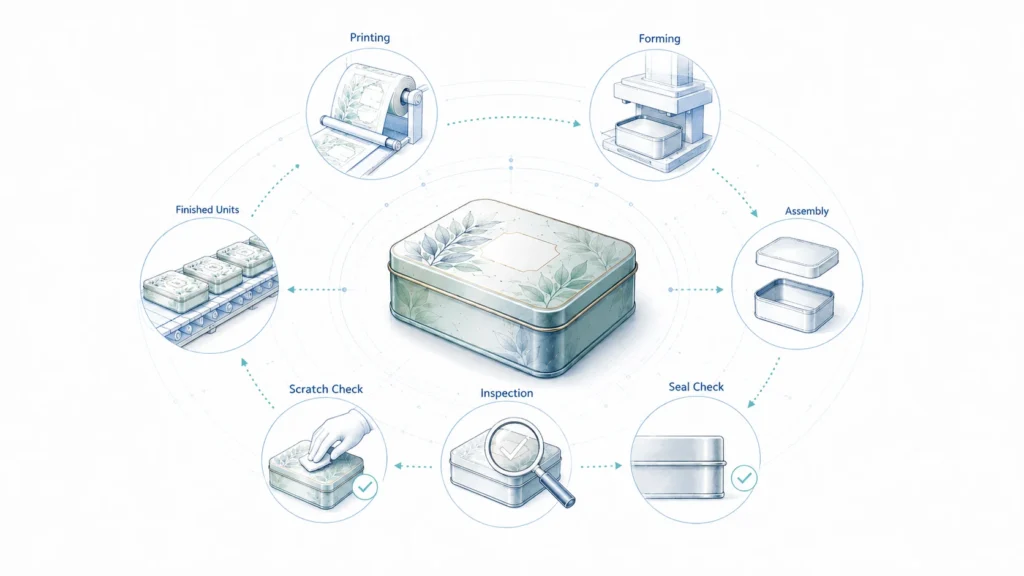
After sample approval and tooling confirmation, the project moves into production planning. A typical custom tin box production flow includes raw material preparation, coating or printing, varnishing and curing, sheet cutting, stamping, forming, curling, hinge or lid assembly, insert preparation, inspection, cleaning if required, packing, and carton labeling. Some steps may vary depending on structure.
Printing usually happens before forming. This means artwork must be positioned on flat metal sheets so that it lands correctly after cutting and stamping. The production team must control registration, color consistency, coating adhesion, and varnish curing. If the printed sheet is scratched or poorly cured before forming, defects can carry through the rest of production.
Stamping and forming convert the flat printed material into the tin components. This may involve cutting, drawing, bending, curling, seaming, or forming hinge parts. Precision matters because small dimensional differences can affect lid fit and stacking. If the lid is too tight, customers may struggle to open it. If it is too loose, it may come off during transport or feel low quality. If the edge curl is inconsistent, safety and appearance suffer.
Assembly brings components together. Hinged tins need hinge alignment. Window tins need window placement and attachment. Multi-component gift tins need matching lids, bases, trays, and accessories. Industrial tins may need inserts or protective linings installed accurately. Food-related tins may need interior cleanliness and appropriate handling.
A buyer should ask for production control points, not only a final inspection promise. The supplier should check incoming material, print quality, forming dimensions, lid fit, appearance, insert fit, carton packing, and final sampling from finished goods. A custom tin box is a series of processes, and quality should be controlled throughout the series.
Quality control: define acceptance before production starts
Quality control should not be left until the final day. Buyers should define quality requirements before mass production begins. This includes appearance standards, dimensional tolerances, functional requirements, packing requirements, and defect classification. A good supplier should understand which defects are critical, major, and minor.
Critical defects affect safety, legality, or product usability. Sharp edges, contamination, wrong material, severe corrosion, wrong barcode, or serious closure failure may be critical. Major defects affect saleability or function, such as visible dents, poor lid fit, obvious color mismatch, broken hinge, serious print misregistration, or insert failure. Minor defects may include small surface marks within agreed limits, slight color variation, or tiny cosmetic imperfections that do not affect saleability.
A professional inspection plan may include AQL sampling, but buyers should not use AQL language without understanding what it means. The key is to agree on what will be inspected and what is acceptable. For premium retail packaging, cosmetic requirements are usually stricter than for industrial packaging. For food and beauty packaging, odor, cleanliness, and coating condition may be more important than in general promotional tins.
| Inspection item | What to check | Why it matters |
|---|---|---|
| Dimensions | Length, width, height, lid clearance | Ensures product fit and carton planning. |
| Lid function | Opening force, closure security, hinge movement | Defines user experience and transport stability. |
| Appearance | Dents, scratches, coating marks, printing defects | Protects retail shelf quality. |
| Color | Pantone match, batch consistency, gloss level | Protects brand consistency. |
| Edge safety | Curling, burrs, sharp points | Reduces handling risk. |
| Insert fit | Rattle, movement, product support | Protects product and unboxing. |
| Packing | Carton strength, orientation, labels, quantity | Prevents logistics confusion and damage. |
Buyers should keep approved samples and signed specifications available for inspection. If a dispute occurs, the golden sample and written specification are more useful than vague statements like “make it high quality.” Clear standards protect both sides.
Compliance, sustainability, and responsible claims
Packaging compliance is becoming more important in global trade. For food packaging, food-contact rules and documentation are central. For general packaging, recyclability, substance restrictions, labeling, and extended producer responsibility may matter depending on the market. For promotional or gift packaging, safety and claims still need care.
In the EU, the Packaging and Packaging Waste Regulation 2025/40 entered into force on 11 February 2025 and will generally apply from 12 August 2026, according to the European Commission. The regulation covers all packaging and packaging waste regardless of material or origin, sets requirements for manufacturing, composition, and reusable or recoverable nature, and aims to make all packaging on the EU market recyclable in an economically viable way by 2030 (European Commission). The official EUR-Lex text states that all packaging placed on the market shall be recyclable and defines recyclability in relation to design for material recycling, collection, sorting, and recycling at scale (EUR-Lex).
For a custom tin box buyer, this does not mean every project needs a legal memo. It means sustainability and compliance claims should be precise. Avoid vague claims such as “eco-friendly,” “zero waste,” or “fully sustainable” unless you have proper support. Better claims are specific: reusable, recyclable where facilities exist, made from steel/tinplate, designed to reduce breakage, suitable for refill programs, or made with a durable metal body.
Food-contact claims also need precision. “FDA compliant” or “EU compliant” should not be used casually. Ask what material or coating is being referenced, what product conditions it covers, and whether supporting documentation is available. A coating suitable for dry food at room temperature may not automatically be suitable for acidic, oily, hot-filled, or long-contact products. If the tin is only secondary packaging around a sealed pouch, the claim should reflect that role.
The same applies to BPA-related claims. Many buyers request BPA-free or BPA-NI coatings. This can be important, but the buyer should ask for documentation and understand the intended use. A slogan on a quotation is not the same as a test report, declaration, or material specification.
ISO standards may also appear in supplier discussions. ISO 9001 is a quality management standard that helps organizations establish and continually improve a quality management system (ISO). ISO 22000 is a food safety management standard for organizations in the food chain (ISO). Certification can support confidence, but buyers should still review project-specific materials, coatings, samples, and inspection results.
Timeline: what buyers should expect
A custom tin box timeline depends on project complexity. Existing mold projects with simple printing can move faster. New mold projects, complex inserts, special finishes, strict retailer requirements, or food-contact testing can take longer. The safest timeline is built backward from the final delivery date, not guessed after artwork approval.
A practical ordering schedule usually includes concept brief, quotation, structure confirmation, artwork dieline, sample making, sample review, revision, tooling confirmation, printing proof, production scheduling, mass production, inspection, packing, and shipping. If a buyer waits until the product launch is close, there may not be enough time for revisions.
| Project phase | Typical buyer task | Supplier task |
|---|---|---|
| Concept brief | Share product, market, target cost, deadline | Review feasibility and recommend structure. |
| Quotation | Confirm quantity, finish, insert, packing | Provide cost, MOQ, tooling, and timeline. |
| Design | Approve dimensions and dieline | Create 3D drawing and artwork template. |
| Sampling | Review real sample with product | Make sample and adjust structure/finish. |
| Pre-production | Approve golden sample and documents | Prepare tooling, print files, materials. |
| Mass production | Monitor deadline and inspection plan | Print, stamp, assemble, inspect, pack. |
| Shipping | Confirm labels, carton marks, documents | Arrange export packing and delivery. |
For seasonal products, start earlier than you think. Christmas, Lunar New Year, Valentine’s Day, Easter, Halloween, corporate gifting seasons, and retail reset periods can create capacity pressure. Sea freight, customs clearance, retailer receiving appointments, and local fulfillment also add time after the tin boxes leave the factory.
A useful rule is to separate development time from production time. Development time includes design, sampling, revision, and approvals. Production time begins only after specifications, artwork, sample, and order details are approved. Many buyers underestimate development time because they focus only on factory production days.
How to request a quotation that suppliers can answer accurately
A strong RFQ saves time and reduces misunderstanding. Instead of sending only a product photo and asking “how much is a custom tin box,” send a structured request. The more complete the RFQ, the more useful the quote.
Include dimensions or product samples. If you do not know the tin size, provide the product size, product weight, packing quantity per tin, and desired empty space. Provide target order quantity and expected repeat orders. Explain whether the tin is direct-contact or secondary packaging. Mention target markets and whether food-contact, cosmetic-contact, or retailer documents are required. Share artwork if available, or explain the desired finish. Confirm whether you need insert design, inner bag, sticker, sleeve, export carton, or display carton.
If you have a target unit cost, share it honestly. A good supplier can suggest ways to reach it, such as changing shape, using an existing mold, simplifying finish, adjusting thickness, optimizing carton count, or changing insert material. Without a target, the supplier may quote a design that is technically attractive but commercially unsuitable.
| RFQ field | Example of useful information |
|---|---|
| Product | 120 g loose leaf tea in inner foil pouch. |
| Tin role | Secondary packaging; consumer may reuse tin for storage. |
| Size target | Approx. 90 x 90 x 120 mm, open to supplier suggestion. |
| Quantity | First order 10,000 pcs; expected repeat 30,000 pcs annually. |
| Market | U.S. and EU retail. |
| Finish | Matte dark green, gold logo embossing, printed side text. |
| Insert | None, but need inner pouch fit check. |
| Documents | Food-contact material/coating information for retailer file. |
| Deadline | Need approved samples before September 1; delivery before November 15. |
| Packing | Export carton suitable for sea freight; barcode on bottom. |
When the RFQ is clear, Mr. Tin Box or another professional supplier can respond with practical options instead of vague pricing. This makes the buying conversation faster, more professional, and more likely to end in a successful mass-production order.
Common mistakes when ordering a custom tin box
The first mistake is choosing shape before product requirements. A special shape may look good in a presentation, but it can increase tooling, waste space, slow production, or create lid-fit problems. Start with the product, channel, and business goal.
The second mistake is treating “food grade” as one universal label. Food contact depends on material, coating, contact type, product chemistry, contact time, temperature, and market. A tin used around a sealed bag is not the same as a tin touching loose candy directly.
The third mistake is ignoring the insert. The outer tin may be beautiful, but if the product rattles, breaks, scratches, or looks disorganized inside, the customer experience fails.
The fourth mistake is overdecorating. Too many finishes can add cost and risk without improving sales. A clean matte surface with one well-placed embossed logo may be stronger than a crowded design with five special effects.
The fifth mistake is approving samples without real-product testing. Empty samples do not show product fit, weight, rattle, odor transfer, or packing behavior. Always test with the actual item or a realistic equivalent.
The sixth mistake is underestimating lead time. Custom tin box development involves design, tooling, sampling, artwork proofing, printing, forming, assembly, inspection, and shipping. Every approval delay moves the delivery date.
The seventh mistake is comparing quotes without comparing specifications. A lower price may use thinner metal, simpler coating, weaker carton, no insert, no testing, or an existing mold when the buyer expected a new one. Compare quotations line by line.
The eighth mistake is making sustainability claims too broadly. Reusable and recyclable metal packaging is a strong story, but claims must be truthful and market-specific. Use accurate wording and supporting documentation.
How Mr. Tin Box supports the ordering process
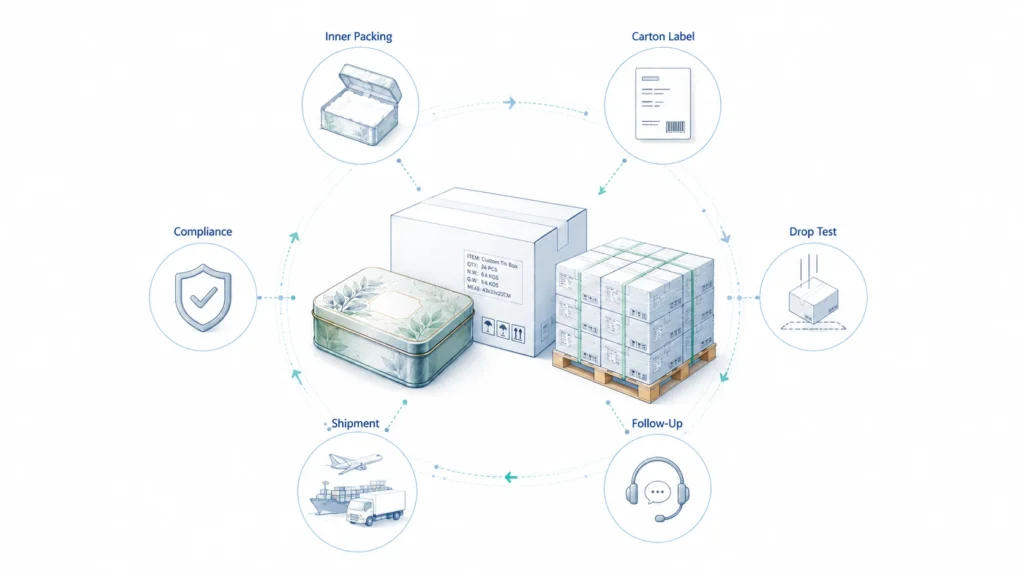
Mr. Tin Box is positioned as a custom metal tin packaging partner for global brands that need online preview, order consultation, and manufacturing support. Its website organizes solutions by industry, which is useful because a tea tin, cosmetic tin, gift tin, and industrial tin should not be specified in the same way.
The company’s homepage highlights a workflow from consultation and 3D structure design to mold development or sample making, printing and surface finishing, stamping and assembly, and final quality inspection. This visible process matters because buyers need more than a product gallery. They need a repeatable way to move from idea to production.
For food and beverage buyers, the Food & Beverage Packaging page presents metal packaging for tea, coffee, snacks, confectionery, and specialty foods, with emphasis on freshness protection, structural durability, shelf stability, and food-grade safety. For cosmetics and wellness, the Beauty & Personal Care Packaging page focuses on premium aesthetics, product protection, and custom printing or surface treatments. For seasonal and promotional buyers, the Gift, Promotional & Holiday Packaging page is relevant to limited editions, corporate promotions, collector series, and holiday collections. For tools, electronics, and technical components, the Specialty & Industrial Packaging page addresses stronger protection and fitted internal structures.
The company also has supporting knowledge content that can guide buyers before they submit an RFQ. The Custom Metal Tin Box Solutions for Global OEM Projects article is relevant for OEM buyers managing structure design, compliance, artwork, testing, and multi-market delivery. The Custom Metal Tin Packaging for Premium Products article is useful for brands evaluating premium positioning. The Custom Tin Box Guide helps buyers think beyond appearance and match packaging to product needs.
When a buyer is ready to begin, the best next step is to send a clear brief through the Contact page. A strong inquiry should include product details, quantity, size target, desired finish, insert needs, target market, and deadline. This allows the Mr. Tin Box team to respond with a realistic structure recommendation, sample route, quotation, and production plan.
Final buyer checklist before placing the order
Before placing a purchase order for a custom tin box, review the project as a whole system. Confirm the product, structure, material, coating, artwork, insert, sample, tooling, quality standard, packing method, and delivery plan. Make sure the supplier and buyer are working from the same approved drawing, same artwork version, same finish specification, and same golden sample.
Do not rely only on verbal agreement. A proper order should have written specifications. Confirm dimensions, material thickness if specified, coating or lacquer, printing method, finish effects, embossing or debossing, insert material, packing quantity, carton size, carton marks, inspection requirements, and delivery terms. If compliance documents are needed, list them before production begins.
| Final confirmation | Yes/No |
|---|---|
| Product and packaging role are clearly defined. | |
| Direct-contact or secondary-packaging status is confirmed. | |
| Tin structure, size, and lid style are approved. | |
| Artwork, dieline, colors, and finish effects are approved. | |
| Insert or internal protection has been tested with real product. | |
| Golden sample is signed and retained for inspection. | |
| Tooling cost, ownership, and revision rules are clear. | |
| Unit price includes agreed packing and accessories. | |
| Quality standards and defect limits are defined. | |
| Target market documents and claims are reviewed. | |
| Production schedule and shipping method are confirmed. |
The goal is not to make the ordering process complicated. The goal is to prevent avoidable problems before they become expensive. A custom tin box is a physical product, a marketing surface, a protective container, a logistics unit, and sometimes a regulated packaging article. Good planning brings those roles together.
Conclusion
Ordering a custom tin box from concept design to mass production is a structured process. It starts with a clear brief, not a shape. It continues through material and coating selection, structure design, artwork development, insert planning, sample approval, tooling, printing, forming, assembly, inspection, and shipping. Each step affects the next one.
For buyers, the most valuable habit is to think in systems. The tin must fit the product. The coating must fit the contact scenario. The artwork must fit metal printing. The insert must fit the product and packing process. The carton must fit the shipping route. The documentation must fit the target market. The timeline must fit the launch date.
A professional custom tin box supplier should help you make these decisions clearly. Mr. Tin Box’s category pages, project workflow, and buyer-focused knowledge content show the kind of questions that matter: application, structure, finishing, sample verification, stamping, quality inspection, and mass-production reliability.
If your brand is preparing a food, beauty, gift, promotional, or industrial packaging project, the best time to involve the supplier is before the design is locked. Early collaboration can reduce tooling risk, improve shelf impact, protect the product, and create a tin box that customers actually want to keep.
A custom tin box is not only packaging. When developed correctly, it is a durable brand asset that can protect the product, support premium pricing, improve unboxing, strengthen sustainability messaging, and make the brand more memorable long after the first purchase.
FAQ
What information do I need before requesting a custom tin box quote?
You should prepare product dimensions, product weight, target quantity, target market, packaging role, desired tin size or reference sample, artwork direction, finish preference, insert needs, delivery deadline, and any food-contact or cosmetic-contact requirements. The more complete the brief, the more accurate the quote.
Can I use an existing mold instead of paying for a new custom mold?
Yes. Many projects can use existing or near-standard molds, especially when the main differentiation comes from printing, embossing, finishing, or inserts. A new mold is most useful when the shape itself creates brand value, improves product fit, or supports a long-term repeat program.
Is a custom tin box automatically food grade?
No. Food-contact suitability depends on the material, internal coating, product type, contact condition, market, and documentation. A tin used as secondary packaging around a sealed pouch is different from a tin that directly touches food. Always specify the contact scenario early.
How long does custom tin box sampling take?
Sampling time depends on complexity. Mr. Tin Box mentions rapid prototype sampling in its workflow, but a simple existing-mold sample is different from a new-mold printed sample with special finish and inserts. Buyers should confirm the sample route, not only the number of days.
What affects the unit price of a custom tin box?
Key cost drivers include size, metal thickness, mold choice, order quantity, printing, varnish, embossing, insert, accessories, packing method, inspection requirements, and shipping. A low quotation should always be checked against the exact specification.
Should I choose matte or gloss finish?
Choose based on brand position and handling conditions. Gloss is bright and retail-friendly but can show scratches and fingerprints. Matte feels premium and modern but may reduce color brightness. The best answer is to review physical metal proofs before approval.
Can a custom tin box improve sustainability messaging?
Yes, but claims should be accurate. Metal tins are durable, reusable, and recyclable where proper systems exist. Steel packaging also has strong recycling data in the U.S. and Europe. Avoid vague claims such as “zero waste” unless you have specific evidence.
Why is the insert so important?
The insert controls product movement, unboxing, protection, and perceived quality. A beautiful tin with a poor insert can still fail because the product rattles, breaks, scratches, or looks cheap inside. Always test inserts with real products.
What should I approve before mass production starts?
Approve final drawings, dimensions, dieline, artwork, colors, finish effects, material and coating assumptions, insert, carton packing, quality standards, and a golden sample. Any change after approval may affect cost or lead time.
How do I start a project with Mr. Tin Box?
Prepare a clear brief and contact the team through the Mr. Tin Box Contact page. Include product information, quantity, target market, desired style, deadline, and any compliance or insert requirements so the team can recommend a practical custom tin box solution.