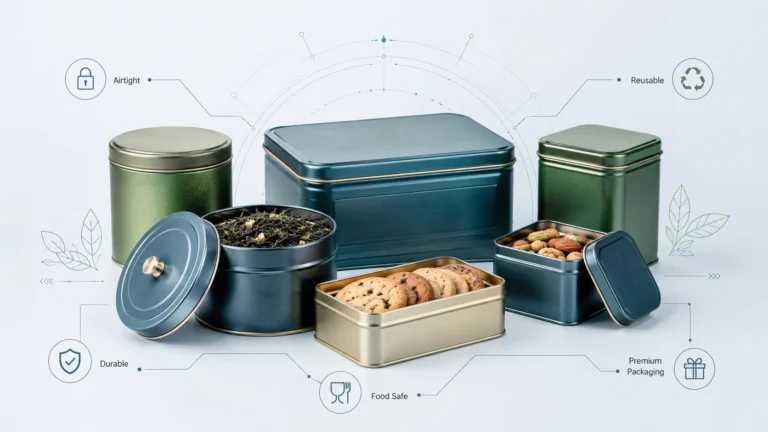


Food-grade custom metal packaging is not only a decorative container. For a food brand, importer, private-label company, distributor, or promotional buyer, it is part of the product system. A custom tin box can protect tea from light, make chocolate feel giftable, help cookies survive retail handling, give coffee a premium shelf presence, and keep a seasonal food program memorable after the product has been consumed. But if the packaging is poorly specified, the same custom tin box can create delays, food-contact uncertainty, artwork revisions, tooling waste, closure problems, or retailer documentation questions at the worst possible time.
This guide is written for commercial buyers who are preparing a food-grade custom metal packaging project before production. It explains what buyers should clarify before sampling, what “food-grade” actually means in business practice, how tinplate and coatings are selected, how regulations affect documentation, and how to avoid common mistakes when moving from design concept to mass production. It is designed for buyers who want a practical roadmap, not a laboratory textbook.
For brands reviewing food, beverage, confectionery, tea, coffee, cookie, and specialty food projects, Mr. Tin Box’s Food & Beverage Packaging page is a useful starting point because it describes food-grade tin boxes and metal containers as packaging for snacks, tea, coffee, chocolates, candies, and specialty foods. For deeper packaging planning, the article on Custom Tin Box for Tea, Coffee, Chocolate, Cookies, and Candy Packaging can help buyers match a custom tin box structure to the actual food category rather than choosing only by appearance.
The key message is simple: a food-grade tin project should begin with the product, market, and contact scenario. Shape, printing, embossing, finish, and price should support those requirements, not replace them.
Why food-grade metal packaging deserves early planning
Many buyers start a custom tin box project with an image: a round tea tin, a hinged chocolate tin, a Christmas cookie tin, a mint tin, a window tin, or a collectible gift box. That is normal. Packaging is visual. However, food-grade custom metal packaging involves more than visual design. It must be practical to manufacture, suitable for the product, reasonable to ship, aligned with the retail channel, and supported by the right documentation for the target market.
The most important early question is not “Can we make this shape?” It is “What job must this packaging perform?” A tin used as a secondary gift box around individually wrapped chocolates is very different from a tin used for direct contact with loose cookies. A coffee tin with an internal pouch is different from a tin expected to function as the primary aroma barrier. A tea tin for loose leaves needs different planning from a tin that holds sealed tea bags. A cookie tin for e-commerce may need stronger carton and insert planning than a tin placed directly on a supermarket shelf.
Food-contact authorities also look at packaging as a system. In the United States, the FDA explains that a food contact substance includes food packaging and its components, such as adhesives, colorants, and substances applied on packaging surfaces, when those substances come into contact with food and are not intended to have a technical effect in the food. The FDA also notes that authorization considers migration and toxicological data when evaluating whether the intended use is safe. Buyers can review this framework on the FDA page about food packaging and substances that come into contact with food.
In the European Union, food-contact materials must follow general principles of safety and inertness. The European Commission explains that Regulation (EC) No 1935/2004 provides the harmonized legal framework for food contact materials, while Regulation (EC) No 2023/2006 covers good manufacturing practice for materials and articles intended to come into contact with food. This does not mean every buyer must become a regulatory lawyer. It means the buyer must specify the intended use clearly enough for suppliers, coating providers, and testing partners to evaluate the project correctly.
A professional custom tin box project therefore connects three decisions at the beginning: the food product, the packaging role, and the market. Once those three are clear, the supplier can recommend a more realistic structure, coating, printing route, sample plan, and documentation path.
| Planning question | Why it matters before production | Example buyer answer |
|---|---|---|
| What food will go inside? | Food chemistry affects coating, odor, corrosion, and migration questions. | Dry cookies, wrapped chocolate, loose tea, coffee beans, candy, mints. |
| Will food touch the metal directly? | Direct contact needs more careful food-contact review than secondary packaging. | Loose biscuits touch inner lacquer; chocolates are individually wrapped. |
| Which market will receive the product? | U.S., EU, UK, GCC, Japan, Australia, and other markets may request different documentation. | Primary launch in the EU and U.S.; later expansion to Canada. |
| What is the shelf-life expectation? | Longer storage increases the importance of compatibility and barrier planning. | 12 months for tea; 6 months for cookies. |
| How will the tin be filled and shipped? | Filling method, carton design, and logistics affect deformation risk and lead time. | Empty tins ship to a co-packer for filling; final products ship by sea. |
| Is the project seasonal or repeatable? | Tooling investment and sampling strategy depend on the program horizon. | Annual holiday gift tin with repeat orders. |
What “food-grade” really means for a custom tin box
“Food-grade” is one of the most common phrases in packaging sourcing, but it is also one of the most easily misunderstood. In practical purchasing, “food-grade custom metal packaging” should not be treated as a single universal label. A tin is not automatically suitable for every food simply because it is made from metal. The correct status depends on the metal substrate, internal coating, printing system, product chemistry, contact time, storage temperature, food type, and target market.
For a buyer, the first distinction is direct food contact versus secondary packaging. Direct food contact means the food touches the tin interior, liner, coating, or inserted component. Secondary packaging means the food is already protected by another primary barrier, such as a sealed pouch, wrapper, bottle, jar, tray, paper cup, or film. In many premium food programs, the custom tin box is a secondary package. It gives protection, presentation, gift value, and shelf impact, while the actual food-contact barrier is an inner pouch, wrapper, or tray. That can simplify the compliance pathway, but it does not eliminate the need for responsible material selection and clear documentation.
The second distinction is dry food versus demanding food. Many decorative tins are used for dry or low-moisture products such as tea, coffee, biscuits, cookies, candies, mints, and wrapped chocolates. These applications are common because tinplate offers excellent rigidity, strong decoration potential, and good light protection. However, even within dry food, there are differences. Coffee may release aroma and oil. Chocolate can be sensitive to odor and temperature. Cookies may create crumbs and fat contact. Hard candies may be acidic or sticky. Tea may absorb odors from coatings, inks, cartons, or warehouse environments. A food-grade project should consider these details before mass production.
The third distinction is regulatory compliance versus marketing language. A buyer should avoid asking only, “Is this food-grade?” A better question is: “Can you confirm the substrate, inner coating, and intended food-contact scenario for this specific product and market?” Another practical question is: “What test reports, declarations, or supplier documents can support this application?” This moves the discussion from vague claims to project-specific evidence.
Mr. Tin Box has a dedicated article, Food Grade Custom Tin Box Packaging: Materials, Coatings, and Safety Considerations, that is directly relevant for buyers who want to understand why material and coating selection must be clarified before production. It is worth linking this topic internally because it supports the same buyer journey: from a general packaging idea to a production-ready specification.
| Contact scenario | Practical meaning | Typical buyer concern | Recommended action |
|---|---|---|---|
| Direct dry food contact | Loose cookies, candy, tea, or other dry food touches the interior surface. | Coating suitability, odor, migration, corrosion, crumbs, cleaning. | Confirm inner lacquer, food type, testing scope, and documentation early. |
| Indirect food contact | Food is packed in a pouch, wrap, or tray inside the tin. | Whether the tin is secondary packaging and what barrier protects the food. | Document the primary food-contact material and tin’s secondary role. |
| Wrapped confectionery | Chocolates or candies are individually wrapped inside the tin. | Gift presentation, odor control, insert layout, shelf impact. | Confirm wrapper as primary barrier and evaluate odor/finish compatibility. |
| Refillable use | Consumer may reuse the tin for food storage later. | Claims, cleaning, consumer expectations, durability. | Avoid overclaiming; design for reuse but specify original intended use. |
| Promotional food gift | Tin holds mixed sealed food items or seasonal products. | Fit, unboxing, barcode placement, retail deadline. | Prioritize insert, schedule, carton plan, and brand presentation. |
Tinplate, coatings, and decoration: the material system buyers should understand
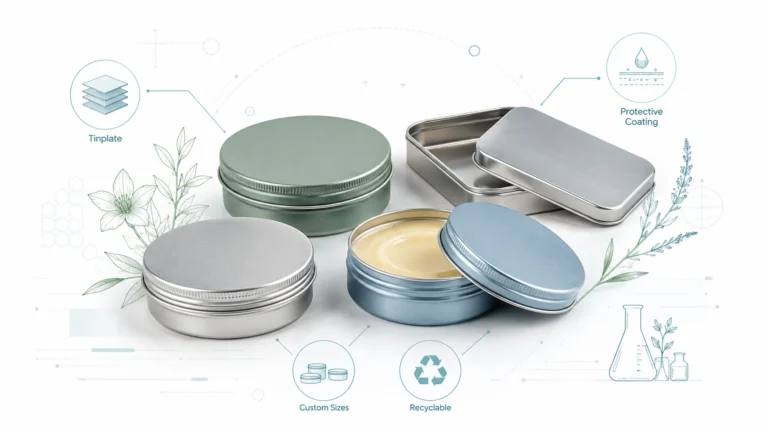
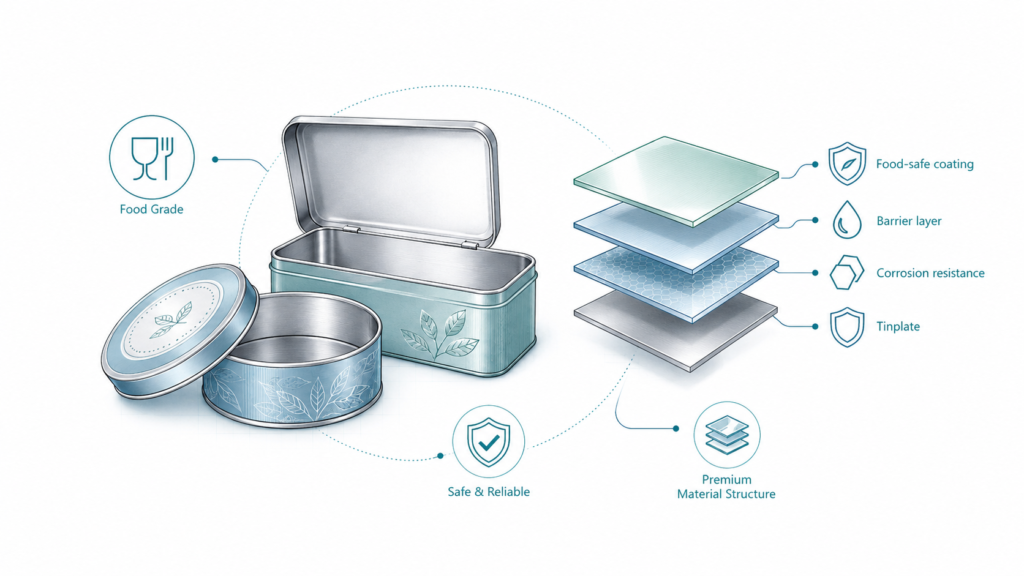
Most custom tin boxes are made from tinplate, which is low-carbon steel coated with a thin layer of tin. The steel provides strength, formability, and magnetic recyclability. The tin layer supports corrosion resistance and makes the substrate suitable for decorative packaging applications. In business conversation, the term “tin box” usually means a tinplate box, not a container made entirely from tin.
Material thickness affects performance. A very small mint tin can use a different gauge than a large cookie tin or an industrial gift set. Thicker tinplate usually increases rigidity and perceived quality, but it also increases cost and may affect forming. Thinner material may reduce cost but can dent more easily, especially for larger flat panels. The right choice depends on box size, shape, lid style, distribution route, and expected consumer handling.
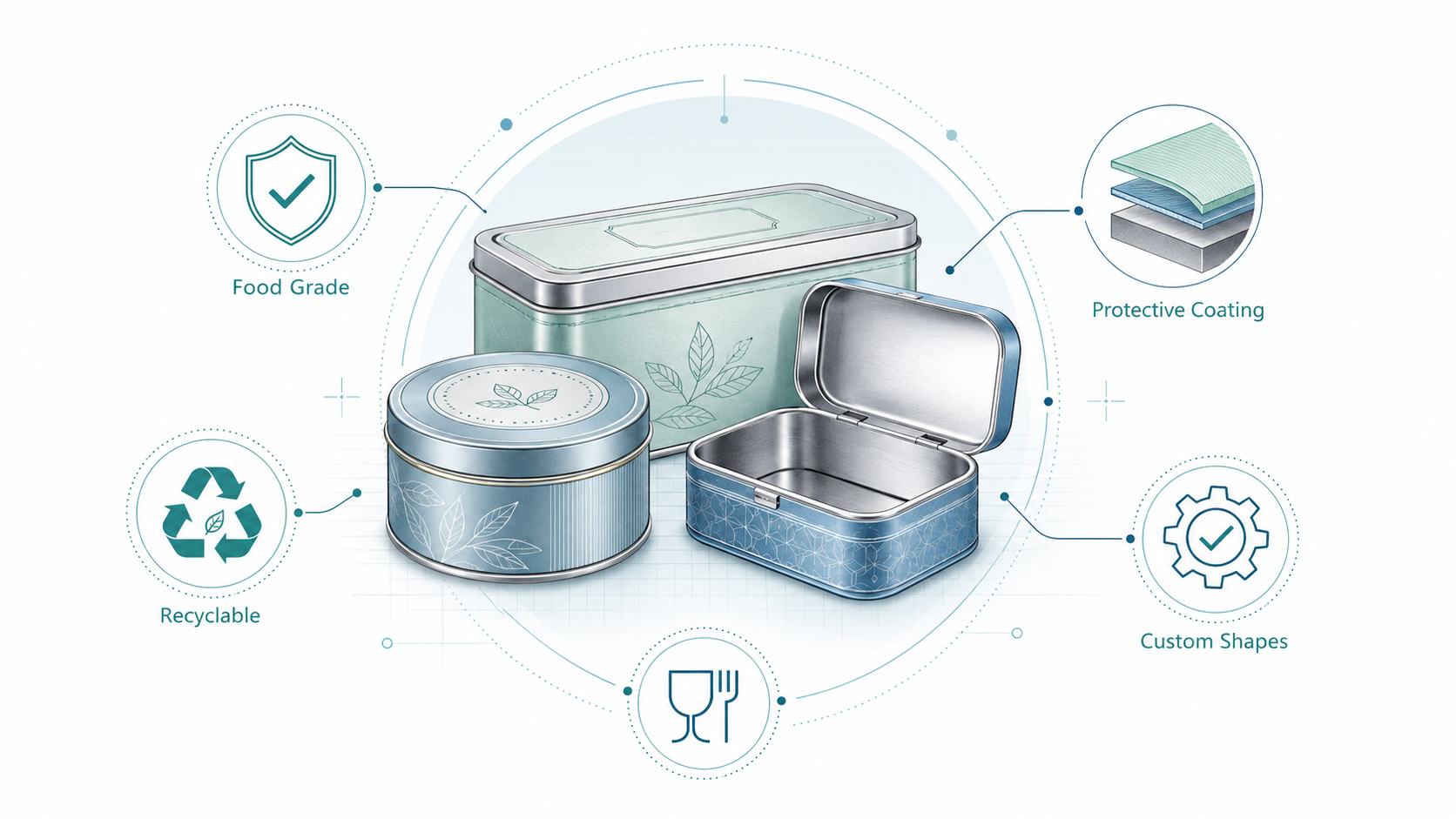
The coating system is equally important. A custom tin box normally has multiple layers: base metal, tin coating, primer or coating layers, inks, varnish, and sometimes an internal lacquer. The outer surface may use offset printing, spot colors, CMYK artwork, matte varnish, gloss varnish, metallic effects, embossing, debossing, texture, or other decorative processes. The inner surface may use clear, gold, white, or other food-contact-suitable coatings depending on the intended use.
Buyers should understand that exterior decoration and interior suitability are different questions. A beautiful matte exterior does not prove the inner coating is suitable for a food application. A premium embossed lid does not prove the tin will close well after stamping. A window design does not automatically make the package more sustainable or easier to recycle. Good packaging development requires each layer and feature to be evaluated for its own role.
For decoration planning, Mr. Tin Box’s article on Metal Tin Box Finishing Options is useful because it explains why finish affects first touch, shelf photography, scratch resistance, fingerprints, and perceived quality. For food projects, that point matters commercially: shoppers often judge the safety and quality of a food product partly through the packaging’s feel, closure, cleanliness, and surface finish.
| Packaging layer or feature | Main function | Buyer risk if ignored | Practical note |
|---|---|---|---|
| Tinplate substrate | Strength, forming, magnetic recovery, shape stability. | Dents, weak hand feel, forming defects. | Match thickness to size, structure, and transport stress. |
| Interior lacquer | Separates food from metal surface when direct contact applies. | Corrosion, odor, coating incompatibility, compliance questions. | Specify food type, contact time, and target market. |
| Exterior ink | Carries brand design and product information. | Color shift, registration issues, abrasion. | Provide correct artwork, color references, and print tolerances. |
| Protective varnish | Protects print and controls gloss/matte texture. | Scratches, fingerprints, weak shelf appearance. | Choose finish according to retail environment and brand position. |
| Embossing/debossing | Adds tactile branding and premium feel. | Distortion, weak lid fit, tooling rework. | Place effects where forming will not damage artwork. |
| Window or insert | Shows or supports product. | Scratches, adhesive issues, recyclability confusion. | Confirm material, assembly method, and claim language. |
Matching food categories to packaging risk
A food-grade custom metal packaging project becomes easier when buyers translate the product into packaging risk. This does not mean every buyer needs a technical laboratory plan. It means buyers should recognize that tea, coffee, chocolate, cookies, candies, and specialty foods do not behave the same way inside a tin.
Tea is often sensitive to aroma, moisture, light, and odor transfer. A tea tin may be used with loose tea, tea bags, or an inner pouch. If the tin is mainly a premium secondary package, the inner pouch may provide the primary barrier. If loose tea touches the tin, inner coating and odor control become more important. The lid should close smoothly and feel secure. Many tea brands also value reusability because the tin can remain in the kitchen after purchase.
Coffee is more demanding because aroma is central to product value. Coffee beans or grounds may release oils and volatile compounds. A decorative tin alone may not be the best primary freshness barrier unless the full structure is engineered for that purpose. Many coffee projects use an inner bag and rely on the tin for shelf presence, protection, gift value, and reuse. Buyers should not assume that a standard decorative tin replaces a specialized high-barrier coffee pouch.
Chocolate and confectionery projects often focus on gift value, breakage reduction, odor, and temperature sensitivity. A luxury chocolate tin may need a tray or insert to keep pieces separated. A biscuit and chocolate gift box may need internal partitions and food-safe paper cups or trays. If chocolates are wrapped, the tin is usually secondary packaging, but the tin still affects perceived quality and unboxing.
Cookies and biscuits need crush resistance, stackability, and a clean presentation. A large flat lid can look premium, but it may dent if material thickness or carton protection is insufficient. Seasonal cookie tins often ship in large volumes under deadline pressure, so production planning matters as much as artwork.
Candies and mints often use small sliding tins, hinged tins, or round tins. These packages are opened and closed repeatedly, so edge safety, smoothness, hinge quality, and pocket durability become important. A small custom tin box for mints is also a branding object that may stay with consumers long after purchase.
| Product type | Common packaging goal | Typical risk | Buyer should clarify |
|---|---|---|---|
| Loose tea | Aroma protection, premium shelf presence, reuse. | Odor absorption, moisture, lid fit. | Direct contact or inner pouch? Required storage life? |
| Coffee beans or grounds | Premium presentation and aroma strategy. | Oil, aroma loss, barrier overclaiming. | Is the tin primary barrier or secondary outer packaging? |
| Chocolate | Gift value, product separation, premium unboxing. | Scuffing, odor, heat sensitivity, tray fit. | Wrapped or unwrapped? Insert type? Retail temperature? |
| Cookies and biscuits | Crush resistance, seasonal display, family-size gift value. | Dents, crumbs, broken product, carton compression. | Product weight, tray plan, stacking, shipping route. |
| Candies and mints | Portability, repeat opening, impulse purchase. | Edge feel, hinge fatigue, coating wear. | Opening cycle, pocket use, direct-contact status. |
| Specialty foods | Differentiation and shelf impact. | Unknown chemistry, retailer questions. | Food composition, pH/oil/salt, contact time, target market. |
Documentation buyers should request before production
Documentation is where many food-grade packaging projects become delayed. Buyers often ask for certificates too late, after artwork approval or after production has started. A better approach is to discuss documentation during quotation and sampling. The required documents depend on the product, contact scenario, market, retailer, and importer responsibilities.
In the U.S., buyers should understand that food-contact substances may be authorized through regulations in Title 21 of the Code of Federal Regulations, Food Contact Notifications, exemptions, or other recognized pathways depending on the substance and use. The FDA maintains an inventory of food contact substances listed in 21 CFR, which includes authorized substances and intended-use conditions. This is important because authorization is not abstract; it is tied to the substance and its use conditions.
In the EU, buyers should understand the general framework around safety, inertness, traceability, labeling, and good manufacturing practice. The European Commission’s food contact materials legislation page explains that Regulation (EC) No 1935/2004 sets out general principles for food contact materials and that GMP rules apply to manufacturing. For a custom tin box project, this means the supplier and buyer should align on material, coating, printing, and intended use before producing commercial goods.
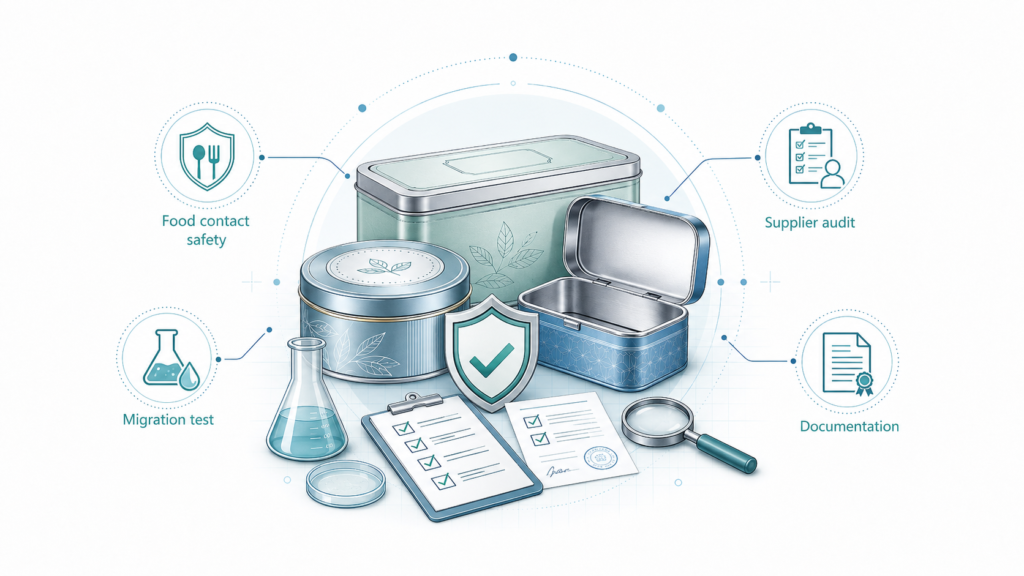
Documentation may include material declarations, coating information, migration test reports, heavy metal testing for certain materials or coatings, statement of intended use, quality inspection reports, and production batch traceability. Not every document is required for every project, and a supplier should not be expected to produce irrelevant paperwork. However, when food contact is involved, the buyer should be precise enough to request documents that match the actual application.
| Document or evidence | What it supports | When it is most relevant | Buyer note |
|---|---|---|---|
| Material specification | Confirms substrate, thickness, and basic construction. | All custom tin box projects. | Helps compare suppliers fairly. |
| Coating or lacquer information | Supports interior surface suitability. | Direct or possible food contact. | Ask for intended food type and market relevance. |
| Migration or extraction testing | Evaluates transfer under defined conditions. | Direct food contact or retailer requirement. | Test conditions should match food type and contact scenario. |
| Heavy metal or restricted substance testing | Supports safety and regulatory review. | Decorated packaging, coatings, inks, certain markets. | Useful for brand compliance files. |
| Declaration or compliance statement | Summarizes intended use and applicable basis. | Importer, retailer, or audit file. | Must be specific enough to be meaningful. |
| Production inspection report | Documents dimensional, visual, and functional quality. | Before shipment and repeat orders. | Include closure fit, coating, print, dents, carton condition. |
| Traceability records | Connects batch, materials, and shipment. | Larger retail or regulated supply chains. | Helps investigate issues if they occur. |
Food-contact testing: how to think about scope without overcomplicating it
Testing should be designed around intended use. A test report is only useful when the conditions make sense for the actual product. A buyer should not simply collect random certificates and assume the project is safe. A test for one coating, one food type, one temperature, or one contact duration may not automatically apply to another application.
The basic logic is migration. If food touches a packaging surface, substances from that surface may transfer into the food under certain conditions. The amount depends on the material, coating, food chemistry, temperature, time, surface area, and other factors. Regulatory systems use different methods and assumptions, but the practical buyer lesson is the same: define the food-contact scenario before requesting testing.
For dry foods, the risk profile may be different from fatty, acidic, alcoholic, or hot-fill foods. Many custom tin box projects for tea, cookies, candies, and wrapped chocolates are lower complexity than high-moisture or acidic canned foods, but that does not mean buyers should ignore compatibility. Odor transfer, coating taste, staining, and corrosion are commercial problems even when a project seems simple. A package can be technically acceptable yet commercially unacceptable if the tea smells like varnish or the chocolate absorbs an off-odor.
A sensible testing and validation plan may include review of the coating system, migration or extraction tests when direct contact applies, odor checks, storage simulation, drop or compression testing for filled cartons, and functional opening/closing checks. For repeat programs, buyers should also keep approved samples and quality standards so that future batches can be compared against the original approval.
| Validation item | What to check | Why it matters |
|---|---|---|
| Surface compatibility | Interior coating with actual food or food simulant. | Reduces risk of corrosion, odor, taste, or migration issues. |
| Odor evaluation | Tin interior, printed exterior, cartons, inserts, and packed sample. | Tea, chocolate, and coffee are especially sensitive to odor. |
| Storage simulation | Sample stored under expected time and temperature conditions. | Shows whether appearance or odor changes before launch. |
| Closure function | Lid tightness, opening force, hinge, and repeat use. | A premium custom tin box must feel reliable. |
| Product fit | Insert, tray, wrap, and product movement. | Prevents breakage, scuffing, and noisy unboxing. |
| Carton protection | Dents, deformation, and compression under shipping conditions. | Food tins often fail in logistics, not in the showroom. |
Designing for brand value without creating production risk
The commercial appeal of custom metal packaging is clear: it can look premium, feel durable, and remain useful after purchase. But premium packaging is not achieved by adding every decorative effect available. It is achieved by aligning structure, material, artwork, finish, and user experience.
A buyer may want matte varnish, gloss contrast, embossing, debossing, metallic ink, spot UV, interior printing, a window, and a custom insert in the same package. Some combinations are possible. But each process adds cost, tolerance risk, sampling time, and potential quality variation. A cleaner design with one strong tactile feature can be more effective than a crowded tin with too many effects.
For food packaging, visual trust matters. A clean interior, smooth edge, well-fitted lid, consistent color, and durable surface finish communicate reliability. The package should not feel sharp, oily, warped, noisy, loose, or fragile. A food-grade custom tin box should make the consumer feel that the product has been protected and presented with care.
The structure also needs to support the retail channel. A supermarket package may need clear front-facing branding and barcode placement. An e-commerce tin may need better outer carton protection and less reliance on fragile decorative parts. A gift set may need an insert that prevents product movement during delivery. A holiday tin may need efficient stacking and carton loading to control freight cost.
Mr. Tin Box’s 10 Creative Custom Metal Tin Packaging Design Ideas page highlights options such as embossing, special shapes, windowed packaging, multi-purpose tins, and protective inserts. Those ideas are valuable when used strategically. The buyer’s job is to choose features that support the product’s business case rather than adding decoration only because it is available.
| Design choice | Commercial advantage | Production or compliance question |
|---|---|---|
| Embossed logo | Adds tactile branding and perceived value. | Does it distort artwork or lid fit after forming? |
| Matte finish | Premium look and lower glare in photography. | Is it scratch-resistant enough for shipping and shelf handling? |
| Window lid | Shows product visibility and builds trust. | What is the window material, assembly method, and claim language? |
| Custom shape | Creates strong shelf recognition. | Is tooling cost justified by repeat orders or premium positioning? |
| Interior printing | Enhances unboxing and brand storytelling. | Is it compatible with food-contact requirements or secondary packaging only? |
| Fitted insert | Improves product protection and presentation. | Is the insert food-contact suitable if it touches food? |
MOQ, tooling, and lead time: what buyers should budget realistically
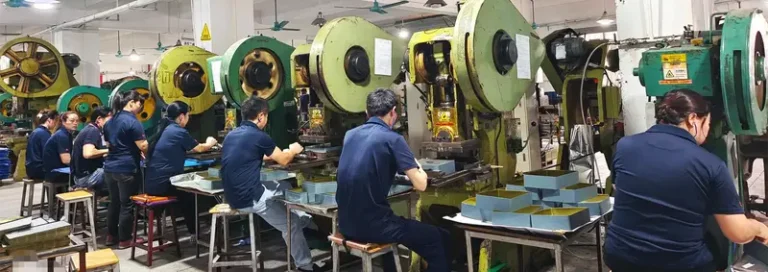
Custom metal packaging is an industrial process. It includes consultation, structure design, material selection, sample development, artwork proofing, printing, coating, cutting, stamping, forming, assembly, inspection, packing, and shipment. Even a simple-looking custom tin box can involve many steps. Buyers who plan only around the final unit price often underestimate the time and decisions required before production.
MOQ depends on structure, material, print setup, tooling, order quantity, and supplier capacity. Standard or existing molds can reduce tooling cost and shorten development time. Fully custom shapes require tooling investment and more sample validation. The best choice depends on the program. For a one-time event, it may be smarter to use an existing structure with strong printing and finish. For a repeat premium SKU, a custom mold can make sense because the tooling cost can be spread across future orders.
Lead time also depends on how quickly the buyer approves decisions. Many delays are not caused by stamping or printing alone. They come from late artwork revisions, uncertain food-contact requirements, unclear insert dimensions, missing product samples, retailer label changes, or slow approval of pre-production samples. Buyers can shorten the schedule by preparing the brief correctly.
Mr. Tin Box’s MOQ and Lead Time Planning for Your Custom Tin Box article is a relevant internal resource because it addresses order quantity, tooling, finishing, and food-contact planning. It is especially useful for buyers comparing a beautiful custom concept against the practical realities of budget and launch deadline.
| Project type | Typical planning implication | Buyer recommendation |
|---|---|---|
| Existing mold, standard shape | Faster sampling and lower tooling risk. | Use artwork, finish, and insert to create differentiation. |
| Modified standard structure | Moderate development complexity. | Confirm which dimensions can change without new tooling. |
| Fully custom shape | Higher tooling cost and longer development. | Use only when shape creates real brand or functional value. |
| Seasonal food tin | Deadline-sensitive production and shipping. | Freeze artwork early and approve samples quickly. |
| Repeat premium SKU | Tooling may be justified. | Invest in better structure, testing, and quality standards. |
| Retailer-controlled launch | Documentation and carton performance may be strict. | Ask retailer requirements before sampling. |
Production workflow: from concept to shipment
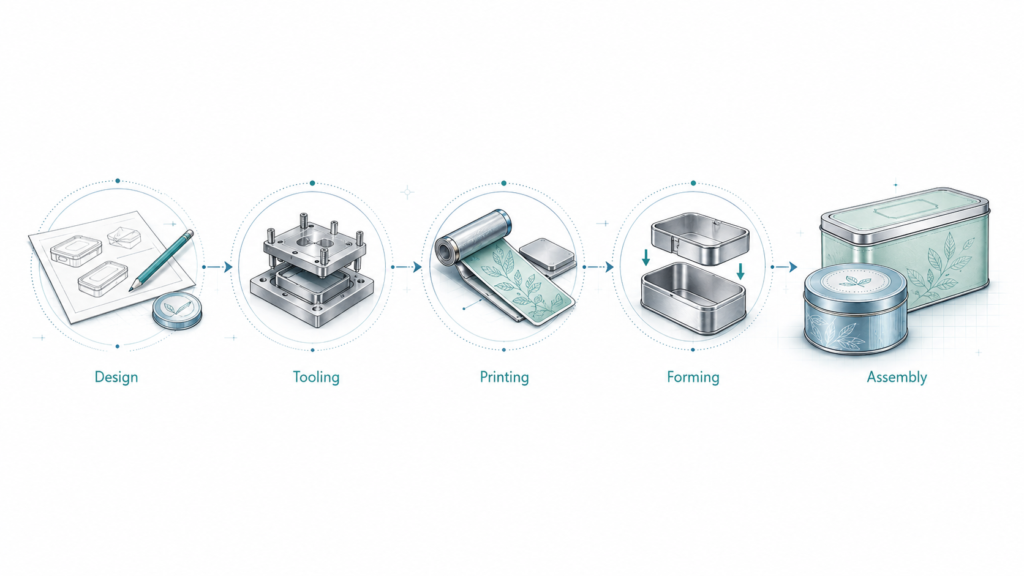
A well-managed food-grade custom metal packaging project follows a logical sequence. The exact workflow varies by supplier and product, but the process should move from requirements to design, then sampling, approval, production, inspection, and shipment. Skipping steps usually creates more cost later.
The first stage is consultation. The buyer provides the product brief, dimensions, intended use, target market, order quantity, artwork direction, and deadline. At this point, the supplier should identify whether the project is direct food contact, secondary packaging, cosmetic contact, gift packaging, or another use case. The supplier should also ask whether the buyer needs specific documentation or retailer standards.
The second stage is structure and material planning. This is where the supplier recommends tinplate thickness, mold route, lid style, edge design, insert, and coating system. If the buyer wants a custom shape, the supplier should explain tooling implications and limitations. If food touches the tin directly, the interior surface must be discussed before artwork approval.
The third stage is sample development. Samples can include white samples for structure, printed samples for artwork, or pre-production samples using actual materials and processes. Buyers should test samples with real products whenever possible. A tin that looks perfect empty may not perform well when filled with cookies, chocolate trays, or coffee pouches.
The fourth stage is artwork proofing and production approval. Metal printing is not identical to paper printing. Color may appear different because of substrate, coating, varnish, and forming. Buyers should approve realistic tolerances and keep signed reference samples.
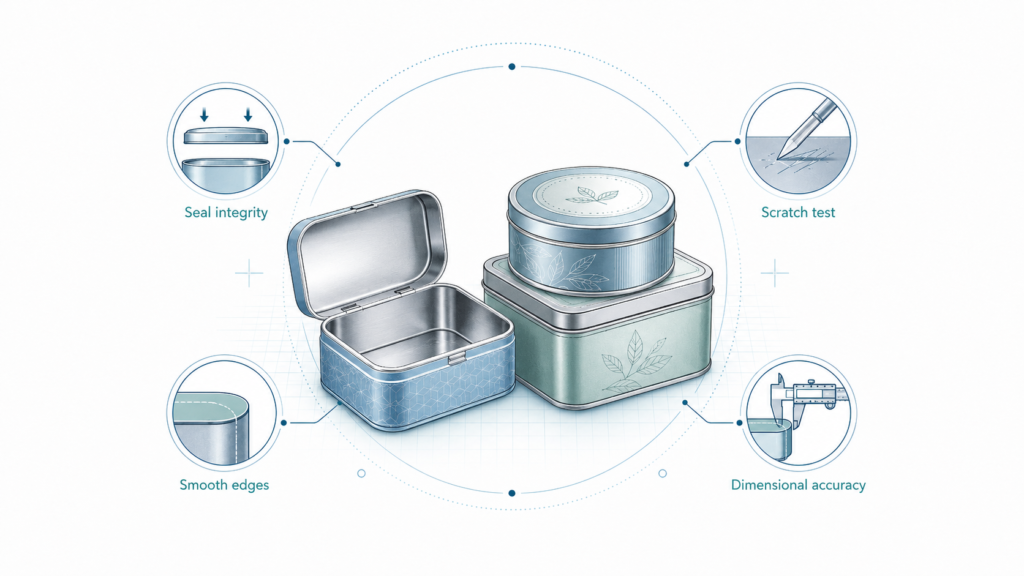
The fifth stage is mass production and quality control. Inspection should cover material, dimensions, print, finish, lid fit, edge safety, cleanliness, odor, coating appearance, insert fit, carton packing, and shipment readiness. A good inspection standard prevents arguments because both buyer and supplier know what is acceptable.
For buyers who want a broader workflow overview, Mr. Tin Box’s article on How to Order a Custom Tin Box from Concept Design to Mass Production and the guide on How to Develop a Custom Tin Box from Concept to Mass Production provide useful internal context.
| Workflow stage | Buyer deliverables | Supplier deliverables | Approval point |
|---|---|---|---|
| Requirement review | Product details, target market, quantity, deadline. | Feasibility feedback and initial recommendation. | Packaging brief confirmed. |
| Structure planning | Product samples, dimensions, reference tins. | 3D concept, mold suggestion, material plan. | Structure direction approved. |
| Food-contact review | Contact scenario and documentation needs. | Coating information and testing/document plan. | Compliance path agreed. |
| Sampling | Real product for fit and use testing. | White sample or printed sample. | Sample approved or revised. |
| Artwork proofing | Final artwork, barcode, legal text. | Print proof and production layout. | Artwork frozen. |
| Mass production | Purchase order and delivery plan. | Printing, forming, assembly, packing. | Production inspection passed. |
| Shipment | Shipping marks, carton requirements, logistics method. | Packed goods, inspection report, documents. | Shipment released. |
Sustainability and recycling claims: stay accurate and credible
Metal packaging has strong sustainability advantages, especially durability, reusability, and recyclability. However, buyers should avoid exaggerated environmental claims. A custom tin box is not automatically “zero waste” or “eco-friendly” in every context. The most credible claims are specific, accurate, and tied to real recovery systems.
Steel packaging has a clear recycling pathway because steel is magnetic and can be separated from mixed waste streams. The U.S. EPA reported that steel containers and packaging generated 2.2 million tons in 2018 and that 1.6 million tons were recycled, equivalent to 73.8% of generation in that data set. The same EPA page reported that plastic containers and packaging had a 13.6% recycling rate in 2018, while glass containers were 31.3%. These numbers help explain why metal packaging often appears in sustainability discussions, although recycling rates vary by country, methodology, and collection system.
At the same time, newer industry methodology can produce different numbers. A 2025 Can Manufacturers Institute report using 2023 data estimated a U.S. national steel packaging recycling rate of around 34% for all steel packaging types, with food cans estimated at 44%. This difference shows why buyers should be careful when using recycling statistics: methodology matters. An older EPA data set, a revised industry methodology, and a European “really recycled” methodology may not be directly comparable.
In Europe, Steel for Packaging Europe announced that 82% of steel packaging placed on the European market in 2023 was actually recycled. The organization emphasized that this refers to material entering recycling operations, not merely collected material. For brands selling in Europe, this supports credible discussion of steel packaging within circular economy expectations.
The EU’s new Packaging and Packaging Waste Regulation also matters. The European Commission states that Regulation (EU) 2025/40 entered into force on 11 February 2025 and will generally apply from 12 August 2026, with an objective to make all packaging on the EU market recyclable in an economically viable way by 2030. Buyers planning long-term food packaging programs should therefore consider recyclability, material combinations, sorting labels, packaging minimization, and claim accuracy early.
| Data point | Reported value | Source context | Buyer takeaway |
|---|---|---|---|
| U.S. containers and packaging recycling rate, 2018 | 53.9% | U.S. EPA containers and packaging data | Packaging remains highly visible in waste policy. |
| U.S. steel containers and packaging recycling rate, 2018 | 73.8% | U.S. EPA data set | Steel packaging has historically strong recovery data. |
| U.S. plastic containers and packaging recycling rate, 2018 | 13.6% | U.S. EPA data set | Material choice affects recovery discussion. |
| U.S. steel packaging recycling rate, 2023 revised methodology | Around 34%; food cans around 44% | CMI/RRS methodology report | Use current statistics carefully and cite methodology. |
| European steel packaging actually recycled, 2023 | 82% | Steel for Packaging Europe announcement | Useful for EU-facing sustainability messaging. |
| EU PPWR general application date | 12 August 2026 | European Commission overview | Long-term programs should prepare for stricter packaging rules. |
The best claim for a custom tin box is usually balanced: “durable, reusable, and recyclable where suitable collection and recycling systems exist.” This is stronger than vague green language because it is more accurate. A refillable or reusable tin should also be designed for real reuse. If the lid becomes loose, the surface scratches easily, or the shape is inconvenient, consumers are less likely to keep it.
Common mistakes buyers should avoid
The first mistake is treating “food-grade” as a yes-or-no certificate. Food-contact suitability depends on intended use. A generic certificate may not answer whether a specific coating is suitable for loose cookies, oily coffee beans, unwrapped candies, or long-term tea storage. Buyers should ask for project-relevant information.
The second mistake is choosing a special shape before defining the product. A heart-shaped tin, window tin, suitcase tin, book tin, or unusual geometric tin can be effective, but only if it supports the product, schedule, carton loading, and budget. Unique shape should be a business decision, not only an aesthetic impulse.
The third mistake is ignoring inserts and internal layout. Many premium food tins fail because the outer box looks good but the inside feels cheap, loose, noisy, or difficult to use. For chocolate, biscuits, cookies, and gift sets, inserts are part of the customer experience. They should be sampled with real products.
The fourth mistake is overdecorating. Matte varnish, gloss contrast, metallic ink, embossing, debossing, and window features can all add value, but too many effects can increase cost and risk without improving sales. A clean design with one well-placed embossed logo can be more powerful than a crowded design with five special processes.
The fifth mistake is approving an empty sample only. The buyer should test the tin with the actual product, inner pouch, tray, wrap, divider, label, and carton. Filled samples reveal problems that empty samples hide: lid pressure, product movement, breakage, odor, carton deformation, barcode placement, and shelf presentation.
The sixth mistake is waiting too long to ask about documentation. If the product is food, the buyer should discuss food-contact status, target market, and retailer requirements at quotation stage. Waiting until production is complete can create expensive delays.
The seventh mistake is making sustainability claims too aggressively. A custom tin box can be durable, reusable, and recyclable, but claims should be precise. Avoid statements that imply all consumers will recycle the package or that the package has no environmental impact.
A practical buyer checklist before production approval
Before approving production, a buyer should be able to answer the following questions clearly. If any answer is uncertain, the project may still move forward, but the uncertainty should be managed deliberately rather than ignored.
| Checklist item | Confirmed? | Notes for buyer review |
|---|---|---|
| Product and contact scenario are defined. | Direct food contact, indirect contact, wrapped product, or secondary packaging. | |
| Target market requirements are identified. | U.S., EU, UK, Canada, Australia, GCC, Japan, or global distribution. | |
| Tin structure and dimensions are approved. | Include tolerances, lid fit, height, opening method, and carton loading. | |
| Material thickness and coating system are agreed. | Include internal lacquer if food contact applies. | |
| Artwork files are production-ready. | Confirm dieline, bleed, barcode, legal copy, color references. | |
| Decorative effects are technically feasible. | Embossing, matte/gloss, metallic ink, window, texture. | |
| Real product fit has been tested. | Test with actual food, pouch, tray, wrap, or insert. | |
| Odor and storage checks are acceptable. | Especially important for tea, coffee, chocolate, and cookies. | |
| Documentation path is agreed. | Material, coating, migration/testing, declaration, inspection report. | |
| MOQ, tooling, and lead time are understood. | Include sample time, production time, shipping, and peak-season risk. | |
| Quality acceptance criteria are defined. | Dents, scratches, color tolerance, lid fit, cleanliness, carton condition. | |
| Sustainability claims are accurate. | Use cautious language tied to recyclability and reuse. |
How Mr. Tin Box can support food-grade custom metal packaging projects
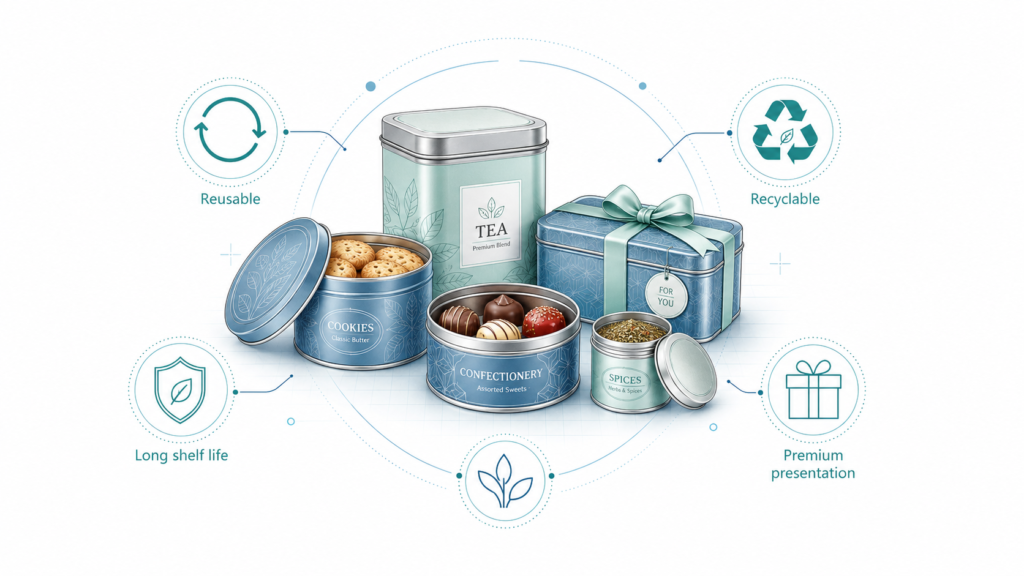
For a buyer, the value of a custom tin box supplier is not only whether it can manufacture a beautiful tin. The real value is whether the supplier can help turn a commercial packaging idea into a production-ready specification. That includes asking the right questions, reviewing product and market requirements, recommending an appropriate structure, selecting suitable materials and coatings, developing samples, managing printing and forming, and inspecting finished goods before shipment.
Mr. Tin Box positions its food and beverage packaging around freshness protection, structural durability, shelf stability, and food-grade safety. The company’s Food & Beverage Packaging page also describes the use of high-quality tinplate, multi-stage stamping, edge curling, seamless assembly, food-safe lacquer layers, and customizable exterior finishes. For buyers, this matters because food packaging performance depends on both structure and surface system.
The company’s internal content also supports different stages of the buyer journey. The Custom Tin Box Guide helps buyers think through product fit and packaging selection. The Food Grade Custom Tin Box Packaging article connects materials, coatings, and safety considerations. The MOQ and Lead Time Planning article helps buyers estimate schedule and cost drivers. The Metal Tin Box Finishing Options article helps design teams choose finishes that match brand positioning and manufacturing reality.
For chocolate and biscuit buyers, Custom Tin Box for Luxury Chocolate and Biscuit Lines is also relevant because premium confectionery packaging depends heavily on internal layout, gift value, surface finish, and product protection. For promotional food gifts, the article on Custom Tin Boxes for Corporate Gifts and Promotions can help teams understand how a custom tin box can support campaign value and post-purchase brand exposure.
A strong supplier-buyer conversation should begin with the following information: product samples, target market, food-contact role, expected order quantity, launch deadline, preferred structure, branding direction, inner packaging plan, and documentation needs. With that information, Mr. Tin Box can provide a more useful recommendation than a simple unit price.
Conclusion: specify the package before you decorate it
Food-grade custom metal packaging works best when buyers treat the tin as an engineered brand asset. The custom tin box must protect the product, support the food-contact scenario, match the target market, fit the retail channel, and communicate brand value. Decoration is important, but it should come after the product requirements are clear.
Before production, buyers should define whether food touches the tin, what coating and documentation are needed, how the product will be inserted, how the package will be shipped, which market rules apply, and what quality standard will be used for inspection. These decisions prevent late-stage problems and help the supplier deliver a package that is attractive, practical, and commercially reliable.
The best food-grade custom metal packaging is not the most complicated tin. It is the tin that fits the product, satisfies the buyer’s market requirements, supports the brand story, and can be manufactured consistently at the required volume and deadline. For tea, coffee, chocolate, cookies, candies, and specialty foods, that is exactly where a well-planned custom tin box can create real business value.
FAQ
Is every custom tin box food-grade?
No. A custom tin box should not be assumed to be food-grade for every food or every market. Food-contact suitability depends on the substrate, internal coating, product type, contact time, temperature, and regulatory requirements. Buyers should clarify whether the tin is direct food contact or secondary packaging.
Can a tin box replace an inner pouch for coffee or tea?
Sometimes the tin can support storage and presentation, but it should not automatically be treated as a high-barrier freshness system. Coffee and tea brands often use an inner pouch or liner for aroma and moisture control, while the tin provides premium presentation, durability, and reuse value.
What documents should I ask for before placing an order?
Start with material specification, coating information, intended-use statement, relevant test reports if direct food contact applies, and a clear production inspection standard. Retailers or importers may request additional documentation depending on market and product category.
Should I choose an existing mold or a fully custom mold?
Use an existing or near-standard mold when the priority is speed, cost control, and lower tooling risk. Choose a fully custom mold when the shape itself creates clear brand value, functional benefit, or repeat-order potential.
What is the biggest risk in food-grade custom metal packaging?
The biggest risk is unclear specification. If the buyer does not define the product, contact scenario, target market, insert, coating, artwork, and deadline early, the project can suffer from repeated revisions and late compliance questions.
How can I start a project with Mr. Tin Box?
Prepare product photos or samples, dimensions, target market, order quantity, expected launch date, design references, and food-contact requirements. Then contact Mr. Tin Box through the Contact page to discuss structure, sampling, quotation, and production planning.