
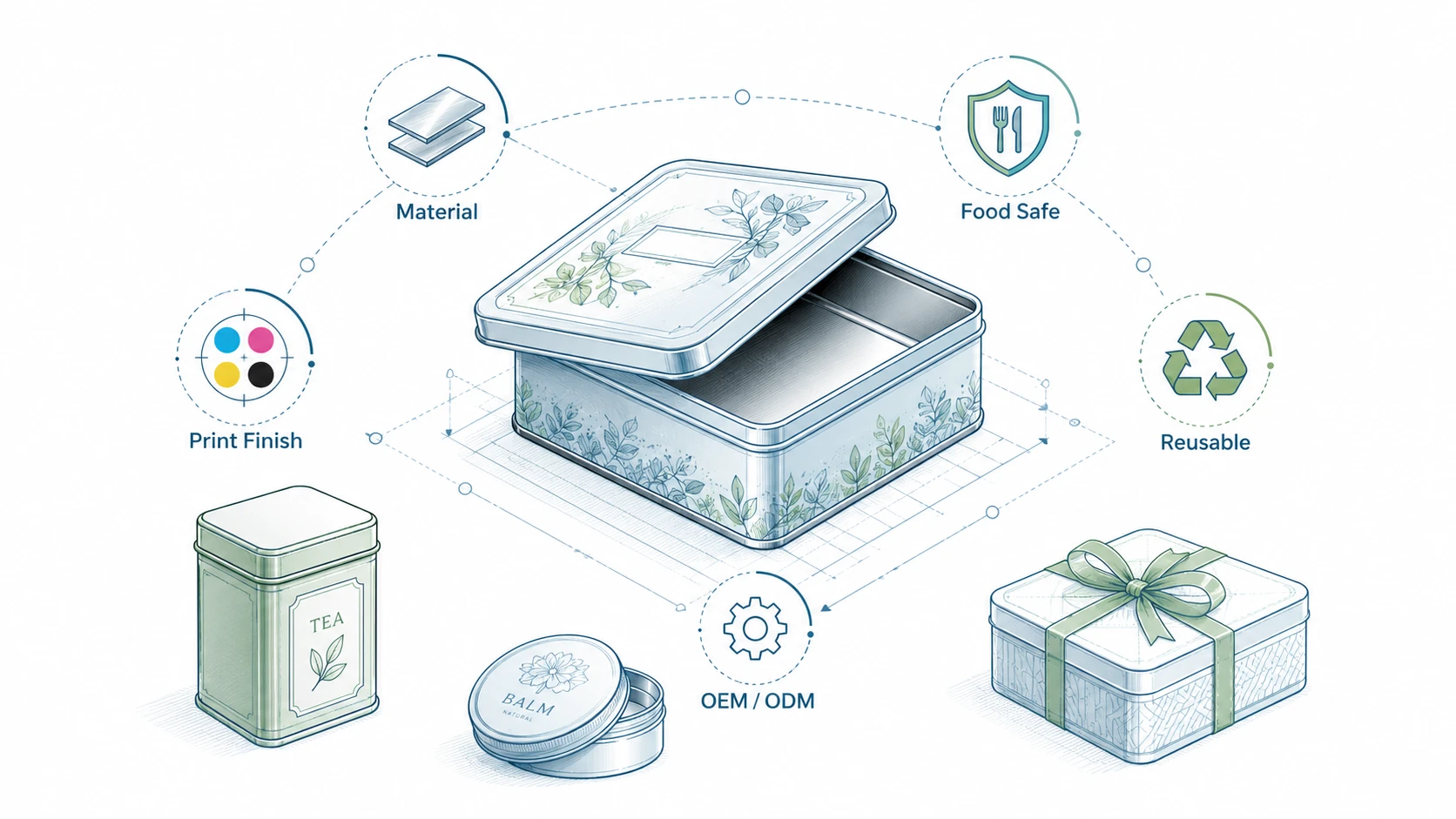

Choosing a custom tin box is not only a design decision. For a brand that sells food, tea, coffee, confectionery, cosmetics, gift sets, promotional items, tools, collectibles, or specialty components, metal packaging influences product protection, customer trust, shelf impact, shipping stability, sustainability messaging, and total landed cost. A beautiful tin that does not fit the product, protect the contents, meet market requirements, or arrive on time can become an expensive mistake. A well-planned tin, however, can become part of the product experience and part of the brand asset.
This guide is written for business buyers, brand managers, sourcing teams, product developers, packaging designers, and OEM project managers who need to choose the right custom tin box with practical confidence. It explains the commercial and technical questions that should come before artwork approval: product sensitivity, material choice, tinplate thickness, food-contact safety, closure design, inserts, printing, finishing, tooling, MOQ, lead time, logistics, quality inspection, and supplier capability.
At Mr. Tin Box, custom metal packaging is positioned for global brands across Food & Beverage Packaging, Beauty & Personal Care Packaging, Gift, Promotional & Holiday Packaging, and Specialty & Industrial Packaging. This article brings those application categories together into a single buyer-friendly framework so you can decide what kind of custom tin box is most suitable for your product, your market, and your budget.
Table of Contents
Why a custom tin box is a business decision, not just a packaging style
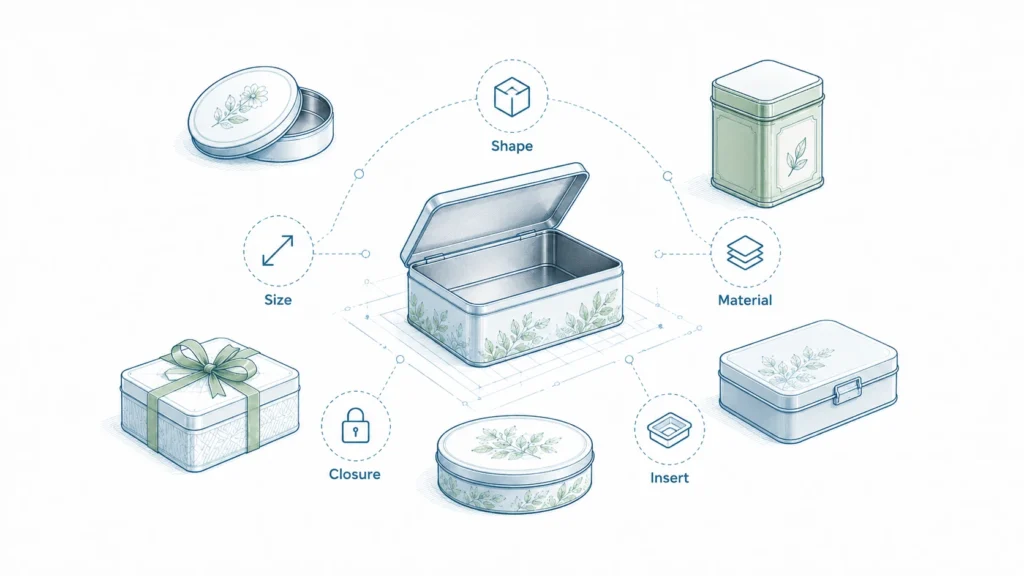
Packaging has always had two jobs: protect the product and help sell the product. In modern retail and global sourcing, it also has several more jobs. It must support compliance documentation, survive export handling, align with recycling expectations, photograph well for e-commerce, fit cartons and pallets efficiently, and communicate value before the product is touched. That is why choosing a custom tin box should start with the full business case, not only with a visual preference.
Public waste data shows why packaging decisions receive increasing scrutiny. The U.S. Environmental Protection Agency reports that containers and packaging generated 82.2 million tons of municipal solid waste in the United States in 2018, equal to 28.1% of total municipal solid waste generation. In Europe, Eurostat reported that the EU generated 79.7 million tonnes of packaging waste in 2023, or 177.8 kg per inhabitant. These numbers do not mean brands should avoid packaging. They mean packaging should be purposeful, durable, measurable, and designed for the real supply chain.
Metal packaging has advantages in this context when it is specified responsibly. Steel-based tinplate is rigid, opaque, magnetically sortable, durable, and often reusable. Worldsteel describes steel as a material that can be recycled over and over again without loss of properties. Recent industry reporting from Packaging Europe stated that Steel for Packaging Europe indicated 82% of steel packaging placed on the European market was recycled in practice in 2023. For business buyers, the practical takeaway is clear: a custom tin box can support a premium and circularity-oriented packaging strategy, but only when the design avoids unnecessary mixed materials, oversized structures, poor coatings, and non-recyclable inserts.
| Business objective | What packaging must achieve | How a custom tin box can help | What the buyer should confirm |
|---|---|---|---|
| Product protection | Reduce damage, light exposure, moisture risk, and crushing | Rigid tinplate body, opaque walls, controlled closure, fitted insert | Product sensitivity, transport route, closure type, inner protection |
| Premium positioning | Make the product feel more valuable before opening | Metal feel, embossing, matte/gloss contrast, collectible format | Brand tone, finish tolerance, artwork proof, sample approval |
| Food or cosmetic safety | Prevent unsuitable contact or corrosion risk | Food-safe lacquer, product-specific lining, secondary inner pack | Target market, contact type, migration testing, supplier documents |
| Retail shelf impact | Stand out in-store and in photos | Unique shape, high-quality printing, strong color and tactile finish | Shelf orientation, front-facing area, barcode and legal text placement |
| Sustainability story | Support reuse and recyclability claims | Durable reusable object, steel/tinplate recovery potential | Local recycling rules, mixed-material components, disposal labels |
| Logistics efficiency | Reduce damage and avoid excessive freight cost | Stackable geometry, strong carton packing, dimensional control | Carton quantity, pallet layout, container loading, drop-test needs |
A custom tin box works best when every one of these objectives is discussed early. A special shape may look attractive, but if it increases tooling cost, reduces carton efficiency, or creates a weak closure, the final packaging may underperform. A simple rectangular tin may look less dramatic, but with the right artwork, embossing, and insert, it can deliver stronger commercial value.
Start with the product before choosing the tin shape
Many buyers begin with a picture: a round tea tin, a rectangular cookie tin, a hinged gift tin, a sliding mint tin, or a special holiday shape. This is natural because packaging is visual. But the correct workflow starts with the product. A custom tin box should be designed around what the product needs to survive, sell, and comply.
Begin by defining the role of the tin. Is the tin the primary packaging that directly contacts the product? Is it secondary packaging around a pouch, sachet, jar, bottle, blister pack, or paper-wrapped item? Is it a gift box intended to be kept and reused? Is it a protective case for specialty parts? These roles change the material, inner coating, insert, and compliance requirements.
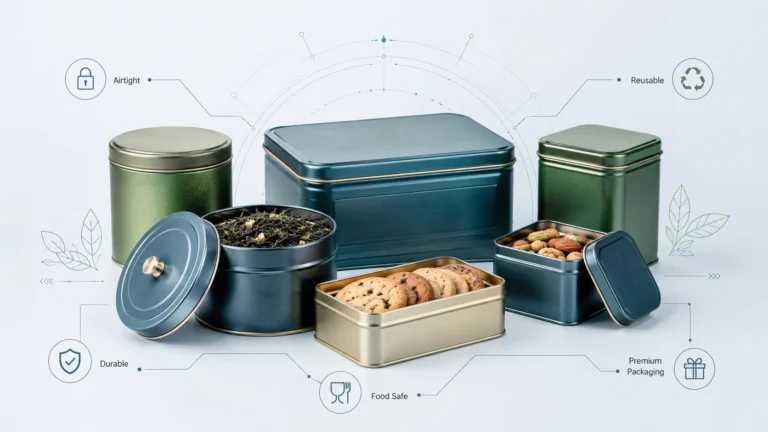
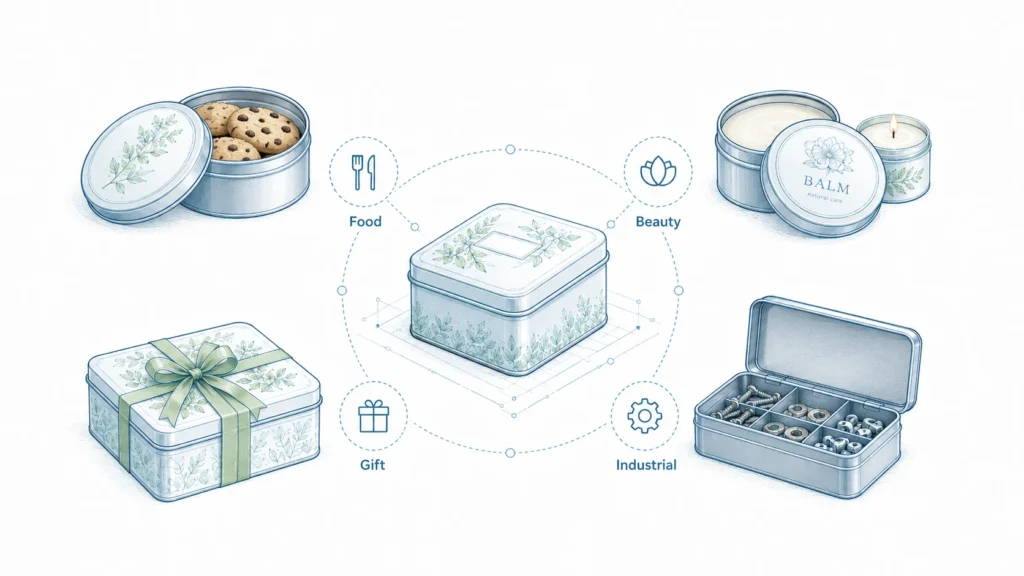
For food and beverage products, the discussion often includes aroma protection, oxygen exposure, moisture control, grease resistance, and food-contact documentation. A tea or coffee tin may need an inner bag or seal to preserve aroma. A biscuit or confectionery tin may need a food-safe internal lacquer and a fitted tray to prevent breakage. A chocolate tin may need attention to scuffing, heat exposure, and internal layout. The Food & Beverage Packaging page from Mr. Tin Box emphasizes tinplate packaging for snacks, tea, coffee, chocolates, candies, and specialty food products, with attention to barrier properties, food-safe coatings, and structural durability.
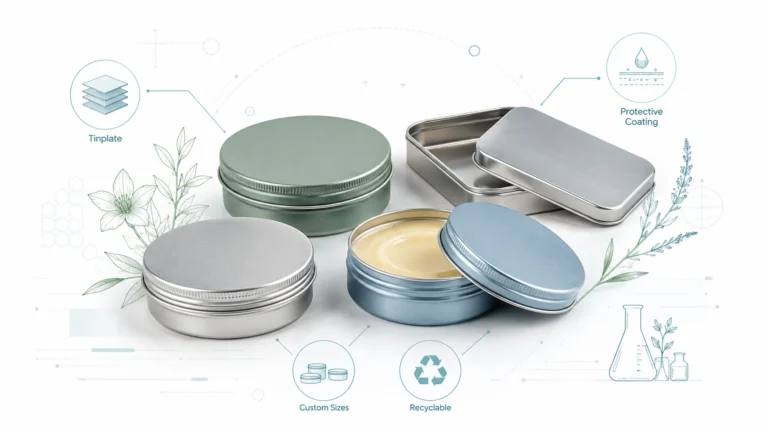
For beauty and personal care products, the focus is often different. Balms, solid perfumes, soaps, skincare sets, fragrance samples, beauty tools, and wellness kits may require premium finishes, smooth hand feel, corrosion resistance, and insert protection. Direct contact with oily or aromatic formulas should not be assumed safe without compatibility review. The Mr. Tin Box Beauty & Personal Care Packaging page highlights corrosion-resistant tinplate or aluminum, decorative effects, liners, coatings, and inserts for cosmetics and personal care applications.
For gifts, promotions, and holidays, the tin becomes part of the campaign. The question is not only “Can it hold the product?” but “Will the recipient keep it?” The Gift, Promotional & Holiday Packaging page describes tins for seasonal campaigns, corporate gifts, holiday collections, brand launches, promotional giveaways, and premium gift sets. In this category, perceived value, artwork impact, unique opening, and reusability are often just as important as physical protection.
For specialty and industrial applications, the tin may protect tools, fasteners, electronics accessories, samples, test kits, or precision components. Here, strength, dimensional fit, corrosion resistance, abrasion resistance, and internal organization matter. The Specialty & Industrial Packaging page discusses reinforced structures, high-impact resistance, protective coatings, EVA foam inserts, partitions, and fitted trays.
| Product information to define | Why it matters | Example decision it affects |
|---|---|---|
| Product dimensions and fill weight | Determines internal size, depth, and stacking strength | Rectangular tin, round tin, deep body, shallow tray |
| Direct contact or secondary packaging | Determines coating and compliance needs | Food-safe lacquer, inner pouch, paper wrap, plastic jar |
| Sensitivity to light, oxygen, moisture, oil, odor, or vibration | Determines barrier and insert requirements | Airtight lid, inner seal, desiccant, foam tray, internal bag |
| Sales channel | Changes packaging priorities | Retail shelf front, e-commerce durability, gift unboxing, export strength |
| Target market | Determines documentation and labeling | FDA-related documentation, EU food contact compliance, recycling labels |
| Expected order quantity and repeat plan | Determines whether custom tooling is economical | Stock mold, modified mold, fully custom mold |
| Launch date | Determines whether special tooling and complex finishing are realistic | Simple shape, existing tool, rapid sample, phased upgrade |
The safest first step is to prepare a short packaging brief. Include the product type, product size, filling method, whether the tin touches the product directly, target countries, order quantity, desired launch date, brand positioning, artwork status, and any compliance requirements. A supplier can then recommend a practical custom tin box instead of only quoting a catalog shape.
Match the tin format to your product category and sales channel
There is no universal best custom tin box. The best structure is the one that fits the product, protects it, supports the brand, and works with production and logistics. A round tin can be excellent for tea, coffee, cookies, candles, or balm products. A rectangular hinged tin can be better for biscuits, gift sets, beauty kits, stationery, and electronics accessories. A sliding tin can work for mints, small tools, sample cards, or pocket-size promotional items. A window tin can help display a visually attractive product, but the window material may complicate recycling and must be evaluated for food-contact safety if relevant.
The decision becomes easier when the sales channel is included. Retail shelf packaging needs a clear front face and strong brand visibility from a distance. E-commerce packaging needs abrasion resistance, crush protection, and carton planning because the tin may be handled roughly before the customer sees it. Gift packaging needs a strong unboxing experience and a finish that feels worth keeping. Industrial packaging needs functional organization, repeat opening, and enough strength for storage and transport.
| Common tin format | Best-fit products | Commercial advantage | Key risk to check |
|---|---|---|---|
| Round tin | Tea, coffee, cookies, candles, balm, candy | Strong classic look, good hand feel, attractive pantry storage | Label orientation, lid fit, internal seal, carton efficiency |
| Rectangular tin | Biscuits, chocolate, gift sets, tools, cosmetics | Efficient shelf face, easy stacking, flexible insert design | Corner deformation, hinge alignment, internal movement |
| Square tin | Tea, snacks, premium gifts, collectibles | Balanced display, good stacking, modern appearance | Lid tolerance, sidewall artwork distortion |
| Hinged tin | Gift sets, confectionery, beauty kits, PR boxes | Premium opening experience and reusable value | Hinge strength, lid alignment, assembly consistency |
| Slip-lid tin | Tea, candy, stationery, small food items | Simple, cost-effective, clean structure | Lid tightness, opening force, product leakage risk |
| Window tin | Cookies, candy, tea bags, display products | Shows product without opening | Window material, scratch resistance, food-contact suitability |
| Special-shape tin | Seasonal gifts, licensed IP, collectibles | Strong shelf impact and collectability | Tooling cost, lead time, stacking, shipping efficiency |
| Sliding tin | Mints, cards, small kits, samples | Compact and convenient for repeat use | Sliding friction, edge safety, small-part retention |
For a first project, many brands benefit from starting with an existing or near-standard mold. This reduces tooling investment and shortens the development schedule. For a repeat program, a fully custom shape may make more sense because the tooling cost can be amortized across multiple production runs. This is especially true for core product lines, annual holiday tins, licensed collections, or high-volume promotional programs.
Choose materials and thickness with performance in mind
Most custom tin boxes are made from tinplate, which is steel coated with a thin layer of tin. Tinplate offers a useful combination of formability, printability, strength, corrosion resistance, and recyclability. It can be cut, stamped, curled, embossed, printed, varnished, and assembled into many shapes. For some applications, aluminum or tin-free steel may also be considered, but tinplate remains one of the most common choices for premium metal tins.
Thickness should be selected based on product weight, tin size, stacking load, embossing depth, and desired feel. Very thin material may reduce cost but can dent more easily, feel less premium, and create problems in larger formats. Overly thick material may increase cost, forming difficulty, and shipping weight without adding meaningful value. A professional supplier should recommend thickness based on drawings, product weight, and usage conditions rather than applying one standard to every project.
The table below provides a practical buyer reference. These are typical industry planning ranges, not universal specifications. Final material selection should always be confirmed by the supplier based on product drawings, forming structure, tooling design, and target market requirements.
| Application | Common planning priority | Typical material approach | Notes for buyers |
|---|---|---|---|
| Small mint or candy tins | Light weight, smooth sliding, safe edges | Thin tinplate with controlled curling | Check edge safety and sliding friction |
| Tea, coffee, and pantry tins | Aroma protection, pantry reuse, appearance | Tinplate with food-safe internal coating | Consider inner bag or seal for freshness |
| Biscuit and confectionery tins | Crush resistance, print quality, shelf impact | Medium-gauge tinplate with internal lacquer | Use trays or dividers for fragile items |
| Beauty and wellness tins | Tactile finish, corrosion resistance, formula compatibility | Tinplate or aluminum with suitable coating | Test oily, fragrant, or acidic products carefully |
| Premium gift boxes | Rigid feel, embossing, reusable value | Medium to stronger tinplate depending on size | Confirm hinge, insert, and lid alignment |
| Industrial component tins | Impact resistance, abrasion resistance, organization | Stronger tinplate or steel with protective coating | Consider EVA foam, anti-scratch lining, or partitions |
Material selection also affects printing and finishing. Tinplate has a smooth surface that works well with lithographic printing, varnishes, metallic effects, and embossing. If the brand wants a “bare metal” or brushed steel look, the design must preserve visible metal areas and use a protective varnish. If the artwork requires a strong white background or accurate Pantone color, the prepress plan should include white coating, color proofing, and clear tolerance expectations.
Food-contact safety and documentation should be specified early
For food products, “food grade” should never be treated as a vague label. A custom tin box may be suitable for one food application and unsuitable for another. Dry tea leaves, cookies, chocolate, acidic candy, oily snacks, powdered supplements, spices, and coffee beans have different contact risks. Temperature, contact time, product chemistry, grease content, acidity, moisture, and whether the product touches the metal directly all affect the correct coating and test plan.
In the United States, the FDA explains that a food contact substance is a substance that comes into contact with food and is not intended to have a technical effect in the food. FDA resources also include an inventory of food contact substances listed in 21 CFR, which helps businesses understand authorized uses and use conditions for food-contact substances. For a buyer, the important point is not simply asking whether a supplier “has FDA.” The important point is asking what material, coating, ink, varnish, or liner is intended to contact the food and what documentation supports that intended use.
In the European Union, Regulation (EC) No 1935/2004 applies to materials and articles intended to come into contact with food, already in contact with food, or reasonably expected to transfer constituents to food under normal or foreseeable use. The European Commission food contact materials framework sets out the general safety logic for food contact materials, while the EDQM guide for metals and alloys used in food contact materials provides technical guidance for metallic food-contact materials and articles.
A serious food packaging brief should therefore include the food type, whether there is direct contact, whether an inner bag will be used, expected shelf life, filling temperature, storage conditions, target market, and any customer-specific testing protocol. If the food will be packed in a sealed inner pouch and the tin is secondary packaging, the compliance burden may be different from a loose tea tin or candy tin with direct contact. If the food is oily, acidic, or moist, the internal lacquer and migration testing become more important.
| Food-contact question | Why it matters | Practical supplier request |
|---|---|---|
| Does the food touch the tin directly? | Determines coating and migration test needs | Ask for internal lacquer specification and relevant test reports |
| Is the food dry, oily, acidic, moist, or aromatic? | Product chemistry affects corrosion and migration risk | Share product details before sampling |
| Will an inner bag, tray, or paper wrap be used? | Secondary packaging changes contact scenario | Confirm which material actually contacts the food |
| What markets will the product enter? | Regulations and documentation differ by region | Request market-specific compliance support |
| How long is the expected shelf life? | Longer contact time can increase compatibility risk | Ask for shelf-life and storage-condition review |
| Will the tin be heated, chilled, or exposed to humidity? | Temperature and moisture affect coatings and corrosion | Include storage and shipping conditions in the RFQ |
Buyers should also remember that ink and external coatings usually should not be assumed safe for direct food contact. If a tin has internal printing, internal decoration, a window, a plastic insert, a paper liner, or adhesive components, each material should be considered within the full food-contact scenario. This is where a supplier with experience in food and beverage metal packaging can prevent costly redesigns.
Product protection: barrier, closure, insert, and carton design work together
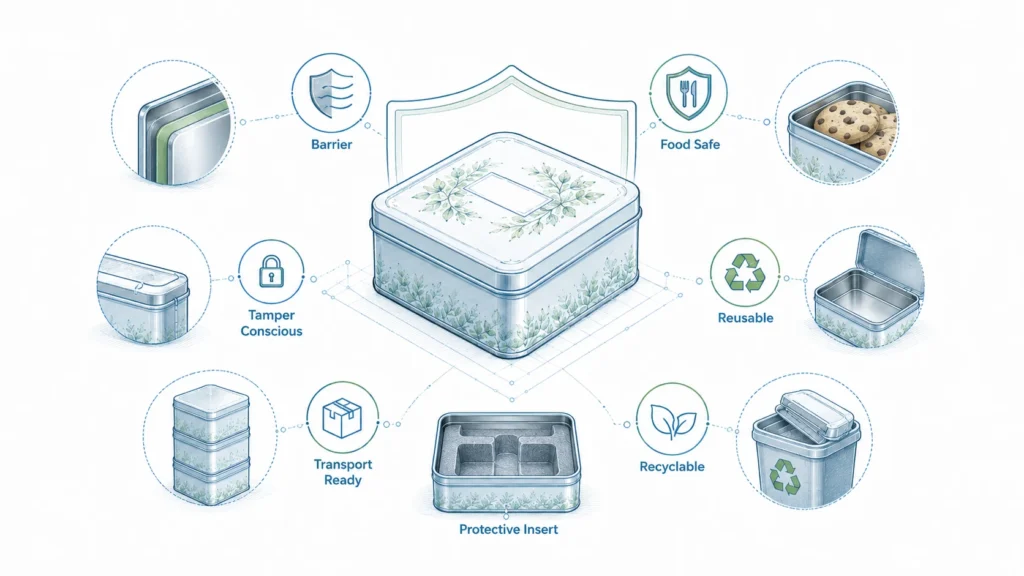
A custom tin box protects a product through several mechanisms. The metal body provides rigidity and opacity. The closure controls dust, handling, and partial air exchange. The internal coating protects the metal and contents from interaction. The insert prevents movement, abrasion, and breakage. The export carton protects the tin itself from dents and scuffs during logistics. If any one of these elements is weak, the final package may fail despite looking good in a photo.
For aroma products such as tea, coffee, spices, and herbal blends, the tin often works with an inner bag or seal. The tin provides premium presentation, light protection, and reusable storage, while the inner bag provides a stronger oxygen and moisture barrier. This is a practical solution because a decorative tin alone may not always provide the same hermetic performance as a sealed flexible pouch. For biscuits, cookies, and confectionery, the tin can reduce crushing and create gift value, while trays, paper cups, or dividers prevent product breakage.
For cosmetics and personal care, protection is often about leakage, scratch control, and formula compatibility. Glass bottles, jars, metal tools, and small accessories can rub against each other inside a tin. A custom paperboard insert, EVA foam tray, vacuum-formed tray, or molded pulp insert can improve both protection and unboxing. For oily balms, solid perfumes, or soaps, the supplier should confirm whether direct contact is appropriate or whether the product should stay in a separate primary container.
For industrial or specialty products, protection may require anti-scratch lining, anti-static foam, moisture control, or precise cavities for components. The tin must be strong enough for storage and repeated handling. It may need durable hinges, reinforced ribs, or a finish that hides wear better than a high-gloss decorative surface.
| Protection risk | Common product examples | Custom tin box design response |
|---|---|---|
| Light exposure | Tea, spices, pigments, cosmetics | Opaque metal body, suitable internal coating, controlled closure |
| Moisture pickup | Biscuits, powder, tea, coffee, bath salts | Inner bag, seal, desiccant plan, lid fit, carton moisture control |
| Oxygen exposure | Coffee, nuts, chocolate, aroma products | Secondary barrier pouch, inner seal, shorter headspace where appropriate |
| Crush damage | Cookies, fragile gifts, glass containers | Rigid tin body, insert, dividers, export carton protection |
| Surface scratching | Beauty bottles, electronics, tools | EVA foam, paperboard insert, anti-scratch liner |
| Corrosion or staining | Oily, acidic, humid, industrial products | Product-compatible lacquer, protective varnish, compatibility test |
| Repeated opening wear | Corporate gifts, tool kits, pantry tins | Hinge durability, safe curling, scuff-resistant finish |
A useful rule is to test the complete package, not only the empty tin. A perfect empty sample may perform differently once filled, packed, shipped, opened, and reused. For important launches, buyers should request a filled-sample review, carton drop test, rub test, stacking check, opening-force check, and visual inspection after handling.
Printing and finishing turn metal into brand value
The outside of a custom tin box is a brand surface. It can communicate premium quality, heritage, freshness, technology, sustainability, fun, celebration, or industrial reliability before the customer reads the product description. Research on packaging design supports the business importance of visual decisions. A 2023 study in SAGE Open on snack food packaging design found that color, shape, image, line, and typography were among the most essential design characteristics influencing consumer purchase behavior, with image identified as the most significant impact factor in that study (SAGE Open). A study in the Bulletin of Japanese Society for the Science of Design also explored how packaging-design benefits connect with brand equity (J-STAGE).
For metal tins, printing and finishing must be planned for the substrate. Tinplate is not paper. It reflects light differently, bends during forming, and can show color shifts depending on white coating, varnish, metallic base, and curing. Good artwork on screen does not guarantee good printed metal. This is why color proofing, sample approval, and realistic finish selection matter.
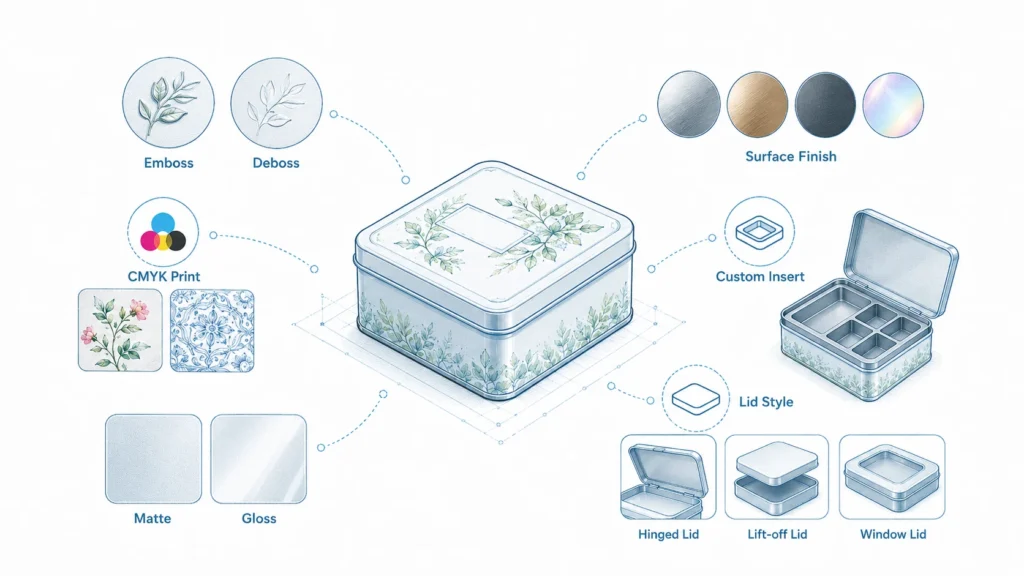
The Mr. Tin Box article on metal tin box finishing options discusses matte, glossy, metallic, pearlescent, brushed, special effects, and textured finishes. The commercial logic is that each finish should match the product category and handling environment. A glossy confectionery tin can create bright shelf impact. A matte tea tin can feel calm and premium. A soft-touch cosmetic tin can feel more intimate and high-end. A textured industrial tin can hide wear and improve grip.
| Finish option | Visual or tactile effect | Suitable product categories | Buyer caution |
|---|---|---|---|
| Gloss varnish | Bright color, strong reflection, high shelf impact | Candy, holiday tins, children’s products, mass retail | May show fingerprints and scratches more easily |
| Matte varnish | Calm, premium, modern, less reflective | Tea, coffee, beauty, wellness, luxury gifts | Dark matte surfaces may need anti-scuff testing |
| Satin finish | Balanced shine and softness | Food gifts, corporate gifts, premium retail | Confirm actual gloss level on sample |
| Spot UV | Contrast between matte and glossy areas | Logos, patterns, limited editions | Registration accuracy must be controlled |
| Embossing | Raised logo or pattern, tactile premium feel | Gifts, confectionery, cosmetics, collectibles | Embossing depth affects tooling and forming |
| Debossing | Pressed-in detail, subtle premium effect | Luxury, minimalist, heritage brands | Fine details may lose sharpness during forming |
| Metallic ink or bare-metal effect | Highlights metal nature and premium value | Spirits accessories, tech, industrial, luxury gifts | Requires varnish protection and color planning |
| Soft-touch coating | Smooth, premium hand feel | Cosmetics, wellness, premium gift sets | Test scratch resistance and oil transfer |
| Textured coating | Grip, durability, wear hiding | Tools, outdoor kits, industrial parts | May reduce fine artwork clarity |
The best finish is not always the most complex finish. Too many special effects can increase cost and production risk without improving sales. A clean matte tin with a well-positioned embossed logo may be stronger than a crowded design with several inks, spot UV, foil, embossing, and complicated gradients. For B2B purchasing, the right question is: which finish improves the product’s perceived value enough to justify the added cost and quality-control complexity?
Inserts and inner structures are part of the product experience
Many packaging projects over-focus on the lid artwork and under-focus on the inside. This is a mistake. When a customer opens a tin, the insert determines whether the product feels premium, organized, safe, and intentional. A loose product rattling inside a beautiful tin can make the brand feel careless. A precise insert can make the same product feel like a gift.
Common insert materials include paperboard, corrugated board, molded pulp, PET or PP trays, EVA foam, EPE foam, velvet-covered foam, metal dividers, and fabric pouches. The choice depends on product weight, category, sustainability goals, visual style, and whether the insert touches food or cosmetics. For food packaging, paper cups, food-safe trays, or inner wraps may be needed. For beauty sets, inserts should protect glass and prevent label scuffing. For corporate gift tins, inserts can create a staged unboxing sequence. For industrial parts, inserts should prioritize retention and abrasion control.
| Insert type | Strengths | Best-fit use cases | Caution |
|---|---|---|---|
| Paperboard divider | Cost-effective, printable, recyclable in many systems | Biscuits, gifts, stationery, light products | Limited shock absorption |
| Molded pulp tray | Sustainability-friendly appearance, shaped cavities | Beauty sets, gifts, e-commerce kits | Surface may feel less luxury unless well finished |
| PET or PP tray | Precise cavities, clean product presentation | Candy, cosmetics, tools, electronics | Material compatibility and recycling claim must be reviewed |
| EVA foam | Strong cushioning, premium fit | Tools, electronics, glass bottles, devices | Less ideal for sustainability messaging |
| Velvet or fabric-covered insert | Luxury presentation | Jewelry, beauty, collectibles, high-end gifts | Higher cost and dust control requirements |
| Metal divider | Durable and consistent with metal packaging | Tea sets, tools, premium kits | Can increase weight and tooling complexity |
The insert also affects the external tin size. If a brand chooses a thick foam insert, the tin may need to be larger, increasing tinplate usage, carton size, and freight cost. If the insert is too tight, users may struggle to remove the product. If it is too loose, products may move during shipping. For premium products, buyers should approve the filled insert experience, not only the empty tin structure.
Sustainability: design for reuse, recyclability, and honest claims
Sustainability in packaging should be specific, not vague. A custom tin box can support a responsible packaging strategy because it is durable, reusable, and made from a recyclable metal material. But the sustainability outcome depends on design decisions. A tin with difficult-to-remove plastic windows, mixed-material decorations, excessive foam inserts, oversized dimensions, or unclear recycling labels may be less convincing than a simpler recyclable structure.
The European Commission packaging waste page states that the Packaging and Packaging Waste Regulation entered into force on 11 February 2025 and will generally apply from 12 August 2026. The Commission says the regulation aims to make all packaging on the EU market recyclable in an economically viable way by 2030, safely increase the use of recycled plastics in packaging, decrease virgin material use, and put the sector on track to climate neutrality by 2050. Even if a brand is not based in Europe, these rules matter because many global retailers and importers use EU policy as a reference point.
For custom tin boxes, the most credible sustainability strategy is often reuse plus recyclability. A tea tin that customers keep in the kitchen, a cookie tin reused for storage, a cosmetic tin used as a small organizer, or a corporate gift tin kept on a desk extends brand visibility while delaying disposal. Reuse should be designed intentionally: comfortable opening, safe edges, attractive artwork, durable varnish, and a practical shape that fits real homes or offices.
| Sustainability design lever | Better practice | Weaker practice |
|---|---|---|
| Size optimization | Fit product closely while allowing protection | Oversized tin used only to look premium |
| Material simplicity | Mostly metal body with removable inserts | Permanent mixed-material parts that complicate recycling |
| Reuse value | Attractive, durable, useful after product is consumed | One-time decorative shape with no practical reuse |
| Insert choice | Right-size paperboard, molded pulp, or removable tray | Excess foam or unnecessary plastic layers |
| Decoration | Durable varnish and recyclable-friendly layout | Heavy coatings or glued decorations without disposal guidance |
| Claims | Market-specific and evidence-based | Generic “eco-friendly” claim without support |
A supplier should not promise that every custom tin box is automatically sustainable in every market. Recycling systems vary by country and city. What can be recycled in one area may not be accepted in another. The safer claim is more precise: tinplate is a recyclable steel-based packaging material; the finished package can be designed to improve reuse and recovery potential; and mixed-material components should be minimized or made removable where possible.
MOQ, tooling, lead time, and cost planning
A custom tin box project includes design, engineering, material selection, tooling, sampling, printing, forming, assembly, inspection, packing, and shipping. Cost is therefore influenced by more than the metal material. Buyers who ask only for the lowest unit price may miss the real cost drivers.
Tooling is often the first major cost factor. Existing molds reduce cost and schedule risk. Modified molds may balance uniqueness with efficiency. Fully custom molds create stronger differentiation but require more investment and lead time. Special shapes, deep draws, unusual lids, complex hinges, windows, multi-piece construction, and embossed details can all add tooling and production complexity.
Printing and finishing are another cost driver. CMYK printing, Pantone matching, matte varnish, gloss varnish, spot UV, embossing, debossing, metallic inks, internal printing, and special coatings each add steps. Insert design also affects cost, especially when using custom foam, molded trays, or multi-layer gift presentation. Packing method and logistics can change the final landed cost as well.
| Cost driver | What increases cost | How to optimize without losing value |
|---|---|---|
| Tooling | New shape, complex lid, deep structure, hinge, window | Start from existing mold when possible; customize artwork and finish first |
| Material | Larger size, thicker tinplate, special substrate | Optimize dimensions and avoid unnecessary empty space |
| Printing | Many spot colors, difficult color matching, internal printing | Use strong design hierarchy and limit special colors to key brand elements |
| Finishing | Embossing, spot UV, foil, soft-touch, special texture | Use one or two high-impact effects instead of many effects |
| Insert | Custom foam, luxury fabric, complex cavities | Match insert quality to product value and protection risk |
| Assembly | Multi-piece construction, hinges, clasps, windows | Simplify structure if deadline or budget is tight |
| Logistics | Oversized shape, poor carton efficiency, heavy packing | Check carton count, pallet plan, and container utilization early |
Lead time should be discussed honestly. A simple tin using an existing mold and ready artwork can move faster than a fully custom shaped tin with new tooling, several proofing rounds, and special finishes. Sampling can reveal needed adjustments in lid fit, insert tolerance, color, embossing, or carton protection. Buyers should leave enough time for correction rather than treating the first sample as a final production approval.
For large OEM programs, total landed cost matters more than unit price alone. A slightly higher unit cost may be acceptable if the tin reduces damage, improves shelf value, supports repeat sales, or increases carton efficiency. A cheaper tin may be more expensive in practice if it dents easily, fails compliance review, delays the launch, or creates customer complaints.
Quality control: what to inspect before mass production
A custom tin box must look good and function consistently across thousands or millions of units. Quality control should therefore cover appearance, dimensions, structure, print, coating, assembly, packaging, and shipment condition. A beautiful approval sample is not enough. The supplier must be able to reproduce the sample in mass production.
Before production, buyers should approve drawings, materials, artwork proofs, color references, finish samples, embossing details, insert layout, carton packing, and any testing requirements. During production, the supplier should monitor printing registration, varnish curing, stamping accuracy, lid fit, hinge alignment, edge curling, scratches, dents, coating defects, contamination, and carton protection. After production, final inspection should confirm that the shipment matches approved specifications.
| Inspection area | What to check | Why it matters |
|---|---|---|
| Dimensions | Length, width, height, lid fit, insert cavity | Product fit, stacking, carton efficiency |
| Appearance | Dents, scratches, dust, stains, color defects | Customer perception and retail acceptance |
| Printing | Color accuracy, registration, text clarity, barcode readability | Brand consistency and legal/retail compliance |
| Coating | Curing, adhesion, odor, internal lacquer coverage | Durability, safety, product compatibility |
| Structure | Curling, seams, hinge, lid opening force, window fixing | User experience and safety |
| Insert | Fit, retention, clean edges, material quality | Product protection and unboxing quality |
| Packing | Polybag, dividers, carton strength, palletization | Prevents damage during shipping |
| Documentation | Test reports, material declaration, inspection report | Supports import, retailer, and compliance review |
A practical buyer should request a golden sample, retain it, and use it as a reference for production inspection. For important projects, third-party inspection may be useful, especially before final payment or shipment. The inspection checklist should be agreed before production begins. If the buyer waits until after production to define quality expectations, disputes become harder to solve.
How to evaluate a custom tin box supplier
Choosing the right supplier is as important as choosing the right tin structure. A supplier that only prints a catalog price may not be able to solve engineering, compliance, lead time, or quality problems. A professional custom tin box supplier should ask product-specific questions and explain trade-offs.
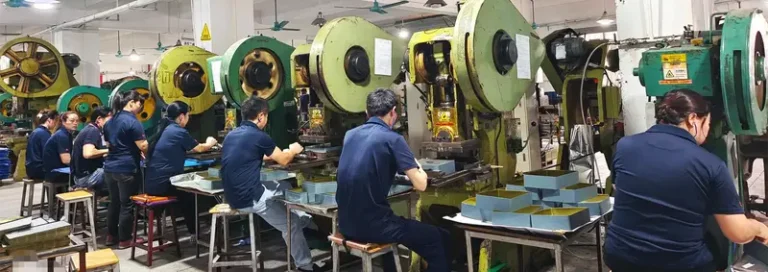
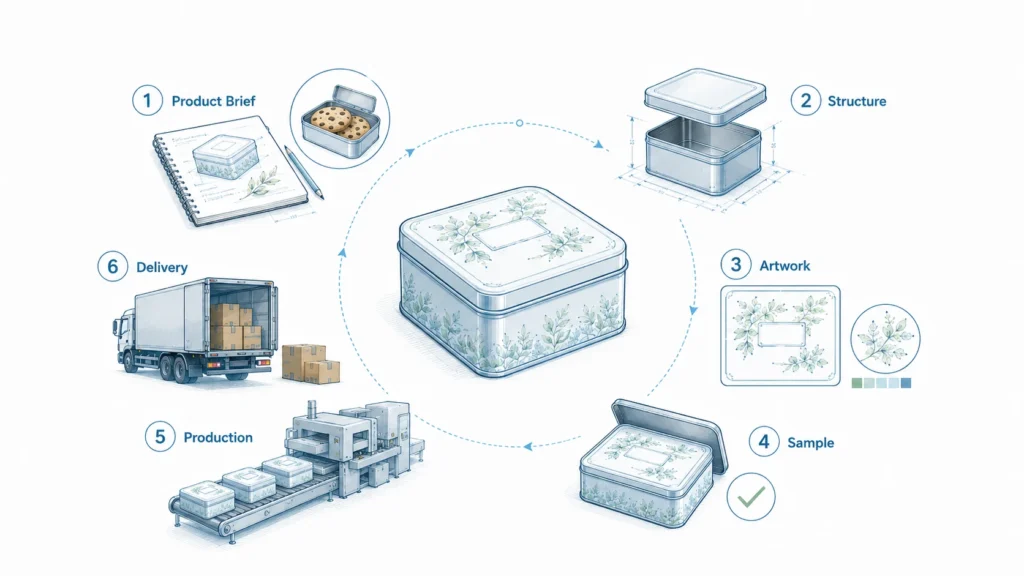
Mr. Tin Box describes a workflow that includes consultation, 3D drawing and structure design, mold development or sample making, printing and surface finishing, stamping and assembly, and quality inspection. The company also presents in-house mold development, premium printing and finishing, strict QC, food-grade material support, fast prototype sampling, and large production capacity on its website. For buyers, these capabilities matter because custom tin packaging requires coordination between design, tooling, printing, forming, and inspection.
The Mr. Tin Box article on custom metal tin box solutions for global OEM projects is especially relevant for buyers managing multi-market projects. It discusses size, shape, volume optimization, material selection, coatings, printing, structural features, compliance, cost drivers, and typical OEM use cases. If your program involves repeated orders, several product SKUs, or multiple countries, this kind of structured project approach is more useful than a one-time catalog quotation.
| Supplier evaluation factor | Strong signal | Warning sign |
|---|---|---|
| Product understanding | Asks about product, market, contact scenario, channel, deadline | Quotes only from photos without technical questions |
| Engineering support | Provides drawings, size options, tooling advice, sample review | Cannot explain structure or tolerance choices |
| Compliance support | Discusses intended use, coatings, food-contact documents, testing | Uses vague claims such as “food grade” without details |
| Printing capability | Offers proofing, Pantone discussion, finish samples | No color-control process or unclear artwork requirements |
| Quality system | Has inspection checklist, golden sample, production QC | Relies only on final visual check |
| Lead-time discipline | Explains sample, tooling, production, and shipping schedule | Promises unrealistic delivery without reviewing complexity |
| Commercial guidance | Helps balance cost, MOQ, tooling, and logistics | Pushes the cheapest option regardless of risk |
| Communication | Provides clear RFQ feedback and project updates | Slow, vague, or inconsistent technical answers |
A strong supplier should not simply say yes to every idea. If a requested special shape will reduce stacking strength or extend the schedule, the supplier should explain the trade-off. If an inner coating is unsuitable for a certain food or cosmetic formula, the supplier should ask for more information. If the budget is tight, the supplier should suggest practical alternatives such as using an existing mold, simplifying the insert, or choosing one premium finish instead of several.
Category-specific recommendations
Different industries use custom tin boxes for different reasons. The sections below summarize what buyers should prioritize in the four major application groups served by Mr. Tin Box.
Food and beverage products
Food and beverage brands usually choose custom tins for freshness support, shelf appeal, gifting value, and product protection. Typical products include tea, coffee, biscuits, cookies, chocolates, candies, mints, snacks, spices, and specialty foods. For these products, the tin must be attractive and practical, but the food-contact scenario must be clear.
For tea and coffee, aroma and moisture control are central. A tin can protect against light and provide reusable pantry storage, but a sealed inner bag is often used for stronger barrier performance before opening. For biscuits and cookies, the tin protects against crushing and adds gift value, while trays or paper liners reduce breakage. For chocolate and candy, artwork, seasonal design, internal layout, and food-safe contact materials matter.
Recommended internal link: explore Mr. Tin Box Food & Beverage Packaging for examples of food-grade tin boxes for tea, coffee, snacks, confectionery, and specialty foods. Buyers can also read Why Metal Packaging Boosts Shelf Life and Brand Value for more context on barrier protection and brand perception.
Beauty and personal care products
Beauty and personal care packaging must protect the product and elevate the sensory experience. Products may include skincare sets, solid perfume, balm, soap, essential oils, beauty tools, fragrance samples, wellness kits, and promotional cosmetic gifts. The tin should feel smooth, premium, and safe to handle. Matte, satin, soft-touch, pearlescent, metallic, or embossed finishes can work well depending on brand positioning.
The key technical issue is compatibility. If the cosmetic formula is oily, acidic, aromatic, or likely to leak, direct contact with metal may be unsuitable without a tested liner or primary container. Many beauty projects use the tin as secondary packaging around jars, bottles, tubes, sachets, or wrapped products. Inserts protect glass bottles and create a premium reveal.
Recommended internal link: review Beauty & Personal Care Packaging for application ideas and structure considerations for cosmetics, skincare, fragrance, and wellness packaging.
Gift, promotional, and holiday campaigns
Gift and promotional tins work because they can become keepsakes. A holiday cookie tin, corporate gift tin, anniversary tin, limited-edition collectible, or influencer PR box can stay in the customer’s home or office long after the original product is consumed. This makes the custom tin box more than packaging; it becomes a brand reminder.
For campaign projects, timeline discipline is critical. Holiday packaging has a fixed launch window. Late packaging can miss the season entirely. Buyers should finalize structure, artwork, sampling, and production schedule early. If timing is tight, use an existing mold and focus customization on artwork, finish, and insert. For corporate gifts and promotions, the Mr. Tin Box article on custom tin boxes for corporate gifts and promotions provides useful context on brand recall, promotional use cases, and design essentials.
Recommended internal link: browse Gift, Promotional & Holiday Packaging for premium gift tins, seasonal campaigns, corporate promotions, and collector series.
Specialty and industrial products
Specialty and industrial tins are less about decorative luxury and more about protection, organization, and durability. Products may include tools, fasteners, electronics accessories, samples, device components, repair kits, tobacco-related accessories where lawful, collectibles, and technical parts. The packaging should resist impact, reduce part movement, and remain useful after repeated handling.
In this category, buyers should focus on tinplate strength, reinforced structure, insert fit, anti-scratch lining, coating durability, and carton protection. Glossy luxury finishes may not be necessary. Textured, semi-gloss, or brushed metal styles can look more appropriate and hide wear better. If electronic components are involved, anti-static requirements may need to be discussed.
Recommended internal link: visit Specialty & Industrial Packaging for metal boxes designed for tools, hardware, electronics, and sensitive components.
A practical RFQ checklist for custom tin box buyers
A clear RFQ reduces misunderstanding and helps suppliers quote accurately. Instead of asking only “How much is a custom tin box?”, provide enough information for a meaningful recommendation.
| RFQ item | Information to provide | Why it matters |
|---|---|---|
| Product description | Product type, size, weight, contact scenario | Determines structure, coating, and insert |
| Target market | Countries or regions of sale | Determines documentation and labeling expectations |
| Quantity | First order and estimated annual volume | Determines tooling logic and unit price |
| Tin dimensions | Existing size target or product dimensions | Allows supplier to recommend stock or custom mold |
| Structure preference | Round, square, rectangular, hinged, slip lid, window, special shape | Determines tooling and production complexity |
| Artwork status | Final AI/PDF files, Pantone colors, logo, legal text | Determines proofing and printing schedule |
| Finish preference | Matte, gloss, spot UV, embossing, metallic, soft-touch | Determines cost and sample requirements |
| Insert requirement | Product layout, tray material, cavities, protection needs | Determines inner structure and tin size |
| Compliance needs | Food contact, cosmetic compatibility, retailer documents | Determines material and test plan |
| Deadline | Sample deadline, mass production deadline, launch date | Determines feasible structure and shipping method |
| Shipping terms | Destination, carton requirements, pallet requirements | Determines packing and logistics planning |
If the buyer has no final drawings, simple sketches and product photos can still help. A professional supplier can propose preliminary dimensions and structure options. However, final quotation and tooling decisions require accurate dimensions and confirmed artwork.
Common mistakes to avoid
The first mistake is choosing the shape before defining the product requirement. A beautiful heart-shaped or irregular tin may create shelf impact, but it can also increase tooling cost, reduce carton efficiency, and create stacking issues. Shape should serve the product and brand, not create avoidable problems.
The second mistake is treating “food grade” as a single universal certificate. Food-contact suitability depends on the actual materials, coatings, contact conditions, food chemistry, and market. Buyers should request relevant documentation and testing based on intended use.
The third mistake is ignoring the insert. The outside may look premium, but if products rattle, scratch, or break inside, the customer experience fails. Inserts should be tested with real products, not only designed from drawings.
The fourth mistake is overdecorating the tin. Too many finishes can increase cost and quality risk. A clear design hierarchy with one strong tactile or visual effect often performs better than a crowded finish stack.
The fifth mistake is underestimating lead time. Custom tin box projects include artwork preparation, proofing, tooling, sampling, production, inspection, and shipping. Seasonal and promotional projects need buffer time.
The sixth mistake is comparing suppliers only by unit price. A lower price may hide weaker material, poor coating, poor carton protection, limited QC, or poor communication. The correct comparison should include tooling, sample quality, inspection process, compliance support, and delivery reliability.
Why Mr. Tin Box is commercially relevant for custom tin box programs
For a buyer evaluating metal packaging suppliers, the ideal partner is not just a factory that can stamp metal. The ideal partner can translate brand goals into practical packaging specifications. Mr. Tin Box positions itself around custom metal tin packaging for food, beauty, gift, and industrial applications, supported by mold development, printing and finishing, stamping, assembly, and quality inspection.
The company’s website communicates a structured project workflow: consultation and requirements review, 3D drawing and structure design, mold development or sample making, printing and surface finishing, stamping and assembly, and final quality inspection. This is important because a custom tin box project requires coordination across multiple disciplines. A packaging design may look simple, but the real result depends on tooling feasibility, material selection, coating behavior, print registration, forming tolerance, lid fit, insert fit, and carton protection.
The website also includes category-specific resources and articles that help buyers understand packaging choices. For example, the article How to Choose the Right Custom Metal Tin Packaging for Your Business covers product protection, shelf impact, sustainability, compliance, MOQ, quality control, and supplier evaluation. The article Custom Metal Tin Box Solutions for Global OEM Projects is useful for buyers who need repeatable OEM packaging, multi-market planning, and full project management. The finishing guide, category pages, and promotional packaging articles provide further internal resources that support buyer education.
For commercial buyers, this content depth matters. It helps position Mr. Tin Box not only as a supplier but as a packaging development partner that understands the questions behind a serious RFQ: what the product is, how it will be sold, what market it will enter, what documentation is needed, what risks must be controlled, and how the packaging can create value beyond containment.
Final buyer checklist
Before approving a custom tin box for mass production, use the following checklist. It is deliberately practical and can be shared with sourcing, design, engineering, quality, and marketing teams.
| Decision area | Confirm before production approval |
|---|---|
| Product fit | Product dimensions, fill weight, inner layout, clearance, removal experience |
| Contact scenario | Direct contact, secondary packaging, coating, liner, insert material |
| Structure | Shape, lid type, hinge, window, closure tightness, edge safety |
| Artwork | Final print file, Pantone values, barcode, legal text, recycling marks |
| Finish | Gloss/matte/satin/soft-touch/spot UV/embossing sample approved |
| Insert | Material, cavity fit, protection performance, visual presentation |
| Compliance | Food contact or cosmetic compatibility documents identified |
| Quality standard | Golden sample, inspection checklist, tolerance expectations |
| Packing | Inner packing, carton strength, pallet method, shipment protection |
| Schedule | Tooling, sample approval, production, inspection, shipping, launch buffer |
| Cost | Tooling cost, unit cost, insert cost, carton cost, freight impact |
| Reuse and recycling | Reusable shape, removable inserts, honest market-specific claims |
FAQ
What is a custom tin box?
A custom tin box is a metal packaging container made to match a product’s size, structure, artwork, finish, branding, and protection needs. It is commonly made from tinplate and can be produced in round, square, rectangular, hinged, sliding, windowed, or special shapes. A custom tin box may be used for food, tea, coffee, confectionery, cosmetics, gifts, promotional items, tools, collectibles, and specialty products.
Is a custom tin box suitable for food packaging?
Yes, it can be suitable for food packaging when the correct material, coating, liner, and contact scenario are specified. Buyers should not rely on a vague “food grade” claim. They should share the food type, contact conditions, target market, and shelf-life requirements, then request suitable food-contact documentation and testing where needed.
Is tinplate packaging recyclable?
Tinplate is a steel-based material, and steel is widely recyclable in many markets. Worldsteel states that steel can be recycled repeatedly without loss of properties. However, the recyclability of the finished package can be affected by inserts, windows, coatings, labels, local recycling systems, and whether mixed materials are removable. Buyers should design for material simplicity and provide market-appropriate disposal guidance.
What is the best finish for a premium custom tin box?
There is no single best finish. Gloss works well for bright retail impact. Matte and satin finishes suit premium tea, coffee, beauty, and wellness products. Soft-touch coatings can feel luxurious for cosmetics. Embossing and spot UV can make logos or patterns more tactile. The best finish should match brand positioning, handling conditions, budget, and production reliability.
How can I reduce the cost of a custom tin box?
Cost can often be reduced by using an existing mold, optimizing dimensions, avoiding unnecessary empty space, limiting special finishes, simplifying the insert, and planning production early. The goal should not be the cheapest tin, but the best balance of unit cost, tooling cost, protection, perceived value, and logistics efficiency.
How long does a custom tin box project take?
Lead time depends on structure complexity, mold availability, artwork readiness, sampling rounds, finishing requirements, order quantity, and shipping method. Existing molds and simple finishes move faster. Fully custom shapes, complex inserts, new tooling, and special coatings need more time. Buyers should discuss the launch date at the beginning of the RFQ.
What files should I prepare for custom tin box artwork?
Most suppliers prefer editable vector artwork files such as AI or properly prepared PDF files, with clear Pantone colors, CMYK images, fonts outlined or supplied, barcode placement, legal text, recycling marks, and dieline alignment. For metal printing, buyers should also review color proofs or production samples because colors may appear differently on tinplate than on paper or screen.
Should I choose a stock mold or a fully custom mold?
A stock mold is usually better for faster launches, smaller budgets, and first-time projects. A fully custom mold is better when the shape itself is part of the brand identity, the order quantity is large enough to justify tooling, or the program will repeat over multiple seasons or SKUs. Many successful projects start with a standard structure and customize through artwork, finish, and insert design.
Conclusion
A custom tin box can protect a product, elevate brand perception, support reuse, improve shelf visibility, and create a memorable customer experience. But the best result comes from disciplined specification. Start with the product, define the contact scenario, choose the correct structure, confirm material and coating requirements, design a practical insert, select finishes that add real value, plan tooling and lead time realistically, and inspect production against an approved standard.
For food, beauty, gift, promotional, holiday, and industrial packaging buyers, the right custom tin box is not simply the most decorative option. It is the packaging that fits the product, supports the brand, satisfies market requirements, protects value through logistics, and makes commercial sense at the required order quantity. When those elements are aligned, metal packaging becomes more than a container. It becomes a durable brand asset.
If you are planning a new custom tin box project, begin with a clear product brief and compare your options with the relevant Mr. Tin Box category resources: Food & Beverage Packaging, Beauty & Personal Care Packaging, Gift, Promotional & Holiday Packaging, and Specialty & Industrial Packaging. For project development, samples, and quotation support, contact Mr. Tin Box with your product details, drawings, artwork, target market, and launch schedule.