Holiday gifts and seasonal campaigns are not ordinary packaging projects. They compress emotion, retail pressure, logistics planning, brand storytelling, and deadline risk into one short selling window. A chocolate brand preparing a Christmas collection, a tea company launching a Lunar New Year gift set, a cosmetics brand developing a winter self-care kit, or a B2B company planning corporate gifts all face the same challenge: the package must sell the idea before the product is opened.
That is where custom metal tin packaging becomes commercially powerful. A tin box is not only a container. It can become a gift-ready presentation, a reusable keepsake, a collector item, a shelf display, a protective transit unit, and a branded object that remains in the customer’s home or office after the product is consumed. For seasonal campaigns, this matters because the packaging often carries the purchase decision. Consumers may compare many similar products, but they usually remember the one that feels more giftable, more premium, and more intentional.
For brands using metal packaging, the objective should not be to make a box that simply looks festive. The objective is to create a campaign asset that supports pricing, retail visibility, unboxing experience, repeat purchase, and long-term brand recall. A good tin can make a simple product feel more complete. A poorly planned tin, however, can create avoidable cost, tooling delays, insert problems, shipping inefficiency, or compliance risk. The difference is strategic packaging planning.
Mr.Tin Box serves brands that need Gift, Promotional & Holiday Packaging as well as category-specific packaging for Food & Beverage Packaging, Beauty & Personal Care Packaging, and Specialty & Industrial Packaging. This article explains practical holiday and seasonal tin packaging ideas from a buyer’s perspective, with enough market data, design logic, and production planning guidance to help brands build more successful campaigns.
Table of Contents
Market signals that make holiday tin packaging commercially relevant
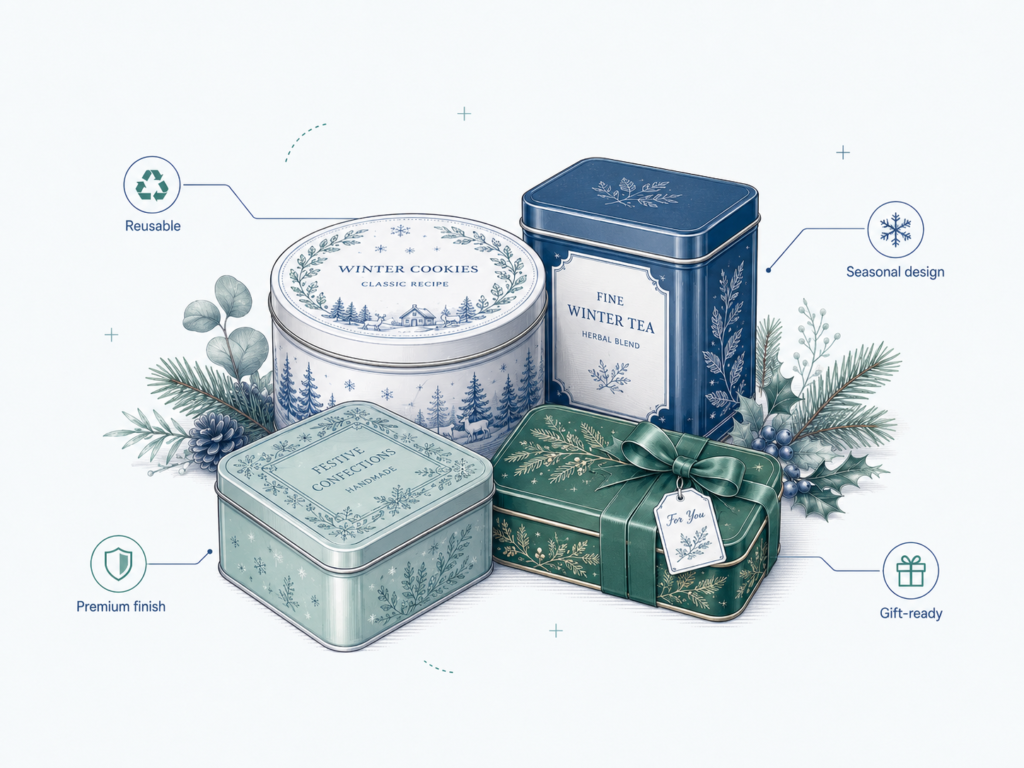
Seasonal packaging decisions should be creative, but they should not be random. The market data behind holiday shopping, promotional products, sustainability expectations, and recycling policy all point in the same direction: brands need packaging that looks valuable, protects products, supports campaign timing, and fits the sustainability language modern buyers expect.
The point is simple: holiday packaging is commercially important, but the market is selective. Buyers still care about price, quality, convenience, and product value. A custom tin box works best when it improves all four areas instead of acting as decoration alone.
For more industry context, see NRF’s winter holiday data and trends, NRF’s 2025 holiday sales forecast, PPAI’s promotional products sales volume estimate, McKinsey’s 2025 sustainable packaging consumer research, and Steel for Packaging Europe’s steel packaging recycling update.
What makes metal tins different from ordinary holiday packaging
Many seasonal packages are built for one short moment: attract attention, protect the product for a few weeks, then become waste. Metal tins can do more. Tinplate has strength, printability, tactile value, and reuse potential. The material feels more permanent than paperboard and more gift-worthy than many flexible packs. It can also handle forming, embossing, debossing, varnishing, internal trays, hinged lids, slip lids, window features, and multi-compartment structures.
This physical difference changes the commercial role of the package. A paper sleeve may communicate a seasonal theme. A custom metal tin can become part of the product proposition itself. A cookie tin can stay in the kitchen. A tea tin can be refilled. A cosmetics tin can store accessories. A candy tin can become a desk object. A promotional tin can keep a company logo visible for months. That extended life is one of the strongest arguments for holiday tin packaging.
Seasonal packaging also has a psychological function. Gift buyers want confidence. They want the product to look complete without needing extra wrapping. They want the recipient to feel that the gift was selected with care. Metal tins help because they provide structure, sound, weight, closure, and a smooth surface for decoration. These sensory cues can support higher perceived value, especially for chocolate, biscuits, tea, coffee, candles, skincare kits, promotional merchandise, and limited-edition collectibles.
However, metal tins should be specified with discipline. A tin that is too large may raise freight cost and create empty space. A shape that is too complex may require new tooling and longer development time. A glossy finish may look bright on screen but show fingerprints during handling. An insert may look neat in a rendering but fail if it is not tested with real products. Seasonal campaigns are deadline-driven, so every design decision should be linked to manufacturability, packing efficiency, and launch timing.
Idea 1: Limited-edition collectible tins
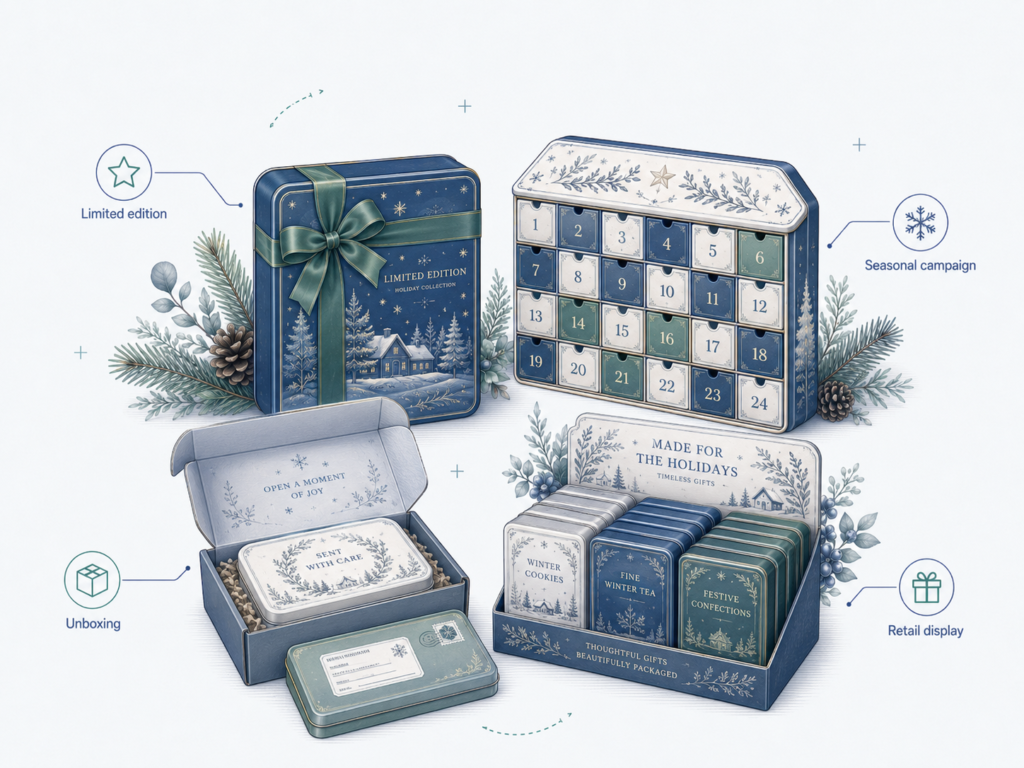
A limited-edition collectible tin is one of the most effective formats for holiday gifts because it combines scarcity, design value, and reuse. It works especially well for chocolates, cookies, biscuits, tea, coffee, candies, candles, cosmetics, and small lifestyle products. The packaging becomes more than a wrapper; it becomes the reason some consumers choose the seasonal SKU over the standard product.
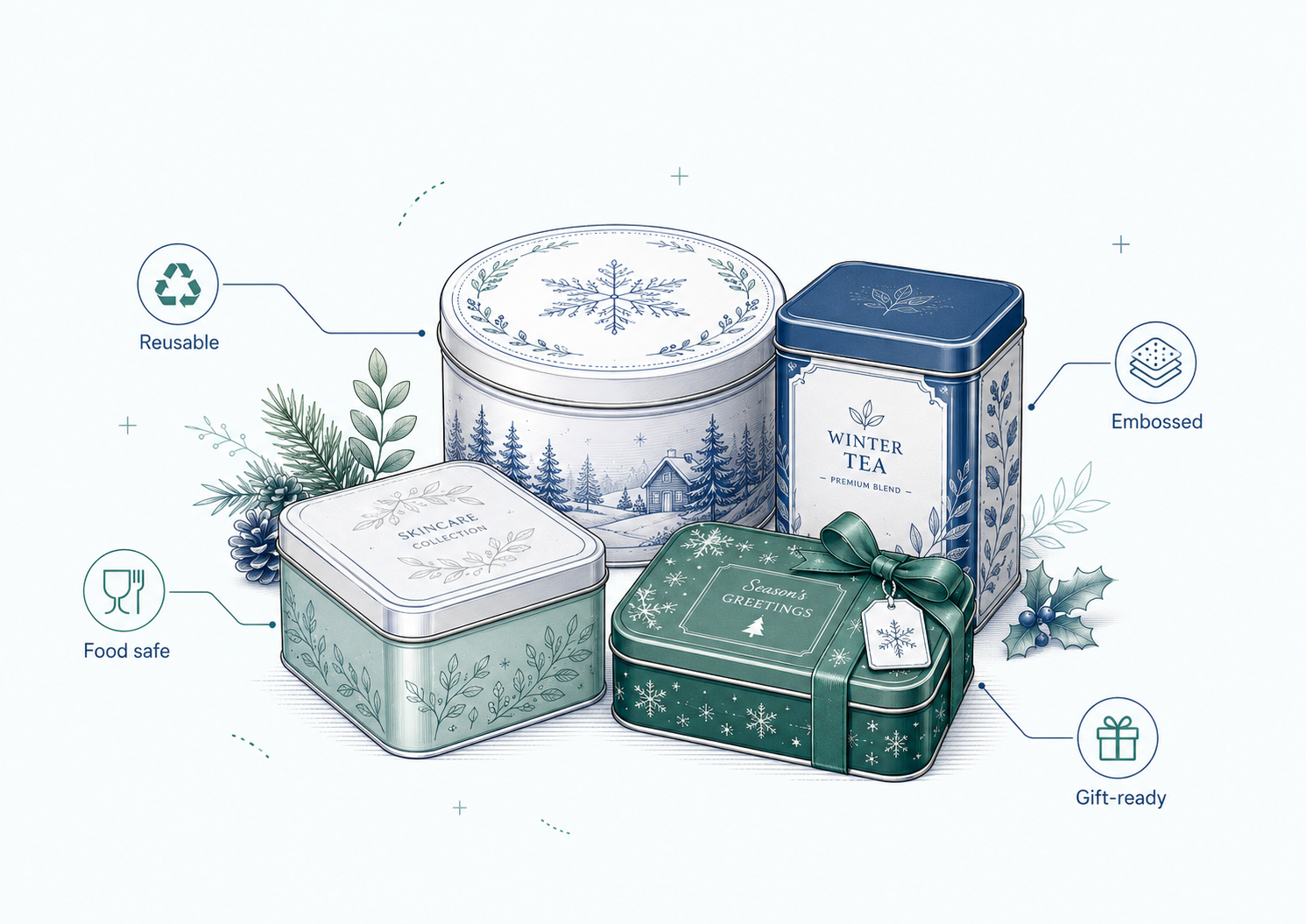
The key is to make the limited edition feel purposeful. A collectible tin should have a clear visual concept: winter village, heritage pattern, botanical illustration, city landmark, festive animal, zodiac theme, anniversary artwork, or artist collaboration. The design should be recognizable from a distance but still rich enough to reward close viewing. Embossing, debossing, metallic ink, matte varnish, or spot gloss can add depth without making the surface too busy.
A strong collectible tin series can also support repeat seasonal sales. Instead of launching one unrelated design every year, a brand can build an annual series. For example, a tea brand might produce a new winter tin every December, while a confectionery brand could release a numbered holiday biscuit tin. Collectors may purchase each new version even when the product inside remains familiar. This helps the brand turn packaging into a retention tool.
For production planning, buyers should decide early whether the collectible value comes from printing only or from a new structure. Printing-only changes can often use an existing mold or standard tin shape, which can reduce tooling cost and lead time. New shapes can be more distinctive, but they require more engineering time. If the campaign date is fixed, the safest strategy is often to use a proven structure and invest creativity in artwork, finish, and insert design.
Idea 2: Advent calendar tins and countdown gift boxes
Advent calendars and countdown gift boxes are powerful because they turn one purchase into a multi-day experience. They work for chocolates, candies, tea sachets, coffee capsules, fragrance samples, skincare minis, jewelry charms, stationery, toys, and promotional merchandise. A metal tin version can feel more premium than disposable paperboard because the outer structure can be reused after the campaign.
The most common design challenge is internal organization. A countdown tin needs compartments that hold products securely, reveal them in order, and create a pleasant opening experience. Brands can use paperboard dividers, EVA trays, molded pulp, PET trays, or hybrid inserts depending on product weight, compliance needs, and sustainability goals. The tin itself should be easy to open repeatedly without bending, scratching, or losing closure strength.
For retail, the outer face must communicate the campaign instantly. Buyers should not need to read many words. A simple number system, festive illustration, or window arrangement can make the format understandable. For e-commerce, the structure must also survive parcel handling. Heavy internal products can shift if the insert tolerance is poor. Sample testing with real products is essential before confirming production.
A countdown tin also works well for B2B campaigns. A company can create a twelve-day client appreciation kit with small branded items, snacks, product samples, or message cards. This format gives a sales team multiple touchpoints after delivery, especially when paired with QR codes that lead recipients to product pages, service introductions, or seasonal landing pages.
Idea 3: Premium confectionery, biscuit, and chocolate gift tins
Food gifting is one of the strongest applications for custom metal tin packaging. Chocolates, cookies, biscuits, candies, nuts, tea, coffee, cocoa, and specialty snacks all benefit from packaging that feels protective and gift-ready. Tin boxes are particularly attractive for premium food because they can combine food-safe coatings, strong structure, attractive decoration, and shelf presence.
For food projects, the packaging conversation must start with product behavior. Is the food dry or oily? Is it individually wrapped? Does it contain aroma-sensitive ingredients? Is the product expected to touch the tin directly, or will it sit inside a liner, pouch, tray, or paper cup? Does the target market require specific food-contact documentation? These questions influence material selection, internal coating, liner choice, and testing.
The U.S. FDA explains that food contact substances used in packaging must be authorized for their intended use when they meet the definition of a food additive, and the EU framework for food contact materials sets general safety and inertness principles for materials that contact food. Buyers do not need to become regulatory experts, but they should treat food-contact packaging as a technical specification, not a marketing label. Useful starting points include the FDA page on food packaging and food contact substances and the European Commission page on food contact material legislation.
For gift confectionery, structure matters as much as artwork. A shallow rectangular tin can present cookies neatly. A round tin can work well for butter cookies, chocolates, or holiday assortments. A hinged tin can improve repeated opening. A windowed lid can show product color, but it may reduce the classic all-metal look and require careful sealing. A two-layer tin can create surprise, but it increases assembly complexity. The best design is the one that protects the product, supports portion layout, and makes the gift feel abundant without wasting space.
Brands can explore Mr.Tin Box’s Food & Beverage Packaging capabilities when planning food-grade holiday tins, especially for seasonal snacks, chocolate lines, tea collections, and premium biscuits.
Idea 4: Tea, coffee, cocoa, and winter beverage tins
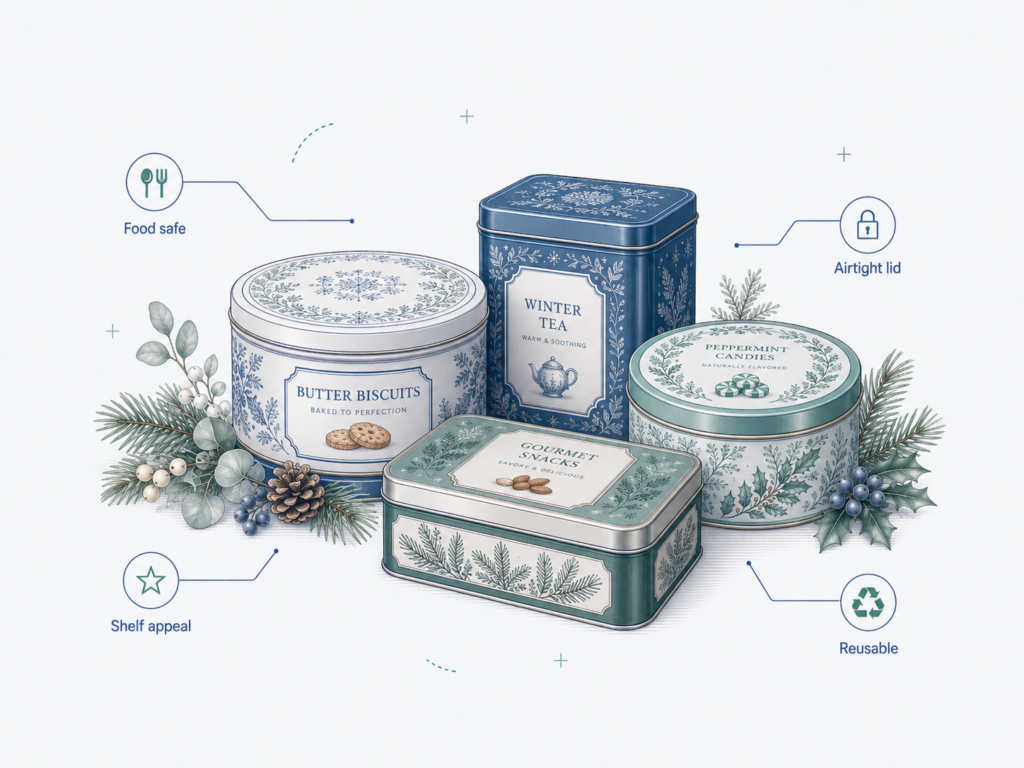
Hot drinks naturally fit seasonal campaigns. Tea, coffee, cocoa, powdered drinks, spices, and wellness blends all have strong holiday potential because they connect with comfort, rituals, and gifting. A tin package can reinforce freshness, aroma protection, and premium presentation, especially when combined with inner bags, foil pouches, or sealed sachets.
A practical beverage tin strategy is to build around usage occasions. A winter tea tin can be positioned for evening relaxation. A coffee tin can be designed for office gifting. A cocoa tin can be paired with marshmallows, biscuits, or a mug. A spice tin can support holiday baking. Instead of decorating every surface with festive icons, the design should show how the product fits the season.
Tin shapes should match the way the consumer will store the product. Tall rectangular tins work well for tea bags or sachets. Cylindrical tins suit loose tea, coffee, or cocoa. Flat tins can hold sample packs or travel portions. Multi-compartment tins can separate flavors. A refillable tin can support repeat purchase if the brand sells refill pouches later.
For export-focused brands, beverage tins are also useful because they can carry localized seasonal artwork without changing the product formula. A brand can use the same tea blend but create different tin designs for Christmas, New Year, Lunar New Year, Mid-Autumn Festival, Ramadan/Eid, or regional retail events. This allows marketing teams to localize campaigns while operations teams maintain product consistency.
Idea 5: Beauty, skincare, fragrance, and self-care holiday kits
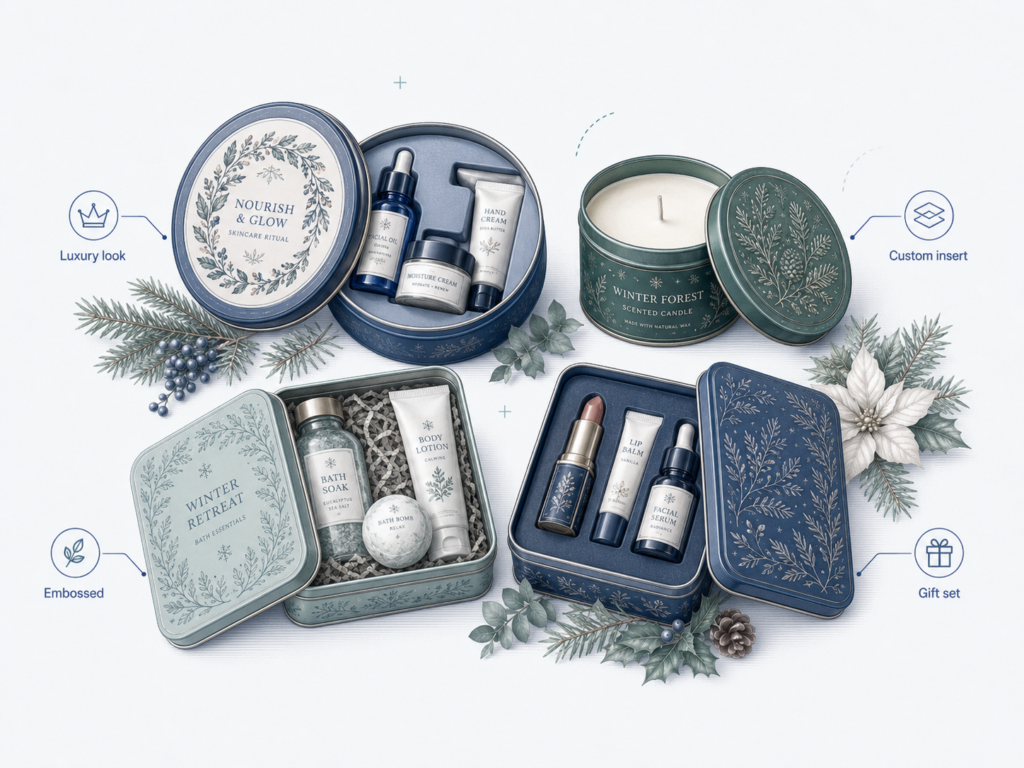
Beauty and personal care products depend heavily on perceived value. A seasonal kit may include lip balm, hand cream, mini fragrance, soap, essential oil, sheet masks, hair accessories, or travel-size skincare. Custom metal tin packaging helps these kits feel more substantial, especially when the product sizes are small.
The most important design issue is internal fit. A beautiful outer tin cannot compensate for loose bottles, rattling jars, or scratched caps. Inserts should be tested with real products, including label thickness, cap tolerances, and any secondary wraps. Foam, EVA, pulp, paperboard, or molded trays can all work, but the insert should match the brand’s sustainability position and the product’s fragility.
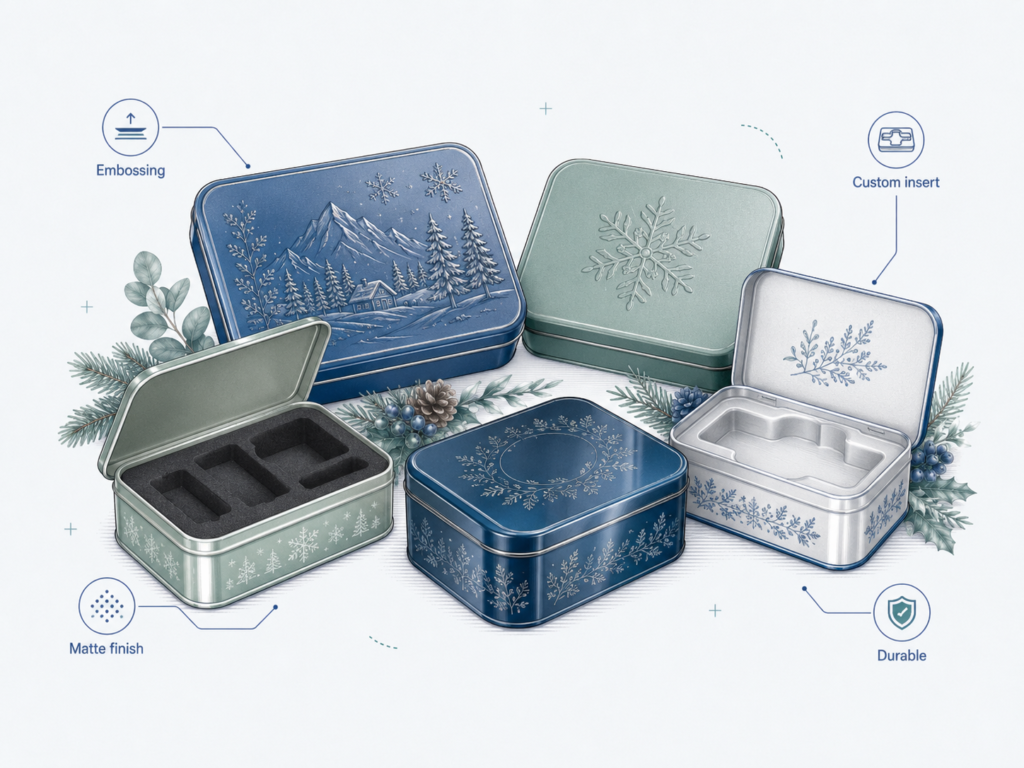
For cosmetics, surface finish is critical. Matte and soft-touch finishes can communicate quiet luxury. Metallic effects can support festive shine. Embossed logos can make the package feel more premium without adding too much visual clutter. Spot UV can highlight snowflakes, stars, product names, or brand motifs. The goal is to create a package that photographs well for online selling and feels refined in hand.
Holiday beauty tins can also be designed for reuse. A consumer may store makeup tools, jewelry, cotton pads, travel minis, or desk accessories in the tin. That secondary use keeps the brand visible. For premium brands, this is valuable because the package continues working after the product is consumed.
Mr.Tin Box’s Beauty & Personal Care Packaging page is a useful internal reference for brands developing cosmetics, skincare, fragrance, and personal care tin packaging.
Idea 6: Corporate gift tins and promotional campaign kits
Corporate gifting is different from consumer retail. The buyer is often a marketing manager, HR team, sales department, distributor, trade show organizer, or procurement team. They care about presentation, budget control, on-time delivery, customization, and recipient experience. A custom metal tin can help because it organizes multiple items into one branded package.
A corporate gift tin may contain chocolate, tea, coffee, cookies, stationery, USB accessories, samples, gift cards, product brochures, or small tools. The tin itself can carry the company logo, campaign slogan, QR code, or event artwork. Unlike a disposable gift bag, a tin has a longer life and may sit on a desk after the campaign. That makes it especially useful for B2B brand visibility.
PPAI’s promotional product data shows that promotional merchandise remains a large market, and sustainable promotional products are growing quickly. This supports a practical argument for reusable metal tins: they can package the gift and become part of the gift. Instead of spending budget on a box that disappears, a company can invest in a container that recipients may keep.
The strongest corporate tin concepts are simple and useful. A rectangular desk tin for stationery and snacks. A slim metal case for sample cards. A round tin for tea and sweets. A hinged tin for onboarding kits. A rugged tin for tools, fasteners, or technical samples. For trade shows, the tin should be easy to pack, carry, and display. For direct mail, it should be designed around parcel size, weight, and protection.
Brands developing B2B seasonal gifts can connect this strategy with Mr.Tin Box’s Gift, Promotional & Holiday Packaging service page and related knowledge content such as MOQ and Lead Time Planning for Your Custom Tin Box.
Idea 7: Regional festival tins for global markets
Holiday packaging should not be limited to Christmas. Global brands often need different seasonal programs across different markets. A custom tin strategy can support Christmas, New Year, Lunar New Year, Mid-Autumn Festival, Valentine’s Day, Mother’s Day, Halloween, Easter, Ramadan/Eid, Diwali, national holidays, school seasons, wedding seasons, and corporate anniversaries.
Each event has different emotional codes. Christmas packaging may use warmth, nostalgia, snow, lights, gold, green, red, or winter scenes. Lunar New Year often emphasizes prosperity, family, red, gold, zodiac animals, and gift etiquette. Mid-Autumn packaging may focus on moon imagery, reunion, tea, and premium food gifting. Ramadan and Eid packaging may emphasize sharing, elegance, geometry, lanterns, and hospitality. Diwali packaging often uses light, celebration, color, sweets, and decorative patterns.
A strong global tin program uses cultural cues respectfully. It avoids superficial symbols that feel generic. It considers local color preferences, gift sizes, reading direction, language, retail calendar, and compliance needs. The structure can remain similar across markets, while artwork and insert configuration change by campaign. This is efficient for brands that want local relevance without redesigning everything from zero.
Regional festival tins also support distributor selling. A distributor can show retailers a family of seasonal designs and explain how each version fits a specific selling window. This makes the packaging easier to sell internally and externally. It also helps brands plan production earlier because multiple seasonal designs can be developed as one program.
Idea 8: Multi-product gift sets with engineered inserts
Many seasonal campaigns fail inside the box. The outer design may look impressive, but the products inside move, collide, or feel underfilled. Engineered inserts solve this problem. A custom tin with the right insert can hold multiple SKUs neatly and make the gift feel organized.
Insert choice depends on product category. Confectionery may need paper cups, trays, dividers, or food-safe liners. Tea and coffee may need sachet slots or pouches. Beauty kits may need foam, molded pulp, EVA, or paperboard trays. Industrial gift kits may need stronger dividers or formed inserts. A small electronics or accessory set may need anti-scratch protection.
The buyer should not approve an insert based only on a digital rendering. Real products should be placed inside a physical sample. The test should check fit, removal force, visual presentation, shaking, drop sensitivity, packing speed, and whether the product can be placed correctly by assembly workers. Seasonal campaigns often involve large volume in a short time, so packaging that is difficult to assemble can create late-stage bottlenecks.
A good insert also helps avoid overpackaging. Instead of making the tin larger to look full, the brand can design a smarter internal layout. This reduces material use, improves shipping efficiency, and makes the gift feel intentional.
Idea 9: Window tins, reveal lids, and transparent storytelling
Window tins are useful when product color, texture, or assortment is a selling point. A transparent window can show chocolates, cookies, tea bags, candies, cosmetics, ornaments, or samples. It helps shoppers understand the product quickly and can reduce hesitation in retail.
However, window tins must be used carefully. A window may reduce the all-metal premium feel. It may affect light protection. It may require extra sealing or bonding. It can also create scratching or fogging concerns if the plastic window is not specified properly. For food, the window material and adhesive must fit the intended use. For premium gifting, the window shape should look designed, not simply cut out.
A reveal lid is another option. Instead of a large transparent window, the tin can use layered artwork, an embossed lid, a belly band, or an internal printed message that appears when the box opens. This preserves the metal surface while still creating surprise. For high-end holiday gifts, this is often more elegant than showing everything at once.
Window and reveal concepts work best when tied to a clear story. For example, a snowflake-shaped window on a chocolate tin, a small round window showing tea blend color, or a die-cut star revealing metallic-wrapped candies. The visual element should support the product, not distract from it.
Idea 10: QR-connected tins for seasonal storytelling
A tin box is physical, but it can connect to digital campaigns. A QR code can lead shoppers to a holiday landing page, recipe, greeting video, product origin story, loyalty program, gift message, instruction page, or reorder page. This is especially useful for seasonal campaigns because the package may remain in the home after the campaign ends.
The QR code should be integrated tastefully. It can sit on the back panel, bottom label, internal lid, or printed card. Avoid placing it where it disrupts the premium appearance of the main artwork. The landing page should also be campaign-specific. A generic homepage wastes the opportunity. A holiday tin should send users to content that extends the seasonal experience.
For food brands, QR content can include recipes, pairing suggestions, allergen information, sourcing details, or refill options. For beauty brands, it can include usage routines, ingredient explanations, or gift set tutorials. For B2B gifts, it can lead to a personalized thank-you page, catalog, service introduction, or appointment booking page.
The QR strategy is also measurable. Brands can track scans by campaign, market, product line, or sales channel. This helps evaluate whether packaging is creating engagement after purchase. For seasonal programs, that data can improve next year’s design.
Choosing the right tin structure for each holiday product
The tin structure should follow the product, channel, and campaign objective. The table below gives practical starting points.
| Product or campaign type | Recommended tin format | Why it works | Watch-outs |
|---|---|---|---|
| Butter cookies, biscuits, chocolates | Round, square, or rectangular food tin | Familiar gift format, strong shelf presence, reusable kitchen storage | Confirm food-contact coating, internal liner, and product movement |
| Tea, coffee, cocoa, spices | Tall rectangular tin, cylindrical tin, or multi-compartment tin | Good storage value and strong aroma/freshness presentation | Match closure and inner pouch to product freshness needs |
| Beauty gift set | Hinged tin, flat rectangular tin, or premium tray tin | Protects small items and improves perceived value | Insert tolerance, scratch protection, and finish consistency are critical |
| Corporate gift kit | Rectangular hinged tin or slip-lid tin | Easy to brand, pack, ship, and reuse on desks | Control weight, parcel size, and MOQ before confirming design |
| Advent calendar | Large flat tin with dividers or numbered compartments | Turns the package into a daily experience | Requires early insert engineering and assembly testing |
| Toy, stationery, or craft kit | Hinged tin or compartment tin | Keeps small parts organized and supports reuse | Test hinge durability and child-related safety requirements where relevant |
| Industrial sample kit | Reinforced tin with durable finish | Protects components and communicates technical quality | Avoid excessive decoration; prioritize strength and internal protection |
| Premium limited edition | Custom shape or standard shape with high-end finish | Creates collectibility and visual differentiation | New molds need more budget and longer timelines |
A buyer does not always need a new mold to create a strong seasonal result. In many cases, a proven shape with excellent artwork, finish, insert, and presentation will outperform a complicated new shape that causes delays. The right decision depends on launch timing, budget, expected volume, and the role of packaging in the product’s selling price.
Decoration and finishing ideas for holiday campaigns
Finishing is where holiday packaging becomes tactile. A good finish can make the tin feel premium before the customer reads the product name. The best choice depends on the brand position, product category, and retail environment.
| Finish or decoration | Best seasonal use | Commercial benefit | Practical note |
|---|---|---|---|
| Matte varnish | Luxury food, tea, cosmetics, minimalist gifts | Reduces glare and creates a refined look | Can show oil or fingerprints depending on coating quality |
| Gloss varnish | Bright candy, children’s gifts, festive retail displays | Creates strong color impact and shelf shine | Glare may affect photography under strong lights |
| Spot UV | Snowflakes, stars, logo highlights, product names | Adds contrast without covering the whole surface | Artwork registration must be controlled carefully |
| Embossing | Logos, patterns, borders, characters, icons | Adds touch value and premium feel | Avoid overly small details that may not form cleanly |
| Debossing | Minimalist luxury packaging | Creates subtle depth and shadow | Works best with simple geometry and strong material support |
| Metallic ink | Gold, silver, copper, festive accents | Supports holiday sparkle without separate foil | Color proofing is important because metal effects vary by print process |
| Soft-touch coating | Beauty, premium tea, luxury confectionery | Creates a warm, giftable hand feel | Check scratch resistance and compatibility with artwork |
| Textured finish | Retro tins, craft products, industrial gifts | Adds grip and distinctive feel | May affect fine printing clarity |
| Interior printing | Surprise messages, brand story, refill instructions | Improves unboxing and reuse value | Adds cost and should be planned in artwork files early |
For deeper packaging finish guidance, brands can refer to Mr.Tin Box’s article on Metal Tin Box Finishing Options. Seasonal packaging does not need every special effect. In fact, a clean matte surface with one embossed logo and a carefully chosen color palette can feel more premium than a crowded design with too many decorations.
Sustainability: how to make the tin’s reuse story credible
Sustainability has become a standard part of packaging conversations, but it should be handled carefully. McKinsey’s 2025 packaging research shows that price and quality remain the strongest purchase factors in many markets, while environmental concern varies by country and category. That means brands should not rely on sustainability claims alone. The package must first perform well as a gift, a protective container, and a brand experience.
The advantage of metal tins is that they can support a practical sustainability story when designed responsibly. Steel packaging has strong recycling infrastructure in many markets. Steel for Packaging Europe reported an 82% real recycling rate for steel packaging placed on the EU market in 2023, and Eurostat data shows that packaging waste reduction and recycling remain central policy issues in Europe. The EU’s Packaging and Packaging Waste Regulation also increases pressure toward recyclable, minimized, and circular packaging systems; the European Commission’s overview of packaging waste policy is a useful reference for brands selling into Europe.
For marketing, the safest language is specific and verifiable. Instead of saying, “This package is eco-friendly,” a brand can say the tin is reusable, recyclable where facilities exist, designed for long-term storage, or produced with a removable insert. If the tin includes a plastic window, adhesive label, magnet, foam insert, or decorative sleeve, the brand should consider whether those components affect recycling or reuse claims.
Designing for reuse also means designing for real life. A tin that is too seasonal may be discarded after the holiday. A tin with a beautiful general pattern may be reused for storage all year. A tea tin with a refillable format supports future purchases. A cosmetics tin with a clean interior may become a useful organizer. A corporate gift tin that fits pens, cables, or cards may stay on a desk. The more useful the second life, the stronger the sustainability story.
Food-contact and compliance planning for seasonal tins
Food-contact compliance is especially important for holiday campaigns because many tins are used for chocolates, cookies, biscuits, candies, nuts, tea, coffee, and specialty foods. Buyers should never assume that all tins are suitable for all foods. The right specification depends on intended use, contact time, temperature, food chemistry, whether the product is directly touching the metal, and the target market.
| Compliance question | Why it matters | Buyer action |
|---|---|---|
| Will food directly touch the tin? | Direct contact creates different coating and documentation requirements from individually wrapped food. | Define contact conditions before quoting. |
| Is the food oily, acidic, aromatic, or dry? | Product chemistry can affect coating choice and migration considerations. | Share product type and packaging method with the supplier. |
| Which market will receive the product? | U.S., EU, UK, and other markets may require different documentation or tests. | Confirm destination markets early. |
| Will there be an inner bag, liner, tray, or wrapper? | Secondary packaging may carry the primary food-contact function. | Test the complete packaging system, not only the outer tin. |
| Is the campaign for children? | Toys, candies, small parts, and decorative features may trigger additional safety considerations. | Review safety and labeling needs with qualified compliance support. |
| Will the tin be reused for food storage? | Reuse messaging may create additional expectations. | Avoid claims that exceed the tested or intended use. |
The FDA and European Commission resources linked earlier provide useful starting points, but final compliance should be based on the product, destination market, and qualified testing. For buyers, the practical takeaway is simple: include food-contact requirements in the first brief, not after artwork approval.
Production timeline: how to avoid missing the seasonal window
The most expensive holiday packaging problem is not always unit cost. It is missing the launch date. Seasonal campaigns have fixed retail calendars. If the product arrives late, the entire campaign value can disappear. Custom tin projects should therefore be planned backwards from the in-warehouse date.
Exact timing varies by volume, tooling, finish complexity, factory capacity, shipping method, and destination market. Mr.Tin Box’s guide on MOQ and Lead Time Planning for Your Custom Tin Box is relevant for buyers who want to understand how minimum order quantity and lead time affect launch planning.
Cost control without weakening the gift experience
Holiday packaging must feel special, but budget still matters. The best cost control comes from simplifying the right things, not from removing every premium feature.
First, consider whether an existing mold can achieve the campaign goal. Standard or near-standard shapes reduce tooling investment and usually speed development. A new custom shape should be reserved for campaigns where structural uniqueness directly supports brand value or repeat use.
Second, control finish complexity. Matte plus embossing may be enough. Metallic ink plus spot UV may be enough. A tin does not need every effect at once. Too many processes can increase cost, risk, and approval time without improving conversion.
Third, optimize the insert. A well-designed paperboard divider may be more cost-effective and easier to recycle than a complex plastic tray. For fragile products, stronger inserts may be necessary, but the buyer should test whether the added cost improves protection and presentation.
Fourth, design around logistics. A tin that is slightly too tall may increase carton volume and freight cost. A heavy gift set may need stronger master cartons. A round tin may look attractive but pack less efficiently than a rectangular tin. These operational details affect landed cost.
Fifth, plan repeat use across campaigns. If a structure can support Christmas, New Year, corporate gifts, and spring promotions through artwork changes, the brand can spread development learning across more programs. This is often better than treating every seasonal package as a one-off project.
How to write a professional tin packaging brief
A clear brief saves time, reduces quotation errors, and improves sample quality. For seasonal projects, the brief should include both creative and technical information.
| Brief item | What to include |
|---|---|
| Product information | Product type, size, weight, unit count, fragility, aroma, food-contact status, and whether product touches the tin |
| Campaign details | Holiday or season, launch date, sales channel, target market, retail price, and quantity forecast |
| Tin structure | Preferred shape, approximate dimensions, lid type, hinge needs, window needs, handle needs, or standard mold preference |
| Insert requirements | Product layout, divider/tray preference, sustainability goals, assembly speed, and product removal experience |
| Artwork direction | Brand guidelines, colors, logo files, seasonal theme, languages, barcode/QR needs, and required warnings |
| Finish requirements | Matte, gloss, embossing, debossing, spot UV, metallic effects, soft-touch, interior printing, or protective coating |
| Compliance needs | Food-contact documentation, destination market rules, child-safety issues, labeling requirements, and testing expectations |
| Logistics details | Shipping method, carton requirements, pallet requirements, warehouse deadline, and retail display constraints |
This brief does not need to be perfect before the first conversation, but it should be specific enough for the supplier to guide the project. Vague requests such as “make a holiday tin” produce vague quotes. Specific briefs create faster engineering, more accurate pricing, and better samples.
Common mistakes when designing holiday metal tins
The first mistake is starting too late. Holiday packaging feels creative, but it is still manufacturing. Structure, printing, tooling, sampling, testing, production, packing, freight, customs, and distribution all need time. Late starts force brands into standard options, rushed approvals, and expensive shipping.
The second mistake is treating artwork as the whole project. Artwork matters, but the success of a tin depends on dimensions, closure, material thickness, internal fit, surface finish, stacking, carton packing, and user experience. A beautiful tin that dents easily or wastes space will not support the campaign.
The third mistake is using too many seasonal symbols. Snowflakes, ribbons, stars, bells, red, gold, and typography can work, but overcrowding makes the package look cheaper. Premium seasonal packaging often uses restraint: one strong visual idea, one clear focal point, and enough empty space for the metal surface to breathe.
The fourth mistake is ignoring the afterlife of the tin. A strongly dated design may perform well for a short event but fail as a reusable object. Brands should decide whether the tin should feel seasonal, evergreen, collectible, or refillable.
The fifth mistake is not testing the complete packed product. A sample tin without the real product inside tells only half the story. Buyers should test real packed samples for fit, shaking, surface scratching, opening force, stacking, and perceived value.
Where custom metal tins fit across major seasonal campaigns
Custom metal tin packaging can be adapted to many seasonal moments. The idea is not to force the same visual language everywhere. The idea is to match structure, artwork, and insert logic to the buying occasion.
| Season or event | Suitable products | Tin packaging idea |
|---|---|---|
| Christmas and winter holidays | Cookies, chocolate, tea, coffee, candles, beauty kits | Limited-edition collectible tins, advent tins, winter gift assortments |
| Lunar New Year | Tea, confectionery, nuts, premium snacks, cosmetics | Red/gold gift tins, zodiac tins, family-sharing boxes, refillable tea tins |
| Valentine’s Day | Chocolate, fragrance, jewelry, cosmetics | Heart-inspired tins, small luxury hinged tins, paired gift sets |
| Mother’s Day | Tea, skincare, candles, cookies, personal care | Soft color tins, floral patterns, self-care kits, keepsake boxes |
| Halloween | Candy, snacks, toys, novelty products | Character tins, glow-themed artwork, reusable candy boxes |
| Mid-Autumn Festival | Mooncakes, tea, confectionery | Premium food tins, moon-themed artwork, multi-compartment trays |
| Ramadan and Eid | Dates, sweets, tea, fragrance, gift assortments | Elegant geometric tins, sharing boxes, hospitality gift sets |
| Diwali | Sweets, dry fruits, tea, candles | Bright festive tins, metallic finishes, reusable gift boxes |
| Back-to-school | Stationery, snacks, small accessories | Pencil tins, organization tins, branded student kits |
| Trade show season | Samples, tools, documents, promotional items | Compact branded sample tins, QR-connected sales kits |
This table also shows why a tin packaging strategy can be planned across the full year. A brand that only thinks about Christmas may miss opportunities in regional holidays, corporate events, trade shows, and product anniversaries.
Why Mr.Tin Box is a practical partner for seasonal tin packaging
Seasonal packaging requires both creativity and execution. The supplier must understand how the product should look, how the tin should function, how the insert should secure the contents, how the finish should match the brand, and how production should meet the campaign date. Mr.Tin Box positions its service around custom metal packaging for food, beauty, gifting, promotional, holiday, specialty, and industrial applications.
For holiday and promotional projects, the Gift, Promotional & Holiday Packaging page highlights custom tin packaging for gifting, promotions, seasonal campaigns, refined presentation, durable protection, and memorable unboxing. The page also describes a workflow that includes consultation, 3D drawing and structure design, mold development or sample making, printing and surface finishing, stamping and assembly, and final quality inspection. This sequence matters because a seasonal tin project is not only a design task; it is a controlled production process.
Brands can also use the site’s category pages to match the package to the product. Food brands can start with Food & Beverage Packaging. Cosmetics and personal care companies can start with Beauty & Personal Care Packaging. Technical, tool, component, or sample kit projects can refer to Specialty & Industrial Packaging. Buyers who are still choosing structure and finish can read guides such as 10 Creative Custom Metal Tin Packaging Design Ideas, Metal Tin Box Finishing Options, and MOQ and Lead Time Planning for Your Custom Tin Box.
The practical value for buyers is guidance. A good supplier should help clarify whether a campaign needs a standard mold or custom tooling, whether the artwork is printable, whether the insert protects the products, whether the coating suits the application, whether the schedule is realistic, and whether the final tin supports both marketing and manufacturing requirements.
FAQ
Is custom metal tin packaging suitable for small holiday campaigns?
It can be, but the answer depends on MOQ, tooling, decoration, and target price. If the quantity is modest, brands should consider existing tin shapes and focus customization on printing, finish, labels, sleeves, or inserts. A fully custom mold is usually more suitable for larger orders or repeat seasonal programs.
How early should a brand start a holiday tin project?
For a serious seasonal campaign, planning 24 to 32 weeks before launch is safer, especially if the project includes new tooling, food-contact requirements, complex inserts, or international shipping. Shorter timelines may be possible with existing molds and simple decoration, but late changes can still create risk.
Can metal tins be used for direct food contact?
Yes, but only when the material, coating, and intended use are appropriate for the product and destination market. Buyers should define whether the food directly touches the tin, whether it is wrapped, what the food chemistry is, and what documentation is required. Food-contact requirements should be discussed at the beginning of the project.
Are metal tins sustainable?
Metal tins can support sustainability goals because they are reusable and recyclable where proper systems exist. However, sustainability claims should be specific. A tin with mixed components, plastic windows, foam inserts, or decorative accessories should be evaluated as a complete packaging system. The strongest message is usually reuse, durability, and recyclability where facilities are available.
What is the best finish for a premium holiday tin?
There is no universal best finish. Matte varnish, soft-touch coating, embossing, debossing, metallic ink, and spot UV can all work. Premium packaging usually benefits from fewer, better-chosen effects rather than too many decorations. The finish should match the product category and the brand’s price position.
Should a holiday tin use a custom shape?
A custom shape can create strong differentiation, but it also increases tooling cost and development time. If the campaign is urgent or budget-sensitive, a standard shape with excellent artwork and finishing may be the better commercial choice. Custom shapes are most useful when the structure itself becomes part of the brand story.
Can one tin structure support several seasonal campaigns?
Yes. This is often a smart strategy. A brand can use the same structure for Christmas, New Year, Mother’s Day, and corporate gifts while changing artwork, insert layout, or sleeve design. This reduces engineering risk and helps teams build repeatable seasonal packaging programs.
What should be tested before mass production?
Brands should test structure, lid fit, hinge strength if applicable, insert fit, product movement, surface finish, printing color, carton packing, drop sensitivity, user opening experience, and compliance needs. Testing the complete packed sample is much more useful than checking an empty tin.
Final thoughts: turn the tin into a campaign asset, not just a container
Holiday gifts and seasonal campaigns are moments when packaging can create real commercial leverage. Consumers are already looking for products that feel giftable. Retailers need displays that attract attention. Corporate buyers want branded gifts that feel thoughtful and useful. E-commerce teams need packaging that photographs well and survives delivery. A well-planned custom metal tin can support all of these goals.
The best seasonal tins are not the most complicated ones. They are the most aligned ones. The product fits properly. The structure supports the channel. The artwork fits the holiday without becoming cluttered. The finish matches the brand level. The insert improves presentation. The compliance requirements are understood. The production timeline is realistic. The sustainability story is specific. The tin remains useful after the campaign.
For brands preparing holiday gifts, limited editions, corporate promotions, or regional festival programs, custom metal tin packaging offers a rare combination of presentation, protection, reuse, and brand memory. With careful planning and the right manufacturing partner, a seasonal tin can become more than a package. It can become the physical object customers associate with the campaign, the gift, and the brand itself.
To discuss a new seasonal packaging idea, brands can explore Mr.Tin Box’s custom gift, promotional, and holiday tin packaging solutions or contact the team through the Mr.Tin Box contact page.