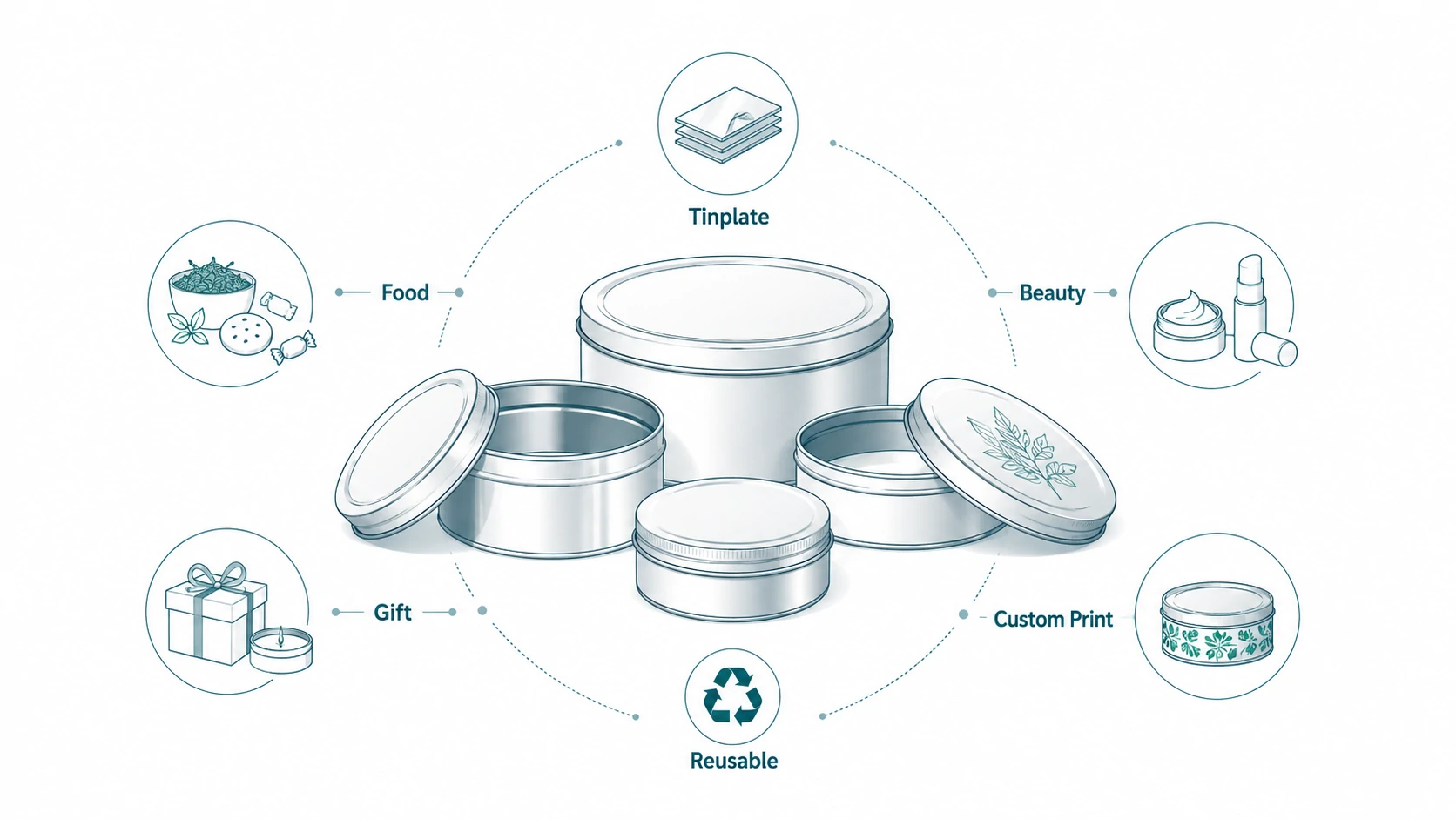
Round tin containers with lids are one of the most flexible custom metal packaging formats for consumer brands. They are simple in shape, easy to recognize, comfortable to hold, efficient for many filling processes, and visually strong on retail shelves. For food, beauty, gift, promotional, holiday, and specialty product packaging, the round form often creates the right balance between product protection, premium presentation, and cost-controlled customization.
For brand owners and packaging buyers, the key question is not only whether a round tin looks attractive. The better question is whether the round container structure fits the product, the sales channel, the user behavior, the required decoration area, and the buyer’s sustainability expectations. A tea brand may need aroma protection and a clean refill system. A cosmetic brand may need a smooth rim, a safe inner coating, and a lid that customers can open repeatedly without frustration. A gift brand may need a tin that feels collectible and can remain in the customer’s home after the product is consumed. A specialty product buyer may need a durable container that protects parts, samples, tools, or accessories during transport.
At Mr. Tin Box, we focus on custom metal tin packaging for global brands across food, beauty, gift, promotional, holiday, and specialty applications. Round tin containers with lids are especially useful because they can be engineered as small balm tins, medium candy tins, tea tins, coffee tins, candle tins, cosmetic tins, gift tins, or industrial sample containers. They can be produced with slip lids, friction lids, plug lids, screw lids, hinged systems, window lids, or custom insert structures, depending on the product and market.
This guide explains how to choose round tin containers with lids for real commercial projects. It covers product use cases, typical sizes, lid options, food-contact considerations, coating decisions, printing and finishing strategies, sustainability data, procurement checkpoints, and practical tables that can support request-for-quotation discussions. The goal is to help buyers understand what matters before tooling, sampling, and mass production begin.
Table of Contents
Why Round Tin Containers Work So Well for Brands
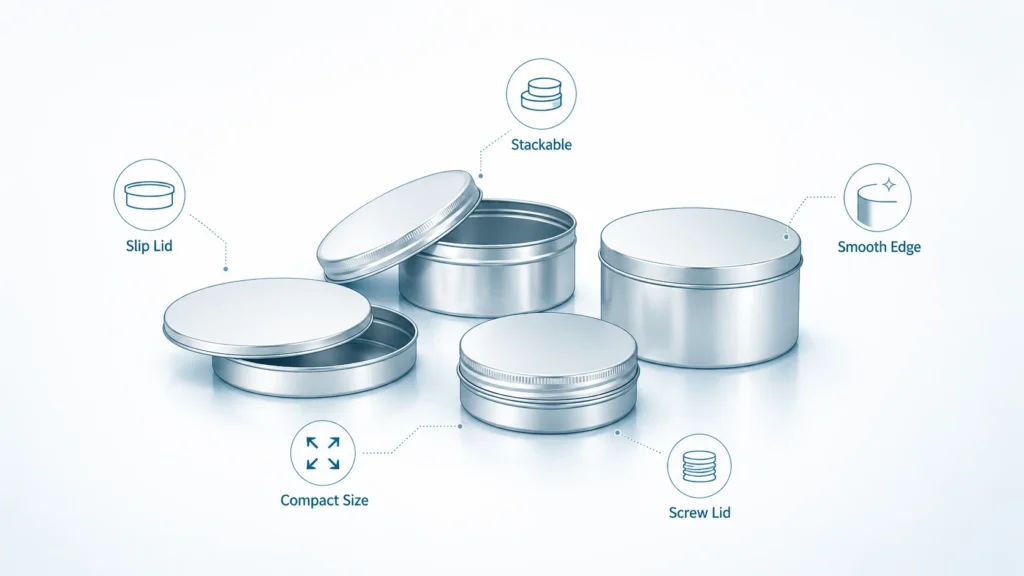
A round tin container is not just a circular box. Its geometry changes how the package feels, fills, stacks, displays, and opens. Compared with rectangular or square tins, round tins have no sharp corners, which makes them comfortable for hand-held use and suitable for products that customers open repeatedly. The curved wall also creates a smooth premium look that works well for food, beauty, candles, and gifts.
Round tins are often selected when the product itself is granular, loose, poured, scooped, molded, or circular in use. Tea leaves, coffee, cocoa powder, spices, candies, cookies, wax, lip balm, solid perfume, shaving soap, cream, hair wax, and small gift items all work naturally with circular packaging. In many cases, the container form supports the product story: a round tea tin feels traditional and refined; a round candle tin feels stable and clean; a small round balm tin feels pocketable and tactile; a round gift tin feels friendly and reusable.
The round structure also helps with perceived value. Consumers often associate metal tins with durability, reusability, and keepsake value. A lightweight pouch may be practical, but it is usually discarded after use. A well-made tin can be kept for desk storage, travel items, sewing accessories, coins, tea refills, small tools, or decorative display. This after-use value is one reason metal packaging can keep the brand visible long after the first purchase.
Mr. Tin Box discusses this broader brand value in the article Why Metal Packaging Boosts Shelf Life and Brand Value, which explains how metal packaging can combine protection, tactile value, decoration, and repeat visibility. For round tin containers with lids, these advantages become especially strong when the product is handled frequently or purchased as a gift.
The following table summarizes why brands commonly choose round tins instead of other common packaging formats.
| Packaging goal | Why round tin containers with lids are useful | Typical product examples |
|---|---|---|
| Premium first impression | Metal gives weight, rigidity, and a cool tactile feel; the round shape looks smooth and refined. | Tea, coffee, chocolate, candles, solid perfume, gift sets |
| Repeated opening | Round lids can be designed for smooth opening and closing without corner stress. | Lip balm, hair wax, mints, spices, wax melts |
| Product protection | Rigid tinplate helps resist crushing, light exposure, and external contamination. | Cookies, confectionery, cosmetic solids, small accessories |
| Reusability | Consumers often keep round tins for storage or display. | Holiday tins, souvenir tins, promotional tins |
| Decoration impact | The lid creates a strong circular branding area for logos, illustrations, embossing, or seasonal artwork. | Premium food, beauty, gifts, limited editions |
| Product compatibility | Circular forms work naturally for molded, poured, loose, granular, or scoopable products. | Candles, balms, creams, tea, coffee, spices |
Round Tin Containers at a Glance
Before comparing detailed specifications, it helps to understand the broad categories of round tin containers with lids. The term can include very small cosmetic tins, shallow candy tins, medium food tins, deep tea tins, candle tins, and larger promotional containers. The right version depends on internal volume, lid style, tinplate thickness, coating, printing method, and whether the product contacts the metal directly.
A small round tin for lip balm may only need a smooth screw lid, corrosion-resistant inner coating, and a clean top label or direct printing. A round tea tin may need a friction lid, optional inner plug lid, and enough wall height for printed origin information. A round candy tin may need food-grade coating, an insert or paper cup system, and a lid that protects the product during retail handling. A candle tin needs coating and heat-related compatibility checks, because wax, fragrance oil, and wick centering can affect the final user experience.
The following buyer map gives practical starting points. Exact specifications should always be confirmed through product testing and supplier sampling.
| Round tin type | Approximate use range | Common lid type | Best-fit applications | Key buyer checks |
|---|---|---|---|---|
| Micro round tin | 5-30 ml | Screw lid, slip lid | Lip balm, solid perfume, sample cream, small pills | Rim smoothness, coating compatibility, finger access |
| Mini round tin | 30-100 ml | Slip lid, screw lid, shallow plug lid | Mints, spices, wax melts, cosmetic balm, small candles | Opening force, inner coating, print readability |
| Small retail round tin | 100-300 ml | Slip lid, friction lid, window lid | Candies, cookies, loose tea, coffee, cocoa, skincare bars | Food contact, aroma control, fill volume, carton pack-out |
| Medium round tin | 300-800 ml | Friction lid, plug lid, slip lid | Tea, coffee, biscuits, gift packs, candle series | Wall strength, lid fit, stacking, label area |
| Deep round tin | 800 ml and above | Plug lid, friction lid, custom lid | Tea collections, coffee refills, holiday cookies, specialty gifts | Dent resistance, vertical stability, shipping protection |
| Round tin with insert | Size varies | Hinged, slip lid, plug lid | Gift sets, beauty kits, promotional items, accessories | Insert tolerance, unboxing, rattling prevention |
This size map is not a substitute for engineering drawings. It is a planning tool. In a real custom project, outside diameter, inner diameter, usable height, lid engagement depth, shoulder design, curling radius, material thickness, insert thickness, and packaging tolerances all affect final capacity and performance.
For a broader overview of compact tin formats, the Mr. Tin Box article Small Tin Containers: Sizes, Uses, and Custom Packaging Ideas provides useful planning context for buyers comparing small and medium tin sizes across food, beauty, gift, and specialty applications.
Best Uses in Food and Beverage Packaging
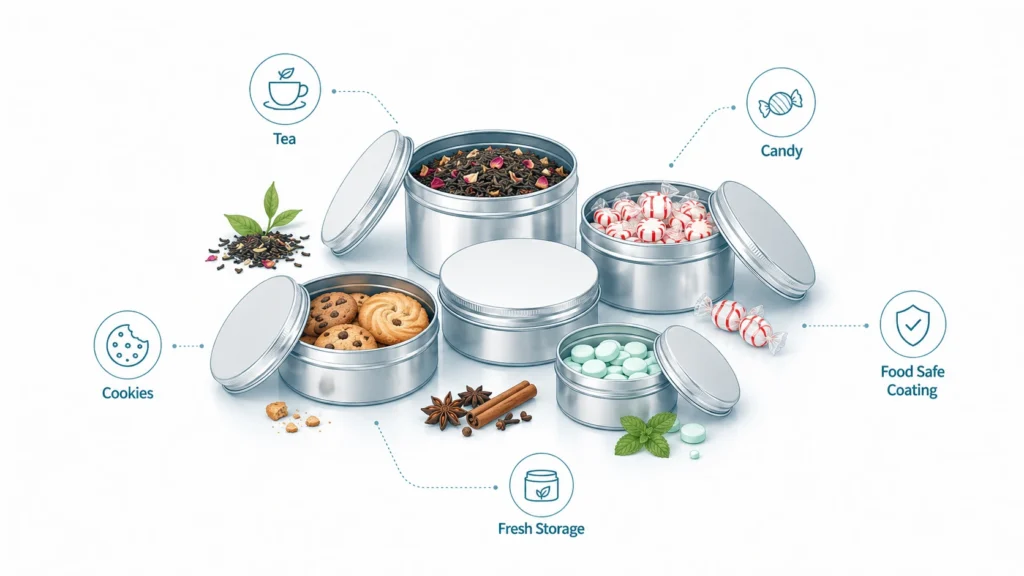
Food and beverage packaging is one of the strongest application areas for round tin containers with lids. The round shape is familiar, practical, and giftable. It works well for dry or semi-dry products where the packaging needs to protect flavor, aroma, texture, and shelf appearance. Tea, coffee, cocoa, spices, mints, candies, chocolates, cookies, biscuits, popcorn, supplements, powdered drink mixes, and seasonal food gifts can all benefit from custom round tins.
The Food & Beverage Packaging page on Mr. Tin Box highlights food-grade tin boxes and metal containers for snacks, tea, coffee, chocolates, candies, and specialty food products. For round containers, the commercial value is strongest when the product has at least one of these needs: light blocking, crush protection, premium gifting, refill behavior, aroma retention, or reusable afterlife.
Metal packaging is especially useful for products affected by light, moisture, oxygen, and physical damage. A technical review available through the U.S. National Library of Medicine notes that metal packaging materials provide excellent barrier properties and can protect food from gases, moisture, light, and microorganisms (source). For brands, the practical point is simple: when a product’s flavor, aroma, color, or crisp texture matters, the packaging structure must be part of the product strategy.
Food buyers should separate three levels of food packaging need. First, dry food storage, such as tea, coffee, cookies, and confectionery, often needs food-safe surfaces, aroma management, and moisture protection. Second, shelf-stable processed foods in hermetically sealed containers involve more serious regulatory and processing requirements. Third, decorative outer tins used around an inner bag or wrapper may not contact food directly, but they still need to protect the product and support labeling. The correct specification depends on which level applies.
USDA FSIS guidance states that high-acid canned foods can generally be stored for 12 to 18 months, while low-acid canned foods such as meat and vegetables can keep for two to five years under proper conditions (USDA FSIS Food Product Dating). This does not mean every round tin is automatically a long-shelf-life can. Many round tins are decorative or reclosable containers rather than thermally processed cans. However, the data demonstrates why metal packaging has such a strong history in shelf-stable food systems: when the right container, closure, coating, and process are used together, metal packaging can support serious product protection.
For dry foods, round tins help brands create giftable formats and premium shelf presence without turning every product into a fully processed canned food. A tea brand can use a round tin with a plug lid and printed origin story. A cookie brand can use a shallow round tin with a paperboard divider. A chocolate brand can use a round holiday tin with an inner food-grade tray. A spice brand can use a small round tin with a shaker insert or friction lid. A coffee brand can use a medium round tin as a refillable premium pack.
| Food category | Why a round tin works | Recommended structure | Commercial benefit |
|---|---|---|---|
| Tea and herbal blends | Protects aroma, blocks light, supports premium storytelling | Friction lid or plug lid; optional inner seal | Higher perceived value, refill potential, giftable format |
| Coffee and cocoa | Helps preserve aroma and creates a premium kitchen-storage pack | Deep round tin with tight lid and inner coating | Reusable container, stronger shelf impact |
| Cookies and biscuits | Resists crushing and supports holiday gift positioning | Shallow or medium round tin with paper liner or divider | Better gift appeal, less deformation in transit |
| Candies and mints | Easy to open, portable, collectible | Mini or small round tin, slip lid or screw lid | Impulse purchase, promotional flexibility |
| Chocolates | Protects pieces and supports decorative seasonal artwork | Round tin with insert or tray | Premium presentation, limited-edition value |
| Spices and seasonings | Good for pantry storage and repeat use | Small round tin, plug lid, shaker insert, or slip lid | Refill behavior, strong kitchen visibility |
| Nutraceutical powders | Blocks light and improves perceived quality | Food-contact round tin with coating and inner seal | Better trust cues, cleaner storage experience |
The most common food packaging mistake is choosing the tin before defining the product’s sensitivity. Does the product absorb moisture? Does it release oil? Is it aromatic? Does it need an inner bag? Is direct food contact required? Will the customer scoop the product, pour it, or pick pieces by hand? Will the container be sold online, in retail, in travel retail, or as a seasonal gift? These answers should shape the lid, coating, internal volume, and printing design.
Food brands should also consider instructions and claims. If a package says recyclable, reusable, food-safe, BPA-free, airtight, moisture-resistant, or long shelf life, the claim should match the actual material, coating, test documentation, and market regulations. Responsible packaging copy builds trust; exaggerated claims create compliance and reputation risk.
Best Uses in Beauty and Personal Care Packaging
Beauty and personal care products are another natural fit for round tin containers with lids. Many beauty products are tactile, small, fragrant, solid, semi-solid, or giftable. Lip balm, solid perfume, lotion bars, shaving soap, beard balm, hair wax, body butter, sample creams, bath salts, makeup removers, cosmetic powders, and beauty tool sets can all use round tins effectively.
The Beauty & Personal Care Packaging page on Mr. Tin Box explains how custom metal packaging supports cosmetics, skincare, fragrance, and wellness applications. For beauty buyers, the most important point is that the packaging is not only a container. It is part of the user experience. Customers touch it, carry it, open it, close it, store it, and often judge product quality before trying the formula.
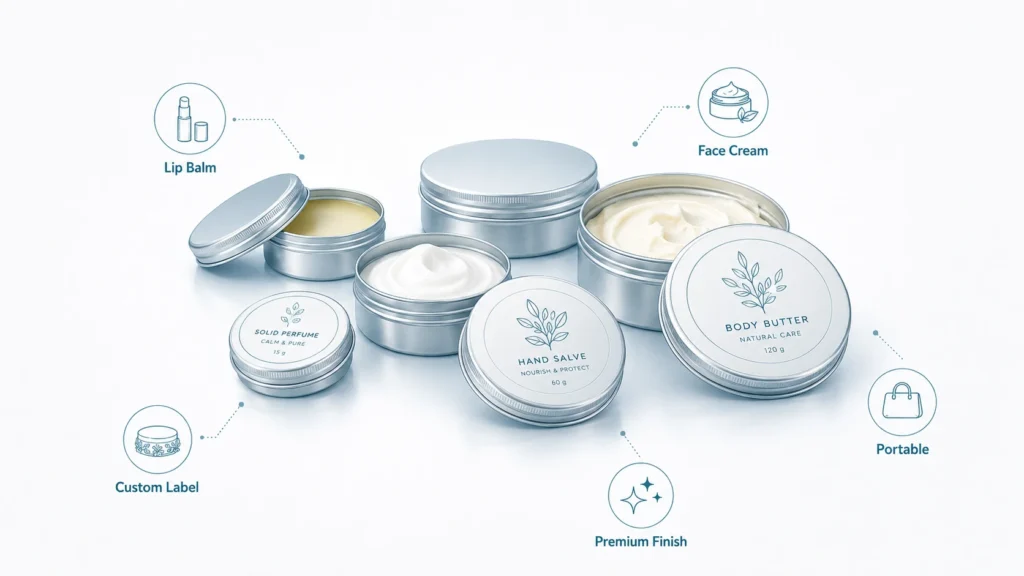
A small round tin can make a simple balm feel more premium. A screw lid can make a solid perfume feel secure and travel-ready. A shallow round tin can make a shaving soap or lotion bar look clean and giftable. A printed round lid can create a strong brand mark in retail photography, subscription boxes, and influencer content. Because the round shape has no harsh corners, it also feels soft and friendly in hand, which is valuable for wellness, skincare, and natural product brands.
However, beauty packaging requires careful compatibility checks. Oils, fragrances, waxes, salts, pigments, essential oils, and actives can interact with internal coatings differently. A coating that works for dry mints may not be suitable for a scented balm. A tin that looks fine in a short sample test may show staining, odor transfer, or corrosion after longer storage. For this reason, beauty buyers should test the actual formula, not only a similar product.
The Mr. Tin Box article Metal Lip Balm Tin Packaging: Sizes, Coatings, and Branding Options explains this point clearly: the base metal is only one layer of the packaging system; the internal lacquer, external coating, printing ink, varnish, lid tolerance, and packing method all influence final quality.
| Beauty product | Suitable round tin format | Main design concern | Recommended buyer test |
|---|---|---|---|
| Lip balm | Micro round tin with screw or slip lid | Finger access, rim smoothness, coating compatibility | Fill test, opening torque, formula storage test |
| Solid perfume | Small screw lid round tin | Fragrance retention, premium touch, leakage perception | Fragrance compatibility, carry test, lid security |
| Hair wax or beard balm | Small to medium round tin | Repeated opening, oil compatibility, label durability | Formula aging test, greasy-hand handling test |
| Lotion bar | Shallow round tin | Product fit, removal behavior, surface protection | Insert or liner test, user removal test |
| Shaving soap | Medium round tin | Water exposure during use, corrosion resistance | Wet-use simulation, coating validation |
| Bath salts | Small or medium round tin | Salt corrosion, moisture control, inner barrier | Salt compatibility and humidity test |
| Gift skincare set | Round tin with insert or divider | Unboxing, part retention, product arrangement | Drop test, insert tolerance, retail display review |
Beauty brands should also decide whether the decoration should feel clinical, natural, luxurious, playful, vintage, or artisanal. Round tins can support many surface treatments: CMYK printing, spot color printing, matte varnish, glossy varnish, soft-touch finish, metallic effects, embossed logos, debossed patterns, textured coatings, and paper labels. The right choice depends on brand positioning. A medical-style balm may need clean one-color printing. A premium fragrance solid may need embossing and satin varnish. A natural skincare brand may prefer soft matte colors and minimal typography.
For beauty products sold online, the top surface of the round lid is especially important because it appears clearly in product thumbnails. A strong circular layout can make the product recognizable in marketplace grids, social ads, and subscription box photos. This is why many beauty brands use the lid as the primary branding surface and keep the side wall for ingredients, weight, barcode, batch code, or regulatory information.
Best Uses in Gift, Promotional, and Holiday Packaging
Round tin containers with lids are highly effective for gift, promotional, and holiday packaging because they combine visual charm with after-use value. A gift package is judged before the product is opened. The material, weight, print quality, lid action, and overall structure all tell the customer whether the product feels thoughtful or ordinary.
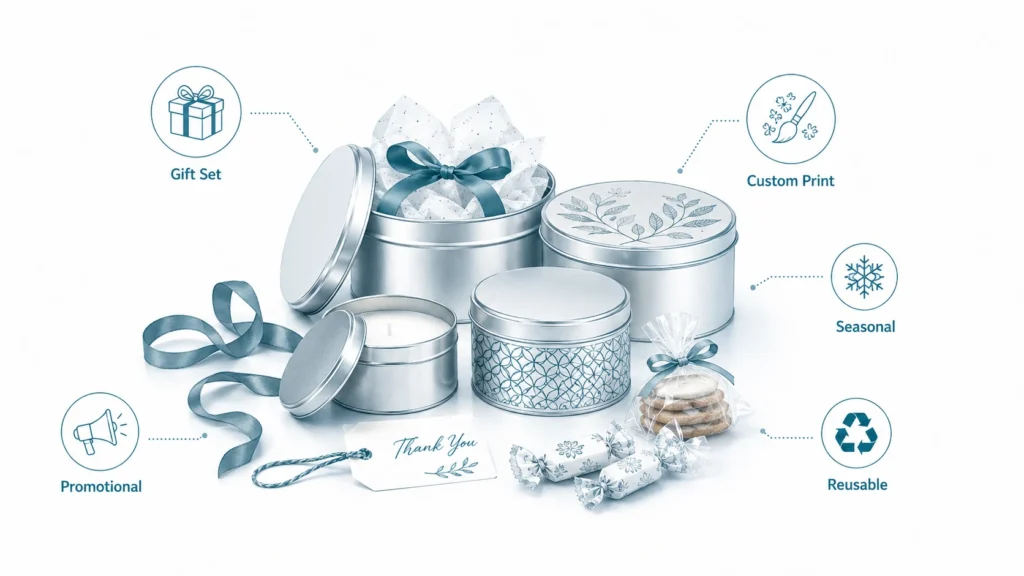
Mr. Tin Box works across gift, promotional, and holiday packaging categories, and the site positions custom tins as a practical format for seasonal collections, promotional campaigns, and premium brand presentation. Round tins are especially suitable for cookies, candies, chocolate assortments, tea gifts, coffee samplers, wedding favors, anniversary gifts, souvenir packs, corporate gifts, influencer mailers, and limited-edition retail launches.
Gift buyers often want packaging that customers keep. A paper box may be beautiful but disposable. A round tin can become a storage box, desk container, kitchen tin, keepsake, or decorative item. This extended visibility gives the brand additional exposure without another ad impression. For promotional buyers, this is a major advantage: a reusable tin can keep a logo in front of the customer long after an event ends.
Round tins also support seasonal artwork very well. The circular lid can carry snowflakes, floral patterns, wedding monograms, festival illustrations, mascot graphics, anniversary badges, or limited-edition collector numbers. The side wall can carry repeat patterns or a simple color band. Embossing can make the lid more tactile, while metallic printing can make holiday designs more festive.
For more creative packaging concepts, the Mr. Tin Box guide 10 Creative Custom Metal Tin Packaging Design Ideas discusses embossing, debossing, hot stamping, seasonal themes, simple designs, and fun prints for custom tin packaging. These ideas apply directly to round gift tins, especially when the packaging itself is part of the product story.
| Gift or promotional use | Why round tins work | Recommended customization | Important timeline point |
|---|---|---|---|
| Holiday cookie tin | Familiar, collectible, protective | Full-lid seasonal print, side-wall pattern, food-safe liner | Start sampling early before holiday logistics peak |
| Wedding favor tin | Soft shape, easy to personalize | Monogram, date, pastel colors, small insert | Confirm small-batch decoration feasibility |
| Corporate gift tin | Reusable desk item, strong logo visibility | Embossed logo, brand colors, premium varnish | Check PMS matching and event delivery date |
| Museum or tourism souvenir | Circular lid works for landmark illustration | Detailed artwork, metallic effects, limited edition | Validate artwork resolution before proofing |
| Candy promotion | Impulse-friendly, easy to gift | Bright colors, window lid, character graphics | Check food-contact and child-market labeling needs |
| Influencer launch kit | Photogenic, reusable, premium | Custom insert, printed inside lid, QR code | Confirm insert tolerance and unboxing sequence |
The main risk in seasonal packaging is timeline compression. Tooling, dielines, artwork proofing, sampling, printing, forming, packing, inspection, and shipping all need time. If the tin requires custom embossing, a new diameter, a special insert, or multi-market labeling, the project should start earlier. A delayed holiday tin can miss the selling window even if the final product is beautiful.
Gift packaging also needs honest cost planning. A round tin can increase perceived value, but only when the product value, artwork, and sales price support the packaging investment. For high-margin confectionery, limited-edition tea, cosmetics, candles, and branded merchandise, the tin often supports a higher retail price. For very low-margin products, a simpler standard-size round tin with direct printing or a paper label may be more practical.
Specialty and Industrial Uses
Round tin containers are not limited to food, beauty, and gifts. They can also package specialty and industrial items such as small parts, samples, fasteners, repair kits, medical-adjacent accessories, craft supplies, fishing accessories, seeds, wax samples, pigments, hardware kits, and demonstration products. In these applications, the package may need to prioritize protection, identification, organization, and repeat handling.
For specialty uses, the lid system is often more important than decorative complexity. A small parts tin may need a tight slip lid or hinged lid to prevent loss. A sample tin may need a label area for batch information. A repair kit may need foam or paperboard inserts to stop parts from rattling. A pigment or wax sample may need coating compatibility and clear item identification. A field-use kit may need stronger varnish because it may be carried in a toolbox or vehicle.
The round shape works best when the contents are loose, circular, stacked, coiled, poured, or arranged around a central insert. If the contents are long, flat, or rectangular, a square or rectangular tin may be more space-efficient. This is why the first question should always be product geometry, not only packaging style.
For industrial buyers, the value of a round tin is often operational. It can protect samples during shipping, keep parts organized, improve professional presentation during sales visits, and support repeated use in training kits or demonstration cases. The package becomes part of the sales tool.
Materials, Tinplate, Coatings, and Food-Contact Strategy
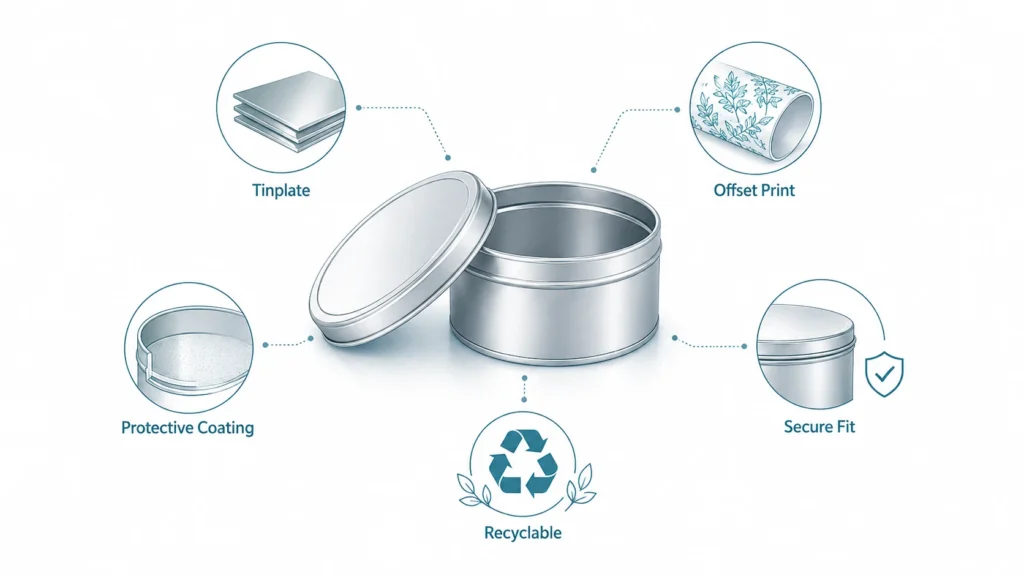
Most round tin containers are made from tinplate, which is a thin steel sheet coated with tin. Tinplate combines the strength and formability of steel with the corrosion resistance and decorative benefits of tin. It can be cut, formed, curled, stamped, printed, embossed, varnished, and assembled into many container styles.
The Mr. Tin Box article Tinplate Packaging Explained: Material, Coating, Printing, and Food Safety is a useful internal reference for buyers who need a deeper explanation of material, coating, and food safety considerations. For round tin containers with lids, the important buyer lesson is that material selection is not only about metal thickness. It includes coating chemistry, product compatibility, lid tolerance, printing process, and market compliance.
Food-contact packaging in the United States is regulated through FDA food contact rules and the relevant sections of Title 21 of the Code of Federal Regulations. FDA explains that components of a food packaging material used in compliance with 21 CFR 174-179 need no further FDA review (FDA food contact material guidance). FDA also maintains an inventory of substances authorized for uses in contact with food (FDA inventory).
For the European Union, Regulation (EC) No. 1935/2004 provides the harmonized legal framework for food contact materials and sets out general principles of safety and inertness for materials intended to contact food (European Commission food contact materials legislation). The practical message for buyers is that a food tin is not qualified only by appearance. The coating, ink, varnish, migration risk, intended food type, contact duration, temperature conditions, and target market all matter.
The following table gives a buyer-friendly view of common components.
| Component | Function | Key buyer question | Why it matters |
|---|---|---|---|
| Tinplate body | Provides shape, rigidity, and magnetic recyclability | What thickness is suitable for this diameter and height? | Affects dent resistance, forming feasibility, and cost |
| Tin coating | Helps protect steel and supports surface performance | Is the product dry, oily, acidic, salty, or aromatic? | Influences corrosion risk and compatibility |
| Internal lacquer | Separates product from metal and supports food or formula compatibility | Is direct contact required? Which market regulations apply? | Important for food safety, taste, odor, and shelf life |
| Exterior varnish | Protects printed artwork and controls surface feel | Matte, glossy, satin, soft-touch, or textured? | Affects shelf appearance and scratch resistance |
| Lid structure | Controls opening, closing, sealing, and repeated use | Slip, friction, plug, screw, hinge, or window? | Affects user experience and product protection |
| Insert or liner | Holds product, separates pieces, improves presentation | Paperboard, foam, molded pulp, PET, or no insert? | Affects unboxing, damage prevention, and sustainability profile |
| Secondary packing | Protects tins during export and storage | How many units per carton? Need dividers? | Affects freight cost, dent risk, and receiving quality |
Buyers should never assume that one coating fits every product. Tea, coffee, salt, candy, acidic fruit, oily snacks, wax, fragrance, balm, and bath salts have different contact profiles. If the product has strong fragrance, high oil content, high salt content, low pH, alcohol content, or active ingredients, compatibility testing becomes more important. A responsible supplier should ask about the product, not only the desired tin size.
Lid Styles and Closure Decisions
The lid is the most important functional part of a round tin container. It determines how the customer opens the package, how secure the contents feel, how often the package can be reused, and whether the product seems premium or frustrating. A beautiful printed tin with a poor lid experience can damage the brand.
The Mr. Tin Box article Metal Tins with Lids: Structure Guide for Custom Packaging is a useful internal reference for understanding lid structures. For round tins specifically, common options include slip lids, friction lids, plug lids, screw lids, hinged lids, and window lids.
| Lid style | Best applications | Advantages | Trade-offs |
|---|---|---|---|
| Slip lid | Cookies, candies, gifts, candles, general dry goods | Simple, familiar, cost-effective, good decoration area | Seal depends on fit; lid can be misplaced |
| Friction lid | Tea, coffee, powders, premium food | Better closing feel and stronger perceived protection | Tolerance control is important |
| Plug lid or inner plug | Aroma-sensitive tea, coffee, powders | Improves closure feel and moisture/aroma control | Adds component cost and user steps |
| Screw lid | Balms, solid perfume, creams, wax, travel products | Secure, repeatable, premium for small round tins | Thread quality and coating compatibility must be validated |
| Hinged lid | Gift sets, mints, kits, specialty products | Lid stays attached, strong repeat-use experience | More complex tooling and structure |
| Window lid | Confectionery, gift items, colorful products | Shows product directly, supports retail trust | Adds material complexity and may reduce barrier performance |
For food and beauty packaging, the lid should be tested with real users. Can the customer open it easily? Does it feel too loose? Does it require too much force? Does it make a pleasant closing sound? Does it stay closed during a shake or drop simulation? Does it scratch the printing? Does the customer understand whether the product has already been opened? These small details influence customer satisfaction.
The best lid is not always the most expensive lid. A tea tin may benefit from a friction lid or plug lid. A lip balm tin may need a screw lid. A cookie tin may only need a well-fitted slip lid. A promotional tin may need a hinge because users will open it many times. A candle tin may need a simple lid that protects the wax surface and supports stacking.
Printing, Finishing, and Brand Decoration
Round tin containers with lids can be designed in many styles. The lid can carry the main logo, hero illustration, product name, fragrance name, flavor, collection theme, or holiday graphic. The side wall can carry repeat patterns, product information, ingredient panels, QR codes, barcode areas, usage directions, or recycling instructions. The bottom can carry batch codes, supplier marks, or regulatory details when appropriate.
Because the lid is circular, artwork should be designed specifically for a circular field. Designs that work on rectangular paper labels may not work on a round lid. Long horizontal logos can feel cramped. Important text should not sit too close to the edge or curling area. Small text should be tested at actual print size, not only on a computer screen. If the tin will appear as a small thumbnail online, the main visual mark should remain legible at reduced size.
Common decorative options include direct metal printing, paper labels, embossing, debossing, matte varnish, glossy varnish, satin varnish, soft-touch coating, metallic effects, spot UV, textured finishes, and special color matching. Each choice has a different cost, timeline, and quality-control requirement.
| Decoration method | Best for | Strength | Buyer caution |
|---|---|---|---|
| Direct offset printing | High-volume branded tins | Durable, premium, integrated with metal surface | Requires accurate proofing and color management |
| Paper label | Smaller runs or flexible SKUs | Fast design changes, lower setup complexity | Less premium than direct print; edge adhesion matters |
| Embossing | Logos, seals, premium cues | Adds tactile brand memory | Requires tooling and good artwork simplification |
| Debossing | Elegant minimal branding | Subtle, premium, durable | Less visible on complex artwork |
| Matte varnish | Natural, modern, luxury positioning | Reduces glare, soft visual feel | Can show scratches depending on use |
| Glossy varnish | Bright food, candy, holiday tins | Strong color and shelf shine | Can show fingerprints or reflections |
| Soft-touch finish | Beauty, wellness, premium gifts | Smooth hand feel | Needs abrasion and stain testing |
| Metallic effects | Holiday, luxury, collector tins | High impact under retail light | Avoid overuse; test readability |
Packaging artwork should also account for manufacturing realities. Round tins involve forming and curling, so distortion can occur near curved areas. Artwork must respect safe zones, bleed, seam positions, and lid engagement areas. If the design includes a character face, product photo, detailed illustration, or precise logo alignment, proofing and sample review are essential.
Sustainability, Recycling, and Circular-Economy Signals
Sustainability is a major reason brands consider metal packaging. Steel and aluminum are widely recycled materials, and metal packaging has a strong circular-economy story when collection and recycling systems are available. Metal Packaging Europe reports that 82% of steel packaging and 75% of aluminum beverage cans are recycled in Europe (Metal Packaging Europe). Steel for Packaging Europe states that 82% of steel packaging placed on the market was really recycled in Europe in 2023 (Steel for Packaging Europe). Its homepage also highlights that using recycled steel saves 70% energy and that steel is 100% recyclable forever (Steel for Packaging Europe homepage).
For brand communication, this does not mean every local market will recycle every tin in the same way. Recycling depends on local collection systems, sorting infrastructure, consumer behavior, coatings, mixed-material components, and contamination. However, metal has clear advantages: steel is magnetic, which helps sorting; tins are reusable; and the material can remain valuable in recycling streams.
The EU Packaging and Packaging Waste Regulation, Regulation (EU) 2025/40, sets sustainability and labeling requirements across the packaging life cycle and aims to prevent unnecessary packaging while promoting reuse, refill, and recycling (EUR-Lex summary). For exporters selling into the EU, this direction matters because packaging claims, material choices, labeling, and recyclability documentation are increasingly important.
Food waste is another relevant sustainability angle. UNEP’s Food Waste Index Report 2024 states that 1.05 billion tonnes of food were wasted at retail, food service, and household levels in 2022, equal to about 19% of food available to consumers (UNEP Food Waste Index Report 2024). Packaging is not the only solution to food waste, but better protection, clearer storage, and longer quality retention can help reduce product loss in certain categories.
| Sustainability factor | How round tin containers can help | Claim caution |
|---|---|---|
| Recyclability | Tinplate is steel-based and can enter metal recycling streams where systems exist | Avoid universal claims without local-market context |
| Reusability | Consumers often keep tins for storage, gifting, or display | Reuse depends on design quality and consumer behavior |
| Shelf protection | Metal can block light and support protection from moisture and aroma loss | Do not claim shelf-life improvement without product testing |
| Reduced damage | Rigid tins can protect fragile food, cosmetics, and gifts | Validate through drop, compression, and shipping tests |
| Refill potential | Tea, coffee, spices, and beauty solids can use refill strategies | Refill system must be practical and hygienic |
| Brand trust | Durable packaging can signal quality and responsible design | Claims should be specific and evidence-based |
A strong sustainability message should be specific rather than vague. Instead of saying “our packaging is green,” use clearer language: “the container is made from tinplate steel, is reusable, and can be recycled through metal recycling systems where local collection is available.” That sentence is more credible, easier to defend, and more helpful to buyers.
Market Data: Why Metal Packaging Still Matters
Round tin containers are part of the larger metal packaging market, which remains commercially important even as brands test paper, flexible pouches, molded pulp, glass, and mono-material plastic solutions. Fortune Business Insights estimated the global metal packaging market at USD 154.83 billion in 2025 and projected growth from USD 159.40 billion in 2026 to USD 209.91 billion by 2034, with a CAGR of 3.50% (Fortune Business Insights). Grand View Research estimated the global metal packaging market at USD 148.13 billion in 2024 and projected it to reach USD 184.21 billion by 2030, with a CAGR of 3.7% from 2025 to 2030 (Grand View Research).
These numbers should not be used to claim that every round tin project will grow automatically. Market growth does not replace product-market fit. However, the data supports a practical conclusion: metal packaging continues to attract demand because it solves real problems in protection, recyclability, premium appearance, and consumer convenience. For brands selling tea, coffee, cookies, candles, balms, cosmetics, gift sets, and promotional items, round tin containers with lids remain relevant because they combine technical function with retail emotion.
| Data point | Source | Practical meaning for round tin container buyers |
|---|---|---|
| Global metal packaging market estimated at USD 154.83 billion in 2025 | Fortune Business Insights | Metal packaging is a large established packaging category, not a niche novelty. |
| Projected global metal packaging market reaches USD 209.91 billion by 2034 | Fortune Business Insights | Continued demand supports supplier investment in materials, printing, and forming capacity. |
| Grand View Research estimated USD 148.13 billion in 2024 and projected USD 184.21 billion by 2030 | Grand View Research | Independent estimates also point to steady market demand. |
| 82% of steel packaging recycled in Europe | Metal Packaging Europe and Steel for Packaging Europe | Recycling performance can strengthen responsible packaging narratives when claims are market-specific. |
| 1.05 billion tonnes of food waste in 2022 at retail, food service, and household levels | UNEP Food Waste Index Report 2024 | Packaging that protects quality can be part of broader waste-reduction discussions. |
For B2B buyers, the most useful way to use market data is not to fill an article with large numbers. It is to connect those numbers to practical decisions. If sustainability pressure is rising, buyers should ask about material, recyclability, and local disposal instructions. If premium consumer goods are growing, buyers should invest in decoration and tactile quality. If food waste is a concern, buyers should test whether a better closure, liner, or inner seal helps the product maintain quality.
How to Choose the Right Diameter, Height, and Volume
The size of a round tin container should start with the product, not the catalog. A container that is too small can crush products, complicate filling, or make the user experience poor. A container that is too large can create an underfilled look, increase freight cost, and waste retail shelf space. The right size balances product fit, perceived value, operational efficiency, and brand positioning.
Start by measuring the product in its real selling condition. Loose tea settles differently from coffee beans. Cookies need headspace and protection from breakage. Chocolates may require trays. Wax may shrink after cooling. Balms may need enough opening diameter for finger access. Powdered products may need a scoop or inner seal. Gift items may need inserts, tissue, cards, or instruction leaflets. These components reduce usable internal volume.
Buyers should also consider carton pack-out. A few millimeters in diameter can change how many tins fit in a shipping carton. That can affect landed cost, pallet efficiency, and dent risk during export shipping. A beautiful tin that wastes carton space may be expensive at scale.
| Design parameter | Why it matters | Practical buyer question |
|---|---|---|
| Outside diameter | Affects shelf footprint, carton pack-out, and hand feel | Does it fit the display, carton, and customer hand? |
| Internal diameter | Determines usable product access and fill behavior | Can the customer scoop, pick, pour, or remove the product easily? |
| Usable height | Controls fill volume and headspace | Is there enough room for product, liner, insert, and lid clearance? |
| Lid engagement depth | Affects opening force and closure security | Does the lid feel secure without being hard to open? |
| Curling radius | Affects safety, comfort, and appearance | Are edges smooth enough for repeated handling? |
| Tinplate thickness | Affects strength, dent resistance, and forming | Is the selected thickness suitable for diameter and height? |
| Insert thickness | Reduces usable volume but improves protection | Is the insert necessary for unboxing or damage prevention? |
| Master carton layout | Affects freight and damage risk | How many units fit per carton without excessive empty space? |
A good sample review should include more than visual approval. Fill the tin with the real product. Close and open it repeatedly. Shake it. Pack it in the intended inner carton. Check artwork readability. Put it under typical retail lighting. Try it with wet hands, cold hands, or oily hands if the product requires that scenario. Ask whether the package feels like the target price point.
Quality Testing and Sampling Checklist
A round tin project should move through structured sampling. The first sample checks size and structure. The second sample may check artwork, coating, lid fit, and finishing. A pre-production sample confirms final materials and decoration before mass production. Skipping these steps can create costly problems after printing or shipment.
| Test item | What to check | Why it matters |
|---|---|---|
| Size and capacity | Real product fill weight, headspace, insert fit | Prevents underfill or product damage |
| Lid opening force | Too loose, too tight, uneven, noisy, scratching | Controls user experience and transport security |
| Edge safety | Rim smoothness, curled edges, burrs | Important for food, beauty, and repeated use |
| Coating compatibility | Staining, odor, corrosion, taste transfer, formula reaction | Critical for food and beauty products |
| Printing quality | Color accuracy, registration, scratches, varnish finish | Protects brand consistency |
| Drop and vibration | Dents, lid release, product movement | Important for e-commerce and export shipping |
| Carton packing | Divider need, carton strength, pallet layout | Reduces logistics damage and freight waste |
| Label and compliance area | Ingredients, warnings, barcode, QR code, recycling mark | Avoids unreadable or missing required information |
| Shelf display | Stacking, rotation, front-facing visibility | Supports retail performance |
| Consumer handling | Opening, closing, carrying, reuse | Confirms the packaging feels right in real life |
For food and beauty products, compatibility testing should be conservative. Short tests may not reveal longer-term issues. If the formula contains oil, fragrance, salt, acidity, alcohol, essential oils, pigments, or active compounds, longer storage tests should be considered. The supplier can recommend typical coating systems, but the brand owner remains responsible for ensuring the final packaging is suitable for the specific product and market.
Procurement Workflow for Custom Round Tin Containers
A successful round tin container project usually follows a structured path. The process begins with product information, not artwork. Suppliers need to understand product type, fill weight, direct contact requirements, target market, sales channel, desired size, lid style, decoration, order quantity, and timeline. Once these details are clear, the supplier can recommend existing tooling or determine whether custom tooling is required.
Mr. Tin Box emphasizes a practical custom workflow on its food and beauty packaging pages: consultation and requirements, design and engineering, sampling, production, inspection, and quotation support. For buyers, the most efficient approach is to prepare a clear brief before asking for price.
| Procurement step | Buyer action | Supplier output |
|---|---|---|
| Define product and market | Provide product type, fill weight, contact conditions, country of sale | Material and coating direction |
| Select structure | Choose round tin size, height, lid style, insert need | Size recommendation or tooling options |
| Prepare artwork | Submit logo, dieline artwork, colors, mandatory text | Digital proof and print feasibility feedback |
| Confirm sample | Test fit, coating, lid feel, printing, packing | Revised sample or pre-production sample |
| Approve production | Approve final sample, carton mark, quantity, lead time | Mass production schedule |
| Inspect and pack | Confirm quality criteria and shipping method | Finished tins packed for export |
| Review after launch | Track customer feedback, returns, dents, comments | Design improvements for next order |
A strong RFQ should include the following information: product name, product category, expected fill weight or volume, direct food or formula contact, target country, desired diameter and height, lid style, printing method, surface finish, inside coating requirement, quantity, delivery date, packing requirement, and any compliance document needs. The more complete the brief, the more accurate the quotation and sampling plan will be.
Common Mistakes to Avoid
Many round tin packaging problems come from early assumptions. Buyers may assume that a catalog size will fit the product, that any inner coating is food-safe for any product, that a lid described as tight is automatically suitable for shipping, or that a beautiful rendering will print perfectly on curved metal. These assumptions can lead to delays and extra sampling costs.
One common mistake is treating the tin as only a decorative shell. For food and beauty products, the tin is a product-contact or product-protection system. It must match formula, filling process, storage conditions, and consumer use. Another mistake is choosing a highly customized structure without checking order quantity and timeline. Special tooling, embossing, inserts, or window lids can be excellent, but they require planning.
A third mistake is ignoring the side wall. Buyers often focus on the top lid because it is visually dominant, but the side wall may carry important information and drive shelf recognition when tins are stacked. For round tins displayed in retail, the side wall may be the first visible surface. The design should work from multiple angles.
| Mistake | Result | Better approach |
|---|---|---|
| Choosing size before testing real fill | Underfilled look, crushed product, poor opening | Test real product volume and insert needs first |
| Ignoring coating compatibility | Corrosion, odor, staining, formula interaction | Share product details and run storage tests |
| Using tiny text on circular artwork | Poor readability and compliance risk | Test artwork at actual print size |
| Over-customizing too late | Missed launch date or high tooling cost | Confirm structure early and plan backward |
| Making vague sustainability claims | Trust and compliance risk | Use specific, market-aware language |
| Skipping shipping tests | Dents, loose lids, damaged products | Test carton packing, vibration, and drop risk |
FAQ
What are round tin containers with lids used for?
Round tin containers with lids are used for tea, coffee, cookies, candies, chocolates, spices, candles, lip balm, solid perfume, shaving soap, hair wax, gift sets, promotional products, and specialty samples. They are popular because they combine product protection, reusable value, and premium shelf appeal.
Are round tin containers suitable for food packaging?
Yes, round tin containers can be suitable for food packaging when the material, internal coating, lid structure, and intended food-contact conditions are correctly specified. Dry foods such as tea, coffee, cookies, candies, spices, and chocolates are common applications. For processed shelf-stable foods, regulatory and processing requirements are more complex and should be reviewed with qualified food safety professionals.
What lid style is best for round tin containers?
The best lid depends on the product. Slip lids are common for cookies, candy, candles, and gift tins. Friction or plug lids are useful for tea, coffee, and powders. Screw lids are often preferred for balms, solid perfumes, creams, and travel products. Hinged lids work well for promotional kits and products that are opened repeatedly.
Can round tin containers be printed or embossed?
Yes. Round tins can be decorated with direct printing, paper labels, matte or glossy varnish, soft-touch coatings, metallic effects, embossing, debossing, and special surface textures. The artwork should be designed around the circular lid, side wall, forming zones, and safe print areas.
Are round tin containers recyclable?
Tinplate round tins are steel-based and can be recycled through metal recycling systems where local collection and sorting infrastructure is available. Steel for Packaging Europe and Metal Packaging Europe report high steel packaging recycling rates in Europe, but brand claims should still be written carefully because recycling systems vary by market.
Conclusion
Round tin containers with lids are a practical and commercially powerful packaging choice for food, beauty, gift, promotional, holiday, and specialty products. Their value comes from the combination of metal protection, circular visual appeal, smooth handling, reusable afterlife, and rich customization options. For the right product, a round tin does more than hold contents. It improves shelf presence, supports brand storytelling, protects the product, and creates a package customers may keep.
The strongest projects begin with product requirements, not only visual design. Buyers should define fill volume, product sensitivity, food or formula contact needs, lid behavior, artwork requirements, target market, sustainability claims, carton packing, and launch timeline before finalizing size and structure. The right supplier can then recommend suitable tinplate thickness, coating, lid style, printing method, and sampling steps.
For brands planning tea tins, coffee tins, candy tins, cookie tins, balm tins, cosmetic tins, candle tins, gift tins, or specialty sample tins, Mr. Tin Box can help turn a simple round container into a complete custom packaging system. When material, structure, coating, decoration, and user experience work together, round tin containers with lids become more than packaging. They become a durable brand asset that protects the product, elevates the presentation, and keeps the brand visible long after purchase.