

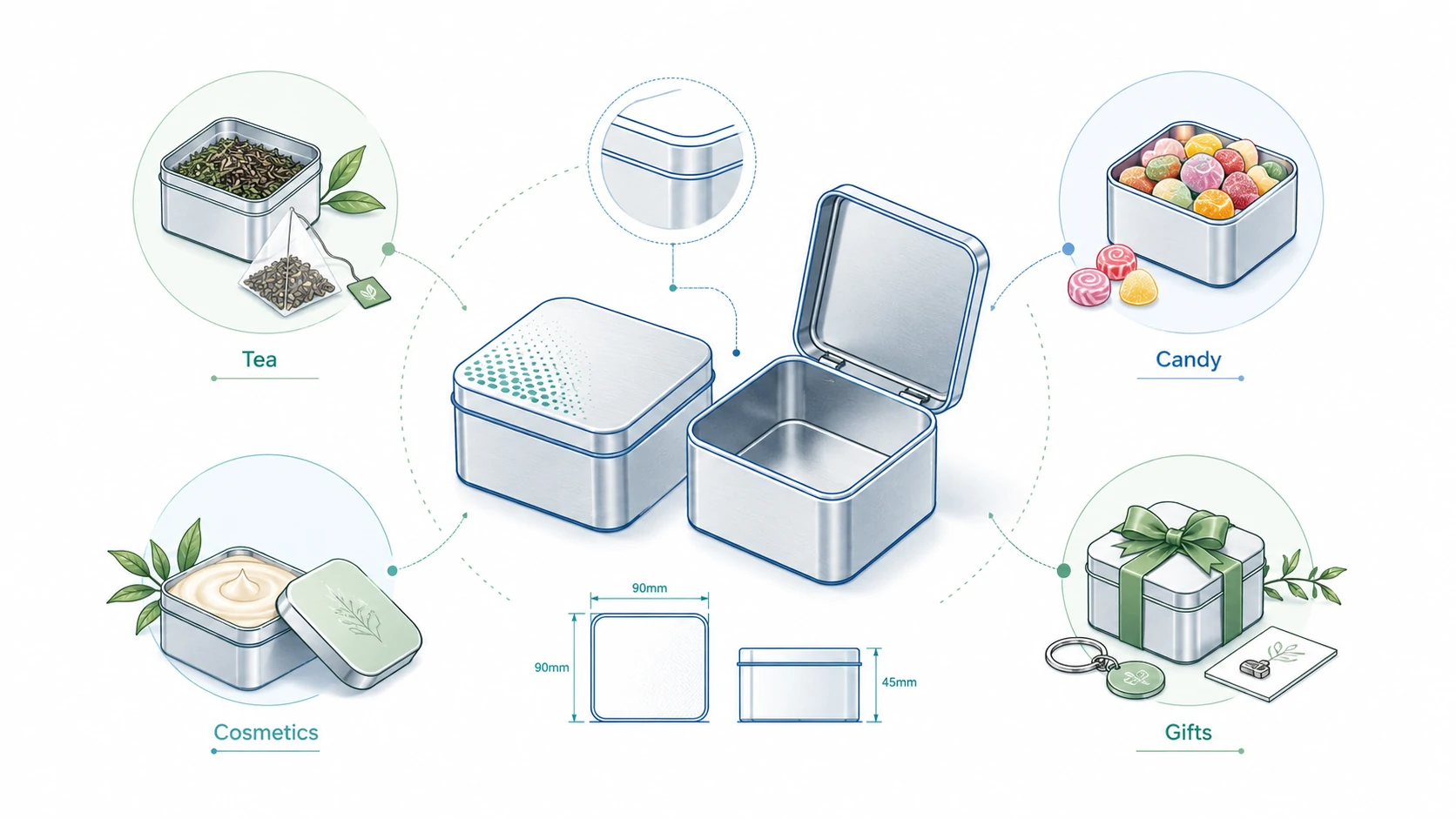

Square metal tins are one of the most versatile formats in custom metal packaging. They look clean, stack neatly, give brands a strong printable surface, and can be engineered for tea, candy, cosmetics, gifts, promotional kits, and specialty products. For a brand owner, the value is not only that a tin can hold a product. The value is that a square tin can protect the product, organize the presentation, strengthen shelf impact, and create a reusable object that stays with the customer after the original product has been consumed.
This is why square metal tins are widely used in premium and practical packaging programs. A tea brand can use a square tin to build a modern shelf block with consistent color coding. A candy brand can use it for holiday collections, limited-edition flavors, and gift sets. A cosmetics company can use it for solid perfume, lip balm, cleansing bars, mini skincare kits, and sample collections. A corporate buyer can use it for event gifts, promotional kits, desk accessories, and branded keepsakes. The same basic format can become a minimalist tea caddy, a colorful candy tin, a soft-touch beauty box, or a luxury gift container.
For Mr. Tin Box, square metal tins also fit the broader custom packaging system shown on the Food & Beverage Packaging and Beauty & Personal Care Packaging pages. The goal is not to sell a standard empty container. The goal is to help buyers match the right tinplate structure, lid style, coating, printing, insert, and packing method to a real commercial product.
This guide explains how to use square metal tins in a practical way. It covers packaging ideas for tea, candy, cosmetics, and gifts, but it also explains the engineering and sourcing details that affect cost, sampling, lead time, and customer experience. If your team is comparing paper boxes, plastic jars, flexible pouches, round tins, and square metal tins, this article will help you understand when the square format is the stronger business choice.
Table of Contents
Why the Square Format Works So Well for Retail Packaging
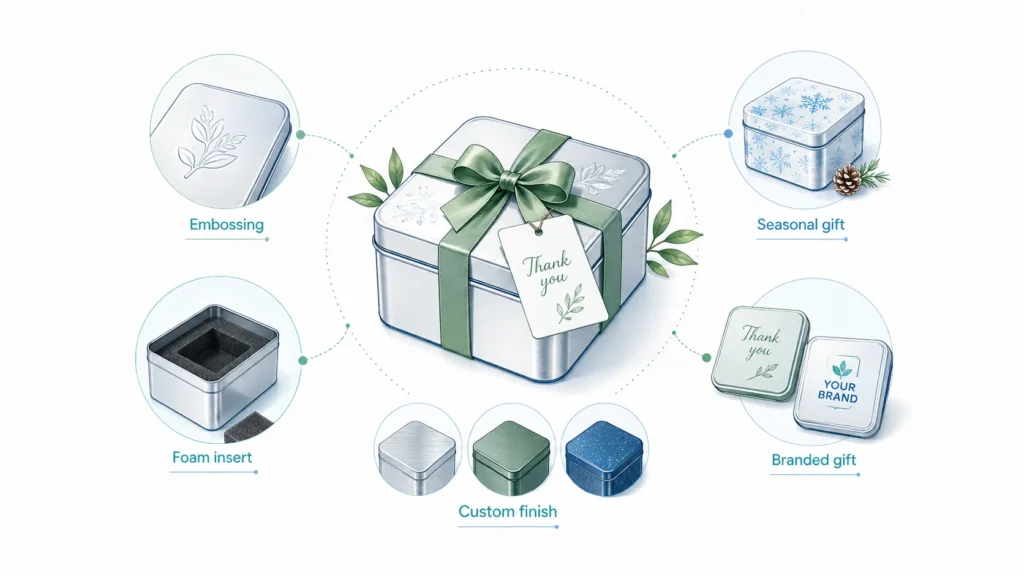
A square tin has a simple visual advantage: it creates order. On a shelf, square and rectangular packages can line up cleanly, form attractive blocks, and make a product family easier to understand. A round tin may feel soft and familiar, but it wastes some display space and gives less uninterrupted flat area for product information. A square tin gives four flat sides, a flat lid, and a strong front-facing panel. This makes it especially useful when the brand needs both decoration and readable information.
The square shape also improves perceived value. Consumers often associate rigid packaging with better protection and higher quality. When the packaging has a cool metal touch, a stable lid, and a printed or embossed surface, the product feels more intentional. This matters for small products because small items can easily look cheap if the packaging is thin, loose, or disposable. A 40 g tea sampler, 80 g candy assortment, or mini cosmetic set can feel much more giftable when placed inside a well-designed square tin.
From a logistics point of view, square tins can also help carton efficiency. They can be packed in grids, stacked in display trays, and arranged into multipack gift sets more predictably than irregular shapes. This does not mean every square tin automatically saves shipping cost. The exact result depends on wall thickness, lid height, corner radius, insert design, and master carton layout. But in early planning, the square format gives packaging engineers a more controllable geometry.
Another advantage is brand architecture. A square tin can support a full product series by changing artwork while keeping the same tooling. For example, a tea company may use the same 100 mm square tin for black tea, green tea, oolong, herbal blends, and seasonal flavors. A confectionery brand may use one tin size for chocolate almonds, fruit candies, mints, and holiday assortments. A cosmetics brand may use one square tin for travel soap, balm sets, and promotional sample kits. This reduces tooling complexity and helps customers recognize the product family.
The table below shows where square metal tins often create value in commercial packaging decisions.
| Business requirement | Why square metal tins help | Practical packaging result |
| Better shelf blocking | Straight sides align well in rows and displays | Cleaner retail presentation and stronger product family recognition |
| More printable surface | Flat lid and side panels support artwork, ingredients, QR codes, and recycling instructions | Easier compliance and stronger visual identity |
| Giftable appearance | Rigid metal body feels more premium than thin flexible packaging | Higher perceived value for tea, candy, cosmetics, and promotional products |
| Reusable after use | Customers often keep tins for small storage | Longer brand exposure after purchase |
| Insert compatibility | Square footprint works well with paperboard, foam, molded pulp, and metal dividers | Organized kits, fewer damaged items, better unboxing |
| Efficient series planning | The same tooling can support multiple SKUs with different printing | Lower complexity for product families and seasonal campaigns |
Useful Industry Data for Packaging Buyers
Packaging decisions are easier when the buyer can support them with practical data. Square metal tins are not chosen only because they look attractive. They are often chosen because they combine product protection, shelf appeal, reuse potential, and recyclability in a way that fits modern packaging expectations.
In the United States, the U.S. Environmental Protection Agency reports that containers and packaging had a 53.9% recycling rate in 2018, while 30.5 million tons of containers and packaging were landfilled in the same year (EPA containers and packaging data). This matters because packaging buyers are under pressure to reduce waste and choose materials that have a credible recovery pathway. Metal packaging is not a perfect answer to every sustainability question, but steel has important circular-economy advantages. The World Steel Association explains that recycled steel maintains its inherent properties and that steel’s magnetic properties make it easy and affordable to recover from waste streams (Worldsteel circular economy). Steel for Packaging Europe also highlights that steel is a permanent material that can be recycled repeatedly without loss of quality and that its magnetic properties support efficient sorting (Steel for Packaging Europe recycling).
Regulation is another reason to think carefully about packaging. The European Commission states that the new packaging rules aim to make all packaging on the EU market recyclable in an economically viable way by 2030 (European Commission packaging waste objectives). EUR-Lex summaries also show that EU recycling targets include material-specific targets, including ferrous metals, under packaging and packaging waste rules (EUR-Lex packaging and packaging waste targets). For brands exporting to Europe, this means packaging should be designed not only for appearance, but also for recyclability, labeling, and future compliance expectations.
For material understanding, tinplate is widely used in packaging because it combines steel strength with a tin coating. JFE Steel describes tinplate as a thin steel sheet coated with tin, with corrosion resistance, solderability, weldability, and use in food cans, beverage cans, and artistic cans (JFE tinplate and tin free steel). Tata Steel also describes food-safe tinplate products for packaging applications, including drawn and wall-ironed cans and three-piece cans (Tata Steel tinplate). In plain language, tinplate gives packaging designers a strong, formable, printable, and recyclable base material.
The following table converts these data points into buyer-friendly packaging arguments.
| Data or regulation point | What it means for square metal tins | How to use it in a packaging brief |
|---|---|---|
| EPA reports a 53.9% recycling rate for generated U.S. containers and packaging in 2018 | Packaging recovery is a real commercial issue, not only a design topic | Ask suppliers how the tin structure, window, insert, and label affect recyclability |
| Worldsteel says recycled steel maintains inherent properties | Steel can remain useful across multiple recycling cycles | Position tinplate as a durable material with a credible circular-economy story |
| Steel is magnetic and easy to recover from waste streams | Steel packaging can be separated efficiently in many recycling systems | Avoid unnecessary non-metal attachments that make sorting more difficult |
| EU packaging rules aim for economically viable recyclability by 2030 | Export packaging should be designed for future compliance | Request clear material specifications, coating information, and sorting guidance |
| Tinplate is thin steel coated with tin | The material combines strength, formability, and corrosion resistance | Match tinplate thickness and coating to product type, lid structure, and distribution channel |
Square Metal Tins for Tea Packaging
Tea is one of the strongest categories for square metal tins because tea is sensitive to aroma loss, light, moisture, and brand perception. A good tea package must do more than hold leaves. It must protect freshness, communicate origin, support gifting, and make repeated opening convenient. Square tins serve these needs well because they provide a rigid container with a generous label area and a stable shelf footprint.
Loose tea has a special challenge: volume is not the same as weight. A dense black tea, a fluffy white tea, a rolled oolong, and a large herbal blend can require very different internal volumes for the same fill weight. This is why tea buyers should never choose a square tin based only on a catalog photo. The supplier should test the real tea or a close physical sample. Settling during shipping should also be considered. A tin that looks correctly filled at the factory may look underfilled after vibration if the product settles significantly.
For premium tea, the most common square tin concepts include single-origin tins, sampler tins, refill tins, gift tins, and subscription tins. A single-origin tin can use one color, one label system, and a clean origin story. A sampler tin can hold several small inner pouches or compartments. A refill tin can be designed for repeated use, with refill bags sold separately. A gift tin can use embossing, metallic inks, or a seasonal illustration. A subscription tin can be part of a reusable storage system so the customer keeps the tin and receives refill packs later.
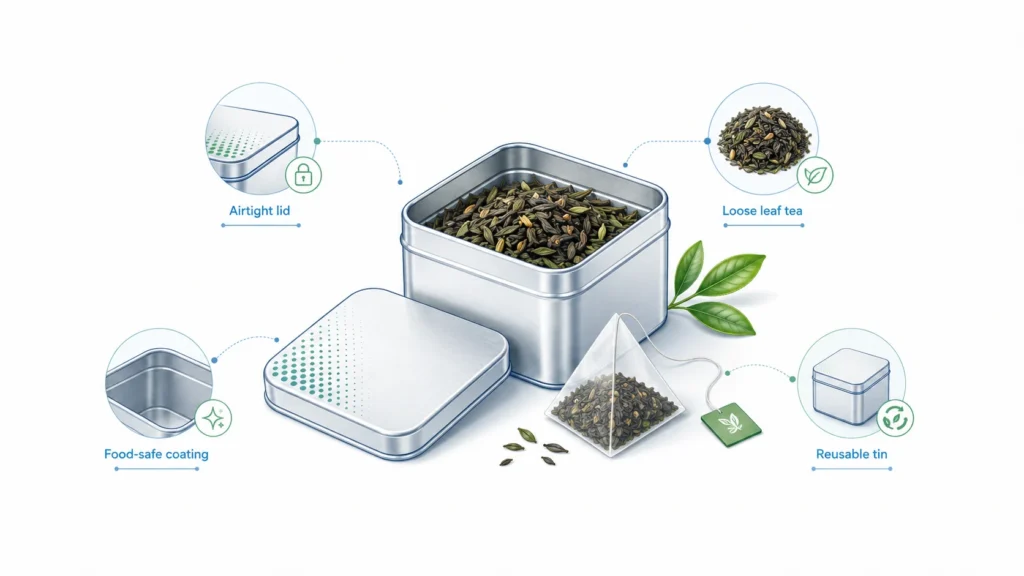
The lid is critical for tea. A simple slip lid may work for short-term gifts or individually bagged tea. For loose tea, a plug lid, inner lid, or better friction fit can improve aroma retention. Some buyers add an inner bag to provide additional moisture protection and use the tin mainly for structure and brand experience. This approach can be practical because it separates the barrier function from the decorative metal container. The inner bag protects the tea, while the square tin delivers premium appearance and reuse value.
Mr. Tin Box discusses related size and structure issues in the Small Tin Containers guide, which is useful when planning tea samplers, pocket tins, and compact gift tins. For buyers comparing closure structures, the Tin Containers with Lids article is also a useful internal reference.
| Tea packaging concept | Typical product | Recommended square tin direction | Key buyer question |
|---|---|---|---|
| Tea sampler tin | 5-30 g loose tea or bags | Mini square tin with slip lid or hinged lid | Will the tea be loose, bagged, or packed in inner sachets? |
| Premium origin tin | 50-150 g loose tea | Medium square tin with friction lid or plug lid | How much volume does the real tea occupy after settling? |
| Matcha or powder tin | 30-100 g powder | Square tin with inner seal or bag | Does the powder need stronger moisture protection? |
| Gift collection tin | Multiple flavors or sachets | Square tin with paperboard or molded pulp insert | Should the insert show all flavors immediately at opening? |
| Refill system tin | Repeat-use storage container | Durable square tin with clean branding | Will the brand sell refill pouches later? |
A strong tea tin design is usually not too busy. Tea customers often respond well to a calm surface, origin information, a color-coded flavor system, and a high-quality finish. Matte varnish can feel natural and premium. Glossy varnish can make color more vivid. Embossing can highlight a logo, mountain pattern, tea leaf, or cultural motif. The important point is to keep text readable. A square tin gives more surface area than many small round packages, but mandatory information, barcode, QR code, brewing instructions, ingredients, net weight, and recycling guidance still need careful hierarchy.
Square Metal Tins for Candy and Confectionery
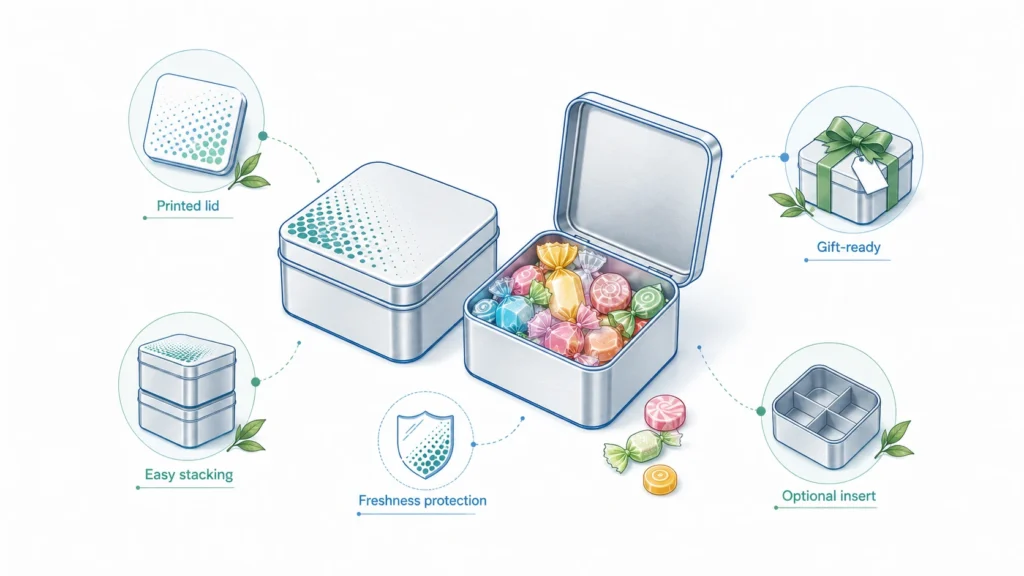
Candy and confectionery packaging depends heavily on emotion. Customers buy candy for taste, but packaging often decides whether the product feels like a small treat, a premium gift, a seasonal purchase, or a collectible item. Square metal tins are especially effective because they protect fragile pieces, support colorful artwork, and make the product feel more permanent than a disposable pouch.
For candies, chocolates, mints, cookies, and biscuit pieces, crush protection is a major advantage. A rigid tin can reduce deformation during transport, retail handling, and gifting. This does not replace good internal packing. Chocolate pieces may still need paper cups, trays, flow wraps, or dividers. Cookies may need a bag or food-safe liner. Mints may need a sliding or hinged tin that supports repeat opening. But the metal container gives a protective shell and a premium first impression.
Square candy tins are excellent for seasonal programs. Christmas, Valentine’s Day, Halloween, Lunar New Year, Easter, wedding favors, anniversary gifts, and corporate events all benefit from limited-edition artwork. A brand can keep the same square tin tooling and change the printing for each campaign. This reduces structural risk while keeping the packaging fresh. For large seasonal orders, this is a practical way to balance creativity and cost control.
Food-contact planning is important. If candy touches the tin directly, the internal coating and compliance documentation must match the product and target market. If the product is packed in a bag or tray inside the tin, direct contact risk may be lower, but the overall packaging still needs to be designed responsibly. For U.S. projects, buyers may discuss food-contact coatings with reference to FDA indirect food additive regulations, such as resinous and polymeric coatings under 21 CFR 175.300. For EU projects, buyers should consider the framework for materials intended to come into contact with food, such as Regulation (EC) No 1935/2004, together with product-specific requirements and supplier documentation.
The table below gives practical ideas for confectionery buyers.
| Product type | Packaging idea | Square tin benefit | Extra component to consider |
|---|---|---|---|
| Hard candy | Color-coded flavor tin | Strong visual shelf block and reusable storage | Food-safe liner or inner bag |
| Chocolate pieces | Premium gift tin | Crush protection and luxury presentation | Paper cups, tray, or divider |
| Mints | Pocket square tin | Repeat opening and compact carry | Hinged or sliding lid |
| Cookies or biscuits | Seasonal square tin | Large decorative lid and gift appeal | Inner bag, paper wrap, or grease-resistant liner |
| Gummies | Collector tin series | Bright graphics and campaign flexibility | Inner pouch for moisture control |
| Wedding favors | Mini square tin | Elegant surface for names, dates, and motifs | Insert card or ribbon |
A candy tin should feel joyful, but it should not look confusing. Use the lid for the main visual promise, the front side for product name and flavor, and the back or bottom for required information. If the tin is sold in a retail display, make sure the visible side carries the key message. If the tin is sold online, make sure the lid design reads well in a thumbnail. If the tin is for gifting, consider how it looks when stacked with other gifts or placed in a hamper.
For additional creative direction, the Mr. Tin Box article 10 Creative Custom Metal Tin Packaging Design Ideas discusses concepts such as unique shapes, windowed packaging, premium finishes, collectible series, and custom compartments. Square tins can use many of the same ideas while keeping a clean, efficient structure.
Square Metal Tins for Cosmetics and Personal Care Products
Cosmetics and personal care products are a natural fit for square metal tins because the customer experience is tactile. The customer picks up the tin, feels the surface, opens the lid, sees the product or kit arrangement, and decides whether the product feels safe, clean, premium, and giftable. This is especially important for solid cosmetics, skincare samples, balm sets, soap bars, beauty tools, travel kits, and wellness gifts.
Square tins can be used for solid perfume, lip balm sets, lotion bars, cleansing bars, bath salts, shaving soap, hair wax, beard balm, nail-care kits, mini facial tools, fragrance discovery sets, and spa amenity products. A square shape is useful when the product needs an insert or compartment. For example, a skincare sample kit may include several small jars or sachets. A grooming kit may include a comb, balm, and instruction card. A soap set may include two or four bars separated by a paperboard insert. A nail-care set may need foam or molded pulp to hold tools securely.
The most important technical topic for cosmetics is compatibility. Some formulas contain oils, waxes, fragrances, pigments, salts, essential oils, or active ingredients. These ingredients may interact with coatings, varnishes, adhesives, labels, or inserts. A tin that works for a dry soap bar may not be appropriate for a wet scrub or a high-fragrance balm. Buyers should share the formula type, filling method, storage temperature, target shelf life, and target market with the supplier early in the project.
The Metal Lip Balm Tin Packaging guide is a useful Mr. Tin Box internal reference because lip balm tins raise many of the same questions that apply to small cosmetic metal packaging: size, coating, lid style, formula compatibility, branding, and user experience. The Beauty & Personal Care Packaging page also explains how metal packaging can support cosmetics, skincare, fragrances, and personal care applications.
| Cosmetic packaging use | Recommended square tin approach | Main technical concern | Branding opportunity |
|---|---|---|---|
| Solid perfume set | Small square tin with fitted insert | Fragrance and coating compatibility | Soft-touch finish and embossed logo |
| Soap bar | Shallow square tin or hinged square tin | Moisture, ventilation, and liner choice | Natural matte finish and simple typography |
| Balm or salve kit | Mini square tin with compartments | Oil and wax compatibility | Premium color system for scents or formulas |
| Skincare samples | Square gift tin with paperboard insert | Product stability and label space | Unboxing layout and QR code education |
| Beauty tool kit | Hinged square tin with foam or pulp insert | Tool movement and scratch resistance | Metallic ink, mirror-like effects, or satin varnish |
| Bath salts | Square tin with inner pouch | Moisture control and corrosion risk | Spa-style artwork and reusable storage claim |
For beauty products, the packaging should not overpromise. If the tin is mainly a secondary container around sachets, jars, or wrapped bars, describe it clearly. If the product touches the tin directly, validate the coating and migration requirements for the target market. If the tin will be opened frequently in a bathroom, consider humidity, wet hands, and surface durability. If the product is sold as a premium gift, consider the full unboxing sequence: outer sleeve, tin surface, lid opening force, insert material, product arrangement, and instruction card.
Square tins also work well for refill and reuse strategies. A beauty brand can sell a durable tin with replaceable product refills, or use the tin as a reusable travel container. This can support sustainability messaging, but the claim should be accurate. A tin is only truly useful as a reuse package if the customer has a reason to keep it and if the structure holds up to repeated use. Strong hinges, smooth edges, reliable lid fit, and scratch-resistant varnish all contribute to reuse value.
Square Metal Tins for Gift, Promotional, and Holiday Packaging
Gift packaging is one of the most commercially powerful uses for square metal tins. A gift package must do several jobs at once. It must protect the product, look attractive, communicate the occasion, and feel worth giving. Square tins support these jobs because they look organized, feel substantial, and can be decorated with high visual impact.
For holidays, square tins can carry seasonal illustrations, metallic effects, embossed patterns, or collector artwork. For corporate gifts, they can hold candy, tea, coffee, desk accessories, USB drives, pins, cards, vouchers, or product samples. For retail promotions, they can bundle several SKUs into one higher-value set. For museum shops, tourist stores, and cultural brands, square tins can become souvenirs. For weddings, anniversaries, and events, mini square tins can carry personalized artwork.
The after-use value is a key advantage. Many customers throw away paper sleeves quickly, but they may keep a metal tin for coins, sewing items, tea bags, stationery, jewelry, travel medicine, earbuds, craft parts, or small tools. This turns the package into a brand reminder. In promotional marketing, that repeated visibility is valuable. A low-cost disposable giveaway may be forgotten immediately, while a useful metal tin can stay on a desk or shelf.
Gift packaging also requires timeline discipline. Seasonal tins have fixed launch dates. If a Christmas tin arrives in January, the project has failed even if the tin quality is good. Buyers should plan backward from the retail date and allow time for design, structural confirmation, tooling if needed, artwork proofing, color matching, sampling, testing, production, quality inspection, export packing, shipping, customs clearance, and domestic distribution. If the design includes embossing, special varnish, a custom insert, a window, or a complex gift set assembly, add more time.
| Gift program type | Square tin idea | Commercial advantage | Planning warning |
|---|---|---|---|
| Holiday candy tin | Seasonal artwork with same base tooling | Fresh campaign look without changing structure | Confirm artwork and color proof early |
| Corporate gift tin | Logo tin with tea, candy, or accessories | Reusable brand exposure | Check event deadline and carton labeling |
| Retail bundle tin | Multiple products in one square kit | Higher perceived value and easier upsell | Insert tolerance must match all SKUs |
| Wedding favor tin | Mini square tin with names and date | Personalized keepsake | Small text must remain readable |
| Museum or souvenir tin | Illustration-led square tin | Collectible, giftable, and reusable | Protect artwork with suitable varnish |
| Influencer mailer tin | Premium presentation kit | Strong unboxing and social media appeal | Design inner layout for photography |
For premium consumer goods, packaging is not only a cost line. It is part of the product experience. Mr. Tin Box discusses this in Metal Packaging Trends for Premium Consumer Goods, where metal packaging is positioned as a brand asset that supports trust, tactile experience, and repeat purchase. Square tins are a practical way to turn that idea into a repeatable packaging program.
Material, Coating, and Structure Basics
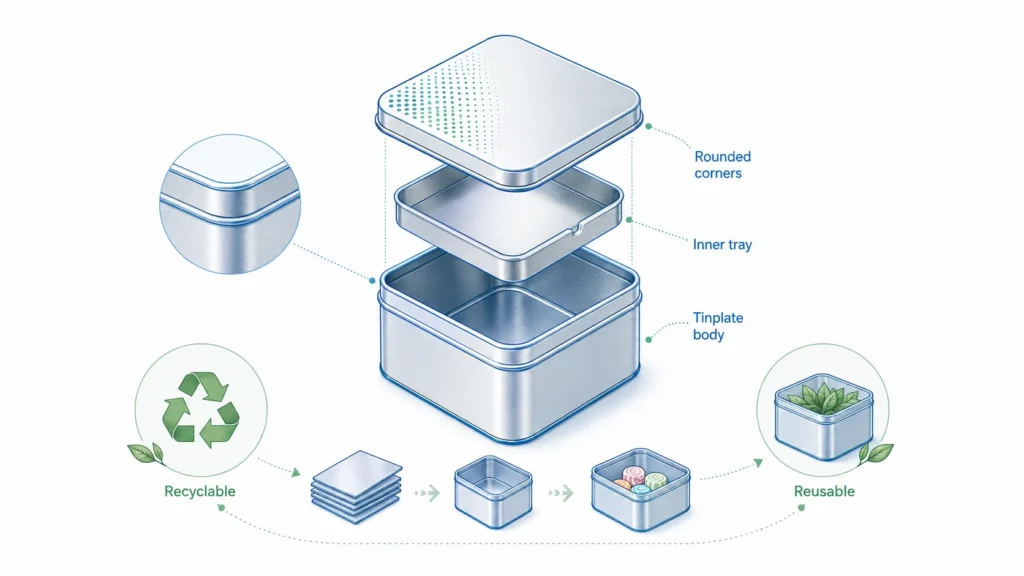
Most square metal tins are made from tinplate, which is steel sheet coated with tin. The base steel gives strength and formability. The tin layer helps with corrosion resistance and surface quality. The internal coating helps separate the product from metal when needed. The external varnish protects printing and controls the final look and feel.
For a buyer, the most important point is that a tin is a system. It is not just metal. It includes tinplate thickness, temper, surface finish, internal lacquer, external coating, printing ink, lid fit, edge curling, hinge or lid structure, insert, label, and export carton. A change in one component can affect the entire project. For example, a thicker tinplate may improve dent resistance but increase cost and forming difficulty. A matte varnish may look premium but show scratches differently from gloss. A window lid may improve product visibility but add material complexity and reduce barrier performance. A foam insert may protect tools but may not match a sustainability claim.
Square tins also require corner design. Sharp square corners are not usually practical because formed metal needs radius. The corner radius affects appearance, stacking, lid fit, and tooling. A small corner radius looks modern and geometric but may be more difficult to form cleanly. A larger radius can improve forming stability and safety but may look softer. Buyers should review physical samples, not only 3D renderings, because metal reflection, edge feel, and lid force are hard to judge on screen.
| Component | Function | Key specification question | Risk if ignored |
|---|---|---|---|
| Tinplate body | Provides strength, shape, and printable surface | What thickness and temper fit the size and depth? | Dents, weak corners, unstable lid fit |
| Internal coating | Helps separate product from metal | Is the product dry, oily, acidic, salty, fragrant, or moist? | Corrosion, odor, taste change, compliance problems |
| External varnish | Protects print and controls touch | Matte, gloss, satin, soft-touch, spot UV, or textured? | Scratching, poor shelf appearance, brand mismatch |
| Lid structure | Controls opening, closing, and sealing | Slip lid, hinged lid, plug lid, sliding lid, or screw lid? | Bad user experience, weak protection, loose lid |
| Insert | Holds product and improves unboxing | Paperboard, molded pulp, foam, PET, or metal divider? | Product movement, breakage, poor presentation |
| Export packing | Protects tins during shipping | What inner bag, divider, carton, and pallet method is needed? | Scratched tins, dented corners, carton collapse |
If the square tin is used for food, beverage, supplements, or cosmetics, buyers should request documentation appropriate to the target market. This may include food-contact declarations, coating information, migration testing where applicable, heavy metal considerations, BPA-related statements, or other compliance documents. The required documentation depends on the product, market, contact condition, and legal obligations. Packaging suppliers can support the process, but brands should also involve their regulatory, QA, or compliance teams.
Lid Styles for Square Metal Tins
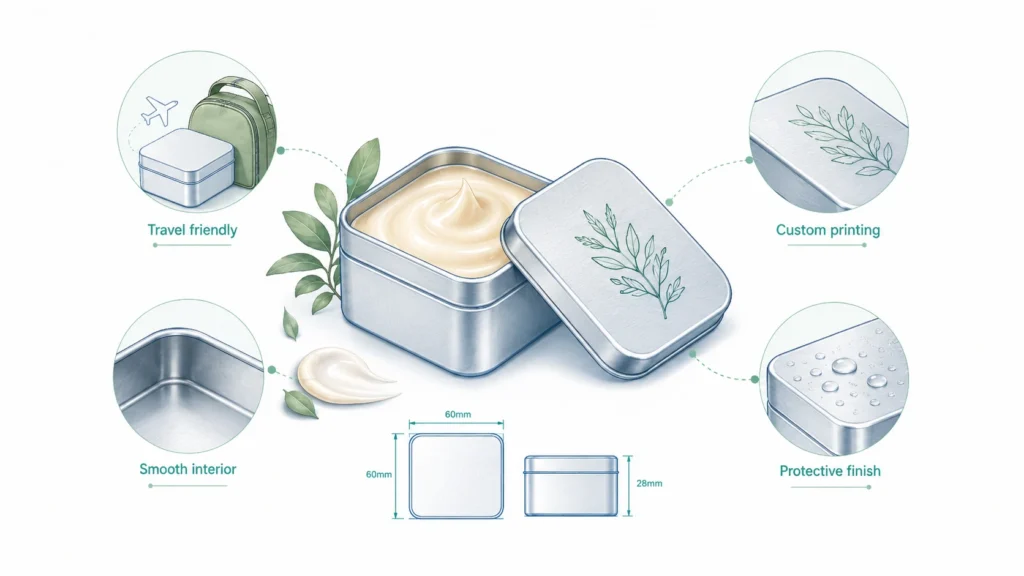
The lid decides how the customer experiences the package. A beautiful square tin with a weak lid will not feel premium. A strong lid that is too hard to open can also frustrate customers. The best lid style depends on product type, frequency of use, sealing requirement, gift value, and cost target.
A slip lid is the simplest and most common option. It works well for candy, cookies, tea bags, gift sets, and many promotional products. It gives a large printable lid area and keeps the structure straightforward. A hinged lid feels more durable and prevents the lid from being lost. It is useful for mints, gift kits, beauty tools, and small accessories. A plug lid or inner lid can improve the sense of closure for tea, coffee, powders, and aroma-sensitive dry products. A sliding lid is compact and distinctive, especially for mints and pocket products, but it is usually limited in depth. A window lid lets customers see the product, which can be useful for colorful candy or cosmetics, but it reduces opacity and may complicate recycling and barrier performance.
| Lid style | Best use cases | Strengths | Trade-offs |
|---|---|---|---|
| Slip lid | Tea, candy, cookies, gifts | Simple, cost-effective, large decoration area | Lid can be misplaced; fit must be controlled |
| Hinged lid | Mints, tool kits, beauty sets, premium gifts | Lid stays attached and feels durable | More structural complexity than slip lid |
| Plug lid or inner lid | Tea, coffee, powders, premium dry foods | Better closure feel and aroma protection | Extra component and tolerance control needed |
| Sliding lid | Pocket mints, tablets, small accessories | Compact, fun, and repeatable opening | Limited depth and product range |
| Window lid | Confectionery, gift sets, cosmetic colors | Product visibility and shelf trust | Added material complexity and weaker light barrier |
| Screw lid | Balms, creams, round or hybrid formats | Secure repeated closure | Less common for true square tins; tooling complexity |
The buyer should test the lid with real users. Can customers open it easily? Does it close with a satisfying feel? Does it stay closed in a bag or carton? Does the lid scratch the printed side wall? Does the hinge feel strong enough after repeated opening? Does the tin make noise if the product moves inside? These details determine whether the package feels premium in real life.
For structure comparison, Mr. Tin Box’s Tin Containers with Lids page is a relevant internal link because it covers packaging options for food, gifts, and personal care products. For buyers specifically comparing lid performance and product fit, this should be part of the internal reading path before sending an RFQ.
Printing, Finishing, and Decoration Options
Square metal tins give brands a strong decoration canvas. The lid can carry the main artwork. The side walls can carry flavor names, product information, icons, instructions, barcodes, QR codes, or regulatory marks. The bottom can carry manufacturing information, recycling guidance, batch coding, or legal text. Because the surface is rigid and reflective, color and finish decisions matter.
Offset printing is common for full-color artwork. Spot colors can be used for brand consistency. Metallic ink or the natural metal effect can create premium highlights. Embossing raises part of the metal surface to create tactile branding. Debossing presses details inward. Spot UV can highlight logos or product names. Matte varnish creates a calm premium feel. Gloss varnish makes color appear brighter. Soft-touch coatings can make cosmetics and gift tins feel more luxurious. Textured varnish can support special effects, such as leather-like, sand-like, or frosted finishes.
However, every decorative option affects cost, sampling, and lead time. A simple one-color tin can be efficient and elegant. A full-color printed tin with embossing, soft-touch varnish, and a window will need more control. The best decoration is not the most complicated one. The best decoration is the one that supports the product price point, sales channel, and brand story.
| Decoration option | Visual or tactile effect | Best product categories | Buyer note |
|---|---|---|---|
| CMYK printing | Full-color artwork and illustrations | Candy, gifts, seasonal tins | Request color proof and compare under real lighting |
| Spot color printing | Accurate brand colors | Tea, cosmetics, corporate gifts | Provide Pantone references and approved artwork |
| Matte varnish | Calm, premium, low-glare surface | Tea, wellness, natural cosmetics | Can show handling marks differently from gloss |
| Gloss varnish | Bright and vivid colors | Candy, holiday, kids’ gifts | Strong shelf visibility but may feel less subtle |
| Soft-touch finish | Smooth luxury hand feel | Cosmetics, premium gifts | Test scratch and fingerprint resistance |
| Embossing | Raised logo or pattern | Luxury tea, chocolate, cosmetics | Requires tooling and careful artwork placement |
| Debossing | Inset premium detail | Minimalist and high-end brands | Works best with simple typography or icons |
| Spot UV | Local shine contrast | Gift tins and premium collections | Needs accurate registration |
| Metallic effect | Reflective premium highlight | Candy, festive gifts, beauty | Use carefully to avoid visual clutter |
A practical artwork rule is to design for the physical tin, not for a flat screen. Corners, curls, seams, hinges, and lid overlaps can affect visible artwork. Keep important text away from edges and curved areas. Use mockups for concept approval, but use dielines and production proofs for final approval. If the tin is part of a series, test all colors together to make sure the family looks coherent.
Inserts and Internal Presentation
The inside of the tin is part of the sales experience. Many brands spend time on the lid artwork but forget what the customer sees after opening. For tea, candy, cosmetics, and gifts, the inside layout can make the difference between a simple container and a premium package.
Paperboard inserts are common because they are printable, relatively lightweight, and easy to customize. Molded pulp inserts can support a natural sustainability story and work well for gift sets, cosmetics, and delicate products. Foam inserts provide strong cushioning for tools, accessories, and fragile items, but buyers should consider sustainability positioning and material compatibility. PET or other plastic trays can provide precise cavities and high clarity, but they add material complexity. Metal dividers can create a durable and premium feel, but they may increase cost and require careful assembly.
| Insert type | Best for | Advantages | Considerations |
|---|---|---|---|
| Paperboard divider | Tea sachets, candy, cosmetics kits | Printable, lightweight, cost-effective | Moisture resistance and fit tolerance |
| Molded pulp tray | Beauty sets, gifts, eco-positioned products | Natural look and good cushioning | Tooling, texture, and color consistency |
| Foam insert | Tools, fragile accessories, premium kits | Strong protection and clean cavities | Sustainability perception and odor control |
| PET tray | Chocolate, cosmetics, visible product layout | Precise shape and clean presentation | Material separation and recyclability questions |
| Metal divider | Luxury gifts, tea, collectibles | Durable and premium | Higher cost and assembly control |
| Fabric or paper wrap | Jewelry, gifts, confectionery | Soft premium unboxing | Labor cost and consistency |
For commercial projects, insert design should be confirmed before the tin size is finalized. If the insert is added later, it may reduce usable internal space and make the product fit too tight. Buyers should provide the exact product dimensions, tolerance, unit weight, number of pieces, and any instruction cards, desiccants, spoons, labels, or refill packs that must fit inside.
Sustainability and Responsible Packaging Claims
Sustainability claims must be specific and honest. A square metal tin can support strong sustainability messaging because tinplate is durable, reusable, and recyclable in many systems. Steel’s magnetic properties support sorting, and steel can be recycled repeatedly without losing its inherent material properties. But a brand should not simply say “eco-friendly” without explaining what that means.
Better claims are more concrete. For example: “reusable tin container,” “tinplate body,” “designed for long-term storage,” “recyclable where facilities exist,” or “designed to reduce disposable gift packaging.” If the tin includes a plastic window, foam insert, laminated label, magnet, ribbon, or mixed-material decoration, the claim should reflect the full package, not only the metal body. If the brand sells in the EU, it should also monitor evolving packaging rules under Regulation (EU) 2025/40 and design for future recyclability expectations (Regulation (EU) 2025/40).
The most responsible packaging strategy is often a balanced one. Use enough material to protect the product and prevent damage, but avoid unnecessary weight. Use decoration that supports sales, but avoid decorative parts that make recycling difficult without adding real value. Use inserts when they protect the product or improve unboxing, but avoid overpacking. Design the tin so customers want to keep it.
| Sustainability decision | Better practice | Why it matters |
|---|---|---|
| Tin body | Use an appropriate thickness, not automatically the thickest material | Balances protection, forming, cost, and material use |
| Window | Use only when product visibility is commercially important | Reduces unnecessary mixed-material complexity |
| Insert | Choose paperboard or molded pulp when suitable | Supports easier separation and brand positioning |
| Decoration | Avoid excessive glued-on accessories | Helps recovery and reduces assembly complexity |
| Labeling | Provide clear recycling and material information where appropriate | Helps customers and supports compliance |
| Reuse | Design for a real second use | Makes the sustainability story more believable |
Sustainability is also connected to product protection. If weak packaging causes broken candy, stale tea, scratched cosmetics, or returned gift sets, the environmental result may be worse than using a stronger package. The best square tin packaging protects the product through the real supply chain and remains useful after purchase.
How to Choose the Right Square Tin Size
Size selection should begin with the product, not with a catalog image. The buyer should define the product form, fill weight, unit count, required headspace, inner bag or insert, label needs, and sales channel. For tea, fill density is critical. For candy, piece count and breakage risk matter. For cosmetics, formula volume and insert layout matter. For gifts, the full set arrangement matters.
A common mistake is choosing a tin that looks premium but is too large for the product. Customers notice underfilled packaging. Empty space can make the product feel less valuable, even if the tin itself is beautiful. Another mistake is choosing a tin that is too tight. This can damage products, make assembly slow, and create customer frustration when items are difficult to remove.
| Size planning step | What to measure | Why it matters |
|---|---|---|
| Product dimensions | Length, width, height, diameter, or piece size | Confirms physical fit |
| Fill behavior | Weight, volume, settling, compression | Prevents underfill or overflow |
| Insert space | Tray thickness, divider width, cavity tolerance | Avoids late-stage fit problems |
| Label space | Required text, barcode, QR code, symbols | Keeps information readable |
| Opening behavior | Hand access, scoop access, product removal | Improves customer experience |
| Carton pack-out | Units per inner box, master carton, pallet | Controls landed cost and shipping efficiency |
For early planning, buyers can create a simple size brief: product type, target fill weight, internal volume estimate, preferred square footprint, target height, lid style, direct-contact or secondary-contact use, insert requirement, artwork style, target MOQ, launch date, and destination market. This brief helps the supplier recommend an existing mold or evaluate whether custom tooling is needed.
Cost Drivers and How to Control Them
Square metal tins can be cost-effective or premium, depending on design choices. The main cost drivers include tin size, tinplate thickness, tooling, printing complexity, finishing process, embossing, lid structure, insert type, order quantity, packing requirements, inspection level, and shipping method. Buyers can control cost by separating must-have features from nice-to-have features.
For example, a tea brand may need a good friction lid and food-contact coating, but it may not need a window. A candy brand may need colorful printing and an inner tray, but it may not need embossing on every seasonal design. A cosmetics brand may need soft-touch finish and insert protection, but it may choose one standard tin size across several SKUs to reduce tooling complexity. A corporate gift buyer may need fast delivery and clear logo printing, but it may choose existing tooling instead of a custom shape.
| Cost driver | Lower-cost direction | Premium direction | Decision advice |
|---|---|---|---|
| Tooling | Use existing square tin mold | Create custom size or special structure | Use custom tooling only when it supports long-term sales |
| Printing | One or two colors | Full CMYK plus spot color | Match print complexity to shelf strategy |
| Finish | Standard gloss or matte | Soft-touch, spot UV, texture, metallic effect | Add premium finishes where touch matters |
| Lid | Slip lid | Hinged, plug, window, or complex lid | Choose based on product use, not only appearance |
| Insert | Simple paperboard | Molded pulp, foam, PET, or custom divider | Use insert when it protects or sells the product |
| Quantity | Small trial order | Larger production run | Balance launch risk with unit-cost efficiency |
| Packing | Standard export carton | Individual sleeves, gift boxes, retail displays | Add packing only when channel requires it |
A good sourcing process starts with commercial priorities. Is the tin meant to increase shelf price? Reduce damage? Support a gift program? Build a collectible series? Replace plastic packaging? Improve export presentation? The answer changes the specification. Without a clear priority, buyers may over-design the tin and increase cost without improving sales.
RFQ Checklist for Custom Square Metal Tins
A clear request for quotation saves time and reduces sampling revisions. Instead of asking only for “square metal tins price,” provide a structured brief. The more specific the brief, the easier it is for the supplier to recommend the right structure, estimate cost, and identify risks early.
Include the product category, target size, fill weight, product contact condition, lid style, inner coating requirement, artwork method, finish preference, insert requirement, order quantity, destination country, regulatory requirements, packing method, and launch timeline. If you have reference photos, send them. If you have product samples, provide them before final size confirmation. If you have a strict retail date, communicate it from the beginning.
| RFQ item | Information to provide | Example |
|---|---|---|
| Product | What will go inside the tin | 80 g loose tea, wrapped chocolate pieces, soap bar, beauty kit |
| Contact condition | Direct contact or inner pack | Direct food contact, inner pouch, paper cups, cosmetic jar inside |
| Size target | Internal or external dimensions | 90 x 90 x 70 mm external, or 100 g tea capacity |
| Lid style | Preferred opening method | Slip lid, hinged lid, plug lid, window lid |
| Coating | Internal and external needs | Food-safe lacquer, matte exterior varnish, soft-touch finish |
| Artwork | Printing and decoration | CMYK, spot color, embossed logo, metallic ink |
| Insert | Product holding system | Paperboard divider, molded pulp tray, foam insert |
| Quantity | Trial and production volume | 3,000 pcs pilot, 20,000 pcs production |
| Market | Destination and compliance needs | U.S., EU, UK, Canada, Australia, Middle East |
| Timeline | Launch date and delivery need | Samples in 3 weeks, mass shipment before September |
| Packing | Retail and export packing | Polybag, inner carton, display tray, master carton, pallet |
This is also where Mr. Tin Box can help buyers turn an idea into a workable production plan. Square tins may look simple, but successful production requires alignment between product, tooling, coating, artwork, assembly, and logistics. A structured RFQ helps the supplier respond with useful recommendations instead of generic pricing.
Packaging Ideas by Industry
Square metal tins can be adapted across many categories. The best concept depends on the product’s sensitivity, price point, customer use, and sales channel.
For tea, use square tins to build a clean product family. Each flavor can have a color code, origin icon, and brewing instruction. A plug lid or inner pouch can support aroma protection. A larger square tin can become a refillable tea caddy, while a smaller tin can support sampling and subscription programs.
For candy, use square tins to make the product more giftable. Bright colors, character artwork, metallic finishes, and seasonal patterns work well. If the candy is fragile or premium, use internal trays, cups, or dividers. If the product is for impulse purchase, keep the message clear and visible from a distance.
For cosmetics, use square tins to create tactile value. Soft-touch finishes, minimal typography, embossed logos, and organized inserts can make a small product feel expensive. Validate formula compatibility and ensure the opening experience is comfortable. For bathroom or travel use, test durability in realistic conditions.
For gifts, use square tins as keepsakes. Design the tin around the occasion and after-use. A holiday tin can become storage for ornaments or cookies. A corporate gift tin can become desk storage. A wedding tin can become a small memory box. A promotional tin can become a reusable travel container.
| Industry | Square tin concept | Best design direction | Commercial goal |
|---|---|---|---|
| Tea | Refillable square tea caddy | Calm colors, origin story, aroma-focused lid | Build repeat purchase and premium perception |
| Candy | Seasonal square confectionery tin | Bright artwork, protective insert, gift message | Increase impulse and holiday sales |
| Cosmetics | Square beauty kit tin | Soft-touch finish, insert layout, clean typography | Make small products feel premium |
| Corporate gifts | Logo square tin with useful contents | Durable finish and simple brand message | Extend brand visibility after event |
| Wedding and events | Personalized mini square tin | Elegant color palette and readable details | Create a memorable keepsake |
| Specialty products | Square organizer tin | Strong structure, insert, durable label | Protect parts and improve usability |
Why Choose Mr. Tin Box for Square Metal Tin Projects
A successful square metal tin project is not just about finding a container with the right dimensions. It requires packaging engineering, artwork translation, material selection, coating decisions, sampling, quality control, and export-ready communication. Mr. Tin Box focuses on custom metal tin packaging for global brands, with applications across food and beverage, beauty and personal care, gifts, promotional packaging, holiday packaging, and specialty industrial uses.
For buyers developing tea, candy, cosmetics, or gift packaging, the main advantage is practical guidance. Instead of forcing every project into one standard tin, the packaging should be matched to product behavior and commercial goals. Tea needs aroma and moisture planning. Candy needs food-contact and presentation planning. Cosmetics need formula compatibility and tactile branding. Gifts need timing, decoration, and after-use value. Specialty products need strength and organization.
The Mr. Tin Box website already provides useful reading paths for buyers. If you are still defining the container format, start with Small Tin Containers. If you are comparing lid structures, read Tin Containers with Lids. If you are working on beauty items, review Beauty & Personal Care Packaging and Metal Lip Balm Tin Packaging. If you are building a premium product family, read Why Metal Packaging Boosts Shelf Life and Brand Value and Metal Packaging Trends for Premium Consumer Goods.
The right square metal tin should be beautiful, but it should also be manufacturable, safe for its intended use, efficient to pack, and suitable for the target market. That is the difference between packaging that only looks good in a rendering and packaging that performs in real retail, e-commerce, and export distribution.
Practical Square Tin Design Examples
Below are several practical concepts that can be adapted for real projects.
Modern tea collection tin: Use a medium square tin with a friction or plug-style lid, matte varnish, and color-coded labels for each tea type. Add a QR code linking to brewing instructions, origin information, and refill options. Use the same tin tooling across several SKUs to keep the product family consistent.
Holiday candy gift tin: Use a shallow or medium square tin with full-color seasonal artwork, glossy varnish, and a food-safe inner bag or tray. Consider embossing only the main logo or festive motif to control cost while improving touch. Design the lid so it looks good in online thumbnails and retail displays.
Luxury chocolate assortment tin: Use a square tin with a paperboard or PET tray that holds each chocolate securely. Keep the outside design elegant, with darker colors, metallic accents, and minimal text. Use the inside lid for a short brand story or flavor map.
Solid cosmetics sample kit: Use a hinged square tin with a molded pulp or paperboard insert. Include small solid products or sachets and a printed instruction card. Use soft-touch or satin finish for the exterior. Confirm compatibility between fragrance, oils, insert, and coating.
Corporate welcome kit: Use a square tin with the company logo, a simple brand color, and a durable varnish. Fill it with mints, tea, a USB drive, badge accessories, or small stationery. The goal is long-term desk use, so avoid artwork that feels too event-specific unless the tin is meant only for a one-time campaign.
Wedding favor tin: Use a mini square tin with names, date, and a subtle pattern. Fill with candies, tea sachets, or small keepsakes. Keep the typography large enough to read and choose a finish that photographs well.
Specialty parts organizer: Use a deeper square tin with a hinged lid and internal divider. This works for small tools, repair kits, craft parts, sewing kits, fishing accessories, or product samples. The design should prioritize durability, edge safety, and clear labeling.
Common Mistakes to Avoid
The first mistake is choosing shape before understanding the product. A square tin is attractive, but it must fit the product, insert, and use case. Always confirm real product dimensions and fill behavior before approving tooling or final size.
The second mistake is ignoring lid experience. The lid should open smoothly, close securely, and match the product’s use pattern. A tea tin opened daily needs a different closure feel from a holiday candy tin opened once at a party.
The third mistake is overusing decoration. Too many effects can make the tin expensive, slow to produce, and visually confusing. Use premium finishes with a purpose. Emboss the logo, highlight a pattern, or create a tactile cue, but do not add every possible effect to one package.
The fourth mistake is treating sustainability as a slogan. If the tin includes mixed materials, explain the package honestly. Design for reuse and recyclability where possible. Avoid accessories that make the package harder to separate unless they add clear value.
The fifth mistake is leaving compliance until the end. If the product is food, tea, candy, cosmetics, supplements, or direct-contact personal care, discuss coating, migration, labeling, and market requirements early. Late compliance changes can force redesign, delay shipment, or increase cost.
The sixth mistake is forgetting logistics. A beautiful tin can still fail if it scratches during shipping, wastes carton space, arrives late for a seasonal launch, or requires slow manual assembly. Export packing and production workflow should be part of the design conversation from the beginning.
FAQ
What are square metal tins made from?
Most square metal tins are made from tinplate, which is thin steel sheet coated with tin. Tinplate combines steel strength and formability with corrosion resistance and a printable surface. Depending on the product, the tin may also include internal lacquer, external varnish, printing ink, inserts, labels, or other accessories.
Are square metal tins suitable for tea?
Yes. Square metal tins are especially suitable for tea because they block light, protect the product physically, and create a premium storage experience. For loose tea, buyers should confirm fill density, settling behavior, lid fit, and whether an inner bag or inner lid is needed for moisture and aroma protection.
Can square tins be used for candy and chocolate?
Yes. Square tins are widely used for candies, chocolates, cookies, mints, and seasonal confectionery. If the food touches the tin directly, the internal coating and food-contact documentation must match the product and target market. Fragile confectionery may also need trays, paper cups, liners, or dividers.
Are square metal tins good for cosmetics?
They can be excellent for solid cosmetics, soap bars, balm sets, skincare samples, beauty tools, and gift kits. The main requirement is compatibility. Oils, fragrances, salts, waxes, pigments, and active ingredients may affect coating or insert choices, so buyers should share formula and contact information early.
What lid style is best for a square tin?
There is no single best lid. Slip lids are simple and cost-effective. Hinged lids feel durable and keep the lid attached. Plug lids or inner lids can improve closure feel for tea and powders. Window lids show the product but add material complexity. The right choice depends on product type, use frequency, sealing requirement, and budget.
Can square metal tins be printed with custom artwork?
Yes. Square metal tins can support CMYK printing, spot colors, matte varnish, gloss varnish, soft-touch finish, metallic effects, spot UV, embossing, and debossing. Buyers should use production dielines and leave enough safe area around edges, corners, hinges, curls, and seams.
Are square metal tins recyclable?
Tinplate is steel-based and steel is widely recycled in many systems. Steel’s magnetic properties make it easier to recover from waste streams. However, recyclability can be affected by added windows, labels, inserts, adhesives, and mixed materials. Buyers should design the whole package responsibly and provide accurate recycling guidance for the target market.
What information should I provide for a square tin quotation?
Provide the product type, fill weight, target dimensions, direct-contact or indirect-contact condition, lid style, coating needs, artwork, finish, insert requirement, quantity, destination country, compliance requirements, packing method, and launch timeline. Product samples or reference tins are also helpful.
Is an existing tin mold better than custom tooling?
Existing tooling is usually faster and more cost-effective for early launches, small campaigns, and standard product sizes. Custom tooling is better when the brand needs a unique structure, special capacity, long-term product family, or strong differentiation. The decision should be based on sales potential, timeline, and budget.
How can a brand make a square tin feel more premium?
Premium feel comes from structure, surface, and detail. Use a stable lid, smooth edges, good printing, a suitable varnish, and an organized internal layout. Embossing, soft-touch coating, metallic accents, and custom inserts can help, but only when they support the brand story and price point.
Final Thoughts
Square metal tins are a strong packaging choice for brands that need protection, shelf appeal, gift value, and reuse potential in one format. They work especially well for tea, candy, cosmetics, and gifts because these categories depend on both product quality and emotional presentation. The square format gives clean geometry, strong printable surfaces, efficient display behavior, and excellent compatibility with inserts and product families.
The best result comes from treating the tin as a complete packaging system. Material, coating, lid, printing, insert, compliance, carton packing, and customer use should be planned together. A square tin for loose tea is not the same as a square tin for chocolate. A cosmetic kit has different risks from a corporate gift tin. A holiday tin has different timing pressure from a year-round refill container.
For brands preparing a real packaging project, the next step is to create a practical brief: product details, target market, size range, lid preference, artwork direction, quantity, compliance requirements, and launch timeline. With that information, Mr. Tin Box can help turn square metal tins into packaging that protects the product, supports the brand, and creates a better customer experience from shelf to home.


