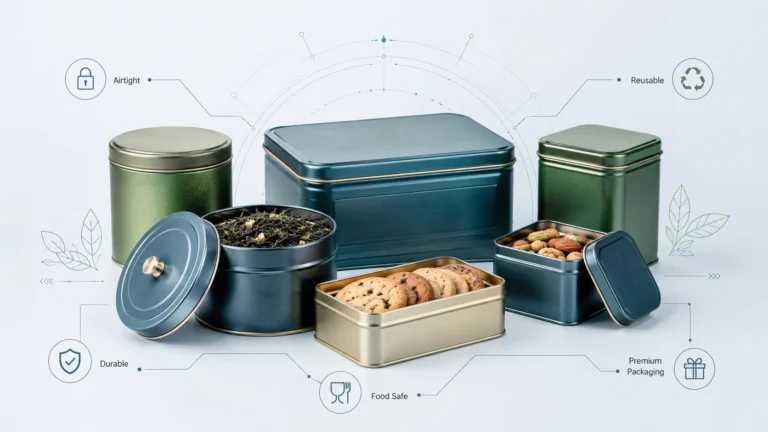

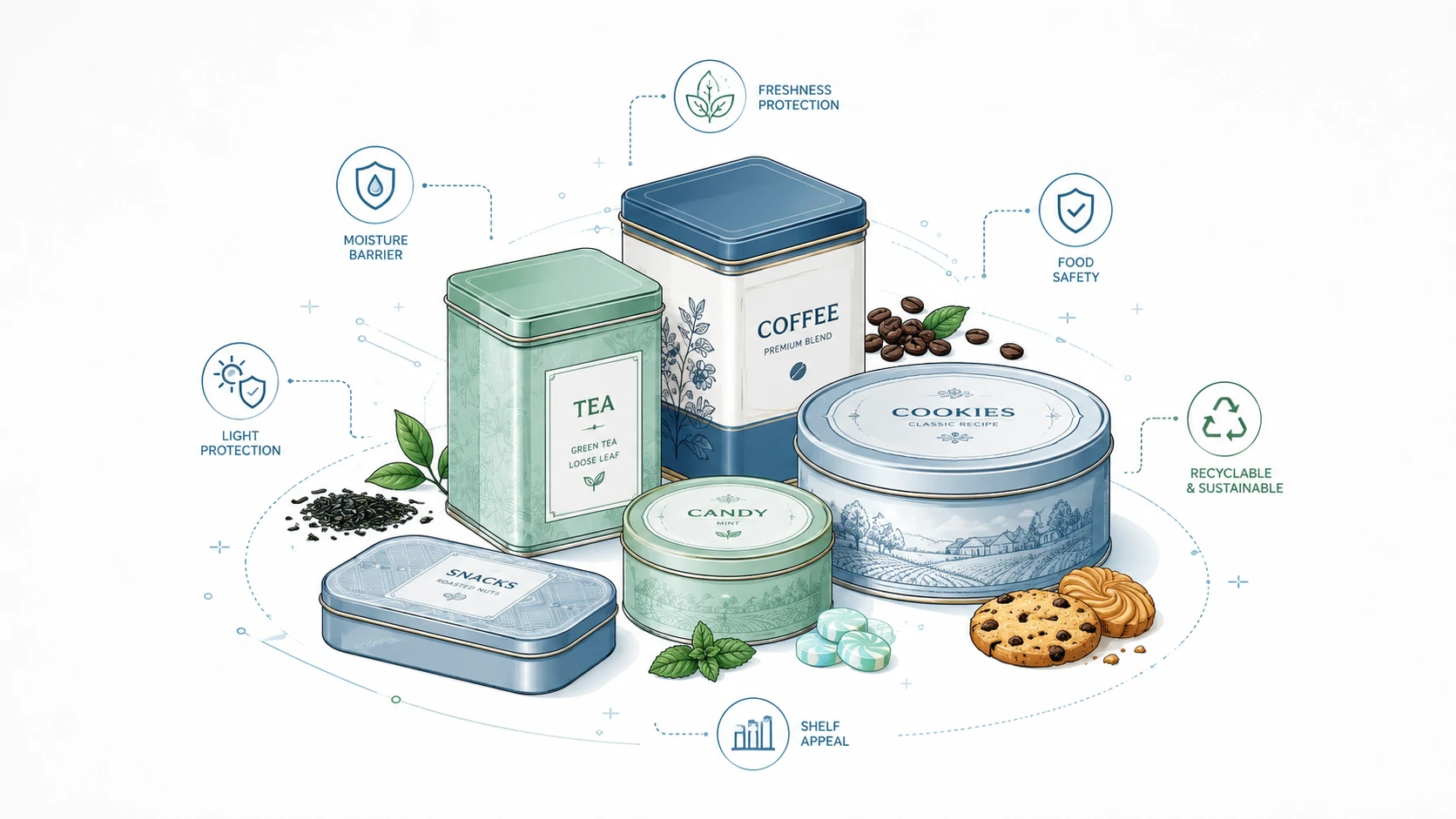

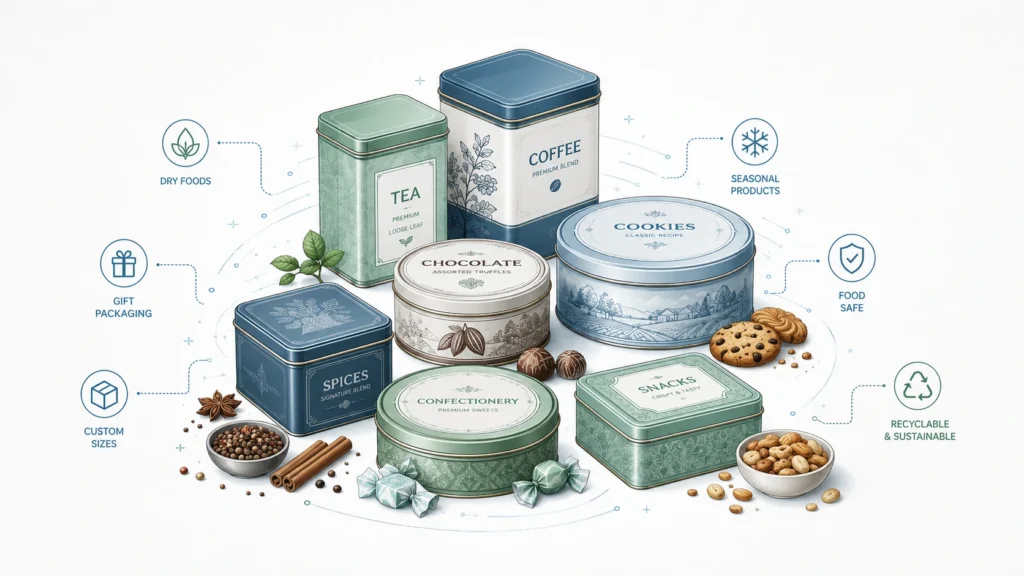
Food tins are one of the most practical packaging formats for food brands that need protection, shelf appeal, and long-term brand visibility in the same package. For tea, coffee, cookies, biscuits, chocolates, candies, mints, spices, powdered mixes, premium snacks, and seasonal gift assortments, a well-designed metal tin is more than a container. It is a protective barrier, a retail display tool, a reusable household object, and a physical expression of brand quality.
This is why metal food packaging continues to matter even in a market filled with flexible pouches, paper boxes, composite cartons, glass jars, and plastic tubs. Many food products are sensitive to oxygen, moisture, light, odor transfer, impact, and repeated handling. A cardboard carton may print beautifully but can lose shape during logistics. A plastic tub may be light but may not deliver the premium feel expected for gifting. Glass may feel high-end but is heavy and fragile. Food tins occupy a useful middle ground: rigid, printable, reusable, recyclable, stackable, and strong enough to protect product presentation from factory to shelf.
At Mr. Tin Box, we focus on custom metal tin packaging for global brands across food, beverage, beauty, gifting, promotional, and specialty categories. For food brands, the most relevant starting point is our Food & Beverage Packaging capability, where tin boxes are designed for snacks, tea, coffee, chocolates, candies, and specialty food products. The objective is simple: help brands choose a food tin structure that protects the product and also makes the product easier to notice, trust, gift, store, and repurchase.
This guide explains how food tins protect food products, how they improve shelf appeal, what buyers should check before ordering custom tins, and how metal tin packaging can support a stronger commercial position. It is written for brand owners, product managers, importers, procurement teams, packaging developers, private-label buyers, and food companies planning a new retail line or a premium packaging upgrade.
Why food tins still matter in modern food packaging
The strongest reason food tins remain relevant is that they solve several business problems at once. Food packaging must protect quality, carry branding, survive logistics, comply with food-contact expectations, communicate value, and fit a target retail price. A food tin can contribute to all of these goals when the design is planned properly.
For dry foods and premium edible gifts, packaging is often the first quality signal shoppers see. Consumers cannot taste the tea, coffee, cookies, chocolate, or mints before buying. They judge from the package: structure, weight, finish, closure, printing, color, cleanliness, and overall presentation. A metal tin gives the product a stronger physical presence than many ordinary paper or plastic packages. It suggests that the product is meant to be protected, saved, gifted, and displayed.
Food tins also perform well in categories where customers open and close the package repeatedly. Tea and coffee tins may sit on a kitchen counter for weeks. Mint tins may be carried in a bag or pocket. Cookie tins may be opened during family gatherings and later reused for storage. A rigid container with a well-fitted lid supports repeated use better than a disposable paper sleeve or thin flexible pouch. Even when the primary food-contact layer is an inner pouch, the outer metal tin can protect against crushing, scuffing, and poor shelf presentation.
From a brand perspective, food tins also extend the life of the packaging message. A paper box usually disappears after consumption. A decorative tin may remain in the home as a storage box, desk organizer, sewing kit, tea container, or collectible holiday tin. That second life is valuable because it keeps the brand visible after the first purchase. For premium food and gift programs, the package becomes part of the consumer experience rather than a disposable wrapper.
The data also supports the commercial importance of food packaging. According to MarketsandMarkets, the global food packaging market was estimated at USD 421.38 billion in 2025 and projected to reach USD 548.51 billion by 2030. For metal packaging specifically, Grand View Research reported that the food and beverages segment represented the largest revenue share of the metal packaging market in 2024. These figures do not mean every product should use metal packaging, but they do show that food and beverage applications remain central to the packaging industry.
| Business pressure for food brands | Why it matters | How food tins can help |
|---|---|---|
| Product protection | Food quality can decline through oxygen, moisture, light, odor, impact, and handling | Rigid tinplate structure, fitted lids, internal coating, and secondary liners can reduce common damage risks |
| Shelf differentiation | Retail shelves and e-commerce listings are crowded | Metal surfaces support bold printing, embossing, special finishes, and premium shapes |
| Giftability | Food is often purchased as a gift during holidays, events, and promotions | Tins feel more durable and keepsake-worthy than standard disposable packs |
| Reuse and sustainability messaging | Consumers and retailers increasingly compare packaging waste and recyclability | Metal packaging can be reusable and recyclable when designed and collected properly |
| Procurement stability | Brands need repeatable quality across batches | Custom tooling, approved samples, QC standards, and documented material specifications support consistency |
What food tins are made from
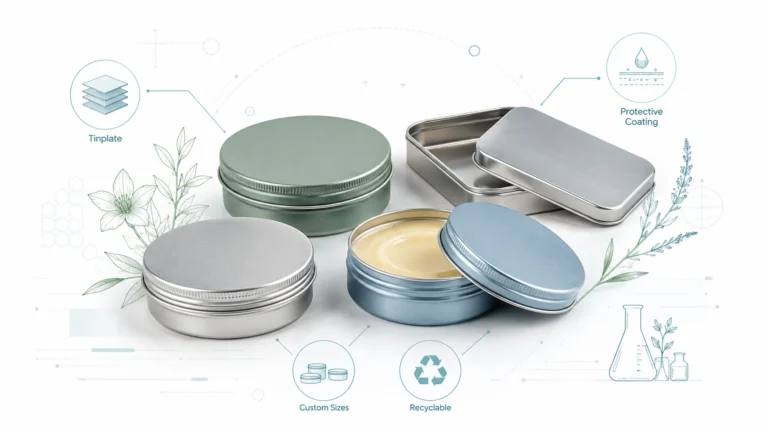
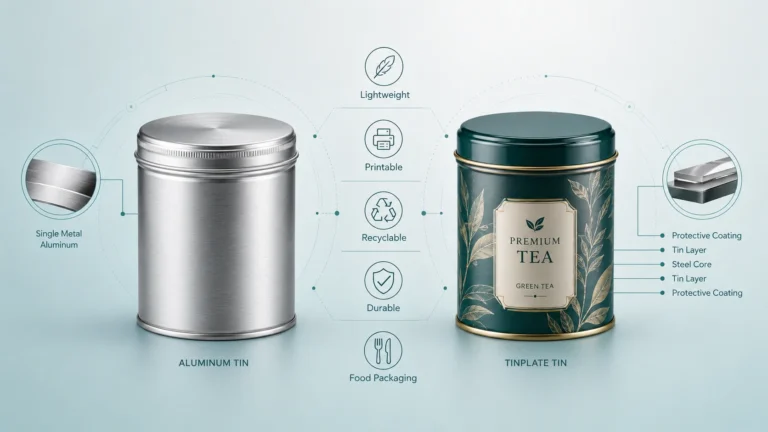
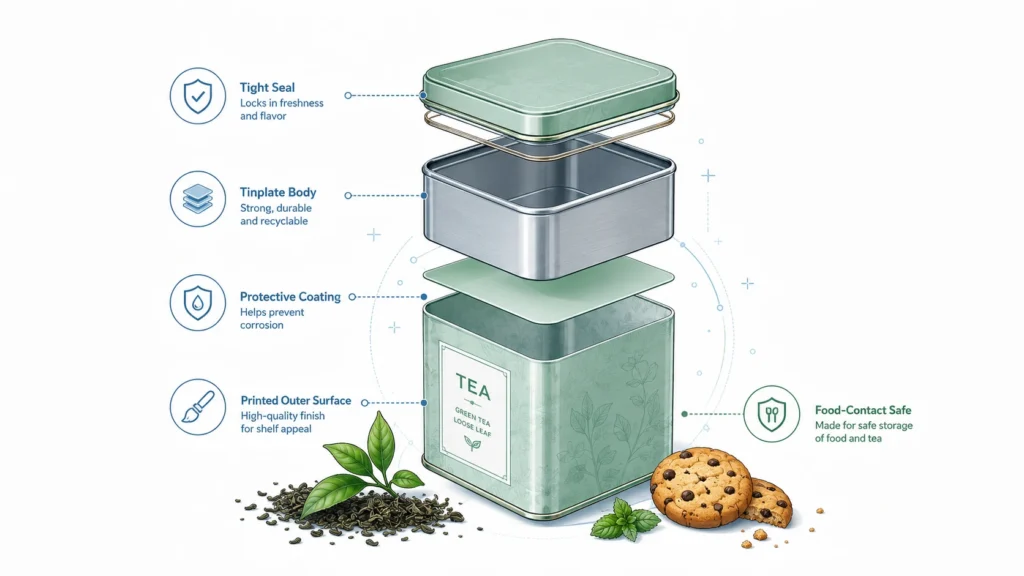
Most commercial food tins are made from tinplate, not solid tin. Tinplate is thin steel sheet coated with a very thin layer of tin. The steel provides stiffness, forming strength, and impact resistance. The tin coating improves corrosion resistance and creates a clean metallic surface that can be printed, coated, varnished, stamped, curled, and assembled into different container styles.
This distinction is important because many buyers use terms such as tin box, food tin, tin can, metal tin, cookie tin, tea tin, coffee tin, candy tin, and tinplate container interchangeably. In practical packaging language, these terms often refer to a steel-based tinplate structure combined with coatings, inks, varnish, formed edges, and sometimes an inner food-contact liner. A food tin is therefore not just one material. It is a packaging system.
The typical food tin system may include a low-carbon steel base, tin coating, passivation or surface treatment, interior lacquer, exterior primer, offset printing inks, protective top varnish, rolled edges, seams, hinges, slip lids, plug lids, or inserts. Each layer affects performance. The steel gauge affects stiffness. The coating affects food compatibility. The varnish affects scratch resistance. The lid tolerance affects closure feel. The printing route affects color and brand consistency. The packing method affects whether the tins arrive clean and undented.
For a deeper technical explanation of tinplate layers, coatings, and food-contact considerations, see the Mr. Tin Box guide Tinplate Packaging Explained: Material, Coating, Printing, and Food Safety. That guide is especially useful when comparing direct-contact tins, tins with inner pouches, lacquered tins, BPA-free coating requests, and printed decorative tins.
| Layer or component | Practical role in food tin packaging | Buyer question to ask |
|---|---|---|
| Steel base | Gives the tin its structure, rigidity, forming strength, and dent resistance | What thickness and temper are suitable for the tin size and expected product weight? |
| Tin coating | Supports corrosion resistance and metallic surface quality | Is the material suitable for the intended food packaging environment? |
| Internal lacquer | Separates the product or inner atmosphere from metal and supports food-contact performance | Is the coating appropriate for direct food contact, indirect contact, oily food, dry food, or aroma-sensitive food? |
| Exterior primer and inks | Carry the brand artwork, color, pattern, and retail message | Will the artwork be printed on white base, clear base, metallic base, or another finish? |
| Top varnish | Protects printing and creates gloss, matte, satin, texture, or soft-touch feel | What level of scratch resistance and visual effect is required? |
| Lid and closure system | Controls opening force, reclosure, user feel, and shelf stability | Should the tin use a slip lid, plug lid, hinged lid, screw lid, or windowed lid? |
| Insert or inner liner | Holds food pieces, separates flavors, improves unboxing, or provides direct-contact layer | Does the product need paper liner, plastic tray, blister, inner pouch, foam, or divider? |
How food tins protect product quality
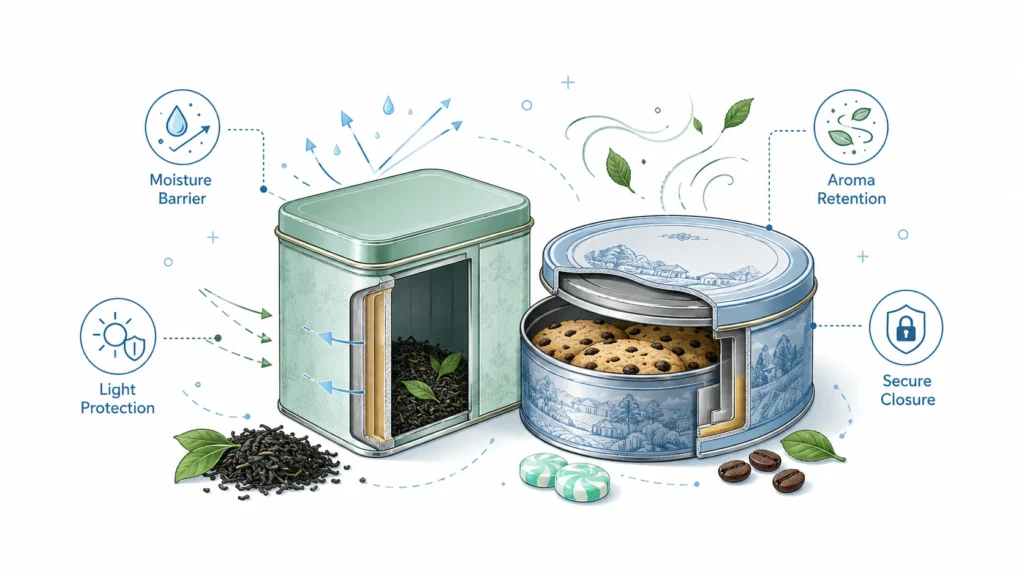
Food quality can decline for predictable reasons. Oxygen can drive oxidation and rancidity. Moisture can soften crunchy products, clump powders, or change texture. Light can affect pigments, vitamins, fats, and aroma compounds. External odors can contaminate delicate products such as tea, coffee, and chocolate. Physical impact can break cookies, dent chocolates, crush candies, or damage premium display sets.
A peer-reviewed review on metal packaging published through the U.S. National Library of Medicine explains that packaging helps prevent deteriorating factors such as light, moisture, oxygen, and microorganisms from affecting food shelf life (PMC review on metal packaging). Another review on food packaging materials notes that packaging supports food safety, handling, transport, and shelf-life extension by protecting products from contamination and quality loss (food packaging materials review). In business terms, better protection reduces complaints, returns, discounting, and brand damage.
Metal tins are especially useful where the product benefits from a rigid outer shell. A cookie can be individually wrapped, but a weak carton may still allow breakage during shipment. Tea may be sealed in an inner bag, but a decorative metal tin adds light protection, storage value, and premium shelf presence. Chocolate may sit in a tray, but the tin helps create a giftable structure and reduces compression damage. Candy, mints, and small snacks benefit from tins because the package can be opened, closed, carried, and reused.
Protection does not mean all food tins are automatically suitable for every food. A dry tea tin is not the same as a tin for acidic sauce. A wrapped candy tin is not the same as a direct-contact oily snack tin. A holiday cookie tin may prioritize decorative impact and crush resistance, while a coffee tin may prioritize aroma retention and lid performance. This is why buyers should define the food-contact scenario before asking for a quotation.
| Product type | Main quality risks | Recommended food tin priorities |
|---|---|---|
| Tea | Aroma loss, moisture, odor transfer, light exposure | Tight lid fit, odor-neutral coating, clean interior, optional inner bag, elegant shelf design |
| Coffee | Aroma loss, oxidation, moisture, repeated opening | Better closure tolerance, aroma-sensitive material review, inner seal or pouch, premium counter display |
| Cookies and biscuits | Breakage, moisture pickup, scuffed retail appearance | Rigid body, stable lid, inner tray or paper liner, scratch-resistant exterior varnish |
| Chocolates | Heat sensitivity, odor transfer, surface bloom, gift presentation | Insert or tray, clean lacquer, controlled packing, premium finish, seasonal artwork |
| Candies and mints | Repeated opening, carrying damage, flavor transfer, hygiene | Compact tin structure, smooth edges, reliable lid, direct-contact review if loose product is packed |
| Spices and powders | Moisture, odor loss, clumping, contamination | Tight closure, inner seal or shaker insert, coating compatibility, clear labeling area |
| Premium snack mixes | Oil staining, aroma, breakage, salt corrosion risk | Inner pouch or coating review, stronger structure, product compatibility testing |
Barrier protection: oxygen, moisture, light, and odor
Food tins are valuable because metal has excellent inherent barrier characteristics. Unlike many polymer films, metal does not allow gases or water vapor to pass through the sheet itself under normal packaging conditions. For a tin box, the most important barrier questions usually shift from the material sheet to the closure system, seams, inner liner, coating, and packing process.
For dry food tins, the lid fit is often more important than buyers expect. A beautiful tin with a loose lid may fail in real-world use because the package feels cheap, opens during shipping, or does not help preserve aroma after opening. For tea and coffee, the consumer expects the tin to feel protective every time it is opened. For cookies and confectionery, the closure helps maintain a clean and giftable presentation. For mints, the lid must be secure enough for bags and pockets but easy enough to open without frustration.
Moisture is another key issue. Many food products are texture-driven: crisp cookies, crunchy candy shells, powdered drink mixes, tea leaves, freeze-dried snacks, and premium biscuits. If the food gains moisture, the consumer may experience staling, clumping, softening, or loss of crunch. A metal tin can protect against external moisture better than many paper packages, but the full system still needs correct closure design and often an inner pouch, foil bag, seal, or desiccant strategy.
Light protection also matters. Even products that do not spoil quickly can lose color, aroma, or perceived freshness when exposed to light for long periods. Opaque metal packaging helps create a dark internal environment. This is one reason food tins are popular for tea, coffee, chocolates, and gift assortments where appearance and aroma are part of the buying experience.
Odor control is especially important for tea, coffee, chocolate, spices, and premium confectionery. A tin must not contribute unwanted odor from coating, ink, varnish, paper liner, glue, or packing materials. Buyers should review odor and taint during sampling. For sensitive products, it is wise to place real product in the sample package and evaluate it after a reasonable storage period, not only immediately after receiving the sample.
Food-contact safety and regulatory expectations
Food packaging is not only a marketing decision. It is also a safety and compliance decision. The U.S. FDA explains that food contact substances include substances that come into contact with food through packaging and its components, processing equipment, preparation surfaces, or cookware. The FDA also states that food contact substances that are food additives must be authorized for their intended use before being marketed in the United States, typically through food contact notifications and safety review (FDA consumer information on food packaging).
For industry users, the FDA provides a dedicated section on Packaging & Food Contact Substances, including guidance, inventories, and regulatory information. The FDA also explains that the regulatory status of a food-contact material depends on the status of each individual substance reasonably expected to migrate to food, including components covered by 21 CFR regulations, GRAS status, prior sanction, Threshold of Regulation exemption, or an effective Food Contact Substance Notification (FDA regulatory status guidance).
In the European Union, the European Commission states that food contact materials include packaging and containers used during production, processing, storage, preparation, and serving. The EU principle is clear: packaging materials intended to contact food, including metal, must comply with EU safety rules so they do not release substances into food in a way that could endanger health, change the food composition, or affect taste or smell (European Commission food contact materials).
For food tin buyers, this means compliance should be planned early. Do not wait until the artwork is finished and the mold is ready before discussing food contact. A buyer should define the destination market, direct-contact or indirect-contact situation, food type, expected storage conditions, temperature exposure, inner liner material, and retailer requirements. A tin used only as a decorative outer box for individually wrapped candies has a different compliance profile from a tin that directly touches loose oily snacks.
| Compliance question | Why it matters | Practical action for buyers |
|---|---|---|
| Is the tin in direct contact with food? | Direct contact usually requires stricter review of internal coating and migration risk | Define the food-contact surface in the specification and request suitable documentation |
| Is there an inner pouch, wrapper, tray, or liner? | The inner layer may become the primary food-contact material | Confirm the safety status of both the inner pack and the metal tin system |
| What is the destination market? | FDA, EU, LFGB, retailer, and national rules may differ | Share target markets before sampling and quotation |
| Is the product oily, acidic, salty, aromatic, or dry? | Product chemistry affects corrosion, odor, migration, and coating selection | Provide product samples or clear formulation categories for compatibility review |
| Will the product be heat processed in the tin? | Decorative tins are different from retort food cans | Do not assume a gift tin is suitable for thermal processing unless specifically engineered for it |
| What documentation is required? | Importers and retailers may need declarations and test reports | Ask for material declarations, test reports, and coating information early |
Shelf life: what packaging can and cannot promise
Food tins can help protect product quality, but packaging cannot fix an unstable formulation, poor processing, weak sanitation, unsuitable storage, or unrealistic shelf-life claims. A tin is a barrier and presentation system. It should be part of the product’s shelf-life strategy, not the only strategy.
For commercially canned shelf-stable foods, USDA guidance explains that dates on cans often indicate peak quality rather than automatic safety failure, and that low-acid canned foods can be stored for two to five years while high-acid foods are generally in the 12 to 18 month range when properly stored (USDA food safety blog). That guidance refers to commercially canned foods, not every decorative tin box. Still, it helps buyers understand an important principle: shelf life depends on food type, process, packaging integrity, and storage conditions.
Many custom food tins for tea, cookies, chocolates, candies, and gifts are not retort cans. They may be decorative containers with inner bags, wrappers, trays, or liners. In those cases, the shelf-life performance depends on the primary food-contact package as well as the outer metal tin. A coffee brand may use a foil pouch inside a printed tin. A cookie brand may use a sealed inner film plus a decorative tin. A chocolate brand may use individual wrappers and a formed tray. The tin improves protection, display, and user experience, while the inner pack may provide the strongest oxygen and moisture barrier.
Buyers should therefore avoid vague claims such as “this tin extends shelf life by six months” unless the claim is supported by shelf-life testing. A more defensible statement is that the metal tin helps protect the product from common external factors such as light, impact, handling, and, depending on closure and liner design, moisture and oxygen exposure. When shelf-life claims matter, test the complete packaging system with the real product under expected storage conditions.
| Shelf-life factor | Packaging influence | Recommended validation |
|---|---|---|
| Oxygen exposure | Tin body is a strong barrier, but lid and inner seal determine real package performance | Oxygen transmission or headspace testing when necessary |
| Moisture exposure | Metal blocks moisture through the sheet, while closure and liner control practical moisture ingress | Water activity, texture, clumping, or sensory testing |
| Light exposure | Opaque tin blocks light better than transparent packaging | Compare product color, aroma, and sensory quality after storage |
| Odor transfer | Coatings, inks, varnish, liners, and packing materials must be odor-neutral | Odor and taint evaluation with actual product |
| Mechanical damage | Rigid tin structure improves crush and handling protection | Drop, vibration, compression, and shipping simulation tests |
| Consumer reclosure | Lid design affects product protection after opening | Opening-force, reclosure, and repeated-use checks |
Shelf appeal: why metal tins make products easier to sell
Shelf appeal is not only about decoration. It is about how quickly a shopper understands the product, trusts it, remembers it, and feels that it is worth the price. Food tins can improve shelf appeal because they create a combination of visual impact, tactile feel, structure, weight, and giftability.
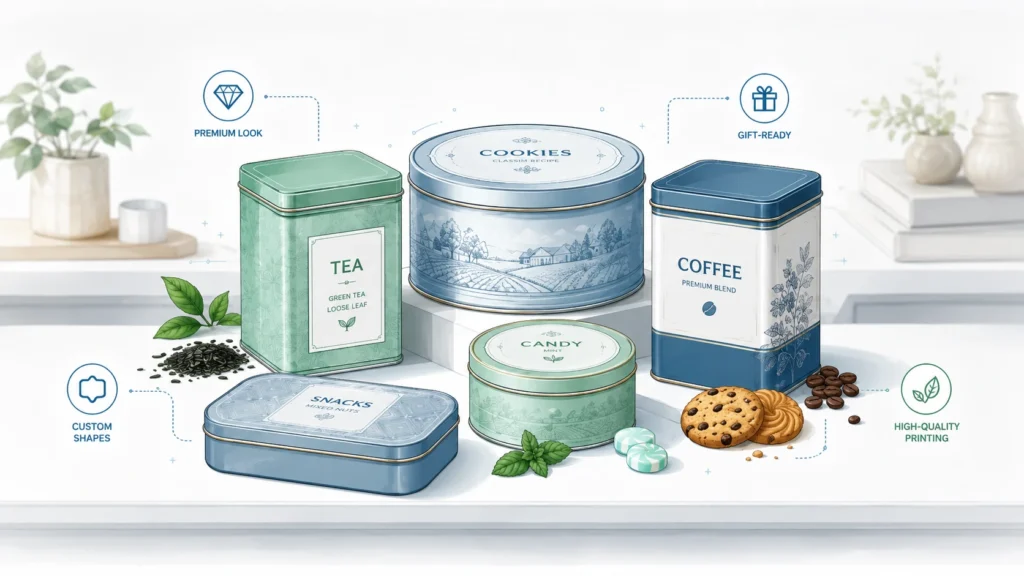
A flat paper carton competes mostly through printed graphics. A food tin competes through print plus shape, shine, texture, edge quality, lid movement, embossing, debossing, window options, and finish. A matte tea tin can look calm and premium. A glossy cookie tin can look festive and bright. A small mint tin can look portable and collectible. A chocolate gift tin can feel luxurious when paired with a fitted insert and clean interior presentation.
For more detail on how metal packaging can strengthen perceived value, see Metal Tin Packaging: Benefits, Applications & Custom Options for Brands and Metal Tins with Lids: Structure Guide for Custom Packaging. These resources show why structure, lid type, finish, and customization options should be planned together instead of treated as separate purchasing details.
Shelf appeal also affects e-commerce. Product photos of metal tins can perform well because metal packaging reflects light, creates depth, and communicates premium quality. However, reflective surfaces require careful artwork and finish choices. A glossy tin may look attractive in retail lighting but show glare in photos. A matte tin may photograph better for minimalist brands but need scratch-resistant varnish and protective packing. A metallic effect can look premium but may shift color compared with a paper proof. These tradeoffs should be reviewed during sampling.
| Shelf appeal element | Commercial effect | Food tin design option |
|---|---|---|
| Unique shape | Helps the SKU stand out in a crowded shelf set | Rectangular, square, round, oval, heart, house, book, or custom mold |
| Premium finish | Signals quality before the product is tasted | Matte, gloss, satin, metallic, soft-touch, spot UV, textured varnish |
| Tactile branding | Makes the package more memorable | Embossed logo, debossed pattern, raised border, textured surface |
| Color consistency | Protects brand identity across repeat orders | Pantone control, metal proofing, approved golden sample |
| Window display | Shows product while retaining metal structure | PET window, transparent lid, hybrid tin-window structure |
| Insert design | Improves unboxing and product arrangement | Paper tray, plastic tray, molded insert, divider, inner pouch, sleeve |
| Reusable form | Keeps brand visible after consumption | Durable lid, attractive interior, collectible artwork, storage-friendly size |
Common food tin structures and when to use them
The right structure depends on product type, retail channel, target price, and user behavior. Food tins are not one standard box. They can be shallow, deep, round, rectangular, hinged, slip-lid, plug-lid, stackable, windowed, compartmentalized, or shaped for a specific promotion.
Slip-lid tins are common for tea, cookies, candies, mints, and gift products. They are easy to open and can be cost-effective when a standard mold is available. Plug-lid tins can create a tighter premium feel for tea, coffee, and powders. Hinged tins are useful for mints, candies, gift cards, sampler sets, and portable products where the lid should stay attached. Windowed tins are useful when product visibility improves trust, such as colorful candies, decorated cookies, or mixed gift assortments. Compartment tins can separate flavors, colors, or small items for a more organized unboxing experience.
A detailed overview of lid options and structure selection is available in Tin Containers with Lids for Food, Gifts & Personal Care Packaging. For compact formats, Small Tin Containers: Sizes, Uses, and Custom Packaging Ideas is useful for brands planning mint tins, sample tins, promotional tins, mini snack tins, spice tins, or portable food packaging.
| Tin structure | Best-fit food categories | Advantages | Watch-outs |
|---|---|---|---|
| Round tin | Tea, cookies, chocolates, confectionery, gift assortments | Classic shape, good shelf recognition, strong gift feel | Artwork alignment and lid tolerance should be checked |
| Rectangular tin | Cookies, biscuits, tea bags, chocolate bars, gift sets | Efficient shelf and shipping layout, large branding area | Large flat panels may need stronger gauge or structural ribs |
| Square tin | Tea, coffee, candies, premium snacks | Compact, stackable, modern appearance | Corners require good forming and packing protection |
| Hinged tin | Mints, candies, sampler sets, promotional food gifts | Lid stays attached, good repeated-use experience | Hinge alignment and opening force must be controlled |
| Windowed tin | Candies, decorated cookies, colorful snacks | Allows product visibility while retaining metal structure | Window material must be reviewed for food-contact and scratch risk |
| Compartment tin | Chocolate assortments, candies, spices, sampler packs | Separates flavors and improves unboxing | Insert material and fit tolerance affect perceived quality |
| Custom-shaped tin | Seasonal gifts, licensed products, children’s snacks, brand campaigns | High memorability and strong retail differentiation | Tooling cost, development time, and artwork distortion must be planned |
Printing and finishing options for food tins
Food tins are excellent for branding because tinplate supports rich printing and many decorative effects. Most custom decorative tins are printed on flat tinplate sheets before forming. This allows full-surface artwork, photographic images, patterns, seasonal designs, and brand colors. After printing, the sheet is varnished, cut, stamped, curled, assembled, and packed.
Metal printing behaves differently from paper printing. Tinplate is non-porous and reflective. Colors may look different depending on whether the design uses a white base coat, clear base, metallic background, matte varnish, or glossy varnish. A paper proof is useful for layout, but a metal proof is better for final color approval. Buyers should avoid placing small text too close to curled edges, hinges, seams, or deep forming areas. Artwork should be prepared with the dieline and forming zones in mind.
Embossing and debossing are particularly valuable for food tins because they add tactile recognition. A raised logo on a tea tin or cookie tin can make the product feel more premium. A debossed pattern can create subtle luxury without adding too much visual noise. However, embossing depth must be realistic. Aggressive embossing can distort printed details, crack coating, or affect stacking. The best results happen when the packaging factory reviews structure, artwork, and finish together.
| Finish option | Visual and tactile effect | Good applications | Procurement note |
|---|---|---|---|
| Gloss varnish | Bright, shiny, colorful, retail-friendly | Holiday cookie tins, children’s candy tins, festive gift tins | Can show glare and fingerprints in photography |
| Matte varnish | Soft, modern, premium, low glare | Tea, coffee, chocolate, minimalist snack brands | Needs scratch-resistance review for dark colors |
| Satin varnish | Balanced between gloss and matte | Mass-market premium food tins | Often a practical finish for repeat production |
| Metallic effect | Uses metal shine for premium depth | Coffee, tea, confectionery, luxury gifts | Colors can appear darker than paper proofs |
| Soft-touch coating | Smooth tactile feel | Premium chocolates, gift sets, boutique food brands | Must test scuffing, fingerprints, and packing protection |
| Embossing | Raised surface texture | Logos, borders, patterns, limited editions | Confirm forming limits before artwork approval |
| Debossing | Recessed surface detail | Luxury branding, subtle patterns | Avoid conflict with fine printed text |
| Spot UV | Local contrast and shine | Logos, product names, decorative highlights | Requires accurate registration |
Sustainability, reuse, and recyclability
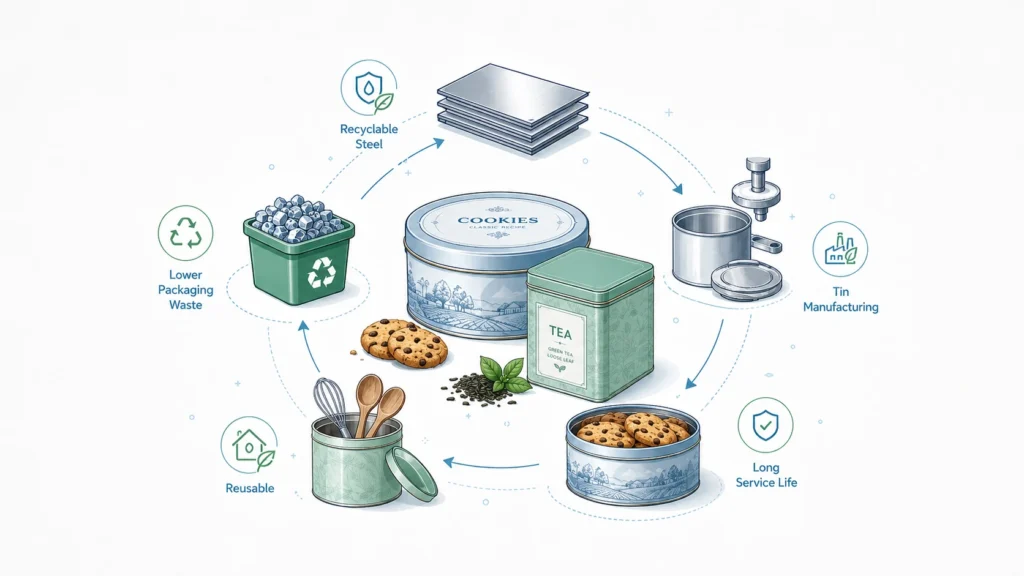
Sustainability claims must be accurate, specific, and market-aware. Metal packaging has strong sustainability advantages, especially reusability and recyclability, but actual recycling outcomes depend on local collection, sorting, and recycling systems. A brand should not simply claim that a food tin is “zero waste” or “fully sustainable” without evidence and local context. A better claim is more specific: reusable tinplate packaging, recyclable where metal packaging collection exists, designed for long-term secondary use, or made to reduce the need for additional gift wrapping.
Recycling data is one reason metal packaging remains attractive. Steel for Packaging Europe reported that 82% of steel packaging placed on the European market was “really recycled” in 2023 under the EU harmonized methodology. In the United States, the EPA estimated the recycling rate of steel containers and packaging at 73.8% of generation in 2018, compared with 13.6% for plastic containers and packaging. Eurostat also reports EU packaging recycling targets, including 80% for ferrous metals by 2030 and 60% for aluminium by 2030.
These figures are useful for B2B marketing, but they should be used responsibly. Recycling rates vary by region, material, collection system, and measurement method. A decorative food tin with a plastic window, magnets, mixed inserts, or adhesive labels may require additional design consideration to improve recyclability. Reuse is often the strongest consumer-facing advantage because shoppers naturally keep attractive tins for storage. For food brands, reusable design can be a practical way to extend brand exposure and reduce the perceived waste of premium packaging.
Food waste is also part of the sustainability conversation. The FAO State of Food and Agriculture 2019 reported that around 14% of food produced globally is lost from the post-harvest stage up to, but excluding, retail. The UNEP Food Waste Index Report 2024 estimated that 1.05 billion tonnes of food were wasted at retail, food service, and household levels in 2022. Packaging cannot solve food loss and waste alone, but appropriate packaging can help protect quality, reduce breakage, support portioning, and maintain consumer confidence.
| Sustainability topic | Useful data point | What it means for food tin buyers |
|---|---|---|
| European steel packaging recycling | 82% “really recycled” in 2023 according to Steel for Packaging Europe | Steel-based tins can support circular packaging narratives in markets with strong recycling systems |
| U.S. steel containers and packaging | EPA estimated 73.8% recycling of steel containers and packaging in 2018 | Metal tins may compare favorably with many plastic packaging categories in recycling discussions |
| U.S. plastic containers and packaging | EPA estimated 13.6% recycling in 2018 | Brands should avoid vague “recyclable” claims and compare materials carefully |
| EU packaging recycling target | Eurostat notes 2030 targets by material, including 80% for ferrous metals | EU-bound brands should design packaging with future recyclability expectations in mind |
| Food loss and waste | FAO and UNEP highlight large global food loss and waste volumes | Durable packaging can contribute to protection, but claims should be supported by testing and responsible wording |
Cost, MOQ, tooling, and lead time considerations
Custom food tins can be cost-effective, but they require more planning than simple paper boxes. The total cost depends on tinplate thickness, structure, mold status, size, printing colors, varnish, embossing, inner accessories, packaging method, order quantity, inspection level, and shipping route. A standard mold is usually faster and less expensive than a custom mold. A custom shape can create stronger differentiation, but it requires tooling cost, engineering review, and development time.
MOQ is also influenced by printing and material efficiency. Metal offset printing is typically done on sheets, and each sheet layout may include multiple pieces. If a design uses many colors, special varnish, or separate artwork versions, the production setup becomes more complex. For seasonal food tins, buyers should plan earlier because delays in artwork approval, sample confirmation, or compliance documents can threaten the sales window.
Lead time should be separated into stages: requirement confirmation, structure design, mold selection or mold development, artwork adaptation, proofing, sample production, sample approval, mass printing, stamping, assembly, QC, packing, and shipping. A supplier may be able to produce prototypes quickly, but that does not mean mass production can start without approved artwork, material, coating, and packing standards.
At Mr. Tin Box, the custom workflow generally includes consultation, 3D drawing and structure design, mold development or sample making, printing and surface finishing, stamping and assembly, and final quality inspection. This process is described on the Food & Beverage Packaging page and is important because each stage reduces a different type of risk.
| Cost driver | How it affects the project | Cost-control suggestion |
|---|---|---|
| Tin size and shape | Larger tins use more material and may require stronger gauge | Start from product volume, shelf space, and shipping carton efficiency |
| Standard vs custom mold | Custom mold increases tooling investment and development time | Use standard molds for fast launches; reserve custom molds for hero SKUs |
| Printing complexity | More colors and effects increase setup and proofing complexity | Keep seasonal versions on the same structure where possible |
| Finish type | Matte, soft-touch, spot UV, and embossing can add cost | Use premium effects on focal areas rather than every surface |
| Insert and inner liner | Trays, dividers, and pouches improve presentation but add cost | Choose inserts based on product protection and unboxing value |
| Inspection and packing | Higher protection reduces dents and scratches but increases packing cost | Define acceptable defect limits and retail presentation requirements early |
| Shipping method | Air freight is faster but costly for metal packaging | Plan seasonal production early to allow sea freight where possible |
How to choose the right food tin for your product
The best food tin is not the most expensive or the thickest. It is the structure that matches the product, the brand position, the retail channel, the compliance requirement, and the target cost. A premium chocolate gift tin may need a refined matte finish, insert tray, and embossed logo. A mass-market cookie tin may need strong panel stability, colorful printing, and efficient shipping. A tea tin may need aroma protection, a clean interior, and repeated-use closure quality. A mint tin may need smooth edges, pocket durability, and reliable lid retention.
Start with the product. Is it dry, oily, wrapped, loose, powder, aromatic, fragile, or temperature-sensitive? Then define the packaging role. Is the tin the primary food-contact container, a secondary gift box, a reusable storage container, or a promotional collectible? Next, define the market. Does it need FDA, EU, LFGB, retailer-specific, BPA-free, or other documentation? Finally, define the commercial goal. Is the tin meant to reduce damage, justify a premium price, launch a seasonal campaign, increase gifting value, or improve repeat purchase?
A useful buyer brief should include product weight, product dimensions, filling method, direct-contact status, expected shelf life, target market, artwork direction, preferred finish, target order quantity, timeline, shipping destination, and packaging requirements. The more clearly this information is shared, the more accurately the supplier can recommend structure and cost.
| Buyer decision | Good question | Why it matters |
|---|---|---|
| Product contact | Will food directly touch the tin or an inner pouch? | Determines coating, testing, and compliance direction |
| Product sensitivity | Is the food moisture-sensitive, aroma-sensitive, oily, acidic, or fragile? | Determines lid, liner, material, and packing strategy |
| Sales channel | Retail shelf, e-commerce, wholesale, duty-free, gift shop, or seasonal display? | Determines finish, dent resistance, barcode location, and outer carton protection |
| Brand position | Mass-market, premium, luxury, organic, children’s, holiday, or corporate gift? | Determines structure, color, artwork, and finish choices |
| Reuse expectation | Should consumers keep the tin after consumption? | Determines durability, interior appearance, and closure experience |
| Launch timing | Is the project tied to Christmas, Lunar New Year, Valentine’s Day, or a trade show? | Determines whether standard mold or custom mold is realistic |
Quality control points before mass production
Food tin quality is visible. A small scratch, dent, color shift, loose lid, sharp edge, or odor issue can damage the consumer’s perception of the food inside. This is why a golden sample is essential. The approved sample should define the acceptable standard for structure, print, finish, lid fit, color, embossing, insert, odor, and packing.
Mass production should control both appearance and function. Appearance checks include scratches, dents, print defects, dust, color variation, varnish consistency, embossing quality, and edge cleanliness. Functional checks include lid fit, opening force, hinge movement, stacking, insert fit, barcode scan position, carton packing, and drop resistance when required. For food-contact projects, documentation and traceability should also be controlled.
It is also important to inspect the packaging method. Tins can scratch each other if packed without enough separation. Dark matte finishes may need extra protection. Windowed tins require protection against window scratches. Large flat lids may need careful stacking. Export cartons should be strong enough for real logistics, not just factory storage.
| QC item | What to check | Why it matters |
|---|---|---|
| Color and printing | Pantone match, image sharpness, registration, text clarity | Protects brand consistency across retail shelves |
| Surface finish | Scratch, scuff, gloss level, matte uniformity, fingerprints | Affects premium perception and e-commerce photos |
| Lid fit | Opening force, closing feel, shake resistance, repeated use | Affects user experience and product protection |
| Edge safety | Smooth curled edges, no burrs, no sharp corners | Protects consumers and supports quality perception |
| Interior condition | Cleanliness, odor, coating coverage, liner fit | Important for food safety, flavor, and trust |
| Insert fit | Product movement, tray stability, divider position | Reduces breakage and improves unboxing |
| Packing protection | Individual wrapping, separators, carton strength, pallet plan | Reduces scratches and dents during shipment |
| Documentation | Material declarations, test reports, batch references | Supports importer, retailer, and compliance review |
Food tins for different commercial strategies
Food tins can support several commercial strategies. They can make an everyday product feel premium. They can turn a seasonal product into a gift. They can improve shelf blocking through consistent shapes and colors. They can support limited editions and collectible series. They can help brands move from low-margin commodity packaging into higher perceived value.
For tea and coffee brands, food tins work well when the brand wants a permanent kitchen presence. A well-designed tin can sit on the counter and remind the customer to repurchase. For cookies and biscuits, tins are especially useful for holiday gifting and family occasions. For chocolates and candies, tins can create a premium unboxing experience and improve product organization. For spices and powdered foods, small tins can create a clean, reusable storage system. For corporate food gifts, the tin can carry a logo, message, or event artwork while protecting the contents.
Food tins are also effective for product line architecture. A brand can use the same tin structure across multiple flavors while changing color bands, labels, embossing plates, or printed artwork. This creates a consistent family look while allowing SKUs to be differentiated. For seasonal campaigns, a brand can use limited-edition artwork on an existing mold, reducing tooling cost while creating newness.
For brands planning a cross-category packaging system, Mr. Tin Box also supports adjacent categories such as Gift, Promotional & Holiday Packaging, which is relevant for food gift sets, corporate food promotions, and seasonal assortments.
| Strategy | Food tin approach | Example use |
|---|---|---|
| Premium upgrade | Use matte finish, embossing, better lid fit, and clean insert | Specialty tea, premium coffee, luxury chocolates |
| Seasonal gifting | Use festive artwork on existing tin mold | Christmas cookies, Lunar New Year candy, Valentine chocolate |
| Collectible series | Use numbered designs, artist artwork, or regional themes | Tea collections, biscuit series, souvenir tins |
| E-commerce protection | Use rigid tins with inner trays and stronger export cartons | Fragile cookies, chocolate assortments, snack gifts |
| Retail shelf blocking | Use consistent tin shape with SKU color variation | Spice range, tea range, mint range |
| Corporate promotion | Add custom logo, message, and gift-ready presentation | Event candies, branded cookies, premium sample sets |
Common mistakes to avoid when buying custom food tins
The first mistake is choosing the tin only by appearance. A food tin must look good, but it must also fit the product, meet contact requirements, survive logistics, and be manufacturable. A beautiful shape that causes high scrap rates or dents easily may not be commercially successful.
The second mistake is ignoring the inner packaging. Many food tins rely on an inner pouch, liner, tray, or wrapper. If the inner pack is weak, the outer tin cannot fully protect freshness. If the inner pack looks cheap, the premium effect of the tin is reduced. The best food tin projects consider both outer presentation and inner protection.
The third mistake is approving artwork without considering forming. Printed metal is stamped and curled after printing. Logos, text, patterns, and gradients can distort near edges, corners, seams, and embossed areas. Artwork should be reviewed against the dieline and forming map.
The fourth mistake is making unsupported shelf-life or sustainability claims. Buyers should test the complete packaging system before making specific shelf-life promises. Sustainability claims should reflect actual material, local recyclability, reuse potential, and regulatory expectations.
The fifth mistake is ordering too late for seasonal launches. Food tins require sampling, artwork approval, material preparation, printing, forming, inspection, packing, and shipping. Christmas, Easter, Lunar New Year, Valentine’s Day, Ramadan, and other seasonal programs should be planned well in advance.
A practical specification checklist for food tin projects
A clear specification saves time, reduces quotation errors, and improves final quality. The following checklist can be used before contacting a tin packaging supplier.
| Specification area | Details to prepare |
|---|---|
| Product information | Food type, weight, dimensions, wrapped or loose, dry/oily/acidic/aromatic, fragile or not |
| Contact status | Direct contact with tin, contact with liner, inner pouch, tray, individual wrapper, or no food contact |
| Target market | United States, European Union, United Kingdom, Canada, Australia, Japan, Middle East, or other markets |
| Compliance needs | FDA, EU food contact, LFGB, BPA-free, heavy metals, retailer manual, migration testing, or other requirements |
| Tin structure | Round, square, rectangular, hinged, slip lid, plug lid, windowed, compartment, custom shape |
| Dimensions | Internal dimensions, external dimensions, shelf space, product fit, carton count |
| Artwork | Brand files, dieline, Pantone colors, CMYK images, barcode, nutrition label, language versions |
| Finish | Matte, gloss, satin, metallic, soft-touch, embossing, debossing, spot UV, window |
| Insert and liner | Paper liner, plastic tray, molded pulp, inner bag, divider, desiccant, label, sleeve |
| Testing | Lid fit, drop, vibration, odor, coating, migration, rub, salt spray if relevant, shelf-life validation |
| Packing | Individual polybag or paper wrap, separators, inner carton, export carton, palletization |
| Timeline | Sample deadline, approval deadline, mass production deadline, shipping deadline, launch date |
How Mr. Tin Box supports food tin packaging projects
Food tin packaging requires a combination of material knowledge, tooling capability, printing control, finishing experience, compliance awareness, and quality inspection. Mr. Tin Box supports custom metal tin packaging projects from idea to mass production, including structure consultation, 3D design, mold development, sample making, metal printing, surface finishing, stamping, assembly, QC, and export packing.
For food brands, we help evaluate whether the project is better suited to an existing mold or a custom mold. Existing molds can reduce development time and cost. Custom molds can create stronger shelf differentiation when the product needs a unique silhouette or branded shape. We also help buyers plan printing and finishing so that artwork, embossing, lid structure, and packaging protection work together.
Our food and beverage tin packaging services are suitable for tea tins, coffee tins, cookie tins, biscuit tins, chocolate tins, candy tins, mint tins, spice tins, snack tins, and seasonal food gift tins. Depending on product requirements, the tin can be designed for direct food contact, indirect food contact with inner packaging, or decorative secondary packaging. For complex food-contact scenarios, buyers should share product details and destination market requirements so the correct coating and documentation can be discussed early.
A successful food tin project is not only about making a container. It is about creating a retail-ready packaging system that protects food, supports compliance, photographs well, survives logistics, improves shelf appeal, and fits the brand’s commercial strategy.
Frequently asked questions about food tins
Are food tins safe for direct food contact?
Food tins can be designed for direct food contact, but safety depends on the material, internal coating, food type, destination market, and testing requirements. A decorative tin for wrapped cookies is different from a direct-contact tin for loose oily snacks. Buyers should define the food-contact scenario and request appropriate documentation.
Do all food tins need an internal lacquer?
Most food-related tinplate packaging uses some form of internal coating or lacquer, especially where direct contact, aroma sensitivity, or corrosion control matters. If the food is packed in a sealed inner pouch, the coating requirement may be different, but the complete packaging system should still be reviewed.
Can food tins extend shelf life?
Food tins can help protect products from light, impact, handling, and, depending on the closure and inner pack, moisture and oxygen exposure. However, shelf life must be validated with the actual food, packaging structure, process, and storage conditions. Packaging should support shelf life, not replace proper formulation and testing.
What foods are best suited for metal tins?
Food tins are especially popular for tea, coffee, cookies, biscuits, chocolates, candies, mints, spices, snack mixes, powdered products, and seasonal food gift sets. They are most valuable when the product benefits from premium presentation, protection, reuse, or gifting appeal.
Are food tins recyclable?
Steel-based tins are recyclable in many markets where metal packaging collection and recycling systems exist. Recycling outcomes depend on local infrastructure and package design. Tins with mixed materials, windows, labels, or inserts should be designed carefully to support recycling and clear consumer instructions.
Are food tins reusable?
Yes. Reuse is one of the strongest practical advantages of decorative food tins. Consumers often keep tins for tea, coffee, stationery, sewing supplies, snacks, craft items, or household storage. Reusable design can extend brand visibility after the food is consumed.
What is the best lid type for food tins?
There is no single best lid. Slip lids are common and cost-effective. Plug lids can feel tighter and more premium. Hinged lids are convenient for small candies and mints. Windowed lids help show colorful products. The best lid depends on product weight, user behavior, desired opening force, and shelf positioning.
How early should a seasonal food tin project start?
Seasonal tins should start as early as possible because artwork, sampling, mold decisions, printing, production, inspection, and shipping all require time. If the project uses a custom mold, start earlier than a standard-mold project. Late starts can force compromises in shipping cost, finish choices, or launch timing.
Can one tin structure be used for multiple SKUs?
Yes. Many brands use one tin structure across several flavors or seasonal variants. This can reduce tooling cost and create a consistent shelf family. SKU differentiation can be achieved through color, label, printed artwork, embossing plate, insert, or sleeve.
What files are needed for custom printed food tins?
Most projects require vector logo files, dieline-based artwork, Pantone or CMYK color information, barcode placement, product information, nutrition or regulatory text if printed on the tin, and any retailer-required labeling. For best results, artwork should be reviewed against forming areas before proofing.
Final thoughts
Food tins remain a strong packaging choice because they combine product protection with commercial value. They help block common external threats, improve handling durability, support premium printing, strengthen shelf appeal, and create a package consumers may reuse long after the food is finished. For food brands competing in crowded retail and e-commerce markets, that combination can make the difference between ordinary packaging and memorable packaging.
The best results come from treating the tin as a complete packaging system. Material, coating, lid fit, inner liner, artwork, finish, compliance, testing, and logistics should be planned together. A tin that looks beautiful but has poor closure, weak packing, unclear food-contact status, or unrealistic lead time can create problems. A tin that is engineered from the beginning around the product and the sales channel can protect the food, support the brand, and improve perceived value.
If you are developing tea tins, coffee tins, cookie tins, chocolate tins, candy tins, mint tins, spice tins, snack tins, or seasonal food gift tins, Mr. Tin Box can help you evaluate structure, finish, mold options, inner packaging, and production planning. Start with the product’s protection needs, define the target market, choose a structure that fits the brand, and build a food tin that works both on the shelf and in the customer’s hands.