



Premium brands rarely win on product quality alone. In crowded retail channels and increasingly demanding online markets, customers judge a product long before they use it. They read the material, feel the finish, notice the structure, and decide whether the packaging looks disposable or worth keeping. That is exactly why custom metal tin packaging continues to gain attention among serious brand owners in food, beauty, gifting, and specialty products. A well-designed tin is not simply a container. It is part protection system, part brand signal, part compliance decision, and part long-term commercial asset.
For premium products, packaging has to do more than look attractive in a catalog. It has to preserve aroma, texture, and product integrity. It has to arrive in one piece after warehousing, export handling, and e-commerce shipment. It has to justify a higher perceived value without creating avoidable operational risk. It also has to fit a business environment shaped by tighter sustainability expectations, stricter food-contact rules, and more educated buyers. In that context, custom metal tins are valuable because they solve several problems at once instead of only one.
At Mr.Tin.Box, that practical reality is visible across the company’s work in Food & Beverage Packaging, Beauty & Personal Care Packaging, Gift, Promotional & Holiday Packaging, and Specialty & Industrial Packaging. The site’s broader content library also reflects the same idea from different angles, including Custom Metal Tin Packaging for Food, Beauty, and Gift Brands, Why Metal Packaging Boosts Shelf Life and Brand Value, Metal Packaging Trends for Premium Consumer Goods, Global Sourcing Guide for Custom Metal Packaging, How to Select the Right Factory for Metal Packaging, and Design Principles for Modern Metal Packaging Solutions.
This article explains, in plain business language, why custom metal tins are especially effective for premium product packaging. It also integrates publicly available information from the U.S. Environmental Protection Agency, the European Commission, the U.S. Food and Drug Administration, the World Steel Association, the OECD, Steel for Packaging Europe, and McKinsey’s 2025 packaging consumer research. The goal is not to make theoretical claims. The goal is to show why premium packaging decisions around metal can create measurable commercial advantages when they are engineered correctly.
Table of Contents
Premium packaging now has to perform, not just decorate
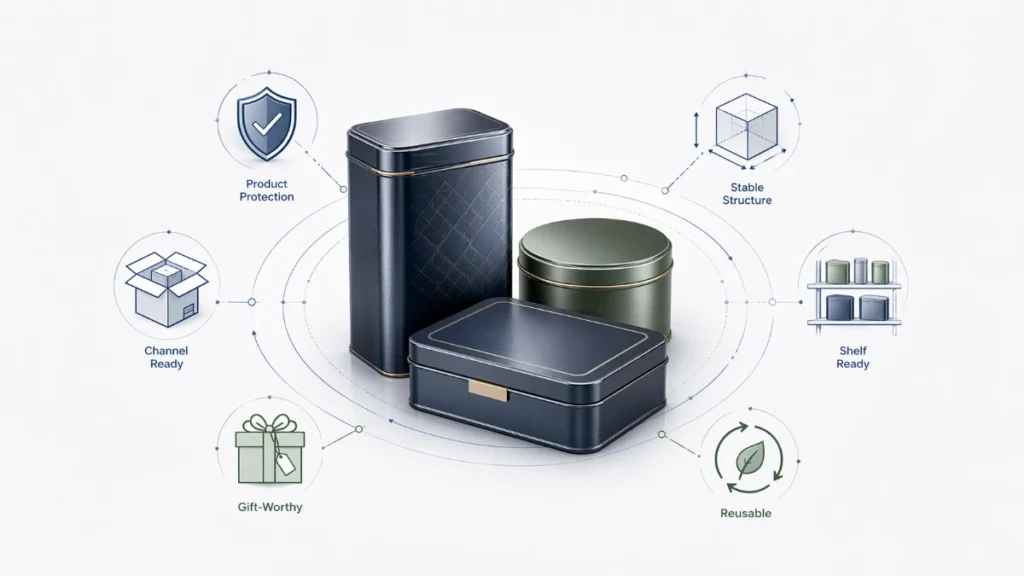
Ten or fifteen years ago, many brands treated premium packaging as a visual decision. If the box looked elegant and the print quality was acceptable, that was often enough. Today, that standard is no longer sufficient. Premium packaging now sits at the intersection of branding, logistics, compliance, sustainability, and customer experience. That change matters because it shifts packaging from a marketing accessory to an operational decision.
A premium pack must first protect the product. That sounds obvious, but it is often where under-specified packaging fails. A beautiful pack that scuffs in transit, dents too easily, leaks aroma, or collapses under load does not act like premium packaging in the real world. It acts like an avoidable business problem. When a brand invests in premium ingredients, refined formulas, or elevated product positioning, weak packaging undercuts the whole commercial promise.
A premium pack must also support channel complexity. Many products no longer move through only one route to market. They may need to work on shelves, in gift boxes, in cross-border shipments, and in e-commerce parcels. The packaging has to survive all of those conditions while still delivering the same emotional message at the moment of opening. This is where rigid metal structures have an advantage. They offer a higher baseline of dimensional stability than many flexible or light paper-based alternatives, and they keep presentation more consistent across handling conditions.
Then there is the customer’s interpretation of value. Premium buyers do not judge price only through the product itself. They judge it through coherence. Does the packaging feel aligned with the formula, ingredients, gifting intent, or collectible nature of the item? Does it feel considered? Does it invite retention rather than disposal? When the answer is yes, the package supports margin. When the answer is no, the package weakens pricing power even before the product is tried.
This is one reason premium metal packaging continues to grow in categories that depend heavily on first impression, repeat gifting, and shelf credibility. The pack is not only decorative. It provides a practical structure for preserving product quality, reducing presentation risk, and reinforcing price justification in a way that customers understand immediately.
What custom metal tin packaging really includes
The phrase custom metal tin packaging is often used loosely, but buyers should separate several very different packaging roles before making design decisions. In practice, metal tins can function as primary packaging, secondary packaging, premium outer packaging, promotional packaging, or reusable post-purchase storage. Each role creates different technical requirements, different cost logic, and different compliance checkpoints.
Primary packaging means the product directly contacts the metal pack or its approved lining system. Tea tins, confectionery tins, balm tins, coffee tins, and some dry food containers fall into this category. In these applications, the buyer must think carefully about food-contact compliance, internal coating compatibility, closure integrity, and migration control. Visual design still matters, but it comes after product protection and regulatory fit.
Secondary packaging means the product sits inside another primary pack, and the metal tin acts as the protective and branding shell. This structure is common for skincare sets, fragrance kits, chocolate assortments, supplements, candles, and promotional collections. Here, the metal pack does not always require the same direct-contact specification, but it becomes even more important in controlling presentation, protection, and the premium unboxing experience.
Promotional and holiday packaging is a further category. The tin may hold a product for a limited time, but the real commercial value lies in collectibility, reusability, and visual storytelling. These programs are common in seasonal confectionery, commemorative launches, collaboration packs, and corporate gifts. In those cases, the retained life of the tin is part of the commercial strategy. The packaging becomes a reminder object that stays in the customer’s environment long after the initial product has been consumed.
There is also the material distinction within metal itself. Tinplate and aluminum are not identical solutions. Tinplate tends to offer excellent stiffness, robust formability for many decorative box formats, and strong compatibility with premium rigid structures. Aluminum can be valuable where light weight, corrosion resistance, or particular forming behaviors are important. The correct choice depends on the product, structure, channel, and price point rather than on a generic assumption that one metal is always superior.
That is why experienced suppliers do not begin with artwork alone. They begin with the packaging role, product sensitivity, distribution conditions, required finish quality, and expected commercial scale. Once those variables are clear, the material, structure, and finishing route can be chosen more intelligently.
Public data that strengthens the business case
The argument for premium metal packaging becomes more persuasive when it is supported by widely usable public information rather than only by aesthetic opinion. The data below do not mean that metal is always the correct answer for every SKU. They do show why metal belongs in serious packaging conversations for premium products.
| Public data point | Source | Why it matters commercially |
|---|---|---|
| U.S. EPA estimated the 2018 recycling rate for all containers and packaging at 53.9%. | U.S. EPA Containers and Packaging | Packaging choices are now evaluated not only on function, but on how credibly they fit real recovery systems. |
| U.S. EPA estimated steel containers and packaging recycling at 73.8% in 2018, with 1.63 million tons recycled. | U.S. EPA Steel Containers and Packaging | Steel packaging already participates in established recovery streams, which supports stronger circularity messaging. |
| EPA also reported a 70.9% recycling rate for steel cans in 2018. | U.S. EPA Ferrous Metals | Buyers comparing formats can see that steel cans have meaningful recovery infrastructure in real markets. |
| Steel for Packaging Europe reported that 82% of steel packaging was really recycled in Europe in 2023. | Steel for Packaging Europe | Premium brands selling into Europe can use metal packaging within a more credible recycling narrative. |
| The European Commission states that the Packaging and Packaging Waste Regulation (PPWR) entered into force on 11 February 2025 and will generally apply from 12 August 2026. | European Commission Packaging Waste | Regulation is moving packaging decisions toward recyclability, reduction, and clearer materials strategies. |
| The European Commission states that food-contact materials must not transfer constituents into food at levels that endanger health or unacceptably change food composition, taste, or odor. | European Commission Food Contact Materials | Food tins require coating, lining, and process discipline. Decoration alone is not enough. |
| FDA maintains a formal framework for food contact substances and related regulatory inventories. | FDA Packaging & Food Contact Substances | Food-packaging buyers should evaluate suppliers on regulatory competence, not only on sample appearance. |
| FDA states that many color additives used in food, drugs, or cosmetics are subject to approval and batch certification. | FDA Color Certification | Premium beauty and personal-care packaging requires attention to decorative chemistry and label claims. |
| USDA notes that high-acid canned foods generally keep best quality for 12–18 months, while low-acid canned foods can keep best quality for 2–5 years. | USDA FSIS Food Product Dating | Shelf-stable packaging has real value for export programs, inventory planning, and premium slow-turn SKUs. |
| OECD reported global plastic waste rose from 156 million tonnes in 2000 to 353 million tonnes in 2019, with 40% from packaging. | OECD press release | Brands face growing pressure to justify disposable packaging formats and improve material recovery credibility. |
| World Steel describes steel as a permanent material that can be recycled over and over without losing its properties. | worldsteel circular economy | Metal’s circularity story is strategically useful when premium brands need durable sustainability positioning. |
| McKinsey’s 2025 U.S. packaging survey found that food safety and shelf life remain the most important packaging characteristics, and 77% of respondents rate recyclability as extremely or very important for packaging sustainability. | McKinsey 2025 US consumer views | Premium packaging has to satisfy both product protection and credible sustainability expectations. |
These figures matter because they point in the same direction. Buyers increasingly expect packaging to be durable, recyclable, regulation-aware, and clearly compatible with the product category. Metal is not the only packaging material that can address those needs, but it is one of the few that can do so while also strengthening the premium feel of the product.
Why metal works so well for premium perception
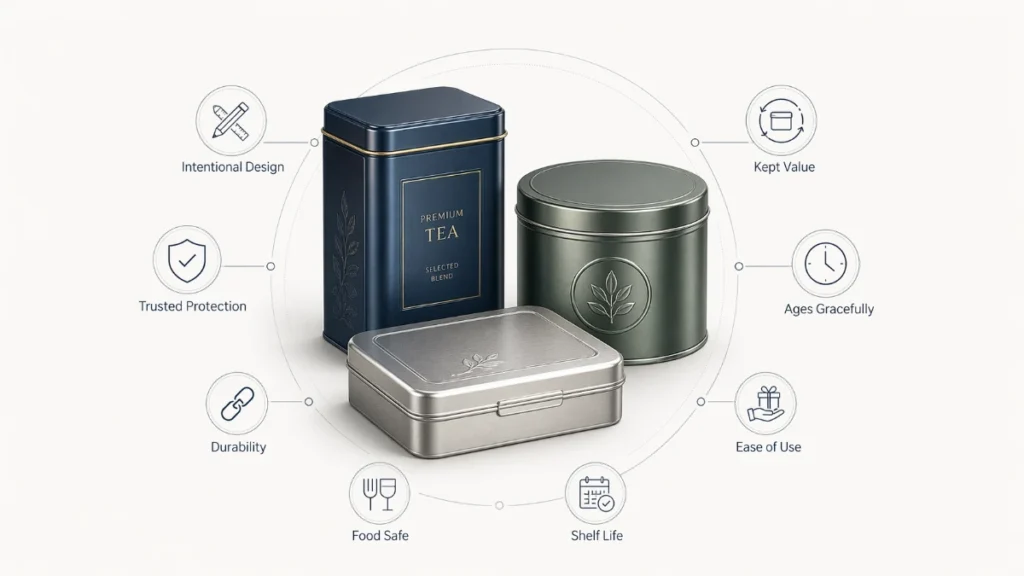
Premium perception is built from signals. Customers do not read a technical brief before deciding whether a product feels high quality. They interpret weight, rigidity, sound, closure feel, surface finish, edge quality, and the overall coherence between packaging and product. Metal packaging performs unusually well because it offers a combination of tactile cues that customers often associate with permanence, care, and value.
First, metal feels intentional. A custom tin usually does not read like a low-commitment packaging choice. It suggests that the brand has invested in the structure itself rather than only in graphics. That impression becomes stronger when the tin includes well-controlled radii, a stable lid fit, crisp embossing, consistent varnish, or a high-quality insert. The customer senses this before understanding it analytically.
Second, metal gives brands better control over the “kept value” of packaging. A carton may be attractive, but it is often discarded quickly. A rigid tin is more likely to remain on a desk, vanity, kitchen shelf, or storage drawer. That retention matters because it extends the life of the brand object. The pack keeps communicating after the purchase, which is especially valuable for gift products, seasonal launches, and limited editions.
Third, metal aligns well with categories where trust matters. In premium tea, confectionery, supplements, candles, cosmetics, balms, and gift assortments, consumers want the packaging to imply that the product has been protected and cared for. A rigid decorated tin helps create that expectation. It does not replace formulation quality, but it supports the customer’s confidence in the product before use.
Fourth, metal tends to age more gracefully in premium applications. Minor handling marks on a flexible package can immediately reduce perceived value. A metal tin can often maintain its visual authority better over time, especially when coating and finish selections are specified correctly. That is important for retail display, warehousing, and gifting contexts where presentation must remain stable.
McKinsey’s 2025 U.S. packaging research also offers an important reality check. The same study that found recyclability to be highly important also noted that packaging appearance ranks lower than factors such as food safety, shelf life, ease of use, label information, and durability. That does not weaken the case for premium tins. It clarifies it. The winning package is not merely the prettiest one. It is the package that looks premium and performs against the deeper concerns buyers and end users actually have.
Barrier performance, shelf life, and product protection
One of the strongest reasons premium brands choose metal is that the package can support product protection in a very concrete way. The visual value of a tin is easy to notice, but the barrier value is often more important financially. Damage, aroma loss, moisture pickup, oxidation, and poor presentation all create downstream costs that are harder to see than unit packaging cost, yet often more expensive.
A scientific review published in the U.S. National Library of Medicine notes that metal-based packaging materials provide excellent barrier properties and are widely used in food packaging. That matters because many premium categories are highly sensitive to oxygen, light, or moisture. Tea can lose aromatic character. Coffee can stale. Confectionery can absorb moisture or lose texture. Powdered or dry goods can cake. Fragranced or active-containing products can lose stability or sensory impact. When the package reduces those risks, it protects both the product and the brand claim.
Food regulations also reinforce why barrier performance matters. Codex guidance on canned foods and U.S. regulations for low-acid foods in hermetically sealed containers make clear that long shelf life is not a marketing phrase by itself. It is linked to processing discipline, closure integrity, and the ability of the container system to maintain commercial sterility or protect product quality over time.
This does not mean every custom tin must become a fully hermetic technical package. It does mean that premium brands should think beyond graphics. The closure system, gasket, rolled edge, seam design, and internal fit all influence whether the pack preserves the product’s intended experience. A premium decorated box with poor closure engineering is a weak package no matter how beautiful it looks.
Shelf-life performance also matters because it reduces hidden waste. If packaging helps preserve product quality for longer, the brand may see fewer markdowns, fewer returns, better export resilience, and fewer customer complaints tied to “stale,” “dull,” or “damaged” first use. This is especially relevant for premium SKUs that move more slowly than mass-market products but still need to reach the consumer in perfect condition.
The same logic applies to physical protection. Tins can help reduce crushing, abrasion, and presentation damage in gift packs and e-commerce. When the internal insert design is correct, the package can stabilize glass bottles, jars, sachets, bars, or accessories without relying on excessive external packaging. That protects the product, simplifies presentation, and helps the premium pack arrive looking deliberate rather than overbuilt.
Sustainability and circularity are no longer side issues
For many years, sustainability in packaging was treated as a secondary message. Today, it is part of commercial risk management. Retailers, regulators, and customers increasingly expect brands to explain why they selected a material and how that material fits real circular systems. Metal packaging is relevant here not because it makes all sustainability questions disappear, but because it gives brands a stronger starting point in several important areas.
The first area is recyclability. According to worldsteel, steel is a permanent material that can be recycled again and again without losing its properties. Steel for Packaging Europe reports an 82% real recycling rate for steel packaging in Europe for 2023, while U.S. EPA figures show strong steel packaging recovery relative to many other packaging formats. These do not prove that every tin is automatically sustainable. They do prove that steel packaging participates in established recycling systems more credibly than many materials that are only recyclable in theory.
The second area is durability and reuse. Metal packaging can often be repurposed into storage, gifting, collectible display, or household organization. That retained life is not just a sentimental bonus. It can materially improve the sustainability story of a premium pack because the object stays useful instead of becoming immediate waste. A decorative holiday tin that is kept for years is operating very differently from a disposable single-use pack.
The third area is policy pressure on packaging waste. The European Commission’s PPWR timeline is one clear example that the regulatory environment is moving toward more recyclable, more transparent, and better-designed packaging systems. The OECD’s plastics data show why many brands are under pressure to re-evaluate packaging strategies, particularly in short-lived packaging categories. As a result, premium brands are increasingly asking not only “Does this package look right?” but also “Can we defend this package in a more demanding market?”
The fourth area is consumer expectation. McKinsey’s 2025 U.S. packaging findings show that recyclability is the most important sustainability factor for consumers, with 77% considering recyclable packaging extremely or very important. That is a useful insight because it suggests that visible circularity cues matter commercially. A premium tin can be positioned not just as a luxury object, but as a durable and recyclable one, which strengthens both brand legitimacy and market fit.
Of course, metal does not automatically win every carbon comparison. A lightweight pouch can appear favorable in some transport scenarios. But lifecycle value depends on more than grams of material. If a metal package increases recyclability, improves reuse, protects product quality, and reduces damage or spoilage, the business case becomes more sophisticated than a simple lightweighting argument. Premium products should be evaluated through the total system, not only through the empty package.
Why food and beverage brands choose custom tins
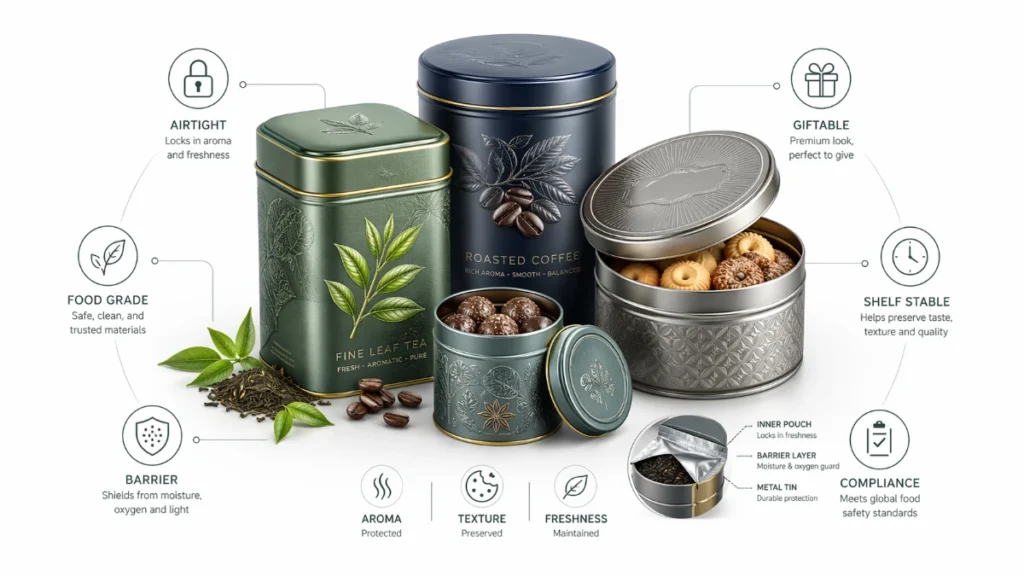
Food and beverage packaging is often the most technically demanding area for premium tins, but it is also one of the most commercially rewarding when done properly. Products such as tea, coffee, biscuits, confectionery, spices, cocoa, dry nutritional powders, and gourmet snacks all benefit from packaging that protects aroma, texture, and visual freshness.
The Food & Beverage Packaging section of Mr.Tin.Box emphasizes several features that matter in this category: airtightness, durability, food-grade materials, and strong barrier performance. Those are not abstract claims. In premium food packaging, light, moisture, oxygen, and contamination are common enemies. A well-specified tin helps reduce those variables and gives the brand a more stable presentation in retail and during storage.
Premium food brands also benefit from tins because the structure supports gifting and repeat use. Tea, chocolate, biscuits, and seasonal food collections often sell partly because they are giftable. A carton may protect the product, but a custom tin elevates it into an object with retained value. This is particularly important for holiday products, regional specialty foods, and assortments designed for corporate gifting or seasonal promotions.
Another advantage is presentation stability. Food packs frequently pass through long distribution chains and mixed storage conditions. If the outer pack dents easily or loses its shape, the premium impression is damaged before the consumer even opens it. Metal tins, especially those designed with appropriate gauge, edge construction, and closure geometry, are better suited to maintaining a crisp look across those conditions.
Food-contact compliance is where discipline matters most. The European Commission’s food-contact materials framework and FDA’s food contact substance resources make clear that food packaging must be considered as a regulated system. The right tin for tea is not necessarily the right tin for acidic confectionery or oil-containing food items. Internal coatings, lacquer selection, and testing logic have to match the product. A buyer who ignores that reality may get a beautiful sample and a poor long-term result.
That is why premium food buyers should ask more intelligent questions during development. What is the product’s sensitivity to oxygen, moisture, and light? Does it require a direct-contact pack or a tin around an inner pouch? What lining system is intended? How will closure integrity be verified? What shelf-life logic is being assumed? Those questions separate packaging that only photographs well from packaging that performs.
Why beauty and personal care brands are a natural fit
Beauty and personal care packaging depends heavily on emotion, texture, and visual authority, which is exactly where custom metal tins have unusual strength. The Beauty & Personal Care Packaging section of Mr.Tin.Box rightly positions metal as a premium structure for skincare sets, fragrances, essential oils, wellness products, and cosmetic collections. In these categories, packaging often functions as part of the product identity, not just as a protective shell.
One reason beauty brands use tins is tactile confidence. A well-made metal box feels more permanent and more intentional than many lightweight alternatives. That matters for gift sets, discovery kits, holiday editions, and collector collections where the packaging is meant to communicate sophistication. A premium metal pack suggests order, ritual, and durability, all of which fit the emotional language of beauty products.
Another reason is display coherence. Beauty products are frequently photographed, shared, gifted, and re-displayed in domestic settings. A tin helps the package retain a strong visual presence on vanities, shelves, and gifting surfaces. If the brand wants to signal refinement, minimalism, heritage, or collectible value, metal offers a better physical platform for those cues than many disposable options.
Metal tins are also valuable because they work well as outer presentation packs around individually protected units such as bottles, jars, sachets, or trays. This allows the brand to combine an elegant rigid exterior with a practical internal product system. The result is often more giftable, more reusable, and more aligned with premium pricing.
However, decoration and regulatory fit still require care. The FDA notes that many color additives used in food, drugs, or cosmetics are subject to approval and, in many cases, batch certification. Even when the product does not directly contact the decorative surface, premium beauty packaging still demands responsible material choices for inks, coatings, adhesives, and inserts. Surface feel and color richness should not come at the expense of regulatory awareness or long-term stability.
Beauty buyers should also think beyond appearance and ask practical questions. Will the tin scuff easily in retail sets? Does the closure feel smooth and precise? Will inserts hold the product securely through shipping? Does the coating stack resist scratching from frequent handling? Can the pack survive influencer seeding, retail display, and e-commerce transport while still looking premium? These issues matter because beauty is one of the categories where disappointment with packaging can be especially damaging to brand credibility.
Why gift, promotional, and holiday brands gain even more value
If there is one category where metal packaging often feels most natural, it is premium gifting. The Gift, Promotional & Holiday Packaging pages and related Mr.Tin.Box content make this clear. Gift tins are not simply carrying products. They are carrying occasions, brand stories, and emotional timing.
This matters because holiday, collaboration, and promotional packaging often has to accomplish three things at once. It must be immediately eye-catching. It must feel special enough to justify higher purchase intent. And it must create an afterlife that keeps the brand present after the gifting moment is over. Metal tins do this unusually well because they are reusable, decorative, and easy to adapt into limited-edition structures without changing the entire packaging logic of a product line.
A seasonal confectionery tin, for example, does more than protect chocolates or biscuits. It becomes a display object during the season and often a storage object afterward. A corporate gift tin does more than contain branded products. It becomes a durable reminder of the campaign or the relationship. A collaboration pack does more than ship contents. It becomes part of the collectibility of the release itself.
This is why gift tins often justify more elaborate decoration than a standard commercial pack. Embossing, debossing, metallic inks, textured varnishes, spot gloss over matte fields, custom inserts, and shaped formats can all contribute to the sense that the pack is part of the gift. When these elements are managed well, the packaging does not feel excessive. It feels coherent with the purpose of the product.
From a marketing perspective, tins also help manage premium limited editions more efficiently. A brand can keep its core product system stable while rotating the outer graphic language, structure details, or insert layout for different campaigns. That reduces redevelopment friction while still enabling seasonal differentiation. The result is often better cost control than a fully reinvented packaging program.
The main risk in this category is treating the tin as a novelty instead of a designed object. Premium gift packaging still requires sound hinge or lid engineering, good print control, durable finishes, secure inserts, and predictable lead times. If those fundamentals are ignored, the pack may look exciting in concept and underperform in reality. That is why promotional packaging still benefits from the same manufacturing discipline that food and beauty packaging require.
Choosing between tinplate, aluminum, and hybrid structures
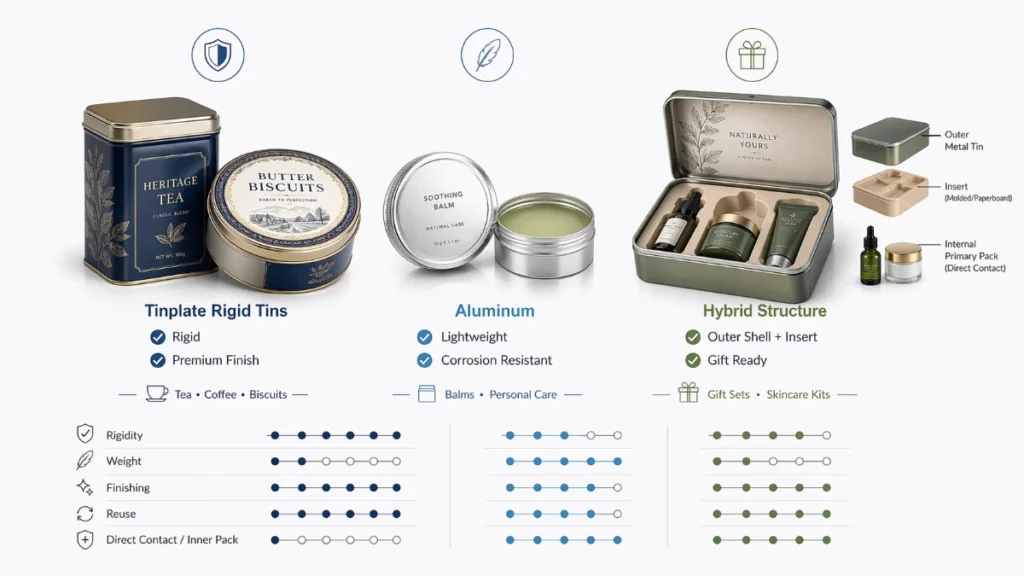
Material selection in premium packaging should never be reduced to surface preference alone. Different metals and structures perform differently in rigidity, corrosion behavior, weight, finishing compatibility, and commercial cost. Buyers who understand those trade-offs make better packaging decisions and avoid expensive redesigns later.
| Packaging route | Typical strengths | Typical watch-outs | Best-fit premium uses |
|---|---|---|---|
| Tinplate rigid tins | Strong rigidity, crisp premium feel, good forming for many box styles, strong decoration platform | Requires correct internal coating selection for direct-contact products; structure and tooling affect cost | Tea, coffee, chocolate, biscuits, dry foods, gift sets, cosmetics outer packs |
| Aluminum rigid formats | Light weight, corrosion resistance, useful in selected formed structures | Primary aluminum can be energy intensive; structure options vary by design and tooling logic | Balms, specialty cosmetic formats, selected food and personal-care packs |
| Metal tin around internal primary packaging | Excellent premium presentation, safer for formulas sensitive to direct contact, strong reuse value | Requires careful insert design and total-pack cost planning | Skincare kits, fragrance gift sets, confectionery assortments, corporate gifts |
| Metal plus molded or paperboard inserts | Combines premium outer shell with organized interior presentation | Insert fit, tolerance, and logistics protection must be designed together | Multi-item premium sets, promotional kits, limited editions |
| Windowed or mixed-material premium tins | Good for display and gifting where visibility matters | More complex recyclability story and structural engineering | Seasonal displays, confectionery, collectible or novelty launches |
In many premium programs, hybrid structures make the most sense. The metal pack becomes the durable and brand-rich shell, while the product itself remains in a separate primary package designed for direct-contact compliance or dosing convenience. This is especially useful in beauty, nutraceutical, and premium confectionery categories where product sensitivity and gifting presentation both matter.
The correct decision depends on function. If the product needs direct barrier protection from light and ambient exposure, a tinplate primary pack may be ideal. If the main commercial goal is premium gifting around individually wrapped or bottled units, a secondary metal pack may create better value. If e-commerce durability is critical, insert and wall design become as important as metal choice itself.
Finishes, structure, and decoration that justify premium pricing
Premium packaging is often discussed as though decoration is only an aesthetic layer. In reality, decoration is part of value communication. It influences perceived quality, giftability, brand memorability, and the customer’s willingness to keep the pack after use. That is why decoration choices in metal packaging should be tied to commercial intent rather than selected only because they look interesting on a reference board.
| Design element | What it communicates | Commercial use case |
|---|---|---|
| Matte varnish | Restraint, sophistication, modern premium tone | Luxury tea, skincare, wellness, minimalist gift sets |
| High gloss finish | Energy, vivid color, strong shelf pop | Seasonal confectionery, promotional launches, youth-oriented gifting |
| Embossing or debossing | Tactile quality, craftsmanship, logo emphasis | Heritage brands, premium collectibles, corporate gifts |
| Metallic inks or foil accents | Richness, celebratory character, visual drama | Holiday packs, limited editions, prestige collections |
| Soft-touch coatings | Sensory luxury, elevated hand feel | Beauty kits, fragrance outer packs, premium accessories |
| Window structures | Product visibility and trust | Select gift foods, curated assortments, retail display formats |
| Hinged-lid or specialty opening system | Ritual, collectibility, sense of engineered value | Commemorative launches, premium box sets, reusable storage packs |
The key is alignment. A premium structure with careless print choices will not feel convincing. A dramatic graphic concept on a weak structural form will also fail. The best premium tins align geometry, surface feel, opening experience, color strategy, and product category. This is exactly why 10 Creative Custom Metal Tin Packaging Design Ideas and Design Principles for Modern Metal Packaging Solutions are helpful companion reads when a brand is still shaping its creative direction.
Decoration choices should also reflect where the product will be sold. Shelf-first products often need stronger frontal impact. Gift-first products may benefit more from tactile detail and lid ritual. E-commerce-first products still need premium cues, but scratch resistance and structural protection may matter more than delicate surface effects. The finish system should therefore be chosen as part of the sales strategy, not after it.
Compliance and technical checkpoints brands should not ignore
Premium packaging can fail for very non-premium reasons. The most common problems are not creative. They are technical: poor lining compatibility, unverified color systems, weak closure tolerances, unstable inserts, corrosion risk, or incomplete documentation. That is why sophisticated buyers review packaging through a technical lens even when the project is design-led.
| Technical checkpoint | Why it matters | Questions a buyer should ask |
|---|---|---|
| Product-contact compatibility | Incorrect coating or lining can affect safety, taste, odor, or long-term stability | What lining or lacquer system is proposed, and what evidence supports it for this product type? |
| Closure integrity | Shelf life and transit performance depend on seal or lid fit quality | How is closure fit validated, and what tolerance controls are used? |
| Decoration durability | Premium packs can lose value quickly if scuffing or scratching appears early | What varnish or coating system is used, and how does it perform under handling? |
| Insert stability | Premium sets fail if products rattle, shift, or chip in transit | Has the insert been tested with the real product load and transit scenario? |
| Migration and food-contact compliance | Direct-contact food applications require regulatory discipline | What compliance documents or test pathways are available for the market being served? |
| Traceability and QC | Scale introduces batch risk if process controls are weak | How are print, forming, and final inspection records managed? |
| Export readiness | Long-distance logistics expose weak design assumptions | Has the pack been reviewed for palletization, compression, and cross-border shipping stress? |
For food, buyers should pay close attention to European food-contact legislation, FDA food-contact substance resources, and the practical implications of product chemistry. For premium beauty or cosmetic kits, questions around external decoration chemistry, insert security, and overall durability become more prominent. For gift packs, repeated opening performance, scuff resistance, and retained quality after handling deserve more scrutiny.
In all cases, a premium pack should be reviewed as a system. The material, closure, insert, finish, and logistics route influence one another. This is one reason why Metal Packaging for Food, Beverage and Cosmetic Brands is a useful internal reference: it reminds buyers that packaging categories may share a material, but they do not necessarily share the same technical priorities.
Cost, MOQ, tooling, and lead-time planning
Many buyers are attracted to premium tins but become uncertain when the conversation turns to cost. That is understandable. Metal packaging is highly customizable, and the commercial structure of a project depends on more than size alone. But cost planning becomes much easier when the main drivers are broken down clearly.
| Cost driver | How it affects the project | Practical implication |
|---|---|---|
| Structure complexity | Unusual shapes, windows, hinged systems, and specialty openings often increase tooling and process complexity | Reserve high-complexity structures for launches where visual differentiation matters enough to justify it |
| Material choice and thickness | Gauge and metal type affect rigidity, weight, and cost | Match thickness to real logistics and premium needs instead of overspecifying by default |
| Decoration stack | More print colors, embossing, specialty varnishes, foil accents, and interior decoration add cost and process steps | Use premium effects where they create visible value, not simply because they are available |
| Insert design | Foam, EVA, molded trays, and custom separators improve presentation and protection but add cost | Evaluate inserts as part of total protection and gifting performance, not as an afterthought |
| MOQ | Lower quantities can make custom tooling and setup costs harder to absorb | Align structure ambition with realistic order volume and repeat-program potential |
| Lead time | Tooling, approvals, print proofing, sampling, and production planning all influence calendar risk | Start earlier for seasonal or campaign-driven projects where timing failure is expensive |
| Sampling rounds | Premium projects often need both structural and visual validation rounds | Plan sample iterations into the project from the beginning rather than treating them as delays |
The commercial logic is straightforward. A standard or near-standard geometry with premium graphics may be more efficient than a highly custom shape when the order quantity is limited. On the other hand, a recurring SKU with strong forecast stability may justify more upfront engineering and tooling because those costs can be amortized over future production. The correct answer depends on program horizon, not just on the first PO.
Lead-time planning also deserves more discipline than many buyers initially expect. Premium metal tins typically involve structural design review, artwork adaptation, sample making, and finish validation before volume production. That does not make them slow by definition. It means the program should be managed like a real packaging development cycle, especially for seasonal gift launches where missing the calendar can destroy the business case.
Mr.Tin.Box’s published workflow highlights rapid sampling in roughly 7–10 days for prototypes on relevant category pages. That is commercially useful, but serious buyers should still plan enough time for feedback, revisions, final confirmation, and mass-production readiness. Fast sampling is valuable. Reliable commercialization is more valuable.
How to source custom tins without creating avoidable risk
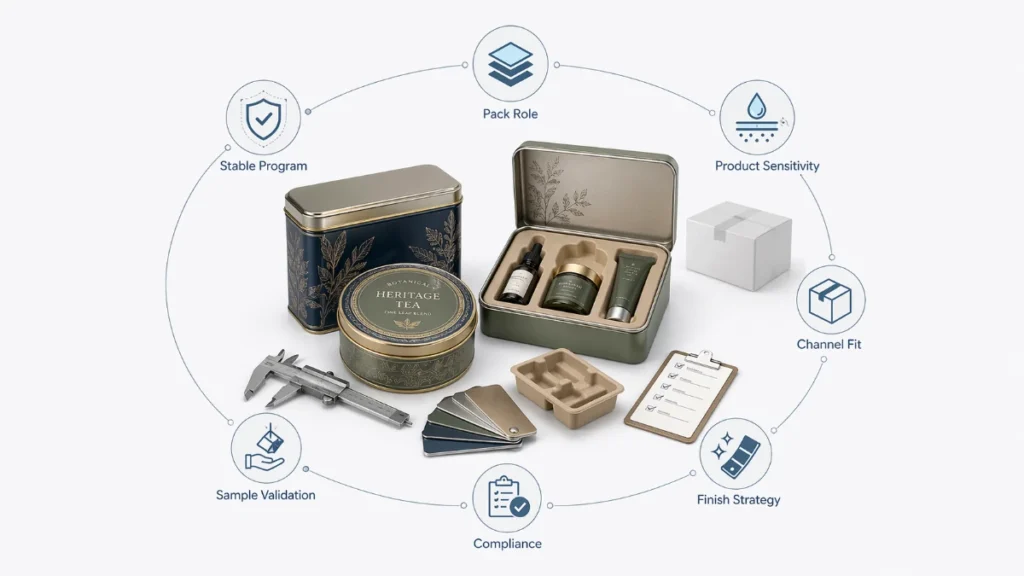
Sourcing risk in premium packaging rarely comes from one dramatic mistake. It usually comes from a series of small assumptions. The buyer assumes the supplier understands the product sensitivity. The supplier assumes the buyer cares mainly about print. No one fully defines the packaging role, finish durability, insert tolerance, or compliance pathway. The project then looks acceptable until scale, shipping, or real retail handling exposes the gap.
A more disciplined sourcing framework works better.
First, define the role of the metal pack. Is it direct-contact primary packaging, a premium secondary shell, a gift object, or an e-commerce protective format? That single decision shapes almost everything else.
Second, define the product sensitivity. Does the product need light barrier, moisture control, aroma retention, or only premium presentation? Is there any chemistry that requires particular coating attention? What customer complaints would be most damaging if the pack underperformed?
Third, define the channel. A retail-only display pack may not face the same abuse as a cross-border e-commerce pack. A gift tin that will be stacked and shipped in mixed cartons needs different structural discipline from a locally distributed counter pack.
Fourth, define the premium message. What exactly should the customer feel when holding the pack? Minimalist luxury? Festive richness? Heritage quality? Modern collectible energy? The finishing route should serve that goal rather than copy a competitor’s effects.
Fifth, define the regulatory context and evidence needed. Premium buyers should ask suppliers what documentation, process controls, and market-specific experience they can provide. A supplier that discusses material, lining, tolerance, and inspection logic in detail is usually safer than one that responds only with a unit price.
Sixth, validate the sample under realistic conditions. A premium sample should not be judged only at a conference table. The product should be inserted, opened, closed, handled, packed, and, where appropriate, shipped in conditions similar to actual use. Cosmetic damage, insert looseness, or closure weakness often appears only during realistic handling.
This is why Global Sourcing Guide for Custom Metal Packaging and How to Select the Right Factory for Metal Packaging are strategically relevant. The right supplier relationship is not built on low price alone. It is built on whether the supplier can turn a good-looking packaging concept into a stable commercial program.
A practical comparison against common alternatives
Premium brands do not choose metal in a vacuum. They compare it with cartons, rigid paper packaging, molded pulp, glass-plus-carton systems, plastic jars, plastic pouches, and hybrid formats. The right comparison is not “Which material is best in general?” The right comparison is “Which format best supports this product’s real business needs?”
| Packaging option | Typical advantages | Typical limitations for premium products | When metal often has the edge |
|---|---|---|---|
| Folding carton | Cost-effective, easy to print, light weight | Lower retained value, more crush risk, often less giftable | When premium feel, reuse, or rigid presentation matter |
| Rigid paper box | Good premium presentation, versatile inserts | Can scuff, soften, or deform more easily under humidity or handling | When durability and long-term kept value are priorities |
| Plastic pouch or flexible pack | Lightweight and efficient in some transport scenarios | Lower premium feel, harder recycling outcomes in many markets, weaker structural authority | When protection, reuse, and visible circularity are important |
| Plastic jar or tub | Functional and lightweight | Often weaker premium signaling, scrutiny around plastics is increasing | When the brand wants a more durable, giftable, or collectible impression |
| Glass with secondary box | Strong product credibility in some categories | Breakage risk, weight, often needs another outer protective system | When the pack itself should be durable, reusable, and structurally protective |
| Metal tin | Strong barrier, rigid structure, reuse value, premium feel, strong decoration platform | Tooling and finish planning require discipline; not always the lowest-cost choice | Best when the product needs premium perception plus practical protection |
This table helps explain why custom tins are so compelling for premium products. They are not always the cheapest material. They are often the format that combines enough practical performance with enough perceived value to create a stronger total business result.
Why custom metal tin packaging is especially strong for premium products
At this point, the core argument becomes clear. Premium products need packaging that protects, differentiates, and justifies value simultaneously. Custom metal tins do that unusually well because they combine material authority with design flexibility.
They protect well. Metal supports strong barrier performance, dimensional stability, and better presentation retention under handling. That matters for food, gifting, beauty, and export programs.
They differentiate well. Metal offers tactile quality, premium sound and closure feel, memorable decoration routes, and a sense of designed permanence that many other packs cannot match.
They justify value well. Because the tin often survives after purchase, the customer is more likely to perceive the package as part of the product rather than as disposable overhead. That strengthens premium pricing logic.
They align well with circularity expectations. Steel’s established recycling performance, the broader circular-economy language around permanent materials, and the consumer importance placed on recyclability all support a stronger sustainability position when the pack is designed and communicated responsibly.
They work across multiple premium categories. Food values barrier performance and shelf life. Beauty values presentation and tactile quality. Gifting values collectibility and reuse. Premium tins can address all three without forcing the brand into a completely different material logic.
This is also why content such as Metal Packaging vs Plastic: Environmental Impact Review and Metal Packaging Trends for Premium Consumer Goods is useful in the broader Mr.Tin.Box ecosystem. Premium packaging decisions are no longer isolated to creativity. They sit inside a larger commercial and sustainability conversation. Metal packaging performs strongly inside that conversation because it has both emotional and technical legitimacy.
Why Mr.Tin.Box is commercially relevant for premium packaging programs
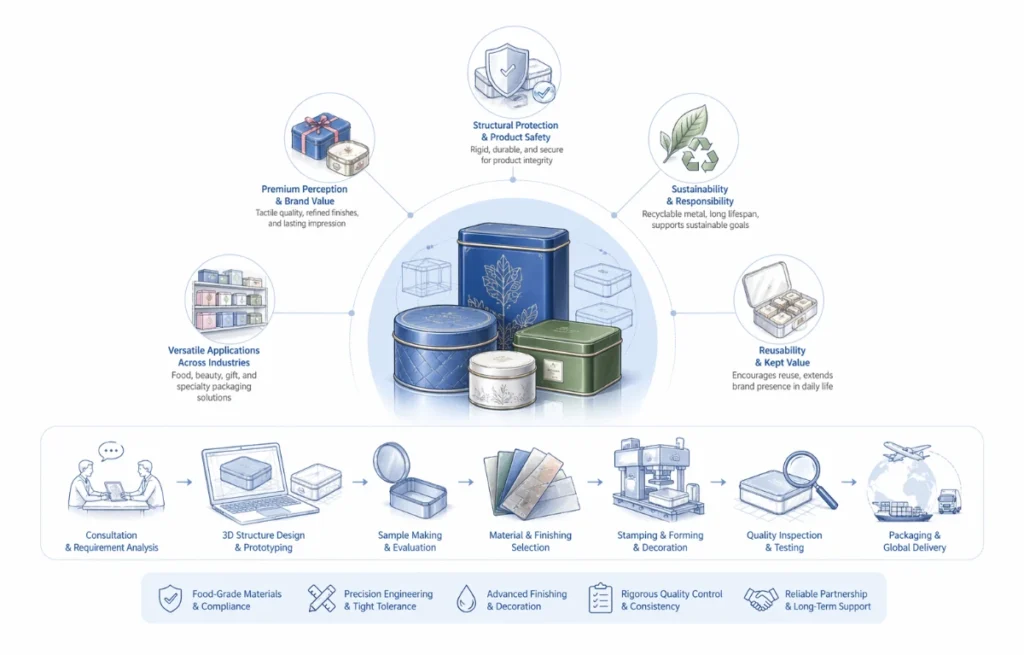
A premium packaging article would be incomplete without clarifying what makes a supplier commercially relevant beyond marketing language. In the case of Mr.Tin.Box, several published signals are worth noting.
The first is category breadth. The site clearly organizes its capabilities across food, beauty, gifting, and specialty applications rather than presenting metal packaging as one generic offer. That matters because serious buyers in these sectors do not all need the same packaging logic. A supplier that frames the category differences more clearly is usually better positioned to ask the right questions early.
The second is process visibility. The homepage and category pages outline a step-by-step workflow from consultation and 3D structure design through sampling, finishing, stamping, and final inspection. Buyers do not need a supplier to be theatrical. They need the supplier to show that packaging development follows a repeatable manufacturing logic. The site’s published production sequence helps communicate that logic.
The third is emphasis on finishing and structural quality together. Many suppliers can show attractive prints. Fewer communicate the importance of molding, stamping accuracy, closure fit, inspection, and long-term durability in the same breath. Premium packaging lives or dies on that combination.
The fourth is supporting content depth. A site that publishes material such as Custom Metal Tin Packaging for Food, Beauty, and Gift Brands, Why Metal Packaging Boosts Shelf Life and Brand Value, and How to Select the Right Factory for Metal Packaging is doing more than listing products. It is showing that the supplier understands the practical decision framework buyers are working through.
The fifth is alignment with premium use cases that are growing globally. The combination of food-grade applications, beauty presentation packs, holiday and corporate gift tins, and specialty protective formats makes commercial sense because these are exactly the areas where metal packaging tends to create above-average value.
That does not mean a buyer should skip normal supplier due diligence. It means the platform presents the right kind of signals for brands that are evaluating a real premium tin program rather than casually browsing packaging references.
A decision framework premium brands can actually use
Packaging teams often struggle because they are trying to answer too many questions at the same time. A simpler decision framework makes premium packaging selection easier.
Start with the product. Ask what the package must protect: aroma, texture, formula integrity, breakage resistance, gifting presentation, or all of the above.
Then move to the channel. Ask whether the package must succeed on shelf, in e-commerce, in cross-border logistics, or in seasonal display. Do not assume the same structure performs equally well everywhere.
Then move to the premium promise. Ask what exactly the customer should feel on first touch and after first use. Premium can mean refined minimalism, collectible richness, heritage confidence, or festive excitement. The structure and finish should fit that promise.
Then move to the circularity story. Ask whether the package is realistically recyclable, likely to be reused, and defensible in the target market’s sustainability conversation. The answer should be based on actual systems, not vague claims.
Then move to execution. Ask whether the supplier can explain structure, tooling, sample validation, finishing durability, QC, and documentation in a way that fits the product category and target market.
If custom metal tins score strongly across those questions, they are not just aesthetically appealing. They are commercially sensible.
Final thoughts
The strongest packaging decisions are rarely driven by one factor alone. Premium products need a package that can preserve quality, survive real logistics, communicate value immediately, and still make sense in a market that is asking harder questions about materials, recyclability, and waste. That is why custom metal tin packaging is so often the right answer for premium packaging programs.
A custom tin is not valuable simply because it is metal. It becomes valuable when the structure is matched to the product, the finish is matched to the brand, the technical details are matched to the market, and the sourcing discipline is matched to the commercial reality of the program. When those elements align, the tin stops being “just the package.” It becomes part of what the customer believes they are buying.
For premium food, beauty, gifting, and specialty products, that combination is powerful. The package can protect. It can persuade. It can remain in use. And it can carry the brand story beyond the first transaction. Very few packaging formats can do all of that equally well.
Brands planning a new premium line, a retail upgrade, a holiday collection, or a more durable presentation pack should therefore look at metal tins not as an expensive embellishment, but as a serious strategic option. The right program can strengthen shelf life, improve perceived value, support better sustainability positioning, and reduce avoidable presentation losses across the supply chain.
That is the deeper reason why custom metal tin packaging is ideal for premium product packaging. It does not force brands to choose between beauty and function. When developed correctly, it gives them both.
For teams ready to turn that strategy into a real project, the most practical next step is to compare the product’s needs against the structures and references already published on Mr.Tin.Box, review the relevant category pages, and move into a packaging discussion that starts with performance instead of assumptions.


