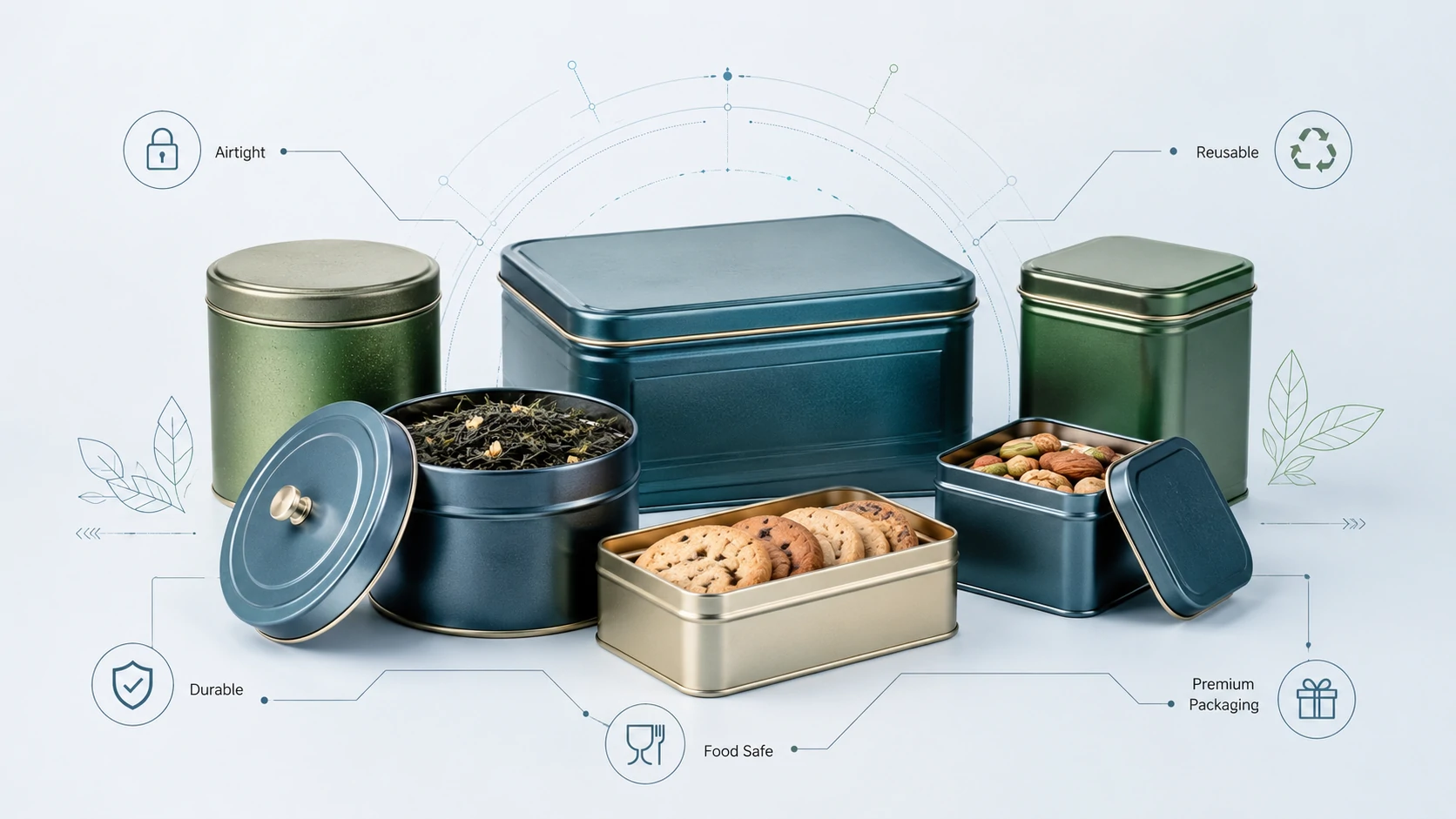
Food storage tins may look like a traditional packaging format, but they remain one of the most commercially useful options for premium food brands. In a market full of flexible pouches, paper cartons, plastic jars, glass bottles, and compostable experiments, metal tins still solve a set of problems that many brands cannot ignore: product protection, shelf appeal, gift value, reuse, and long-term brand visibility in the customer’s home.
For food buyers and packaging teams, the phrase food storage tins usually means rigid metal containers made from tinplate or similar food-grade metal materials. They may be used for tea, coffee, cookies, biscuits, chocolate, candies, nuts, spices, drink powders, premium snacks, bakery gifts, holiday assortments, and specialty foods. Some tins are designed for direct food contact with a suitable coating or liner. Many premium tins are used as secondary packaging, where the food is first packed in an inner bag, tray, pouch, paper wrap, or flow pack, and the tin provides structure, display value, and a reusable storage function.
That distinction matters. A decorative food storage tin is not automatically the same as a hermetically sealed food can. A tin for cookies, tea bags, chocolate assortments, or gift snacks may need a tight slip lid, hinged lid, plug lid, inner pouch, paper liner, or foam insert depending on the product. A retort food can has a different manufacturing and sealing system. The business value of food storage tins comes from choosing the right structure for the right product, not from assuming that every metal container performs the same way.
At Mr. Tin Box, the food packaging conversation normally starts with product sensitivity and brand positioning. The company develops custom metal tin packaging for food and beverage, beauty and personal care, gift and holiday, promotional, specialty, and industrial applications. For food projects, the Food & Beverage Packaging page highlights food-grade tin boxes and metal containers for snacks, tea, coffee, chocolates, candies, and specialty foods, with emphasis on tinplate forming, safe contact design, barrier protection, custom printing, embossing, and reusable value.
This article explains why food storage tins are still popular for premium food packaging, how buyers should evaluate materials and structures, what data supports the business case, and how to prepare a practical specification before requesting a custom tin packaging quote.
Table of Contents
Why Food Storage Tins Still Win in Premium Food Packaging
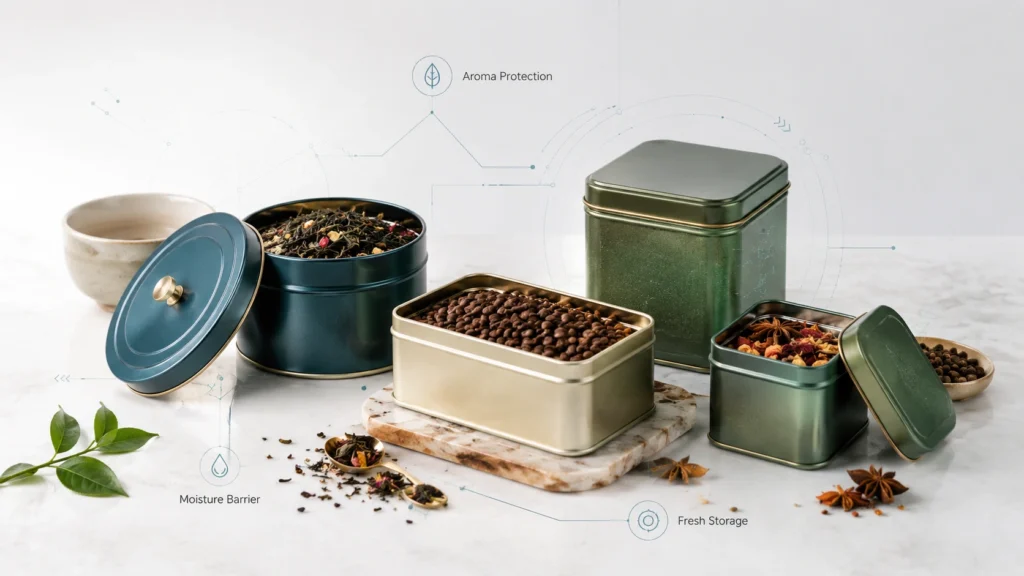
The simplest reason is that food storage tins combine two functions that are often separated in other packaging formats. They protect the product, and they also sell the product.
A plain flexible pouch can be efficient, lightweight, and affordable. A paper box can be easy to print and stack. A glass jar can communicate purity. But a metal tin gives a brand a rigid container with a strong tactile feel, good opacity, a premium surface for printing, and a second life after the food is consumed. When a customer keeps the tin for tea bags, kitchen accessories, candies, sewing items, office supplies, or small household objects, the package continues to show the brand long after the original purchase.
That long after-use value is a major reason food storage tins remain common in premium categories. Tea brands use tins because aroma and ritual matter. Coffee brands use tins because freshness perception and gift value matter. Cookie and biscuit brands use tins because crush protection and holiday presentation matter. Chocolate brands use tins because rigid packaging turns a simple assortment into a giftable product. Spice and powder brands use tins because light blocking, shelf organization, and refill value matter.
This is also why tins are particularly useful for brands that sell through multiple channels. The same product may need to work on a supermarket shelf, in an e-commerce box, in a boutique store, in a duty-free shop, in a corporate gift program, and in a holiday promotion. A well-designed tin can travel across those channels with fewer changes than many lower-value packs. The lid, insert, label area, printing finish, and outer carton can be adjusted while the core container remains consistent.
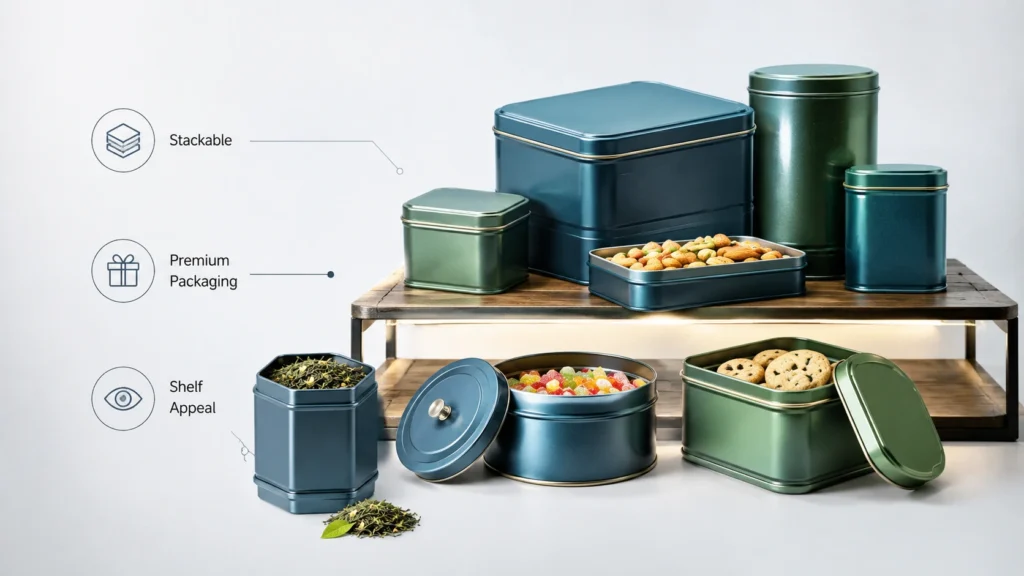
From a merchandising perspective, metal tins also create stronger shelf blocking. Square and rectangular tins line up cleanly. Round tins create a softer visual style for cookies, tea, candy, and festive gifts. Small tins work well for samples, impulse purchases, mini assortments, and travel-size food products. Larger tins can support premium bundles and family-size gift sets. If you are still comparing shapes, the Mr. Tin Box guide on tin containers with lids is a useful related reference because it explains how lid styles, inner packaging, and product type affect the final structure.
The premium effect is not only visual. Customers feel the package before they evaluate the full product story. A metal tin has cool touch, weight, sound, and rigidity. Those sensory cues create a quality signal even before the customer reads the ingredient list or brand message. In premium food, this first impression can influence giftability, willingness to pay, and repeat purchase.
Industry Data That Supports the Business Case
Packaging decisions should not be based only on personal taste. The wider market data shows why metal food packaging remains relevant. The global packaging market is under pressure from several directions at once: sustainability expectations, food waste reduction, product safety, longer supply chains, e-commerce damage risk, and premiumization. Food storage tins sit at the intersection of these forces.
The metal packaging industry is not a niche category. Global Market Insights reported that the global metal packaging market was valued at USD 156.7 billion in 2025 and projected to reach USD 218.9 billion by 2035, with a 3.5% CAGR from 2026 to 2035. The same report notes that the containers and cans segment was valued at USD 46.8 billion in 2025, supported by use in packaged food, beverages, and other consumer categories. You can review the source here: Global Market Insights – Metal Packaging Market Size.
Sustainability data also supports metal as a serious packaging material, but claims should be specific. MPMA reports that 84% of steel for packaging and 76.3% of aluminium beverage cans are recycled in Europe, citing Steel for Packaging Europe and Metal Packaging Europe. It also reports a UK metal packaging recycling rate of 80.4% in 2024. See: MPMA – Recycling. These figures do not mean every tin automatically has the same recycling outcome in every country, but they do show why metal packaging is often included in circular packaging discussions.
Food waste is another important context. The UNEP Food Waste Index Report 2024 and its key messages state that the world wasted 1.05 billion tonnes of food in 2022, equal to about 19% of food available to consumers at retail, food service, and household level. Packaging alone cannot solve food waste, but packaging that protects texture, aroma, portioning, and storage quality can help reduce quality loss and unnecessary disposal, especially in premium dry foods.
| Business factor | Useful public data point | Why it matters for food storage tins |
|---|---|---|
| Metal packaging market size | USD 156.7 billion in 2025; projected USD 218.9 billion by 2035 | Metal packaging remains a large and investable category, not a fading format. |
| Containers and cans segment | USD 46.8 billion in 2025 | Rigid metal containers continue to serve high-volume food, beverage, and premium packaging markets. |
| European steel packaging recycling | 84% steel for packaging recycled in Europe | Tinplate and steel packaging can support credible circularity messaging when local recycling systems exist. |
| Global consumer-level food waste | 1.05 billion tonnes in 2022 | Better protection, storage, and portioning can support food waste reduction goals. |
| EU food contact framework | Regulation (EC) No 1935/2004 requires safety and inertness for food contact materials | Export food brands need packaging designed around compliance documentation, traceability, and intended use. |
These numbers help explain why food storage tins still appear in premium shelves even when cheaper materials exist. Metal is not chosen only because it looks beautiful. It is chosen because it can help brands manage protection, value perception, sustainability messaging, and long-distance distribution in one packaging system.
What Counts as A Food Storage Tin?
In practical sourcing language, food storage tins can include many structures. The most common formats include round cookie tins, square tea tins, rectangular biscuit tins, hinged candy tins, small mint tins, tall coffee tins, spice tins, chocolate gift boxes, popcorn tins, nested tin sets, promotional food tins, and custom-shaped novelty tins for holiday or limited-edition campaigns.
Most are made from tinplate, which is thin steel sheet coated with tin. Tinplate is widely used because it offers rigidity, formability, printability, and a protective metallic surface. In custom decorative food tins, the exterior is usually printed or decorated, while the interior may be plain, gold lacquered, clear lacquered, white coated, or treated with a food-contact coating depending on the product and market requirements. For more material detail, Mr. Tin Box has a separate guide on tinplate packaging material, coating, printing, and food safety.
A food storage tin can be the primary food-contact container, but this must be planned. Direct contact with oily, acidic, salty, wet, or strongly flavored foods requires more careful coating selection and testing than a tin used for wrapped cookies or tea bags. Dry foods can also vary. Tea leaves, coffee, cocoa powder, nuts, candies, and spices have different sensitivities to oxygen, moisture, aroma loss, oil migration, and staining. This is why professional buyers should never describe the project only as “one food tin.” They should define the exact food type, contact condition, filling process, shelf-life target, destination market, storage temperature, and whether an inner bag or tray will be used.
The inner packaging decision is especially important. Many premium foods are best packed inside a sealed pouch or wrapper before being placed in the tin. The tin then provides crush protection, retail display value, gifting value, and consumer reuse. This approach is common for cookies, biscuits, tea bags, candy assortments, chocolates, and seasonal gift sets. For loose tea, powder, coffee, or spices, the tin may need a plug lid, inner seal, or foil membrane depending on the aroma and moisture target.
Food storage tins also differ from industrial storage tins or general household tins. A premium food tin must consider food safety, clean edges, consumer handling, odor neutrality, decorative accuracy, packaging line compatibility, shipping protection, and brand consistency. A tin that looks good in a sample photo can still fail commercially if the lid is too tight for elderly customers, too loose for e-commerce shipping, too sharp at the rolled edge, too tall for retail shelves, or too expensive for the target margin.
Product Protection: the Technical Reason Metal Remains Relevant
Premium food quality depends on controlling what reaches the product before the customer opens it. The main threats are light, oxygen, moisture, impact, odor transfer, and temperature abuse. Food storage tins do not solve every risk by themselves, but they give brands a strong starting point.
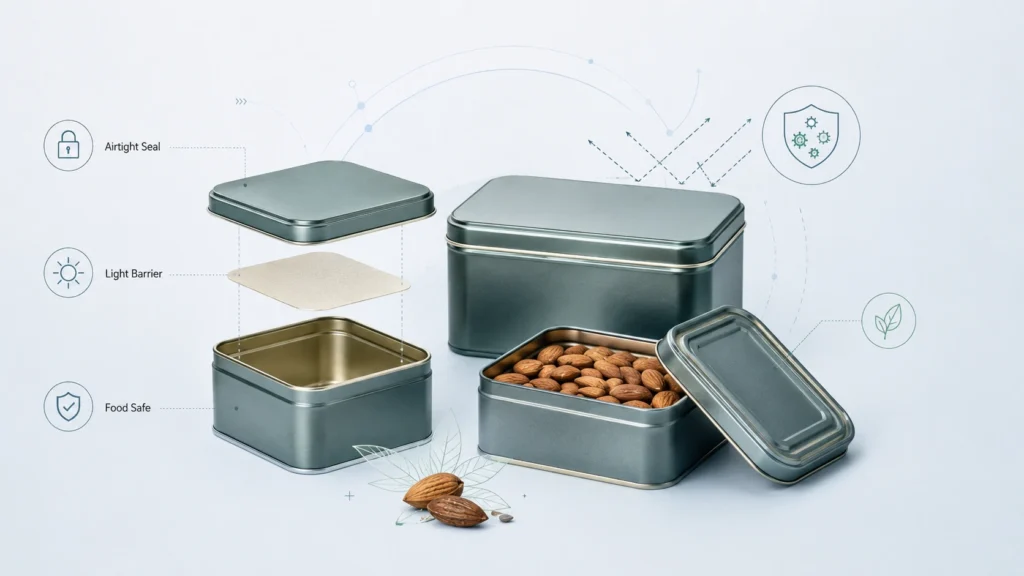
Metal is naturally opaque, so it blocks light. This matters for tea, coffee, herbs, cocoa, spices, and some confectionery products because light can accelerate color changes, aroma loss, oxidation, and quality drift. A paper box may need a foil pouch to achieve similar light protection. A transparent jar may need a label, sleeve, or outer carton. A tin removes light exposure as a basic material advantage.
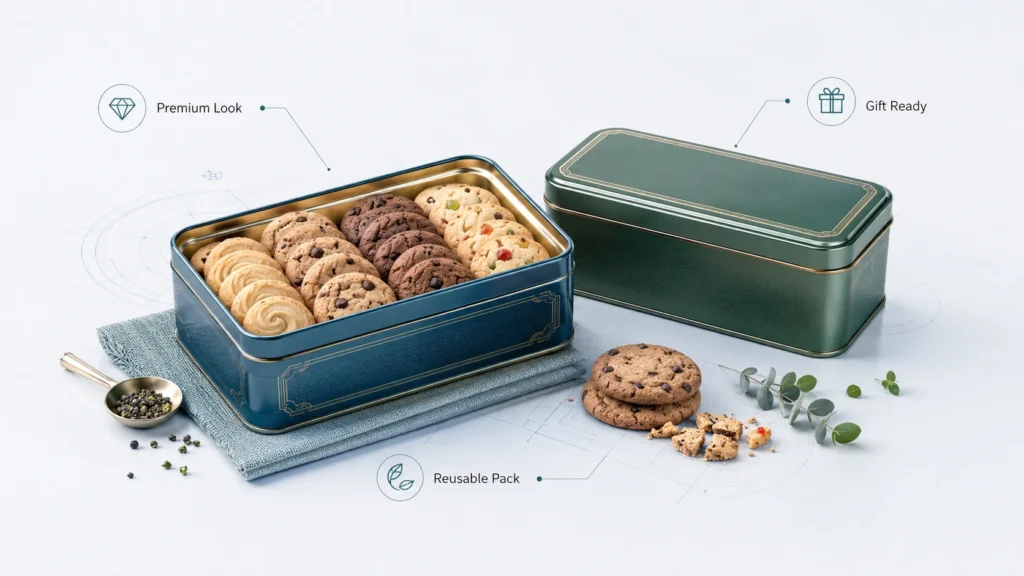
Metal is also rigid. This is valuable for fragile foods such as cookies, biscuits, wafers, chocolate pieces, macarons, candy collections, and premium snacks. If the product arrives broken, the customer does not blame the shipping company first; they blame the brand. Rigid tins help reduce crushing and deformation during handling, especially when combined with inserts, trays, dividers, paper cups, or inner flow packs.
Moisture and oxygen protection depend on the structure. A decorative slip-lid tin may reduce exposure better than a paper box, but it is not the same as a hermetic can. For moisture-sensitive foods, brands may need a sealed pouch inside the tin, a gasket, a plug lid, or a tamper-evident seal. For aroma-sensitive tea and coffee, an inner foil bag or freshness seal can be more important than the tin wall itself. In other words, the tin is the protective shell and brand surface, while the inner packaging may carry the final moisture and oxygen barrier.
This layered approach is commercially powerful. It lets brands combine the efficiency of flexible barrier packaging with the premium feel of metal. The inner pack can be optimized for shelf life, while the outer tin is optimized for display, reuse, and customer experience.
The right choice depends on the real risk profile. A butter cookie assortment may need crush protection and grease-resistant liners. A loose leaf tea tin may need aroma protection and easy scooping. A chocolate tin may need insert control and temperature-aware shipping. A spice tin may need a dispensing opening and strong odor management. A powdered drink tin may need moisture protection, scoop storage, and tamper evidence.
Decorative Tins are not the Same as Hermetic Food Cans
One of the most common buyer mistakes is using the words “airtight,” “sealed,” and “food safe” too casually. These words have different meanings in packaging engineering and compliance.
A decorative food storage tin can be tight enough for household reuse and premium presentation, but it may not be hermetically sealed. A hermetic container is designed to prevent the entry of microorganisms and maintain commercial sterility after processing. This is the logic behind many shelf-stable canned foods. The USDA’s FSIS shelf-stable food guidance explains that shelf-stable foods can be stored safely at room temperature and includes canned goods in that category. See: USDA FSIS – Shelf-Stable Food Safety.
Most custom decorative tins for cookies, tea, chocolate, candy, and gift foods are not retort cans. They are premium containers. They can protect against light, handling, and some environmental exposure, but shelf-life performance must be engineered through lid design, inner packaging, coatings, filling conditions, and storage instructions.
This does not reduce their value. It simply clarifies the role of each component. For many premium dry foods, a decorative tin with an inner pouch is the best commercial structure because it balances safety, shelf life, appearance, cost, and production flexibility. A fully hermetic metal can may be unnecessary, overengineered, or unsuitable for the desired opening experience.
A good supplier should therefore ask practical questions before recommending a structure:
- Will the food touch the metal directly?
- Is the product dry, oily, acidic, salty, powdery, or aromatic?
- Is the tin filled manually or by an automatic line?
- Does the product need tamper evidence?
- Does the market require FDA, EU, LFGB, or other food-contact documentation?
- What is the intended shelf life?
- Will the product ship through e-commerce, retail cartons, or export containers?
- Should the consumer reuse the tin after opening?
When these questions are answered early, the project avoids costly redesign later.
Best Food Categories for Storage Tins
Food storage tins are most effective when the food benefits from rigidity, visual premiumization, gifting, aroma protection, or reuse. They are less suitable when the product is extremely price-sensitive, high-moisture without proper sealing, or sold mainly as a disposable low-margin commodity.
| Food category | Common tin format | Main packaging goal | Practical design notes |
|---|---|---|---|
| Tea and herbal blends | Square tin, round tin, tall caddy, plug-lid tin | Aroma protection, shelf display, refill reuse | Use inner bag, plug lid, or tight-fit lid for loose tea; create color-coded tins for product families. |
| Coffee and cocoa | Tall tin, rectangular tin, gift tin | Freshness perception, light blocking, premium gifting | Use sealed inner pouch for roasted coffee; consider degassing needs before choosing the final pack. |
| Cookies and biscuits | Round tin, rectangular tin, holiday tin | Crush protection, seasonal appeal, giftability | Use trays, paper cups, or dividers to reduce breakage and improve opening experience. |
| Chocolate and candy | Hinged tin, flat tin, shaped tin, gift box tin | Gift value, portion control, limited editions | Consider insert fit, grease resistance, temperature risk, and food-contact liners. |
| Nuts and snacks | Round tin, square tin, large family tin | Resealability, protection, shareability | Use inner pouch if shelf life depends on oxygen and moisture control. |
| Spices and powders | Small tin, shaker tin, rectangular tin | Light blocking, organization, refill use | Match lid and dispensing style to particle size, aroma strength, and kitchen handling. |
| Premium food gifts | Custom-shaped tin, embossed tin, windowless gift tin | Brand storytelling, collectible value, high perceived value | Use embossing, matte finish, metallic ink, and internal presentation to justify premium price. |
This table also shows why the same tin structure cannot serve every food category equally well. A cookie tin needs space and protection. A tea tin needs aroma management. A spice tin needs dispensing convenience. A candy tin needs attractive opening and portion control. A food gift tin needs emotional value and perhaps a collectible design.
For shape selection, buyers can also compare the Mr. Tin Box articles on small tin containers and square metal tins, because both formats are commonly used in food samples, tea, candies, and gift packaging.
Food Safety: How Buyers Should Think about Compliance
Food safety is not a slogan printed on a website. It is a combination of material selection, coating selection, production control, intended use, testing, documentation, and buyer responsibility.
In the United States, the FDA maintains an Inventory of Food Contact Substances Listed in 21 CFR. FDA explains that the inventory includes substances authorized for uses in contact with foods and provides information on substance identity and listed regulations for specific intended uses and conditions. This matters because food-contact compliance is based on the materials and substances used, not simply the generic name of the package.
In the European Union, the European Commission explains that Regulation (EC) No 1935/2004 provides the harmonized legal framework for food contact materials. It requires that materials do not release constituents into food at levels harmful to human health and do not change food composition, taste, or odor unacceptably. The Commission also notes that food-contact materials require compliance documentation and traceability, and that GMP rules under Regulation (EC) No 2023/2006 help ensure controlled manufacturing.
For food storage tins, compliance planning should start with intended use. If the food is wrapped and does not touch the metal, the risk profile is different from loose food directly touching the tin. If the food is dry and neutral, the coating requirement may be different from oily, acidic, salty, or wet food. If the tin is for export, documentation expectations may vary by market. For example, a U.S. buyer may ask for FDA-related material statements, while an EU buyer may ask for EU framework compliance, specific migration testing where relevant, and a declaration of compliance.
A practical food tin specification should define:
- Food type and ingredients that may contact the packaging.
- Direct or indirect food contact.
- Expected filling temperature and storage conditions.
- Whether the product is oily, acidic, salty, dry, powdery, or aromatic.
- Shelf-life target and barrier strategy.
- Destination market and required documentation.
- Printing and coating system.
- Whether the customer will reuse the tin for food storage after opening.
This is why Mr. Tin Box encourages buyers to prepare a clear product brief. The Custom Tin Packaging Guide explains that a practical specification template helps suppliers respond accurately and reduces back-and-forth communication. For food projects, this preparation also reduces compliance risk.
Coatings, Lacquers, and Direct Food Contact
Tinplate is a strong base material, but the internal surface must still match the food. The coating or lacquer helps prevent corrosion, staining, flavor interaction, and metal exposure under the expected use conditions. Common options may include clear lacquer, gold lacquer, white internal coating, or BPA-free alternatives depending on the supplier’s system and market requirements.
The phrase “BPA-free” should be used carefully. It can be important for certain markets and buyer policies, but it is not the only requirement. A BPA-free coating must still be suitable for the intended food, processing conditions, and regulatory market. Buyers should ask for documentation based on the actual coating and food-contact scenario rather than relying on a generic label.
The broader food packaging industry is also under increasing scrutiny for chemicals of concern. In February 2024, the FDA announced that PFAS-containing grease-proofing substances for food packaging paper and paperboard were no longer being sold by manufacturers for food contact use in the U.S. market. See: FDA – PFAS Used in Grease-Proofing Agents for Food Packaging No Longer Being Sold in the U.S.. This development does not mean metal tins automatically have PFAS issues; rather, it shows why packaging buyers increasingly ask for clearer material declarations and safer chemistry choices across all packaging formats.
For food storage tins, good practice is to avoid vague claims and specify the actual requirement. For example:
- “Direct-contact tin for dry loose tea, EU market, requires suitable food-contact coating and documentation.”
- “Secondary decorative tin for individually wrapped cookies, no direct food contact, but internal surface must be clean, odor-neutral, and safe for consumer handling.”
- “Premium spice tin with shaker lid, direct contact with dry powder, requires migration testing guidance and corrosion control.”
- “Chocolate gift tin with paper cups and PET tray, no direct metal contact, but all inserts must be food-contact suitable.”
This level of detail helps the manufacturer choose the right material and prevents overengineering.
The Premium Branding Advantage
A food storage tin can do something that many disposable packages cannot do: it can become part of the brand memory. When a customer buys a holiday cookie tin, a tea caddy, or a chocolate gift tin, the package may stay in the kitchen for months. Every reuse becomes a reminder of the brand.
This makes tins especially effective for premium food brands that depend on gifting, collecting, seasonal releases, tourism, limited editions, and repeat purchases. A paper box is often discarded quickly. A flexible pouch may be folded away or thrown out. A high-quality tin is more likely to be kept because it has functional value.
The branding surface is also excellent. Tinplate supports lithographic printing, spot color systems, metallic effects, matte varnish, glossy varnish, soft-touch finishes, embossing, debossing, raised logos, windowless premium layouts, and full-wrap seasonal artwork. Compared with labels on jars or pouches, a printed tin feels more integrated and deliberate.
For premium foods, the most effective tin designs usually avoid clutter. The goal is not to fill every surface with text. It is to build a visual system that supports recognition and perceived quality. A tea tin might use color bands by flavor. A biscuit tin might use nostalgic illustration. A coffee tin might use a matte black body with metallic logo embossing. A candy tin might use bright seasonal artwork. A spice tin might use clean typography and simple color coding for kitchen organization.
Decoration should still respect practical constraints. Embossing looks premium, but it requires tooling and can affect lead time. Metallic ink looks attractive, but artwork should be tested under real lighting. Matte finishes can feel premium but may show scratches depending on handling. Highly detailed artwork may need color proofing. A beautiful sample is not enough; the design must be repeatable in mass production.
This is where existing mold selection can help. A brand can use a standard round, square, or rectangular tin structure and invest more budget into printing, finishing, inserts, and retail presentation. For many food brands, this creates a better ROI than building a custom shape immediately. A custom mold is more suitable when the shape itself is part of the brand asset, such as a limited-edition holiday tin, collectible series, or distinctive premium gift pack.
Sustainability: Recyclable, Reusable, and Honest
Sustainability claims must be specific and defensible. Food storage tins have strong sustainability arguments, but brands should avoid overclaiming.
The strongest points are recyclability and reuse. Tinplate and steel packaging are widely recyclable in many markets, and metal retains value in recycling systems. As noted earlier, MPMA reports high recycling rates for metal packaging in Europe and the UK. The consumer reuse angle is also powerful because a tin can become household storage rather than immediate waste.
However, recyclability is not the same as actual recycling. Actual recycling depends on local collection systems, sorting, consumer behavior, contamination, and regional infrastructure. A brand selling globally should not assume that one recycling claim applies equally in every market. Better wording is usually more accurate: “recyclable where facilities exist,” “designed for reuse,” “made from recyclable tinplate,” or “reusable metal tin for home storage.
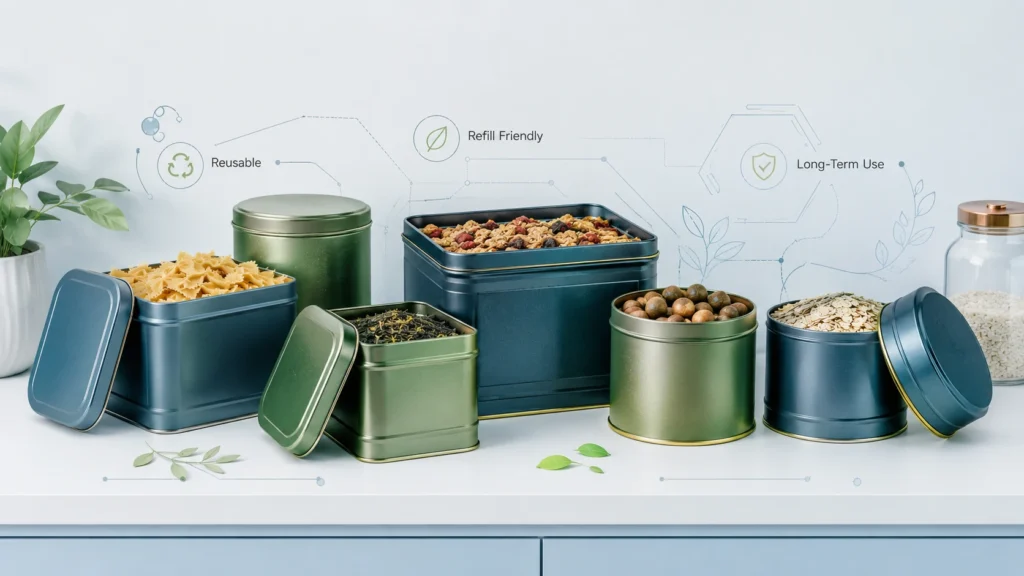
Reuse is especially important because it can be understood by customers immediately. A tea tin can be refilled. A cookie tin can hold snacks. A spice tin can organize a kitchen. A candy tin can become a small storage box. For premium brands, reuse extends the brand’s physical presence and reduces the sense of disposable packaging.
Food waste reduction is another sustainability angle, but it should be framed carefully. A tin does not automatically reduce food waste. It helps when it protects fragile products, blocks light, supports resealing, enables portion control, or encourages better storage after opening. For example, a spice tin that blocks light and closes well may help preserve aroma longer than a thin clear bag. A cookie tin with dividers may reduce breakage. A tea tin with a good lid may help consumers keep tea organized and protected after opening.
The best sustainability story is therefore not simply “metal is recyclable.” It is a fuller packaging system: recyclable metal, reusable container, good product protection, reduced damage, clearer storage behavior, and premium value that discourages immediate disposal.
Cost, MOQ, Lead Time, and Practical Sourcing
Food storage tins can be cost-effective, but they must be planned correctly. The final cost depends on size, shape, tinplate thickness, existing mold availability, printing complexity, coating, lid style, embossing, inserts, packing method, order quantity, and testing requirements.
A standard mold is usually the fastest route. It reduces tooling cost and allows the brand to focus on decoration and internal presentation. This is often the best choice for first-time food brands, seasonal launches, trial runs, and product line extensions. A custom mold is more expensive and slower, but it can create stronger differentiation when the package shape becomes a signature brand element.
MOQ is affected by printing and production setup. Metal tin production involves sheet printing, cutting, stamping, forming, lid assembly, quality inspection, and packing. Small orders are possible, but unit cost may be higher because setup costs are spread across fewer pieces. Buyers should align the tin project with realistic sales volume, launch timing, and inventory planning.
Lead time also depends on proofing. Artwork confirmation, color proof, blank sample, printed sample, coating approval, insert sample, carton packing test, and compliance documentation can all add time. For a simple repeat order using an existing mold, the process is faster. For a new custom shape with direct food-contact requirements, buyers should allow more time for sampling and testing.
The table below summarizes the main decision points.
| Decision area | Lower-risk option | Premium/custom option | Buyer note |
|---|---|---|---|
| Mold | Existing round, square, or rectangular mold | Fully custom shape or size | Start with existing molds if speed and cost matter; use a custom mold when shape is strategic. |
| Food contact | Inner bag, tray, or wrapper inside tin | Direct-contact coating system | Direct contact requires more material and testing discipline. |
| Printing | Standard CMYK or spot-color print | Metallic ink, matte varnish, embossing, debossing | Premium finishes improve shelf impact but may increase setup and proofing time. |
| Lid style | Slip lid or simple hinged lid | Plug lid, gasket, membrane, tamper feature | Match lid to shelf-life target and consumer opening experience. |
| Inserts | Paper liner or simple tray | Molded insert, divider, flocked or specialty presentation | Inserts can reduce damage and improve gift value. |
| Compliance | Basic material statement for indirect contact | Market-specific food-contact documents and tests | Export projects should define destination market early. |
| Logistics | Bulk packed tins, simple carton | Retail-ready packing, e-commerce protection, display carton | Packaging must survive the actual sales channel, not only look good in photos. |
A professional supplier should help the buyer balance these factors. The cheapest tin is not always the most profitable tin. If a slightly better lid, tray, or finish reduces breakage and improves gift perception, it may produce better commercial results than saving a small amount on unit cost.
How Food Storage Tins Improve Retail and E-commerce Performance
Retail and e-commerce create different packaging problems. A food storage tin can support both, but the design priorities may change.
In retail, the package must win attention quickly. Shape, color, finish, shelf alignment, readable front panel, and perceived quality are critical. A square tea tin may create a clean block on the shelf. A round cookie tin may communicate tradition and gifting. A small hinged candy tin may encourage impulse purchase near checkout. A tall coffee tin may look premium in a specialty store.
In e-commerce, the main issue is protection. The package must survive warehouse handling, carrier sorting, vibration, drops, and compression. A tin is more crush-resistant than a paper box, but it can still dent if the outer carton is weak. This is why e-commerce food tin projects should include outer carton design, void-fill strategy, pallet packing, drop testing expectations, and perhaps protective sleeves for premium surfaces.
For omnichannel brands, the best tin is designed with both environments in mind. It should look attractive on a shelf and survive direct-to-consumer shipping. This may require stronger tinplate, protective shrink wrap, corner-aware carton design, or internal trays to stop product movement.
Food storage tins can also improve unboxing. When the customer opens an e-commerce parcel and sees a rigid printed tin instead of a plain pouch, the product feels more giftable. This matters for subscription boxes, influencer seeding, holiday campaigns, corporate gifts, tourist souvenirs, and premium online food stores.
Design Strategies That Make Tins Sell Better
A food storage tin should not be treated as a blank container. It should be treated as a small retail environment. Every surface can support a sales decision.
The lid is usually the first visual point. It should carry the strongest brand element, flavor cue, collection identity, or seasonal artwork. The front panel should communicate product type quickly. The side panels can include flavor variants, serving suggestions, origin story, barcode area, or regulatory information if the tin is the outer retail pack. The bottom can carry batch information, recycling message, or manufacturing details if required.
For premium foods, restraint often works better than excessive copy. A clean visual system communicates confidence. If the product needs more legal or nutritional information, use a sleeve, belly band, hang tag, sticker, outer paper wrap, or printed insert. This keeps the tin collectible and reusable without covering it in dense text.
Embossing can be very effective when used on logos, borders, patterns, or product icons. Debossing gives a subtle luxury feel. Matte varnish can create a soft premium finish. Gloss varnish can make festive artwork brighter. Metallic effects can support chocolate, coffee, holiday, and gift collections. But each finish should have a reason. Decoration that does not improve recognition, perceived value, or storytelling may only add cost.
For product families, color architecture is essential. A tea brand can use one tin shape with different color bands for green tea, black tea, herbal tea, and fruit blends. A cookie brand can use seasonal illustrations while keeping a consistent logo position. A spice brand can organize tins by cuisine, heat level, or ingredient type. This system makes the shelf easier to shop and reduces confusion.
The opening experience also matters. A lid that feels too loose can reduce confidence. A lid that feels too tight can frustrate customers. A hinged lid should close cleanly and align well. A plug lid should feel secure but not impossible to open. For powders and spices, the opening should match how the product is used in the kitchen. Packaging is not finished when it looks good; it is finished when customers can use it comfortably.
Mistakes Buyers Should Avoid
The first mistake is choosing a tin only from a photo. A product photo does not tell you whether the lid fit is suitable, the edge is smooth, the material thickness is enough, the coating is compatible, or the tin can survive shipping. Buyers should evaluate physical samples whenever possible.
The second mistake is ignoring direct food contact. If the food touches the tin, the project needs appropriate material, coating, documentation, and testing. If the food does not touch the tin, say so clearly. This distinction affects cost and compliance.
The third mistake is overdesigning the structure. A custom shape, special coating, embossing, window, insert, and premium finish may sound impressive, but not every SKU needs all of them. Overengineering can hurt margins and delay launch. The best design solves the product’s real commercial problem.
The fourth mistake is underestimating artwork proofing. Metal printing behaves differently from paper printing. Metallic surfaces, varnishes, curves, embossing, and forming can change how artwork appears. Color proofing and production samples are important, especially for premium food brands where shelf appearance drives sales.
The fifth mistake is forgetting logistics. A tin that looks perfect at the factory can arrive dented if carton packing is weak. E-commerce shipping requires different testing from retail pallet shipping. Premium finishes may need protective film, sleeves, or careful carton separation.
The sixth mistake is relying on vague sustainability claims. Customers, retailers, and regulators increasingly expect more specific language. Say what the package is made from, whether it is reusable, whether it is recyclable where facilities exist, and how it supports storage or reduced damage. Avoid claims that cannot be supported in the destination market.
The seventh mistake is not planning the refill or reuse story. If the tin is meant to be reused, make it easy to reuse. A clean interior, durable finish, comfortable lid, and attractive design all increase the chance that the customer keeps it.
A Practical Specification Checklist for Custom Food Tins
Before requesting a quote, a buyer should prepare a structured brief. This allows the supplier to recommend the right mold, material, coating, printing route, and packing method. It also speeds up sampling and reduces misunderstandings.
| Specification item | What to provide | Why it matters |
|---|---|---|
| Product type | Tea, coffee, cookies, chocolate, candy, nuts, spices, powder, or other food | Product sensitivity determines coating, lid, insert, and barrier needs. |
| Contact condition | Direct food contact or inner bag/tray/wrapper | Direct contact changes compliance and coating requirements. |
| Target size | Product weight, serving count, or desired tin dimensions | Size affects mold choice, shipping cost, shelf fit, and unit price. |
| Shelf-life target | Expected shelf life and storage conditions | Helps define whether the tin needs inner barrier packaging or sealing features. |
| Destination market | U.S., EU, UK, Canada, Australia, Middle East, Japan, or global | Documentation and testing expectations vary by market. |
| Sales channel | Retail, e-commerce, gift, duty-free, wholesale, subscription, corporate | Channel affects carton packing, surface protection, and display design. |
| Artwork plan | Logo, colors, print area, finish, embossing, label needs | Determines printing method, proofing time, and tooling needs. |
| Inner components | Tray, divider, paper liner, pouch, desiccant, spoon, scoop, label | Internal parts affect food safety, user experience, and packing line efficiency. |
| Quantity and launch date | Estimated order quantity and required delivery date | Impacts mold selection, production scheduling, and cost. |
| Compliance documents | FDA, EU, LFGB, BPA-free, migration test, declaration, or buyer-specific forms | Documents should match the actual product and market. |
This checklist can be added to a sourcing email or RFQ form. It is also a useful internal worksheet for brand managers, product developers, and procurement teams before they contact suppliers.
Why Work with A Custom Tin Packaging Partner Instead of Buying Generic Tins?
Generic tins can be useful for small craft brands, local testing, or hobby-level packaging. But premium food brands usually need more control. They need the right dimensions, lid fit, coating, printing, inserts, carton packing, and quality consistency. They may also need the supplier to understand export documentation, retailer expectations, food-contact concerns, and brand presentation.
A custom partner can help with practical decisions that are difficult to solve from a catalog alone. For example, a buyer may want a square tin, but the supplier may recommend a slightly different height to improve pallet efficiency. A brand may request embossing, but the supplier may suggest limiting embossing to the lid logo to avoid deformation on a side panel. A food team may want direct contact, but the supplier may recommend an inner pouch to reduce compliance burden and improve shelf life. These recommendations can save money and protect the launch schedule.
Mr. Tin Box supports custom metal tin packaging across food and beverage, beauty, gifts, promotions, and specialty applications. The company’s Metal Tins with Lids Structure Guide explains that choosing metal tins with lids is a packaging engineering decision involving mold options, lid style, inserts, coatings, finishes, packing methods, and quality tests. That is exactly how food storage tin projects should be evaluated.
For food brands, the supplier relationship should include more than unit price. It should include project consultation, structure recommendation, sample development, printing proofing, material guidance, quality inspection, and export-ready packing. The goal is to create a tin that can be sampled, tested, mass produced, shipped, displayed, opened, reused, and reordered without avoidable problems.
How Food Storage Tins Support Premium Pricing
Premium pricing depends on perceived value. A customer may not know the exact cost of a tin, but they can feel the difference between a thin disposable package and a well-made metal container. If the product is a gift, the packaging may carry even more weight than the net weight of the food.
A food storage tin can support premium pricing in several ways. It makes the product feel more substantial. It gives the customer a reusable object. It protects the product during shipping and handling. It creates a stronger shelf presence. It allows seasonal and limited-edition storytelling. It can turn an ordinary SKU into a giftable SKU.
This is particularly useful for food categories where the ingredient cost is not the only value driver. Tea, coffee, cookies, chocolate, candy, nuts, spices, and specialty snacks often compete on experience, origin story, brand trust, and visual appeal. A tin can communicate these values faster than a pouch or simple box.
Premium pricing also works better when the tin is designed as part of a system. The product, tin shape, artwork, insert, outer carton, and unboxing sequence should tell the same story. A luxury chocolate tin with a cheap insert feels inconsistent. A premium tea tin with a weak lid feels disappointing. A beautiful cookie tin with broken cookies fails the promise. Packaging value depends on the full experience.
When Food Storage Tins May not be the Best Choice
A responsible packaging article should also explain when tins are not ideal. Food storage tins may not be the best option for very low-margin products where packaging cost must be minimal. They may not suit products that require squeeze dispensing, microwave heating, transparent product visibility, or ultra-light shipping without a premium value offset. They may also be unsuitable for high-moisture or acidic foods unless the project is engineered with proper sealing, coatings, and testing.
Tins are also not automatically more sustainable in every scenario. If a product is shipped long distances in very small quantities and the tin is not reused or recycled, the sustainability case may be weaker than expected. The best result comes when the tin protects the product, supports reuse, fits the channel, and is realistically recyclable in the destination market.
This is why a packaging decision should compare total value rather than material alone. For some SKUs, a pouch inside a paper carton may be better. For others, a glass jar may be more appropriate. For premium dry foods, gift foods, collectible products, and reusable storage concepts, food storage tins often offer a stronger overall business case.
Practical Examples of Premium Food Tin Projects
A tea brand launching a premium loose-leaf line may use square food storage tins with plug lids. Each tin can use a different color band for flavor recognition, while the brand logo stays in the same position. The tea can be packed in an inner pouch for aroma protection, and the tin can be positioned as a refillable caddy. This improves shelf organization and encourages repeat purchase through refill packs.
A cookie brand preparing a holiday campaign may use round tins with internal paper cups or trays. The artwork can change every season while the mold remains the same. Embossing on the lid can create collectible value. The outer carton can be designed for export and e-commerce. The tin becomes part of the gift, not just a container.
A chocolate brand may use a rectangular hinged tin with a molded insert. The insert protects product shape and improves presentation. The tin can use matte varnish and metallic accents for a premium look. A paper sleeve can carry nutrition and regulatory information so the tin itself remains clean and reusable.
A spice brand may use small rectangular or round tins with shaker openings. The metal body blocks light and helps organize the kitchen. Color coding can separate spice families. Refill pouches can reduce future packaging cost while keeping the tin in use.
A coffee brand may use a tall tin as a premium outer container with a sealed inner pouch. This avoids relying on the tin alone for oxygen control while still creating a strong shelf and gifting experience. The tin can later be reused for coffee accessories, filters, or kitchen storage.
These examples show a consistent principle: the best food storage tins are not generic containers. They are engineered sales tools.
FAQ
Are food storage tins safe for food?
Food storage tins can be safe for food when the material, coating, printing, and contact scenario are designed correctly. If the food touches the tin directly, the buyer should request suitable food-contact material documentation and testing guidance for the destination market. If the food is packed in an inner bag, tray, or wrapper, the tin may function as secondary packaging, but it should still be clean, odor-neutral, and appropriate for consumer use.
Are food storage tins airtight?
Some tins have a tight lid, plug lid, gasket, or seal, but many decorative food storage tins are not hermetically sealed like processed food cans. If moisture or oxygen control is critical, use an inner barrier pouch, seal, liner, or a structure specifically designed for that shelf-life requirement.
What foods are best for custom metal storage tins?
Tea, coffee, cookies, biscuits, chocolate, candies, nuts, spices, powdered drinks, premium snacks, and gift assortments are common applications. The best candidates are foods that benefit from rigidity, light blocking, premium presentation, gifting, reuse, or organized storage.
Can food storage tins be reused?
Yes. Reuse is one of the strongest commercial advantages of metal tins. Many customers keep tins for tea, snacks, kitchen items, office supplies, or small household storage. Reuse depends on good design: smooth edges, comfortable lid fit, durable finish, clean interior, and attractive artwork.
Are tinplate food tins recyclable?
Tinplate and steel packaging are recyclable in many markets, but actual recycling depends on local infrastructure and consumer behavior. Brands should use accurate claims such as “recyclable where facilities exist” and should also emphasize reuse when the tin is designed for a second life.
What is the difference between a food storage tin and a food can?
A food can is often designed for hermetic sealing and thermal processing. A decorative food storage tin is usually designed for premium display, product protection, and reuse. Some tins can be made more protective with plug lids, seals, or inner packaging, but buyers should not assume that every tin performs like a canned food container.
What information should I provide when requesting a custom food tin quote?
Provide the food type, contact condition, target size, destination market, shelf-life target, lid preference, artwork plan, quantity, launch schedule, sales channel, and required documents. The clearer the brief, the more accurate the recommendation and quotation.
Food storage tins remain popular because they solve business problems
Food storage tins are not popular only because they are nostalgic. They remain popular because they solve real business problems for premium food brands. They protect fragile products, block light, improve shelf presence, support gifting, communicate quality, encourage reuse, and create a stronger brand memory in the customer’s home.
The key is to treat the tin as a packaging system. Material, coating, lid style, inner packaging, printing, inserts, carton packing, compliance documents, and sales channel should all work together. A beautiful tin that does not protect the product is incomplete. A technically safe tin that does not sell on shelf is also incomplete. The best food storage tins do both.
For brands planning tea tins, coffee tins, cookie tins, candy tins, chocolate tins, spice tins, snack tins, or premium food gift tins, Mr. Tin Box can help turn a product idea into a manufacturable custom metal packaging solution. Start with the product, define the contact condition, clarify the market requirements, and choose a tin structure that supports both protection and premium value.
If your team is comparing packaging options for a new premium food product, you can explore Mr. Tin Box’s Food & Beverage Packaging, review the Tinplate Packaging Guide, or prepare a sourcing brief using the Custom Tin Packaging Guide. A well-specified food storage tin is more than a container. It is a protection system, a retail display, a gift object, and a long-lasting brand asset.