

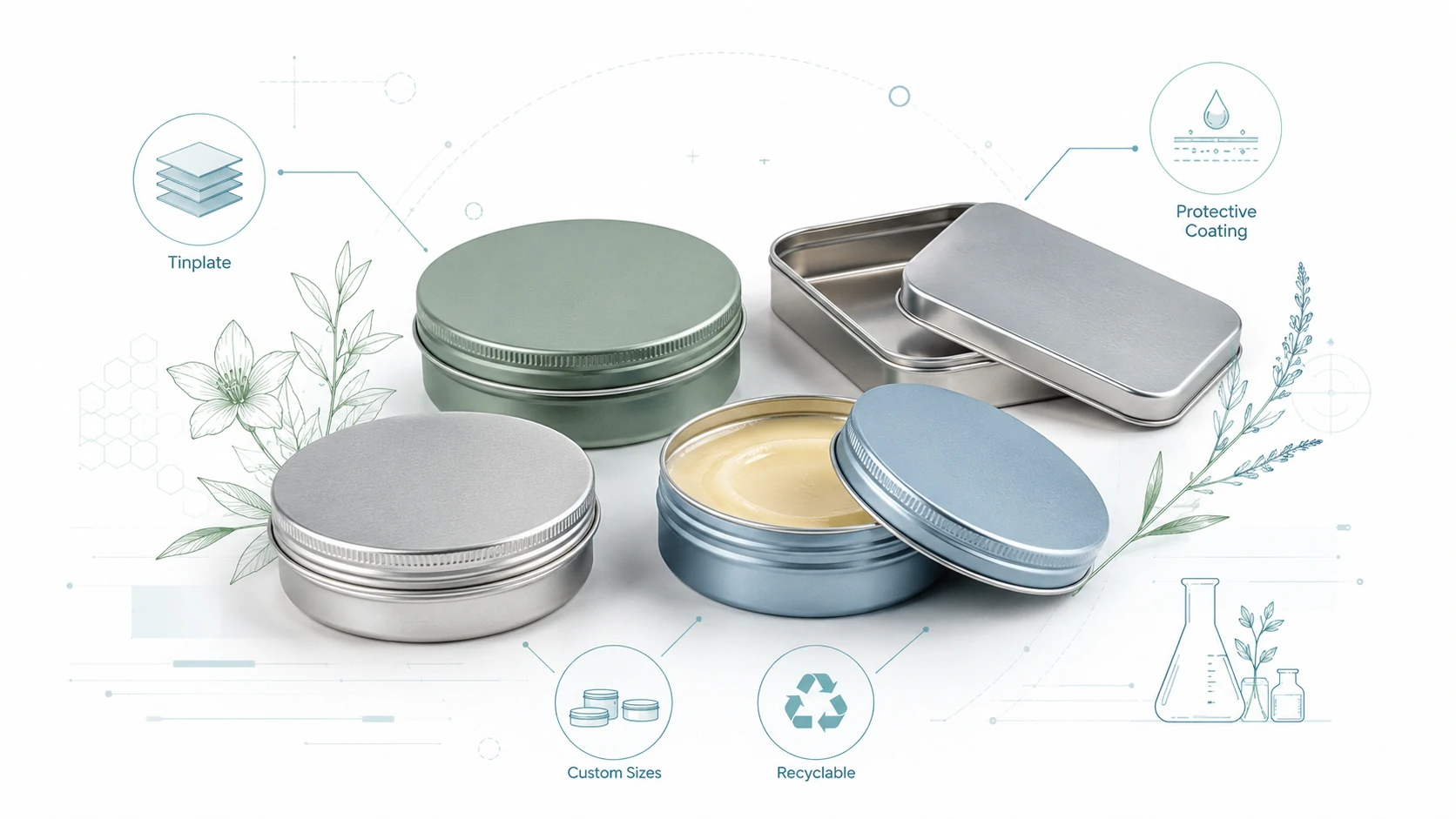

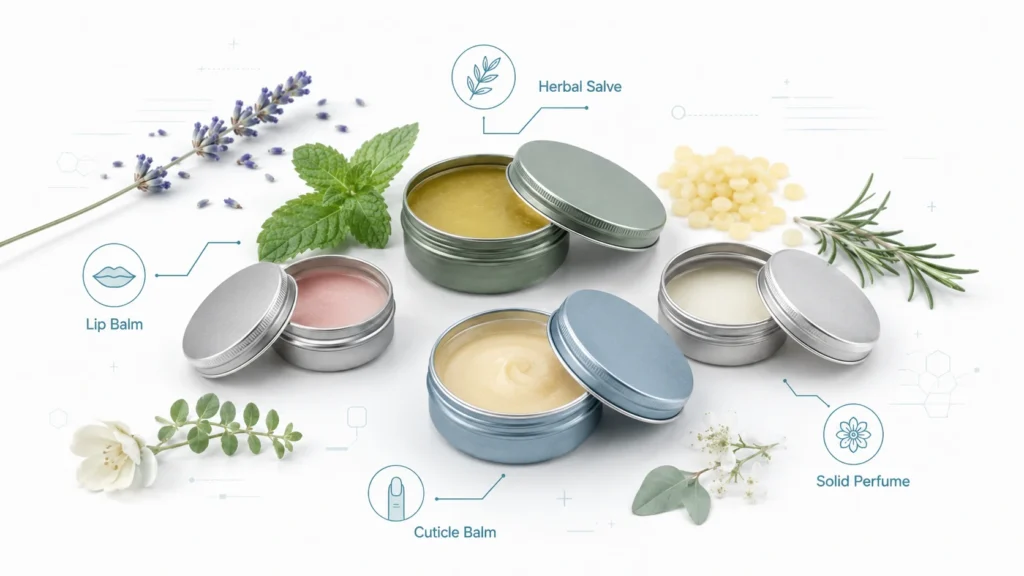
Salve tins are small, durable metal containers designed for wax-rich and oil-based personal care products such as balms, body salves, cuticle care, beard balm, solid lotion, massage balm, tattoo aftercare balm, multipurpose skincare, and travel-size wellness products. For brand owners, they are more than a simple jar alternative. A well-designed salve tin can protect a sensitive formula, communicate a natural or premium positioning, fit comfortably into direct-to-consumer shipping, and create a tactile opening experience that customers remember.
For Mr. Tin Box, salve tins sit naturally inside the broader field of Beauty & Personal Care Packaging. The format is closely related to lip balm tins, small cosmetic tins, soap tins, solid perfume tins, candle tins, and promotional wellness kits. That means a salve tin project is not only about choosing a diameter and height. It also involves material selection, internal coating, lid fit, printing method, artwork tolerance, product compatibility, carton packing, retail display, regulatory language, and the business logic behind minimum order quantity, sampling, and repeat production.
The appeal is easy to understand. Salves are often positioned as concentrated, practical, ingredient-led products. They are usually not watery lotions. They are rich, portable, and often made with waxes, butters, carrier oils, botanical extracts, essential oils, or other functional ingredients. The package should reflect that same sense of substance. A thin, disposable-looking pack can weaken the product story; a custom metal tin can reinforce it.
This guide explains how to choose and customize salve tins for commercial skincare, wellness, and personal care brands. It covers market context, material choices, common sizes, coating decisions, printing options, compliance considerations, sustainability claims, purchasing specifications, and the practical reasons to work with a custom tin packaging manufacturer rather than buying a generic blank container.
Table of Contents
Why Salve Tins Matter for Modern Skincare and Wellness Brands
The personal care market is crowded. New brands enter through Shopify stores, Amazon listings, boutique retailers, spas, apothecaries, tattoo studios, barbershops, outdoor lifestyle shops, hotel amenities, subscription boxes, and influencer-led launches. In this environment, packaging has to do several jobs at once. It must protect the formula, present the brand, survive transport, provide enough label space, meet the expectations of the sales channel, and support a price point that makes sense.
Salve tins are especially useful because they match the way many balm and salve products are used. Customers open the container repeatedly. They touch the tin with dry or oily fingers. They place it in a bag, bathroom drawer, gym kit, travel pouch, glove compartment, first-aid organizer, or bedside table. They may keep it long after the original product is used. This repeated contact makes packaging quality highly visible.
A plastic jar may be light and inexpensive, but it can feel ordinary for a premium balm. A glass jar can look upscale, but it is heavier, more fragile, and less practical for travel or outdoor use. A paper tube can support a low-plastic story, but it may not be ideal for products that are repeatedly opened, exposed to oils, or handled in damp environments. A metal salve tin offers a practical middle ground: rigid, compact, printable, reusable, recyclable in many markets, and familiar to consumers who already associate metal tins with balms, solid perfumes, beard care, and traditional apothecary products.
The business case is also strong. A salve tin is small enough to ship efficiently, but large enough to carry a clear brand mark. It can be sold as a single product, a bundle, a sample size, a gift set component, or a seasonal promotional item. The same tooling family can often support multiple artwork versions, allowing brands to create product lines without redesigning the entire package. For example, one brand may use the same 1 oz or 2 oz tin structure for an unscented balm, lavender balm, calendula balm, muscle rub, foot balm, and cuticle balm, while changing the color palette and copy for each SKU.
That flexibility matters because beauty growth is increasingly driven by targeted products, small-batch storytelling, and value scrutiny. McKinsey’s 2025 beauty outlook notes that global beauty is expected to keep growing through 2030, but consumers are evaluating perceived value more carefully (McKinsey, State of Beauty 2025). Packaging cannot carry a weak product, but it can make a credible product easier to understand, easier to gift, and easier to trust.
What Salve Tins Are, and How They Differ from Ordinary Small Tins
A salve tin is usually a small metal container with a shallow or medium-height body and a removable lid. The lid may be a slip lid, plug lid, screw lid, hinged lid, or specialty structure depending on the material, shape, and user experience required. In many custom packaging projects, salve tins are made from tinplate, which is a thin steel sheet coated with tin. Major steel producers describe tinplate as a strong, formable packaging material with corrosion resistance and an attractive metallic surface; for example, JFE Steel explains that tinplate is a thin steel sheet coated with tin and used for containers and other applications (JFE Steel).
For skincare products, the key difference is not only the external structure. It is the relationship between the container and the formula. Salves may contain oils, waxes, butters, fragrance components, menthol, essential oils, botanical extracts, pigments, or other ingredients that can interact with surfaces over time. A supplier should therefore discuss the internal coating, varnish, edge design, lid fit, and product compatibility with the buyer before mass production.
This is why salve tins should not be treated as random commodity containers. A blank tin may be acceptable for testing a handmade formula, but a commercial product needs more discipline. The tin must fit the fill volume, tolerate filling temperature, avoid leakage under normal handling, resist corrosion in contact with the formula, provide enough branding area, and align with the regulatory category of the product.
A balm that is sold as a cosmetic moisturizer is different from an OTC skin protectant or pain-relief rub in the United States. FDA explains that a product can be a cosmetic, a drug, or both depending on intended use and claims, and that the term “cosmeceutical” has no legal meaning under U.S. law (FDA: Is It a Cosmetic, a Drug, or Both?).
For packaging buyers, this means the tin design and the label copy should be developed together. A small salve tin may have limited printable area. If the product requires warnings, Drug Facts, ingredient declaration, net quantity, distributor details, batch coding, or multilingual copy, the brand may need a secondary carton, label wrap, insert card, peel-back label, or larger tin format. A beautiful tin is not useful if the required information cannot be presented clearly.
Market Context: Why Balms, Salves, and Solid Skincare Need Better Packaging
Salves benefit from several overlapping trends: concentrated formats, waterless beauty, travel-friendly personal care, natural-positioned skincare, wellness gifting, small-format DTC shipping, and refill or reuse narratives. These trends are not limited to boutique brands. Larger personal care companies are also exploring solid, concentrated, low-plastic, and premium portable formats.
The broader market numbers help explain the opportunity. Grand View Research estimated the global skin care products market at USD 155.84 billion in 2025 and projected it to reach USD 202.77 billion by 2033 (Grand View Research). The Global Wellness Institute reported that the global wellness economy reached USD 6.8 trillion in 2024, with personal care and beauty forming one of the major wellness economy sectors (Global Wellness Institute). Those figures do not mean every balm brand will succeed, but they show that skincare and wellness remain large, competitive, and packaging-sensitive categories.
For salve brands, the packaging opportunity is not only about entering a big market. It is about solving specific retail and consumer problems:
- Small products need a strong shelf signal. A 0.5 oz or 1 oz balm can be visually lost if the package is generic. Custom printing, embossing, and color-coded variants help create recognition.
- Oil-rich formulas need credible containment. A tin must be matched with the formula and filling process to reduce the risk of staining, odor transfer, corrosion, or messy opening.
- Wellness products are often gifted. A reusable metal tin can make a simple salve feel more substantial in a gift set.
- Natural-positioned brands need practical sustainability language. Metal can support a recyclable and reusable packaging story, but claims should be specific and substantiated.
- Retailers care about barcode, batch code, and display. The tin must work with real shelves, not only with product photography.
The best salve tin projects begin with these commercial realities. Instead of asking only, “What is the cheapest 2 oz tin?” a stronger question is, “What tin structure, coating, finish, and decoration method will support our formula, price point, launch channel, and reorder plan?”
Common Salve Tin Sizes and Product Applications
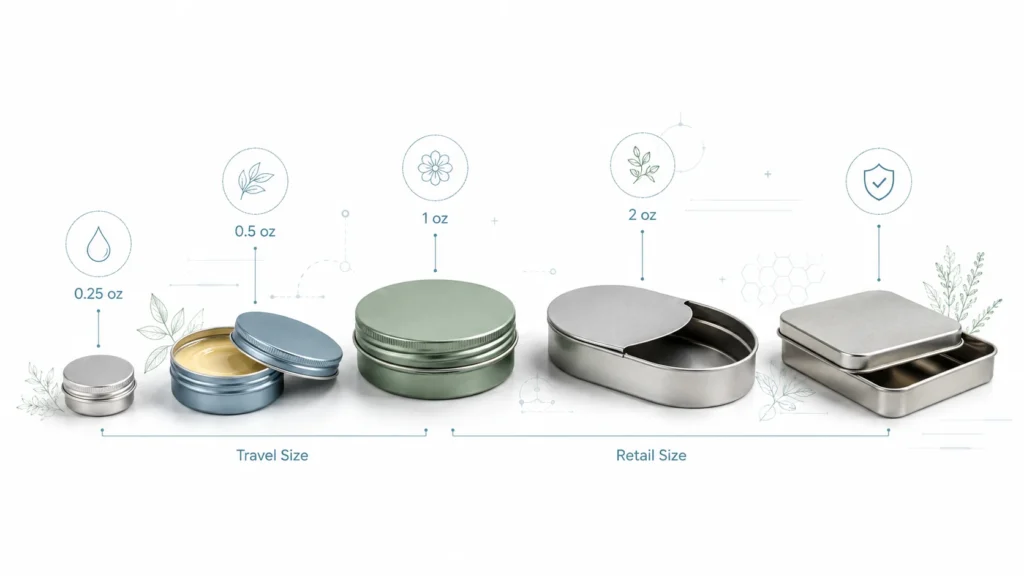
Salve tins are commonly described by capacity, diameter, and height. However, buyers should be careful with capacity language. A “1 oz tin” may refer to approximate fluid capacity, nominal market size, or a supplier’s catalog name. The true fill weight depends on the density of the formula and the desired headspace. A dense balm, whipped salve, wax-rich ointment, and soft butter blend may fill differently even in the same container.
For commercial projects, the practical approach is to test the actual formula in sample tins. Fill the tin at the intended production temperature, allow the product to cool or set, inspect surface appearance, check lid closure, simulate transport, and evaluate customer opening experience. The table below gives typical planning ranges, not final engineering specifications.
| Typical salve tin size | Common use cases | Business advantage | Buyer notes |
|---|---|---|---|
| 0.25 oz / 7 g class | Trial balm, sample salve, hotel amenity, subscription box, gift-with-purchase | Low unit weight, easy sampling, useful for scent or formula testing | Limited label area; may require secondary card or outer pouch for compliance copy |
| 0.5 oz / 15 g class | Lip repair balm, cuticle balm, travel salve, pocket skincare, beard balm sample | Strong portable format; good for impulse purchase and bundles | Check lid security because customers often carry it in bags or pockets |
| 1 oz / 30 g class | Multipurpose salve, herbal balm, tattoo aftercare, foot balm, hand balm | Popular balance of value, portability, and label space | Good starting point for DTC and boutique retail products |
| 2 oz / 60 g class | Body balm, massage balm, family skincare, larger beard balm, outdoor balm | Higher perceived value; more branding and instruction space | More important to test dent resistance, stacking, and shipping cartons |
| 4 oz / 120 g class and above | Professional spa use, refill concept, gift set hero item, specialty wellness product | Premium shelf presence and stronger giftability | Requires closer attention to structure, material thickness, fill temperature, and carton packing |
For Mr. Tin Box customers who are still comparing compact formats, the guide to Small Tin Containers is a useful internal reference because it explains how small-format tins work across food, beauty, gifts, promotional programs, and specialty applications. Buyers developing balm lines can also compare salve tins with the format logic explained in Metal Lip Balm Tin Packaging, especially when the product sits between lip care, skincare, and solid personal care.
Tinplate, Aluminum, and Coated Metal: Choosing the Right Material
Most custom salve tin projects begin with either tinplate or aluminum. Both materials can work, but they do not behave exactly the same in manufacturing, decoration, cost, structure, dent resistance, and brand perception.
Tinplate is widely used for custom metal boxes because it combines the rigidity of steel with a tin-coated surface. It can be stamped, formed, printed, embossed, and finished in many ways. Tinplate is especially common for decorative tins, food tins, gift tins, cosmetic tins, and specialty metal containers. Mr. Tin Box has a more detailed material discussion in its Tinplate Packaging Guide, including coatings, printing, and food-safety considerations.
Aluminum is also common in small cosmetic jars and screw-top balm containers. It is lightweight, corrosion resistant in many applications, and often associated with modern minimal packaging. However, aluminum may require different forming methods and lid structures, and it may not provide the same magnetic or steel-based recycling behavior as tinplate. For many brands, the decision is not simply “which is better?” but “which material best fits our formula, target market, decoration method, and packaging budget?”
| Packaging decision | Tinplate salve tins | Aluminum salve tins | Practical recommendation |
|---|---|---|---|
| Brand feel | Classic, durable, giftable, apothecary, decorative | Lightweight, clean, modern, minimalist | Choose based on positioning: heritage and collectible lines often suit tinplate; minimalist body care may suit aluminum |
| Decoration | Strong for lithographic printing, embossing, debossing, varnish, metallic effects | Often used with labels, printing, anodized or brushed effects depending on supplier capability | If full-surface custom artwork is central, confirm printing tolerances early |
| Structure | Slip lids, hinged tins, shallow round tins, rectangular tins, special shapes | Commonly screw-top jars and small cosmetic pots | Match lid style to customer use: pocket carry needs better closure control |
| Formula contact | Usually needs an appropriate internal coating for oil-rich formulas | May also require internal treatment depending on formula and claims | Always conduct compatibility and stability testing with the actual formula |
| Dent resistance | Good rigidity, but depends on thickness and design | Lightweight but can dent depending on gauge and geometry | Test shipping cartons and retail handling conditions, not only the empty tin |
| Sustainability story | Steel packaging has strong recycling infrastructure in many markets | Aluminum is also highly recyclable where collected | Avoid vague green claims; use specific, market-appropriate language |
For many salve brands, tinplate remains a strong default because it supports premium printing and can be produced in a wide range of shapes. Round tins are popular for balm and salve because they are easy to hold and apply from. Rectangular or square tins can create a stronger shelf block and provide more front-panel branding. Hinged tins can be useful for gift sets or solid perfume concepts, while screw-top tins can provide a more secure feel for travel. The final choice should be made after reviewing formula behavior, target fill volume, closure expectations, and artwork requirements.
Internal Coatings and Formula Compatibility
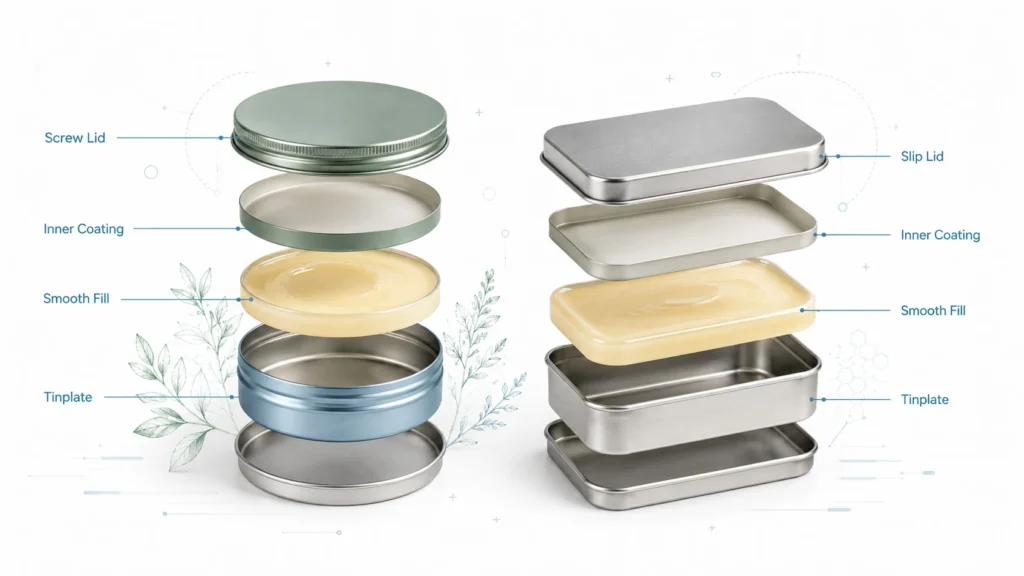
The internal surface of a salve tin deserves serious attention. Many salves contain oils, waxes, plant extracts, fragrance oils, essential oils, or active ingredients that may affect the container over time. Even if the formula looks stable during a short test, longer storage can reveal staining, softening, odor changes, corrosion points, discoloration, or lid-opening problems.
The purpose of an internal coating is to create a suitable barrier between the metal and the product. Depending on the formula and market, the coating may need to support food-contact expectations, cosmetic-contact expectations, odor neutrality, corrosion resistance, and visual cleanliness. The right coating choice depends on the formula, processing conditions, and regulatory requirements. It should not be selected only by appearance.
A responsible packaging development process normally includes these checks:
- Formula review. Share the product type, ingredient profile, fragrance level, essential oil content, fill temperature, expected shelf life, and target market with the packaging supplier.
- Sample filling. Fill the salve into candidate tins under realistic conditions. If the production process fills hot wax or melted balm, the sample test should reflect that.
- Stability observation. Store filled samples in relevant conditions, including room temperature, elevated temperature, and possible cold-chain or transport conditions if applicable.
- Closure and leakage checks. Test lid fit after filling, cooling, shipping simulation, and repeated opening.
- Sensory review. Evaluate smell, appearance, residue, surface smoothness, and user experience.
- Regulatory and label review. Confirm whether the product is cosmetic, OTC drug, aromatherapy, wellness, or another regulated category in each target market.
This process may seem slow, but it is much cheaper than discovering a compatibility issue after thousands of decorated tins have been filled. For salves containing essential oils, menthol, camphor, CBD alternatives where legal, botanical extracts, or high fragrance loads, compatibility testing becomes even more important. A premium salve tin should protect the product story, not become the source of customer complaints.
Lid Design, Opening Force, and Daily User Experience
The lid is one of the most important parts of a salve tin. It affects leakage perception, pocket portability, filling speed, customer satisfaction, and the overall feeling of quality.
A loose lid can create anxiety even when the product is semi-solid. Customers may worry that the balm will open inside a bag. A lid that is too tight can be frustrating, especially for customers using hand balm, cuticle balm, or outdoor salve when their hands may already be dry, cold, oily, or dirty. A lid with poor edge finishing can feel cheap or uncomfortable. A lid with inconsistent fit can create problems in automated or semi-automated filling.
There are several common lid approaches:
- Slip lid: A simple push-on lid. It is common, cost-effective, and suitable for many balm tins, but tolerances matter.
- Plug lid: Designed to sit more securely into the tin body. It can improve perceived closure quality.
- Screw lid: Often associated with aluminum jars or specialty metal pots. It provides a more secure feel, though it may affect cost and supplier options.
- Hinged lid: Useful when the lid should stay attached, especially for gift sets, solid perfume, or display tins.
- Window lid: Sometimes used for visual display, but not always ideal for light-sensitive formulas or premium salve positioning.
For salves, the best lid is not always the tightest lid. It is the lid that balances closure security, openability, consistency, production efficiency, and brand experience. If a product is designed for outdoor use, travel, or gym bags, closure strength becomes more important. If the product is sold as a daily hand balm for older customers, easy opening may matter more. If the tin is a gift set component, a smooth tactile opening can support the premium impression.
Printing and Decoration Options for Custom Salve Tins
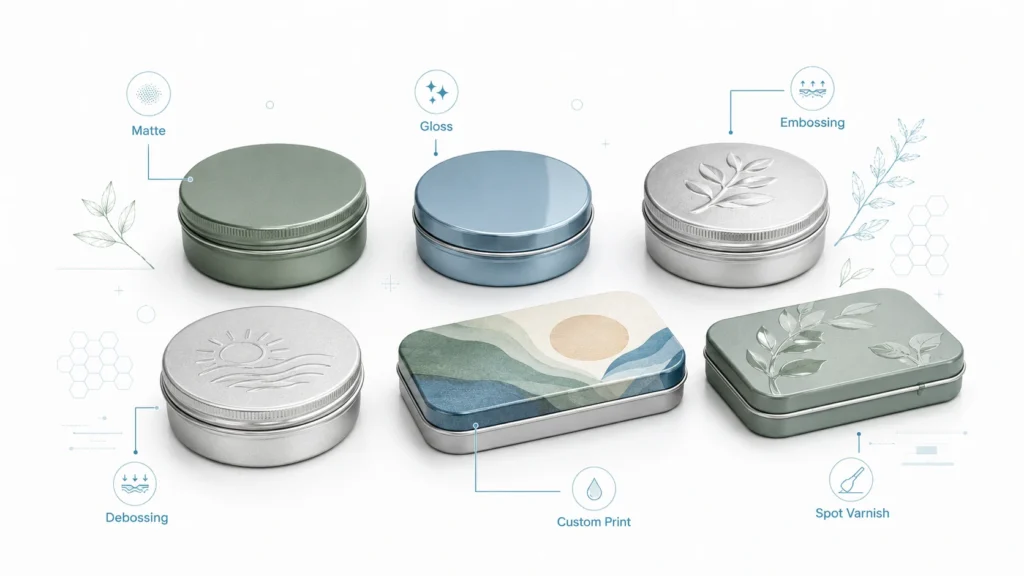
Salve tins may be small, but they can still deliver strong brand impact. Decoration choices include offset printing on metal, PMS color matching, CMYK artwork, matte varnish, gloss varnish, spot varnish, metallic effects, embossing, debossing, raised logos, paper labels, belly bands, sleeves, shrink bands, and secondary cartons. The right decoration route depends on order quantity, artwork complexity, budget, lead time, SKU count, and the brand’s visual system.
For a startup brand, labels may be practical for early market testing. A blank or standard-color tin with a high-quality label allows the brand to test scents, formulas, and copy with lower upfront cost. For a more established brand, fully printed tins create a stronger shelf presence and reduce the “handmade label” feel. For a premium line, embossing or debossing can make the tin feel more tactile and collectible.
A few design rules are especially important for salve tins:
- Prioritize the top lid. The lid is usually the main brand surface in e-commerce photos, retail displays, and gift sets.
- Use sidewalls intelligently. Side printing or labels can carry flavor, scent, net weight, barcode, batch code, or warning copy.
- Avoid overcrowding. A small tin cannot carry the same amount of copy as a folding carton.
- Plan for variant systems. A color-coded family helps customers distinguish lavender, unscented, citrus, herbal, muscle, foot, beard, and cuticle formulas.
- Respect manufacturing tolerances. Artwork that looks perfect on a flat screen may shift slightly during metal forming and printing. Keep critical text away from edges and curved transitions.
For broader design inspiration, Mr. Tin Box’s article on Metal Tin Packaging Benefits, Applications, and Custom Options explains how metal packaging supports beauty, gifts, food, and specialty products through structure and decoration. Salve tins are a small-format expression of the same packaging logic: protection, branding, repeat use, and premium feel.
Compliance: Cosmetic, OTC Drug, or Wellness Product?
Salve packaging must support the product’s regulatory category. In everyday language, brands may call many products “healing balm,” “rescue salve,” “pain relief balm,” “skin repair ointment,” or “therapeutic rub.” In regulatory language, these phrases can matter. A product that only moisturizes or beautifies the skin may be a cosmetic in one market. A product that claims to treat disease, relieve pain, heal cuts, prevent infection, or affect body structure or function may be regulated as a drug, medicine, medical product, or another category depending on jurisdiction.
In the United States, FDA states that intended use can be established through claims, consumer perception, ingredients with well-known therapeutic use, or other evidence. FDA also notes that cosmetics generally do not need premarket approval, except for color additives, but they must comply with applicable laws after entering the market (FDA Authority Over Cosmetics). If a salve is positioned as an OTC skin protectant, pain-relief rub, or other drug product, different rules may apply. For example, the U.S. OTC skin protectant monograph is codified in 21 CFR Part 347 (eCFR 21 CFR Part 347).
In the European Union, cosmetic products placed on the market must follow Regulation (EC) No 1223/2009. The European Commission states that responsible persons and, in some cases, distributors must submit product information through the Cosmetic Product Notification Portal before placing products on the EU market (European Commission CPNP).
For packaging buyers, the key lesson is practical: do not finalize tin size, print area, or artwork until you know what information must appear on the immediate container, outer packaging, or both. FDA’s summary of cosmetic labeling requirements explains that required label statements can apply to the inside as well as any outside container or wrapper (FDA Cosmetic Labeling Requirements). This is especially important for small salve tins because the printable area may be limited.
The following table shows common compliance questions that affect salve tin design. It is not legal advice; brands should confirm requirements with qualified regulatory specialists in their target markets.
| Compliance question | Why it affects packaging | Possible packaging response |
|---|---|---|
| Is the product a cosmetic, OTC drug, or both? | Claims, warnings, required panels, and registration duties may differ | Choose larger tin, secondary carton, peel-back label, or insert card if more copy is required |
| What markets will the product enter? | U.S., EU, UK, Canada, Australia, and other markets may have different label rules | Reserve artwork space for multilingual copy, responsible person details, symbols, and market-specific wording |
| Does the formula contain fragrance allergens or sensitizing ingredients? | Ingredient declaration and allergen communication may be needed | Use clear label hierarchy and avoid tiny unreadable text |
| Is the salve filled hot? | Heat can affect coating, graphics, and dimensional stability | Test actual filling temperature with coated sample tins |
| Are environmental claims planned? | Recyclable, reusable, plastic-free, and sustainable claims may require substantiation | Use specific claims and avoid vague language; consider local recyclability rules |
| Will batch coding or expiry dating be required? | Small tins may lack flat coding space | Plan a sidewall code area, bottom code, label panel, or outer carton |
Sustainability, Recyclability, and Responsible Green Claims
Metal packaging can support a strong sustainability story, but the language should be accurate. Steel and aluminum are valuable materials in recycling systems, and many markets have well-established metal recovery infrastructure. Steel for Packaging Europe reports an 84% steel packaging recycling rate in Europe based on 2024 data and states that steel packaging is 100% recyclable (Steel for Packaging Europe: Recycling). In the United States, EPA’s containers and packaging data estimates steel packaging recycling in 2018 at 1.6 million tons, or 73.8% of generation (U.S. EPA Containers and Packaging Data).
These numbers are useful, but brands should still avoid overclaiming. “Recyclable” does not always mean that every local program accepts every small metal item. Collection, sorting, size, contamination, local rules, and consumer behavior all matter. A tiny metal tin may perform differently from a food can in a municipal recycling facility. In the United States, the FTC Green Guides explain how marketers can avoid unfair or deceptive environmental claims under Section 5 of the FTC Act (eCFR 16 CFR Part 260). California’s SB 343 also restricts recyclability claims unless products or packaging are regularly collected and processed for recycling in the state (CalRecycle SB 343).
For salve brands, stronger sustainability language is usually specific and practical:
- “Metal tin designed for reuse after product is finished.”
- “Please clean before recycling where local facilities accept metal packaging.”
- “Refill-ready format available for selected product lines.”
- “Plastic-free primary container, subject to label and closure components.”
- “Durable tin suitable for travel and repeated opening.”
Weaker claims are vague or absolute:
- “Eco-friendly packaging.”
- “100% sustainable.”
- “Zero waste.”
- “Always recyclable everywhere.”
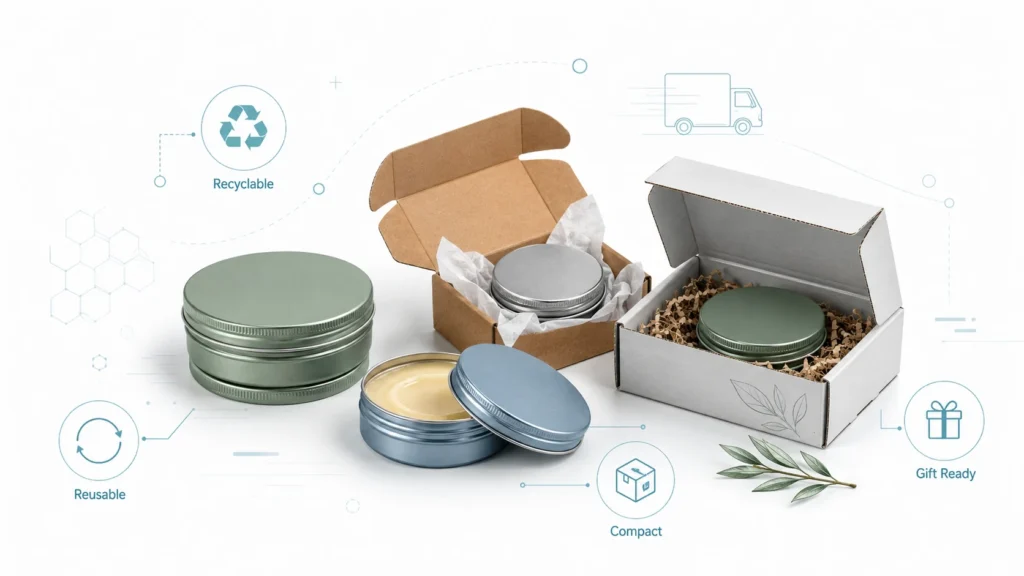
A custom salve tin can support circularity better when it is designed for actual reuse. For example, a premium 2 oz salve tin may be reused for jewelry, pins, travel soap, small tools, earbuds, craft supplies, or refill balm. A decorative tin with a strong brand story may remain in the customer’s home longer than a disposable plastic pot. This reuse value is difficult to measure, but it is real from a brand-experience perspective.
How Salve Tins Support E-commerce, Retail, and Gift Programs
The same salve tin may behave differently across sales channels. For e-commerce, the package must photograph well, ship safely, resist dents, and fit efficient mailer systems. For retail, it must stand out on a shelf, communicate quickly, scan properly, and survive handling. For gift programs, it must feel substantial and coordinate with other products. For professional channels such as spas, barbershops, tattoo studios, and wellness practitioners, it must feel clean, credible, and practical.
E-commerce often rewards simple, high-contrast design because the product image is small on mobile screens. A printed lid with a clear product name and scent color can improve recognition. However, e-commerce also increases the risk of denting during parcel delivery. That means carton design, inner dividers, master carton strength, and drop testing may matter as much as the tin itself.
Retail requires a different balance. A salve tin may need a barcode, tamper-evident seal, hang tab carton, counter display tray, or shelf-ready packaging. If the product is small, retailers may prefer multi-unit trays or outer cartons to reduce shrinkage and improve shelf organization. For premium boutiques, a fully printed tin may be enough. For mass retail, regulatory panels and scanability may require secondary packaging.
Gift and promotional programs are especially strong for salve tins. A wellness brand can create seasonal kits with hand balm, lip balm, solid perfume, candle tin, soap tin, and tea tin. A hotel or spa can use small salve tins as amenities. A corporate wellness program can add custom printed tins to holiday boxes. Mr. Tin Box’s Gift, Promotional & Holiday Packaging category is relevant here because salve tins often become part of a broader branded gift experience rather than a single standalone SKU.
This is where custom metal packaging becomes commercially valuable. A generic container holds product. A custom tin helps create a line architecture, a giftable system, and a repeatable brand asset.
Cost Drivers in Custom Salve Tin Projects
Salve tin pricing depends on more than size. Buyers often compare unit prices before they have defined the specifications, which can lead to misleading quotes. A 2 oz tin with plain label decoration is not equivalent to a fully printed, embossed, matte-varnished tin with a custom insert and tight color tolerance. The cost structure is shaped by tooling, material, thickness, forming complexity, printing plates, coating, finishing, quality standards, packing method, shipping volume, and order quantity.
Major cost drivers include:
- Material and gauge. Thicker material can improve rigidity but increases material cost and may affect forming.
- Shape and structure. Round tins are often more efficient than complex custom shapes. Hinges, windows, screw closures, and special embossing can add cost.
- Decoration method. Full metal printing, spot varnish, embossing, and multi-SKU artwork increase setup complexity.
- Internal coating. Specialized coatings or food-contact/cosmetic-contact expectations can change cost and lead time.
- MOQ and SKU count. A single artwork at a higher quantity is usually more efficient than many small artwork batches.
- Packing requirements. Individual polybags, paper wraps, dividers, retail cartons, master cartons, and pallet requirements affect labor and freight.
- Quality tolerance. Premium beauty brands may require tighter appearance standards than industrial promotional products.
- Testing and documentation. Compatibility testing, migration documentation, inspection reports, or compliance support can add time and cost.
A good supplier will not quote only the lowest possible number. They will ask what the tin must achieve. For a brand owner, the lowest unit price may not be the lowest business cost if the tin dents easily, creates filling problems, fails compatibility testing, or cannot carry required label copy.
A Practical Specification Checklist for Buyers
A clear specification helps the supplier recommend the right tin structure and reduces back-and-forth during development. It also makes quotations more comparable. When buyers ask several factories for “1 oz salve tins,” they may receive quotes for different materials, thicknesses, coatings, lid types, print methods, packing standards, and quality assumptions. A structured brief prevents confusion.
Before requesting a quotation from Mr. Tin Box or any custom tin manufacturer, prepare the following information:
- Product type: cosmetic salve, beard balm, tattoo balm, cuticle balm, solid lotion, OTC skin protectant, massage balm, or other format.
- Formula notes: oil level, wax level, fragrance or essential oil level, fill temperature, expected shelf life, and any sensitive ingredients.
- Fill target: net weight, approximate volume, desired headspace, and whether the product is filled hot or cold.
- Target markets: United States, EU, UK, Canada, Australia, Japan, Middle East, or other regions.
- Sales channel: DTC, Amazon, boutique retail, pharmacy, spa, hotel, corporate gift, wholesale, or distributor.
- Preferred size and shape: round, square, rectangular, shallow, deep, hinged, slip lid, screw lid, or custom shape.
- Decoration: label, full metal printing, embossing, debossing, matte/gloss varnish, metallic effect, or sleeve.
- Compliance space: ingredient list, warnings, barcode, batch code, expiry date, responsible person, Drug Facts, multilingual copy.
- Packaging method: bulk packed, individually packed, display tray, retail carton, gift box, or master carton requirement.
- Quantity plan: launch quantity, expected reorder quantity, number of SKUs, and forecast by quarter.
- Timeline: artwork deadline, sample deadline, filling date, launch date, and shipping destination.
Mr. Tin Box’s Custom Tin Packaging Guide provides a useful starting point for brands preparing product details, size requirements, artwork direction, target market, compliance needs, and launch schedule before requesting samples or a quotation.
Design Strategy: Building A Salve Line, not Just One Tin
Many brands start with one hero salve. If the product succeeds, they quickly add variants. This is why packaging should be designed as a product system from the beginning. A salve line may include unscented balm, herbal balm, lavender balm, citrus balm, after-sun balm, foot balm, hand balm, beard balm, baby balm, tattoo balm, and seasonal limited editions. If each tin looks unrelated, the brand loses shelf impact. If every tin looks identical, customers cannot distinguish variants quickly.
A strong line system usually includes a consistent brand mark, stable typography, repeatable layout, and controlled color variation. For example:
- The lid center can hold the master brand logo.
- The upper ring can carry the product family name.
- The lower ring can carry scent, function, or ingredient cue.
- The sidewall can carry net weight, barcode, batch code, and legal copy.
- Color can identify the variant.
- Embossing can remain consistent across all SKUs.
This system is especially useful for wholesale and retail buyers. Retailers prefer packaging that looks organized on shelf. Consumers prefer packaging that makes choice easy. A custom salve tin should therefore be designed not only for one product photo, but for a complete merchandising block.
Brands should also plan for future formats. The same visual identity may later extend to lip balm tins, soap tins, candle tins, tea tins, or wellness gift boxes. Mr. Tin Box’s content on Tin Containers with Lids and Square Metal Tins can help buyers think beyond one container and build a broader metal packaging system.
Quality Control Points for Salve Tins
Quality control for salve tins should cover appearance, structure, cleanliness, function, and packing. Beauty and wellness products are often judged visually. A small scratch, color shift, dent, or lid issue can feel more serious when the product is sold as premium skincare.
Important QC points include:
- Dimension check: diameter, height, lid fit, opening clearance, and stacking behavior.
- Surface inspection: scratches, dents, color variation, printing registration, varnish consistency, dust, and metal exposure.
- Edge safety: smoothness of rolled edges, corners, lid rims, and any cut lines.
- Coating inspection: internal coating coverage, appearance, adhesion, and compatibility with product testing.
- Closure test: lid tightness, openability, repeated opening, and shipping movement.
- Print accuracy: logo placement, barcode readability, small text clarity, color matching, and artwork orientation.
- Packing inspection: individual protection, carton strength, dividers, moisture control, and export marking.
- Documentation: sample approval, production reference, batch records, inspection report, and retained samples.
For filled products, the brand or filler should also run post-filling checks. A tin that passes empty inspection may behave differently after hot fill, cooling, capping, labeling, and shipment. If a balm shrinks after cooling, the surface may pull away from the sidewall. If the tin is overfilled, the lid may touch the product and create smearing. If the label is applied before the tin has fully cooled, adhesive performance may suffer. Packaging and filling should be validated together.
How Salve Tins Compare with Plastic Jars, Glass Jars, and Paper Tubes
No packaging material is perfect. The right choice depends on product positioning, target market, formula, price point, and logistics. Salve tins are strong in many situations, but brands should understand the trade-offs.
Plastic jars are inexpensive, light, and available in many standard sizes. They can be practical for mass-market products or very low-cost lines. However, they may not communicate premium value, and sustainability pressure on plastic packaging continues to rise.
Glass jars look premium and have good chemical resistance, but they are heavier and breakable. For bathroom, travel, outdoor, gym, and child-handling situations, breakage can be a practical concern. Freight weight can also increase cost and emissions.
Paper tubes or paperboard jars can support a natural look, but oil-rich formulas may create staining or barrier challenges. They may be better for stick balms, deodorant-style products, or dry solid products than for soft salves that are repeatedly finger-applied.
Metal tins provide a balance of rigidity, portability, decoration, reuse, and recyclability. They are especially strong when the product is semi-solid, giftable, and brand-driven. The main considerations are compatibility testing, dent prevention, closure fit, and copy space.
For many salve brands, the best strategy is not to replace every format with metal. It is to use metal where it creates visible business value: hero products, gift sets, premium lines, travel sizes, solid skincare, limited editions, and refillable or reusable concepts.
When to Choose A Custom Tin Instead of A Stock Tin
Stock tins are useful for early testing. They allow a brand to validate a formula, sell at a farmers market, test online demand, or prepare small promotional batches. But once the product moves into serious retail or repeat production, stock tins can limit the brand.
A custom salve tin becomes worthwhile when:
- The brand needs a distinctive visual identity.
- The formula requires a specific internal coating.
- The lid fit of stock tins is inconsistent.
- The brand wants better shelf impact.
- The product line includes multiple variants.
- The buyer needs export cartons, barcode plans, or retailer-specific packaging.
- The tin must match a gift set, display tray, or promotional kit.
- The order volume supports tooling, printing, or custom finishing.
Custom does not always mean fully unique tooling. Many projects use existing molds with custom printing, coating, embossing, or packing. This can balance cost and brand differentiation. A truly unique shape may be appropriate for premium brands, but it increases development time and tooling cost. The best supplier will help buyers decide whether to use an existing size, modify a structure, or invest in a new mold.
Working with Mr. Tin Box on Salve Tin Packaging
Mr. Tin Box focuses on custom metal tin packaging for global brands across food, beauty, gift, promotional, holiday, specialty, and industrial applications. For salve tins, that cross-category experience is useful because balm packaging often borrows from several packaging worlds: cosmetic presentation, food-safe coating discipline, gift packaging design, and export-ready metal tin manufacturing.
A typical salve tin development path can include:
- Brief review. The buyer shares product type, fill target, formula notes, market, artwork direction, sales channel, and launch schedule.
- Structure recommendation. Mr. Tin Box suggests suitable tin sizes, shapes, lid styles, materials, coatings, and decoration routes.
- Sample selection. The buyer receives existing samples or prototypes for size, hand feel, and formula testing.
- Artwork adaptation. The design is adjusted for metal printing, lid curvature, sidewall dimensions, bleed, safe zones, and color behavior.
- Compatibility discussion. Internal coating and formula contact requirements are reviewed before production.
- Pre-production sample. A sample is approved for color, structure, fit, finish, and packing method.
- Mass production. Production follows approved specifications, with inspection points for forming, coating, printing, assembly, and packing.
- Export and reorder support. Carton packing, shipping marks, documentation, and future reorder consistency are managed.
This process helps buyers avoid the most common salve tin problems: wrong size, insufficient label space, weak closure, poor formula compatibility, unattractive print results, dented shipping, and unclear specifications. It also supports better marketing because the final package is engineered around the brand story rather than chosen as an afterthought.
Practical Examples of Salve Tin Concepts
To make the strategy more concrete, here are several salve tin concepts that brands can develop with custom metal packaging.
1. Herbal multipurpose salve in a 1 oz round tin. This format works for DTC, boutique retail, and wellness shops. The lid can carry the brand logo and ingredient cue, while the sidewall carries net weight and batch code. A matte green or botanical color palette can support a natural positioning without relying on vague environmental claims.
2. Tattoo aftercare balm in a 2 oz black tin. This product needs a durable, professional look. A black or gunmetal finish with high-contrast printing can work well in tattoo studios and online stores. Because aftercare claims can be regulatory sensitive, copy should be reviewed carefully.
3. Beard balm in a shallow screw-top or slip-lid tin. Men’s grooming products often benefit from a sturdy pocketable format. Embossing, dark colors, metallic ink, or a simple label system can support barber and grooming retail channels.
4. Cuticle balm in a 0.5 oz tin. This small format works well for salons, checkout counters, subscription boxes, and gift-with-purchase programs. Because label area is limited, a printed lid plus outer card may be useful.
5. Spa massage balm in a 4 oz tin. A larger tin can create premium presence for professional use or gift sets. The structure should be tested for dent resistance and easy opening, especially if therapists open it repeatedly during service.
6. Seasonal wellness gift set. A brand can combine salve tins with candle tins, soap tins, tea tins, or candy tins in a coordinated metal packaging theme. This approach turns a small balm into part of a higher-value gift purchase.
These examples show why salve tins are commercially flexible. The same basic packaging category can serve skincare, grooming, tattoo care, spa, outdoor, baby care, wellness gifting, and promotional markets. The differences lie in structure, coating, decoration, claims, and channel strategy.
Common Mistakes to Avoid
Salve tin projects can fail for simple reasons. Many issues are preventable if the buyer and supplier discuss the right details early.
Choosing a tin before testing the formula. A salve may look simple, but oils, essential oils, fragrance, menthol, or botanical components can behave differently over time. Always test the actual formula in the actual coated tin.
Using medical-style claims without regulatory review. Words like heal, treat, cure, pain relief, anti-inflammatory, wound care, or infection prevention may change the regulatory status of a product in some markets. Packaging space and copy must match the legal category.
Overloading a small lid with text. A tiny salve tin cannot carry a full brand story. Use clear hierarchy and move detailed copy to a carton, insert, product page, or peel-back label.
Ignoring opening experience. A lid that is difficult to open can damage repeat purchase. Test with real users, not only packaging engineers.
Underestimating shipping damage. Small tins can still dent if packed poorly. Export cartons, dividers, and drop tests matter.
Making vague sustainability claims. Metal packaging has real recycling and reuse strengths, but claims should be specific, substantiated, and suitable for the target market.
Quoting without a full specification. A low quote based on unclear specifications can create problems later. Define material, size, coating, printing, packing, and quantity before comparing suppliers.
FAQ
Are salve tins suitable for natural and essential-oil-based balms?
They can be suitable, but the formula must be tested with the selected tin and internal coating. Essential oils, fragrance oils, menthol, camphor, botanical extracts, and high oil loads may require additional compatibility checks. Do not assume that every metal tin is appropriate for every salve formula.
What is the best size for a new salve brand?
For many brands, 1 oz and 2 oz tins are practical starting points. A 1 oz tin is portable and good for DTC or trial purchase. A 2 oz tin offers more perceived value and more label space. However, the best size depends on formula density, price point, sales channel, and required label information.
Can Mr. Tin Box make fully printed salve tins?
Yes. Custom metal tin packaging can include full-surface printing, logo printing, color matching, matte or gloss varnish, embossing, debossing, and other decorative effects depending on the project specification. Buyers should provide artwork files and confirm safe zones, color expectations, and MOQ.
Do salve tins need an inner coating?
In many commercial salve projects, an appropriate internal coating is recommended because the product may contain oils, waxes, fragrances, or other ingredients that contact the metal. The final coating should be selected after reviewing the formula and target market.
Are metal salve tins recyclable?
Metal packaging is recyclable in many markets, and steel packaging has strong recycling performance in Europe and the United States. However, recyclability depends on local collection and processing systems. Brands should avoid absolute claims and provide clear disposal guidance based on the target market.
Can salve tins be used for OTC skin protectants or pain-relief balms?
They can be used as containers, but the product category may trigger additional regulatory requirements. In the United States, products making skin protectant or pain-relief claims may fall under OTC drug rules. Brands should confirm the regulatory pathway before finalizing label size and artwork.


