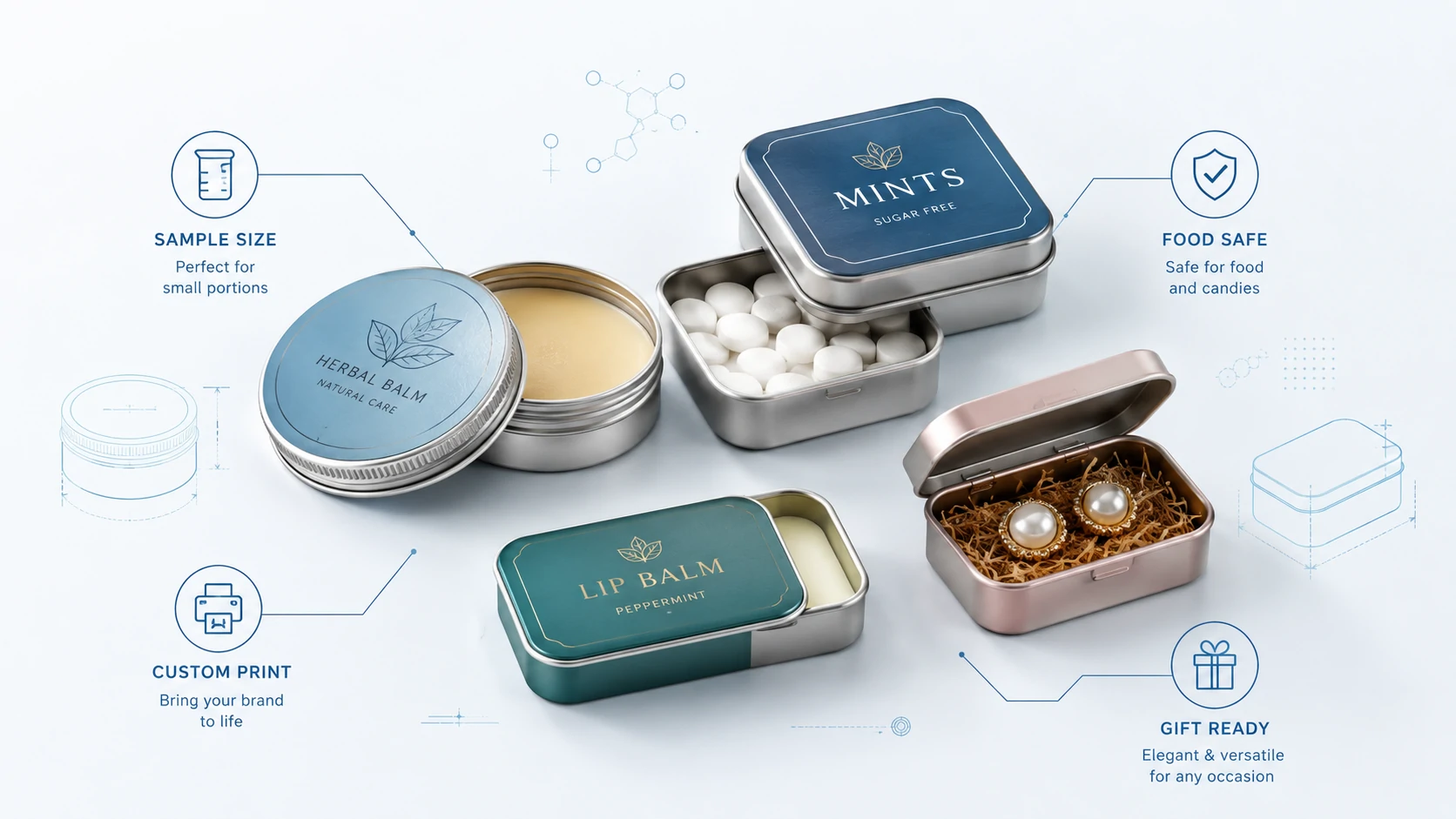
Mini tins are small metal boxes designed to make compact products feel more useful, more giftable, and more valuable in the customer’s hand. They are commonly used for candy, mints, chocolate samples, tea samples, lip balm, solid perfume, cosmetic trial kits, wedding favors, corporate gifts, promotional giveaways, craft supplies, small hardware, and limited-edition collections. For a brand owner or sourcing team, the attraction is simple: a mini tin is small enough to control unit cost, but rigid enough to protect the product and premium enough to support a stronger shelf impression than a simple pouch, plastic jar, or paper box.
At Mr. Tin Box, mini tins sit naturally inside the wider custom metal tin packaging system used for Food & Beverage Packaging, Beauty & Personal Care Packaging, gift programs, holiday campaigns, and specialty industrial items. A mini tin can be a small candy container, a lip balm tin, a sample kit, a pocket gift, or a reusable storage case. The same basic format can serve different business goals when the material, size, lid style, coating, insert, printing, and packing method are specified correctly.
This guide is written for brand owners, product managers, procurement teams, promotional product buyers, importers, and private-label developers who need a clear commercial understanding of mini tins before requesting samples or a quotation. It explains what mini tins are, where they work best, which technical details matter, how to plan size and artwork, and what to prepare before contacting a custom tin manufacturer.
Table of Contents
Quick Buyer Summary
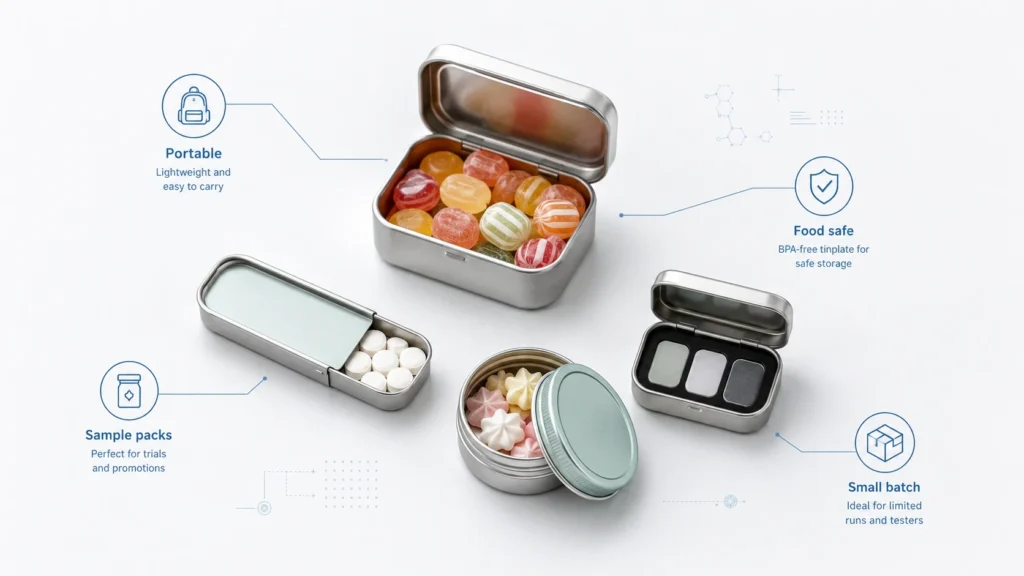
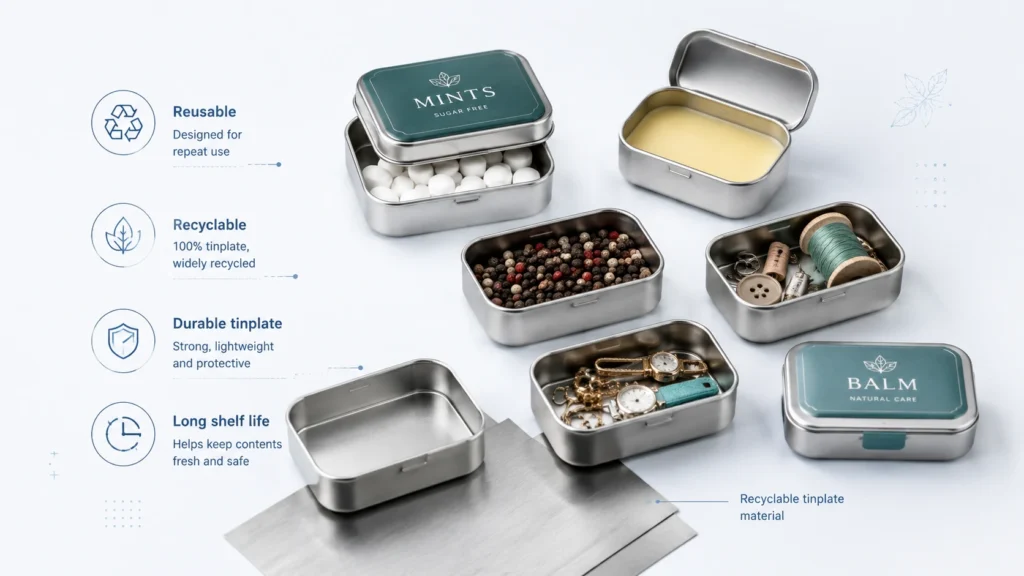
Mini tins are most valuable when the product is small, repeatable, touchable, collectible, or giftable. They are especially useful when the package itself becomes part of the customer experience. A mint tin that stays in a pocket, a balm tin that sits on a desk, a tea sample tin that gets reused in a kitchen, or a promotional tin that holds office supplies all create repeated brand exposure after the first purchase.
For commercial buyers, the strongest reasons to choose mini tins are:
- Higher perceived value: metal makes a small product feel more substantial and premium.
- Strong protection: rigid tinplate helps protect small items from crushing, light exposure, and daily handling.
- Reusable format: many customers keep mini tins for storage, travel, desk organization, or collectibles.
- Brandable surface: the lid and body can carry offset printing, embossing, debossing, spot varnish, metallic effects, and matte or glossy finishes.
- Flexible use cases: one structure can support candy, lip balm, samples, gifts, wedding favors, retail add-ons, or promotional campaigns.
- Sustainability story: steel-based tinplate is compatible with established metal recycling systems in many markets, although claims should always be specific to the target country and final package design.
The key point is that mini tins should not be treated as a generic small box. A successful mini tin is a designed packaging system. It must match the product, target market, contact requirements, opening feel, artwork, display method, shipping route, and budget.
What Are Mini Tins?
Mini tins are compact metal containers, usually made from tinplate, that are formed into small round, square, rectangular, oval, heart-shaped, slider, hinged, or specialty structures. In commercial packaging, the word “tin” normally means tinplate rather than solid tin. Tinplate is a thin steel sheet coated with a thin layer of tin. The steel gives the package rigidity and forming strength, while the tin layer and organic coatings help protect the surface and support printing or decoration.
This material logic is explained in the Mr. Tin Box guide to tinplate packaging, which is a useful internal reference for buyers who want to understand material, coating, printing, and food safety questions before launching a project. Mini tins use the same general tinplate principles as larger custom tins, but the small scale makes tolerance control more important. A slight lid looseness, a sharp edge, a misaligned print, or an insert that does not sit flat can be more obvious on a mini package because there is less surface area to hide defects.
Mini tins usually include three functional layers:
- The structural metal body, which provides shape, rigidity, and product protection.
- The coating system, which may include internal lacquer, external primer, inks, varnish, or specialty finishes.
- The functional accessories, which may include trays, paper liners, foam inserts, inner bags, labels, cards, shrink bands, or display cartons.
For dry products such as mints, candy, tea samples, sewing kits, or promotional items, a simple tin with the right inner protection may be enough. For lip balm, salve, solid perfume, or other formulas that contain oils, waxes, fragrance, or active ingredients, coating compatibility and formula testing become more important. For direct food contact, the buyer must confirm that the intended material system, coating, inks, and use conditions are appropriate for the target market.
Why Mini Tins Are Commercially Powerful
The commercial power of mini tins comes from a simple tension: the package is small, but the customer experience is physical. A tiny cardboard sleeve may be thrown away immediately. A rigid mini tin may be opened, closed, reused, collected, gifted, and carried. That difference can change how customers perceive a small product.
For sampling programs, mini tins help a brand avoid the cheap feeling that can come from sachets or loose samples. For candy and mints, a mini tin can turn a low-volume product into a pocketable item that customers keep seeing. For lip balm and solid cosmetics, metal packaging supports a tactile beauty experience that feels more intentional than a basic plastic jar. For gifts and promotional campaigns, mini tins make small items feel curated, which is essential when the product itself is inexpensive but the brand wants a premium impression.
Mini tins also work well because they support both standard mold programs and custom design programs. A brand can start with an existing round, square, rectangular, or slider tin to reduce development cost and shorten lead time. Later, if volume grows, the brand can invest in a custom shape, custom lid structure, compartment insert, or exclusive decorative finish. This staged development path is attractive for new product launches, seasonal campaigns, crowdfunding products, subscription boxes, retail trial kits, and private-label testing.
The packaging market also supports this logic. Packaging is a major material flow in consumer goods. The U.S. Environmental Protection Agency notes that containers and packaging accounted for 82.2 million tons of municipal solid waste generation in 2018, or 28.1 percent of total generation, in its containers and packaging data. This does not mean every brand should use more packaging. It means packaging choices are visible, regulated, and commercially important. A small metal package should therefore justify itself through protection, reuse, recyclability, shelf value, or a clear brand function.
Common Mini Tin Applications
Mini tins can be adapted across many industries, but the best applications share a few patterns. The product is compact. The package benefits from rigidity. The customer touches or reuses the container. The lid can carry brand artwork. The product may be sold as a sample, gift, premium add-on, or collectible item.
| Application | Common products | Best mini tin direction | Main commercial benefit |
|---|---|---|---|
| Food and candy | Mints, candies, chocolate pieces, tea samples, spice samples | Round, square, rectangular, or slider tins with food-contact planning | Makes small treats feel premium and giftable |
| Lip balm and solid cosmetics | Lip balm, salve, solid perfume, beard balm, hair wax | Shallow round tins, slider tins, or small screw-style alternatives when available | Supports a tactile beauty experience and easy portability |
| Samples and trial kits | Tea samples, skincare samples, fragrance testers, wellness samples | Small tins with paper liner, insert, or inner pouch | Improves perceived value of low-volume samples |
| Gifts and favors | Wedding favors, party favors, holiday candies, brand gifts | Decorative mini tins, heart tins, shaped tins, or hinged tins | Turns a small item into a keepsake |
| Promotional packaging | Mints, pins, USB drives, sewing kits, survival kits, office items | Hinged, slider, or rectangular tins with logo-focused printing | Provides repeated brand exposure through reuse |
| Specialty and industrial | Small parts, fasteners, blades, accessories, tools, hobby kits | Rigid tins with foam, paperboard, or plastic inserts | Protects small parts and organizes components |
This range is one reason mini tins are a strong fit for a manufacturer like Mr. Tin Box. The company already positions custom metal packaging across food, beauty, gift, promotional, holiday, and specialty applications. A buyer can review related internal references such as Small Tin Containers: Sizes, Uses, and Custom Packaging Ideas, Metal Lip Balm Tin Packaging, and Metal Tins with Lids: Structure Guide for Custom Packaging to compare size, material, lid, and category considerations.
Mini Tins for Candy, Mints, and Confectionery
Candy and mint packaging is one of the most familiar uses for mini tins. A mini mint tin is small, portable, and easy to open repeatedly. A candy tin can sit near a checkout counter, inside a gift basket, or on a desk. For chocolates and premium confectionery, mini tins can act as trial packs, seasonal gifts, event giveaways, or sampler boxes.
The main advantage is perceived value. A few grams of candy in a loose pouch may feel ordinary. The same amount in a printed metal tin can feel like a branded product. This is especially useful for boutique candy brands, coffee shops, hotels, corporate events, museum stores, airline gifts, wedding favors, and holiday collections.
Food buyers should pay attention to contact design. If candy touches the metal directly, the internal coating and overall food-contact system must be suitable for the intended food and market. If the candy is individually wrapped, packed in an inner pouch, or separated by paper, the direct contact surface may be different. This distinction affects specification, testing, documentation, and cost.
The U.S. FDA explains that a food contact substance includes food packaging and components such as adhesives, colorants, and substances applied to packaging surfaces in its food packaging and food contact information. For Europe, the European Commission states that Regulation (EC) No 1935/2004 sets out general principles of safety and inertness for food contact materials on its food contact materials legislation page. In practical sourcing language, this means a buyer should not ask only, “Is the tin food grade?” The better question is, “Which surfaces will contact the food, under which temperature and storage conditions, and which market documentation is required?”
For mints and dry candies, common options include hinged rectangular tins, slider tins, round slip-lid tins, and square lift-off tins. The lid should be secure enough for pockets and bags, but not so tight that the consumer struggles to open it. Interior cleanliness, odor control, coating consistency, and packing protection are important because confectionery products are sensitive to aroma transfer and customer perception.
Mini Tins for Lip Balm, Salves, and Solid Cosmetics
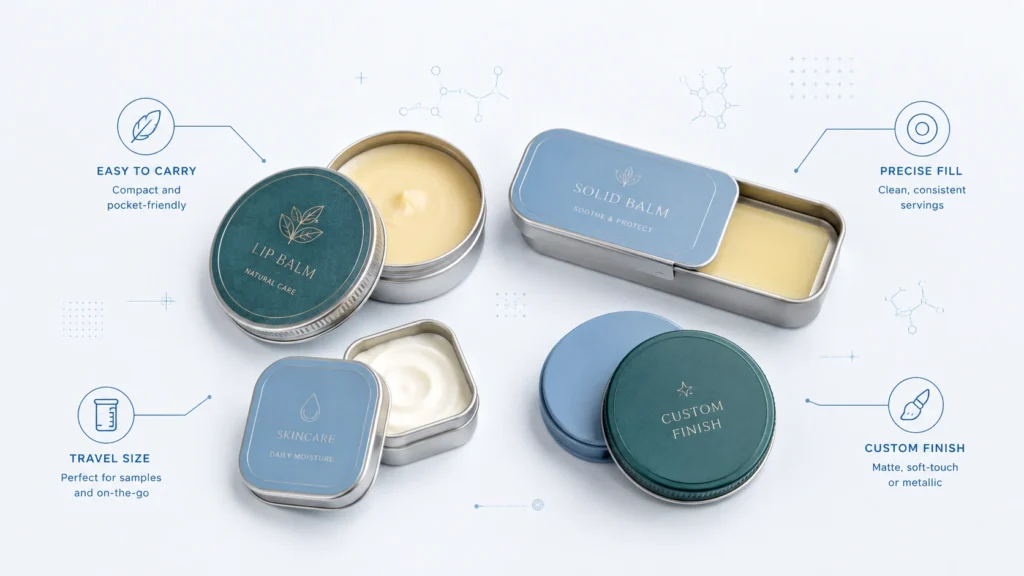
Mini tins are also widely used in beauty and personal care because many formulas are compact and tactile. Lip balm, solid perfume, salve, cuticle balm, beard balm, hair wax, massage balm, solid lotion, and fragrance samples all benefit from a small rigid container. Metal gives these products a durable, premium, and reusable impression.
For cosmetic and balm projects, the most important issue is compatibility between the formula and the packaging system. Oils, waxes, fragrance compounds, essential oils, pigments, and active ingredients can interact differently with coatings, liners, seals, and printing. A tin that works for a dry mint may not automatically work for a citrus-scented balm or a high-oil salve. Brands should conduct compatibility and stability testing with the final formula, fill weight, storage temperature, and shipping conditions.
Mr. Tin Box has a dedicated internal guide on metal lip balm tin packaging, which is especially relevant for small-format beauty packaging. For broader cosmetics and wellness applications, the Beauty & Personal Care Packaging page shows how metal packaging can support cosmetics, skincare, fragrance, and personal care projects with printing, embossing, surface treatment, liners, coatings, and inserts.
For lip balm tins, buyers usually need to decide:
- Is the tin filled directly, or will the balm be poured into an inner cup?
- Does the formula contain fragrance, essential oils, menthol, acids, colorants, or other ingredients that may require extra compatibility testing?
- Should the lid be slip-fit, screw-style, slider, or hinged?
- Does the package need a label, printed lid, embossed logo, or full offset printing?
- Will the tin be sold individually, in a gift set, or as a sample?
- Does the product require tamper evidence, a shrink band, a paper seal, or an outer carton?
A beauty tin is judged by more than appearance. The opening feel, edge smoothness, lid fit, pocket comfort, and surface touch all influence whether the package feels premium. For small cosmetic products, tiny details carry big brand signals.
Mini Tins for Samples and Trial Packaging
Sampling is one of the best commercial uses for mini tins. A sample is supposed to reduce purchase hesitation. If the package looks cheap, the customer may assume the product is cheap. A mini tin can help a sample feel like a real product, especially in premium food, tea, cosmetics, fragrance, wellness, and gift markets.
Mini tins work for samples because they provide a controlled presentation. A tea brand can offer a small tasting tin. A chocolate brand can send a flavor discovery kit. A skincare brand can place several mini balm tins inside a gift box. A spice company can build a sampler set for retail shelves. A hotel or airline can use a mini tin for mints, earplugs, sewing kits, or amenity items. A subscription box can include a small tin that feels more valuable than a sachet.
A sampling tin should be designed around the next step in the customer journey. If the goal is e-commerce conversion, the tin should carry a QR code, website, flavor name, and clear reorder cue. If the goal is retail trial, the lid artwork should be easy to recognize at small size. If the goal is a trade show giveaway, the tin should be pocketable, durable, and clearly branded. If the goal is a premium gift sample, the finish, insert, and opening experience matter more than the lowest unit price.
For sample programs, brands can often begin with existing molds to reduce tooling cost. The key is to make artwork and insert design feel custom even if the structure is standard. This is where mini tins are commercially efficient: the physical metal format already feels more substantial, so a brand can achieve strong impact through print and finish without immediately developing a fully custom shape.
Mini Tins for Gifts, Holidays, and Promotional Campaigns
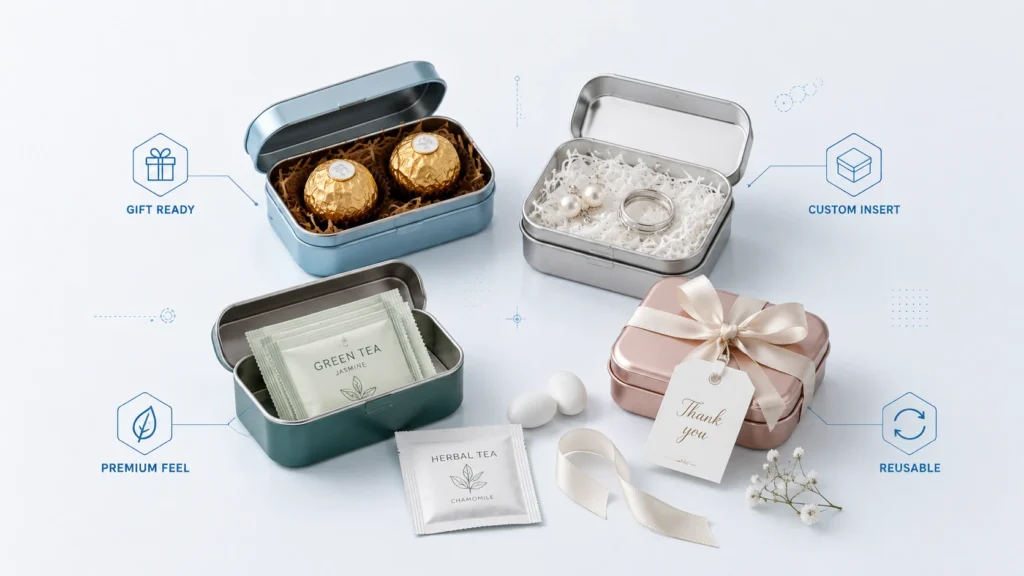
Mini tins are naturally giftable. They are small enough for event budgets, but durable enough to feel like keepsakes. This makes them useful for wedding favors, holiday candies, advent calendar components, corporate gifts, promotional mints, retail bundle add-ons, limited-edition collectibles, museum shop products, travel gifts, and branded merchandise.
Gift and promotional packaging is not only about holding the product. It is about creating a moment. The lid opens, the insert reveals the contents, the customer touches the metal, and the tin often stays after the product is consumed. For this reason, a mini tin can deliver more brand impressions than a disposable wrapper.
Mr. Tin Box’s Gift, Promotional & Holiday Packaging category is directly relevant for these projects. Buyers planning seasonal launches should also consider timelines. Holiday tins, Valentine’s Day tins, wedding favor tins, and event tins need earlier artwork confirmation because printing, finishing, sampling, and export logistics must be coordinated before the campaign date.
Promotional buyers should also consider the balance between cost and retention. A very cheap giveaway may be discarded quickly. A well-designed mini tin may be reused for coins, pills, clips, earphones, small tools, jewelry, sewing items, or travel accessories. That reuse creates longer brand exposure. The unit cost may be higher than paper or plastic alternatives, but the post-event visibility can be stronger.
Mini Tins for Specialty and Industrial Packaging
Although mini tins are often associated with candy and cosmetics, they also work well for specialty and industrial products. Small fasteners, blades, sewing kits, electronics accessories, hobby components, fishing tackle, craft supplies, medical accessories, collectible coins, and repair kits can all benefit from a rigid metal case.
The technical priorities are different from food or beauty. The buyer may care more about crush resistance, insert retention, part organization, labeling, corrosion control, and shipping durability. A foam insert, paperboard insert, molded tray, or divider can turn a mini tin into a compact kit. If the tin will hold sharp or heavy items, the metal thickness, edge forming, lid retention, and internal protection need extra attention.
This category connects to the Mr. Tin Box Specialty & Industrial Packaging application area. For B2B buyers, mini tins can serve both packaging and organization roles. A branded tin for small replacement parts can reduce lost components and make a technical product feel more complete.
Size Planning: How to Choose the Right Mini Tin Dimensions
Size is one of the first decisions in a mini tin project, but it should not be chosen by appearance alone. A tin that looks attractive in a photo may be too shallow for the product, too large for the target price, too tight for an insert, or too small for readable artwork.
The best starting point is the real product. Buyers should measure actual product dimensions, fill weight, density, desired count, inner bag thickness, insert clearance, and lid movement. For food and candy, the same tin size may hold different weights depending on product shape and density. For cosmetics, the fill process and cooling behavior may affect the practical capacity. For gift kits, inserts and cards may require more space than expected.
The following table gives indicative planning ranges. These are not fixed specifications, because every mold and product is different. They are useful starting points for discussing a custom mini tin project.
| Mini tin format | Indicative size range | Typical products | Buyer note |
|---|---|---|---|
| Small round tin | 35-70 mm diameter, 10-25 mm height | Lip balm, salve, wax, mints, samples | Good for pocket-size products and simple branding |
| Shallow rectangular tin | 55-95 mm length, 35-65 mm width, 8-20 mm height | Mints, candy, cards, small kits | Large lid area helps logo visibility |
| Slider tin | 45-90 mm length, 25-60 mm width, 8-18 mm height | Mints, gum, small tools, travel kits | Sliding action feels playful but needs tolerance control |
| Mini square tin | 40-80 mm side length, 10-30 mm height | Candy, tea samples, soap samples, gifts | Balanced shelf look and easy grouping into sets |
| Hinged mini tin | 50-100 mm length, 35-75 mm width, 12-30 mm height | Promotional kits, mints, hardware, first-aid items | Strong reuse value and convenient opening |
| Shaped mini tin | Custom or existing seasonal molds | Wedding favors, holiday candies, collectibles | Strong emotion, but artwork and tooling need early planning |
The most common sizing mistake is choosing a tin based only on outside dimensions. The usable internal volume is smaller because of wall thickness, rolled edges, lid overlap, corner radius, and insert space. If a product must fit precisely, buyers should test real samples before approving mass production.
Material and Coating Choices
Most mini tins are made from tinplate because it combines strength, formability, printability, and recyclability. Some projects may use aluminum, especially when the buyer wants lower weight, a specific metallic look, or a cosmetic packaging feel. The best material depends on product type, target price, tooling, forming method, corrosion risk, and brand positioning.
| Material or layer | What it does | Common use in mini tins | Key question for buyers |
|---|---|---|---|
| Tinplate | Provides rigidity, forming strength, and a magnetic steel base | Most candy tins, gift tins, sample tins, and many lip balm tins | Is the thickness and coating suitable for the product and structure? |
| Aluminum | Lightweight, corrosion-resistant, non-magnetic metal | Selected cosmetic tins, balm tins, specialty containers | Does the project need aluminum’s look or weight advantage? |
| Internal lacquer | Helps separate product from metal surface | Food-contact or formula-contact applications | Is the lacquer suitable for the intended contact and market? |
| External primer and ink | Creates printed brand graphics | Printed lids, bodies, holiday artwork, logos | Can the artwork be simplified for small-scale printing? |
| Top varnish | Protects print and controls surface feel | Glossy, matte, satin, soft-touch, or specialty finish | Will the finish resist scratches during packing and shipping? |
| Insert or liner | Holds product, improves presentation, or separates contact | Candy cups, foam insert, paper tray, plastic tray, inner pouch | Does the insert support both protection and sustainability claims? |
For food and personal care projects, buyers should avoid vague material language. Instead of saying, “We need a food-grade mini tin,” provide the product type, contact condition, fill method, storage time, target market, and whether the product touches the metal directly. This allows the supplier to recommend coating, testing, and documentation more accurately.
Lid Structures and Opening Experience
The lid is one of the most important parts of a mini tin. It affects protection, opening feel, repeat use, shelf display, and customer satisfaction. A loose lid can create leakage, rattling, or a poor quality perception. An overly tight lid can frustrate users. A hinge can improve reuse, but it may cost more and requires careful alignment. A slider can feel modern and pocket-friendly, but it needs stable tolerances.
| Lid style | Best for | Advantages | Watch-outs |
|---|---|---|---|
| Slip lid | Round tins, square tins, simple candy or balm tins | Simple, economical, easy to customize | Fit must be consistent; may need shrink band for tamper evidence |
| Hinged lid | Mints, kits, promotional products, small hardware | Strong reuse value; lid stays attached | Hinge alignment and opening angle must be controlled |
| Slider lid | Mints, gum, travel kits, compact samples | Pocketable, playful, distinctive | Sliding tolerance and product dust control matter |
| Plug-style lid | Dry food, tea, coffee samples, premium gift tins | Better lid engagement and freshness perception | May increase tooling and production complexity |
| Window lid | Candy, gifts, visual products | Shows product or insert directly | Window material can affect recyclability and scratch resistance |
| Specialty shaped lid | Seasonal gifts, collectibles, campaign tins | Strong shelf and emotional impact | Tooling, schedule, and artwork distortion must be planned early |
For small metal boxes, opening feel is part of brand quality. Buyers should ask for pre-production samples and test them with real users if the tin will be opened frequently. A mint tin may be opened several times a day. A lip balm tin may be opened with one hand. A gift tin may be opened once but must feel special. These are different user experiences.
Decoration and Branding Options
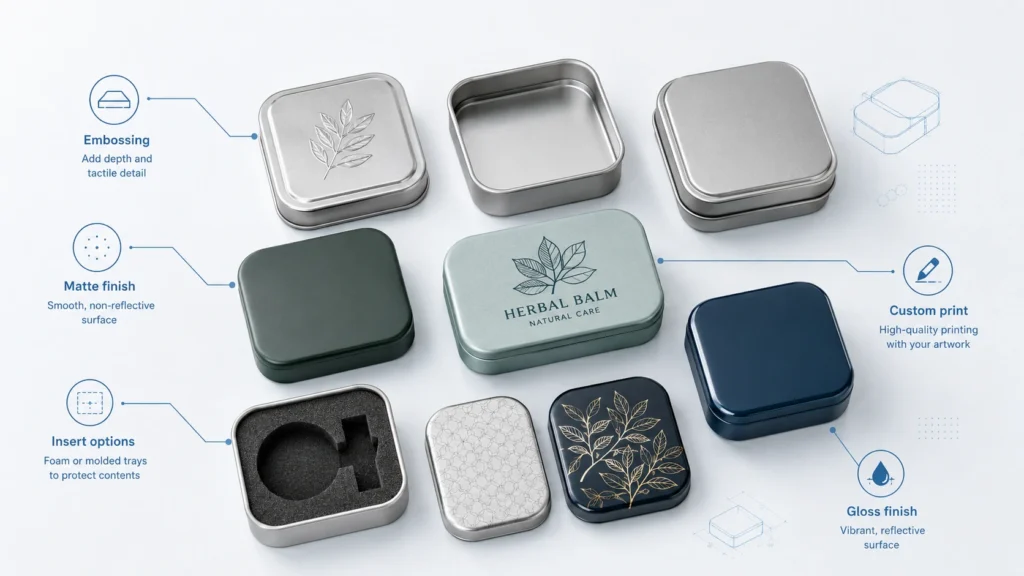
Mini tins have limited surface area, so artwork must be disciplined. A large tin can carry a complex illustration, long product story, and multiple claims. A mini tin usually needs a simpler visual system: strong logo, clear product name, readable flavor or scent, limited color palette, and possibly a QR code or short website.
Common decoration options include offset printing, screen printing, embossing, debossing, matte varnish, glossy varnish, spot varnish, metallic ink, pearl finish, soft-touch coating, paper labels, belly bands, shrink sleeves, and outer cartons. The right choice depends on volume, budget, artwork complexity, and desired shelf position.
| Decoration method | Visual effect | Good for | Commercial note |
|---|---|---|---|
| Offset printing | Full-color brand graphics | Retail tins, candy, cosmetics, holiday themes | Best for consistent artwork at production scale |
| Embossing or debossing | Raised or recessed tactile detail | Logos, icons, premium patterns | Adds touch value even on small lids |
| Matte varnish | Soft, modern surface | Beauty, wellness, premium food | Can make small tins feel more refined |
| Gloss varnish | Bright, clean, high color impact | Candy, gifts, mass retail | Often cost-effective and vivid |
| Spot varnish | Contrast between matte and gloss areas | Premium branding and logo highlights | Works best with simple artwork |
| Metallic or pearl effects | Reflective or premium finish | Gifts, cosmetics, limited editions | Should be tested because small tins reflect light strongly |
| Paper label | Flexible for low-volume versions | Samples, short runs, variable flavors | Lower tooling risk but less integrated than direct printing |
For mini tins, readability is critical. Text that looks fine on a computer screen may be too small after printing on a 50 mm lid. Regulatory text, ingredients, warnings, batch codes, barcodes, and country-of-origin labels may require an outer carton or bottom label rather than trying to place everything on the lid.
Food Safety and Compliance Planning
Food-contact planning should begin before the buyer approves the design. A beautiful mini candy tin is not enough if the final package cannot meet target market expectations. The required documentation depends on the product, contact surface, market, and customer requirements. A U.S. buyer, EU buyer, UK buyer, retailer, hotel group, or global distributor may request different documentation.
The FDA notes that food packaging and its components can be food contact substances, including colorants, adhesives, and substances applied to packaging surfaces. It also provides an inventory of food contact substances listed in 21 CFR for authorized uses and conditions. In the EU, Regulation (EC) No 1935/2004 is the framework regulation for materials and articles intended to come into contact with food. These references show why food-contact packaging should be specified by intended use, not by a generic claim.
| Compliance question | Why it matters | What the buyer should prepare |
|---|---|---|
| Does the food touch the metal directly? | Direct contact requires closer review of lacquer, coating, and migration expectations | Product type, contact duration, storage temperature, and market |
| Is there an inner bag or wrapper? | The food-contact surface may be the inner wrapper rather than the tin | Bag material, seal method, and packing process |
| Is the product acidic, oily, salty, or aromatic? | Product chemistry can affect coating choice and odor control | Ingredient profile and stability requirements |
| Will the tin be heat processed? | Most decorative mini tins are not designed for retort or canning | Process temperature and filling method |
| Which market will receive the product? | U.S., EU, UK, and retailer requirements may differ | Destination countries and required test reports |
| Are inks or varnishes near contact surfaces? | Decoration must be controlled to avoid unintended transfer | Artwork layout and print surface plan |
For candy, mints, tea samples, and dry snacks, an inner liner or individual wrapping can simplify contact design, but it does not remove the need for overall packaging due diligence. For oily or aromatic products, testing is essential because odor, staining, corrosion, or coating softening can appear only after storage.
Sustainability, Recycling, and Reuse
Sustainability is a major reason many brands consider mini tins, but it must be discussed carefully. A mini tin is not automatically the best environmental choice in every situation. It uses more material than a very thin sachet. However, it can offer durability, reuse, long-term brand retention, and compatibility with metal recycling systems. The strongest sustainability story is specific: what material is used, how the package is designed for recycling, whether unnecessary mixed materials are avoided, and whether customers are likely to reuse it.
Steel has a strong circularity story. worldsteel describes steel as a permanent material that can be recycled over and over again without losing its properties on its circular economy page. Steel for Packaging Europe reports that 84 percent of steel packaging is recycled in Europe based on 2024 data using the new EU calculation methodology. These data points are useful for buyers, especially when comparing metal packaging with formats that are harder to sort or recycle in practice.
At the same time, sustainability claims should be reviewed by market and package design. A tin with a PVC window, glued foam insert, full plastic sleeve, or mixed-material accessory may be less straightforward to recycle than a simple tin. A high-end mini tin that customers reuse for years may create a different value case than a tin used once. For this reason, brands should decide whether the project goal is recyclability, reuse, premium retention, refill, reduced breakage, gift value, or a combination.
The EU’s new packaging rules also make design-for-recycling more important. The European Commission says the Packaging and Packaging Waste Regulation aims to make all packaging on the EU market recyclable in an economically viable way by 2030 on its packaging waste page. The legal text of Regulation (EU) 2025/40 covers packaging and packaging waste across the packaging life cycle. For brand owners selling into Europe, this means future packaging briefs should avoid unnecessary complexity and should document material choices more clearly.
Cost Drivers in Mini Tin Projects
Mini tins are compact, but they are not always simple. Cost depends on material thickness, tin size, mold availability, structure complexity, printing method, number of colors, coating requirements, embossing, inserts, packing method, inspection requirements, and order quantity.
A small standard slip-lid tin with one-color printing will usually be more economical than a custom shaped hinged tin with full-color printing, embossing, internal lacquer, foam insert, individual polybag, and export display cartons. The cheapest unit price is not always the best purchasing decision. A tin that dents easily, opens poorly, smells strange, scratches during shipping, or fails artwork approval can delay launch and damage the brand.
| Cost driver | Lower-cost direction | Higher-cost direction | Buyer decision |
|---|---|---|---|
| Mold | Existing mold | New custom mold | Is exclusive size or shape commercially necessary? |
| Structure | Simple slip lid | Hinged, slider, plug, window, or shaped tin | Does the user experience justify added complexity? |
| Printing | Fewer colors or label | Full offset printing with specialty finish | How premium must the product look? |
| Coating | Standard suitable coating | Specialized internal coating or extra testing | Does the product require direct contact or formula compatibility? |
| Insert | No insert or simple paper liner | Foam, molded tray, compartment insert | Does the insert improve protection or gift value? |
| Packing | Bulk pack | Individual bag, sleeve, display carton, set assembly | What shipping and retail presentation are required? |
| Quantity | Small trial order | Larger production batch | Can volume be consolidated across flavors or campaigns? |
A smart sourcing approach is to separate “must-have” requirements from “nice-to-have” effects. For example, food-contact suitability, lid fit, and clean edges may be must-haves. A custom shape, spot varnish, and complex insert may be nice-to-haves unless the tin is sold as a premium gift. This hierarchy helps the supplier recommend a realistic solution.
Standard Mold or Custom Tooling?
One of the most common questions is whether a mini tin project should use an existing mold or develop custom tooling. There is no universal answer. It depends on budget, schedule, quantity, brand strategy, and competitive need.
Existing molds are usually better for early launches, sampling programs, promotional campaigns, and lower-risk market testing. They reduce development cost and can shorten the route to sampling. Custom tooling is better when the tin shape is central to the product identity, the buyer expects repeat orders, or the standard size cannot fit the product properly.
| Decision point | Existing mold is usually better when… | Custom tooling is usually better when… |
|---|---|---|
| Launch schedule | The campaign date is close | There is enough time for design, tooling, and testing |
| Budget | The project must control upfront cost | The brand can invest in exclusive structure |
| Quantity | The order is a trial or seasonal batch | The order is repeated or high volume |
| Product fit | A standard size works with minor adjustment | The product, insert, or fill weight needs exact fit |
| Brand strategy | Printing can create enough differentiation | Shape itself is part of the brand asset |
For many brands, the best route is progressive. Start with an existing mini tin, validate product-market fit, then move to custom tooling once the product line proves demand. This approach reduces risk while keeping the door open for stronger differentiation later.
Quality Control Points for Mini Tins
Quality control is especially important for mini tins because small defects become visible quickly. A slightly scratched lid, uneven curl, loose hinge, rough edge, or color mismatch can affect customer perception. The smaller the package, the more the customer notices the details.
Buyers should discuss quality criteria before mass production. The approved sample should define color tolerance, lid fit, edge smoothness, print registration, coating appearance, odor, internal cleanliness, and packing method. For food and beauty projects, hygiene and contact surface control should be taken seriously. For gift and promotional tins, visual consistency and dent protection are often the main concerns.
| QC item | What to check | Why it matters |
|---|---|---|
| Lid fit | Opens smoothly, stays secure, no excessive looseness | Affects user experience and perceived quality |
| Edge forming | No sharp edges, burrs, or rough curls | Protects users and improves tactile feel |
| Printing alignment | Logo centered, colors consistent, no obvious misregistration | Protects brand appearance |
| Surface finish | No scratches, stains, dust, bubbles, or coating defects | Mini tins are often inspected closely by customers |
| Interior cleanliness | No metal dust, odor, oil, or foreign matter | Important for food, beauty, and premium gifts |
| Insert fit | Tray or liner sits flat and holds product securely | Prevents rattling and improves presentation |
| Packing protection | Cartons, dividers, and bagging prevent dents and abrasion | Reduces damage during export and fulfillment |
A good mini tin supplier should help the buyer avoid predictable problems before mass production. This includes reviewing artwork readability, lid function, insert fit, coating suitability, and packing protection at the sample stage.
How to Prepare a Quotation Brief
A clear brief saves time and reduces sampling rounds. Many project delays happen because the buyer asks for a quote without enough information. The supplier then has to guess the size, product contact, artwork, finish, quantity, and packing method. This leads to inaccurate pricing and repeated clarification.
Before requesting a quote from Mr. Tin Box, prepare the following details wherever possible:
- Product type: candy, mints, tea, lip balm, solid perfume, gift item, promotional item, hardware, or another product.
- Product dimensions or fill weight: include real samples or measurements if available.
- Direct contact situation: explain whether the product touches the tin, an inner pouch, wrapper, liner, tray, or separate cup.
- Target market: U.S., EU, UK, Canada, Australia, Middle East, Japan, or other countries.
- Preferred tin shape: round, square, rectangular, slider, hinged, heart, oval, or custom.
- Target size or capacity: provide an existing package reference if possible.
- Artwork plan: logo only, full-color artwork, seasonal design, multiple flavors, or variable labels.
- Finish requirements: matte, gloss, embossing, debossing, soft-touch, metallic, spot varnish, or paper label.
- Accessory needs: insert, liner, tray, card, outer carton, shrink band, barcode label, or display box.
- Estimated quantity: trial order, annual volume, or campaign quantity.
- Timeline: sample deadline, artwork approval date, delivery deadline, and campaign launch date.
- Compliance documents: any retailer, importer, or market-specific requirements.
This information allows a supplier to recommend whether an existing mold is suitable, whether internal coating is needed, whether a custom insert is required, and whether the target schedule is realistic.
Production Workflow for Custom Mini Tins
A custom mini tin project normally moves through a structured workflow. The exact steps vary by product and complexity, but the overall path is consistent.
First, the buyer shares product details, size targets, market, artwork, quantity, and functional requirements. The supplier reviews existing molds or recommends custom tooling. If a standard mold is selected, the team can move toward artwork layout and sample confirmation. If custom tooling is needed, 3D drawings, structure review, and mold development are required.
Second, artwork is adapted to the tin shape. This step matters because metal forming can affect artwork position, especially around curved surfaces, lid edges, corners, and embossed areas. Text should remain readable after forming. Logos should avoid critical distortion zones. If the tin is very small, the brand may need a simplified artwork version.
Third, samples are prepared. Depending on project type, the sample may be a blank tin, printed sample, hand sample, digital proof, or pre-production sample. The buyer should test product fit, lid function, insert fit, surface finish, packing method, and customer handling.
Fourth, mass production begins after approval. Production may include tinplate cutting, coating, printing, curing, stamping, forming, lid assembly, insert assembly, inspection, packing, and export carton preparation. Quality control should check both appearance and function.
Finally, shipping and fulfillment should be planned. Mini tins can dent if packed poorly, even though metal is strong. Export cartons, separators, bagging, and palletization should match the shipping route. If the tins will be filled by the buyer or a co-packer, the supplier should understand filling line requirements, bulk packing preferences, and handling constraints.
Mini Tins and Retail Presentation
Mini tins can be sold individually, grouped into sets, included in gift boxes, placed in counter displays, attached to cards, inserted into subscription boxes, or packed as promotional giveaways. The retail strategy affects the packaging design.
An individual retail mini tin may need barcode space, legal text, flavor identification, and strong shelf visibility. A set of mini tins may need color coding, tray alignment, and a larger outer box. A counter display program may need consistent front-facing orientation and stable stacking. A gift favor may need a ribbon, sticker, personalized label, or thank-you card. A lip balm tin may need tamper evidence and an outer carton if regulatory text cannot fit on the tin.
Small packages are easy to underestimate in retail. Because the product is physically small, it can disappear on a shelf unless the artwork has strong contrast and simple messaging. Buyers should view artwork at actual size before approval. A good test is to print the design at 100 percent scale and place it at normal viewing distance. If the brand name, product name, and flavor cannot be understood quickly, the artwork should be simplified.
Packaging Claims: What to Say and What to Avoid
Mini tin packaging can support strong claims, but brands should avoid vague or risky statements. Words like “eco-friendly,” “green,” “food safe,” “plastic-free,” “recyclable,” and “BPA-free” can have legal and retailer implications. Claims should match the final package, target market, and documentation.
Better claims are specific. For example, a brand may say the tin is made from steel-based tinplate, designed for reuse, or recyclable where metal recycling facilities exist, if that is accurate for the final packaging and local market. If the tin uses an inner plastic tray, window, foam insert, label, or shrink band, the claim may need qualification. If the product is food or cosmetic, the brand should confirm contact compliance instead of relying on a generic supplier statement.
The most practical rule is this: make the package as simple as possible while still meeting product protection and brand goals. A clean tinplate body with direct printing may be easier to explain than a complex mixed-material package. A reusable mini tin with a useful second life can also support a stronger customer story.
How Mr. Tin Box Can Support Mini Tin Projects
Mr. Tin Box focuses on custom metal tin packaging for global customers across food, beauty, gifts, promotions, holiday packaging, and specialty applications. For mini tins, this cross-category experience matters because the same size range can be used in very different ways. A mint tin, lip balm tin, tea sample tin, promotional kit, and wedding favor may look similar from the outside, but they have different requirements for contact, coating, artwork, lid fit, insert design, packing, and documentation.
Buyers can use Mr. Tin Box as a development partner, not only a unit-price supplier. The company can help compare existing molds, discuss size and structure, review artwork feasibility, evaluate printing and finishing options, consider inserts or liners, and plan samples before mass production. For related background, buyers can review Custom Tin Packaging Guide for Brand Owners, Metal Tin Packaging: Benefits, Applications, and Custom Options, and Tin Containers with Lids.
The most successful projects usually begin with a clear commercial goal. Do you need a low-risk sample tin? A premium lip balm container? A holiday candy gift? A promotional mint tin? A collectible retail series? A protective case for small parts? Once the goal is clear, the material, lid, size, finish, insert, and packing method can be selected more logically.
Practical Specification Checklist
Use this checklist before starting a mini tin project. It can help your team create a complete brief and avoid costly revisions.
| Specification area | Questions to answer before sampling |
|---|---|
| Product | What will be packed? What are the dimensions, weight, and special sensitivities? |
| Contact | Does the product touch metal, coating, liner, pouch, wrapper, or insert? |
| Size | What internal capacity is required after lid overlap and insert clearance? |
| Shape | Do you prefer round, square, rectangular, slider, hinged, oval, or custom shape? |
| Lid | Should the lid be easy-open, tight, hinged, sliding, plug-style, or tamper-evident? |
| Material | Is tinplate suitable, or is aluminum required for a specific reason? |
| Coating | Is internal lacquer required for food, balm, fragrance, or formula compatibility? |
| Artwork | Is the design readable at actual size? Are claims and barcodes placed correctly? |
| Finish | Matte, gloss, embossing, debossing, metallic, pearl, soft-touch, label, or sleeve? |
| Insert | Is a tray, liner, paperboard insert, foam insert, or inner pouch needed? |
| Compliance | Which market and which buyer documents are required? |
| Packing | Bulk pack, individual bag, shrink band, display box, or gift set assembly? |
| Logistics | How will the empty tins ship, and who will fill them? |
| Quantity | Trial order, launch order, annual program, or multi-flavor production? |
FAQ
What are mini tins usually made of?
Most mini tins are made from tinplate, which is a thin steel sheet coated with tin. Tinplate is strong, formable, printable, and suitable for many small metal packaging structures. Some mini tins may use aluminum when the buyer wants a specific weight, appearance, or cosmetic packaging effect. The final material choice should match the product, contact requirements, structure, finish, and budget.
Are mini tins food safe?
Mini tins can be suitable for food when the correct material, internal coating, production process, and documentation are used for the intended product and market. A tin for wrapped candies is different from a tin where unwrapped food touches the metal directly. Buyers should explain the food type, contact surface, storage conditions, and destination market before confirming the specification.
Can mini tins be used for lip balm?
Yes. Mini tins are widely used for lip balm, salves, solid perfume, beard balm, hair wax, and related personal care products. However, formula compatibility is important. Oils, waxes, fragrance, essential oils, pigments, and active ingredients should be tested with the selected coating, liner, and tin structure before mass production.
What is the best size for a mini tin?
The best size depends on the product’s real dimensions, fill weight, density, insert needs, lid clearance, and retail strategy. For lip balm, shallow round tins are common. For mints, rectangular hinged or slider tins are popular. For samples, small square or round tins may work well. The safest approach is to test real product samples in existing molds before confirming the final size.
Can I customize mini tins with my logo?
Yes. Mini tins can be customized with direct printing, paper labels, embossing, debossing, matte varnish, glossy varnish, spot effects, metallic finishes, or outer sleeves. Because the surface is small, the artwork should be simple and readable at actual size.
Are mini tins recyclable?
Steel-based tinplate mini tins are compatible with metal recycling systems in many markets. Steel for Packaging Europe reports high recycling rates for steel packaging in Europe, and worldsteel describes steel as a permanent material that can be recycled repeatedly without losing its properties. However, recyclability claims should consider local recycling systems and the final package design, including windows, inserts, labels, sleeves, or mixed materials.
Do mini tins need an inner coating?
Not always. Dry, wrapped, or non-contact products may not need the same internal coating as direct-contact food or balm products. If the product touches the tin, especially if it is oily, acidic, salty, aromatic, or cosmetic, internal coating and compatibility testing should be discussed early.
Should I choose an existing mold or custom mold?
Choose an existing mold if you need lower development cost, faster sampling, or a trial launch. Choose custom tooling if the tin shape is central to your brand, the product needs exact fit, or the order volume justifies the investment. Many brands start with existing molds and move to custom tooling after demand is proven.
Can mini tins be used for promotional gifts?
Yes. Mini tins are excellent for promotional gifts because they are pocketable, reusable, and easy to brand. Common promotional uses include mints, candy, office kits, sewing kits, travel kits, first-aid accessories, USB drives, pins, and small tools. A reusable tin can keep the brand visible long after the event.
What information should I send to get a quote?
Send the product type, target size, fill weight, product contact details, target market, preferred shape, artwork requirements, finish, insert needs, quantity, packing method, and timeline. If possible, provide photos, drawings, product samples, or an existing package reference. A complete brief helps Mr. Tin Box recommend the right mini tin structure faster and more accurately.
Final thoughts
Mini tins are small packages with unusually high commercial potential. They can protect candy, present samples, hold lip balm, upgrade gifts, organize small parts, and extend brand visibility through reuse. Their value comes from the combination of rigidity, portability, decoration, tactile feel, and customer retention.
For buyers, the best mini tin project starts with a clear question: what job should this small metal box perform? If the goal is simple low-cost containment, a basic standard tin may be enough. If the goal is premium gifting, the lid, insert, finish, and unboxing experience become more important. If the goal is food or cosmetic contact, coating and compliance planning must come early. If the goal is sustainability, the design should avoid unnecessary mixed materials and support reuse or practical recyclability.
Mr. Tin Box can support mini tin projects from concept to production by helping brands connect size, structure, material, coating, artwork, finish, insert, packaging protection, and sourcing strategy. Whether you are developing mini tins for samples, candy, lip balm, gifts, promotions, or specialty products, a clear specification today can save sampling time tomorrow and help your product reach the market with stronger protection, better presentation, and higher buyer confidence.