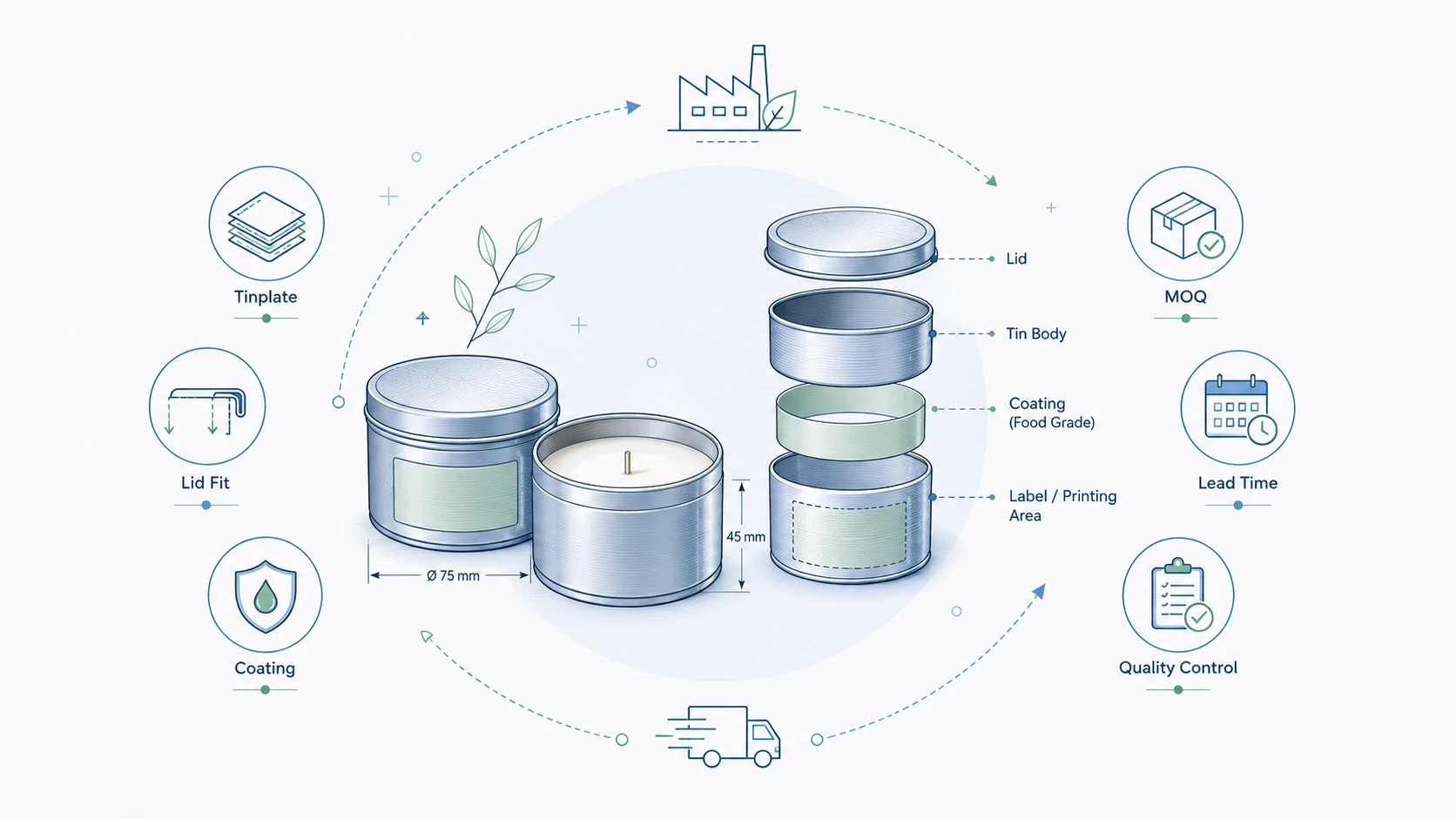
Wholesale candle tins look simple from the outside: a metal cup, a lid, a label or printed design, and enough space for wax and fragrance. In reality, the tin is one of the most important technical decisions a candle brand makes before launch. It affects burn performance, safety validation, filling efficiency, shipping damage rate, product photography, retail shelf appeal, holiday gift positioning, and even whether customers keep the empty container after the candle is finished.
For candle brands, private-label candle manufacturers, home-fragrance startups, gift companies, promotional buyers, and retail sourcing teams, candle tins wholesale is not only a price question. It is a packaging system question. A low unit price can become expensive if the tin dents too easily, the lid becomes loose during shipping, the coating discolors after hot filling, the artwork scratches in e-commerce delivery, or the candle does not pass internal burn testing. The right wholesale candle tin should match the wax formula, fragrance load, wick selection, fill temperature, target burn time, sales channel, brand position, and compliance expectations in the destination market.
At Mr. Tin Box, our work focuses on custom metal tin packaging for global brands across food, beauty, gift, promotional, holiday, and specialty product categories. Candle packaging sits naturally between beauty, lifestyle gifting, and home fragrance. It needs the visual language of premium consumer goods, the structural consistency of industrial packaging, and the practical safety mindset of a product used with an open flame. This guide explains what candle brands should know before ordering candle tins wholesale, with practical tables, buying checklists, and data points that can be used in product planning, RFQ preparation, supplier communication, and internal decision-making.
Table of Contents
Why Candle Tins Are a Strong Packaging Choice for Candle Brands
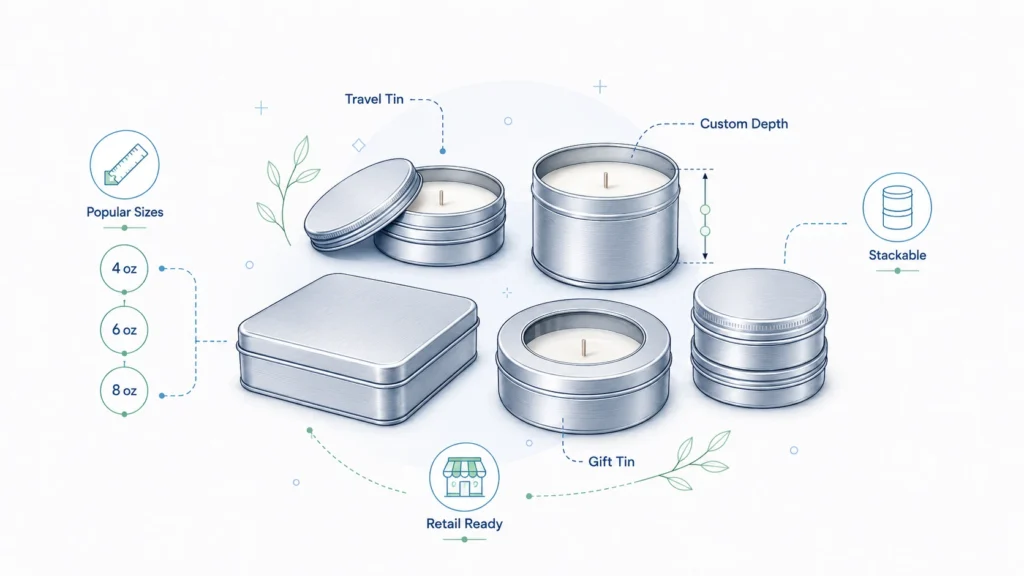
Candles are highly sensory products. Consumers buy them for scent, mood, decor, gifting, relaxation, and seasonal rituals. The National Candle Association states that U.S. retail sales of candle products are estimated at approximately $3.14 billion annually, that more than 1 billion pounds of wax are used in producing candles sold each year in the U.S., and that more than 10,000 different candle scents are available to U.S. consumers. It also notes that container and jar candles are currently the most popular candle types among American consumers.
Those facts matter for packaging. If container candles are already familiar to consumers, the container becomes part of the value proposition. A candle tin can communicate portability, safety-minded design, giftability, and price accessibility more quickly than many fragile glass formats. It is lighter than glass, less likely to shatter, easier to ship in multi-packs, and suitable for travel-size candles, discovery sets, seasonal promotions, subscription boxes, hotel amenities, spa programs, corporate gifts, and private-label home fragrance collections.
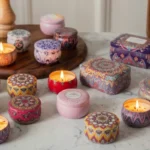
The commercial appeal is also practical. A candle tin gives brands a broad design range without forcing them into a single aesthetic. A matte black tin can look modern and gender-neutral. A gold tin can support holiday gifting. A pastel printed tin can fit bath, wellness, and lifestyle brands. A white tin with minimalist typography can work for clean-beauty adjacent candles. A fully printed tin can create collectible seasonal artwork. This flexibility is why many candle brands treat tins not as a temporary container but as a reusable branded object.
The table below summarizes why brands often choose candle tins wholesale instead of glass jars, ceramic vessels, or paperboard-only packaging.
| Buyer goal | Why candle tins help | Practical implication for wholesale ordering |
|---|---|---|
| Reduce shipping breakage | Metal tins do not shatter like glass | Useful for e-commerce, subscription boxes, and cross-border shipping |
| Launch multiple scents quickly | Same tin structure can carry different printed designs or labels | Reduces tooling complexity and supports seasonal drops |
| Improve gift appeal | Metal has a durable, premium hand feel | Works well for holiday, wedding, spa, and promotional gifts |
| Control unit cost | Standard round tins can be cost-efficient at volume | Best results come from choosing proven sizes and lid systems |
| Support reuse | Empty tins can become storage boxes for small items | Extends brand visibility after the candle is used |
| Improve portability | Tins are lightweight and often compact | Suitable for travel candles, sample sets, and event giveaways |
| Build a cohesive product line | Multiple sizes can share one visual system | Helps brands create 2 oz, 4 oz, 8 oz, and gift-set families |
For a deeper look at the role of metal packaging in premium consumer categories, the Mr. Tin Box article Metal Packaging Trends for Premium Consumer Goods is a useful internal reference because it explains how premium brands use metal packaging for protection, shelf impact, reuse, and circular-economy positioning.
Candle Industry Data That Should Influence Packaging Decisions
Packaging decisions become clearer when the buyer understands how people buy and use candles. A candle tin is not just a container for wax. It is a small consumer product interface that must perform during purchase, storage, burning, gifting, and disposal or reuse.
The National Candle Association’s industry facts are especially relevant for candle brands ordering wholesale tins. Approximately 35% of candle sales occur during the Christmas and holiday season, while non-seasonal business accounts for about 65% of sales. Fragrance is described as the most important characteristic affecting candle purchases, with three-fourths of candle buyers saying it is extremely important or very important. Nine out of ten candle users say they use candles to make a room feel comfortable or cozy, and approximately three-fourths typically burn candles for 4 hours or less per sitting.
These points translate directly into packaging strategy. Holiday sales require early planning because custom printed tins, embossing, color approvals, and freight scheduling all need lead time before the seasonal peak. Fragrance-driven buying means packaging should help shoppers understand scent families quickly through color, icon systems, labels, or variant names. Cozy room usage means the tin must look good in the home, not only on the shelf. Four-hour-or-less burn sessions suggest that lid fit, wax pool behavior, heat management, and warning labels are all part of the real user experience.
Market research firms differ in how they estimate the global candle market because they use different definitions, regions, product categories, and forecast models. For example, Global Market Insights estimated the candle market at USD 21.3 billion in 2025 and projected USD 32.5 billion by 2035, while Grand View Research estimated the candle market at USD 14.77 billion in 2025 and projected USD 25.44 billion by 2033. The exact number is less important than the direction: candles remain a large, competitive, design-sensitive category where packaging can affect both perceived value and operational risk.
| Data point | What it means for candle tins wholesale | Source context |
|---|---|---|
| U.S. candle retail sales are estimated at about USD 3.14 billion annually | Candle packaging serves a large, mature consumer category, so differentiation matters | National Candle Association |
| About 35% of candle sales occur during the Christmas/holiday season | Wholesale tin projects should start early enough for sampling, artwork approval, production, and freight | National Candle Association |
| More than 1 billion pounds of wax are used annually in U.S. candle production | Tin compatibility with wax formulas and fill processes is commercially important | National Candle Association |
| More than 10,000 scents are available to U.S. consumers | Color coding, scent labels, and SKU management should be planned before printing | National Candle Association |
| Container and jar candles are the most popular candle types with American consumers | Candle tins can participate in an already familiar consumer format | National Candle Association |
| Candle users often burn candles for 4 hours or less per sitting | Warning labels, lid use instructions, wax pool behavior, and wick sizing must match real behavior | National Candle Association |
The practical conclusion is simple: candle tins wholesale should not be treated as a generic packaging purchase. The tin has to support a consumer habit, a fragrance strategy, and a retail calendar.
What “Wholesale” Really Means in Candle Tin Sourcing
The phrase candle tins wholesale can mean several different buying models. Some buyers only need blank stock tins. Others need custom colors, printed lids, embossed logos, inner coating adjustments, barcode labels, display trays, outer cartons, and inspection documentation. Before asking for a quote, a brand should identify which wholesale model it actually needs.
A stock tin order is the fastest and simplest route. The supplier provides existing sizes, existing colors, and existing lid structures. The brand may add paper labels or stickers after receiving the tins. This works for early testing, small-batch candle makers, event candles, farmers-market brands, and product validation. The limitation is differentiation. Many competitors can buy the same shape, color, and lid, so the brand relies heavily on labeling and scent quality.
A semi-custom tin order uses an existing mold but adds custom decoration. This may include exterior color coating, lid printing, body printing, embossing on the lid, or a branded sleeve. For many candle brands, semi-custom is the most practical wholesale route because it balances recognizable brand identity with lower tooling risk. It is especially suitable for 4 oz and 8 oz tins, limited-edition holiday candles, corporate gifts, and private-label collections.
A fully custom tin order changes the structure. The brand may request a unique diameter, special lid profile, deep drawn body, window lid, hinge, custom texture, special embossing, unusual shape, or proprietary closure system. This is appropriate when packaging itself is a competitive advantage, but it requires more time for engineering, tooling, testing, and approval. It is not the best path for a brand that has not yet validated its candle formula or sales channel.
| Wholesale model | Best for | Main advantages | Main risks |
|---|---|---|---|
| Blank stock tins | Startup testing, small-batch makers, sample candles | Fast, simple, low commitment | Limited differentiation, possible size constraints |
| Stock tins with labels | Low-MOQ DTC launches, local retail | Flexible scent changes, easy rebranding | Label adhesion and appearance must be controlled |
| Existing mold + custom color | Growing brands, gift sets, seasonal SKUs | Better brand identity without new tooling | Color approval and coating durability need samples |
| Existing mold + custom printing | Retail-ready candle lines | More premium and consistent than labels | Artwork, registration, and curing must be validated |
| Existing mold + embossing/debossing | Premium lines, corporate gifting | Tactile brand cue, strong shelf value | Tooling and sample approval add time |
| Fully custom structure | Established brands with clear volume | Proprietary packaging and stronger differentiation | Higher tooling cost, longer development, more testing |
For related planning, the Mr. Tin Box article MOQ and Lead Time Planning for Your Custom Tin Box can support internal procurement discussions because it explains why quantity, tooling, printing, sampling, and inspection affect the final schedule.
Choosing the Right Candle Tin Size
Size selection is where many candle tin projects become expensive. A buyer may choose a tin based on a competitor’s listing or a simple ounce number, only to discover that wax weight, total brimful volume, safe fill level, fragrance load, wick type, burn diameter, heat behavior, and lid clearance all affect the final product.
A candle tin should not be filled to the absolute top. The brand needs headspace for safe handling, lid closure, wax expansion, and manufacturing tolerance. The displayed “oz” size in the market may refer to water capacity, wax fill weight, nominal product size, or retail naming convention. For example, a tin sold as an “8 oz candle tin” may not always hold exactly 8 oz of finished wax by weight, because wax density differs from water and because the safe fill line may be lower than brimful capacity.
This is why buyers should specify both tin dimensions and target wax fill weight in the RFQ. The supplier can then recommend existing tooling or advise whether the desired fill weight requires a different diameter or height.
| Common candle tin category | Typical retail positioning | Approximate use case | Buyer notes before ordering |
|---|---|---|---|
| 1-2 oz mini tin | Samples, wedding favors, hotel amenities, discovery sets | Low-cost scent trial and gift-with-purchase | Small print area; usually needs label, belly band, or outer card |
| 3-4 oz travel tin | Travel candles, promotional candles, subscription boxes | Portable format with stronger perceived value than a tealight | Validate lid fit and heat behavior for carry use |
| 6 oz tin | Mid-size DTC candle, spa gift, boutique retail | Good balance of fill volume and compact footprint | Check wick size carefully because diameter affects melt pool |
| 8 oz tin | Main retail SKU, private-label candle, holiday collection | Popular size for everyday use and gifting | Requires strong wall and lid consistency for e-commerce shipping |
| 10-12 oz tin | Premium single candle, larger gift item | Higher perceived value and longer burn expectation | Heat, stability, and shipping protection become more important |
| Multi-wick tin | Premium home fragrance, seasonal centerpiece | Strong scent throw and visual impact | Requires careful wick spacing, flame control, and burn testing |
The most common mistake is selecting height before selecting diameter. In candle design, diameter controls the melt pool and strongly influences wick choice. A tall narrow tin may look elegant, but it may not burn the way the fragrance team expects. A shallow wide tin may provide beautiful lid branding, but it may require a different wick strategy to avoid tunneling or overheating. The packaging team, candle maker, and supplier should discuss diameter, inner coating, wall thickness, lid clearance, and fill line before approving the order.
For brands comparing smaller metal packaging formats, Small Tin Containers: Sizes, Uses, and Custom Packaging Ideas provides a helpful reference for compact tin packaging and the trade-offs between size, usability, and branding space.
Lid Styles and Closure Performance
The lid is a small component with large consequences. It affects shelf presentation, dust protection, transport security, customer experience, and perceived quality. A loose lid can make the candle feel cheap. A lid that is too tight can frustrate users or damage the printed surface. A lid that scratches easily can ruin the unboxing experience. A lid that traps fragrance residue, wax dust, or coating particles can create complaints.
For candle tins wholesale, the most common lid styles include slip lids, plug lids, screw lids, window lids, hinged lids, and decorative embossed lids. Each has a different use case.
| Lid style | Typical application | Advantages | Watch-outs |
|---|---|---|---|
| Slip lid | Standard candle tins, travel candles, gift sets | Simple, familiar, cost-efficient, easy to print | Fit tolerance must be controlled so lids do not loosen in shipping |
| Plug lid | Premium candle tins requiring stronger seating | Cleaner fit and improved dust protection | May feel tight if coating thickness varies |
| Screw lid | Travel candles, reusable tins, premium small candles | Secure closure, strong user confidence | Thread quality and smoothness need careful tooling |
| Window lid | Scent/color display, decorative wax tops | Allows product visibility and visual storytelling | Window material can affect recyclability and scratch resistance |
| Hinged lid | Gift candles, collectible tins, specialty packaging | Reusable feel and integrated lid | Hinge alignment and opening angle require inspection |
| Embossed lid | Premium branding, corporate gifts, limited editions | Strong tactile brand recognition | Embossing depth must match artwork and tooling limits |
For many brands, the best first choice is a proven slip lid or plug lid on an existing round tin. The reason is not that these are the most exciting options; it is that they are easier to validate. Once the formula and sales channel are proven, the brand can move into embossed lids, custom colors, windows, hinges, or proprietary shapes.
A candle tin lid does not normally make a candle airtight in the way a food can is hermetically sealed, but it still matters for fragrance preservation, dust protection, shelf appearance, and shipping. If the brand wants a stronger fragrance-retention claim, it should test fragrance loss under realistic storage conditions instead of relying only on lid appearance.
The Mr. Tin Box article Metal Tins with Lids: Structure Guide for Custom Packaging is a relevant internal link here because it explains how lid structures influence function, protection, and buyer decisions across custom packaging projects.
Material, Coating, and Heat Considerations
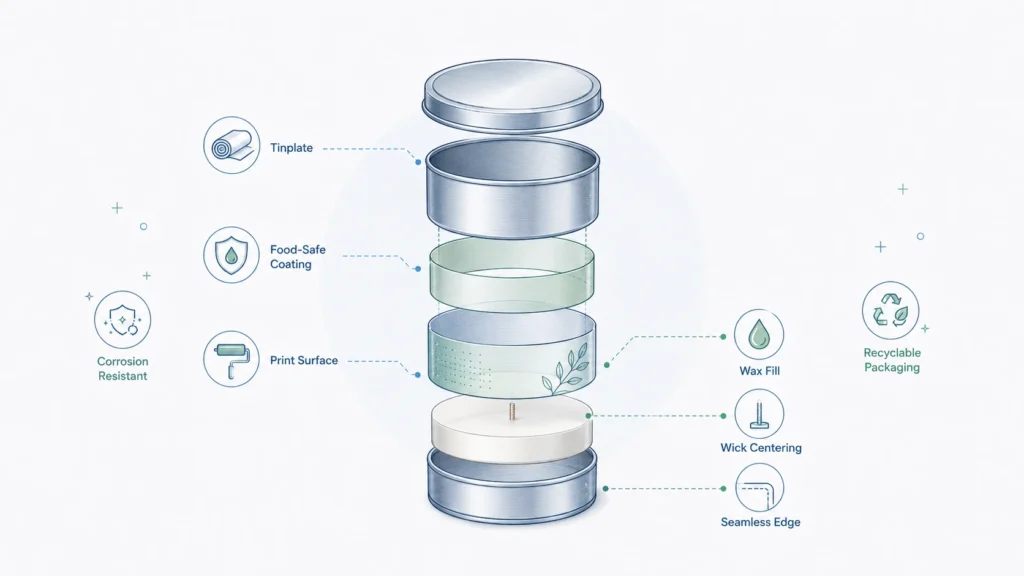
Most candle tins are made from tinplate or related coated steel materials. Tinplate is thin steel coated with a layer of tin, then formed into containers through stamping, drawing, curling, trimming, coating, printing, and assembly processes. The World Steel Association describes tinplate as tin-plated steel used primarily in food cans and industrial packaging, with typical thickness between 0.13 mm and 0.49 mm and typical width between 600 mm and 1100 mm.
For candle tins, the key issue is not simply whether the metal is “strong.” The buyer must consider the full material system: base steel, tin or coating layer, internal lacquer, exterior coating, inks, varnish, curing, forming stress, and how those layers behave when exposed to hot wax, fragrance oils, storage conditions, and open-flame heat during burning.
Internal coating is especially important. Candle formulas may contain soy wax, coconut wax, beeswax, paraffin, rapeseed wax, palm wax, mineral wax blends, essential oils, fragrance oils, dyes, and additives. Some fragrance components are more aggressive than others. Some wax systems shrink differently during cooling. Some dyes or oils may stain surfaces. A coating that performs well for dry products may not be ideal for hot-filled scented wax. Therefore, buyers should request real sample testing with the actual wax and fragrance, not only with unscented wax or water.
| Technical factor | Why it matters | What buyers should ask |
|---|---|---|
| Tinplate thickness | Affects rigidity, dent resistance, weight, and cost | What thickness range is recommended for this size and channel? |
| Internal lacquer | Helps separate wax/fragrance from metal surface | Is the lacquer compatible with hot-filled scented wax? |
| Exterior coating | Controls color, scratch resistance, and appearance | Can the coating survive filling, packing, and shipping abrasion? |
| Ink and varnish system | Determines print durability and color consistency | Are proofs or color samples available before mass production? |
| Curl and rim quality | Affects hand feel and lid fit | Are rims smooth and consistent after forming? |
| Bottom shape | Affects stability, heat transfer, and perceived quality | Is the base flat and stable on retail and home surfaces? |
| Packing method | Prevents scratches and dents before filling | How are tins separated, nested, bagged, or cartoned? |
For tinplate material, coating, printing, and food-safety concepts, buyers can reference Tinplate Packaging Guide: Materials, Coatings, Printing & Food Safety. Even though candle tins are not food containers, the same discipline of matching material, coating, printing, and end-use conditions applies.
Safety Standards and Compliance Topics Candle Brands Should Know
Candle tins are used with an open flame, so packaging decisions should always connect with candle safety. The tin is only one part of the candle system. Wax, wick, fragrance load, dye, container diameter, fill height, airflow, surface stability, user instructions, and accessories all affect safety.
In the United States, the Consumer Product Safety Commission candle business guidance notes that metal-cored candlewicks and candles using such wicks must not contain lead in the metal core in excess of 0.06% by weight under 16 CFR § 1500.17(a)(13). The same guidance lists several industry consensus standards for candles, including ASTM F2058 for candle fire safety labeling, ASTM F2417 for fire safety for candles, and ASTM F2601 for candle accessories.
The National Candle Association’s safety standards page explains that ASTM F2417 establishes maximum flame height, tip-over limits, secondary-ignition proscriptions, and end-of-useful-life specifications. ASTM also describes F2417 as addressing excessive flame height, secondary ignition, end-of-use issues, and candle stability. Meanwhile, the NFPA candle safety page reports that during 2020-2024, candles were the heat source for 2% of reported home fires, 2% of home fire deaths, and 5% of home fire injuries.
These sources do not mean candle tins are unsafe. They mean candle brands should treat safety validation as part of product development. The container must be validated with the final candle formula, not evaluated as an empty tin only.
| Topic | Relevant standard or source | What it means for candle tin buyers |
|---|---|---|
| Candle fire safety design | ASTM F2417 | Validate flame height, stability, secondary ignition, and end-of-life behavior for the finished candle |
| Warning labels | ASTM F2058 | Reserve enough label space for warnings, not only branding |
| Candle accessories | ASTM F2601 | If the tin is sold with holders, lids used as bases, decorative rings, or accessories, evaluate accessory safety |
| Lead in metal-cored wicks | CPSC / 16 CFR § 1500.17(a)(13) | Avoid non-compliant wicks and maintain supplier documentation |
| Home fire context | NFPA | Reinforce clear safety instructions and conservative burn testing |
| Container performance | Internal testing and applicable standards | Test filled tins under real burn, storage, and transport conditions |
A buyer should not ask a tin supplier to “guarantee the candle is safe” without testing the final candle. The tin supplier can support structure, coating, lid fit, material documentation, printing, and packaging quality. The candle brand or candle manufacturer must validate the complete candle system.
Printing, Finishes, and Brand Positioning
Candle packaging must work in three places: on the shelf, in photos, and inside the customer’s home. A tin that looks attractive under factory lighting may look different in e-commerce photography. A glossy surface may show scratches or reflections. A matte surface may look premium but show oil marks from handling. Metallic colors can look luxurious but may need careful color matching. Soft-touch coatings feel high-end but may require extra durability checks.
For candle tins wholesale, decoration choices usually fall into four groups: labels, direct printing, color coating, and special effects.
Labels are flexible and cost-efficient. They allow fast scent changes, smaller runs, and simpler inventory management. A blank black tin can become ten scent variants through different labels. The downside is that label edges, adhesion, moisture resistance, and alignment must be controlled.
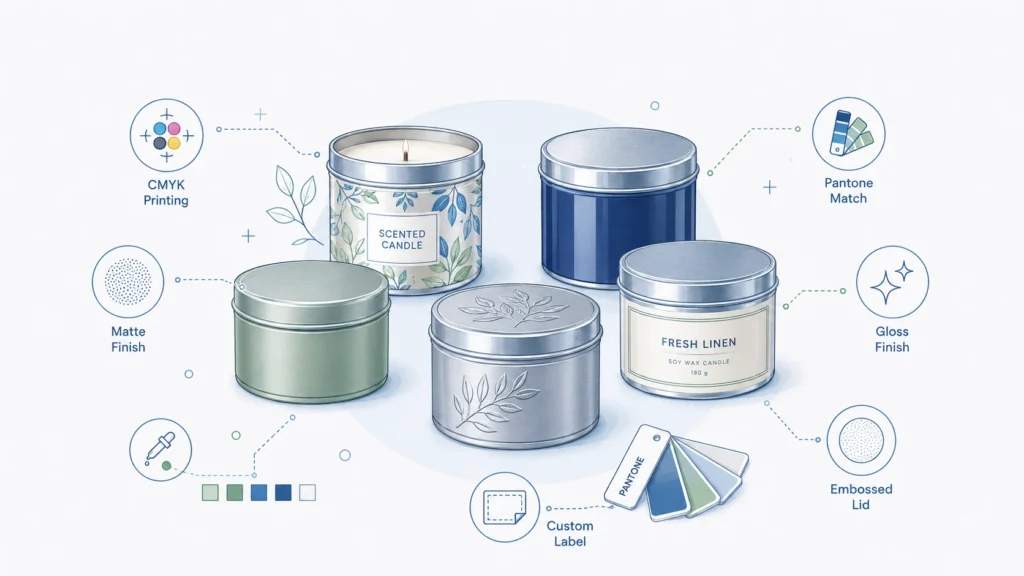
Direct printing creates a more integrated package. It is cleaner, more durable, and more premium than a simple label when done well. It also supports full-surface designs, seasonal art, and a retail-ready appearance. The trade-off is that printed tins require artwork proofing, color approval, setup time, and a stronger commitment to a design.
Color coating gives the tin a consistent brand base. Matte black, matte white, kraft-inspired neutrals, brushed metallic effects, pastel tones, and holiday metallic colors can all support candle lines. A color-coated tin with a small label can be a strong balance between custom appearance and flexible SKU management.
Special effects include embossing, debossing, spot UV, metallic inks, pearlescent finishes, textured varnish, soft-touch coating, and lid relief. These effects can make a candle tin feel collectible, especially for gift lines. However, they must be tested for scuff resistance and consistency because candles are handled repeatedly.
| Finish option | Brand impression | Best use case | Procurement note |
|---|---|---|---|
| Glossy coating | Bright, commercial, colorful | Mass retail, holiday patterns, playful scents | Good shelf impact but may show reflections in photos |
| Matte coating | Modern, calm, premium | Wellness, luxury, minimalist candle lines | Check fingerprint and scuff resistance |
| Satin coating | Balanced and versatile | Broad lifestyle brands | Often easier to manage than very matte finishes |
| Metallic finish | Premium, festive, giftable | Holiday candles, luxury collections, corporate gifts | Color matching can be more complex |
| Soft-touch | High-end tactile feel | Premium DTC and gift sets | Requires careful abrasion testing |
| Spot UV | Contrast and logo emphasis | Premium lid graphics and limited editions | Needs precise registration |
| Embossing/debossing | Tactile brand memory | Logos, monograms, collectible tins | Tooling and approved samples are essential |
The internal Mr. Tin Box guide Metal Tin Box Finishing Options Matte, Glossy and More is directly relevant because it explains how matte, glossy, satin, textured, metallic, soft-touch, spot UV, embossing, and protective coatings influence brand perception, cost, and mass-production consistency.
Sustainability and Regulatory Direction
Many candle brands are shifting away from fragile or heavy packaging and toward materials that support reuse, recyclability, and lower plastic dependence. Metal packaging fits this direction when it is designed responsibly. Steel and tinplate packaging can be magnetically sorted in many recycling systems, and a durable candle tin can also be reused by the consumer before it ever enters recycling.
Sustainability claims should still be made carefully. A tin is not sustainable only because it is metal. The actual outcome depends on design, local collection systems, labels, coatings, inserts, windows, adhesives, and whether the consumer can separate components. A printed all-metal tin is usually simpler to communicate than a complex mixed-material package with glued windows and hard-to-remove inserts. If a window is necessary, brands should decide whether product visibility is worth the added material complexity.
Regulation is also moving packaging design toward recyclability and clearer labeling. The European Commission states that under the Packaging and Packaging Waste Regulation, all packaging must be recyclable by 2030 and easier to label and sort. Even brands that do not sell directly into the EU should pay attention because global retailers often align packaging briefs with stricter markets to simplify SKU management.
For candle tins wholesale, this means buyers should avoid unnecessary material complexity and think about end-of-life from the beginning. A beautiful tin with a glued plastic window, foam insert, shrink sleeve, mixed-material label, and non-removable decorative accessory may look premium, but it may be harder to explain under modern packaging expectations. A simpler all-metal tin with high-quality printing, clear recycling information, and reusable value may be easier for both consumers and retailers to understand.
| Sustainability decision | Better practice | Reason |
|---|---|---|
| Material selection | Use metal-dominant structures where possible | Supports sorting and recycling communication |
| Decoration | Prefer direct printing or removable labels when practical | Reduces hard-to-separate layers |
| Inserts | Use only when needed for protection or gift presentation | Avoids unnecessary empty space and material waste |
| Windows | Use only when product visibility drives real sales value | Mixed materials can complicate recycling messages |
| Reuse | Design tins with smooth edges, durable lids, and attractive proportions | Makes the package useful after the candle is burned |
| Labeling | Provide clear recycling and safety information | Supports consumer trust and retailer requirements |
For broader context on how metal packaging supports shelf life, premium value, and circular-economy messaging, see Why Metal Packaging Boosts Shelf Life and Brand Value.
MOQ, Tooling, and Lead Time Planning
MOQ is one of the most common friction points in candle tins wholesale. Buyers often ask for a very low MOQ with custom color, custom printing, embossing, and special packing. In practice, MOQ depends on the existing mold, material procurement, coating line setup, printing setup, color changes, labor, inspection, and packing method.
If the buyer uses an existing stock tin with a standard color, the MOQ may be lower. If the buyer wants a custom Pantone color, full-body printing, or special varnish, the supplier must set up coating and printing processes, which increases the practical MOQ. If the buyer wants a new shape, new lid profile, or special embossing, tooling cost and development time must be included.
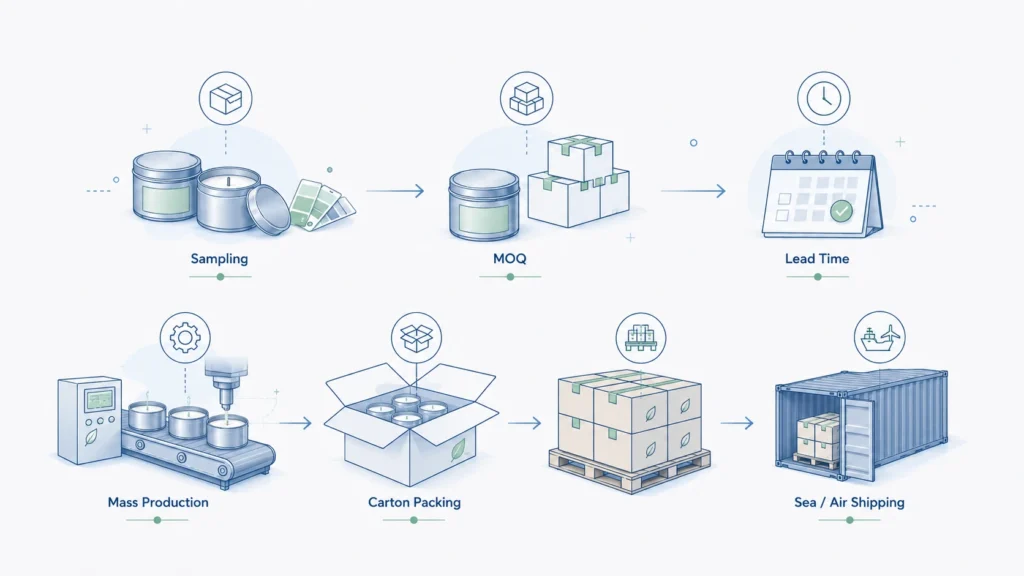
Lead time should be separated into development time and production time. Development includes requirement confirmation, drawing, sample making, artwork proofing, coating approval, functional testing, and revision. Production includes material preparation, coating, printing, forming, inspection, packing, and shipment. When buyers compress these steps, they usually increase risk.
| Project stage | Typical work involved | Buyer responsibility | Risk if skipped |
|---|---|---|---|
| Requirement brief | Size, fill weight, wax type, lid style, artwork goal, market | Provide complete product and channel details | Wrong tin size or unsuitable lid selected |
| DFM review | Check manufacturability, tooling, coating, print area | Approve practical trade-offs | Beautiful design may be hard to mass-produce |
| Structural sampling | Empty tin samples for size, lid fit, finish, and packing | Test handling, filling, and carton fit | Fit or usability problems found too late |
| Candle burn testing | Test final wax, wick, fragrance, fill line, and tin | Conduct or commission safety testing | Flame, heat, tunneling, or end-of-life issues |
| Artwork proofing | Print proof, color sample, finish sample | Approve real sample, not only digital mockup | Color disputes and brand inconsistency |
| Pilot or pre-production check | Validate mass-production settings | Confirm QC criteria | Defects scale across the whole order |
| Mass production | Coating, printing, forming, inspection, packing | Monitor schedule and approve shipment | Late seasonal delivery or quality disputes |
| Incoming QC | Check cartons, dents, color, lid fit, count | Inspect before filling | Defective tins enter filling line |
A useful rule is to treat wholesale candle tins as part of product engineering, not as a last-minute purchase. For holiday launches, the packaging brief should begin months before the selling season. The NCA’s point that about 35% of candle sales occur during the Christmas/holiday season is a reminder that late packaging decisions can affect the most important revenue window.
How to Prepare a Professional RFQ for Candle Tins Wholesale
A strong RFQ saves time for both the buyer and the supplier. Instead of asking only “How much is an 8 oz candle tin?”, the buyer should provide enough information for the supplier to recommend the right structure and quote accurately.
The most important RFQ details include target candle fill weight, target outer dimensions if known, wax type, fragrance load if available, fill temperature range, wick count, desired lid type, intended sales channel, destination market, artwork method, finish preference, expected annual volume, first-order quantity, packaging method, and testing requirements.
The RFQ should also distinguish between “must-have” and “nice-to-have” requirements. For example, a must-have may be an existing 8 oz round tin, matte black finish, slip lid, and stable lid fit for e-commerce. A nice-to-have may be embossed lid branding if MOQ and tooling budget allow. This helps the supplier propose options instead of quoting only the most expensive version.
| RFQ field | Example buyer input | Why it matters |
|---|---|---|
| Target product | Scented soy candle in metal tin | Defines end-use and coating assumptions |
| Fill weight | 6 oz finished wax fill | Prevents confusion between brimful volume and wax weight |
| Wax/fragrance | Soy wax blend, 8-10% fragrance load | Supports compatibility and heat discussions |
| Fill temperature | Approx. 60-75°C hot fill | Helps evaluate coating and process suitability |
| Tin size | Existing round tin preferred | Reduces tooling if suitable size exists |
| Lid style | Slip lid or plug lid | Determines tooling, fit, and user experience |
| Decoration | Matte black body, one-color lid print | Affects MOQ, lead time, and cost |
| Market | U.S. retail and DTC | Influences labeling and packing expectations |
| Quantity | First order 10,000 pcs, annual 80,000 pcs | Helps supplier plan tooling, pricing, and capacity |
| Packing | Scratch-resistant bulk packing for filling factory | Prevents damage before candle filling |
| Documentation | Material and coating details, inspection report | Supports internal QA and retailer review |
If the project is still early, it is acceptable to ask for options. A professional request can say: “We are developing a 6 oz to 8 oz scented candle line for U.S. DTC and boutique retail. We prefer an existing round tin with matte finish and slip lid. Please recommend available sizes, safe fill ranges, MOQ, custom color options, printing options, sample cost, and estimated production lead time.” That gives the supplier room to recommend practical structures instead of guessing.
For process reference, How to Develop a Custom Tin Box from Concept to Mass Production explains the broader custom tin development workflow from consultation and design to sampling, tooling, production, and inspection.
Quality Inspection Points Before Filling Candles
Candle brands should inspect tins before filling, not after candles are already poured. Once wax is inside, defects become more expensive to manage. A dented tin may need to be scrapped with wax included. A poor lid fit may require relabeling or repacking. A coating problem may require investigation across both packaging and formula.
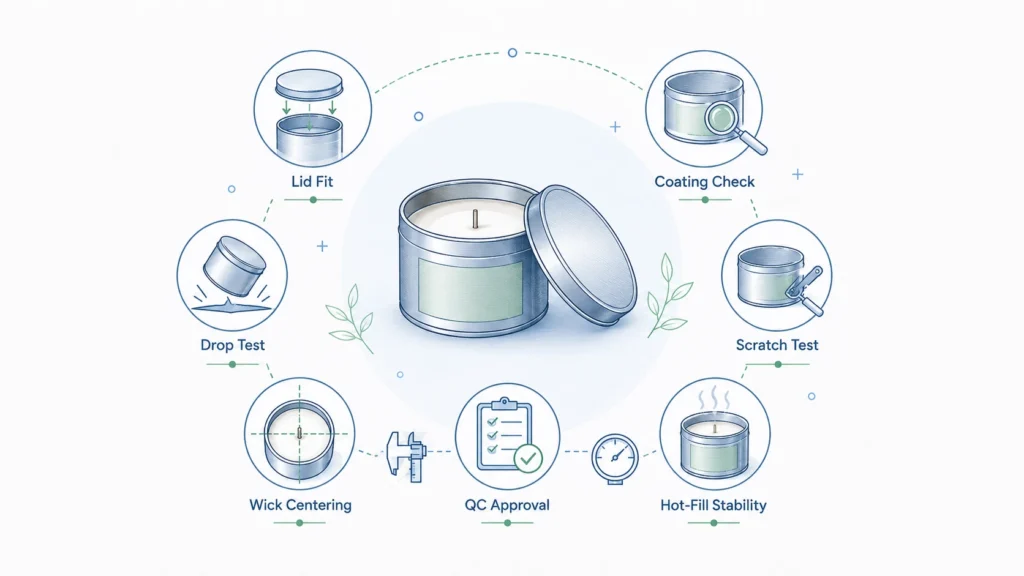
Incoming QC does not have to be complicated, but it should be systematic. Check the outer cartons for crushing, moisture, contamination, and count accuracy. Open samples from different cartons, not only the top carton. Inspect color consistency, print alignment, scratches, dents, lid fit, rim smoothness, interior cleanliness, odor, and bottom stability. If the tin will be filled on an automated or semi-automated line, check whether the tins denest or handle smoothly.
| QC checkpoint | What to inspect | Why it matters |
|---|---|---|
| Carton condition | Crushing, moisture, broken pallets, wrong labels | Prevents hidden transit damage |
| Count accuracy | Quantity per carton and total shipment | Avoids production shortages |
| Dents and deformation | Sidewalls, rims, bottoms, lids | Dented tins create brand complaints |
| Lid fit | Loose, overly tight, inconsistent fit | Affects retail feel and shipping security |
| Rim smoothness | Sharp edges, burrs, uneven curl | Important for user safety and hand feel |
| Interior surface | Dust, oil, coating defects, odor | Protects wax appearance and scent quality |
| Print quality | Color, registration, scratches, missing ink | Protects brand consistency |
| Coating durability | Rub, abrasion, tape pull if applicable | Reduces scuffs in e-commerce and handling |
| Stability | Rocking, uneven base, bottom deformation | Important for candles used on flat surfaces |
| Packing method | Separators, nesting marks, abrasion protection | Prevents damage before filling |
After filling, brands should continue testing. The finished candle should be evaluated for lid clearance, wax adhesion or shrinkage, surface appearance, fragrance retention, label adhesion, heat behavior, burn performance, soot, flame size, melt pool, container temperature, and end-of-life behavior. If anything changes in wax, fragrance, wick, fill level, or tin supplier, the candle should be revalidated.
Cost Drivers in Wholesale Candle Tin Orders
The unit price of a candle tin is shaped by many variables. Buyers often compare quotes without checking whether the specifications are truly the same. One quote may include a thicker tinplate body, custom color coating, scratch-resistant varnish, individual polybagging, and export cartons. Another may include a thinner blank tin with bulk packing. The cheaper quote may not be cheaper after filling losses, returns, or repacking.
The main cost drivers are material thickness, tin size, lid complexity, tooling, order quantity, coating, printing, embossing, inspection level, packing method, and freight. A larger tin uses more material and carton space. A special lid may require additional tooling. Matte or soft-touch finishes may require more process control. Full-color printing requires proofing and setup. Individual wrapping reduces scratches but increases labor and packing material.
| Cost driver | Low-cost direction | Premium direction | Buyer decision |
|---|---|---|---|
| Size | Smaller stock tin | Larger custom size | Balance fill weight, retail price, and freight |
| Structure | Existing round body and slip lid | Custom shape, hinge, window, or screw lid | Use proven structure unless differentiation justifies tooling |
| Material | Standard thickness | Heavier gauge or reinforced structure | Match sales channel and dent-resistance needs |
| Finish | Standard color or blank tin | Matte, metallic, soft-touch, spot UV | Choose based on brand position and handling risk |
| Decoration | Paper label | Direct print, embossing, multi-color artwork | Consider SKU flexibility versus premium appearance |
| Packing | Bulk nested packing | Separated, bagged, or tray-packed | Prevent scratches before filling |
| QC | Standard inspection | Detailed AQL, color control, fit control | Retail and DTC brands should define QC criteria |
| Freight | Sea freight, planned early | Air freight for urgent launches | Late planning can erase unit-price savings |
The best procurement strategy is to calculate total landed and usable cost, not only quoted unit cost. Usable cost considers defects, handling damage, filling loss, repacking, customer returns, and delayed seasonal revenue. For candle tins wholesale, packaging that protects the selling season and brand reputation is often more valuable than the lowest initial price.
Common Mistakes Candle Brands Make Before Ordering
Many candle tin problems are preventable. They usually come from making packaging decisions before product decisions are stable.
The first mistake is choosing a tin before finalizing the wax, wick, and fragrance. A tin that works with one formula may not work with another. Fragrance load can affect burn behavior. Wick size may need to change with diameter. Fill height can affect heat. If the container changes, burn testing should be repeated.
The second mistake is confusing water capacity with wax fill weight. A buyer may assume an 8 oz tin holds 8 oz of candle wax safely, but actual fill depends on wax density and safe headspace. This mistake can cause overflow, poor lid clearance, incorrect labels, or misleading retail claims.
The third mistake is over-customizing too early. New candle brands sometimes want a special shape, custom embossing, window lid, metallic finish, and low MOQ in the first launch. That increases cost and schedule risk before the brand has validated scent demand. A better path is to start with a proven structure and invest in good artwork, labels, and testing.
The fourth mistake is ignoring outer packing. Even a strong tin can scratch if thousands of pieces are nested or rubbed together during transit. If the tin surface is matte, dark, metallic, or soft-touch, packing protection becomes more important.
The fifth mistake is not reserving space for warning labels and required information. Candle packaging must communicate safety instructions clearly. A beautiful small lid is not enough if the bottom label cannot fit warnings, net weight, company details, batch code, barcode, scent name, and any required market-specific information.
The sixth mistake is approving digital mockups only. Digital renders are useful for design communication, but they do not prove color, gloss, texture, embossing, lid fit, or scratch resistance. Brands should approve real physical samples before mass production whenever possible.
Recommended Wholesale Buying Strategy by Brand Stage
Not every candle brand should order the same type of tin. The right strategy depends on stage, sales channel, and volume.
A startup candle brand should usually begin with stock tins and high-quality labels. This keeps investment lower while the brand tests scents, pricing, photography, shipping, and customer feedback. The focus should be on choosing the right diameter, lid fit, and safe fill weight. Once the best-selling scents are known, the brand can move into custom color or direct printing.
A growing DTC candle brand should consider semi-custom tins using existing molds. Matte or satin color coating, lid printing, and improved packing can upgrade perceived value without the risk of fully custom tooling. This stage should also define repeatable QC standards because customer reviews and unboxing photos matter.
A retail-ready brand should invest in stronger color control, barcode planning, carton pack-out, display compatibility, and retailer documentation. If candles will be sold through boutiques, gift shops, department stores, or mass retailers, packaging consistency becomes more important. A lid that feels acceptable in a small batch may become a problem when thousands of consumers compare tins on a shelf.
A premium or luxury candle brand may justify embossing, custom shapes, metallic effects, soft-touch coatings, rigid gift boxes, or collectible series. However, premium does not mean fragile. Premium candle tins must survive handling and shipping while still looking beautiful.
| Brand stage | Recommended tin approach | What to prioritize |
|---|---|---|
| Startup | Stock tin + label | Burn testing, scent validation, safe fill weight, cash flow |
| Early growth | Existing mold + custom color | Brand recognition, photography, improved packing |
| DTC scale-up | Existing mold + print or premium label | Scratch resistance, unboxing, review quality |
| Retail launch | Custom finish + controlled QC | Shelf consistency, barcode, warnings, carton efficiency |
| Premium line | Embossing, special finish, gift set system | Tactile value, collectibility, durability |
| Corporate gifting | Custom lid print, seasonal color, gift-ready packing | Deadline control, logo accuracy, presentation |
Why Work with Mr. Tin Box for Candle Tins Wholesale
A successful candle tin project needs more than a catalog size. It needs a supplier that understands how metal packaging connects with product use, decoration, production stability, and brand positioning. Mr. Tin Box focuses on custom metal tin packaging for brands that need both presentation and practical performance.
For candle brands, we can help evaluate size options, lid structures, coating choices, decoration methods, packing protection, and project timelines. We can support blank tins, semi-custom programs, printed tins, premium finishes, gift packaging structures, and related metal packaging projects across beauty, food, gift, promotional, holiday, and specialty applications.
If your candle line overlaps with wellness, bath, fragrance, gift sets, or personal care, our Beauty & Personal Care Packaging capabilities are relevant because candle packaging often uses similar premium finishes, small-format structures, and tactile brand cues. If your candle line is positioned as a gift, seasonal collection, or premium lifestyle product, our experience in Gift, Promotional & Holiday Packaging can support artwork planning, collectible series, and event-based timelines. For candle lines sold with confectionery, tea, coffee, or specialty food gift sets, Food & Beverage Packaging is also relevant because it reflects our broader experience with tinplate structures, coatings, and shelf presentation.
A good wholesale candle tin should be easy to fill, attractive to sell, durable to ship, consistent to reorder, and safe to validate as part of the final candle. That is the standard candle brands should use when comparing suppliers.
Practical Ordering Checklist
Before placing a candle tins wholesale order, review the checklist below. It can be copied into an internal sourcing document or sent to a supplier as part of the project brief.
| Checklist item | Confirmed? | Notes |
|---|---|---|
| Final wax formula selected | Include wax type and fragrance load if available | |
| Target fill weight defined | Separate wax weight from tin brimful volume | |
| Target diameter confirmed | Diameter affects wick and melt pool | |
| Lid type selected | Slip, plug, screw, hinged, or window | |
| Fill temperature considered | Test coating and hot-fill process | |
| Burn testing plan prepared | Include final wax, wick, fragrance, and tin | |
| Warning label space reserved | Follow market and retailer requirements | |
| Artwork method selected | Label, direct print, coating, embossing, or mixed approach | |
| Finish durability tested | Especially matte, dark, metallic, or soft-touch finishes | |
| Packing protection specified | Prevent scratches and dents before filling | |
| MOQ and lead time confirmed | Include sampling and approval time | |
| Destination market identified | U.S., EU, UK, Canada, Australia, or other markets | |
| Incoming QC process planned | Inspect before filling candles | |
| Reorder strategy considered | Keep specs stable for repeat production |
FAQ
Are candle tins better than glass jars?
Candle tins and glass jars serve different brand strategies. Tins are lighter, less fragile, easier to ship, and often better for travel candles, sample sets, promotional gifts, and e-commerce. Glass jars can communicate transparency, weight, and luxury in a different way. The best choice depends on the candle formula, retail price, shipping channel, and brand identity.
Can I use the same candle tin for soy wax, coconut wax, beeswax, and paraffin?
Possibly, but you should test. Different waxes and fragrance oils behave differently during hot filling, cooling, storage, and burning. The tin, coating, wick, and fill height should be validated with the final formula.
What is the most popular candle tin size?
Many brands use 4 oz travel tins and 8 oz main retail tins because these sizes balance portability, value, and shelf appeal. However, there is no universal best size. The correct size depends on target wax fill weight, diameter, wick strategy, burn time goal, and sales channel.
Can candle tins be custom printed?
Yes. Candle tins can often be decorated with labels, color coating, direct printing, lid printing, embossing, debossing, spot UV, metallic effects, and other finishes. The best method depends on MOQ, artwork complexity, budget, and whether the brand needs flexible scent changes.
Do candle tins need special internal coating?
Many candle tins use an internal coating or lacquer system. The coating should be checked against the actual wax and fragrance formula, especially for hot-filled scented candles. Buyers should request samples and test before mass production.
Can I order custom candle tins at low MOQ?
Low MOQ is easier with stock tins and labels. Custom colors, printing, embossing, and new tooling usually require higher MOQ because production setup costs must be spread across enough units. A practical approach is to start with an existing mold and customize decoration.
What should I test before mass production?
At minimum, test lid fit, fill compatibility, cooling appearance, label adhesion, coating appearance, burn behavior, flame height, container heat, stability, tunneling, soot, end-of-life behavior, packing durability, and e-commerce shipping if applicable.
Are metal candle tins recyclable?
Metal tins can be recyclable in many systems, but actual recyclability depends on local collection infrastructure and the final package design. Avoid unnecessary mixed materials, glued windows, hard-to-remove inserts, and confusing labels if recyclability is part of your brand message.
Final advice for candle brands before ordering
Ordering candle tins wholesale is not only about finding a container that looks good in a product photo. The tin must work with wax chemistry, filling temperature, wick behavior, fragrance strategy, safety labeling, retail display, e-commerce shipping, holiday timelines, and customer expectations. A well-chosen tin can make a candle feel more giftable, more portable, more premium, and more memorable. A poorly chosen tin can create dents, lid complaints, labeling problems, delayed launches, and safety concerns.
The smartest path is to start with function, then build the brand experience around it. Confirm the candle formula. Choose a diameter that supports the burn. Select a lid style that feels reliable. Test the coating with hot wax and fragrance. Reserve space for warnings. Approve real samples. Define packing and QC. Then use color, printing, finish, and embossing to turn the tin into a brand asset.
For brands preparing a new candle line, seasonal gift collection, private-label program, or wholesale retail launch, Mr. Tin Box can support the packaging conversation from concept to mass production. Start with your target fill weight, scent strategy, visual direction, and sales channel, and the candle tin specification can be built around real commercial needs rather than guesswork.