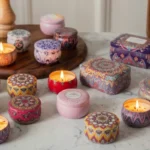
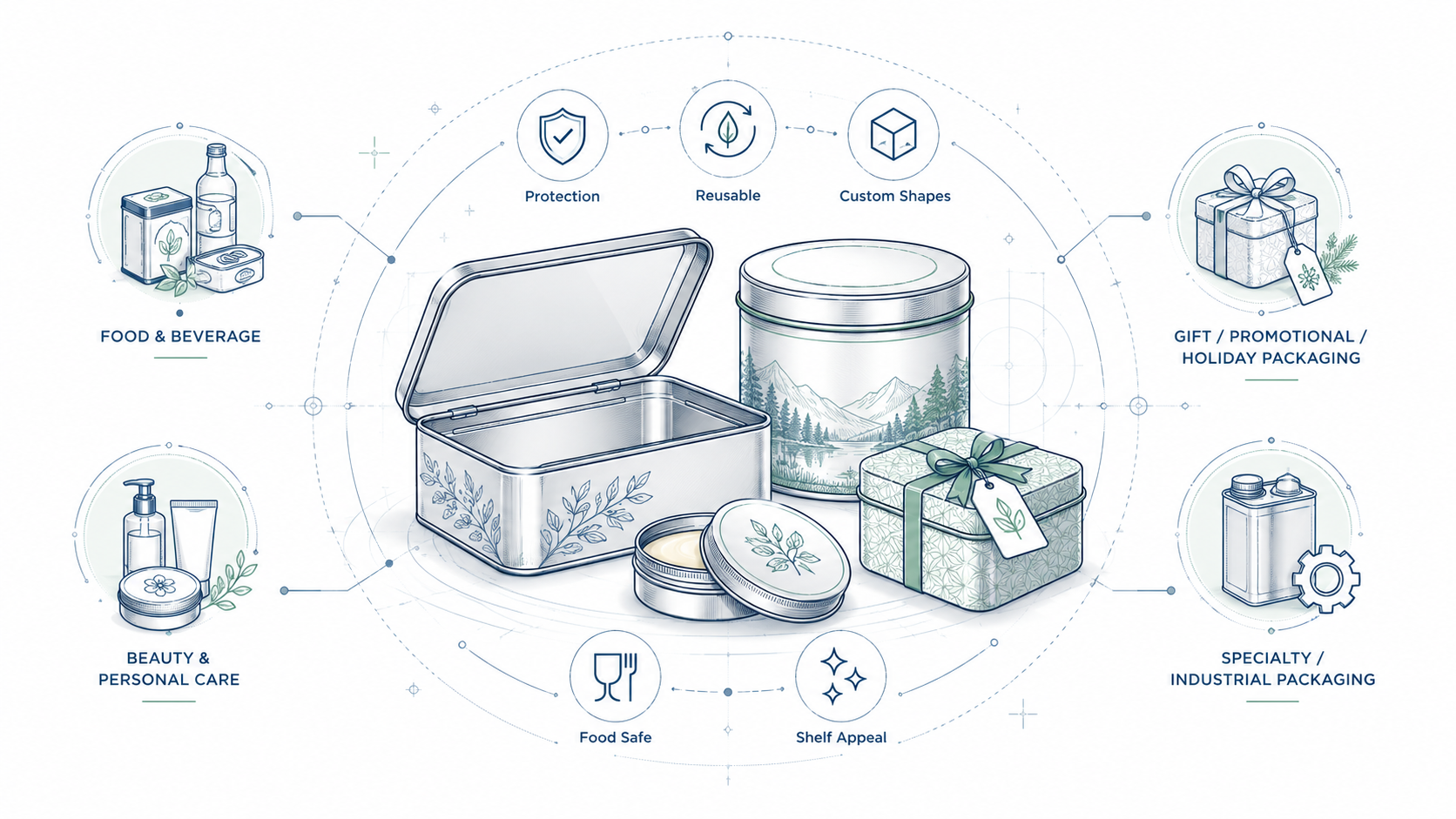
For brands that sell food, beverages, cosmetics, gifts, promotional products, or specialty consumer goods, packaging is no longer a simple container. It is a protection system, a sales message, a sustainability signal, and often the first physical interaction a customer has with the product. This is why metal tin packaging continues to attract brand owners that want packaging with a stronger shelf presence, better product protection, and more long-term value than ordinary disposable packs.
At Mr. Tin Box, we focus on custom metal tin packaging for global brands across Food & Beverage Packaging, Beauty & Personal Care Packaging, Gift, Promotional & Holiday Packaging, and Specialty & Industrial Packaging. The goal is not only to make a tin box that looks attractive. A successful project should match the product, market, sales channel, target price, compliance expectations, and mass-production reality.
This guide explains the benefits, applications, and custom options of metal tin packaging in plain business language. It also includes data points and practical tables that can help packaging buyers, brand managers, product developers, and sourcing teams make better decisions before requesting a quotation.
Table of Contents
Key industry data brands should know

Before choosing a packaging format, it helps to understand where metal packaging fits in the wider market. The numbers below show why metal tin packaging is commercially relevant, why sustainability claims should be specific, and why packaging design should be treated as part of the sales strategy.
| Data point | What it means for brand owners | Source |
|---|---|---|
| The global metal packaging market was estimated at USD 148.13 billion in 2024 and is projected to reach USD 184.21 billion by 2030, with a 3.7% CAGR from 2025 to 2030. | Metal packaging is not a niche material. It remains a large, mature, and growing packaging category. | Grand View Research |
| Food and beverages represented 57.36% of the global metal packaging market by end use in 2024. | Food-related applications remain the largest commercial demand driver for metal packaging. | Grand View Research |
| Steel for Packaging Europe reported that 82% of steel packaging placed on the EU market was really recycled in 2023. | Steel-based tin packaging can support credible circularity messaging when claims are adapted to the local market and recycling system. | Steel for Packaging Europe |
| The U.S. EPA estimated steel packaging recycling at 73.8% of generation in 2018, while overall plastic containers and packaging recycling was 13.6%. | Recycling performance varies by country and material, so buyers should avoid vague claims and use market-specific evidence. | U.S. EPA |
| The U.S. aluminum beverage can recycling rate was around 43% in 2023, and the Can Manufacturers Institute has targets of 70% by 2030, 80% by 2040, and 90% by 2050. | Metal circularity is strong, but the actual recycling rate still depends on collection, sorting, and consumer behavior. | Can Manufacturers Institute |
| Ipsos research found that 72% of American consumers said packaging design often influences purchase decisions, and 67% said packaging materials often influence purchase decisions. For gifts, 81% said packaging design can influence selection. | Packaging is part of the product’s perceived value, especially for premium and gift categories. | Ipsos |
| NIQ reported that 95% of consumers say they are trying to live more sustainably, including actions such as recycling, buying recyclable packaging, and using refillable containers. | Reusable and recyclable packaging can support brand preference when the message is clear and believable. | NielsenIQ |
| In the EU, Regulation (EC) No 1935/2004 sets general principles for food contact materials, including safety, inertness, documentation, and traceability. | Food-grade metal tin packaging must be evaluated as a system, including coatings, inks, varnishes, inserts, and direct-contact surfaces. | European Commission |
The takeaway is simple: metal tin packaging gives brands a rare combination of structure, shelf impact, reusability, and recyclability. However, the best results come when a brand designs the tin around a specific product requirement instead of treating it as a generic box.
What is metal tin packaging?
Metal tin packaging usually refers to rigid or semi-rigid containers made from tinplate, which is a thin steel sheet coated with tin. The steel provides strength and formability, while the tin coating helps protect the surface and supports a clean metallic appearance. In some projects, aluminum may also be used, especially where light weight, corrosion resistance, or a specific premium look is required.
In practical packaging conversations, buyers often use terms such as tin box, tin can, metal tin, custom tin container, metal packaging, and tinplate packaging interchangeably. The exact structure can vary widely. A simple mint tin may use a slide lid. A tea tin may use a plug lid or inner seal. A cookie tin may use a removable tray. A cosmetic balm tin may need a smooth screw lid and coating compatibility. A promotional tin may need embossing, a window, foam insert, and a custom sleeve.
A good metal tin is not just a shaped sheet of metal. It is a system made from several decisions:
- material grade and thickness
- inner coating or lacquer
- exterior printing and varnish
- surface finish
- lid structure and closure style
- edge curling and safety treatment
- optional hinge, window, handle, or lock
- inserts, trays, foam, paperboard, or molded pulp
- packing method for export shipping
- quality inspection standard
This system-level thinking is especially important for food and beauty products. The U.S. FDA explains that food packaging and its components can be food contact substances, and that components used in compliance with 21 CFR 174-179 generally need no further FDA review for that covered use. In the EU, the food-contact framework requires materials not to release constituents into food at harmful levels or change food composition, taste, or odor in an unacceptable way. For a brand owner, that means the question is not only “Is the tin food grade?” The better question is: “Which parts touch the product, what coating is used, what testing or documentation can support the intended market, and what storage conditions will the product face?”
Mr. Tin Box highlights this same system approach in its article Food-Grade Custom Metal Packaging: What Buyers Should Know Before Production, where the focus is on material, coating, direct-contact surfaces, testing, and production control before mass production.
Why brands choose metal tin packaging
Brands usually choose metal tin packaging because it solves several commercial problems at the same time. It can protect the product, improve the shelf impression, support sustainability messaging, and create a package consumers may keep long after purchase.
Strong physical protection
A rigid metal body protects products from compression, abrasion, vibration, and handling damage. This is valuable for cookies, biscuits, chocolate assortments, tea collections, candles, cosmetic sets, tools, electronics accessories, and promotional gifts. In e-commerce, packaging must survive courier handling, stacking, and impact. A paperboard box can be excellent for many uses, but a tin is often stronger when the product needs a durable outer shell or premium gift structure.
For food brands, crush protection can directly affect the customer experience. A cookie tin that arrives with broken biscuits creates disappointment, even if the recipe is excellent. For beauty brands, dented or scratched packaging can make a premium product feel cheap. For industrial kits, a metal tin can help keep small components organized and protected.
Excellent barrier potential
Metal is naturally opaque, which means it blocks light. This matters for products that are sensitive to UV or visible light, such as tea, coffee, spices, nutraceutical powders, fragrances, balms, oils, candles, and certain food ingredients. Academic and technical packaging literature commonly recognizes metal packaging for strong barrier performance against gases, moisture, light, and odors, which is why metal has been widely used in food packaging for generations.
However, buyers should be precise. A metal body alone does not automatically make every tin airtight, moisture-proof, or suitable for retort processing. Barrier performance depends on the full design: lid fit, seam, gasket, liner, inner pouch, coating, and product chemistry. For tea, coffee, and snacks, many brands use a tin as the premium outer package and add an inner bag or sealed pouch for freshness. For true shelf-stable canned foods, the requirements are more demanding. Under U.S. regulations, a hermetically sealed container is designed to prevent microorganism entry and maintain commercial sterility after processing, as described in 21 CFR Part 113.
This distinction helps protect brand credibility. A decorative tea tin can be food-safe and protective without being the same as a retort can. A cookie tin may need an inner bag for moisture control. A cosmetic tin may need coating compatibility testing for oils, waxes, fragrances, or alcohols.
Premium look and touch
Metal communicates value before the consumer reads the label. The cool touch, rigid body, opening sound, weight, embossing, lid fit, and surface finish all influence perceived quality. This is why metal tins are popular in categories where packaging is part of the gift: chocolates, cookies, tea, coffee, candles, cosmetics, perfumes, wellness kits, and limited-edition products.
Packaging research supports this business logic. Ipsos found that packaging design and packaging materials often influence purchase decisions. In gift situations, packaging design can become even more important because the buyer is choosing an experience, not just a product. A reusable metal tin can make the gift feel more complete and more valuable.
Reuse and long-term brand exposure
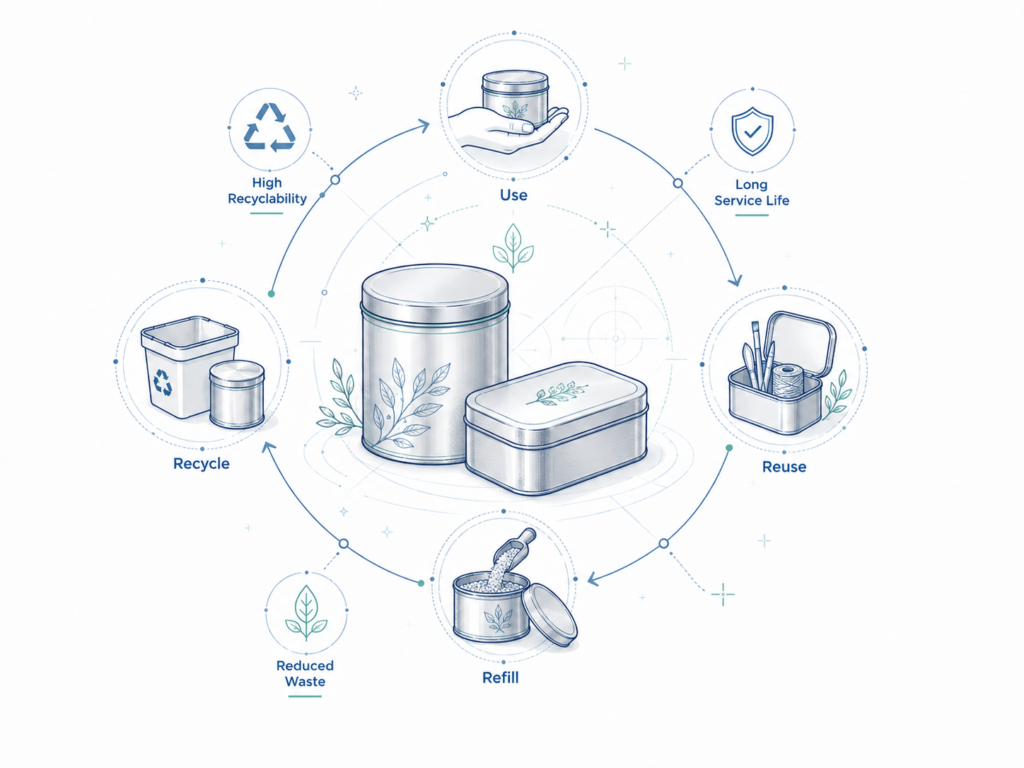
One of the strongest advantages of metal tin packaging is that people often keep it. Consumers may reuse tins for tea bags, sewing items, stationery, accessories, candy, receipts, photos, small tools, or storage. That second life gives the brand repeated visibility inside the home or workplace.
This makes tin packaging especially useful for seasonal and promotional campaigns. A holiday cookie tin, anniversary tin, collector tin, or branded gift tin can continue working as a brand asset after the product is consumed. Mr. Tin Box discusses this keepsake value in Metal Packaging Trends for Premium Consumer Goods, where premium packaging is described as an object that protects the product and strengthens perceived value.
Sustainability messaging with measurable support
Steel and aluminum are widely recycled in many markets, and metal can be recycled repeatedly without the same kind of property degradation associated with some other materials. Steel packaging has the additional benefit of magnetic sorting, which helps recovery in many recycling systems. In Europe, steel packaging reached an 82% real recycling rate in 2023 according to Steel for Packaging Europe. In the United States, the EPA estimated steel packaging recycling at 73.8% of generation in 2018.
Still, sustainability claims must be responsible. A brand should avoid broad statements like “100% eco-friendly” unless there is strong evidence and local context. Better claims are more specific:
- reusable metal tin
- steel packaging is widely recyclable where local collection systems exist
- designed for long-term reuse
- recyclable metal packaging with removable insert
- reduced need for secondary gift packaging
The Mr. Tin Box article Sustainable Custom Metal Packaging: Why Tin Boxes Support Circular Packaging Goals is a useful internal reference for brands that want to position tin packaging around circularity, reuse, and recyclability without overstating the claim.
Application guide: where metal tin packaging works best
Metal tin packaging is flexible because the same material family can serve many different categories. The key is to match the tin structure to the product’s real business goal.
| ApplicationWhy metal tin packaging worksImportant design considerations | ||
|---|---|---|
| Tea, coffee, matcha, and spices | Protects from light, supports aroma perception, creates premium shelf presence | Lid fit, inner coating, inner bag, plug lid, stackability, moisture control |
| Cookies, biscuits, chocolates, and candies | Adds gift value, protects against crushing, supports seasonal design | Food-grade coating, inner tray, divider, scuff-resistant varnish, carton protection |
| Mints, lozenges, and small snacks | Compact, durable, reusable, pocket-friendly | Slide lid, safe curled edges, smooth opening, abrasion-resistant printing |
| Cosmetics and skincare | Feels premium, protects solid products, supports travel and refill concepts | Coating compatibility, corrosion resistance, screw lid, insert, finish durability |
| Candles, fragrance, and wellness | Creates decor value and protects aroma-sensitive products | Heat behavior, fragrance compatibility, coating selection, lid fit, label requirements |
| Promotional gifts and holiday campaigns | High perceived value, collectible, memorable | Full-surface printing, embossing, spot UV, metallic finish, custom shape |
| Specialty and industrial products | Strong protection and organization for small parts | Foam insert, compartments, hinge, latch, labeling area, corrosion control |
Food and beverage packaging
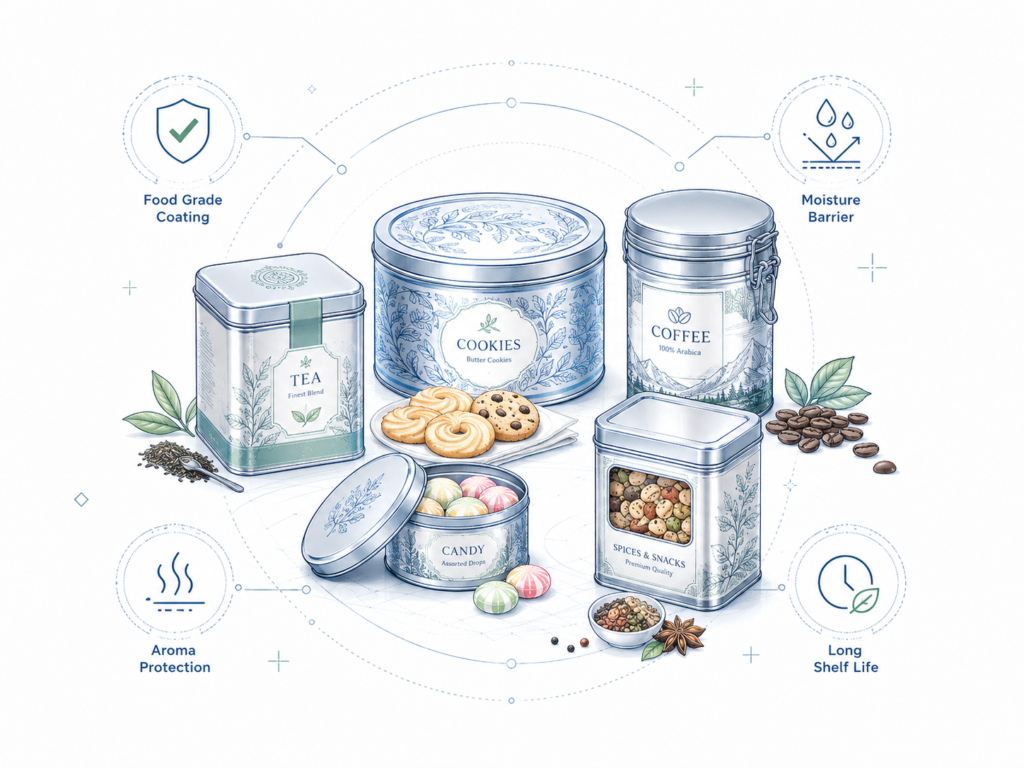
Food and beverage brands often choose metal tin packaging because it supports freshness perception, premium display, and structural protection. On its Food & Beverage Packaging page, Mr. Tin Box describes metal packaging for snacks, tea, coffee, chocolates, candies, and specialty food products, emphasizing tinplate forming, airtightness, durability, and safe food contact.
For dry foods, the main quality risks are moisture, oxygen, light, odor transfer, and breakage. A tin helps reduce several of these risks, especially when combined with an inner pouch, sealed bag, food-grade coating, or suitable liner. This is common for tea, coffee, cookies, biscuits, candies, and premium snacks. The outer tin creates the brand experience, while the inner packaging provides extra freshness control.
For confectionery and gift foods, visual impact matters as much as protection. A chocolate or cookie tin is often purchased for gifting, not only consumption. Embossed logos, seasonal illustrations, metallic inks, matte varnish, or a window lid can turn ordinary food into a gift-ready product. The package can also encourage repeat seasonal purchases because consumers may collect different designs.
For food-contact projects, buyers should confirm direct-contact surfaces, coating system, printing and varnish suitability, odor control, and documentation. If the product is acidic, salty, oily, alcohol-based, or high-moisture, the supplier should review compatibility carefully. If the tin is only a secondary package and the food is sealed in an inner pouch, the risk profile is different from direct food contact.
Beauty and personal care packaging
Beauty and personal care brands use tin packaging for products that need a premium, compact, durable, and tactile format. Common examples include lip balm, solid perfume, shaving soap, beard balm, salve, cuticle balm, hair wax, massage balm, solid lotion, fragrance accessories, candle sets, skincare sample kits, and promotional beauty boxes.
Mr. Tin Box’s Beauty & Personal Care Packaging page highlights corrosion-resistant tinplate or aluminum, precision stamping, custom printing, embossing, surface treatments, optional liners, coatings, and inserts. This is the right way to think about beauty packaging: the structure and surface must work together.
Beauty packaging is more than decoration. Many formulas contain oils, waxes, essential oils, fragrances, alcohols, acids, botanical extracts, or active ingredients. These materials may interact with coatings or cause odor, staining, corrosion, or finish changes if the wrong structure is selected. For that reason, a beauty tin project should start with product type, formula behavior, filling method, storage conditions, and target market.
From a branding perspective, metal tins fit the premiumization trend. A matte finish may support a clean wellness brand. A glossy finish can make a colorful cosmetic line feel playful. A brushed or metallic look can support luxury positioning. Embossing can make a logo feel more physical and memorable. For gift sets, an EVA insert, paperboard tray, or molded pulp insert can organize products and improve the unboxing moment.
Gift, promotional, and holiday packaging
Gift packaging has an emotional job. It must make the product feel special before it is opened. Metal tin packaging performs well here because it is rigid, decorative, reusable, and collectible. A seasonal tin can become part of the gift instead of disposable wrapping.
For Christmas cookies, Valentine’s chocolates, wedding favors, tea gift boxes, corporate gifts, promotional bundles, and limited-edition product launches, metal tins support full-surface storytelling. Brands can print illustrations, add metallic effects, emboss logos, include ribbon-ready structures, create character shapes, or build numbered collector series.
Mr. Tin Box covers this topic in Custom Metal Tin Packaging Ideas for Holiday Gifts and Seasonal Campaigns and 10 Creative Custom Metal Tin Packaging Design Ideas. These ideas are useful because a tin can be both graphic and physical. It can tell a seasonal story on the outside and present the product neatly on the inside.
Promotional tins are also valuable in B2B marketing. A metal tin with a foam insert can carry samples, tools, badges, USB drives, cards, or product miniatures. Because the tin is durable, it may stay on a customer’s desk long after a paper brochure is discarded.
Specialty and industrial packaging
Not every tin is used for food or beauty. Specialty and industrial brands use metal packaging when they need protection, organization, and a professional presentation. Examples include small tools, screws, fasteners, electronic components, replacement parts, tobacco accessories, medical or pharmaceutical kits, collector items, and sample sets.
In these applications, the tin must often do more than look good. It may need a hinge, latch, foam insert, molded tray, printed instruction area, anti-rattle structure, corrosion-resistant interior, or strong outer carton. The goal is to prevent product loss, improve organization, and make the package feel reliable.
A specialty tin can also improve brand trust. When a buyer opens a metal box and sees components arranged cleanly in a fitted insert, the product feels engineered and controlled. This is especially useful for technical brands that want packaging to reflect precision.
Custom options for metal tin packaging
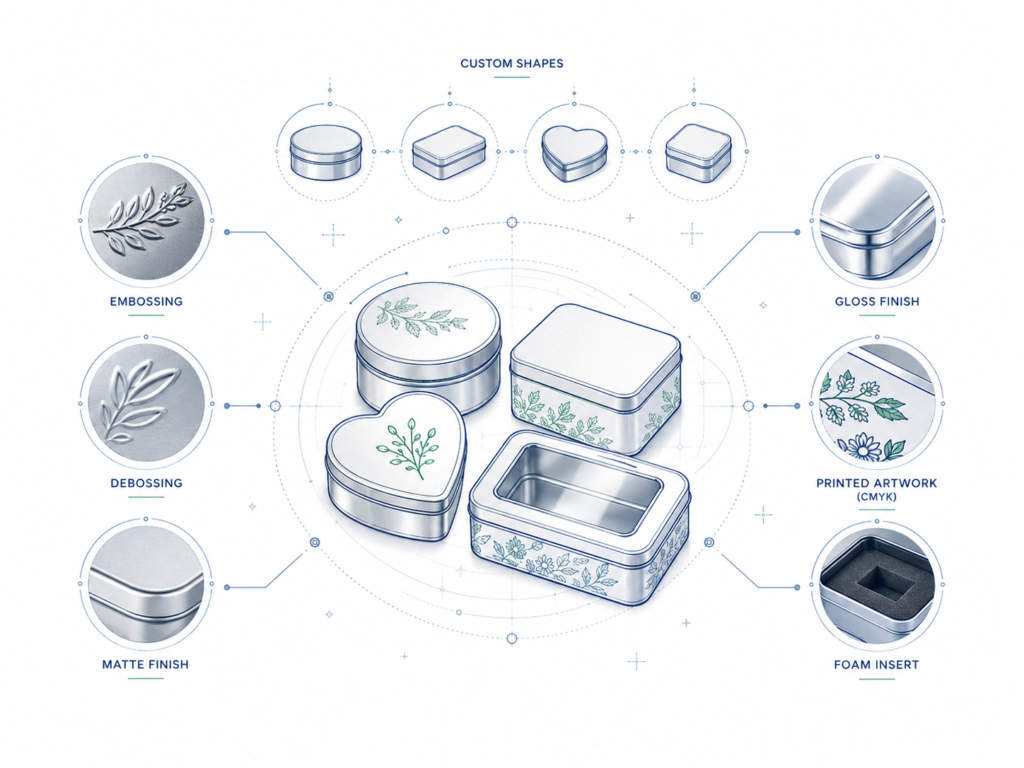
Customization is where metal tin packaging becomes powerful. A brand can adjust size, shape, structure, finish, and internal layout to match the product and the selling story. The table below shows common options and how they affect business outcomes.
| Custom option | Typical choices | Business impact |
|---|---|---|
| Shape | Round, square, rectangular, oval, heart, hexagonal, book-shaped, custom mold | Differentiates the product and improves shelf recognition |
| Size | Mini tins, pocket tins, medium gift tins, large assortments, nested sets | Matches product quantity, retail shelf plan, and shipping carton efficiency |
| Material | Tinplate, aluminum, coated steel | Balances strength, weight, corrosion resistance, appearance, and cost |
| Lid style | Slip lid, plug lid, hinged lid, screw lid, slide lid, window lid, latch lid | Controls usability, sealing perception, gift value, and product access |
| Coating | Food-grade lacquer, BPA-free alternatives, corrosion-resistant coating, protective varnish | Supports product compatibility, durability, and compliance expectations |
| Printing | CMYK offset printing, spot color, metallic ink, white base, inside printing | Builds brand identity and improves retail visibility |
| Surface finish | Glossy, matte, satin, soft-touch, textured, pearl, metallic, brushed effect | Changes perceived value and tactile experience |
| Decoration | Embossing, debossing, spot UV, foil stamping, laser coding, QR code area | Adds premium details, authentication cues, and campaign interaction |
| Insert | PET tray, paperboard insert, EVA foam, molded pulp, dividers, silk lining | Protects product, organizes sets, improves unboxing |
| Window | PET window, cut-out shape, transparent lid area | Shows product visibility while maintaining tin structure |
| Sustainability design | Reusable structure, removable insert, mono-material strategy, clear recycling message | Improves claim credibility and end-of-life handling |
Shape and size
Shape is one of the fastest ways to create recognition. Round tins work well for candles, balms, cookies, and candies. Rectangular tins are efficient for tea, chocolate bars, stationery, tools, and gift sets. Oval tins feel softer and more premium. Heart-shaped tins work for Valentine’s Day, wedding gifts, and confectionery. Custom shapes can create strong shelf impact, but they may require mold investment and longer development time.
Size should be decided by product quantity, shelf space, shipping carton efficiency, and consumer use. Oversized packaging may feel wasteful and increase logistics cost. Undersized packaging may damage products or make the gift feel less valuable. A smart tin design uses enough internal space for protection and presentation without creating unnecessary volume.
Lid and closure design
The closure is one of the most important parts of a tin. It affects opening feel, freshness perception, safety, and cost. A slip lid is simple and common. A plug lid gives a tighter fit and can support tea or coffee packaging. A hinged lid improves convenience and keeps the lid attached. A screw lid is common for balms and cosmetics. A slide lid works well for mints and compact items. A window lid adds product visibility.
Buyers should not choose a lid only by appearance. They should consider how often the consumer will open the tin, whether the product needs moisture protection, whether the lid must stay attached, whether the product is used in travel, and whether the closure needs a tamper-evident feature or inner seal.
Printing and finishing
Printing turns a tin into a brand surface. Most custom tins use offset printing on metal sheets before forming. This allows high-quality graphics, brand colors, patterns, illustrations, and product information. A white base may be used when bright color accuracy is needed. Metallic effects can be created by allowing parts of the metal surface to show through or by using metallic inks.
Finishing controls both appearance and durability. Glossy varnish makes colors bright and retail-friendly. Matte varnish feels modern and premium. Satin finish sits between matte and gloss. Soft-touch coating creates a luxury hand feel. Textured varnish can increase grip and create a tactile impression. Spot UV can highlight logos or design details. Embossing and debossing add physical depth.
For a deeper review of finish choices, Mr. Tin Box provides a detailed guide: Metal Tin Box Finishing Options: Matte, Glossy and More. This is useful for buyers who want to understand why finish selection affects first impression, scratch resistance, fingerprint visibility, compliance considerations, cost, and lead time.
Inserts and internal structure
The inside of the tin often determines whether the package feels premium after opening. Inserts can hold products in place, prevent rattling, separate flavors or colors, and present a clean arrangement. Food tins may use plastic trays, paperboard dividers, or paper liners. Beauty tins may use EVA foam, molded pulp, paperboard trays, or velvet-style inserts. Industrial tins may use precision foam cutouts or compartments.
Insert choice affects cost, sustainability, and assembly time. A removable paperboard insert may support recyclability better than glued mixed-material structures. Molded pulp can support natural and eco-positioned brands. EVA foam can look premium and protect fragile objects, but buyers should consider whether it fits the sustainability message.
Food safety and compliance: practical buyer checklist
Food-grade metal tin packaging should be discussed carefully because food safety is not only about the metal. It involves every surface that may contact food or affect odor, taste, migration, corrosion, and hygiene.
A practical recommendation is to separate two cases. If the food is already sealed in an inner pouch and the tin is a secondary protective package, the tin mainly supports branding, protection, and gift value. If the food touches the tin directly, the coating and contact surfaces become much more important. For products like tea, coffee, cookies, candies, and confectionery, many brands combine a food-grade tin with inner packaging to balance freshness, cost, and presentation.
For buyers serving the United States, the FDA’s guidance on food packaging and food contact substances is a useful starting point. For the EU market, the European Commission’s page on food contact materials legislation explains the framework around safety, inertness, good manufacturing practice, traceability, and compliance documentation.
Sustainability: what metal tins can and cannot claim
Metal tin packaging can support a strong sustainability story, but it should be framed correctly. The strongest claims are usually based on three ideas: recyclability, reuse, and durability.
Recyclability means the material can enter a recycling system where collection and processing infrastructure exists. Steel and aluminum are valuable materials in recycling streams, and steel is magnetically sortable. However, a package’s actual recycling outcome depends on local collection systems, consumer disposal behavior, contamination, attached materials, and whether inserts are removed.
Reuse means the package has a second life before recycling. This is where metal tins are especially strong. A tin that becomes a storage box, desk organizer, gift container, or kitchen tin may deliver more brand impressions and delay disposal. For premium brands, this is often more persuasive than simply saying the package is recyclable.
Durability means the package protects the product and may reduce damage-related waste. If a tin prevents broken cookies, damaged gift sets, scratched cosmetics, or lost small parts, the packaging can reduce hidden waste in the supply chain. This benefit is harder to quantify, but it matters in real operations.
Brands should avoid unsupported green claims. Instead of saying “eco-friendly tin packaging,” use clear language such as “reusable metal tin,” “widely recyclable where facilities exist,” or “designed with a removable paperboard insert.” These claims are easier for buyers, retailers, and regulators to understand.
How to develop a custom metal tin packaging project
A professional custom tin project should follow a structured process. Mr. Tin Box describes its own workflow from consultation and 3D drawing to mold development, printing, stamping, assembly, inspection, and packaging. Buyers can use the same logic to prepare better project information before contacting a supplier.
Step 1: Define the product and market
Start with the product, not the tin. What is being packed? Is it food, cosmetics, gift items, or industrial parts? Will the product touch the tin directly? Is the target market the United States, EU, UK, Australia, Middle East, Japan, or another region? Will the product be sold in retail stores, e-commerce, supermarkets, gift shops, trade shows, or wholesale channels?
These answers affect coating, labeling, closure, insert, durability, and compliance documentation.
Step 2: Define the packaging role
Ask what the tin must accomplish. Is the goal to extend freshness perception, protect fragile products, increase shelf impact, create a gift-ready pack, support reuse, improve unboxing, reduce shipping damage, or organize multiple items? A tin can do several of these things, but one or two priorities should guide the design.
Step 3: Choose structure and size
Decide the shape, dimensions, lid type, material thickness, edge treatment, and insert. If a standard mold can work, it may reduce cost and shorten lead time. If the product needs a unique shape, a custom mold may be worth the investment. For mass-market products, efficient carton packing can be as important as shelf appearance.
Step 4: Design the visual system
Prepare artwork with printing constraints in mind. Metal printing is different from paper printing. Color appearance can change depending on white base, metallic background, varnish, and forming. Important logos, barcodes, QR codes, and small text should be placed away from curved edges, seams, deep embossing, or high-stress forming areas.
Step 5: Confirm finish and decoration
Choose matte, gloss, satin, texture, soft-touch, metallic, spot UV, embossing, debossing, or foil effects based on brand positioning and handling conditions. A luxury skincare tin may benefit from matte or soft-touch finishes. A candy tin may need bright gloss. An industrial kit may need scratch-resistant varnish and clear labeling.
Step 6: Request samples and test them
A real sample is essential. Check lid fit, opening force, edge safety, printing alignment, color, finish, odor, coating, insert fit, barcode scanning, stacking, carton packing, and product compatibility. For food or cosmetics, check whether the sample supports the necessary documentation or testing path.
Step 7: Approve mass-production standards
Before production, define acceptable tolerances. Metal tins may have small variations in color, forming, lid tightness, and surface appearance. A clear approved sample, artwork file, packing method, inspection standard, and defect limit can reduce disputes later.

Cost drivers and lead-time factors
Metal tin packaging cost depends on more than size. The final quotation is shaped by material, tooling, printing, finish, structure, insert, quantity, and inspection requirements.
| Factor | Cost impact | How to control it |
|---|---|---|
| Custom mold | Higher initial investment | Use existing mold if dimensions are flexible |
| Material thickness | Thicker metal increases strength and cost | Match thickness to product weight and protection need |
| Shape complexity | Deep or unusual shapes require more tooling control | Simplify curves and avoid unnecessary forming difficulty |
| Printing colors | More complex artwork may increase setup and QC time | Prepare print-ready artwork and color references |
| Special finish | Soft-touch, texture, metallic, spot UV, and embossing can add cost | Use special effects on key areas instead of every surface |
| Insert | Custom foam or molded trays increase material and assembly cost | Use paperboard or standard tray when possible |
| Quantity | Higher volume usually lowers unit cost | Plan seasonal campaigns and repeat orders together |
| Testing and documentation | May add time and expense | Clarify target market and required standards early |
| Packing method | Stronger export cartons and protection add cost | Balance shipping risk with acceptable damage rate |
The lowest unit price is not always the best total cost. A cheaper tin that dents easily, scratches during shipping, fails compatibility testing, or looks inconsistent on shelf can cost more through returns, delays, and brand damage. A good supplier should help buyers find the right balance between cost, performance, and appearance.
Common mistakes to avoid
The first common mistake is choosing a beautiful shape before understanding the product. A tin that looks good in a rendering may not protect the product, fit the carton efficiently, or work with the required insert.
The second mistake is ignoring the closure. Lid fit affects usability and freshness perception. A lid that is too loose feels cheap. A lid that is too tight frustrates customers. For products used daily, opening feel matters.
The third mistake is treating food-grade packaging as a simple yes-or-no question. Food safety depends on contact surfaces, coating, product chemistry, storage, and target market. The supplier needs enough information to recommend the right structure.
The fourth mistake is using vague sustainability claims. Metal tins can support a strong sustainability message, but the claim should be accurate. Reuse, recyclability, removable inserts, and material-specific recycling data are stronger than broad green language.
The fifth mistake is approving artwork without considering forming. Metal sheets are printed before shaping, and design elements can shift visually around curves, corners, and seams. Keep important text and logos in safe areas.
The sixth mistake is skipping product testing. A sample should be tested with the actual product, insert, shipping method, and storage conditions whenever possible. This is especially important for oils, waxes, fragrances, acidic products, salty foods, and high-value gift sets.
Specification template for requesting a quote
When contacting a custom tin packaging supplier, provide clear information. This saves time and improves quotation accuracy.
| Information to provide | Example |
|---|---|
| Product type | Tea, cookies, lip balm, candle, cosmetic kit, tool set |
| Intended contact | Direct food contact, inner bag only, cosmetic formula contact, no direct contact |
| Target market | United States, EU, UK, Canada, Australia, Japan, global |
| Quantity | 5,000 pcs, 20,000 pcs, 100,000 pcs |
| Size or capacity | 100 g tea, 200 g cookies, 50 ml balm, 6-piece gift set |
| Shape preference | Round, rectangular, square, custom shape, existing mold acceptable |
| Lid style | Slip lid, hinged lid, screw lid, plug lid, window lid |
| Artwork | AI/PDF file, brand color references, Pantone number if available |
| Finish | Matte, glossy, satin, metallic, soft-touch, embossing, spot UV |
| Insert | PET tray, paperboard divider, EVA foam, molded pulp, no insert |
| Packing method | Export carton, individual polybag, paper wrap, anti-scratch protection |
| Compliance needs | FDA-related food contact, EU food contact, LFGB, BPA-free statement, other tests |
| Timeline | Sample deadline, mass-production deadline, shipping deadline |
A complete specification allows the supplier to recommend whether an existing mold can work, whether a custom mold is needed, what coating should be considered, and what cost trade-offs are available.
Why choose Mr. Tin Box for custom metal tin packaging?
Mr. Tin Box is positioned for brands that need custom metal tin packaging with both design value and manufacturing reliability. The website highlights in-house mold development, premium printing and finishing, strict quality control, food-grade material options, fast sampling, and capacity for mass-market orders.
For buyers, this matters because custom tin packaging is not only about buying a container. It is about coordinating structure, surface, compliance expectations, sample approval, production consistency, and export packing. A strong supplier should be able to explain trade-offs clearly instead of simply saying yes to every design idea.
Mr. Tin Box can support projects across multiple industries:
- food and beverage tins for tea, coffee, snacks, candies, chocolate, cookies, and specialty foods
- beauty and personal care tins for balms, soaps, solid perfumes, skincare kits, wellness products, and gift sets
- promotional and holiday tins for seasonal campaigns, corporate gifts, wedding favors, and limited editions
- specialty and industrial tins for tools, electronics accessories, samples, collectibles, and organized kits
If you are still comparing materials, start with the article Custom Metal Packaging: A Complete Guide for Premium Product Brands. If you are selecting a supplier, review Custom Metal Tin Packaging Manufacturer Guide for Global Buyers. If your main concern is shelf life and perceived value, read Why Metal Packaging Boosts Shelf Life and Brand Value.
FAQ
Is metal tin packaging safe for food?
It can be safe for food when the material, coating, production process, and intended use are properly matched. Buyers should confirm whether the food touches the tin directly or remains inside an inner bag. They should also ask about inner lacquer, direct-contact surfaces, documentation, and target-market requirements. For dry foods such as tea, coffee, cookies, candies, and snacks, many brands use a food-grade tin together with an inner pouch for added freshness control.
Is tin packaging the same as aluminum packaging?
No. Tin packaging usually refers to tinplate, which is steel coated with tin. Aluminum packaging uses aluminum. Both are metal packaging materials, but they differ in weight, forming behavior, corrosion resistance, cost, appearance, and recycling systems. The right choice depends on the product and brand goal.
Can metal tins be recycled?
Steel and aluminum are widely recyclable in many markets, but the actual recycling outcome depends on local collection and sorting systems. Steel packaging benefits from magnetic sorting, and European steel packaging reached an 82% real recycling rate in 2023. Brands should use accurate claims such as “recyclable where facilities exist” and design removable inserts when possible.
Do metal tins extend shelf life?
Metal tins can help protect products from light, physical damage, and some environmental stresses, especially when the lid, liner, coating, and inner packaging are designed correctly. For true shelf-stable canned foods, hermetic sealing and validated processing are required. For decorative tins used for tea, cookies, candies, and gifts, an inner bag or seal may be needed for stronger moisture and aroma protection.
What products are best for metal tin packaging?
Metal tin packaging is especially effective for tea, coffee, cookies, biscuits, chocolates, candies, mints, spices, candles, lip balms, solid perfumes, shaving soaps, skincare sets, holiday gifts, promotional kits, collector items, small tools, and specialty components. It works best when the product benefits from protection, premium presentation, reuse, or collectability.
What is the minimum order quantity for custom tins?
MOQ depends on size, mold, printing method, material, finish, and customization level. Existing mold projects usually have more flexible requirements than fully custom shapes. For accurate pricing, buyers should provide product type, dimensions, quantity, artwork, finish, insert, and target market.
How long does a custom tin packaging project take?
Lead time depends on mold availability, sample approval, artwork complexity, finishing process, order quantity, and testing requirements. Existing mold projects are usually faster. Custom mold projects need more time for structure design, tooling, sampling, and adjustment. A realistic timeline should include sample production, approval, mass production, inspection, and shipping.
Can I add embossing, debossing, or spot UV to a tin?
Yes. Embossing, debossing, spot UV, metallic ink, foil effects, texture, matte varnish, gloss varnish, and soft-touch finishes are common premium options. The best choice depends on brand positioning, budget, artwork, and handling conditions.
Can metal tin packaging be used for e-commerce?
Yes, but e-commerce packaging should be designed for parcel handling. A tin may still need a protective sleeve, paper wrap, inner support, or stronger export carton to prevent scratches and dents. The tin itself improves product protection, but the shipping system must also be tested.
Build a better brand experience with metal tin packaging
Metal tin packaging is powerful because it connects product protection, premium design, consumer reuse, and sustainability communication in one format. It can make food feel more giftable, cosmetics feel more premium, promotional products more memorable, and specialty items more organized. It also gives brands a surface for high-quality printing, tactile finishing, embossing, and structural customization.
The best tin packaging projects begin with the product requirement. What must the package protect? What should the customer feel when opening it? What market will it enter? What compliance documents may be needed? How will it be shipped? How will it be reused or recycled?
When those questions are answered clearly, metal tin packaging becomes more than a container. It becomes a brand asset that helps products stand out, survive distribution, and stay in the customer’s memory.
If your brand is developing a new food, beauty, gift, promotional, or specialty product, contact Mr. Tin Box to discuss custom metal tin packaging options, sample development, surface finishing, food-grade requirements, and production planning.