Choosing a custom metal tin packaging manufacturer is no longer a simple sourcing task. For global buyers, the package is part product protection, part brand asset, part compliance document, and part supply-chain decision. A tin box that looks beautiful in a digital mockup can still fail if the coating does not match the product chemistry, if the closure is loose, if the MOQ is unrealistic, or if the artwork is not adapted to metal printing. On the other hand, a well-engineered metal tin package can help a brand improve shelf impact, protect aroma and texture, support refill or reuse programs, and create a premium unboxing experience that customers remember.
This guide is written for brand owners, procurement teams, packaging developers, importers, distributors, and marketing managers who need a practical way to evaluate custom tin box suppliers. It focuses on the real questions buyers ask before placing an order: What material should we use? What coating is needed? How does printing on tinplate work? What is a reasonable lead time? What documents should we request? How do we avoid hidden tooling costs? How do we compare a cheap quotation with a professional quotation?
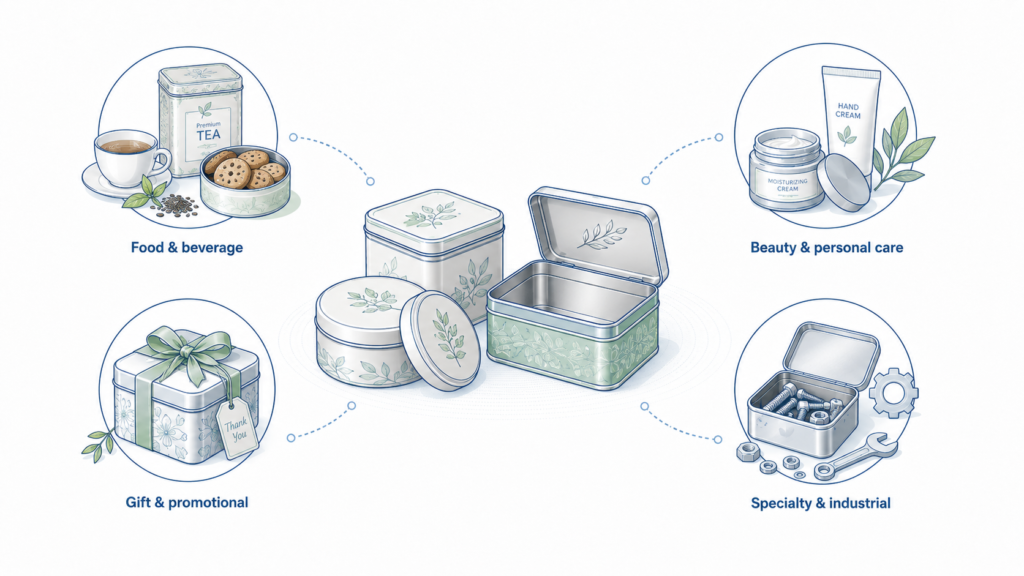
The short answer is that custom metal tin packaging should be specified like an engineered consumer product, not like a generic box. The buyer needs to define the product, the market, the storage environment, the filling method, the decoration target, and the compliance requirements before the manufacturer can recommend the right structure. This is especially true for Food & Beverage Packaging, Beauty & Personal Care Packaging, Gift, Promotional & Holiday Packaging, and Specialty & Industrial Packaging, where the package must work across different sales channels and regulations.
At Mr. Tin Box, the positioning is clear: custom metal tin packaging is not only a container, but a way to combine precision forming, premium appearance, and practical production planning for global buyers. The company’s category pages, such as Food & Beverage Packaging and Beauty & Personal Care Packaging, show how the same manufacturing base can serve very different product categories when the design brief is clear. This article builds on that logic and gives buyers a structured decision guide.
Table of Contents
The market signal: metal packaging is still a serious global category
Metal packaging is sometimes viewed as a traditional format, but market data shows that it remains a large and resilient packaging category. The reasons are practical: metal offers strong barrier performance, high perceived value, durable structure, recyclability, and broad compatibility with food, beauty, gifting, and industrial products. It also fits a market environment where brands need packaging that is both visually premium and operationally reliable.
The global packaging market is enormous. Mordor Intelligence estimated the overall packaging market at USD 1.22 trillion in 2026, with expected growth to USD 1.44 trillion by 2031. Within that wider market, Grand View Research estimated the global metal packaging market at USD 148.13 billion in 2024, projected to reach USD 184.21 billion by 2030. Global Market Insights estimated the metal packaging market at USD 156.7 billion in 2025 and projected it could reach USD 218.9 billion by 2035. These numbers differ because each research firm defines categories and forecast periods differently, but they point to the same conclusion: metal packaging is not a niche option. It is a major packaging format with long-term commercial relevance.
| Market or regulatory signal | Data point | What it means for custom tin buyers | Source |
|---|---|---|---|
| Overall packaging market | USD 1.22 trillion in 2026, projected USD 1.44 trillion by 2031 | Packaging is a strategic cost and brand system, not a minor purchase | Mordor Intelligence |
| Global metal packaging market | USD 148.13 billion in 2024, projected USD 184.21 billion by 2030 | Metal remains a large, investable packaging category | Grand View Research |
| Alternative metal packaging forecast | USD 156.7 billion in 2025, projected USD 218.9 billion by 2035 | Demand is expected to grow steadily across food, beverage, household, and premium applications | Global Market Insights |
| EU packaging policy | Packaging and Packaging Waste Regulation 2025/40 entered into force on 11 February 2025 and generally applies from 12 August 2026 | Exporters to the EU should treat recyclability, labeling, and waste rules as design requirements | European Commission |
| EU recyclability direction | All packaging must be recyclable by 2030 | Design-for-recycling decisions should start at the artwork and structure stage, not after production | European Commission |
| Steel packaging recycling | Steel packaging recycling in Europe reached 84% in 2024 | Tinplate packaging can support circular-economy messaging when designed and collected properly | Tata Steel Packaging |
| Food-contact definition | FDA defines food contact substances to include packaging and packaging components | Food tins require attention to coatings, inks, adhesives, and intended food contact conditions | U.S. FDA |
For a buyer, the most useful takeaway is not just “the market is growing.” The real lesson is that custom metal tin packaging sits at the intersection of premium branding, product protection, and regulatory pressure. A good manufacturer should therefore be able to discuss more than price. The conversation should include material choice, forming limitations, coating systems, sample validation, artwork proofing, production tolerance, documentation, logistics, and reordering strategy.
What custom metal tin packaging actually includes
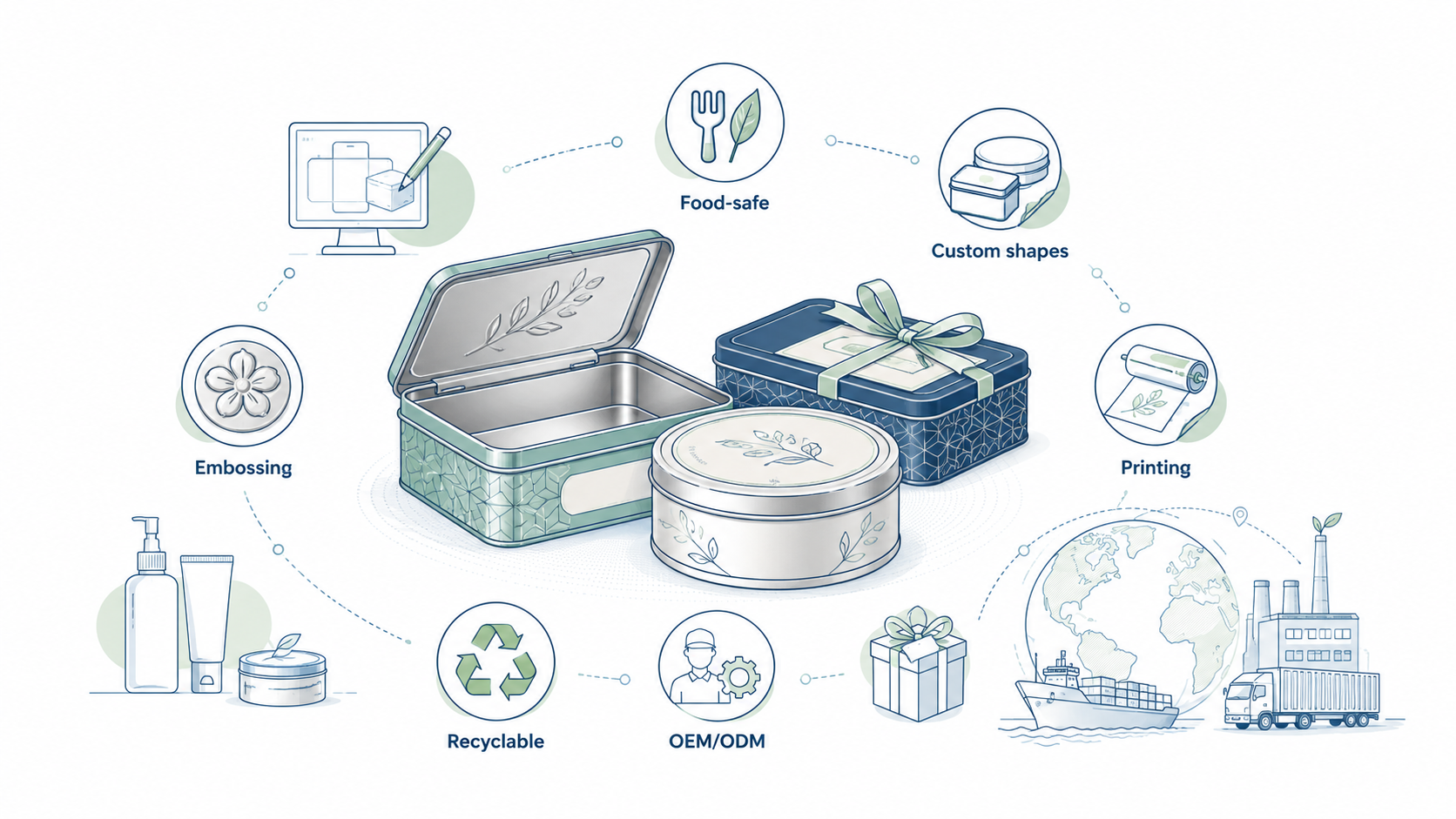
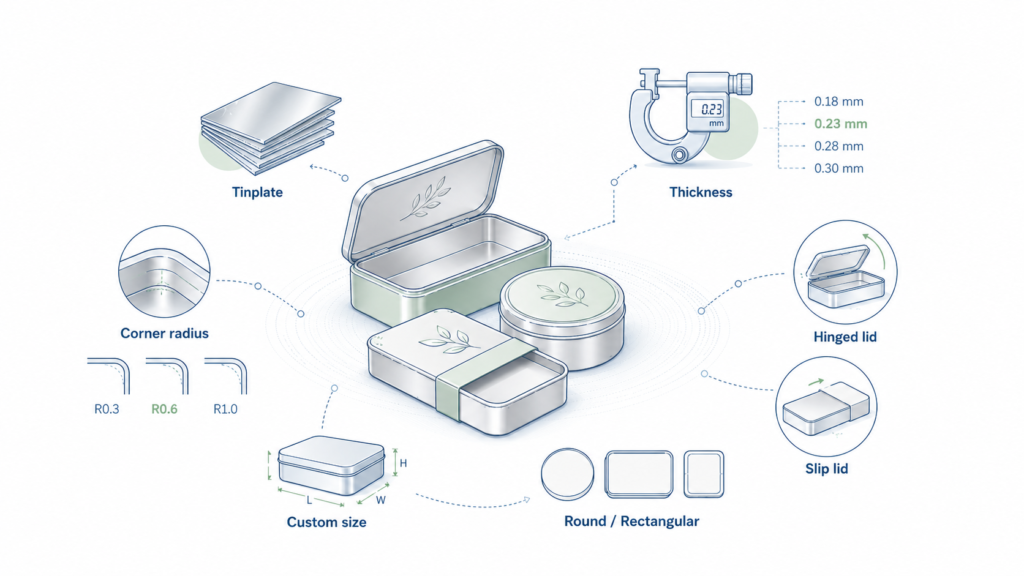
Custom metal tin packaging usually starts with tinplate, which is thin steel coated with tin for corrosion resistance and printability. Depending on the product and market, aluminum or other metal structures may also be considered, but tinplate is common for rigid tin boxes because it balances strength, formability, print performance, and cost. The package may be a simple rectangular tin, a round tea tin, a hinged cosmetic box, a windowed candy tin, a sliding mint tin, a nested gift set, or a shaped promotional container.
A complete custom tin package is more than the outer shell. It can include a body, lid, hinge, curled edge, rolled rim, printed sheet, inner lacquer, outer varnish, embossing, debossing, window, insert tray, divider, foam, paperboard sleeve, barcode label, tamper evidence, shrink wrap, shipping carton, and export pallet plan. Each layer affects cost and performance. For example, a luxury cookie tin may need food-contact coating, a snug closure, internal dividers, anti-scratch finish, and retail display cartons. A cosmetic gift tin may prioritize soft-touch varnish, embossing, and precise color matching. An industrial sample tin may prioritize durability, chemical compatibility, and simple labeling.
This is why buyers should avoid sending only a picture and asking for “best price.” A professional supplier needs a packaging brief. That brief should include the product type, approximate dimensions, fill weight, whether direct food contact is expected, target countries, sales channel, desired quantity, expected launch date, brand style, and any required tests. If the buyer is not sure, the manufacturer should help translate the product requirements into a workable tin structure.
Mr. Tin Box’s own content around MOQ and lead time planning makes an important point: MOQ and timing are not random barriers. They come from sheet utilization, printing setup, tooling, sampling, forming, assembly, inspection, and shipping. The same logic applies to nearly every technical decision in custom tin manufacturing. Good planning reduces surprises.
Main product categories and buyer priorities
Different product categories use metal tin packaging for different reasons. Some care most about barrier protection. Some care about premium display. Some care about collectibility. Some need rugged storage or safe transport. The buyer should define the category priority before choosing shape, finish, and accessories.
| Product category | Common products | Main buyer priority | Typical tin packaging direction | Useful Mr. Tin Box reference |
|---|---|---|---|---|
| Food & beverage | Tea, coffee, cookies, chocolates, candies, spices, snacks | Freshness, food-contact safety, aroma protection, shelf stability | Food-grade lining, tight lid fit, easy opening, good moisture and light barrier | Food & Beverage Packaging |
| Beauty & personal care | Skincare sets, fragrance gifts, soap, balm, hair care, wellness items | Premium appearance, product organization, gift value, surface durability | Soft-touch, matte, metallic effects, embossing, insert trays | Beauty & Personal Care Packaging |
| Gift and seasonal campaigns | Holiday gifts, promotional tins, limited editions, corporate gifts | Shelf impact, collectibility, campaign timing, brand memory | Custom shapes, festive printing, window designs, reusable storage concept | Design Ideas |
| Premium consumer goods | Lifestyle products, accessories, retail bundles, collector editions | Brand value, unboxing, repeat purchase, perceived quality | Hinged tins, specialty finishes, internal organization, consistent color | Premium Trends |
| Specialty and industrial | Small components, samples, tools, technical kits, protective storage | Strength, organization, durability, labeling, protection | Thicker structure, simple printing, foam or divider inserts, robust closure | Contact Mr. Tin Box |
The same tin box cannot be optimal for every category. A food tin may need coating and migration considerations that are irrelevant to a promotional stationery tin. A beauty tin may need fingerprint resistance and a luxury surface, while an industrial tin may need stacking strength and legible labeling. The manufacturer’s value is not simply in producing metal boxes. The value is in matching the structure to the product’s real use case.
Material selection: tinplate, coating, and structure
Tinplate is widely used because it combines the strength of steel with the corrosion resistance and surface quality provided by tin coating. It can be printed before forming, stamped into many shapes, and finished with varnishes that control gloss, protection, and tactile feel. For many dry foods, confectionery, tea, coffee, cosmetics, and gift products, tinplate is a practical starting point.
However, buyers should not treat “tinplate” as a single universal material. Thickness, temper, tin coating weight, surface finish, inner lacquer, outer varnish, and forming method all matter. A deep-drawn round tin may require different forming behavior from a shallow rectangular hinged box. A food-contact interior may require a different lacquer from a decorative gift tin. A high-humidity product may need more careful corrosion evaluation than a dry candy tin.
| Specification item | What buyers should define | Why it matters | Practical question to ask the manufacturer |
|---|---|---|---|
| Base metal | Tinplate, aluminum, or other metal format | Affects strength, forming, cost, recyclability, and appearance | Which material is recommended for our product and target market? |
| Thickness | Approximate gauge or required rigidity | Affects dent resistance, forming limits, weight, and cost | Can you recommend thickness based on box size and distribution channel? |
| Temper and formability | Bending, drawing, stamping, edge curling | Affects whether the design can be produced without cracking or distortion | Is this shape suitable for stamping or deep drawing? |
| Inner coating | Food-grade lacquer, corrosion-resistant lacquer, or no direct-contact coating | Affects food safety, corrosion, odor, and product compatibility | Is direct contact expected, and which coating system is suitable? |
| Outer coating | Gloss, matte, satin, soft-touch, textured, protective varnish | Affects brand feel, scratch resistance, fingerprints, and retail appearance | Which finish gives the best balance of premium feel and durability? |
| Closure system | Slip lid, hinged lid, rolled edge, screw top, insert lid, plug lid | Affects freshness, user experience, safety, and shipping performance | How tight should the closure be, and do we need a gasket or inner seal? |
| Insert system | PET tray, paperboard insert, EVA foam, pulp tray, divider | Affects product protection, presentation, and sustainability message | Is the insert necessary for protection, or mainly for display? |
Buyers who want a premium look should also read the Mr. Tin Box guide to metal tin box finishing options. Finishing is not just decoration. It can affect scratch resistance, fingerprints, gloss consistency, surface feel, and the way colors appear after metal forming. A matte black cosmetic tin, a glossy candy tin, and a brushed-metal tea tin may all use metal, but their production controls are different.
Food-contact and compliance considerations
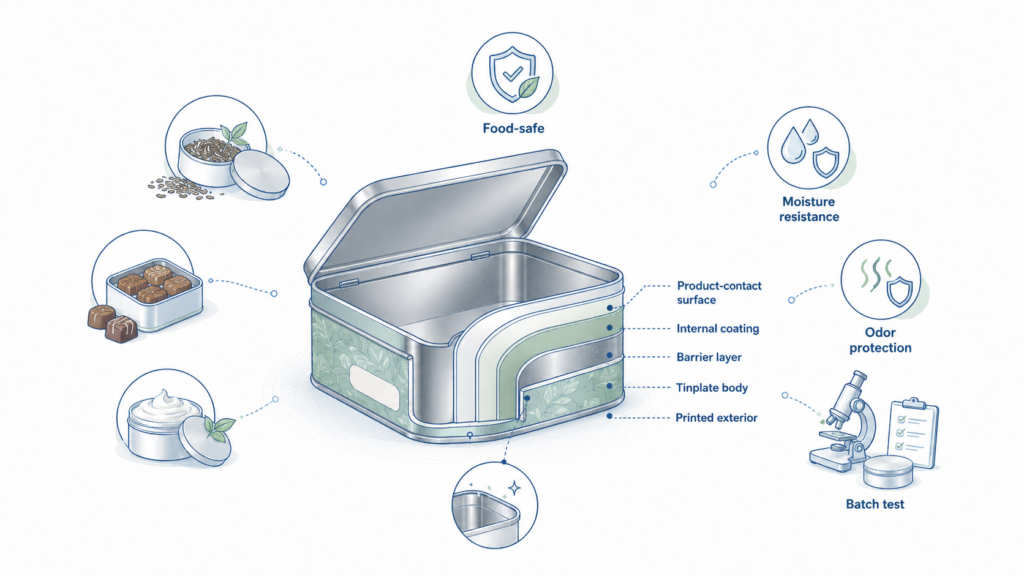
Food-grade custom metal tin packaging requires a more disciplined brief than non-food packaging. The phrase “food-grade” should never be treated as a universal label. In real sourcing, food-contact suitability depends on the product type, contact area, contact time, temperature, fat content, acidity, moisture, coating system, inks, adhesives, and target market. A tin used as an outer gift box for individually wrapped chocolates is different from a tin where cookies directly touch the interior surface. A dry tea tin is different from an oily snack tin. A spice tin is different from a wet or acidic food container.
The U.S. FDA explains that a food contact substance includes packaging and its components, including substances applied to packaging surfaces such as adhesives, colorants, and antioxidants. The FDA also maintains an inventory of substances authorized in Title 21 of the Code of Federal Regulations for uses in contact with food. For EU markets, Regulation (EC) No 1935/2004 and related good manufacturing practice expectations are often part of the broader food-contact discussion. Because requirements vary by product and destination, buyers should treat food-contact compliance as a project-specific documentation topic, not a generic claim.
A practical buyer should ask the manufacturer for the intended coating system, whether the coating is suitable for the product type, what declarations or test reports can be provided, and whether additional migration testing is needed. For direct food contact, testing should be planned early because it can affect both cost and launch timing. The Mr. Tin Box content around food and beverage packaging also emphasizes freshness protection, structural durability, and food-grade safety, which are the right starting points for buyer conversations.
| Food-contact question | Why it matters | Typical documentation or action |
|---|---|---|
| Will the product directly touch the tin? | Direct contact creates higher coating and migration responsibility | Confirm inner lacquer and request relevant food-contact documents |
| Is the food dry, oily, acidic, aromatic, or high-moisture? | Product chemistry can affect corrosion, odor, and coating performance | Share formulation category and storage conditions with the supplier |
| What is the target market? | U.S., EU, UK, and other markets may require different documentation | Ask for market-specific compliance support and test planning |
| What is the expected contact time and temperature? | Long storage or heat exposure can change migration risk | Define shelf life, filling temperature, and storage conditions |
| Are inks or coatings near contact surfaces? | Printing layers and coatings may be part of the food-contact assessment | Confirm layer structure and production process |
| Are there sensitive consumers or children’s products? | Extra safety expectations may apply | Plan additional testing and labeling review if needed |
This article is not legal advice, but it gives buyers a practical sourcing rule: specify food-contact conditions before confirming materials. A professional manufacturer should welcome this discussion because it prevents wrong assumptions and protects both parties.
Barrier performance and shelf-life value
One of the strongest commercial arguments for metal packaging is barrier performance. Many products lose quality because of oxygen, moisture, light, aroma loss, physical damage, or contamination risk. Metal packaging can help control several of these variables at once. It is naturally opaque, so it blocks light. It is rigid, so it protects against crushing. With the right structure and closure, it can improve protection against moisture and oxygen compared with many simple paperboard or plastic formats.
For food and beverage products such as tea, coffee, chocolates, cookies, candies, and spices, this matters because aroma and texture are part of the product promise. A premium coffee brand does not only sell beans; it sells freshness. A tea brand does not only sell leaves; it sells aroma. A chocolate brand does not only sell sweetness; it sells appearance, snap, and gift value. A tin package can help protect those qualities during warehousing, retail display, e-commerce delivery, and home storage.
The Mr. Tin Box article on why metal packaging boosts shelf life and brand value explains this in buyer-friendly language: metal packaging blocks light, moisture, and oxygen when it is designed and sealed correctly, while also communicating a premium feeling before the customer reads a word. That dual benefit is important. Packaging ROI does not come only from reduced damage. It can also come from higher perceived value, stronger gifting appeal, and better repeat-use behavior.
The key phrase is “when designed correctly.” A loose lid, weak hinge, poor coating, or unsuitable insert can reduce the advantage of metal. Buyers should therefore request functional samples and test them with real products. Shake the tin. Open and close it repeatedly. Place it in the shipping carton. Check whether powder leaks, cookies rattle, cosmetics scratch, or inserts deform. The earlier these issues are found, the cheaper they are to solve.
Branding value: why metal often feels premium
Metal packaging has a physical presence that is difficult to imitate. It feels cool to the touch, sounds solid when closed, holds crisp edges, and can be shaped into collectible objects. This is why brands use tins for gift sets, holiday campaigns, limited editions, tea collections, chocolate assortments, skincare kits, fragrance samplers, and promotional programs. The tin is not only discarded packaging. It can become storage, decoration, or a keepsake.
For global buyers, that reuse potential matters because it extends brand exposure. A paper carton may be thrown away immediately. A well-designed metal tin may stay on a desk, kitchen shelf, vanity table, or retail display long after the original product is consumed. This creates repeated impressions without additional advertising spend. It also helps premium brands justify higher packaging investment when the tin supports the product story.
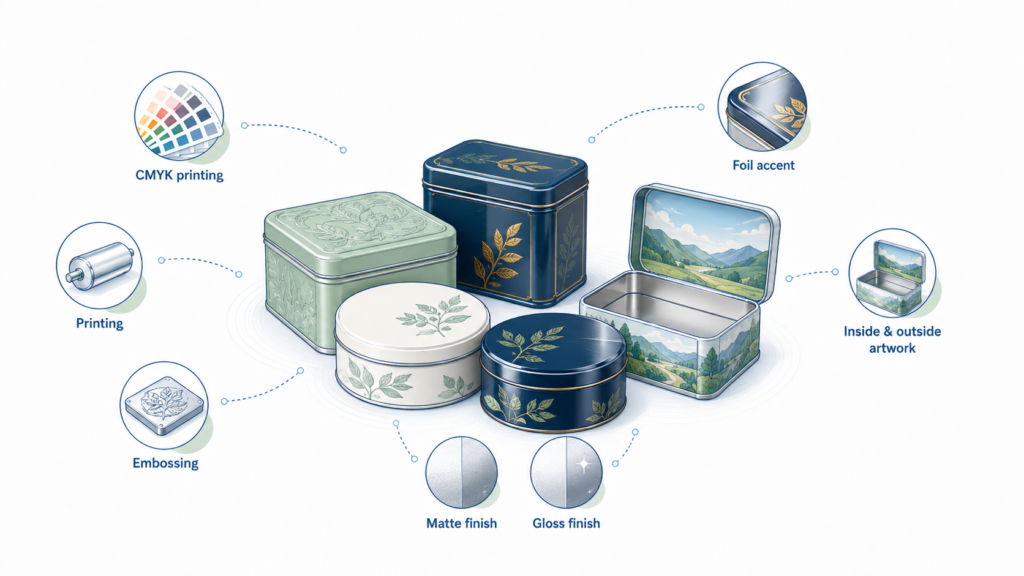
Design choices should be intentional. A bright glossy tin may work for candy and children’s gifts. A satin or soft-touch finish may suit skincare. A brushed metallic effect may suit tea, coffee, or wellness products. Embossing can make a logo tactile. Debossing can create a subtle luxury effect. Spot UV can highlight a pattern. A window can show the product, but it may reduce light protection and recyclability simplicity. A shaped tin can create shelf impact, but it may increase tooling cost and reduce carton efficiency.
| Decoration option | Best use | Strength | Risk if overused |
|---|---|---|---|
| CMYK printing | Full-color brand graphics, product images, seasonal patterns | Strong visual storytelling | Color may shift if artwork is not adapted for metal printing |
| Spot color printing | Brand color consistency, premium minimal design | Cleaner identity control | May increase setup complexity |
| Matte varnish | Beauty, tea, wellness, premium food | Elegant, modern, lower glare | Can show scuffs depending on formulation |
| Gloss varnish | Candy, bright retail, promotional tins | Strong color pop and shelf visibility | May look less premium for luxury minimal brands |
| Soft-touch finish | Cosmetics, gift sets, premium lifestyle products | Tactile luxury feel | Can require careful scratch and fingerprint testing |
| Embossing | Logos, patterns, collector editions | Memorable touch and depth | Tooling cost and distortion risk if artwork is too detailed |
| Debossing | Subtle luxury branding | Refined and understated | May be less visible on complex graphics |
| Window | Product visibility for candy, tea bags, gifts | Builds trust by showing contents | Can reduce barrier performance and complicate recycling |
The Mr. Tin Box guide to creative custom metal tin packaging design ideas is useful for brainstorming, but buyers should always connect design ideas back to function. The best tin is not the one with the most effects. It is the one where structure, finish, cost, and brand message work together.
Manufacturing workflow from concept to mass production
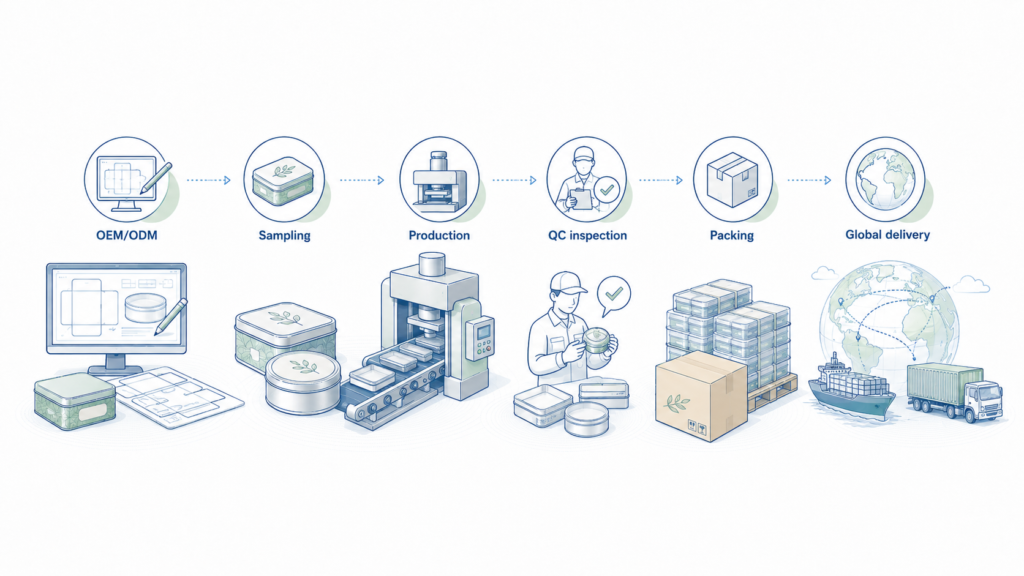
A custom tin box project usually follows a predictable workflow. The exact timing depends on project complexity, sample rounds, tooling, quantity, testing, and shipping method, but buyers can use the following structure to plan a launch calendar. The most common mistake is to count only “production time” and ignore design confirmation, sampling, testing, artwork proofing, inspection, and logistics.
| Stage | What happens | Buyer input needed | Risk if rushed |
|---|---|---|---|
| Requirement brief | Define product, size, target market, quantity, launch date, compliance needs | Product samples, dimensions, target price, sales channel | Supplier quotes the wrong structure or misses compliance needs |
| Concept and structure proposal | Manufacturer recommends shape, material, closure, insert, and finish | Feedback on brand style and user experience | Design looks good but cannot be manufactured efficiently |
| Tooling evaluation | Existing mold or new tooling is selected | Confirmation of dimensions and shape | Hidden tooling cost appears later |
| Prototype or white sample | Physical sample validates size, fit, closure, and structure | Real product for fit testing | Mass production starts with untested assumptions |
| Artwork adaptation | Design is prepared for metal printing and forming | AI/PDF artwork, Pantone references, logo files | Color mismatch, distortion, barcode problems |
| Pre-production sample | Printed sample confirms visual and functional performance | Final approval and comments | Buyer approves digital mockup but dislikes physical result |
| Mass production | Printing, coating, cutting, stamping, forming, assembly, packing | Purchase order, deposit, approved sample, shipping plan | Delays due to artwork or material changes |
| Quality inspection | Dimensions, appearance, fit, print, coating, packing are checked | Acceptance criteria and inspection level | Disputes because “acceptable quality” was not defined |
| Shipping and delivery | Cartons, pallets, documents, freight method | Consignee details, incoterms, customs needs | Launch delay due to logistics planning gap |
A practical way to reduce risk is to separate the approval process into three gates: structure approval, artwork approval, and production approval. Structure approval confirms that the tin fits the product and protects it. Artwork approval confirms that the graphics, color, barcode, and legal text are correct. Production approval confirms that the sample represents the final product. Skipping one of these gates often creates expensive problems.
MOQ, lead time, and order planning
MOQ is one of the first questions buyers ask, but it is often misunderstood. MOQ is not just a sales rule. It is tied to production economics. Tinplate sheets must be printed and coated efficiently. Tools must be set up. Machines must be adjusted. Workers must assemble and pack. If the quantity is too small, the setup cost per unit becomes too high. This is why custom shapes, special finishes, and new tooling usually require higher MOQs than standard tins.
Lead time is also more than machine time. A buyer may hear “production takes 30 days” and assume the goods can arrive in 30 days. In reality, the total project timeline may include design discussions, quotation, sample making, sample shipping, feedback, tooling modification, artwork proofing, printing, forming, inspection, export packing, sea freight, customs, and last-mile delivery. For seasonal campaigns, these steps must be planned backward from the in-store or launch date.
Mr. Tin Box’s MOQ and lead time planning guide is especially relevant for buyers because it frames MOQ and lead time as strategic planning tools. A buyer should not simply ask for the lowest MOQ. The better question is: what order quantity gives the best balance of unit cost, cash flow, warehouse space, and reorder risk?
| Project type | Typical planning character | Cost behavior | Buyer strategy |
|---|---|---|---|
| Standard tin with custom printing | Faster because existing mold may be available | Lower tooling cost, better for first orders | Use for market testing and faster launches |
| Standard tin with premium finish | Moderate complexity | Finish may add cost and approval steps | Request physical finish samples early |
| Custom shape with new tooling | Longer because tooling and validation are required | Higher upfront tooling and MOQ pressure | Use when shape is central to brand differentiation |
| Food-contact direct-use tin | Requires coating review and possible testing | Compliance work can add time and cost | Define product chemistry and destination market early |
| Seasonal gift tin | Deadline-driven | Air freight may be needed if planning is late | Lock design calendar and production slot early |
| Multi-SKU tin series | More artwork and inventory complexity | Shared structure can reduce tooling cost | Use common mold with different printed designs |
For global buyers, incoterms and freight method also matter. A low ex-factory unit price may not be the best total landed cost if cartons are inefficient, pallets are poorly planned, or the tin shape wastes container space. Ask for packing details, carton dimensions, gross weight, units per carton, and estimated container loading. These numbers help procurement compare quotations on a landed-cost basis.
Quality control: what global buyers should inspect
Quality control for custom metal tin packaging should cover appearance, dimensions, function, safety, and packing. A shiny tin with poor lid fit is not acceptable. A structurally good tin with color mismatch may fail brand review. A food tin with unclear coating documentation may create compliance risk. A strong tin packed in weak cartons may arrive dented.
Buyers should define acceptance criteria before mass production. This does not need to be complicated, but it should be specific. For example, define critical defects such as sharp edges, rust, contamination, wrong artwork, broken hinge, or severe deformation. Define major defects such as poor lid fit, visible scratches, color out of tolerance, dents, printing misregistration, or barcode failure. Define minor defects such as tiny surface marks within an agreed limit. If the order is large, the buyer may use a third-party inspection company or an agreed AQL plan.
| Inspection area | What to check | Why it matters |
|---|---|---|
| Dimensions | Length, width, height, lid fit, hinge alignment, insert fit | Ensures product compatibility and carton efficiency |
| Surface appearance | Scratches, dents, stains, rust, coating bubbles, fingerprints | Protects premium brand perception |
| Printing | Color, registration, text, barcode, legal marks, orientation | Prevents retail and compliance problems |
| Edge safety | Rolled edges, sharp burrs, corners, seams | Protects users and reduces complaint risk |
| Closure performance | Open/close force, looseness, noise, leakage, lid retention | Affects freshness, user experience, and shipping stability |
| Coating and odor | Inner lacquer coverage, odor, visible contamination | Important for food, beauty, and sensitive products |
| Drop and vibration resistance | Carton packing, internal movement, corner damage | Reduces freight damage and e-commerce failure |
| Packing | Carton strength, labels, pallet plan, moisture protection | Prevents damage before the goods reach the buyer |
The buyer should also keep a signed approval sample. This sample becomes the reference for mass production and dispute resolution. Digital renderings are useful for discussion, but they cannot replace a physical approved sample because metal printing, varnish, embossing, and closure feel must be judged in real life.
Sustainability and circular packaging expectations
Sustainability is now part of packaging procurement, not just marketing. In the EU, the Packaging and Packaging Waste Regulation 2025/40 entered into force in February 2025 and generally applies from August 2026. The European Commission also states that all packaging must be recyclable by 2030. This does not mean every packaging format is automatically compliant in every market, but it does mean buyers should discuss recyclability, material separation, labeling, and packaging minimization earlier in the design process.
Metal packaging has a strong sustainability story when it is designed responsibly and collected through recycling systems. Steel is magnetically separable, which supports recovery in many waste-management systems. Worldsteel states that the global steel industry has recycled over 25 billion tonnes of steel since 1900. Tata Steel Packaging reports that steel packaging in Europe reached an 84% recycling rate in 2024. These are strong signals for buyers who want packaging aligned with circular-economy goals.
However, buyers should avoid simplistic claims. A heavy tin with unnecessary inserts, difficult-to-separate mixed materials, oversized secondary packaging, or non-recyclable windows may weaken the sustainability case. The right approach is to design for durability, recyclability, reuse, and efficient shipping. A reusable gift tin can be a strong choice when the customer actually keeps it. A refillable concept can be even stronger when the brand has a practical refill system. A simple recyclable tin may be better than a complex multi-material package that looks sustainable but is difficult to process.
| Sustainability design choice | Better practice | Watch-out |
|---|---|---|
| Reusable tin format | Design the tin so consumers can store tea, sweets, accessories, or refills | Reuse claims are weak if the tin is inconvenient or poorly made |
| Recyclable metal body | Keep the main structure metal and avoid unnecessary mixed materials | Windows, magnets, foam, and labels may complicate sorting |
| Minimal insert design | Use only the insert needed for product protection and presentation | Overbuilt inserts increase cost and waste |
| Efficient carton packing | Optimize tin shape and carton layout for container loading | Unusual shapes can increase freight emissions and landed cost |
| Clear disposal labeling | Provide market-appropriate recycling or disposal guidance | Labeling rules differ by country and should be checked |
| Durable finish | Reduce scuffing and damage so fewer units are rejected | Some specialty finishes may require extra testing |
Mr. Tin Box’s sustainability-related content can be supported by external sources such as the European Commission packaging waste overview, Worldsteel circular economy data, and Tata Steel packaging recycling data. For SEO and trust, these links are useful because they show that the sustainability discussion is grounded in recognized industry and regulatory sources.
Cost drivers: why quotations vary so much
Two custom tin quotations can look very different even for similar box sizes. The reason is that cost is driven by many variables, not only material weight. Tooling, sheet layout, printing colors, coating, finish, embossing, insert design, labor, defect rate, packaging method, testing, inspection, and shipping all influence the final price. Buyers should ask suppliers to explain the cost logic instead of only comparing the bottom-line unit price.
The lowest quotation may be attractive, but it can hide risk. A supplier may use thinner material, simplified coating, loose tolerances, weak cartons, or fewer inspection steps. That may be acceptable for a low-risk promotional item, but not for premium food, cosmetics, or export retail. A professional supplier should be able to provide alternatives: standard mold versus custom mold, matte versus soft-touch, paper insert versus molded tray, sea freight versus air freight, and different quantity breaks.
| Cost driver | How it affects price | How buyers can control it |
|---|---|---|
| New tooling | Adds upfront cost and time | Use existing mold when speed or budget matters |
| Tinplate thickness | More material increases cost but improves rigidity | Match thickness to box size and distribution channel |
| Printing colors | More colors and tighter matching may increase setup complexity | Provide clear artwork and Pantone references early |
| Specialty finish | Soft-touch, texture, metallic effects, spot UV, embossing add value and cost | Use premium effects where they support brand value |
| Insert system | Foam, PET, paperboard, pulp, or divider adds material and assembly cost | Choose insert based on protection need, not decoration alone |
| Food-contact testing | Adds time and documentation cost | Define target market and product contact conditions early |
| Packing method | Better cartons, dividers, pallets, and moisture control cost more | Compare landed damage risk, not only carton cost |
| Order quantity | Higher quantity can reduce unit cost through setup efficiency | Request price breaks and calculate inventory carrying cost |
| Freight method | Air is faster but expensive; sea is slower but efficient | Plan early to avoid emergency air freight |
A strong buying process compares total value, not just unit price. A tin that costs a few cents more but reduces damage, improves shelf appearance, and avoids compliance issues may be the cheaper option in the real world. Conversely, an over-engineered tin may waste budget if the product does not need premium finishes or complex structure. The best manufacturer helps the buyer find the right specification level.
How to evaluate a custom metal tin packaging manufacturer
A reliable manufacturer should be evaluated across capability, engineering support, quality systems, communication, export experience, and category understanding. Many suppliers can make a basic tin. Fewer can guide an international buyer through material selection, artwork adaptation, food-contact questions, sampling, inspection, and logistics with clear communication.
Start with the manufacturer’s product range. Do they produce the type of tin you need: rectangular, round, hinged, sliding, deep-drawn, windowed, or shaped? Do they have existing molds that match your size? Can they produce the finish you want? Do they understand your category? A supplier that regularly works with food and beverage packaging will ask different questions than a supplier focused only on promotional tins.
Next, evaluate sample quality. Samples reveal manufacturing discipline. Look at edges, corners, lid fit, hinge movement, print clarity, varnish consistency, odor, insert fit, and carton packing. Open and close the tin multiple times. Place the real product inside. Photograph it under retail lighting. Test whether the barcode scans after forming. If the tin will be sold online, test how it looks in e-commerce photos and how it survives parcel delivery.
| Supplier evaluation area | Strong signal | Warning sign |
|---|---|---|
| Technical questioning | Supplier asks about product, contact conditions, target market, quantity, deadline | Supplier quotes only from a photo without asking details |
| Sample quality | Clean edges, stable closure, consistent finish, good packing | Dents, sharp edges, odor, loose lid, poor color control |
| Artwork support | Explains print distortion, metal color effect, proofing, barcode checks | Treats tin printing like paper printing with no adjustment |
| Compliance awareness | Discusses food-contact coating, documents, testing, market needs | Uses “food-grade” as a vague universal claim |
| Production planning | Provides clear timeline, MOQ logic, tooling plan, inspection steps | Gives unrealistic lead time with no workflow detail |
| Communication | Fast, specific, written answers with photos or drawings | Vague replies, unclear responsibility, changing terms |
| Export readiness | Understands incoterms, cartons, pallets, documents, logistics | No clear packing data or export documentation support |
| Reorder support | Keeps tooling, artwork, and sample references for repeat production | No system for repeat color or structure consistency |
Buyers should also consider whether the supplier can support future product lines. If a brand plans to launch multiple SKUs, seasonal editions, or regional versions, it is useful to build a common tin platform. One mold can support several printed designs. A shared insert concept can reduce development time. A consistent finish family can make the product line look unified. This type of planning turns a manufacturer into a packaging partner.
Creating a professional RFQ brief
A good RFQ brief saves time and improves quotation accuracy. It also helps buyers compare suppliers fairly. Without a clear brief, each supplier may quote a different material, thickness, finish, packing method, or lead time, making comparison meaningless. The goal is not to know every technical detail in advance. The goal is to provide enough information for the manufacturer to recommend the right solution.
A complete RFQ should include product category, product dimensions, required tin size, target quantity, target market, direct-contact status, desired shape, closure preference, finish preference, artwork status, insert requirement, launch date, shipping destination, and any testing needs. If the buyer has a target price, it can be shared as a range, but it should not replace technical discussion.
| RFQ item | Example buyer input | Why it helps |
|---|---|---|
| Product type | Premium loose-leaf tea, 100 g per tin | Helps determine barrier and aroma protection needs |
| Contact status | Tea will be packed in an inner bag; tin is secondary packaging | Changes food-contact risk and coating requirements |
| Target market | United States and EU | Guides compliance and labeling discussion |
| Desired size | Approx. 95 mm diameter x 150 mm height | Allows mold search and carton estimation |
| Quantity | First order 10,000 units, possible reorder 30,000 units | Helps MOQ and price-break planning |
| Finish | Matte dark green, embossed logo, gold spot color | Helps print and tooling evaluation |
| Insert | No insert required | Reduces cost and simplifies sustainability story |
| Deadline | Goods needed in warehouse by 15 October | Allows backward planning for sampling and shipping |
| Shipping destination | Los Angeles warehouse | Helps estimate freight and packing plan |
| Documents | Food-contact declaration for secondary food packaging | Prevents late compliance questions |
For buyers who are unsure about the structure, it is better to ask for two or three options. For example: standard mold option for faster launch, custom mold option for stronger brand differentiation, and premium finish option for high-end retail. This allows decision-makers to compare cost, timeline, and brand impact instead of relying on one quotation.
Design-for-manufacturing: common mistakes to avoid
Many custom tin problems begin at the design stage. The first mistake is choosing an unusual shape before defining the product requirements. A custom shape may look attractive, but it can create tooling cost, reduce carton efficiency, complicate forming, or weaken closure performance. Shape should support the product and brand, not create unnecessary manufacturing risk.
The second mistake is overdecorating the tin. Too many effects can increase cost and defect risk without improving sales. A clean matte finish with one well-placed embossed logo may communicate premium value better than a crowded design with metallic ink, spot UV, embossing, texture, and a window. Premium packaging is not always complex packaging.
The third mistake is ignoring the insert. Many premium tins fail because the outside looks good but the inside feels cheap, loose, noisy, or difficult to use. If the product rattles, scratches, or looks poorly organized, the unboxing experience weakens. Inserts should be sampled with real products, not only rendered in a mockup.
The fourth mistake is approving color only on a screen. Metal printing is affected by substrate, coating, varnish, forming, and lighting. Buyers should review physical samples, especially for brand colors, skin tones, luxury dark colors, metallic effects, and barcodes. Color expectations should be documented before mass production.
The fifth mistake is underestimating logistics. A beautiful tin that ships inefficiently can become expensive at scale. Carton size, nesting ability, pallet loading, container utilization, and protection against dents all affect the landed cost. This is especially important for global buyers importing by sea.
Category-specific recommendations
For food and beverage brands, start with product sensitivity. Tea, coffee, chocolate, cookies, candy, spices, and specialty foods have different risks. Define whether the tin is primary packaging or secondary packaging. If food directly touches the tin, discuss inner lacquer and compliance documents early. For aroma-sensitive products, prioritize closure fit and barrier protection. For fragile foods, test inserts and shipping cartons.
For beauty and personal care brands, prioritize surface feel, color consistency, and product organization. Skincare and fragrance gift sets often need inserts that hold products securely and present them beautifully. Soft-touch, matte, satin, metallic, and embossed finishes can all work, but they should be tested for scratch resistance and fingerprints. The package should look premium after shipping, not only in sample photos.
For gift and promotional campaigns, prioritize timing and shelf impact. Seasonal tins must arrive before the campaign window. A late holiday tin loses much of its value. Use existing molds when the timeline is tight. Use custom shapes when the campaign has enough lead time and the shape supports the story. Think about whether the customer will reuse the tin; if yes, design it as a desirable object, not just a temporary container.
For specialty and industrial packaging, prioritize durability and clear labeling. The package may need to protect parts, samples, or kits during handling. Decoration can be simpler, but structure and organization matter. Foam, dividers, or paperboard inserts may be useful if they prevent movement and damage. Label areas should be clear for SKUs, barcodes, warnings, or technical information.
Internal linking strategy for publishing this article on Mr. Tin Box
Because this article is intended for SEO and marketing, internal links should guide readers to relevant service and knowledge pages. The links should not all point to the homepage. They should support user intent at different stages of the buying journey.
When discussing food and beverage use cases, link to Food & Beverage Packaging. When discussing cosmetics and personal care, link to Beauty & Personal Care Packaging. When discussing finishes, link to Metal Tin Box Finishing Options. When discussing order planning, link to MOQ and Lead Time Planning for Your Custom Tin Box. When discussing freshness and premium value, link to Why Metal Packaging Boosts Shelf Life and Brand Value. When discussing premium market trends, link to Metal Packaging Trends for Premium Consumer Goods. When the reader is ready to start a project, link to the Contact page.
This internal link structure helps the article act like a hub page. It can attract search traffic for broad buying-intent terms such as “custom metal tin packaging manufacturer,” then move readers toward category pages, technical guides, and inquiry pages. It also helps search engines understand the topical relationship between manufacturer capability, food packaging, beauty packaging, finishing, lead time, and shelf-life value.
Buyer checklist before placing an order
Before confirming an order, global buyers should complete a final checklist. This step is simple, but it prevents many expensive mistakes. The checklist should be shared internally with procurement, marketing, regulatory, logistics, and product teams.
| Checklist item | Confirmed? | Notes |
|---|---|---|
| Product type and contact status are defined | Yes / No | Direct food contact, secondary packaging, cosmetic contact, or non-contact use |
| Target markets are confirmed | Yes / No | U.S., EU, UK, Canada, Middle East, Asia-Pacific, or other markets |
| Tin dimensions and tolerance are approved | Yes / No | Based on real product samples, not only drawings |
| Existing mold or new tooling is confirmed | Yes / No | Include tooling cost, ownership, and maintenance assumptions |
| Inner coating and outer finish are approved | Yes / No | Include food-contact or odor considerations where relevant |
| Artwork is production-ready | Yes / No | Include dieline, barcode, legal text, color references, and bleed |
| Physical sample is approved | Yes / No | Keep signed reference sample for mass production |
| Insert and packing method are approved | Yes / No | Confirm carton dimensions and protection method |
| Quality standard is agreed | Yes / No | Define critical, major, and minor defects |
| Lead time and shipping plan are realistic | Yes / No | Include sampling, production, inspection, freight, and customs |
| Required documents are listed | Yes / No | Food-contact declaration, test reports, packing list, invoice, certificates if needed |
| Reorder plan is discussed | Yes / No | Tooling, artwork files, color references, and forecast |
The best time to solve packaging problems is before production. Once printing and forming begin, changes become expensive. Once goods are shipped, changes become nearly impossible. A professional checklist helps buyers protect schedule, budget, and brand reputation.
Frequently asked questions
What is the best material for custom metal tin packaging?
Tinplate is a common choice because it is strong, formable, printable, and suitable for many rigid tin box applications. However, the best material depends on product type, size, contact conditions, target market, finish, and budget. A professional manufacturer should recommend the material after reviewing the product and packaging brief.
Is custom metal tin packaging suitable for food?
Yes, metal tin packaging can be suitable for food, but “food-grade” must be specified carefully. Buyers need to define whether food directly touches the tin, what type of food is packed, how long it will be stored, and which markets it will enter. Inner coating, documentation, and testing should be discussed before production.
How long does a custom tin box project take?
The timeline depends on whether existing molds are used, whether new tooling is needed, how many sample rounds are required, whether food-contact testing is needed, and how the goods are shipped. Buyers should plan the full chain: brief, quotation, sample, artwork, approval, production, inspection, and logistics.
Why is MOQ required for custom tin boxes?
MOQ exists because custom tin manufacturing includes fixed setup costs such as printing preparation, coating, tooling setup, machine adjustment, labor, and inspection. Higher quantity spreads those setup costs over more units. Buyers should request price breaks and compare total landed cost, not only unit price.
Can a brand use one tin structure for multiple SKUs?
Yes. This is often a smart strategy. A shared mold can support multiple printed designs, seasonal versions, flavors, or regional SKUs. This reduces tooling cost and can create a consistent brand family. The key is to design the base structure around the full product line, not only the first SKU.
Are windows recommended for tin packaging?
Windows can help customers see the product, which is useful for candies, gifts, and some retail displays. However, windows may reduce light protection, complicate recycling, increase cost, and introduce extra assembly steps. They should be used when product visibility clearly improves sales or trust.
What should buyers send to get an accurate quotation?
Buyers should send product type, approximate size, quantity, target market, direct-contact status, desired shape, finish, artwork status, insert requirement, deadline, shipping destination, and any compliance needs. Photos are helpful, but they are not enough for an accurate quotation.
How should buyers compare suppliers?
Compare suppliers on technical questions, sample quality, artwork support, compliance awareness, production planning, communication, export readiness, and reorder support. A lower unit price may not be the best value if the supplier cannot control quality, documentation, or delivery.
Choose a manufacturer, not just a tin box quotation
For global buyers, custom metal tin packaging is a strategic purchasing decision. It affects product protection, shelf appeal, customer experience, sustainability messaging, compliance risk, logistics cost, and brand value. The right manufacturer should help translate a product idea into a practical packaging specification, then support sampling, artwork, production, inspection, and delivery.
The most successful projects begin with clear product requirements. Define what the tin must protect, where it will be sold, how it will be filled, how it will be shipped, how customers will use it, and what brand message it should communicate. Then choose material, coating, closure, finish, insert, and packing method around those requirements.
For brands developing food, beauty, gift, promotional, or specialty packaging, Mr. Tin Box provides a focused starting point for custom metal tin packaging discussions. Buyers can explore category solutions such as Food & Beverage Packaging, review design and finish considerations through the Metal Tin Box Finishing Options guide, plan order timing with the MOQ and Lead Time Planning article, and contact the team through the Mr. Tin Box inquiry page.
A good custom tin box should look premium, protect the product, fit the supply chain, support compliance, and make commercial sense. When those elements work together, metal tin packaging becomes more than packaging. It becomes a durable brand asset that helps global buyers sell with confidence.