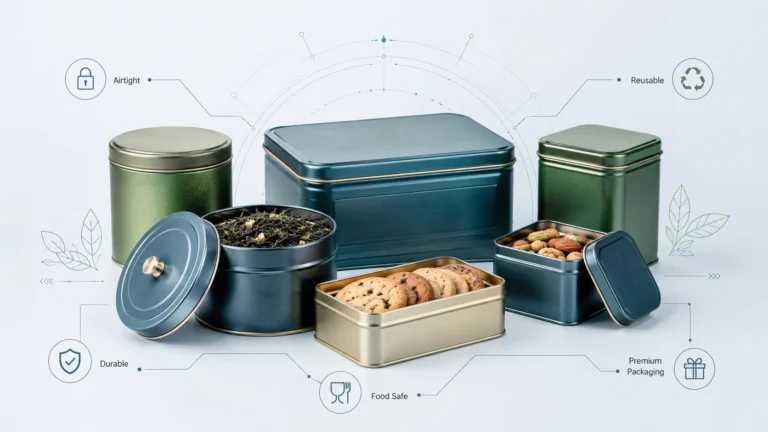


Tin packaging has become one of the most practical ways for brands to combine product protection, premium presentation, and sustainability messaging in a single package. For food companies, metal tins help protect aroma, texture, color, and shelf appeal. For gift and promotional brands, a tin can become part of the product experience instead of being thrown away immediately after opening. For cosmetics and personal care brands, tin packaging can signal quality, support refill or reuse behavior, and create a compact, durable format for solid balms, waxes, powders, candles, fragrance sets, and limited-edition kits.
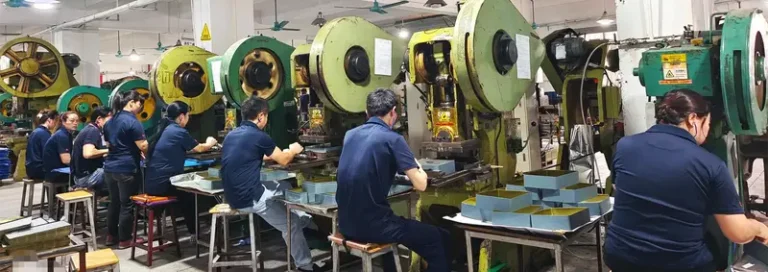
At Mr.Tin Box, tin packaging is positioned for global brands that need more than a decorative container. The goal is to help buyers develop custom metal tins that fit the product, the sales channel, the target market, the branding strategy, and the real manufacturing process behind mass production. A successful tin project is not only about choosing a nice shape. It is a structured decision that includes material, coating, printing, finish, closure, insert, packing method, quality inspection, and export logistics.
This guide explains why brands use metal tins for food, gifts, and cosmetics, what buyers should know before requesting a quote, and how to compare tin packaging with alternative materials in a practical way. It also includes market data, compliance references, and buyer-friendly tables that can support a more confident purchasing decision.
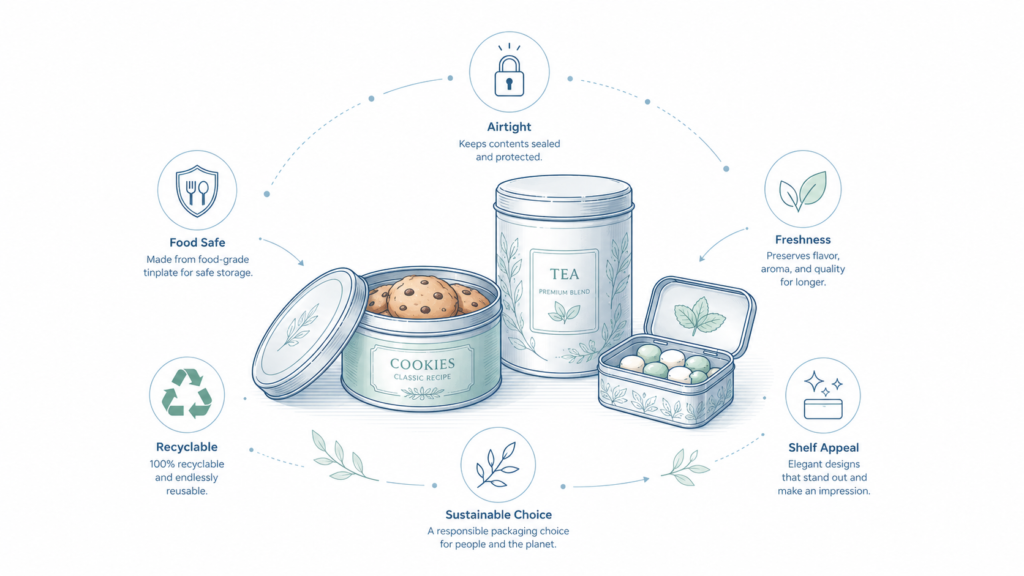
Key industry data brands should understand first
Before discussing design, it is useful to look at the larger packaging environment. Brand owners are under pressure from three directions at the same time: consumers want better packaging experiences, regulators want packaging to become more recyclable and resource-efficient, and retailers want packages that can survive transport while still looking attractive on the shelf.
| Data point | What it means for brand owners | Source |
|---|---|---|
| The metal packaging industry is projected by Smithers to be worth over $177 billion by 2029, with 2024-2029 growth around 3%. | Metal packaging is not a niche option. It remains a large, mature, and commercially relevant packaging category. | Smithers – The Future of Metal Packaging and Coatings to 2029 |
| Steel packaging in Europe reached a 82% real recycling rate in 2023 according to Steel for Packaging Europe. | Steel-based tin packaging can support credible circularity claims when those claims are adapted to the market where the product is sold. | Steel for Packaging Europe |
| EU packaging rules aim to make all packaging on the EU market recyclable in an economically viable way by 2030. | Export brands should design packaging with recyclability, material simplicity, and documentation in mind from the beginning. | European Commission – Packaging waste |
| FDA defines food contact substances broadly, including packaging components, adhesives, colorants, coatings, and other materials that contact food. | Food-grade tin packaging is not just about the metal sheet. Coatings, inks, varnishes, liners, and direct-contact surfaces also need proper evaluation. | U.S. FDA – Food Packaging & Food Contact Substances |
| UNEP’s Food Waste Index Report 2024 estimates 1.05 billion tonnes of food waste from retail, food service, and households in 2022. | Packaging that helps preserve quality and reduce damage can be part of a broader waste-reduction strategy, especially for food and specialty goods. | UNEP – Food Waste Index Report 2024 |
| Ipsos research found that 72% of American consumers said packaging design often influences purchase decisions, and 67% said packaging materials influence purchase decisions. | The material itself can become part of the selling message. Metal can communicate premium quality before the consumer reads the label. | Ipsos packaging survey |
| McKinsey’s 2025 global consumer research found that every geography studied has a consumer segment willing to pay more for sustainable packaging. | Sustainable packaging is not only a compliance topic; it can influence premium positioning, but claims must remain specific and defensible. | McKinsey – Sustainable packaging 2025 |
These numbers do not mean every product should use a metal tin. They do mean that tin packaging is worth serious consideration when a brand needs a package that protects the product, improves perceived value, supports reuse, and gives the sales team a stronger story to tell.
What tin packaging means in modern consumer products
In everyday language, buyers often use “tin packaging” to describe small or medium-size metal containers made from tinplate. Technically, tinplate is usually a thin steel sheet coated with a layer of tin. The steel provides strength and formability, while the tin coating helps protect the surface and improves suitability for many packaging applications. Depending on the product, the inside of the tin may also use a food-safe lacquer, protective coating, liner, paperboard insert, PET tray, EVA foam, or other structure.
This is why a professional tin packaging project should not start with shape alone. It should start with the product’s real requirements. A cookie tin needs different internal planning from a lip balm tin. A tea tin needs better aroma and moisture control than a simple promotional stationery tin. A chocolate gift tin may need food-grade coating, a removable tray, seasonal graphics, and a scratch-resistant varnish. A cosmetics tin may need a smooth opening feel, corrosion-resistant inner surface, and a finish that looks premium in social media photography.
Mr.Tin Box describes its Food & Beverage Packaging solutions as metal packaging designed for freshness protection, structural durability, and shelf stability. Its Beauty & Personal Care Packaging page highlights protection, aesthetic value, and long-term reliability for skincare, cosmetics, fragrance, and wellness applications. These two categories show an important point: the same basic material can serve very different commercial goals when the structure, coating, and decoration are customized correctly.
Tin packaging can be used for many products, including tea, coffee, cookies, biscuits, chocolate, candy, mints, spices, nutraceutical powders, candles, wax melts, solid perfume, shaving soap, lip balm, skincare sets, promotional gifts, wedding favors, holiday tins, stationery, accessories, small tools, collector items, and premium sample kits. The common reason is simple: a metal tin feels more permanent than disposable packaging.
Why brands choose metal tins instead of ordinary packaging
Tin packaging is rarely chosen for only one reason. Brands usually choose it because it solves several problems at once.
First, metal tins offer strong physical protection. A rigid tin helps protect the product from crushing, bending, and retail handling damage. This matters for fragile food products such as biscuits, cookies, chocolate pieces, and gift assortments. It also matters for cosmetics and promotional products that need to arrive in good condition after international shipping.
Second, metal gives strong barrier performance when the closure and coating system are designed properly. Metal naturally blocks light, and light protection is important for products whose color, fragrance, active ingredients, oils, or flavors can degrade during storage. Metal can also support moisture and aroma protection, especially when the lid fit, gasket, liner, or secondary seal is designed for the product category.
Third, metal tins create a premium tactile experience. The cool touch, rigid structure, opening sound, lid fit, embossing, and surface finish all influence how consumers judge quality. This is why premium brands often use metal tins for gift sets, limited editions, chocolate assortments, tea collections, beauty kits, candles, and collectible packaging.
Fourth, tin packaging supports reuse. A well-designed tin may be used by the consumer for storage after the original product is gone. This gives the brand more time in the home and more repeated visual exposure. The Mr.Tin Box article on Metal Packaging Trends for Premium Consumer Goods explains this keepsake value well: a premium tin can become a useful object rather than disposable waste.
Fifth, metal packaging can support stronger sustainability communication, especially when the brand focuses on realistic claims such as recyclability, durability, reuse, and compatibility with established recycling systems. Steel is magnetically sortable, and European steel packaging recycling rates are high. However, brands should avoid vague claims such as “eco-friendly” without context. A better claim is more specific: “reusable metal tin,” “steel packaging is widely recyclable where collection systems exist,” or “designed for long-term reuse.”
Tin packaging by application: food, gifts, and cosmetics
Different product categories use tin packaging in different ways. The table below shows how the business logic changes by application.
| Application | Main reason to use tin packaging | Important design details | Common commercial goal |
|---|---|---|---|
| Tea, coffee, matcha, spices | Aroma, moisture, light, and premium shelf presence | Tight lid fit, inner coating, optional freshness seal, stackable shape | Improve freshness perception and premium positioning |
| Cookies, biscuits, chocolate, candy | Crush protection, gifting value, seasonal display | Food-grade coating, inner tray, divider, printed seasonal artwork | Increase gift appeal and reduce transit damage |
| Mints, lozenges, small snacks | Pocket-size durability and repeat use | Smooth lid, compact size, rounded safe edges | Build daily brand exposure and convenience |
| Cosmetics and skincare | Premium feel, formula protection, refill or reuse potential | Corrosion-resistant coating, insert, smooth opening, matte or satin finish | Upgrade brand image and support gift sets |
| Candles and fragrance products | Heat resistance, premium home decor look, protection | Proper coating, lid fit, fragrance compatibility review | Create display value and improve unboxing experience |
| Promotional gifts and holiday campaigns | Memorability, collectability, strong decoration | Embossing, spot UV, metallic finish, custom shape | Increase campaign impact and perceived gift value |
| Specialty and industrial items | Durability, organization, damage protection | Foam liner, compartments, hinge, latch, labeling area | Protect small parts and improve professional presentation |
This category-specific thinking is essential because a tin that works for cookies may not work for cosmetics, and a tin that looks impressive for a holiday gift set may be unnecessarily expensive for a basic industrial part kit. The best packaging choice depends on the product’s sensitivity, margin, distribution method, and brand promise.
How tin packaging protects food products
Food brands often choose tin packaging because it helps control the main factors that damage product quality: oxygen, moisture, light, odor transfer, and physical breakage. Packaging cannot make a poor formula fresh forever, but it can reduce the environmental stresses that cause quality loss during storage and distribution.
For dry foods, moisture control is especially important. Cookies become soft, powders cake, tea loses freshness, and coffee aroma declines when the package does not manage moisture and air exposure well. Tin packaging can help because the metal body is rigid, opaque, and compatible with tight-fitting closures. For sensitive dry foods, brands may add an inner bag, aluminum foil pouch, induction seal, or liner inside the tin. This hybrid approach allows the tin to carry the brand experience while the inner structure provides additional freshness control.
For light-sensitive products, metal has a natural advantage because it is opaque. This is valuable for tea, spices, nutraceutical powders, functional ingredients, chocolate, and certain natural products. Retail lighting, warehouse light exposure, and long shelf display can create quality variation. A metal tin reduces this variable by blocking light at the primary package level.
For crush-sensitive products, rigidity is the main benefit. Biscuits, wafers, cookies, confectionery pieces, and gift assortments are vulnerable to breakage. A tin body resists compression better than many flexible packages or paperboard cartons. When combined with a plastic tray, paper insert, or molded pulp insert, the tin can reduce movement inside the package and improve the consumer’s first impression when the lid is opened.
For shelf-stable foods, the technical requirements are much stricter. Regulatory references such as 21 CFR Part 113 define a hermetically sealed container as one designed to be secure against the entry of microorganisms and to maintain commercial sterility after processing. Codex also defines canned food as commercially sterile food in hermetically sealed containers in its hygienic practice documents. These references are most relevant to true canned-food systems, retort processes, and low-acid foods. Decorative tins for cookies, tea, candy, and gifts do not automatically meet these requirements unless they are engineered and validated for that purpose.
This distinction is important for honest marketing. A tea tin can be food-grade and protective without being a retort can. A cookie tin can be suitable for direct food contact when the inner coating and production process are appropriate, but it may still require an inner bag for freshness. A cosmetic tin can use food-safe material but still needs compatibility review for oils, waxes, acids, alcohols, fragrances, or active ingredients.
Food-grade tin packaging: what buyers should check
Food-grade tin packaging should be evaluated as a full system. The metal sheet is only one part of that system. The coating, ink, varnish, lid, insert, packing environment, and intended use all matter.
The U.S. FDA explains that food contact substances include food packaging and its components, as well as substances applied on packaging surfaces such as adhesives, colorants, and antioxidants. In the EU, Regulation (EC) No 1935/2004 provides the general framework for materials intended to come into contact with food. In practical purchasing language, this means buyers should not simply ask, “Is the tin food grade?” They should ask, “Which components will contact the food, what coating is used, what tests or declarations are available, and for what product type and market?”
| Food-grade checklist | Why it matters | Buyer question to ask |
|---|---|---|
| Inner coating or lacquer | Helps separate food from metal surface and supports corrosion resistance | What inner coating is recommended for my food type? |
| Ink and varnish system | Exterior decoration should not create odor, migration, or durability problems | Are inks and varnishes suitable for my market requirements? |
| Direct-contact area | The food may touch the base, lid, seam, insert, or liner | Which surfaces will be in direct contact with the product? |
| Product chemistry | Salt, acid, fat, alcohol, essential oil, and moisture affect compatibility | Has a similar product been packed in this structure before? |
| Closure and freshness system | Lid fit influences moisture and aroma protection | Do I need a plug lid, slip lid, gasket, seal, or inner bag? |
| Testing and documentation | Different markets require different evidence | Can the supplier support food-contact testing or documentation? |
| Production hygiene | Cleanliness affects food packaging credibility | How are tins packed after production and inspection? |
For many dry food applications, a practical solution is to use a food-grade tin with an inner bag or sealed pouch. This is common for tea, coffee, cookies, candies, and premium snacks. The inner bag gives added freshness control, while the metal tin provides shelf appeal, protection, and gift value. For products that require direct contact with the tin, coating selection becomes more critical.
Brands should also consider the sales channel. A tin sold through supermarkets may need strong scuff resistance because it will be handled frequently. An e-commerce tin may need better outer carton protection because parcel delivery creates more vibration and impact. A luxury gift tin may need tighter visual tolerances because consumers expect a flawless surface.
Why metal tins work so well for gifts and seasonal campaigns
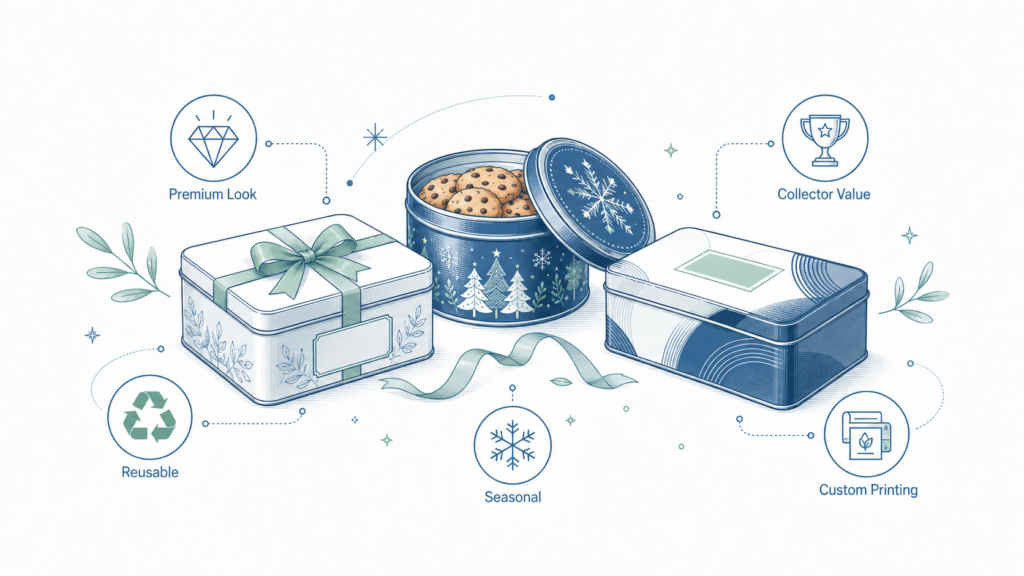
Gift packaging has a different job from ordinary packaging. It must protect the product, but it must also create emotional value. When someone buys a holiday cookie tin, chocolate tin, tea gift set, candle set, or promotional tin, the package is part of the gift. This is where tin packaging performs especially well.
Metal tins are rigid, decorative, reusable, and collectible. They can be printed with seasonal artwork, embossed with a logo, finished with matte varnish, decorated with metallic effects, or designed in special shapes. The Mr.Tin Box article on 10 Creative Custom Metal Tin Packaging Design Ideas gives examples such as printed patterns, seasonal motifs, artistic collaborations, unique shapes, and custom compartments. These ideas work because tins can carry both graphic storytelling and physical interaction.
A paper box may look beautiful on the shelf, but it often loses value after opening. A well-made tin can continue to be used. Consumers may keep it for tea bags, sewing tools, stationery, candies, small accessories, photos, receipts, or household storage. This second life extends brand exposure beyond the purchase moment.
For seasonal campaigns, tin packaging also helps brands create urgency. A limited-edition tin feels more collectible than a normal carton. This supports higher perceived value and can encourage repeat purchase across different themes. A brand can launch a winter tin, Valentine’s tin, Easter tin, summer travel tin, Halloween tin, or anniversary tin while keeping the same core product. The packaging becomes a campaign platform.
| Campaign type | Tin packaging advantage | Useful customization options |
|---|---|---|
| Christmas and holiday gifts | Strong keepsake value and festive shelf impact | Full-surface printing, metallic finish, embossing, ribbon-ready structure |
| Corporate gifts | Professional appearance and long-term desk visibility | Logo embossing, custom insert, satin finish, premium sleeve |
| Wedding and event favors | Small quantity customization and memorable presentation | Mini tins, personalized labels, soft colors, window lids |
| Limited-edition snacks | Collectability and repeat purchase across designs | Numbered series, character artwork, seasonal patterns |
| Beauty gift sets | Premium feel and organized product layout | EVA insert, paperboard tray, mirror-like accents, matte finish |
| Retail promotional bundles | Higher perceived value without changing the product formula | Bundle tin, divider, printed campaign message, QR code area |
The key is to design the tin as an object, not just a container. A good gift tin should have comfortable proportions, safe curled edges, a lid that feels smooth, a finish that resists scratches, and an insert that presents the product neatly.
Why cosmetics and personal care brands use tin packaging
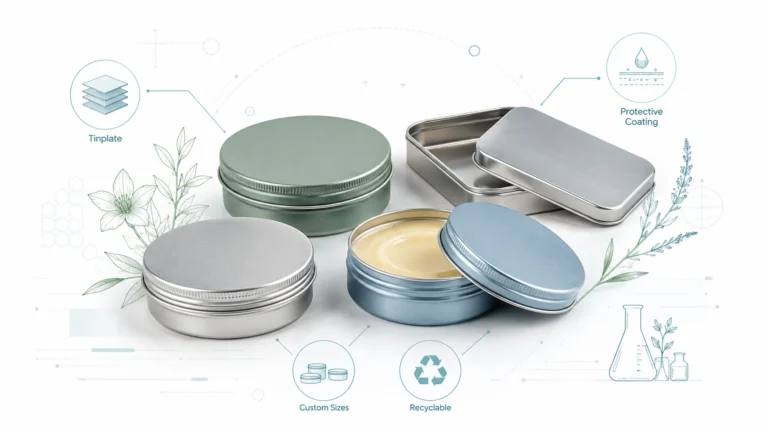
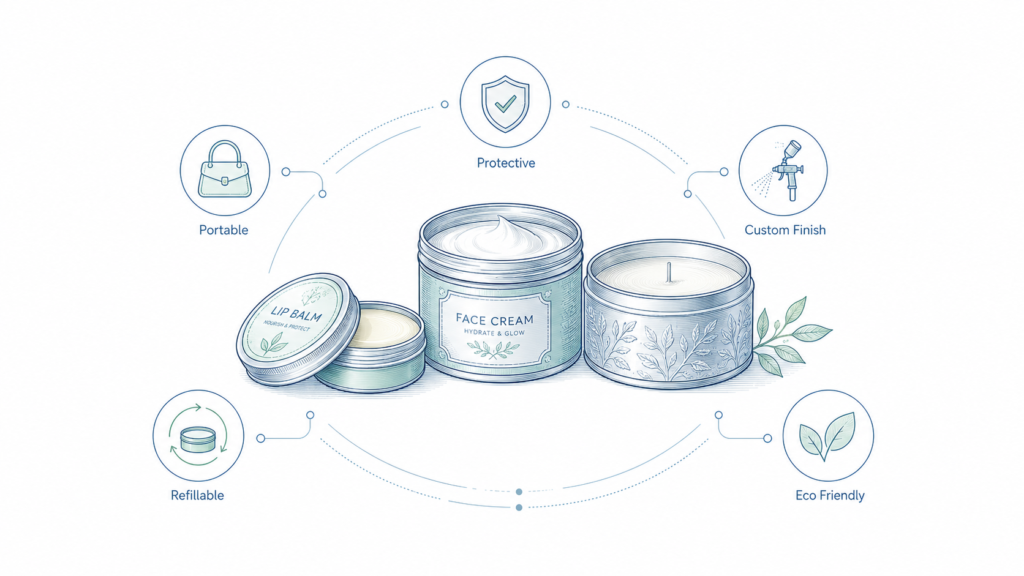
Cosmetics packaging has to balance appearance, formula protection, usability, and brand positioning. Tin packaging is especially strong for products where a compact, durable, premium container makes sense. Common examples include lip balm, solid perfume, beard balm, shaving soap, hair wax, massage balm, salve, cuticle balm, solid lotion, sample kits, candles, fragrance accessories, and gift sets.
The appeal is partly emotional. Metal feels clean, durable, and premium. A matte tin can make a skincare product feel natural and modern. A glossy tin can make a colorful beauty product feel playful and giftable. A satin tin can support a minimalist wellness brand. Embossing can make a logo feel more expensive without requiring a complex structural change.
The appeal is also practical. Metal tins protect against crushing in handbags, travel kits, retail displays, and e-commerce parcels. They are compact and easy to carry. They can be reused or refilled in some product systems. They also support custom inserts for multi-product sets, which is useful for beauty kits, fragrance discovery sets, and promotional launches.
However, cosmetics buyers need to pay attention to compatibility. Many cosmetic formulas contain oils, waxes, fragrances, alcohols, botanical extracts, acids, or active ingredients. These materials may interact with coatings or cause staining, odor absorption, corrosion, or finish changes if the wrong structure is selected. A supplier should review the formula type, filling process, expected storage conditions, and market requirements before recommending a tin.
| Cosmetic product type | Tin packaging fit | Key technical concern |
|---|---|---|
| Lip balm and solid balm | Excellent for small portable formats | Formula compatibility with coating and lid fit |
| Solid perfume | Strong premium and travel appeal | Fragrance oil interaction and odor control |
| Shaving soap and beard balm | Durable, masculine, reusable presentation | Corrosion resistance and repeated open/close behavior |
| Candles and wax melts | Good for premium home fragrance lines | Heat behavior, coating selection, labeling regulations |
| Skincare sample kits | Useful for organized premium sets | Insert design and clean product separation |
| Powder cosmetics | Good for gift tins and refills | Moisture control and internal liner design |
Mr.Tin Box’s Beauty & Personal Care Packaging page highlights corrosion-resistant tinplate or aluminum, precision stamping, custom printing, embossing, surface treatments, optional liners, coatings, and inserts. This is the right way to think about cosmetics tin packaging: structure and surface must work together.
The material structure behind a custom tin
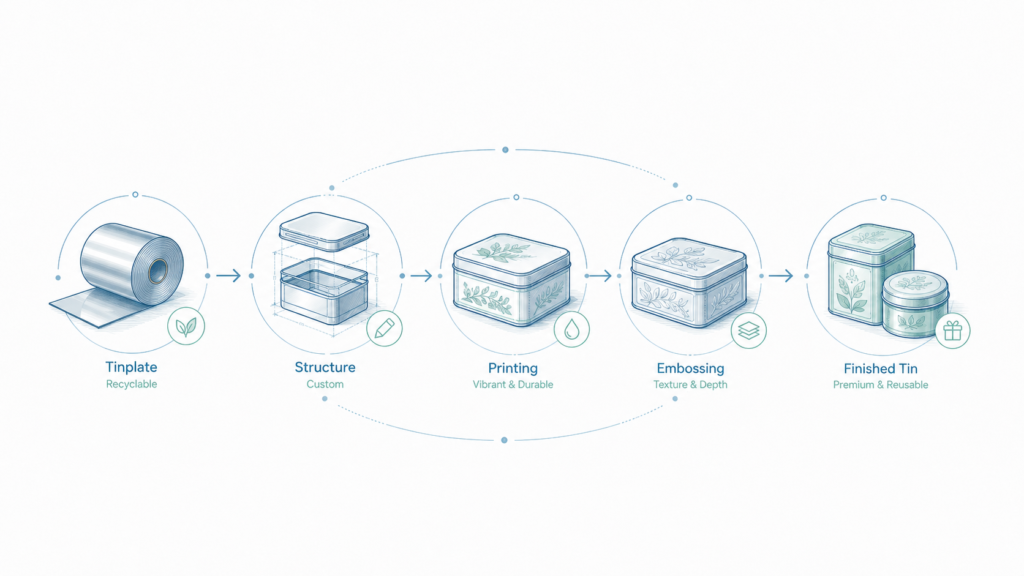
A custom tin may look simple, but it is the result of several manufacturing layers and decisions. The typical structure includes tinplate sheet, forming process, inner coating, exterior printing, protective varnish, edge curling, lid fitting, optional hinge, optional window, optional insert, and final packing.
The tinplate thickness affects rigidity, weight, cost, forming difficulty, and user experience. A thicker sheet can feel more premium and resist deformation, but it may increase material cost and shipping weight. A thinner sheet may be more economical, but it must still pass handling and drop expectations. The right choice depends on tin size, shape, product weight, and target retail positioning.
The forming process affects corners, seams, body straightness, and lid fit. Round tins, rectangular tins, hinged tins, slide tins, window tins, and irregular tins each require different tooling. A simple round tin may have lower development risk than a complex custom-shaped tin with deep embossing and a hinged lid. This is why buyers should involve the factory early, before finalizing artwork.
The inner coating affects food contact, corrosion resistance, and product compatibility. For dry foods, the coating may be relatively straightforward. For salty, acidic, oily, fragrant, or wet products, coating selection becomes more sensitive. For cosmetics, compatibility testing may be needed because fragrance oils or active ingredients can be aggressive.
The exterior printing system affects brand presentation. Tin packaging can support offset printing, spot colors, CMYK artwork, metallic effects, matte varnish, glossy varnish, satin varnish, texture varnish, spot UV, embossing, debossing, and special finishes. Mr.Tin Box’s guide to Metal Tin Box Finishing Options explains that finish is not just decoration; it influences first impressions, protection, scuff resistance, fingerprint visibility, and premium positioning.
The closure system affects usability and freshness. Slip lids, plug lids, hinged lids, screw lids, and slide lids all create different opening experiences. For gift tins, a smooth opening feel can increase perceived quality. For food tins, lid fit can influence moisture and aroma protection. For cosmetics, repeated opening and closing must remain smooth over time.
How finishing choices change brand perception
Many buyers spend most of their time on shape and artwork, but the finish is what customers touch first. A finish can make the same tin feel modern, playful, luxury, natural, industrial, festive, or minimalist.
Matte finishes are popular for premium brands because they reduce glare, photograph well, and create a soft modern look. They are especially useful for tea, coffee, skincare, wellness, and luxury gift packaging. However, some matte finishes can show fingerprints or rub marks if not selected carefully.
Glossy finishes create bright colors and strong shelf impact. They are useful for candy, children’s products, seasonal gifts, and products that need vivid artwork. Gloss can also be easier to clean visually, but it may show scratches more clearly than satin or textured finishes.
Satin finishes are a balanced option. They feel premium but practical, and they often work across many product categories. If a buyer is unsure which finish to choose, satin is often a safe starting point.
Soft-touch finishes create a luxury feel, especially for cosmetics, fragrance, and premium gift tins. They make the package pleasant to hold, but they require careful testing for scratch resistance, fingerprints, and compatibility with packing materials.
Spot UV can highlight a logo, product name, or pattern. It works especially well on matte or satin bases because the gloss contrast draws attention without making the whole tin shiny. Embossing and debossing add tactile value and make a logo feel more permanent.
| Finish option | Best for | Commercial effect | Risk to control |
|---|---|---|---|
| Matte | Tea, coffee, skincare, premium gifts | Modern, calm, high-end | Fingerprints, rub marks, color shift |
| Glossy | Candy, holiday tins, colorful artwork | Bright, playful, high visibility | Scratches and glare |
| Satin | Broad consumer goods | Premium but practical | Less dramatic than matte or gloss |
| Soft-touch | Luxury cosmetics and fragrance | Tactile, memorable, premium | Handling marks and higher cost |
| Spot UV | Logos and pattern accents | Contrast and shelf detail | Registration accuracy |
| Embossing/debossing | Brand logos and collectibles | Physical brand recognition | Tooling cost and deformation control |
| Metallic effects | Gifts, chocolate, festive products | Luxury and celebration | Color consistency and overuse |
The most effective approach is not to add every finish at once. For many brands, a satin base with a spot UV logo, or a matte base with embossing, creates enough premium impact without overcomplicating mass production.
Sustainability: where tin packaging has a strong story
Sustainability is one of the main reasons brands are reconsidering packaging materials. However, sustainability communication must be precise. Tin packaging is not automatically the best choice in every life-cycle scenario. Its advantages depend on recyclability, reuse behavior, product protection, transport efficiency, and local waste management systems.
The strongest sustainability arguments for tin packaging are practical and specific.
First, metal is widely recyclable where proper collection and sorting systems exist. Steel packaging has a major sorting advantage because it is magnetic. In Europe, Steel for Packaging Europe reported that steel packaging reached an 82% real recycling rate in 2023. This is a strong data point for brands selling into markets with established recycling systems.
Second, metal tins are reusable. Reuse is not guaranteed, but it is common when the tin is attractive, durable, and useful. A tea tin may become a kitchen storage container. A cookie tin may become a household box. A cosmetic tin may become a travel case. This reuse behavior is commercially valuable because the brand remains visible after the product is consumed.
Third, metal packaging can reduce product damage and waste. If a rigid tin prevents breakage, moisture damage, or retail returns, the sustainability value is not only in the package material. It is also in the protected product. UNEP’s Food Waste Index Report 2024 shows the huge global scale of food waste, including more than one billion meals’ worth of food wasted by households every day. Better packaging cannot solve food waste alone, but packaging that protects quality can contribute to waste reduction in the supply chain.
Fourth, metal tins can support refill models for selected categories. Cosmetics, candles, tea, and specialty foods can sometimes use a durable outer tin with refill packs. This approach requires careful design because the tin must remain attractive and functional after repeated use.
| Sustainability claim | Stronger wording | What to avoid |
|---|---|---|
| Recyclable | “Steel tin packaging is widely recyclable where metal collection systems exist.” | “100% eco-friendly” without context |
| Reusable | “Designed as a durable tin that consumers can reuse for storage.” | Claiming every consumer will reuse it |
| Circularity | “Metal supports circular packaging goals in markets with effective recycling systems.” | Suggesting recycling rates are identical in all countries |
| Waste reduction | “Rigid tins can help reduce product damage during shipping and handling.” | Claiming packaging alone eliminates waste |
| Plastic reduction | “A metal tin can reduce reliance on certain single-use plastic formats.” | Claiming it has no environmental impact |
The EU’s packaging policy direction also matters for export brands. The European Commission says the EU packaging rules aim to make all packaging on the EU market recyclable in an economically viable way by 2030. For global brands, this means packaging design should be prepared for stricter recyclability, labeling, and documentation expectations. Tin packaging can fit this direction when it is designed with material clarity, removable components where needed, and realistic claims.
Tin packaging versus paper, plastic, glass, and flexible pouches
No packaging material is perfect. The right choice depends on product sensitivity, price point, logistics, brand positioning, and disposal or reuse pathway. The table below gives a practical comparison.
| Material | Strengths | Limitations | When tin packaging may be better |
|---|---|---|---|
| Paperboard carton | Lightweight, printable, cost-effective | Limited moisture and crush protection unless laminated or reinforced | When the product needs a premium reusable package or stronger physical protection |
| Flexible pouch | Lightweight, efficient shipping, good barrier options | Less rigid, often lower premium feel, harder to reuse | When the brand wants gift value, shelf presence, or a durable keepsake |
| Rigid plastic | Moldable, lightweight, transparent options | Sustainability pressure, scratching, lower premium feel in some categories | When brand positioning benefits from metal touch and recyclability messaging |
| Glass jar | Premium, inert, transparent, recyclable | Heavy, breakable, higher shipping risk | When breakage risk, travel use, or compact format matters |
| Metal tin | Rigid, opaque, reusable, printable, premium | Higher tooling and unit cost than simple cartons, less visibility without a window | When product protection, gifting, reuse, and brand value justify the investment |
This comparison helps explain why many brands use tin packaging selectively. A company may use flexible pouches for daily refill packs and a metal tin for premium starter kits. A chocolate brand may use paperboard for standard retail bars and tins for holiday assortments. A skincare brand may use glass for serum and tins for solid balm or gift bundles. Tin packaging works best when it is used strategically.
Cost and ROI: why tin packaging can be worth the investment
Tin packaging usually costs more than a simple paperboard box or flexible pouch. It may require tooling, sampling, print setup, coating selection, inspection, and more protective shipping cartons. For this reason, buyers should evaluate tin packaging through total value, not only unit price.
The value can appear in several areas.
A premium tin can increase perceived value. If consumers are willing to pay more for a giftable package, the higher packaging cost can be offset by a higher retail price. This is especially relevant for chocolate, biscuits, tea, coffee, cosmetics, candles, and holiday sets.
A stronger package can reduce damage. If a tin reduces breakage or dent-sensitive product returns, it may save hidden costs in e-commerce and export logistics. The packaging cost should be compared with the cost of complaints, replacements, markdowns, and damaged brand reputation.
A reusable package can extend brand exposure. The consumer may keep the tin for months or years. That is difficult to measure, but it has real marketing value. A package that remains on a kitchen shelf or dressing table is a small brand billboard.
A seasonal tin can refresh the same product without changing the formula. This is valuable for food and gift brands because packaging artwork can create new demand around holidays, events, collaborations, or limited editions.
| Cost factor | What increases cost | How to control it |
|---|---|---|
| Tooling | Custom shape, hinge, window, complex lid | Start with proven shapes when speed and budget matter |
| Material | Larger size, thicker tinplate, special coating | Match thickness to actual product weight and handling risk |
| Printing | Many colors, complex artwork, metallic effects | Use clear artwork files and limit unnecessary effects |
| Finish | Soft-touch, spot UV, embossing, texture | Choose one or two premium effects with clear purpose |
| Insert | EVA foam, molded tray, paperboard divider | Use insert only where presentation or protection needs it |
| Testing | Food contact, coating compatibility, transit tests | Define target markets early so testing is not repeated |
| Packing | Individual bags, sleeves, export cartons | Balance surface protection with labor and material cost |
The best way to improve ROI is to connect packaging decisions to business goals. If the goal is gift value, invest in shape, finish, and insert. If the goal is shelf life, invest in closure, coating, and inner seal. If the goal is e-commerce durability, invest in structural strength and outer packing. If the goal is premium cosmetics, invest in tactile finish and smooth opening feel.
How to plan a custom tin packaging project
A successful tin project follows a clear process. Rushing directly into artwork can create expensive revisions later, especially if the design cannot be formed, printed, embossed, or packed consistently.
Start with the product. Define size, weight, shape, fragility, moisture sensitivity, oxygen sensitivity, light sensitivity, odor sensitivity, and whether the product touches the tin directly. Also clarify filling method, shelf life target, storage conditions, and sales markets.
Define the commercial goal. Is the tin supposed to reduce damage, increase gift value, support a premium price, improve shelf visibility, support a refill model, or create a limited-edition collectible? The answer affects structure and finish.
Choose the tin type. Common options include round tins, rectangular tins, square tins, hinged tins, slide tins, window tins, plug-lid tins, deep-drawn tins, and custom-shaped tins. A standard structure may reduce cost and sampling time. A custom structure may create stronger differentiation.
Plan the coating and food-contact requirements. For food, identify direct-contact surfaces and market requirements. For cosmetics, review formula compatibility. For candles and fragrances, check heat, fragrance, and coating behavior.
Create artwork based on real dielines. Artwork should consider seams, corners, curves, embossing position, barcode readability, regulatory text, recycling labels, and color consistency. Tin printing behaves differently from paper printing, so buyers should approve physical samples before mass production.
Test the sample. Check lid fit, opening feel, surface finish, print color, edge safety, stacking, insert fit, product fit, odor, coating, and shipping performance. Physical sample approval is essential because screens cannot show real gloss, texture, embossing depth, or metal reflection.
Prepare mass production controls. Confirm inspection standards for dents, scratches, color tolerance, lid fit, coating defects, print registration, packing method, and carton marking. For export orders, confirm palletization, humidity control, and shipping documentation.
Common mistakes buyers should avoid
The first mistake is choosing a tin only by appearance. A beautiful tin that fails lid fit, scratches easily, or does not match the product chemistry will create problems during launch. Appearance must be balanced with manufacturability and use conditions.
The second mistake is using vague food-grade language. “Food grade” should be supported by clear information about coating, contact surface, intended food type, and target market. A dry cookie tin and an acidic sauce can require very different packaging systems.
The third mistake is over-designing the finish. Too many effects can make a tin expensive, slower to produce, and harder to control. A simple matte finish with clean embossing may look more premium than a crowded design with too many metallic and glossy effects.
The fourth mistake is ignoring logistics. A tin can be strong, but its decorative surface still needs protection during shipping. If tins rub against each other in a carton, scratches may occur. Individual polybags, tissue paper, dividers, or better carton layout may be needed for premium finishes.
The fifth mistake is approving only digital proofs. Digital proofs are useful for layout, but they cannot show real color on metal, varnish reflection, embossing depth, lid tightness, or scratch behavior. Buyers should approve real samples before mass production.
The sixth mistake is not planning MOQ and lead time early. Custom tin packaging involves material preparation, tooling, printing, forming, finishing, assembly, inspection, and packing. Lead time can change depending on complexity, season, and order volume. A holiday tin project should begin early enough to allow sampling, revisions, production, sea freight, and retail distribution.
Buyer specification template for tin packaging
A clear specification helps the supplier quote accurately and reduces misunderstanding. Buyers can use the following template before contacting a manufacturer.
| Specification item | Example information to provide |
|---|---|
| Product type | Tea, coffee, cookies, chocolate, lip balm, candle, gift set, small tools |
| Product size and weight | Exact dimensions, net weight, number of pieces per tin |
| Direct contact | Yes/no; if yes, describe product chemistry and moisture/oil/acidity |
| Target market | U.S., EU, UK, Canada, Japan, Australia, Middle East, global export |
| Tin style | Round, rectangular, hinged, slide, plug lid, window, custom shape |
| Tin dimensions | Length x width x height, or diameter x height |
| Material requirement | Tinplate thickness preference, food-grade coating, BPA-free preference if needed |
| Printing | CMYK, Pantone colors, logo position, barcode, regulatory text |
| Finish | Matte, glossy, satin, soft-touch, spot UV, embossing, metallic effect |
| Insert | Paper tray, PET tray, EVA foam, molded pulp, divider, no insert |
| Freshness requirement | Inner bag, seal, desiccant, oxygen absorber, gasket, tight lid |
| Packing | Individual bag, paper wrap, master carton, export pallet |
| Quantity | Trial order quantity and forecast annual volume |
| Timeline | Sample deadline, launch date, shipping method |
| Documentation | Food contact report, material declaration, recycling label support, compliance documents |
This level of detail allows a supplier like Mr.Tin Box to recommend a structure that is realistic for production instead of quoting a generic tin that may not match the product.
Where Mr.Tin Box fits into the buying process
Mr.Tin Box focuses on custom metal tin packaging for food, beauty, gift, holiday, promotional, specialty, and industrial applications. The website presents the company as a supplier for global brands that need precision engineering, premium materials, advanced manufacturing, and support from concept to mass production.
For food buyers, the Food & Beverage Packaging page is a relevant starting point because it discusses food-grade tin boxes and metal containers for snacks, tea, coffee, chocolates, candies, and specialty foods. For cosmetics buyers, the Beauty & Personal Care Packaging page is useful because it covers metal packaging for cosmetics, skincare, fragrances, and personal care items. For brands comparing decoration systems, the Metal Tin Box Finishing Options guide can help buyers understand matte, glossy, satin, soft-touch, spot UV, embossing, and protective coatings. For brands that need a broader business case, Why Metal Packaging Boosts Shelf Life and Brand Value explains how metal packaging can protect products and support premium perception.
The best use of Mr.Tin Box is not only to request a price. It is to discuss the product, market, and business goal early. A professional supplier can help identify whether the project should use an existing mold, modified standard structure, or fully custom tooling. It can also recommend finishing combinations that look premium without creating avoidable production risk.
Practical recommendations by product category
For tea and coffee brands, start with aroma and moisture protection. Use a tin that supports a tight lid, consider an inner foil bag, and choose a finish that fits the brand personality. Matte or satin often works well for premium tea. Glossy or colorful printing may work better for flavored coffee or gift products.
For cookies and biscuits, focus on crush protection and presentation. Use an inner tray or divider if the product is fragile. Seasonal printing, embossing, and metallic effects can increase gift value. Make sure the tin size does not allow too much movement inside.
For chocolate and confectionery, focus on food-contact safety, temperature-sensitive logistics, and premium unboxing. A tin can make a chocolate assortment feel more giftable, but inserts and product separation are important. Avoid finishes that scratch easily if the tin will be heavily handled in retail.
For cosmetics, start with formula compatibility. Solid balm, wax, and fragrance products may need coating review. Choose a smooth lid structure and finish that supports the brand image. Matte, satin, and soft-touch finishes are often strong choices for premium cosmetics, while bright gloss may work for youthful or colorful brands.
For candles and fragrance products, consider heat, fragrance oil, and home decor value. The tin should look good after the candle is used, not only on the first day. A reusable lid and attractive finish can support long-term brand exposure.
For corporate gifts and promotional campaigns, focus on memorability. Add a logo treatment such as embossing or spot UV, use an insert to organize the contents, and design the tin so the recipient wants to keep it. The tin should feel useful after the campaign.
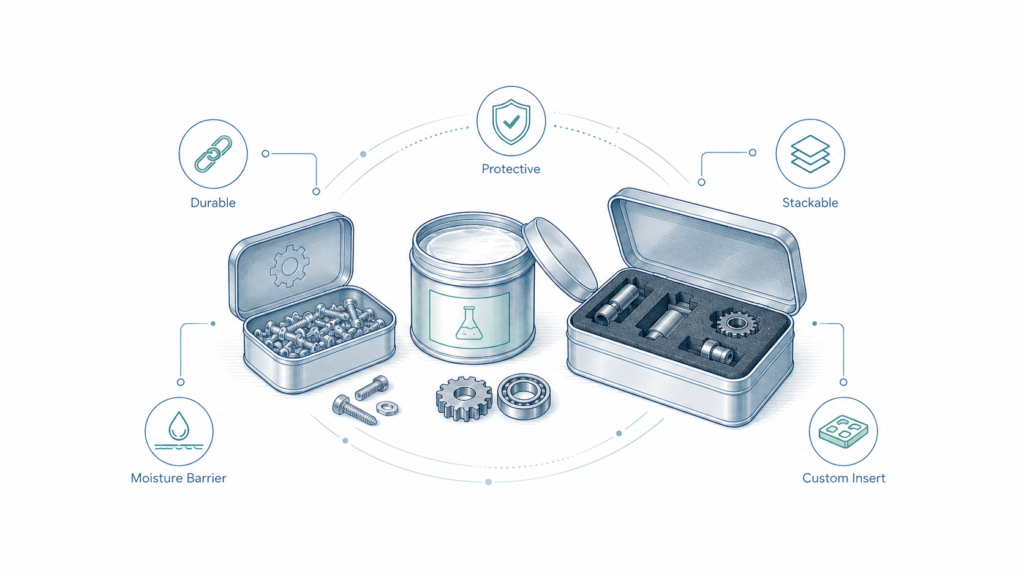
For industrial and specialty products, focus on protection and organization. Foam liners, compartments, labels, hinges, and latches may matter more than decorative finishes. The goal is often to improve product handling and professional presentation.
FAQ about tin packaging
Is tin packaging safe for food?
Tin packaging can be suitable for food when the material, coating, production process, and intended use are properly selected. Buyers should confirm which surfaces contact the food, what coating is used, and what documentation or testing is needed for the target market. Dry foods such as tea, cookies, candies, and coffee often use food-grade tins, sometimes with an inner bag or tray for added freshness and separation.
Is tin packaging recyclable?
Steel-based tin packaging is widely recyclable in markets with metal collection and sorting systems. Steel’s magnetic properties help recycling facilities separate it from other waste streams. However, recycling rates vary by country and local infrastructure. Brands should use market-specific claims and avoid vague language.
Is a tin better than a paper box?
A tin is usually stronger, more reusable, and more premium than a simple paper box. A paper box is usually lighter and lower cost. Tin packaging is often better when the product needs gift value, crush protection, long-term reuse, or stronger shelf impact. Paperboard may be better for low-cost, lightweight, or very high-volume products where premium reuse is not important.
Can metal tins extend shelf life?
Metal tins can help protect products from light, physical damage, and, when designed properly, moisture and aroma loss. For many dry products, an inner bag inside the tin may provide the strongest freshness system. For true shelf-stable canned foods, hermetic sealing and thermal processing are technical requirements that must be validated separately.
What is the best finish for premium tin packaging?
There is no single best finish. Matte is strong for modern premium brands, satin is a safe and versatile option, glossy is effective for colorful retail products, soft-touch is useful for luxury cosmetics, and spot UV or embossing can add premium detail. The best finish depends on brand positioning, handling conditions, and budget.
How early should a brand start a custom tin project?
A brand should start as early as possible, especially for holiday launches and export orders. Custom tins may require structure confirmation, tooling, sampling, artwork adjustment, coating review, production, inspection, and shipping. Starting early reduces the risk of rushed decisions and late delivery.
Can tin packaging be used for refill systems?
Yes, selected products can use a durable tin as a long-life outer package with refill packs. This is more common in tea, coffee, cosmetics, candles, and specialty products. The tin must be designed to remain attractive and functional after repeated use.
Final takeaway: tin packaging is a brand asset, not just a container
Tin packaging is valuable because it sits at the intersection of protection, presentation, and long-term brand memory. For food, it can help protect freshness perception, reduce damage, and create premium shelf appeal. For gifts, it turns packaging into part of the present. For cosmetics, it creates a compact, tactile, reusable format that supports premium positioning.
The strongest tin packaging projects are not based on decoration alone. They begin with the product’s real requirements, then connect those requirements to material, coating, closure, printing, finish, insert, packing, testing, and market compliance. When those decisions are aligned, a tin becomes more than a box. It becomes a sales tool, a quality signal, a reusable object, and a physical expression of the brand.
For brands planning a new food line, cosmetic set, holiday gift campaign, or premium promotional product, Mr.Tin Box can support the process from concept discussion to custom tin development. Start with the product, define the commercial goal, and build the tin packaging system around what the product and the customer truly need.