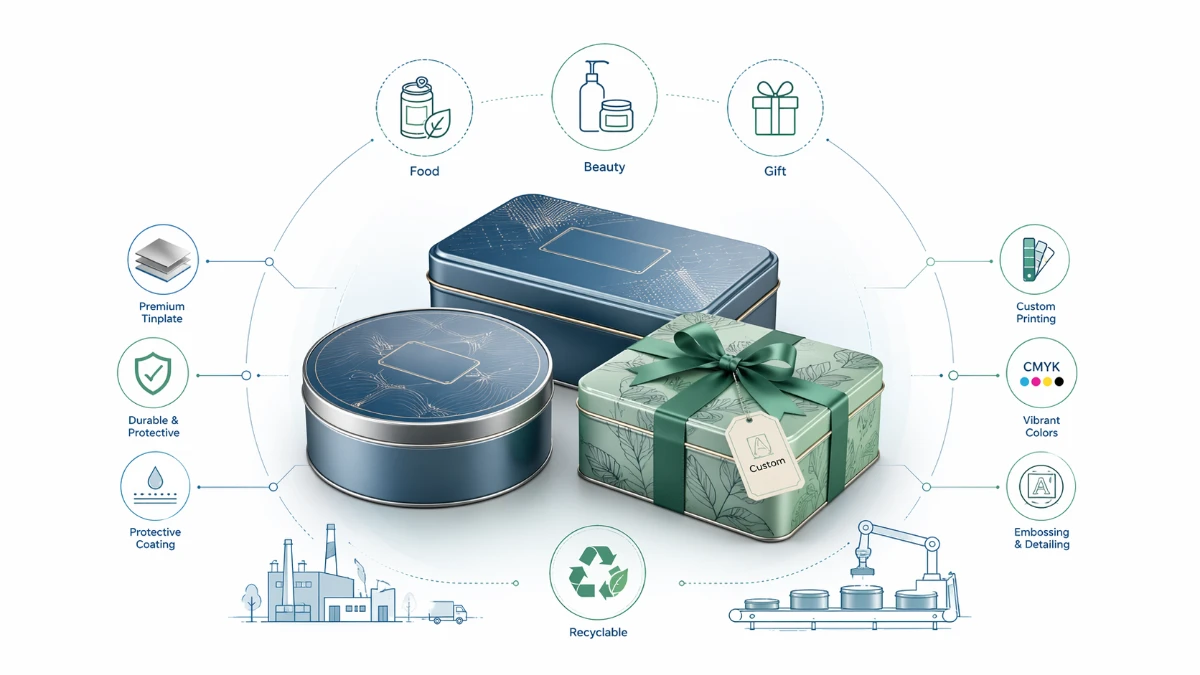
Custom metal tin packaging has moved far beyond the old idea of a simple container. For modern brands, it is part protection system, part brand asset, part compliance task, and part long-term commercial tool. A well-designed tin package can help preserve product quality, support export and e-commerce distribution, strengthen shelf impact, and communicate premium value before a customer even reads the label. That is why more companies in food, beauty, and gifting continue to invest in custom metal tin packaging even while the wider packaging market faces pressure on cost, regulation, and sustainability.
For buyers, the real question is not whether metal packaging looks attractive. It does. The more important question is whether a custom tin program can create measurable business value. In many cases, the answer is yes. Food brands use metal tins because strong barrier performance helps reduce exposure to light, moisture, and oxygen; beauty brands use them because rigid metal structures support premium decoration and a durable user experience; gift and promotional brands use them because tins are reusable, collectible, and naturally suited to limited-edition storytelling. When these benefits are engineered correctly, custom metal tin packaging is not only a packaging choice. It becomes a growth decision.
At Mr.Tin.Box, the focus is on helping global buyers turn that decision into a reliable production program. The company’s positioning across Food & Beverage Packaging, Beauty & Personal Care Packaging, and premium brand applications reflects what serious buyers actually need: structure, decoration, manufacturing discipline, and a sourcing partner that understands how packaging must perform in real commercial conditions. That practical approach also aligns with the packaging guidance already reflected in site content such as Why Metal Packaging Boosts Shelf Life and Brand Value, Metal Packaging Trends for Premium Consumer Goods, and 10 Creative Custom Metal Tin Packaging Design Ideas.
This article explains why custom metal tin packaging continues to gain strategic value for food, beauty, and gift brands, and how that value should be specified, tested, and sourced. It also integrates public data from the U.S. Environmental Protection Agency, the European Commission, the U.S. Food and Drug Administration, the USDA Food Safety and Inspection Service, the OECD, and Metal Packaging Europe, so the commercial case is supported by widely usable industry information rather than generic marketing language.
Table of Contents
Why custom metal tin packaging matters in a more demanding packaging market
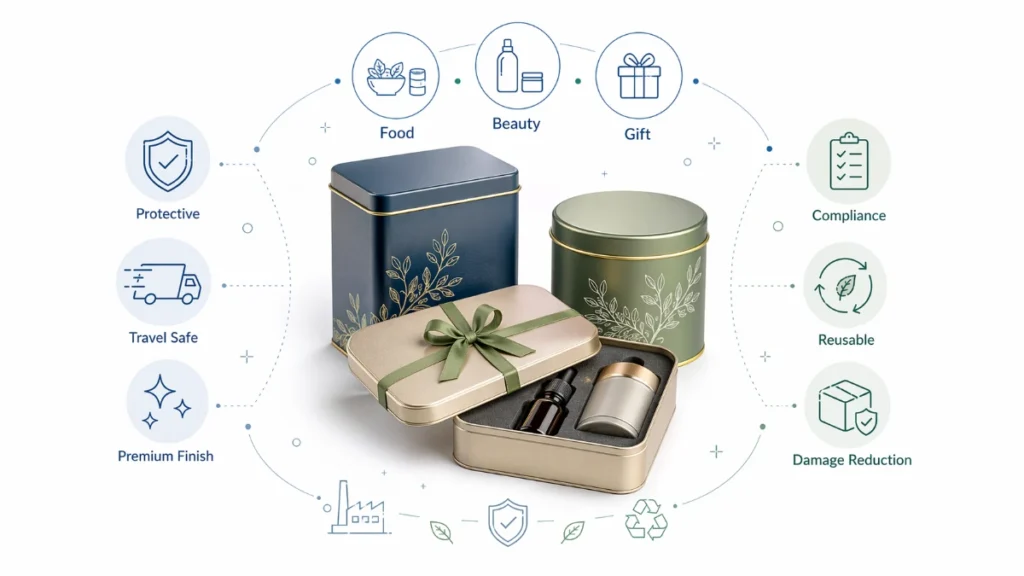
Packaging decisions are more complex now than they were a decade ago. Brands are dealing with higher customer expectations, longer supply chains, stricter labeling and material rules, broader sustainability scrutiny, and growing pressure to differentiate at the point of sale. In that environment, the package must perform several jobs at once. It must protect the product. It must travel safely. It must look like the brand deserves its price point. It must also fit the compliance framework of the target market and avoid creating unnecessary waste or operational friction.
Custom metal tin packaging performs well because it supports all of those jobs in one system. Metal tins can be designed as primary packs, secondary packs, gift packs, collector packs, or hybrid formats with inserts and accessories. They can protect dry foods, confectionery, tea, coffee, candles, balms, skincare gift sets, seasonal promotions, and specialty products that need higher perceived value. They can also carry embossing, debossing, matte and gloss finishes, metallic effects, printed artwork, fitted trays, and tamper-evident elements without losing structural integrity.
This combination of function and presentation matters commercially. Food buyers often think first about shelf life, migration safety, coating compatibility, and closure integrity. Beauty buyers often focus on premium appearance, tactile feel, convenience, and formula compatibility. Gift and promotional buyers care about collectibility, visual storytelling, and reusability after the original product is consumed. Metal packaging can address all three groups, which is one reason it works especially well for brands that sell across multiple channels or run both core and seasonal product lines.
Another reason custom metal tin packaging matters is that packaging is now part of risk management. A weak package does not only create a bad first impression. It can create dents, seal failures, scuffed decoration, broken inserts, customer complaints, returns, and damaged reviews. Once a product enters long-distance logistics or e-commerce fulfillment, those risks become more expensive. In contrast, a tin program designed around product sensitivity, logistics conditions, and visual standards can reduce avoidable waste and protect margin.
The strongest packaging strategies therefore start with a simple idea: choose a packaging format that can protect, differentiate, and scale at the same time. For many food, beauty, and gift products, custom metal tin packaging is one of the few solutions that can do all three convincingly.
Public data that supports the commercial case for metal packaging
The argument for custom metal tin packaging becomes stronger when it is backed by public data and policy direction. The table below brings together several data points that are useful across industries.
| Public data point | Source | Why it matters to buyers |
|---|---|---|
| U.S. EPA estimated that steel food cans, other cans, and other steel packaging totaled 2.2 million tons of generation in 2018, with 1.6 million tons recycled, equal to a 73.8% recycling rate. | U.S. EPA: Containers and Packaging Product-Specific Data | Steel packaging already operates within established recovery systems, which strengthens the sustainability story for tin-based packs. |
| In Europe, industry reporting states that 82% of steel packaging and 75% of aluminium beverage cans are recycled. | Metal Packaging Europe | High recycling performance supports circularity claims that many premium buyers and retailers now expect. |
| The EU Packaging and Packaging Waste Regulation entered into force on 11 February 2025 and generally applies from 12 August 2026; it aims to make all packaging on the EU market recyclable in an economically viable way by 2030. | European Commission: Packaging Waste | Packaging formats that are already strong on recyclability and material recovery are strategically advantaged. |
| OECD data shows global annual plastic waste increased from 156 million tonnes in 2000 to 353 million tonnes in 2019, with almost two-thirds coming from short-lived applications. | OECD Global Plastics Outlook | Brands are under more pressure to reduce disposable packaging footprints and justify material choices more clearly. |
| USDA/FSIS guidance notes that high-acid canned foods generally keep best quality for 12 to 18 months, while low-acid canned foods can keep best quality for 2 to 5 years. | USDA FSIS: Food Product Dating | Shelf-stable packaging is a commercial asset for export, inventory planning, and premium slow-turn SKUs. |
| The EU food-contact framework requires that food-contact materials must not release constituents at harmful levels or change food composition, taste, or odour in an unacceptable way. | European Commission: Food Contact Materials Legislation | Food tins must be engineered around coatings, inks, and migration compliance, not only around shape and artwork. |
| FDA states that color additives, except coal tar hair dyes, are subject to approval before use in food, drugs, or cosmetics, and many must be batch certified. | FDA: Color Certification | Decorative and labeling decisions must account for regulatory compliance, especially in beauty and personal care products. |
These numbers do not mean that every product should move into metal immediately. They do show, however, that the policy and sustainability environment is moving in a direction that favors recyclable, durable, high-barrier formats. For brands that already compete on quality, gifting, safety, or premium positioning, custom metal tin packaging is aligned with that direction.
What “custom metal tin packaging” actually covers
The phrase “custom metal tin packaging” is often used too loosely. In practice, buyers may be discussing very different structures. Some programs use tinplate as the main structural material for a direct-contact food tin. Some use metal as a secondary package around pouches, sachets, bottles, or jars. Others use decorated tins as gift boxes, seasonal collectors, or premium promotional kits. These are not the same engineering task, so it is important to define the packaging role early.
For most commercial projects, custom metal tin packaging falls into four broad categories.
The first is primary packaging, where the metal structure directly contains the product. This is common in tea tins, coffee tins, confectionery tins, balm tins, and certain specialty food packs. In these applications, the buyer must think carefully about coating compatibility, closure integrity, migration safety, and whether the product chemistry will interact with the metal substrate or lining.
The second is secondary packaging, where the metal tin protects and presents a separate primary pack. This is very common in beauty gift sets, premium chocolate assortments, candles, accessories, and wellness bundles. In these programs, the tin becomes the high-value outer shell. Its job is to elevate presentation, protect the internal pack, and give the customer a durable object worth keeping.
The third is gift and promotional packaging, where the tin is often designed around campaign value. The contents matter, but the pack itself is part of the event, season, or brand story. Limited-edition holiday tins, anniversary packs, collaboration kits, corporate gifts, and commemorative launches fall into this category. In many of these cases, the long afterlife of the tin is a selling point rather than an accident.
The fourth is specialty or industrial-adjacent packaging, where the tin protects smaller tools, components, electronics accessories, or highly presentation-sensitive items. While this article centers on food, beauty, and gift brands, this category is still commercially relevant because it shows how flexible the format can be.
A serious buyer also needs to separate material selection from shape selection. Tinplate and aluminum behave differently in cost, stiffness, weight, corrosion behavior, and decoration options. Likewise, a rectangular hinged tin, a seamless round tin, a fitted lid box, or a rolled-edge window tin each create different manufacturing routes and different cost drivers. The custom work is not only the print. It includes tool design, forming method, coating stack, closure design, inserts, and tolerance control.
This is why experienced suppliers do not begin with artwork alone. They begin with the role the package must play. Once that is clear, the structure, material, and decoration strategy can be matched to the commercial goal.
Why food brands continue to choose custom metal tin packaging
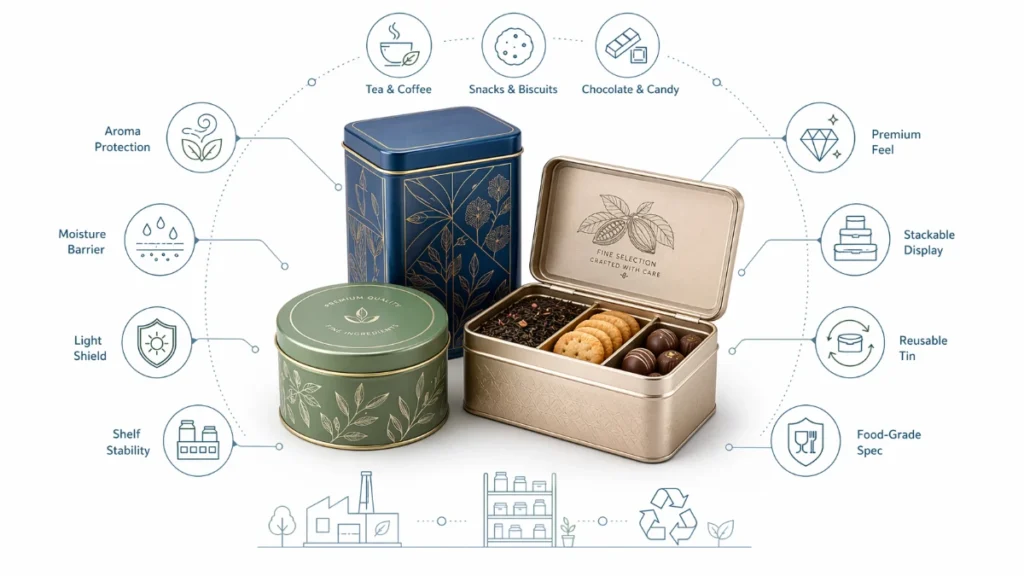
Food packaging is where metal earns trust most clearly. The basic advantages are well known: metal is opaque, rigid, durable, and capable of high barrier performance. But for brand owners, the practical value goes deeper than that. A custom tin can help preserve aroma, maintain texture, protect against light, reduce deformation during shipping, and support shelf-stable distribution strategies that would be harder to achieve with lighter materials alone.
For dry and semi-dry products, the barrier story is especially important. Tea, coffee, biscuits, chocolate, spices, candies, snack mixes, and nutraceutical powders are all vulnerable in different ways. Aroma-sensitive products lose value when volatile compounds escape. Crunchy products lose consumer appeal when moisture gets in. Light-sensitive ingredients can degrade in flavor or appearance. In each case, the strongest packaging programs remove as many external variables as possible. Metal tins do that very effectively when the structure and closure are designed properly.
The commercial value of shelf stability is also underestimated. A premium food SKU may not move at supermarket speed. It may be sold through gifting channels, cross-border e-commerce, duty-free, seasonal launches, or specialty retail where the product needs to remain high quality over a longer selling cycle. The USDA/FSIS quality guidance for canned foods shows why durable, shelf-stable systems matter in food operations. Even though many decorative tins are not retort cans, the broader point still stands: packaging that supports longer best-quality windows gives brands more flexibility in production planning, export timing, and promotional calendars.
Food brands also choose tins because rigid packaging changes the perceived value of the product. A tea blend presented in a well-finished embossed tin feels more premium than the same tea in a flexible pouch. A confectionery assortment in a collectible box is more giftable. A coffee tin that customers reuse on the kitchen counter keeps the brand visible long after first purchase. That post-purchase visibility is one of the most valuable and least discussed advantages of custom metal tin packaging.
There is also a practical retail advantage. Tins create cleaner stacking, stronger shelf presence, and better shape retention than many flexible alternatives. The graphics stay visible. Corners and edges communicate precision. Limited-edition artwork looks intentional rather than temporary. For food brands competing in premium segments, that matters.
Of course, food applications also create the highest compliance burden. Buyers must evaluate the relationship between product chemistry and package structure. Acidity, fat content, salt, fragrance transfer, fill temperature, and shelf-life expectation all influence whether the selected metal and coating system are appropriate. That is why professional suppliers do not treat “food-grade” as a vague slogan. They treat it as a specification exercise.
Food applications that fit custom metal tin packaging particularly well
The table below is not a strict rulebook, but it gives a practical view of where custom metal tin packaging is often most commercially effective for food brands.
| Food category | Typical packaging objective | Why metal tins perform well |
|---|---|---|
| Tea and herbal blends | Aroma retention, premium look, countertop reuse | Metal helps limit light exposure and supports repeated opening with a premium tactile feel. |
| Coffee and ground beverages | Aroma protection, gifting, storage after opening | Rigid tins improve premium positioning and are well suited to fitted closures and refill concepts. |
| Biscuits, cookies, wafers | Crush resistance, seasonality, gifting | Tins protect fragile contents better and work very well for holiday and collectible programs. |
| Chocolate and confectionery | Premium presentation, shape protection, flavor stability | High decoration quality and strong structure support retail and gifting use cases. |
| Candies and mints | Pocketable format, brand visibility, refill potential | Small tins are durable, portable, and easy to turn into repeat-purchase or souvenir items. |
| Nutraceutical powders or specialty dry foods | Barrier support, tidy dispensing, premium trust cues | Metal-based formats can support higher-perceived hygiene and more robust storage performance. |
Food brands should still validate every project according to product sensitivity and market regulations. The point is not that tins replace every other format. The point is that custom metal tin packaging solves a specific cluster of problems very well: protection, premiumization, reusability, and long selling windows.
Food compliance is not optional: lining, migration, and manufacturing discipline
The strongest food-tin projects are built around compliance from the beginning. This is where many buyers make mistakes. They approve a beautiful shape and artwork concept, then ask about food safety later. That is backwards. The structural and coating decisions must be made before decoration is finalized.
In the European Union, the Food Contact Materials legislation page is a good starting point because it summarizes the framework rules that apply broadly. Regulation (EC) No 1935/2004 sets out the basic principle that food-contact materials must not release their constituents into food at harmful levels and must not change composition, taste, or odour in an unacceptable way. The same European Commission page also explains that Commission Regulation (EC) No 2023/2006 requires good manufacturing practice, including fit-for-purpose premises, staff awareness of critical stages, and documented quality assurance and quality control systems.
These are not abstract legal phrases. For custom metal tin packaging, they affect real project decisions. If a buyer is packing tea, cocoa, cookies, chocolate, or candies, the chosen inner lacquer or protective layer must match the product’s sensitivity and expected storage environment. If the product contains higher fat levels, aggressive flavor compounds, or acidity, the compatibility evaluation becomes more important. If the tin is part of an export program, the factory must be able to document the material route, coating route, and quality checks clearly enough to support market access.
In the United States, definitions around hermetically sealed containers remain relevant for shelf-stable applications. The official eCFR section 21 CFR 113.3 defines a hermetically sealed container as one designed and intended to be secure against the entry of microorganisms and thereby maintain commercial sterility after processing. For lower-acid canned foods, 21 CFR Part 113 remains a fundamental reference point. Not every custom tin project falls directly into that rule set, but the operational lesson still matters: closure integrity, process control, and manufacturing discipline are central to food-packaging credibility.
A good supplier will therefore ask questions before quoting confidently. Is the tin direct-contact or secondary? What is the product chemistry? What is the target shelf life? What markets will the pack enter? What temperature and humidity conditions will it face? Does the product require airtightness, child resistance, or tamper evidence? If a supplier does not ask these questions, the buyer should worry.
This is also why internal inserts, windows, foam, paperboard pads, and adhesives cannot be treated as decorative extras. Once the package becomes a food system, every material choice can affect compliance, odor, migration behavior, and customer perception.
Why beauty and personal care brands are a natural fit for custom metal tin packaging
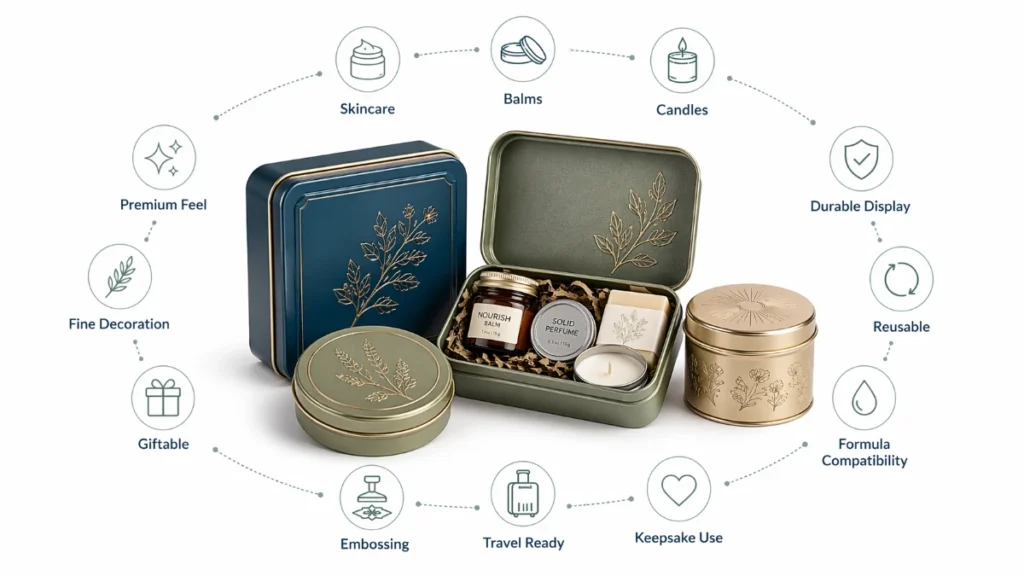
Beauty is often the category where metal packaging creates the most immediate emotional response. Consumers associate rigid metal formats with care, permanence, and value. A metal tin feels intentional. It feels giftable even before the gifting ribbon is added. It also photographs well, travels well, and holds its visual quality better than many lighter alternatives. For brands in skincare, fragrance accessories, balms, solid perfume, soaps, candles, and curated set packaging, these qualities translate directly into commercial advantage.
There are several reasons beauty brands increasingly prefer custom metal tin packaging.
The first is premium perception. Weight, sound, cool touch, and crisp edges all contribute to the feeling that the product is high value. Premium packaging is not only about what the customer sees. It is about what the customer feels when they pick it up, open it, and reuse it. Metal performs strongly across all of those sensory cues.
The second is surface decoration quality. Beauty brands often need exact color control, fine-line artwork, metallic finishes, embossing, soft-touch varnishes, matte/gloss contrast, foil details, and highly disciplined print registration. Metal substrates support these visual effects well, especially when the supplier understands the difference between design intent and mass-production reality.
The third is durability in premium channels. Beauty packs move through boutiques, department stores, subscription boxes, influencer mailers, travel retail, and e-commerce. They may be opened and closed multiple times before sale. They may sit under display lighting. They may also be purchased for gifting. A metal package helps the product survive those conditions while still looking premium at the moment of unboxing.
The fourth is reuse. A well-designed beauty tin often becomes a keepsake container for jewelry, accessories, hair clips, cotton pads, travel essentials, or refillable product formats. That reuse behavior is not only good for sustainability messaging. It extends brand exposure into the customer’s daily life.
Beauty projects do, however, require a different kind of technical attention from food projects. Direct food-contact migration rules are not the main question, but compatibility and product safety substantiation still matter. FDA’s MoCRA page explains that the responsible person must maintain records supporting adequate safety substantiation of cosmetic products. FDA also notes in its guidance on authority over cosmetics that safety can be substantiated through relevant data and appropriate testing. In plain packaging language, that means the brand owner cannot assume the container is harmless simply because it looks premium. The packaging must be appropriate for the formula and intended use.
Beauty applications that work especially well in tins
| Beauty or personal care use case | Packaging goal | Why a custom tin helps |
|---|---|---|
| Solid perfume, balm, salve, wax-based care | Portable premium pack with easy opening | Small tins support elegant portability and strong gifting appeal. |
| Skincare or fragrance gift set | Secondary rigid pack for presentation and protection | Tins turn a set into a keepsake object and improve display quality. |
| Candles, aromatherapy, wellness kits | Structure, decoration, retail presence | Metal packaging supports premium finish options and stronger e-commerce protection. |
| Soap bars and grooming accessories | Brandable reusable storage format | A tin adds post-purchase usefulness and strengthens the premium feel. |
| Limited-edition beauty campaigns | Collectibility and strong seasonal storytelling | Custom artwork, embossing, and edition-specific shapes work especially well on metal. |
The best beauty programs are therefore not designed only for “luxury appearance.” They are designed for appearance, durability, formula compatibility, repeat handling, and a strong unboxing sequence. When those elements come together, custom metal tin packaging becomes a powerful part of the brand experience.
Labeling, inks, and color decisions matter more than many beauty brands expect
Beauty packaging projects often become more complicated during the artwork stage. Marketing wants strong colors, trend-led palettes, metallic effects, regulatory claims, and small-format storytelling. Compliance teams want clear labeling, legible net content statements, appropriate warning language, and documented inputs. These objectives can coexist, but only if the packaging program is managed properly.
In the United States, FDA’s summary of cosmetics labeling requirements is a useful reference because it reminds brand owners that labeling is not an afterthought. Packaging space must be planned to accommodate required information. Tiny tins create a special challenge here because premium design often competes with space for mandatory text. That means dielines and artwork planning should start early, especially when multilingual labels or multiple market versions are involved.
Color selection also deserves more care than many buyers expect. FDA’s color certification guidance states that color additives, except coal tar hair dyes, are subject to approval before they may be used in food, drugs, or cosmetics, and many require batch certification. While outer-pack printing inks and direct-contact cosmetics are not the same thing, the broader compliance lesson is clear: color decisions should never be treated casually in regulated categories. The buyer must understand which materials, coatings, and decorative inputs are appropriate for the intended use and market.
For international beauty programs, this is one more reason to work with a supplier that can speak both design language and regulatory language. A supplier who can only reproduce artwork is not enough. A supplier should be able to discuss labeling zones, finish durability, scratch resistance, insert choices, and whether decorative decisions create unnecessary production risk. That is especially important for beauty launches where packaging consistency is tightly linked to brand trust.
Custom metal tin packaging is strong in beauty precisely because it can unite design ambition with production discipline. But that only happens when the project is managed as an engineered packaging program rather than a one-off visual exercise.
Why gift, promotional, and holiday brands benefit so much from metal tins
Gift and promotional packaging is where custom metal tin packaging often outperforms other rigid options on pure emotional value. A gift tin does not behave like disposable packaging. It behaves like part of the gift. That changes how the customer experiences the product and how long the pack remains in use.
For seasonal and promotional brands, reuse is a major commercial advantage. A cardboard pack is usually thrown away quickly. A metal tin is often kept. It may become a memory box, desk organizer, tea canister, jewelry case, or storage container for everyday items. That means the brand stays in the customer’s environment longer. In practical marketing terms, the package becomes a durable media object.
This is one reason tins work so well for holidays, commemorative editions, tourist products, corporate promotions, and collaboration launches. They support story-driven graphics and they retain perceived value after the original contents are gone. Limited-edition artwork feels more meaningful on a metal object than on a disposable carton because the customer assumes the object is worth keeping.
Gift programs also benefit from the structural strength of tins. A premium gift should arrive looking intentional, not crushed. E-commerce has made this issue bigger. Many gift packs now ship directly to the end recipient. If the outer presentation arrives dented or scuffed, the emotional moment is lost. Custom metal tin packaging reduces that risk and protects the “first look” better.
Holiday programs gain another advantage from metal: visual versatility. Tins support deep colors, metallics, embossing, nostalgia-driven graphics, minimalist luxury looks, child-focused illustration, or collectible series designs. A brand can keep the same proven tin structure across several campaigns while changing only the artwork and finishing stack. That supports both speed and cost control across recurring launches.
This is also where creative design content from Mr.Tin.Box becomes commercially useful. Articles such as 10 Creative Custom Metal Tin Packaging Design Ideas help explain why pattern, surface texture, shape, and compartment design matter for shelf visibility and reusability. Likewise, the broader premium trend discussion in Metal Packaging Trends for Premium Consumer Goods is directly relevant to gift packaging because it connects material choice to trust, tactile experience, and repeat purchase.
For buyers planning a promotional or holiday project, the key is not simply to choose a “nice tin.” It is to define what the tin must achieve. Is the goal stronger perceived value at retail? Better delivery protection? A collectible series? A reusable branded object? A higher-end corporate gift? Once that is clear, the size, finish, insert design, and artwork language can be specified around a real commercial outcome.
Design choices that change both aesthetics and performance
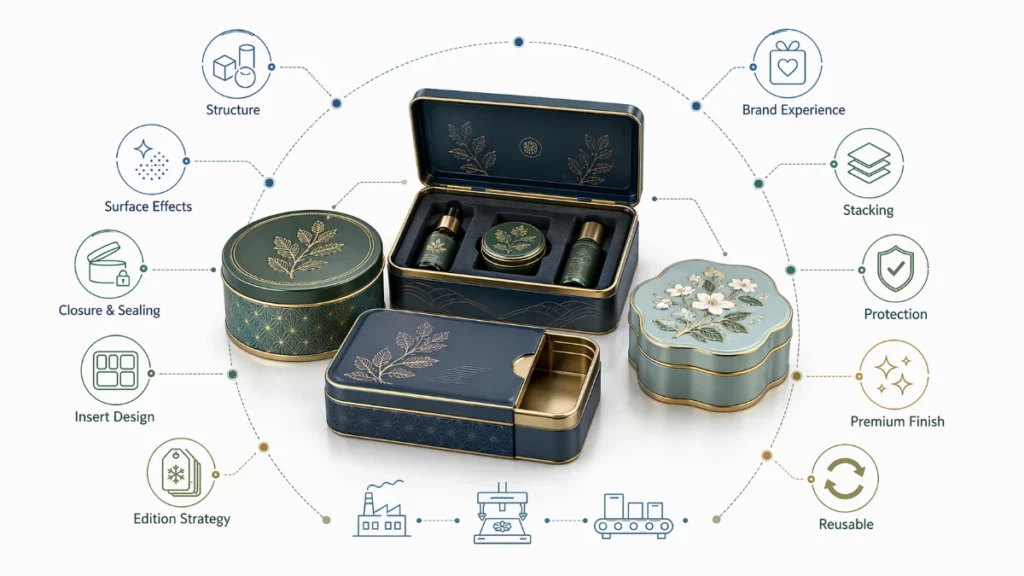
A common mistake in custom metal tin packaging is to treat decoration and engineering as separate decisions. They are not separate. The shape affects cost, stacking, and logistics. The closure affects barrier performance and customer experience. The finish affects scratch visibility, premium feel, and print risk. The insert affects product protection, assembly time, and unboxing quality. Good programs succeed because these elements are designed together.
The first major design decision is structure. Round tins, rectangular tins, square tins, heart shapes, hexagons, sliding lids, hinged lids, slip lids, and window tins each create different manufacturing and commercial outcomes. A round tin may be simpler and more cost-efficient for some products. A shaped gift tin may cost more but create stronger shelf distinction. A hinged-lid design may feel more premium for reuse, while a removable lid may be better for filling efficiency or long-term storage.
The second design decision is surface effect. Printing alone can create strong branding, but premium tins often go further with embossing, debossing, spot gloss, matte varnish, pearl effects, textured coatings, or metallic accents. These details are not purely decorative. They influence how a customer interprets the product’s price point and quality before opening it. A buyer should therefore decide which visual cues matter most: luxury restraint, playful impact, vintage nostalgia, clean wellness, or festive collectibility.
The third decision is closure and sealing. For food and other sensitive products, closure design is where performance is won or lost. For beauty and gift products, closure design also influences tactile quality and reuse. Tight-fitting lids, friction closures, gasketed systems, or specialty mechanisms each change both user perception and manufacturing route. The right closure is usually category-specific.
The fourth decision is internal presentation. Inserts, pads, trays, and partitions are especially important in beauty sets and gifting. They keep products centered, reduce movement, and improve the unboxing sequence. But they also affect sustainability messaging, assembly time, and cost. A clever insert design can make the difference between “beautiful outside” and “premium throughout.”
The fifth decision is edition strategy. Brands that plan to use tins across multiple launches should think in platforms. A proven tin structure can support seasonal graphics, collaboration editions, or market-specific labeling with much lower risk than rebuilding the structure every time. This is often the smartest way to scale custom metal tin packaging: stabilize the engineering, then refresh the story.
Design therefore works best when it starts with a technical brief and ends with a brand experience. Not the other way around.
Sustainability and circularity: why metal remains a serious packaging material
Sustainability claims are easy to make and harder to defend. Buyers are now expected to talk clearly about recyclability, recovery systems, reusability, material efficiency, and the difference between marketing language and actual waste outcomes. Metal packaging holds up well in that discussion because it combines durability, established recycling routes, and strong reuse potential in one material family.
The public data is important here. The U.S. EPA’s estimate of a 73.8% recycling rate for steel containers and packaging in 2018 shows that steel packaging already participates meaningfully in waste recovery systems. European data reported through Metal Packaging Europe is even more striking, with 82% of steel packaging and 75% of aluminium beverage cans reportedly recycled. These figures do not mean every individual tin is recycled everywhere. They do show that metal packaging is not a speculative circularity story. It is already connected to functioning material recovery streams.
The regulatory context also supports metal. The European Commission’s packaging-waste page explains that the EU Packaging and Packaging Waste Regulation is designed to reduce primary raw-material use, improve recyclability, and make all packaging on the EU market recyclable in an economically viable way by 2030. That policy direction matters because it rewards packaging formats that can be sorted, recovered, and returned to material use at scale. Rigid metal packaging is well positioned in that environment.
There is also an energy argument. Metal Packaging Europe states that recycling one tonne of metal scrap uses substantially less energy than producing metal from virgin raw materials. Exact savings vary by material and route, but the principle is clear: the more efficiently metal returns into production loops, the stronger its climate case becomes.
Custom metal tin packaging also benefits from reuse, which is often a more immediate sustainability advantage than recycling from the customer’s point of view. A gift tin that becomes a household storage object is not instantly entering the waste stream. A tea tin that becomes a refill container extends product life and can support repeat purchase. A beauty set tin that lives on as an accessory box adds value without additional packaging manufacture. These reuse behaviors are especially strong in categories where the tin itself is attractive, collectible, or useful.
That said, sustainability still requires honest design choices. A metal tin overloaded with difficult mixed-material components, unnecessary plastics, or nonfunctional decorative complexity may weaken its circularity performance. The best sustainable tin programs therefore keep the package durable, reusable, and as straightforward to recover as the application allows.
How to source custom metal tin packaging without creating avoidable risk
Sourcing mistakes in packaging are expensive because they often appear late. A quote looks acceptable, a prototype looks good, and then the problems begin during production or shipping. Common failures include inconsistent color, weak fit between lid and body, late tooling changes, denting in transit, insert problems, scratched finishes, and poor documentation around coatings or compliance. These issues are rarely caused by one dramatic error. They usually come from weak project definition at the beginning.
The safest way to source custom metal tin packaging is to normalize the process in stages.
Start with the application brief. Define what the package contains, whether it is primary or secondary packaging, target dimensions, fill method, target market, shelf-life expectation, compliance needs, expected distribution conditions, and desired premium level. This sounds basic, but many bad quotes happen because buyers provide only approximate dimensions and a picture.
Next, define the commercial role of the package. Is it meant to reduce product damage? Increase giftability? Support a refill concept? Upgrade a premium line? Enable a holiday series? Without that commercial role, it is difficult to judge trade-offs intelligently.
Then move into technical normalization. Ask each supplier the same questions. What material do they recommend and why? What coating route would they use? What tolerances do they hold? What testing do they recommend? What documentation can they provide? How do they approach artwork approval, preproduction samples, and cosmetic standards? Can they show previous category experience?
After that, validate the program through samples and testing. A decorative sample is not enough. The right sample strategy depends on the product, but the buyer often needs at least one functional sample round and one final print/finish validation round. Drop testing, closure testing, fit checks, scratch evaluation, odor checks, and shipping simulation can all be relevant depending on the application.
Finally, confirm the change-control and production plan. How does the supplier control color drift? How are tooling changes handled? What is the plan if a coating or insert source changes? How are defects categorized? What packaging method will be used for export cartons? Serious suppliers can answer these questions clearly.
A practical sourcing checklist
| Evaluation area | What strong suppliers usually show | Warning sign |
|---|---|---|
| Brief review | Asks about product, market, compliance, and logistics before quoting | Quotes immediately from size and artwork only |
| Material recommendation | Explains tinplate/aluminum choice, coating logic, and closure options | Uses vague phrases like “food-grade” without technical context |
| Sampling method | Separates functional validation from decoration approval | Treats one visual sample as full validation |
| Quality control | Can describe appearance checks, fit checks, and production controls | Cannot explain how approvals are maintained at scale |
| Documentation | Understands compliance documents and market-specific expectations | Avoids details about coatings, inputs, or standards |
| Logistics thinking | Discusses export cartons, protection, and delivery risk | Assumes the unit pack alone is enough |
| Change management | Has a defined process for revisions and re-approvals | Makes informal changes without documentation |
This sourcing logic is consistent with the broader advice buyers will find in Mr.Tin.Box content about premium packaging and factory selection. The commercial theme is simple: the best packaging supplier is not the one who speaks fastest about price. It is the one who reduces risk across the whole program.
Cost, MOQ, tooling, and lead-time planning
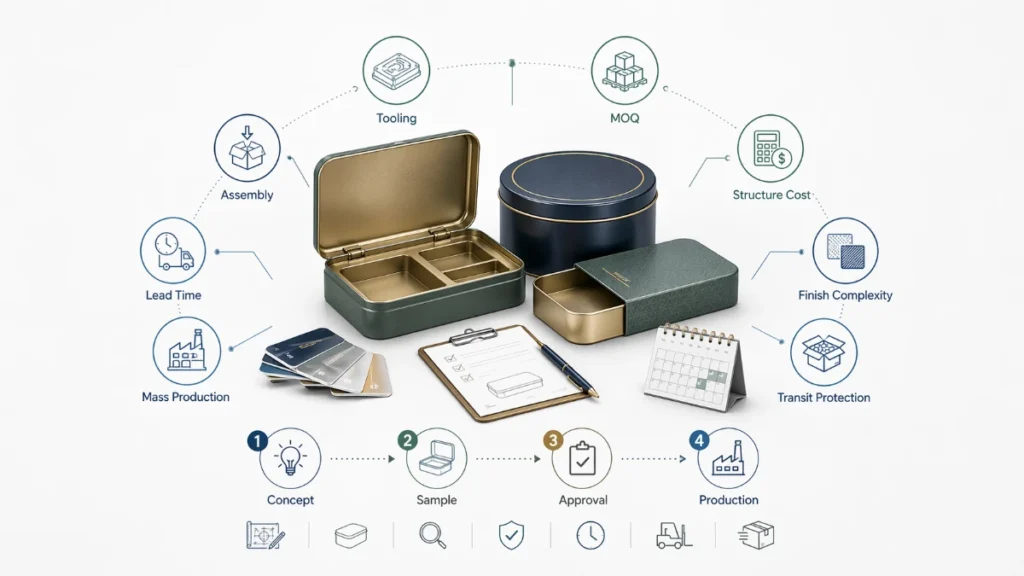
Buyers often ask for a simple number: “How much will a custom tin cost?” In reality, cost is shaped by structure, material thickness, size, tooling complexity, decoration stack, insert design, order quantity, and packaging method. That does not mean cost planning is unpredictable. It means cost planning must be tied to the right variables.
The first major driver is tooling. Standard shapes or close-to-standard forms can often move faster and more efficiently than highly customized geometries. A truly custom shape may create stronger shelf distinction, but it usually increases tooling investment and extends development time. The right choice depends on whether the brand needs unique structure or can get enough differentiation through graphics and finishing.
The second driver is quantity and program horizon. A one-time campaign has a different cost logic from a recurring SKU. A holiday tin ordered once a year may justify higher unit cost if it drives strong seasonal value. A core product line may justify more engineering work up front because the tooling can be amortized over repeat orders.
The third driver is finish complexity. Matte plus gloss contrast, embossing, debossing, specialty coatings, metallic inks, interior printing, or highly demanding color matching all add production steps and quality-control demands. Sometimes those effects are worth every dollar. Sometimes a cleaner, simpler finish creates a stronger premium look with less risk.
The fourth driver is assembly. Inserts, partitions, wrapped components, hand-assembly requirements, and accessory packing all influence labor cost and lead time. Brands should therefore define whether the tin is shipped empty, partially assembled, or as a completed set.
The fifth driver is delivery protection. Export carton design, inner wrapping, anti-scratch measures, and master-carton loading should not be treated as optional extras. Good transit packaging prevents hidden losses and preserves premium appearance at the destination.
Lead time follows the same logic. Sampling and production timelines depend on whether tooling already exists, whether the artwork is final, whether the finish is straightforward, and whether the pack requires multiple validation rounds. Buyers who plan early almost always get better commercial outcomes than buyers who rush a custom program after marketing deadlines are fixed.
A practical way to manage this is to plan the project in four stages: concept confirmation, technical sample, final sample approval, and mass production. Each stage should have a defined owner, review standard, and change cutoff. That turns custom metal tin packaging from a stressful creative exercise into a manageable supply-chain project.
Why Mr.Tin.Box is commercially relevant for this category
A strong article on custom metal tin packaging should not end with general theory. Buyers need to know how the category thinking turns into a usable supplier proposition. This is where Mr.Tin.Box is relevant.
The site already presents the company as a specialist in premium custom metal packaging for global brands, with dedicated positioning across food, beauty, gift, and specialty applications. The category pages for Food & Beverage Packaging and Beauty & Personal Care Packaging reflect exactly the kind of category specialization that serious buyers want to see. Food brands need a supplier who understands airtightness, shelf stability, and food-contact logic. Beauty brands need a supplier who understands premium appearance, inserts, surface quality, and repeatable decoration. Gift brands need a supplier who can translate creative concepts into robust structures that survive real logistics. A generalist supplier may offer all categories, but a category-aware supplier usually executes them better.
The company’s knowledge content is also commercially useful because it teaches buyers how to think, not just what to buy. A page like Why Metal Packaging Boosts Shelf Life and Brand Value helps explain the dual role of packaging as both protection and brand asset. Metal Packaging Trends for Premium Consumer Goods frames metal packaging within premiumization, regulation, circularity, and gifting trends. 10 Creative Custom Metal Tin Packaging Design Ideas provides more visual and structural inspiration relevant to seasonal and promotional packaging. This matters for SEO, but it also matters for lead quality: educated buyers ask better questions and usually build better projects.
From a commercial perspective, the most important message is that Mr.Tin.Box can be positioned not just as a factory that makes tins, but as a partner that helps brands make better packaging decisions. That positioning is especially powerful for B2B buyers who are balancing marketing demands, quality expectations, and international compliance pressures at the same time.
In practical terms, that means the strongest sales proposition is not “we can print your logo on a tin.” The stronger proposition is “we can help you define the right custom metal tin packaging structure for your product, market, visual goal, and supply chain.” That is the language serious buyers trust.
A strategic framework for choosing the right tin program
When a brand is deciding whether to move forward with custom metal tin packaging, it helps to use a simple strategic framework. Ask five questions.
First, does the product gain measurable value from barrier, rigidity, or reusability? If the answer is yes, metal deserves serious consideration.
Second, does the category compete on premium feel, gifting, or tactile differentiation? If the answer is yes, tins often create a stronger commercial return than lower-value packaging formats.
Third, does the distribution model include export, e-commerce, long shelf cycles, or seasonal inventory? If yes, stronger packaging may reduce hidden losses and improve the consistency of product presentation.
Fourth, is the target market putting more pressure on recyclability, recovery, or packaging legitimacy? If yes, metal’s circularity profile becomes strategically more valuable.
Fifth, can the program be engineered and sourced with enough discipline to support repeatable quality? If no, even a beautiful concept will become a risky project. That is why supplier selection matters so much.
This framework is useful because it brings packaging back to business logic. Custom metal tin packaging is not automatically the right answer for every SKU. But when the product benefits from protection, premium presentation, and reuse, it becomes one of the most commercially persuasive options available.
Final thoughts
Custom metal tin packaging sits at an important intersection of branding, product protection, compliance, and sustainability. That is why it continues to grow in relevance for food, beauty, and gift brands. Food companies use tins to protect aroma, texture, and shelf-life performance while strengthening premium retail presence. Beauty brands use them to deliver tactile value, durable presentation, and memorable unboxing experiences. Gift and promotional brands use them because a metal tin can outlive the campaign itself, turning packaging into a keepsake rather than waste.
Public data supports the category. U.S. and European recycling data show that metal packaging is deeply connected to established material recovery systems. EU packaging regulation is moving toward economically viable recyclability across all packaging by 2030. FDA and EU food-contact rules confirm that compliance must be built into the material and manufacturing choices, not added later. USDA shelf-stability guidance shows why durable packaging systems matter commercially. OECD plastics data adds another layer of pressure on brands to justify packaging choices with more credibility.
For serious B2B buyers, the conclusion is straightforward. Custom metal tin packaging is strongest when it is approached as a system: the right material, the right structure, the right coating route, the right decoration strategy, the right supplier, and the right quality controls. When those pieces align, a tin does more than hold a product. It protects product value, raises perceived quality, improves gifting and reuse potential, and helps the brand compete with more confidence.
That is the real opportunity for brands working with Mr.Tin.Box. The opportunity is not just to order a container. It is to build packaging that sells better, travels better, lasts longer, and remains relevant in a market that now demands more from every packaging decision.