

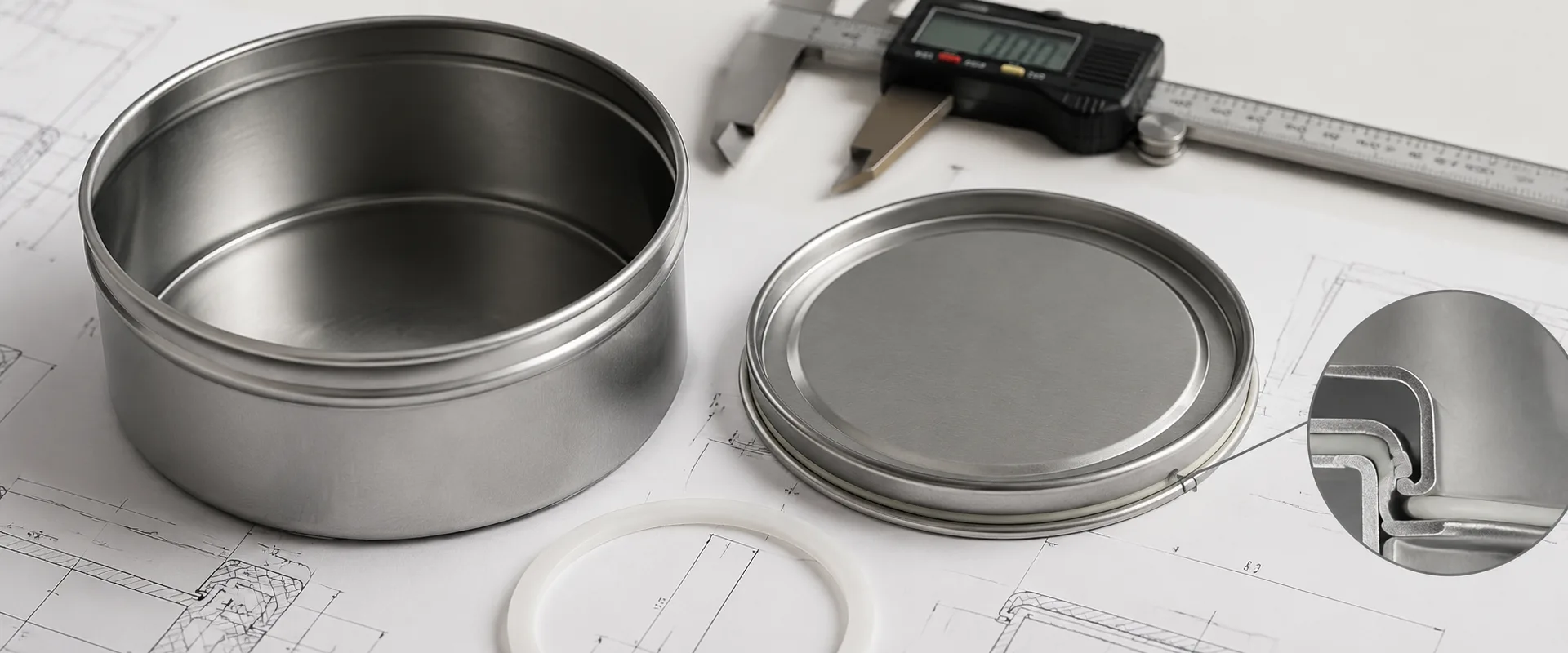

The lid fit of a tin packaging container is determined by the dimensional relationship between the lid and body. For airtight metal containers, dimensional tolerances influence the contact condition, opening force, closing force, lid retention, and the ability of the closure to limit air and moisture exchange.
A tin packaging lid is not controlled by its nominal diameter alone. The final closure condition is affected by tinplate thickness, forming deformation, curl geometry, lid-to-body clearance, coating thickness, tooling accuracy, and production variation. These factors work together to determine how the lid engages with the body.
For tin box lid tolerance, the engineering objective is not simply to make the lid as tight as possible. A closure that is too loose may have insufficient contact, while a closure that is too tight can produce excessive opening force, metal friction, deformation, or damage to the coating.
For tea and coffee packaging, these dimensional relationships become part of the overall closure and barrier system. The metal body provides the package structure, while the lid and body interface determine how the container is opened, closed, and maintained during storage and handling.
Table of Contents
Tin Packaging Lid Fit and Closure Geometry
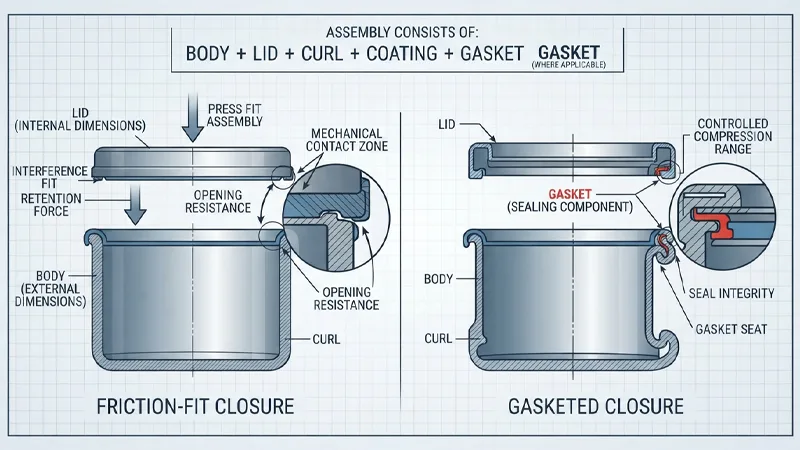
The lid and body of a tin container are designed as a dimensional pair. Their final relationship depends on the geometry of both components rather than on a single measurement.
For a friction-fit closure, the lid is manufactured so that its internal dimensions correspond to the external dimensions of the body. When the lid is pressed onto the body, the two components establish mechanical contact. The amount and distribution of this contact determine the resistance to opening and the retention of the lid.
The same principle applies to containers with a gasket, although the sealing mechanism is different. The lid and body still require controlled dimensions because the gasket can only function within a defined compression range.
The closure therefore needs to be considered as an assembly consisting of the body, lid, curl, coating, and sealing component where applicable.
Lid and Body Dimensional Relationship
The nominal diameter of a lid does not provide enough information to determine its actual fit.
The body has an outside diameter, while the lid has an inside diameter. Their relationship creates the available clearance or interference at the closure interface.
If the body diameter varies around its circumference, the lid may contact some areas more strongly than others. This can produce uneven opening force and inconsistent sealing conditions.
The same issue can occur when the lid is dimensionally consistent but the body curl has variation. The closure condition is therefore affected by both component dimensions and the geometry produced during forming.
Contact Area
Contact area is another part of closure geometry.
A friction-fit lid may contact the body over a defined section of the side wall or curl. Increasing or decreasing the contact length changes the mechanical behavior of the closure.
A longer contact area does not automatically mean better sealing. The actual result depends on the dimensional relationship, surface condition, material properties, and closure structure.
For a gasketed closure, the contact area also determines where the gasket is compressed. The gasket must remain positioned within the intended sealing surface after the lid is closed.
Dimensional Tolerances in Tin Packaging
Dimensional tolerances in tin packaging define the permitted variation around a specified dimension.
No stamping or forming process produces every component at exactly the same dimension. Material thickness, tooling condition, press behavior, forming force, temperature, and production variation can all affect the final dimensions.
The tolerance therefore needs to be established according to the function of the dimension.
A body diameter that has little influence on the closure may have a different tolerance requirement from a dimension that directly controls lid engagement.
Lid-to-Body Clearance
For a basic friction-fit relationship, the difference between the lid internal diameter and the body external diameter creates the dimensional clearance.
The actual closure condition is more complicated because both dimensions have their own tolerances.
For example, if the body is manufactured toward the upper limit of its permitted dimension while the lid is manufactured toward the lower limit, the resulting clearance can become smaller than the nominal design value.
The opposite tolerance combination can produce a larger clearance.
This is why tin box lid tolerance should be considered as a tolerance relationship rather than as an isolated lid dimension.
Tolerance Stack-Up
A tin packaging closure can contain several dimensional variables at the same time.
The body diameter, body curl, lid diameter, lid curl, material thickness, coating thickness, and gasket dimensions can all contribute to the final closure condition.
These dimensions form a tolerance stack-up.
For example, a body diameter variation combined with lid diameter variation can change the effective clearance. If an internal coating is located within the closure interface, its thickness can also influence the available space.
The engineering drawing should therefore identify the dimensions that directly affect closure performance and define their tolerances according to the actual manufacturing process.
Tin Box Lid Tolerance and Opening Force
The opening force of a tin container is related to the mechanical interaction between the lid and body.
For a friction-fit closure, the main variables include clearance, contact area, surface condition, material thickness, and forming accuracy.
If the clearance becomes too small, the contact pressure and friction can increase. The result can be a higher opening force.
If the clearance becomes too large, the lid may have less mechanical retention and reduced contact with the body.
The objective is therefore to establish a dimensional range that produces the required closure behavior.
When the Lid Is Too Tight
A tight lid can be caused by insufficient clearance, dimensional variation, deformation of the body, variation in the curl profile, or changes in material thickness.
The problem may not be visible from the nominal dimensions alone. A body can meet its specified diameter while still producing excessive opening force if its shape is not uniform around the circumference.
A tight closure can also increase friction between metal surfaces. Depending on the surface condition and coating system, repeated opening and closing can influence the condition of the contacting surfaces.
When the Lid Is Too Loose
A loose lid can result from excessive clearance or dimensional variation in the opposite direction.
If the lid does not maintain sufficient contact with the body, the closure can become easier to open but may have reduced retention.
For packaging where the lid is expected to limit air and moisture exchange, the closure condition also needs to be considered as part of the barrier system.
Friction-Fit vs. Gasketed Tin Packaging Closures
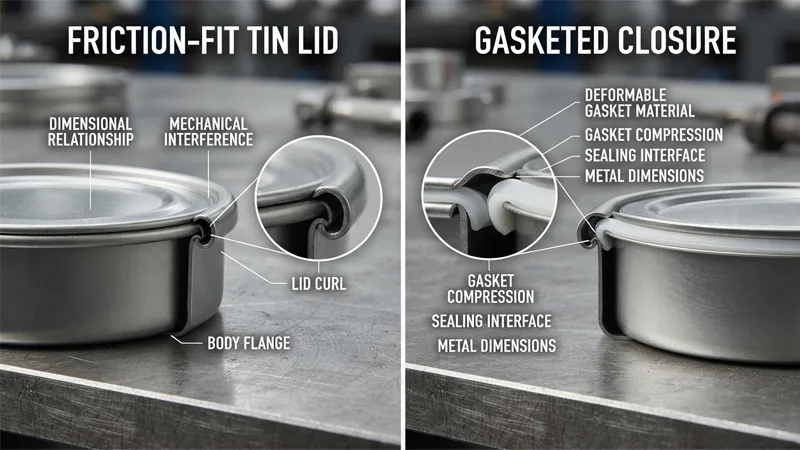
The two closure structures use different mechanisms.
A friction-fit tin lid depends mainly on the dimensional relationship between the lid and body. The lid is retained through mechanical interference and contact between the two components.
A gasketed closure introduces a deformable material between the mating surfaces. The sealing condition is determined by gasket compression together with the dimensions of the lid and body.
Friction-Fit Tin Lid
For a friction-fit tin lid, the internal diameter of the lid and the external diameter of the body are important dimensions.
The curl profile also affects how the lid engages with the body.
The closure must maintain sufficient mechanical retention while allowing the intended opening force. The dimensions should therefore be evaluated together with the forming process that produces them.
Gasketed Closure
A gasketed closure requires control of both metal dimensions and gasket dimensions.
The gasket must be compressed sufficiently to fill the intended interface. If compression is insufficient, a continuous sealing condition may not be established.
If compression is excessive, the opening and closing force can increase, and the gasket can experience greater mechanical deformation.
The gasket material also needs to remain compatible with the product and storage conditions.
Tin Lid Curl Geometry and Closure Performance
The curl is part of the mechanical interface between the lid and body.
During manufacturing, the edge of the metal component is formed into a controlled profile. The resulting curl diameter, shape, height, and position influence how the lid engages with the body.
Curl Diameter
Changes in curl diameter can change the position at which the lid contacts the body.
A difference between the intended curl dimension and the produced dimension can therefore affect closure force and lid retention.
The effect becomes more significant when the curl is directly involved in the sealing interface.
Curl Profile
The profile of the curl determines the shape of the contact area.
A variation in the profile can create localized contact instead of a more uniform contact condition.
For gasketed closures, the curl can also determine where the gasket is positioned and compressed.
Curl Deformation
Curl deformation can occur during forming, handling, stacking, or transport.
If the curl is deformed after production, the lid may no longer engage with the body according to the original dimensional relationship.
This is one reason why closure testing after mechanical handling can provide different results from testing performed immediately after production.
Material Thickness and Tin Packaging Dimensions
Tinplate thickness affects both the structural behavior and forming behavior of the container.
A thinner material can have different stiffness and deformation characteristics from a thicker material. These differences influence how the body and lid respond during forming and subsequent handling.
Material thickness also contributes to the final dimensional relationship of the closure.
For example, when a component is formed around a specified tool profile, the material thickness can influence the resulting geometry. The effect depends on the component design and forming process.
Material selection should therefore be considered together with container dimensions, drawing depth, forming method, closure design, and required mechanical behavior.
Forming Process and Dimensional Variation
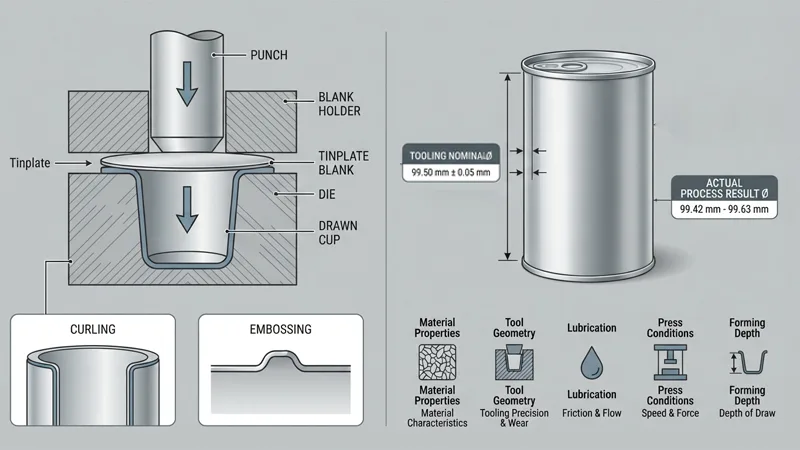
The dimensions of a finished tin container are established through a sequence of manufacturing operations.
Stamping forms the initial component geometry. Drawing can change the diameter and height of the body. Curling creates the edge geometry used by the closure. Embossing can introduce local deformation.
Deep Drawing
Deep drawing changes the shape of the flat tinplate into the required body geometry.
During drawing, the material undergoes deformation and the final wall dimensions can be influenced by material properties, tooling geometry, lubrication, press conditions, and forming depth.
The body diameter produced after drawing is therefore a process result rather than simply a value copied from the tooling drawing.
Stamping
Lid components are commonly produced through stamping operations.
The stamping process determines the lid dimensions, including the geometry that later interacts with the body.
Tool wear or changes in process conditions can gradually influence these dimensions during production.
Curling
Curling creates the final edge profile of the lid or body.
Because the curl can be part of the closure interface, variation in curling can influence lid engagement and opening force.
The curling process therefore needs dimensional control where the curl directly affects the closure.
Tin Packaging Tolerance Stack-Up
Tin packaging tolerance stack-up describes the combined effect of multiple dimensional variations within the closure.
Consider a basic lid and body assembly. The body has a specified external diameter with an allowable tolerance. The lid has a specified internal diameter with its own tolerance. Both components may also have variation in their curl geometry.
If a coating or liner occupies part of the interface, its thickness can introduce another variable.
The final closure condition is therefore determined by the combined dimensional range.
A useful engineering approach is to identify the dimensions that directly influence the closure and calculate the possible minimum and maximum conditions before tooling is released.
This can identify a potential tight-fit condition and a potential loose-fit condition before mass production.
Tolerance stack-up is particularly important when the container uses several formed components because each additional component introduces another dimensional relationship.
Coating Thickness and Lid Fit
The internal and external coating systems can also be relevant to tin packaging dimensional tolerances when they are located within a functional interface.
A coating applied to a surface adds a small amount of material to the substrate. In most areas of a tin container, this may have little influence on the final package dimensions.
However, if the coated surface forms part of a close mechanical interface, the coating thickness should be considered during design.
The same principle applies to printing and external varnish when these layers are located near a lid or closure interface.
For a friction-fit closure, the engineering dimensions should be based on the actual finished component condition rather than assuming that the metal substrate exists without its coating system.
Embossing and Tin Packaging Dimensional Tolerances
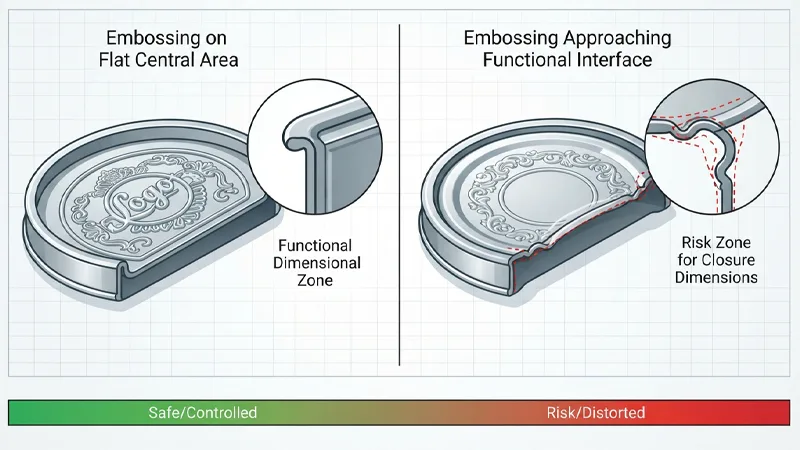
Embossing changes the local geometry of the tinplate.
When embossing is located on the flat central area of a lid, its effect on the closure may be limited. When it approaches the curl or other functional interface, the resulting deformation can become relevant to the lid fit.
The position, depth, and geometry of the embossing should therefore be considered during DFM.
The objective is not to prohibit embossing near every edge. Instead, the engineering drawing should distinguish between decorative areas and functional dimensional zones.
Closure dimensions should remain controlled in the areas that determine lid engagement and sealing.
Inspection of Tin Packaging Dimensions
Dimensional inspection provides information about whether the finished components remain within their specified ranges.
For a tin container, body diameter can be measured at defined positions around the circumference. Measuring at more than one position can help identify variation caused by forming or deformation.
Lid diameter can be evaluated in the same way. The measurement should represent the actual functional dimension used in the closure rather than an unrelated external dimension.
Curl dimensions can also be inspected because the curl profile may directly influence the lid-to-body relationship.
For production control, the measurement method should be defined so that different operators and inspection equipment obtain comparable results.
Tin Box Opening Force and Closing Force
Tin box opening force is a practical measurement of the mechanical relationship between the lid and body.
Opening force can change when the lid-to-body clearance changes. It can also change when the contact area, curl profile, material thickness, surface condition, or gasket compression changes.
Closing force should be considered at the same time.
A closure that requires very low closing force may have insufficient mechanical engagement. A closure that requires excessive closing force may create problems during filling, assembly, or consumer use.
The opening and closing forces should therefore be evaluated together with the dimensional measurements and sealing requirements.
Repeated opening and closing can also be used to evaluate whether the closure behavior remains within the intended range after use.
Failure Modes in Tin Packaging Closure Design
Lid Too Loose
A loose lid can result from excessive clearance, undersized body dimensions, oversized lid dimensions, curl variation, or deformation during handling.
The result may be reduced lid retention and a change in the closure interface.
Lid Too Tight
A tight lid can result from insufficient clearance, oversized body dimensions, undersized lid dimensions, curl deformation, or process variation.
The result can be increased opening force and increased friction between contacting surfaces.
Uneven Lid Fit
An uneven lid fit can occur when the body or lid is not sufficiently round or when the curl profile varies around the circumference.
The lid may then contact one area more strongly than another.
This can create inconsistent opening force and may affect the sealing condition where the closure is intended to provide a barrier.
Inconsistent Opening Force
Variation in opening force can result from dimensional variation, material thickness variation, forming variation, surface condition, or changes in gasket compression.
If the same nominal dimensions produce different opening forces, the dimensional inspection should be combined with an examination of forming and surface conditions.
Closure Damage During Transport
A finished tin can experience mechanical loads during stacking, handling, and transport.
If the lid or body is deformed, the original dimensional relationship can change.
The sequence can therefore be:
Mechanical impact → dimensional change → closure change → opening-force change or leakage
Transport evaluation can be useful when the closure is an important part of the package barrier system.
DFM Considerations for Tin Packaging Lid Design
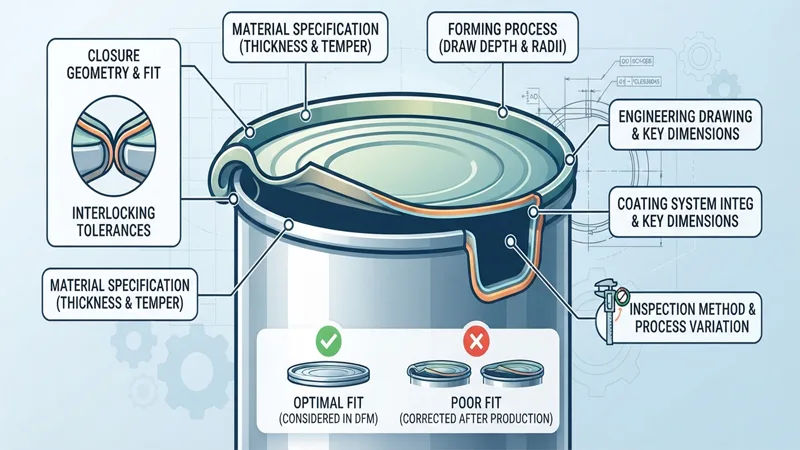
The lid fit should be considered during the DFM stage rather than corrected only after mass production begins.
The material specification, tooling dimensions, forming process, coating system, closure geometry, and inspection method should be considered together.
The engineering drawing should identify the dimensions that directly affect the closure. These dimensions should have tolerances that can be maintained by the intended manufacturing process.
Tooling should also account for expected material and process variation. A tool dimension should not be selected only from the nominal finished-product dimension without considering forming behavior and material thickness.
This approach reduces the risk of designing a closure that works at one dimensional condition but becomes difficult to control across production variation.
Validation of Tin Packaging Closure Dimensions
Closure validation should begin with the actual finished components.
During prototype and tooling trials, the lid and body dimensions can be measured before assembly. The measured values can then be compared with the engineering drawing.
After dimensional verification, the components can be assembled and evaluated for lid fit, opening force, and closing force.
Where the package requires a sealing function, leakage testing should then be performed using the actual closure configuration.
For gasketed containers, the gasket condition should also be evaluated because the metal dimensions alone do not determine the sealing result.
If the package is expected to experience mechanical handling during distribution, transport simulation or mechanical testing can be followed by another closure and leakage evaluation.
The purpose is to determine whether the dimensional and sealing relationships remain within the specified range after the expected handling conditions.
Conclusion
Tin packaging lid fit and dimensional tolerances are directly related to the mechanical and sealing behavior of the finished container.
The lid and body must be treated as a dimensional pair. Their relationship is affected by diameter, clearance, curl geometry, material thickness, coating thickness, forming deformation, and production variation.
For a friction-fit tin lid, dimensional interference and contact geometry determine the mechanical retention and opening behavior. For a gasketed closure, the same dimensional control is combined with gasket compression and sealing-surface geometry.
Tolerance stack-up is also important because the final closure condition results from several dimensions acting together. Body diameter, lid diameter, curl geometry, coating thickness, and gasket dimensions can all contribute to the final fit.
The manufacturing sequence also influences the result. Stamping, drawing, curling, embossing, coating, and assembly can each introduce dimensional variation.
For this reason, tin box lid tolerance should be defined during the engineering and DFM stages, measured on finished components, and validated through closure and leakage testing where required.
The basic engineering relationship can be summarized as:
Material → Tooling → Forming → Dimensions → Tolerance Stack-Up → Lid Fit → Opening Force → Sealing Performance
A tin container should therefore not be evaluated only by whether the lid can be opened and closed. The dimensional relationship between the lid and body is part of the overall package design and needs to be controlled according to the intended closure function.
FAQ
What is lid-to-body clearance in tin packaging?
Lid-to-body clearance is the dimensional relationship between the internal dimension of the lid and the external dimension of the body at the closure interface. The actual clearance depends on the container geometry and the tolerances of both components.
Why is my tin box lid too tight?
A tin box lid can become too tight because of insufficient clearance, dimensional variation, body deformation, lid deformation, curl variation, or changes in material and forming conditions.
Why does a tin box lid become loose after production?
A loose lid can result from excessive clearance, dimensional variation, curl variation, or deformation during handling and transport. Repeated opening and closing can also change the contact condition in some closure structures.
What affects tin box opening force?
Opening force is influenced by lid-to-body clearance, contact area, curl geometry, material thickness, surface condition, forming accuracy, and gasket compression where a gasket is used.


