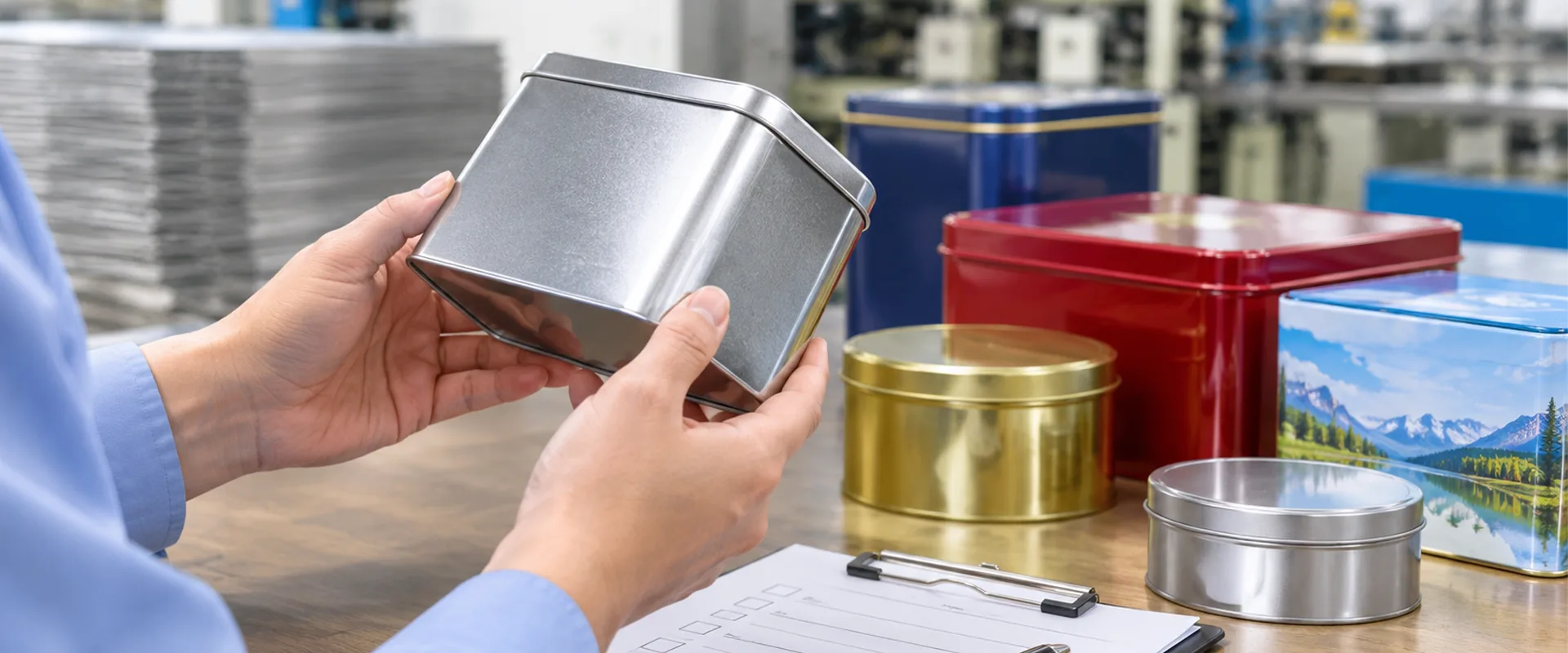
Tin box manufacturer selection criteria are the checks a buyer applies before ordering custom tin boxes: capacity, cost structure, quality system, material, compliance documents and lead time. A tin box is a container made from tinplate, and a factory that makes it needs the right equipment, tooling and documents for the product. This article lists each criterion, the question to ask, and the document that confirms the answer. It applies to tin box manufacturers in any country, including the United States, Europe and China, and it follows the production steps covered in earlier articles on tin packaging forming processes, tooling and testing and validation.
Table of Contents
Why tin box manufacturer selection criteria matter
Two quotations for the same tin can differ by more than the unit price. One may include the mould and plates, and the other may not. One may state the metal thickness, and the other may leave it open. Without written tin box manufacturer selection criteria, the buyer compares numbers that do not describe the same product.
A fixed set of criteria gives each supplier the same questions and the same document requests. It also links the buying step to the production steps that follow it. Problems such as dimensional variation, cracking and wrinkling usually start in tooling, material or forming settings, and the buyer can ask about each of these before the order, not after the first shipment.
The criteria below follow the order of a purchase: product fit, capacity, cost, quality system, material, compliance, samples, shipping terms and references. Each section names the document that confirms the answer.
Confirm the product type and what the manufacturer produces
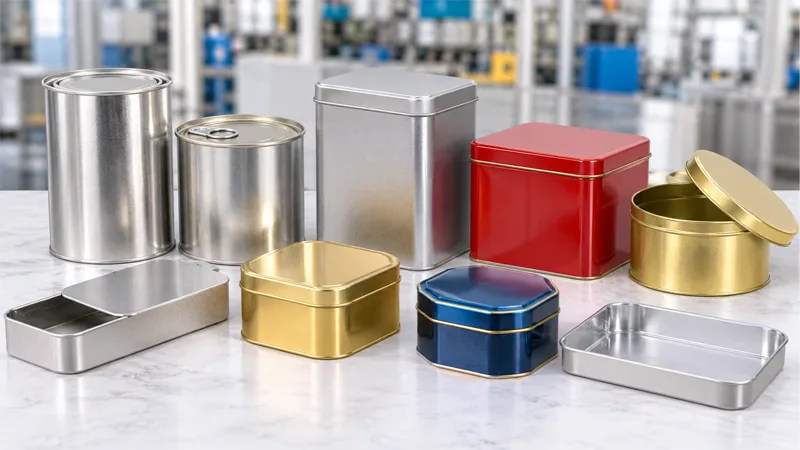
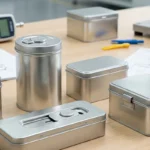
Tin packaging covers several constructions, and a factory usually specializes in some of them:
- Two-piece and three-piece cans: cylindrical bodies, with a seam or a drawn wall.
- Hinged and slip-lid boxes: rectangular, square, round and shaped boxes made from flat sheet.
- Child-resistant tins: boxes with a locking closure.
- Trays and lids: flat or shallow parts.
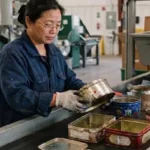
Ask for a list of the shapes and closure types the factory has made in the last two years, with photos. A factory that has not produced a similar construction will need a new mould and a longer sampling period.
Check production capacity and equipment
| Item | Question to ask | What confirms it |
|---|---|---|
| Printing | Which printing method, and how many colours per pass? | Equipment list, printed sheet sample |
| Forming | How many presses, and what tonnage? | Factory visit or video audit |
| Monthly output | How many pieces per month for this shape? | Production schedule for a similar order |
| In-house tooling | Does the factory make its own moulds? | Tooling workshop record |
| Existing moulds | Is there a mould with the same dimensions? | Mould list with dimensions |
Capacity is stated per shape, because output per hour differs between a round drawn tin and a hinged rectangular box.
Ask how the factory controls forming equipment over a long run. Die wear changes dimensions and closure fit gradually, so a sample made at the start of a run does not show the condition of the tools at the end. The same applies to forming processes such as stamping, drawing and curling, which set wall thickness and edge shape.
Compare minimum order quantity and tooling cost
MOQ depends on printing setup and moulds. For custom designs, the quantity is set per design and sometimes per colour variant.
| Cost element | Type | Notes |
|---|---|---|
| Mould (tooling) | One time | Not charged if an existing mould is used |
| Printing plates or screens | One time per artwork | Charged again when artwork changes |
| Unit price | Per piece | Depends on size, metal thickness, printing, finishing and quantity |
| Inserts, liners, gaskets | Per piece | Quoted separately in some cases |
| Packing | Per carton or pallet | Depends on carton layout |
| Freight | Per shipment | Depends on incoterm |
Ask for a quotation that separates these lines. A quotation with one total price cannot be compared between suppliers.
The mould is the largest one-time item for a new shape. What sets its price is covered in tin packaging tooling cost, and the design side is covered in tin packaging tooling. Ask who owns the mould after payment, where it is stored, and whether it can be moved to another factory.
Review the quality system
| Document | What it covers |
|---|---|
| ISO 9001 | Quality management system |
| BRCGS Packaging Materials or FSSC 22000 | Hygiene and food safety management for packaging production |
| Third-party test report (for example from SGS or a comparable lab) | Results for a specific product, issued by an outside laboratory |
| Inspection plan | Which checks are done, how often, and the sampling level (for example AQL under ISO 2859-1) |
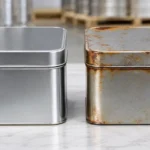
A certificate shows that a system exists at a site. A test report shows results for one product. Buyers check the certificate’s scope, site address and expiry date, and ask for a test report for the same material and coating as the order.
ISO 9001 certifies a management system, not a single product. Food safety schemes for packaging production, such as BRCGS Packaging Materials, add hygiene requirements for the site. For incoming and final inspection, ask which sampling plan is used. The acceptable quality limit (AQL) sets how many defective pieces in a sample are allowed before a lot is rejected. Test methods for leak, dimension and closure performance are described in tin packaging testing and validation.
5. Check material and coating
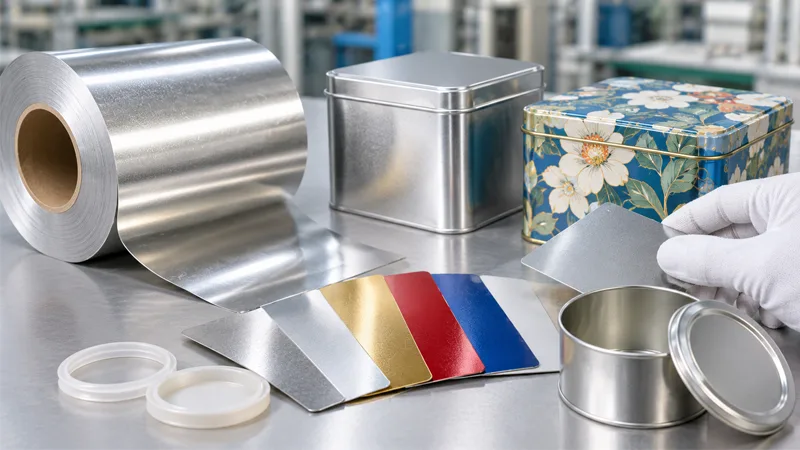
- Base metal: tinplate or tin-free steel, and the thickness in millimetres.
- Inner coating: for food, tea, coffee and cosmetics, ask for the coating type and the supplier’s declaration of compliance.
- Outer coating and varnish: ask for the cure method and the adhesion test result.
- Plastic or silicone parts: ask for the material grade and the compliance statement.
Material details are the base of every later check. Tinplate is steel with a thin tin layer, and the coating system on top of it decides whether the tin suits food contact. For tea, coffee and other products that need an airtight closure, see hermetic metal packaging. For coatings and migration, see food grade tin packaging.
Match compliance documents to the destination market
| Market | Common requirement for food contact | Document to request |
|---|---|---|
| United States | FDA food contact regulations (for example 21 CFR for coatings) | Coating supplier’s letter of compliance |
| European Union | Framework Regulation (EC) No 1935/2004 and good manufacturing practice under (EC) No 2023/2006 | Declaration of compliance for the finished tin |
| Other markets | Local food contact rules | Test report issued for that market |
For child-resistant tins, ask which test standard applies in the destination market and request the test report for the exact model, as described in the child-resistant tin article on this blog.
Primary sources for the rules named above: Regulation (EC) No 1935/2004 on materials in contact with food, Regulation (EC) No 2023/2006 on good manufacturing practice, and 21 CFR Part 175 for adhesives and coatings used in food contact in the United States. Rules change, so confirm the current text for the destination market before ordering.
Request samples in the right order
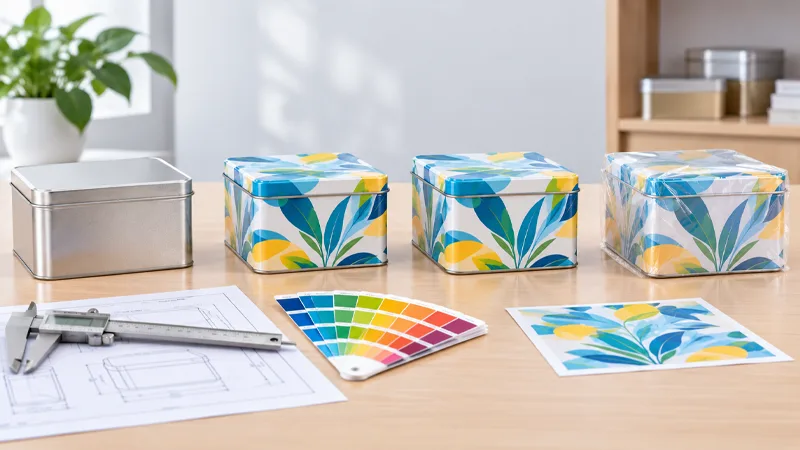
- White sample or existing sample: to check size, closure and metal thickness.
- Printed sample: to check colour against the reference, with ΔE if a colour target exists.
- Pre-production sample: made from the production mould and printing setup, to approve before mass production.
- Shipment sample: taken from the finished order, for the buyer’s own inspection.
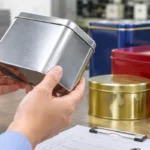
Colour on metal differs from paper, so the buyer approves the colour on tinplate. Dimensions and closure fit are checked against the drawing, including the tolerances described in the lid fit article.
Closure fit is the check most affected by tolerance. The measurement points and the allowed variation are explained in tin packaging lid fit and dimensional tolerances, and seam quality is covered in tin packaging seams and joints.
Confirm lead time, packing and shipping terms
| Item | What to confirm |
|---|---|
| Sampling time | Days from approved drawing to sample |
| Mould time | Days to make a new mould |
| Production time | Days from sample approval and deposit to finished goods |
| Packing | Pieces per inner carton, cartons per master carton, pallet layout |
| Terms | Incoterm (for example FOB, CIF, DDP), payment terms, who handles customs |
| Claims | How defects found on arrival are reported and settled |
Incoterms define who pays for freight and insurance and where risk passes to the buyer. The contract names the term and the named place, for example FOB with the port of loading.
Check references and track record
- Request two or three customers in the same industry, or order records for a similar product.
- Check whether the company name, address and licence in the contract match the factory that produces the order. Some suppliers are trading companies that place orders with factories, which is not a problem if the contract and the quality responsibilities state it.
- Arrange a factory audit or a video audit if the order value justifies it.
How to score suppliers with tin box manufacturer selection criteria
Weighted scoring turns the criteria into one comparable number per supplier. The buyer sets the weights before collecting quotations, so that the result does not follow the price alone. The weights below are an example. Change them to match the project, for instance a higher weight on compliance for food tins.
| Criterion | Example weight | Score (1–5) | Evidence used |
|---|---|---|---|
| Product fit | 15% | Photos and records of similar tins | |
| Capacity and equipment | 10% | Equipment list, audit | |
| Cost structure and MOQ | 20% | Itemised quotation | |
| Quality system and testing | 20% | Certificates, test reports | |
| Material and coating | 10% | Specification sheet, declarations | |
| Compliance documents | 10% | Documents for the destination market | |
| Lead time and packing | 10% | Production schedule, packing list | |
| References | 5% | Customer contacts, order records |
Multiply each score by its weight, add the results, and divide by 100. A supplier that scores 1 on compliance documents is excluded, whatever the total.
What to send in a request for quotation
A quotation request that states the same details to every supplier produces quotations that can be compared. Include:
- Drawing or dimensions in millimetres (length, width, height, lid height)
- Shape, closure type and any inserts or liners
- Metal type and thickness, or a request that the supplier states them
- Inner and outer coating requirements, and the food contact rule that applies
- Artwork file, number of colours, and special effects such as embossing or varnish
- Order quantity, and the quantities for any price breaks
- Packing requirement and destination port
- Required delivery date and the documents needed
- Whether a sample is needed before mass production
Ask each supplier to answer line by line and to state any item it cannot meet.
Common mistakes when applying tin box manufacturer selection criteria
- Comparing unit prices without checking whether the mould, plates and packing are included.
- Accepting a certificate without reading its scope, site and expiry date.
- Approving artwork colour on a screen, not on printed tinplate.
- Skipping the pre-production sample to save time.
- Not stating the destination market, so the compliance documents do not match the rules there.
- Leaving mould ownership and storage out of the contract.
Tin box manufacturer selection criteria checklist
| Check | Done |
|---|---|
| Product type matches the factory’s past production | ☐ |
| Capacity stated per shape and per month | ☐ |
| Quotation split into mould, plates, unit price, packing, freight | ☐ |
| Certificate scope, site and expiry checked | ☐ |
| Material, thickness and coating stated in writing | ☐ |
| Compliance documents match the destination market | ☐ |
| Pre-production sample approved before mass production | ☐ |
| Lead time, packing and terms in the contract | ☐ |
| References or audit completed | ☐ |
Frequently asked questions
What is the usual minimum order quantity for custom tin boxes?
It depends on the shape, the printing and the mould. Quantities of 1,000 to 5,000 pieces per design are common, and the manufacturer sets the exact figure in the quotation.
How long does it take to produce custom tin boxes?
The time depends on whether a new mould is needed. Mould making and sampling come first, and mass production starts after the sample is approved.
Should a buyer choose a domestic or an overseas manufacturer?
The choice depends on quantity, lead time, freight cost, import duty and compliance requirements. Domestic production shortens transport time. Overseas production is often used for larger quantities and shaped boxes. The checklist above applies to both.
Is a trading company different from a manufacturer?
A trading company places orders with factories. A manufacturer owns the production lines. Both can supply tin boxes. The buyer confirms who is responsible for quality, claims and compliance documents.
Which documents should a buyer request for food tins?
Certificate of the quality system, declaration of compliance for the inner coating and the finished tin, and a test report for the destination market.