

Sustainable packaging has become part of the procurement and compliance process for many international packaging projects. For brand owners, importers, food manufacturers, cosmetics companies, industrial product manufacturers, and retailers, packaging specifications increasingly cover more than appearance, product protection, unit cost, and production capacity. Material composition, recyclability, recycled content, packaging weight, carbon emissions, end-of-life treatment, and regulatory requirements can all become part of the supplier evaluation.
Metal packaging is one of the material systems being considered in this context. Tinplate, tin-free steel, and aluminum are used for cans, tins, boxes, closures, and other rigid packaging formats. Their sustainability characteristics are closely connected with material recovery, recycling infrastructure, durability, manufacturing efficiency, and the possibility of returning recovered metal to industrial production.
At the same time, recyclability alone does not determine the environmental performance of a package. Package weight, material thickness, forming process, coating system, printing, transportation, product-to-package ratio, expected service life, collection system, and recycling route can all affect the result.
For B2B buyers, the practical question is therefore not simply whether a package is made from a recyclable material. The more useful approach is to evaluate the complete packaging system: how much material is used, how the package is manufactured and transported, what regulations apply, and what happens to the material after use.
This article examines these factors from the perspective of metal packaging procurement, with particular attention to tinplate packaging, lifecycle assessment, recycling, circular economy principles, and regulatory requirements.
Table of Contents
Metal Packaging and the Meaning of Sustainability
What materials are used?

Sustainable metal packaging refers to packaging designed and manufactured with consideration for material use, product protection, manufacturing processes, recycling, emissions, and end-of-life recovery.
Common metal packaging materials include tinplate steel, tin-free steel, aluminum, and other steel-based materials.
Tinplate consists of a steel substrate with a thin tin coating. The steel provides the main mechanical structure, while the tin coating contributes to corrosion resistance and surface protection. Depending on the application, the finished package may also contain internal coatings, external coatings, inks, varnishes, adhesives, hinges, inserts, or other components.
This means that the environmental profile of a finished metal package cannot be determined from the substrate alone. Relevant factors can include the metal grade, thickness, package dimensions, forming method, production yield, coating system, printing system, closure structure, auxiliary components, transport packaging, and the recycling infrastructure available in the destination market.
Recyclable does not mean automatically recycled
A distinction between recyclability and actual recycling is important in packaging procurement.
A metal package may technically be suitable for recycling, but recovery still depends on what happens after the package is discarded. Collection, sorting, material separation, scrap preparation, transportation, and processing all form part of the recycling route.
Steel packaging has an established recovery mechanism because steel is magnetic and can be separated from mixed waste streams using magnetic equipment. Recovered steel scrap also has value as an industrial raw material and can be used in steelmaking.
However, this does not mean that every steel package reaches a recycling facility. A package that enters an unsuitable waste stream may not be recovered, regardless of the recyclability of the material itself.
The distinction is therefore straightforward:
Recyclable packaging describes the material and package’s ability to enter a recycling system.
Actual recycling describes whether the package is collected, sorted, processed, and returned to material production.
Both are relevant when evaluating sustainable metal packaging.
Material Efficiency and Package Design
Recyclability is only one part of packaging design. The quantity of material required to perform the packaging function is also important.
A metal package must have enough structural strength to withstand manufacturing and use. Depending on the design, this can include stamping, drawing, forming, lid assembly, stacking, transportation, repeated opening and closing, and the weight of the product inside.
Reducing material thickness can lower material consumption, but reducing it beyond the requirements of the application can create other problems. Deformation, damaged closures, higher rejection rates, additional protective packaging, or product loss can affect the overall environmental result.
The practical design principle is therefore not simply to use the thinnest possible sheet.
It is to use the amount of material required to meet the functional specification.
Where material efficiency is determined
Material efficiency starts during package design but continues through manufacturing.
Package dimensions affect how much sheet material is required. Blank layout affects cutting yield. Forming operations influence material utilization and production scrap. Closure design can determine whether additional components are needed. Packaging dimensions also affect pallet and container utilization during transportation.
For a tin box manufacturer, these factors can be documented through material specifications, component weights, production yield, scrap records, and packaging configuration.
This type of information is more useful for B2B sustainability assessment than a general statement that a package is “environmentally friendly.”
Lifecycle Assessment of Metal Packaging
Lifecycle assessment, commonly referred to as LCA, evaluates environmental impacts across defined stages of a product system.
For packaging, the assessment may cover:
Raw material production → metal processing → packaging manufacturing → distribution → product use → collection → recycling or disposal
The exact scope depends on the purpose of the study.
A cradle-to-gate assessment generally evaluates the product system up to the factory gate. A cradle-to-grave assessment extends through the end-of-life stage. A closed-loop or cradle-to-cradle assessment can also examine how recovered material returns to production.
The system boundary matters because different assumptions can produce different results. A packaging LCA should therefore define its functional unit, geographic region, time period, data sources, allocation method, recycling assumptions, transportation assumptions, and end-of-life scenario.
Raw material production
For tinplate packaging, the material stage generally involves steel production followed by rolling and tin coating. Steel production requires energy and raw materials, so a recyclable metal package should not be described as having no environmental impact.
The sustainability consideration comes from the material’s ability to remain in the industrial material cycle. Steel scrap can be used as an input to steel production, reducing the need for some virgin raw materials.
However, scrap availability is not unlimited. Global steel demand exceeds the amount of scrap available, so primary material production remains necessary alongside recycled material.
This is why recycled content and recyclability should be treated as two separate characteristics.
Packaging manufacturing
Once the metal reaches the packaging factory, additional processes contribute to the lifecycle impact. Depending on the package, manufacturing can include sheet cutting, printing, coating, stamping, drawing, forming, curling, seaming, lid production, assembly, inspection, and packing.
Material yield and production scrap are particularly relevant because unnecessary material consumption increases the amount of material that has to be produced and processed.
For B2B procurement, useful factory-level information may include material specification, thickness, component weight, production yield, scrap rate, electricity consumption, fuel consumption, coating type, ink system, waste treatment, and documented recycled material input where applicable.
Not every supplier will have all of this information available, but a structured data request can establish what information can be provided.
Coatings, Printing, and Other Package Components

Metal packaging commonly uses coatings and printing systems.
Internal coatings can separate the metal substrate from the packaged product. This can be important for food, beverages, cosmetics, chemicals, and other products that may interact with the metal.
External coatings and inks can provide printing, surface protection, handling resistance, scratch resistance, and product identification.
The presence of these materials does not automatically make the metal substrate non-recyclable. During metal recycling, coatings, inks, labels, and residues are exposed to the conditions of the recycling process. Their behavior depends on the coating chemistry, quantity, recycling process, and industrial controls.
For this reason, the more accurate approach is to evaluate the coating and printing system against the intended recycling route rather than making a general claim that coatings either have no effect or prevent recycling.
There is also an important distinction between food-contact compliance and recyclability. A coating can meet food-contact requirements while the overall package still needs to satisfy separate requirements related to chemical restrictions, packaging waste management, and recycling.
These requirements should be assessed separately.
Metal Packaging, Recycling, and the Circular Economy
A circular economy aims to keep materials in productive use for as long as practical and reduce the need for disposal and extraction of new resources.
Metal packaging can participate in this system because recovered steel and aluminum can be returned to industrial material production.
There are two relevant sources of metal scrap in the packaging lifecycle.
Pre-consumer manufacturing scrap
Manufacturing scrap can include sheet trimming, stamping scrap, punching scrap, cutting losses, production offcuts, defective components, and process rejects.
Because these materials remain inside the manufacturing environment, they are generally easier to identify, collect, and separate by material type.
However, recycling manufacturing scrap does not make unnecessary material consumption irrelevant. The material still had to be produced, transported, processed, and eventually recycled.
This is why material utilization and scrap reduction remain important even where a factory has an established scrap recycling route.
Post-consumer packaging
Post-consumer scrap is generated after the product has been used. Examples include empty tin boxes, food cans, cosmetic containers, gift boxes, storage tins, and metal closures.
At this stage, recovery depends much more heavily on the waste management system in the target market.
The same tin box may have a different practical recycling pathway in two markets if their collection and sorting systems are different.
For international packaging projects, recyclability should therefore be considered together with the destination market’s collection and recycling infrastructure.
Recycled Content and Recyclability Are Different
These two terms are often used together, but they describe different parts of the material cycle.
Recyclability concerns what can happen to the package after use.
Recycled content concerns what material was used to manufacture the package.
A tin box can be recyclable while containing little or no recycled metal. Conversely, a package can contain recycled material while still having limitations in its collection, sorting, or end-of-life route.
For B2B buyers, both may be relevant depending on the environmental specification or regulation involved.
Where recycled content is requested, the supplier should provide information that can be supported by appropriate material documentation rather than assuming that recyclable packaging automatically contains recycled material.
Packaging Carbon Footprint and Logistics

Carbon footprint is another part of lifecycle assessment.
For a metal package, relevant stages can include raw material production, rolling and coating, printing, forming, assembly, packing, transportation, and end-of-life treatment.
Transportation deserves particular attention because metal packaging can have a higher mass than lightweight flexible packaging. However, transport emissions are not determined by package weight alone.
Carton quantity, carton dimensions, pallet utilization, container loading efficiency, packaging density, shipping distance, transport mode, and product-to-package ratio can all affect logistics emissions.
A package that can be efficiently nested or stacked may use transport volume differently from a package with similar weight but poor packing efficiency.
Consequently, reducing packaging weight is not the only logistics consideration. The relationship between package dimensions, material quantity, product protection, and shipping configuration should be evaluated together.
Durability, Reuse, and Service Life
Not every metal package follows a single-use model.
Some tins and boxes remain in use after the original product has been consumed. Examples include storage tins, small-parts containers, decorative storage boxes, reusable food containers, and tool boxes.
If a container remains functional for several years, the original material can provide multiple periods of use before entering the recycling system.
However, reuse should be assessed according to actual use rather than assumed automatically. Relevant factors include the number of reuse cycles, cleaning requirements, energy used for cleaning or preparation, transportation, product replacement rate, durability, and expected service period.
The environmental effect of reuse therefore depends on how the package is actually used throughout its service life.
Designing Metal Packaging for Recycling
Design decisions made before production can affect the eventual recycling route.
Material selection
The selected metal substrate should be compatible with an established recycling stream in the intended market.
Component selection
Unnecessary materials and components can be avoided where they do not provide a required packaging function. At the same time, components that are necessary for product protection, closure performance, or safety should not be removed simply to reduce material count.
Material connections
When multiple materials are required, their connection and separation should be considered as part of the package design.
Coatings and decoration
Internal coatings, external coatings, inks, varnishes, labels, and adhesives should be evaluated according to product compatibility, regulatory requirements, manufacturing conditions, and the intended end-of-life system.
Closure design
Lids, hinges, handles, inserts, and other components form part of the complete package structure and should be included in the material assessment.
The objective is not necessarily to eliminate every non-metal component. It is to make sure the complete package performs its required function while remaining compatible with the intended recycling system.
Comparing Metal with Plastic Requires a Functional Basis
Broad statements such as “metal is more sustainable than plastic” do not provide enough information for a technical packaging comparison.
A meaningful comparison requires a defined functional unit. This could be one container providing a defined volume, one thousand containers, one kilogram of packaged product, or another unit that represents the actual packaging function.
Metal packaging can have higher mass than some plastic formats, which can affect raw material use and transportation. At the same time, metal can provide mechanical strength, light protection, barrier performance, and established metal recycling routes.
Plastic packaging has different characteristics. Rigid PET and HDPE can be recycled through established systems in many markets, while recovery depends on polymer type, collection, sorting, contamination, color, labels, additives, and local processing capacity. Flexible multilayer packaging can introduce additional separation challenges because several polymer layers, barrier materials, adhesives, and coatings may be combined.
A packaging LCA should therefore compare packages that provide the same function rather than comparing the material categories in isolation.
| Factor | Tinplate Packaging | Rigid Plastic | Flexible Multilayer |
|---|---|---|---|
| Material recovery | Established steel recycling routes | Depends on polymer and local system | Often more difficult |
| Magnetic separation | Applicable to steel | Not applicable | Not applicable |
| Material durability | High | Application-dependent | Application-dependent |
| Recycling process | Steel melting and refining | Sorting, washing, reprocessing | Depends on structure |
| Transport weight | Usually higher than films | Often lower | Usually low |
| Material efficiency | Depends on design | Depends on design | Often high by weight |
| Barrier properties | Can provide strong barrier | Depends on polymer structure | Can provide multi-layer barriers |
| End-of-life performance | Depends on collection and sorting | Depends on local infrastructure | Depends strongly on local infrastructure |
This table describes technical characteristics rather than providing a universal environmental ranking. A product-specific LCA is still required when quantitative environmental conclusions are needed.
Regulatory Requirements for International Metal Packaging
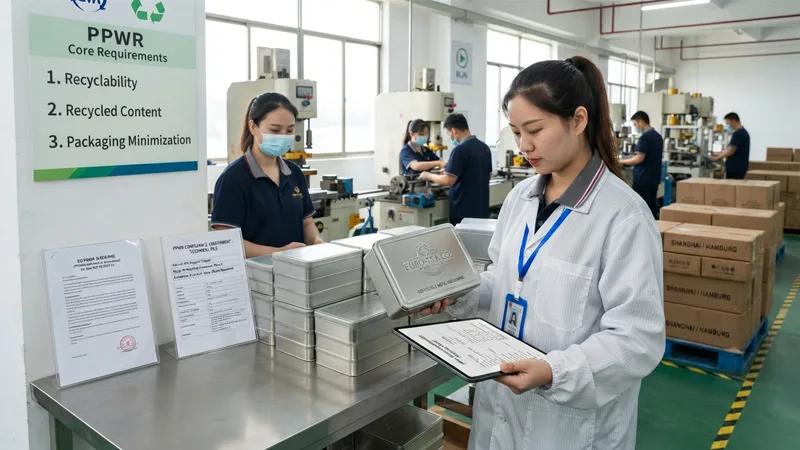
Sustainability and regulatory compliance overlap in packaging procurement, but they are not the same thing.
A package may need to meet packaging waste requirements, chemical requirements, food-contact requirements, and producer-responsibility obligations at the same time.
EU Packaging and Packaging Waste Regulation
The European Union has been strengthening requirements concerning packaging waste, recyclability, material efficiency, and packaging design.
The Packaging and Packaging Waste Regulation, commonly referred to as PPWR, introduces requirements related to packaging sustainability and waste prevention. The European Commission has stated that packaging placed on the EU market is intended to become recyclable by 2030, together with requirements concerning design and recycling at scale.
For companies supplying metal packaging or products using metal packaging in the EU market, this means that packaging specifications may need to include more than the basic material type.
Depending on the applicable requirement, information may include Metal Packaging Europe, recyclability, packaging weight and volume, recycled content, substances of concern, waste management, reuse requirements, EPR obligations, and supporting documentation.
The exact obligation depends on the packaging format, product category, market role, and position of the company within the supply chain. A supplier should therefore avoid describing a package simply as “PPWR compliant” without identifying the specific requirements that have been evaluated.
REACH and chemical information
REACH is the EU framework governing the registration, evaluation, authorization, and restriction of chemicals.
For metal packaging, relevant chemical information may concern coatings, inks, varnishes, adhesives, polymers, processing chemicals, and other packaging components.
B2B buyers may request declarations concerning restricted substances or substances of very high concern depending on the application and supply chain.
Food packaging introduces another layer because materials that come into contact with food are subject to applicable food-contact requirements.
Chemical compliance and recyclability should therefore remain separate parts of the compliance review.
RoHS is not a general metal packaging regulation
RoHS is frequently included in supplier compliance documentation, but its scope should be checked before applying it to packaging.
The EU RoHS Directive concerns certain hazardous substances in electrical and electronic equipment within its scope. Ordinary tin boxes and metal food packaging are not automatically subject to RoHS simply because they are sold in Europe.
If a metal packaging component forms part of electrical or electronic equipment, the applicable requirements may be different.
For procurement documentation, the relevant question is therefore whether RoHS applies to the actual product and its intended use, rather than whether the product contains metal.
Extended Producer Responsibility
Extended Producer Responsibility, or EPR, places certain packaging waste responsibilities on producers or other obligated parties.
Depending on the market, EPR systems may involve packaging registration, quantity reporting, fees, collection systems, recycling infrastructure, packaging data, and national reporting requirements.
The legally responsible party is not necessarily the factory that manufactures the packaging. Depending on the supply chain, responsibility may fall on the brand owner, importer, distributor, or another party placing the packaged product on the market.
For this reason, a tin box manufacturer may need to provide accurate technical data that the buyer can use for its own reporting.
Useful information can include metal type, metal weight, coating information, component weight, packaging weight, packaging composition, and documented recycled content where applicable.
What B2B Buyers Should Request from a Metal Packaging Supplier
As sustainability requirements become part of procurement, buyers may need a more structured supplier information package.
Material information
The basic material section can include:
- Metal type
- Steel grade
- Tinplate specification
- Material thickness
- Component weight
- Recycled content where documented
Manufacturing information
Production-related information can include:
- Forming process
- Production yield
- Material utilization
- Production scrap
- Scrap handling
- Energy data where available
- Waste management
Coating and chemical information
Depending on the application, buyers may request:
- Internal coating
- External coating
- Printing ink
- Varnish
- Adhesive
- Relevant chemical declarations
- Food-contact information where applicable
Recycling and environmental information
This can include:
- Recyclability information
- Material identification
- Intended recycling route
- Recycled content where applicable
- Packaging weight
- Transport configuration
- Available environmental data
Packaging and logistics information
The specification can also include:
- Unit weight
- Carton quantity
- Pallet quantity
- Packaging dimensions
- Shipping configuration
- Container loading information where relevant
This information can support packaging LCA, EPR reporting, environmental assessments, and internal sustainability programs.
A Practical Specification for Sustainable Metal Packaging
Rather than treating sustainability as a separate marketing statement, it can be incorporated directly into the technical packaging specification.
| Specification Area | Information to Define |
|---|---|
| Material | Metal type, grade, thickness, surface treatment, recycled content where applicable |
| Dimensions | Length, width, height, lid dimensions, closure dimensions, tolerances |
| Surface & Printing | Internal coating, external coating, ink, varnish, food-contact requirements |
| Manufacturing | Forming process, joining method, production tolerances, material utilization, scrap handling |
| Sustainability | Recyclability, material composition, recycling route, package weight, transport configuration, environmental data |
| Compliance | Applicable EU requirements, national packaging regulations, EPR, REACH-related information, food-contact requirements |
This format allows environmental information to become part of normal engineering and procurement documentation.
A Practical Evaluation Framework for Buyers
When evaluating a metal packaging project, six questions provide a useful starting point.
What material is being used?
Identify the actual substrate rather than referring only to “metal.” Determine whether the package uses tinplate, tin-free steel, aluminum, another steel grade, or a combination of materials.
How much material is required?
Measure the actual package weight and material thickness. A comparison based only on material names does not show how much material is required to perform the packaging function.
Can the package enter the local collection and sorting system?
Technical recyclability does not guarantee recovery. The waste management infrastructure in the target market should be considered.
What happens after collection?
Determine whether the recovered material can enter an established recycling route and return to material production.
What is included in the lifecycle assessment?
If environmental performance is being compared quantitatively, define the functional unit, system boundary, geographic region, data sources, transportation assumptions, recycling assumptions, and end-of-life scenario.
Which regulations apply?
Depending on the market and product, this may involve PPWR, EPR, REACH, food-contact legislation, national packaging regulations, or other requirements.
This approach provides a more useful procurement framework than selecting a package based on a general environmental label.
Sustainable Metal Packaging in International Supply Chains
International supply chains introduce another variable: distance.
A metal package may be manufactured in one country, shipped to another country for filling or assembly, and then transported to the final market. Factory location, shipping distance, container utilization, pallet configuration, packaging density, and product-to-package ratio can therefore affect the overall lifecycle.
A rigid tin box may have a relatively high packaging weight compared with flexible packaging, but its dimensions and stackability can determine how efficiently it uses container volume.
This is why logistics should be evaluated together with package design.
The objective is not simply to minimize package weight. It is to avoid unnecessary material and transport requirements while maintaining the required packaging function.
Common Errors in Sustainable Packaging Claims
Technical packaging documentation should avoid environmental claims that cannot be supported by defined data.
“Metal has zero environmental impact.”
Metal production requires energy and raw materials and generates environmental impacts. Recyclability does not remove those impacts.
“All metal packaging is automatically sustainable.”
Environmental performance depends on package design, material quantity, manufacturing, transportation, use, collection, and recycling.
“Metal is infinitely recyclable, so production emissions do not matter.”
Recycling and primary material production are different parts of the lifecycle. Recyclability does not eliminate the environmental impacts associated with producing the original material.
“All plastic is non-recyclable.”
Different plastic packaging formats have different recycling systems. Rigid PET and HDPE, for example, can enter established recycling systems in many markets.
“All metal packaging is recycled.”
Actual recovery depends on collection, sorting, consumer behavior, and regional recycling infrastructure.
“RoHS applies to every metal package.”
RoHS concerns electrical and electronic equipment within its scope. Ordinary metal packaging is not automatically subject to RoHS because it is sold in the EU.
“PPWR compliance only means using recyclable material.”
PPWR-related requirements cover more than a material declaration. Packaging design, recyclability, waste prevention, and other conditions may be relevant depending on the package and market.
Using technically defined language makes it easier for suppliers and buyers to distinguish between a documented characteristic and a general environmental claim.
What Sustainability Means at a Tin Box Factory
For a tin box manufacturer, sustainability can be incorporated into existing production and quality controls rather than treated as a separate product category.
At the material stage, the factory can maintain records for steel type, thickness, material consumption, and component weight.
During cutting and forming, material utilization and production scrap can be monitored. This provides information about how much material becomes part of the finished package and how much enters the scrap stream.
At the coating and printing stage, coating and ink specifications can be documented. At assembly, unnecessary components can be reviewed without compromising the required package function.
During packing, carton dimensions, pallet utilization, and shipping configuration can be evaluated.
At the end-of-life stage, package construction can be reviewed against the intended metal recycling system.
These activities can be incorporated into normal packaging engineering, production, quality, and procurement documentation. For B2B buyers, this type of measurable information can be more useful than a general sustainability statement because it can be used directly in internal environmental assessments, LCA studies, EPR reporting, and compliance records.
The Direction of Sustainable Metal Packaging
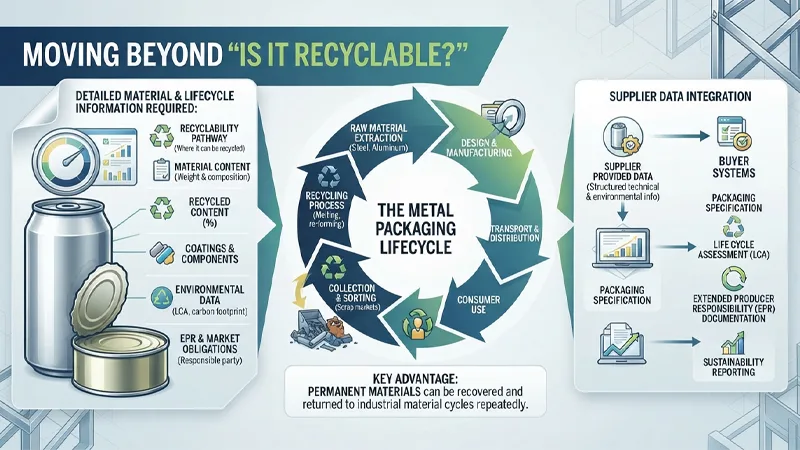
The direction of sustainable packaging procurement is moving toward more detailed material and lifecycle information.
Instead of asking only whether a package is recyclable, buyers may need to determine where it can be recycled, how much material it contains, whether recycled material is used, what coatings and components are present, how much the package weighs, what environmental data is available, and which party is responsible for market-specific obligations.
This changes the information expected from packaging suppliers.
A supplier may increasingly need to provide structured technical and environmental data that can be incorporated into the buyer’s own packaging specification, LCA, EPR documentation, and sustainability reporting.
For metal packaging, the fundamental material characteristic remains relevant: steel and aluminum can be recovered and returned to industrial material cycles. Steel recycling is supported by established scrap markets and separation mechanisms.
However, the environmental performance of a specific package still depends on how it is designed, manufactured, transported, used, collected, and recycled.
Conclusion
Sustainable metal packaging should be evaluated as a complete packaging system rather than through recyclability alone.
Tinplate packaging can participate in a circular material system because its steel substrate can be recovered and recycled. Magnetic separation, established scrap markets, and industrial recycling infrastructure support steel recovery in many waste streams.
At the same time, metal production requires energy and raw materials. Package weight, material efficiency, production scrap, coating systems, transportation, product protection, service life, and end-of-life collection all contribute to the overall lifecycle.
Lifecycle assessment provides a structured way to evaluate these factors together. For a meaningful comparison, the functional unit and system boundary need to be defined rather than comparing materials only by weight or by broad material category.
For international B2B buyers, the practical evaluation can therefore be organized around:
material efficiency + manufacturing data + recycling + lifecycle impact + regulatory compliance + EPR requirements
The same framework can be applied when comparing metal with rigid plastic, flexible plastic, paper-based packaging, or other packaging systems.
The objective is not to identify one material as universally sustainable. It is to select a packaging system that provides the required product protection, uses materials efficiently, fits the relevant supply chain, satisfies applicable requirements, and allows valuable materials to remain in productive use after the package reaches the end of its first application.
For companies purchasing tin boxes or other metal packaging for international markets, this approach also provides a practical basis for supplier communication. Instead of relying on broad environmental claims, buyers can request measurable information about material composition, package weight, coatings, manufacturing processes, recycling characteristics, logistics, and applicable compliance requirements.
That information can then become part of the technical packaging specification and the company’s wider environmental and compliance documentation.
FAQ
Is tinplate packaging recyclable?
Yes. Tinplate consists of a steel substrate with a thin tin coating, and the steel can enter established steel recycling systems. Actual recovery still depends on collection, sorting, and recycling infrastructure in the relevant market.
Does recyclable metal packaging automatically have a lower carbon footprint than plastic packaging?
No. Carbon footprint depends on the complete lifecycle. Material production, package weight, manufacturing, transportation, product protection, reuse, and end-of-life treatment can all affect the result. A meaningful comparison should use the same functional unit and a defined LCA system boundary.
Do coatings and printing prevent tin boxes from being recycled?
Not necessarily. Metal packaging commonly uses internal coatings, external coatings, inks, and varnishes. Their presence does not automatically make the metal substrate non-recyclable. However, the complete coating and printing system should be considered when evaluating the package against the intended recycling route.
Is RoHS required for all tin packaging sold in Europe?
No. RoHS primarily concerns certain hazardous substances in electrical and electronic equipment within its scope. Ordinary tin packaging is not automatically subject to RoHS simply because it is sold in the EU. Other chemical, food-contact, and packaging requirements may apply depending on the product and market.
What should B2B buyers ask suppliers about sustainable metal packaging?
Buyers can request information about the metal type, material thickness, package weight, recycled content where applicable, coating and ink systems, manufacturing scrap, recyclability, recycling route, packaging configuration, chemical requirements, and available environmental data. This information can support packaging LCA, EPR reporting, and market-specific compliance assessment.