
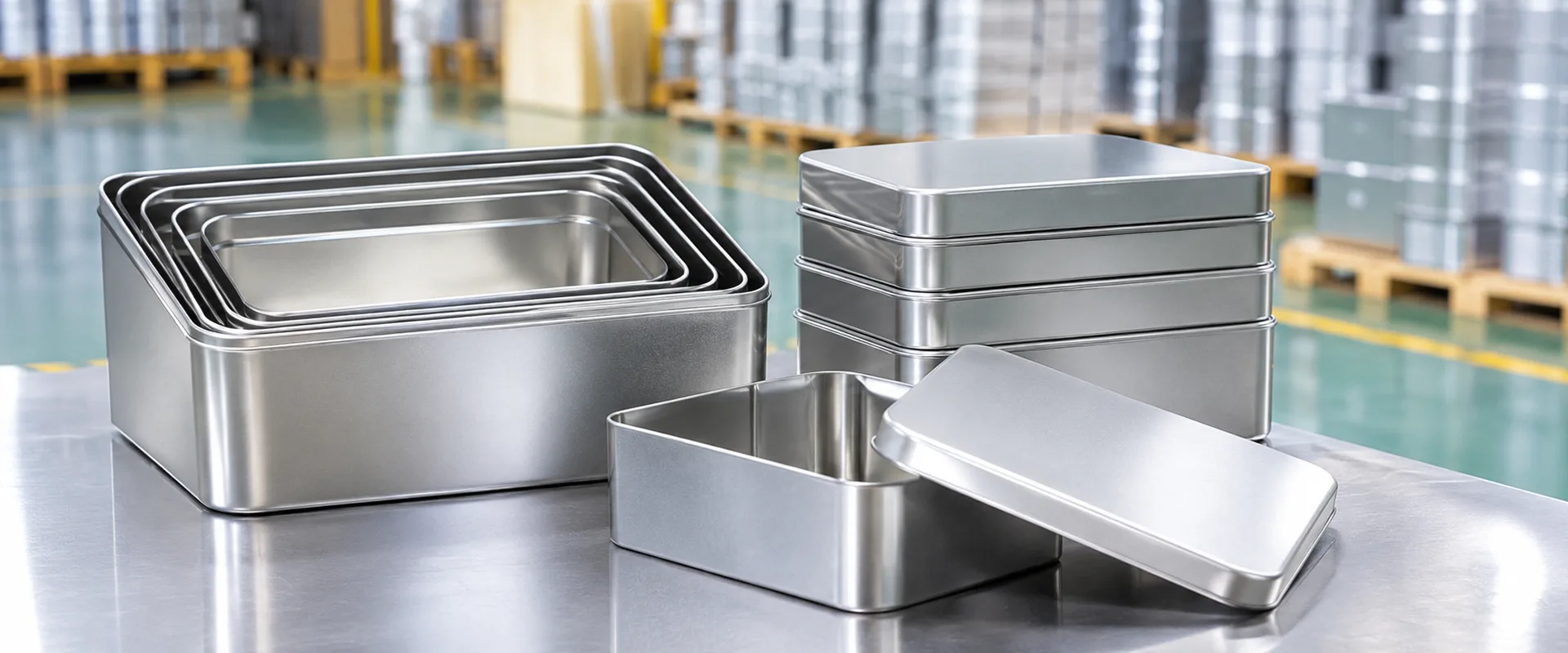
Nesting design for empty tin boxes means shaping the body so that one tin sits inside the next, which reduces the height of a stack and the volume of a shipment. Nesting tin boxes are used when empty tins are shipped to a filler, a packer or a warehouse, and shipping cost depends on the space they take. This article explains the difference between nesting and stacking, which tin shapes can nest, the design parameters that set the nested height, why nested tins stick together, how nesting changes freight cost, and which tests a buyer can ask for.
Table of Contents
What are nesting tin boxes?
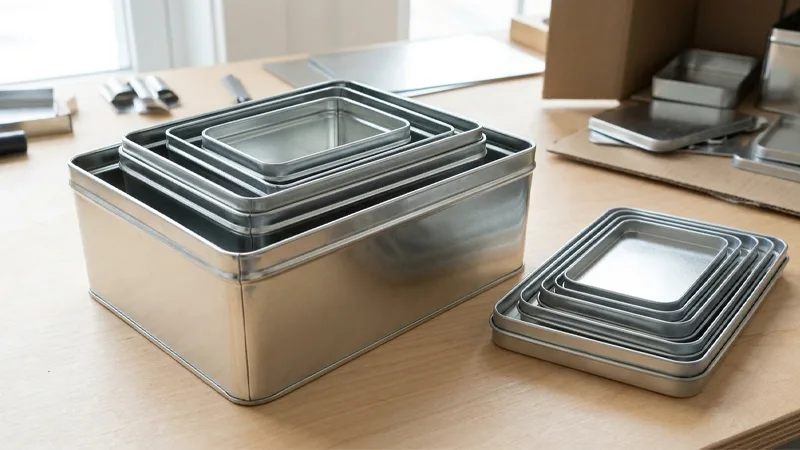
Nesting and stacking are two ways to arrange empty containers:
- Stacking places one container on top of another. The stack height is the sum of the container heights, and the space inside each container stays empty.
- Nesting places one container inside another. Each added container increases the stack height by a small amount, called the stack pitch.
Nesting works when the container has clearance for the next one to enter. This usually means the opening is wider than the base, either through a taper or through a stepped profile. A tin with straight vertical walls and no stepped profile or stop feature usually cannot nest, because the base of one tin does not fit into the opening of the next without clearance.
A tin box has a body and a lid, and nesting applies to each part separately. Bodies nest with bodies, and lids nest with lids. A tin shipped with the lid already fitted cannot nest, so nesting applies to tins shipped as separate parts or with the lid off. The same nesting principle applies to other metal containers with suitable clearance, including tapered round cans. Stackable tin boxes that are designed for carton or pallet stacking without insertion require a different structural arrangement.
Which tin box shapes can nest?
| Shape | Nesting | Reason |
|---|---|---|
| Round slip-lid tin with tapered wall | Yes | The wall angle gives clearance for the next tin |
| Round straight-wall tin | Usually no | Requires sufficient clearance or a stepped profile |
| Rectangular tin with tapered or stepped walls | Possible | Geometry provides clearance for insertion |
| Rectangular straight-wall tin | Usually no | Vertical walls provide little or no insertion clearance |
| Hinged tin, hinge attached | Usually no | The hinge joins body and lid and sticks out |
| Shaped tin (oval, heart, other) | Depends | Needs a constant taper and a corner radius on every curve |
| Tin with lock, latch or heavy embossing | Reduced | Raised features stop the next tin early |
The forming method sets what is possible. Deep drawing forms a body with a taper from one sheet, and the taper is part of the die design. The steps are described in the article on tin packaging forming processes, and the general principle is explained under deep drawing.
Tin box nesting design parameters
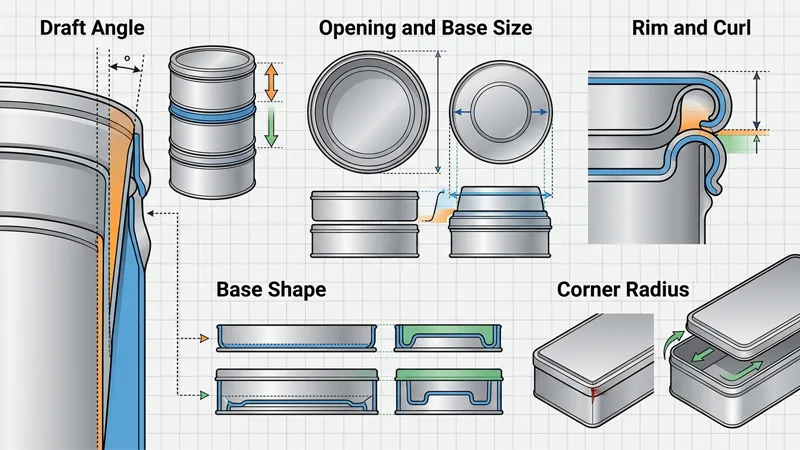
Five design parameters determine whether a tin can nest and how closely the bodies fit together.
- Draft angle. The draft angle is the slope of the wall from vertical. A larger draft angle generally increases the clearance between adjacent tin bodies and can make separation easier. However, it does not automatically produce a smaller stack pitch. The final pitch depends on the wall geometry, rim construction, base profile, and any stop features designed into the body. Increasing the draft angle also changes the internal dimensions and usable volume, so these requirements should be evaluated together during tooling design. See draft for the term.
- Opening and base size. The inside dimension at the opening must be larger than the outside dimension at the base of the next tin, with a margin for tolerance.
- Rim or curl. A curled rim adds thickness around the opening. In many designs the curl rests on the rim below and sets the stack pitch, so the curl acts as a stop.
- Base shape. A flat base nests closely. A base with a bead, a recess or a raised panel needs room in the tin below.
- Corner radius. On rectangular and shaped tins, a larger corner radius lets the next tin enter and reduces the risk of jamming at the corners.
The usable volume and the nesting requirement affect each other, so they are evaluated together during tooling design. A tin designed for a fixed product volume and a nesting requirement needs both numbers on the drawing before the mould is made. The effect of tooling on dimensions is covered in tin packaging tooling, and changes after tooling cost more, as described in tin packaging tooling cost.
Stack pitch and nested height: how to calculate
The height of a nested stack follows a simple formula:
Nested stack height = single tin height + (number of tins − 1) × stack pitch
Example with assumed values: a round tin body 100 mm in diameter and 50 mm high, with a stack pitch of 8 mm.
| Number of tins | Stacked, no nesting | Nested |
|---|---|---|
| 1 | 50 mm | 50 mm |
| 10 | 500 mm | 122 mm |
| 20 | 1,000 mm | 202 mm |
For 20 tins, the nested stack is 202 mm high, and the stacked height is 1,000 mm. The packing-height ratio is 1,000 ÷ 202, which is approximately 4.95. This means the nested arrangement uses about one-fifth of the stack height required by conventional stacking, assuming the same footprint. The ratio has a ceiling: it cannot exceed the single tin height divided by the pitch, which is 50 ÷ 8 = 6.25 in this example. A small pitch gives a larger saving, and each millimetre of pitch counts when the stack is long.
The values above are for illustration. The real stack pitch comes from the drawing and from measuring a sample stack.
Why nested tin boxes stick together
Nested tins that do not separate cause problems at the filling line. The usual causes are:
| Cause | What happens | Design or process response |
|---|---|---|
| Draft angle too small | Walls wedge against each other | Increase the angle, or add stop features |
| Trapped air | The stack acts as a seal and the tins resist separation | Add an air path, such as a small gap or a shallow groove at the base |
| Close-fitting contact surfaces | Closely fitted surfaces with a large contact area may resist separation, particularly when the clearance is very small | Review body geometry, contact area and stop features first; if a different varnish is considered, check its adhesion, abrasion resistance and compatibility with the printing system |
| Dents or burrs on the rim or wall | Local interference | Control forming and trimming, and check edges |
| Pressure on the stack | Walls deform and wedge | Limit stack height and carton pressure |
| Moisture, oil or residue between surfaces | Moisture can cause capillary adhesion; oil can change friction and contaminate the coating | Control storage conditions, surface cleanliness and clearance |
Moisture trapped between closely fitted surfaces can create capillary adhesion and increase separation resistance. Oil or other residues may change surface friction and contaminate the coating. Storage conditions, surface cleanliness, and the clearance between adjacent tins should therefore be controlled.
A stop feature, such as a ledge or lug, keeps the next tin from sliding too far in. It sets a gap between walls, and the tins separate with little force. The cost is a slightly larger pitch.
Tolerance matters for separation. If the opening is smaller than the nominal value on one tin and the base is larger on another, the pair can jam. Dimensional control is explained in tin packaging lid fit and dimensional tolerances, and wear in the tools changes dimensions over a run, as described in tin packaging tool wear.
Protecting print and coating in nested stacks
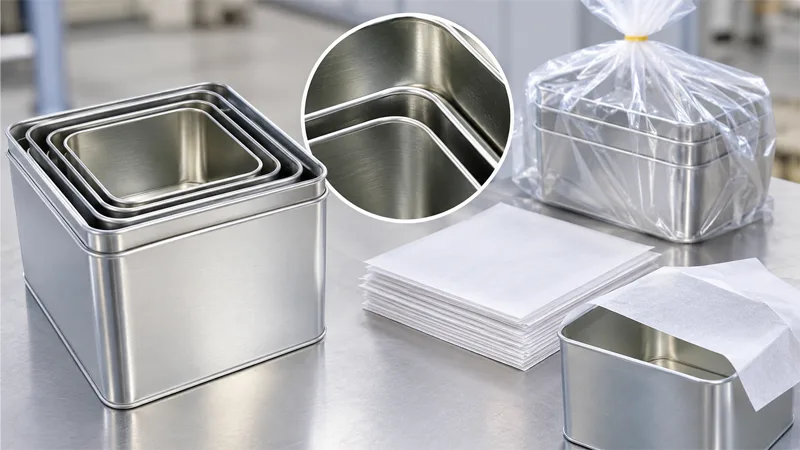
In a nested stack, the outer surface of one tin touches the inner surface of the next. This causes two problems.
Scuffing. Transport vibration moves the tins against each other. Ink, varnish and the metal surface can show rub marks, scratches or burnish marks. Responses:
- Specify a varnish with resistance to rubbing, and test it on a nested sample.
- Place a paper or film sheet between groups of tins.
- Pack stacks in bags or sleeves.
- Limit the number of tins per stack, so weight on the lower tins stays low.
Contact with the inner surface. The inner surface of a food tin may carry a coating selected for contact with the packaged product, while the outer surface of the next tin is not intended for product contact. For food, tea, coffee, and cosmetic packaging, the cleanliness requirements should be agreed between the tin manufacturer and the filling facility. Depending on the product and filling-line requirements, protective packaging, controlled handling, or a defined cleaning procedure may be necessary before filling. Nesting and transport arrangements should not introduce dust, oil, or other residues onto product-contact surfaces. The coating requirements are covered in food grade tin packaging. Surface marks and other flaws are listed in tin packaging defects.
Empty tin box shipping and freight efficiency
Freight cost depends on volume or on weight, whichever the carrier charges. Empty tins are light and take space, so volume is usually the limit in empty tin box shipping.
- Sea freight, full container. The charge is per container. Fewer cartons per order, or more tins per carton, can reduce the number of containers. Standard intermodal containers have internal volumes of roughly 33 m³ for 20 ft, 67 m³ for 40 ft and 76 m³ for 40 ft high cube. Usable volume is lower because of pallets and gaps. The loadable volume also depends on the container type, pallet pattern, carton layout and loading limits, and the buyer confirms it with the freight forwarder.
- Sea freight, less than container load. The carrier charges per cubic metre or per tonne, whichever is greater. A cubic metre of empty tins weighs far less than a tonne, so volume sets the charge.
- Air freight and courier. The charge uses dimensional weight: length × width × height in centimetres, divided by a divisor that differs between carriers and services. Values such as 6,000 and 5,000 are common examples and are not universal. The transport contract and the carrier’s rules set the actual calculation. Empty tins are lightweight but occupy considerable space, so their dimensional weight may exceed their actual weight and determine the chargeable weight.
The example from above, expressed per cubic metre of carton space, with square packing and the tins and cartons ignoring wall thickness:
| Packing | Tins per cubic metre |
|---|---|
| Not nested, round tins 100 mm × 50 mm | About 2,000 |
| Nested in stacks of 20, pitch 8 mm | About 8,000 |
The nested figure counts 100 stacks per layer and 4 layers of 202 mm in a one-metre cube. The ratio is about four, a little below the 4.95 packing-height ratio because only whole layers fit. Real cartons, pallets and container dimensions change the result, so the buyer asks the manufacturer for a packing plan for the specific order.
The saving applies to the empty tin, and the filled tin ships at its full size, so nesting benefits shipments from the tin factory to the filler. It does not change the cost of shipping filled products.
Carton and pallet packing for nested tins
The freight section above covers how much space nesting saves. This section covers how the factory arranges nested tins into cartons and pallets. A packing plan states, for each carton and pallet, the following values:
| Item | What to state |
|---|---|
| Tins per stack | Number of nested tins in one stack |
| Stacks per carton | Layout in length and width |
| Carton size | Outside dimensions in millimetres |
| Carton strength | Board grade and compression strength |
| Cartons per layer and layers per pallet | Pallet pattern |
| Pallet size | For example 1,200 × 800 mm or 1,219 × 1,016 mm (48 × 40 in) |
| Interleaving | Paper, film or none |
| Total weight per pallet | Weight and height limit |
Cartons should hold the stacks without leaving space for movement, because movement causes scuffing. Carton height is chosen so that the lower tins do not carry excess load, and the pallet pattern is chosen so that cartons stay within the edge of the pallet and keep their strength when stacked.
Testing nesting performance in tin boxes
| Test | What it checks |
|---|---|
| Nested height measurement | Height of 10 or 20 nested tins against the drawing |
| Separation test | Force needed to separate a tin from a nested stack, or hand separation of a set number of tins |
| Repeated nesting and denesting test | Whether clearance, rim, sidewall and print stay consistent after repeated insertion and removal |
| Transport simulation | Vibration and drop tests on packed cartons, using a method such as those published by ISTA |
| Scuff inspection | Surface of tins after the transport test |
| Carton compression | Whether the carton supports the pallet load |
| Dimension check | Opening, base and rim size on a sample from the run |
| Production sample check | Nested height and clearance on samples from actual production runs |
| Line trial | A run on the filler’s denesting equipment |
General methods for leak, dimension and closure checks are described in tin packaging testing and validation.
Repeated nesting and denesting test. Repeatedly insert and remove a defined number of tin bodies to check whether the clearance remains consistent. Inspect the rim, sidewalls, and printed surfaces for deformation, coating damage, or progressive changes in separation force. This test is useful when tins will be handled repeatedly before filling or assembly.
Production consistency in nested tin boxes. A nesting design should be evaluated using samples from actual production runs, not only from the initial prototype. Drawing dimensions for the opening, base and rim can all be within limits, and a production batch can still fail to nest smoothly. Factors that change the result include:
- Tool wear that changes dimensions over a run
- Differences in forming between material batches
- Variation in rim height and corner radius position
- Consistency of nested height from batch to batch
- Compression deformation of tins at different positions in a carton
Periodic measurements of nested height and dimensional clearance during mass production help identify changes caused by tooling wear or forming variation. The acceptance limits should be agreed before production begins, particularly when the tins will be separated by an automatic denesting system.
When nesting is not suitable
A tin box nesting design is not a fit for every tin:
- Tins with a hinge, lock or raised surface features that block entry.
- Tins with straight walls, where a taper changes the product or the look.
- Tins that need a specific internal volume that a taper would reduce.
- Orders so small that the freight saving is lower than the cost of a revised mould.
- Tins shipped fully assembled, with the lid fitted, to a packer who needs no separation.
In these cases, the options are stacking with a tight carton, or flat-packing the parts where the design allows it.
Specification checklist for nestable tin boxes
A buyer who asks for nesting states these items in the request for quotation:
| Item | Example of what to state |
|---|---|
| Parts shipped | Body only, lid only, or both in separate stacks |
| Maximum nested height | For a given number of tins |
| Stack pitch limit | In millimetres |
| Internal volume | Minimum volume the tin must hold |
| Draft angle | Allowed range |
| Separation requirement | Manual separation, or denester on a filling line |
| Surface protection | Interleaf, bag or none |
| Packing plan | Tins per carton, cartons per pallet, pallet size |
| Destination and mode | Port, mode of transport, and container size |
The order of a project, from drawing to mass production, is described in how to develop a custom tin box from concept to mass production, and the checks that apply to a supplier are in tin box manufacturer selection criteria.
Frequently asked questions
What does nesting mean for empty tin boxes? Nesting means placing one empty tin body inside another, so that a stack takes less height than the same number of stacked tins.
Can straight-wall tin boxes be nested? Usually not, because vertical walls provide little or no insertion clearance. Some designs use a stepped profile, a local recess or a stop feature that creates clearance, and the drawing and a sample stack show whether the design works.
What is the stack pitch of a nestable tin box? Stack pitch is the height added to a nested stack by each extra tin. It depends on the wall geometry, rim construction, base profile and stop features, and it is measured on a sample stack. The draft angle alone does not fix it.
How many empty tin boxes can fit in one nested stack? The number depends on the draft angle, the carton height, the load the lower tins can carry without deforming, and the separation method. The manufacturer states the number in the packing plan.
Can nesting damage printed tin boxes? It can, because surfaces rub against each other during transport and repeated handling. Varnish choice, interleaving paper and stack size control the risk, and a transport test and a repeated nesting test on packed samples show the result.
Does nesting reduce shipping costs for empty tin boxes? It can reduce the volume of the shipment, so freight charges based on volume or on the number of containers may fall. The saving depends on the carrier’s rules, the container type, the carton layout and the order quantity. Filled tins ship at full size, so the saving applies to empty tins only.