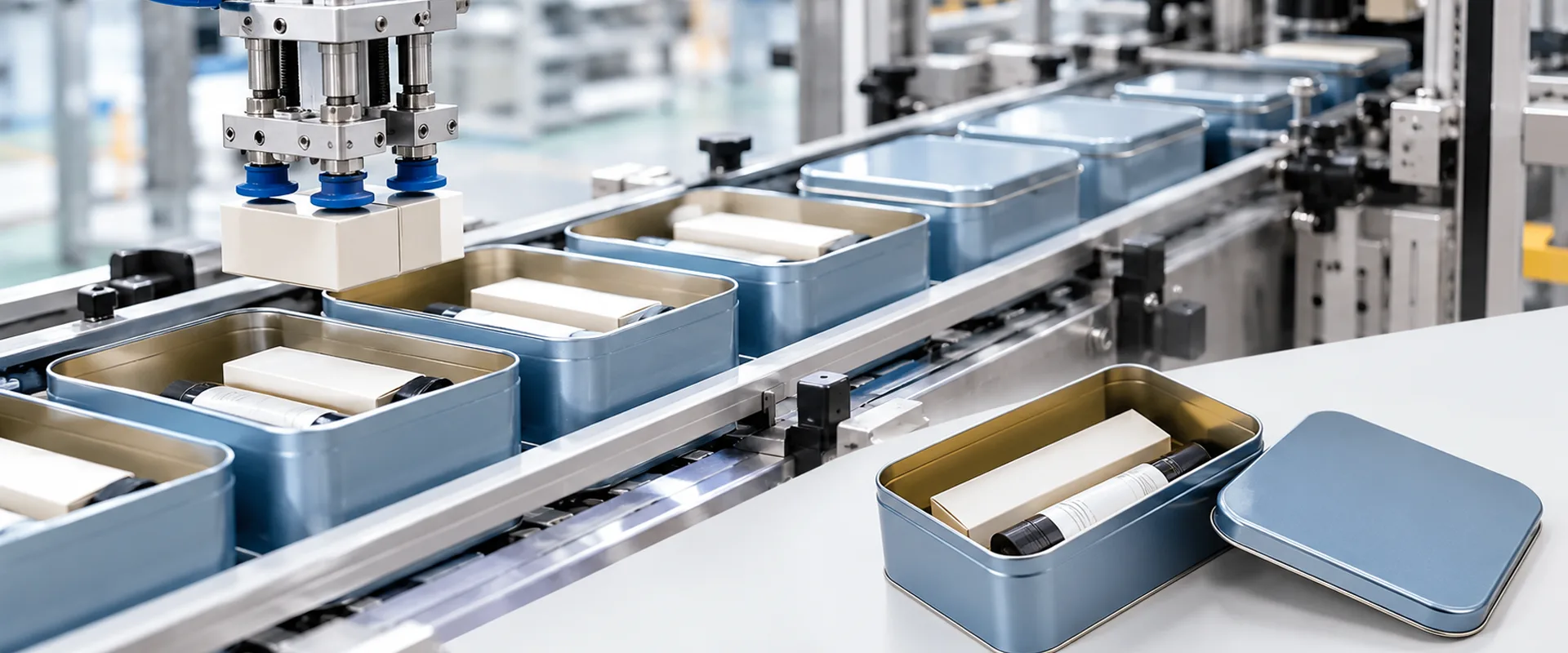
Custom tin box packaging must accommodate both the product and the process used to place, arrange, and close it inside the container. For manufacturers using manual, semi-automatic, or automatic packaging equipment, the tin box dimensions, opening structure, internal space, and closure design affect how the product moves through the packing operation.
A tin box that fits the product does not necessarily fit the packaging process. Product loading may require additional clearance, a specific orientation, an insert, or a defined opening size. The lid may also need to remain separate until the filling operation is complete.
When developing custom tin boxes for production packing, the packaging specification should include more than external dimensions and artwork. Product size, filling method, loading direction, pack quantity, closure sequence, and downstream handling should be reviewed before the structure is finalized.
This article explains how custom tin box packaging can be designed around product loading and packaging line requirements, including usable internal dimensions, filling access, insert design, lid construction, and production considerations.
Table of Contents
Custom Tin Box Packaging for Product Loading
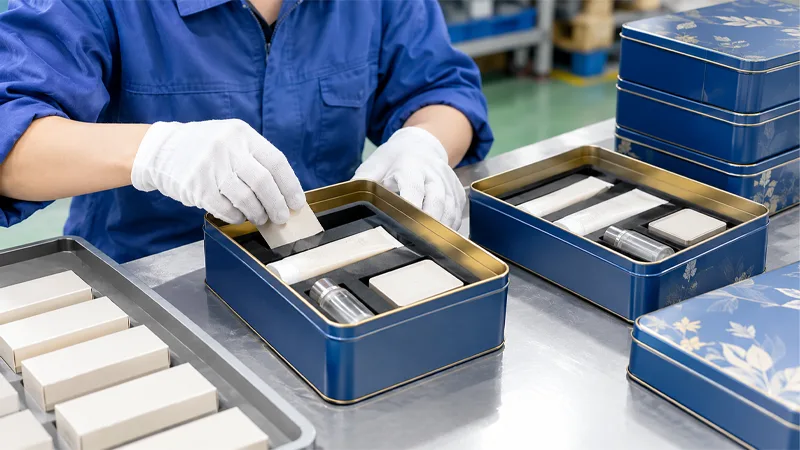
Product loading is the operation of placing one or more products into a packaging container. Depending on the product and production volume, this may be performed manually, through a semi-automatic arrangement, or by an automated packing system.
For custom metal tin packaging, the loading method influences the required opening, internal clearance, product orientation, and packaging sequence.
Manual Product Loading
Manual loading is used when the product requires positioning, when the package contains several components, or when the production quantity does not justify an automated system.
The operator needs sufficient access to the interior of the tin box to place the product without contacting the printed edge, damaging the product, or displacing an insert.
For example, a rectangular tin box used for a product set may contain several items arranged in separate positions. The usable interior dimensions must accommodate the complete arrangement rather than only the largest individual item.
The following information should be defined:
- Product dimensions and weight
- Number of products per tin box
- Product orientation during loading
- Required clearance around the product
- Insert or divider arrangement
- Position of the lid during filling
The loading method should be considered during structural design because the opening and internal space cannot always be changed after tooling has been completed.
Semi-Automatic Product Packing
Semi-automatic packing may use a fixture, guide, conveyor, or positioning device to place products into tin boxes.
The fixture may control product orientation or help maintain a consistent position during loading. In this arrangement, the tin box must fit the fixture as well as the product.
A small dimensional difference may affect how the container is positioned. For example, a fixture designed around the external width of a tin box may not accommodate a revised structure with a different corner radius or sidewall profile.
The packaging specification should identify the dimensions used by the loading equipment, including:
- External width and length
- Container height
- Corner radius
- Base geometry
- Positioning reference
- Opening dimensions
These dimensions should be based on the actual production structure rather than a conceptual drawing.
Automated Product Packing
Automated packing equipment may use mechanical guides, grippers, pick-and-place units, conveyors, or other devices to move products into packaging.
The equipment configuration depends on the product, container, production rate, and packing arrangement. A tin box may be loaded from above, from the side, or through another defined access direction.
For automated product packing, the packaging structure should be reviewed for:
- Consistent external dimensions
- Stable positioning during loading
- Sufficient opening clearance
- Repeatable product placement
- Access for the loading mechanism
- A defined sequence for lid installation
A custom tin box used on an automated packaging line should be evaluated using the actual loading method. External dimensions alone are not enough to determine whether the container is suitable.
Tin Box Dimensions and Usable Internal Space
The external dimensions of a tin box do not represent the available space for product loading.
Formed sidewalls, curled edges, seams, corner radii, and lid engagement reduce the usable internal area. Inserts and dividers also occupy space that would otherwise be available for the product.
For this reason, custom tin box dimensions should be defined using both external and internal measurements.
External Dimensions
External dimensions describe the overall size of the finished tin box.
They are commonly used for:
- Carton layout
- Packaging line positioning
- Storage and shipping calculations
- Product display arrangements
- Fixture design
For rectangular tin boxes, the external length, width, and height should be measured from the finished container. The measurement reference should specify whether the lid is included.
Internal Dimensions
Internal dimensions describe the space available inside the container.
They are used to determine whether the product can be loaded and positioned without interference.
A simplified calculation for a rectangular tin box is:
Usable internal length = external length − structural allowances
Usable internal width = external width − structural allowances
Usable internal height = internal body height − insert height − other obstructions
The structural allowances must be determined from the actual tin box construction. They may include material thickness, forming geometry, seams, corner radii, and lid engagement.
These calculations provide an initial estimate. Final product fit should be confirmed using the approved sample or a dimensional drawing.
Product Clearance
Product clearance is the space between the product and the surrounding packaging structure.
Clearance is required when the product must be placed into the tin box without force, when an insert needs to accommodate dimensional variation, or when the loading method requires access around the product.
The required clearance depends on the product shape, loading direction, and packaging method.
For a product loaded vertically, the opening dimensions may be more important than the bottom dimensions. For a product placed horizontally, the internal length and width may determine whether it can be positioned without contacting the sidewalls.
The packaging specification should therefore identify the product’s loading orientation and the dimensions that control the fit.
Tin Box Opening Design for Filling and Loading
The opening of a tin box determines the access available during product loading.
Different tin box structures provide different opening arrangements. The appropriate structure depends on the product, filling method, required access, and closure sequence.
Slip Lid Tin Boxes
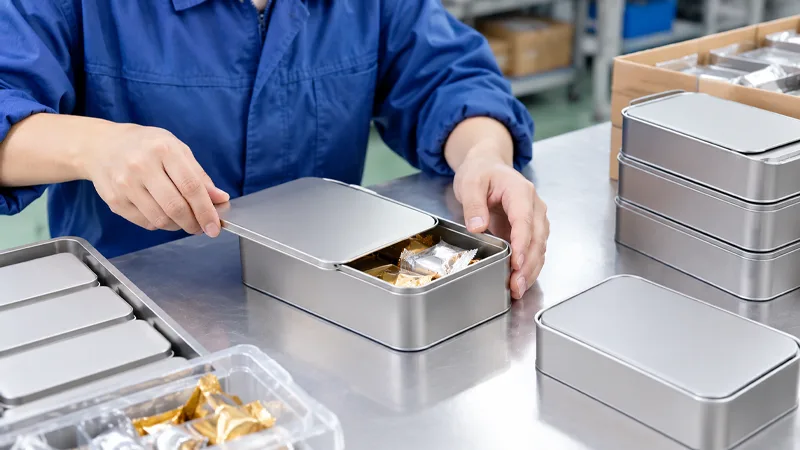
A slip lid tin box has a removable lid that fits over or into the body.
This structure can provide access across most of the container opening, depending on the lid construction.
Slip lid tin boxes are used for products such as confectionery, tea, accessories, stationery, and product sets.
For product loading, the opening should be large enough to accommodate the product and the loading method. If the product is placed into the container using a fixture, the opening must also provide access for the fixture or loading mechanism.
The lid fit should be reviewed separately from the loading clearance. A lid that fits correctly may still restrict access if its skirt or engagement structure occupies part of the opening.
Hinged Tin Boxes
A hinged tin box has a lid connected to the body by a hinge.
The opening angle affects the available loading space. If the lid remains attached during filling, the hinge and lid position may restrict access to part of the container.
For manual loading, the operator may need to hold the lid open while positioning the product.
For automated loading, the lid position must be compatible with the equipment. The loading mechanism should not contact the hinge, lid, or surrounding structure.
If the product requires loading from above, the hinge location and opening direction should be confirmed before the structure is released for tooling.
Deep Drawn Tin Containers
Deep drawn tin containers may have a formed body with a specific opening profile.
The opening size and body geometry affect product access. A product that fits inside the lower part of the container may not pass through the opening during loading.
This is particularly relevant when the container has tapered walls, a narrow neck, or a reduced opening.
The product dimensions should be compared with the smallest opening along the loading path, not only with the internal dimensions at the base.
Custom Tin Box Inserts for Product Positioning
Custom tin box inserts are used to hold products in defined positions inside the container.
An insert may separate several products, prevent movement, support a product during loading, or maintain a specific arrangement after the lid is closed.
The insert design should be developed using the product dimensions and loading method.
Insert Opening and Product Fit
The insert opening must accommodate the product while maintaining the required position.
If the opening is too small, the product may be difficult to load or may become damaged during placement.
If the opening is too large, the product may move inside the insert during handling.
For products with dimensional variation, the insert should account for the expected range rather than only the nominal product dimensions.
Insert Height and Lid Clearance
The insert height affects the available internal height and the position of the product.
The product, insert, and lid should be reviewed as a complete assembly.
For example, if the product extends above the insert, the lid must provide sufficient clearance to close without applying unintended pressure.
A simple clearance calculation is:
Available clearance = internal height − insert height − product height
This calculation should use the actual internal dimensions of the tin box.
If the product is positioned at an angle or has an irregular shape, the clearance should be evaluated using the complete product profile.
Insert Materials
Insert materials may include paperboard, foam, plastic, or other materials selected for the product and packaging requirements.
The material selection should consider:
- Product weight
- Product surface
- Insert geometry
- Loading method
- Contact requirements
- Required positioning
- Packaging environment
The insert should be evaluated with the finished tin box because the material thickness and shape affect the usable space.
Product Arrangement Inside Tin Box Packaging
The product arrangement determines how many items can be placed inside a container and how they are positioned.
For multi-item packaging, the arrangement should be defined before the tin box dimensions are finalized.
Single Product Packaging
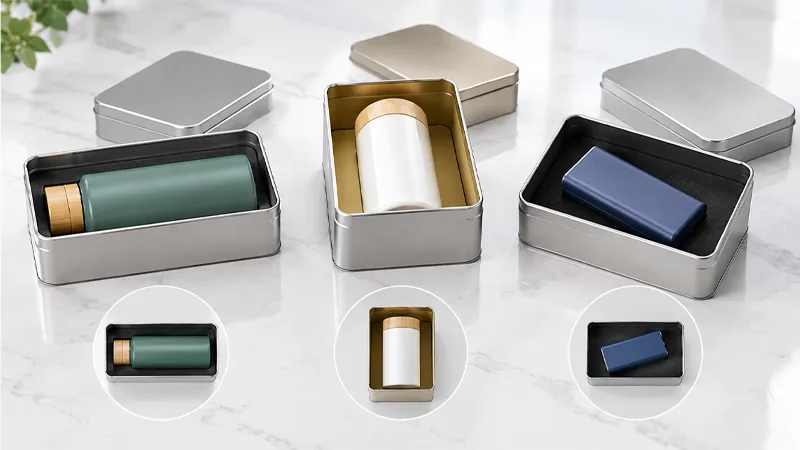
A single product may be positioned horizontally, vertically, or at an angle.
The loading orientation should be selected based on the product dimensions, opening size, and required internal clearance.
If the product is inserted vertically, the opening must accommodate its cross-section. If the product is placed horizontally, the internal length and width must accommodate the product in its loading orientation.
Multiple Product Packaging
Multiple products may be arranged in rows, columns, layers, or separate compartments.
The total number of products is not determined only by the internal volume of the tin box.
The arrangement also depends on:
- Product dimensions
- Product orientation
- Clearance between products
- Insert thickness
- Divider position
- Loading sequence
For example, a rectangular tin box may have enough internal volume for six products, but the opening or insert geometry may only allow four products to be loaded in the required arrangement.
The packaging layout should be reviewed using the actual product dimensions.
Mixed Product Sets
Some tin box packaging contains products with different shapes or sizes.
In this case, the insert may include several compartments with different opening dimensions.
The arrangement should account for the loading sequence. A product placed into the first compartment should not obstruct access to another compartment.
For automated or semi-automatic loading, the sequence may also determine whether the products can be placed using one loading head or require separate operations.
Tin Box Closure and Packaging Sequence
The closure method affects the sequence used to complete the packaging operation.
A typical sequence may include:
- Position the empty tin box.
- Load the product or product set.
- Place the insert or divider if required.
- Check the product arrangement.
- Install the lid.
- Transfer the closed package to the next operation.
The actual sequence depends on the tin box structure and the product.
For a slip lid tin box, the lid may be installed after the product has been loaded.
For a hinged tin box, the lid remains connected to the body and must be positioned during loading.
For a tin box with an inner plug or separate component, the additional component may require a separate installation operation.
The closure sequence should be defined during packaging development. If the product loading method changes after the tin box structure has been approved, the opening, lid, and insert may need to be reviewed again.
Custom Tin Box Packaging for Packaging Line Integration
Packaging line integration refers to the relationship between the packaging container and the equipment used to move, load, close, and transfer it.
For custom tin box packaging, this may include conveyors, positioning fixtures, loading equipment, lid installation stations, and downstream carton packing.
The tin box specification should identify the relevant equipment interfaces.
Container Positioning
The equipment may position the tin box using its base, sidewalls, or another reference feature.
The selected reference should be consistent with the finished container.
If a tin box has a raised base, formed edge, or non-flat bottom, the positioning method should account for that structure.
Product Loading Access
The loading mechanism must have access to the product and the interior of the tin box.
The opening should not be obstructed by the lid, hinge, insert, or surrounding equipment.
Changeover Between Tin Box Sizes
When a packaging line handles several tin box sizes, the changeover process may require adjustments to guides, fixtures, loading positions, or closure equipment.
The packaging specification should identify the dimensions that change between formats.
A common external width does not necessarily mean two tin boxes can use the same fixture. Their height, corner geometry, base structure, or opening may differ.
Information Required for Custom Tin Box Packaging
Before developing a custom tin box for product loading, the packaging requirements should include the product and the packing process.
| Requirement | Information to provide |
|---|---|
| Product dimensions | Length, width, height, diameter, or full product drawing |
| Product weight | Weight of one product and total pack weight |
| Product quantity | Number of products per tin box |
| Loading method | Manual, semi-automatic, or automatic |
| Loading orientation | Vertical, horizontal, angled, or defined arrangement |
| Tin box structure | Slip lid, hinged lid, plug lid, or other construction |
| Internal space | Required usable length, width, and height |
| Insert | Material, thickness, compartment layout, and product fit |
| Closure sequence | When and how the lid is installed |
| Packaging line | Relevant equipment, fixture, and positioning dimensions |
| Secondary packaging | Carton quantity, arrangement, and handling requirements |
These details allow the tin box structure to be reviewed against the actual packing operation.
Common Problems When Tin Box Packaging Is Not Designed for Product Loading
Several problems can occur when the packaging container is developed without considering the loading process.
Product Does Not Pass Through the Opening
The product may fit inside the tin box but cannot pass through the opening.
This can occur when the container has a narrow opening, tapered walls, or a lid structure that reduces access.
The product should be checked along the complete loading path.
Product Positioning Is Inconsistent
The product may fit inside the container but move during loading or after the lid is closed.
This may result from insufficient insert support, excessive clearance, or an arrangement that does not maintain the required orientation.
The insert and product layout should be reviewed together.
Lid Cannot Close After Loading
The product or insert may extend above the available internal height.
The lid may contact the product before reaching its intended position.
This can occur when the external dimensions are used to estimate the available internal space without accounting for the lid structure and insert.
Packaging Equipment Cannot Position the Tin Box
A tin box may not sit correctly in a fixture or conveyor guide.
The cause may be a difference in external dimensions, corner geometry, base structure, or positioning reference.
The finished container should be checked against the equipment interface before the packaging line is released.
Conclusion
Custom tin box packaging for product loading requires coordination between the product dimensions, container structure, usable internal space, insert design, and closure method.
The external dimensions of a tin box do not define its complete loading capacity. The opening, internal geometry, product orientation, and packaging sequence also determine whether the product can be placed into the container as intended.
When these requirements are defined before tooling and sampling, the tin box structure can be developed around the actual packing operation rather than adjusted after the packaging line has been configured.
FAQ
Can custom tin boxes be used for automated product packing?
Yes. Custom tin boxes can be used in manual, semi-automatic, or automated packing operations. The structure should be developed around the product dimensions, loading method, opening clearance, positioning requirements, and closure sequence.
How do I calculate the internal dimensions of a tin box?
Internal dimensions should be determined from the finished container structure. External dimensions must be adjusted for material thickness, formed edges, seams, corner geometry, and lid engagement. The final usable space should be confirmed using a drawing or physical sample.
How do I choose the right tin box size for my product?
Start with the product dimensions, weight, quantity, and loading orientation. Then determine the required clearance, insert dimensions, and lid space. The selected tin box should accommodate both the product and the loading method.
Can custom tin box inserts be designed for automated loading?
Yes. Inserts can be designed around a defined product arrangement and loading process. The insert openings, material thickness, product clearance, and positioning features should be compatible with the loading equipment.
What information should I provide when ordering custom tin box packaging?
Provide the product dimensions, product weight, quantity per tin, loading method, preferred tin box structure, required internal space, insert requirements, packaging line information, and secondary packaging requirements. A product sample or drawing can also help define the packaging structure.