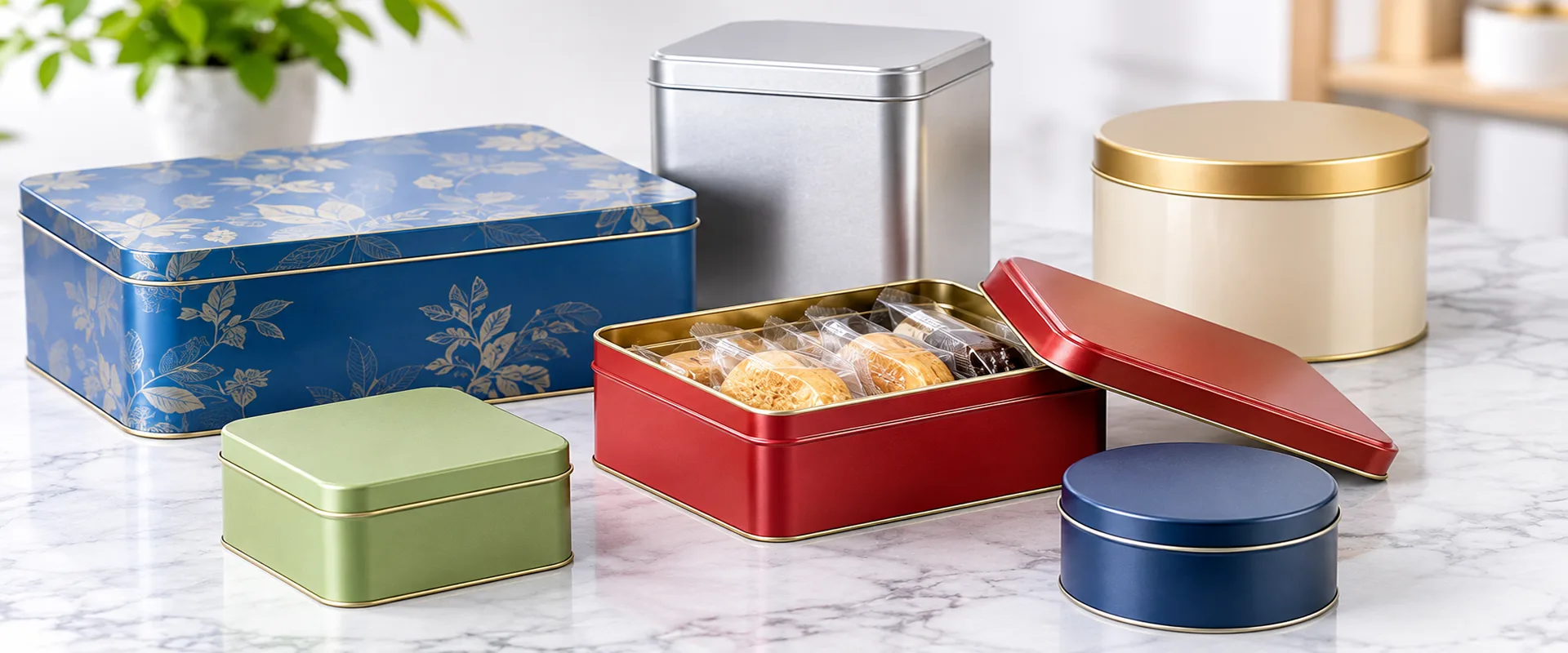
Custom tin box sizes must be defined according to product dimensions, packaging quantity, internal clearance, and container structure. When a brand develops several products with different sizes or weights, the packaging specification needs to account for each product rather than applying one container size to the entire product range.
Selecting custom tin box sizes involves more than matching the external dimensions of a container to the product. The usable internal space, lid construction, material thickness, forming geometry, and product arrangement also affect the final packaging dimensions.
For manufacturers developing custom metal tin packaging for tea, confectionery, cosmetics, accessories, or other products, the size specification should be established before tooling and artwork development.
This article explains how to determine custom tin box dimensions for different products, calculate usable internal space, select packaging sizes for multiple SKUs, and define dimensional requirements for production.
Table of Contents
Custom Tin Box Dimensions and Product Size
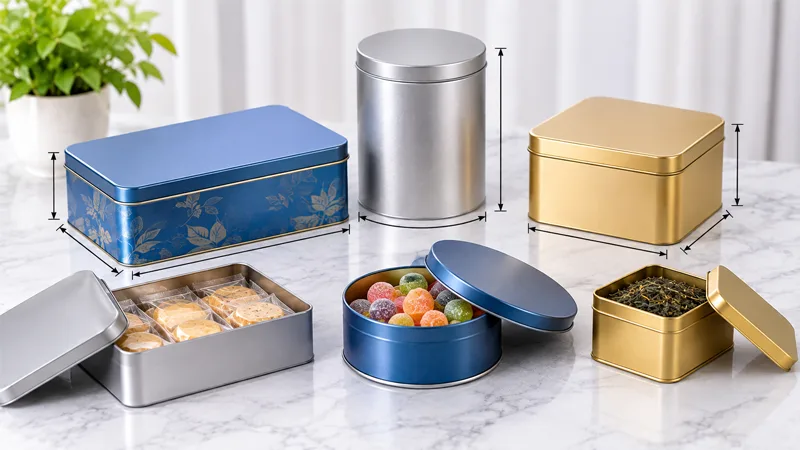
Custom tin box dimensions should be determined from the physical characteristics of the product and the packaging arrangement.
A product may have a defined length, width, and height, or it may consist of loose materials that occupy a specific volume. The packaging specification should identify the dimensions that control the container size.
For products with a fixed shape, the following information is generally required:
- Product length
- Product width
- Product height
- Product weight
- Product quantity per tin box
- Product orientation
- Required clearance
For loose products, such as tea leaves, confectionery, or small components, the required internal volume should be determined using the actual product and filling arrangement.
Product weight alone cannot determine the correct tin box size. Different products with the same weight may occupy different volumes.
Product Dimensions and Packaging Clearance
The product dimensions define the minimum space required inside the container.
Packaging clearance is the additional space required to place the product inside the tin box and maintain its intended position.
The required clearance depends on the product shape, loading direction, insert design, and packaging method.
For example, a rectangular product may require additional clearance along its length and width to allow placement without contacting the formed sidewalls.
A product with an irregular shape may require an insert to maintain its position.
The packaging specification should distinguish between the nominal product dimensions and the required usable internal dimensions.
How to Calculate Tin Box Internal Dimensions
The internal dimensions of a tin box are different from its external dimensions.
The external length, width, and height describe the overall container size. The internal dimensions describe the space available for the product.
For a rectangular tin box, the internal dimensions are affected by material thickness, forming geometry, corner radii, seams, and lid construction.
A simplified calculation can be used during the initial packaging development.
Internal Length and Width
The usable internal length can be estimated as:
Usable internal length = external length − structural allowances
The usable internal width can be estimated as:
Usable internal width = external width − structural allowances
The structural allowances should be determined from the actual tin box design.
For example, a rectangular tin box with an external length of 150 mm may not provide 150 mm of usable internal length.
The formed sidewalls, material thickness, and corner geometry reduce the available space.
The same principle applies to the internal width.
Internal Height
The usable internal height should account for the body structure, lid engagement, and any insert placed inside the container.
A simplified calculation is:
Usable internal height = available internal height − insert height − other obstructions
The available internal height should be determined from the finished tin box structure.
When the product extends above the insert, the remaining clearance must be sufficient for the lid to close without contacting the product.
Example of Tin Box Size Calculation
Assume a product has the following dimensions:
| Product dimension | Measurement |
|---|---|
| Length | 120 mm |
| Width | 75 mm |
| Height | 25 mm |
The product is placed horizontally inside a rectangular tin box.
The initial packaging specification may require:
- Internal length greater than 120 mm
- Internal width greater than 75 mm
- Internal height greater than 25 mm
The actual dimensions must include the required clearance and account for the insert, if one is used.
These values are only an initial reference. The final custom tin box dimensions should be confirmed using the actual product and finished container structure.
Custom Tin Box Sizes for Different Products
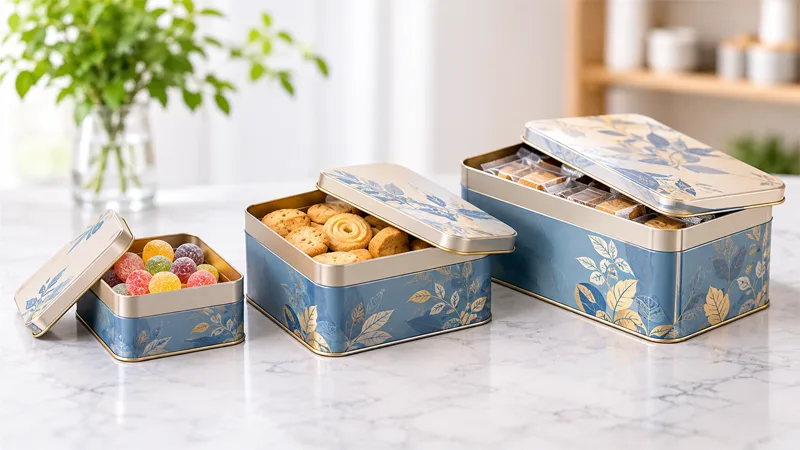
A product range may contain several items with different dimensions, weights, or quantities.
For example, a confectionery brand may offer three package sizes:
| Product | Net weight | Packaging requirement |
|---|---|---|
| Small pack | 100 g | Small tin box |
| Medium pack | 250 g | Medium tin box |
| Large pack | 500 g | Large tin box |
The tin box dimensions should be determined from the actual product volume and arrangement.
A 500 g product does not necessarily require a container that is five times the size of a 100 g product.
The required space depends on the product density, shape, filling method, and internal arrangement.
Separate Tin Box Sizes
Separate tin box sizes may be required when the products have different dimensions or when a common container would leave excessive unused space.
For example, a small product may require a shallow tin box, while a larger product may require greater internal height.
Each size should have its own dimensional specification.
The specification should identify:
- External dimensions
- Internal dimensions
- Body height
- Lid structure
- Material thickness
- Insert dimensions
- Product arrangement
The dimensions should be confirmed before tooling development.
Common Tin Box Size for Multiple Products
A common tin box size may be used when several products can fit within the same internal dimensions.
Different inserts or product arrangements may allow the same container to accommodate several products.
However, the container should not be selected only because its volume is sufficient.
The product must also fit through the opening, remain in the intended position, and allow the lid to close.
The packaging specification should identify which products can use the common container and which require separate sizes.
Tin Box Dimensions for Different Product Shapes
Product shape affects the dimensions and structure of the tin box.
A rectangular product, cylindrical product, or irregularly shaped product may require different internal space.
Rectangular Products
Rectangular products are generally evaluated using length, width, and height.
The packaging dimensions should account for the product orientation and the clearance required during loading.
If the product is placed horizontally, the internal length and width must accommodate the product in that orientation.
If the product is placed vertically, the opening dimensions must accommodate its cross-section.
Cylindrical Products
Cylindrical products may be placed vertically or horizontally.
For vertical placement, the internal diameter or width must accommodate the product diameter.
For horizontal placement, the container length and width must accommodate the product’s overall dimensions.
The product height should also be considered when selecting the internal height of the tin box.
Irregularly Shaped Products
Irregular products may require an insert or a specific internal arrangement.
The packaging dimensions should be determined from the product’s full profile rather than a single nominal measurement.
A product drawing or physical sample can help define the required space.
Custom Tin Box Inserts and Internal Dimensions

Custom tin box inserts affect the usable internal space and the position of the product.
An insert may include separate compartments, openings, supports, or dividers.
The insert specification should include the material, thickness, dimensions, and product arrangement.
Insert Dimensions
The insert dimensions should be developed using the internal dimensions of the tin box.
The insert must fit inside the container without interfering with the sidewalls or lid.
If the insert is too large, it may not fit into the tin box.
If the insert is too small, the product may move during handling.
Product Clearance Inside the Insert
The insert opening should accommodate the product and the required clearance.
For products with dimensional variation, the insert should account for the expected range rather than only the nominal product size.
The product should also be checked for height clearance.
If the product extends above the insert, the remaining internal height must accommodate the product and the lid.
Custom Tin Box Sizes for Multiple SKUs
A product line may contain several SKUs with different product dimensions or quantities.
The packaging specification should identify which dimensions change between the SKUs.
For example, a product line may use:
| SKU | Tin box length | Tin box width | Tin box height |
|---|---|---|---|
| SKU A | 120 mm | 80 mm | 35 mm |
| SKU B | 150 mm | 100 mm | 40 mm |
| SKU C | 180 mm | 120 mm | 50 mm |
These values are illustrative only.
The actual dimensions should be determined from the product size, required clearance, container structure, and insert arrangement.
Shared Dimensions Across SKUs
Some product lines may share the same external length and width but use different heights.
Others may use different lengths while keeping the width and height constant.
The shared dimensions should be identified during packaging development.
However, common dimensions do not necessarily mean that the same tooling can be used for every size.
The tooling requirement depends on the forming process and component structure.
Tin Box Material Thickness and Size Selection
Tinplate thickness affects the forming and structural characteristics of the container.
The material specification should be selected according to the tin box dimensions, structure, forming process, and product requirements.
A larger tin box does not automatically require thicker tinplate.
The required material thickness depends on the panel dimensions, structural features, forming conditions, and intended use.
For a product line with several tin box sizes, the material specification should identify whether all sizes use the same thickness or whether different structures require different material specifications.
Material thickness should be confirmed during packaging development and production preparation.
Tooling Requirements for Different Tin Box Sizes
Different tin box sizes may require separate tooling components.
The tooling requirement depends on the container dimensions and forming process.
For example, a change in body height may require different tooling even when the length and width remain unchanged.
A change in length or width may also affect the blank dimensions, forming arrangement, and lid structure.
The packaging specification should identify:
- Tin box size
- Body dimensions
- Lid dimensions
- Material specification
- Forming process
- Tooling components
- Required production quantity
Tooling requirements should be confirmed before the final dimensions are approved.
Artwork for Multiple Tin Box Sizes
Artwork for custom tin box packaging should be developed using the approved dieline for each container size.
The printable area changes when the panel dimensions change.
For example, a logo that fits on a large tin box may not fit on a smaller panel without changing its position or size.
The artwork specification should identify which elements remain the same and which elements change between product sizes.
These may include:
- Logo position
- Product name
- Net weight
- Product information
- Barcode
- Panel layout
- Bleed area
- Seam allowance
The artwork should be checked against the actual container structure.
Information Required for Custom Tin Box Sizes
When requesting custom tin box sizes, the following information should be provided.
| Requirement | Information |
|---|---|
| Product dimensions | Length, width, height, or product drawing |
| Product weight | Weight of each product |
| Product quantity | Number of products per tin box |
| Product shape | Rectangular, cylindrical, irregular, or loose product |
| Product arrangement | Horizontal, vertical, or multiple compartments |
| Required internal space | Internal length, width, and height |
| Tin box structure | Slip lid, hinged lid, plug lid, or other construction |
| Insert requirement | Material, dimensions, and compartment layout |
| Material specification | Tinplate grade and thickness |
| Artwork | Approved artwork and dieline |
| Production quantity | Quantity required for each size |
These details help define the container dimensions and packaging structure before tooling and production.
Conclusion
Custom tin box sizes should be developed from the product dimensions and the packaging requirements.
The external dimensions alone do not determine whether a product fits inside the container. The usable internal space, opening dimensions, insert structure, and lid construction must also be considered.
For product lines with several SKUs, the packaging specification should identify which tin box dimensions remain constant and which change between products.
When the product dimensions and packaging requirements are defined before tooling, each tin box size can be developed according to the actual product and production specification.
FAQ
How do I choose the right custom tin box size?
Start with the product dimensions, product weight, quantity, and arrangement. Determine the required usable internal space and then define the external dimensions based on the container structure.
What is the difference between internal and external tin box dimensions?
External dimensions describe the overall size of the finished container. Internal dimensions describe the space available for the product. Material thickness, formed edges, seams, corner radii, and lid construction affect the difference.
Can one tin box size be used for multiple products?
Yes, if the products fit within the usable internal dimensions and the packaging structure supports the required arrangement. Different inserts may be used to accommodate different products.
Do different tin box sizes require separate tooling?
Some sizes require separate tooling components. The tooling requirement depends on the dimensions, forming process, and container structure.
What information is needed to develop custom tin box dimensions?
The main information includes product dimensions, product weight, quantity per tin, product arrangement, required internal space, tin box structure, insert requirements, material specification, and production quantity.