

Introduction
Custom tin boxes for candle packaging are used for container candles, travel candles, gift sets, and scented candle products. Tinplate offers a rigid metal structure, a printable exterior, and several options for body and lid construction. However, selecting a suitable candle tin requires more than matching the container diameter to the intended candle size.
The container must accommodate the wax formulation, fragrance load, wick configuration, filling process, cooling behavior, and intended burning conditions. Its internal coating must be suitable for contact with the candle ingredients and the temperatures encountered during normal use. The body, base, rim, and lid must also retain their intended geometry during filling, handling, storage, and transportation.
For brands and packaging buyers sourcing custom candle tins, these requirements should be defined before tooling and production specifications are finalized. A container that looks correct when empty may still present problems during wax filling, wick placement, lid installation, or candle burning.
This guide explains the main engineering and manufacturing considerations for custom tin candle packaging, from material selection and container dimensions to internal coatings, lid construction, testing, and batch inspection.
Table of Contents
Selecting the Right Tinplate Construction for Candle Containers
Tinplate consists of a steel substrate with a thin tin coating. The steel provides structural strength, while the tin coating contributes to corrosion resistance and supports subsequent coating or printing processes. In candle packaging, the finished container’s performance depends on the complete material and coating system rather than the tin layer alone.
Custom candle tins are available in round, square, rectangular, and other formed shapes. A shallow round tin may use a relatively simple body and lid construction, whereas a rectangular candle tin may require additional attention to corner radii, sidewall deformation, and the geometry of the bottom and upper rim.
Tinplate thickness and container rigidity
Tinplate thickness affects body stiffness, forming behavior, rim construction, and resistance to denting. The appropriate thickness depends on the container’s diameter, height, shape, material temper, forming depth, and production method.
A larger-diameter candle tin has a broader unsupported surface at the base and may require a different construction from a small travel candle container. Rectangular candle tins also have flat sidewalls and corners that respond differently to forming and handling loads.
Increasing material thickness is not automatically the best solution to a denting problem. A change in body geometry, bottom structure, rim profile, or forming process may also affect rigidity. The material specification should therefore be assessed alongside the complete container design.
For a custom candle tin manufacturer, the relevant production parameters include the following:
- Tinplate thickness, grade, temper, and material specification.
- Body diameter or length and width, together with finished height.
- Bottom construction and the geometry of the upper rim.
- Lid type and the required clearance between mating components.
- Exterior printing, protective coating, and interior coating requirements.
These parameters should be recorded on the approved drawing or product specification. A general description such as “heavy-duty candle tin” does not provide enough information for tooling, inspection, or repeat production.
Round versus rectangular candle tins
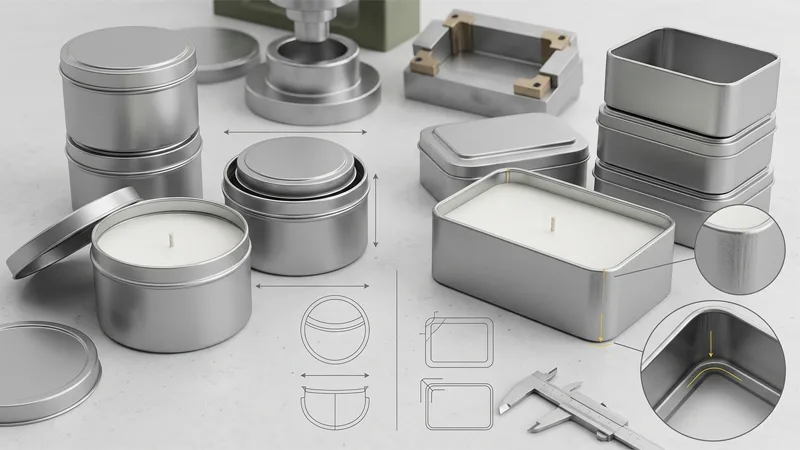
Round candle tins are often straightforward to form and provide a continuous sidewall without corners. Their diameter and height determine the available internal space, while the base and rim construction affect rigidity and assembly.
Rectangular candle tins provide a different packaging format, but their corners introduce additional design considerations. During forming, material flows around the corners, and the final geometry depends on the blank layout, tooling, material properties, and forming conditions.
The inside corner radius also affects how the wax occupies the container. Sharp internal transitions can make filling and cleaning more difficult, while a suitable radius provides a smoother transition between the base and sidewalls.
The shape should be selected according to the intended candle format, available space, filling equipment, and visual design. A change from a round tin to a rectangular tin should not be treated as a simple dimensional adjustment because it may require different tooling and validation.
Defining Candle Tin Dimensions and Usable Capacity
The nominal dimensions of a candle tin do not directly indicate how much wax it can hold. The usable internal space is affected by wall thickness, bottom construction, corner radii, lid engagement, and the required clearance below the rim.
For this reason, custom tin box dimensions should be specified using both external and internal measurements where necessary.
External dimensions versus internal dimensions
External dimensions describe the finished package’s overall size. They are useful for shipping cartons, retail displays, shelf planning, and product packaging layouts.
Internal dimensions determine the available space for the candle. For a round tin, the main measurements are internal diameter and usable internal height. For a rectangular tin, length, width, and height must be considered together with the internal corner radii.
The usable filling height may be lower than the full internal wall height. A candle may require free space below the rim to accommodate the wax surface, filling variation, or other design requirements. The correct clearance should be established through the candle filling process and the finished product specification rather than assumed from the container height alone.
For example, two round candle tins with the same external diameter may have different internal capacities if their material thicknesses, wall profiles, or bottom constructions differ.
Estimating wax capacity
For a cylindrical container, the approximate internal volume can be calculated using:
[
V=\pi r^2h
]
where:
- (V) is the internal volume.
- (r) is the internal radius.
- (h) is the usable internal height.
If the internal diameter is 70 mm and the usable filling height is 35 mm, the ideal cylindrical volume is approximately 135 mL.
This value is a geometric estimate, not a wax-weight specification. The actual wax mass depends on the wax blend’s density, filling temperature, cooling behavior, and the required headspace. The final fill quantity should be established using the actual formulation and production process.
For rectangular candle tins, the internal volume can be estimated from internal length, width, and height, with adjustments for rounded corners and other structural features.
A useful purchasing specification should distinguish the following:
| Specification | Purpose |
|---|---|
| External dimensions | Carton design, storage, and retail display |
| Internal dimensions | Available space for the candle |
| Usable filling height | Defines the intended wax fill level |
| Nominal wax mass | Establishes the target product fill quantity |
| Rim clearance | Defines the space between the wax surface and the container opening |
| Dimensional tolerances | Controls variation between production batches |
These measurements should be checked against the actual manufactured tin rather than relying only on a nominal catalog size.
Internal Coatings and Compatibility with Candle Wax

The interior surface is one of the most important specifications for custom tin boxes for candle packaging. A coating that performs well with one wax formulation may not be suitable for another formulation containing different fragrance oils, dyes, additives, or other ingredients.
The compatibility assessment should consider the complete formulation and intended use conditions.
Why the internal coating matters
Tinplate has a metal substrate and a protective tin layer, but the exposed surface can still be affected by coating defects, forming damage, and the chemistry of the materials that contact it.
An internal coating may be used to provide a specified surface barrier or support corrosion protection. Its suitability depends on the coating chemistry, application method, curing conditions, film integrity, and the intended candle formulation.
Fragrance oils and other candle additives vary considerably in their composition. Some formulations may affect a coating differently from others. A coating should not be selected solely because it is commonly used in another type of metal packaging.
The buyer and manufacturer should confirm the intended wax system, fragrance formulation, and expected contact conditions before selecting the coating.
Coating compatibility testing
A coating specification should identify the coating system and the conditions under which it will be evaluated. Where relevant, the evaluation may include visual inspection, adhesion assessment, and examination for discoloration, blistering, softening, corrosion, or other changes after exposure to the intended formulation.
The test method and acceptance criteria should be agreed upon in advance. Results from one wax formulation should not automatically be applied to a different fragrance blend or additive package.
Forming can also affect the coating. Bending, drawing, curling, and other manufacturing operations may place stress on the coating film. The finished tin should therefore be inspected in the areas most likely to experience deformation, including the rim, corners, and bottom transitions.
A coating that passes an initial inspection on flat tinplate may behave differently after the sheet has been formed into a finished container.
Interior coating and exterior printing are separate requirements
The exterior decoration of a candle tin may include CMYK printing, Pantone spot colors, matte or gloss finishes, and protective overvarnish. These features address the external appearance and surface protection of the package.
They do not establish the suitability of the interior coating for the candle formulation.
The exterior and interior should be specified separately in the technical documentation. This helps prevent confusion when the package uses one coating system for printed surfaces and another for the inside of the container.
Wick Placement and the Geometry of the Candle Tin
Wick placement affects the candle’s burning behavior and should be evaluated with the actual wax formulation and wick system. The metal container provides the physical boundary for the candle, but the container alone cannot determine the correct wick size or burning performance.
Container diameter and wick selection
Candle manufacturers typically select wick systems according to factors such as wax composition, fragrance concentration, dye content, candle diameter, and intended burning characteristics.
A change in container diameter can alter the distance between the wick and the sidewall. A different container shape may also change the way heat is distributed during burning.
For this reason, wick selection should not be based on container diameter alone. The finished candle should be tested using the specified formulation and wick configuration.
When a candle tin is redesigned, the previous wick configuration should be reviewed rather than assumed to remain suitable. Even if the nominal capacity remains similar, differences in geometry may affect the burning pattern.
Wick alignment and bottom construction
The bottom of the tin should provide a suitable surface for the intended wick attachment method. The base should be sufficiently stable and should not have unintended deformation that interferes with the attachment process.
The candle manufacturer should confirm that the wick attachment method is compatible with the container surface and the filling process. Adhesive, wick tabs, and other attachment components should be selected and validated by the candle manufacturer.
For production control, wick position can be checked against a defined center point or a specified positional tolerance. The correct tolerance depends on the candle design and should be agreed upon rather than assigned arbitrarily.
The tin manufacturer is responsible for producing the specified metal container. The candle manufacturer is responsible for validating the wick, wax, fragrance, and burning system as a finished candle.
Candle Tins with Lids and Closure Design

Candle tins with lids are used for product protection, storage, and presentation. The lid may help reduce exposure to dust during storage and handling, but a conventional metal lid should not be treated as an airtight seal or as a substitute for an appropriate safety closure.
The lid construction must be compatible with the body dimensions, rim geometry, and intended use.
Slip lids and friction fit
A slip lid typically fits over or into the body of the tin. Its retention depends on the geometry of the mating components, material thickness, forming accuracy, and dimensional variation.
If the fit is too tight, the lid may be difficult to install or remove. If the fit is too loose, the lid may detach during handling or fail to remain in its intended position.
A functional evaluation should consider lid installation, removal, retention, and repeated use where applicable. The acceptable fit should be established using production-representative samples rather than a single hand-adjusted prototype.
The lid and body should be assessed as a matched system. Checking their dimensions independently may not reveal the combined effect of tolerances on the finished fit.
Lid clearance and wax headspace
The internal depth of the lid and the position of the candle surface should be considered together. If the wax surface, wick, or other candle components extend too close to the opening, the lid may contact the finished candle.
The required clearance depends on the lid profile and the intended candle design. It should be verified with filled samples because wax surface height may vary with formulation, filling conditions, and cooling behavior.
The lid should also be evaluated for interference with the wick or any decorative elements. A container that fits correctly when empty may not provide sufficient clearance once the candle has been filled.
Lid fit does not establish sealing performance
A standard candle tin lid is primarily a closure for the container. Its presence does not establish that the package is hermetic, moisture-tight, or suitable for pressure containment.
If the product requires a specific sealing performance, that requirement must be separately defined and tested. It should not be inferred from a close-fitting lid alone.
Heat Testing and Candle Container Safety
A metal candle container must be evaluated as part of the finished candle system. The fact that tinplate is a metal does not establish that every tin design is suitable for every wax formulation, wick, burn duration, or operating condition.
Heat behavior depends on the candle formulation, flame characteristics, wick configuration, container geometry, base construction, and surrounding environment.
Testing the filled candle
Testing should use the intended wax formulation, fragrance concentration, wick, fill quantity, and production-representative container. A substitute formulation may not produce equivalent results.
The evaluation should follow an appropriate candle safety test plan for the intended market and product type. Applicable requirements should be confirmed for the destination market, product category, and current edition of the relevant standard.
Depending on the product and test plan, the evaluation may examine:
- Container stability during use.
- External container temperature at defined measurement locations.
- Flame behavior and candle performance over the intended burn cycle.
- Changes in the metal base, sidewall, and rim during testing.
- Wick position and the behavior of the remaining wax.
- Evidence of coating deterioration or other unexpected changes.
The exact test conditions and acceptance criteria should be established by the responsible candle manufacturer or product safety team. No single temperature threshold or test duration should be assumed to apply to every candle tin.
Why the container should not be evaluated alone
An empty tin can be inspected for dimensions, coating condition, and structural defects. However, these checks do not demonstrate that the completed candle will perform safely.
The filled candle introduces heat, combustion, wax movement, and wick behavior that are absent from an empty-container inspection.
For this reason, container approval and finished-candle approval should be documented separately. A change to the container material, coating, dimensions, wick, wax formulation, or fragrance system may require a review of the existing validation results.
The final assessment should also consider the instructions and warnings supplied with the finished candle.
Custom Candle Tin Printing and Decoration
Custom candle tin packaging may use printed graphics, solid colors, metallic effects, matte finishes, gloss finishes, embossing, or debossing. These processes should be selected according to the design and the construction of the container.
The artwork should be prepared using the manufacturer-approved dieline. The dieline identifies printable panels, cutting boundaries, fold lines, seams, and areas where the artwork may be affected by forming or assembly.
Artwork placement around the rim and corners
Artwork positioned close to a rolled edge, seam, or forming transition requires particular attention. Some areas may be covered, distorted, or displaced during manufacturing.
For rectangular candle tins, the artwork should account for corner geometry and the transitions between adjacent panels. For round candle tins, the design should account for the continuous sidewall and any overlap or seam associated with the selected construction.
The manufacturer should identify non-printable or restricted areas on the approved dieline. These areas should be incorporated into the artwork rather than corrected after production.
Color reproduction on tinplate
Printed tinplate does not reproduce colors in exactly the same way as white paper. The appearance of a color depends on the ink system, white ink coverage where used, surface reflectivity, protective coating, and viewing conditions.
A design that uses light colors or large solid-color areas may require particular attention to the underlying surface and the specified white ink layer. Metallic effects also depend on the interaction between the printed design and the metal substrate.
For repeat production, the approved color reference and inspection conditions should be documented. The inspection method should specify the applicable viewing conditions and color evaluation procedure where instrumental measurement is required.
Color approval should not be confused with approval of the candle container’s functional properties. Printing, coating, forming, and finished-candle testing are separate parts of the overall product specification.
Quality Inspection for Custom Candle Tins
Quality inspection should verify the characteristics that have been defined in the approved drawing, material specification, appearance standard, and coating requirements.
The inspection plan should identify the measurement method, sampling approach, acceptance criteria, and responsibilities for each inspection stage.
Dimensional inspection
Important dimensions may include the body diameter or length and width, finished height, rim profile, base geometry, and lid dimensions.
Inspection should confirm that the body and lid remain compatible after forming. A lid may meet its individual dimensional specification while still producing an unsuitable fit when combined with a body near the opposite tolerance limit.
For this reason, assembled fit checks are useful alongside individual dimensional measurements.
Surface and coating inspection
The exterior should be examined for defects such as scratches, dents, ink contamination, printing misregistration, coating damage, and visible forming marks that exceed the approved appearance standard.
The interior should be inspected for the coating defects relevant to the specified system. The rim, bottom transition, corners, and other formed areas deserve attention because these regions may experience greater deformation during manufacturing.
The inspection criteria should distinguish acceptable manufacturing characteristics from defects that could affect coating integrity or product function.
Batch consistency
A production batch should be evaluated against the approved reference sample and documented specifications. Checks may include dimensions, lid fit, print appearance, surface condition, and the integrity of the specified coating system.
Where the finished candle’s safety depends on the container design, the candle manufacturer should maintain the applicable validation records and assess whether a material or design change affects those results.
A clear distinction between container inspection and finished-product testing helps both parties identify which requirements have been verified and which remain the responsibility of the candle manufacturer.
What to Specify When Ordering Custom Candle Tins
A complete specification helps the tin manufacturer determine the required construction and identify questions that need to be resolved before production.
The request should include the intended candle application, container shape, target dimensions, lid type, decoration requirements, and the expected production quantity. Where a candle formulation is already available, the buyer should provide the relevant compatibility requirements for the interior coating.
The specification should also identify whether the project requires an existing container design or new tooling. New shapes, non-standard lid profiles, or complex forming features may require additional design review and prototype evaluation.
A practical specification can cover the following information:
Container structure: Shape, external dimensions, internal dimensions where required, material thickness, body construction, and lid style.
Candle requirements: Target wax mass, usable filling height, wick configuration, fragrance formulation, and required headspace.
Surface requirements: Exterior print design, protective finish, interior coating specification, and approved appearance reference.
Quality requirements: Dimensional tolerances, lid-fit criteria, coating inspection, sampling requirements, and finished-container acceptance criteria.
Validation requirements: Compatibility evaluation, filled-candle testing, applicable market requirements, and documentation responsibilities.
Not every detail needs to be finalized at the first inquiry. However, unresolved requirements should be identified before the corresponding design or production decision is frozen.
Common Problems in Custom Candle Tin Projects
Problems with custom candle tins often arise when the metal container is specified independently of the candle manufacturing process.
A tin may have the correct external dimensions but insufficient usable internal capacity. A lid may fit the empty container but interfere with the filled candle. An interior coating may appear satisfactory before forming but show damage at a highly deformed area. A printed design may match the approved artwork but lose detail around a seam or corner.
These issues are easier to investigate when the container specification, candle formulation, and acceptance criteria are documented separately.
| Observed problem | Possible factor to investigate | Appropriate check |
|---|---|---|
| Lid is difficult to remove | Mating dimensions, rim geometry, or forming variation | Measure the body and lid and evaluate assembled fit |
| Wax fill varies between batches | Fill temperature, wax density, filling method, or usable height | Verify the fill process and actual container dimensions |
| Coating shows discoloration | Formulation compatibility, heat exposure, or coating condition | Review the coating system and perform an appropriate compatibility assessment |
| Artwork is distorted near an edge | Dieline placement or forming deformation | Review the approved dieline and formed sample |
| Candle behaves differently after a container change | Changed diameter, geometry, heat distribution, or wick suitability | Repeat the relevant finished-candle evaluation |
| Finished tins show inconsistent appearance | Printing, coating, handling, or forming variation | Compare production samples with the approved reference and inspection criteria |
These are possible causes rather than universal diagnoses. A visible defect should be investigated using the actual production conditions and relevant test results.
Conclusion
Custom tin boxes for candle packaging require coordinated specifications for the metal container, internal coating, candle formulation, wick system, lid, and printed exterior. Dimensions should be defined according to usable capacity rather than external measurements alone, and coating compatibility should be evaluated using the intended formulation.
The container manufacturer should verify the specified material, forming quality, dimensions, surface condition, and lid fit. The candle manufacturer should validate the completed candle under its intended conditions of use. Separating these responsibilities makes it easier to document the requirements, investigate defects, and maintain consistency between approved samples and production batches.
FAQ
1. What material is used for custom tin boxes for candle packaging?
Custom candle tins are commonly made from tinplate, which consists of a steel substrate with a tin coating. The required thickness, material grade, body construction, and surface coating depend on the container dimensions, forming process, intended use, and product specification.
2. Do candle tin containers need an internal coating?
The requirement depends on the tinplate surface, the candle formulation, and the intended application. An internal coating may be specified for surface protection or compatibility requirements, but it should not be selected solely on the basis of general packaging practice. The coating system should be evaluated against the intended wax and fragrance formulation.
3. How do I calculate the capacity of a candle tin?
For a round candle tin, the approximate internal volume can be calculated from its internal radius and usable internal height using (V=\pi r^2h). The calculated volume does not directly determine the wax weight. The final fill quantity should account for wax density, filling conditions, and required clearance below the rim.
4. Can a standard metal lid make a candle tin airtight?
Not necessarily. A conventional slip lid or friction-fit lid provides closure, but its presence does not demonstrate airtightness or hermetic sealing. If a specific sealing performance is required, it must be defined and verified through an appropriate test.
5. Should a finished candle be tested after changing the tin container?
A change to the container’s dimensions, material, coating, or construction may affect the finished candle’s performance. The candle manufacturer should review the existing validation results and determine whether additional testing is required. The review should consider the wax formulation, wick, fragrance, and intended use conditions as well as the container change.