

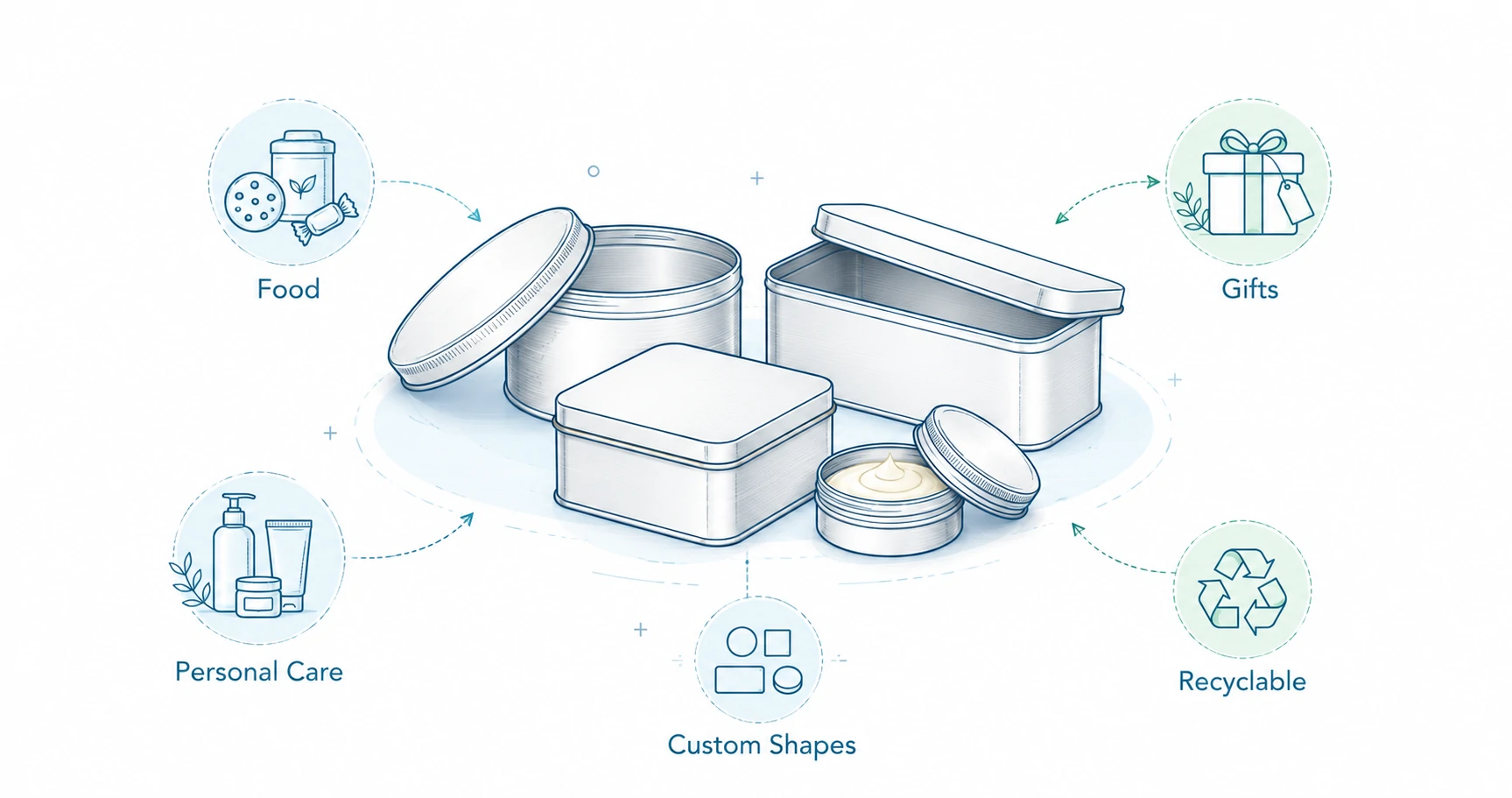

Tin containers with lids are no longer used only as simple storage boxes. For modern consumer brands, they have become a practical packaging platform that combines product protection, shelf impact, reuse value, and a stronger sustainability story. A well-designed tin container can protect tea from moisture, keep biscuits looking premium after long-distance shipping, turn a cosmetic balm into a giftable item, and make a seasonal promotion feel more collectible than a paper box or thin plastic tub.
For buyers comparing packaging options, the key question is not simply, “Can I put my product in a tin?” The better question is, “Which tin structure, lid style, material thickness, lining, printing finish, and insert system will protect my product while supporting the sales channel and brand position?” This guide answers that question from a commercial, technical, and sourcing perspective. It is written for food brands, gift companies, beauty and personal care brands, distributors, private-label buyers, and promotional product teams that need custom tin packaging that looks good, performs consistently, and can be produced at scale.
At Mr.Tin Box, custom metal tin packaging is developed for Food & Beverage Packaging, Beauty & Personal Care Packaging, Gift, Promotional & Holiday Packaging, and Specialty & Industrial Packaging. The company’s application pages describe food-grade tin boxes for snacks, tea, coffee, chocolates, candies, and specialty foods, as well as luxury metal boxes for perfumes, skincare sets, essential oils, and premium cosmetic products. This article brings those use cases together around one high-intent keyword: tin containers with lids.
Table of Contents
Quick buyer summary
If you need a fast starting point, use the table below. It shows how tin containers with lids normally fit different product categories and what buyers should pay attention to before requesting a quote.
| Product category | Common product examples | Recommended lid direction | Key protection goal | Typical decoration strategy | Main buyer concern |
|---|---|---|---|---|---|
| Food and beverage | Tea, coffee, biscuits, chocolate, candies, mints, snacks | Slip lid, plug lid, hinged lid, airtight inner lid | Reduce moisture, oxygen, light, odor transfer, crushing | Food-safe printing, matte or glossy varnish, embossing | Food-contact compliance and seal performance |
| Gifts and promotions | Holiday tins, corporate gifts, wedding favors, limited editions | Hinged lid, window lid, shaped lid, two-piece lid | Improve perceived value and unboxing experience | Full-color printing, metallic ink, spot UV, embossing | Shelf impact, artwork consistency, MOQ, lead time |
| Beauty and personal care | Balms, soaps, solid perfume, skincare kits, waxes, grooming sets | Screw lid, slip lid, hinged lid, shallow tray lid | Protect fragrance, texture, formula stability, premium appearance | Matte, satin, soft-touch, foil stamping, minimal typography | Compatibility with formula, inserts, scratch resistance |
| Specialty and industrial | Small tools, electronics accessories, spare parts, collectible items | Hinged lid, sliding lid, locking lid, compartment lid | Impact resistance, organization, long-term storage | Screen printing, label plates, embossed logo | Insert design and transit durability |
The table also explains why there is no single “best” tin container. A round screw-lid tin may be perfect for a lip balm, but inefficient for biscuits. A hinged rectangular tin may be ideal for a corporate gift set, but too expensive for a high-volume candy launch. A food tin for coffee may need improved sealing, while a decorative holiday tin may focus more on artwork and gifting value. The right specification always begins with the product, not the catalog photo.
What are tin containers with lids?
Tin containers with lids are metal packaging containers, usually made from tinplate, designed with a removable, hinged, sliding, plug, screw, or specialty lid. In most commercial packaging contexts, “tin” does not mean the container is made of pure tin. It usually refers to tinplate: a thin steel sheet coated with tin and then formed into boxes, cans, trays, or decorative containers. Tinplate is widely used because it offers good rigidity, printability, magnetic recoverability, and a premium hand feel.
A tin container has three basic jobs. First, it holds the product. Second, it protects the product from handling, stacking, humidity, light, dust, and retail damage. Third, it communicates brand value. This third job is where tin packaging often outperforms lower-cost disposable packs. When consumers hold a rigid tin, they immediately feel weight, structure, and permanence. That physical cue can support premium pricing, repeat purchase, and giftability.
The lid is especially important because it controls opening experience and perceived quality. A loose lid can make a product feel cheap. A lid that is too tight can create frustration. A lid that opens smoothly, aligns cleanly, and closes with a reassuring fit makes the container feel engineered. This is why serious custom tin programs should test lid tolerance, opening force, edge safety, and repeat-use performance before moving into mass production.
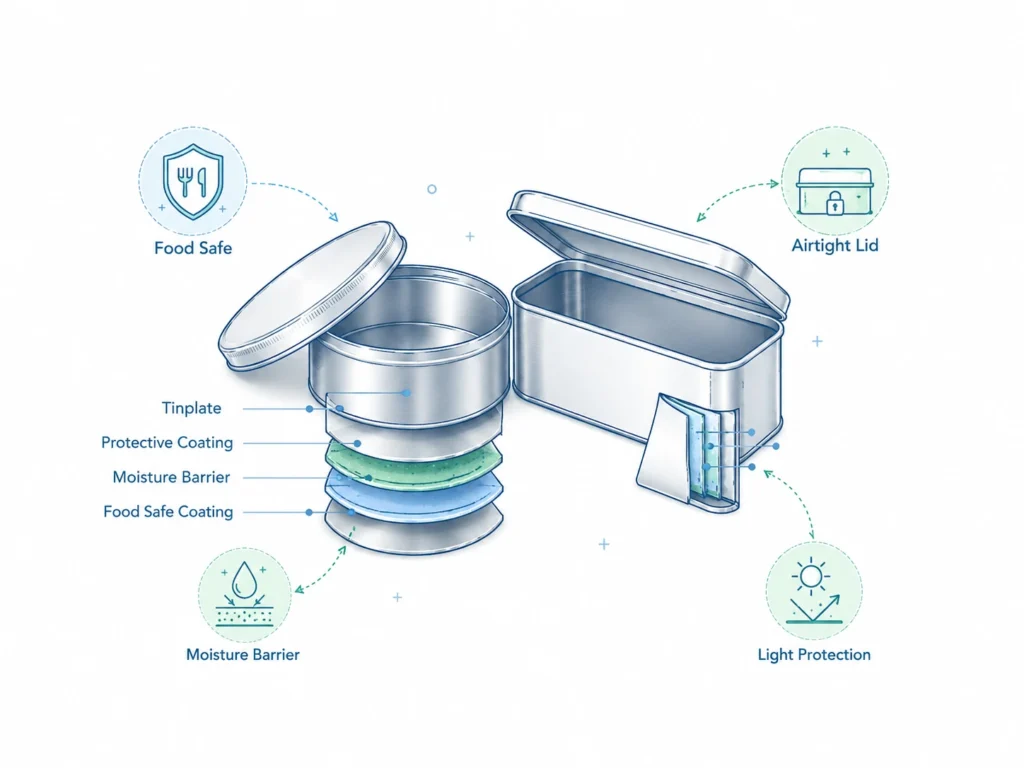
For food packaging, the lid can also affect shelf life. Many decorative tins are not hermetically sealed like processed food cans, but they can still provide meaningful protection when combined with inner bags, seals, plugs, gaskets, or overwrap. For dry foods such as tea, coffee, biscuits, mints, confectionery, and powders, the tin is often paired with a food-safe inner pack to create a practical balance between appearance, protection, and cost.
Why brands choose tin containers with lids
Brands choose tin containers with lids because they solve several commercial problems at the same time. They make products look more valuable, reduce deformation compared with paperboard, provide a strong surface for printing and embossing, and often stay in the consumer’s home after the product is used. That reusable quality gives the brand more exposure than a pack that is immediately discarded.
The business case becomes stronger in premium and semi-premium categories. In tea, coffee, chocolate, biscuits, candles, balms, fragrance, grooming kits, and corporate gifts, the package is not only a cost item; it is part of the product experience. A consumer may compare two similar products on a shelf and choose the one that feels more giftable. A buyer may select a private-label tin because it photographs better on an e-commerce page. A distributor may prefer a rigid tin because it can reduce complaints related to crushed cartons.
Packaging also influences trust. For food and personal care products, consumers expect the container to feel clean, safe, and appropriate for the contents. A thin box that bends easily can make a premium product feel less reliable. A well-fitted metal container suggests better control, better protection, and stronger manufacturing discipline. This is one reason Mr.Tin Box’s Food & Beverage Packaging page emphasizes food-grade materials, precision stamping, edge curling, seamless assembly, inner coatings, and barrier protection against light, moisture, oxygen, and contamination.
Industry trends also support this direction. Grand View Research estimated the global metal packaging market at USD 148.13 billion in 2024 and projected it to reach USD 184.21 billion by 2030, with food and beverages representing the largest end-use segment in its summary of the metal packaging market. Meanwhile, the European Commission’s packaging policy direction is pushing packaging toward recyclability and lower primary raw material use, including the objective that all packaging on the EU market should be recyclable in an economically viable way by 2030. These signals matter because packaging buyers increasingly need both retail performance and credible environmental positioning.
Useful market and regulatory data for packaging decisions
The following data points are useful when building a business case for custom tin containers with lids. They should not be treated as a one-size-fits-all promise, because packaging performance depends on design, local recycling systems, and product compatibility. However, they help explain why metal packaging is often considered for premium, food, gift, and personal care applications.
| Topic | Data or guidance | Why it matters for tin container buyers | Source |
|---|---|---|---|
| Global metal packaging market | Estimated at USD 148.13 billion in 2024 and projected at USD 184.21 billion by 2030 | Shows that metal packaging remains a large, commercially relevant category rather than a niche material | Grand View Research |
| Food-contact substances | FDA explains that food packaging and its components can be food contact substances and may require authorization when they are food additives | Buyers should specify food-contact coatings, inks, liners, and testing expectations early | U.S. FDA |
| EU food-contact safety | EU guidance states that materials intended to contact food, including metal, must comply with strict safety rules and not endanger health or affect food quality | Important for brands selling food tins into European markets | European Commission Food Safety |
| Packaging waste policy | EU packaging rules aim to make all packaging on the EU market recyclable in an economically viable way by 2030 | Reinforces the need to design tins for recyclability, responsible material use, and clear labeling | European Commission Environment |
| U.S. packaging waste | EPA reported 82.22 million U.S. tons of containers and packaging generated in 2018, with a 53.9% recycling rate for generated containers and packaging | Shows why packaging material choice and recovery systems are visible sustainability topics | U.S. EPA |
| Steel packaging recycling | Steel for Packaging Europe reported record recycling performance for steel packaging in Europe in recent reporting; industry news reported 84% for 2024 | Supports the circularity case for steel-based packaging where collection and recycling systems are strong | CanTech International |
| Packaging recoverability | ISO 18604 specifies requirements for packaging to be classified as recoverable through material recycling | Useful reference when brands discuss design-for-recycling expectations | ISO 18604 |
For a commercial article, these data points are valuable because they connect product-level packaging decisions with wider market and regulatory pressure. A buyer does not need to become a regulatory specialist, but the buyer does need to know which questions to ask: Is the coating appropriate for the product? Is the ink system suitable? Will the package be sold in the U.S., EU, UK, or another regulated market? Is the container meant for direct food contact, or will the food be packed in a separate bag inside the tin? Does the lid design support the required freshness target?
How lid design changes packaging performance
A tin container is only as good as its lid system. The lid determines how customers open the pack, how the product is protected after opening, how the container stacks, how it looks on shelf, and how much tooling complexity is required. For sourcing teams, lid structure is one of the first decisions to define.
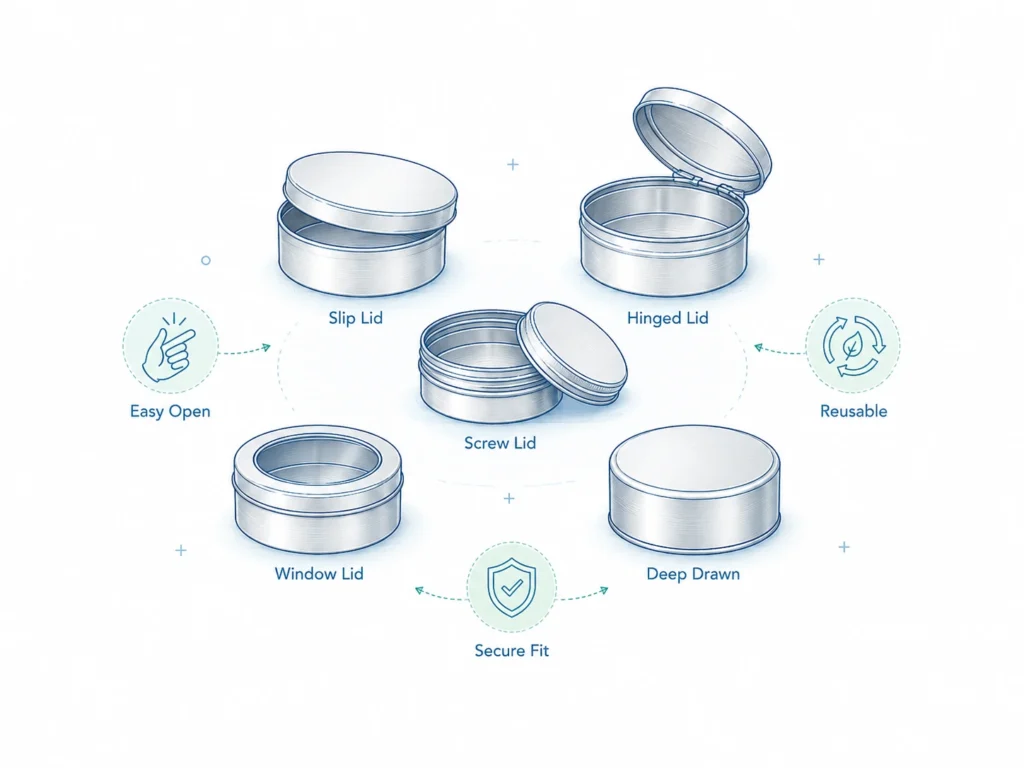
A slip lid is one of the most common options. It slides over the body of the tin and is widely used for candies, biscuits, tea, gifts, soaps, and general storage tins. It is simple, familiar, and cost-effective. However, it is not always the best choice when a product needs repeated airtight use. For a tea or coffee project, a plug lid or inner lid may improve closure performance.
A hinged lid keeps the lid attached to the body. It is popular for gift tins, mint tins, grooming kits, stationery, and small accessories. The biggest advantage is convenience: the consumer cannot easily lose the lid, and the opening experience feels more premium. The trade-off is that hinge alignment and durability need careful quality control. If a hinge feels loose or opens unevenly, the perceived value drops quickly.
A screw lid is common for small round tins used in balms, waxes, creams, solid perfumes, salves, and personal care products. It provides a more secure closure than a loose slip lid and works well for products that consumers open repeatedly. For formulas that contain oils, fragrance, or active ingredients, compatibility testing is important. The tin, coating, sealing layer, and formula must be evaluated together.
A plug lid is often used when a tighter fit is required. It can improve the sense of sealing and is suitable for dry foods, tea, coffee, powders, and premium storage tins. A plug lid can also support a more refined opening feel. However, tolerances need to be controlled carefully, because a plug lid that is too tight can be difficult to open, while one that is too loose can undermine protection.
A window lid can display the product while keeping the strength and brand value of a metal container. It is often used for candies, cookies, gift sets, stationery, and promotional packs. The transparent window material must be selected carefully, especially for food and export markets. Buyers should confirm whether the window is needed at all, because windows can reduce recyclability simplicity and may complicate production.
A sliding lid is compact and memorable, especially for mints, cards, small tools, and promotional products. It can create a satisfying user interaction. The limitation is that it is less suitable for bulky products or products that need high barrier protection.
Tin containers with lids for food and beverage packaging
Food and beverage is one of the strongest applications for tin containers with lids. Products such as tea, coffee, biscuits, cookies, chocolate, candies, nuts, spices, cocoa powder, drink powders, and specialty snacks all benefit from packaging that protects aroma, reduces crushing, and looks suitable for gifting. The Food & Beverage Packaging page of Mr.Tin Box specifically highlights food-grade tin boxes and metal containers for snacks, tea, coffee, chocolates, candies, and specialty food products.
For food brands, the first decision is whether the tin will contact the food directly. Many dry foods are packed in a bag, pouch, tray, or paper wrap inside the tin. In that case, the tin functions as a decorative protective secondary pack. This is common for biscuits, cookies, tea bags, chocolate assortments, and candy gift sets. If the food will contact the metal or coating directly, the project requires a higher level of food-contact review, including food-safe lacquer, migration considerations, product chemistry, and regulatory requirements in the target market.
The second decision is moisture sensitivity. Biscuits, crackers, tea, coffee, powders, and mints are sensitive to moisture. A decorative slip-lid tin may support protection, but it may not be enough by itself for long shelf-life requirements. Many brands combine tins with inner foil bags, sealed pouches, desiccant sachets where appropriate, or plug lids. For coffee and tea, aroma protection is also important. A tin that looks beautiful but allows odor exchange can damage the product experience.
The third decision is retail format. A tea brand may need a tall round tin for countertop storage. A biscuit brand may need a shallow rectangular tin that can be stacked in cartons. A chocolate brand may need a tray-style tin with PET, paperboard, or molded pulp inserts. A spice brand may need small tins with shaker or plug-lid functions. Each product has a different filling method and distribution environment.
Food packaging option matrix
| Food product | Tin container direction | Lid recommendation | Inner packaging suggestion | Main technical question |
|---|---|---|---|---|
| Loose tea | Round or square storage tin | Plug lid or slip lid with inner seal | Inner bag or foil pouch for aroma control | How much oxygen and moisture protection is required? |
| Coffee beans or ground coffee | Tall round tin or rectangular tin | Plug lid, inner lid, or overcap | Degassing bag or sealed pouch if required | Is the tin decorative, functional, or both? |
| Biscuits and cookies | Rectangular or round gift tin | Slip lid or hinged lid | Tray, paper cup, or sealed flow pack | How will the product avoid breakage during transit? |
| Chocolate and confectionery | Shallow tin, window tin, or shaped gift tin | Hinged, slip, or window lid | Food-safe tray or dividers | Is the lining suitable for fat-containing products? |
| Mints and candies | Small pocket tin or slider tin | Hinged lid or sliding lid | Direct contact only if coating is qualified | What opening force feels right for consumers? |
| Spices and powders | Small round or square tin | Plug lid, shaker insert, or screw cap | Food-contact liner when needed | Is the closure suitable for powder leakage control? |
This matrix is useful in early sourcing discussions because it separates appearance from function. Many packaging problems happen when a buyer chooses a shape first and discusses product protection later. A better process is to define product sensitivity, shelf-life target, filling method, and shipping route before finalizing the tin structure.
For food and beverage brands, tin packaging also supports premium merchandising. A tea tin can become kitchen storage. A biscuit tin can become a holiday keepsake. A chocolate tin can become a collectible gift. This is why tin containers with lids are popular for seasonal assortments and limited editions. They create a package that consumers may keep, which extends brand visibility beyond the first purchase.
Tin containers with lids for gift and promotional packaging
Gift and promotional packaging has a different logic from everyday food packaging. The main goal is not only to protect the item, but also to create an emotional response. A gift tin should look intentional, feel durable, and create the sense that the product is worth giving. For corporate gifting, holiday campaigns, anniversary editions, and retail promotions, the tin container often becomes the visible centerpiece of the offer.
Tin containers with lids are especially useful for gift packaging because they can be customized in shape, color, printing, embossing, and interior layout. A brand can use the same base structure for multiple campaigns and update the artwork seasonally. This is efficient for buyers because tooling can be reused while the visual story changes. A Christmas cookie tin, a Lunar New Year candy tin, a Valentine chocolate tin, and a corporate appreciation tin may share similar construction but use different graphics and inserts.
The lid experience matters strongly in gift packaging. A hinged lid feels complete and premium. A two-piece slip lid feels traditional and collectible. A window lid can increase immediate product visibility. A shaped lid can make the pack more memorable, but may require more tooling cost and longer development time. When planning promotional packaging, buyers should balance uniqueness with production reliability.
For promotional campaigns, timeline is often the biggest risk. A buyer may want a fully custom tin for a holiday launch but start too late. Tooling, sampling, artwork proofing, printing, forming, assembly, inspection, and sea freight all require time. This is why packaging briefs should be prepared early, especially when the tin has a custom mold, special finish, embossing, or inserts.
Gift packaging planning table
| Campaign type | Best tin approach | Decoration focus | Buyer advantage | Risk to manage |
|---|---|---|---|---|
| Holiday retail launch | Round, square, or rectangular tin with seasonal artwork | Metallic inks, glossy varnish, embossing, festive color | Strong shelf appeal and giftability | Late artwork approval can delay shipment |
| Corporate gift set | Hinged rectangular tin with custom insert | Logo embossing, matte or satin finish, premium typography | Professional presentation and reusable value | Insert fit must match all items precisely |
| Limited edition collaboration | Shaped tin or collectible printed tin | Unique illustration, numbering, QR code, special texture | Higher perceived scarcity and social sharing | Complex tooling and QC requirements |
| Wedding or event favor | Small round, heart-shaped, or sliding tin | Soft colors, names, date, simple icon | Easy personalization and keepsake value | MOQ and unit cost sensitivity |
| Retail sampler kit | Shallow tin with compartments | Clean layout, product icons, window or printed guide | Organizes multiple SKUs in one pack | Product movement during transit |
Gift tins succeed when structure, artwork, and interior presentation work together. A beautiful outer print is not enough if the products rattle inside. A premium lid is not enough if the insert looks cheap. The unboxing path should be planned from the outside in: first shelf impression, then hand feel, then opening, then product arrangement, then reuse.
Mr.Tin Box’s homepage describes Gift, Promotional & Holiday Packaging as creative, high-impact packaging solutions for seasonal gifts, corporate promotions, and brand campaigns. That positioning fits the strongest commercial use cases for gift tins: packaging that is not just consumed, but kept, displayed, collected, or reused.
Tin containers with lids for beauty and personal care
Beauty and personal care brands use tin containers with lids for both primary and secondary packaging. Common products include lip balm, body balm, beard balm, solid perfume, soap, shampoo bars, conditioner bars, wax, candles, skincare sets, grooming tools, fragrance samplers, nail care items, and wellness kits. Metal packaging works well in this category because it feels clean, compact, durable, and premium.
The Beauty & Personal Care Packaging page of Mr.Tin Box describes custom metal packaging for cosmetics, skincare, fragrances, and personal care items, with options such as printing, embossing, surface treatments, liners, coatings, and inserts. These details matter because beauty packaging is judged by touch as much as by sight. A consumer opening a solid perfume tin expects smooth edges, consistent lid fit, and a finish that feels refined.
For personal care formulas, compatibility is the first technical question. Some balms contain oils, fragrances, waxes, essential oils, or active ingredients that may interact with coatings or seals. A container that is safe for one formula may not be ideal for another. Buyers should request compatibility testing, aging tests, and sample filling trials before mass production. This is especially important when the product will be stored in warm conditions or shipped internationally.
Screw-lid tins are popular for balms and waxes because they help prevent accidental opening in handbags or travel kits. Slip-lid tins work for soaps, shampoo bars, and gift sets when the product is wrapped or protected inside. Hinged tins are useful for grooming kits and curated beauty sets. Shallow tray tins can work for solid fragrance palettes or sampler collections. Each style should be tested for opening force, edge comfort, and repeat use.
Beauty brands also pay close attention to surface finish. Matte, satin, soft-touch, metallic, and spot UV effects can create a premium visual language. The Mr.Tin Box article on metal tin box finishing options explains how matte, glossy, satin, textured, metallic, soft-touch, spot UV, embossing, debossing, and protective coatings affect both appearance and durability. For beauty products, the finish should match the brand’s positioning. A minimalist skincare brand may prefer matte white or soft-touch pastel. A luxury fragrance gift set may use deep color, metallic ink, foil stamping, or embossed patterns.
Beauty and personal care selection guide
| Product | Suggested tin style | Finish direction | Insert or liner | Testing priority |
|---|---|---|---|---|
| Lip balm or salve | Small round screw-lid tin | Matte, satin, or metallic | Formula-compatible inner coating | Formula compatibility and leakage resistance |
| Solid perfume | Small round or shallow hinged tin | Soft-touch, pearl, or premium matte | Coating suitable for fragrance oils | Odor retention and coating stability |
| Soap or shampoo bar | Rectangular or oval slip-lid tin | Minimal matte or printed pattern | Paper wrap or drainage-aware insert | Moisture management and corrosion protection |
| Skincare gift set | Hinged or two-piece rectangular tin | Satin body with embossed logo | Molded pulp, EVA, paperboard, or PET insert | Insert fit and shipping vibration |
| Grooming kit | Hinged tin with compartments | Brushed metal effect or dark matte | Foam or paperboard insert | Tool movement and hinge durability |
Because beauty packaging is often photographed for e-commerce, the finish must also work on camera. High gloss can make colors vivid, but may create glare. Matte can look elegant, but may show scuffing if the topcoat is not durable enough. Satin often gives a balanced result. For premium lines, selective contrast is powerful: matte base with glossy logo, satin body with embossed brand mark, or soft-touch background with foil details.
Tin containers with lids for specialty and industrial products
Specialty and industrial applications are sometimes overlooked, but they are highly practical for tin containers with lids. Small tools, drill bits, electronic accessories, sewing kits, fishing tackle, spare parts, medical accessories, collectible cards, tobacco accessories where legally appropriate, and hobby products can all benefit from rigid metal packaging.
In these categories, the tin is often selected for protection and organization rather than food safety. The container may need compartments, foam liners, molded trays, label areas, hang holes, or anti-rattle features. Hinged tins and sliding tins are common because they are convenient for repeated access. Rectangular tins are efficient for storage and shipping. Small round tins work for components, waxes, pastes, or repair kits.
The key design issue is internal movement. A metal box protects against external pressure, but if small parts move freely inside, they may scratch each other or create noise that makes the package feel cheap. Inserts solve this problem. Foam can protect fragile components. Paperboard dividers can organize low-weight items. Molded pulp can support a sustainability message. PET or blister trays can improve product visibility. The right insert depends on product weight, fragility, display needs, and cost target.
Specialty tins also need clear labeling. Industrial buyers may care less about decorative artwork and more about product identification, barcode readability, part numbers, warnings, and storage instructions. In these cases, screen printing, laser marking, paper labels, or printed sleeves may be more appropriate than complex full-surface graphics.
Materials, coatings, and food-contact considerations
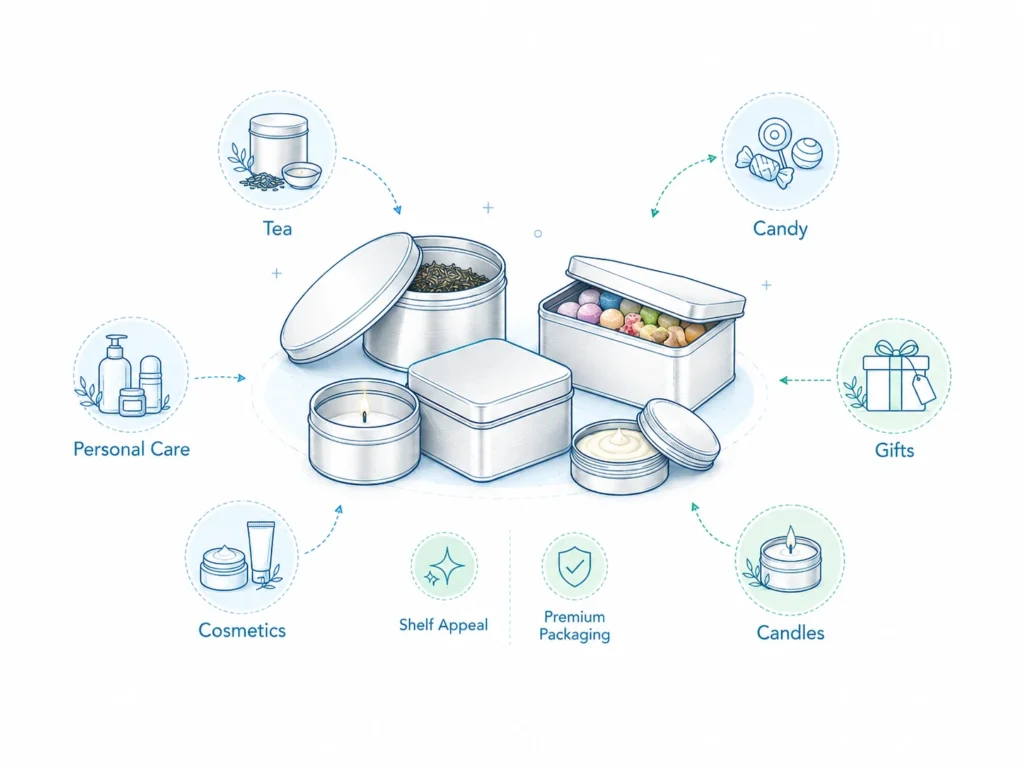
Most custom tin containers with lids are made from tinplate, but the performance of the final package depends on much more than the base metal. Material thickness, temper, tin coating, passivation, inner lacquer, printing inks, varnish, edge finishing, and assembly accuracy all influence the finished container.
For general gift and promotional tins, the main requirements are formability, appearance, and durability. For food tins, food-contact safety becomes central. The U.S. FDA explains that food packaging and its components can fall within food-contact substance considerations. In the EU, food contact materials must comply with requirements designed to ensure they do not release substances into food in a way that endangers health or changes the food’s composition, taste, smell, or appearance. Buyers should never assume that a decorative tin is automatically suitable for direct food contact.
There are three common food-contact scenarios. First, the product never touches the tin because it is packed in a sealed inner pouch or wrapper. Second, the product may touch a food-safe tray or liner inside the tin. Third, the product contacts the coated metal directly. The third scenario requires the most careful review. The coating must match the product, especially if the food is oily, acidic, salty, or aromatic.
For beauty and personal care, a similar logic applies. A solid balm or fragrance may not be food, but it can still interact with coatings. Essential oils, solvents, waxes, and fragrance compounds can challenge packaging materials. Compatibility testing is not optional for serious brands. It is part of responsible product development.
Specification checklist for safer sourcing
| Specification area | What to define before sampling | Why it matters |
|---|---|---|
| Product type | Food, cosmetic, gift, tool, accessory, powder, oil-based formula | Determines coating, liner, testing, and lid direction |
| Contact condition | Direct contact, indirect contact, wrapped product, sealed inner pouch | Determines food-contact or formula-contact requirements |
| Target market | U.S., EU, UK, Canada, Australia, Middle East, Japan, global | Determines regulatory and documentation expectations |
| Storage condition | Ambient, humid, warm, cold chain, long shelf life | Influences corrosion resistance, coating, and seal decisions |
| Lid style | Slip, hinged, screw, plug, sliding, window, specialty | Controls opening feel, sealing, cost, and tooling |
| Finish | Matte, gloss, satin, soft-touch, metallic, spot UV, embossing | Controls brand perception and wear resistance |
| Insert | None, paperboard, foam, PET, pulp, EVA, metal tray | Controls product movement and unboxing quality |
| Testing | Migration, compatibility, drop, vibration, abrasion, opening force | Reduces risk before mass production |
This checklist is practical because it turns a vague inquiry into a manufacturable brief. Instead of asking “How much for a tin box?”, the buyer can ask for a specific solution: a rectangular food-grade tin container with a slip lid, matte varnish, embossed logo, inner food-safe tray, and export documentation for a defined market.
Shape and size options for tin containers with lids
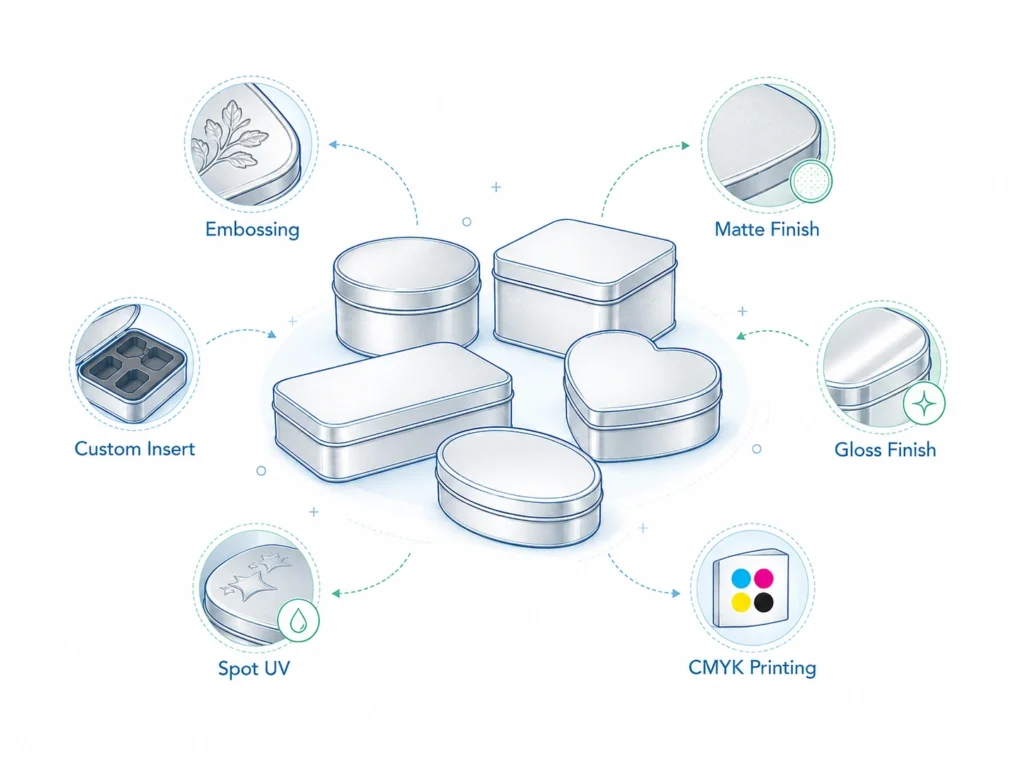
Tin containers can be produced in many shapes, but every shape has cost and tooling implications. Standard shapes include round, square, rectangular, oval, heart-shaped, and shallow tray formats. Custom shapes can include hexagonal, book-shaped, house-shaped, car-shaped, character-shaped, or product-shaped tins. The more unique the shape, the stronger the brand memory may be, but the higher the development risk and tooling cost may become.
Round tins are strong and visually familiar. They work well for tea, cookies, candies, balms, waxes, candles, and powders. Square tins are efficient for shelf display and gift sets. Rectangular tins are excellent for biscuits, chocolate assortments, corporate gifts, tools, and personal care kits. Oval tins feel softer and are often used for soaps, cosmetics, and specialty gifts. Shallow tins are useful for sets, trays, and sampler packs.
Size should be driven by product volume, not only by visual preference. A container that is too large creates empty space, higher material cost, higher freight cost, and possible product movement. A container that is too small may make filling difficult and damage the product. Buyers should send exact product dimensions, weight, filling arrangement, and required clearance. If an insert is used, the insert thickness and tolerance must also be considered.
Stackability matters for both retail and logistics. A beautiful custom shape may look impressive alone but perform poorly in cartons. If the tin cannot stack efficiently, shipping cost can rise. For export programs, carton quantity, pallet efficiency, and container loading should be considered early. Packaging is not only a unit design problem; it is also a logistics system.
Printing and finishing options that increase perceived value
One of the biggest advantages of tin containers with lids is that they can be decorated in ways that feel permanent and premium. Printing can cover the body, lid, sides, and bottom. Finishing can change the way the surface reflects light and feels in the hand. Embossing and debossing can make logos tactile. Spot UV can highlight selected artwork. Metallic effects can make seasonal packaging more festive.
The Mr.Tin Box guide to metal tin box finishing options explains that finishing is not just decoration. It is a system of base coating, printing inks, and topcoat that affects gloss, texture, protection, adhesion, color accuracy, corrosion resistance, and wear. This is an important point for buyers. A finish that looks good in a rendering may not be durable enough for mass retail handling. Samples should be reviewed under actual lighting and handling conditions.
Matte finish is popular for premium tea, skincare, wellness, and minimalist gift packaging. It reduces glare and feels modern. The trade-off is that low-quality matte coatings can show scratches or polishing marks. Glossy finish is common for candy, biscuits, holiday gifts, and bright promotional artwork because it makes colors vivid. Satin is a balanced option that offers refinement without extreme glare. Soft-touch finish can feel luxurious, but it needs careful testing for scuff resistance and long-distance shipping.
Embossing and debossing are especially effective on metal because the material holds shape. A raised logo on a tin lid can make the container feel expensive without changing the entire structure. For collectible gift tins, embossing can become part of the product identity. Spot UV works well when used with restraint. A matte tin with a glossy logo can look more premium than an all-gloss design because the contrast guides attention.
Finish selection table
| Finish or effect | Best for | Commercial benefit | Watch point |
|---|---|---|---|
| Glossy varnish | Candy, biscuits, holiday gifts, bright graphics | Strong color saturation and festive shelf impact | Fingerprints and glare in photography |
| Matte varnish | Tea, coffee, skincare, wellness, luxury gifts | Premium, calm, modern appearance | Scuff visibility on dark colors |
| Satin or semi-gloss | Broad premium categories | Balanced look and practical durability | Must define target sample clearly |
| Soft-touch | Luxury beauty, fragrance, high-end gifts | Memorable tactile experience | Requires abrasion testing |
| Metallic ink | Seasonal, luxury, limited edition | Adds shine without full foil cost | Color approval under lighting is important |
| Foil stamping | Luxury logos, gift editions | High perceived value | Registration and cost control |
| Spot UV | Logos, icons, patterns | Selective contrast and premium feel | Requires precise artwork alignment |
| Embossing/debossing | Brand marks, patterns, collectible tins | Tactile identity and anti-counterfeit cue | Tooling and sample approval needed |
The best finish is not always the most expensive finish. The best finish is the one that matches the brand, survives the supply chain, photographs well, and can be reproduced consistently. For many brands, a simple satin tin with a clean embossed logo is more powerful than an overloaded design.
Sustainability, recyclability, and reuse
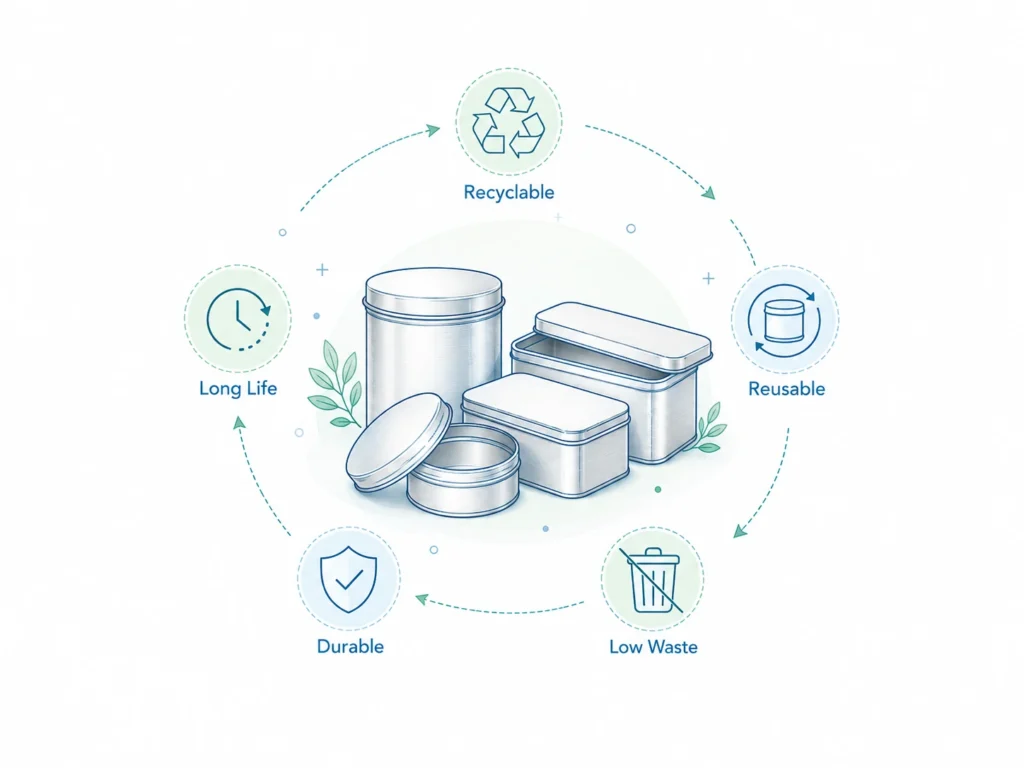
Sustainability has become a major reason buyers consider tin containers with lids. Metal packaging has a strong recycling story in many markets because steel is magnetically sortable and can be recycled repeatedly. However, responsible claims should be accurate and market-specific. A tin is not automatically sustainable just because it is metal. Its environmental performance depends on material efficiency, recycled-content policies, local collection systems, consumer behavior, decoration choices, and whether the container is actually reused or recycled.
The European Commission’s packaging rules emphasize reducing packaging waste, lowering primary raw material use, and making packaging recyclable in an economically viable way by 2030. This policy direction supports design choices that are easy to sort and recover. ISO 18604 also provides a useful reference for packaging recoverability through material recycling.
Steel packaging has a strong recycling position in Europe. Recent industry reporting from Steel for Packaging Europe, summarized by CanTech International, reported that 84% of steel packaging placed on the European market was recycled in 2024. In the U.S., EPA data shows that containers and packaging remain a major municipal solid waste category, with 82.22 million tons generated in 2018 and a 53.9% recycling rate for generated containers and packaging. These numbers tell buyers two things: packaging is highly visible in sustainability discussions, and material selection must be paired with responsible design and clear recovery communication.
Reuse is another advantage. A well-designed tin may become home storage for tea, sewing supplies, stationery, cosmetics, small tools, or keepsakes. This reuse value is commercially important because it extends brand exposure. If the container stays on a kitchen shelf for months, the brand stays visible. For gift tins, this can be a powerful reason to invest in better structure and finish.
To improve sustainability performance, buyers can consider right-sizing the container, avoiding unnecessary mixed-material windows when not needed, using removable inserts where possible, selecting durable finishes that reduce defects and returns, printing recycling guidance clearly, and designing tins that consumers will want to keep. The most sustainable premium pack is often the one that is useful enough not to become immediate waste.
Cost drivers and how to control them
Custom tin containers with lids can be cost-effective at scale, but several factors influence price. Material thickness, shape complexity, lid type, mold requirements, printing coverage, number of colors, finishing effects, embossing, inserts, packaging method, order quantity, and inspection requirements all affect the final quote.
A standard rectangular or round tin with existing tooling is usually more economical than a fully custom shape. A simple slip lid is usually more economical than a complex hinged or screw mechanism. Full-color printing is common, but specialty effects such as foil stamping, spot UV, soft-touch varnish, and multi-level embossing add cost. Inserts can also change the budget significantly, especially if they require custom molds or hand assembly.
The best way to control cost is not to remove all premium features. The best way is to invest in the features that customers will notice and remove the features that do not affect purchase decisions. For example, an embossed lid logo may provide more value than an unusual body shape. A satin finish may be more practical than soft-touch if the product will ship through rough e-commerce channels. A standard tin size with excellent artwork may sell better than a custom shape with rushed printing.
Common cost driver table
| Cost driver | Lower-cost direction | Higher-cost direction | Buyer recommendation |
|---|---|---|---|
| Shape | Existing round, square, rectangular tooling | Fully custom shape | Use existing tooling unless shape is central to brand identity |
| Lid style | Slip lid | Hinged, screw, window, specialty lid | Choose based on user experience and protection needs |
| Printing | Limited colors or standard CMYK | Metallic, foil, spot UV, special coatings | Use premium effects only on high-impact areas |
| Embossing | No emboss or simple logo emboss | Complex full-surface embossing | Use embossing for brand marks or collectible details |
| Insert | No insert or paperboard divider | Molded PET, EVA, foam, pulp, multi-part insert | Choose insert based on product protection and unboxing |
| Testing | Basic visual inspection | Migration, compatibility, vibration, drop, abrasion | Do not skip testing for food, beauty, or export programs |
| Quantity | Small batch | Mass production | Confirm MOQ early and plan repeat orders when possible |
Cost control should begin at the concept stage. Once artwork and samples are approved, late changes can be expensive. If a buyer changes the lid type, tin size, or insert layout after tooling, the timeline and cost may reset. A strong brief prevents this.
Quality control for tin containers with lids
Quality control is critical because tin packaging is highly visible. A small scratch on a paper shipping box may not matter, but a dent on a premium tin can make the product look defective. Buyers should define acceptable quality levels and inspection points before production.
Key checks include material thickness, body dimensions, lid fit, hinge alignment, edge safety, printing registration, color consistency, gloss level, coating adhesion, embossing depth, scratch resistance, carton packing, and final appearance. For food or personal care applications, coating documentation and compatibility testing may also be required. For e-commerce channels, drop testing and vibration testing are useful because courier handling can be more aggressive than palletized retail distribution.
Lid fit deserves special attention. The opening and closing experience should be tested by real users, not only by engineers. If the lid is too tight, customers may damage the tin or spill the product. If it is too loose, the package feels low quality. Hinged lids should open smoothly and remain aligned. Screw lids should thread cleanly without grinding. Plug lids should provide a confident seal without requiring excessive force.
Artwork quality also requires control. Tin printing involves metal substrate behavior, coating layers, curing, and forming. Colors can look different on metal than on paper. Buyers should approve drawdowns, printed proofs, or pre-production samples. They should also define whether color will be matched to Pantone, CMYK, physical sample, or brand standard. For global brands, this step is essential.
How to build a strong RFQ for custom tin containers
A strong request for quotation saves time and improves accuracy. Instead of asking for a generic price, provide clear details. A professional supplier can then recommend the right structure and identify risks early.
Include product type, dimensions, weight, fill quantity, whether the product contacts the tin, target market, expected shelf life, storage conditions, lid preference, shape preference, artwork status, finish preference, insert requirements, annual quantity, first order quantity, target delivery date, certification needs, and shipping destination. If you already have a reference sample, send photos and dimensions. If you do not, explain the product and brand position clearly.
For example, a good RFQ might say: “We need a rectangular tin container with lid for a premium biscuit gift set. Product will be flow-wrapped inside the tin. Target size is around 220 x 160 x 70 mm. We need a slip lid, food-safe coating, full-color exterior printing, matte varnish, embossed logo on lid, paperboard tray insert, and export shipment to the U.S. First order target is 10,000 pieces, with repeat orders for seasonal campaigns.”
This is much better than “Please quote biscuit tin.” It gives the manufacturer enough information to suggest tooling, material thickness, printing process, insert options, and development schedule.
Why work with Mr.Tin Box for custom tin containers with lids
Mr.Tin Box positions itself as a custom metal tin packaging partner for global brands, with applications across food, beauty, gifts, and industrial packaging. The website describes high-quality tin boxes designed for Food, Beauty, Gift, and Industrial applications, crafted with precision, creativity, and manufacturing standards. It also highlights key service directions including in-house mold development, premium printing and finishing, strict QC, food-grade materials, fast sampling, and production capacity.
For food and beverage buyers, the relevant starting point is Food & Beverage Packaging, especially if the project involves tea, coffee, snacks, confectionery, or specialty food. For cosmetic and wellness buyers, the relevant starting point is Beauty & Personal Care Packaging, especially for balms, soaps, fragrance, skincare sets, and beauty gift packaging. For premium decoration decisions, the guide to Metal Tin Box Finishing Options is useful because it explains matte, glossy, satin, textured, metallic, soft-touch, spot UV, embossing, and protective coating choices.
If your team is still building the business case for metal packaging, the article Why Metal Packaging Boosts Shelf Life and Brand Value is a useful internal link because it explains protection, shelf impact, and brand-value logic. If your brand is planning a premium product line, the article Metal Packaging Trends for Premium Consumer Goods is also relevant because it discusses premiumization, tactile identity, reuse, e-commerce robustness, smart packaging, and design-for-recycling decisions.
The strongest reason to involve a custom tin manufacturer early is risk reduction. Tin containers with lids are not only visual packaging. They involve material selection, tooling, forming, printing, coating, assembly, lid tolerance, inserts, testing, and logistics. A supplier that understands these details can help brands avoid expensive mistakes before mass production.
Practical examples by industry
Premium tea brand
A premium tea brand wants a reusable storage tin for loose tea. The product is sensitive to moisture, oxygen, aroma loss, and light. The best solution may be a round or square tin with a plug lid, inner foil pouch, food-safe coating, and matte or satin finish. Embossing on the lid can help the tin feel collectible. The brand should test aroma retention and confirm whether the tin is decorative secondary packaging or part of the freshness system.
Biscuit and cookie brand
A biscuit brand wants a holiday gift tin for retail shelves. The product is fragile and may break during shipping. A rectangular or round tin with a slip lid can provide good shelf impact, but the interior needs trays, paper cups, or flow-wrap to reduce movement. A glossy or metallic finish can create a festive look. Drop and vibration testing should be considered because broken biscuits create customer complaints even when the outer tin looks perfect.
Chocolate gift brand
A chocolate brand needs a premium assortment tin. The main priorities are appearance, food-contact safety, and product organization. A shallow hinged tin or two-piece tin with a food-safe tray can work well. If chocolates contain fats or strong aromas, material compatibility and liner selection are important. The design can use satin varnish, foil stamping, and an embossed logo for a luxury effect.
Skincare and balm brand
A skincare brand wants small tins for solid balm. The key concerns are formula compatibility, lid security, and premium feel. A round screw-lid tin is often suitable. The coating must be tested with the balm formula, especially if it contains essential oils or fragrance. Matte or soft-touch finishes can support a natural premium brand identity, but abrasion testing should be done before approving mass production.
Corporate gifting company
A corporate gifting company needs a reusable tin for several items: chocolate, tea, a notebook, and a small accessory. A hinged rectangular tin with a custom insert is likely the best direction. The insert should prevent movement and create a clean presentation. The exterior can use corporate colors, logo embossing, and satin varnish. The buyer should confirm item dimensions early because one late product change can require a new insert design.
Common mistakes to avoid
The first mistake is choosing a tin only from a photo. Photos do not show lid fit, edge comfort, coating durability, insert performance, or carton efficiency. Always request physical samples when possible.
The second mistake is ignoring the product’s sensitivity. Food, fragrance, balm, powder, chocolate, and tools all have different packaging risks. The tin structure should be selected around those risks.
The third mistake is assuming all tins are food-grade. Food-contact safety depends on coating, liner, ink, varnish, contact condition, and target market. Buyers should define direct or indirect food contact clearly.
The fourth mistake is over-designing the package. Too many finishes, shapes, windows, and inserts can increase cost and risk without improving sales. A clean structure with one or two premium details often works better.
The fifth mistake is starting too late. Custom tin packaging requires time for structure design, sampling, artwork proofing, tooling, printing, forming, assembly, inspection, and shipping. Holiday and promotional campaigns should begin early.
The sixth mistake is not testing for distribution. E-commerce, retail pallets, air freight, and sea freight create different risks. A premium tin should be tested against the channel where it will actually be sold.
FAQ about tin containers with lids
Are tin containers with lids suitable for food?
Yes, they can be suitable for food when the correct material, coating, liner, and packing method are used. Many food brands use tins for tea, coffee, cookies, chocolate, candies, and snacks. However, buyers should clearly define whether the food will contact the tin directly or be packed in an inner pouch, tray, or wrapper. Direct food contact requires stricter review.
Are tin containers airtight?
Some tin containers can provide a tighter closure than others, but most decorative tins are not automatically hermetic. Slip lids, hinged lids, plug lids, and screw lids have different performance levels. If airtightness is important, discuss plug lids, inner seals, overwrap, foil pouches, gaskets, or other barrier systems with the manufacturer.
Which lid style is best for beauty products?
For balms, waxes, and solid perfumes, screw-lid tins are often preferred because they close securely and support repeated use. For soaps and shampoo bars, slip-lid tins may work well when the product is wrapped. For gift sets, hinged tins with inserts can create a better unboxing experience.
Can tin containers be printed with custom artwork?
Yes. Tin containers can support full-color printing, matte varnish, glossy varnish, satin finish, metallic effects, spot UV, foil stamping, embossing, debossing, and other decorative options. Buyers should approve physical samples because color and gloss can look different on metal than on screen.
Are tin containers recyclable?
Tinplate steel containers are recyclable in many markets, and steel packaging can be magnetically sorted in recycling systems. However, recyclability depends on local infrastructure and package design. Avoid unnecessary mixed-material components when possible and provide clear recycling guidance for the target market.
What information is needed for a quote?
A strong quote request should include product type, product size and weight, target tin size, lid preference, direct or indirect contact condition, target market, finish requirements, artwork status, insert needs, order quantity, delivery deadline, and shipping destination.
Final thoughts
Tin containers with lids are a strong packaging option when brands need more than a disposable box. They offer rigidity, printability, premium hand feel, reuse value, and strong category fit across food, gifts, beauty, personal care, and specialty products. The best results come from matching the tin structure to the product’s real needs: protection, compliance, shelf appeal, user experience, cost, and logistics.
For food brands, the priority is safety, freshness, and product protection. For gift and promotional brands, the priority is unboxing, collectibility, and seasonal impact. For beauty and personal care brands, the priority is formula compatibility, tactile quality, and premium presentation. For specialty and industrial products, the priority is organization, durability, and clear identification.
If your brand is exploring custom tin containers with lids, start with a structured brief and involve the manufacturer early. Define the product, target market, contact condition, lid style, finish, insert, testing needs, and commercial timeline. With the right specification, a tin container can become more than packaging. It can become a durable brand asset that protects the product, improves shelf impact, and remains useful long after the first purchase.


