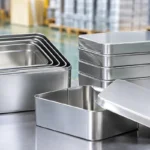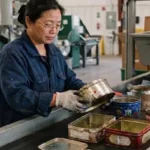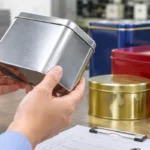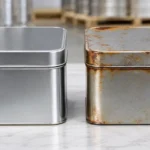
Are tin boxes recyclable? In most cases, yes. Most tin boxes are made of tinplate, which is steel sheet with a thin layer of tin, and steel is accepted by metal recycling systems in many countries. Recyclability in practice depends on the rest of the box: the coating and print on the metal, any plastic, paper or foam inside, the size of the item, and the rules of the local collection program. This article explains what a tin box is made of, how it is recycled, what makes recycling harder, which rules apply, and what a buyer can ask a tin box manufacturer before placing an order.
Table of Contents
What a tin box is made of
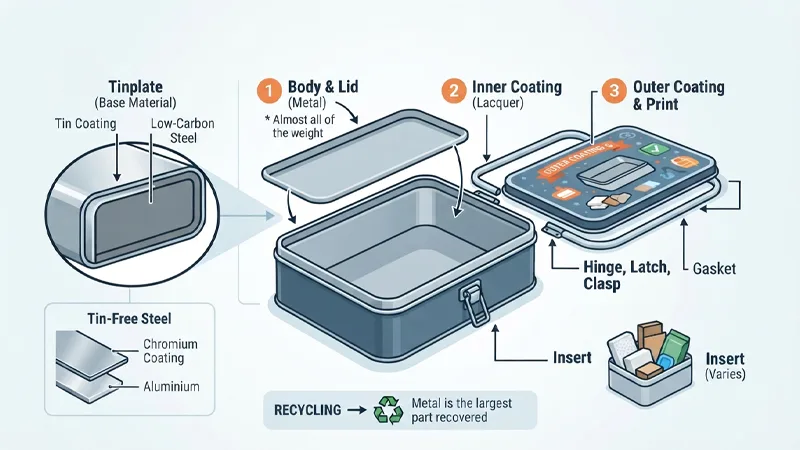
A tin box is a container made from thin metal sheet, with a lid that opens and closes. The usual base material is tinplate: low-carbon steel with a coating of tin on both sides. Tin prevents rust on the steel surface and gives a surface that accepts lacquer and printing ink. Some boxes use tin-free steel, which has a thin chromium-based coating instead of tin. Others use aluminium.
A finished tin box has several layers and parts:
| Part | Typical material | Share of the box |
|---|---|---|
| Body and lid | Tinplate, tin-free steel or aluminium | Almost all of the weight |
| Inner coating | Organic lacquer, often an epoxy-free or polyester-based system for food use | Thin film on the inside |
| Outer coating and print | Base coat, ink and varnish | Thin film on the outside |
| Hinge, latch, clasp | Steel, zinc alloy or plastic | Small |
| Insert or liner | Plastic, paper, cardboard, foam or fabric | Varies by product |
| Gasket | Silicone or rubber | Small |
The metal is the largest part by weight, and it is the part that recycling systems are built to recover. The other layers and parts decide how easy the recovery is.
Why steel is recyclable
Steel is a permanently recyclable material, and tinplate scrap can be recovered and reused in steelmaking. However, the chemical composition of scrap must be controlled. Residual elements such as copper and tin can accumulate in the steel melt and affect the properties of certain steel grades. Steelmakers therefore manage scrap composition through sorting, blending and appropriate charge selection. Tinplate scrap goes back into steelmaking in the same way as other steel packaging. Three properties make steel packaging practical to collect:
- Steel is magnetic. Magnets pull steel items from mixed waste and from mixed recyclables, so a steel tin can be sorted without manual work.
- Steel scrap has a market. Steel mills in basic oxygen furnaces and electric arc furnaces use scrap as a raw material.
- Coatings are thin. The tin layer and the lacquers make up a small share of the weight, and furnaces handle them as part of the melt or the exhaust gas treatment.
Tin is a residual element in steel, and steelmakers limit its content in some grades. Because of this, tinplate scrap is blended with other scrap, and For certain tinplate scrap streams, detinning may be used to recover the tin coating before the steel substrate enters the steelmaking process. However, this is a specialised recovery route rather than a standard requirement for every recycled tinplate container. The recycler handles this step, and it does not change what the consumer or the buyer does with the box.
How a tin box moves through recycling
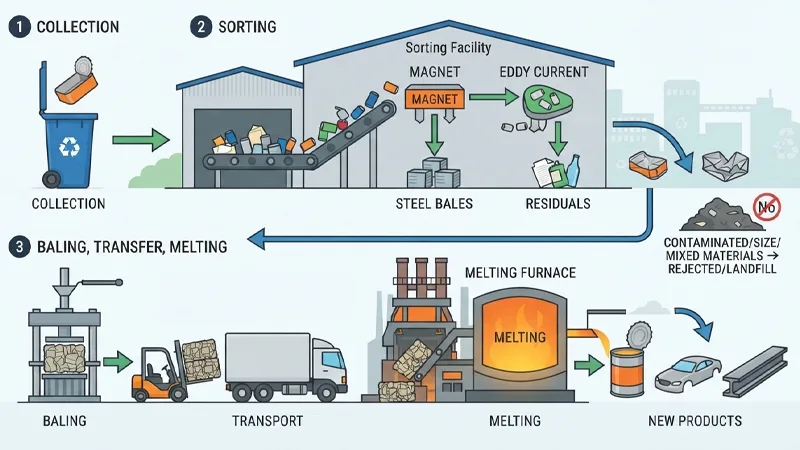
- Collection. The box goes into a curbside bin, a drop-off container for metal, or a recycling center, depending on local rules.
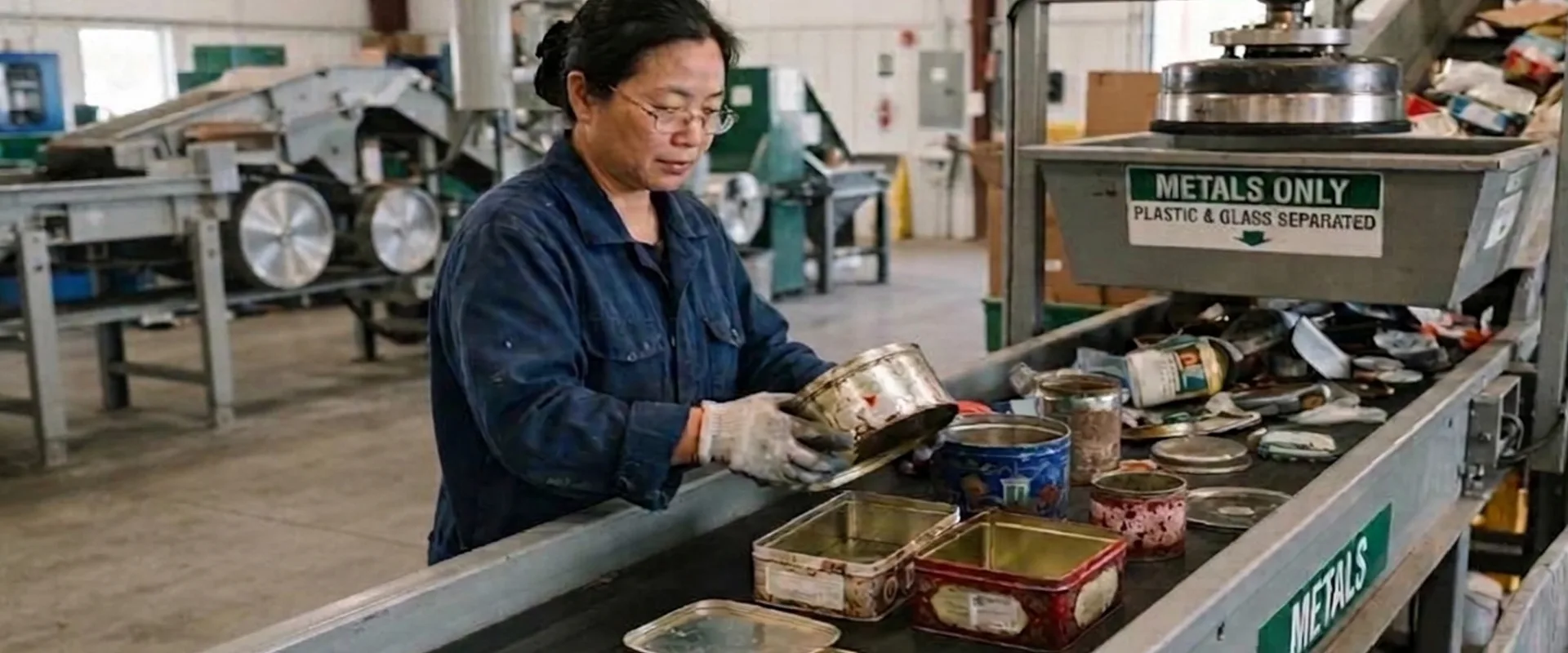
- Sorting. At a sorting facility, magnets separate steel from paper, plastic and glass. Magnets separate ferrous metals such as steel from the mixed material stream. Eddy current separators are then used to eject non-ferrous metals, including aluminium, from the remaining material. Additional sorting equipment may be needed to separate different non-ferrous metals.
- Baling or shredding. The steel is pressed into bales or shredded into small pieces.
- Transfer to a mill. Scrap dealers or the sorting operator sell the steel to a steel mill or a processor.
- Melting. The scrap is melted with other feedstock. Organic coatings and inks burn off or are captured in the furnace gas treatment, and the steel is cast into new products.
A tin box that does not pass step 2 does not reach step 5. Size, contamination and mixed materials are the reasons boxes fail at the sorting stage.
What affects the recyclability of a tin box
| Feature | Effect on recycling | What reduces the problem |
|---|---|---|
| Plastic insert or tray | Non-metal parts are separated from the metal or reach the furnace as contamination | Insert that lifts out without tools, or a design without an insert |
| Foam, fabric or flocking | Hard to separate and not recoverable with the metal | Paper or cardboard liner instead, or no liner |
| Silicone or rubber gasket | Remains attached to the lid | Gasket that peels off, or a metal-to-metal closure |
| Magnets, ribbons, metal charms | Mixed materials and different metals | Remove before collection, or avoid in the design |
| Plastic hinge or lock | Small plastic part fixed to a metal body | Metal hinge, or a lock that can be removed |
| Food, oil or wax residue | Contamination of the metal stream | Empty and wipe the box before collection |
| Thick or non-metal-based decoration | Added material on the surface | Printed ink and varnish on the metal, with no film laminate or paper label glued on |
| Small size | Items can fall through sorting screens | Check local rules for the minimum size accepted |
| Aluminium and steel in the same box | Two metals in one item | Use one metal for body and lid |
Printed ink and varnish on tinplate are normal in tin packaging, and recycling systems handle them. The printing process is described in the article on tin packaging printing, and the coating systems are covered in food grade tin packaging.
Linings differ by product. Custom cigar tins, for example, can use flocked blister packs, EVA foam or wood linings. These materials separate from the metal less easily than a paper liner, so they are the first parts to review when recycling is a requirement.
How to check whether a tin box is steel or aluminium
A small magnet gives the answer. If the magnet sticks to the body, the box is steel. If it does not stick, the box is aluminium or another non-ferrous metal. This matters because steel and aluminium go into separate recycling streams. Both are recyclable, and local programs usually accept both as metal, but the sorting equipment treats them differently.
Recycling rates for steel packaging
Recycling rate figures show how much of a material is recycled in a region. Steel for Packaging Europe, the association of European packaging steel producers, reported that 84 per cent of the steel packaging placed on the EU market in 2024 was recycled. The association states that this figure counts material that entered recycling operations, not only material that was collected. The figure comes from an industry body, and it applies to steel packaging as a whole, which includes food cans and aerosol cans as well as tins. It is not a recycling rate for tin boxes alone.
Rates differ between countries and between collection systems. A tin box that is collected through a metal recycling program has a high chance of being recycled. A tin box in mixed waste that goes to landfill or incineration does not. Collection access is therefore as important as the material.
Rules that apply to recyclability and labelling
European Union. Regulation (EU) 2025/40 on packaging and packaging waste (PPWR) entered into force on 11 February 2025 and applies in general from 12 August 2026. It covers all packaging and all materials, including metal. Parts of it apply from the general application date, such as conformity documentation and limits on certain substances in packaging. Other parts apply later, including requirements on recyclability grades and harmonised labels, which are phased in on dates set in the regulation and in secondary legislation. The text of the regulation and the later implementing acts are the source for the current dates.
Two parts of the regulation concern tin boxes for food directly:
- Limits on the sum of lead, cadmium, mercury and hexavalent chromium in packaging.
- Limits on PFAS in food-contact packaging, which apply to packaging placed on the market after 12 August 2026.
A buyer who sells tins with food in the EU asks the manufacturer for a statement on these substances for the coating, the ink and the plastic parts.
Food tins add coating and migration requirements on top of recycling rules. The article on custom metal tins for chocolate and biscuit lines covers compliance and food safety for that category.
United States. There is no federal packaging recycling label. Collection rules are set by municipalities and states. Claims such as “recyclable” on a product or package fall under the Federal Trade Commission’s Green Guides, which require that a recyclability claim can be substantiated and that recycling facilities are available to a substantial majority of consumers where the product is sold. A voluntary label program, How2Recycle, gives instructions for each part of a package.
Other markets. Many countries have their own extended producer responsibility schemes, fees or labelling rules. A buyer checks the rules in each destination country.
Design choices that affect recyclability
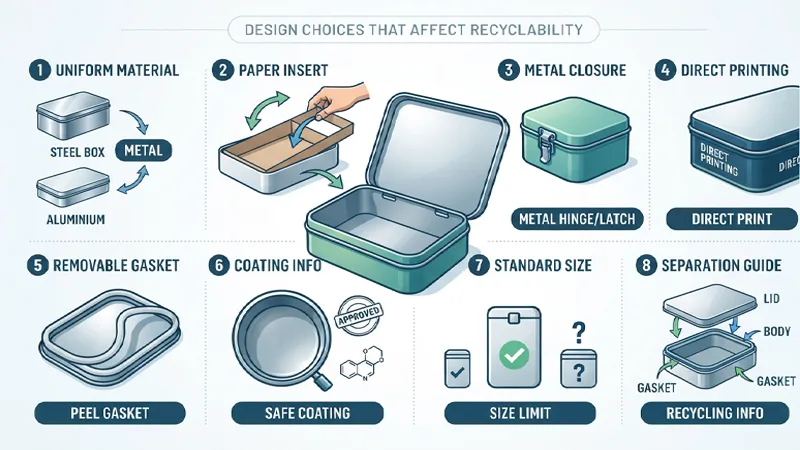
A tin box can be designed so that it is more likely to be recycled. The choices are made at the specification stage, before the mould and the printing plates are made.
- One metal for body and lid. Steel with steel, or aluminium with aluminium.
- No insert, or an insert made of paper or cardboard. Where a plastic insert is required for the product, it lifts out by hand.
- Metal hinge and latch. Plastic parts in the closure are limited to those the product needs, for example the lock of a child-resistant tin.
- No glued-on labels or laminates. Printing is applied directly to the metal.
- Gasket that separates. A silicone gasket that peels from the lid, or a design that does not need one.
- Food-safe coating with a known composition. The supplier states the coating type and the substances it contains.
- Size within the range accepted by local sorting. Small tins are checked against local rules.
- Recycling instructions on the pack. The instruction names the parts to separate.
Some of these choices affect function. A hermetic closure for tea or coffee may need a gasket or a liner, and a child-resistant tin needs a lock. The buyer decides which part is required for the product and which part is optional.
The order of a project, from concept to tooling and mass production, is described in how to develop a custom tin box from concept to mass production. Mould design and cost are covered in tin packaging tooling, and design changes after tooling cost more than changes made at the drawing stage.
Questions to ask a tin box manufacturer
| Topic | Question | Document to request |
|---|---|---|
| Base metal | Is the body tinplate, tin-free steel or aluminium? What is the thickness? | Material specification |
| Coatings | What are the inner and outer coatings and the ink system? | Coating supplier declaration |
| Substances | Do the coating, ink and plastic parts contain PFAS, lead, cadmium, mercury or hexavalent chromium? | Statement of compliance, test report |
| Parts | Which parts are not metal, and can they be removed by hand? | Bill of materials with weights |
| Closure | Does the closure use a gasket or a plastic lock? | Drawing, sample |
| Labels | Are labels, laminates or adhesives used on the metal? | Specification |
| Markets | Which recycling or packaging rules apply in the destination market? | Compliance statement for that market |
These questions fit into the checks in the article on tin box manufacturer selection criteria, and the testing of finished boxes is covered in tin packaging testing and validation.
Reuse before recycling
A tin box is built for repeated opening, and many tins are reused as storage containers for small items, sewing supplies, tools and food. Reuse keeps the box in use for longer, and recycling follows when the box is no longer used. A box that is kept for storage is not counted as recycled. For packaging that the buyer expects customers to keep, a decorated and durable box is a choice that the buyer makes with the end of life in mind, since printed metal is recyclable.
How to prepare a tin box for recycling
- Empty the contents.
- Remove plastic inserts, foam, fabric, paper liners, ribbons and magnets.
- Peel off gaskets and labels where they come away easily.
- Wipe out wax, oil or food residue. The box does not need to be washed until it is spotless.
- Put the lid back on the box or place it loose in the same container, depending on local rules. Small lids can fall through sorting screens, so some programs ask for the lid to stay on the box.
- Place the box in the metal collection stream that the local program names.
Frequently asked questions
Are tin boxes recyclable in curbside bins?
In most programs that accept metal, yes. Steel tins are accepted in many curbside programs, and a drop-off center for metal accepts them where curbside collection does not. The local program lists what it takes.
Are printed tin boxes recyclable?
Yes. Ink and varnish on tinplate are thin layers, and recycling systems handle them. Paper labels and laminates glued to the metal are removed where possible.
Can tin boxes with plastic inserts be recycled?
The metal can be recycled after the plastic is removed. If the plastic cannot be removed, the box may not be accepted, and the local program decides.
Is tinplate the same as tin?
No. Tinplate is steel sheet with a thin coating of tin. The body is steel, and the tin is the coating.
Do magnets and recycling work together for tin boxes?
Magnets are used at sorting facilities to pull steel out of the waste stream. A steel tin responds to the magnet, and an aluminium tin does not, so the two go to different streams.