

Tinplate packaging is one of the most practical choices for brands that need packaging to do more than look attractive. It protects products from light, moisture, oxygen, impact, odor transfer, and repeated handling. It also gives designers a rigid surface for printing, embossing, debossing, matte varnish, glossy varnish, metallic effects, and collectible limited-edition artwork. For food, tea, coffee, confectionery, cosmetics, promotional gifts, and specialty items, a well-engineered tinplate box can become both a protective container and a long-term brand asset.
For buyers, however, tinplate packaging can be confusing at first. Many suppliers use words such as tin box, tin can, metal tin, tinplate container, food-grade tin, lacquered tinplate, BPA-free coating, offset printing, and varnish without explaining how these layers work together. A beautiful sample may look simple, but the final packaging is the result of material selection, coating compatibility, forming design, printing control, curing conditions, and food-contact safety management.
This guide explains tinplate packaging in clear business language. It is written for brand owners, product managers, procurement teams, importers, and packaging developers who need to specify custom metal tins with confidence. It also connects technical decisions to commercial outcomes: shelf appeal, product protection, compliance readiness, sampling speed, mass production stability, and buyer trust.
At Mr. Tin Box, tinplate packaging is positioned for global Food & Beverage Packaging, Beauty & Personal Care Packaging, Gift, Promotional & Holiday Packaging, and Specialty & Industrial Packaging. The goal is not only to make a metal box, but to help each brand select the right structure, finish, coating, and production route for its product category.
What Tinplate Packaging Means
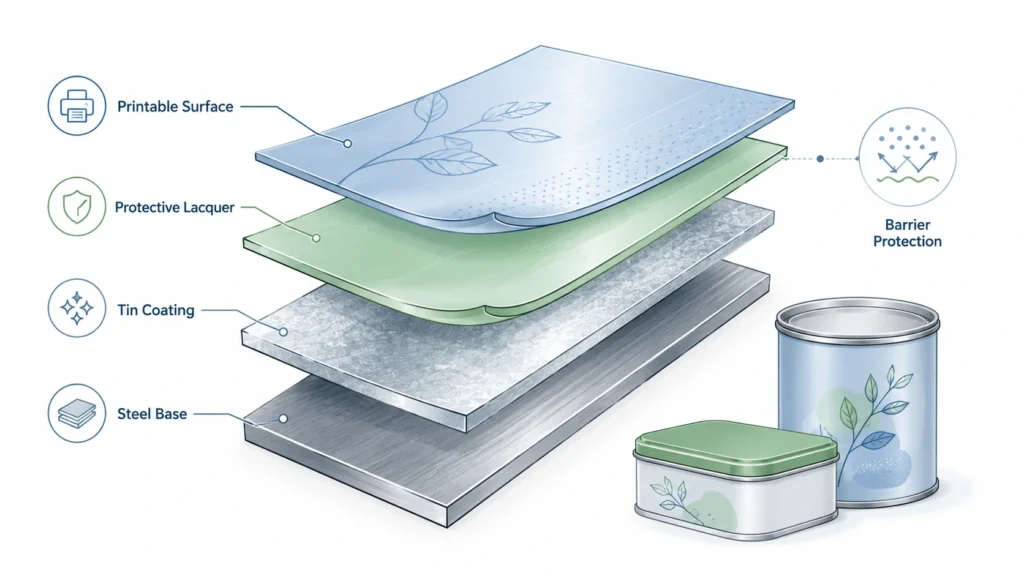
Tinplate packaging is packaging made from thin steel sheet coated with a very thin layer of tin. The steel gives the package rigidity, forming strength, and impact resistance. The tin layer improves corrosion resistance, supports soldering or welding in certain applications, and provides a clean metallic surface for printing and coating. In many modern food and gift tins, tinplate is then combined with internal lacquer, external primer, inks, top varnish, and sometimes special decorative finishes.
The word “tin” can be misleading. A tin box is not made from solid tin. Tin itself is a soft metal and would be too expensive and weak for most packaging structures. In commercial packaging, “tin” usually means tinplate: steel as the structural base, tin as the protective metallic coating, and organic coatings as the functional barrier between the package and the product.
According to the World Steel Association tinplate eco-profile, tin-plated steel is commonly used for food cans and industrial packaging, with typical thickness ranges around 0.13 mm to 0.49 mm and common widths around 600 mm to 1100 mm before conversion. Those figures are useful because they show why tinplate can be thin, strong, printable, and efficient at the same time.
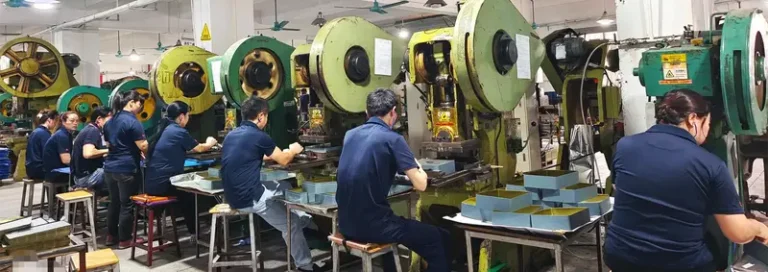
For custom tin boxes, the material is usually supplied in sheets, printed before forming, and then stamped, curled, hinged, assembled, or fitted with lids depending on the structure. This is different from many paper boxes, where the printed substrate is folded and glued. Tinplate packaging requires more attention to tooling, forming tolerance, artwork deformation, edge safety, coating adhesion, and packing protection.
Why Brands Choose Tinplate Instead of Ordinary Packaging
Brands choose tinplate packaging when they want a package that communicates durability, premium value, safety, and reusability. A folding carton may be suitable for low-cost retail, but it usually does not offer the same impact resistance, barrier feel, or keepsake value. Plastic may be light and flexible, but many premium brands want a more substantial, reusable, and recyclable presentation. Glass can feel premium, but it is fragile and heavy. Tinplate sits in a valuable middle position: strong, lightweight enough for shipping, printable, shapeable, and easy to reuse.
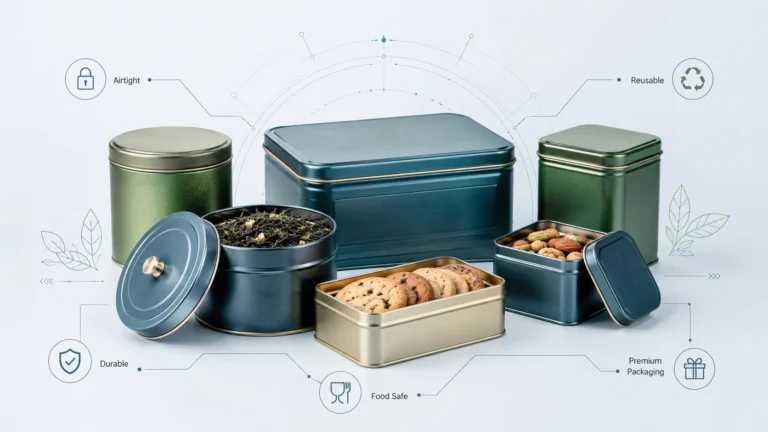
For food and beverage categories, tinplate boxes are popular for tea, coffee, cookies, chocolates, candies, mints, biscuits, spices, powdered drink mixes, and seasonal gift sets. The structure protects against crushing and improves shelf presence. With the right inner coating or liner strategy, it can also support food-grade packaging requirements. The Mr. Tin Box Food & Beverage Packaging page highlights common uses such as snacks, tea, coffee, chocolates, candies, and specialty foods, as well as the role of tinplate, stamping, edge curling, coating, and finishing in product protection.
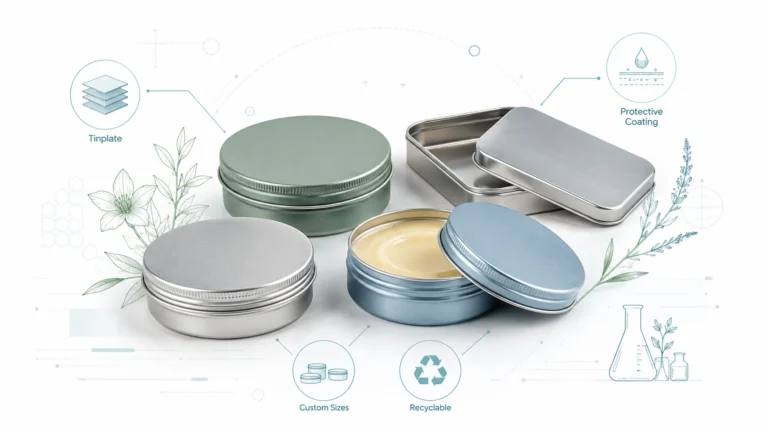
For beauty and personal care, tinplate is used for skincare sets, soap tins, fragrance gift boxes, candle tins, lip balm boxes, shaving sets, and promotional kits. These applications often care less about direct food-contact performance and more about tactile finish, color consistency, giftability, corrosion resistance, and long-term display value.
For gift and promotional packaging, tinplate is valuable because it survives beyond the first purchase. Consumers often keep attractive tins for storage, decoration, or collection. That second life extends brand exposure. A biscuit tin used as a desk organizer or a tea tin kept in the kitchen can continue advertising the brand long after the original product has been consumed.
The Tinplate Packaging Layer System
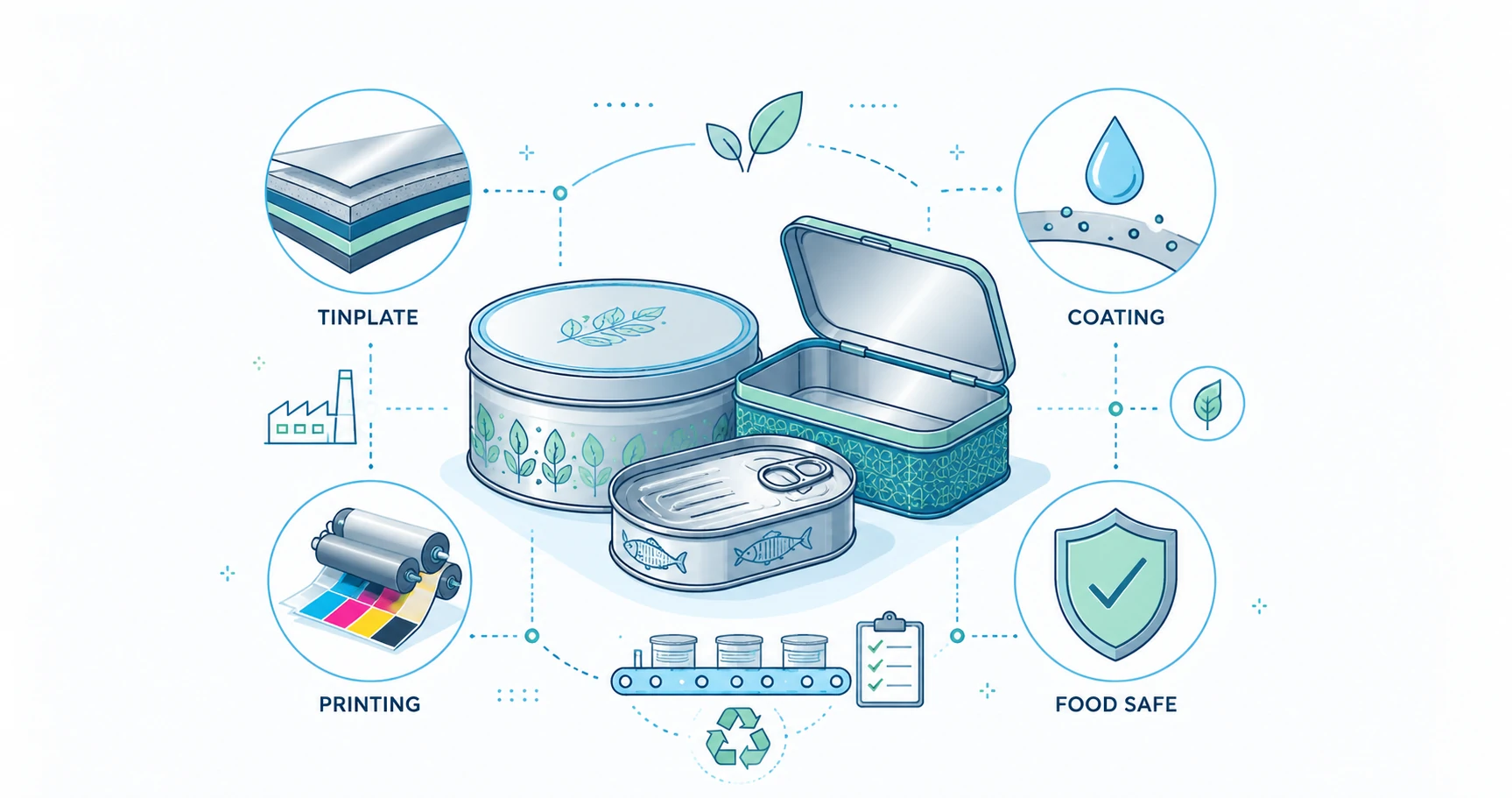
A tinplate package is best understood as a layer system. Each layer has a job. If one layer is selected incorrectly, the package may still look acceptable at sampling stage but fail during production, shipping, storage, or consumer use.
| Layer | Main Function | Buyer Questions to Ask |
|---|---|---|
| Low-carbon steel base | Provides stiffness, forming strength, shape retention, and impact resistance | What thickness and temper are recommended for the tin size, shape, and expected load? |
| Tin coating | Improves corrosion resistance and supports a clean metallic surface | Is the tin coating suitable for the product chemistry and forming process? |
| Passivation / surface treatment | Stabilizes the tin surface and supports coating adhesion | Is the surface treatment compatible with food-grade lacquer and offset printing? |
| Internal lacquer or coating | Separates the product from metal and reduces corrosion or migration risk | Which lacquer system is recommended for food, cosmetic, or non-food use? |
| External primer / base coat | Creates a printable surface and improves ink anchoring | Is a white base coat, clear base, or metallic effect required? |
| Printing inks | Carry the artwork, brand colors, patterns, and product information | Are Pantone references, CMYK files, and proofing standards defined? |
| Top varnish / finish | Protects graphics and creates gloss, matte, satin, texture, or soft-touch feel | What scratch resistance, gloss level, and handling durability are required? |
| Formed edges and seams | Improve safety, strength, closure performance, and user experience | Are curl radius, lid fit, hinge movement, and edge smoothness checked? |
This layer-by-layer thinking is important for procurement. Instead of asking only for “a printed tin box,” buyers should specify product use, filling condition, food-contact requirement, artwork, finish, storage environment, shipping route, and target retail positioning. A supplier can then recommend material thickness, mold design, coating, printing route, and packing method more accurately.
Material Selection: Thickness, Temper, Shape, and Structure
Tinplate thickness is one of the first technical choices, but it should never be selected in isolation. A thin sheet can be strong if the box has good geometry, ribs, curled edges, or a compact shape. A thicker sheet may still dent if the lid design is weak, the flat panel is too large, or the packing method allows friction during shipping. The right specification balances protection, forming performance, cost, weight, and visual quality.
For most custom tin boxes, material selection depends on four main factors: the product weight, the box size, the closure design, and the desired finish. A large rectangular cookie tin needs more panel stability than a small mint tin. A hinged box needs different tolerance control from a slip-lid tin. A deeply embossed design needs a material and coating combination that can tolerate forming without cracking or whitening.
| Packaging Type | Typical Commercial Priority | Tinplate Consideration | Common Buyer Risk |
|---|---|---|---|
| Tea and coffee tins | Aroma protection, premium shelf image, repeated opening | Stable lid fit, food-safe inner surface, good exterior varnish | Loose lid, odor transfer, poor color matching |
| Cookie and biscuit tins | Large decorative panels, gift value, dent resistance | Panel rigidity, curl strength, scuff-resistant topcoat | Panel dents, scratched artwork, weak stacking |
| Chocolate and candy tins | Food-contact safety, premium finish, seasonal artwork | Inner lacquer or liner, sharp print, clean edges | Coating mismatch, color variation, delayed seasonal delivery |
| Cosmetic gift tins | Luxury touch, branding, corrosion resistance | Soft-touch, matte, spot UV, embossing, insert compatibility | Fingerprints, coating scratches, insert movement |
| Promotional tins | Cost control, logo visibility, flexible quantity | Standard molds, simple printing, efficient packing | Over-customization, high tooling cost, long lead time |
| Industrial or specialty tins | Durability, functional storage, component protection | Stronger structure, label space, corrosion resistance | Inadequate thickness, lid looseness, rough edges |
The best material is not always the thickest. In many projects, smarter structure design delivers better performance than simply increasing gauge. For example, a rolled edge improves user safety and lid stiffness. A raised border around a flat panel can reduce visible denting. A shallow emboss may be safer than an aggressive emboss on artwork with fine gradients. A good packaging engineer considers the whole system.
Coating and Lacquer: The Functional Barrier Inside the Tin
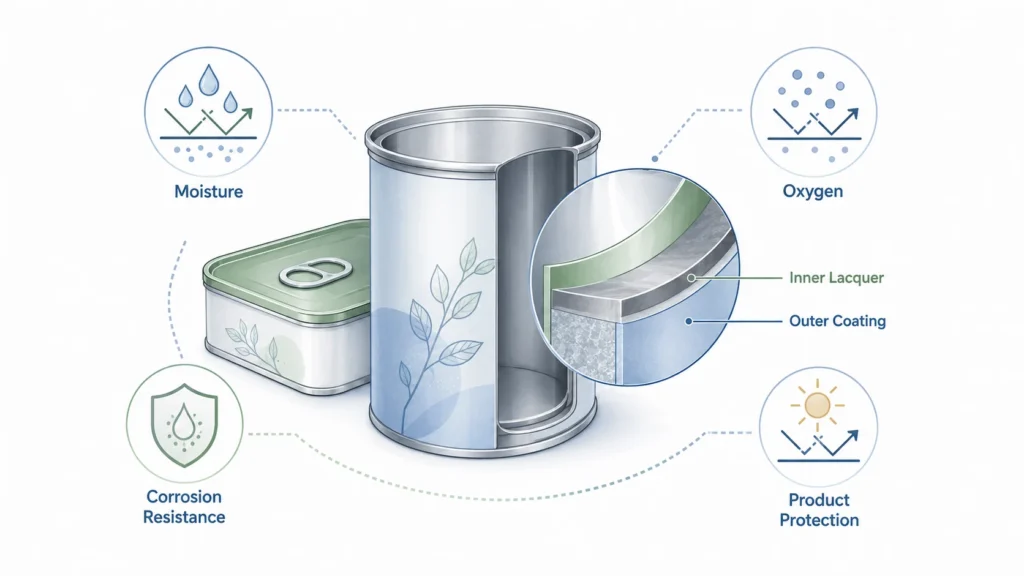
Coating is one of the most important parts of tinplate packaging. Without a suitable coating, food ingredients, moisture, salts, acids, essential oils, fragrances, or cosmetic formulas may interact with the metal surface. Even dry products can create problems if the package is stored in humid conditions or if aroma compounds are sensitive to metal contact.
In food packaging, internal lacquer helps reduce corrosion, discoloration, flavor impact, and direct contact between the product and metal. In non-food packaging, coatings still matter because they protect the substrate, improve cleanliness, and support a premium interior appearance.
A useful rule is simple: the more chemically active or moisture-sensitive the product is, the more carefully the coating must be selected and tested. Dry cookies and wrapped candies are less demanding than acidic sauces, salty snacks with high oil content, or wet foods. Tea and coffee may be dry, but they can be aroma-sensitive. Cosmetics may contain oils, alcohols, fragrance components, or active ingredients that require compatibility review.
| Product Condition | Coating Concern | Practical Recommendation |
|---|---|---|
| Dry food with inner bag | Mainly appearance, odor control, and general food-grade suitability | Use food-grade tin and confirm packaging-contact scenario; inner bag may carry direct contact responsibility |
| Direct-contact dry food | Migration, cleanliness, odor, and corrosion control | Specify food-contact coating and request compliance documentation or test reports |
| Oily snacks or confectionery | Oil resistance, staining, flavor protection | Test product compatibility under expected storage temperature and time |
| Acidic or salty food | Higher corrosion risk | Use specialized food-can coating systems and validate through migration and corrosion testing |
| Tea and coffee | Aroma preservation, odor neutrality, lid fit | Confirm coating odor, seal design, and storage performance |
| Cosmetics and fragrances | Solvent, oil, and fragrance compatibility | Test formula contact, insert materials, and varnish resistance |
| Non-food gifts | Graphic protection, scratch resistance, user feel | Focus on exterior varnish, edge safety, and structural durability |
Can coatings are a specialized field because they must perform during forming, filling, storage, and sometimes heat processing. The Food Packaging Forum background article on can coatings explains that food and beverage can coatings must withstand manufacturing and be suitable for many food types and processing conditions. A peer-reviewed review of metal packaging also notes that metal packaging provides strong barrier properties and is widely used in food packaging applications, while protective coatings play an important role in corrosion control and product compatibility.
For custom decorative tins, the product is often packed in an inner pouch, tray, paper liner, or plastic bag. In that case, the metal tin may not be the primary direct food-contact layer. However, buyers should not assume this removes all safety responsibilities. The full packaging system should still be reviewed: tin box, inner liner, ink, adhesive, insert, desiccant, label, and product filling process.
BPA, BPA-Free Coatings, and Food Safety Expectations
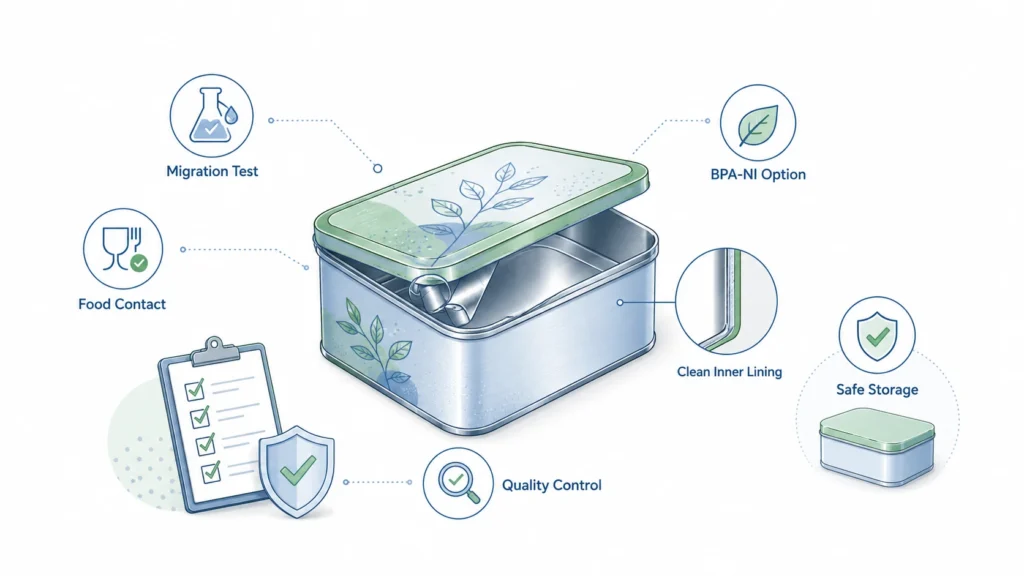
Food-contact safety has become more important for global buyers. Many brands now request BPA-free coatings, not only because of regulation, but also because consumers, retailers, and importers increasingly expect safer and more transparent packaging.
BPA, or bisphenol A, has historically been used in some epoxy-based coatings and plastic materials. Regulatory approaches differ by market. The U.S. FDA states that it has amended regulations so BPA-based epoxy resins are no longer provided for use as coatings in infant formula packaging. In the European Union, the regulatory direction has become stricter. In December 2024, the European Commission announced a ban on BPA in food-contact materials, including coatings on metal cans. The European Commission announcement connects this decision to EFSA’s scientific assessment, and the legal text is available through EUR-Lex Regulation (EU) 2024/3190.
For buyers, the practical lesson is not to rely on vague claims such as “food safe” or “eco coating.” A purchasing specification should define the destination market, product category, direct or indirect food contact, expected storage conditions, and requested documentation. For EU-bound food-contact packaging, BPA-related compliance now deserves special attention. For U.S.-bound projects, buyers should review FDA food-contact requirements and any retailer-specific or state-level requirements that may apply.
| Food Safety Topic | Why It Matters | What Buyers Should Request |
|---|---|---|
| Direct vs indirect food contact | Determines which layer is responsible for food safety | Packaging structure diagram and contact-surface definition |
| BPA-free coating | Important for EU compliance and brand safety positioning | Written coating declaration and, when needed, test reports |
| Overall and specific migration | Confirms substances do not transfer at unsafe levels | Third-party migration testing based on destination market |
| Heavy metals and restricted substances | Important for inks, coatings, pigments, and decorations | Material safety data and restricted-substance test scope |
| Odor and taint | Protects flavor-sensitive foods such as tea, coffee, and chocolate | Sensory checks and sample evaluation after storage |
| GMP and traceability | Supports stable production and accountability | Batch records, incoming material checks, and QC process |
| Retailer requirements | Many retailers have standards beyond law | Share retailer manual before quotation and sampling |
The European Commission food contact materials page explains the core EU principle clearly: food packaging materials, including metal, must not release substances into food in a way that endangers health, changes food composition, or affects taste or smell. The FDA regulatory status guidance explains that food-contact components may be evaluated through 21 CFR indirect additive regulations, GRAS status, prior sanctions, Threshold of Regulation exemptions, or Food Contact Substance Notifications.
Printing on Tinplate: Why It Is Different from Paper Printing
Printing on tinplate is not the same as printing on paper. Paper absorbs ink. Tinplate does not. The metal surface is smooth, non-porous, and reflective. This makes color beautiful when done correctly, but it also creates challenges in adhesion, curing, color matching, and forming resistance.
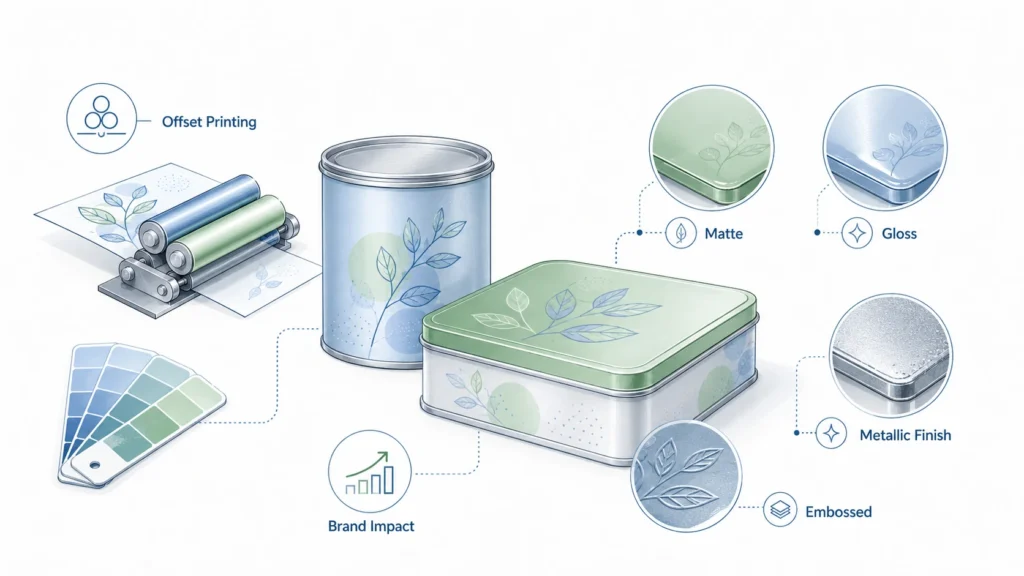
Most decorative tinplate packaging uses metal offset printing. Artwork is printed on flat sheets before the tin is stamped and assembled. Because the sheet will later be cut, curled, pressed, and shaped, the artwork must be designed with production in mind. Critical logos should not be placed too close to edges, corners, hinges, curl areas, or deep embossing zones unless the supplier confirms feasibility. Large flat colors may show slight variation more easily than busy patterns. Metallic backgrounds can shift perceived color compared with white base coating.
The printing route typically includes prepress checking, color proofing, base coating, printing, curing, varnishing, cutting, and forming. Each step affects the final result. For example, a matte varnish may soften contrast, while a glossy varnish may increase color depth. A white base coat can make colors brighter, while a clear or metallic base allows the tinplate shine to show through. Spot UV can make logos stand out, but it requires accurate registration.
| Printing Decision | Effect on Final Packaging | Buyer Guidance |
|---|---|---|
| CMYK printing | Efficient for images, gradients, and full-color artwork | Use high-resolution files and approve a printed metal proof when color is critical |
| Pantone spot colors | Better for brand colors and flat logos | Provide Pantone codes and tolerance expectations |
| White base coat | Makes colors more solid and closer to paper proof | Recommended for bright brand colors and detailed artwork |
| Clear base / metallic effect | Allows metal shine to influence artwork | Use carefully because colors can appear darker or more reflective |
| Matte varnish | Premium, low glare, modern look | Good for luxury food, cosmetics, and minimalist branding |
| Gloss varnish | Bright, vivid, retail-friendly look | Good for colorful gift tins and seasonal packaging |
| Satin varnish | Balanced look and lower risk | Often a safe choice for mass-market premium packaging |
| Soft-touch coating | High-end tactile feel | Test scratch resistance, fingerprint behavior, and packing protection |
| Embossing / debossing | Adds tactile brand recognition | Confirm forming limit and avoid conflict with detailed graphics |
The Mr. Tin Box guide to metal tin box finishing options explains finish as a system that can include base coating, printing inks, and topcoat. That is the correct way to think about tinplate decoration. Finish is not only a visual choice. It affects scratch resistance, handling, e-commerce photography, perceived value, and mass production stability.
Coating, Printing, and Forming Must Be Engineered Together
A common mistake is to treat artwork approval and structural approval as separate processes. In tinplate packaging, they are connected. A design that looks perfect on a flat proof may stretch, shift, or distort when formed. A coating that looks beautiful may become more vulnerable on sharp corners. An embossed logo may improve shelf appeal but cause color cracking if the artwork and varnish are not planned correctly.
This is why sample making is essential. A digital mockup is useful for early discussion, but it cannot fully predict metal reflection, varnish texture, lid fit, edge feel, or embossing depth. A physical pre-production sample allows the buyer to evaluate weight, opening force, color, finish, smell, insert fit, label placement, and packing method.
For brand owners, the safest workflow is:
- Define product, market, and contact requirements.
- Select existing mold or custom mold direction.
- Confirm tinplate thickness, structure, lid style, and inner packaging.
- Prepare artwork with dielines and forming areas.
- Choose internal coating and external finish.
- Produce prototype or printed sample.
- Run fit, odor, coating, rub, and drop checks as needed.
- Approve golden sample before mass production.
- Keep approved color, material, and packing references for repeat orders.
Mr. Tin Box describes a similar custom workflow on its Food & Beverage Packaging page: consultation, 3D drawing and structure design, mold development or sample making, printing and surface finishing, stamping and assembly, and quality inspection. That workflow matters because each step reduces a different type of risk.
Food-Grade Tinplate Packaging: What Buyers Should Confirm
Food-grade tinplate packaging is not a single universal material. It is a packaging system designed for a specific food-contact scenario. A tin that is acceptable for wrapped candies may not be automatically acceptable for direct contact with oily snacks. A box suitable for tea bags may not be suitable for acidic fruit products. A decorative gift tin with printed exterior and plain interior may still need review if the product is loose inside.
Buyers should start with the product itself. Is it dry, wet, oily, acidic, salty, aromatic, powdered, individually wrapped, or directly exposed? Will the tin be filled manually or automatically? Will the product be hot-filled, retorted, frozen, shipped by sea, or stored in humid warehouses? Will the package be sold in the EU, U.S., UK, Canada, Australia, Japan, or multiple regions?
A useful food-grade specification should include:
| Specification Item | Example Buyer Input | Why It Helps the Supplier |
|---|---|---|
| Product type | Loose tea, coffee beans, chocolate truffles, cookies, mints | Defines odor, moisture, and contact risks |
| Contact mode | Direct contact, inner bag, tray, paper cup, wrapped pieces | Defines whether the tin interior is a food-contact surface |
| Destination market | EU, U.S., UK, Canada, Middle East, global | Defines applicable legal and retailer expectations |
| Storage condition | 12 months at room temperature, humid warehouse, e-commerce shipping | Guides coating, packing, and corrosion-control review |
| Filling process | Manual fill, automated line, hot product, cold product | Affects scratch, heat, and handling requirements |
| Artwork and finish | Matte black, glossy CMYK, metallic gold, embossed logo | Affects printing route and surface durability |
| Compliance request | BPA-free, FDA, EU food contact, LFGB, migration testing | Makes documentation scope clear before quotation |
The term “FDA approved” is often misused in global packaging conversations. The FDA usually evaluates substances, intended uses, and regulatory status rather than giving a simple universal approval to a finished decorative tin. As the FDA guidance explains, components may comply when used according to relevant 21 CFR regulations or other recognized pathways. For professional sourcing, it is better to ask for “food-contact compliant materials for the intended use” and define the target regulation, test condition, and contact scenario.
Barrier Performance and Shelf-Life Support
Tinplate packaging helps support shelf life because metal provides an excellent barrier to light and a strong physical barrier to crushing and handling damage. When used with a tight lid, inner bag, seal, or liner, tinplate can help protect product aroma, texture, color, and premium presentation.
However, a tin box is not automatically hermetic. Many decorative tins are not designed like sealed food cans. A slip-lid tea tin, hinged cookie tin, or gift box may reduce exposure to light and handling damage, but it may still need an inner pouch, foil bag, gasket, shrink band, or freshness seal for oxygen and moisture control. This distinction is important. Metal provides the structure and barrier shell; the total packaging system provides shelf-life performance.
For tea and coffee, aroma protection is critical. A tin can improve premium perception and reduce light exposure, but buyers often pair it with an inner foil pouch or sealed bag. For cookies, a tin protects against crushing and supports gift presentation, but a food-grade inner tray or bag may be needed for freshness. For chocolates, temperature and fat bloom risks are often more important than the tin itself, so inserts and logistics conditions must be controlled.
| Product | Main Shelf-Life Risk | Role of Tinplate Packaging | Additional Packaging Often Needed |
|---|---|---|---|
| Tea | Aroma loss, humidity, light | Rigid reusable shell and light barrier | Inner pouch, tight lid, desiccant if suitable |
| Coffee | Aroma loss, oxidation | Premium shell and storage protection | Valve bag or sealed inner pouch |
| Cookies | Breakage, humidity, texture loss | Crush protection and gift display | Food bag, tray, paper liner |
| Chocolate | Heat, odor absorption, surface damage | Gift protection and premium presentation | Tray, wrapping, temperature-controlled logistics |
| Candy | Moisture, sticking, contamination | Durable retail package | Inner wrap or food-safe liner |
| Cosmetics | Formula leakage, fragrance interaction | Durable branded kit | Insert, bottle closure, compatibility-tested coating |
A related Mr. Tin Box article, Why Metal Packaging Boosts Shelf Life and Brand Value, makes a useful commercial point: packaging should protect product quality and elevate the brand experience at the same time. In tinplate packaging, technical protection and brand value are not separate goals. The same rigid structure that protects cookies from damage also makes the gift feel more valuable.
Sustainability and Recycling: What Tinplate Can Offer
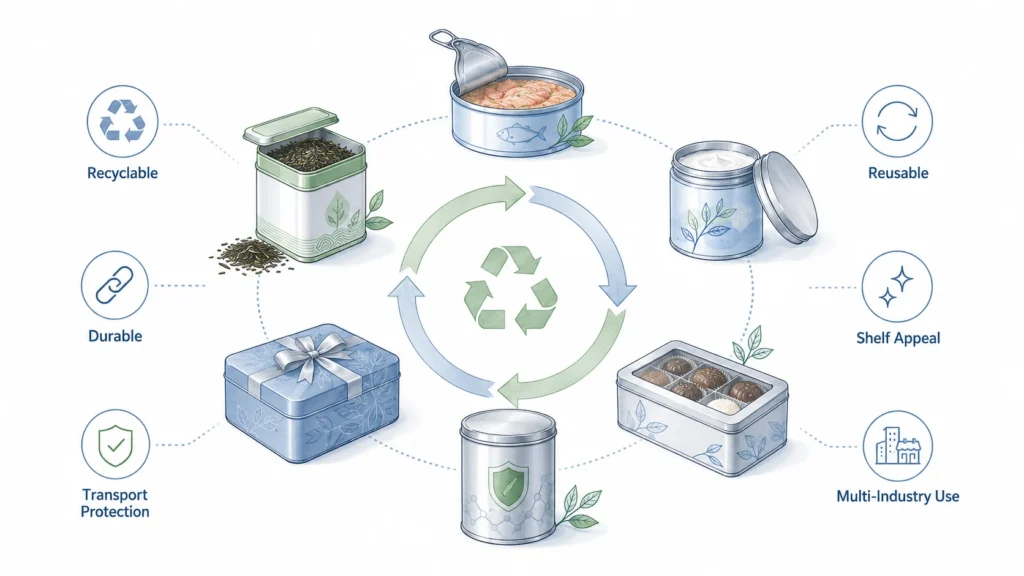
Sustainability is one of the strongest business arguments for tinplate packaging, especially in markets where consumers and retailers care about recyclability and reuse. Steel is magnetic, which makes it easier to separate from mixed waste streams compared with many non-magnetic materials. Tinplate packaging is also reusable in everyday life, especially for tea, coffee, biscuits, candies, stationery, sewing kits, small tools, and keepsake storage.
In Europe, steel packaging has achieved high recycling performance. Steel for Packaging Europe reported that 82% of steel packaging placed on the EU market was really recycled in 2023, meaning it entered actual recycling operations rather than being merely collected. This is valuable information for brands that need credible sustainability talking points. Buyers can link to Steel for Packaging Europe’s recycling announcement when preparing sustainability claims.
Sustainability claims should still be made carefully. A tin is recyclable, but local recycling outcomes depend on collection systems, consumer behavior, and regional infrastructure. A tin may be reusable, but reuse depends on design attractiveness and practical function. A coating may be needed for food safety, but buyers should confirm whether it affects recycling claims in their market. Responsible communication is better than exaggerated green marketing.
| Sustainability Feature | Commercial Value | Claiming It Responsibly |
|---|---|---|
| Steel recyclability | Supports circular packaging goals | Say steel is widely recyclable where collection exists; avoid claiming every package will be recycled everywhere |
| Magnetic separation | Helps sorting in recycling systems | Explain that steel can be separated magnetically in suitable facilities |
| Reusability | Extends brand exposure after purchase | Design the tin to be useful and attractive after the product is consumed |
| Durability | Reduces damage and product waste | Connect structure to product protection, not only material recycling |
| Premium keepsake value | Helps justify higher retail price | Use collectible artwork, functional shape, or refill strategy |
| Refill potential | Supports repeat purchase and loyalty | Pair tin with refill pouches or seasonal refill campaigns |
Mr. Tin Box’s article on Metal Packaging Trends for Premium Consumer Goods points to a practical idea: a premium tin that becomes a storage box is not perceived as waste by the consumer. This is one of the unique advantages of metal packaging. Reuse is not only an environmental argument. It is a marketing advantage because the package stays visible in the home.
Commercial Design: How Tinplate Packaging Raises Perceived Value
Tinplate packaging can increase perceived value because it changes how the product feels before the consumer even opens it. Weight, sound, surface texture, lid movement, embossing, metallic reflection, and print sharpness all contribute to the buying experience. A paper box may communicate convenience. A tin box often communicates gift value, durability, and care.
This is especially important for products sold in crowded retail categories. Tea, cookies, chocolates, mints, cosmetics, and seasonal gifts often compete visually. A rigid tin with a distinctive shape or finish can stand out faster than a flat carton. For online sales, a well-designed tin can improve product photography and unboxing content. For wholesale buyers, it can make the line feel more retail-ready.
The commercial value of tinplate packaging comes from several design levers:
- Shape: round, square, rectangular, oval, heart-shaped, book-shaped, windowed, hinged, slider, or multi-compartment.
- Surface: matte, gloss, satin, soft-touch, textured, metallic, pearlescent, or spot UV.
- Decoration: CMYK images, Pantone color blocks, embossing, debossing, foil-like metallic effects, and registered relief.
- Function: refillable tin, stackable design, window lid, hinged lid, child-resistant concept, or travel-size box.
- Storytelling: seasonal artwork, regional patterns, artist collaboration, heritage branding, limited edition series.
Mr. Tin Box’s article 10 Creative Custom Metal Tin Packaging Design Ideas gives examples such as patterned designs, unique shapes, windowed packaging, multi-purpose tins, premium finishes, collectible series, and custom compartments. These design directions are useful for brands that want a tin to behave like a silent salesperson on the shelf.
Quality Control: What Should Be Checked Before Shipment
Quality control for tinplate packaging should cover appearance, dimensions, function, coating performance, printing durability, edge safety, packing protection, and compliance documentation. It is not enough to check only whether the tin looks nice. Many issues appear only when the lid is opened repeatedly, tins are stacked, cartons are shipped, or products are filled.
A professional inspection plan should include both visual and functional checks. For example, color should be compared against an approved metal proof or golden sample under controlled lighting. Lids should be tested for fit: too loose and the package feels cheap; too tight and consumers may struggle to open it. Edges should be smooth enough for safe handling. Hinges should move consistently. Printing should resist reasonable rubbing. Interior surfaces should be clean and free from sharp burrs, heavy odor, rust, oil, or visible coating defects.
| QC Area | What to Check | Typical Acceptance Focus |
|---|---|---|
| Appearance | Scratches, dents, stains, color variation, dust, printing defects | Consistent retail appearance |
| Dimension | Length, width, height, lid depth, insert fit | Product fit and carton packing accuracy |
| Lid function | Opening force, closing feel, alignment, looseness | Good consumer experience |
| Edge safety | Curl smoothness, burrs, sharp corners | Safe handling and premium feel |
| Coating | Peeling, cracking, odor, corrosion marks | Product compatibility and durability |
| Printing | Registration, rub resistance, gloss level, logo position | Brand consistency |
| Packing | Polybag, divider, carton strength, pallet method | Reduced scratches and transit damage |
| Documentation | Material declaration, test reports, inspection report | Importer and retailer confidence |
Buyers should also ask how the supplier separates defective units, how golden samples are preserved, and how repeat orders are controlled. For seasonal products, late discovery of defects can be expensive because launch windows are fixed. A clear QC checklist before production is usually cheaper than urgent sorting after arrival.
Cost Drivers: Why Tinplate Packaging Prices Vary
Tinplate packaging prices vary because each project combines material, mold, printing, coating, forming complexity, labor, packing, testing, and logistics. Two tins with similar size can have different costs if one uses a standard mold and simple glossy printing, while the other requires a custom shape, deep embossing, soft-touch varnish, food-contact testing, and individual scratch-protection packing.
The biggest cost drivers are usually tooling, material thickness, order quantity, number of colors, special finishes, structural complexity, and testing scope. A standard rectangular tin can be cost-effective because the mold already exists. A unique shape can be valuable for branding but may require new tooling. Matte or satin varnish may be manageable, while soft-touch or registered spot UV requires more process control. Food-contact testing adds cost but can reduce risk for regulated markets.
| Cost Driver | Lower-Cost Direction | Higher-Cost Direction | Business Note |
|---|---|---|---|
| Mold | Existing shape and standard size | Fully custom shape or special lid | Standard molds reduce time and tooling cost |
| Material | Moderate thickness suitable for use | Extra thickness or special grade | Thickness should match structure, not just perception |
| Printing | Simple CMYK or one/two spot colors | Full artwork plus special effects | More effects require more proofing and control |
| Finish | Gloss or satin varnish | Soft-touch, texture, spot UV, complex embossing | Premium finishes can raise perceived value |
| Food safety | Indirect contact with inner pouch | Direct food contact with migration testing | Testing should match actual use and destination market |
| Packing | Bulk with dividers | Individual bag, foam, export carton, pallet | Better packing can reduce scratch claims |
| Quantity | Larger repeat order | Small custom run | MOQ affects unit cost significantly |
A practical sourcing strategy is to decide where the package must be special and where it can remain standard. For example, a brand may use an existing mold but invest in premium printing and embossing. Another brand may use a custom shape but keep finish simple. The best commercial solution is rarely the most complex one. It is the one that gives the consumer a strong reason to buy while remaining stable in production.
How to Write a Clear Tinplate Packaging RFQ
A request for quotation should give the supplier enough information to recommend the right material, coating, printing, and production route. Vague RFQs create vague prices. Clear RFQs reduce back-and-forth communication, prevent wrong samples, and help both sides compare options fairly.
A strong RFQ should include product type, expected quantity, dimensions, shape, lid style, artwork status, printing requirements, finish, food-contact requirement, destination market, target launch date, packing preference, and testing needs. If the brand has an existing sample, send photos, measurements, and a physical sample if possible. If the brand needs development support, ask for standard mold options and structure suggestions first.
Here is a practical RFQ template:
| RFQ Field | Information to Provide |
|---|---|
| Product | What will be packed inside the tin? |
| Contact mode | Direct food contact, inner pouch, wrapped product, cosmetic bottle, non-food item |
| Size | Length x width x height, or target capacity |
| Shape | Round, square, rectangular, oval, hinged, slip lid, window, handle, compartment |
| Quantity | Trial order and annual forecast if available |
| Material | Supplier recommendation or required thickness |
| Printing | CMYK, Pantone, metallic effect, logo placement, dieline status |
| Finish | Matte, glossy, satin, soft-touch, texture, spot UV, embossing, debossing |
| Compliance | FDA, EU food contact, BPA-free, LFGB, retailer standard, test report needs |
| Packing | Individual bag, dividers, export carton, pallet, Amazon/e-commerce requirement |
| Schedule | Sample deadline, mass production deadline, launch date |
| Reference | Photos, competitor sample, brand guideline, previous packaging |
For buyers who are still exploring options, the best first step is often to ask for standard mold recommendations. Standard molds can reduce sampling time and investment. Once the brand proves market demand, a custom mold can be developed for a more distinctive second-generation package.
Common Mistakes to Avoid
Many tinplate packaging problems come from decisions made too late. For example, if food-contact requirements are discussed only after artwork approval, the coating system may need to change. If embossing is added after dieline approval, the logo may need repositioning. If e-commerce shipping is considered only after production, the tins may arrive with scuffed surfaces.
Avoid these common mistakes:
- Choosing a tin only by photo without confirming size, closure, material, and sample quality.
- Using paper-printing expectations for metal printing without approving a metal proof.
- Placing critical artwork too close to edges, curls, hinges, or deep forming areas.
- Assuming all tins are airtight or suitable for direct food contact.
- Asking for “FDA approved” without defining the actual contact material and intended use.
- Choosing soft-touch or matte finishes without scratch and packing tests.
- Ignoring carton design, dividers, and surface protection for export shipping.
- Starting custom tooling too late for a seasonal launch.
- Treating sustainability claims as marketing copy without checking local rules.
- Approving a sample but changing artwork, coating, or packing before mass production without rechecking risks.
The better approach is to make technical decisions early and document them clearly. A good tinplate packaging supplier should be able to explain trade-offs, not simply agree to every request. If a structure is risky, the supplier should suggest alternatives. If a finish may scratch, the supplier should recommend packing protection. If direct food contact is involved, the supplier should clarify testing needs before production.
Recommended Tinplate Packaging Strategy by Industry
Different industries should use tinplate packaging differently. A tea brand needs aroma, storage, and premium shelf presence. A chocolate brand needs gift value, food-safe presentation, and seasonal reliability. A cosmetics brand needs tactile luxury, insert design, and compatibility with bottles or jars. A promotional gift buyer needs cost control, fast sampling, and logo impact.
| Industry | Best Tinplate Strategy | Suggested Internal Link |
|---|---|---|
| Tea, coffee, cookies, candies | Use food-grade material planning, inner pouch or liner where needed, and strong shelf artwork | Food & Beverage Packaging |
| Premium snacks and confectionery | Combine crush protection with seasonal or collectible design | Why Metal Packaging Boosts Shelf Life and Brand Value |
| Beauty and personal care | Prioritize matte, satin, soft-touch, embossing, and insert fit | Metal Tin Box Finishing Options |
| Luxury consumer goods | Treat the package as part of product engineering and brand positioning | Metal Packaging Trends for Premium Consumer Goods |
| Promotions and holiday gifts | Use standard molds, strong logo areas, and fast decoration routes | 10 Creative Custom Metal Tin Packaging Design Ideas |
| Specialty and industrial items | Focus on structure, durability, functional labeling, and corrosion control | Mr. Tin Box Custom Metal Tin Packaging |
This strategic approach prevents overengineering. Not every tin needs every premium feature. The right features are the ones that support the sales channel, product sensitivity, compliance requirements, and target retail price.
FAQ About Tinplate Packaging
Is tinplate packaging safe for food?
Tinplate packaging can be safe for food when the material, coating, printing, and contact scenario are designed for food use. Buyers should define whether the product touches the tin directly or is packed inside an inner bag, tray, or wrapper. For direct food contact, request suitable food-contact coating documentation and testing based on the destination market.
Is a tin box the same as a sealed food can?
No. Many decorative tin boxes are not hermetically sealed like processed food cans. They provide rigidity, light protection, and premium presentation, but oxygen and moisture control may require an inner pouch, seal, gasket, or liner. Always define shelf-life requirements before choosing the structure.
What is the difference between tinplate and tin-free steel?
Tinplate is steel coated with tin. Tin-free steel, often electrolytic chromium-coated steel, uses a different surface system. Tinplate is widely used for decorative tins and many food packaging applications because it offers good formability, printability, and corrosion resistance when properly coated. The best choice depends on the product, coating, forming process, and market requirements.
Can tinplate packaging be printed in full color?
Yes. Tinplate can be printed with CMYK artwork, Pantone spot colors, metallic effects, matte varnish, glossy varnish, satin finish, soft-touch coating, and special effects. For critical brand colors, approve a printed metal proof because color on metal may look different from color on paper or screen.
Does tinplate packaging need an inner coating?
It depends on the product and contact mode. Direct-contact food, oily products, acidic products, salty products, and some cosmetics may require a specific internal coating. Products packed in sealed inner bags may rely on the inner bag as the primary food-contact layer, but the tin should still be clean, suitable for use, and compatible with the product environment.
How should I choose between matte and glossy finish?
Matte finish looks modern and premium, reduces glare, and works well for luxury food and cosmetics. Glossy finish looks bright, vivid, and energetic, which is useful for colorful gift packaging and seasonal promotions. Satin is often a balanced choice when the brand wants a premium look with lower handling risk.
Can tinplate packaging be recycled?
Tinplate is steel-based and steel packaging is widely recyclable where collection and recycling systems exist. Steel’s magnetic properties can help sorting. However, recycling outcomes depend on local infrastructure and consumer behavior. Brands should make sustainability claims accurately and avoid implying universal recycling in every region.
What information should I send to get a fast quotation?
Send product type, contact mode, destination market, size, shape, quantity, artwork, finish, compliance needs, packing requirements, and launch schedule. If you have a reference sample or competitor tin, include photos and measurements. Clear information helps the supplier quote faster and recommend the correct production route.
Final Takeaway: Treat Tinplate Packaging as Product Engineering
Tinplate packaging is powerful because it combines material strength, coating science, printing technology, food safety planning, and brand storytelling. When these elements work together, the result is more than a container. It becomes a premium product experience: strong in logistics, attractive on the shelf, safe for the intended use, and memorable after purchase.
For business buyers, the most important lesson is to specify the package as a system. Do not separate material, coating, printing, and compliance. Start with the product and destination market. Define the contact scenario. Choose a structure that fits the sales channel. Select coatings and finishes that match both performance and brand positioning. Approve real samples before mass production. Keep documentation and golden samples for repeat orders.
Mr. Tin Box helps global brands turn tinplate packaging ideas into production-ready metal tins for food, beauty, gifts, promotions, and specialty applications. If you are developing a new tin box project, share your product details, target market, artwork direction, and packaging goals. The right tinplate packaging solution can protect your product, strengthen your brand, and create a package customers want to keep.