Custom metal tin containers are no longer just a decorative container. For many food, beauty, gift, promotional, and specialty brands, it is now a practical business decision that connects product protection, shelf impact, sustainability positioning, logistics risk, compliance documentation, and long-term brand value. A tin can protect a product from crushing, light, moisture, and careless handling. It can also make a product feel more premium before the customer reads a single line of copy.
The challenge is that not every custom tin is right for every product. A tea brand, a skincare gift set, a holiday confectionery program, and a small electronics accessory kit may all use metal packaging, but their requirements are not the same. One project may need aroma protection and food-contact coatings. Another may need a luxury unboxing experience, accurate color reproduction, and a fitted insert. A seasonal promotion may need strong shelf visibility and reliable delivery before a fixed campaign date. A specialty industrial item may need dimensional control, corrosion resistance, and durable storage.
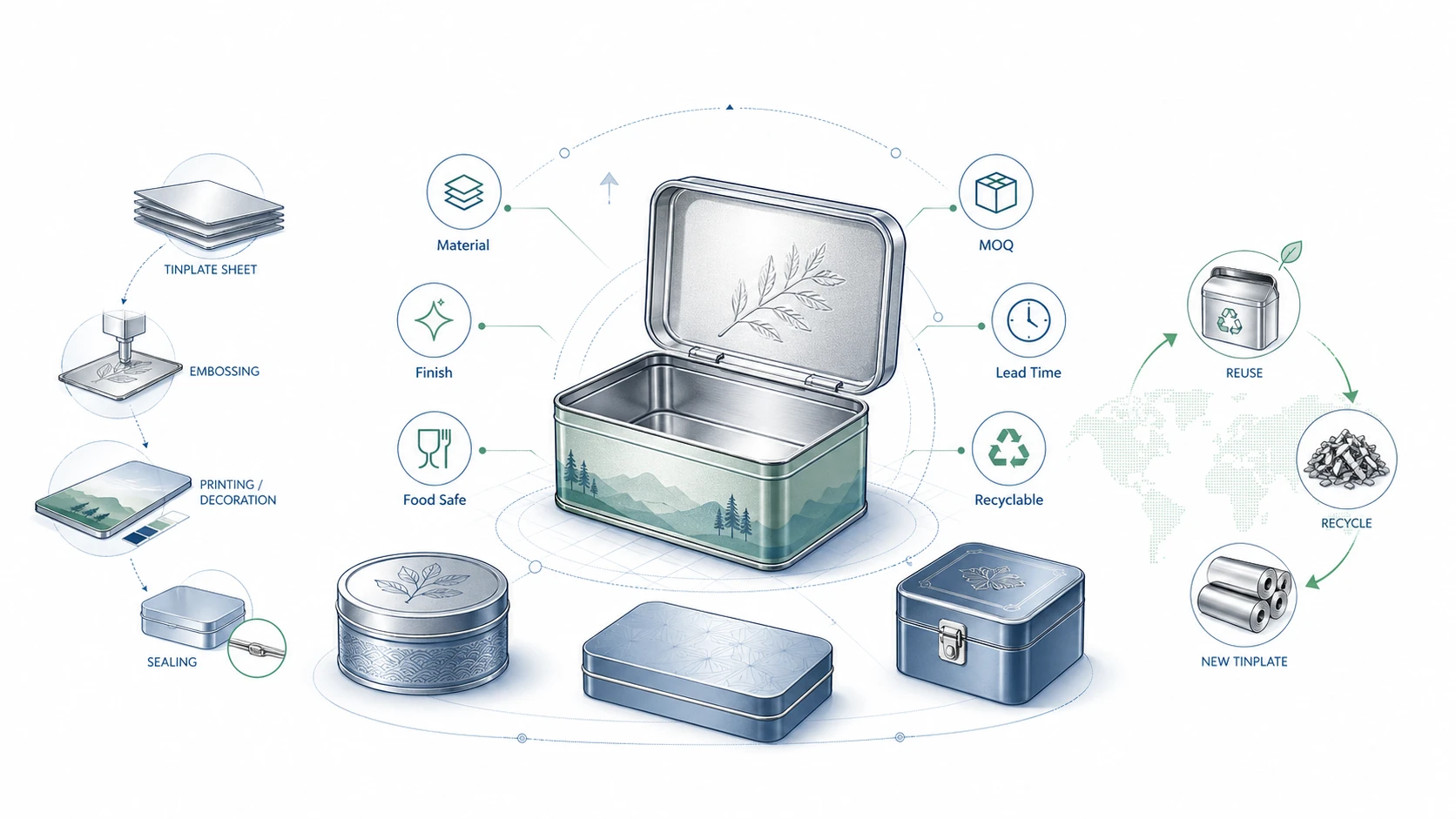
At Mr.Tin.Box, we approach custom metal tin packaging as both an engineering task and a commercial tool. The best result is not simply the most beautiful box. The best result is packaging that fits the product, protects the contents, supports the brand story, can be manufactured repeatably, and makes sense for MOQ, lead time, budget, and target market requirements. This guide explains how to make that decision clearly and confidently.
If you are comparing suppliers or preparing an RFQ, this article can also be used as a buyer checklist. It brings together practical manufacturing logic, public packaging data, and internal Mr.Tin.Box resources such as our Food & Beverage Packaging, Beauty & Personal Care Packaging, MOQ and Lead Time Planning for Your Custom Tin Box, and Global Sourcing Guide for Custom Metal Packaging pages.
Table of Contents
Why the right custom metal tin containers affects business performance
Packaging affects more than appearance. It influences whether a product arrives without damage, whether a customer trusts the brand, whether a retailer can display the product cleanly, whether a warehouse can store inventory efficiently, and whether a brand can support sustainability and compliance claims with evidence.
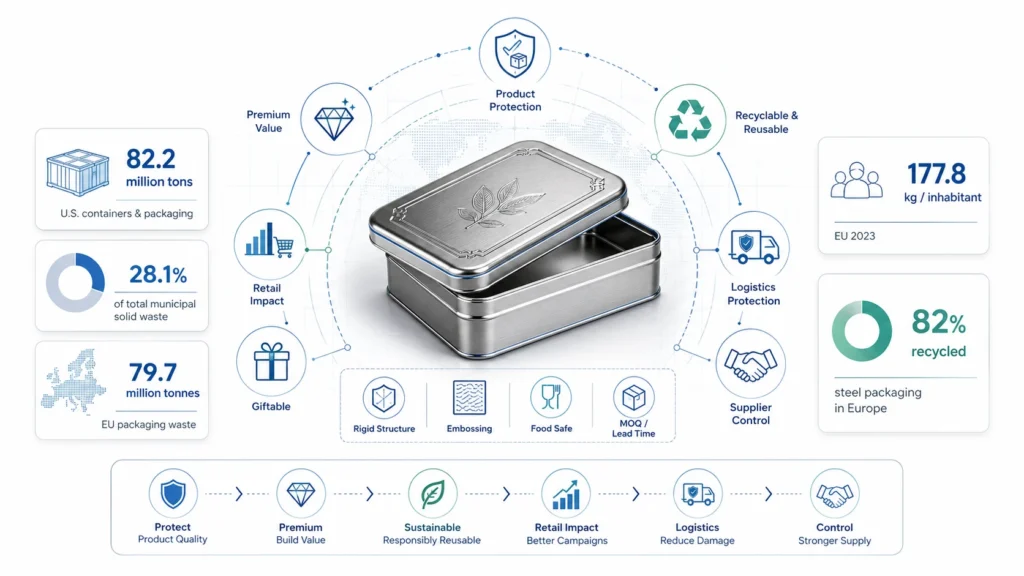
The commercial importance of packaging is visible in waste and recycling data as well. The U.S. Environmental Protection Agency reports that containers and packaging represented 82.2 million tons of municipal solid waste generation in the United States in 2018, equal to 28.1% of total generation. The same EPA page notes that containers and packaging are used not only for wrapping and protecting goods, but also for shipping, storage, protection, sales, and marketing. That is exactly why a packaging choice should not be treated as a minor purchasing detail.
In Europe, packaging pressure is also a policy issue. Eurostat packaging waste statistics show that the EU generated 79.7 million tonnes of packaging waste in 2023, or 177.8 kg per inhabitant. The European Commission states that the new packaging rules aim to make all packaging on the EU market recyclable in an economically viable way by 2030, while reducing primary raw material use and moving toward a more circular economy. These trends matter to global brands because packaging that cannot be justified environmentally, legally, or commercially will face increasing scrutiny.
Custom metal tin packaging sits in a strong position within this environment when it is designed responsibly. Steel and tinplate formats are durable, reusable, magnetically sortable, and widely understood by recycling systems in many markets. Worldsteel describes steel as a permanent material that can be recycled repeatedly without losing its properties. Steel for Packaging Europe reported that 82% of steel packaging placed on the European market was really recycled in 2023. Those figures do not mean every tin project is automatically sustainable, but they do show why metal remains a serious material for brands that want packaging with long-term recovery potential.
For business buyers, the key question is not “Is metal packaging good?” The better question is “Which metal packaging structure is right for this product, this market, this launch plan, and this budget?”
| Business objective | What the packaging must do | Why custom metal tin packaging can help | What to confirm before ordering |
|---|---|---|---|
| Protect product quality | Reduce light, moisture, oxygen, crushing, or contamination risks | Metal is rigid, opaque, and strong; proper lining and closure design can improve protection | Product sensitivity, closure type, lining, shelf-life expectation |
| Build premium value | Make the product feel higher-end and more giftable | Metal supports embossing, matte/gloss contrast, metallic inks, and collectible formats | Brand positioning, finish tolerance, color control, tactile requirements |
| Support sustainability messaging | Reduce perceived disposability and improve recyclability story | Steel/tinplate is widely recyclable and often reused by consumers | Local recycling rules, labeling, mixed-material components, insert materials |
| Improve campaign performance | Help seasonal or promotional products stand out | Unique shapes and printed metal create strong shelf and unboxing impact | Campaign date, MOQ, tooling schedule, artwork deadline |
| Reduce logistics damage | Protect goods through retail, export, and e-commerce handling | Rigid structure resists compression and abrasion better than many lightweight formats | Carton packing, palletization, drop-test needs, shipping route |
| Strengthen supplier control | Make specifications measurable and repeatable | Metal packaging can be inspected by dimensions, coating, print, fit, and finish standards | Drawings, golden sample, QC checklist, inspection plan |
Start with the product, not the tin shape
Many packaging projects begin with a visual idea: a rectangular tin, a round tin, a hinged box, a windowed lid, or a special holiday shape. That is natural because packaging is highly visual. However, a successful custom metal tin packaging project should begin with the product and the commercial situation, not the shape.
The first question is what role the tin will play. Is it primary packaging that directly holds the product? Is it secondary packaging around another bottle, pouch, jar, sachet, or tray? Is it a gift box intended to be kept after use? Is it a protective storage case for a specialty item? Each role creates different technical priorities.
If the tin is direct-contact food packaging, the inner coating, odor control, migration safety, and closure integrity become central. If the tin is a cosmetic gift box around glass bottles, the internal insert, anti-scratch finish, and unboxing experience may be more important. If the tin is for corporate gifts, the campaign timeline, logo treatment, and perceived value may dominate the discussion. If it is for specialty tools or electronics accessories, abrasion resistance, dimensional fit, and repeated opening may matter most.
The second question is what can damage the product. Light may affect tea, spices, pigments, cosmetics, and certain botanical ingredients. Moisture may soften biscuits, cake powders, salts, bath products, or powdered supplements. Oxygen may affect coffee aroma, nut oils, chocolate quality, or fragrance stability. Vibration and compression may damage fragile confectionery, glass jars, candles, instruments, or precision parts. The right tin structure should be chosen to control the most important risk, not to follow a generic catalog picture.
The third question is where and how the product will be sold. Retail packaging must win attention on the shelf. E-commerce packaging must survive parcel handling. Export packaging must tolerate container freight, humidity, customs delays, and long storage windows. Gift packaging must feel impressive when opened. A duty-free or travel retail product may need durability and premium presentation at the same time.
The fourth question is whether the package must be reused. Reuse can be an intentional brand strategy. A tea tin that becomes a kitchen storage container, a cosmetic tin that becomes a jewelry box, or a corporate gift tin that stays on a desk can deliver brand impressions long after the original product is consumed. If reuse matters, the tin should be designed with comfortable opening, clean edges, durable coating, and a shape people actually want to keep.
A useful way to start is to write a short product-packaging brief before asking for a quotation. This brief should include product dimensions, fill weight, product sensitivity, whether the tin touches the product directly, target market, sales channel, expected shelf life, desired finish level, order quantity, launch date, and any compliance requirements. A good supplier can then recommend a practical structure rather than simply quoting the cheapest available shape.
A practical decision table for choosing the right tin format
Custom metal tin packaging is not one single format. It includes many structures, closures, materials, finishes, and insert systems. The table below gives a practical starting point for matching common business needs to appropriate tin formats.
| Product or program type | Suitable tin format | Key technical priorities | Commercial advantage |
|---|---|---|---|
| Tea, coffee, cocoa, spices | Rectangular, square, round, or slip-lid tins | Aroma control, light protection, fitted lid, food-contact lining | Premium storage image and countertop reuse |
| Cookies, biscuits, wafers | Large rectangular or shaped tins with trays | Crush resistance, food-safe coating, internal organization | Seasonal gifting and stronger shelf presence |
| Chocolate and confectionery | Hinged tins, shallow tins, compartment tins | Product separation, odor control, decoration accuracy | Higher gift value and limited-edition potential |
| Mints and candies | Small pocket tins or sliding tins | Smooth edges, repeat opening, compact size | Portable brand visibility and repeat purchase |
| Skincare gift sets | Rigid tins with EVA, paperboard, or pulp inserts | Insert fit, scuff resistance, luxury finish | Premium unboxing and reduced breakage |
| Solid perfume, balm, soap | Small direct or secondary tins | Coating compatibility, corrosion resistance, easy opening | Tactile, durable, travel-friendly packaging |
| Candles and fragrance kits | Round or rectangular tins with protective insert | Heat exposure, fragrance compatibility, lid fit | Giftability and elegant storage value |
| Holiday promotions | Shaped tins, embossed tins, collectible series | Tooling schedule, print registration, campaign deadline | Strong emotional appeal and seasonal shelf impact |
| Corporate gifts | Logo tins, hinged tins, multi-item sets | Brand color accuracy, insert layout, finish consistency | Higher perceived value than paper boxes |
| Electronics accessories | Hinged or fitted tins with foam/pulp inserts | Anti-scratch design, dimensional fit, durability | Protection plus premium presentation |
| Specialty industrial items | Heavy-duty tins or metal cases | Thickness, edge safety, corrosion control, repeated use | Organized storage and long service life |
This table should not replace project-specific engineering. It is a decision aid. The most important lesson is that structure should follow the product’s job-to-be-done. If the goal is aroma retention, closure and lining matter more than unusual shape. If the goal is luxury gifting, finish and insert design may matter more than maximum airtightness. If the goal is export safety, carton packing and pallet protection must be specified together with the tin.
Material choice: tinplate, aluminum, and specialty options
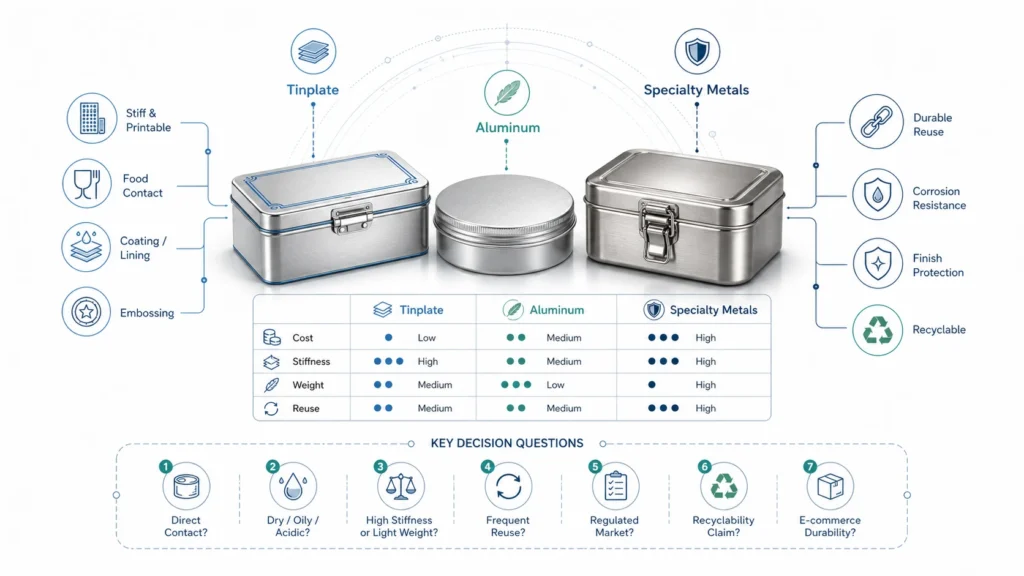
Most custom metal tin packaging projects begin with tinplate because it offers an effective balance of cost, stiffness, formability, printability, and recyclability. Tinplate is steel sheet coated with a thin layer of tin, often combined with internal lacquer or coating systems depending on the application. It is widely used for decorative tins, food tins, gift tins, confectionery tins, tea tins, cosmetic tins, and promotional packaging.
Tinplate is strong enough to form crisp edges and stable shapes. It supports printing, embossing, debossing, varnishing, metallic effects, and many lid styles. Because it is steel-based, it is also magnetic, which can help sorting in recycling systems. For many B2B buyers, tinplate is the standard starting point because it is practical at scale and familiar to packaging factories.
Aluminum can be appropriate when lightweight feel, corrosion resistance, or a particular premium aesthetic is more important. It is common in some personal care, fragrance, balm, candle, and specialty container formats. Aluminum is softer than steel in many applications, so thickness, forming method, dent resistance, and decoration plan must be reviewed carefully. It can be an excellent material, but it should not be chosen only because it sounds premium.
Stainless steel and other specialty metals are less common for standard consumer packaging because of cost, but they may be useful for durable reusable programs, high-end gifts, outdoor lifestyle products, or long-life storage cases. These projects should be evaluated differently from ordinary packaging because the tin may become part of the product experience rather than a disposable pack.
Material selection must also account for coatings and finishes. A food tin may require a coating system suitable for the food category and the expected contact conditions. A beauty tin may need resistance to oils, fragrances, alcohols, or acids. A gift tin may need strong exterior varnish to protect artwork from scratching during logistics. A specialty tin may need corrosion protection for storage environments.
A useful material decision should answer these questions:
- Will the product touch the metal directly?
- Is the product dry, oily, acidic, fragrant, salty, or reactive?
- Does the package need high stiffness or light weight?
- Will it be reused frequently?
- Will it enter a food, cosmetic, pharmaceutical, or child-related regulatory environment?
- Does the market expect recyclability or reuse claims?
- Does the finish need to survive e-commerce handling or retail display?
When these questions are answered clearly, the supplier can recommend tinplate, aluminum, coating type, thickness range, and forming method with much better accuracy.
Food and beverage packaging: protection, freshness, and compliance
Food and beverage brands often choose custom metal tin packaging because metal supports protection and trust. Tea, coffee, chocolates, biscuits, candies, cookies, spices, powders, and gourmet assortments are often damaged by light, moisture, oxygen, pressure, or poor handling. A well-designed metal tin can reduce these risks while creating a premium shelf appearance.
The Food & Beverage Packaging page on Mr.Tin.Box highlights the practical role of food-grade metal packaging: it is designed for products such as snacks, tea, coffee, chocolates, candies, and specialty foods, using high-quality tinplate through precision stamping and forming. That focus is important because food packaging cannot be reduced to decoration. It must protect freshness, support safe contact where required, and maintain appearance through distribution.
For aroma-sensitive products such as tea and coffee, opacity and closure quality are important. Light can degrade quality, and poor closure can allow aroma loss or moisture ingress. For biscuits and wafers, crush resistance may be the first requirement. For chocolates and confectionery, the tin may need internal trays or dividers to preserve shape and presentation. For powders, the inner coating, dispensing method, and closure cleanliness should be considered.
Food brands should also be careful with the word “airtight.” Some tins can provide excellent fitted closure performance, but not every decorative tin is a hermetically sealed can. In regulated food language, hermetic sealing has a specific meaning. If a product requires commercial sterility, retort processing, vacuum performance, or strict oxygen barrier targets, that must be defined during the engineering stage. For many decorative food tins, the goal is not full canning performance but practical protection, premium presentation, and improved shelf life within the product’s own packaging system.
Food-contact compliance should be treated as a design input from the first conversation. In the EU, the European Commission explains that Regulation (EC) No 1935/2004 provides a harmonized framework for food contact materials and sets out the principles of safety and inertness. In the United States, 21 CFR 175.300 addresses resinous and polymeric coatings that may be used as food-contact surfaces under prescribed conditions. These references matter because direct-contact metal packaging depends not only on the metal substrate, but also on the coating, ink system, adhesives, and any internal components.
| Food packaging requirement | Why it matters | Practical specification point |
|---|---|---|
| Food-contact safety | Packaging should not create unsafe migration or unacceptable taste/odor change | Request material and coating information, relevant declarations, and testing where needed |
| Aroma protection | Tea, coffee, cocoa, and spices lose value when aroma escapes | Define closure type, lid fit, inner liner or secondary seal if needed |
| Moisture control | Cookies, powders, candies, and crisps can soften or clump | Review lid fit, inner bag strategy, desiccant plan, and storage environment |
| Light protection | Light-sensitive foods and ingredients may degrade | Use opaque tin structures and avoid unnecessary windows unless protected |
| Crush resistance | Fragile biscuits, wafers, and chocolates need physical protection | Use internal trays, proper tin thickness, and export carton protection |
| Retail presentation | Premium foods rely on shelf appeal and gifting value | Define print finish, embossing, color tolerance, and display orientation |
A strong food tin project usually combines a metal outer structure with a practical internal packaging strategy. For example, biscuits may use a food-safe inner tray and film wrap inside a decorative tin. Tea may use an inner pouch plus reusable outer tin. Chocolate may use compartments to prevent movement. This hybrid thinking is often more reliable than forcing the metal container to solve every technical problem alone.
Beauty and personal care packaging: premium feel and product compatibility
Beauty and personal care brands often use custom metal tin packaging because the material naturally communicates value. A tin feels cool, smooth, durable, and giftable. It photographs well, supports premium surface effects, and can become a keepsake container after the product is used.
Mr.Tin.Box’s Beauty & Personal Care Packaging page describes this category as packaging for cosmetics, skincare, fragrances, and personal care items, with emphasis on protection, aesthetic value, and long-term reliability. That is the right starting point. Beauty packaging must look attractive, but it also has to protect delicate products, inserts, bottles, jars, tools, or solid formulations.
For skincare gift sets, the tin is often a secondary package. It may hold glass bottles, tubes, jars, applicators, or samples. The insert is therefore critical. EVA foam, paperboard, molded pulp, PET trays, or cardboard platforms can all be used, but each creates different cost, sustainability, and appearance implications. A loose insert can make the product feel cheap. A tight insert can make the product hard to remove. A poor insert can scratch bottles during shipping. Insert design should be treated as part of the packaging engineering, not an afterthought.
For balms, soaps, solid perfumes, candles, waxes, and oil-based products, compatibility becomes more important. Some formulas may interact with coatings, inks, adhesives, or metal surfaces. Fragrance transfer, staining, corrosion, or odor contamination can damage the customer experience. The correct approach is to define the formula type and contact conditions early, then validate materials through samples and compatibility checks.
Beauty brands also care about color. A brand color printed on metal can look different from the same color printed on paper or plastic because the substrate, base coat, varnish, gloss level, and lighting conditions change perception. If color is important, the buyer should provide Pantone references, approved artwork files, target finish, and acceptable tolerance. For high-end brands, a golden sample should be preserved as the production reference.
| Beauty packaging goal | Tin design implication | Buyer question to ask |
|---|---|---|
| Luxury unboxing | Use rigid structure, clean opening, premium finish, and fitted insert | Does the sample feel premium when opened and closed repeatedly? |
| Formula protection | Choose suitable coating and avoid reactive materials | Will oils, fragrances, acids, alcohols, or waxes contact the package? |
| Gift set organization | Design inserts around product dimensions and removal experience | Can customers remove each item easily without shaking the box? |
| Influencer/e-commerce delivery | Strengthen outer carton and protect finish from scuffing | Will the tin still look good after parcel handling? |
| Reuse after purchase | Choose durable coating and practical shape | Would the customer realistically keep this tin on a desk or vanity? |
| Brand consistency | Control color, gloss, embossing, and artwork registration | Is there a master sample and defined color tolerance? |
For beauty brands, the right custom tin does more than hold a product. It turns a set into a gift, a refill into a ritual, and a simple product into an object that customers want to photograph, keep, and reuse.
Gift, promotional, and holiday packaging: collectibility and campaign value
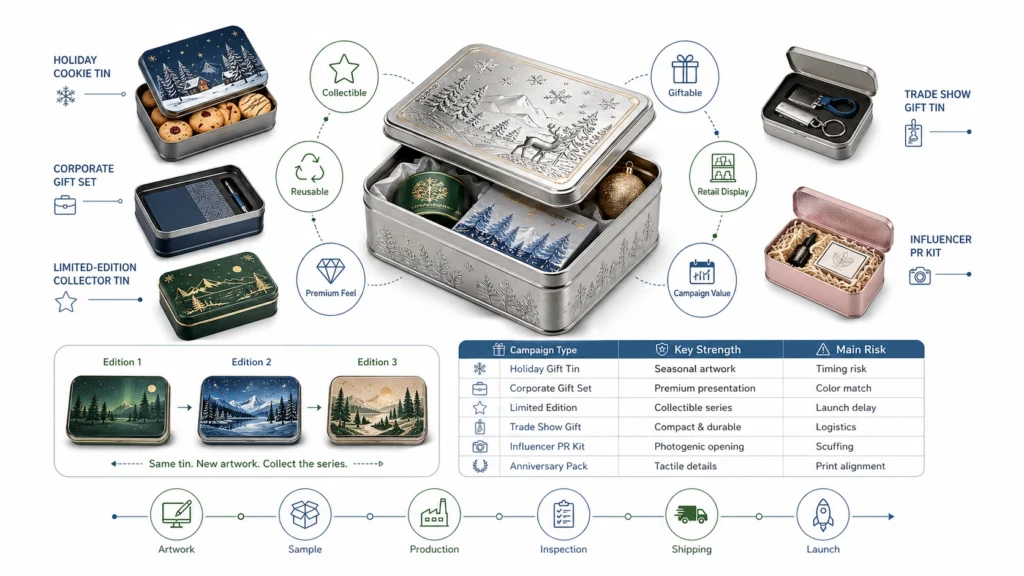
Gift, promotional, and holiday programs are one of the strongest use cases for custom metal tin packaging. In these projects, the packaging is not only protective; it is part of the reason the customer buys. A holiday cookie tin, a corporate gift box, a limited-edition tea set, or a branded promotional kit must create emotional impact quickly.
The commercial logic is straightforward. Gift packaging has to feel worth giving. Promotional packaging has to keep the brand visible. Holiday packaging has to stand out in a crowded seasonal environment. Metal tins support all three goals because they combine structure, printability, tactile value, and reuse.
Mr.Tin.Box’s article on 10 Creative Custom Metal Tin Packaging Design Ideas shows how shapes, patterns, embossing, debossing, seasonal artwork, and compartments can turn a tin into a brand experience. The Custom Tin Boxes for Corporate Gifts and Promotions page is also useful for buyers planning branded gift programs, company events, distributor gifts, or premium promotional campaigns.
For gift and holiday tins, timing is often the biggest risk. A beautiful tin delivered after the campaign window has little value. Buyers should plan backward from the launch date, including artwork approval, tooling, sampling, revisions, mass production, inspection, ocean or air freight, customs clearance, warehousing, and final distribution. Seasonal programs should not treat lead time as a simple production estimate.
Collectibility is another powerful advantage. A metal tin can be designed as part of a series: annual holiday editions, regional artwork, artist collaborations, anniversary tins, or limited runs. If the structure remains stable while the artwork changes, brands can control tooling cost while refreshing the visual story. This is especially useful for confectionery, tea, cosmetics, alcohol accessories, lifestyle products, and corporate gift sets.
| Campaign type | Recommended strategy | Key risk to control |
|---|---|---|
| Christmas or holiday gift tin | Use seasonal artwork, embossing, and strong retail display shape | Late artwork approval or delayed shipping |
| Corporate gift set | Prioritize logo accuracy, insert layout, and premium feel | Cheap-looking insert or poor color match |
| Limited-edition product drop | Use collectible structure and serialized visual story | Tooling complexity that delays launch |
| Distributor or trade show gift | Use compact, durable tins that travel well | Excessive size or weight for event logistics |
| Influencer PR kit | Use dramatic opening experience and photogenic finish | Scuffing during parcel delivery |
| Anniversary or collaboration pack | Use artwork and tactile details that justify premium pricing | Misregistration between embossing and print |
For this category, the most important question is not simply “What shape looks special?” It is “What will customers want to keep?” A tin that remains useful after the original product is consumed can continue delivering brand exposure for months or years.
Specialty and industrial packaging: protection, organization, and durability
Specialty and industrial packaging is sometimes overlooked in discussions about custom metal tin packaging, but it can be commercially important. Small tools, accessories, electronic parts, maintenance kits, hardware sets, samples, collectibles, and technical components often require packaging that organizes, protects, and communicates quality.
Unlike food and beauty packaging, specialty packaging may not need luxury decoration. It may need stronger thickness, more precise inserts, corrosion-resistant coating, safer edges, label durability, or repeated opening performance. The tin may be used in a workshop, warehouse, vehicle, toolbox, laboratory, or field-service environment. In these cases, practical durability is often more important than decorative complexity.
A metal tin can help reduce product loss, simplify storage, and make kits easier to identify. For example, a small accessory kit in a printed tin can include compartments for parts and instructions. A maintenance set can use a hinged tin that stays with the equipment. A premium electronics accessory can use a rigid tin to reduce damage and improve unboxing value.
The key is to define the actual use environment. Will the tin be exposed to humidity? Will it be opened frequently? Will it carry sharp components? Does it need foam, molded pulp, or plastic trays? Will it be stacked? Does it need barcode labeling or serialized identification? Should the finish prioritize scratch resistance over gloss? These questions help turn a generic tin into a functional packaging system.
For industrial-adjacent programs, buyers should also pay close attention to edge safety and dimensional consistency. A tin that looks fine in a photo may fail if edges are sharp, hinges are weak, lids are loose, or internal parts move during shipping. This is why prototypes and functional testing matter.
Decoration and finishing: where brand value becomes visible
Decoration is where custom metal tin packaging becomes commercially powerful. The same tin structure can feel mass-market, premium, nostalgic, modern, industrial, playful, or luxury depending on surface treatment and graphic execution.
Common decoration options include CMYK printing, spot colors, matte varnish, gloss varnish, soft-touch coating, metallic inks, pearlescent effects, embossing, debossing, texture varnish, foil effects, windows, labels, sleeves, and special lid treatments. Each option affects cost, production complexity, lead time, and quality risk.
A common buyer mistake is treating decoration as a design file rather than a manufacturing process. Printing on metal is not identical to printing on paper. The base coating, metal reflectivity, curing process, varnish stack, and forming sequence can all affect final appearance. If embossing is aligned with printed artwork, registration control becomes critical. If a window is added, the structure, adhesive, food safety, and recyclability implications must be reviewed.
| Finish or decoration | Best used for | Commercial benefit | Risk to manage |
|---|---|---|---|
| Matte varnish | Modern beauty, tea, wellness, luxury food | Soft premium look, reduced glare | Shows scuffs if coating is not durable enough |
| Gloss varnish | Bright food, candy, promotional tins | Strong color saturation and shelf impact | Fingerprints and glare may be more visible |
| Embossing | Logos, patterns, premium gift tins | Tactile brand recognition | Print-to-emboss alignment must be controlled |
| Debossing | Minimal luxury, brand marks, texture | Subtle premium effect | Depth must not deform functional areas |
| Metallic ink | Festive, premium, limited edition | High perceived value | Color shifts under different lighting |
| Soft-touch coating | Beauty, skincare, luxury gifting | Strong tactile differentiation | Scratch and handling resistance must be tested |
| Window feature | Product visibility for food/gifts | Builds trust by showing contents | Mixed-material complexity and sealing risk |
| Internal printing | Collectible tins, gift messages | Enhances unboxing and reuse | Adds cost and inspection requirements |
| Spot effects | Highlight logos or artwork details | Creates depth and visual contrast | Requires clear artwork separation and QC standards |
For premium programs, decoration should be specified like an engineering requirement. Buyers should define artwork file format, color references, finish stack, coating expectation, acceptable defects, inspection distance, and golden sample procedure. Without these details, disagreements can arise because “premium” means different things to different teams.
A good supplier should also advise where not to add decoration. Embossing across a tight lid fit may create closing problems. Heavy ink coverage near formed corners may increase cracking risk if the process is not optimized. A window may look attractive but weaken the sustainability message or complicate sealing. The best design is not the most complicated design; it is the design that delivers the strongest brand effect while remaining manufacturable.
Sustainability and public data buyers can actually use
Sustainability claims must be handled carefully. It is not enough to say that metal is “eco-friendly.” Buyers need to understand what can be supported by material characteristics, recycling data, reuse behavior, and market-specific recovery systems.
Metal’s strongest sustainability arguments are durability, recyclability, and reuse potential. Steel is widely recycled and can be sorted magnetically. Many consumers also reuse decorative tins because they are attractive and durable. However, a tin with complex mixed-material parts, excessive plastic inserts, non-removable windows, or unnecessary overpacking may weaken the sustainability story. Good design matters.
The table below summarizes public data points that can be useful when explaining packaging choices to internal teams, distributors, or content readers.
| Public data point | Source | Business meaning for custom metal tin packaging |
|---|---|---|
| Containers and packaging made up 82.2 million tons of U.S. MSW generation in 2018, equal to 28.1% of total generation. | U.S. EPA | Packaging is a major waste category, so material choice and design efficiency matter. |
| EPA estimated steel containers and packaging generation at 2.2 million tons in 2018, with 1.6 million tons recycled, or 73.8% of generation. | U.S. EPA | Steel packaging has established recovery performance in the U.S. data set. |
| EU packaging waste reached 79.7 million tonnes in 2023, or 177.8 kg per inhabitant. | Eurostat | Packaging reduction, recyclability, and reporting pressure are significant in Europe. |
| In 2023, metal represented 3.9 million tonnes, or 4.9%, of EU packaging waste. | Eurostat | Metal is a smaller share by weight than paper, plastic, glass, or wood, but remains strategically important in high-value applications. |
| The EU aims to make all packaging on the EU market recyclable in an economically viable way by 2030. | European Commission | Brands selling into Europe should design for recyclability and documentation early. |
| Steel is described as a permanent material that can be recycled over and over without losing its properties. | Worldsteel | Tinplate packaging can support a credible circularity story when collection and recycling systems exist. |
| Steel for Packaging Europe reported that 82% of steel packaging placed on the European market was really recycled in 2023. | Steel for Packaging Europe | European recovery performance strengthens the case for well-designed steel/tinplate packaging. |
| FAO states that 13.2% of food is lost after harvest and before retail, while 19% is wasted at retail, food service, and household levels according to 2024 UNEP statistics. | FAO | Packaging that protects quality and extends usable life can contribute to waste-reduction strategies. |
For brands, the practical conclusion is simple: sustainable packaging is not only about choosing a material. It is about designing the whole system responsibly. A reusable tin with minimal unnecessary components, clear labeling, efficient packing, and recyclable material choices is stronger than a visually impressive tin that creates avoidable waste.
This is also where internal links on the Mr.Tin.Box website can support buyer education. The article Why Metal Packaging Boosts Shelf Life and Brand Value explains the connection between protection and brand value, while Metal Packaging Trends for Premium Consumer Goods discusses how premium brands are responding to sustainability and regulation.
Compliance and documentation: what serious buyers should request
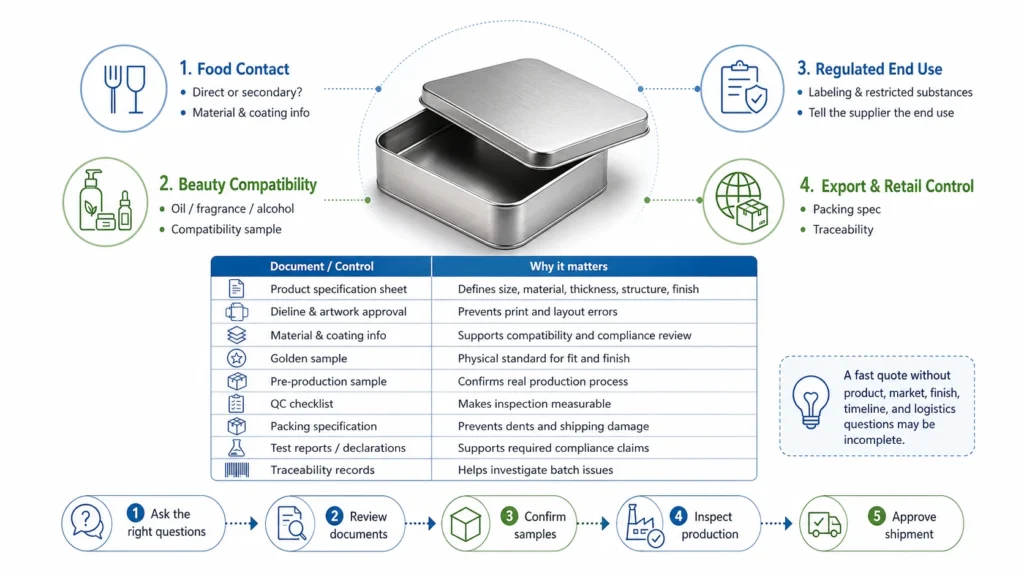
Compliance is not only a legal issue. It is also a buyer-confidence issue. A professional custom metal tin packaging supplier should be able to explain materials, coatings, printing, inspection, and production controls in a way that supports the target market.
For food applications, the buyer should ask whether the tin is direct-contact or secondary packaging. If direct-contact, the supplier should provide relevant material and coating information. Depending on the market, product type, and customer requirements, declarations, migration test reports, FDA-related information, LFGB-related testing, or EU food-contact documentation may be needed. Requirements vary by market and application, so buyers should avoid assuming that a generic “food-grade” claim is enough.
For beauty and personal care, the packaging may not require food-contact compliance, but it still must be appropriate for the formula and market. Oils, fragrances, alcohols, acids, pigments, and active ingredients can interact with packaging materials. The buyer should request compatibility samples and test the product under realistic conditions. If the tin will hold a glass bottle, tube, or jar, the insert should be tested for abrasion and fit.
For gift and promotional packaging, compliance may involve labeling, claims, restricted substances, child safety, or product-specific rules. If the tin is for children’s items, tobacco accessories, pharmaceutical-adjacent products, or regulated consumer goods, additional standards may apply. The supplier should be told the end use, not just the dimensions.
For export and retail programs, documentation should also include production drawings, material specifications, artwork approvals, color references, inspection standards, packaging method, carton dimensions, pallet information, and corrective-action procedure. These documents reduce disputes and help the buyer maintain consistency across repeat orders.
A practical documentation checklist includes:
| Document or control item | Why it matters |
|---|---|
| Product specification sheet | Defines size, material, thickness, structure, finish, and functional requirements |
| Dieline and artwork approval | Prevents printing layout errors and mismatched graphics |
| Material and coating information | Supports food, beauty, and product compatibility review |
| Golden sample | Creates a physical standard for appearance, fit, and finish |
| Pre-production sample | Confirms the mass-production process, not only prototype appearance |
| QC checklist | Makes inspection measurable and reduces subjective disputes |
| Packing specification | Prevents dents, abrasion, moisture damage, and shipping losses |
| Test reports or declarations | Supports compliance claims where required |
| Traceability records | Helps investigate issues by batch, date, material, or production line |
Serious buyers should expect serious questions from the supplier. If a supplier quotes instantly without asking about product contact, target market, finish, timeline, and logistics, the quote may be fast but incomplete.
MOQ, tooling, lead time, and cost planning
Custom metal tin packaging cost is shaped by more than unit price. Buyers should consider tooling, printing setup, finishing complexity, material thickness, coating requirements, insert design, MOQ, order frequency, packing method, freight, inspection, and inventory risk.
The Mr.Tin.Box article MOQ and Lead Time Planning for Your Custom Tin Box explains that MOQ and lead time should be treated as strategic planning topics, not just factory numbers. This is especially true for custom tins because tooling, artwork approval, sampling, printing, stamping, finishing, assembly, QC, and logistics all affect the final schedule.
Tooling is often the first cost driver. A standard round, square, or rectangular tin may use existing tooling or require limited modification. A custom shape, hinged structure, windowed lid, special closure, or deep embossing may require new molds or more complex production fixtures. Tooling can be worthwhile if the structure creates strong brand value or repeat-order potential, but it should be evaluated against the program’s commercial horizon.
Printing and finishing are another major cost driver. A simple one-color logo on a standard tin is very different from full-surface CMYK artwork with spot colors, matte/gloss contrast, embossing, internal printing, metallic effects, and strict cosmetic inspection. Premium effects are valuable when they support the brand, but they also increase setup time and quality-control complexity.
Inserts can also change cost and lead time. EVA foam, molded pulp, paperboard, PET trays, dividers, handles, ribbons, locks, sleeves, and labels may have their own suppliers and MOQs. A buyer who focuses only on the outer tin may be surprised later when the insert becomes the bottleneck.
| Cost driver | How it affects the project | Planning advice |
|---|---|---|
| Existing vs. new tooling | New shapes increase upfront cost and schedule | Use existing shapes when speed matters; invest in new tooling for repeat programs |
| Material thickness | Thicker metal improves rigidity but increases material cost | Match thickness to size, weight, and durability needs |
| Coating requirements | Food/contact coatings and specialty finishes can add cost | Define product contact and market requirements early |
| Print complexity | More colors/effects increase setup and inspection demands | Use premium effects where customers will notice them most |
| Embossing/debossing | Adds tooling and registration requirements | Keep embossing away from critical closure zones when needed |
| Inserts/accessories | Add components, suppliers, and assembly time | Prototype the complete set, not only the outer tin |
| MOQ | Larger orders reduce unit cost but increase inventory risk | Compare price breaks against forecast and storage cost |
| Freight method | Air freight saves time but raises cost; ocean freight requires planning | Plan launch calendar backward from delivery date |
| Inspection level | Tighter inspection costs more but reduces risk | Use stricter inspection for first orders and premium programs |
The smartest way to evaluate cost is to compare total project value, not only unit price. A cheaper tin that dents easily, misses the campaign window, fails color approval, or creates customer complaints is not cheaper. A slightly higher-cost tin that protects the product, improves shelf conversion, and supports repeat orders may produce better commercial return.
Quality control: how to prevent beautiful samples from becoming risky production
A common problem in custom packaging is the “beautiful sample, unstable production” gap. A supplier may produce an attractive hand-finished sample, but mass production requires repeatable process control. Buyers should therefore approve not only the appearance, but also the manufacturing route.
Quality control should begin with the drawing. Critical dimensions should be defined clearly: outer size, inner usable size, lid fit, height, curl, hinge position, insert clearance, window location, and any areas that affect closure. If a product or insert must fit inside the tin, the supplier needs actual product samples or accurate 3D data.
Next comes material and surface control. Tinplate thickness, coating type, print finish, varnish, and embossing should be matched to the approved sample. If the design uses a special matte finish, the buyer should test whether it scratches during handling. If it uses a glossy finish, the buyer should check fingerprints, glare, and abrasion. If it uses a dark color, dents and scuffs may be more visible.
Functional checks are just as important as visual checks. The lid should open and close smoothly. Hinges should not feel loose or sharp. Edges should be safe. The tin should sit flat. Internal trays should not rattle. Stacking should be stable. Cartons should protect the tins from dents and rubbing. These details determine whether the customer experience feels premium or careless.
A practical quality plan can include:
| Inspection stage | What to check | Why it matters |
|---|---|---|
| Incoming material | Tinplate/aluminum thickness, surface condition, coating information | Prevents hidden material problems before forming |
| Printing approval | Color, registration, varnish, artwork placement | Prevents mass printing errors |
| Forming inspection | Dimensions, edges, curls, lid fit, hinge function | Ensures structure works, not just looks good |
| Decoration inspection | Scratches, dents, stains, emboss depth, gloss/matte consistency | Protects premium appearance |
| Insert inspection | Fit, removal experience, abrasion, odor, material quality | Controls unboxing and product protection |
| Final packaging inspection | Carton strength, separation, moisture protection, palletization | Prevents shipping damage |
| Pre-shipment inspection | AQL sampling, defect classification, photo records | Gives buyer confidence before goods leave factory |
For first orders, buyers should use tighter inspection and more detailed acceptance criteria. Once the supplier proves consistency, inspection can be optimized. However, quality standards should never be left vague. Words like “good,” “premium,” and “acceptable” should be translated into measurable criteria wherever possible.
Supplier evaluation scorecard
Choosing the right supplier is as important as choosing the right tin. A supplier that understands forming, printing, coating, tooling, inserts, QC, and export packing can prevent many problems before they happen. A supplier that only competes on low price may create risk in sampling, documentation, consistency, or delivery.
The Mr.Tin.Box article How to Select the Right Factory for Metal Packaging is a useful internal reference for this decision. The core idea is that buyers should evaluate capability, not only quotation speed.
| Evaluation area | Strong supplier behavior | Red flag |
|---|---|---|
| Engineering review | Asks about product, market, contact, closure, finish, and logistics | Quotes only from size and quantity |
| Tooling capability | Explains mold design, ownership, maintenance, and modification options | Cannot explain tooling cost or timeline clearly |
| Material knowledge | Recommends tinplate/aluminum/coating based on application | Uses vague terms such as “metal material” |
| Printing and finishing | Discusses color control, varnish, embossing, and process limits | Promises any effect without technical review |
| Compliance awareness | Understands food, beauty, export, and documentation needs | Treats “food-grade” as a generic marketing word |
| Sampling process | Offers prototype, decorated sample, and pre-production sample steps | Treats one visual sample as enough for mass production |
| QC system | Provides measurable inspection points and defect standards | Relies only on casual visual checks |
| Communication | Gives structured feedback and risk warnings | Says yes to everything, then changes details later |
| Lead-time planning | Separates tooling, sampling, production, QC, and freight | Gives one vague delivery estimate |
| Export packing | Specifies cartons, separators, moisture protection, pallets | Uses minimal packing to reduce quote artificially |
This scorecard helps buyers avoid the most dangerous sourcing trap: selecting the lowest unit price without checking whether the supplier can actually deliver the required performance.
Common mistakes when choosing custom metal tin packaging
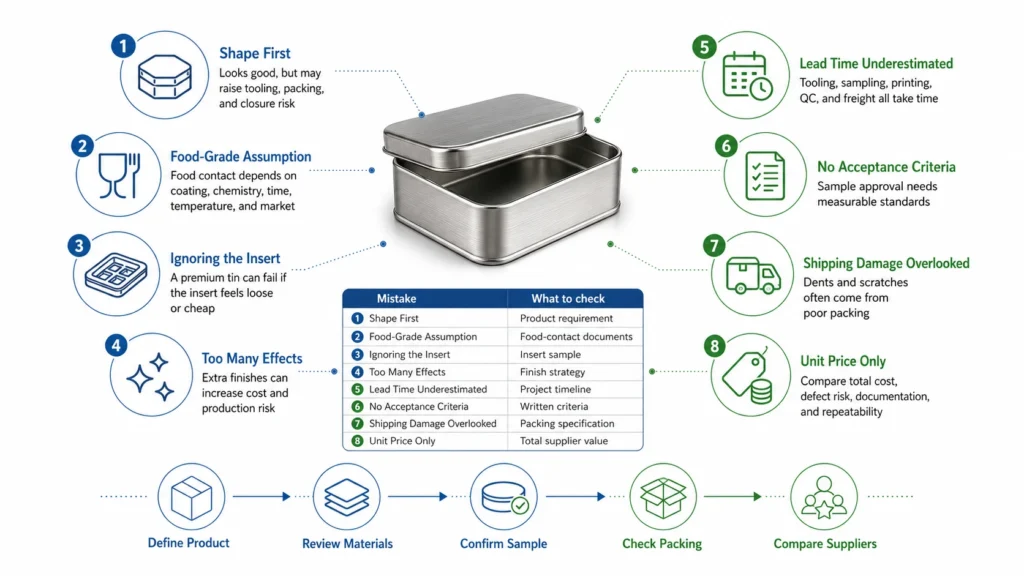
The first mistake is choosing a shape before defining the product requirements. A special shape may look attractive, but it can create tooling cost, packing inefficiency, closure problems, or late delivery. Shape should support the product and the brand, not distract from practical performance.
The second mistake is treating “food-grade” as a single universal label. Food contact depends on substrate, coating, product chemistry, contact time, temperature, market, and documentation. Buyers should ask for relevant information instead of assuming all tins are suitable for all foods.
The third mistake is ignoring the insert. Many premium tins fail because the outer box looks good but the inside feels cheap, loose, noisy, or difficult to use. Inserts are part of the product experience and should be sampled with real products.
The fourth mistake is overdecorating the tin. Too many effects can increase cost and risk without improving sales. A clean matte finish with one well-placed embossed logo may be stronger than a crowded design with five special processes. The right finish should match the brand position and manufacturing reality.
The fifth mistake is underestimating lead time. Custom metal tin packaging includes consultation, design, tooling, sampling, artwork proofing, printing, forming, finishing, assembly, QC, packing, and freight. Seasonal and promotional buyers should plan backward from the required delivery date.
The sixth mistake is approving a sample without written acceptance criteria. A sample is useful only if it becomes a measurable standard. Buyers should document dimensions, color, finish, lid fit, defect limits, insert fit, packing method, and any special tests.
The seventh mistake is ignoring shipping damage. A tin can be strong, but finished tins can still be dented or scratched if packed poorly. Export cartons, separators, humidity control, pallet configuration, and container loading should be part of the quotation discussion.
The eighth mistake is comparing suppliers only by unit price. A low unit price can hide weak packing, poor inspection, unclear tooling, unstable color, or longer lead time. A professional comparison should include total landed cost, defect risk, project management, documentation, and long-term repeatability.
Why Mr.Tin.Box is a practical partner for custom tin programs
At Mr.Tin.Box, our role is to help brands turn packaging ideas into manufacturable, repeatable, and commercially useful tin programs. We support food, beauty, gift, promotional, holiday, and specialty applications because these categories share one important need: packaging must protect the product and strengthen the brand at the same time.
Our website organizes these capabilities by application, not only by shape. Buyers can review Food & Beverage Packaging for food-grade tin projects, Beauty & Personal Care Packaging for cosmetics and skincare packaging, and broader resources such as Custom Metal Tin Packaging for Food, Beauty, and Gift Brands for cross-category decision-making.
We also provide content that helps buyers think through the full sourcing process. For example, How to Develop a Custom Tin Box from Concept to Mass Production is useful when a project is still moving from idea to sample. MOQ and Lead Time Planning for Your Custom Tin Box helps procurement and marketing teams align quantity and launch timing. Global Sourcing Guide for Custom Metal Packaging helps buyers understand international sourcing risk, documentation, and supplier shortlisting.
The practical advantage of working with a specialist is that structure, decoration, production, and quality can be discussed together. A tin is not only a printed shell. It is a system of material, coating, forming, closure, finish, inserts, carton packing, and inspection. When these elements are coordinated early, the project usually moves faster and with fewer surprises.
For a new project, we typically want to understand the product category, size, fill weight, target market, whether the tin is direct-contact or secondary packaging, desired shape, artwork direction, expected quantity, launch schedule, and any testing or documentation requirements. With those details, we can recommend a more realistic path: existing mold or new tooling, simple print or premium finish, standard insert or custom insert, sample timing, production plan, and packing method.
The goal is not to push every buyer into the most expensive tin. The goal is to help each buyer choose the right custom metal tin packaging for the business case. Sometimes that means a cost-efficient standard structure with excellent artwork. Sometimes it means investing in a custom shape for long-term brand recognition. Sometimes it means simplifying decoration to protect the launch schedule. Good packaging advice should improve the commercial outcome, not only the appearance.
Final buyer checklist
Before confirming a custom metal tin packaging project, use this checklist to align your team and supplier.
| Question | Why it matters |
|---|---|
| What product will the tin hold, and will there be direct contact? | Determines coating, compliance, and compatibility requirements |
| What are the exact product dimensions and fill weight? | Controls inner size, insert design, and carton planning |
| What is the target market? | Determines regulatory, labeling, and documentation expectations |
| What is the sales channel? | Retail, e-commerce, export, and gifting all create different priorities |
| What must the tin protect against? | Light, moisture, oxygen, impact, abrasion, odor, or corrosion |
| Is the package expected to be reused? | Influences shape, finish durability, and opening experience |
| Is the shape standard or fully custom? | Determines tooling cost, MOQ, and lead time |
| What decoration effects are required? | Affects cost, schedule, and quality-control complexity |
| What insert or internal structure is needed? | Determines product protection and unboxing quality |
| What is the launch date? | Determines whether tooling, sampling, production, and shipping are realistic |
| What MOQ and price breaks make sense? | Balances unit cost against inventory risk |
| What documents and tests are required? | Supports compliance, customer audits, and market access |
| What is the approved golden sample? | Creates the production standard |
| What are the inspection criteria? | Prevents subjective quality disputes |
| How will tins be packed for export or e-commerce? | Reduces dents, scuffs, moisture exposure, and returns |
If your team can answer these questions, you are ready for a productive supplier conversation. If several answers are still unclear, it is better to clarify them before tooling or artwork approval.
FAQ
What is custom metal tin packaging?
Custom metal tin packaging refers to tinplate, aluminum, or related metal packaging designed around a specific product, brand, and commercial use. It can include custom shapes, sizes, lids, hinges, embossing, printing, coatings, inserts, and surface finishes. It may be used as primary packaging, secondary packaging, gift packaging, promotional packaging, or specialty storage packaging.
Is custom metal tin packaging suitable for food products?
Yes, it can be suitable for many food products, especially tea, coffee, biscuits, candies, chocolates, spices, and specialty dry foods. However, food applications must be reviewed carefully. Buyers should define whether the food touches the tin directly, what coating is required, what market regulations apply, and whether testing or declarations are needed. Food packaging should never rely on vague claims alone.
Is every metal tin airtight?
No. Some tins provide excellent closure performance, but not every decorative tin is hermetically sealed. If your product requires airtightness, vacuum, retort processing, or a strict barrier target, that requirement must be specified during design. Many brands use an inner pouch, seal, liner, or film together with the outer tin to achieve the best balance of protection and presentation.
Which is better: tinplate or aluminum?
Tinplate is often the best starting point for decorative tins, food tins, gift tins, and many premium consumer packs because it is strong, formable, printable, and cost-effective at scale. Aluminum is useful when lightweight feel, corrosion resistance, or a specific aesthetic is important. The best choice depends on the product, target price, finish, durability requirement, and contact conditions.
How does custom metal tin packaging support premium branding?
Metal supports premium branding through rigidity, tactile feel, sound, surface quality, and long-term reuse. It can carry embossing, debossing, matte finishes, gloss finishes, metallic effects, internal printing, and custom inserts. These details make the package feel more like a durable brand object than a disposable wrapper.
What information should I provide when asking for a quote?
A strong RFQ should include product type, size, fill weight, direct-contact status, target market, sales channel, desired shape, artwork direction, finish requirements, insert needs, order quantity, launch deadline, compliance requirements, and shipping destination. The more complete the brief, the more accurate the quotation and lead-time estimate.
What causes MOQ to increase?
MOQ may increase when the project requires new tooling, complex printing, special finishes, embossing, custom inserts, uncommon materials, strict color control, or special compliance documentation. MOQ is also affected by production efficiency and supplier setup costs. Buyers should compare several quantity levels rather than focusing only on the minimum order.
How long does a custom tin project take?
Lead time depends on tooling, sample revisions, artwork approval, production capacity, inspection, and freight. Simple projects using existing molds can move faster. Fully custom shapes, premium finishes, and seasonal campaigns need more planning. Buyers should separate design time, tooling time, sampling time, mass production time, QC time, and shipping time instead of asking only for “production days.”
Can metal tins be recycled?
Steel and tinplate packaging can be recycled in many markets, and steel is widely recognized as a permanent material that can be recycled repeatedly without losing its properties. Actual recycling performance depends on local collection and sorting systems. Buyers should also avoid unnecessary mixed materials and design the complete packaging system with recyclability in mind.
How can I reduce cost without weakening the packaging?
Start by using an existing mold if it fits the brand strategy. Simplify decoration where customers will not notice the difference. Optimize size to reduce material and freight volume. Use inserts only where they improve protection or presentation. Compare price breaks against realistic demand forecasts. Most importantly, avoid cutting quality-control and export-packing costs too aggressively, because damage and returns can cost more than the savings.
Conclusion
Choosing the right custom metal tin packaging is a business decision that should balance product protection, brand value, compliance, sustainability, cost, MOQ, lead time, and supplier capability. The best tin is not always the most complex tin. It is the tin that solves the right problems for the product and creates measurable value for the brand.
For food and beverage brands, the priority may be freshness, barrier protection, closure quality, and food-contact documentation. For beauty and personal care brands, the priority may be premium feel, insert design, formula compatibility, and visual consistency. For gift and promotional brands, the priority may be collectibility, campaign timing, and emotional shelf impact. For specialty and industrial products, the priority may be organization, protection, and repeated use.
When these priorities are defined clearly, custom metal tin packaging can become more than a container. It can become a reusable brand asset, a protective structure, a sustainability-supporting format, and a practical sales tool. If you are planning a new food, beauty, gift, or specialty packaging project, the best next step is to prepare a clear brief and discuss your requirements with a supplier that understands both manufacturing and commercial outcomes.
At Mr.Tin.Box, we are ready to help global brands develop metal packaging that looks right, works correctly, and scales reliably. To start a project conversation, visit our Contact page and share your product, quantity, timeline, and packaging goals.