

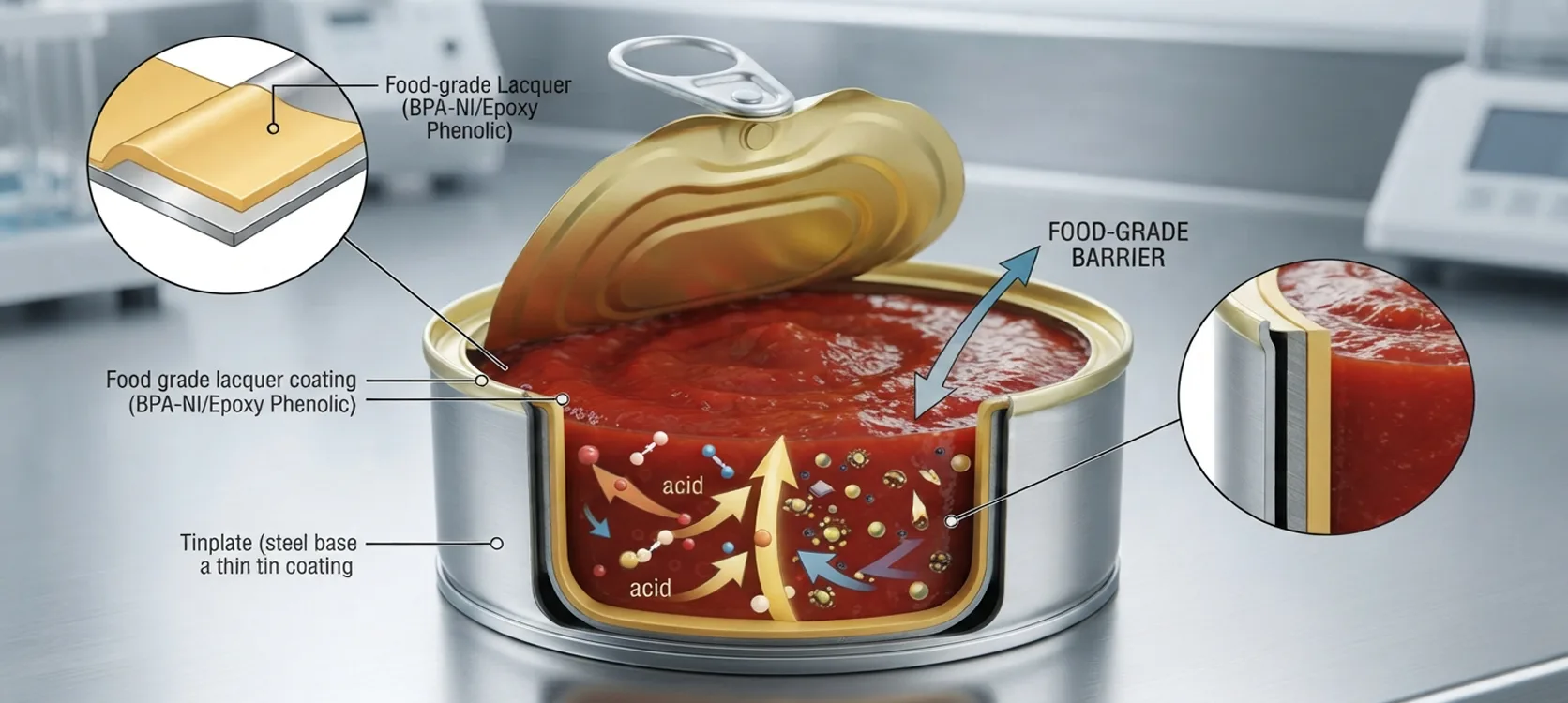

Food grade tin packaging is not defined by the metal container alone. For tea, coffee, cookies, confectionery, spices, and other food products, food contact tin packaging consists of several interacting components, including the tinplate substrate, internal coating, forming process, closure, gasket or liner, printing system, and the packaged food.
In food grade tin packaging, the internal coating separates the food from the metal substrate and contributes to corrosion control and product compatibility. The coating system must therefore be evaluated together with food composition, acidity, moisture, fat content, storage temperature, contact time, and intended shelf life.
For tea and coffee packaging, the material system also needs to account for product-specific conditions. Tea packaging may require control of moisture and aroma exchange, while coffee packaging can involve coffee oils, oxygen exposure, and carbon dioxide released after roasting.
A tin box described as food grade should not be evaluated only through terms such as “food safe” or “BPA-free.” Food-contact suitability depends on the actual material formulation, intended conditions of use, applicable regulatory requirements, and supporting documentation.
This article examines the engineering relationship between tinplate packaging, internal coating, food contact migration, tinplate corrosion, coating thickness, food compatibility, forming, and validation testing.
Table of Contents
Food Grade Tin Packaging: Metal Substrate and Internal Barrier
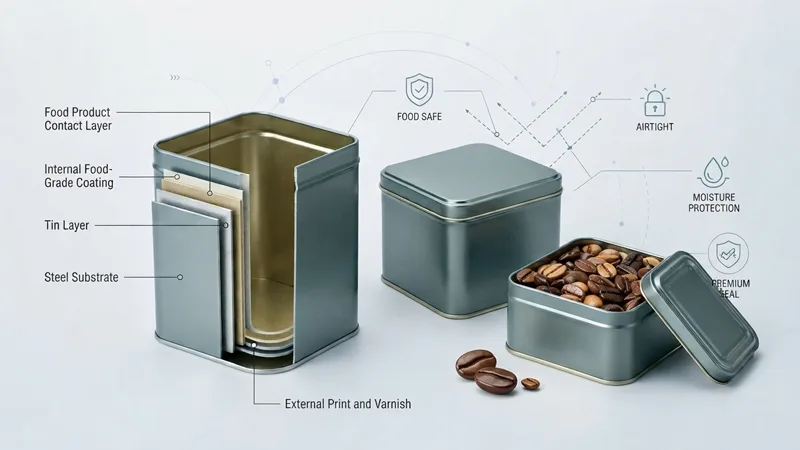
Tinplate Structure
Tinplate is a steel substrate with a thin tin coating, where the steel provides the mechanical structure while the tin layer and internal coating system contribute to corrosion protection and product compatibility. Its basic structure consists of the food product at the top, followed downward by the internal food-contact coating, the tin layer, and the steel substrate, while the external surface may include an external coating, printing ink, and varnish system.
Internal Coating as a Food Contact Barrier
The internal coating provides separation between the packaged food and the metallic substrate, which is important because food products have different chemical and physical characteristics such as pH, acidity, salt concentration, fat content, moisture content, alcohol content, organic acids, essential oils, storage temperature, contact duration, and oxygen exposure, meaning a coating suitable for one food application should not automatically be assumed to have the same suitability for another.
Food Contact Tin Packaging as a Complete System
The finished package should therefore be evaluated as a system:
Food product → Internal coating → Tinplate → Formed container → Closure → Storage condition
This system-level approach is particularly relevant when the package is intended for long-term food storage.
Tinplate Coating for Food Packaging
The internal coating of tinplate packaging performs several technical functions. Its performance depends on the formulation, application process, curing condition, forming process, and food-contact environment.
Corrosion Protection
The internal coating reduces direct contact between the food and the underlying metal structure, but if the coating is damaged, discontinuous, improperly cured, chemically incompatible, or cracked during forming, the underlying metal can become exposed, leading to potential consequences such as corrosion, metal ion release, product discoloration, flavor changes, and loss of package integrity; therefore, the coating should remain continuous after the container has undergone the intended forming operation.
Chemical Barrier
The coating also functions as a chemical barrier between the food product and the metal substrate.The required chemical resistance depends on the food matrix.
| Product Type | Relevant Compatibility Factors |
|---|---|
| Loose-leaf tea | Moisture, polyphenols, storage duration |
| Matcha powder | Moisture, fine particles, oxygen exposure |
| Coffee beans | Coffee oils, volatile compounds, storage duration |
| Ground coffee | Coffee oils, surface area, moisture |
| Cookies | Fat, moisture, oxygen |
| Chocolate | Fat, moisture, flavor compounds |
| Spices | Essential oils, acidity, volatile compounds |
| Candy | Acidity, sugar concentration, moisture |
This is why a generic food grade coating for tin packaging should not be treated as suitable for every food category without reviewing its intended conditions of use.
Food Contact Coating Selection for Tin Packaging
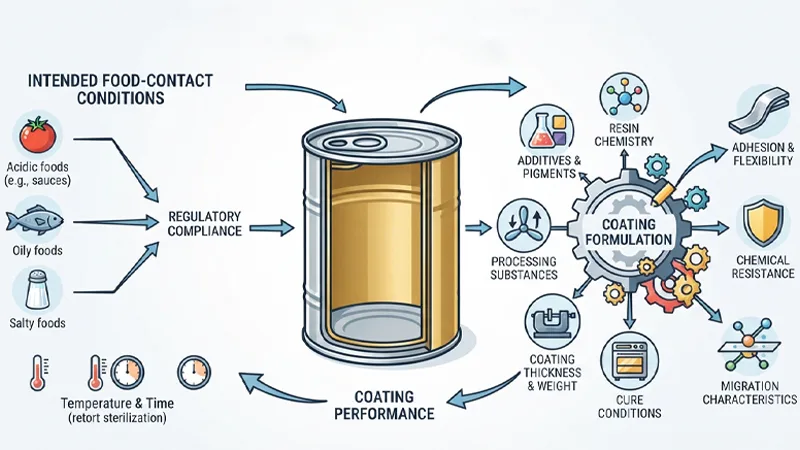
A food contact coating must be selected according to the intended food-contact conditions.
Coating Formulation
Important parameters include resin chemistry, additives, pigments, processing substances, coating thickness, coating weight, cure conditions, adhesion, flexibility, chemical resistance, and migration characteristics, as the complete formulation determines how the coating behaves during both manufacturing and food contact.
Coating Application
The coating process must provide consistent coverage over the intended food-contact surface.
Important production controls include coating weight, film thickness, application uniformity, curing temperature, curing time, surface preparation, and adhesion, as the required process conditions depend on the selected coating system.
Food Contact Compliance
The term food-grade coating does not by itself establish the complete compliance status of the finished package.
The applicable requirements depend on:
- Destination market
- Food category
- Contact conditions
- Temperature
- Contact duration
- Material formulation
For example, food-contact requirements in the United States and European Union use different regulatory frameworks. The documentation should therefore correspond to the actual coating formulation and intended application.
BPA-Free Tin Packaging and BPA-NI Coatings
BPA-free tin packaging and BPA-NI coatings are frequently used specifications for metal food packaging.
However, these terms should not be treated as complete descriptions of coating performance.
What Does BPA-Free Mean?
BPA-free generally indicates that bisphenol A is not intentionally used or present according to the relevant material specification, but it does not by itself establish complete food-contact compliance, migration performance, corrosion resistance, forming performance, or chemical compatibility.
BPA-NI Coating
BPA-NI means Bisphenol A Non-Intentional, and while different coating chemistries such as polyester-based and acrylic-based formulations may be used in these systems, they can differ in adhesion, flexibility, chemical resistance, curing behavior, migration, and forming performance; therefore, the actual coating formulation and supporting technical documentation are more informative than the label.
Food Packaging Migration: What Needs to Be Evaluated?
Food packaging migration refers to the transfer of substances from packaging materials into food or food simulants under defined conditions, with potential sources including internal coatings, coating additives, residual processing substances, adhesives, gaskets, liners, plastic components, and printing-related substances where applicable, while the overall migration behavior depends on several variables.
Potential sources include:
Temperature
Temperature can affect molecular mobility and the transfer of substances from packaging materials.Higher temperatures may increase migration for certain substances and material systems.The test temperature should therefore correspond to the intended or foreseeable conditions of use.
Contact Time
Longer contact periods provide more opportunity for substances to transfer from packaging components. This is relevant for products with extended shelf life, including tea, coffee, cookies, confectionery, and spices.
Food Composition
Food packaging migration is influenced by the food matrix through relevant characteristics such as water content, acidity, alcohol, fat, salt, and organic acids, which is why migration testing commonly uses food simulants representing different food environments.
Surface-Area-to-Volume Ratio
The amount of packaging material in contact with a given quantity of food can affect the resulting migration calculation.Small containers with a relatively high packaging surface area compared with food volume may require different evaluation conditions from larger packages.
Tinplate Corrosion and Food Compatibility
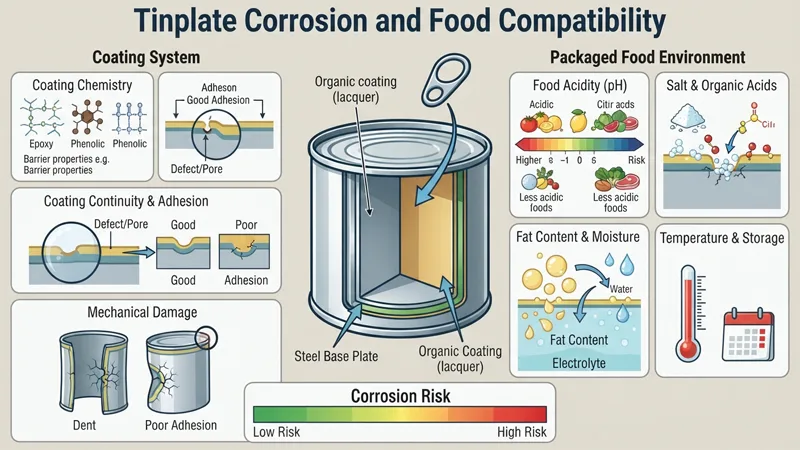
Tinplate corrosion is closely related to the internal coating system and the packaged food environment.
Corrosion behavior can be affected by coating chemistry, coating continuity, adhesion, food acidity, salt concentration, organic acids, fat content, moisture, temperature, storage duration, and mechanical damage.
Coating Defects
Potential coating defects include pinholes, cracks, peeling, blisters, and areas of insufficient coverage, any of which can expose the underlying metal and create a localized interaction between the food environment and substrate.
Food Chemistry
Different foods create different chemical environments.For example, acidic or salty products may require different corrosion resistance from dry products.Coffee also introduces coffee oils and other compounds that need to be considered when selecting the internal coating.
Formed Container vs. Flat Sheet
Compatibility should not be evaluated only on unused flat tinplate. The finished container may experience deformation during drawing, stamping, curling, necking, and embossing, so the coating must remain intact after the actual forming process.
Coating Thickness and Coverage in Food Grade Tin Boxes
The internal coating must provide the specified coverage while remaining compatible with forming.
| Parameter | Engineering Consideration |
|---|---|
| Coating weight | Must meet the coating system specification |
| Film thickness | Influences barrier and forming behavior |
| Coverage | Important around corners, curls, and formed areas |
| Adhesion | Must remain stable after forming |
| Cure condition | Affects final coating properties |
| Flexibility | Important during drawing and forming |
| Chemical resistance | Depends on food composition |
| Migration | Depends on formulation and conditions of use |
Coating Weight
Coating weight should be controlled according to the selected coating system, because too little coating may result in insufficient coverage, while excessive coating may affect forming behavior, cure, surface appearance, material cost, and closure dimensions where the coating enters a mechanical interface.
Film Thickness
Film thickness is related to the coating system and application process.It should be controlled consistently rather than specified independently from the coating formulation.
Coverage at Formed Areas
Corners, bottom radii, curls, and other formed areas can experience different deformation from flat surfaces.These areas should be included in inspection and validation.
Internal Coating Performance After Metal Forming
During deep drawing and forming, the metal experiences local deformation around corners, bottom radii, side walls, necking areas, lid interfaces, and embossed surfaces, and the internal coating must accommodate this deformation.
Coating Cracking
Cracking can occur when the coating cannot accommodate the local deformation of the substrate.
Potential causes include:
- Excessive forming strain
- Incompatible coating flexibility
- Incorrect forming radius
- Excessive drawing depth
- Incorrect forming parameters
Coating Peeling
Peeling can result from poor substrate preparation, inadequate curing, poor adhesion, or mechanical damage.
Pinholes and Exposed Metal
Small defects can expose the underlying metal.These defects may be particularly relevant where the packaged product remains in contact with the same area for an extended period.Therefore, internal coating inspection after forming should be included where the forming process produces significant deformation.
Food Grade Tin Packaging for Tea and Coffee
Tea and coffee use similar metal packaging structures but have different product-contact requirements.
Tea Packaging
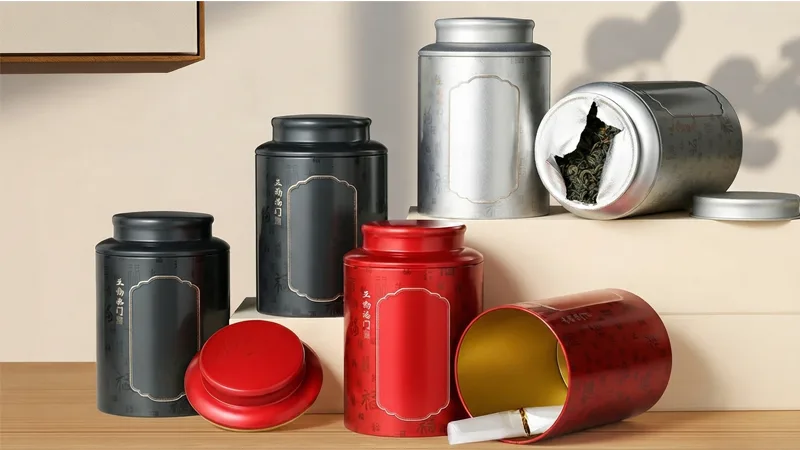
For food grade tea packaging, the main considerations include moisture protection, aroma retention, oxygen exposure, polyphenol interaction, storage duration, repeated opening, and internal coating compatibility, as loose-leaf tea can be packaged directly into a coated metal container when the complete system meets the intended requirements, or an inner pouch or foil seal may be used when an additional barrier is required.
Matcha Packaging
Matcha is a fine powder with a relatively large exposed surface area, meaning the relevant factors include moisture, oxygen, aroma, light, internal coating compatibility, and closure performance; therefore, the package design should consider the product’s physical form in addition to the metal container.
Coffee Packaging
For food grade coffee packaging, additional factors include coffee oils, oxygen exposure, moisture, roast level, whole bean or ground coffee, CO₂ release, storage temperature, and closure structure. Freshly roasted coffee can release CO₂ after roasting. Where required, a one-way degassing valve can allow CO₂ to escape while limiting external air ingress. The valve should be evaluated together with the tin body and closure.
Food Contact Migration Testing for Tin Packaging
Food contact migration testing should be designed around the actual material system and intended conditions of use.
Two broad categories are commonly considered.
Overall Migration
Overall migration evaluates the total amount of substances transferred under defined test conditions.The result provides information about the overall transfer from the tested packaging system.
Specific Migration
Specific migration testing evaluates selected substances for which individual migration requirements may apply.The substances selected for evaluation depend on the formulation and regulatory requirements.
Food Simulants
Testing can use appropriate food simulants representing different food environments, including water-based foods, acidic foods, alcohol-containing foods, and fatty foods. The selected simulant should correspond to the intended application.
Test Conditions
A migration test should define the test temperature, contact time, food simulant, surface-area-to-volume ratio, sample condition, and repeated-use conditions where applicable. The test conditions should represent the intended or foreseeable use of the packaging.
Coating Adhesion and Chemical Resistance Testing
Migration testing does not replace physical coating inspection.A complete tinplate coating test can include several evaluation methods.
Coating Weight Verification
The coating weight should be measured according to the relevant coating specification.
Adhesion Testing
A cross-hatch or other applicable adhesion test can be used to determine whether the coating remains attached to the substrate.
Post-Forming Inspection
The formed container should be inspected for cracks, pinholes, peeling, blisters, exposed metal, and uneven coverage.
Chemical Resistance
Chemical resistance should be evaluated against the intended food environment or appropriate test conditions.
The test should reflect the relevant:
- Temperature
- Contact duration
- Chemical environment
Coating Cure
Incomplete curing can affect adhesion, chemical resistance, migration, and forming performance. Curing conditions should therefore be controlled according to the coating supplier’s process specification.
Printing, Varnish, and Food Contact Boundaries
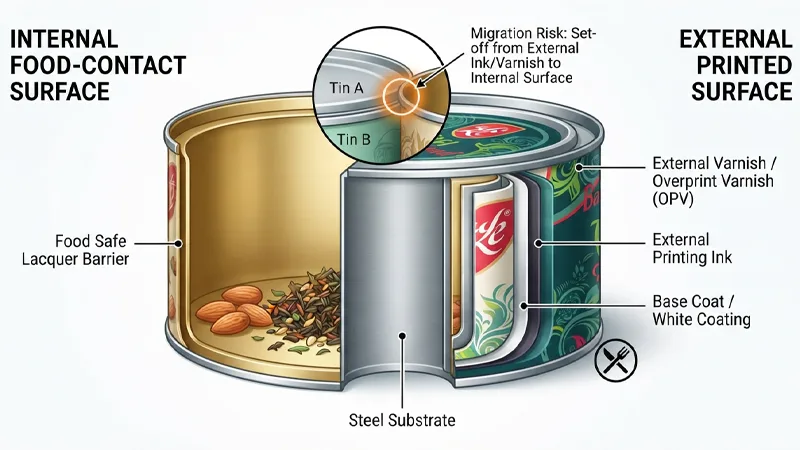
Food packaging specifications should distinguish between internal food-contact surfaces and external printed surfaces. The external printing system does not normally serve as the primary food-contact barrier, but external inks and varnishes can affect the packaging system through set-off, transfer, and contact between stacked surfaces.
Ink Set-Off
During stacking or nesting, printed surfaces may come into contact with other surfaces. This can result in ink transfer, surface marking, set-off, or varnish damage.
Printing Near Closure Areas
Printing and varnish should be controlled around curl areas, friction-fit surfaces, gasket tracks, and mechanical closure interfaces. Excessive coating or ink buildup in these areas can affect the dimensional relationship of the closure and sealing components.
Embossing
Embossing changes the geometry of the metal. For food tins with a friction-fit or gasketed closure, the embossing location should be evaluated against material thickness, forming depth, closure geometry, curl location, and gasket position.
DFM Parameters for Food Contact Tin Packaging
Design for Manufacturing (DFM) should connect the material specification with the actual forming and coating process.
Important parameters include:
| Engineering Parameter | Manufacturing Consideration |
|---|---|
| Tinplate thickness | Controls stiffness and forming behavior |
| Internal coating formulation | Determines food-contact and chemical requirements |
| Coating weight | Controls coating coverage |
| Coating cure | Influences final coating properties |
| Forming radius | Influences local deformation |
| Drawing depth | Influences forming strain |
| Corner geometry | Affects coating deformation |
| Curl geometry | Affects closure fit |
| Closure dimensions | Affects mechanical interface |
| Coating clearance | Prevents interference with closure surfaces |
| Inspection method | Defines how critical characteristics are measured |
Tinplate Thickness
Tinplate thickness should be selected according to container dimensions, drawing depth, fill weight, stack load, transport conditions, and forming requirements. A thicker gauge is not automatically required for every food tin.
Internal Coating and Weight
The coating formulation and coating weight should be defined together.
The coating should provide the required coverage without creating problems during forming or closure assembly.
Forming Radius
Forming radius affects local metal deformation and coating strain.Small radii can increase local deformation and should therefore be evaluated with the selected coating system.
Curl Geometry
The curl affects both mechanical strength and closure fit.If the internal coating extends into a mechanical sealing area, coating thickness and clearance must be considered during DFM.
Failure Modes in Food Contact Tin Packaging
A food-grade metal package can experience failures at different stages of its life cycle.
Coating Cracking
Potential causes include excessive forming strain, incorrect forming radius, incompatible coating flexibility, and excessive drawing depth.
Coating Peeling
Potential causes include poor substrate preparation, inadequate curing, low adhesion, and mechanical damage.
Tinplate Corrosion
Potential causes include coating discontinuity, product chemistry, moisture, temperature, long storage duration, and local coating damage.
Flavor Change
Potential causes include metal-product interaction, coating degradation, migration, and external odor transfer.
Closure Interference
A coating or varnish layer extending into a mechanical closure area can change the effective dimensions of the interface. This can result in increased opening force, reduced closure fit, surface damage, or coating wear.
Therefore, internal coating, external printing, and closure geometry should be considered together during package design and validation.
Validation Protocol for Food Grade Tin Packaging
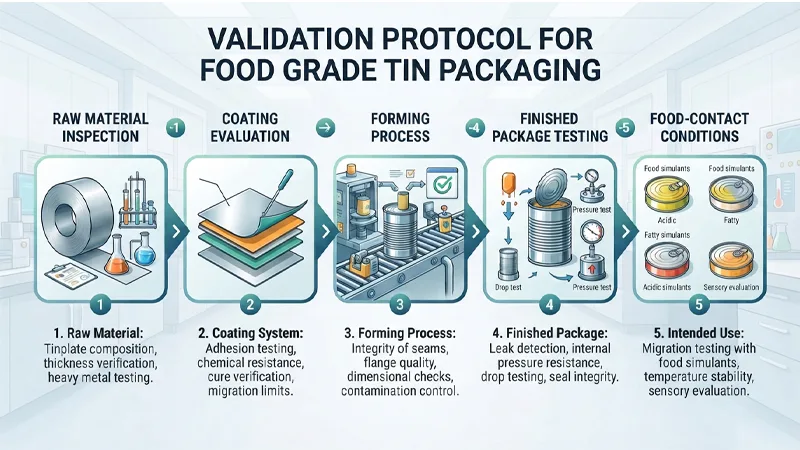
A food grade tin packaging validation protocol should evaluate the material, coating, forming process, finished package, and intended food-contact conditions.
Material Documentation
Documentation review covers the tinplate specification, material thickness, coating technical data, food-contact declaration, regulatory documentation, and supplier information.
Coating Verification
Inspection covers coating weight, coverage, cure, adhesion, and, where applicable, chemical resistance.
Package Formation
Samples are produced using the actual stamping, drawing, curling, embossing, and coating processes. This allows coating performance to be evaluated after the same forming conditions used in production.
Food Compatibility
The package is evaluated against the intended food, appropriate food simulant, intended storage temperature, and contact duration.
Migration Testing
Where required, conduct overall and/or specific migration testing under defined conditions.
Storage Evaluation
Evaluation considers temperature, humidity, contact duration, product condition, and packaging configuration.
Finished Package Inspection
Inspection covers dimensions, closure, internal coating, surface condition, printing, formed areas, and packaging configuration.
Food Grade Tin Packaging: Tea vs. Coffee
The same tinplate substrate can be used for both tea and coffee, but the product-contact requirements are different.
| Requirement | Tea Packaging | Coffee Packaging |
|---|---|---|
| Moisture control | Important | Important |
| Oxygen exposure | Product dependent | Important |
| Aroma retention | Important | Important |
| Light protection | Important | Important |
| Coffee oil compatibility | Not normally primary | Important |
| CO₂ management | Not normally primary | Important for freshly roasted coffee |
| Degassing valve | Usually not required | May be required |
| Internal coating | Required according to application | Required according to application |
| Repeated opening | Common | Common |
| Migration evaluation | Application dependent | Application dependent |
| Corrosion evaluation | Application dependent | Application dependent |
The packaging structure should therefore be selected according to the product rather than applying one coating or closure specification to all food products.
How Internal Coating, Migration, and Sealing Work Together
A food grade tin box should not be evaluated only by its internal coating.The package has several separate engineering functions:
Barrier
The package controls the movement of oxygen, moisture, and aroma compounds.
Food Contact
The internal coating controls the interaction between the food, coating, and metal substrate.
Mechanical Structure
The package design controls stiffness, deformation, closure geometry, and stack performance through the container structure and closure system.
Sealing
The package controls air exchange, moisture exchange, and leakage through the container body, closure, sealing interface, and material system.
Pressure Management
For coffee packaging, the package needs to control CO₂ release and oxygen ingress, and these functions are related to the overall package design and material system. Closure geometry affects seal performance, the forming process affects coating integrity, food chemistry affects corrosion behavior, coating formulation affects migration behavior, and storage temperature affects both migration and product stability.
Therefore, food-contact packaging development should evaluate the complete container system rather than assessing individual components in isolation.
Conclusion
Food grade tin packaging is an integrated material and manufacturing system. Tinplate, internal coating, forming, closure, printing, and the packaged food all contribute to final package performance.
For food contact tin packaging, material selection should consider the food characteristics, contact conditions, coating formulation, coating coverage, forming performance, migration requirements, and corrosion resistance. These factors should be supported by appropriate technical and compliance documentation and verified through migration, compatibility, and finished-package validation.
For tea and coffee packaging, this integrated approach helps maintain product quality, barrier performance, corrosion resistance, and package integrity throughout storage and distribution.
FAQ
What makes a tin box food grade?
A food-grade tin box requires a suitable material and coating system, precise manufacturing controls, and supporting compliance documentation tailored to the destination market.
Is BPA-free the same as food grade?
No. BPA-free indicates the absence of bisphenol A in a formulation but does not independently verify full food-contact compliance for the finished container.
Can tea and coffee be stored directly in tin boxes?
Yes, provided the tinplate substrate, internal coating, closure, and barrier system are specifically engineered for the target tea or coffee product.
What documents should a buyer request?
Buyers should request material specifications, coating technical data sheets, food-contact declarations, regulatory compliance statements, migration test reports, and batch traceability records.


