



Hermetic metal packaging for tea and coffee requires more than a metal body and a close-fitting lid. The sealing performance of a tea tin or coffee container depends on the closure structure, dimensional tolerances, gasket or liner design, internal coating, barrier system, and the conditions encountered during storage and transport.
For airtight tea packaging, the main concerns are moisture ingress, oxygen exposure, aroma retention, and closure performance after repeated opening and closing. For coffee packaging, the design must also account for carbon dioxide released by freshly roasted coffee. A package that restricts oxygen ingress but cannot manage internal CO₂ pressure may not be suitable for freshly roasted coffee.
The term hermetic packaging should also be used carefully. A friction-fit lid or gasketed closure can provide a high level of sealing without automatically meeting a defined hermetic leakage specification. Hermeticity should therefore be associated with a specified test method, pressure or vacuum condition, test duration, and acceptance criterion.
This article explains the structural and manufacturing factors involved in metal packaging sealing, including double-lid tea tins, gasket-sealed coffee containers, one-way degassing valves, dimensional tolerances, internal coatings, printing constraints, cost factors, and seal validation.
Table of Contents
Airtight vs. Hermetic Sealing in Metal Packaging
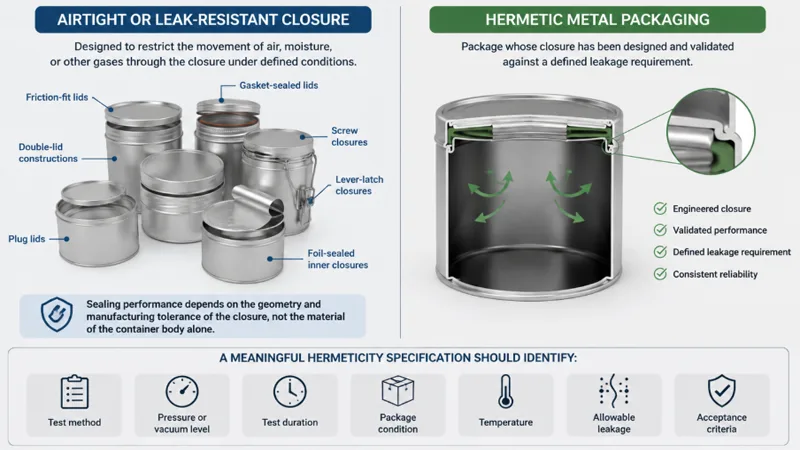
Airtight, leak-resistant, and hermetic are related but should not be treated as interchangeable engineering terms.
Airtight or Leak-Resistant Closure
An airtight or leak-resistant metal package is designed to restrict the movement of air, moisture, or other gases through the closure under defined conditions.
Typical structures include:
- Friction-fit lids
- Double-lid constructions
- Plug lids
- Gasket-sealed lids
- Screw closures
- Lever-latch closures
- Foil-sealed inner closures
The actual sealing performance depends on the geometry and manufacturing tolerance of the closure rather than the material of the container body alone.
Hermetic Metal Packaging
Hermetic metal packaging normally refers to a package whose closure has been designed and validated against a defined leakage requirement.
A meaningful hermeticity specification should identify:
- Test method
- Pressure or vacuum level
- Test duration
- Package condition
- Temperature
- Allowable leakage
- Acceptance criteria
For this reason, a hermetic tea tin should not be specified simply because it has a tight-fitting lid. The required sealing level must be defined according to the product and intended shelf-life conditions.
Airtight Tea Tin Design: Double-Lid Interference Fit
A double-lid airtight tea tin uses two closure components to increase the sealing path between the container interior and the external environment. This structure is commonly considered for loose-leaf tea, matcha, tea blends, and other products where moisture and aroma retention are important.
The system generally consists of:
- An external decorative lid
- An internal metal plug or inner lid
- A cylindrical container body
- A controlled closure interface between the inner lid and body
The inner plug is formed to engage with the inside diameter of the container. The fit is controlled through the relationship between:
- Body opening diameter
- Inner plug diameter
- Material thickness
- Curl geometry
- Forming sequence
- Dimensional tolerance
- Material springback
The interference fit creates an overlapping metal closure path. This increases resistance to moisture and air exchange and can reduce aroma loss.
However, the double-lid structure should not automatically be described as a hermetic seal. Its actual performance depends on the dimensional relationship between the components and the leakage requirement established for the application.
Double-Lid Tea Tin vs. Single Slip Lid
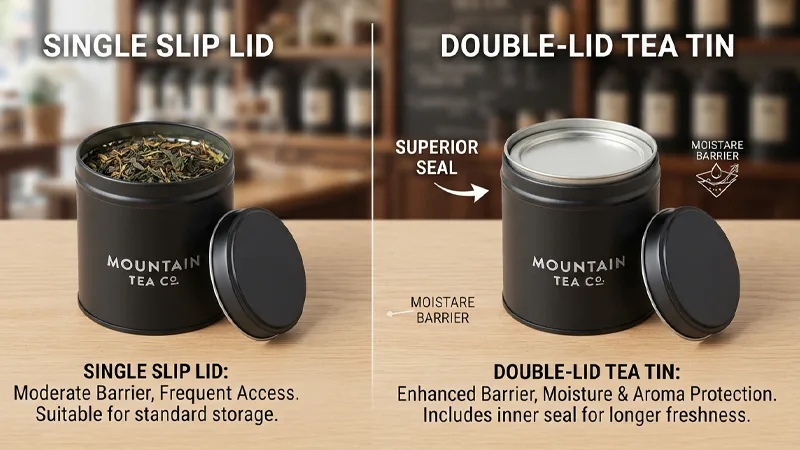
A single friction-fit lid may be suitable for applications with moderate barrier requirements and frequent consumer access. A double-lid tea tin provides an additional closure interface and can be selected when greater resistance to moisture and aroma exchange is required.
For long shelf-life applications, the metal closure may also be combined with an internal foil seal, liner, or pouch. The appropriate structure depends on the required barrier performance rather than the appearance of the tin.
Airtight Coffee Packaging with Silicone Gasket Seals
Airtight coffee packaging has different requirements from many dry-food applications because roasted coffee releases carbon dioxide after roasting.
For ground coffee or coffee products that are opened and closed repeatedly, a gasket can be incorporated into the closure system.
A typical gasket-sealed coffee container consists of:
- Metal container body
- Lid or closure
- Food-contact gasket
- Sealing track or contact surface
- Mechanical closure mechanism
The gasket is compressed between the mating surfaces. Controlled compression helps compensate for small surface irregularities and reduces leakage through the closure interface.
Depending on the package design, the closure can use:
- Press-fit geometry
- Lever latch
- Screw closure
- Clamping mechanism
- Other mechanical compression systems
Food-Contact Silicone Gasket Selection
The suitability of a silicone gasket for food packaging depends on the specific material formulation, manufacturing process, intended food-contact conditions, and applicable regulatory requirements.
The specification should therefore consider:
- Silicone formulation
- Hardness
- Compression characteristics
- Temperature range
- Food-contact requirements
- Chemical compatibility
- Compression set
- Repeated opening and closing
- Supplier compliance documentation
The gasket should be evaluated as part of the complete closure system rather than as an isolated component.
One-Way Degassing Valves for Coffee Packaging
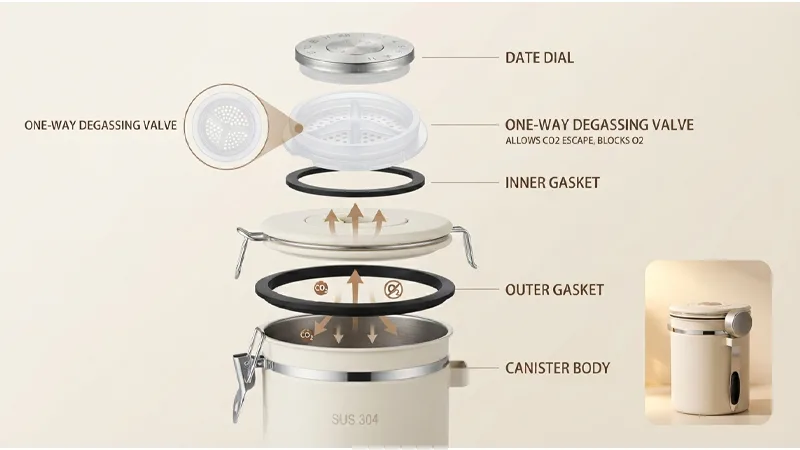
Freshly roasted coffee releases carbon dioxide (CO₂) during degassing. This makes coffee packaging different from a simple airtight dry-food container.
If a freshly roasted coffee product is placed inside a completely closed package, the accumulation of CO₂ can increase internal pressure. The required packaging structure therefore needs to balance two opposing requirements:
- Restrict oxygen entering the package
- Allow accumulated CO₂ to leave the package
A one-way coffee degassing valve is designed for this purpose.
The valve allows internal CO₂ to escape while limiting the movement of external air into the package. The valve should be selected according to the coffee product, roast profile, filling conditions, package volume, and expected storage period.
The valve system does not replace the package’s overall oxygen and moisture barrier. The container body, closure, liner, valve, and any secondary seal should be considered as one packaging system.
Coffee Tin Packaging and CO₂ Management
For coffee tin packaging, the design should consider:
- Coffee fill weight
- Roast date
- Expected CO₂ generation
- Headspace volume
- Oxygen exposure
- Moisture exposure
- Valve characteristics
- Closure structure
- Opening frequency
The objective is not simply to make the container completely sealed. The objective is to control gas exchange according to the behavior of the packaged coffee.
Metal Packaging DFM Parameters for Tea and Coffee
The dimensional design of an airtight tea tin or coffee container should be established during the DFM stage.
A closure cannot be evaluated independently from the body because small changes in body diameter, lid diameter, curl geometry, or material thickness can change the closure force and sealing behavior.
| Engineering Parameter | Typical / Controlled Specification | Structural Consideration |
|---|---|---|
| Base Material Thickness | 0.23–0.28 mm tinplate, subject to container geometry | Influences body stiffness, forming behavior, dent resistance, and dimensional stability |
| Closure Dimensions | Defined according to body opening and lid geometry | Controls interference, closure force, and fit |
| Closure Dimensional Tolerance | Defined on the engineering drawing for each critical dimension | Prevents excessive interference or insufficient contact |
| Internal Coating | Food-contact coating specified for the intended application | Separates the product from the metal substrate and provides corrosion protection |
| Coating Weight | Controlled according to the selected coating system | Affects coverage, curing, and coating performance |
| Curled Edge Profile | Controlled forming geometry | Provides structural rigidity and defines the closure interface |
| Gasket Compression | Defined according to gasket material and closure geometry | Determines contact pressure and sealing performance |
| Valve Opening / Position | Defined according to package structure | Provides controlled CO₂ release for roasted coffee applications |
Lid-to-Body Dimensional Control
There is no single universal ±0.05 mm lid-to-body clearance that applies to every tin container.
The required tolerance depends on:
- Container diameter
- Lid diameter
- Material thickness
- Curl profile
- Forming process
- Closure type
- Required opening force
- Required leakage performance
- Material springback
For this reason, critical closure dimensions should be specified on the engineering drawing with a defined datum structure and measurement method.
Tea and Coffee Packaging Barrier Requirements
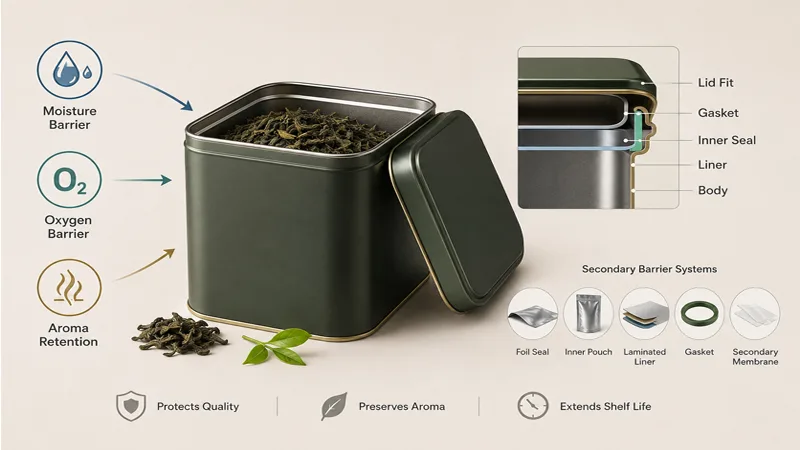
The metal body provides a strong barrier against light and provides a low-permeability structure compared with many polymer packaging materials. However, the complete package performance is also determined by the closure and any secondary barrier.
For tea packaging, the main factors are:
Moisture Barrier
Tea can absorb moisture from the surrounding environment. Moisture ingress can affect:
- Texture
- Aroma
- Flavor
- Storage stability
- Product quality
The closure interface therefore needs to limit moisture exchange according to the required shelf-life conditions.
Oxygen Exposure
Oxygen can contribute to quality changes in tea and coffee. The relevant requirement depends on the product composition, roast level, formulation, storage conditions, and intended shelf life.
Aroma Retention
Volatile compounds can migrate through imperfect closure interfaces. A tea tin therefore requires attention not only to the metal barrier but also to:
- Lid fit
- Gasket design
- Inner seal
- Liner
- Closure tolerance
Secondary Barrier Systems
Where the metal closure alone does not provide the required barrier performance, the package may incorporate:
- Foil seal
- Inner pouch
- Laminated liner
- Gasket
- Secondary membrane
This distinction is important because metal packaging is not automatically a complete hermetic barrier package.
Lid Fit and Dimensional Tolerances in Airtight Metal Packaging
The closure interface is one of the most important variables in airtight metal packaging.
For a friction-fit or interference-fit closure, the relationship between the lid and body determines both sealing contact and opening force.
If the interference is too low:
- The lid may fit loosely
- Air and moisture exchange can increase
- The closure may become unstable during transport
If the interference is too high:
- Opening force increases
- Metal surfaces may gall or deform
- The lid may damage the curled edge
- Consumer usability can be affected
The target condition is therefore a controlled relationship between closure dimensions and mechanical force.
Critical Closure Variables
The engineering drawing should define the relevant dimensions, including:
- Body inside diameter
- Lid outside diameter
- Curl diameter
- Curl height
- Wall thickness
- Plug diameter
- Gasket groove dimensions
- Closure depth
The appropriate tolerance should be established through tooling capability, measurement data, and physical validation.
Internal Coatings for Tea and Coffee Metal Packaging
The internal coating protects the metal substrate from direct contact with the packaged product and can provide corrosion resistance.
For tea and coffee metal packaging, the coating specification should consider:
- Food-contact application
- Product acidity
- Fat or oil content
- Moisture
- Contact duration
- Temperature
- Coating formulation
- Curing conditions
- Coating weight
Coffee oils can interact differently with a coating system than dry tea leaves. Tea products can also contain compounds that require consideration when selecting the internal coating.
A food-contact coating should therefore be selected based on the intended application and supported by appropriate supplier documentation and applicable regulatory requirements.
Printing and Embossing Constraints for Airtight Tin Containers

External printing and embossing can affect the mechanical interface when they extend into closure or friction-fit areas.
Printing Clearance Around the Closure
A defined clearance zone should be maintained around:
- Necking areas
- Curling areas
- Friction-fit surfaces
- Gasket contact areas
- Mechanical closure interfaces
Heavy ink or coating buildup in a friction-fit area can change the effective dimensions of the closure and increase friction during opening and closing.
The actual clearance should be established according to:
- Printing process
- Ink thickness
- Varnish thickness
- Closure geometry
- Tooling design
- Required dimensional tolerance
Embossing Limits for Double-Lid Tins
Embossing changes the local geometry and stiffness of the metal.
For a double-lid tea tin, embossing is generally better positioned away from:
- Curling edges
- Structural seams
- Gasket tracks
- Friction-fit interfaces
The allowable embossing depth and location should be established during DFM according to material thickness and forming capability.
Cost Drivers for Hermetic Metal Packaging
The cost of hermetic metal packaging depends on the closure structure, material, tooling, secondary components, and validation requirements.
Tooling for Double-Lid Tins
A standard single-lid container may require a relatively simple tooling arrangement.
A double-lid system requires additional tooling because the external lid and internal plug are formed separately.
Tooling cost depends on:
- Number of forming operations
- Container dimensions
- Drawing depth
- Material thickness
- Embossing
- Closure geometry
- Tooling steel
- Existing tooling compatibility
Rather than applying a universal percentage increase, the tooling should be quoted from the actual structure and production process.
Degassing Valve Cost
A one-way coffee degassing valve introduces:
- Valve material cost
- Additional punching or forming operations
- Valve installation
- Position control
- Additional inspection requirements
The actual unit-cost impact depends on the valve specification and production volume.
Material Gauge
Increasing tinplate thickness can increase material cost and may improve structural rigidity.
For larger coffee containers, the material gauge should be evaluated against:
- Container dimensions
- Fill weight
- Stack load
- Transport conditions
- Vacuum or pressure conditions
- Forming requirements
A thicker material should not be selected simply because it is thicker. The gauge should correspond to the structural requirements of the package.
Metal Packaging Seal Testing and Validation
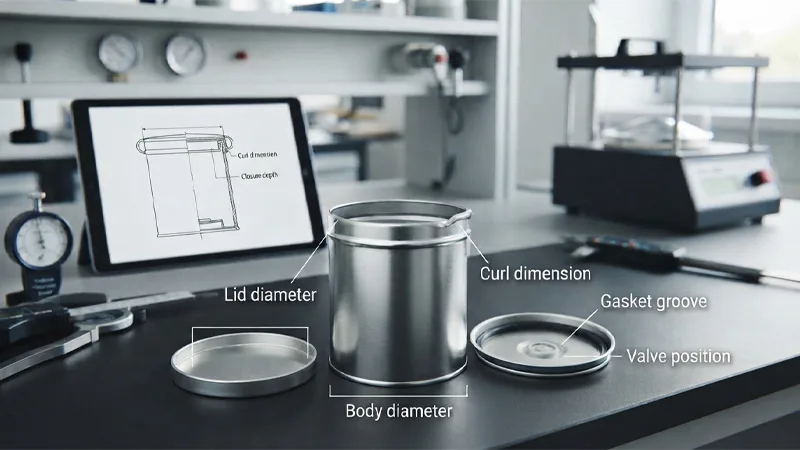
The sealing performance of a tea tin or coffee container should be validated using a test method appropriate to the closure structure.
A single test cannot establish every aspect of package performance.
Closure Dimensional Inspection
Dimensional inspection can evaluate critical features such as:
- Body diameter
- Lid diameter
- Curl dimensions
- Closure depth
- Gasket groove
- Valve position
Measurement equipment should be selected according to the required dimensional accuracy and feature geometry.
Leakage Testing
Leakage testing can use pressure-based, vacuum-based, or water-immersion methods depending on the package design.
The test specification should define:
- Pressure or vacuum level
- Test duration
- Temperature
- Package orientation
- Sample condition
- Acceptance criteria
For example, a water-submersion test can be performed by applying a defined internal air pressure and observing whether air bubbles emerge from the closure. The test duration and pressure should be specified in the validation protocol rather than treated as universal values.
Mechanical Integrity Testing
Drop testing can be used to determine whether the package maintains its required geometry and closure performance after mechanical impact.
The evaluation can include:
- Lid displacement
- Curl deformation
- Gasket movement
- Body deformation
- Closure performance after impact
For transport validation, the test conditions should correspond to the intended packaging configuration and distribution environment.
Coating Inspection
Internal coating evaluation may include:
- Coating weight
- Visual coverage
- Adhesion
- Cure condition
- Chemical resistance
- Food-contact documentation
A cross-hatch adhesion test can be used where applicable to evaluate coating adhesion. Chemical resistance should be evaluated separately when required by the intended product and contact conditions.
Repeated Opening and Closing Performance
Tea and coffee containers are often opened multiple times during their service life. Initial closure performance therefore does not necessarily represent long-term performance.
For reusable tea tins and coffee canisters, the closure should be evaluated after repeated cycles where relevant.
Important variables include:
- Opening force
- Closing force
- Lid deformation
- Gasket compression set
- Friction surface wear
- Closure dimensional change
- Leakage performance after cycling
A closure that performs well during initial assembly may behave differently after repeated opening and closing. This is particularly relevant for gasketed coffee containers and reusable tea tins.
Tea Tin vs. Coffee Tin: Different Sealing Requirements
Although both products can use metal packaging, their sealing requirements are not identical.
| Requirement | Tea Packaging | Coffee Packaging |
|---|---|---|
| Moisture protection | High importance | High importance |
| Oxygen control | Product dependent | High importance |
| Aroma retention | High importance | High importance |
| Light protection | Important | Important |
| CO₂ management | Generally not a primary requirement | Critical for freshly roasted coffee |
| One-way valve | Usually not required | May be required |
| Gasket | Application dependent | Useful for reusable closures |
| Double lid | Common option | Possible depending on design |
| Foil inner seal | Application dependent | Application dependent |
| Repeated opening | Common | Common |
| Seal validation | Required according to specification | Required according to specification |
The package should therefore be designed around the behavior of the product rather than using the same closure structure for every application.
Conclusion
Airtight tea packaging and coffee packaging require a system-level approach to sealing. The metal body provides the basic container structure, but the final package performance is determined by the interaction between the body, lid, closure geometry, material thickness, coating, gasket or liner, secondary seal, and—where required—the coffee degassing valve.
For tea, the design typically focuses on moisture ingress, oxygen exposure, aroma retention, and repeated opening. For freshly roasted coffee, the design must additionally manage CO₂ release while limiting oxygen ingress.
The engineering process should therefore follow:
Product requirements → Barrier requirements → Closure structure → DFM dimensions → Material and coating selection → Manufacturing controls → Seal testing → Validation
A properly specified hermetic metal packaging system should not be defined by the presence of a particular lid, gasket, or valve alone. Its performance should be demonstrated against measurable requirements established for the intended product, storage conditions, transport environment, and service life.
FAQ
What is the difference between an airtight tea tin and a hermetic tea tin?
An airtight tea tin describes a closure designed to restrict air or moisture exchange under defined conditions. A hermetic tea tin should be associated with a defined leakage specification and validation method. A tight-fitting lid should not automatically be classified as hermetic.
Is a double-lid tea tin airtight?
A double-lid tea tin can provide increased resistance to air and moisture exchange through its overlapping closure structure. Its actual sealing performance depends on the lid geometry, body dimensions, material properties, manufacturing tolerances, and validation conditions.
What is the best seal for tea packaging?
There is no single closure structure that is suitable for every tea product. Loose-leaf tea, matcha, tea bags, and powdered products can have different moisture and aroma requirements. The closure should be selected according to product characteristics, filling conditions, opening frequency, and required shelf life.
How does coffee tin packaging handle CO₂?
Freshly roasted coffee releases CO₂ after roasting. A one-way degassing valve can allow CO₂ to escape while limiting external oxygen ingress. The valve should be evaluated together with the container, closure, headspace, and barrier system.
How does lid tolerance affect tin box sealing?
The relationship between the lid and body dimensions determines the closure force and contact condition. Excessive interference can make opening difficult or deform the closure, while insufficient interference can reduce sealing performance. Critical dimensions should therefore be established through DFM and physical validation.


